'Biggest shock in history': Nobel Prize-winning economist sounds alarm on Trump's new move
AlterNet
April 5, 2025

Late Friday afternoon, April 4, a Reuters headline read, "Trading Day: Trump Tariffs Wipe $5 Trillion Off Wall Street." The Dow Jones Industrial Average and the S&P 500 were plummeting in response to steep new tariffs that President Donald Trump is imposing on a long list of countries, and many economists are warning that consumers can expect to pay higher prices for everything from fruits and vegetables to computers to vacuum cleaners to clothes to cars.
One of the economists who is sounding the alarm is former New York Times columnist Paul Krugman.
During an appearance on "The Ezra Klein Show" posted on the Times' website on April 5, Krugman warned that a variety of factors could help push the United States into a recession — including tariffs.
READ MORE: A large revenue heist': WSJ bashes Trump’s 'ideological fixation on tariffs'
Krugman told Klein, "I think most people thought it was going to be some kind of across-the-board tariff — same on everybody. Or maybe two or three different types of tariffs. Instead, he announced this whole complicated, different tariff for every country, at levels much higher than the smart money — or the money that thought it was smart — was betting. Something like a 23 percent average tariff now, which is huge. It's higher than U.S. tariffs were after the Smoot-Hawley Tariff Act of 1930 was passed. And trade is a much bigger part of the economy now than it was in 1930. So, this is the biggest trade shock in history."
The economist added, however, that tariffs aren't the only Trump policy that could help bring about a recession.
"What's unique about this situation is that the protectionism is unpredictable and unstable," Krugman told Klein. "And it's that uncertainty that is the recessionary force…. So this is the instability of policy. The fact that nobody knows what's coming next makes a recession certainly a whole lot more likely…. But unstable protectionism, coupled with all the other instabilities out there in policy: How many programs is DOGE going to ax?"
Krugman continued, "How many federal workers are going to be laid off? What's going to happen to Medicaid?... That all creates an environment that is really bad for business."
READ MORE: 'Just plain dumb': Trump’s smuggled fentanyl tariff mocked
Another major Trump-related problem, according to Krugman, is the possibility of the U.S. dollar losing value.
"We could undermine the dollar's role as a reserve currency," Krugman told Klein. "We may be doing that as we speak. Because who wants to hold an unreliable, erratic country's currency as a reserve? But that's not going to solve any major problems."
READ MORE:How Mike Johnson's behavior exposes GOP push to 'force women out of public life': analysis
Ezra Klein's full interview with Paul Krugman available at this link (subscription required).
April 5, 2025

Late Friday afternoon, April 4, a Reuters headline read, "Trading Day: Trump Tariffs Wipe $5 Trillion Off Wall Street." The Dow Jones Industrial Average and the S&P 500 were plummeting in response to steep new tariffs that President Donald Trump is imposing on a long list of countries, and many economists are warning that consumers can expect to pay higher prices for everything from fruits and vegetables to computers to vacuum cleaners to clothes to cars.
One of the economists who is sounding the alarm is former New York Times columnist Paul Krugman.
During an appearance on "The Ezra Klein Show" posted on the Times' website on April 5, Krugman warned that a variety of factors could help push the United States into a recession — including tariffs.
READ MORE: A large revenue heist': WSJ bashes Trump’s 'ideological fixation on tariffs'
Krugman told Klein, "I think most people thought it was going to be some kind of across-the-board tariff — same on everybody. Or maybe two or three different types of tariffs. Instead, he announced this whole complicated, different tariff for every country, at levels much higher than the smart money — or the money that thought it was smart — was betting. Something like a 23 percent average tariff now, which is huge. It's higher than U.S. tariffs were after the Smoot-Hawley Tariff Act of 1930 was passed. And trade is a much bigger part of the economy now than it was in 1930. So, this is the biggest trade shock in history."
The economist added, however, that tariffs aren't the only Trump policy that could help bring about a recession.
"What's unique about this situation is that the protectionism is unpredictable and unstable," Krugman told Klein. "And it's that uncertainty that is the recessionary force…. So this is the instability of policy. The fact that nobody knows what's coming next makes a recession certainly a whole lot more likely…. But unstable protectionism, coupled with all the other instabilities out there in policy: How many programs is DOGE going to ax?"
Krugman continued, "How many federal workers are going to be laid off? What's going to happen to Medicaid?... That all creates an environment that is really bad for business."
READ MORE: 'Just plain dumb': Trump’s smuggled fentanyl tariff mocked
Another major Trump-related problem, according to Krugman, is the possibility of the U.S. dollar losing value.
"We could undermine the dollar's role as a reserve currency," Krugman told Klein. "We may be doing that as we speak. Because who wants to hold an unreliable, erratic country's currency as a reserve? But that's not going to solve any major problems."
READ MORE:How Mike Johnson's behavior exposes GOP push to 'force women out of public life': analysis
Ezra Klein's full interview with Paul Krugman available at this link (subscription required).
'Did you anticipate this?' Trump adviser put on the spot over tariff financial chaos
Tom Boggioni
April 5, 2025
RAW STORY
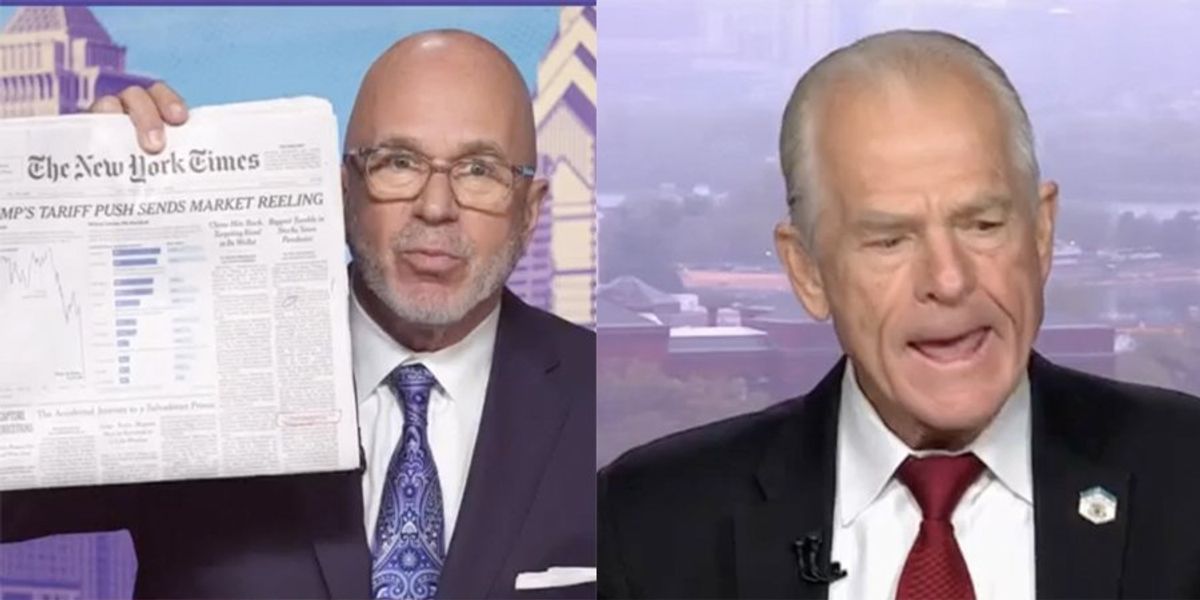
Michael Smerconish, Petere Navarro (CNN screenshot)
Donald Trump's Senior Counselor for Trade, Peter Navarro, faced a blizzard of questions on CNN on Saturday morning as he attempted to put a happy face on the president's trade war with the rest of the world.
Speaking with host Michael Smerconish, the Trump insider was put on the spot over the wreckage on Wall Street as the Dow Jones slid downward over 4,000 points since Navarro's boss announced his sweeping tariff plan.
During the animated back and forth, the CNN host held up the front page of the New York Times which proclaimed that Trump's tariffs "send markets reeling," which seemed to exasperate Navarro.
"I'm holding up the front page of the New York Times today with all the downward trajectory," the CNN host prompted his guest. "And I simply want to know, did you anticipate this? If I had been with you 2 or 3 days ago at the announcement in the Rose Garden, would you have expected that on Saturday morning, it would all, as I said, have hit the fan to this extent?"
"It hasn't hit the fan!" Navarro insisted. "Look, sure, what we're having is going to be a restructuring and a repricing of companies, that's a given. I mean, it's a given. But what's also a given ––."
"So you knew this would happen?" Smerconish interrupted.
"What's 'this' you're referring to?" the Trump adviser argued. "We knew that markets were going to adjust to the bond market ––."
"I'm referring to the S&P 500 bottom falling out in one week," Smerconish shot back.
"Okay, so let's let's level set here for the American people," the clearly exasperated Trump advisor replied. "And this would be a great poll question: do you think the world is treating the United States and its manufacturing base fairly? The problem we're trying to deal here with, and I would love to see the New York Times put up a front page on this is a national emergency associated with a $1.2 trillion annual trade deficit. that is the result of systematically higher tariffs and non-tariff barriers, which are institutionalized by the World Trade Organization."
"That's what we're up against, Michael," he exclaimed. "We've transferred. $18 trillion of wealth into foreign hands since China joined the WTO in 2001. $18 trillion –– that's two thirds of our annual GDP in 2024."
Tom Boggioni
April 5, 2025
RAW STORY
Michael Smerconish, Petere Navarro (CNN screenshot)
Donald Trump's Senior Counselor for Trade, Peter Navarro, faced a blizzard of questions on CNN on Saturday morning as he attempted to put a happy face on the president's trade war with the rest of the world.
Speaking with host Michael Smerconish, the Trump insider was put on the spot over the wreckage on Wall Street as the Dow Jones slid downward over 4,000 points since Navarro's boss announced his sweeping tariff plan.
During the animated back and forth, the CNN host held up the front page of the New York Times which proclaimed that Trump's tariffs "send markets reeling," which seemed to exasperate Navarro.
"I'm holding up the front page of the New York Times today with all the downward trajectory," the CNN host prompted his guest. "And I simply want to know, did you anticipate this? If I had been with you 2 or 3 days ago at the announcement in the Rose Garden, would you have expected that on Saturday morning, it would all, as I said, have hit the fan to this extent?"
"It hasn't hit the fan!" Navarro insisted. "Look, sure, what we're having is going to be a restructuring and a repricing of companies, that's a given. I mean, it's a given. But what's also a given ––."
"So you knew this would happen?" Smerconish interrupted.
"What's 'this' you're referring to?" the Trump adviser argued. "We knew that markets were going to adjust to the bond market ––."
"I'm referring to the S&P 500 bottom falling out in one week," Smerconish shot back.
"Okay, so let's let's level set here for the American people," the clearly exasperated Trump advisor replied. "And this would be a great poll question: do you think the world is treating the United States and its manufacturing base fairly? The problem we're trying to deal here with, and I would love to see the New York Times put up a front page on this is a national emergency associated with a $1.2 trillion annual trade deficit. that is the result of systematically higher tariffs and non-tariff barriers, which are institutionalized by the World Trade Organization."
"That's what we're up against, Michael," he exclaimed. "We've transferred. $18 trillion of wealth into foreign hands since China joined the WTO in 2001. $18 trillion –– that's two thirds of our annual GDP in 2024."
You can watch below or at the link.
- YouTube
By AFP
April 5, 2025

President Donald Trump has long touted increasing tariffs -- a policy found throughout US history - Copyright AFP/File SAUL LOEB
Thomas URBAIN
Long before Donald Trump’s “Liberation Day” announcement, the United States had toyed with imposing high tariffs throughout its history, with inconclusive — and sometimes catastrophic — results.
“We have a 20th century president in a 21st century economy who wants to take us back to the 19th century,” Dartmouth College economics professor Douglas Irwin posted on X.
The 19th century marked the golden age of tariffs in the United States, with an average rate regularly flirting with 50 percent.
The century extended a doctrine adopted since the country’s founding, which advocated for the protection of the American economy as it underwent a period of industrialization.
“Careful studies of that period suggest that the tariffs did help protect domestic development of industry to some degree,” said Keith Maskus, a professor at the University of Colorado.
“But the two more important factors were access to international labor, and capital… which was flowing in the United States during that period,” he added.
Christopher Meissner, a professor at the University of California, Davis, told AFP that in addition to these factors, “the reason we had a thriving industrial sector in the United States was we had great access to natural resources.”
These resources included coal, oil, iron ore, copper and timber — all of which were crucial to industry.
“The industrial sector wouldn’t have been much smaller if we had much lower tariffs,” Meissner added.
Shortly after taking office in January, Trump said: “We were at our richest from 1870 to 1913.”
The 78-year-old Republican often references former US president William McKinley, who was behind one of the country’s most restrictive tariff laws, which passed in 1890.
These tariffs did not prevent imports from continuing to grow in the years that followed, although once customs duties were lowered in 1894, the amount of goods the US purchased abroad remained below previous peaks.
– Great Depression –
In 1929, Harvard professor George Roorbach wrote: “Since the end of the Civil War (1865), during which the United States has been under a protective system almost, if not quite, without interruption, our import trade has enormously expanded.”
“Fluctuations that have occurred seem to be related chiefly to factors other than the ups and downs of tariff rates,” he added.
A year later, the young nation tightened the screws with tariffs again, this time under Republican president Herbert Hoover.
The Smoot-Hawley Tariff Act of 1930 is best remembered “for triggering a global trade war and deepening the Great Depression,” according to the Center for Strategic and International Studies.
“What generated the depression… was a lot of complicated factors, but the tariff increase is one of them,” said Maskus from the University of Colorado.
The end of the Second World War marked the start of a new era in trade, defined by the ratification in 1947 by 23 countries — including the United States — of the GATT free trade agreement.
The agreement created the conditions for the development of international trade by imposing more moderate customs duties.
The momentum was maintained by the North American Free Trade Agreement (NAFTA) between the United States, Mexico and Canada, which took effect in 1994.
Alongside NAFTA, free trade in the United States was further expanded by the creation of the World Trade Organization in 1995, and a 2004 free trade agreement between the United States and several Central American countries.
During his first term in office, Donald Trump reopened the tariff ledger and decided on new measures against China, many of which were maintained under his successor, Joe Biden.
But despite these levies, the US trade deficit with China continued to grow until 2022, when China was hit by a brutal economic slowdown unrelated to the tariffs.
For Keith Maskus, the tariffs on Beijing did not do much to prevent the growth of imports from China.
Trump’s trade math baffles economists
By AFP
April 3, 2025

The numbers presented on the chart Trump used in his presentation differ from actual tariff figures - Copyright AFP Jade GAO
Trade economists were scratching their heads on Thursday at the formula used by the White House to measure trade imbalances and inflict punishment on all its global trading partners.
Handed a chart in the White House Rose Garden, US President Donald Trump presented the rationale for how his administration would impose reciprocal tariffs on partners ranging from major powers like China and Europe to the smallest nations.
The figures presented bear little resemblance to actual tariff levels, however.
While Trump’s chart claims China imposes a 67 percent tariff on American products, World Trade Organization data shows China’s average tariff in 2024 was just 4.9 percent.
Similar discrepancies exist for the European Union (39 percent versus 1.7 percent) and India (52 percent versus 6.2 percent).
Administration officials explained they incorporated factors beyond tariffs, including environmental standards and “currency manipulation and trade barriers.”
The US trade representative published a formula with Greek letters to provide some academic credibility to the calculations — and one that actually did not include tariff levels as a factor.
Following Trump’s trade philosophy, the formula takes a country’s trade deficit with the US as evidence of unfairness.
Officials then divided this deficit by the value of goods imported from that country to determine what they call “the tariff rate necessary” to balance the bilateral deficits.
Two other variables were included — price elasticity of import demand and elasticity of import prices — but were set such that they cancelled each other out.
Trump said the administration then halved the resulting figure because “we’re nice,” while imposing a flat 10 percent tax on countries with which the US maintains a trade surplus.
“There’s so much wrong with this approach that it’s hard to know where to start,” Nobel laureate Paul Krugman, a trade economist and frequent Trump critic, wrote on his blog.
Trump’s focus on trade deficits reflects his view that they represent American job losses to foreign production — a zero-sum standpoint that contradicts established international economic principles since World War II.
To most economists, Trump’s deficit-obsessed beliefs dismiss the intricacies of the US economy, the world’s biggest, where a company like Apple manufactures 90 percent of its products abroad, but delivers huge wealth domestically.
By AFP
April 3, 2025
The numbers presented on the chart Trump used in his presentation differ from actual tariff figures - Copyright AFP Jade GAO
Trade economists were scratching their heads on Thursday at the formula used by the White House to measure trade imbalances and inflict punishment on all its global trading partners.
Handed a chart in the White House Rose Garden, US President Donald Trump presented the rationale for how his administration would impose reciprocal tariffs on partners ranging from major powers like China and Europe to the smallest nations.
The figures presented bear little resemblance to actual tariff levels, however.
While Trump’s chart claims China imposes a 67 percent tariff on American products, World Trade Organization data shows China’s average tariff in 2024 was just 4.9 percent.
Similar discrepancies exist for the European Union (39 percent versus 1.7 percent) and India (52 percent versus 6.2 percent).
Administration officials explained they incorporated factors beyond tariffs, including environmental standards and “currency manipulation and trade barriers.”
The US trade representative published a formula with Greek letters to provide some academic credibility to the calculations — and one that actually did not include tariff levels as a factor.
Following Trump’s trade philosophy, the formula takes a country’s trade deficit with the US as evidence of unfairness.
Officials then divided this deficit by the value of goods imported from that country to determine what they call “the tariff rate necessary” to balance the bilateral deficits.
Two other variables were included — price elasticity of import demand and elasticity of import prices — but were set such that they cancelled each other out.
Trump said the administration then halved the resulting figure because “we’re nice,” while imposing a flat 10 percent tax on countries with which the US maintains a trade surplus.
“There’s so much wrong with this approach that it’s hard to know where to start,” Nobel laureate Paul Krugman, a trade economist and frequent Trump critic, wrote on his blog.
Trump’s focus on trade deficits reflects his view that they represent American job losses to foreign production — a zero-sum standpoint that contradicts established international economic principles since World War II.
To most economists, Trump’s deficit-obsessed beliefs dismiss the intricacies of the US economy, the world’s biggest, where a company like Apple manufactures 90 percent of its products abroad, but delivers huge wealth domestically.
California to defy Trump’s tariffs to allay global trade fears
By AFP
April 4, 2025

California Governor Gavin Newsom pledges to work with global trade partners to protect the state's massive economy from tariff blowback - Copyright AFP Patrick T. Fallon
California Governor Gavin Newsom said Friday that he will seek agreements with the rest of the world to avoid the expected retaliations against US President Donald Trump’s tariffs.
“California is not Washington, DC,” Newsom said in a video posted to social media.
“Donald Trump’s tariffs do not represent all Americans, particularly those that I represent here in the fifth largest economy in the world, the state of California.”
The majority of goods that enter the United States from China pass through Californian ports, and the state has considerable trade with Mexico and Canada.
These three countries represent 40 percent of California’s imports and are also the countries the state exports to most.
“The Golden State will remain a steady, reliable partner for generations to come, no matter the turbulence coming out of Washington,” Newsom added in a statement.
He did not specify how new agreements could bypass Trump’s protectionist policies.
Newsom, 57, faces term limits that bar him from running for re-election in 2026. His political ambitions remain unknown, but the Democrat is seen as a potential 2028 presidential candidate.
In a trade offensive that is unprecedented since the 1930s, Trump unleashed broad spanning global tariffs this week, sending markets into a record-breaking slump and resulting in retaliatory tariffs.
Trump’s latest levies mean Chinese products must be taxed at a total of 54 percent, and those from the European Union at 20 percent.
On Friday, China retaliated by announcing additional tariffs of 34 percent on American products starting April 10, “in addition to the currently applicable tariff rates.”
“We will not stand idly by during Trump’s tariff war,” Newsom said on X.
As the most populous state in the country, with nearly 40 million inhabitants, California accounts for 14 percent of the American GDP and would be the fifth-largest economy in the world if it were a country, Newsom said.
The cradle of tech, California is also a leading manufacturer and agricultural producer in the country.
After fires ravaged Los Angeles in January, California faces concerns that tariffs will hinder the city’s reconstruction by making frequently imported construction materials like wood, steel, aluminum, and drywall more expensive.
By AFP
April 4, 2025
California Governor Gavin Newsom pledges to work with global trade partners to protect the state's massive economy from tariff blowback - Copyright AFP Patrick T. Fallon
California Governor Gavin Newsom said Friday that he will seek agreements with the rest of the world to avoid the expected retaliations against US President Donald Trump’s tariffs.
“California is not Washington, DC,” Newsom said in a video posted to social media.
“Donald Trump’s tariffs do not represent all Americans, particularly those that I represent here in the fifth largest economy in the world, the state of California.”
The majority of goods that enter the United States from China pass through Californian ports, and the state has considerable trade with Mexico and Canada.
These three countries represent 40 percent of California’s imports and are also the countries the state exports to most.
“The Golden State will remain a steady, reliable partner for generations to come, no matter the turbulence coming out of Washington,” Newsom added in a statement.
He did not specify how new agreements could bypass Trump’s protectionist policies.
Newsom, 57, faces term limits that bar him from running for re-election in 2026. His political ambitions remain unknown, but the Democrat is seen as a potential 2028 presidential candidate.
In a trade offensive that is unprecedented since the 1930s, Trump unleashed broad spanning global tariffs this week, sending markets into a record-breaking slump and resulting in retaliatory tariffs.
Trump’s latest levies mean Chinese products must be taxed at a total of 54 percent, and those from the European Union at 20 percent.
On Friday, China retaliated by announcing additional tariffs of 34 percent on American products starting April 10, “in addition to the currently applicable tariff rates.”
“We will not stand idly by during Trump’s tariff war,” Newsom said on X.
As the most populous state in the country, with nearly 40 million inhabitants, California accounts for 14 percent of the American GDP and would be the fifth-largest economy in the world if it were a country, Newsom said.
The cradle of tech, California is also a leading manufacturer and agricultural producer in the country.
After fires ravaged Los Angeles in January, California faces concerns that tariffs will hinder the city’s reconstruction by making frequently imported construction materials like wood, steel, aluminum, and drywall more expensive.
Frightening’: US restaurants, producers face tariff whiplash
By AFP
April 4, 2025

US restaurant owners worry that a planned 20 percent tariff on European goods would harm their profits, forcing them to hike prices - Copyright AFP/File Jim WATSON
Beiyi SEOW
From European wines to industrial tools, global tariffs launched by US President Donald Trump this week promise to sweep through the world’s biggest economy, impacting everyone from restaurant owners to industrial manufacturers.
For Brett Gitter, who makes his quality control instruments in China-based factories, Trump’s planned tariff hike on goods from the country marks a further price surge to potentially startling levels for customers.
“I add a surcharge at the bottom of every invoice to cover the expense of the tariff,” he told AFP.
“The bottom of the invoice now is going to say 54 percent,” he added, referring to a new rate hitting Chinese imports starting next Wednesday.
All of this stacks on an existing 25 percent rate Chinese imports already faced before Trump returned to the presidency, he said, although he tried to absorb some of the earlier duties.
“That’s a lot,” he added. “That’s going to alarm people.”
This week, Trump unveiled a sweeping 10 percent tariff on most US trading partners, set to take effect on Saturday.
He declared that foreign trade practices have caused a “national emergency,” imposing levies to boost his country’s position.
Additionally, “worst offenders” that have large trade imbalances with the United States will face even higher rates come April 9.
The list covers about 60 partners including the European Union, China, India and Japan.
Gitter said his customers, who are American manufacturers too, will have to decide if they want to foot the higher bill.
“Other countries that have similar types of product have added tariffs too,” he said.
“Where does my product made in China fit, and how bad does it take a hit compared to other competitors?”
– ‘Frightening’ –
Andrew Fortgang, who runs three restaurants and a wine shop in Oregon, worries about Trump’s additional 20 percent tariff on European Union imports — specifically, wine.
The rate is also taking effect April 9.
“Probably 25 percent of our revenue is from imported wine,” he told AFP, noting that the steep tariff will bite.
For these sales to vanish would be “really frightening,” he said.
Beyond that, “everything from oil, to mustards, cheeses, and meats, they are just not fungible, they are not made here,” Fortgang said. “It’s going to add up.”
While he expects he would be forced to pass on some costs to consumers by hiking menu prices, high inflation after the Covid-19 pandemic have weighed on customers.
“You’ll kind of reach a tipping point,” he said, “on how much you can raise prices.”
US Wine Trade Alliance president Ben Aneff called the plan “a disaster for small businesses.”
“Restaurants really rely on large margins in order to effectively subsidize the rest of their business,” he said, adding that consumers will likely see higher prices.
“We import about $4.5 billion worth of (wine) from the EU and US businesses make almost $25 billion from those imports. There is no plug for that hole,” he told AFP.
Others in the food and beverages sector have already been hit by Trump’s multiple waves of tariffs.
Bill Butcher, a craft brewer in Virginia, earlier saw a shortage of glass bottles for his beers when metals tariffs took effect in March — as industry giants pivoted away from aluminum cans to avoid added costs.
Now, he awaits suppliers’ verdict on how much the incoming tariffs on European goods will add to costs for the grains and hops needed in his brews.
“It’s just a lot of uncertainty and chaos in our supply chain,” he said.
– Hard to relocate –
Gitter, whose business is based in New Jersey, has tried “many times” to relocate production to the United States.
“There’s a lack of infrastructure in the US to support what we do,” he said.
The printed circuit boards used in his instruments, for example, require chips made in East Asia.
Will Thomas, whose company transforms coils of steel into metal products, added: “We import from necessity, not desire.”
While he is not hard hit by Trump’s partner-based tariffs this week, earlier 25 percent duties on steel and aluminum imports have eaten away at his profits.
“I’m hoping this is not another nail in the coffin for foreign supply,” Thomas said.
“I would just like the leaders of the countries to be able to sit down and work things out.”
By AFP
April 4, 2025
US restaurant owners worry that a planned 20 percent tariff on European goods would harm their profits, forcing them to hike prices - Copyright AFP/File Jim WATSON
Beiyi SEOW
From European wines to industrial tools, global tariffs launched by US President Donald Trump this week promise to sweep through the world’s biggest economy, impacting everyone from restaurant owners to industrial manufacturers.
For Brett Gitter, who makes his quality control instruments in China-based factories, Trump’s planned tariff hike on goods from the country marks a further price surge to potentially startling levels for customers.
“I add a surcharge at the bottom of every invoice to cover the expense of the tariff,” he told AFP.
“The bottom of the invoice now is going to say 54 percent,” he added, referring to a new rate hitting Chinese imports starting next Wednesday.
All of this stacks on an existing 25 percent rate Chinese imports already faced before Trump returned to the presidency, he said, although he tried to absorb some of the earlier duties.
“That’s a lot,” he added. “That’s going to alarm people.”
This week, Trump unveiled a sweeping 10 percent tariff on most US trading partners, set to take effect on Saturday.
He declared that foreign trade practices have caused a “national emergency,” imposing levies to boost his country’s position.
Additionally, “worst offenders” that have large trade imbalances with the United States will face even higher rates come April 9.
The list covers about 60 partners including the European Union, China, India and Japan.
Gitter said his customers, who are American manufacturers too, will have to decide if they want to foot the higher bill.
“Other countries that have similar types of product have added tariffs too,” he said.
“Where does my product made in China fit, and how bad does it take a hit compared to other competitors?”
– ‘Frightening’ –
Andrew Fortgang, who runs three restaurants and a wine shop in Oregon, worries about Trump’s additional 20 percent tariff on European Union imports — specifically, wine.
The rate is also taking effect April 9.
“Probably 25 percent of our revenue is from imported wine,” he told AFP, noting that the steep tariff will bite.
For these sales to vanish would be “really frightening,” he said.
Beyond that, “everything from oil, to mustards, cheeses, and meats, they are just not fungible, they are not made here,” Fortgang said. “It’s going to add up.”
While he expects he would be forced to pass on some costs to consumers by hiking menu prices, high inflation after the Covid-19 pandemic have weighed on customers.
“You’ll kind of reach a tipping point,” he said, “on how much you can raise prices.”
US Wine Trade Alliance president Ben Aneff called the plan “a disaster for small businesses.”
“Restaurants really rely on large margins in order to effectively subsidize the rest of their business,” he said, adding that consumers will likely see higher prices.
“We import about $4.5 billion worth of (wine) from the EU and US businesses make almost $25 billion from those imports. There is no plug for that hole,” he told AFP.
Others in the food and beverages sector have already been hit by Trump’s multiple waves of tariffs.
Bill Butcher, a craft brewer in Virginia, earlier saw a shortage of glass bottles for his beers when metals tariffs took effect in March — as industry giants pivoted away from aluminum cans to avoid added costs.
Now, he awaits suppliers’ verdict on how much the incoming tariffs on European goods will add to costs for the grains and hops needed in his brews.
“It’s just a lot of uncertainty and chaos in our supply chain,” he said.
– Hard to relocate –
Gitter, whose business is based in New Jersey, has tried “many times” to relocate production to the United States.
“There’s a lack of infrastructure in the US to support what we do,” he said.
The printed circuit boards used in his instruments, for example, require chips made in East Asia.
Will Thomas, whose company transforms coils of steel into metal products, added: “We import from necessity, not desire.”
While he is not hard hit by Trump’s partner-based tariffs this week, earlier 25 percent duties on steel and aluminum imports have eaten away at his profits.
“I’m hoping this is not another nail in the coffin for foreign supply,” Thomas said.
“I would just like the leaders of the countries to be able to sit down and work things out.”
With tariff war, Trump also reshapes how US treats allies
By AFP
April 3, 2025

US President Donald Trump pumps his fist upon arrival at Miami International Airport - Copyright AFP/File JUNG YEON-JE
Shaun TANDON
Japan and Taiwan promised billions in investment. Britain offered an invitation from the king.
In the end, even US allies failed to dissuade President Donald Trump from hitting them with tariffs, which threaten to remake not just the global economy but the foundations of US foreign policy.
Trump, in what he called “Liberation Day,” on Wednesday unleashed across-the-board global tariffs on US friends and foes alike with some of the most punishing rates hitting longstanding US allies.
“This is a huge change in how we deal with the world,” said Danielle Pletka of the conservative American Enterprise Institute.
Trump, seeing himself as a master dealmaker, believes he can gain leverage when effectively “you take exports hostage, and then you start negotiating the price of their release.”
“That’s not usually how America does business. Sometimes it will do business this way with our adversaries,” she said. “It is very rarely how we do business with our allies.”
Heather Hurlburt, who was chief of staff to the US trade representative during former president Joe Biden’s administration, said the United States traditionally has put security ties first.
“What you now have is the people around Trump saying we want to fix our economic relationships and the security relationships can follow where we approve of the economic relationships.
“That’s a complete inversion in how US policy has worked,” said Hurlburt, now an associate fellow at think tank Chatham House.
– Flattery fails –
In his first term, Trump confounded US allies, but many found combinations of flattery and incentives to prevent drastic actions.
Japan’s late prime minister Shinzo Abe, whom Trump singled out for praise at Wednesday’s event, had gifted the Republican mogul a golden golf club, building a rapport that helped shield Japan.
French President Emmanuel Macron, in office during both Trump terms, has feted him with an Eiffel Tower dinner and a seat of honor at a military parade. Macron notched up some successes, including persuading Trump to reverse course on pulling out of Syria.
In the White House Rose Garden on Wednesday, Trump instead basked in praise from a blue-collar worker who declared Trump the greatest president ever as he was invited to the podium.
Ahead of the tariffs, some US partners tried to woo Trump with big announcements. Chipmaking giant TSMC of Taiwan, which counts on the United States for security against China, last month said it would invest $100 billion in the United States.
Trump acknowledged the investment in his remarks but said that Taiwan “took all of our computer chips and semiconductors” and announced 32 percent tariffs on its exports.
A Washington-based diplomat of one country hit by heavy tariffs said his government decided on a quiet approach, reaching out to Trump officials to plead for cooperation.
“It didn’t work at all. The tariffs are much higher than anything we were expecting,” he said on condition of anonymity.
– ‘Nationalism’ on two fronts –
Trump, in sharp contrast to Biden, has piled pressure on allies. He has demanded Europe spend more on its own defense and take the lead in arming Ukraine.
Vice President JD Vance, in an interview with Breitbart News, said the United States would no longer be the “piggy bank of the world” and drew a link between economic and security policies.
“In a word, it’s nationalism,” he told the right-wing outlet. “In our economic policy, we’re going to fight back against ridiculous trade practices. In our foreign policy, we’re going to stop starting stupid wars.”
Trump has vowed to generate “trillions of dollars” from tariffs to reduce taxes and stimulate domestic manufacturing.
Most mainstream economists dismiss Trump’s logic, noting that tariff costs will be passed on to consumers. Wall Street on Thursday suffered its worst fall in five years.
Hurlburt, the Chatham House expert, said that policymakers around Trump consider tariffs an “opening move” to reshape the economic order, with tariffs eventually stabilizing at a “reciprocal level” and a weaker dollar boosting US exports.
To achieve such a long-term transformation, she said, “you need at least some level of cooperation with other countries” — which will need to be certain that they can make deals that the United States will honor.
“It’s a little unclear that other countries will indeed conclude that negotiating with us is a good investment,” she said.
By AFP
April 3, 2025
US President Donald Trump pumps his fist upon arrival at Miami International Airport - Copyright AFP/File JUNG YEON-JE
Shaun TANDON
Japan and Taiwan promised billions in investment. Britain offered an invitation from the king.
In the end, even US allies failed to dissuade President Donald Trump from hitting them with tariffs, which threaten to remake not just the global economy but the foundations of US foreign policy.
Trump, in what he called “Liberation Day,” on Wednesday unleashed across-the-board global tariffs on US friends and foes alike with some of the most punishing rates hitting longstanding US allies.
“This is a huge change in how we deal with the world,” said Danielle Pletka of the conservative American Enterprise Institute.
Trump, seeing himself as a master dealmaker, believes he can gain leverage when effectively “you take exports hostage, and then you start negotiating the price of their release.”
“That’s not usually how America does business. Sometimes it will do business this way with our adversaries,” she said. “It is very rarely how we do business with our allies.”
Heather Hurlburt, who was chief of staff to the US trade representative during former president Joe Biden’s administration, said the United States traditionally has put security ties first.
“What you now have is the people around Trump saying we want to fix our economic relationships and the security relationships can follow where we approve of the economic relationships.
“That’s a complete inversion in how US policy has worked,” said Hurlburt, now an associate fellow at think tank Chatham House.
– Flattery fails –
In his first term, Trump confounded US allies, but many found combinations of flattery and incentives to prevent drastic actions.
Japan’s late prime minister Shinzo Abe, whom Trump singled out for praise at Wednesday’s event, had gifted the Republican mogul a golden golf club, building a rapport that helped shield Japan.
French President Emmanuel Macron, in office during both Trump terms, has feted him with an Eiffel Tower dinner and a seat of honor at a military parade. Macron notched up some successes, including persuading Trump to reverse course on pulling out of Syria.
In the White House Rose Garden on Wednesday, Trump instead basked in praise from a blue-collar worker who declared Trump the greatest president ever as he was invited to the podium.
Ahead of the tariffs, some US partners tried to woo Trump with big announcements. Chipmaking giant TSMC of Taiwan, which counts on the United States for security against China, last month said it would invest $100 billion in the United States.
Trump acknowledged the investment in his remarks but said that Taiwan “took all of our computer chips and semiconductors” and announced 32 percent tariffs on its exports.
A Washington-based diplomat of one country hit by heavy tariffs said his government decided on a quiet approach, reaching out to Trump officials to plead for cooperation.
“It didn’t work at all. The tariffs are much higher than anything we were expecting,” he said on condition of anonymity.
– ‘Nationalism’ on two fronts –
Trump, in sharp contrast to Biden, has piled pressure on allies. He has demanded Europe spend more on its own defense and take the lead in arming Ukraine.
Vice President JD Vance, in an interview with Breitbart News, said the United States would no longer be the “piggy bank of the world” and drew a link between economic and security policies.
“In a word, it’s nationalism,” he told the right-wing outlet. “In our economic policy, we’re going to fight back against ridiculous trade practices. In our foreign policy, we’re going to stop starting stupid wars.”
Trump has vowed to generate “trillions of dollars” from tariffs to reduce taxes and stimulate domestic manufacturing.
Most mainstream economists dismiss Trump’s logic, noting that tariff costs will be passed on to consumers. Wall Street on Thursday suffered its worst fall in five years.
Hurlburt, the Chatham House expert, said that policymakers around Trump consider tariffs an “opening move” to reshape the economic order, with tariffs eventually stabilizing at a “reciprocal level” and a weaker dollar boosting US exports.
To achieve such a long-term transformation, she said, “you need at least some level of cooperation with other countries” — which will need to be certain that they can make deals that the United States will honor.
“It’s a little unclear that other countries will indeed conclude that negotiating with us is a good investment,” she said.
US business groups voice dismay at Trump’s new tariffs
By AFP
April 2, 2025

Donald Trump's announcement was widely criticized by US trade associations - Copyright AFP JIM YOUNG
Daniel AVIS
President Donald Trump’s tariff announcement on Wednesday was widely panned by US business lobbying groups, who voiced concern about the impact of the sweeping new duties on their operations.
During a speech in the White House’s rose garden, Trump unveiled a baseline 10 percent tariff against almost all US trading partners in the world from April 5, and an additional top-up rate from April 9 for other countries currently imposing tariff and non-tariff barriers against US companies.
Trade groups reacted with dismay to the measures, which would see most goods imported from China, for example, facing an additional tariff totaling 34 percent on top of existing levies.
“Applying new tariffs at this scale will create change and disruption that restaurant operators will have to navigate to keep their restaurants open,” the National Restaurant Association said in a statement.
“The stakes for manufacturers could not be higher,” said Jay Timmons, the president of the National Association of Manufacturers.
“The high costs of new tariffs threaten investment, jobs, supply chains and, in turn, America’s ability to outcompete other nations and lead as the preeminent manufacturing superpower,” he added.
Alongside China, the European Union, India, and several other top US trading partners will also face new tariffs of at least 20 percent from April 9.
“These broad tariffs are a tax increase that will raise prices for American consumers and hurt the economy,” US Chamber of Commerce chief policy officer Neil Bradley said in a statement before the tariffs were unveiled.
In a recent analysis, Yale University’s Budget Lab estimated that a 20 percent across-the-board tariff on imports could cost the average US household at least $3,400 — a painful cost-of-living adjustment for most Americans.
“President Trump’s sweeping global and reciprocal tariffs are massive tax hikes on Americans that will drive inflation, kill jobs on Main Street, and may cause a recession for the US economy,” Consumer Technology Association chief executive Gary Shapiro said in a statement.
“These tariffs will raise consumer prices and will force our trade partners to retaliate,” he said.
Other reactions came from National Association of Home Builders chairman Buddy Hughes, who said Trump’s tariff announcement would “undoubtedly” raise some construction costs, and from the US wine Trade Alliance, which said in a statement that the measures on imported wines would harm US businesses “far more” than their foreign counterparts.
“Damage to the U.S. economy will increase the longer the tariffs are in place and may be exacerbated by retaliatory measures,” the Business Roundtable, which represents the interests of chief executives, said in a statement.
Despite the widespread condemnation, some lobbying groups were more positive about the announcement.
“Today’s trade action prioritizes domestic manufacturers and America’s workers,” said Scott Paul, president of the Alliance for American Manufacturing.
“These hardworking men and women have seen unfair trade cut the ground from beneath their feet for decades,” he continued, calling Trump’s announcement “a necessary step in the right direction.”
By AFP
April 2, 2025
Donald Trump's announcement was widely criticized by US trade associations - Copyright AFP JIM YOUNG
Daniel AVIS
President Donald Trump’s tariff announcement on Wednesday was widely panned by US business lobbying groups, who voiced concern about the impact of the sweeping new duties on their operations.
During a speech in the White House’s rose garden, Trump unveiled a baseline 10 percent tariff against almost all US trading partners in the world from April 5, and an additional top-up rate from April 9 for other countries currently imposing tariff and non-tariff barriers against US companies.
Trade groups reacted with dismay to the measures, which would see most goods imported from China, for example, facing an additional tariff totaling 34 percent on top of existing levies.
“Applying new tariffs at this scale will create change and disruption that restaurant operators will have to navigate to keep their restaurants open,” the National Restaurant Association said in a statement.
“The stakes for manufacturers could not be higher,” said Jay Timmons, the president of the National Association of Manufacturers.
“The high costs of new tariffs threaten investment, jobs, supply chains and, in turn, America’s ability to outcompete other nations and lead as the preeminent manufacturing superpower,” he added.
Alongside China, the European Union, India, and several other top US trading partners will also face new tariffs of at least 20 percent from April 9.
“These broad tariffs are a tax increase that will raise prices for American consumers and hurt the economy,” US Chamber of Commerce chief policy officer Neil Bradley said in a statement before the tariffs were unveiled.
In a recent analysis, Yale University’s Budget Lab estimated that a 20 percent across-the-board tariff on imports could cost the average US household at least $3,400 — a painful cost-of-living adjustment for most Americans.
“President Trump’s sweeping global and reciprocal tariffs are massive tax hikes on Americans that will drive inflation, kill jobs on Main Street, and may cause a recession for the US economy,” Consumer Technology Association chief executive Gary Shapiro said in a statement.
“These tariffs will raise consumer prices and will force our trade partners to retaliate,” he said.
Other reactions came from National Association of Home Builders chairman Buddy Hughes, who said Trump’s tariff announcement would “undoubtedly” raise some construction costs, and from the US wine Trade Alliance, which said in a statement that the measures on imported wines would harm US businesses “far more” than their foreign counterparts.
“Damage to the U.S. economy will increase the longer the tariffs are in place and may be exacerbated by retaliatory measures,” the Business Roundtable, which represents the interests of chief executives, said in a statement.
Despite the widespread condemnation, some lobbying groups were more positive about the announcement.
“Today’s trade action prioritizes domestic manufacturers and America’s workers,” said Scott Paul, president of the Alliance for American Manufacturing.
“These hardworking men and women have seen unfair trade cut the ground from beneath their feet for decades,” he continued, calling Trump’s announcement “a necessary step in the right direction.”