Monday, April 14, 2025


Footprints of tail-clubbed armored dinosaurs found for the first time


Taylor & Francis Group
Calla Scott and Teague Dickson consolidating the Ruopodosaurus holotype before moulding in Aug2024 

image: 

Calla Scott and Teague Dickson consolidating the Ruopodosaurus holotype before moulding in Aug2024: Royal BC Museum fossil preparator Calla Scott and former University of Victoria MSc student Teague Dickson apply consolidants to the type specimen of Ruopodosaurus before making a silicone mould in August 2024. 

view more 

Credit: RBCM


Victoria, BC— For the first time, footprints of armoured dinosaurs with tail clubs have been identified, following discoveries made in the Canadian Rockies. The 100-million-year-old fossilized footprints were found at sites at both Tumbler Ridge, BC, and northwestern Alberta.

There are two main groups of ankylosaurs. Nodosaurid ankylosaurs have a flexible tail and four toes, while ankylosaurid ankylosaurs have a sledgehammer-like tail club, and only three toes on their feet.

Unlike the well-known ankylosaur footprints called Tetrapodosaurus borealis found across North America, which have four toes, these new tracks have only three—making them the first known examples of ankylosaurid ankylosaur footprints anywhere in the world. The expert team named the new species of this ankylosaurid ankylosaur Ruopodosaurus clava. It means 'the tumbled-down lizard with a club/mace,' referencing both the mountainous location in which these tracks were discovered and the distinctive tail clubs of these dinosaurs.

A research team including Dr. Victoria Arbour, the curator of palaeontology at the Royal BC Museum, alongside researchers from the Tumbler Ridge Museum and the Tumbler Ridge UNESCO Global Geopark, report their findings in the peer-reviewed Journal of Vertebrate Paleontology.

“While we don’t know exactly what the dinosaur that made Ruopodosaurus footprints looked like, we know that it would have been about 5-6 metres long, spiky and armoured, and with a stiff tail or a full tail club,” says Arbour, an evolutionary biologist and vertebrate palaeontologist who specializes in the study on ankylosaurs. “Ankylosaurs are my favourite group of dinosaurs to work on, so being able to identify new examples of these dinosaurs in British Columbia is really exciting for me.”

Dr. Charles Helm, scientific advisor at the Tumbler Ridge Museum, had noted the presence of several of these three-toed ankylosaur trackways around Tumbler Ridge for several years, and invited Arbour to work together to identify and interpret them during a visit in 2023. Eamon Drysdale, curator at the Tumbler Ridge Museum, Roy Rule, geoscientist at the Tumbler Ridge UNESCO Global Geopark, and the late Martin Lockley, formerly of the University of Colorado, contributed to the study.

The tracks date back to the middle of the Cretaceous period, about 100 to 94 million years ago. No bones from ankylosaurids have been found in North America from about 100 to 84 million years ago, leading to some speculation that ankylosaurids had disappeared from North America during this time. These footprints show that tail-clubbed ankylosaurs were alive and well in North America during this gap in the skeletal fossil record. The discovery also shows that the two main types of ankylosaurs—nodosaurids and ankylosaurids, including this new three-toed species—coexisted in the same region during this time.

“Ever since two young boys discovered an ankylosaur trackway close to Tumbler Ridge in the year 2000, ankylosaurs and Tumbler Ridge have been synonymous. It is really exciting to now know through this research that there are two types of ankylosaurs that called this region home, and that Ruopodosaurus has only been identified in this part of Canada,” says Helm.

“This study also highlights how important the Peace Region of northeastern BC is for understanding the evolution of dinosaurs in North America – there’s still lots more to be discovered,” says Arbour.

This find gives us a new piece of the puzzle about the ancient creatures that once roamed what is now Canada.


New dinosaur footprints dubbed Ruopodosaurus clava were made by armoured ankylosaurid dinosaurs. While the exact species that made these footprints is unknown, it was likely similar to Gobisaurus or Jinyunpelta, both known from China.

Credit

Illustration copyright Sydney Mohr.

Ruopodosaurus hand and footprints from Tumbler Ridge: Ruopodosaurus footprints from Tumbler Ridge

Credit

Credit V. Arbour/C. Helm.
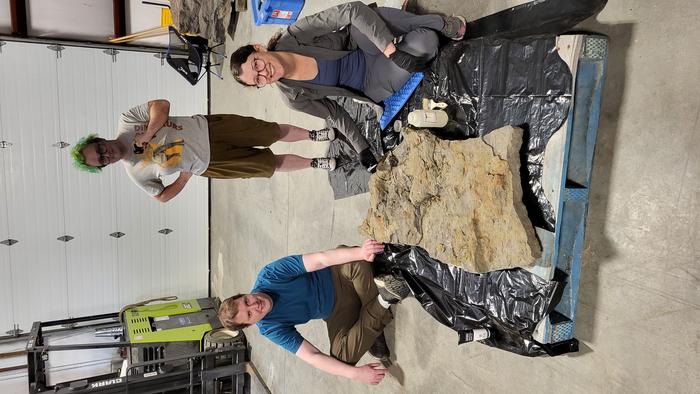

Palaeontologists from the Tumbler Ridge Museum and Royal BC Museum created a silicone mould of the type specimen of Ruopodosaurus in August 2024. From left to right, Eamon Drysdale (Tumbler Ridge Museum curator),  

Credit

Royal BC Museum

Victoria Arbour with Ruopodosaurus holotype in the field in Aug2023: Victoria Arbour (Royal BC Museum) with the type specimen of Ruopodosaurus still in the field at Wolverine River in August 2023.

Credit

Credit to Royal BC Museum

 SPACE/COSMOS

Scientists may have solved a puzzling space rock mystery


Carbon-rich asteroids are abundant in space yet make up less than 5 per cent of meteorites found on Earth. An international team of scientists scoured the globe to find an answer


Curtin University


An international team of researchers may have answered one of space science’s long-running questions – and it could change our understanding of how life began.


Carbon-rich asteroids are abundant in space yet make up less than 5 per cent of meteorites found on Earth.


An international team of scientists from Curtin University’s School of Earth and Planetary Sciences, the International Centre for Radio Astronomy (ICRAR), the Paris Observatory and more scoured the globe to find an answer.


Published today in Nature Astronomy, researchers analysed close to 8500 meteoroids and meteorite impacts, using data from 19 fireball observation networks across 39 countries — making it the most comprehensive study of its kind.


Co-author Dr Hadrien Devillepoix from Curtin’s Space Science and Technology Centre and Curtin Institute of Radio Astronomy (CIRA) said the team discovered Earth’s atmosphere and the Sun act like giant filters, destroying fragile, carbon-rich (carbonaceous) meteoroids before they reach the ground.


“We’ve long suspected weak, carbonaceous material doesn’t survive atmospheric entry,” Dr Devillepoix said.


“What this research shows is many of these meteoroids don’t even make it that far: they break apart from being heated repeatedly as they pass close to the Sun.


“The ones that do survive getting cooked in space are more likely to also make it through Earth’s atmosphere.”


Carbonaceous meteorites are particularly important because they contain water and organic molecules — key ingredients linked to the origin of life on Earth.


Paris Observatory’s Dr Patrick Shober said the findings reshape how scientists interpret meteorites collected so far.


“Carbon-rich meteorites are some of the most chemically primitive materials we can study — they contain water, organic molecules and even amino acids,” Dr Shober said.


“However, we have so few of them in our meteorite collections that we risk having an incomplete picture of what’s actually out there in space and how the building blocks of life arrived on Earth.


“Understanding what gets filtered out and why is key to reconstructing our solar system’s history and the conditions that made life possible.”


The study also found meteoroids created by tidal disruptions — when asteroids break apart from close encounters with planets — are especially fragile and almost never survive atmospheric entry.


“This finding could influence future asteroid missions, impact hazard assessments and even theories on how Earth got its water and organic compounds to allow life to begin,” Dr Shober said.


Other institutions involved in the study were the Astronomical Institute of the Romanian Academy, National Museum of National History and Aix-Marseilles University.


The study was supported by funding from the International Centre for Radio Astronomy Research.


Perihelion history and atmospheric survival as primary drivers of the Earth’s meteorite record was published in Nature Astronomy.


High blood pressure? Eat more bananas


New mathematical model demonstrates ratio of potassium to sodium intake key to regulating blood pressure


University of Waterloo
Facebook


New research from the University of Waterloo suggests increasing the ratio of dietary potassium to sodium intake may be more effective for lowering blood pressure than simply reducing sodium intake.

High blood pressure affects over 30 per cent of adults globally. It's the leading cause of coronary heart disease and stroke and may also lead to other afflictions like chronic kidney disease, heart failure, irregular heartbeats, and dementia.

"Usually, when we have high blood pressure, we are advised to eat less salt," said Anita Layton, professor of Applied Mathematics, Computer Science, Pharmacy and Biology at the University of Waterloo and the Canada 150 Research Chair in Mathematical Biology and Medicine. 

"Our research suggests that adding more potassium-rich foods to your diet, such as bananas or broccoli, might have a greater positive impact on your blood pressure than just cutting sodium." 

Potassium and sodium are both electrolytes – substances that help the body send electrical signals to contract muscles, affect the amount of water in your body and perform other essential functions. 

"Early humans ate lots of fruits and vegetables, and as a result, our body's regulatory systems may have evolved to work best with a high potassium, low sodium diet," said Melissa Stadt, a PhD candidate in Waterloo's Department of Applied Mathematics and the lead author of the study. 

"Today, western diets tend to be much higher in sodium and lower in potassium. That may explain why high blood pressure is found mainly in industrialized societies, not in isolated societies." 

While previous research found that increasing potassium intake can help control blood pressure, the researchers developed a mathematical model that successfully identifies how the ratio of potassium to sodium impacts the body. 

The model also identifies how sex differences affect the relationship between potassium and blood pressure. The study found that men develop high blood pressure more easily than pre-menopausal women, but men are also more likely to respond positively to an increased ratio of potassium to sodium.

The researchers emphasize that mathematical models like the one used in this study allow these kinds of experiments to identify how different factors impact the body quickly, cheaply, and ethically. 

The study, Modulation of blood pressure by dietary potassium and sodium: sex differences and modeling analysis, was recently published in the American Journal of Physiology-Renal Physiology. 


Nature’s plan for delaying pest resistance deciphered


A new study cracks the code for increasing sustainability of the pest-killing proteins in genetically engineered crops.


University of Arizona


Farmers in dozens of countries have embraced crops genetically engineered to produce proteins from Bacillus thuringiensis (Bt) bacteria that kill some key pests yet are safe for people and wildlife. Although this biotech approach reduces reliance on insecticide sprays thereby providing economic and environmental benefits, resistance to Bt crops has evolved in at least 11 species of pests. Thus, effective ways to combat such pest resistance are urgently needed.

A new study published in the Proceedings of the National Academy of Sciences identifies a natural strategy for thwarting pest resistance to Bt proteins. The researchers at the University of Arizona and Nanjing Agricultural University discovered that a Bt protein kills one of the world’s most damaging crop pests via two different pathways. “So, the protein’s efficacy is more durable because even if the pest blocks one pathway, the other pathway remains lethal and the pest is not resistant unless both pathways are disarmed,” said Bruce Tabashnik, one of the study’s authors and head of the Department of Entomology at the University of Arizona.

Insights from disabling Bt receptors in the Asian corn borer

To kill insect pests, Bt proteins must be ingested and bind to specific receptors in the lining of the gut. Because humans and other animals lack such receptors, they are not harmed by Bt proteins. But as with disease-causing germs and antibiotics, pests can evolve resistance to Bt proteins. The most common and most potent mechanism of Bt resistance entails changes in the receptors that reduce or eliminate their binding of Bt proteins. Three of the receptors implicated in many cases of Bt resistance are gut proteins called ABCC2, ABCC3, and cadherin.

The team of scientists used gene editing to disable ABCC2, ABCC3, and cadherin in caterpillars of the Asian corn borer (Ostrinia furnacalis), the major pest of corn in China and elsewhere in Asia. They determined how disabling the three receptors singly and in pairs affects the pest’s responses to Bt proteins Cry1Ab and Cry1Fa, which are used widely in Bt corn that targets corn borers and other lepidopteran pests.

The researchers discovered that Cry1Ab kills the caterpillars via two different toxic pathways. One pathway requires ABCC2, while the other requires cadherin and ABCC3. This means that if a mutation in the pest blocks one pathway, the other pathway can still deliver a lethal blow. Only when both pathways are knocked out does the pest become resistant. This “backup system” for Cry1Ab makes it much harder for resistance to evolve, because the pest needs mutations simultaneously inactivating two separate pathways to survive.

Cry1Fa, on the other hand, uses only one pathway, the one with ABCC2. If that’s blocked, the pest survives exposure to Cry1Fa. Thus, a single mutation in the pest disrupting ABCC2 can make it highly resistant to Cry1Fa.

To check the predictions from the results summarized above, the scientists did the reverse experiment by modifying a cell line from another lepidopteran pest (the fall armyworm) to produce the receptors from the Asian corn borer. The results from the modified cells support the conclusions from the caterpillars with disabled receptors. For example, while the unmodified cells were not killed by Cry1Ab or Cry1Fa, cells modified to produce ABCC2 were killed by both Bt proteins, confirming the conclusion that ABCC2 facilitates a toxic pathway for both. Also, cells modified to produce cadherin and ABCC3 were susceptible to Cry1Ab but not Cry1Fa. As expected, this modification provided the second pathway for Cry1Ab, which does not exist for Cry1Fa.

Potential solution of a mystery about a major pest in North America and Europe

The new results with the Asian corn borer could elucidate a previously unexplained pattern observed in its close relative that is a major pest in North America and Europe, the European corn borer (Ostrinia nubilalis). In the lab and field, the European corn borer has evolved resistance slower to Cry1Ab than Cry1Fa. For example, in Canada, practical resistance reducing the efficacy of Bt corn against this pest in the field was not evident after 21 years of exposure to Bt corn producing Cry1Ab whereas practical resistance was first documented after just 12 years of exposure to Bt corn producing Cry1Fa. One plausible explanation is that, like the Asian corn borer, the European corn borer has two toxic pathways for Cry1Ab but only one for Cry1Fa. This idea could be tested directly by conducting the same type of experiments with the European corn borer that were used to analyze the Asian corn borer.

Implications for enhancing sustainability

Tabashnik noted, “Functional redundancy, the use of more than one toxic pathway by a single Bt protein, is not limited to Cry1Ab and the Asian corn borer – it also occurs with other Bt proteins and other major lepidopteran pests. This natural strategy for delaying pest resistance could be harnessed to enhance sustainability by seeking native Bt proteins or designing novel Bt proteins that attack pests via multiple pathways.”


Fishing for cephalopod DNA allows for efficient marine surveying


Kobe University
250414-Wu-Metabarcoding-Illustration 

image: 

In the technique known as “environmental DNA metabarcoding,” probes are designed to target specific DNA fragments, similar to how anglers use specific bait to catch a particular species. The challenge is creating probes that are specific enough to just the group one tries to detect, but also general enough to catch anything within that group.

view more 

Credit: WU Qianqian


New DNA probes allow for efficient surveying of the hidden lives of squids and octopuses in the deep sea. This development by Kobe University provides an effective tool for marine ecological research and conservation efforts.

Squids and octopuses eat and are eaten, and in between that they move around a lot. “Cephalopods play an important role in marine ecosystems, contributing to the distribution of energy and nutrients in the food web,” explains Kobe University marine ecologist WU Qianqian. And while for ecological research it is therefore essential to know about the distribution of the various species of squids and octopuses, collectively known as cephalopods, their deep-sea habitat is largely inaccessible to direct surveys. Wu says, “The deep sea covers a large portion of Earth’s surface and is home to many unknown organisms whose ecology remains largely unexplored.”

Wu and her team therefore set out to develop a detection system based on DNA released to the environment. In the technique known as “environmental DNA metabarcoding,” the environmental DNA is probed with small pieces of DNA specific to the target, similar to how anglers use specific bait to catch a particular species. The challenge is creating probes that is specific enough to just the group one tries to detect, but also general enough to catch anything within that group. “For this, our lab, which is renowned for its environmental DNA research, worked together with researchers from the Japan Agency for Marine-Earth Science and Technology (JAMSTEC) who have developed a system for collecting large amounts of deep-sea samples,” says Wu.

In the journal Marine Environmental Research, the Kobe University researcher now reports that they developed DNA probes, called “primers,” that could specifically detect DNA from a broad range of cephalopod species. This worked both in mock samples created from tissues from the Osaka Museum of Natural History and in sea samples from the surface all the way down to 2,000 meters deep. In the latter, their ability to detect some species of cephalopods in the waters around Japan for the first time is a testament to the power of their technique. One possible key element in their success was that Wu and her colleagues were fishing for longer DNA fragments than had been attempted before. Although longer DNA fragments might degrade more quickly, this is not as big of a problem in the deep, cold sea, and it also ensures that the DNA is relatively “fresh,” more accurately representing the distribution of species. Having more DNA per sample also allows for more precise identification of exactly what species it came from.

The Kobe University team detected octopus DNA only in samples from the deepest seas. From their trials with mock samples, the team can be confident that this is not because their primers don’t work properly; rather, they see it as their technique’s ability to even infer the target organisms’ lifestyle from the results, as octopuses are mostly ground dwelling, hidden and solitary.

“In future studies, we need to nevertheless revise our sampling strategy to account for life history and behavioral patterns of different cephalopods. In addition, we need to resolve issues with misidentification of species due to errors in the DNA databases, and for this we intend to strengthen the collaboration between molecular biologists and taxonomists” says Wu. She adds: “Nevertheless, our technique is expected to open new possibilities for deep-sea cephalopod research and to serve as a foundation for marine life conservation.”

This research was funded by the Ministry of Environment of Japan. It was conducted in collaboration with researchers from Kyoto University, the Osaka Museum of Natural History, the Natural History Museum and Institute, the Japan Agency for Marine-Earth Science and Technology (JAMSTEC) and the Okinawa Churashima Foundation.

Kobe University is a national university with roots dating back to the Kobe Higher Commercial School founded in 1902. It is now one of Japan’s leading comprehensive research universities with nearly 16,000 students and nearly 1,700 faculty in 10 faculties and schools and 15 graduate schools. Combining the social and natural sciences to cultivate leaders with an interdisciplinary perspective, Kobe University creates knowledge and fosters innovation to address society’s challenges.