Monday, April 21, 2025

Trump's Lawlessness Comes From Seeds Planted by Bush-Cheney

The federal government’s willingness to violate federal and international law with impunity didn’t begin with Trump.


Vice President Cheney and President George W Bush riding in back of a limousine smiling, Washington DC, Washington, USA, February 28, 2008.
(Photo by Smith Collection/Gado/Getty Images)

Rebecca Gordon
Apr 21, 2025
TomDispatch

In 2003, the Macedonian police arrested Khaled el-Masri, a German citizen vacationing in their country. They handed the unfortunate man over to the CIA, who shipped him off to one of their “black sites.” For those too young to remember (or who have quite understandably chosen to forget), “black sites” was the name given to clandestine CIA detention centers around the world, where that agency held incommunicado and tortured men captured in what was then known as the Global War on Terror. The black site in this case was the notorious Salt Pit in Afghanistan. There el-Masri was, among other things, beaten, anally raped, and threatened with a gun held to his head. After four months he was dumped on a rural road in Albania.

It seems that the CIA had finally realized that they had arrested the wrong man. They wanted some other Khalid el-Masri, thought to be an al-Qaeda associate, and not, as Amy Davidson wrote in the New Yorker, that “car salesman from Bavaria.”

El-Masri was not the only person that representatives of the administration of President George W. Bush and Vice President Dick Cheney mistakenly sent off to another country to be tortured. In an infamous case of mistaken arrest, a Canadian citizen named Maher Arar was detained by the FBI at JFK Airport in New York while on his way home from a vacation in Tunisia. He was then held in solitary confinement for two weeks in the United States, while being denied contact with a lawyer before ultimately being shipped off to Syria. There, he would be tortured for almost a year until the Canadian government finally secured his release.

An “Administrative Error”

I was reminded of such instances of “extraordinary rendition” in the Bush-Cheney era when I read about the Trump administration’s March 2025 deportation of Kilmar Armando Abrego García to a grim prison in El Salvador. Because of threats against him and his family from Barrio 18, a vicious Salvadoran gang, Abrego García had fled that country as a young teenager. He entered the U.S. without papers in 2011 to join his older brother, already a U.S. citizen.

He was arrested in 2019, while seeking work as a day laborer outside a Home Depot store and handed over to U.S. Immigration and Customs Enforcement (ICE), which accused him of being a member of another Salvadoran gang, MS-13. This proved a false claim, as the immigration judge who heard his case agreed. While not granting Abrego García asylum, the judge assigned him a status — “withholding from removal” — which kept him safe in this country, because he faced the possibility of torture or other violence in his homeland. That status allowed him to work legally here. He married a U.S. citizen and they have three children who are also U.S. citizens.

Then, on March 12, 2025, on his way home from his job as a sheet-metal apprentice, he was suddenly stopped by ICE agents and arrested. They told him his status had been revoked (which wasn’t true) and promptly shipped him to various detention centers around the country. Ultimately, he was deported to El Salvador without benefit of legal assistance or a hearing before an immigration judge. As far as is known, he is now incarcerated at CECOT, the Center for the Confinement of Terrorists, a Salvadoran prison notorious for the ill treatment and torture of its inmates. While built for 40,000 prisoners, it now houses many more in perpetually illuminated cells, each crammed with more than 100 prisoners (leaving about 6.5 square feet of space for each man. It is considered “one of the most dangerous prisons in the Western Hemisphere” with “some of the most inhumane and squalid conditions known in any carceral system.” Furthermore, among the gangs reported to have a substantial presence at CECOT is Barrio 18, the very crew Abrego García fled El Salvador to escape so many years ago.

The Trump Justice Department has now admitted that they made an “administrative error” in deporting him but have so far refused to bring him home. Responding to a Supreme Court ruling demanding that the government facilitate his return, the Justice Department on April 12th finally acknowledged to the D.C. district court that he “is currently being held in the Terrorism Confinement Center in El Salvador.” Its statement continued: “He is alive and secure in that facility. He is detained pursuant to the sovereign, domestic authority of El Salvador.” On April 14, 2025, in contemptuous defiance of the supreme court, President Trump and his Salvadoran counterpart Nayib Bukele made it clear to reporters that Abrego García will not be returning to the United States.Previously, the government’s spokesman, Michael G. Kozak, who identified himself in the filing as a “Senior Bureau Official” in the State Department’s Bureau of Western Hemisphere Affairs, had failed to comply with the rest of Judge Paula Xinis’s order: to identify what steps the administration is (or isn’t) taking to get him released. The judge has insisted that the department provide daily updates on its efforts to get him home, which it has failed to do. Its statement that Abrego García “is detained pursuant to the sovereign, domestic authority of El Salvador” suggests officials intend to argue that — despite paying the Salvadoran government a reported six million dollars for its prison services — the United States has no influence over Salvadoran actions. We can only hope that he really is still alive. The Trump administration’s truth-telling record is not exactly encouraging.


Extraordinary Rendition

The technical term for such detainee transfers is “extraordinary rendition.” “Rendition” involves sending a prisoner to another country to be interrogated, imprisoned, and even possibly tortured. Rendition becomes “extraordinary” when it occurs outside of normal legal strictures, as with the cases of el-Masri and Ahar decades ago,, and Abrego García today. Extraordinary rendition violates the United Nations Convention Against Torture, which explicitly prohibits sending someone to another country to be mistreated or tortured. It also violates U.S. anti-torture laws. As countless illegal Trump administration acts demonstrate, however, illegality is no longer a barrier of any sort to whatever its officials want to do.

Two other flights left for El Salvador on the day Abrego García was rendered. They contained almost 200 people accused of being members of a Venezuelan gang, Tren de Aragua, and were similarly deported under the Alien Enemies Act of 1798 without any hearings. Are they actually gang members? No one knows, although it seems likely that at least some of them aren’t. Jerce Reyes Barrios, for example, was a Venezuelan soccer coach who sought asylum in the U.S. and whose tattoo, celebrating the famous Spanish soccer team Royal Madrid, was claimed to be evidence enough of his gang membership and the excuse for his deportation.

Andry José Hernández Romero is another unlikely gang member. He’s a gay makeup artist who entered the United States last August to keep a pre-arranged asylum appointment. Instead, he was arrested and held in detention until the Tren de Aragua flights in March. The proof of his gang membership? His “Tres Reyes” or “Three Kings” tattoos that were common in his hometown in Venezuela.

In fact, all 200 or so deportees on those flights have been illegally rendered to El Salvador in blatant defiance of a judge’s court order to stop them or return those already in the air. None of those men received any sort of due process before being shipped off to a Salvadoran hellhole. In response, Salvadoran President Nayib Bukele tweeted, “Oopsie… Too late” with a laughing-face emoji.

Even U.S. citizens are at risk of incarceration at CECOT. After Secretary of State Marco Rubio met with President Bukele, the State Department’s website praised his “extraordinary gesture never before extended by any country,” an offer “to house in his jails dangerous American criminals, including U.S. citizens and legal residents.” Trumpreiterated his interest in shipping “homegrown criminals” to El Salvador during his press conference with Bukele. As former federal prosecutor Joyce Vance has observed, “If it can happen to Abrego Garcia, it can happen to any of us.”

It Didn’t Start with Trump

It’s tempting to think of Donald Trump’s second term as a sui generis reign of lawlessness. But sadly, the federal government’s willingness to violate federal and international law with impunity didn’t begin with Trump. If anything, the present incumbent is harvesting a crop of autocratic powers from seeds planted by President George W. Bush and Vice-President Dick Cheney in those war on terror years following the attacks of September 11, 2001. In their wake, the hastily-passed Patriot Act granted the federal government vast new detention and surveillance powers. The Homeland Security Act of 2002 established a new cabinet-level department, one whose existence we now take for granted.

As I wrote more than a decade ago, after September 11th, torture went “mainstream” in the United States. The Bush administration cultivated an understandable American fear of terrorism to justify abrogating what, until then, had been a settled consensus in this country: that torture is both wrong and illegal. In the face of a new enemy, al-Qaeda, the administration argued that the requirements for decent treatment of wartime detainees outlined in the Geneva Conventions had been rendered “quaint.” Apparently, wartime rights granted even to Nazi prisoners of war during World War II were too risky to extend to that new foe.

In those days of “enhanced interrogation,” I was already arguing that accepting such lawless behavior could well become an American habit. We might gradually learn, I suggested, to put up with any government measures as long as they theoretically kept us safe. And that indeed was the Bush administration’s promise: Let us do whatever we need to, over there on the “dark side,” and in return we promise to always keep you safe. In essence, the message was: there will be no more terrorist attacks if you allow us to torture people.

The very fact that they were willing to torture prisoners was proof that those people must deserve it — even though, as we now know, many of them had nothing whatsoever to do with al-Qaeda or the September 11th attacks. (And even if they had been involved, no one, not even a terrorist, deserves to be tortured.)

If you’re too young to remember (or have been lucky enough to forget), you can click here, or here, or here for the grisly details of what the war on terror did to its victims.

The constant thrill of what some have called security theater has kept us primed for new enemies and so set the stage for the second set of Trump years that we now find ourselves in. We still encounter this theater of the absurd every time we stand in line at an airport, unpacking our computers, removing our shoes, sorting our liquids into quart-sized baggies — all to reinforce the idea that we are in terrible danger and that the government will indeed protect us.

Sadly, all too many of us became inured to the idea that prisoners could be sent to that infamous offshore prison of injustice at Guantánamo Bay, Cuba, perhaps never to be released. (Indeed, as of January 2025, of the hundreds of people incarcerated there over the years, 15 war on terror prisoners still remain.) It should perhaps be no surprise, then, that the second time around, Donald Trump seized on Guantánamo as a possible place to house the immigrants he sought to deport from this country. After all, so many of us were already used to thinking of anybody sent there as the worst of the worst, as something other than human.

Dehumanizing the targets of institutionalized mistreatment and torture proved to be both the pretext for and a product of the process. Every torture regime develops a dehumanizing language for those it identifies as legitimate targets. For example, the torturers employed by the followers of Augusto Pinochet, who led Chile’s 1973 military coup, typically called their targets “humanoids” (to distinguish them from actual human beings).

For the same reason, the Israel Defense Forces now refer to just about anyone they kill in Gaza or on the West Bank as a “terrorist.” And the successful conflation of “Palestinian” with “terrorist” was all it took for some Americans to embrace Donald Trump’s suggestion that Gaza should be cleared of its people and turned into the “Riviera of the Middle East” for Israelis, Americans, and foreign tourists.

Trump’s representatives have used the same kind of language to describe people they are sending to that prison in El Salvador. His press secretary, Karoline Leavitt, referred to them as “heinous monsters,” which is in keeping with Trump’s own description of his political opponents as inhuman “vermin.” At a rally in New Hampshire in 2023, Trump told the crowd, “We pledge to you that we will root out the communists, Marxists, fascists, and the radical left thugs that live like vermin within the confines of our country.” Here he was talking not only about immigrants, but about U.S. citizens as well.

After years of security theater, all too many Americans seem ready to accept Trump’s pledge to root out the vermin.

It Can Happen to You

One difference between the Bush-Cheney years and the Trump ones is that the attacks of September 11, 2001, represented a genuine and horrific emergency. Trump’s version of such an emergency, on the other hand, is entirely Trumped-up. He posits nothing short of an immigration “invasion” — in effect, a permanent 9/11 — that “has caused widespread chaos and suffering in our country over the last 4 years.” Or so his executive order “Declaring a National Emergency at the Southern Border of the United States” insists. To justify illegally deporting alleged members of Tren de Aragua and, in the future (if he has his way), many others, he has invented a totally imaginary war so that he can invoke the 1798 Alien Enemies Act, which was last used during World War II to justify the otherwise unjustifiable internment of another group of dehumanized people in this country: Japanese-Americans.

Donald Trump has his very own “black site” now. Remember that El Salvador’s Nayib Bukele is perfectly willing to receive U.S. citizens, too, as prisoners in his country. Supreme Court Justice Sonia Sotomayor, joined by Justices Elena Kagan and Ketanji Jackson, made that point in a statement that accompanied that court’s recent order requiring the Trump administration to facilitate Kilmar Abrego García’s return to the United States. They wrote, “The Government’s argument, moreover, implies that it could deport and incarcerate any person, including U.S. citizens, without legal consequence, so long as it does so before a court can intervene.”

As the justices remind us, it can happen here. It can happen to you.

© 2023 TomDispatch.com

Rebecca Gordon is an Adjunct Professor at the University of San Francisco. Prior to teaching at USF, Rebecca spent many years as an activist in a variety of movements, including for women's and LGBTQ+ liberation, the Central America and South Africa solidarity movements and for racial justice in the United States. She is the author of "American Nuremberg: The U.S. Officials Who Should Stand Trial for Post-9/11 War Crimes" (2016) and previously, "Mainstreaming Torture: Ethical Approaches in the Post-9/11 United States" (2014). She teaches in the philosophy department at the University of San Francisco. You can contact her through the Mainstreaming Torture website.
Full Bio >
Gaza civil defence describes medic killings as ‘summary executions’


By AFP
April 21, 2025


A video recovered from the phone of one of the slain aid workers, released by the Red Crescent, appeared to contradict the Israeli military's account - Copyright AFP/File

 Filippo MONTEFORTE

Gaza’s civil defence agency on Monday accused the Israeli military of carrying out “summary executions” in the killing of 15 rescue workers last month, rejecting the findings of an internal probe by the army.

The medics and other rescue workers were killed when responding to distress calls near Gaza’s southern city of Rafah early on March 23, days into Israel’s renewed offensive in the Hamas-run territory.

Among those killed were eight Red Crescent staff members, six from the Gaza civil defence rescue agency and one employee of UNRWA, the UN agency for Palestinian refugees, according to the UN humanitarian agency OCHA and Palestinian rescuers.

“The video filmed by one of the paramedics proves that the Israeli occupation’s narrative is false and demonstrates that it carried out summary executions,” Mohammed Al-Mughair, a civil defence official, told AFP, accusing Israel of seeking to “circumvent” its obligations under international law.

Following the shooting, the Red Crescent released a video recovered from the phone of one of the victims. It does not show executions, but it does directly contradict the version of events initially put forward by the Israeli military.

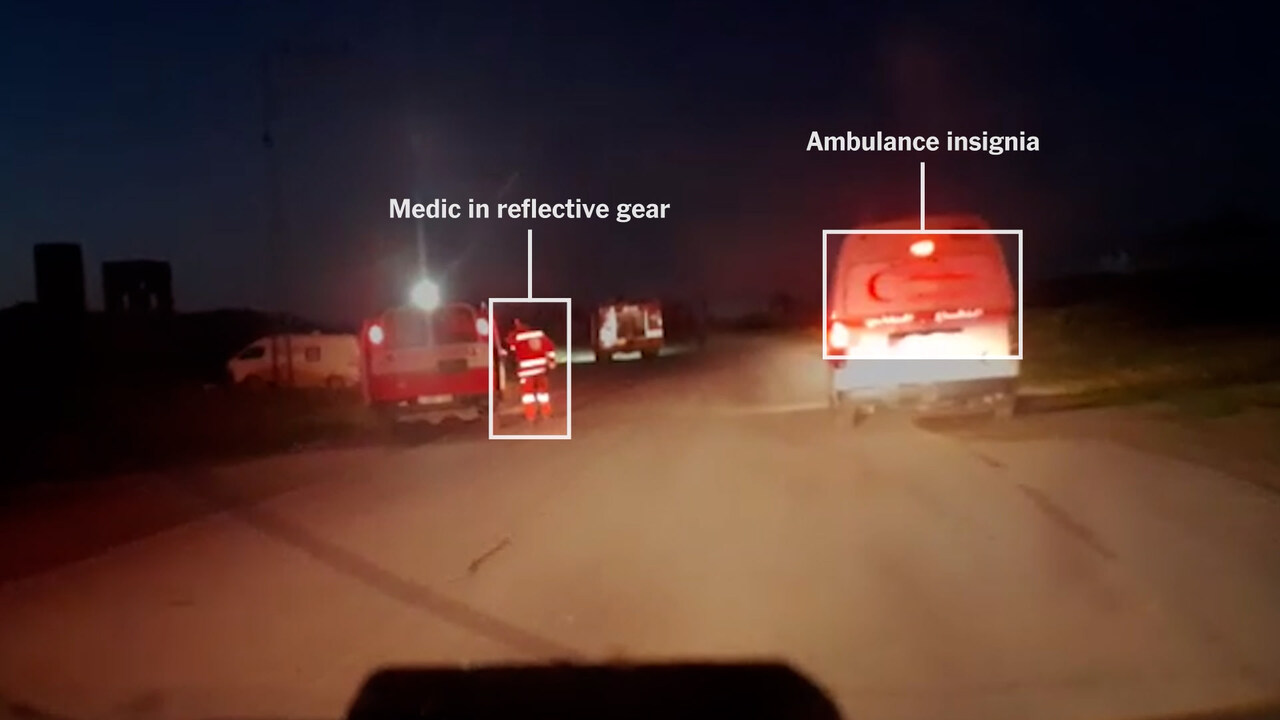
In particular, the video shows clearly that the ambulances were travelling with sirens, flashing lights and headlights on. The military had claimed the ambulances were travelling “suspiciously” and without lights.


– Operational failures –


The incident drew international condemnation, including concern about possible war crimes from UN human rights commissioner Volker Turk.

An Israeli military investigation into the incident released on Sunday “found no evidence to support claims of execution” or “indiscriminate fire” by its troops, but admitted to operational failures and said it was firing a field commander.

It said six of those killed were militants, revising an earlier claim that nine of the men were fighters.

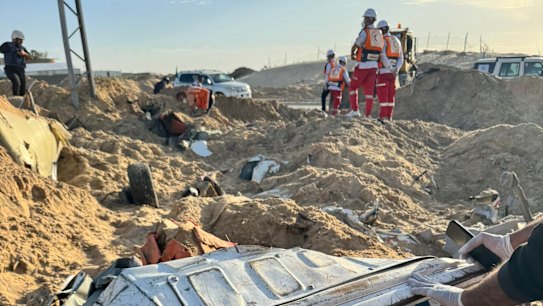
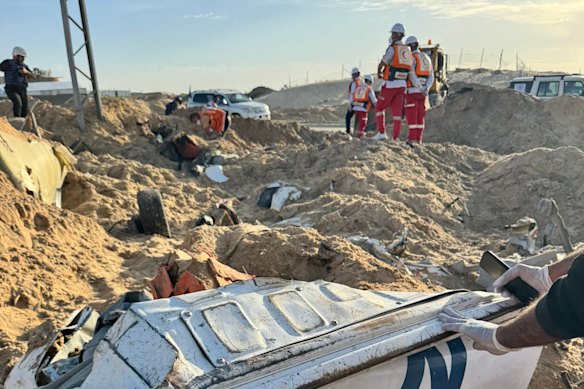
The dead, who were buried in sand by Israeli forces, were only recovered several days after the attack from what the UN human rights agency OCHA described as a “mass grave”.

The Palestine Red Crescent Society denounced the report as “full of lies”.

“It is invalid and unacceptable, as it justifies the killing and shifts responsibility to a personal error in the field command when the truth is quite different,” Nebal Farsakh, spokesperson for the Red Crescent, told AFP.

The Israeli investigation said there were three shooting incidents in the area on that day.

In the first, soldiers shot at what they believed to be a Hamas vehicle.

In the second, around an hour later, troops fired “on suspects emerging from a fire truck and ambulances”, the military said.

The probe determined that the fire in the first two incidents resulted from an “operational misunderstanding by the troops”.

In the third incident, the troops fired at a UN vehicle “due to operational errors in breach of regulations”, the military said.

Israel says ‘misunderstanding’ led to killing of 15 Gaza medics found in mass grave


By Melanie Lidman
April 21, 2025 — AP


Jerusalem: An Israeli investigation into the killings of 15 Palestinian medics last month in Gaza by Israeli forces said it found a chain of “professional failures”, and a deputy commander who was first to open fire has been sacked.

The shootings outraged many in the international community, with some calling the killings a war crime. Medical workers have special protection under international humanitarian law. The International Red Cross/Red Crescent called it the deadliest attack on its personnel in eight years.


The footage shows the convoy of ambulances and a fire truck, clearly marked, with headlights and flashing lights turned on. Supplied by The New York Times.

Israel at first claimed that the medics’ vehicles did not have emergency signals on when troops opened fire but later backtracked.

Cellphone video recovered from one medic contradicted Israel’s initial account. Footage shows the ambulances had lights flashing and logos visible as they pulled up to help another ambulance that earlier came under fire.

The military investigation – released on Sunday, Jerusalem time – found that the deputy battalion commander acted under the incorrect assumption that all the ambulances belonged to Hamas militants.


Emergency crews ‘struck one after another’ as they searched for missing colleagues

It said the deputy commander, operating under “poor night visibility”, felt his troops were under threat when the ambulances sped toward their position and medics rushed out to check the victims. The military said the flashing lights were less visible on night-vision drones and goggles.

The ambulances immediately came under a barrage of gunfire that went on for more than five minutes with brief pauses. Minutes later, soldiers opened fire at a UN car that stopped at the scene.

Eight Red Crescent personnel, six Civil Defence workers and a UN staffer were killed in the shooting before dawn on March 23 by troops conducting operations in Tel al-Sultan, a district of the southern Gaza city of Rafah. Troops bulldozed over the bodies along with their vehicles, burying them in a mass grave. UN and rescue workers were only able to reach the site a week later.

The Israeli military said soldiers buried the bodies to prevent them from being mangled by stray dogs and coyotes until they could be collected, and that the ambulances were moved to allow the route to be used for civilian evacuations later that day.

The investigation found that the decision to crush the ambulances was wrong, but said there was no attempt to conceal the shootings.


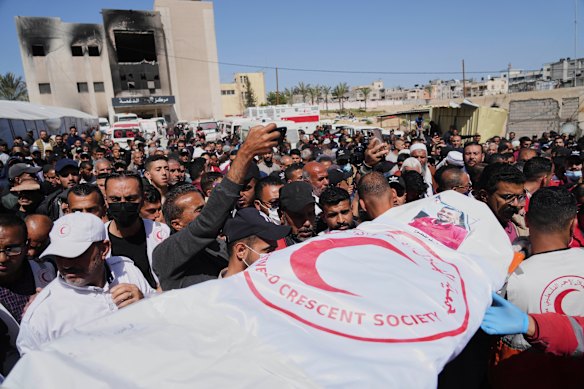
Mourners carry the bodies of Red Crescent emergency responders, recovered in Rafah after a March 23 Israeli attack.CREDIT:AP

Major-General Yoav Har-Even, who oversees the military’s investigations, said it notified international organisations later that day and helped rescue workers locate the bodies.

The head of the Palestinian Red Crescent Society has said the men were “targeted at close range”. Night-vision drone footage provided by the military shows soldiers were 20 to 30 metres away from the ambulances.

The deputy commander was the first to open fire, leading the rest of the soldiers to start shooting, Har-Even said. The investigation found the paramedics were killed due to an “operational misunderstanding” by Israeli forces, and that shooting at the UN car was a breach of orders.

The findings asserted that six of those killed were Hamas militants – it did not give their names – and said three other paramedics were originally misidentified as Hamas. The Civil Defence is part of the Hamas-run government.

No paramedic was armed and no weapons were found in any vehicle, Har-Even said.

One survivor was detained for investigation and remains in custody for further questioning. According to the military, soldiers who questioned the survivor thought he identified himself as a Hamas member, which was later refuted.

Har-Even said the deputy commander was fired for giving a not “completely accurate” report to investigators about the firing on a UN vehicle.

The statement on the findings concluded by saying that Israel’s military “regrets the harm caused to uninvolved civilians”.


The site where the 15 bodies were found. The UN described it as a mass grave.CREDIT:X/@_JWHITTALL

“Without accountability, we risk continuing to watch atrocities unfolding, and the norms designed to protect us all, eroding. Too many civilians, including aid workers, have been killed in Gaza. Their stories have not all made the headlines,” Jonathan Whittall, interim head in Gaza of the UN humanitarian office OCHA, said in a statement responding to the findings.

There was no immediate public reaction from the Red Crescent or Civil Defence.

The findings have been turned over the Military Advocate General, which can decide whether to file civil charges. It is meant to be an independent body, with oversight by Israel’s attorney general and Supreme Court.

There are no outside investigations of the killings under way.

Israeli strikes have killed more than 150 emergency responders from the Red Crescent and Civil Defence, most of them while on duty, and more 1000 health workers during the war, according to the UN. The Israeli military rarely investigates such incidents.

Israel has accused Hamas of moving and hiding its fighters inside ambulances and emergency vehicles, as well as in hospitals and other civilian infrastructure, arguing that justifies strikes on them. Medical personnel largely deny the accusations.

Palestinians and international human rights groups have repeatedly accused Israel’s military of failing to properly investigate or whitewashing misconduct by its troops.

Har-Even said the Israeli military was currently investigating 421 incidents in Gaza during the war, with 51 concluded and sent to the Military Advocate General. There was no immediate information on the number of investigations involving potential wrongful deaths or how many times the MAG has pursued criminal charges.

The International Criminal Court, established by the international community as a court of last resort, has accused Israeli Prime Minister Benjamin Netanyahu and former defence minister Yoav Gallant of war crimes. Israel, which is not a member of the court, has long asserted that its legal system is capable of investigating the army, and Netanyahu has accused the ICC of antisemitism.

The war in Gaza began when Hamas-led militants attacked southern Israel on October 7, 2023, killing about 1200 people and abducting 251. Most of the hostages have been released in ceasefire agreements or other deals. Hamas currently holds 59 hostages, 24 of them believed to be alive.

Israel’s offensive has since killed over 51,000 Palestinians, mostly women and children, according to Gaza’s Health Ministry, which does not distinguish between civilians and combatants.

Frustration has been growing on both sides, with rare public protests against Hamas in Gaza and continued weekly rallies in Israel pressing the government to reach a deal to bring all hostages home.

AP


Israel says Gaza medics’ killing a ‘mistake,’ to dismiss commander


By AFP
April 20, 2025


A video recovered from the cellphone of one of the slain aid workers, released by the Red Crescent, appeared to contradict the Israeli military's account days after the incident - Copyright Palestinian Red Crescent/AFP -


Alice Chancellor with Ruth Eglash in Jerusalem

An Israeli military probe into the killing of 15 Palestinian emergency workers in Gaza admitted Sunday that mistakes led to their deaths and that a field commander would be dismissed.

But the probe found no evidence of “indiscriminate fire” by the troops.

The medics and other rescue workers were killed when responding to distress calls near the southern Gaza city of Rafah early on March 23, just days into Israel’s renewed offensive in the Hamas-run territory.

The incident has drawn international condemnation, including concern about possible war crimes from UN High Commissioner for Human Rights Volker Turk.

Germany had called for an urgent investigation and “accountability of the perpetrators.”

The probe said six of the dead were Hamas militants, although no weapons were found.

“The examination identified several professional failures, breaches of orders and a failure to fully report the incident,” the summary of the investigation said.

Reserve Major General Yoav Har-Even, who led the investigation, accepted that troops involved in the incident had committed an error.

“We’re saying it was a mistake. We don’t think it’s a daily mistake,” he told journalists when asked if he thought the incident represented a pervasive issue within the Israeli military.

Those killed included eight Red Crescent staff members, six from the Gaza civil defence rescue agency and one employee of UNRWA, the UN agency for Palestinian refugees, according to the UN humanitarian agency OCHA and Palestinian rescuers.

Their bodies were found about a week later, buried in the sand alongside their crushed vehicles near the shooting scene in Rafah’s Tal al-Sultan area.

OCHA described it as a mass grave.

Younis al-Khatib, president of the Palestine Red Crescent in the Israeli-occupied West Bank, has said an autopsy of the victims revealed that “all the martyrs were shot in the upper part of their bodies, with the intent to kill”.

The military rejected his accusation.

“The examination found no evidence to support claims of execution or that of any of the deceased were bound before or after the shooting,” the probe said, amid allegations that some of the bodies had been found handcuffed.

“The troops did not engage in indiscriminate fire but remained alert to respond to real threats identified by them,” it said, adding that six of the 15 were “identified in a retrospective examination as Hamas terrorists”.

It had earlier said nine of those killed were militants.

“The IDF (military) regrets the harm caused to uninvolved civilians,” the probe added, but did not provide evidence that six of the men were militants.

Har-Even acknowledged that no weapons were found on the dead men.


– ‘No attempt to conceal’ –


Days after the incident, the army said its soldiers fired on “terrorists” approaching them in “suspicious vehicles”, with a spokesman later adding that the vehicles had their lights off.

But a video recovered from the cellphone of one of the slain aid workers, released by the Red Crescent, appears to contradict the Israeli military’s account.

The footage shows ambulances travelling with their headlights on and emergency lights flashing.

The military acknowledged operational failure on the part of its troops to fully report the incident, but reiterated their earlier statements that Israeli troops buried the bodies and vehicles “to prevent further harm.”

“There was no attempt to conceal the event,” it said.

“We don’t lie,” military spokesman Effie Defrin said on Sunday.

The military said a deputy commander “will be dismissed from his position due to his responsibilities as the field commander in this incident and for providing an incomplete and inaccurate report during the debrief”.

The military said there were three shooting incidents in the area on that day.


– ‘Breach of orders’ –


In the first, soldiers shot at what they believed to be a Hamas vehicle.

In the second incident, around an hour later, troops fired “on suspects emerging from a fire truck and ambulances very close to the area in which the troops were operating, after perceiving an immediate and tangible threat,” the military said.

“The deputy battalion commander assessed the vehicles as employed by Hamas forces, who arrived to assist the first vehicle’s passengers. Under this impression and sense of threat, he ordered to open fire.”

The third incident saw the troops firing at a UN vehicle “due to operational errors in breach of regulations,” the military said.

The probe determined that the fire in the first two incidents resulted from an “operational misunderstanding by the troops.”

“The third incident involved a breach of orders during a combat setting,” it added.

The UN said in early April that after the team of first responders was killed, other emergency and aid teams were hit one after another over several hours while searching for their missing colleagues.

Mundhir Abed, a medic from the Red Crescent Society who survived the attack, told AFP earlier he was beaten and interrogated by Israeli troops.

Another medic also survived and the military confirmed Sunday he was in its custody.


'Another Day, Another Cover-Up,' Rights Group Says as IDF Releases Report on Medics' Killing

"This report doesn't even attempt to engage with the truth," said the Israeli group Breaking the Silence.


Members of the Palestine Red Crescent and other emergency services pray by the bodies of fellow rescuers killed a week earlier by Israeli forces, during a funeral procession at Nasser hospital in Khan Yunis in the southern Gaza Strip on March 31, 2025.
(Photo: Eyad Baba/AFP via Getty Images)

Julia Conley
Apr 20, 2025
COMMON DREAMS

The Israel Defense Forces' report on the killing of 15 paramedics in Gaza last month was "sure to lead to increased demands for an independent investigation," said one journalist for Sky News, which recently released an extensive account of the incident that experts and advocates have called a potential war crime.

The IDF said it had found "several professional failures, breaches of orders, and a failure to fully report the incident" that took place on March 23, when Israeli troops opened fire on a convoy of vehicles that included ambulances, killing the 15 rescue workers.

But officials claimed that there was "no attempt to conceal the event" and the report suggested the firing of a deputy commander for providing an "inaccurate report" and the reprimanding of a commanding officer should satisfy the international outcry over the incident, after which United Nations and Palestinian Red Crescent officials discovered the medics' bodies and their crushed rescue vehicles had been buried in a shallow mass grave.

"Is this meant to be a joke?" said Palestinian writer and poet Mosab Abu Toha after the IDF announced the commanders would be fired and reprimanded. "How is this supposed to help the children and families of these medics? ...These war criminals should be arrested and handed over to the [International Criminal Court] for due legal processing."

The IDF report found that six out of 15 Palestinians killed "were identified in a retrospective examination as Hamas terrorists," but did not produce evidence to support the claim; Sky News, which released its investigation on on Friday, also did not find evidence.

The report also claimed that the army decided to "gather and cover the bodies to prevent further harm and clear the vehicles from the route in preparation for civilian evacuation"—an explanation for the buried bodies and ambulances.

As Common Dreamsreported earlier this month, the IDF's claim that soldiers "did not randomly attack" the convoy but rather fired on suspected "terrorists" in "suspicious vehicles" was refuted by video evidence from the phone of one of the medics who was found in the mass grave—believed to be Refaat Radwan.

The video showed a convoy of clearly marked ambulances and fire truck, with headlights and flashing lights on—contradicting the IDF's claim that the vehicles were driving with their lights off.

Despite the video evidence, the IDF report said there was "no evidence to support claims of execution" and accused those who have made such accusations of "blood libels."

The Sky News report released Friday found that Israel's claim that the medics were not fired at from a close distance was false and that expert analysis of Radwan's cellphone video determined shots had been fired from as close as 12 meters away

Palestinian-American policy analyst Yousef Munayyer said that in the case of the medics' killing, "video evidence exposed [the IDF's] lies forcing this flimsy effort mascarading as accountability so they can sweep it under the rug."

Israel is able to repeatedly attack civilians and aid workers and claim that their deaths were accidental, Munayyer suggested, because "western media is willing to believe as fact initial Israeli narratives around atrocities."

The Israeli probe found "professional failures," said former Human Rights Watch executive director Kenneth Roth, but the IDF "doesn't seem to have examined the rules of engagement, approved by senior officials, that permit killing before clear identification of a combatant."

The killing of the paramedics underscored the "atmosphere of impunity" in Gaza, said one Israeli policy analyst.

"What we know is that we cannot trust the Israeli [military]. Unless The New York Times would have gotten hold of that video clip, I don't think that we would know the truth," Akiva Eldar told Al Jazeera. "It would be another cover-up."

Human rights lawyer Geoffrey Nice told Al Jazeera that the IDF report "invites many questions that it will be difficult, I suspect, for the [Israeli military] to answer."

"For example, [there is] the proposition that six of these people were Hamas, presumably members of Hamas on active [military] service, not people who might have been associated with Hamas in some way. No documentary evidence at all is identified [for that]," he told the outlet.

Breaking the Silence, a group made up of Israeli veterans of the IDF who speak out against Israel's occupation of the Palestinian territories, said the report was "riddled with contradictions, vague phrasing, and selective details."

"We all remember when the IDF claimed that the ambulances emergency lights weren't on—and then we saw the footage proving otherwise. Not every lie has a video to expose it, but this report doesn't even attempt to engage with the truth," said the group.


"Another day, another cover-up," Breaking the Silence added. "More innocent lives taken, with no accountability."


Trump Administration Plots Massive Budget Cuts That 'Would Destroy Public Health'

"Trump promised to fight for the working class, but instead he, Elon Musk, and RFK Jr. are attacking the programs and services that keep middle class, working class, and vulnerable families safe and healthy in order to pay for tax cuts for billionaires."


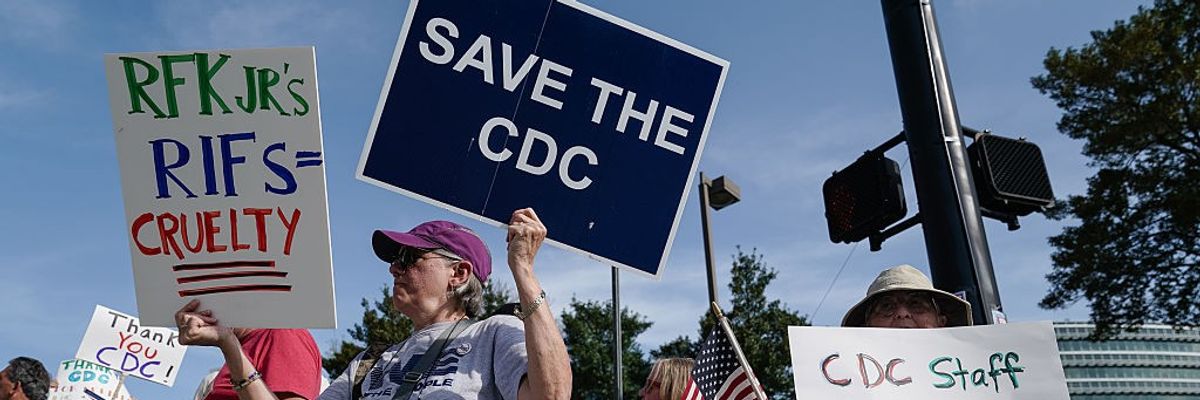
People demonstrate outside the main campus of the Centers for Disease Control and Prevention on April 1, 2025 in Atlanta, Georgia.
(Photo: Elijah Nouvelage/Getty Images)

Jake Johnson
Apr 21, 2025
COMMON DREAMS


The Trump administration is preparing a budget proposal that experts say would utterly devastate public health across the United States by eliminating life-saving initiatives and hampering key medical research, with massive cuts to the Centers for Disease Control and Prevention and the National Institutes of Health.

Under the administration's proposal, which has not been finalized and must ultimately be approved by the Republican-controlled Congress, the CDC and NIH would each see their budgets cut by 40%. Overall, the Department of Health and Human Services (HHS) would see its budget cut from $121 billion to roughly $80 billion under the Trump plan.

Ellie Murray, an independent epidemiologistwarned on social media that "a cut that big would destroy public health."

The administration is also pushing to consolidate departments and programs under the newly announced Administration for a Healthy America (AHA), an initiative spearheaded by HHS Secretary Robert F. Kennedy Jr, who is overseeing large-scale firings at his agency that critics say endanger the well-being of children and families across the U.S.

CNNnoted that as part of a sweeping attack on public health agencies, the proposal "eliminates CDC's global health center and programs focused on chronic disease prevention, and domestic HIV/AIDS prevention."

"While some of the agency's work would be moved into new AHA centers, programs on gun violence, injury prevention, youth violence prevention, drowning, minority health, and others would be eliminated entirely," CNN continued. "The proposal would also eliminate a number of rural health programs at HHS, including grants and residency programs for rural hospitals and state offices."

Thomas Farley, a pediatrician and public health researcher, called the proposal "a bloodbath" and highlighted what he called "stunning examples" of the kinds of initiatives in the administration's crosshairs, including the National Center for Chronic Disease Prevention and Health Promotion and "newborn screening programs for genetic diseases and hearing loss."

"Call your representative and send a copy of this proposed act of abject cruelty to them," Farley urged.


Members of the Democratic caucus in Congress immediately vowed to fight the proposed budget cuts, which come as the administration is gutting health agency staff and working with Republicans to slash Medicaid.

"President Trump promised to fight for the working class, but instead he, Elon Musk, and RFK Jr. are attacking the programs and services that keep middle class, working class, and vulnerable families safe and healthy in order to pay for tax cuts for billionaires," Rep. Rosa DeLauro (D-Conn.), the top Democrat on the House Appropriations Committee, said in a statement, warning that the administration's budget blueprint would condemn "Americans to preventable disease and death."

"If this dangerous budget was ever enacted, communities across the United States would suffer," said DeLauro. "The Trump administration is aiming to further eviscerate the National Institutes of Health, the Centers for Disease Control and Prevention, and the Food and Drug Administration—agencies that boost public health, protect Americans from infectious diseases, lead the world in biomedical research, and help keep our food and drugs safe. President Trump and RFK Jr. want to eliminate programs focused on chronic disease, substance abuse treatment, and mental health services that save lives."

Trump and his allies, including world's richest man Elon Musk, have cast their push for large-scale funding cuts across the federal government as a necessary bid to eliminate waste and abuse.

But as the president targets programs such as Head Start—which cost the federal government roughly $12 billion in fiscal year 2024—he is pursuing a record $1 trillion for the U.S. military, a hotbed of waste and fraud.

"Your budget proposal is morally obscene," Sen. Bernie Sanders (I-Vt.) wrote in a message to the White House late last week. "It must be defeated."


'Big downsizing': GOP plans to snatch health coverage from 'millions of low-income' people


Alex Henderson, 
AlterNet
April 20, 2025 

When Democrats recaptured the U.S. House of Representatives in the 2018 midterms and enjoyed a net gain of 41 seats, President Donald Trump's unpopular efforts to overturn the Affordable Care Act of 2010, a.k.a. Obamacare, were cited as a major factor. Obamacare, many Democratic strategists argued, had become a toxic issue for Republicans.

But during his 2024 campaign, Trump once again called for the ACA to be repealed.

In an article published by the conservative website The Bulwark on April 19, journalist Jonathan Cohn warns that millions of Americans could lose their health insurance if Trump and House Speaker Mike Johnson (R-Louisiana) succeed in undermining Obamacare and Medicaid.

"The likelihood of Donald Trump and his allies in Congress taking Medicaid away from millions of low-income Americans — and, in the process, rolling back a huge piece of the Affordable Care Act — has increased significantly in the last two weeks," Cohn explains. "The change has been easy to miss, because so many other stories are dominating the news — and because the main evidence is a subtle shift in Republican rhetoric. But that shift has been crystal clear if you follow the ins and outs of health care policy — and if you were listening closely to House Speaker Mike Johnson a week ago, when he appeared on Fox News."

On Fox News, Johnson said, "We have to root out fraud, waste, and abuse. We have to eliminate people on, for example, on Medicaid who are not actually eligible to be there — able-bodied workers, for example, young men who are — who should never be on the program at all."

Johnson's remarks, Cohn notes, "may sound like a defense of Medicaid" but included "the language Medicaid critics have been using to describe a big, controversial downsizing of the program."

"Here, it helps to remember what the Affordable Care Act sought to accomplish, and the key role Medicaid played in that," Cohn writes. "The law's main goal was to make decent health insurance available to all Americans, as part of a decades-long, still unfinished campaign to make health care a basic right, as it is in every other economically advanced nation. That meant getting coverage to the uninsured, including low-income Americans who didn't have a way to get insurance on their own because their jobs didn't offer coverage or made coverage available at premiums they couldn't afford, and because individual policies — the kind you buy on your own, not through a job — were either too expensive or unavailable to them because of pre-existing conditions."

Jonathan Cohn's full article for The Bulwark is available at this link.
The Rich Want You to Think They Pay A Lot in Taxes—But It's a Lie


Please ignore the tales of horror that apologists for the ultra-rich concoct to advocate against any meaningful tax increases on their deep-pocketed friends.


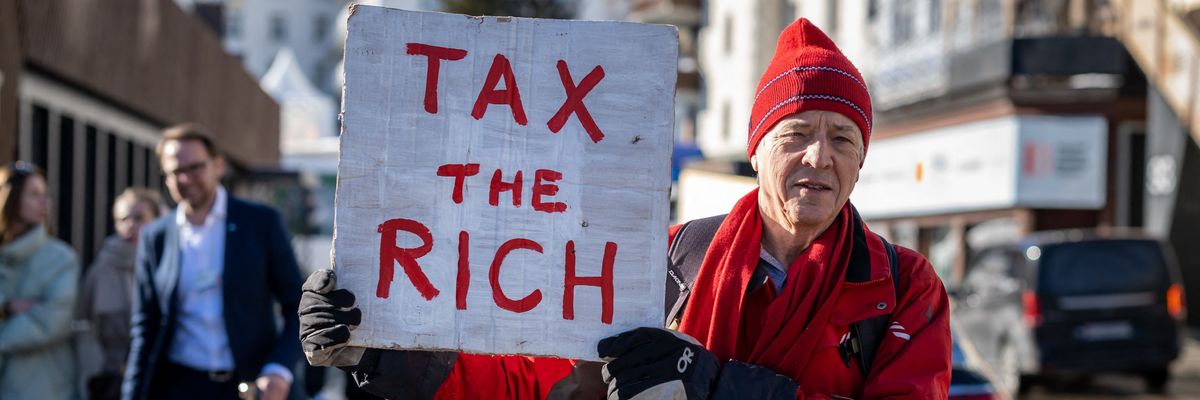
Phil White, a British millionaire poses with a placard reading: "Tax the rich" next to the Congress centre during the World Economic Forum (WEF) annual meeting in Davos on January 18, 2023. - Tax me and tax people like me urges in an interview with AFP Phil White, a British millionaire present at the Davos forum, believing that wealth inequalities fragment the world.
(Photo by Fabrice COFFRINI / AFP via Getty Images)


Bob Lord
Apr 21, 2025
Inequality.org

What is the mission of the Washington, D.C.-based Tax Foundation? Even a quick review of the Tax Foundation’s output makes it perfectly plain: to help make average Americans see the richest among us as terribly overtaxed.

Hardly a Tax Foundation report goes by without one iteration or another of this overtaxed claim. Just last fall, the Tax Foundation produced a study that had billionaire Warren Buffett paying taxes at a rate of over 1,000 percent.

A few years back, early in the Biden years, I deconstructed another Tax Foundation claim, that the passage of tax changes the Biden White House was then pushing would leave the estate of a hypothetical taxpayer worth $100 million facing a tax rate of 61.1 percent. My response detailed the absurdity of that claim.

But what if that 61.1 percent had turned out to be an appropriate calculation? Would that 61.1 percent rate have really amounted to an oppressive tax levy? The Tax Foundation sure wants people to think so.

So let’s take a closer look at the Tax Foundation’s mythical ultra-rich taxpayer and let’s tweak the Tax Foundation’s hypothetical facts to make them just realistic enough to work with.

Suppose we assume our mythical taxpayer originally paid $1 million for the asset that ended up worth $100 million at her death 25 years later. That would leave $99 million of taxable gain. And a $1 million asset appreciating to $100 million after 25 years would have an average annual rate of return of 20.23 percent, a realistic rate for the sort of “home run investments” the ultra-rich actually make.

Let’s also ignore the exemption from federal estate tax — currently $14 million per individual, $28 million for a married couple — and treat the entire amount remaining from the $100 million after payment of income tax as subject to a 40 percent estate tax.

Applying the Tax Foundation’s methodology from that point, we would end up with a total effective tax rate just shy of 65.8 percent, nearly five percentage points higher than the 61.1 percent rate that had our friends at the Tax Foundation clutching their pearls. Wow! Sounds stunningly oppressive, huh?

Actually, no. The reason: The Tax Foundation’s presentation deceptively ignores the tax reduction magic of buy-hold for decades-sell, the tax loophole that causes the effective annual tax rate on the growth in the value of investments to decline as the rate of return and length of the holding period increase.

Our mythical taxpayer would be the quintessential beneficiary of this tax reduction magic. She would see her investment gains compound for 25 years without paying a nickel in income tax, all while her asset’s value was increasing by 20.23 percent per year.

The Tax Foundation, you see, makes quite the fuss over the one-time tax a mythical taxpayer’s estate would pay in the year of her death, but conveniently forgets about the taxpayer’s zero tax rate for the previous 25 years running.

That focus on a once-in-25-years tax payment ignores the full picture. To see that more clearly, consider the impact that a 65.8 percent tax would have on a mythical taxpayer’s overall investment return. At an after-tax annual rate of return of 15.18 percent, an asset with an initial value of $1 million will be worth $34.2 million in 25 years, exactly the amount left of the mythical taxpayer’s $100 million after her estate’s one-time tax payment of $65.8 million. That would be a 25 percent reduction in the pre-tax annual rate of return of 20.23 percent.

In other words, that supposedly onerous 65.8 percent tax at the time of the Tax Foundation’s mythical taxpayer’s death translates to an effective annual tax rate of just 25 percent.

Had the Tax Foundation’s mythical taxpayer been required to pay federal tax, covering both current income tax and future estate tax, at an annual rate of 25 percent on the growth in her investment’s value, and had she sold off just enough of the investment each year to pay the tax, her estate would be left with the same amount in the year of her death as it would have after paying the supposedly oppressive income and estate tax due under the terms of the Biden budget.

So, to review, the Tax Foundation concocted a hypothetical situation to show the proposals in Biden’s budget rated as extreme and oppressive. But even though that hypothetical is so concocted it couldn’t be found in the real-life situations of even the richest Americans, the supposedly oppressive one-time tax rate paid by the Tax Foundation’s mythical taxpayer translates to a modest effective annual tax rate of just 25 percent.

The bottom line: Once we take into account the impact of buy-hold for decades-sell, the tales of horror that apologists for the ultra-rich concoct to advocate against any meaningful tax increases on their deep-pocketed friends turn out to be not at all horrible.

Unless you’re horrified at the prospect of a reformed tax system that prevents the already obscene concentration of American wealth from becoming even worse.

This work is licensed under a Creative Commons Attribution-Share Alike 3.0 License.


Bob Lord
Bob Lord is Senior Advisor, Tax Policy at Patriotic Millionaires and an Institute for Policy Studies associate fellow.
Full Bio >
'Alarming' Report Shows Billions at Risk From Historically Low Snow Melt in Himalayas

"The steadily declining persistence of seasonal snow is a warning bell for an emerging water crisis," according to the report.


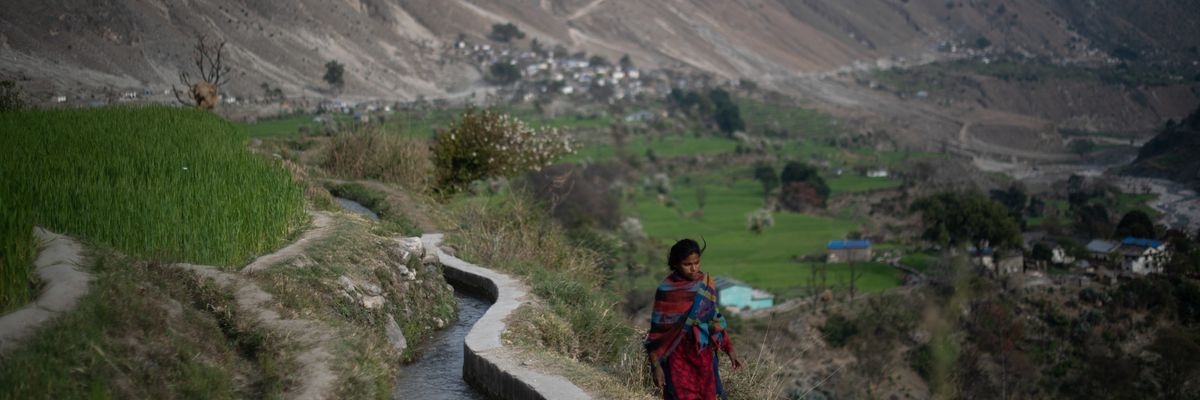
A Nepali child walks along an irrigation channel in Kolti town in the district of Bajura in Nepal.
(Photo: Rebecca Conway/Getty Images)


Eloise Goldsmith
Apr 21, 2025
COMMON DREAMS


A report released Monday found that snow persistence in the Hindu Kush Himalaya region, sometimes called the "third pole" because of its water resources, was at its lowest level in 23 years during the 2024-2025 winter, or 23.6% below normal—a concerning water security development for nearly two billion people who rely on river basins that are fed by the region's snowmelt.

All told, snowmelt from the Hindu Kush Himalaya (HKH) region contributes about a fourth of the total runoff of twelve major river basins in the region, on average. Snow persistence has been below normal across all twelve major river basins, per the report.

These findings come from the Hindu Kush Himalaya Snow Update, an annual report put out by the International Center for Integrated Mountain Development (ICIMOD), which provides yearly analysis of snow persistence in the region—the snow that usually stays on the ground between November and March.

"The steadily declining persistence of seasonal snow is a warning bell for an emerging water crisis," according to the author of the report. "Continuous deficit of meltwater from snow would mean lesser river runoff in dry months and early melt season, highlighting the urgent need for adaptive water resource management strategies in mitigating forthcoming impacts of water shortage, especially for downstream communities facing intensifying summer extremes."

The HKH region stretches multiple thousands of miles long across eight countries—Afghanistan, Bangladesh, Bhutan, China, India, Nepal, Myanmar and Pakistan—according GRID-Arendal, an environmental nonprofit based in Norway that works closely with the United Nations. It is the biggest volume of ice and snow outside of the Arctic and Antartica.

"While below-normal snow persistence has occurred before in this region—between 2003 and 2025 the region experienced thirteen below-normal snow years—the increasing frequency and intensity of such occurrences in recent times is a growing concern," according to the report. The 2024-2025 winter was the third consecutive year of below-normal snow persistence.

Sher Muhammad, a remote sending specialist at ICIMOD who was the lead expert for the report, said in a statement published Monday that the deficit situations occurring in continuous succession is an "alarming trend."

ICIMOD's director general Pema Gyamtsho highlighted the need for policy solutions to address the problem over the long term in a statement published on Monday. "Carbon emissions have already locked in an irreversible course of recurrent snow anomalies in the HKH," said Gyamtsho.

Rising temperatures and water scarcity in the region has already created climate refugees.

Research from ICIMOD published in 2023 found that glaciers in the HKH region are melting at an accelerated rate and could lose up to 80% of their volume by century's end absent ambitious action to slash planet-warming emissions.

In March, a United Nations agency found that, worldwide, 2022-2024 saw the largest three-year loss of glaciers on record.
The Rights of Nature: A Paradigm Shift for Environmental Protection

This revolutionary legal framework moves beyond traditional environmental laws and acknowledges that Nature itself has inherent rights, much like human beings and corporations.


Trees grow in Los Cedros Reserve in Ecuador.
(Photo: Diego Tirira/Wikipedia/CC BY-SA 2.0)

Natalia Greene
Apr 21, 2025
Common Dreams

For centuries, legal systems around the world have treated Nature as property—something to be owned, exploited, and managed for human benefit. This anthropocentric perspective has led to widespread environmental degradation, climate change, and biodiversity loss.

However, a revolutionary legal framework is emerging: the recognition of the Rights of Nature. This paradigm shift moves beyond traditional environmental laws and acknowledges that Nature itself has inherent rights, much like human beings and corporations.

The Rights of Nature concept is based on the idea that ecosystems and species are not mere objects but living entities with their own inherent rights to exist, thrive, and evolve. This legal framework challenges the prevailing notion that Nature is merely a resource for human use and instead recognizes its intrinsic value. By granting legal personhood to rivers, forests, and other natural entities, governments and courts can ensure that these ecosystems have standing in legal proceedings.

By shifting from an exploitative to a respectful relationship with the natural world, humanity can ensure a healthier planet for future generations.

The movement gained global attention when Ecuador became the first country to enshrine the Rights of Nature in its Constitution in 2008. The document states that Nature, or "Pachamama," has the right to exist and regenerate. Similarly, Bolivia passed the Law of Mother Earth in 2010, reinforcing Indigenous worldviews that see Nature as a living system with rights. Since then, countries such as New Zealand, Panama, India, and Colombia have also granted legal rights to specific ecosystems, setting legal precedents that continue to inspire the global community.

Why should we grant rights to Nature, you might ask? Traditional environmental laws often fail to prevent ecological destruction because they are based on regulation rather than protection. Corporations and governments can exploit loopholes, pay fines, or simply weigh the financial cost of pollution against profit margins. The Rights of Nature framework, however, fundamentally shifts the legal system from one of ownership to one of stewardship.

One of the most compelling cases for this approach is the Whanganui River in New Zealand. In 2017, the New Zealand government recognized the river as a legal entity, granting it the same rights and responsibilities as a person. This decision was made in collaboration with the Whanganui iwi, the Indigenous Māori people who have long regarded the river as an ancestor. Now, legal guardians, including representatives from both the government and the Māori community, speak on behalf of the river in legal matters. This recognition has already influenced policy decisions related to conservation and sustainable water management. Similarly, in 2017, the High Court of Uttarakhand in India granted legal rights to the Ganges and Yamuna rivers, acknowledging their sacred and ecological importance. Although this ruling faced legal challenges, it sparked important discussions about environmental governance and the need for stronger protections for vital ecosystems.

Despite these victories, the implementation of the Rights of Nature faces legal, political, and economic challenges. Many governments and corporations resist this shift, fearing restrictions on industrial activities. Additionally, enforcement mechanisms vary widely, and some legal rulings remain symbolic without proper institutional backing. However, the movement continues to gain momentum. Local communities, Indigenous groups, and environmental activists are advocating for the recognition of Nature's rights as a crucial tool for fighting climate change and biodiversity loss. In the United States, cities such as Pittsburgh and Toledo have passed local ordinances recognizing the rights of ecosystems, empowering communities to challenge environmental destruction more effectively.

Ecuador has witnessed several groundbreaking legal victories that affirm Nature's rights. Among these, the 2021 Constitutional Court ruling on Los Cedros Reserve was historic: The court halted mining exploration in this biodiversity hotspot, recognizing that the rights of the forest and its species, including endangered monkeys and orchids, outweighed extractive interests. Similarly, in Intag, a region long defended by local communities, legal actions based on behalf of endangered frogs and the Rights of Nature have helped suspend mining operations that threatened primary cloud forests and rivers vital to both people and ecosystems.

Another notable case is Estrellita, a woolly monkey rescued from illegal trafficking. When authorities attempted to relocate her to a zoo, a judge ruled in favor of her individual rights as part of Nature—marking the first time an animal in Ecuador was granted such recognition. These cases underscore the growing power of constitutional rights when applied to real-life conflicts between conservation and exploitation. They also reflect the tireless advocacy of Indigenous peoples, environmental defenders, and legal experts who are reshaping the legal landscape to center ecological integrity and the interconnectedness of all life.

The Rights of Nature framework is more than just a legal concept—it is a cultural and ethical transformation. By shifting from an exploitative to a respectful relationship with the natural world, humanity can ensure a healthier planet for future generations. As this movement grows, it is essential for policymakers, legal scholars, and citizens alike to support and advance this revolutionary approach to environmental protection.

The Global Alliance for the Rights of Nature (GARN) is a global network that has been at the forefront of the Earth Jurisprudence and Rights of Nature movement for the last 15 years, educating, upholding, and supporting its growth. With over 6,000 allies worldwide, GARN serves as a movement hub, connecting Indigenous leaders, civil society, lawyers, and advocates reshaping environmental governance.


Our work is licensed under Creative Commons (CC BY-NC-ND 3.0). Feel free to republish and share widely.


Natalia Greene
Natalia Greene is a prominent Ecuadorian activist and environmental leader, internationally recognized for her relentless efforts in defending the Rights of Nature and climate justice. She was one of the main advocates for the “Rights of Nature” concept, which in 2008 made Ecuador the first country in the world to include this principle in its Constitution, setting a global precedent in environmental law. Currently, Natalia serves as the global director of the Global Alliance for the Rights of Nature (GARN), an international network dedicated to promoting policies, legal frameworks, and collective actions that recognize and protect Nature as a rights-bearing entity. In this role, she leads efforts to strengthen local and global movements aimed at transforming humanity’s relationship with the environment into a more equitable, respectful model. She is the secretary of the International Rights of Nature Tribunal.

Full Bio >
Big Oil Is Abusing the Law to Silence Water Protectors; It Won’t Succeed

What to do? Stand our ground. Make the solutions. And keep working together.


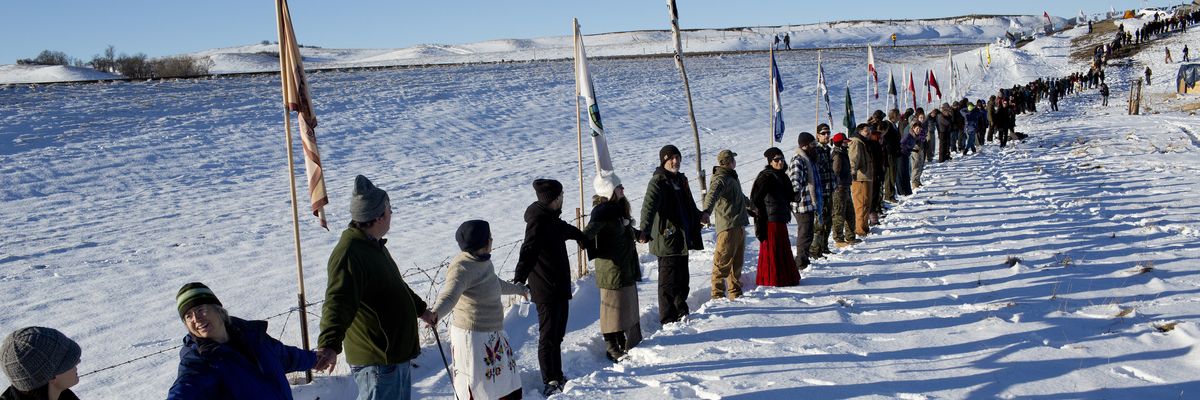
Water Protectors protest the Dakota Access Pipeline on December 4, 2016.
(Photo: Andrew Lichtenstein/Corbis via Getty Images)

Winona Laduke
Apr 21, 2025
Barn Raiser

This story was originally published by Barn Raiser, your independent source for rural and small town news.

The preamble for the next war over water is here. Aggressive corporations are coming after the few remaining pristine places on Mother Earth—mainly on the land of Indigenous people. Nowadays, it’s not just Native people being targeted, it’s our allies.

Last month, two separate court decisions highlighted the repression being leveled on our Water Protector allies.

On March 19, a jury in Mandan, North Dakota, in Morton County, leveled a blistering $660 million verdict against Greenpeace for its part in the Standing Rock resistance against the Dakota Access Pipeline (DAPL). Anyone who was at Standing Rock knows that Greenpeace was barely there, but they have a name, and Energy Transfer, the pipeline’s owner, made an example out of them. I was in the courtroom when the verdict came in. It was sickening.

When Energy Transfer sues people for so-called defamation, they send a clear message: If you stand up, you will be punished in a lawsuit.

On March 10, Marian Moore, a Water Protector who had participated at a gathering to pray for healing, had her charges reversed by a Minnesota Court of Appeals. Her story: Marian, 67, a long-human rights advocate and environmentalist, was the daughter of Paul Moore Jr., the Episcopal bishop of New York from 1972 to 1989 who had walked with Martin Luther King Jr. during the civil rights movement. In this century, Marian had been active in opposing Enbridge’s Line 3 pipeline, which crosses northern Minnesota, on its way from Calgary, Alberta, to Superior, Wisconsin, on lands that are subject to Native treaty rights and through waters full of wild rice, an essential food to the Anishinaabe.

On January 9, 2021, Moore was among the more than 100 Water Protectors who gathered on state Highway 169 for a prayer ceremony near a Line 3 construction site in Aitkin County. For that, she caught three charges, including trespass on critical infrastructure (a gross misdemeanor), unlawful assembly and, rather redundantly, presence at an unlawful assembly (both misdemeanors). I was a witness in her defense.

In November, 2023, an Aitkin County jury found her guilty of gross misdemeanors and sentenced her to six months in county jail, but with a stay of execution for nine months, allowing her to appeal. “I had to not trespass on any Enbridge property and be law-abiding, or I would be in Aitkin County jail for six months,” she explains to me.

Six months seems like a long time for someone who stood on a state highway to pray, looked at a construction site, and left once a dispersal order was given. “I think they targeted me because I was friends with Indigenous people and [was] bringing money to the movement against the pipeline,” says Marian.

Meanwhile out in Morton County, Greenpeace is getting socked with that ridiculous verdict. $660 million is a lot of money for some folks who were barely at Standing Rock. Aitkin County, Minnesota, and Morton County, North Dakota, are trying to teach a lesson; or, more appropriately, through these cases, corporations are trying to stifle resistance and discourage allies.
How Does This happen?

Welcome to the New Order, the one where corporations are now considered legal “persons,” protected by law enforcement and the judicial system as they press the law’s boundaries and extract precious resources.

The entire trial against Greenpeace was shameful.

Here’s how it went: The law firm Gibson Dunn carefully picked Mandan in Morton County, an oil-friendly jurisdiction where Judge James Gion denied most important motions made by Greenpeace. Four motions to change the venue from Mandan were denied. Gion would not let Greenpeace tell the jury of Energy Transfer’s terrible safety record. According to a report by Greenpeace and Waterkeeper Alliance, the Pipeline Hazardous and Materials Safety Administration (PHMSA) issued 106 safety violations to Energy Transfer and Sunoco between 2002 and 2018, including failures to conduct corrosion inspections, to maintain pipeline integrity, and to repair unsafe pipelines in a timely manner within five years.

What’s so sad is that the North Dakota jury couldn’t even stand up for the water, the land, and the people.

Greenpeace was not allowed to tell the jury that Energy Transfer’s identical federal lawsuit against Greenpeace was dismissed by a federal judge. The judge effectively limited defense evidence.

Gion would not allow live streaming, so if you wanted to “see justice” you had to go to Mandan. It’s said that justice is blind, and, in North Dakota, justice is literally blind and asleep. I saw jurors asleep while on duty in the court room.

“Greenpeace did not manipulate Standing Rock, but Energy Transfer has manipulated Morton County,” Janet Alkire, chairwoman of the Standing Rock Sioux Tribe, said in a statement shortly after the verdict.

As I drove toward Bismark from my own reservation, White Earth, a verse from the Rolling Stones’ “You Can’t Always Get What You Want” stuck in my head: I went down to the County Courthouse to get my share of abuse. At least that’s how I sing it. I’ve had my share. That’s what it’s like being on trial in the Deep North, especially if you’re a Water Protector.

The chances for a Native person to get justice in North Dakota or northern Minnesota are probably pretty small. Native people represent a third of the people in jail in Becker, Hubbard, and Aitkin counties. Yet, we represent only 5.2% of the population.

Standing Rock Tribal Chairwoman Alkire was appalled at the state of justice in Mandan:
I take offense to the jury verdict… We expect more from North Dakota judges and members of the jury from our neighboring communities… Neither Greenpeace nor anyone else paid or persuaded Standing Rock to oppose DAPL… Energy Transfer’s false and self-serving narrative that Greenpeace manipulated Standing Rock into protesting DAPL is patronizing and disrespectful to our people. We understand that many Morton County residents support the oil industry… But we are your neighbors, and you should not be fooled that easily.

The lawsuit against Greenpeace is called a SLAPP suit, or Strategic Litigation against Public Participation. It is intended to silence opposition. There are anti-SLAPP laws in 35 states, including Minnesota. Fundamentally, this is a question of free speech. When Energy Transfer sues people for so-called defamation, they send a clear message: If you stand up, you will be punished in a lawsuit.

“To me, this is a freedom of speech case and freedom of association case,” attorney Sarah Vogel, a onetime assistant U.S. attorney and former North Dakota agriculture commissioner, told the North Dakota Monitor before the case went to trial. Vogel, who grew up in Mandan, said, “As residents of a small state without a whole lot of power, we’d better be able to speak up. Who knows? I mean, this time, it’s Greenpeace, but who will it be next time?”

The case in Aitkin County was a little different but had some of the same premises. The idea that “outside agitators” came and did not do nice things was a theme. Greenpeace fits that narrative for Energy Transfer, and Marian Moore, who is a striking six feet two inches tall, does not quite look like a local gal.

Trey Cox is Energy Transfer’s lead attorney from Gibson Dunn (the same law firm that brought us the Chevron Donziger verdict). Cox kept referring to Water Protectors as outsiders and paid protesters. One might wonder, where Energy Transfer is from? Certainly not from Mandan. They are from Texas. Where was TigerSwan, the private security company hired by Energy Transfer from? North Carolina. And where was Frost Kennels, the company whose employees unleashed dogs on Water Protectors, from? Ohio. In other words, mercenaries.

In Minnesota, remember that Enbridge is a foreign corporation from Canada, with big swaths of pipeline networks across our north country, including aging pipes and the dirtiest oil in the world that poses a major threat to the Great Lakes, repository of a fifth of the world’s freshwater. Yet, Enbridge received priority policy protection in Minnesota during the Covid-19 pandemic and was allowed to bring in 4,300 people to build Line 3 as a part of “essential industry” in the state.

These companies also want to censure and erase any mentions of their abysmal safety records. Energy Transfer has a multitude of fines for spills, and Enbridge has the two largest oil spills on the U.S. mainland to its name. In the North Dakota trial, Greenpeace could not bring up Energy Transfer’s safety record, while in Aitkin County, the judge did not allow Marian Moore to say “treaty rights” or allude to the Minnesota case where Anishinaabe Water Protectors’ charges were dismissed in September 2023, based on the treaty and cultural beliefs, and “in the interests of justice.”
The Pipeline to Curtail First Amendment Rights

The Trump administration intends to further criminalize Water Protectors, and certainly protests in general. That much is clear. This is on top of the more than 300 anti-protest bills introduced in state legislatures since 2017, according to the International Center for Not-for-Profit Law, 54 of which have been enacted and currently undermine the First Amendment right to freedom of speech and assembly.

Moreover, over the past half-century, a dangerous doctrine of “qualified immunity” has been hatched up, underwritten by the Supreme Court, to limit the ability of individuals to hold police officers accountable for violating their constitutional rights. Qualified immunity basically gives officers expanding impunity to injure, or even kill, civilians like Water Protectors.

In April 2024, North Dakota Federal Judge Daniel Traynor dismissed Sophia Wilansky’s case against North Dakota law enforcement on the grounds that law enforcement had “qualified immunity.”

Greenpeace was inspired by a story called the Rainbow Warrior, where people of all colors would come together to protect Mother Earth.

A blast from an “explosive munition” was leveled at her in the early hours of November 21, 2016. Law enforcement had constructed a barricade across Backwater Bridge on North Dakota Highway 1806 to prevent unarmed Water Protectors, including Wilansky, from using the road. Morton County Deputy Jonathon Moll, had positioned himself on the turret of a Humvee and fired a flashbang grenade from his 12-gauge shotgun, hitting Wilansky, nearly severing her hand and destroying almost all of the arteries, skin, tissue, muscles, nerves, tendons, and bone in her left forearm. “At 21-years-old, I lost the use of my arm because a police officer shot me from a gun turret with an exploding grenade at a protest. My life will never be the same, but I will also not be scared away from fighting for what is right,” Wilansky said in a Civil Liberties Defense Center media release on April 6, 2024. An additional statement read: “The doctrine of Qualified Immunity is repulsive in that it allows police officers to… shoot protestors with anything they want without repercussions.”

Yes, there will be appeals. Marian Moore won on appeal. And a Greenpeace spokesperson told Barn Raiser the nonprofit will appeal the verdict, but the timing and process of the appeal has yet to be determined.

But what’s so sad is that the North Dakota jury couldn’t even stand up for the water, the land, and the people. Instead, that jury gave a Texas oil pipeline company, founded by Trump-supporting billionaire Kelcy Warren, everything it wanted and then some. That was shameful. And, without that appeals court, an Aitkin County jury would have been content to let Marian Moore sit in the slammer.

Marty Garbus is a trial attorney who has represented, among others, Nelson Mandela, Leonard Peltier, Daniel Ellsberg, Lenny Bruce, Elie Wiesel, Cesar Chavez, and Vaclav Havel. Garbus is also a member of the Energy Transfer v. Greenpeace Trial Monitoring Committee, a group that followed the trial day in and day out. Here is what he said when the jury returned its shameful verdict:
In my six decades of legal practice, I have never witnessed a trial as unfair as the one against Greenpeace that just ended in the courts of North Dakota. This is one of the most important cases in American history. The law that can come down in this case can affect any demonstration, religious or political. It’s far bigger than the environmental movement. Yet the court in North Dakota abdicated its sacred duty to conduct a fair and public trial and instead let Energy Transfer run roughshod over the rule of law.

Greenpeace has very strong case on appeal. I believe there is a good chance it ultimately will win both in court and in the court of public opinion.

What to do? Stand our ground. Make the solutions. And keep working together.

In Minnesota, we call ourselves the Home Team, and we are many colors. Marion and thousands of others told their stories and faced a lot of police for the sake of protecting water. I, for one, am grateful to them, and the new work underway by groups like Rise and Repair in Minnesota that does multi-racial organizing work around climate justice.

Weweg bi azhe giiwewag. The snow geese return.

There is greatness in the flocks of birds returning to these lands of water. Each year, they return and remind us of the life that is here, a life which needs water. I am reminded that’s who I work for. Greenpeace was inspired by a story called the Rainbow Warrior, where people of all colors would come together to protect Mother Earth. Critics say the story wasn’t a real prophecy, but I see it happening today. People of all colors coming together to protect Mother Earth is a good story for epic times. Thank you, allies.


Copyright 2024 by Barn Raising Media


Winona Laduke is Anishinaabe, a writer, an economist and a hemp farmer. LaDuke is a leader in cultural-based sustainable development strategies, renewable energy, sustainable food systems and Indigenous rights. She is the owner of Winona's Hemp, which can be found online at winonashemp.com.
Full Bio >
The 89%: New Media Collaboration Calls Attention to 'Climate Change's Silent Majority'

"If, in fact, a majority of people in your community care about climate change, and yet elected officials aren't responding to that, that's a deficit in democracy," one of the project's organizers said.


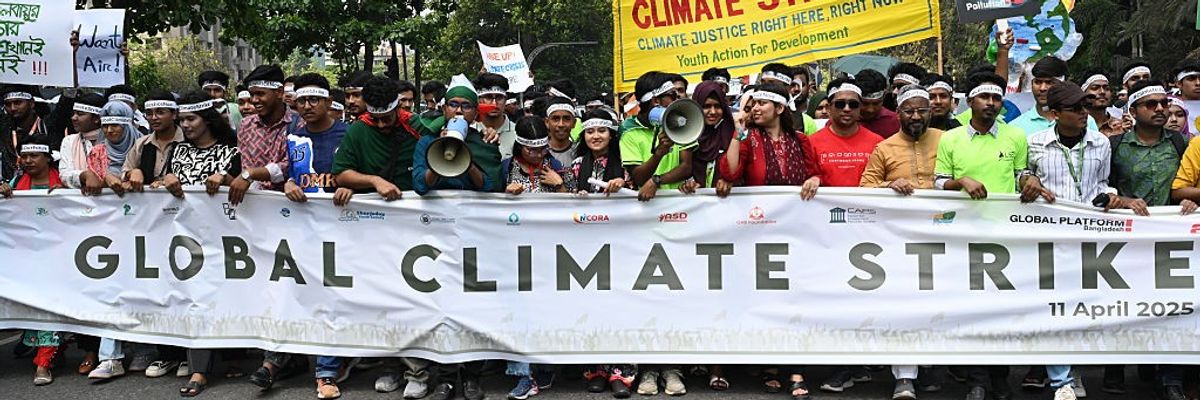
Climate activists and supporters displayed placards during a global climate strike rally, part of the Fridays for Future movement, in Dhaka, Bangladesh, on April 11, 2025.
(Photo: Mamunur Rashid/NurPhoto via Getty Images)


Olivia Rosane
Apr 21, 2025
COMMON DREAMS


According to a global survey, 89% of people worldwide want their government to do more to address the climate crisis, yet current national policies put the world on track for 3.1°C of warming.

To explore this disconnect, Covering Climate Now (CCNow) launched the 89% Project on Monday to encourage coverage of "climate change's silent majority" and ask some key questions.

"If, in fact, a majority of people in your community care about climate change, and yet elected officials aren't responding to that, that's a deficit in democracy," CCNow co-founder Kyle Pope told Common Dreams. "Why is that? What's to be done about it? Where do we go from here?"


'A Media Problem'

The 89% Project is designed as a yearlong initiative that kicks off with a joint week of coverage coinciding with Earth Day. Another week of coverage will take place in the fall in the leadup to the United Nations climate conference (COP30) in Belém, Brazil. In between, CCNow will host webinars and gatherings, promote the project on social media, and analyze the coverage to see what newsrooms are focusing on and what support they may need to continue telling climate stories going forward.

Already, major media outlets have signed on to participate, with The Guardian and Agence France-Presse acting as lead partners. Other core partners include The Nation, Rolling Stone, Scientific American, TIME, Canada's National Observer, Germany's Deutsche Welle, Italy's Corriere della Sera, Japan's Asahi Shimbun, and Arab Reporters for Investigative Journalism. However, media outlets don't need to sign up ahead of time in order to participate. They simply need to publish a story related to the 89% theme during the coverage week, include a logo and tagline with their article, and email their coverage to editors@coveringclimatenow.org.

CCNow encourages stories "focused on the people who comprise the 89%: Who are they? How do their numbers vary across countries, genders, and ages? What kinds of climate action do they want governments to take, and what are the main obstacles to such action?" its website explains.

"It's also for newsrooms to internalize and newsrooms to say, OK, our audience really cares about this. We can't silo it. We can't get distracted by other things."

The project builds on the work CCNow has been doing since it first broke onto the scene five years ago with a week of climate-focused coverage in September 2019 that generated some 3,400 pieces from over 300 partners. CCNow's emergence coincided with the apex of Greta Thunberg's Fridays for Future school strike movement and a growing awareness globally of the climate crisis and its stakes.

In the five years since, Pope said there has been a decline in outright "climate silence" from newsrooms, as well as "both-sidsing" the issue despite an overwhelming scientific consensus that the Earth is heating due to human activity. However, he has noticed a persistent pattern of "leaving climate out of stories where it should be." For example, the bulk of coverage of January's catastrophic Los Angeles wildfires did not mention climate.

The impetus for the 89% Project grew partly from frustration over hearing the same refrain from newsrooms.

"They kept telling us, oh, well, this is a topic that's really divisive. This is a topic that most people want to avoid. This is a topic that is very politically split. And then when we looked at data, surveys from all over the world, we kept seeing that that wasn't true, that in fact, a majority of the people on the planet care about this," he told Common Dreams.

The project was also inspired by a "confluence" of studies that emerged in 2024 finding that an "overwhelming majority" of people worldwide wanted climate action. These included the study that the 89% figure is drawn from, which was published in Nature Climate Change in February of 2024 and was based off of a Global Climate Change Survey included in the 2021-22 Gallup World Poll, which was administered to 129,902 people in 125 countries.

Another example CCNow held up was a U.S.-based survey, published in late January by the Yale Program on Climate Change Communication and George Mason University Center for Climate Change Communication and conducted after the November 2024 election, which found that more than 70% of registered U.S. voters favored climate policies such as regulating carbon dioxide as a pollutant, staying in the Paris agreement, and increasing solar and wind energy.

CCNow first began to discuss the 89% Project in the fall of 2024 and announced it publicly in late January.

The primary goal, according to Pope, is to encourage the mainstream newsrooms to change their thinking around whether or not their audience wants to hear climate stories.

"Our orientation is, we look at everything from a media point of view, and we sort of saw it as a media problem," Pope said.

He hopes newsrooms will learn the importance of maintaining climate coverage even as other breaking stories demand their attention.

"It's also for newsrooms to internalize and newsrooms to say, OK, our audience really cares about this. We can't silo it. We can't get distracted by other things," he explained.
Pluralistic Ignorance

While the 89% Project is aimed at convincing media organizations that their audiences want climate coverage, another goal is to make those audiences aware of each other.

"One of the really remarkable things about this polling is the 89% doesn't think they're in the majority," Pope said. "They think that their concern about climate makes them an outlier. That's not true. You're not an outlier. You're just like most people in your community."

For example, the 89% study also found that 69% of people would be willing to give 1% of their monthly household income to help combat climate change, yet they only thought 43% of their fellow citizens would be willing to do the same.

"Almost everybody dramatically underestimates the level of concern and support for action on climate change."

Anthony Leiserowitz, who directs the Yale Program on Climate Change Communication, told Common Dreams that the academic term for this is "pluralistic ignorance."

"It basically refers to the fact that most of us don't know what's in other people's heads," he said, whether this is family members, strangers we've just met, or the larger groups of people with whom we share a country and planet.

"What we see consistently," he continued, "and this is true across the board, of the general public as well as people in Congress, and news editors, and corporate leaders, and on and on, is that almost everybody dramatically underestimates the level of concern and support for action on climate change."

What the 89% Project has the chance to do, Leiserowitz said, "'is to actually help hold a mirror up to society and help them see themselves."

In a way, the project is fulfilling a hope laid out by the paper's authors.

"Importantly, these systematic perception gaps can form an obstacle to climate action," the study authors wrote. "The prevailing pessimism regarding others' support for climate action can deter individuals from engaging in climate action, thereby confirming the negative beliefs held by others. Therefore, our results suggest a potentially powerful intervention, that is, a concerted political and communicative effort to correct these misperceptions."

And Leiserowitz said he thought it was important that the media step up to make this effort.

"The media is one of the primary ways that anybody who knows about, learns about, becomes engaged with this issue," he said. "Most people are not going out and reading the [Intergovernmental Panel on Climate Change] report on their own or conducting climate science experiments in their backyard. That's not how they're going to learn about it."

Therefore, he said, CCNow's effort to "really encourage and build a community of practice around reporting on climate change is super, super important. The world cannot deal with this issue unless we're talking about it."
Democracy Deficit

Another potential consequence of making the 89% aware of each other is making them aware of the extent to which their political leaders are failing to represent them.

Pope anticipated the coverage might prompt readers to think: "Maybe we should all start questioning our elected officials more. Why aren't you taking climate into account? If we all believe in this, why aren't you doing this?"

The 89% Project is global in scope—and Pope said it was not motivated by the victory of climate-denying President Donald Trump in the November 2024 U.S. election.

"Americans have been growing increasingly concerned and even alarmed about climate change over the past decade. So nobody was voting for this."

However, Pope said, the project did become "more urgent as this new administration has taken a hold and has really gone on the attack on climate policy."

One thing coverage may bring out is the gap between U.S. public opinion and Trump actions such as withdrawing from the Paris agreement, declaring an energy emergency to encourage more oil and gas drilling, gutting environmental regulations, and defunding climate science.

Pointing to Yale's post-election survey cited by CCNow, Leiserowitz said, "This is not what people want."

"It's pretty clear this election was not a referendum on climate change," he added. "Americans have been growing increasingly concerned and even alarmed about climate change over the past decade. So nobody was voting for this."

While Pope acknowledged that "U.S. politics right now toward climate are particularly odious," about half CCNow's collaborators are based in other countries, and they also report a false assumption that climate action is more controversial than the data suggests.

"This general idea that this is a divisive issue, that it's a hot-button topic, that it's something that our audience finds political, those themes you see over and over again," he said.

In the U.S. under Trump, but in other countries as well, the democracy deficit between public opinion and government action goes hand-in-hand with a government attack on democratic freedoms to call for climate action. Trump has also targeted members of the press for their reporting decisions, such as banningThe Associated Press from White House briefings over its refusal to refer to the Gulf of Mexico as the Gulf of America in its style guide.

Pope said that running joint coverage weeks was a good way to encourage newsroom collaboration amid tight resources. Could there also be safety in numbers against government repression?

Pope said that a unified front was harder to attack, though he noted that climate journalists have faced threats and social media trolling for years, and that the Trump administration was likely to continue those attacks regardless. However, he urged against panic.

"I think one of the reasons that the 89% framing is appealing to us is it's not a fear-based idea," he said. "In fact, it's the opposite. It's like we're all in this together, and a lot of us, not just people in the climate movement, not just people who work in this area, but a lot of just our neighbors really care about this. So let's not cower."

This story is part of The 89 Percent Project, an initiative of the global journalism collaboration Covering Climate Now.