Monday, April 21, 2025

EPA Deletes Pollution Tracking Tools as It Offers Exemptions to Polluters

A new lawsuit is challenging the Trump administration’s removal of environmental justice maps and datasets.
April 19, 2025

Marti Blake looks out her front window at the smokestack of the Cheswick coal-fired power plant in Springdale, Pennsylvania, on October 27, 2017. Blake says the amount of sulfur dioxide, nitrogen oxide and coal particles originating from the plant has impacted her health as well as those in the surrounding area.
Robert Nickelsberg / Getty Images

Despite the self-imposed chaos disrupting the federal government, public health watchdogs say the Trump administration’s strategy for axing pollution protections on behalf of its allies in wealthy industries is more sophisticated than what was seen during the president’s first term. Advocates for communities overburdened by industrial pollution and the impacts of climate change say years of progress toward cleaner air, water and corporate accountability are at stake.

Under orders from President Donald Trump, Environmental Protection Agency (EPA) Administrator Lee Zeldin is simultaneously moving to rescind Biden-era rules meant to protect the public from toxic pollution while inviting hundreds of petrochemical manufacturers and the dirtiest coal-burning power plants to apply for sweeping “presidential exemptions” from meeting updated pollution limits for up to two years, after which they can be renewed.

Handing out regulatory exemptions to polluters provides the Trump EPA time to dismantle years of regulatory work toward limiting emissions of hazardous toxins such as mercury and cancer-causing benzene before private companies face requirements to invest in pollution controls that protect public health

Meanwhile, the Trump administration has made it harder for regulators, policy makers, advocacy groups and residents living in the shadow of industry to track health threats from pollution and examine local impacts of energy, infrastructure and disaster relief policies by deleting key datasets and interactive maps from federal agency websites.

“No joke, they are trying to erase the [connection] between pollution and its outcomes on the ground,” said Jane Williams, executive director of the California Communities Against Toxics (CCAT), in an interview. “It’s a very concerted effort by big industry, and it’s not just at EPA, it’s at the Centers for Disease Control and the Department of Health and Human Services too.”

Related Story
Former EPA Employees Warn of Polluted Skies Ahead Under Trump
The vast majority of voters want a strong EPA, but Trump is laying the agency to waste.
By Mike Ludwig , Truthout March 21, 2025


On April 14, CCAT and multiple watchdog groups filed a lawsuit in federal court challenging the removal of multiple online datasets and webtools, including EPA’s EJScreen, an interactive environmental justice mapping tool that allowed the public to analyze the impact of specific pollutants on local areas alongside demographic information. Public health groups scraped EJScreen data to recreate the tool on separate websites, but without fresh data from the EPA, the map will soon become outdated.

Since 2015, watchdog groups along with concerned residents, academics, environmental activists and regulators have used EJScreen to examine and confront environmental racism in areas where Black, Brown and lower-income communities have long been overburdened by pollution and outdated infrastructure. EPA used the tool to prioritize grants and enforcement resources for underserved communities in need of relief.

The Trump administration also deleted the Council on Environmental Quality’s Climate and Environmental Justice Screening Tool (CEJST), which the Biden administration set up to map out areas vulnerable to pollution and climate impacts such as flooding and wildfires. The webtool was created under an executive order signed by President Joe Biden that pledged to direct 40 percent of benefits from federal climate investments to underserved communities but was quickly rescinded by Trump. Both EJScreen and CEJST were used extensively by policy makers, academics, journalists and environmental justice activists fighting pollution in their own backyards, according to the lawsuit.

The lawsuit also challenges the removal of Department of Energy’s Low-Income Energy Affordability Data Tool and Community Benefits Plan Map, used for illustrating inequities in home energy costs and availability; the Department of Transportation’s Equitable Transportation Community Explorer that mapped out access to various modes of transport; and the Federal Emergency Management Agency’s Future Risk Index, which tracked the risk of natural disasters across the country.

The webtools and the data behind them helped watchdogs protect public health when the government fell short, the lawsuit argues. For example, the Union of Concerned Scientists, one of the plaintiffs in the lawsuit, used the data tools to investigate commercial sterilizers that emit ethylene oxide, an invisible gas that causes cancer and acute respiratory disorders. The group found that companies sterilizing medical equipment and dried food products in the U.S. are disproportionately polluting Black and Brown neighborhoods, low-income areas and non-English language speaking communities.

On April 16, news outlets Grist and El Paso Matters published a joint investigation into the dangers posed by ethylene oxide leaking from sterilization warehouses that operate near residential areas across the country.

Gretchen Goldman, president of the Union of Concerned Scientists, said the public has a right to access data and webtools that were funded by taxpayers.

“From vital information for communities about their exposure to harmful pollution, to data that help local governments build resilience to extreme weather events, the public deserves access to federal datasets,” Goldman said in a statement this week. “Removing government datasets is tantamount to theft.”

The lawsuit challenges the removal of the data sets and webtools under longstanding federal laws that require agencies to notify the public before making regulatory changes or cutting off access to major sources of public information on what the government does.

Under Trump’s flurry of executive orders, federal agencies have also deleted references to “climate change,” “environmental justice” and diversity initiatives from federal agencies websites. While critics argue some of the language and initiatives scrubbed from the internet were more of a window dressing than real-world reforms, plenty of critical public health information was lost in the mix.

Williams said EJScreen in particular was a vital tool for advocates pushing for tougher pollution protections during the Biden and Obama administrations, when environmental groups spent years in courtrooms and regulatory hearings fighting for more resources for communities overburdened by toxins. Williams likened the Trump administration’s censorship to “book burning.”

“[EJScreen] gives the government tools to say, these are the most impacted communities, so where do we focus enforcement and resources,” Williams said. “When you wipe out the tools, and you wipe out the ability for government to do stuff like that, you permanently enshrine an underclass…preventing them from knowing or doing anything about the situation, or the government.”

Asked whether public access to the data and tools would be restored after content edits to comply with Trump’s executive orders, an EPA spokesperson said the agency was unable to comment on pending litigation.

“EPA is working to diligently implement President Trump’s executive orders, including the ‘Ending Radical and Wasteful Government DEI Programs and Preferencing,’ as well as subsequent associated implementation memos,” the spokesperson said in an email.

While it took down environmental justice maps and datasets, the EPA published a new webpage inviting fossil fuel and chemical companies to apply for presidential exemptions to pollution limits. Historically, such exemptions are issued in rare cases when the necessary pollution control technology is not available, and compliance would pose a threat to national security, according to Grace Smith, a senior attorney at the Environmental Defense Fund.

“This exemption is really meant for one-off circumstances,” Smith told the Environmental Defense Fund’s outlet Vital Signs.

Dubbed the “polluters’ portal” by critics, the EPA recently set up a new webpage with step-by-step instructions to apply for two-year waivers from nine major EPA pollution protections that Williams and other advocates spent years fighting to put in place. The rules include tougher limits on dangerous pollution from smokestacks and chemical plants, new emission standards for cars and trucks for reducing asthma and lung disease, and a historic rule designed to update water systems and protect children from lead in drinking water. At least 530 industrial facilities are eligible to apply for the exemptions, according to the Environmental Defense Fund.

The EPA quietly announced that a list of nearly 70 aging coal-burning power plants received a presidential exemption from rules requiring reductions of harmful pollutants including mercury, arsenic, benzene and fine particulate matter that lodges in human lungs. Trump signed a “presidential proclamation” on April 8 granting the coal plants the exemption, part of a larger but vague plan to bring back a dying industry responsible for climate-warming air pollution and waste pits that contaminate groundwater.

Technology for removing pollutants from smokestacks has existed for years, but aging coal plants, mostly in red states, have dragged their feet and are now considered among the dirtiest sources of power in the nation. Thanks to the availability of cheap fracked gas, utilities would likely shutter the plants before installing pollution controls. With the exemptions, Trump is once again gleefully throwing the coal industry a lifeline.

Additionally, the American Chemistry Council and the American Fuel & Petrochemical Manufacturers, two industry groups representing hundreds of oil and gas refineries and chemical plants, are reportedly seeking a blanket exemption for more than 200 facilities from historic EPA rules designed to limit emissions of toxic pollutants such as ethylene oxide and chloroprene, which are both linked to an increased risk of cancer.

Residents and activists living near these facilities fought for the limits on ethylene oxide and chloroprene for years, and activists in Louisiana’s infamous “Cancer Alley” celebrated a victory when the EPA announced the final standards in 2024. The Mississippi River corridor between Baton Rouge and Louisiana is packed with petrochemical plants built around historically Black communities dating back to the end of slavery. An investigation by ProPublica found that in certain areas of Cancer Alley the risk of developing cancer is 47 times higher than what the EPA deems acceptable.

One of the plants covered by the new pollution limits operates near a majority-Black elementary school in Reserve, Louisiana. After years of protests and litigation over pollution and elevated cancer rates, the EPA filed a historic civil rights lawsuit in 2023 alleging the company is exposing the surrounding majority-Black community to an unacceptable risk of cancer.

Last month, the Trump administration dropped the landmark lawsuit against Denka. The local school board voted to shut down the elementary school and move it away from the Denka plant last year. Williams now wonders if the school will have enough funding for the move now that the Trump administration is attempting to dismantle the Department of Education.

“How does everything that happened in the last 100 days affect those kids who go to that school?” Williams said, adding that the Trump administration has also undermined voting rights and federal efforts to support disadvantaged public school students.

Besides the coal plants already approved by presidential proclamation, the EPA has not made requests for exemptions from its pollution rules public, according to the Environmental Defense Fund. The group says it filed a Freedom of Information Act request for all records related to the EPA exemption portal, including the names of companies, and pledges to take the matter to court if necessary.

“With this invitation to apply for exemptions, they have opened it up in a way where you can tell that they will be rubber stamping whatever comes their way,” Smith said.
WHITE CHRISTIAN NATIONALIST TERRORIST

Trumpism echoes right-wing 'outlaw' Timothy McVeigh — 30 years after the OK bombing


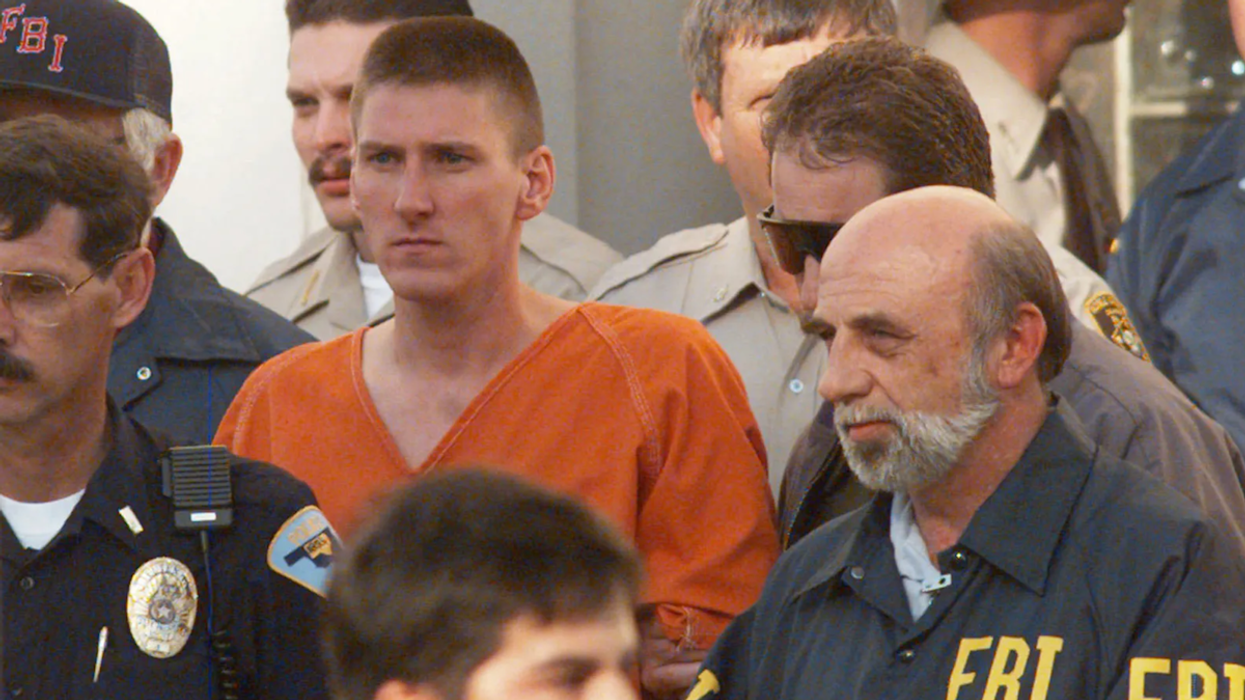
Timothy McVeigh leaves the courthouse in Oklahoma, April 21, 1995. David Longstreath/AAP

April 17, 2025

This week, it will be 30 years since the Oklahoma bombing.

On the morning of April 19 1995, anti-government right-wing extremist Timothy McVeigh parked a Ryder truck loaded with 5,000 pounds of agricultural fertilizer and diesel fuel at the front of the Alfred P. Murrah Federal Building in Oklahoma City. At 9am, McVeigh lit two separate fuses – in case one failed. Two minutes later, the bomb exploded, killing 168 people (including 19 children) and injuring close to 700.

Today, the bombing remains the deadliest act of domestic terrorism in United States history. But in the cultural memory, Oklahoma was eclipsed by 9/11, when America – and the world – shifted their attention to the threat posed by radical Islamic extremism.

Three decades on, the bombing is back on the cultural agenda, as the right-wing extremism that drove McVeigh is on the rise.

In 2025, the threat from US-based violent extremists is believed to be “high”, according to the Department of Homeland Security. Domestic terrorist attacks and plots against government targets motivated by partisan political beliefs nearly tripled in the five years before last – compared to the previous 25 years combined.

New and recent chronicles of the Oklahoma bombing are not just a reflection on the past, but a warning about the future.

A right-wing ‘outlaw’

In his award-winning book about the bombing, Homegrown (2023), US lawyer and journalist Jeffrey Toobin writes:
In the thirty years since the Oklahoma City bombing, the country took an extraordinary journey – from nearly universal horror at the action of a right-wing extremist [McVeigh] to wide embrace of a president who reflected the bomber’s values.

Toobin draws ominous parallels between his subject’s political motivations, and the values and views of the January 6 insurrectionists.

McVeigh, a Gulf War veteran and gun-rights absolutist, always claimed he bombed the Murrah building to protest the “abuses and usurpations” of Bill Clinton’s government.

He specifically mentioned two infamous armed confrontations between extremists and the federal government. One was the 1992 standoff between FBI agents and white separatists at Ruby Ridge, which resulted in three deaths, including the killing of a 14-year-old boy. A year later, more than 75 people died in Waco, Texas, after a shootout and 51-day siege between the FBI and an apocalyptic religious sect, the Branch Davidians.

McVeigh was also mobilised by Clinton’s 1994 ban of assault weapons, which he and other conservatives believed was a violation of the Second Amendment. The assault ban was the final straw.

“When the guns are outlawed”, McVeigh wrote in a letter, “I become an outlaw.”

One of his strongest influences – and a constant companion – was The Turner Diaries, a 1978 novel sometimes referred to as “the bible of the racist right”. In it, a white nationalist destroys a FBI building in Washington with a truck bomb, and the US becomes engaged in a nuclear civil war. McVeigh read the book during his army training and sold copies at gun shows.

His embrace of violence as a justified response to political grievances is reflected in the rhetoric of Trump’s presidency, argues Toobin – most famously, Trump’s January 6 speech, when he exhorted his supporters to march on Congress and “fight like Hell”.
All the trends that McVeigh embodied – the political extremism, the obsession with gun rights, the search for like-minded allies, and above all, the embrace of violence – came together under the 45th president.


When choosing a date for the bombing, McVeigh deliberately opted for April 19: the second anniversary of Waco and the date of the Battles of Lexington and Concord, which marked the start of the American War of Independence. Like McVeigh, the rioters who stormed the Capitol saw “the rebellion” as akin to the revolutionary struggle of the Founding Fathers. They, too, believed violence was necessary to achieve their goals.

In this way, Toobin argues, McVeigh represents an early prototype of the aggrieved Trump voter. The actions of McVeigh and some Trump supporters belong to “a long tradition of gun-obsessed, antidemocratic, violence-fueled extremism”.

The only difference is, Trump’s extremist ideas have become mainstream.

McVeigh and the MAGA movement

A new docudrama, McVeigh, released last month in American cinemas, is a responsible account of McVeigh’s alienation and hostility, and a brooding rumination on the complex interaction of factors that led to his radicalization.

With great restraint, director Mike Ott avoids the sensationalism one might expect.

In McVeigh, the bombing itself is never depicted. Instead, the narrative follows the weeks leading up to the attack, slowly tracking McVeigh’s assemblage of the bomb with his accomplice, Terry Nichols, an old army friend.

Silence, in this sense, is the film’s modus operandi.


In an early scene, McVeigh (played by Alfie Allen) points a pistol at the television, miming the execution of former US Attorney General Janet Reno as she testifies at the Waco hearing.

In the film’s closing moments, we see McVeigh in his truck on the morning of the bombing, waiting patiently for the red light to change.

McVeigh and Nichols speak in gruff monosyllables, their coded communications allowing the pair to hide “in plain sight”. This makes their plans difficult to decipher, though we know how the story ends.

The film has been criticised as a missed opportunity to critically examine the machinery that radicalised McVeigh. But the understated – and at times, excruciatingly dull – representation of events is the very point. Conspiratorial thinking is invisible, and the descent into violent extremism is marked by moments of mundane horror and aimlessness.

We can’t pinpoint the exact moment when McVeigh decides to commit to the attack, nor do we know how it could have been prevented.

But propelled by what one former mentor called his “right-wing, survivalist, paramilitary-type philosophy”, McVeigh can easily be read as a man who is trying to “make America great again”.

In this respect, the slow burn creates an ominous atmosphere as the film drifts toward its inevitable conclusion. The film subtly conveys McVeigh’s rage at the government and, in particular, his pursuit of retribution for Ruby Ridge, Waco and the assault ban, as accelerating forces.


The myth of the ‘lone wolf’


Like Homegrown, McVeigh debunks the myth McVeigh was a lone wolf.

Instead of presenting McVeigh as an eccentric oddity or a freakish outsider, the film shows how he found community in both Elohim, a small religious community with white supremacist orientations, and on the gun show circuit, where he sold books, bumper stickers, guns and ammunition.

Indeed, McVeigh shared his plans for the bombing with others. Like Terry Nichols and his brother James, McVeigh was connected to the Michigan Militia, an armed paramilitary group that advocates for armed defence against federal overreach and perceived incursions on freedom.

“McVeigh may have thought of himself as a lone wolf”, writes Jason Burke, “but he was not one.”

In Homegrown, Toobin too exposes the role of Nichols, who remains in the federal supermax prison in Colorado, serving life without parole. He also exposes Michael Fortier (another army friend of McVeigh’s) and his wife Lori, who both knew about the plot but failed to warn authorities.

Importantly, given the rise of extremist parties and movements, both Homegrown and McVeigh make clear there is no single cause of radicalisation and no single pathway to becoming a violent extremist.

Interestingly, Toobin even suggests McVeigh became an incel before the term itself existed. He argues that in the absence of social media, McVeigh used letter writing to share his extremist views and recruit prospective allies.
Like the incels of a later day, McVeigh was unable to attract the sexual interest of women and responded with rage toward them […] his resentments against Blacks (for taking his job opportunities) and women (for denying him companionship) festered and grew.


McVeigh came of age before the modern internet, but as a teen he was intrigued by its early iteration in the mid-1980s. An amateur hacker, he even broke into a defense department computer using the code name “Wanderer”. Still, he was unable to access social media and other digital technologies, which explains, in part, why he was dismissed as a lone wolf unable to find his “pack”.

“I believe there is an army out there, ready to rise up, even though I never found it”, McVeigh told his lawyers.

Toobin believes if social media existed in the early 1990s, McVeigh would have been able to galvanise the army he yearned for. “More than any other reason”, Toobin concludes, “the internet accounts for the difference between McVeigh’s lonely crusade and the thousands who stormed the Capitol on January 6, 2021.”
McVeigh’s legacy

McVeigh was executed by lethal injection on June 11, 2001, exactly three months before 9/11.

He never showed remorse for his actions. He believed the bombing was a justified response to the “arrogance and oppressive power” of the Clinton government, and described the children he killed as “collateral damage”.

Before he was executed, McVeigh requested his ashes be scattered over the Oklahoma City National Memorial, on the site where the Murrah building once stood.

His defence lawyer and longtime friend, Rob Nigh, talked him out of the plan: “a kind of sneering double immortality for the bombing itself and for his return to the site for eternity”. Instead, McVeigh’s remains were released to the winds in the Rocky Mountains.

The decision, as Toobin notes, was a symbolic one:
By concluding his journey in this way, McVeigh would be everywhere. Where, in a way, he remains.


Kate Cantrell, Senior Lecturer – Writing, Editing, and Publishing, University of Southern Queensland

This article is republished from The Conversation under a Creative Commons license. Read the original article.
CULTUS STUDIES

Revealed: Mormon Church charts major expansion with secretive temples as controversy grows


The Mormon Tabernacle Choir in 2005 (Creative Commons)

April 20, 2025

The Church of Jesus Christ of Latter-day Saints has announced it will build 15 new temples in countries across the world, including one in Liverpool, New South Wales.

This follows a similar announcement last year of plans to build a second temple for Queensland, in South Brisbane.

The two new structures – together with existing temples in Sydney (1984), Adelaide (2000), Melbourne (2000), Perth (2001) and Brisbane (2003) – will bring the total number of Australian temples to seven.

In a nation with fewer than 160,000 practising Mormons, these new buildings seek to increase the legitimacy and visibility of the church.


The Melbourne temple was erected in 2000, as was the temple in Adelaide.
Wikimedia


The significance of temples

There are currently at least 200 completed Mormon temples around the globe, with an additional 182 under construction or announced.

Temples have a different purpose and scope to Mormon chapels, which are far more common: Australia has about 190 Mormon chapels.

Chapels are used for weekly sacrament (or communion) and weekly sermons. They are open to visitors, and often hold cultural events, extra church activities and family history centres.

Temples, on the other hand, represent the blending of the divine and temporal. According to the Mormon worldview and doctrines, they are the world’s most sacred structures.

Each temple is emblazoned with the phrase “The House of the Lord, Holiness to the Lord”. This isn’t just symbolic. Mormons believe each temple is literally the house of God, in which his presence may be felt.


Given the gravity of this belief, these spaces are reserved for those who have been deemed worthy to enter by Mormon leaders.

Inside the House of the Lord

The church itself maintains that temples are “sacred, not secret”. It has long worked to dispel speculation over what happens within temple bounds.

One way it does this is through “open houses”, in which a newly-built temple may be toured by anyone for a brief period. Once the open house has ended and the temple has been “dedicated” by a church leader – a process that includes blessing the building and those who will use it – it becomes entirely closed to the public.

Within the temples, the most sacred rituals and knowledge of “the gospel” are imparted upon faithful members. Rituals can be performed for both living people and deceased ancestors. They must never be conducted – or even discussed – outside the sacred temple space.

One of these rituals is baptism and confirmation for the dead by proxy (baptisms for the living are conducted in chapels or other spaces). This provides the deceased individuals “ordinances” that are necessary for salvation, which they did not receive during life.

These baptisms have been controversial at times, with ordinances performed on individuals who were not direct ancestors of Latter-day Saints, including Holocaust victims and historical figures such as Joseph Stalin and Adolf Hitler. Even prominent Australians such as Ned Kelly, Malcolm Fraser, Neville Bonner and Truganini have allegedly appeared as “baptised” in Mormon records.

Other temple ceremonies, conducted for both the dead and living, include washing and anointing with oil, “endowment” and “sealing”.

The rituals are accompanied by various stages of knowledge progression for attendees. As with the rituals, temple knowledge is not to be discussed outside.


Local opposition

The air of secrecy and exclusivity surrounding Mormon temples has resulted in a flood of negative attention from Australian media, other religious institutions and society at large. News reports from as far back as the early 20th century sought to expose “Mormon temple secrets”.

The first temple, built in Sydney in 1984, was widely protested by community groups and organisations. The building had to be modified by the church before it was eventually approved. A similar situation transpired in Brisbane in the early 2000s.

In other cities, such as Adelaide and Melbourne, temples were not directly protested, but were still critiqued for their lavishness, with the average Australian temple costing around A$8 million in the late 1990s/early 2000s.

Given the cost of living crisis, and contention over the place of religion in contemporary Australia, the two proposed temples will likely also face criticism.
Reputational management

The church’s reputation in Australia has become ever more complicated over the past 20 years, not least due to several controversies.

In 2022 and 2023, The Age and The Sydney Morning Herald reported the church was allegedly abusing tax laws, to the amount of hundreds of millions of dollars. This was addressed, but not confirmed or denied, in the November 2022 Senate Estimates by Australian Tax Office Second Commissioner Jeremy Hirschhorn, after questioning by Greens Senator David Shoebridge. Accusations of tax evasion have also been made in New Zealand and the United States.

Other controversies relate to LGBTQIA+ discrimination, the church’s influence in Australian and global politics, and allegations resulting from the Royal Commission into child sexual abuse.

The new Australian temples will be completed under a pall of critiques and accusations around church finances and other controversies. And while they might be briefly open to the public, their doors will just as quickly shut – adding more fuel to the speculation.

Brenton Griffin, Casual Lecturer and Tutor in History, Indigenous Studies, and Politics, Flinders University

This article is republished from The Conversation under a Creative Commons license. Read the original article.
Claims of ‘anti-Christian bias’ sound to some voters like a message about race


April 19, 2025

President Donald Trump and members of his administration have long used allegations of anti-Christian discrimination as a rallying cry for supporters, arguing that policies and laws on issues like school prayer and LGBTQ+ rights threaten Christians’ right to express their beliefs.

Weeks into his second term, Trump took action, signing an executive order on “Eradicating Anti-Christian Bias.” The order vowed to “protect the religious freedoms of Americans and end the anti-Christian weaponization of government” by identifying anti-Christian conduct and recommending policy changes. In mid-April, Secretary of State Marco Rubio instructed employees in the State Department to report any incidents of such bias that occurred during the Biden administration.

Many critics contest claims of widespread discrimination against Christians in U.S. society, given that Christians are the country’s largest faith group and benefit from associated privileges. Consider how Christmas is recognized as a federal holiday, whereas other faiths’ major holidays are not.

As social psychologists, we were curious who claims of anti-Christian bias appeal to, and how those claims are perceived

.
Hats for sale at a campaign rally for Donald Trump in Vandalia, Ohio,
 on March 16, 2024.  AP Photo/Jessie Wardarski

Our 2024 research, as well as other scholars’ work, suggests that people’s beliefs about anti-Christian discrimination are tied with their attitudes about race. These studies suggest that when politicians talk about anti-Christian bias, it does more than signal a concern and commitment to Christians – it can also serve as a signal of white solidarity.
A changing America

Even though they remain the largest religious and racial groups, white Americans and Christian Americans have both declined as a proportion of the U.S. population. Over the past two decades, the percentage of Christian Americans has decreased from 78% to 63%, and the percentage of white Americans has decreased from 69% to 60%. White Christians now account for less than 50% of the country.

Many scholars have argued that, at the root, some white and Christian Americans feel threatened by these demographic shifts. Increasing secularization and other cultural changes have added to some white Christians’ sense that their identity is under attack. According to FBI data, however, only 3% of hate crimes over the past five years targeted Christians. In comparison, 14% targeted Jews, Muslims or Sikhs – groups that make up just 3% of the population.

The Public Religion Research Institute found that 55% of white Americans believe discrimination against white people is as much of a problem as discrimination against minority groups. Meanwhile, 60% of white evangelicals say that Christians in the U.S. face discrimination.

In his executive order, Trump echoes these perceptions of threat, painting a picture of embattlement for Christians.

The executive order provides examples of charges brought against Christian pro-life protesters and alleges that Democrats failed to respond to attacks on churches. The executive order criticizes the Biden administration for policies that it says “force Christians to affirm radical transgender ideology against their faith,” including for potential foster parents.
Testing views

Historically, white people and Christians were often treated as the quintessential Americans – meaning race and religion are tightly connected in U.S. culture.

Sixty-two percent of white American adults identify as Christian, and 61% of American Christians identify as white
\
Marchers protest school integration in Little Rock, Ark., in 1959. One of their signs says ‘Please save our Christian America.
Bledsoe/Library of Congress/Interim Archives/Getty Images

In our four experiments, published in Psychological Science in March 2024, we tested these connections between views of race and religion, focusing on claims about anti-Christian bias.

First, in two online experiments of about 3,000 participants, we randomly assigned white and Black Christians to one of four groups. One group did not read anything, while the other three were each given a brief blurb about discrimination. Each blurb summarized a different group’s fears that bias against them was increasing: white Americans, Black Americans and Christian Americans.

Afterward, we asked all the participants to assess how much bias they think those groups actually face. Compared to white Christians who did not read anything, white Christians who read the blurb about anti-Christian bias perceived greater anti-white bias. Black Christians who read the blurb about anti-Christian bias, however, did not perceive greater anti-white bias than Black Christians who did not read anything.

Thus, it appears that the white Christians mentally linked anti-Christian and anti-white bias.

In our other two experiments, we randomly assigned about 1,000 white and Black Christians to read an interview excerpt from a fictional local politician who was asked about the most pressing issue in their community. The politician either voiced concern about anti-Christian bias, anti-white bias, religious freedom or the economy.
What are you worried about?
microgen/iStock via Getty Images Plus

Afterward, we asked participants several questions about the politician, including whether they thought this figure was liberal or conservative, and whether they thought this figure would be “concerned about bias against white people.” Black and white Christian respondents believed the politician who voiced concern about anti-Christian bias was also more likely to fight for the rights of white people, relative to the politician who discussed the economy.

We also asked participants whether they found the politician’s interview offensive. Both Black and white Christians viewed the message about anti-Christian bias as less offensive than the message about anti-white bias.

Importantly, these effects held regardless of whether participants believed the politician was conservative or liberal.

Taken together, these findings suggest that expressing concern for anti-Christian bias can be interpreted as signaling allegiance to white people – without the social cost of being accused of racism. Instead, allegations of anti-Christian bias can be presented in a positive way as issues of “religious freedom,” a core American value.

Whether intentionally or not, it seems that rallying around anti-Christian bias can serve as a “dog whistle” signaling support for people concerned about changes in America’s racial makeup, as well.

Rosemary (Marah) Al-Kire, Postdoctoral Research Associate, University of Washington; Clara L. Wilkins, Associate Professor of Psychology, University of Washington, and Michael Pasek, Assistant Professor of Psychology, University of Illinois Chicago

This article is republished from The Conversation under a Creative Commons license. Read the original article.
ALASKA

What you need to know with Mount Spurr likely to erupt


The Conversation
April 19, 2025


Volcanoes inspire awe with spectacular eruptions and incandescent rivers of lava, but often their deadliest hazard is what quietly falls from the sky.

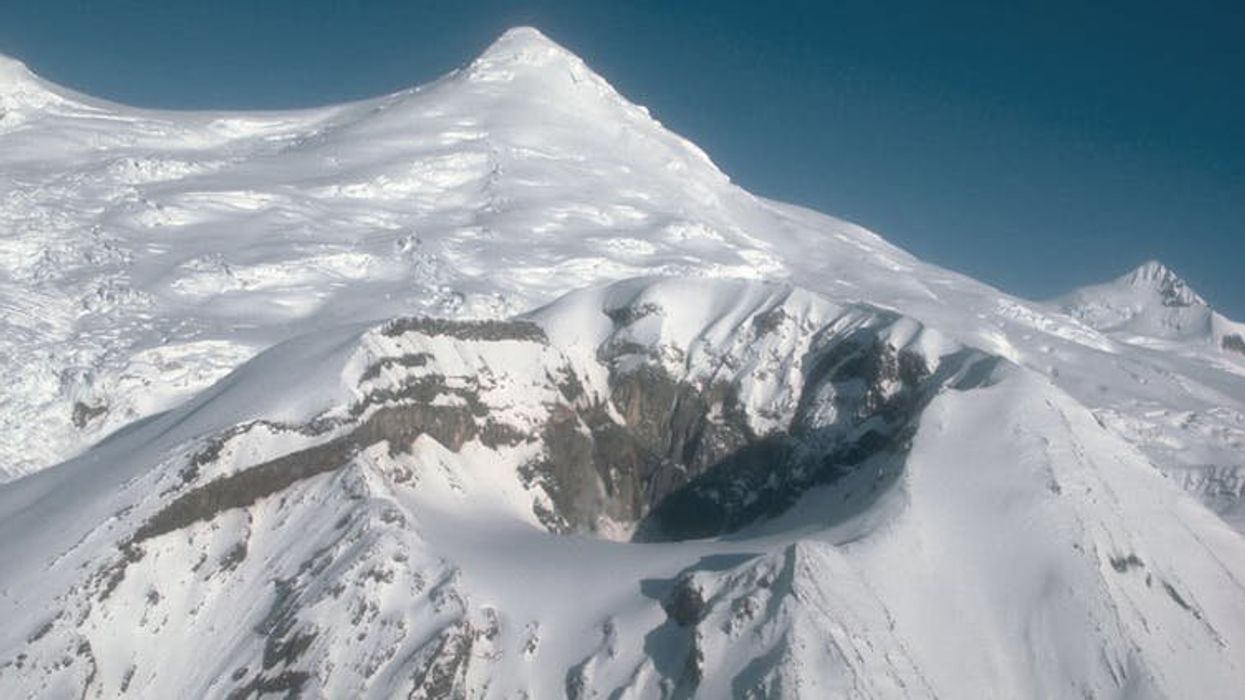
When a large volcano erupts, as Mount Spurr appears close to doing about 80 miles from Anchorage, Alaska, it can release enormous volumes of ash. Fine ash can infiltrate the lungs of people and animals who breathe it in, poison crops and disrupt aquatic life. Thick deposits of ash can collapse roofs, cripple utilities and disrupt transport networks.

Ash may lack the visual impact of flowing lava, but as a geologist who studies disasters, I’m aware that ash travels farther, lasts longer and leaves deep scars.


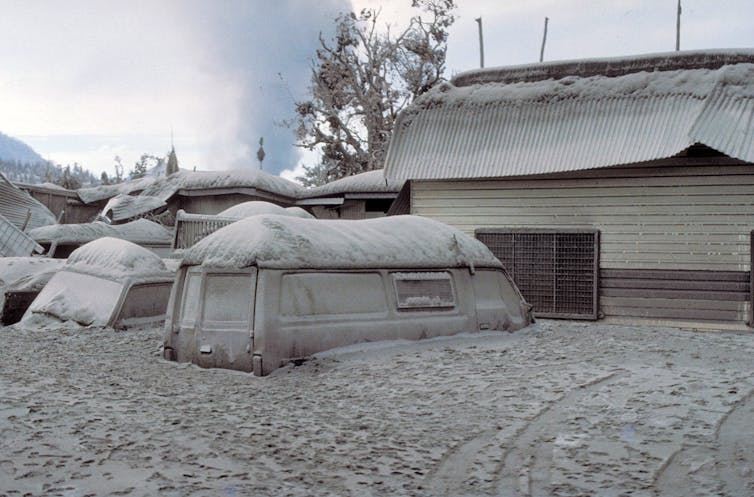
Ash buried cars and buildings after the 1984 eruption of Rabaul in Papua New Guinea.Volcano Hazards Program, U.S. Geological Survey

Volcanic ash: What it is, and why it matters

Volcanic ash forms when viscous magma – molten rock from deep beneath Earth’s surface – erupts, exploding into shards of rock, mineral and glass carried in a near-supersonic stream of hot gas.

Towering clouds of ash rise several miles into the atmosphere, where the ash is captured by high-altitude winds that can carry it hundreds or even thousands of miles.

As the volcanic ash settles back to Earth, it accumulates in layers that typically decrease in thickness with distance from the eruption source. Near the vent, the ash may be several feet deep, but communities farther away may see only a dusting.


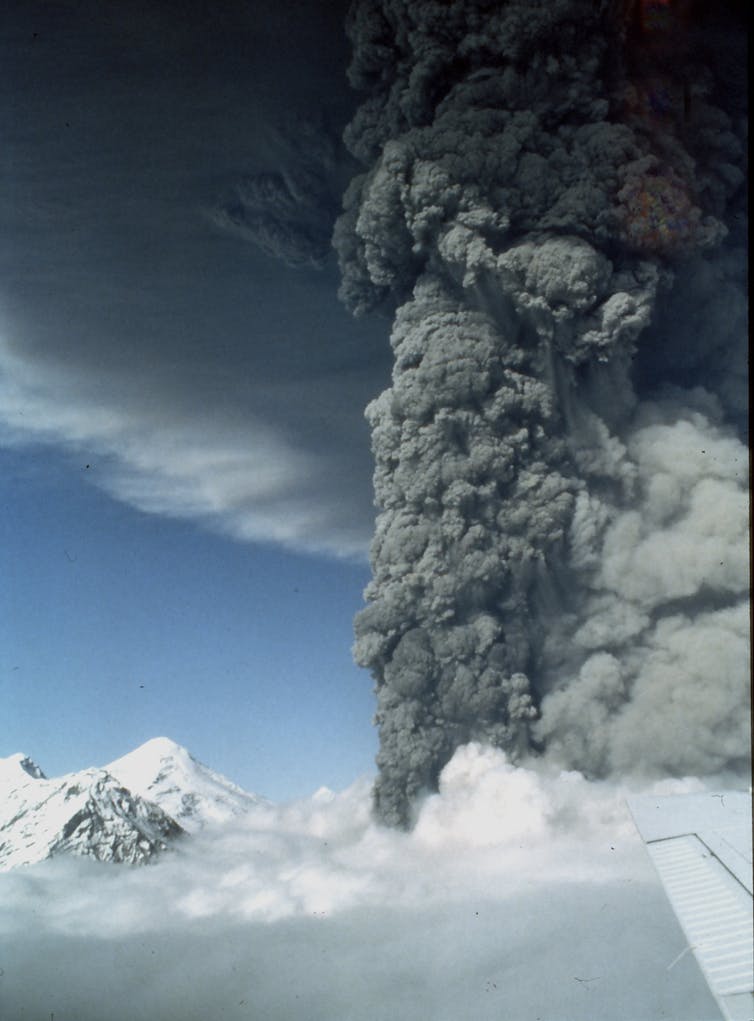
When Mount Spurr erupted in 1992, a dark column of ash and gas shot into the atmosphere from the volcano’s Crater Peak vent. Wind patterns determine where the ash will fall.U.S. Geological Survey


Breathing danger: Health risks from ash


Breathing volcanic ash can irritate the throat and lungs, trigger asthma attacks and aggravate chronic respiratory conditions such as COPD.

The finest particles pose the greatest risk because they can penetrate deep into the lungs and cause death by asphyxiation in the worst cases. Mild, short-term symptoms often resolve with rest. However, the long-term consequences of ash exposure can include silicosis, a lung disease and a possible cause of cancer.

The danger increases in dry regions where fallen ash can be kicked up into the air again by wind or human activity.


Risks to pets and livestock


Humans aren’t the only ones at risk. Animals experience similar respiratory symptoms to humans.

Domestic pets can develop respiratory distress, eye inflammation and paw irritation from exposure to ash

.
Ash covers sheep in Argentina after the 2011 Puyehue volcanic eruption in Chile.Federico Grosso/U.S. Geological Survey

Livestock face greater dangers. If grazing animals eat volcanic ash, it can damage their teeth, block their intestines and poison them.

During the 2010 Eyjafjallajökull eruption in Iceland, farmers were advised to shelter sheep and cattle because the ash contained fluoride concentrations above the recognized safety threshold of 400 parts per million. Animals that remained exposed became sick and some died

Harm to crops, soil and water


Soil and crops can also be damaged. Volcanic ash alters the acidity of soil and introduces harmful elements such as arsenic and sulfur into the environment.

While the ash can add nutrients such as potassium and phosphorus that enhance fertility, the immediate impact is mostly harmful.

Ash can smother crops, block sunlight and clog the tiny stomata, or pores, in leaves that allow plants to exchange gases with the atmosphere. It can also introduce toxins that render food unmarketable. Vegetables, fruit trees and vines are particularly vulnerable, but even sturdy cereals and grasses can die if ash remains on leaves or poisons emerging shoots.

Following the 1991 Mount Pinatubo eruption, vast tracts of farmland in central Luzon in the Philippines were rendered unproductive for years due to acidic ash and buried topsoil. If multiple ashfalls occur in a growing season, crop failure becomes a near certainty. It was the cause of a historic famine that followed the eruption of Mount Tambora in 1815

.
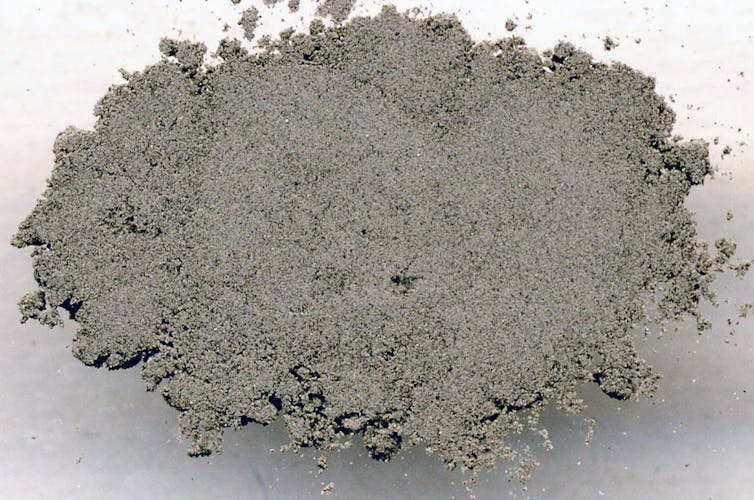
Ash from a 1953 eruption of Mount Spurr included very fine grains, like powder. The ash cloud reached about 70,000 feet high and left Anchorage under a blanket of ash up to a quarter-inch deep, according to a U.S. Geological Survey report at the time.James St. John via Wikimedia Commons


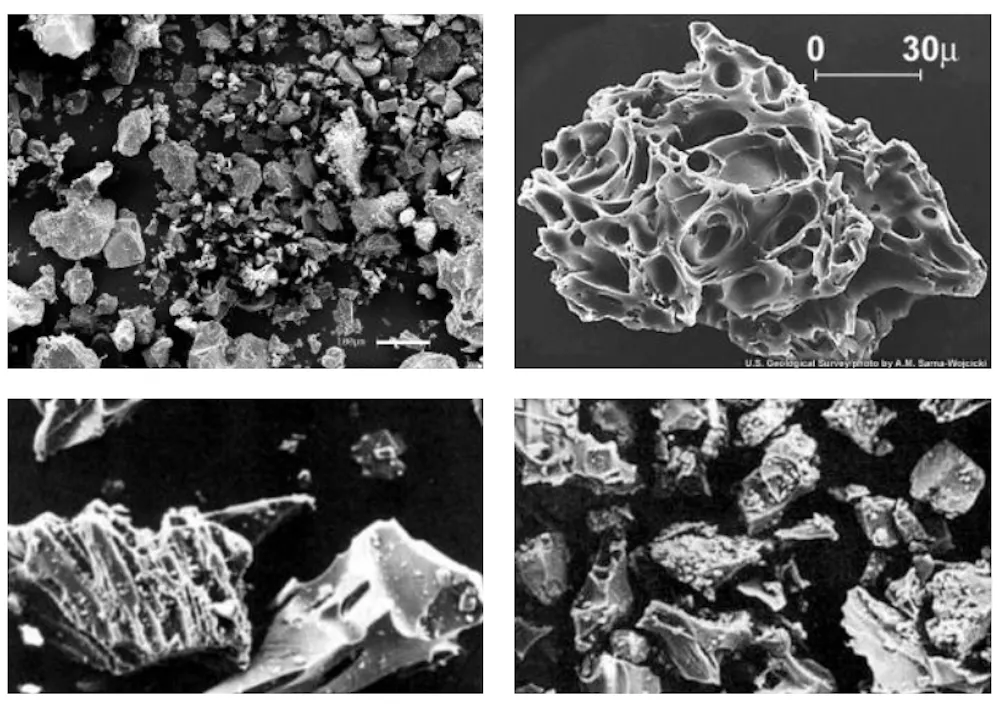
Electron microscope images of ash show how sharp the shards are. The top left image of shards from Mount Etna in 2002 is 1 mm across. Top right is an ash particle from Mount St. Helens magnified 200 times. The shards in the lower images are less than 0.064 mm.Volcano Hazards Program, U.S. Geological Survey

Ash can also contaminate surface water by introducing toxins and increasing the water’s acidity. The toxins can leach into groundwater, contaminating wells. Fine ash particles can also settle in waterways and smother aquatic plants and animals. During the 2008 Chaitén eruption in Chile, ash contamination led to widespread fish deaths in the Río Blanco.

Ash can ground airplanes, gum up infrastructure

Ash clouds are extremely dangerous to aircraft. The glassy ash particles melt when sucked into jet turbines, clog fuel systems and can stall engines in midair.

In 1982, British Airways Flight 9 lost power in all four engines after flying through an ash cloud. A similar incident occurred in 1989 to KLM Flight 867 over Alaska. In 2010, Iceland’s Eyjafjallajökull eruption grounded more than 100,000 flights across Europe, disrupting travel for over 10 million passengers and costing the global economy billions of dollars.

Volcanic ash can also wreak havoc on infrastructure by clogging water supplies, short-circuiting electrical systems and collapsing roofs under its weight. It can disrupt transportation, communication, rescue and power networks, as the 1991 eruption of Mount Pinatubo in the Philippines dramatically demonstrated.
What to do during ashfall

During an ashfall event, the most effective strategy to stay safe is to stay indoors as much as possible and avoid inhaling ash particles.

Anyone who must go outside should wear a properly fitted N95 or P2 mask. Cloth masks provide little protection against fine ash. Rainwater tanks, troughs and open wells should be covered and monitored for contamination. Livestock should be moved to clean pastures or given uncontaminated fodder.

The challenges Alaska is facing if Mount Spurr erupts.

To reduce structural damage, ash should be cleared from roofs and gutters promptly, especially before rainfall.

Older adults, children and people who are sick are at greatest risk, particularly those living in poorly ventilated homes. Rural communities that are dependent on agriculture and livestock are disproportionately affected by ashfall, as are low-income people who lack access to clean water, protective masks or safe shelter.

Communities can stay informed about ash risks through official alerts, including those from the Volcanic Ash Advisory Centers, which monitor ash dispersion and issue timely warnings. The International Volcanic Health Hazard Network also offers guidelines on personal protection, emergency planning and ash cleanup.
The long tail of ash

Volcanic ash may fall quietly, but its effects are widespread, persistent and potentially deadly. It poses a chronic threat to health, agriculture, infrastructure and aquatic systems.

Recognizing the risk is a crucial first step to protecting lives. Effective planning and public awareness can further help reduce the damage.

David Kitchen, Associate Professor of Geology, University of Richmond

This article is republished from The Conversation under a Creative Commons license. Read the original article.
Forget eggs: Behind the battle in Congress over milk


Photo by Providence Doucet on Unsplash

April 19, 2025


In 2010, United States lawmakers passed the Healthy, Hunger-Free Kids Act, which aimed to tackle both childhood obesity and hunger by making school meals more nutritious. Two years later, the Department of Agriculture updated its guidance for schools participating in the National School Lunch Program, or NSLP, in accordance with the law. Whereas schools could previously serve fat-free, 1 percent, 2 percent, or whole milk and be eligible for federal reimbursement, now they could only recoup meal costs if they ditched 2 percent and whole milk, which were thought to be too high in saturated fat for kids.

Representative Glenn “G.T.” Thompson has been on a mission to change that. The Republican legislator representing Pennsylvania’s 15th congressional district believes the 2010 law sparked a decline in students drinking milk across the board. “We have lost a generation of milk drinkers since whole milk was demonized and removed from schools,” he told a local agribusiness group in 2021.

Between 2019 and 2023, Thompson introduced the Whole Milk for Healthy Kids Act — a bill that would allow schools to serve whole milk again under the NSLP — three times without success.

In January of this year, he reintroduced the bill once again — and inspired a group of animal welfare, environmental, and public health organizations to push for a vegan countermeasure. This month, a bipartisan group of legislators put forward the Freedom in School Cafeterias and Lunches, or FISCAL, Act, which would expand the definition of milk under the NSLP to include plant-based options. Currently, schools participating in the NSLP can offer milk substitutions to students with a note from a parent or doctor — but the FISCAL Act is promoting a world where vegan milks are offered freely, alongside cow’s milk.

If students end up replacing their daily cow’s milk with a plant-based alternative, this has the potential to bring down food-related greenhouse gas emissions. But you won’t hear supporters of the FISCAL Act talking up the climate benefits of plant-based milk in the halls of Congress. Instead, they’re focusing on the health benefits of soy, oat, and other vegan drinks for students who can’t digest or simply don’t want cow’s milk.

“Most of this nation’s children of color are lactose intolerant, and yet our school lunch program policy makes it difficult for these kids to access a nutritious fluid beverage that doesn’t make them sick,” said Senator Cory Booker, a Democratic co-sponsor of the bill. This focus on student health — and the absence of any environmental talking points — reflect the eternally tricky politics around milk in U.S. schools, which have become even more complicated in President Donald Trump’s second term.

Milk has a relatively low carbon footprint compared to other animal proteins, like beef, pork, poultry, and cheese. But dairy production still comes with considerable climate impacts — mainly from the food grown to feed cows, as well as methane emitted via cow burps and manure. In 2020, researchers at Pennsylvania State University found that a dairy cow can release 350 pounds of methane every year through their burps — meaning, all told, dairy cows are responsible for 2.7 percent of the U.S.’s total greenhouse gases.

Nondairy milks — fortified drinks like soy, almond, oat, and rice milk — have varying impacts on the environment and climate, but all of these plant-based alternatives use less land and water than cow’s milk to produce, and result in fewer emissions.

Under the NSLP, schools cannot be reimbursed for the cost of meals unless they offer students milk. The Center for a Humane Economy, an animal welfare and environmental group backing the FISCAL Act, calls this America’s “milk mandate.” In 2023, student Marielle Williamson sued her Los Angeles high school for not allowing her to set up an informational table about plant-based milk unless she also promoted dairy. Subsidized school lunches have been described as “a guaranteed market” for farmers’ products; this is all but acknowledged when legislators like Thompson blame school lunch for the decline of the dairy industry. Indeed, in a recent Senate agricultural committee hearing over the whole milk bill, Senator Amy Klobuchar, a Democrat, said, “Not only do school meal programs reduce hunger and promote learning, they also support our local farmers and ranchers at a time when it’s probably the very worst time I’ve seen in decades” for farmers.

The animal welfare groups backing the FISCAL Act argue schools need more flexibility to meet the needs of students with lactose intolerance. Consumption of milk has fallen consistently since the 1970s, according to the U.S. Department of Agriculture’s Economic Research Service. That change is thought to be the result of shifting diets, as well as perhaps a reflection of America’s growing racial and ethnic diversity. It is estimated that half of American adults have difficulty digesting lactose, the protein found in milk and many other dairy products. These rates are higher in Black, Asian American, Hispanic, Native American, and Jewish communities.

“We’ve had so much marketing to tell us that the milk of a cow is, you know, nature’s perfect food, and it clearly is not,” said Wayne Pacelle, the head of Animal Wellness Action, an advocacy group that opposes animal cruelty and supports the FISCAL Act.


Pacelle acknowledged the climate impact of the dairy industry: “It’s just a truth that cows are big contributors to greenhouse gas emissions.” But he noted that arguments related to the climate are unlikely to sway the debate over school lunch beverages. “The Republican Congress is not really so attuned to that,” he said.

As a result, his group and the others pushing for the FISCAL Act aren’t talking much about the environmental considerations of drinking cow’s milk. This aligns with a shift happening in the broader food industry under the second Trump administration, as producers and manufacturers figure out which talking points are most appealing to leaders like Health and Human Services Secretary Robert F. Kennedy, Jr., who has called for schools to start offering whole milk again.

The Republicans pushing for whole milk in schools are talking up the health and economic benefits of whole milk, an argument that came into sharp relief during a Senate agricultural committee hearing in early April. Senator Roger Marshall of Kansas, who drank from a tall glass of milk before addressing the committee, referenced the term “Make America Healthy Again,” or MAHA, when making his case. The movement, popularized by Robert F. Kennedy Jr., taps into wellness, environmental, and food safety concerns in the general public and offers solutions based in pseudoscience and conspiracy theories. Marshall, a co-sponsor of the whole milk bill in the Senate, said MAHA is “about whole foods, and I think we could categorize whole milk as part of” that framework.

While Republicans and Democrats alike may be sidestepping the dairy industry’s environmental impact and spending more time talking about student health, there is one environmental consideration that’s caught the attention of advocates of both whole milk and plant-based milk. That’s food waste, a leading source of greenhouse gas emissions. Forty-five percent of the milk cartons offered at breakfast in schools are thrown out annually because students don’t take them. When students do grab milk at breakfast, a fourth of those cartons still wind up unopened in the trash.

Krista Byler, a food service director for the Union City Area School District in northwestern Pennsylvania, spoke at the Senate agricultural committee hearing and said serving whole milk in her schools helped milk consumption go up, ultimately reducing the amount of milk wasted.

“I hated seeing such an exorbitant amount of milk wasted daily in our small district and was hearing stories of even bigger waste ratios in larger districts,” Byler said in her written testimony.

A similar case has been made by Pacelle and other supporters of the FISCAL Act, who argue students will be more likely to drink — and finish — their beverage at school if they have the option to go plant-based.

Recently, the Whole Milk for Healthy Kids bill passed a House agriculture committee vote. If it passes a full House vote, it could then move on to the Senate. Meanwhile, the FISCAL Act is still in committee in both houses of Congress.

Pacelle said the best chance the FISCAL Act has of passing is if its provisions are included as an amendment to the whole milk bill — framing it not as a rival measure, but as a complementary effort to create more choice for students. “Moving it independently is unlikely because of the power of the dairy lobby,” said Pacelle, “and the G.T. Thompsons of the world.”

This article originally appeared in Grist at https://grist.org/food-and-agriculture/milk-school-lunch-plant-based-vegan-whole-dairy-lobby-congress/.

Grist is a nonprofit, independent media organization dedicated to telling stories of climate solutions and a just future. Learn more at Grist.org


'We’re in it': Economist gives 3 reasons US is 'jumping into recession'


A trader puts on sunscreen, during the closing bell, on the floor at the New York Stock Exchange (NYSE) in New York City, U.S., April 10, 2025. REUTERS/Jeenah Moon

Carl Gibson
April 21, 2025
ALTERNET

The ongoing slide in financial markets is now prompting one economist to declare that the United States is already in a recession, according to several key indicators.

Typically, an economy is only considered to be in a recession after two consecutive quarters of negative growth. The last time that happened was during the Covid-19 pandemic and the shock it caused in mass layoffs, business closures and the total meltdown of the global supply chain. But during a Monday appearance on CNBC, Neil Dutta — who is the head of economics at Renaissance Macro Research (RenMac) — told "Squawk on the Street" anchor Sarah Eisen that there were several telling signs that the U.S. economy was already in negative territory.

"I think we're jumping into recession. You never just glide in," Dutta said. "We're going into it right now."

The RenMac research head said there were three primary reasons for his characterization of a recession. He pointed to the slump in new home purchases due to persistently high interest rates, investment spending plummeting and an expected jump in unemployment which he believed was just around the corner given the impact of President Donald Trump's tariffs.

"I don't like playing this ridiculous game of, like, 50% over the next twelve months," he continued. "We're in it. We're in it."

As Dutta mentioned, the real estate market is indeed down, with CNBC reporting in February that new home sales hit a new record low. That drop came despite new home inventory increasing, suggesting that scarcity was not the reason for the drop in home buying. And investment spending is indeed dropping, as many investors have cited a fear that consumer spending is likely to contract in the coming months due to the cost of goods increasing as a result of Trump's tariffs. And if consumer spending declines sharply enough, it will result in layoffs across multiple industries and an uptick in the unemployment rate.

Earlier this month, Trump paused the imposition of new tariffs on most of the world for 90 days. This was reportedly due to institutional investors dumping U.S. Treasury securities, which are typically considered one of the safest investments in the world. However, his tariffs on China remained in effect. He subsequently increased tariffs on Chinese imports to 145% after China announced retaliatory 125% tariffs on American-made products.

Watch the video of Dutta's remarks by clicking this link.


Why a psychopath wouldn’t hesitate  to cause a global financial crisis — according to science


REUTERS/Andrew Kelly/File Photo

The Conversation
April 19, 2025

Would you want a psychopath looking after your pension? Or what about your shares? In a recent talk at the Cambridge Festival of Science, I spoke about the latest research relating to a psychopath’s love of money, greed for power, and willingness to harm other people financially for personal gain.


Since I began researching corporate psychopaths and the global financial crisis, the idea of the financial psychopath, an employee in the financial sector acting ruthlessly, recklessly, greedily and selfishly with other people’s money, has gained traction.

The theory won support because psychopaths are more commonly found in financial services than in other sectors. It has even been argued that up to 10% of employees in financial services could be psychopathic. That is to say they have no empathy, care for other people, conscience or regrets for any damage they do.

These traits make them ruthless in pursuit of their own agendas and entirely focused on self-promotion and self-advancement.

But my ongoing research goes even further. It has found that psychopaths are willing to knowingly cause financial harm to the entire global community, in order to receive a financial bonus for themselves. Personal greed outweighs the immense social and community costs of implementing that greed.

This aligns with earlier perceptions of some captains of finance or leading politicians as psychopaths. Previous research found they are freed by their selfish philosophy of life and their trivialising of other people from the restraints of being evenhanded, truthful or generous.

This new research also shows that a majority of psychopaths would even be willing to cause a global financial crisis – if they personally would profit from, for example, falling stock prices. This willingness holds true even when they could be personally identified as being the source of the crisis. Only a tiny minority of non-psychopaths would be willing to do this.

Race to the top

Financial insiders appear to agree with the assumption that psychopaths have always been prevalent in the sector. Many psychologists and other management commentators have come to the same conclusion.

Researchers have also found that interpersonal-affective psychopathic traits – such as deceitfulness, superficial charm and a lack of remorse – were associated with success in the finance sector.

Employees at financial institutions in New York scored significantly higher on these traits than people in the wider community. They also had significantly lower levels of emotional intelligence (as would be expected of psychopaths)
.
Employees at financial institutions in New York were found to score higher for psychopathic traits than the general population.
IM_photo/Shutterstock


What’s more, having psychopathic traits has also been linked to higher annual incomes – as well as a higher rank within the corporation.

In other words, it looks like the more psychopathic an employee is, the further up the corporate finance ladder they will go. This corresponds with findings that show there are more psychopaths at the top of organisations than at the bottom.

Creating destruction

This is not to say that personal success in climbing the corporate ladder equates to professional success when someone reaches the top job. Quite the opposite. In fact, my research has shown that psychopathic leadership is associated with organisational destruction.

This includes a greater propensity to take risks with other people’s money, a greater willingness to gamble with someone else’s money and lower returns for shareholders.

In one study over a ten-year period, psychopathic fund managers were found to generate annual returns that were 30% lower than their less psychopathic peers.

The research team concluded that among elite financial investors, psychopathy and its appearance of personal dominance and competence, may enable people to rise to the top of their profession. But this does not translate into improved financial performance at the organisational level, where the presence of the psychopathic is actually counterproductive.

Fraud has always been associated with the psychopathic – so much so that in one study 69% of auditors believed they had encountered corporate psychopaths in relation to their investigations.

Years ago, one bank reportedly used a psychopathy measure to recruit staff. But I would advise against hiring people who score very highly, because they are totally concerned with personal success. They are not bothered about long-term organisational growth or sustainability. As such, decisions will be made to suit the psychopathic worker, and not the organisation.

For example, new hires would be likely to be people who can help the psychopath achieve their personal aims and objectives rather than aid the company. Anyone astute enough to potentially be a challenge to the psychopathic employee would not be hired by them in the first place.

Without exception, psychopathic people love money and they are more motivated by it than other people are.

Unlike the rest of the population, psychopaths are uninterested in higher values such as close emotional connections with family and friends, and much more focused on money and materialism. Seen through this lens, the appeal of the corporate banking sector – and the salaries and bonuses it offers – to people with these traits soon becomes clear.

Clive Roland Boddy, Deputy Head, School of Management, Anglia Ruskin University

This article is republished from The Conversation under a Creative Commons license. Read the original article.
'Bizarre in many ways': Libertarian reveals what’s behind far right’s 'war on empathy'


A crowd of attendees at the 2025 Conservative Political Action Conference. Photo: REUTERS / Nathan Howard

April 21, 2025
ALTERNET


During George W. Bush's presidency, a term that occasionally appeared on right-wing talk radio was "compassion sickness." The implication was that liberals and progressives were wasting sympathy on people who didn't deserve it, and that messaging was a sharp contrast to Bush himself — who famously called himself a "compassionate conservative."

"Compassion sickness" didn't really catch on the way that "bleeding-heard liberal" was popular on the right during the 1970s and 1980s. But now, the MAGA movement has a term that is making the rounds on the far right: "suicidal empathy."

Libertarian/conservative journalist Cathy Young describes this "bizarre" MAGA trend in an article published by The Bulwark on April 21.

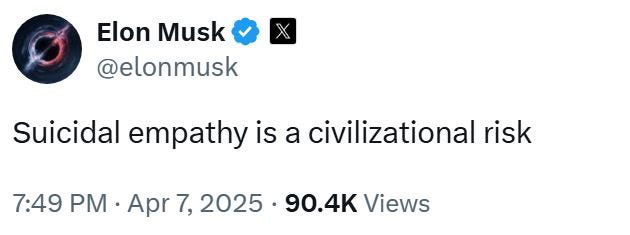
Young notes that Tesla head Elon Musk, on April 7, tweeted, "Suicidal empathy is a civilizational risk." And MAGA pundit Christopher Rufo, on X, wrote, "Corey[sic] Booker going to El Salvador to rescue Kilmer[sic] Abrego Garcia is the male equivalent of Taylor Lorenz gushing over Luigi Mangione. Empathy turned pathological."

Young says of Rufo's tweet, "The analogy is bizarre in many ways: For starters, Luigi Mangione is awaiting trial for the premeditated murder of United Health Care CEO Brian Thompson, while Abrego Garcia has never been charged with any crime. Also, showing empathy for a probably innocent man who may be facing life imprisonment in a modern-day gulag at the age of 29 is maybe not so pathological? And lastly, concern for Abrego Garcia's fate is not just about 'empathy': It is, first and foremost, about the outrageous facts of a case in which a man who had legal authorization to live in the United States, and is the husband and father of U.S. citizens, has been disappeared without due process — and our government is refusing to return him in defiance of the courts."

Young points out that Canadian professor Gad Saad even has a forthcoming book titled "Suicidal Empathy." And she notes that MAGA attacks on ultra-conservative U.S. Supreme Court Justice Amy Coney Barrett lambast her for having "empathy."

"As the sexist attacks on Barrett indicate," Young observes, " the right's war on empathy often has a distinctly misogynistic subtext. Empathy generally tends to be regarded as a feminine trait, and women do, on average, report higher levels of empathy than men, though studies of objective evidence yield mixed results. It's not that the anti-empathy right goes easy on males — Pope Francis is a favorite target — but the swipes at women are far more likely to be sex-specific."

Cathy Young's full article for The Bulwark is available at this link.