Sunday, June 01, 2025


Regional Chinese Censorship More Aggressive Than National Great Firewall: Study


media journalism free speech censorship


By 

By Qian Lang and Tenzin Pema


Online censorship in China by some regional governments is even more aggressive than enforcement of the national-level ‘Great Firewall’ by the central government, according to a recent study and local sources. 

The Great Firewall Report (GFW Report) highlights how the central Chinese province of Henan has adopted its own provincial firewall which is less sophisticated and robust than the central government’s but more volatile and aggressive, blocking significantly more websites than the national-level censorship system.

Local sources told Radio Free Asia that the heightened restrictions at the provincial government level may reflect uncertainty about instructions from higher authorities, leading to “excessive blocking” to avoid blame for failing to carry out their duties. 

GFW Report is a censorship monitoring platform, primarily focused on China. During one experiment its researchers ran between Dec. 26, 2023 and March 31, 2025, they found that the Henan Firewall blocked 4.2 million domains, about six times that of the 741,542 at the national level. 

Since 2023, netizens in Henan had reported a rise in the number of websites that were inaccessible in the region but accessible elsewhere in China, the study found.


“This localized censorship suggests a departure from China’s centralized censorship apparatus, enabling local authorities to exert a greater degree of control within their respective regions,” researchers Mingshi Wu at GFW, Ali Zohaib and Amir Houmansadr at University of Massachusetts Amherst, Zakir Durumeric at Stanford University, and Eric Wustrow at the University of Colorado Boulder wrote in the GFW Report published in May, “A Wall Behind A Wall: Emerging Regional Censorship in China.”

But the phenomenon extends beyond Henan, sources inside China told RFA. 

Local governments in neighboring Hebei, another central Chinese province, as well as those in Tibet and Xinjiang have been operating similar censorship systems as the one reported in Henan for at least four years, Zhao Yuan, a network engineer based in Hebei, said. 

“In the past, we could access overseas websites that were not blocked by the national firewall,” Zhao said. “Now, even virtual private networks (VPNs) in Henan and Hubei don’t work.”

While the national-level firewall, known as the Great Firewall, targets more news and media sites, in line with China’s long-standing policy of censoring politically sensitive information, the provincial-level firewall systems, like the one in Henan, blocks domains focusing on topics like the economy, technology, and business, GFW Report researchers found. 

The Chinese Communist Party has, in recent years, emphasized a multi-pronged approach to censorship, including the management of all types of propaganda at the domestic and international level through a framework known as “territorial management” and implementation of “digital stability maintenance” measures, such as policing of sensitive content online on dates deemed politically sensitive by the government. 

“Local governments have taken the initiative to establish local blocking systems, indicating that the top leaders are increasingly vigilant about the flow of information,” Wei Sicong, a Beijing-based political observer, said. 

‘Turning off the whole world’

Researchers at GFW found that the Henan firewall monitors and blocks traffic leaving and entering the province, as opposed to the national-level censorship system that is focused on traffic entering and exiting the country. 

Other sources in the region told RFA that the heightened restrictions at the provincial government level suggest lack of clear legal know-how about how to enforce instructions from higher-ups.

“Officials would rather block more and more than take responsibility. So the result you see is ‘turning off the whole world’,” network engineer Zhang Jianan said.

GFW Report researchers said their analysis showed no regional censorship in other areas they studied, such as Beijing, Guangdong, Shanghai, and Jiangsu. 

In Henan and Hebei, however, local residents told RFA that even the websites of some foreign universities are inaccessible, as a result of which they turn to VPNs and other circumvention tools to bypass government censorship and surveillance. 

“Some classmates can connect in Beijing and Shanghai, but we can’t in Zhengzhou and can only rely on circumvention software,” Zhang, a student at Henan’s Zhengzhou University, said.

Hebei-based network engineer Zhao said, “The censorship is getting stricter and stricter. We can’t even connect to some foreign university websites.” 

RFA found that as early as December 2023, a university in Henan province sought to purchase a “public opinion monitoring system,” specifically aimed at international students, students and dissidents, and had conducted an open bidding process.

Henan University of Science and Technology had laid out a 2024-2025 budget of 120,000 yuan (or US$16,657) for the public opinion monitoring service system to provide 24/7 real-time monitoring, early warning analysis and crisis response of public opinion information on the entire network, covering news websites and social media platforms such as Weibo and Douyin, the university’s website showed. 

When RFA contacted the university, a teacher confirmed they are using an old monitoring system and that they have now started a bidding process for a new one.


RFA

Radio Free Asia’s mission is to provide accurate and timely news and information to Asian countries whose governments prohibit access to a free press. Content used with the permission of Radio Free Asia, 2025 M St. NW, Suite 300, Washington DC 20036.

 

Reimagining Irregular Warfare: The Case For A Modernized OSS 2.0 – Analysis

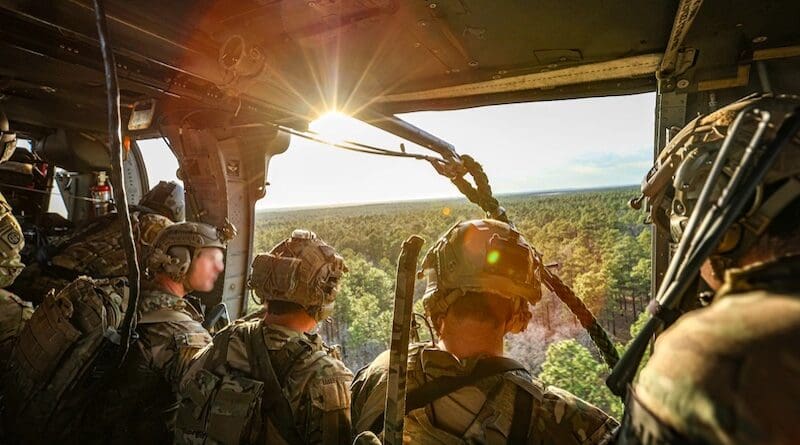
2-82 Assault Helicopter Battalion, 82nd Combat Aviation Battalion UH-60 aircrew teams worked closely with Soldiers assigned to 3rd Special Forces Group to perform fast rope insertion training on Fort Bragg, NC. 25March2025. This training recertified both aircrews and the 3rd SFG team on technical proficiencies. (U.S. Army photo by Sgt. Eli Baker)

By 

A rebuttal to J.R. Seeger’s “A New Office of Strategic Services?” published by FPRI in May 2025.


By Doug Livermore

(FPRI) — A recent piece in the Foreign Policy Research Institute (FPRI) penned by a retired Central Intelligence Agency (CIA) officer argues against proposals to revive the Office of Strategic Services (OSS) model for today’s strategic competition environment. In the piece, the author argues: “Reviving the OSS would add additional bureaucracy without any additional capability and could easily risk intelligence fratricide at a time when the United States needs more focus rather than more capability.” As the co-author of one of the critiqued proposals, I am compelled to note that this argument ignores two fundamental advantages of reviving an OSS 2.0 construct.

First, the assumption is invalid that any updated OSS proposal requires creating more redundant capabilities or excessive additional bureaucracy, rather than simply streamlining existing resources, eliminating redundant capabilities and functions, and breaking down organizational barriers between agencies with identical authorities but different cultures. Secondly, there is no acknowledgement of the very real operational fratricide that is already occurring today because of competing interests between organizations vying for missions and resources in an era of increasing government efficiency. The paralysis this interagency competition causes costs us opportunities that we could better realize through a unitary irregular warfare department under the Department of Defense (DoD).

The Real Opportunity: Streamlining Existing Resources

A modern OSS 2.0 would not require creating entirely new structures from scratch. Instead, it would consolidate and optimize existing resources that are currently fragmented across multiple agencies under the purview of the “Department for Special Operations and Irregular Warfare” (DSOIW), created by redesignating and hyper empowering the DoD’s existing Office of the Assistant Secretary of Defense for Special Operations and Low-Intensity Conflict. This is especially critical as recent reports indicate the CIA is planning to cut 1,200 positions over the next several years, even as the Trump administration requests a historic $1 trillion budget for the DoD.

Given this stark resource disparity and diverging priorities, we face a clear choice: continue with fragmented irregular warfare capabilities split between a shrinking CIA and an expanding DoD or create a more unified approach that eliminates redundancies and maximizes operational effectiveness. Keeping the smaller, shrinking organization as the lead for these efforts threatens limiting and potentially choking off these critical activities just as they are needed most.


Identical Authorities, Broader Capabilities

Both the DoD’s U.S Special Operations Command (USSOCOM) and the CIA’s Special Activities Centerpossess many overlapping and complementary functional capabilities, with both also having the ability to leverage Title 50 authorities to conduct irregular warfare activities. These authorities and capabilities extend beyond kinetic paramilitary activities, such as those made famous in the 2011 raid into Pakistan that killed al-Qaeda leader Osama bin Laden, to include psychological operations, information warfare, and political influence campaigns—areas where DoD has historically relied almost exclusively on its Title 10 (“Armed Forces”) authorities to enable sensitive operations supporting “traditional military activities” that nonetheless far exceed the scope and scale of those conducted by its interagency counterparts.

As I argued in my 2019 Military Times article, “transferring primary responsibility for paramilitary activities from the CIA to Defense Department would simply be a recognition that the majority interest in and capacity for paramilitary activities resides in the Defense Department [with USSOCOM executing].” While such a move would require the assertion of more robust oversight of these USSOCOM activities through existing DoD structures, this would also resolve longstanding congressional concerns that go back decades.

This principle applies equally to the full spectrum of irregular warfare activities. DoD’s Military Information Support Operations (MISO) teams, cyber warfare units, and strategic communications capabilities represent a formidable information-centric arsenal that could be more effectively leveraged in a unified irregular warfare structure under a broader application of the DoD’s Title 50 (“War and National Defense”) authorities. These capabilities, coupled with USSOCOM’s robust operational infrastructure, provide a comprehensive toolkit for influence activities that complement traditional paramilitary operations.

Executive Order 13470 already established the process for assigning covert action responsibility to agencies other than the CIA when “another agency is more likely to achieve a particular objective.” This order already identifies the DoD as the lead for covert action “in time of war declared by the Congress or during any period covered by a report from the President to the Congress consistent with the War Powers Resolution.” And there is precedence for such an arrangement, such as during the Vietnam War when, dissatisfied with the CIA’s performance, President John F. Kennedy transferred primary responsibility for covert actionagainst communist North Vietnam to the DoD. Given USSOCOM’s robust global access and placement, larger personnel reserves, superior technical infrastructure, and significantly greater budgetary resources, it is increasingly clear which organization is better positioned to lead the full range of irregular warfare efforts in today’s strategic environment.

The Global Placement and Capabilities Advantage

USSOCOM has unmatched global access and placement through its network of forward-deployed operators working with partner forces worldwide. These established relationships provide an invaluable foundation for irregular warfare activities without the need to build separate networks or capabilities. A modernized OSS 2.0 structure would leverage this existing infrastructure rather than duplicating efforts.

Human intelligence collection and liaison relationships are critical to the conduct of effective irregular warfare, and the Department of Defense already maintains its own parallel and extensive intelligence networks across the globe. These efforts are spearheaded by the Defense Intelligence Agency (DIA), which specifically focuses on foreign military intelligence and could be more effectively leveraged within a unified irregular warfare framework reporting to DSOIW. However, as a key advisor to the Department of State’s deployed chiefs of mission (or ambassadors), the CIA maintains virtual veto authority over any proposed DoD intelligence and many of its Title 10 irregular warfare activities overseas. The arrangement oftentimes creates tensions driven by divergent organizational interests.

Information Dominance in the Digital Age

Beyond traditional paramilitary operations, today’s irregular warfare landscape demands sophisticated cyber, information, and psychological operations capabilities where DoD has made substantial investments. Of the 18 organizations in the intelligence community, nine fall under the direct purview of the DoD and many focus on those required capabilities. MISO teams, U.S. Cyber Command elements, and strategic communications specialists throughout Defense Intelligence Enterprise (DIE) represent a formidable irregular warfare capability that dwarfs similar resources within the non-DoD intelligence community, including at the CIA.

In an era where influence campaigns, cyber operations, counter-disinformation efforts, and strategic narratives are increasingly decisive in strategic competition, these capabilities must be fully integrated with other irregular warfare tools. Under a unified DSOIW structure, these complementary capabilities could be better synchronized for maximum strategic effect, rather than operating in separate organizational silos with limited coordination.

Efficiency in the Era of Great-Power Competition

Today’s strategic competition with near-peer adversaries requires coherent, efficient application of irregular warfare capabilities. The current bifurcated approach between CIA and DoD creates significant operational inefficiencies that undermine our national security interests. Our intelligence community and special operations forces face duplicative reporting chains that produce redundant intelligence products and congressional oversight, often at considerable taxpayer expense. This unnecessary duplication extends to operational costs as well, with parallel capabilities often maintained across agency boundaries despite serving nearly identical functions.

Perhaps most concerning is how the current structure leads to competing priorities and objectives between agencies engaged in irregular warfare activities. In my own dealings with the congressional intelligence committees, I found that different organizations often briefed the same operations with no mention of other organizations that supported, causing confusion and frustration amongst those elected members charged with overseeing and funding our irregular warfare efforts. This fierce competition for limited resources and attention can compromise operational effectiveness and strategic coherence. Additionally, our limited pool of specialized personnel—individuals with rare skill sets and extensive experience—are inefficiently allocated across multiple organizations rather than being concentrated where they can have maximum impact.

The proposed DSOIW offers a clear solution to these systemic problems. By redesignating and empowering the current Office of the Assistant Secretary of Defense for Special Operations and Low-Intensity Conflict, we would establish proper unitary organizational authority and accountability. This new department would serve as the lead agency for all irregular warfare efforts, eliminating jurisdictional disputes and ensuring unity of effort across the full spectrum of activities and operations.

A Budget Reality Check

The Trump administration’s announcement of a $1 trillion defense budget stands in stark contrast to the CIA’s planned workforce reductions. This dramatic resource disparity makes the case for consolidation even more compelling. Why maintain separate, overlapping irregular warfare capabilities when we could optimize resources under a unified command structure? This move would also unburden the CIA of responsibilities always seen as secondary, allowing the spy organization to refocus on its primary mission: gathering information, generating exceptional analysis, and providing critical strategic insights to national decision-makers.

Secretary of Defense Pete Hegseth recently stated, “President Trump is rebuilding our military—and fast,” while pledging that taxpayer dollars would be spent “wisely, on lethality and readiness.” A modernized OSS 2.0 structure within DSOIW would ensure that irregular warfare capabilities receive appropriate resources while eliminating wasteful redundancies between agencies.

Conclusion: The Path Forward

As we prepare for a new era of strategic competition, we must move beyond institutional turf battles and optimize our irregular warfare capabilities. The proposed OSS 2.0 concept is not about creating something new, but rather about breaking down unnecessary barriers between existing capabilities to create a more efficient and effective approach to irregular warfare. Moreover, the establishment of a single entity fully responsible for and empowered to expand such activities would give Trump a more powerful weapon akin to that wielded by President Franklin Roosevelt in Gen. William “Wild Bill” Donovan’s original OSS during the Second World War.

The timing could not be more appropriate. With CIA resources diminishing while DoD funding reaches historic highs, we face a clear opportunity to streamline our irregular warfare capabilities under a unified structure. Rather than seeing this as a threat to agency prerogatives, we should recognize it as an opportunity to better serve our national security interests in an increasingly complex and dangerous global environment.

The views expressed are the author’s and do not represent official US Government, Department of Defense, or Department of the Army positions.

  • About the author: Doug Livermore is a Special Forces soldier with over two decades of national security experience at tactical, operational, strategic, and policymaking levels.
  • Source: This article was published by FPRI


Published by the Foreign Policy Research Institute

Founded in 1955, FPRI (http://www.fpri.org/) is a 501(c)(3) non-profit organization devoted to bringing the insights of scholarship to bear on the development of policies that advance U.S. national interests and seeks to add perspective to events by fitting them into the larger historical and cultural context of international politics.


ART OF WAR  3 EDITIONS

The Series was origi- nated to aid the distribution of these etexts in multiple formats and to highlight the benefits of PDF Ebooks. They are freely ...

THE ART OF WAR. By Sun Tzu. Translated with introduction and notes by. Lionel Giles, M.A.. 19th May 2004. Page 2. Contents. 1 INTRODUCTION. 4.

The Art of War (Sunzi bingfa/Sun-tzu ping-fa), compiled well over two thousand years ago by a mysterious Chinese warrior-philosopher, is still perhaps the ...


Global Threat Report Reveals Trump’s Strategic Priorities – Analysis


By 

By Luke Coffey


The US Defense Intelligence Agency recently released its annual threat assessment report. While these official government documents are often bland and filled with bureaucratic language, this year’s publication stands out — both for its substance and what it reveals about how the new administration views today’s geopolitical challenges. This is the first threat assessment of President Donald Trump’s second term, and it offers an early insight into the administration’s strategic priorities.

A few things jump out right away. This year’s threat assessment is longer than last year’s, and offers a more detailed and nuanced analysis across multiple sections. But two major changes in this year’s report, when compared with the final assessment produced under the Biden administration, are particularly striking.

The most notable difference is the inclusion of a dedicated section on US homeland defense and border security — placed not as an afterthought but as the first item in the report. This marks a sharp departure from last year’s assessment, which focused almost exclusively on global threats and challenges. The placement and tone of the new homeland security section clearly bear Trump’s personal stamp. One of his most effective political narratives has been that US policymakers focus too much on problems abroad, while neglecting the security of Americans at home. This report reflects that view.

The homeland security section places particular emphasis on the national security implications of illegal immigration, transnational organized crime, and the influx of deadly narcotics by drug cartels into small American communities. These are not just political talking points; they represent real and growing threats to the safety and well-being of Americans. But the political savvy of the framing should not be overlooked.

While the average American may not be deeply familiar with issues such as Taiwan’s security or freedom of navigation in the South China Sea, they are certainly familiar with the devastating impact of fentanyl or cartel violence. Including homeland security at the top of the Defense Intelligence Agency’s global threat assessment makes the report more relevant to the American public and highlights Trump’s emphasis on border security as a matter of national defense.


The second striking difference is the prominent section, entitled “Growing Cooperation Among US Competitors and Adversaries,” which comes immediately after the homeland security section. For the first time, a US threat assessment explicitly links and highlights the emerging coordination among America’s adversaries and competitors. The report states: “Building on activities over the past two years, leaders in Beijing, Moscow, Tehran, and Pyongyang will strengthen their nations’ ties in their drive to undermine the influence of the US and its allies.”

This is an important — and overdue — acknowledgment of a multipolar and interconnected world. For years, much of the US foreign policy establishment has resisted the concept of multipolarity, preferring to see the world in unipolar or bipolar terms. This resistance is rooted in Cold War-era thinking, when power was viewed through a US-versus-Soviet lens. But a new generation of American strategists understands that multiple centers of power exist — and are increasingly coordinating with one another to challenge US interests around the globe.

Recognizing the reality of this multipolar environment does not mean conceding that all powers are equal. It simply acknowledges the complexity of today’s geopolitical landscape. The inclusion of this section in the threat assessment is a necessary step toward grappling with the way these regimes are learning from each other, cooperating diplomatically, militarily, and economically, and exploiting US vulnerabilities.

To illustrate the shift, if you took a diplomat from 1980 and one from 1880 and brought them both to 2025, it might be the latter — accustomed to a world of competing empires and power centers — who would better recognize the dynamics at play today.

Recognizing these trends is one thing, acting on them another. Within the new administration, there are competing schools of thought on how to respond. Some believe China is the primary threat and argue that all instruments of US power should be directed toward countering Beijing. Others, often aligned with more isolationist instincts, believe the US should focus exclusively on homeland security and reduce its global footprint. Then there are more traditional Republican voices who argue that the US must be able to address multiple threats simultaneously and maintain its global leadership role.

Though the administration is still filling out its national security team, the contents of the Defense Intelligence Agency report suggest that the latter group is gaining the upper hand, at least for now. That could signal a more balanced approach in future, one that prioritizes US security at home, while maintaining engagement and vigilance abroad.

In the coming months, the Department of Defense is expected to publish a new National Defense Strategy, which should provide additional clarity on how the US plans to counter the threats identified in the Defense Intelligence Agency assessment. Likewise, the National Security Council is likely to release a similar document outlining a more comprehensive, whole-of-government approach to these challenges.

Importantly, all these strategies must be backed by resources. The White House will need to work with Congress to ensure that the budget aligns with these stated priorities. It is one thing to acknowledge that America’s adversaries are coordinating their efforts, but quite another to craft a strategy — and appropriate the funds — to counter them effectively.

Some in the Biden administration may have understood that this emerging coordination by America’s competitors posed a threat, but were reluctant to spotlight it publicly for fear of being forced to act. The Trump administration, by contrast, has put these challenges front and center. But in doing so, it has also raised the stakes. Having declared that homeland defense is national security — and that America’s adversaries are working together — the administration will now be judged on how it responds.

The coming months will be critical, not only for America’s national security and that of its allies, but also for the future of America’s role in the world.

  • Luke Coffey is a senior fellow at the Hudson Institute. X: @LukeDCoffey

Arab News

Arab News is Saudi Arabia's first English-language newspaper. It was founded in 1975 by Hisham and Mohammed Ali Hafiz. Today, it is one of 29 publications produced by Saudi Research & Publishing Company (SRPC), a subsidiary of Saudi Research & Marketing Group (SRMG).
RBC asks staff to return to office four days a week

By Reuters
Published: May 29, 2025 

Royal Bank of Canada signage is pictured in the financial district in Toronto Sept. 8, 2023. THE CANADIAN PRESS/Andrew Lahodynskyj

TORONTO — Royal Bank of Canada has asked employees to be in office four times a week starting in September, according to a memo seen by Reuters, prompting disapproval among some staff discussing the changes in internal chat groups.

The memos from various business heads were sent to staff on Thursday shortly after the bank reported second-quarter earnings that were lower than analysts’ expectations due to a rise in loan loss provisions to prepare for uncertain times.

The memo said the rule does not apply for roles that are fully remote or are already in full-time office arrangements.

“RBC is a relationship-driven bank and in-person, human connection is core to our winning culture. We set the expectation in 2023 that we’d come together in the office for the majority of the time, with the flexibility to work remotely one to two days a week,” a spokesperson said.

A company-wide internal chat group that discussed the change in policy raised questions such as additional travel time and expenses related to transport, a source told Reuters.


The Canadian lender’s decision comes shortly after U.S. bank JPMorgan Chase, in January asked its employees who are on hybrid work schedules to return to the office five days a week starting in March.

RBC has over 94,000 full-time employees across global offices, as of April 30.

(Reporting by Nivedita Balu in Toronto; Editing by David Gregorio)