Sunday, June 01, 2025

WAIT, WHAT?

EU Should Allow Gene Editing To Make Organic Farming More Sustainable, Researchers Say
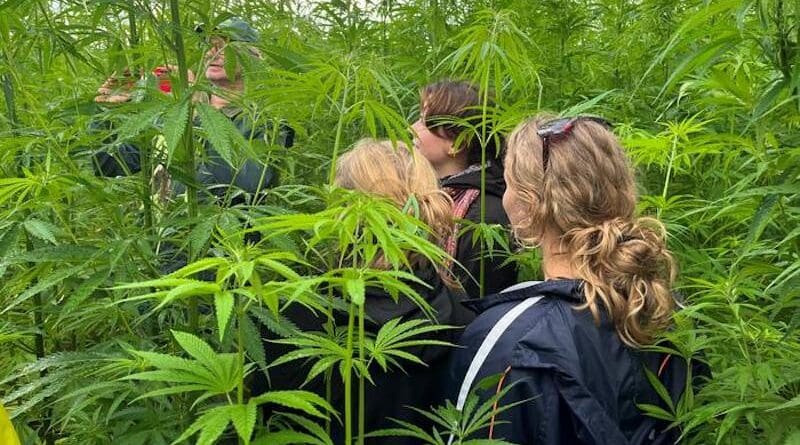
Researchers in a field of hemp. CREDIT: Justus Wesseler

By 

To achieve the European Green Deal’s goal of 25% organic agriculture by 2030, researchers argue that new genomic techniques (NGTs) should be allowed without pre-market authorization in organic as well as conventional food production. NGTs—also known as gene editing-—are classified under the umbrella of GMOs, but they involve more subtle genetic tweaks.


In an opinion paper published in the Cell Press journal Cell Reports Sustainability, the researchers describe how NGTs could enable rapid development of crops that are climate resilient, produce higher yields, and require less fertilizers and pesticides. 

“This is an excellent opportunity to modernize European agriculture, to make it more science based, and to support the goal of improving sustainability inside the European Union,” says first author Alexandra Molitorisová, a food law researcher at the University of Bayreuth. 

Currently, 10% of EU farming areas are organic. Though organic farming can reduce carbon emissions and pollution from fertilizer and pesticides, Molitorisová’s team says that these benefits could be negated by biodiversity losses due to expanding agricultural land, since organic agriculture requires more land to grow the same amount of food. 

“The target of 25% organic land is unlikely to ensure sustainable food production in the EU if modern biotechnology, such as NGTs, is excluded from organic farming,” says Molitorisová. 

European institutions are currently debating how to regulate NGTs—which did not exist when the EU legislation on GMOs was adopted in 2001—in response to a proposal from the European Commission that NGT usage be allowed in conventional but not organic farming. 


“Research suggests that NGTs are still something that European consumers are not completely aware of—they just do not distinguish between NGTs and GMOs,” says senior author Kai Purnhagen, Professor of Food Law at the University of Bayreuth. “There are strong indications that consumers would be willing to accept these technologies if they yield substantial benefits, and the Commission’s proposal for new regulation allowing NGTs in conventional farming points in this direction.” 

Though NGT crops are still developed through genetic alteration, the processes usually don’t involve the insertion of DNA from non-plant species. This means that, in theory, identical crops could be developed using conventional breeding methods, though it would take decades rather than months. For these reasons, the researchers argue that NGTs and GMOs should be defined and regulated separately, including in organic production. 

“From the consumer’s perception of naturalness, the normal breeding process is between two crossable varieties, and that is also what happens with NGTs,” says Molitorisová. “So, if consumers understand the nature and benefits of this technology, it should be easier for them to accept it compared with GMOs, which might involve inserting a gene from a non-plant organism into a plant genome.” 

The researchers also note that the most common type of NGT, targeted mutagenesis, is very similar to mutagenesis—which uses chemical or radioactive substances to induce random genetic mutations and has never been subject to GMO regulation in the EU, even for organic farms. 

“If mutagenesis had not been exempted from GMO legislation, the estimation is that 80%–90% of the cereal products on the European market would have been subject to GMO labeling,” says Purnhagen.  

The team highlights that allowing NGTs in conventional but not organic agriculture creates a formidable hurdle in terms of NGT identification, labeling, and traceability. 

“At the moment, there are unresolved practical problems with the identification of NGTs inside of food, feed, or seeds,” says Molitorisová. “One rational alternative is to allow NGTs in organic production, because if NGT organisms are not identifiable, they are also technically unavoidable.” 

Ultimately, the researchers say that the decision to allow NGTs in organic farming should be made by the organic farming and consumer communities—for example, by way of citizens’ juries or food councils. 

“Organic consumers care about the environment and sustainability. For organic farmers, accepting this technology is a way to speak to those consumers,” says Purnhagen. 


Eurasia Review

Eurasia Review is an independent Journal that provides a venue for analysts and experts to disseminate content on a wide-range of subjects that are often overlooked or under-represented by Western dominated media.


 

Does Planting Trees Really Help Cool The Planet?

Sustainability Hand Keep Tree Energy Globe

By 

Replanting forests can help cool the planet even more than some scientists once believed, especially in the tropics. But even if every tree lost since the mid-19th century is replanted, the total effect won’t cancel out human-generated warming. Cutting emissions remains essential.


In a new modeling study published in Communications Earth & Environment, researchers at the University of California, Riverside, showed that restoring forests to their preindustrial extent could lower global average temperatures by 0.34 degrees Celsius. That is roughly one-quarter of the warming the Earth has already experienced.

The study is based on an increase in tree area of about 12 million square kilometers, which is 135% of the area of the United States, and similar to estimates of the global tree restoration potential of 1 trillion trees. It is believed the planet has lost nearly half of its trees (about 3 trillion) since the onset of industrialized society.

“Reforestation is not a silver bullet,” said Bob Allen, a climate scientist at UC Riverside and the paper’s lead author. “It’s a powerful strategy, but it has to be paired with serious emissions reductions.”

While previous studies have largely focused on trees’ ability to remove carbon from the atmosphere, this research includes another critical dimension. Trees also have an effect on the chemical makeup of the atmosphere in ways that amplify their cooling effect.

Trees naturally release compounds known as biogenic volatile organic compounds, or BVOCs. These interact with other gases to form particles that reflect sunlight and encourage cloud formation, both of which help cool the atmosphere. Most climate models do not account for these chemical interactions.


“When you include these chemical effects, the net cooling impact becomes more significant,” Allen said. “It’s a crucial part of the picture.”

The benefits of reforestation, however, are not evenly distributed. The study found that tropical forests produce stronger cooling effects with fewer drawbacks. Trees in these regions are more efficient at absorbing carbon and produce greater amounts of BVOCs. They also have less of the surface darkening effect that can cause warming by trees in higher latitudes.

Beyond global temperature, reforestation can also affect regional air quality. The researchers found a 2.5 percent reduction in atmospheric dust in the northern hemisphere under their restoration scenario.

In the tropics, increased BVOC emissions were a mixed bag in terms of air quality. They were linked to worse air based on particulate matter associated with enhanced aerosol formation, but improved air quality based on ozone measurements.

These localized effects, the researchers say, suggest that reforestation efforts do not need to be massive to be meaningful.

“Smaller efforts can still have a real impact on regional climates,” said Antony Thomas, graduate student in UCR’s Department of Earth and Planetary Sciences and co-author of the study. “Restoration doesn’t have to happen everywhere at once to make a difference.”

The researchers acknowledge that the scenario modeled in the study is unlikely to be realized. It assumes trees could be restored to all areas where they once grew, which would require reclaiming developments such as housing as well as farmland and pastures. That raises questions about food security and land-use priorities.

“There are 8 billion people to feed,” Allen said. “We have to make careful decisions about where trees are planted. The best opportunities are in the tropics, but these are also the areas where deforestation continues today.”

The researchers highlight Rwanda as an example of how conservation and economic development can align. There, tourism revenue tied to forest protection is reinvested in local communities, providing incentives to preserve land that might otherwise be cleared.

The study began as a project in Allen’s graduate-level climate modeling course at UC Riverside. It eventually evolved into a collaborative research paper, drawing on Earth system modeling and land-use data to explore what large-scale reforestation could realistically achieve.

Its conclusion is cautiously optimistic: forest restoration is a meaningful part of the climate solution, but not a substitute for cutting fossil fuel use.

“Climate change is real,” Thomas said. “And every step toward restoration, no matter the scale, helps.”


Eurasia Review

Eurasia Review is an independent Journal that provides a venue for analysts and experts to disseminate content on a wide-range of subjects that are often overlooked or under-represented by Western dominated media.

 

Mangroves Show Surprising Resilience To Storms In A Changing Climate


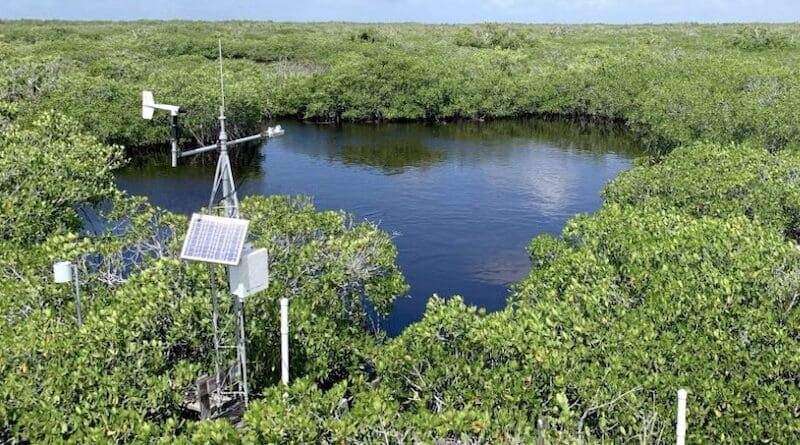
YSE scientists use data from field towers that monitor mangrove-dominated sites in Everglades National Park to assess the impacts of hurricanes on carbon exchange. The site is managed by Florida International University within the Florida Coastal Everglades Long Term Ecological Research program. CREDIT: Yale School of the Environment


By 

Dense, spindly mangrove forests line the coast of tropical regions, buffering coastal flooding and providing a valuable sink for carbon, but there is concern that more intense and frequent storms due to climate change could have prolonged impacts on these ecosystems. A new study by Yale School of Environment scientists, however, suggests that these systems may be more resilient than expected.


The team calculated the “recovery debt” of mangroves in Everglades National Park after hurricanes Wilma and Irma, showing that all the carbon lost during the storms was recovered within four years. (Wilma hit South Florida in 2005 and Irma hit in the region in 2017.) This relatively fast turnaround suggests that these ecosystems will remain strong carbon sinks. The calculations also provide a rough estimate of how many years mangroves need between storms to recover adequately — a vital threshold to understand as storms increase in frequency and intensity, the scientists note.

The findings, recently published in Global Change Biology, help illuminate the complex process of ecosystem recovery after climate-driven shocks and the value of long-term ecological monitoring.

“Mangroves have the capacity to capture carbon lost due to hurricanes relatively quickly,” said Sparkle Malone, assistant professor of ecosystem carbon capture and research scientist with the Yale Center for Natural Carbon Capture, who led the study. “It’s a good sign that mangroves in the Everglades are and will continue to be relatively resilient to the types of disturbances we know they’re going to experience in the future.”

Previous research has focused on the magnitude of individual storms’ impact on mangroves or examined the recovery of individual aspects of the ecosystem. Few studies have unraveled all of the ecological processes at play in recovery.

“Many people frame disturbance research in terms of how much initial loss there was,” said associate research scientist David Reed, the study’s lead author. “That’s part of the story, but it’s really about how long it takes to recover from that loss.”


To that end, the researchers used the novel measure of recovery debt, which reflects the total carbon lost during each storm and how long it would take to get it back.

Reed likened it to an unexpected financial expense. If one’s budget is tight, the debt from the surprising expense could take a long time to pay off, but if one is financially stable, it is less of a burden. 

Biweekly, we highlight three news and research stories about the work we’re doing at Yale School of the Environment.

To calculate recovery debt, the team needed to analyze several years of data both before and after storms. In partnership with Florida International University, they tapped into the Florida Coastal Everglades Long Term Ecological Research program, which provides information on forest structure, soil biogeochemistry, and other data, as far back as 2004 at some sites. The team used observations from two monitoring tower sites and satellite imagery to establish landscape-wide patterns.

“There have been a lot of resources and instrumentation put in this area, and so you can study processes that you can’t do on the landscape scale anywhere else in the world,” Malone said.

The findings reflect a surprising — and reassuring — degree of resilience that underlines the value of restoration efforts, she said.

“We know that it’s in the millions, maybe even billions, of dollars of resource protection that mangrove forests provide, and so this confirms with all of the funding and effort put into Everglades restoration, that it’s worth it,” Malone said. “We will likely continue to reap the benefits of those investments for a long time into the future.”


Eurasia Review

Eurasia Review is an independent Journal that provides a venue for analysts and experts to disseminate content on a wide-range of subjects that are often overlooked or under-represented by Western dominated media.
GULAGS R US

Bishops Of El Salvador Oppose Country Being Used As ‘International Prison’

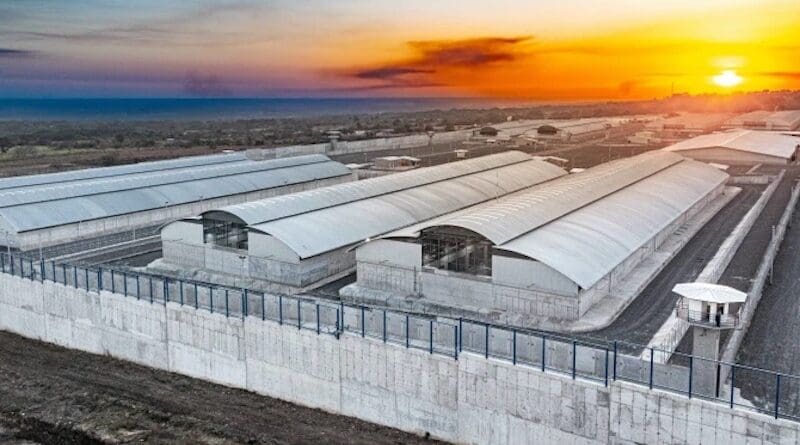
El Salvador's massive Terrorism Confinement Center (CECOT, by its Spanish acronym). | Credit: Courtesy of Office of the President of El Salvador, CC0, via Wikimedia Commons


By 

By Diego López Colín


As El Salvador’s President Nayib Bukele marks his sixth anniversary in office, the country’s Catholic bishops have published a pastoral letterwarning of the risk of turning the Central American nation into a “large international prison” and demanding an end to the state of emergency.

In a May 29 letter, the Salvadoran Bishops’ Conference stated that their intention is not “to contradict the national authorities, as we are well aware of the efforts they are making to govern the country for the benefit of the people.”

They also make it clear that their observations are not in support of “any partisan ideological interest, nor to the interests of powerful groups. What truly moves us is the good of the people.”

“With our voice, we want to make audible the cries of the poor people and the vast majority whose rights are violated, perhaps not with malicious intent; but violated, because in the midst of such an intense reality, it can happen that their barely perceptible voice may not be audible,” the letter reads.

‘Mega-prison’ criticized

Specifically, the prelates asked Salvadoran authorities “not to use our country’s prisons for victims of the anti-immigrant policies of foreign powers.”

In their letter, they pointedly criticize the stance taken following the visit of U.S. Secretary of State Marco Rubio in February, when Bukele offeredto receive “dangerous American criminals, including U.S. citizens,” as well as “illegal immigrants from any other country” at the Terrorism Confinement Center (CECOT, by its Spanish acronym) instead of deporting them to their home country.

The CECOT, popularly known as the “mega-prison,” is a maximum-security prison inaugurated in January 2023 and capable of holding up to 40,000 inmates.

“We ask our leaders not to promote this country as if it were a large international prison. We implore them to think carefully about what they’re doing. Bringing in major criminals could become a danger to our population as well as earn this nation a bad international reputation,” the bishops warned.

As an alternative, they called for “promoting a pro-migrant policy, with the borders open to migrants and integration into the economy as a labor force. Furthermore, a portion of the Salvadoran population is also migrants, and we would not like our fellow citizens to be imprisoned in other nations.”

Another of the demands put forward by the bishops is “to repeal the state of emergency,” a measure in force since March 2022 in the country as part of the government’s strategy to combat criminal gangs.

The state of emergency allows for the constitutional suspension of rights such as freedom of assembly, the inviolability of communications, the right to be informed of the reasons for one’s arrest, and access to legal representation, among others. According to Human Rights Watch, this measure has opened “the door to human rights violations.”

Although the bishops acknowledge that “at one time it was necessary to curb the violence and it was considered successful due to its results. But time has passed, and we believe it is no longer necessary.”

“It’s a matter of allowing the people to exercise their freedom without any pressure. The people cannot continue doing good, behaving properly, and obeying the laws for fear of the consequences of the state of emergency. … Doing good out of fear is coercion, and doing it out of obligation is repression,” the bishops stated.

Human rights defenders ‘persecuted’

In another part of the letter, the bishops condemned the “persecution of human rights defenders simply for carrying out their duties.” This comes after the arrest of lawyer Ruth Eleonora López. According to Human Rights Watch, this case “is part of a series of repressive actions pushed by the government, which has shown increasing hostility toward journalists, union leaders, and human rights defenders.”

In this regard, the bishops requested that “if applicable there are any prisoners held for no other reason than defending human rights, their cases should be studied and they should be immediately released.” They also urged a “very objective” review of all cases of those imprisoned “to ensure that those who are innocent are released as soon as possible.”

This story was first published by ACI Prensa, CNA’s Spanish-language news partner. It has been translated and adapted by CNA.


CNA

The Catholic News Agency (CNA) has been, since 2004, one of the fastest growing Catholic news providers to the English speaking world. The Catholic News Agency takes much of its mission from its sister agency, ACI Prensa, which was founded in Lima, Peru, in 1980 by Fr. Adalbert Marie Mohm (†1986).


Saudi Arabia And Qatar To Provide Financial Support For Syrian State Employees


By 

Saudi Arabia’s Foreign Minister Prince Faisal bin Farhan said on Saturday that the Kingdom will offer with Qatar joint financial support to state employees in Syria.


His statements came during a joint press conference with his Syrian counterpart Asaad Al-Shaibani in Damascus, who welcomed the foreign minister and his delegation on his arrival in the Syrian capital.

“The Kingdom will provide, with Qatar, joint financial support to state employees in Syria,” Prince Faisal said.

Syria and Saudi Arabia had previously discussed ways to strengthen bilateral relations in the financial sectors.

Prince Faisal referred to his country’s role in helping to lift economic sanctions on Syria, saying that Saudi Arabia would continue to be one of the main backers to Syria in its path for reconstruction and economic recovery.

He said he was being accompanied with a high-level economic delegation from the Kingdom to “hold talks (with the Syrian side) to bolster aspects of cooperation in various fields.”


Several visits would then follow in the coming days by Saudi businessmen to Syria to discuss investments in energy, agriculture, infrastructure and other sectors, he said.

The Kingdom and Qatar reaffirmed their commitment to supporting the stability and development of Syria, highlighting their shared historical and fraternal ties with the Syrian people, the Saudi Press Agency reported.

The two countries stressed the importance of improving living conditions and promoting economic and social stability in Syria.

They also expressed a strong desire to work in coordination with the international community and development partners to ensure sustainable, effective support through a comprehensive and unified vision, SPA added.

Later on Saturday, the two foreign ministers toured the Umayyad Mosque in Damascus.

Prince Faisal also met with interim President Ahmed Al-Sharaa on Saturday during his visit and “the high-level economic delegation” held talks with Syrian officials about ways of cooperating “that contribute to supporting Syria’s economy and strengthen institution building.”

On a visit to Riyadh earlier this month, US President Donald Trump said he would lift US sanctions on Syria, a move that paves the way for economic recovery in the war-torn country.

The European Union also recently lifted economic sanctions on Syria.

In February, Sharaa visited Saudi Arabia in his first trip abroad as president.

Last month, Saudi Arabia and Qatar, another key backer of the new authorities, announced they would settle Syria’s debt to the World Bank totaling roughly $15 million.

Damascus is hoping that the lifting of sanctions, particularly by the United States, will pave the way for support from the international community.

Years of war and sanctions have battered the country’s economy, infrastructure and industry.

A recent United Nations Development Programme report estimated Syria’s “lost GDP” during the 2011-2024 war to be around $800 billion.

Prince Faisal first visited Syria’s new authorities in January.

Arab News

Arab News is Saudi Arabia's first English-language newspaper. It was founded in 1975 by Hisham and Mohammed Ali Hafiz. Today, it is one of 29 publications produced by Saudi Research & Publishing Company (SRPC), a subsidiary of Saudi Research & Marketing Group (SRMG).