Sunday, June 01, 2025


‘No one has strengthened the Ukrainian far-right more than Putin’
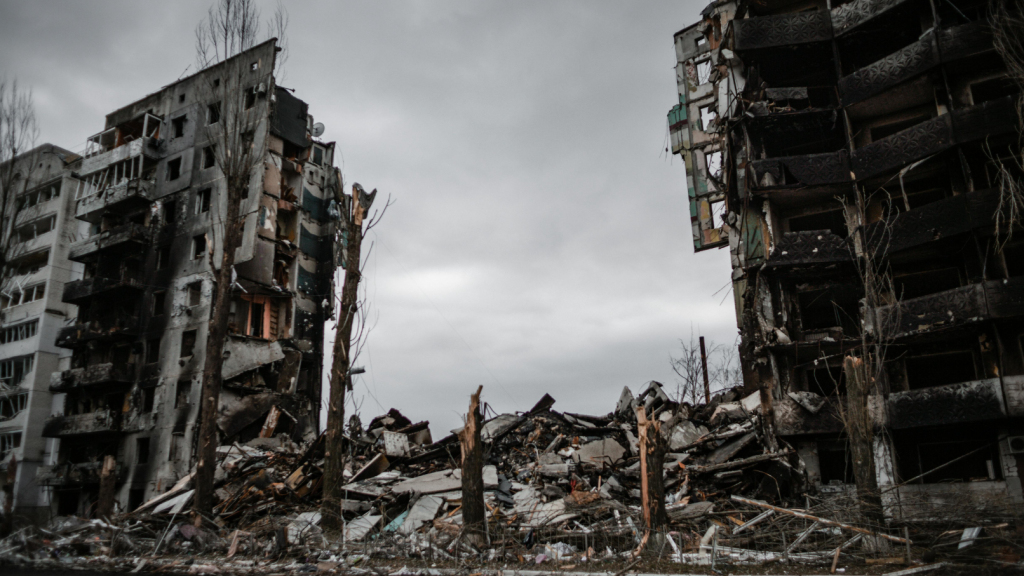
Destroyed building Kyiv

More than three years after Russia’s invasion of Ukraine, the international left remains divided over the war. Ukrainian leftists are understandably disappointed with this state of affairs, but not surprised given the lack of knowledge about Ukraine and the post-Soviet space among leftists in the West and Global South. 

Rather than reach out to leftists in Ukraine (as well as Russia and other post-Soviet countries), many have opted to just accept Russian state propaganda, which claims President Vladimir Putin had no option but to invade to defend Russia against an aggressive right-wing neighbour overrun by neo-Nazis. The truth, however, as Ukrainian leftist Andriy Movchan notes, is “no one has done more to promote and strengthen Ukrainian nationalism and far-right movements than Putin.”

Movchan is a former activist of several left-wing groups in Ukraine, who now lives in Catalonia where he devotes himself to issues of media activism, art and journalism. In the second part of his wide-ranging conversation with Victor Osprey for LINKS International Journal of Socialist Renewal, Movchan delves into the current state of the Russia-Ukraine conflict, the role of the far right in both countries, and the challenges Ukraine’s left forces face in building solidarity with their struggles internationally.

The first part of the interview looked at the influence of progressive thinkers and the Soviet Union on Ukrainian national consciousness, the tense debates among the Bolsheviks on Ukrainian independence, how the history of Great Russian chauvinism towards Ukraine helps us to understand the nature of the current war, and the thorny issue of language discrimination.

What is the status of the war? Is Russia slowly taking more territory and striking deeper into Ukraine, or have Ukrainian forces stabilised the situation and advanced along the front lines? What is the state of Ukrainian morale, particularly among conscripted soldiers, compared to the wave of volunteers in 2022?  

As of spring 2025, both armies are extremely depleted, and have problems with personnel and low morale. However, despite the enemy's superiority, Ukrainians continue to resist heroically and hold the front. Ukrainian society is extremely exhausted. No one dreams of victory anymore. No one dreams of the borders of 1991. The most painful issue for society is forced conscription, which is carried out through gross human rights violations. There are almost no people left willing to voluntarily go to the front. Even state leaders have been forced to take these sentiments into account and set more realistic goals. Today, Ukraine’s position is to freeze the conflict along the current front line, with security guarantees and without recognising Russia’s annexations. Most of society agrees with these conditions. Russia, which still wants to “finish” Ukraine, disagrees.

On the other hand, the size of Russia’s population — 140 million — allows it to not involve the masses in the war and fight primarily with mercenaries. Russian society shows no signs of exhaustion. However, the Russian army is exhausted. The warehouses are running out of Soviet military equipment. The wounded are sent into battle. The occupying army is suffering huge losses. Even Russian military bloggers say it will not be possible to keep fighting for much longer.

How would you politically characterise the Ukrainian government under President Volodymyr Zelensky? Were elections to be held, would Zelensky likely win?

The Zelensky government is a populist neoliberal government. The current president won the 2019 elections with 73% support. This was largely a protest vote against the right-wing conservative policies of previous president Petro Poroshenko. However, Poroshenko left behind a state apparatus that was already heavily influenced by right-wing policies, and this had a major impact on Zelensky’s policies. 

Zelenskyy was definitely not a nationalist by his own convictions. But he became a nationalist as a result of the Russian invasion. We have to understand that nationalist tendencies are inherent in any society facing an existential war. Similarly, in these circumstances, states tend to become authoritarian. We can say that in Ukraine, unfortunately, these tendencies are progressing.

After three years of war, against the backdrop of unpopular military conscription, corruption scandals at all government levels, and glaring inequality, Zelensky’s support is falling sharply, both among civilians and the military. I think it will be difficult for him to win the next election.

To what extent has the far-right in Ukraine gained in influence since 2014, and especially since the 2022 invasion? How extensive is their influence? To what degree is it exaggerated by Russian propaganda?

In 2014, the far right was used by the centre-right opposition as the most determined part of the protest movement against the government. They became the powerhouse of the protests, although the Maidan [uprising] itself was made up of a broad spectrum of participants. 

When Russia launched its proxy invasion of Donbas in April 2014, Ukraine’s army was unprepared for the confrontation. The far right came to form the basis for the most motivated units, which were later integrated into the army. It is natural that in times of war, the role of nationalists increases dramatically, and that nationalists are the most determined fighters. This was seen on both sides in Donbas.

Since 2014, the rising far-right has not had a major impact on electoral politics, but it has significantly complicated the situation on the streets, where they often enjoy impunity from the state. When someone says that there is no problem with the far right in Ukraine, it is simply not true. My own experience of having to leave Ukraine after being repeatedly attacked in the street by these far right radicals for my left-wing views confirms this. 

Nationalists have also gained significant positions in the army. Again, this is natural. It would be surprising if the most capable soldiers in a war for national survival were liberals or social democrats.

But to call Ukraine a “neo-Nazi state” is a great exaggeration. It is clear that Russian propaganda is fuelling the myth of a “neo-Nazi” Ukraine, which, unfortunately, sells well among the Western left. Yes, we have certain internal problems. But what business is it of Russia’s? Is this an excuse to bomb our cities and wipe them off the face of the Earth to “liberate” them? Our problems with right-wing groups are not a reason to conquer our country. Even if Ukraine were twenty times more reactionary than it actually is, this would still not give Russia the right to invade.

In reality, no one has done more to promote and strengthen Ukrainian nationalism and far-right movements than [Russian president Vladimir] Putin. If he had not unleashed two wars — in 2014 and 2022 — the Ukrainian far right would be a relatively marginal phenomenon today.

What can you tell us about the influence of the far right in Russia, including in the military?

At first glance, it may seem that the far-right movement is not that visible in Russia. The Russian state does not tolerate any movements and parties that are independent of it. 

At the same time, the Russian state itself has embraced the radical ideology of imperial nationalist expansion and annexationism, which until relatively recently was considered the domain of marginal forces. What Putin says and does today embodies the programs of the most insane part of Russian ultranationalists. All those writers, retired military officers, philosophers and journalists who have been promoting the idea of a Russian “reconquista” in their books, blogs and patriotic demonstrations have suddenly discovered that the state is implementing their program. These people found themselves at the centre of Russia’s invasion, both as soldiers and media servants of the militaristic crusade against Ukraine.

It should also be noted that since 1991, a huge stratum of people and movements has formed in Russia for whom the collapse of the Soviet Union was a personal tragedy. For them, it was a national humiliation. Unlike Ukrainians, Georgians, Kazakhs and other nationalities, these Russians perceived the entire Soviet Union as their national state, not just the Russian part. For them, the Soviet Union was a single Russian-speaking space that was allegedly “artificially” divided. And they dreamed of revenge. 

Often such people consider themselves “Communists,” although their primary dream is not social equality, but territorial irredentism. People from other countries should understand that such “Communists” in Russia are more likely to be far-right, even if they hide behind a red flag. We call them red-browns.

However, traditional neo-Nazis have also gained prominence in Russia during the war. There are at least two clearly distinct neo-Nazi units in the Russian army: Rusich and EspaƱola. Moreover, persecution of migrants and racially-motivated violence has intensified in the country. A broad network of far-right groups, Russkaya Obshchina, has been formed under the auspices of the state. It persecutes migrants and intimidates indigenous peoples.

What about the treatment of minorities, such as Hungarians, Roma, Tatars and Jews, in Ukraine? 

The situation of different minorities varies greatly. Crimean Tatars, for example, are fully supported by the state and society. On the other hand, Hungarians are somewhat distrusted because the current government of Hungary is friendly to Russia. At the same time, Hungarians managed to achieve certain rights through political pressure from their “historical homeland,” which is a member of the European Union. 

As for Jews, there are occasional incidents of antisemitism, but mostly at the level of daily life, and no higher than in other Eastern European countries. The complaints of Jewish communities are more often related to the policy of commemoration, when nationalist movement figures associated with the persecution of Jews in the first half of the 20th century are included in the state pantheon. 

The situation is most difficult for the Roma, as they face persistent xenophobia in society. Before the war, the far-right repeatedly attacked Roma encampments, knowing the attacks would not receive strong public condemnation.

Has the position of Crimean Tatars remained the same or gotten worse since Russia seized the peninsula in 2014? Is there much sentiment for it to be returned to Ukraine by Tatars and Ukrainians inside and outside Crimea?

Crimean Tatars are the most pro-Ukrainian sector on the peninsula. The trauma of Josef Stalin’s deportation of their people in 1944 is still alive. They are grateful to the independent Ukraine that allowed them to return to their historic lands. 

Crimean Tatars were overwhelmingly against Russia’s annexation. Thousands of Tatars left Crimea for government-controlled Ukraine, where their political body, the Mejlis, is based. Some Tatars fight in the Ukrainian Armed Forces. At the same time, Tatars in Crimea are constantly repressed by Russian occupation authorities. Most Crimean political prisoners in Russian jails are Tatars.

I think it is unlikely that the Tatars want Ukraine to seize Crimea by military means, as this implies destructive fighting on the peninsula. They would prefer a diplomatic solution. The rest of the population of Crimea is overwhelmingly ethnic Russians who favour annexation. 

Currently, the perception in Ukraine is that the return of Crimea is virtually impossible, but only a minority support recognising Russia’s annexation of the peninsula as legitimate.

Given that Russia and the United States want Ukrainian resources, such as rare earth materials, and have little to no interest in Ukrainian territorial integrity and sovereignty, let alone progressive social reforms, should Ukraine look elsewhere for allies, whether in the European Union or the Global South? 

Ever since Donald Trump came to power in the US, Ukraine has been forced to rely more on Europe. Europe remains Ukraine’s only consistent ally in the fight against the aggressor. However, Europe’s military potential is many times smaller than the US’. Ukraine cannot simply dismiss the US, as it is existentially dependent on US military technologies and diplomacy.

As for Ukraine’s relations with the Global South, I believe that many mistakes were made. Ukraine began its resistance with the hope that the richest and most powerful countries in the world were on its side, and that it could therefore neglect support from the rest. This was a delusion. Many things depend on countries from the Global South, including diplomacy, the effectiveness of anti-Russian sanctions, the munitions market, the problem of mercenaries for the Russian army, and dozens of other important issues.

About a year ago, Ukraine’s leaders realised they needed to build diplomatic ties with the Global South: to engage in dialogue with Arab countries, pay visits to South Africa, send humanitarian aid to Palestine, etc. However, we also need to understand the limited capabilities of these countries. What has the Global South done to help Palestine against Israel? Almost nothing. Why then should we hope that it will somehow effectively help Ukraine?

You are a supporter of Solidarity Collectives, a group of Ukrainian anarchists and anti-authoritarians who picked up arms to resist Russia’s invasion. While trying to act as independently from the state as possible, they have not managed to become an alternative to the regular Ukrainian army and instead largely integrated into it. Can you explain their point of view, how that has or hasn’t changed since the invasion, and their role today?

Unfortunately, the Ukrainian left is a small force that has had to exist in extremely difficult circumstances. After 2014, many activists, including myself, left Ukraine because of problems with the far right. Many others live in internal exile in Ukraine. But there are also those who continue public activities despite the difficulties, mainly anarchists, small socialist groups and trade unions. 

Activists from these movements made up the majority of the leftist volunteers who went to defend Ukraine from the invasion. The small size of the Ukrainian left objectively meant it could not become an independent force in the armed resistance. But despite all the contradictions, those leftists who went to war are convinced that the victory of Russia’s invasion would be the greatest injustice to the Ukrainian people.

In the eyes of the dogmatic Western left, defending a country dominated by reactionary ideologues and with an extremely weak left seems a contradictory decision, to say the least. However, such views are non-materialist.

As materialists, we have to understand that reactionary backslide has been a historical pattern following the failures of so-called “real existing socialism”. If we look at any country in Eastern Europe, we will not find any country where socialist (let alone revolutionary) movements are strong and popular. At this historical moment, it is simply impossible. It would be strange to expect Ukraine to be an exception.

But does the fact that a country is at a reactionary stage give someone the right to occupy it? Of course not. Reaction does not last forever. If Ukraine defends its right to exist, it will also defend its potential to change in the future for the better — towards a progressive Ukraine.

What is your opinion of those on the Ukrainian left who hold a different view, that of revolutionary defeatism on both sides, such as the Workers’ Front of Ukraine

As a Ukrainian dissident, I do not condemn those who hold other positions, in particular that of revolutionary defeatism. I understand that you need a certain amount of courage to take such a position in Ukraine. I try to avoid public criticism, because I am not at war myself and have no moral right to call on others to resist. I also understand that such criticism can put others in a position vulnerable to repression (which is common in any country that is struggling with an existential threat).

Nonetheless, I really dislike it when the position of Ukrainian revolutionary defeatists is celebrated by the Western or Russian left. Opposition to the aggressor state and supporting its defeat is the only correct position for the Russian left. As the saying goes: “If Russia stops fighting, it will mean the end of the war; if Ukraine stops fighting, it will mean the end of Ukraine.” 

It is a pity that the chauvinism towards Ukraine inherent in most of the Russian left since Stalin’s time does not allow them to take this position of defeatism, although there are pleasant exceptions to this rule.

Is there anything left of the old, now banned Communist Party of Ukraine (CPU), formed after the dissolution of the Soviet Union, whether in Ukrainian or Russian-held territory?

The CPU’s story seems to be over as its support for Russian aggression means it is unlikely it will ever regain its position in Ukraine. It will not exist in the occupied territories either, as their members are joining the ranks of the Communist Party of the Russian Federation. 

Russia is trying to eradicate everything Ukrainian from the occupied territories, meaning even the Communist Party cannot be Ukrainian there. In the end, it cannot be Communist either, because any attempts to protest against the occupation authorities end in arrests. The function of such “Communists” is limited to legitimising the invasion and occupation.

How important is the role of anti-war, anti-militarist and left-wing activists in Russia itself in undermining the Russian war effort and bringing an end to Russian annexationist ambitions in Ukraine? For example, you have written in support of imprisoned Russian Marxist Boris Kagarlitsky, despite disagreements with his analysis in the past.

Russia is a dictatorship. Therefore, it is difficult to talk about the existence of any anti-war movement there. There are individuals who are against the war. But they do not have the opportunity to express their disagreement within the legal framework. They have no influence on Putin’s actions.

Some of these people have sacrificed their freedom to speak out against the war. This deserves deep respect. Boris Kagarlitsky is among them. In 2014, he took the dishonourable position of supporting Russian imperialism. But his position in 2022 changed dramatically.

In general, two trends have emerged among Russian leftists who are against the war: patriots and defeatists. The patriotic part gives equal weight to the parties in the conflict and calls for peace through Ukraine’s concessions. The defeatists insist the aggressor is unequivocally guilty and call for Russian troops to withdraw.

How does the Spanish left view the war in Ukraine? Is there a distinction between, on the one hand, the more “unitary” left such as the Spanish Socialist Workers' Party (PSOE), Communist Party of Spain (PCE) and Podemos; and, on the other hand, left-independentist parties such as the Catalan Popular Unity Candidacy (CUP) or Basque party EH Bildu?

Unfortunately, in Southern Europe, the left has historically gravitated towards Stalinism and anti-Americanism as the main criterion in politics. For this reason, the issue of Russia’s invasion is perceived by the left — and especially left-wing radicals — as extremely divisive.

The ruling PSOE has consistently advocated for providing Ukraine with weapons to repel Russian aggression, and supports Ukraine’s territorial integrity. Their colleagues in the Sumar coalition [which is in government with the PSOE] also support Ukraine, although they criticise the supply of weapons. 

Podemos, on the other hand, radically opposes military aid to Ukraine. The same goes for the left-wing radical Basque and Catalan separatists. They are actually rooting for Ukraine’s defeat. At first glance, they should be sympathetic to Ukraine’s struggle against assimilationist chauvinism. However, they proceed from the primitive formula that “the enemy of my enemy is my friend” and hope Ukraine’s defeat will open a window of opportunity for them to gain independence.

Many Russians in exile have participated in anti-war demonstrations alongside Ukrainians. To what extent has this happened in Spain?

There are large communities of Russians in Barcelona, Madrid and Valencia, who went into exile after the war started. However, they are not very politically active. Most Russian activists, opposition journalists and intellectuals flocked to Germany and the Baltic states. The less politicised people came to Spain, and are mostly busy setting up their new lives.

Unfortunately, relations between Ukrainians and anti-war Russians are extremely difficult. Ukrainians often avoid contact with Russians because of the trauma of the war. They demand Russians be more active in supporting Ukraine and often accuse them of collective responsibility. All this is not conducive to cooperation.

What resources would you recommend to better understand contemporary Ukraine from a socialist perspective?

I recommend reading the English translations of articles published in the Ukrainian magazine Spilne (Commons). Excellent articles were written at the start of the war by its authors and editors, such as Taras Bilous, a leftist intellectual who joined the armed resistance in the very first days. 

I also recommend reading Russian left-wing political scientists, such as Ilya Matveev and Ilya Budraitskis, who provide a clear picture of Putin’s Russia.

But even more, I would advise foreign observers to understand the historical context of Ukraine and read books such as National Bolshevism : Stalinist mass culture and the formation of modern Russian national identity, 1931-1956 by David Brandenberger, The Affirmative Action Empire: Nations and Nationalism in the Soviet Union, 1923–1939 by Terry Martin, and ‘You, Stalin, are the traitor’. The End of Left-wing Solidarity. The Comintern and Communist Parties in the Second World War 1939-1941 by Bernhard Bayerlein.

The biggest problem I have seen with the Western left is ignorance about the rest of the world, combined with a strange belief that they know everything better than anyone else. I really want to overcome this. 

Building Bridges between Vygotsky and Marx


From Promiscuity to Polyamory

In the early 1970s I joined a community organization called Radical Psychiatry in Berkeley, California. The purpose of the group was to help people in the community who were suffering with moderate to severe mental problems so they did not have to go to a traditional psychiatrist or use drugs. As I recall, these community meetings were once or twice a week for a couple of hours for each meeting. The staff was organized as a collective and this collective had its own weekly meetings to discuss how the public meetings were going. Pretty much all the members of the collective were committed to socialism.

However, an added dimension to the collective was the members’ commitment to “polyamory”. This meant any romantic relationships that were formed had to be open. Both men and women could have more than one sexual relationship at a time while attempting to maintain a loving relationship with each partner. As socialists, we wanted to “smash monogamy” as a form of bourgeois property relations. I first attended the Radical Psychiatry meetings as a member of the community and came, in part to work on my own problems but also because I found what they were doing interesting. Since there was no formal training necessary to be a member of a collective, any member of the community could be asked to join the collective, after the collective had deliberated about it. After a couple of months of attending 10-15 community meetings, I was asked to join. I was flattered and also hot to trot with some of the women in the collective so I easily accepted.

Later on in this article I will tell you how the use of the word “polyamory” instead of “promiscuous” was used to define what we were doing and helped me to participate in the collective’s sexual relations in a more meaningful way. The change in the word meaning to promote both individual and group development will also be a key to understanding how Vygotsky attempted to create parallels between his own psychological theory and Marx’s theory of political economy. I will analyze this story further on in this piece once the tracks of Vygotsky’s theory are laid down.

Orientation


Goodbye to cutting and pasting
When the Russian Marxian, Lev Vygotsky first started out in psychology, he said he didn’t want to contribute to the field by cutting and pasting quotes from the theories of his Marxian masters. He wanted to use Marx’s method to write his own version of Capital for psychology. My article is an attempt report how his efforts turned out. To do this I will rely on three books. Vygotsky and Marx edited by Carl Ratner and Daniele Nunes-Henrique Silva; An Interdisciplinary Theory of Activity by Andy Blunden and Vygotsky’s own Thought and LanguageFollowing the lead of these authors, I claim that there is a parallel between Marx’s attempt to understand capitalism through the “cell” of the commodity and Vygotsky’s attempt to understand psychology through the cell of new word meanings.

I What is Marxist psychology?
Capitalist categories

How would we know a real Marxian psychology when we saw it? For one thing, it would include the major categories in Marx’s work and draw out their psychological implications for individual and social psychology. Marx’s categories for capitalism include at least the following:

  • impact of crises of capitalism
  • impact of finance capital
  • alienation
  • reification
  • the class structure and relations
  • private property
  • wage labor
  • impact of commodity production
  • Llfe under socialism

Psychological categories

The categories above would be applied to the typical topics within psychology:

  • Darwinian evolutionary psychology
  • how the brain works
  • personality theory
  • development throughout the life span
  • sensation and perception
  • emotions
  • thinking processes
  • states of consciousness
  • what motivates people
  • how people learn
  • how people remember
  • social psychology
  • cross-cultural psychology
  • psychopathology
  • therapy

Let us take an example of a controversy within psychology: how does the brain function? Carl Ratner points out the issue is whether the brain is localized in prefigured brain centers (modules) with unique neurophysiological properties or whether the cortex is a general flexible unspecified processing apparatus on which psychological function can be processed from any location. General information processing of psychological features are cultural in nature, origin, formation and function. Evidence is on the side of general processing which would be consistent with Marxism.

How Does the Brain Function?

Localized brain center with unique neurophysiological processesWhat does the brain do?Cortex is generalized unspecified processed apparatus
BiologicalTheoretical orientationSociocultural


What is Cooperative learning?
Vygotsky argued that the leading edge of learning did not happen inside people’s heads. It begins in the social relationship between people in cooperative learning. The sites can be at work, at play or in school The cooperative activity must be meaningful, recursive, with a specified goal and a division of labor. Vygotsky called this first stage the zone of proximal development. In the second stage the cooperative learning becomes internalized and available for the individual to act on independently in terms of specific projects and goals. Ratner writes that the intellectual process of internalization enables the logical operations of reasoning to operate like analysis, synthesis, comparison, generalization and abstraction. The third stage learning is when the individual applies it again to the social world but on a more global scale than they did in stage one. This includes more extended relations across space and time as well as to think more complexly. This will be illustrated in the example below. I call these stages “local interpersonal”, “internalization” and global interpersonal.

An example of the three stages of cooperative learning
Here is an example. A father, Antonio, teaches his son Jules how to bag cookies. In the beginning the father takes the hardest part of the baking process like breaking and mixing the eggs whereas his son might get out all the ingredients and pour milk into a measuring cup. Gradually over the next two or three weeks the father will cede the more difficult parts to his son. This beginning process is called the zone of proximal development. Now let’s say Antonio plays a learning trick on his son. He tells Jules he has to run to the store to get some food for dinner. He tells his son to proceed and they will finish when he gets back. But Antonio stays out longer in the hopes his son will finish the job. It turns out that Jules does finish. Since his son has gone through the whole process of baking the cookie himself, he has now internalized the skill of baking cookies. He can make cookies by himself if he wants to.

Now Antonio tells Jules that the neighborhood he lives on is having a garage sale in a couple of weeks. He wants his son to make cookies for the sale. Baking cookies for a garage sale involves social skills on a higher order than just baking cookies for his domestic household. Now he has to:

  • calculate how large a volume of cookies needs to be made
  • bake many more cookies
  • bake a larger variety of cookies
  • develop the rhetorical skills necessary to convince garage sale browsers to buy the cookies

Later on in this article I will show how Jules’ learning meaning of the new words “neighborhood” “probability” and “perspective” assisted him in completing Vygotsky’s third stage of learning.

The legacy of Soviet psychology
Vygotsky, Luria and Leontiev developed what they called “socio-historical psychology” for many years in what was then the Soviet Union. Their work has been passed on to the next generation which included Ilyenkov, Mikhailov, Lektorsky, Galperin and Davydov. Socio-historical psychology is the most developed expression of Communist psychology in the world. For political reasons coming from both inside and outside the Soviet Union, Western radicals did not build on this tradition. Instead, they tried to build a Marxian psychology from scratch. But as Ratner tells us it is impossible to engage with Marxist psychology while disregarding this 65-year-old social-historical tradition.

Beyond eclecticism
The Frankfurt School, other so-called Western Marxists and radical feminists saw fit to  initiate building a Marxist psychology from scratch either because of ignorance of Vygotsky and his comrades or because they considered that the Soviet Union wasn’t really Marxist. Instead, they eclectically cobbled together a hodge-podge of psychoanalysis, radical gender theory, constructionism and postmodernism and then added selectively from the young Marx without understanding the limits of their eclecticism.

Eclecticism juxtaposes various approaches together including multiple contradictory principles or assumptions. Eclectics attempt to combine the parts of two or more systems that are heterogeneous and diverse. As a Vygotsky follower, Carl Ratner says, the tail of one system is placed against the head of another and the space between them is filled with the trunk of a third. Eclecticism papers over antagonistic elements, as it throws together different systems.

Eclecticists violate a principle of science which is logical coherence and the law of parsimony. The logic of sciences holds that a wide variety of empirical and theoretical issues should be commonly explained by a few core, self-consistent principles. Instead of eclectically combining incompatible systems together we must first tease out the essential incompatibility of systems such as Freudianism, constructivism and radical gender theory with each other first before  comparing them to Marxism.  Also, Vygotsky’s non-Marxist followers have been eclectic in using Vygotsky’s concepts. These eclectics have ignored, denied and distorted the Marxist system of Vygotsky’s concepts. See my article Neoliberal Micro Psychology vs Communist Macro Psychology Part II

II Marx’s Method For Analyzing Capitalism

Philosophy of internal relations
Marx had a special way of understanding socio-history that he learned from Hegel which Bertell Ollman described as the “philosophy of internal relations”. According to Ollman, the philosophy of external relations (in his The Dance of the Dialectic) reality is conceived of as being essentially static and change is only attended to when things bump into each other or into us with sufficient force to have an impact. What externalists take to be things, are from the internalist viewpoint, processes and relations. For externalists, while the whole may be comprised of parts, it is nothing more than the sum of their parts. Internalist contend that:

  • reality is change and stasis is derivative (processes rather than things)
  • not only are the wholes more than the sum of their parts
  • whole is found in the parts

Marx’s internalist orientation allowed him to uncover the details of the multiple internal relations between capital, labor, value, credit, interest, rent, money and wages as part of a web of dialectical relations.

Marx’s methodology
According to Ollman, Marx’s methodology encompasses six components

  • a commitment to a materialist ontology
  • an epistemology comprised of several subcomponents
    • perception (sensory output, mental and emotional activity)
    • abstraction
    • conceptualization of what is abstracted into new or redefined concepts (surplus value, labor power, commodity, credit)
    • an orientation that socio-historical context must be part of all explanations
  • the laws of dialectics operating in capitalist society via the concepts uncovered as a result of abstraction and analyzed through the study of history both backwards and forwards
  • the intellectual reconstruction of what is uncovered through inquiry, where the results of the analysis are unified for the understanding of the researcher in notebooks (as found in Marx’s Grundrisse)
  • the exposition of the results of the analysis for others to comprehend ( in Marx’s Capital)
  • praxis, which unites theory to political practice, which feed backs to a political theory for understanding reality more deeply

When Marx turns to psychology, his starting point for understanding consciousness is the world itself. Humans engage this reality through human species activity, labor and verbal language which is socially created. Consciousness is a product of social labor on one hand and verbal language on the other. Consciousness can exist before and without labor and verbal language.

Marx’s use of the germ cell 
Ratner informs us It wasn’t until microscopes became powerful enough to reveal the microstructure of organisms that Schleiden and Schwann were able to formulate a cell theory of biology in 1839. According to Andy Blunden, Goethe sought to utilize this idea in his study of botany. He insisted on proceeding from the whole (the cell) to the parts. Just as every part is connected to a whole, the whole is in every part of the cell. As Goethe proposed, the foundation for the understanding of a complex whole such as an organism is the discovery of its’ cell form. Furthermore, this whole is a concrete unity. Principals are not something behind appearances but are contained within appearances. This is different from an abstract unity built from a common ancestor, built into a general category. For Hegel the earthly figure of Napoleon was a concrete unity of the spirit of history. For Marx the concrete unity of the commodity is the cell of capitalism

Commodities for Marx is the cell of a capitalist society
Marx searches for the cell of capitalist society when he writes Capital. He found it in the production of commodities. These commodities produce a conflict between use value and exchange value. He then unfolds from an analysis of these contradictions within this single cell the entire process of capitalist society from its private property to its evolution, from industrial to finance capital, its concentration of capital to its globalization process to its terminal crisis.

III Vygotsky’s Method
Vygotsky wants to write his own Capital
Vygotsky thought it was fundamental to submit the founding categories of traditional psychology to the same methodological processes Marx used in the study of the category of political economy. Regarding this movement in relation to psychology, Vygotsky says he wants to write its own Capital. What does this mean? For Vygotsky psychology must aim to study the complex unit of a cell, like Marx. We must not begin by searching for the most fundamental atomic building blocks like sensations, perceptions, impressions like the empiricists do. Vygotsky called these “elements”. Instead, he wanted to find the cell for psychology.

So what is the cell for a Vygotskyan psychology that is equivalent to the relationship between commodity capitalism in economics? There are three levels down we have to go to discover that:

  • in the most macro psychology we have verbal language
  • at the mesocosm in the dialectic between thinking and speaking
  • a microcosm in new word meaning

Dualism between mechanists and holists
Before Vygotsky, there had been a split in psychology between physiologists who approached the field as if psychology were a branch of the natural sciences and those who saw psychology as a branch of the human sciences having little to do with the body. In the 2oth century this split in psychology was demonstrated between behaviorists who denied the existence of consciousness and saw psychology in terms only of reflexes and conditioned responses. On the other hand, empirical psychologists like Wilhelm Wundt studied the mind by means of introspection. There were other holists like the Gestaltists who studied perceptual wholes with no roots in evolutionary biology. But the physiologists, behaviorists, the introspectionists and Gestaltists all had one thing in common. They accepted the separation between the subjective and the objective worlds. Vygotsky argued that the subject matter of psychology should be consciousness (or the mind). But the link between the human subject and social object in consciousness was through human practical activity theory in laboring.

Consciousness, tools, and signs
According to Vygotsky, reality cannot be grasped by human consciousness passively. It is by using the socio-cultural tools and signs given to us by previous generations in history that problems are solved. It is through solving these problems in collaboration with others that people become self-reflectively conscious. The root meaning of consciousness is, after all, “together knowledge”. To master and capture reality requires a system of mental processes which grow  when humans are engaged in work. It is human work which acts as a mediator between human beings and nature. However, in order to work we have to talk each other. One of the great benefits of verbal language is that we can talk about the past and future. So in work we can pool our experience that we learned in our past practice and we can debate the future about how, what and where we work next. The most essential function of language is to enable us to work together. Charles Sanders Pierce further classified signs according to how they are connected to their object by index, icon or symbol.

Speaking and thinking
Vygotsky pointed out that speech develops in two directions:

  • in its communication use
  • in its self-reflective function

Vygotsky claimed that if he could understand the relation between thinking and speaking he could create a paradigm for all domains of psychology.  He writes that thought and speech had different roots. There is pre-intellectual speech (babbling) and pre-verbal thought (utterances). Only with the mastery of verbal language does speech become cultural and thought become verbal. The mastering of verbal language creates an active dialectic between what you have to say and what you think.

An Example of the dialectic between thinking and speaking

When I was first teaching an Introduction to Psychology class I tried to think logically about how to present the order of the topics to my students. First, I think about the history of the field, then the difference in theoretical schools of psychology and lastly about research methods (how we know what we know). However, I learned that  when I teach the subject (the speaking part) I would lose about one-third of  the class if I taught the subjects in this order. I have to speak in teaching rhetorically. I start with what people I know students are spontaneously interested in. First, psychopathology, then personality theory. “Why are people crazy, especially my cousin Phyllis?” For personality theory, “how can I understand my fights with my boyfriend? We seem to have different personalities.” Only later on when people have their curiosity satisfied they might become interested in the history of the field, the theoretical schools and even research methods. As a result of teaching, I reorganized how I thought about teaching.

Word meaning as the unity between speech and thinking
In 1934 Vygotsky came to the conclusion that the central cultural artifact through which people appropriated the culture of the community was not just through tools, as Marx emphasized, but through the verbal language that was mastered. From him spoken word and its meaning was the cell of a unity of speech and thinking. However, we cannot talk about the meaning of the word taken separately. Word meaning is linked up to a sign system that involves the whole of verbal language.

Where is the word meaning? For Voloshinov, a Marxian philosopher of language, meaning does not reside in word, nor the psyche of the speaker nor in the psyche of the listener. Meaning occurs as the result of interaction between speaker and listener as they cooperate in working and planning. But this word meaning is relative not only in working, but cooperative learning at school and in playing. Below is a summary.

An example of a revolutionary changes in word meaning:
The cookie sale
Let’s return to our example of a father teaching his son how to bake cookies. In Vygotsky’s third stage of social learning we said that the dad needed to teach his son to think on a larger scale in order to prepare for the cookie sale during the block garage sale. Up to now, the son, Jules, only learned to bake cookies for his domestic household. In order to prepare for the cookie sale in the neighborhood the boy has to learn what a neighborhood means. Neighborhood is not an easy word to define. When the boy asks, the father may tell him the name of the neighborhood or he might show him a map of the major cross-streets of the neighborhood. Jules also has to consider that many more people may come by his cookie stand who he has not dealt with before. How many? “Well”, Antonio says “it depends on many things – weather conditions, like if it’s cold or warm, how well the garage sale is advertised and the quality of the stuff offered at the sale. The best we can do is think in terms of probability.” Since Jules is too young to understand the practical application of probability, Antonio will have to do the figuring.

The third issue involved Jules’ capacity to take perspective into account. Jules  may have to learn what perspective means. He has to move beyond his egocentric preferences for his favorite cookies. Then Antonio may ask Jules how many other kinds of cookies there are besides the chocolate ones he likes that exist. Antonio encourages his son to make 4 other kinds of cookies besides chocolate. Jules  will learn that even though he does not like those cookies, making cookies he doesn’t like will make him some money. He learns “perspective”. So “neighborhood”, “probability’ and “perspective” are new word meanings that are critical to expanding his cooperative learning skills.

An example of a revolutionary changes in word meaning:
The term rhetoric in teaching my classes
As I said earlier In my learning process as a teacher, I learned over the years what students liked and didn’t like in terms of subject matter through trial and error and I made my chronological adjustments accordingly. Little did I know that the secrets of how to persuade students to learn was a part of a much larger field that was 2000 years old. If someone would have told me there was a field called rhetoric, I would have shrugged my shoulders. The word meant nothing to me. In fact all my associations with rhetoric were negative. Rhetoric was:

  • form without content
  • bombast of a demagogue
  • talk without action

But when I discovered the field of rhetoric through teaching a critical thinking class I discovered the deeper meaning of rhetoric. This new word, rhetoric, made me consciously apply principles that I was only groping for before. This one word was a key to understanding 2000 years of theorists from the Sophists to Aristotle, to Quintilian, Cicero, Sheridan, Campbell, Whately, Perelman, Toulmin, Burke, and Walton. This one word, rhetoric, when deeply understood opened up a new meaning for me as a teacher and improved my work. Keep in mind my learning of this new word was not just to satisfy a curiosity of mine. It not only deepened my thought process, but I discussed it in my critical thinking classes. I also used it in the practical critical activity of teaching in all my classes.

An example of a revolutionary change in word meaning:
The term “polyamorous” in radical psychiatry
When I first heard the world polyamorous discussed in Radical Psychiatry, I really didn’t understand it. I thought their rules about being non-monogamous as a kind of “socialist promiscuity” might be justified through anthropology by some Marxists. But as I got involved with a couple of women at the same time, I came up against both the facts of how liberating it was to satisfy lusts and how difficult it was to overcome jealousy. What the community was doing was the first stage of Vygotsky’s cooperative learning. The whole concept of Radical Psychiatry was in Vygotsky’s zone of proximal development. We were all struggling and some of us were doing better than others.

Our collective meetings also became therapy sessions for some members needing to process sexual engagement with unresolved conflicts while others offered support. It was a very deep experience to attempt to love someone even though I knew they were also dating someone else. I loved those women in a way that I loved no other woman I have dated with a monogamous agreement. However, the relationships were very unstable and it took a lot of emotional work and processing to keep them afloat. Nevertheless, the meaning of the new word polyamory used in Vygotsky’s zone of proximal development took me and many others to new dialectical heights for however a short time it lasted.

I stuck with polyamory  for about three months. I stopped because the time it was taking to process feelings of jealously became more work that I wanted to do. I didn’t drop out of the collective, but I stopped trying to have sexual relationships with the women in the collective. What I have since come to see is that sexual jealousy has deep roots in evolutionary psychology and those predispositions are not going away any time soon. What we were doing in Radical Psychiatry was a great experiment, but in order to overcome evolutionary psychology would take at least a generation of socialist support at regional or even national levels. It can’t easily be done successfully on a local level in a few months or even years. A new generation must be taught polyamory early in life in order for it to gain a foothold.

The relationship between Vygotsky’s three stages of learning and new word meanings
Earlier I said that there are three phases of cooperative learning: local interpersonal, internalization and global interpersonal. How do new word meanings fit within each of the stages as given in my three examples? In the example of the learning situation of cooking-making between Antonio or Jules, there was no new word meaning in the local interpersonal. That is because Antonio understood all the new word meanings of neighborhood, probability and perspective. The new word meaning was internalized by Jules through the process of making cookies at a larger scale for the garage sale. We don’t know how well he mastered the higher level social situation because I never addressed the results of the cookie sale.

In the case of my teaching, there was no new word meaning in the local interpersonal stage because I was just learning how to teach and unconsciously figuring it out by trial and error. However, as part of preparing for a course in critical thinking I internalized a new word “rhetoric” and its history. I didn’t really have a global interpersonal stage with the term rhetoric because I just applied what I had learned to deepen how I taught my existing classes. An example of global interpersonal would have been to have used my knowledge of rhetoric to give lectures at the Seattle Atheist church which I have done recently.

Lastly, in the case of Radical Psychiatry the new word meaning, polyamory, was present in the local interpersonal stage of learning because the entire community was attempting to develop new sexual relationships. The whole community was in the first stage of the zone of proximal development. As for internalization it was not realistic to expect anyone to have internalized the word polyamory so that they could practice it gracefully. There were too many Darwinian sexual selection habits to overcome. The same is true for moving polyamorous practices to larger scale communities. It will be the task of socialist societies in the 21st and 22nd centuries to address whether this is a visionary way to conduct socialist romances.

Conclusion
I began my article by discussing what a Marxist psychology looks like. First, I named the typical categories Marx used in his criticisms of capitalism and then I identified various subheadings of the field of psychology. I applied Vygotsky’s theory to areas of learning, social psychology, and sexuality. Specifically, my examples included cooperative learning in cookie-making, the use of rhetoric in teaching and my attempts to engage in polyamory as a member of a community of Radical Psychiatry in the early 1970s.

A big part of my article centers on the comparisons and parallels between Marx and Vygotsky’s methodology. An important key in investigating Marx’s method is to avoid eclecticism. Marxist psychology began in the Soviet Union with Vygotsky, Luria and Leontiev and any attempt to improve it by the Western psychology must start with them, and not throw together an eclectic hodge-podge of psychoanalysis, the radical gender theory, constructionism or postmodernism. The second methodological starting point for Marx was to analyze capitalism by using a “cell” concept, which for Marx was the commodity. Vygotsky followed Marx, but wanted to find the “cell” for psychology which was rooted in:

  • macro psychology in verbal language
  • at the mesocosm in the dialectic between thinking and speaking
  • a microcosm in word meaning

For Vygotsky:

  • the word-meaning is a unit of analysis for the relation of thinking and intelligent speech
  • thinking and speech together with work, play and school is the microcosm of consciousness

Lastly, I built a bridge between how these new word meanings interacted with Vygotsky’s three stages of learning: local interpersonal, internalization and global interpersonal. I applied how word meanings played out in my examples of cookie-making, teaching techniques and building a polyamorous community in Radical Psychiatry.

What’s missing within Russian Marxist psychology?
In his great book, Problems in the Development of Mind Vygotsky’s comrade Leontiev gave a wonderful example of how a Marxist theory of the mind’s relationship to reality would work in a hunting and gathering society. However, none of the Russian theorists painted a full-fledged picture of how Marxian psychology would apply to all psychological topics listed at the beginning of my article. Secondly, the theory did not contrast how it would work generally with individuals living in a capitalist society and generally how it would work on people living in a socialist society. In the case of the latter it is understandable given the political tensions existing in Russia with Stalin wanting to control the field of psychology. Can you imagine the reception of the state if any of these psychologists tried to make a dialectical critique of the Soviet Union as a socialist society? Lastly, socio-historical psychology must integrate its findings with evolutionary psychology. Socialists can no longer run screaming away from evolutionary psychology by claiming it is biological reductionism in order to continue to be scientifically relevant.

Bruce Lerro has taught for 25 years as an adjunct college professor of psychology at Golden Gate University, Dominican University and Diablo Valley College in the San Francisco Bay Area. He has applied a Vygotskian socio-historical perspective to his three books found on Amazon. He is a co-founder, organizer and writer for Socialist Planning Beyond Capitalism. Read other articles by Bruce, or visit Bruce's website.

Welcome to the Inquisition: Trump’s Christ Nationalist Brigades Aim to Gut Church-State Separation


IMG_E4476.JPG

The ghosts of Paul Weyrich, Jerry Falwell and Pat Robertson, the OG’s (Old Guard) of the religious right are dancing these days. Since his inauguration, Trump has rewarded his religious right allies with executive orders creating a “Religious Liberty Commission” and a “Task Force to Eliminate Anti-Christian Bias.”

“Together they will put the force of the federal government behind the conspiracy theories, false persecution claims, and reactionary policy proposals of the Christian nationalist movement, including its efforts to undermine separation of church and state,” Right Wing Watch’s Peter Montgomery recently reported.

On May 1, members of the religious liberty commission were announced, and nearly all are ultra-conservative Christian nationalists with a huge right-wing agenda. The commission’s chair is Texas Lt. Gov. Dan Patrick, and its vice chair is Ben Carson.

Right Wing Watch profiled several of the commission’s members:

  • Paula White, serving again as Trump’s faith advisor in the White House, has used her position to elevate the influence of dominionist preachers and Christian nationalist activists. A preacher of the prosperity gospel, White has repeatedly denounced Trump’s opponents as demonic. When Trump announced the Religious Liberty Commission, White made the startling assertion, “Prayer is not a religious act, it’s a national necessity.”
  • Franklin Graham, the more-political son of the famous evangelist Billy Graham, is a MAGA activist and fan of Vladimir Putin’s anti-gay policies who backed Trump in 2016 as the last chance for Christians to save America from godless secularists and the “very wicked” LGTBT agenda. After the 2020 election Graham promoted Trump’s stolen-election claims and blamed the Jan. 6 violence at the Capitol on “antifa.”
  • Eric Metaxas, a once somewhat reputable scholar who has devolved into a far-right conspiracy theorist and MAGA cultist, emceed a December 2020 “Stop the Steal” rally at which Oath Keepers founder Stewart Rhodes threatened bloody civil war if Trump did not remain in power.
  • Cardinal Timothy Dolan, who helped lead U.S. Catholic bishops’ opposition to legal abortion and LGBTQ equality, was an original signer of the 2009 Manhattan Declaration, a manifesto for Christian conservatives who declared that when it comes to opposition to abortion and marriage equality, “no power on earth, be it cultural or political, will intimidate us into silence or acquiescence.”
  • Kelly Shackleford, president of First Liberty, who works to undermine church-state separation via the courts; Shackleford has endorsed a Christian nationalist effort to block conservative judges from joining the Supreme Court if they do not meet the faith and worldview standards of the religious right.
  • Allyson Ho, a lawyer and wife of right-wing Judge James Ho, has been affiliated with the anti-abortion and anti-LGBTQ equality religious-right legal groups Alliance Defending Freedom and First Liberty Institute.

Other commission members include Bishop Robert Barron, founder of the Word on Fire ministry; 2009 Miss USA runner-up Carrie Prejean Boller; TV personality Dr. Phil McGraw; and Rabbi Meir Soloveichik.

Montgomery noted that “Advisory board members are divided into three categories: religious leaders, legal experts, and lay leaders. The list is more religiously diverse than the commission itself; in addition to right-wing lawyers and Christian-right activists, it includes several additional Catholic bishops, Jewish rabbis, and Muslim activists.”

Notable new advisory board members:

  • Kristen Waggoner, president of the mammoth anti-LGBTQ legal group Alliance Defending Freedom, which uses the courts to make “generational” wins like the overturning of Roe v. Wade, has been named as a possible Supreme Court Justice by the Center for Judicial Renewal, a Christian nationalist project of the American Family Association’s advocacy arm. The ADF is active around the world.  
  • Ryan Tucker, senior counsel and director of the Center for Christian Ministries with Alliance Defending Freedom.
  • Jentezen Franklin, a MAGA pastor, told conservative Christians at a 2020 Evangelicals for Trump rally, “Speak now or forever hold your peace. You won’t have another chance. You won’t have freedom of religion. You won’t have freedom of speech.”
  • Gene Bailey, host of FlashPoint, a program that regularly promotes pro-Trump prophecy and propaganda on the air and at live events. Bailey has said the point of FlashPoint’s trainings is to help right-wing Christians “take over the world.” FlashPoint was until recently a program of Kenneth Copeland’s Victory Channel.
  • Anti-abortion activist Alveda King, a niece of civil rights leader Martin Luther King, Jr., once dismissed the late Coretta Scott King’s support for marriage equality by saying , ‘I’ve got his DNA. She doesn’t.”
  • Abigail Robertson, CBN podcast host and granddaughter of Christian Coalition founder Pat Robertson.

Donald Trump claiming that he’s the front man for “bringing religion back to our country,” is as if the late Jeffrey Epstein claimed that he was working to end sex trafficking.

The Freedom From Religion Foundation called Trump’s religious liberty commission “a dangerous initiative,” that “despite its branding, this commission is not about protecting religious freedom — it’s about advancing religious privilege and promoting a Christian nationalist agenda”.

Bill Berkowitz is a longtime observer of the conservative movement. Read other articles by Bill.