Sunday, June 01, 2025


UK Campaign group End Not Defend leads fight against workplace sexual harassment


MAY 28, 2025

End Not Defend is a campaign dedicated to ending workplace sexual harassment and protecting workers across all sectors. With one in three workers reporting sexual harassment in a single calendar year, the organisation argues that urgent legislative reform is needed.

The campaign is calling for four major changes to workplace protections. First, they want sexual harassment brought under the scope of the Health and Safety Executive, treating it as the serious workplace safety issue it is. Second, they are calling for mandatory anonymous reporting lines in all workplaces, providing workers with safe channels to report harassment without fear of retaliation. Third, they want annual published reporting on sexual harassment incidents and outcomes to ensure transparency and accountability. Fourth, they are campaigning for an extension to the time limit for grievances, recognising that victims often need more time to come forward.

End Not Defend is currently working with Baroness Carmen Smith, Rights for Women and the Suzy Lamplugh Trust on amendments to the Workers’ Rights Bill. Their advocacy efforts have already seen success, with key proposals progressing through the House of Lords, marking significant progress in their campaign to strengthen legal protections for workers.

Challenging workplace sexual harassment: lessons from around the world

A celebration of ILO Convention 190

Wednesday, June 25th, 6:30 – 8pm

On the anniversary of ILO Convention 190, End Not Defend and Hazards will host a panel of international speakers to hear about the innovative ways they’re working to stop workplace sexual harassment.

Join us for this discussion with:

Rebecca Long-Bailey MP – bringing parliamentary perspective on workers’ rights legislation

Kristjan Bragason – General Secretary of European Federation of Food, Agriculture and Tourism workers, sharing strategies from across European industries

Claire King – Policy Officer, Work Health and Safety Australian Council of Trade Unions, presenting groundbreaking approaches from the Australian trade union movement

This panel brings together frontline voices from parliament, European trade unions, and international labour movements to share practical solutions and successful campaigns. Discover how different countries and sectors are tackling workplace sexual harassment and learn from proven strategies that are making real change happen for workers worldwide.

Online event – register here.

 UK HOUSING

A damning report – and another death

MAY 31, 2025

How SHAC is working to deliver the social action and national tenants and residents union that the Housing Ombudsman’s report suggests is essential.

A single day in May has again thrown social housing into the spotlight for all the wrong reasons, with a damning report on rising disrepairs complaints and the death of a baby in a decaying home owned by a housing association. 

On Thursday, the Housing Ombudsman published a new report which investigated “hundreds of cases and over 3,000 responses to a call for evidence, including MPs and councillors” and which found “some stark data, including a 474% increase in complaints concerning substandard living conditions between 2019-20 to 2024-25.” It highlighted that around two-thirds of these cases stemmed “from poor practice.”

On the same day, the immense tragedy of baby Akram Mohammed’s death in a home unfit for human habitation also hit the headlines. Akram’s untimely death was reported by ITV‘s Daniel Hewitt:

“The family of a 15-week-old baby who died after living in a damp, mould-ridden housing association flat say they believe the conditions contributed to his death… The walls and ceiling [of his home] were covered in black mould and the property smelled of damp.”

The family had reported damp, mould and other disrepairs multiple times to their landlord, Notting Hill Genesis, a housing association established in the wake of Peter Rachman’s brutal slum landlordism of the 1960s which has now turned itself into a provider of slum housing. 

Akram’s father said: “We complained, and complained, but nothing happened… We were crying out for help, but nobody hears.” The day after Akram’s death, the family were moved into suitable accommodation; an option that had been available all along.

The Ombudsman’s press release on its report headlined with a warning that “simmering anger” amongst tenants and residents risks “social disquiet”and calls for the creation of a national resident body to create a resident voice. 

But tenants and residents do not need a voice, they need a body with the power to hold their landlords and politicians to account. This cannot happen without collective organisation. Thus, both social action and the formation of a national tenants and residents union are central to SHAC’s work. 

SHAC continues to support hundreds of groups who are collectively withholding payment over disrepairs or extortionate service charges. This is the most powerful strategy currently available to tenants and residents.

Most importantly, SHAC has long recognised that increasing levels of slum landlordism, just one face of the UK’s housing crisis, will not change until there is a powerful national body that can hold landlords to account. That’s why it launched a project to develop a national tenants and residents union (NTRU) earlier this year.

Unlike the Ombudsman, SHAC does not believe that an NTRU should be funded or controlled by government. This has been tried several times previously, and each iteration has failed to deliver sufficient improvement. 

While such bodies have carried out some useful work, they are immediately recognised by tenants and residents as a device to provide a pressure valve for their anger while carefully maintaining the status quo. None have sought to fundamentally change the balance of power between tenants and landlords.

Instead, SHAC plans an NTRU which is largely self-funding and supported by the trade union movement. It is also firmly committed to ensuring that decision-making structures mirror trade unions’ self-determination and democracy. 

Suzanne Muna, SHAC Secretary and co-founder said: “Government points to the work of housing watchdogs as the best way of regulating landlord behaviour and driving improvement, but time and again, statistics show that housing conditions and the treatment of tenants and residents are sharply deteriorating. The medicine’s not working, and we have to search for a more effective alternative. Tenants and residents have given up waiting for government to ride to the rescue, and are getting organised so that they can create their own solution.”

The NTRU project has a growing list of supporters. It is currently sponsored by 11 housing campaign groups, and 46 local tenants and residents associations.

SHAC and the Unite Housing Workers Branch will be protesting against Notting Hill Genesis’s widespread slum living and poor working conditions. The protest will be held at 4pm, Friday 6th June, at Notting Hill Genesis, Bruce Kenrick House, 2 Killick Street, London N1 9FL.

The  Social Housing Acton Campaign is a campaign group linking tenants, renters, shared owners, and leaseholders living in both social and private housing, campaigning to improve the conditions of homes and neighbourhoods, and to reduce the commercialisation of public homes. www.shaction.org

FB:www.facebook.com/groups/www.shaction.org T(X):@SHAC_Action Insta:@SHAC_Action Bluesky: @SHACAction

Image: https://www.cc4c.imperial.nhs.uk/our-experience/blog/damp-and-mould-advice Creator: Sébastian Dahl | Credit: © Sébastian Dahl (www.sebastiandahl.com) Copyright: Creative Commons BY-NC-SA

Polling analysis shows Labour are losing more voters to Greens and Lib Dems than to Reform


30 May, 2025 
 at Left Foot Forward


Labour should be worried about losing votes to the left, not just to the hard right


Based on coverage in the mainstream media, you’d be forgiven for thinking that the Labour faces its biggest electoral threat from Nigel Farage’s hard-right Reform UK. But new analysis of voting intention polls tells a different story.

According to the analysis – from Electoral Calculus – it is true that Labour are losing some voters to Reform. But that’s only part of the picture.

At the last general election, Labour won the support of 35 out of every 100 people who voted. Since then, three out of those 35 now say they’ll vote for Reform UK.

By contrast, two out of 35 say they’ll be voting Green and two out of the 35 say they’ll be voting Lib Dem. That means more former 2024 Labour voters are saying they’ll vote for one of these parties than for Reform.

More striking for Labour, though, is how many of their previous voters that are now saying they won’t vote at all. Six out of the 35 are now saying they don’t plan to vote.

Despite the fact this analysis reveals that Labour aren’t leaking votes en masse to Reform, it’s still bad news for Keir Starmer, as a large proportion of the party’s 2024 voters are no longer planning on voting Labour.

Nevertheless, it’s also pretty bad news for the Tories. A greater proportion of 2024 Tory voters are saying they’ll vote Reform now than 2024 Labour voters. Like Labour, the Tories are also losing people who voted for them in 2024 and now say they don’t plan to vote.

But crucially, despite Labour having been in government for almost a year, the Tories aren’t winning support from 2024 Labour voters.

Chris Jarvis is head of strategy and development at Left Foot Forward
UK

Farage’s anti-net zero crusade falls flat as voters blame energy bosses for soaring bills


"To make this assertion more credible, maybe he should have written it on the side of a bus.”


As Nigel Farage continues to push the widely debunked claim that Reform could save £225 billion by abandoning net zero policies, the British public appears unconvinced.

According to a new poll by Uplift UK, which advocates for a fair and rapid transition away from oil and gas, most voters reject Farage’s framing of the energy crisis. Instead, 55 percent of those surveyed believe that corporate profiteering is the main cause of rising energy bills, while just 20 percent blame net zero policies.

The survey also found broad support for the windfall tax on oil and gas company profits, including among Conservative voters.

These findings come amid growing scrutiny of the fossil fuel industry. Recent reports show that oil giant Shell paid virtually no tax on its North Sea operations in 2024, and actually received £12.4 million back from the government. While Shell paid £8.6 million to the Treasury last year, the tax relief it received for decommissioning and past overpayments left it £7.1 million in profit after tax.

Tessa Khan, executive director of the pressure group Uplift, said: “It is outrageous that Shell is once again paying no tax in the UK, when the rest of us are paying for its profiteering in unaffordable energy bills and the impacts of climate change.”

In January, it was revealed that Shell cut its investment in renewables last year, instead prioritising £18.7 billion in payouts to shareholders.

“It’s not as if Shell is investing its profits in projects that will lower energy costs,” said Khan. “It has dialled back its investment in renewables and is ploughing on with oil and gas projects, which will just lock us into high energy prices for years longer than is necessary.”

Khan also described Farage’s “anti-net zero crusade” as “out of step with the British public.” Farage has claimed that scrapping net zero would help fund Reform UK’s policy pledges, including ending the two-child benefit cap and reinstating the Winter Fuel Payment for pensioners.

“Most people don’t buy into Reform’s anti-Net Zero crusade — they know the real problem with high energy bills is our current dependence on oil and gas firms that put profit above all,” Khan said. “Politicians that are serious about tackling the UK’s high energy costs need to stand up to the oil and gas profiteers, not cave into their demands, and go faster in building more clean, homegrown energy. Reform’s attempts to disrupt this progress are a disservice to the nation and a slap in the face for the millions still struggling with unaffordable energy bills.”

Farage’s claims have also drawn ridicule. One former Treasury civil servant dismissed the £225 billion savings figure as entirely unrealistic, saying the UK government is spending “nothing on [the] scale” Farage suggests.

And in response to a piece in the iPaper on May 28, one reader mocked: “I read on your front page that Nigel Farage claims he could save £350bn over five years by scrapping net zero and slashing spending. To make this assertion more credible, maybe he should have written it on the side of a bus.”

GMB union perfectly sums up why Nigel Farage is no friend of working people


28 May, 2025 

“Nigel Farage the worker’s friend? No chance."


Nigel Farage, the millionaire privately educated former City banker, likes to portray himself as an ordinary ‘man of the people’, fighting for working communities up and down the country, and yet his voting record shows he’s the exact opposite.

Farage, who has made no secret of his desire to privatise the NHS and slash taxes that would benefit the wealthy, championing policies that would harm the interests of working people, has also been called out for his voting record.

The GMB Union, which has more than half a million members across all industrial sectors, hit out at Farage on its X account yesterday, highlighting how the Reform UK leader had consistently voted against policies that would help working people.

The union wrote on its X account: “Nigel Farage the worker’s friend? No chance.

-He voted against ending fire and rehire.

-He voted against sick pay from day 1.

-He wants to privatise the NHS.

-We see you.”

Basit Mahmood is editor of Left Foot Forward


‘Attacking Trussonomics isn’t enough. We must attack Farage’s anti-migrant bile’

© Fred Duval/Shutterstock.com

People notice that the Labour Party is rightly criticising Nigel Farage over his views on NHS privatisation, the climate, or “Trussonomics”  – the focus of Keir Starmer’s speech today.

But the Prime Minister never seems to criticise what Farage says about migration. And when that is the main plank of the Reform agenda, that silence comes across as a tacit endorsement of those views – because what else explains the absence of criticism of Farage’s horrific anti-migrant rhetoric?

The Prime Minister told us that the UK risks becoming an ‘island of strangers’, a phrase eerily reminiscent of Enoch Powell, while launching an Immigration White Paper that seeks to create a more hostile environment for migrants

Meanwhile, we continue to see daily news stories telling of Reform’s growing popularity, and a Labour government following in its coattails in the mistaken belief that this will calm the threat.

This is a difficult time to be a Labour member of colour

We are at a crossroads. We can continue down a rotten path – invoking “stranger danger”, giving legitimacy to the racist riots that only last summer saw fascists attempt to burn down hotels with residents trapped inside. Or, instead, we can choose to forge a new one.

READ MORE: Revealed: Labour’s financial woes as party unable to balance books this year

This is a difficult time to be a Labour Party member, and particularly so as a person of colour. We feel the shame of knowing that policies being progressed by the government we campaigned for, would have prevented us, our parents, and grandparents, from having come to this country if in place at the time of our arrival.

The hostile environment sends a message to all of us with a migrant background: we are not wanted. It is not tenable to, on the one hand say migrants make a vital contribution to this country, and on the other boast about the number of people you are expelling from it. The disconnect between those two positions speaks volumes.

It’s hard to believe Starmer’s speech was not borrowing from Powell

No. 10 has said that Keir Starmer did not consciously borrow from Enoch Powell. Yet, it’s hard to believe that the similarities are coincidental. Not only was the callback to “becoming strangers” reminiscent of Powell saying white people were being ‘made strangers in their own country’, but there is clear crossover in the speeches. 

Powell spoke of people refusing to integrate, saying that many migrants ‘never conceived or intended such a thing.’ The Prime Minister said that people coming to the UK must ‘commit to integration and to learning our language’, casting all burden and fault onto individuals rather than the system politicians have devised.

As Zarah Sultana has rightly highlighted, it is impossible for it not to be a conscious callback. With the number of people involved in writing such a speech, at least one would have thought to check to ensure there was no similarity between it and the most infamous anti-immigration speech in our nation’s history.

But even beyond Powell comparisons, describing a period of relatively higher migration as a ‘squalid chapter’ is truly awful. It’s deeply concerning that the party’s strategists considered this in any way an acceptable speech to make. It raises serious questions around the judgement and values of those guiding the party’s leadership, suggesting not simply a misstep, but a deeply flawed strategic calculation.

Let’s learn from how Harold Wilson responded to Enoch Powell

Rather than copying them, there is another way of responding to the rise of the far right. 

In 1968, following Powell’s speech, Harold Wilson condemned the Tory Party as a whole, identifying that the ‘virus of Powellism [had] taken so firm a hold at every level.’ He made a point to reiterate that ‘the struggle against racialism is a worldwide fight’, and that ours was ‘the party of human rights.’ Instead of kowtowing to Powell’s demands, Wilson passed the 1968 Race Relations Act, making racial discrimination illegal.

That Keir Starmer was a human rights lawyer is the second most well-known fact about the Prime Minister, behind his father’s occupation. Proclaiming proudly that ‘we are the party of human rights’ is something that Starmer could very capably do. There is a defence of the rights and dignity of all individuals that the Prime Minister could ably speak to. Yet when questioned recently, he gave a timid defence of the European Convention on Human Rights, and instead perversely linked it to being able to tackle so-called ‘illegal migration’.

What trust communities of colour had in the government looks to be collapsing following the ‘island of strangers’ speech. Better policy, rooted in anti-racism, dignity and respect for all people of colour, are needed now more than ever.

There has been misstep after misstep by the party on issues that particularly impact communities of colour, whether that’s mimicking Enoch Powell or saying Israel “had “the right” to withhold food and water in Gaza. These are problems – morally and electorally – that the Labour Party could easily have avoided.

We need to get on with reviving BAME Labour

That the party’s instincts on race and migration are so misguided speaks in part to whose voices are being listened to and who gets ignored. At the same time that the far-right sympathising ‘Blue Labour’ and ‘Red Wall Caucus’ are shouting from the rooftops, BAME Labour is still to be revived, seven years after being wound down, leaving BAME members no democratic vehicle to raise our voices.

Each year sees Labour shelves plans to revive a democratic BAME Labour, this year citing an “impossible” cost to let members meet. Rather than seeing BAME Labour’s self-organisation as a burden to fund, the party should recognise BAME members as a long-neglected but vital asset in the fight for anti-racism and community power.

The last General Election showed what the Labour Party can achieve with a message of hope. But it also revealed fractures in Labour’s vote, particularly with minority ethnic voters. Rebuilding trust with communities of colour will require more than optics. It demands policy rooted in dignity, justice and respect. 

There is growing frustration and anger with the scapegoating, dog-whistles, and outright racial hostility that has become a mainstay of British politics. The party can no longer take our communities’ support for granted, nor can it rebuild the country without us. 

Labour must reject punitive anti-migrant policies and instead commit to confronting racism in all its forms, advancing policies rooted in justice and compassion. Only then can we begin the process of rebuilding trust with communities of colour and lead with the moral clarity this moment demands.


UK
Jeremy Corbyn hints at new left-wing party ahead of next election


Today
Left Foot Forward News

The party would promote 'peace, justice, equality, and diversity.'


Jeremy Corbyn sparked excitement among his supporters by hinting at the potential launch of a new left-wing political party ahead of the next general election.

Speaking at the Conference of Resistance in Huddersfield on May 10, Corbyn addressed a gathering of campaigners, trade unionists, and local political figures, where the People’s Alliance for Change and Equality (PACE) was launched. The initiative seeks to build alliances between grassroots movements, trade unions, and community organisations around a shared platform opposing war, austerity, and racism.

The conference featured a range of left-wing voices, including former Independent MP Claudia Webbe, former North of Tyne mayor Jamie Driscoll, anti-war campaigner Salma Yaqoob, and Iqbal Mohamed, Independent MP for Dewsbury and Batley. Representatives from Liverpool Community Independents, MEND, and Muslim Vote also took part.

During his speech, Corbyn said:

“By next year’s local elections—long before that, I hope—we’re going to have something in place that is very clear, and everyone will want to be part of and support.”

He added that the party would promote, “peace, justice, equality, and diversity.”

His remarks were met with enthusiasm online, with many supporters urging swift action. “I wish he’d done it earlier,” read one comment. Another added: “If Reform can allegedly build a membership of over 200,000 in a matter of weeks, then surely those of us on the left can do the same or better.” A third urged: “Stop hinting and start doing.”

As disenchantment grows with mainstream parties, momentum appears to be building across the country, with grassroots assemblies forming in places like Newcastle and Enfield, supporting Corbyn’s vision of a mass, participatory movement.

“There is a political opening,” a former senior adviser to Jeremy Corbyn said in November, speaking anonymously. “There’s a good chunk of the population in the progressive tent who thought a Labour government would be a change in that direction. But Starmer is proving Labour can’t be.”
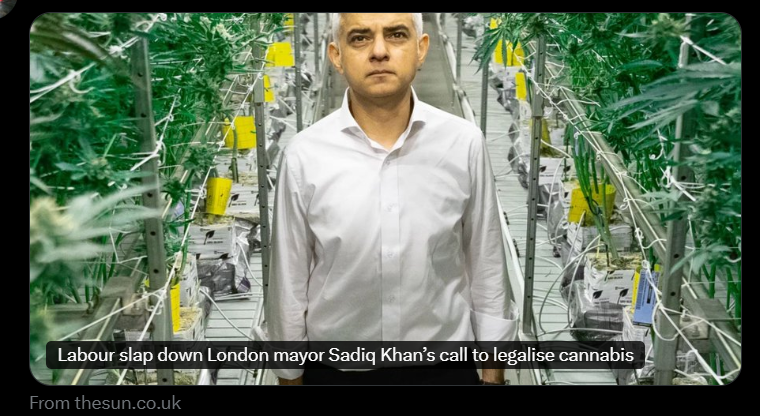
Right-wing in meltdown over  London mayor Sadiq Khan support of cannabis reform

Yesterday
Left Foot Forward News

As ever, right-wing critics focus on fear, missing the point that the proposal does not advocate full legalisation, but rather aims to reduce harm and promote equity, while strengthening education and addiction services.


News broke this week that the London mayor Sadiq Khan has backed calls for the possession of small quantities of natural cannabis to be decriminalised.

Responding to a new report by the independent London Drugs Commission (LDC), Khan said there was a “compelling, evidence-based case” for the government to consider the move.

Cannabis remains a Class B drug in Britain. Anyone found in possession of it face a fine or imprisonment. The LDC’s study examined how the drug is policed around the world and found cannabis policing “continues to focus on particular ethnic communities,” damaging their relations with law enforcement.

The LDC was set up by the London mayor 2022. It is chaired by Charlie Falconer, who was justice secretary under Tony Blair. Falconer argues the current laws are disproportionate and disproportionately impact ethnic minorities.

Rather than full decriminalisation, the commission recommends reclassifying natural cannabis under the Psychoactive Substances Act, allowing personal possession while keeping production and distribution illegal. It also calls for better education on the risks of cannabis use and addiction support.

Lord Falconer said: “Legalisation is not the answer. The criminal justice system response needs to focus only on the dealers and not the users.”

Sadiq Khan shared similar thoughts, saying he had “long been clear that we need fresh thinking on how to reduce the substantial harms associated with drug-related crime in our communities.”

“It [the report] says that the current sentencing for those caught in possession of natural cannabis cannot be justified given its relative harm and people’s experience of the justice system.

“We must recognise that better education, improved healthcare and more effective, equitable policing of cannabis use are long overdue,” Khan added.

Predictably, right-wing commentators lashed out.

The Sun’s Mercy Muroki, a self-proclaimed “unashamedly Conservative” journalist, labelled the proposal “lunacy,” blaming cannabis for crime and drug deaths. “Sadiq Khan is off his head,” read her headline, followed by: “I’d love to know what they’ve all been smoking.”

The Daily Mail focused on criticism from the Met Police and a government minister. Police Commissioner Mark Rowley rejected calls for legal reform, while Labour’s Matthew Pennycook reiterated that government policy remains unchanged.

GB News meanwhile focused on Susan Hall’s reaction. The Conservative London Assembly member and last year’s defeated Conservative candidate for London Mayor, has long been criticised for her unbridled smears of Sadiq Khan. Unsurprisingly, she didn’t hold back. Speaking to the channel, Hall dismissed the proposal as “ridiculous” and accused Khan of merely “tinkering around the edges” of crime in the capital.

“It’s completely dopey, it’s ridiculous. It’s typical of Sadiq Khan,” Hall declared. “If you talk to the commissioner, Mark Rowley, he hasn’t asked for this.

“He’s asking for more money so he can try and get some sort of order on our streets. This is utterly ridiculous, and I think the commission has cost over a quarter of a million pounds. That money could have gone into the policing service in London.”

The Telegraph focused on the comments of Chris Philp, shadow home secretary, who firmly stated that the Conservatives would oppose any move toward decriminalisation.

He said: “Possession of cannabis should not be decriminalised like this. We have seen some US and Canadian cities devastated by soft policies on addictive and harmful drugs – now Sadiq Khan wants to send London the same way.

Philp accused the mayor of prioritising “politically correct posturing for the benefit of his left-wing friends” over focusing on making London a safer city.

While the decriminalisation of cannabis will always spark lively debate, and concerns, such as leading to increased use among young people and additional strain on mental health services, which deserve careful consideration, what’s predictably absent from much of the coverage are the potential benefits. Research from the Transform Drug Policy Foundation suggests legalising cannabis could generate £1.5 billion annually for the Treasury, while significantly cutting into the illegal market.

But, as ever, right-wing critics focus on fear, missing the point that the proposal does not advocate full legalisation, but rather aims to reduce harm and promote equity, while strengthening education and addiction services.
Hungary: the anti-media model loved by the Right


Yesterday
Right-Wing Watch

As populist movements gain ground worldwide, the pressing question is: how far will this authoritarian, anti-media model be allowed to spread?


A year ahead of national elections and Hungary’s prime minister, Viktor Orbán, is moving to tighten control over civil society and free expression. Since taking office in 2010, Orbán and his ruling far-right Fidesz party have steadily dismantled the rule of law, eroding checks and balances and stifling dissent. A primary target has been press freedom, a vital pillar of any functioning democracy.

Orbán’s assault on independent journalism has become something of a blueprint admired by right-wing populists across the globe. From Donald Trump, who called Orbán “the boss” and regularly attacks critical media as “fake news,” to Nigel Farage, who bars critical outlets from Reform events, the Hungarian model of media control is increasingly viewed as a playbook by far-right leaders who seek to delegitimise dissent and consolidate power.

As populist movements gain ground worldwide, the pressing question is: how far will this authoritarian, anti-media model be allowed to spread?

Over the past decade, independent media outlets in Hungary have been closed or bought out by pro-government entities. Journalists who seek to hold power to account face increasing obstacles, from restricted access to information to outright surveillance and harassment.

A February 2024 report “I Can’t Do My Job as a Journalist: The Systemic Undermining of Media Freedom in Hungary,” documents a disturbing pattern of legislation designed to cripple independent reporting, media takeovers orchestrated by allies of Fidesz, and a coordinated campaign to delegitimise dissenting voices.

Accompanying the report is an image from a 2021 protest in Budapest of an activist holding a banner of Orbán’s watchful eyes, an unnerving symbol of state surveillance after revelations that Pegasus spyware was used to monitor critical journalists, opposition politicians, and business leaders.

Now, Orbán’s government is pushing a new bill that threatens to take Hungary’s repression to unprecedented levels. The proposed ‘On the Transparency of Public Life’ legislation would establish a powerful new body, the Sovereignty Protection Office, charged with identifying and punishing organisations deemed a threat to “national sovereignty.”

It would be empowered to cut off funding to foreign-supported media and civil society organisations, including those receiving support from the European Union, and subject them to punitive measures. These organisations would be required to produce legal declarations from every donor confirming that no foreign funding is involved. Existing grants could be frozen indefinitely, pending drawn-out government reviews.

The office would have sweeping powers to conduct unannounced inspections, including at private homes, and could call on the police to assist in these operations. This means work by any organisation, including media organisations, political parties, and intergovernmental bodies that report abuses by the Hungarian government could be liable to sanctions.

Human Rights Watch has warned that such authority poses serious risks to both privacy and due process.

Hugh Williamson, Europe and Central Asia director at Human Rights Watch, described the proposed legislation as part of an escalating campaign to “silence dissent and dismantle independent civil society ahead of next year’s elections.”

“The European Union has to recognise the grave threat to the rule of law the Hungarian government poses, and act firmly before the flame of democracy is snuffed out,” he said.

Human Rights Watch likens Hungary’s proposed bill and attempts to frame public debate and criticism of the government as existential threats to the state, to the infamous Russian foreign agent legislation.

Media censorship: part of the far-right’s DNA

Russia’s “foreign agent” law was rolled out in 2012 just after Vladimir Putin began his third presidential term. The law followed a wave of mass anti-government protests. It began by targeting foreign-funded NGOs, much like Viktor Orbán’s proposed bill in Hungary.

The two strongmen, united by nationalism and disdain for liberal democracy, have reshaped their countries through repressive legislation and media control.

In Russia, the law has ballooned in scope. Today, it can be used against journalists, activists, even ordinary citizens, regardless of any foreign ties. Since a 2022 amendment, merely criticising the Kremlin is enough to earn the “foreign agent” label. Over 900 names are now on the blacklist, updated weekly by the Justice Ministry, according to Novaya Gazeta Europe.

Novaya Gazeta Europe tells its own story as a Russian media casualty. Born in exile in Latvia in 2022 after Putin’s invasion of Ukraine and sweeping censorship, the outlet continues the legacy of Novaya Gazeta, which was one of Russia’s most respected independent newspapers.

Founded in 1993 with Gorbachev’s Nobel Peace Prize money, Novaya Gazeta has long been a Kremlin target. Six of its journalists have been murdered under Putin’s rule. Its editor-in-chief, Dmitry Muratov, won the Nobel Peace Prize in 2021 for defending free speech, something both Putin and Orbán see as a threat to their grip on power.

Israel tightens its media grip

Similarly, in Israel, the right-wing government’s history of stifling dissent has intensified during the war on Gaza. Netanyahu’s government shut down Al Jazeera’s office in Israel, invoking a new law that allows the government to ban any foreign outlet it deems a threat. The same law was soon used to cut the Associated Press’s live feed from northern Gaza. Despite global backlash, the ban on Al Jazeera was extended, then followed by a bill to make the shutdown permanent. This bill can be arbitrarily used against any foreign media outlet deemed unwelcome by the government.

The crackdown comes as Netanyahu’s ties with Hungary’s Viktor Orbán grow stronger. In April, Netanyahu went on a four-day visit to Hungary, his first trip to Europe since the International Criminal Court (ICC) issued a warrant for his arrest over alleged war crimes in Gaza. Orbán wasted no time declaring he’d ignore the warrant, telling reporters that he would “guarantee” the ICC’s ruling would “have no effect in Hungary.”

Echoes of Orbán in Trump

Then there’s Donald Trump, who has openly admired Orbán, calling him “the boss” during a 2024 visit to Mar-a-Lago. The EU Observerdescribed the pair as “two peas in a pod,” and with good reason.

Ahead of the presidential election, Human Rights Watch warned that Orbán’s cosy relationship with Trump should raise red flags for people in the United States who care about “preserving and building an inclusive, healthy, US democracy.”

The parallels are already playing out. Trump is suing media outlets and vowing to “straighten out the press.” Even before the election, the Washington Post and the Los Angeles Times declined to endorse a candidate, a decision that was widely believed to be driven by fear of retribution.

“To see how Trump will control the US media,” wrote Guardian columnist Owen Jones, “look at Viktor Orbán’s Hungary.”

Orbán backs Polish nationalist at CPAC

Meanwhile in Poland, where a presidential election is taking place, Donald Trump’s officials and allies descended on the country this week, rallying support for far-right candidate Karol Nawrocki, ahead of Sunday’s ballot.

On May 27, several keys MAGA figures, including Trump’s head of homeland security, attended Conservative Political Action Conference (CPAC) 2025 in Poland and Hungary, urging Poland to elect Nawrocki of the Law and Justice party and calling the vote a “battle for Western civilisation.”

Addressing attendees at the opening session, Orbán championed Nawrocki, and announced a “patriotic plan” that he said should “transform” the European Union. He described Trump as a “truth serum” and emphasised his vision of a new Europe, in what he calls “the Age of Patriots,” based on the nation, the traditional family, and his version of Christianity.

Britain and the Orbán playbook


Britain isn’t immune to Viktor Orbán’s growing influence on the global right. In 2023, Conservative MP Sir Edward Leigh tweeted a picture of himself and fellow Brexit-backing MPs Christopher Chope and Ian Liddell-Grainger grinning alongside Hungary’s far-right leader in Budapest. The tweet praised Orbán’s “effective” approach to illegal migration.
]


But the more urgent figure to watch is Nigel Farage, whose political clout appears to be rising week by week, with worrying implications for press freedom.

Just over a year ago, Farage and Suella Braverman spoke alongside Orbán at the National Conservatism Conference (NatCon) in Brussels.

Byline Times reported that the line-up for NatCon Brussels “further demonstrates Orbán’s influence on the right of European politics and also includes many speakers with links to radical right networks in Europe and the US…”

The irony is not hard to miss. Farage and his allies claim to champion free speech, yet they undermine media plurality at every turn.

At Reform’s 2024 party conference, several outlets, including Byline Times, DeSmog, and the Observer, had their press passes rejected. Months earlier, pro-EU campaigner and writer Femi Oluwole was forcibly removed from a Reform rally without explanation.

Michelle Stanistreet, head of the National Union of Journalists, called the move “a bad look” for any party claiming to stand for media freedom, warning that cherry-picking media access harms the breadth of diversity reporting on events.

Farage paints the media as undemocratic

Farage’s hostility to the press escalated during the election campaign. After a Channel 4 undercover report caught a Reform canvasser making racist remarks about then prime minister Rishi Sunak, and calling for asylum seekers to be shot, Farage called it a “stitch-up,” claiming the canvasser was a planted actor. Reform accused Channel 4 of election interference and even filed a complaint with the Electoral Commission.

The next day, appearing on BBC Question Time, Farage faced questions about extremism in his party. He responded by accusing the BBC of “rigging” the audience and branding it a political actor. Days later, at a rally in Birmingham, he declared both the BBC and Channel 4 partisan institutions unfit to be called public broadcasters.

For a self-proclaimed defender of free speech, Farage’s record tells a very different story, one that echoes Orbán’s well-worn path of silencing critics and controlling the narrative.

The real danger is that Farage is using anti-media populism, not just to win headlines, but to rig the narrative and build momentum for the next election. Such a calculated long-game will need scrutiny.


Gabrielle Pickard-Whitehead is author of Right-Wing Watch
Right-wing media watch – Dovid Efune insists his ‘British bid’ for Telegraph still alive amid foreign takeover deal

TODAY
Left Foot Forward News

The sale of the Telegraph saga goes on.


The sale of the Telegraph saga goes on.

Dovid Efune, the British-born publisher of the online-only New York Sun, is vowing to press ahead with his bid to buy the Conservative newspaper, despite a rival deal that appears to give control to a UAE-backed firm.

Efune acquired what was a nearly defunct New York Sun five years ago. Since taking over, he has expanded the Sun’s reporting beyond New York, with a strong presence in Washington as well as in Europe and Israel. The title gained the attention of Donald Trump, who regularly posts its articles on Truth Social, which has helped bolster subscriptions.

But Efune has risen to prominence since joining the race for the Telegraph.

Appearing on Sky News recently, the publisher declared that his “British bid for the Telegraph is alive and well, and not going anywhere.”

He dismissed reports of a finalised sale to RedBird IMI, a US-UAE joint venture, as premature, adding: “If the history of the Telegraph’s ownership saga teaches us anything, it’s that the ownership of the Telegraph and, frankly, any other crown jewel of British public life, will not be determined by means of a press release.”

Efune entered the bidding in late 2023 after submitting the highest second-round offer. A self-described admirer of the Telegraph’s “values-based, principled and constitutionalist” journalism, he has cast himself as a defender of British media independence, arguing that the final decision should involve Parliament, the paper’s staff, and its readership.

“The British public will yet have their say via their elected representatives, the Telegraph’s staff and the Telegraph’s readers will have their say, as will the rest of the British press,” he said.

That message, however, sits awkwardly alongside Efune’s history of inflammatory political commentary. In a series of posts on X, he has claimed Israel would “decapitate” Iran’s leadership through “targeted strikes and close quarter assassinations.”

In a speech in 2023 in New York, he said that when it comes to the Israel-Hamas conflict there is a need to “fight with every report and headline”.

Such remarks sparked concern among Telegraph staff about possible editorial influence.

“We are out of the frying pan into the fire,” one insider commented, adding his tweets are “not the behaviour you want to see from a newspaper proprietor. It compromises everybody by association.”

Efune’s defiant position comes just days after RedBird IMI announced an agreement in principle to take a majority stake in the Telegraph from IMI, the UAE’s state-backed media investment arm. RedBird founder Gerry Cardinale aims to become the controlling shareholder, with IMI retaining a passive stake of up to 15%.

That deal is now possible under a new UK law announced on May 15, which allows state-owned investors, including sovereign wealth funds, to hold up to 15% of British newspaper companies. The move raises the threshold from a previously proposed 5% cap, introduced in response to the backlash against RedBird IMI’s original £600 million bid in 2024, fronted by Sheikh Mansour bin Zayed Al Nahyan, owner of Manchester City FC.

Still, uncertainty lingers over how much cumulative foreign state ownership will be allowed, with peers in the House of Lords warning “where will it end?”

With both bids mired in political and editorial controversy, the future of the Telegraph, Britain’s Conservative mouthpiece, which has endorsed the party at every general election since 1945, remains as turbulent and uncertain than ever.


Right-Wing Watch

Woke bashing of the week – woke-bashing backfires as GB News faces backlash over anti-LGBTQ+ slur
Today
Left Foot Forward News


“That is an actual comedy show. Not comedy masquerading as news like GB News output.”


In a moment of poetic justice, GB News is under fire after airing a vile anti-LGBTQ+ remark that sparked hundreds of thousands of complaints and triggered an official investigation by Ofcom.

The controversy centres around the channel’s long-running ‘comedy’ panel show Headliners, where right-wing pundits and comedians discuss the next day’s newspapers and routinely take aim at so-called ‘woke’ culture.

During a January episode, comedian Josh Howie made a comment while discussing a sermon by Bishop Mariann Edgar Budde, who had called on Donald Trump to show compassion for immigrants and LGBTQ+ people.

Quoting the bishop’s statement, Howie sneered:

“I just want to say, that includes paedos, if you’re doing the full inclusion.”

More than 1,200 formal complaints were lodged with Ofcom, alongside a petition from the Good Law Project, signed by over 70,000 people. The petition was delivered to the media regulator, which has confirmed it is investigating the broadcaster – again.

GB News hit back, attempting to frame the controversy as a ‘free speech’ issue.
Its chief executive, Angelos Frangopoulos, said the channel had been “subjected to a coordinated political campaign by far-left pressure groups.”

But the courts have long discredited this kind of rhetoric. The High Court has described the slur linking the LGBTQ+ community with paedophilia as “one of the oldest, most pernicious and most stubbornly ineradicable falsities or myths of homophobia.”

Agustina Oliveri, head of campaigns and communications at the Good Law Project, welcomed the investigation into a “channel of hatred.”

“Ofcom has been letting GB News get away with broadcasting racism, misogyny and homophobia for too long,” Oliveri said. “It’s time for the regulator to do its job and make sure that media barons stop profiting from monetising hate.”

The Good Law Project has since expanded its campaign, urging advertisers to distance themselves from the channel.

Sky, one of GB News’ largest advertisers, has come under pressure, with over 19,800 people emailing CEO Dana Strong demanding that she stops funding hate speech by advertising on the channel.

Even readers of the right-wing Daily Express took aim.

‘Anti-woke’ comedy show sums up all of GB News output,” wrote one commenter in response to the newspaper’s report on Ofcom’s latest investigation into the broadcaster.

Another summed it up: “That is an actual comedy show. Not comedy masquerading as news like GB News output.”

Let’s hope this time, the broadcaster isn’t let off the hook, because, surely, turning hate into entertainment shouldn’t come without consequences.


LGBTQ+ groups call on Ofcom to sanction GB News over homophobic broadcast


29 May, 2025
Left Foot Forward News

“We can’t have foreign-funded broadcasters poisoning the national conversation with these ugly lies. Ofcom needs to say ‘Stop’.”


A coalition of LGBT+ groups and the Good Law Project have joined forces to urge Ofcom to take action over a homophobic broadcast aired by GB News.

The Good Law Project, LGBT Consortium, TransActual, Trans Media Watch and others made a formal submission to Ofcom’s investigation into GB News.

The submission argues that the regulator should sanction GB News for breaches of the broadcasting code, including failing to protect its audience from harmful material and the proscription of hate speech.

The media regulator opened an investigation into GB News in March after presenter Josh Howie made a homophobic slur linking the LGBTQ+ community to paedophilia.

Discussing a bishop’s sermon urging Donald Trump to “have mercy” on marginalised communities, Howie said that when the bishop’s diocese “talks about the ‘full inclusion of LGBTQ+ persons” that “includes paedos, if you’re doing the full inclusion there’.”

More than 70,000 people used an online tool created by the Good Law Project to complain about the homophobic broadcast, making it the biggest complaint Ofcom has ever received. Yet, Paul Marshall’s GB News still stands by the content.

Jo Maugham, executive director of Good Law Project, said this “appalling” broadcast cuts to the heart of British values.

“Britain is a kind country, with kind people, who try to do the right thing,” Maugham said. “We don’t want and we can’t have foreign-funded broadcasters poisoning the national conversation with these ugly lies. Ofcom needs to say ‘Stop’.”

Chair of Trans Media watch, Jane Fae, argued it should be “an open and shut case”.

“Our fear, though,” Fae said, “is that as so many times before, Ofcom will find sufficient wiggle room to allow it to let GB News off with mild censure, and no real consequence.”

Olivia Barber is a reporter at Left Foot Forward
Britain

Labour panders to racism – playing the far right’s game


Friday 30 May 2025, by Simon Hannah


When Keir Starmer was standing for Labour leader in 2020 after Jeremy Corbyn resigned, his slogan was “Another World is Possible”. This was a call back to the ideals and hope of the anti capitalist movement in the late 1990s and early 2000s before 9/11 made our world more reactionary, more dangerous, more cynical. As part of his bid for leadership to win over a membership that had only recently elected Corbyn twice over, Starmer gave a speech in which he outlined his view on immigration; “We welcome migrants, we don’t scapegoat them. Low wages, poor housing, poor public services, are not the fault of migrants… we have to make the case for the benefits of migration”.


Music to the ears of the left – fighting a rearguard action every day against the right wing press, fascists and the political right who are constantly beating the drum that all our problems are ultimately down to mass migration.

It is no surprise of course to see Starmer totally collapse on this issue in the face of the growth of the Reform vote. Starmer has no principles, no spine, no moral code. His only interest is power, and exercising power for the sake of maintaining the collapsing status quo.

Starmer’s speech was to promote the new immigration white paper – in reality a white flag to racism that collapsed Labour’s policy agenda into Reform’s. Nigel Farage gave a statesman performance in Parliament, not crowing or goading, simply acknowledging that Starmer was now on the right track but could go a little further – call a state of emergency at the border for instance. Don’t be surprised if that happens before the end of this parliament.

We are living through the most eroded, politically bankrupt form of a Labour government. Bereft of ideas or inspiration apart from Rachel Reeves’ laughable neoliberalism greatest hits covers band, all they can do is flail around as their hopes of a rejuvenated Britain fuelled by GDP growth collapses around them. News reports of 0.7% GDP growth are hailed as a glimmer of hope, in a world where the tendency towards stagflation and economic decline is growing stronger.

Austerity, austerity and more austerity. Death by a thousand cuts. But you cannot blame the tax dodging businesses or the super rich, and you certainly cannot propose even going back to even the middle ground of post war social democracy. All there is are markets, businesses, wealth and power and the complete subordination of our lives and communities to them.

No such thing as society, indeed.

But there is racism. And nationalism. The last refuge of a desperate scoundrel. And is there any more desperate or scandalous than Sir Starmer? Beating down on migrants and refugees is so commonplace now Starmer probably doesn’t give it a second thought. The ghost of his own self from 2020 is waved away, after all you have to be realistic when you’re in power don’t you? And realism today means transphobia and racism; fresh, bleeding red meat for the hungry mouths of the culture wars.
Labour’s racist history

Of course this is nothing new, Labour has routinely thrown ‘foreigners’ to the wolves despite the fact they historically got a lot of the Black vote.

In 1924 during their first government, one Labour minister proclaimed “I’m here to make sure there is no mucking about with the British Empire”. Labour reluctantly gave up India in 1947 only because of the success of the anti colonial movement, but made sure to partition the country at the cost of millions of lives.

Labour opposed the Tories 1961 anti immigration legislation that would limit the number of people from Commonwealth countries, only to legislate their own three years later. Harold Wilson was clear that Labour “did not contest the need for control of immigration into this country” because as he said the “number of immigrants with differing cultural and social backgrounds” was causing “difficulties”. This was just a few years after the racist riots at Nottinghill when local young white people had attacked Black people living there.

The reality is that immigration under capitalism is always turned on or off for the benefit of business and the bosses. When there was a Labour shortage after World War Two every political party backed recruiting Black workers from the Caribbean. By the 1960s when concerns over economic stagnation began to set in, the anti-immigrant rhetoric ramped up, not just over competition for jobs but a feeling that ‘British culture’ was being undermined by people from abroad. The idea that culture always evolves and changes is lost on the nationalist, all they see is a fake nostalgia for an imagined past, impervious to nuance or facts.

Labour doesn’t just pander to these prejudices to win votes – though it does also do that.. Labour is a political machine for managing capitalism, it claims to shift the balance slightly more favourably towards ‘hard working people’ though as we have seen this is usually just electioneering for the grim reality of servicing the needs of big business and the capitalist class. Because it is a machine that is embedded in and welded to capitalism and the nation state, it will happily attack immigrants if they can convince themselves there is an economic logic to it.

The key shift in Starmer’s speech is that instead of attacking ‘illegal immigrants’ and ‘bogus asylum seekers’ Labour is now going after legal migration – workers and students who have visas.

In a situation of economic decline, the logic to restrict immigration even to sectors that traditionally rely on workers from abroad like social care and health, is based on the theory that too many ‘cheap’ migrants depress wages, therefore there is no investment in new labour saving technology and this limits productivity and therefore growth.

So the idea is that if cheap migration is stopped and British bosses have to start using ‘more expensive’ workers then the incentive is to introduce technology to eventually make them redundant. This is not a pro workers argument, it is a pro business argument because it boosts ‘productive’ sectors like manufacturing (itself increasingly automated) at the expense of sectors that are less profitable. Those people backing the clampdown might do well to think through how this is actually going to help anyone apart from some sections of business.
The fightback

Mass migration is not the cause of the problems in Britain, it is decades of neoliberalism and austerity, huge wealth inequality, the collapsing welfare state and public sector and the growth of reactionary divisive ideas that are tearing apart communities. At the root of it, the problem is an economy predicated on private property and people being mere pawns in the wealth creation of the rich.

Of course it is true that a major growth in population could put pressure on public services, but decades of under-funding or an almost entirely unregulated market in homes is the primary cause of that. But the Reform, the Tories and Labour Party don’t want to tackle the actual problem of the people with economic and social power so they go after Black people and anyone else they can use as a political football to kick around.

We have to be clear – we resist racist policies and nationalism as fake solutions to the more fundamental problems. We are united as working people to fight for a decent quality of life for everyone and we are implacable opponents of anyone and anything that gets in the way of that.

A mass anti racist movement that is rooted in working class communities, including the trade unions is central to this. You cannot fight Reform in isolation, calling them a racist party is limited as a strategy, because a lot of people are voting for them because they are racist, or because their voters on one level do think that mass migration is eroding the country.

Also how can we challenge Reform in isolation when Labour is adopting their policies? The collapse of Labour into Reform’s policy agenda also raises questions over whether ‘voting Labour to stop Reform’ is a viable tactic. The current political dynamic is toward the authoritarian right and Labour is absolutely part of that, whether imprisoning climate protesters, building more prisons, rolling back social provision, its new Crime and Policing Bill or its war on refugees and immigrants, Labour is absolutely in the same game as the Tories and by extension Reform.

18 May 2025

Source Anti*Capitalist Resistance.


Attached documentslabour-panders-to-racism-playing-the-far-right-s-game_a9014.pdf (PDF - 913 KiB)
Extraction PDF [->article9014]


Simon Hannah
Simon Hannah is a member of Anti*Capitalist Resistance and author of several books on political activism in Britain.

International Viewpoint is published under the responsibility of the Bureau of the Fourth International. Signed articles do not necessarily reflect editorial policy. Articles can be reprinted with acknowledgement, and a live link if possible.