Tuesday, June 03, 2025

Horrific details revealed after 'King of the Hill' voice actor shot to death
RACIST HOMOPHOBIC HATE MURDER

Sarah K. Burris
June 2, 2025 
RAW STORY


Actor Jonathan Joss and "King of the Hill" character John Redcorn (Photos: Somerset High School 2017, Creative Commons and screen capture)

Voice actor Jonathan Joss, best known for his role as John Redcorn on the animated series "King of the Hill" and Ken Hotate in “Parks and Recreation," was killed Sunday night outside of his home.

According to his family, it was part of an ongoing attack.

Joss' husband, Tristan Kern de Gonzales, wrote in a Facebook post Monday afternoon that the couple had moved, but went back to their old house to check the mail. The reason they needed to move is that the home was "burned down after over two years of threats from people in the area who repeatedly told us they would set it on fire."

Gonzales wrote that, over and over, the couple reported threats to law enforcement, "and nothing was done."

When they arrived at the house, Gonzales said, "We discovered the skull of one of our dogs and its harness placed in clear view. This caused both of us severe emotional distress. We began yelling and crying in response to the pain of what we saw."

The fire in January claimed the lives of all three of the couple's dogs, NBC News reported.

That was when a neighbor began shouting homophobic slurs and attacked.

"He then raised a gun from his lap and fired," said Gonzales.

"Jonathan and I had no weapons. We were not threatening anyone. We were grieving. We were standing side by side. When the man fired Jonathan pushed me out of the way. He saved my life," he added.

"Jonathan is my husband. He gave me more love in our time together than most people ever get. We were newlyweds. We picked Valentine's Day. We were in the process of looking for a trailer and planning our future," Gonzales continued. "He was murdered by someone who could not stand the sight of two men loving each other. I was with him when he passed. I told him how much he was loved."

Gonzales recalled that they had been "harassed regularly by individuals who made it clear they did not accept our relationship. Much of the harassment was openly homophobic."

"To everyone who supported him, his fans, his friends, know that he valued you deeply. He saw you as family. My focus now is on protecting Jonathan’s legacy and honoring the life we built together. If your concern is how someone coped with trauma or how loudly they speak when recounting injustice and being ignored by authorities, then you never truly cared about my husband. Jonathan saved my life. I will carry that forward. I will protect what he built," Gonzales closed.


The shooting came after Joss and Gonzales returned to San Antonio, Texas, after a Saturday show in Austin. Joss had posted on Facebook that after the Saturday "gig" they were looking for a ride back after his "former manager ghosted" the couple.

Carlos Samudio, of Look Now Productions, which ran the Saturday event where Joss signed comics for fans at a tribal comic and game store, spoke on his Instagram account about "rumors" about Joss on the internet, claiming "Jonathan was all this stuff." Rather, he said that Joss was "as gentle as can be" and "a true gentleman." He later added Joss was "an honorable man, a caring man" who "worshiped nature."

Neighbors told local reporters from KENS News that there was a "terrible neighborhood feud" and that's what led to the violence. They said that there was "a lot of drama" between the two men and that Joss would frequently carry a crossbow. In the night, the neighbors said that they would hear gunshots coming from both homes.

"Not necessarily that the guys were shooting at one another, but there was just a lot of drama all the time," the reporter said. There has never been any conflict where people got hurt, she added.

Jonathan Joss was 59.

Sigfredo Alvarez Ceja, 56, was arrested and charged with murder


Read the full statement here.
'Totally false!' Trump fury sparked by rumors of Harvard grudge origins

Travis Gettys
June 3, 2025 
ALTERNET


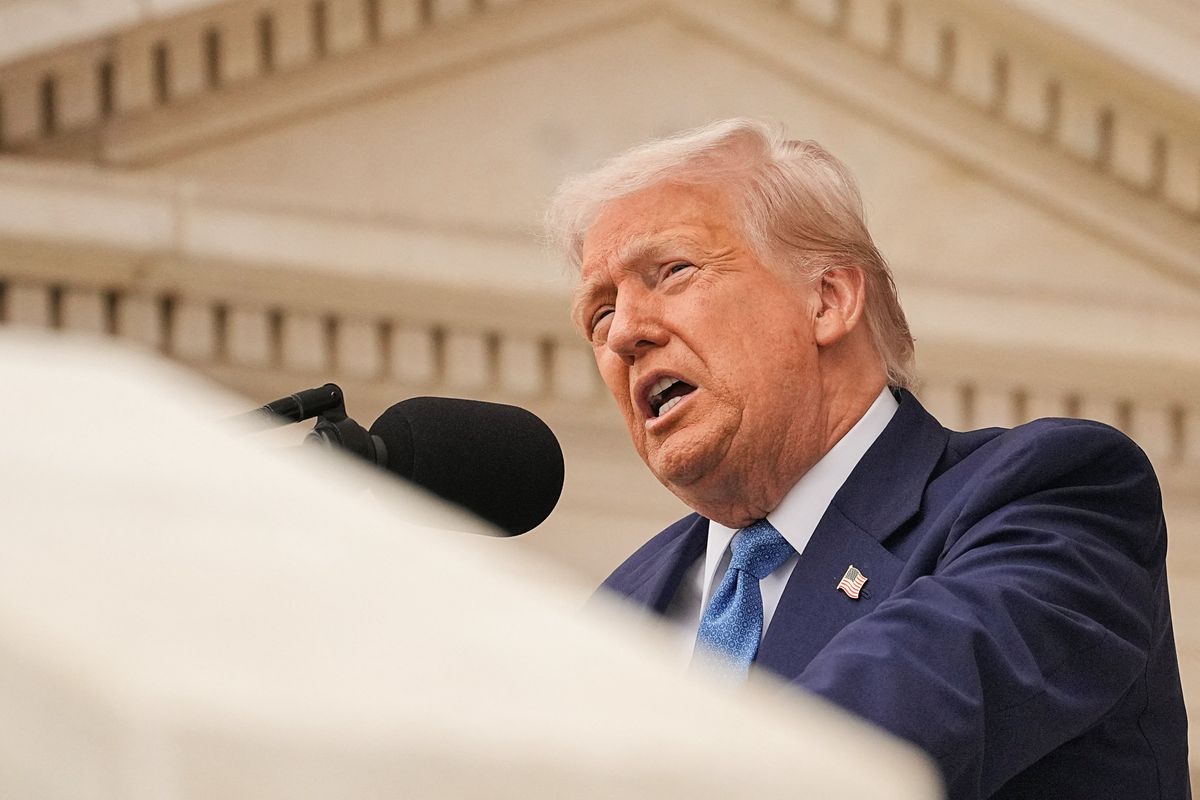
U.S. President Donald Trump delivers remarks at the annual National Memorial Day Observance in the Memorial Amphitheater at Arlington National Cemetery in Arlington, Virginia, U.S., May 26, 2025. REUTERS/Ken Cedeno

President Donald Trump lashed out at one of his biographers after the writer claimed an escalating feud with Harvard University was based on a personal grudge.

Author Michael Wolff, who has written several books about the inner workings of the White House under Trump, claimed the president has brought his executive powers to bear on the Ivy League school because he was not accepted there as a student decades ago. Trump angrily denied his account.

"Michael Wolff, a Third Rate Reporter, who is laughed at even by the scoundrels of the Fake News, recently stated that the only reason I’m 'beating up' on Harvard, is because I applied there, and didn’t get in," Trump posted Monday evening on Truth Social. "That story is totally FALSE, I never applied to Harvard. I graduated from the Wharton School of Finance at the University of Pennsylvania."

"He is upset because his book about me was a total 'BOMB,'" Trump added. "Nobody wanted it, because his 'reporting' and reputation is so bad!"

Trump attacked Wolff back in February, when his latest book, "All or Nothing: How Trump Recaptured America," was released, calling it a “total FAKE JOB, just like the other JUNK he wrote," and said he had repeatedly rebuffed his invitations for an interview.

Wolff said last week that there's a running joke going around the White House that the president has targeted the Ivy League school because his son Barron didn't get in, which Melania Trump publicly denied, but the author said that it was Trump himself who was shut out as an applicant.

“It’s important not to lend too much calculation and planning to anything he does,” Wolff told The Daily Beast Podcast. “But the other thing is that, by the way, he didn’t get into Harvard. So one of the Trump things is always holding a grudge against the Ivy Leagues.”
'Mean'
Trump's new FEMA chief whines after 'joke' leaves new staff stunned

Adam Nichols
June 3, 2025
RAW STORY


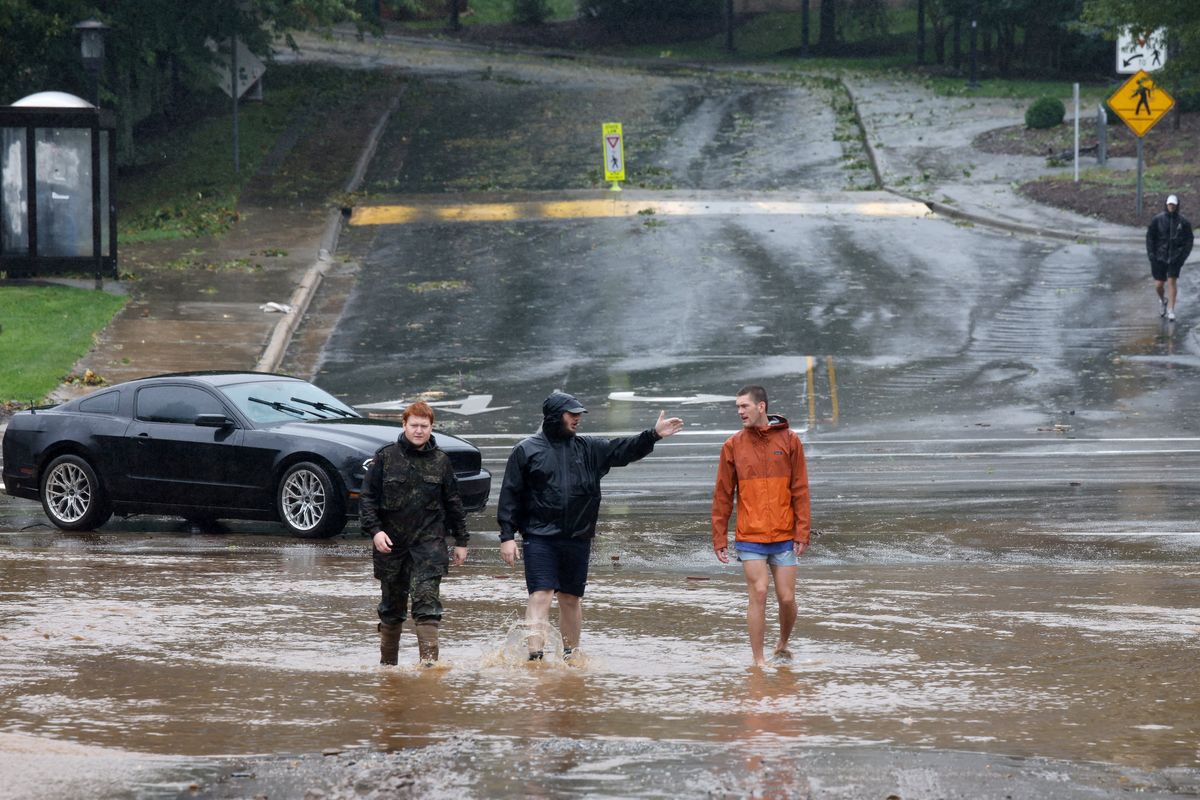
FILE PHOTO: Pedestrians walk through a flooded street as Tropical Storm Helene strikes, in Boone, North Carolina, U.S. September 27, 2024. REUTERS/Jonathan Drake/File Photo

President Donald Trump's new chief of the Federal Emergency Management Agency whined about "mean-spirited" jokes after a comment about hurricane season left his new staff dumbfounded.

David Richardson casually admitted at an all-hands meeting that he didn't know the U.S. had a hurricane season — just a day after it began.

Four sources who spoke to Reuters confirmed the bizarre exchange, which has set off alarm bells throughout the agency tasked with responding to natural disasters. The National Oceanic and Atmospheric Administration has already warned of an "above-normal" season, projecting 6 to 10 hurricanes, with up to five potentially reaching major status.

But in a statement given to the Daily Beast, Richardson's spokespeople passed the staggering comment off as a light-hearted quip.

“Despite mean-spirited attempts to falsely frame a joke as policy, there is no uncertainty about what FEMA will be doing this hurricane season,” a Homeland Security spokesperson said.

While the Department of Homeland Security scrambled to downplay the incident as a "joke," insiders paint a different picture. Richardson, a Marine veteran with zero disaster response experience, was parachuted into the role last month after Trump unceremoniously fired his predecessor for daring to disagree with the president's vision of gutting FEMA.

Adding fuel to the fire, Richardson announced he wouldn't be issuing a new hurricane season plan, despite earlier promises. This leadership vacuum has left FEMA staff in disarray, with one source describing a state of utter confusion within the agency.

Trump's crusade against FEMA is already having real-world consequences. The agency recently denied North Carolina's plea for extended hurricane damage reimbursement after a storm claimed over 100 lives. In St. Louis, Mayor Cara Spencer is still waiting for FEMA assistance days after a devastating tornado caused $1 billion in damage.

As coastal communities brace for what could be a catastrophic hurricane season, the question on everyone's mind is: With a FEMA chief who doesn't even know hurricanes have a season, who will be there to pick up the pieces when disaster strikes?

Trump's FEMA chief admits to staff he didn't know there was a hurricane season


Matthew Chapman
June 2, 2025 
RAW STORY


'FEMA recovery center in Breezy Point, NY
 [Leonard Zhukovsky / Shutterstock.com]

President Donald Trump's head of the Federal Emergency Management Agency stupefied staffers with an admission he wasn't even aware there was a hurricane season, Reuters reported on Monday.

"The remark was made by David Richardson, who has led FEMA since early May. It was not clear to staff whether he meant it literally, as a joke, or in some other context," said the report by Leah Douglas, Ted Hesson, and Nathan Layne. However, "a spokesperson for the Department of Homeland Security, FEMA's parent agency, said the comment was a joke and that FEMA is prepared for hurricane season."

Hurricanes typically are clustered in the time span between June and November, fueled by the summer heat driving up the energy of the waters of the Atlantic Ocean. Experts expect as many as 10 hurricanes could form this year — a deadly natural disaster that can kill and injure dozens every year, swamp coastal communities, and even cause intense flooding hundreds of miles inland, as happened in Western North Carolina last year.


Despite DHS assurances, "Richardson's comments come amid widespread concern that the departures of a raft of top FEMA officials, staff cuts and reductions in hurricane preparations will leave the agency ill-prepared for a storm season forecast to be above normal," noted the report.

Richardson did not have any natural disaster response experience prior to his appointment to the FEMA role. However, the report noted, he "has evoked his military experience as a former Marine artillery officer in conversations with staff."

Trump, since taking office, has made several moves alarming emergency preparedness experts. A few months ago, a judge in Rhode Island found credible evidence that the Trump administration was "covertly" denying disaster aid to states that hadn't voted for him in the 2024 election. Meanwhile, some North Carolina residents have reportedly been incensed at the president's lack of follow-through on his election campaign commitments to clean up hurricane-ravaged areas there.


Exclusive: Memo exposes DOGE's potential 'end game' for U.S. Postal Service
RAW STORY
June 3, 2025 


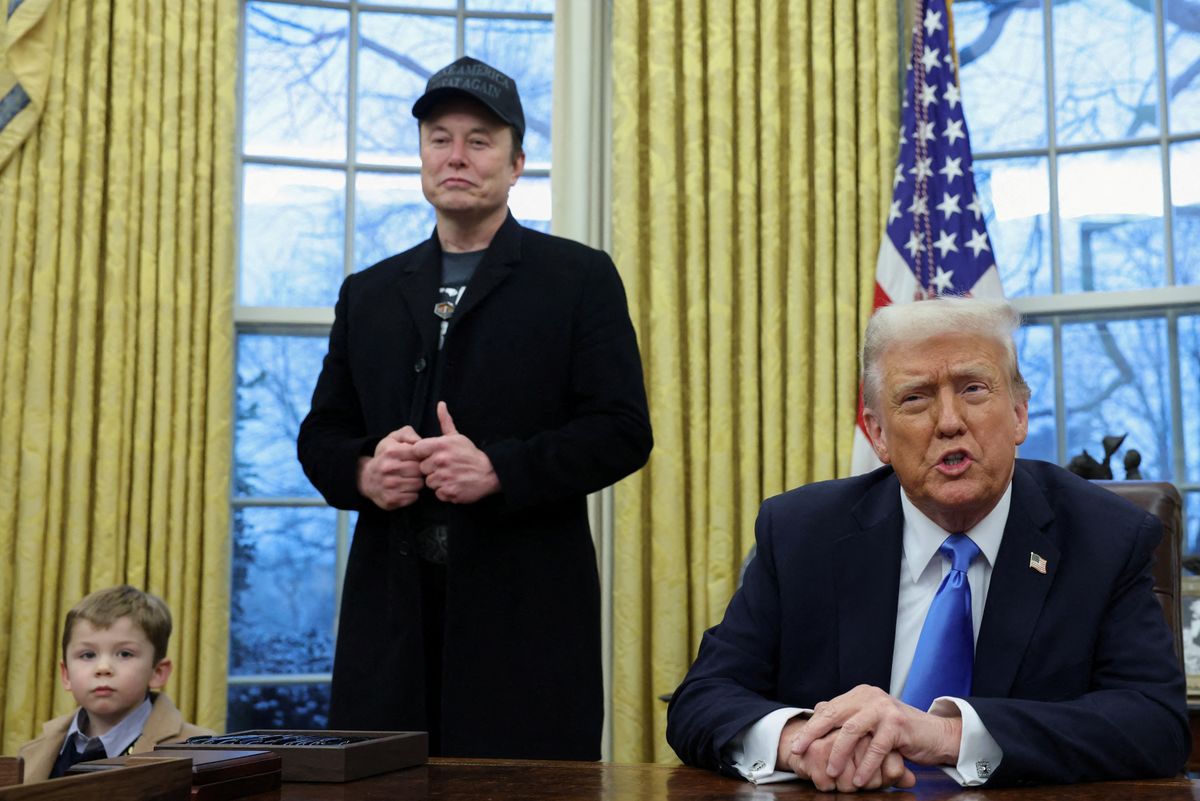
Donald Trump speaks next to Elon Musk and Musk's son in the Oval Office. REUTERS/Kevin Lamarque


While still under the leadership of Elon Musk, the Department of Government Efficiency (DOGE) consulted with the leader of a little known arm of the U.S. Postal Service (USPS), a memo obtained by Raw Story revealed — prompting legal and academic experts to warn of potential trouble ahead.

On March 19, Chief Postal Inspector Gary Barksdale issued a “situational update” to the U.S. Postal Inspection Service (USPIS), USPS’s law enforcement arm, about a meeting with DOGE, according to the memo, which Raw Story received through a Freedom of Information Act request.

In the memo, Barksdale reiterated former Postmaster General Louis DeJoy’s requests for assistance from DOGE as outlined in a March 17 letter to Congress, including help with “efforts to combat counterfeit postage.”

But Barksdale also provided a new recommendation “when [DOGE representatives] asked for specifics on how they could assist us,” asking for "administrative subpoena authority.”


The request “essentially allows for government agencies to issue requests, subpoenas, without any type of specific judicial intervention or judicial approval,” said Felix Shipkevich, a professor of law at Hofstra University.

The request surprised more than half a dozen experts who reviewed the memo.

“I think this foray into the postal inspector’s realm, into his office, is to put the postal inspector on notice that DOGE is looking at them,” said James O’Rourke, a professor of management at the University of Notre Dame’s Mendoza College of Business who studies the postal service.

“The endgame is the dissolution of the U.S. Postal Service. Parts will be sold, and it will be entirely privatized, if the current administration gets its way.”

DOGE aims to slash trillions of dollars from federal budgets, resulting in cancelled government contracts, thousands of redundancies at government agencies, and intense controversy over Musk’s access to federally held data.

The world’s richest man last week left the Trump administration to return to businesses including Tesla and SpaceX.

But DOGE remains active.

A USPS spokesperson did not respond to requests for comment. Representatives of DOGE and its House caucus could not be reached.

‘Mail theft epidemic’

USPIS is tasked with protecting the mail and investigating mail-related crimes. It employs more than 1,250 inspectors and nearly 450 police officers, according to its 2023 fiscal year report.

Mail theft and violent crimes against letter carriers have skyrocketed. Letter carrier robberies increased 543 percent in a three-year period, according to an exclusive Raw Story investigation.


In May 2024, the U.S. Government Accountability Office (GAO) issued a report calling on USPIS to better document decision-making processes in the wake of such a surge in mail-related crime.

USPS agreed with the GAO’s three recommendations, but they remain open a year later, said Derrick Collins, GAO’s director of physical infrastructure.

“They've told us that they're going to identify metrics or factors that they'll consider when making workforce decisions, but that's the extent of the information that we have at this point from them,” Collins told Raw Story. “They've not given us any additional details or timeframes.”

Asked if broader administrative subpoena authority could aid USPIS in investigating serious mail crimes, Collins said, “it did not come up in the course of our work, and we didn't explore it in part because it didn't come up.”

The U.S. Postal Service Office of Inspector General — an independent agency examining fraud, waste and abuse — also investigated USPS’s response to mail theft, finding ineffective efforts in stopping robberies of mail keys and collection boxes.

Tara Linne, a spokesperson for the USPS Office of Inspector General, told Raw Story the agency “didn’t address the administrative subpoena authority in any of our reports” and referred questions to USPIS.


The “mail theft epidemic” coincides with a 2020 statute reinterpretation restricting postal police officers to working on Postal Service properties, unable to intervene in mail crimes on the street, said Frank Albergo, president of the Postal Police Officers Association union (PPOA).

The PPOA and Postal Service remain in litigation about the jurisdiction of postal police officers.

“The Inspection Service now wants to essentially bypass the judicial process and then leave it up to themselves … they want to hoard investigative authority while they bench their own postal police force,” Albergo said.

“Think of how contradictory this is. So, their uniformed police officers don't have any authority to protect postal workers and mail, and yet their postal inspectors should have administrative subpoena power?”


A postal police officer in Detroit greets a letter carrier (Photo courtesy of the Postal Police Officers Association)

USPIS recently joined a Department of Homeland Security task force detaining and deporting undocumented immigrants, and participated in a drug and immigration enforcement raid in Colorado Springs alongside the FBI and IRS, the Washington Post reported.

“It’s a safe assumption that they would use this administrative subpoena authority to go after illegal immigrants,” Albergo said.

Albergo said both Democrats and Republicans in Congress were “really getting annoyed at the Inspection Service and mail theft,” adding: “It's just not going away that they have a police force that they refuse to use. What is the Inspection Service busy doing? They're busy asking for administrative subpoena power. If they were serious, they would ask for postal police power.”


‘Fishing expedition’

Approximately 335 executive branch agencies possess subpoena authority, including the Postal Service, according to a 2002 report to Congress by the Department of Justice, the latest available report.

That scope of authority extends to the postmaster general, said Harold J. Krent, a professor of law at the Illinois Institute of Technology who served in the Office of Management and Budget under President Joe Biden.

Barksdale’s request could signal an interest in “broader use of the subpoena power,” Krent said, adding: “They might want that enforcement authority to spread to more members of the agency.

“At the same time, if you have more agencies that have subpoena power, that then minimizes procedural protections that you might get from centralizing the power.”Krent said administrative subpoena authority is “incredibly important” and “a critical part of the arsenal agencies wield,” but “tensions” can arise if there are not “constraints for private parties, so that they're not fishing expeditions, there's not invasion of privacy.”

O’Rourke took Barksdale’s request to be “a fishing expedition, clearly.”

Shipkevich said administrative subpoena authority was a “very important power” but “overreach” can occur.

Whether DOGE should be involved in USPIS, and USPS overall, is up for debate.

Rick Geddes, a Cornell University economics professor who researches the Postal Service, said the agency had a “government-owned monopoly” over first-class and standard mail.

“It is unlawful to compete with the Postal Service in those areas — it's a crime. That's a recipe for inefficiency,” Geddes said, adding that there could be “a particularly useful role for DOGE to play in cases where a firm performs a fundamentally commercial service, and this is physical document delivery.”

Furthermore, the USPS reported a $9.5 billion loss in the 2024 fiscal year, compared to a net loss of $6.5 billion the year prior.

“A high fixed cost in the face of declining revenue in your core business is a recipe for losses, for fiscal instability,” Geddes said.

O’Rourke, however, said asking the Postal Service to turn a profit would represent a “downward” slope toward privatization of the mail and other agencies like the National Park Service and National Weather Service.

“We do not ask the Marine Corps to make money,” he said. “We don't ask the fire department to make money. We don't even ask them to break even because they don't. They can't.

“We're asking that of government services like the Postal Service. The demand is ‘start making money, or we'll take over and sell you, and we'll show you how to make money.’”

Barksdale said in the memo that USPIS and DOGE “share a common goal to eliminate unnecessary spending, identify redundancies and build efficiencies across organizations.”

Keith LaShier, a former president of the Association of United States Postal Lessors, said “it’s appropriate for the Postal Service to seek outside professional consultant help, on occasion.”

But LaShier, who has been a postmaster and worked in USPS finance, said it would be “very difficult for an outside entity” like DOGE to quickly resolve issues given that the Postal Service has “an endless number of stakeholders.”

“DOGE from what I've seen, just on a personal level, doesn't care what the stakeholders think,” LaShier said.

“It scares me as to what they might encourage the Postal Service to do or gain administration support to impose some changes that are not carefully thought out.”

O’Rourke said Barksdale’s meeting with DOGE was “concerning” and could signal a “principal way to get a foot in the door” as a path toward privatization, an effort reportedly advocated by DOGE and the General Services Administration.

“The sale and dissolution of the Postal Service would return us to the 1920s where there was no rural free delivery,” O’Rourke said.

“You can see, honestly, that it's the poor who will be disadvantaged the most.”

Alexandria Jacobson is a Chicago-based investigative reporter at Raw Story, focusing on money in politics, government accountability and electoral politics. Prior to joining Raw Story in 2023, Alex reported extensively on social justice, business and tech issues for several news outlets, including ABC News, the Chicago Sun-Times and the Chicago Tribune. She can be reached at alexandria@rawstory.com. More about Alexandria Jacobson.
Lebanon on bumpy road to public transport revival


By AFP
June 2, 2025


Lebanon's public transport is yet to recover from the civil war that ended more than three decades ago - Copyright AFP Joseph EID


Lisa Golden

On Beirut’s chaotic, car-choked streets, Lebanese student Fatima Fakih rides a shiny purple bus to university, one of a fleet rolled out by authorities to revive public transport in a country struggling to deliver basic services.

The 19-year-old says the spacious public buses are “safer, better and more comfortable”, than the informal network of private buses and minivans that have long substituted for mass transport.

“I have my bus card — I don’t have to have money with me,” she added, a major innovation in Lebanon, where cash is king and many private buses and minivans have no tickets at all.

Lebanon’s public transport system never recovered from the devastating 1975–1990 civil war that left the country in ruins, and in the decades since, car culture has flourished.

Even before the economic crisis that began in 2019 — plunged much of the population into poverty and sent transport costs soaring — the country was running on empty, grappling with crumbling power, water and road infrastructure.

But public buses, now equipped with GPS tracking, have been slowly returning.

They operate along 11 routes — mostly in greater Beirut but also reaching north, south and east Lebanon — with a private company managing operations. Fares start at about 80 cents.

– Pre-war tram, trains –

Passengers told AFP the buses were not only safer and more cost-effective, but more environmentally friendly.

They also offer a respite from driving on Lebanon’s largely lawless, potholed roads, where mopeds hurtle in all directions and traffic lights are scarce.

The system officially launched last July, during more than a year of hostilities between Israel and militant group Hezbollah that later slammed the brakes on some services.

Ali Daoud, 76, who remembers Lebanon’s long-defunct trains and trams, said the public bus was “orderly and organised” during his first ride.

The World Bank’s Beirut office told AFP that Lebanon’s “reliance on private vehicles is increasingly unsustainable”, noting rising poverty rates and vehicle operation costs.

Ziad Nasr, head of Lebanon’s public transport authority, said passenger numbers now averaged around 4,500 a day, up from just a few hundred at launch.

He said authorities hope to extend the network, including to Beirut airport, noting the need for more buses, and welcoming any international support.

France donated around half of the almost 100 buses now in circulation in 2022.

Consultant and transport expert Tammam Nakkash said he hoped the buses would be “a good start” but expressed concern at issues including the competition.

Private buses and minivans — many of them dilapidated and barrelling down the road at breakneck speed — cost similar to the public buses.

Shared taxis are also ubiquitous, with fares starting at around $2 for short trips.

Several incidents of violence targeted the new public buses around their launch last year.

– Environment –


Student and worker Daniel Imad, 19, said he welcomed the idea of public buses but had not tried them yet.

People “can go where they want for a low price” by taking shared taxis, he said before climbing into a one at a busy Beirut intersection.

Public transport could also have environmental benefits in Lebanon, where climate concerns often take a back seat to daily challenges like long power blackouts.

A World Bank climate and development report last year said the transport sector was Lebanon’s second-biggest contributor to greenhouse gas and air pollution, accounting for a quarter of emissions, only behind the energy sector.

Some smaller initiatives have also popped up, including four hybrid buses in east Lebanon’s Zahle.

Nabil Mneimne from the United Nations Development Programme said Lebanon’s first fully electric buses with a solar charging system were set to launch this year, running between Beirut and Jbeil (Byblos) further north.

In the capital, university student Fakih encouraged everyone to take public buses, “also to protect the environment”.

Beirut residents often complain of poor air quality due to heavy traffic and private, diesel-fuelled electricity generators that operate during power outages.

“We don’t talk about this a lot but it’s very important,” she said, arguing that things could improve in the city “if we all took public transport”.


Aiming a blow at narcos, Colombia pays farmers to uproot coca


By AFP
June 2, 2025


Colombia is the world's top producer of cocaine, a drug derived from the coca leaf - Copyright AFP Joseph EID

David SALAZAR

With cocaine production at an all-time high, Colombia’s government is testing a pacific approach to its narcotics problem: paying farmers to uproot crops of coca, the drug’s main ingredient.

Among the beneficiaries are Alirio Caicedo and his son Nicolas, who a decade ago planted an expanse of coca as they staked their future on the continued patronage of criminal gangs.

Today, they are uprooting the crops and hoping for the best.

The Caicedos and some 4,000 other Colombian families have entered into a pact with the government to replace their coca with alternative crops such as cocoa and coffee.

It is part of a $14.4 million project to reduce supply of a product blamed for untold misery in a country where armed groups force rural communities to grow coca and raze forests for its cultivation.

The project seeks to eradicate coca production on 45,000 hectares in three of Colombia’s most conflict-riddled regions, including the southwestern Micay Canyon where the Caicedos ply their trade in the Argelia municipality.

For farmers it is a risk.

They cannot be sure that their new plantations — coffee in the Caicedos’ case — will succeed, or that guerrillas and other groups whose income depend on cocaine sales will leave them in peace.

“When one is planting a coca plant, there is hope that in time… there will be a harvest and there will be some income,” Nicolas Caicedo, 44, told AFP while he and his dad, 77, shoveled and tugged at the remaining coca shrubs on their property.

“Uprooting the plants means that… there will be no more harvests -— in other words, no more money,” from coca at least.

With coca, the Caicedos said they were guaranteed an income of about $800 per month.

They have received an initial payment of about $300 under the project to grow coffee, with more to come.

But another farmer, who spoke to AFP on condition of anonymity, said he doubted the project could work in areas such as Argelia where illegal groups outnumber the state in terms of fighters and guns.

“No armed group that lives off (coca) is going to want a farmer to stop growing coca and switch to coffee,” he said.


– ‘Naive’ –


Gustavo Petro, Colombia’s first-ever leftist president, took office in 2022 with the goal of extricating his country from the US-led “war on drugs” blamed for double-victimization of rural Colombians already living under the yoke of violent criminal groups.

On his watch, cocaine production in Colombia — the world’s biggest exporter of the drug — reached record levels as demand continues to grow in Europe and the United States — the principal consumer.

Several previous attempts to get Colombian coca producers to change crops have failed as armed groups caused havoc and government payments and other assistance eventually dried up.

For Gloria Miranda, head of Colombia’s illegal crop substitution program, told AFP would be naive to think this new program will end drug trafficking “as long as there is a market of 20 million consumers and it (cocaine) remains illegal.”

In his stated quest for “total peace,” Petro has sought to negotiate with a variety of armed groups, meaning fewer military operations and the abandonment of forced coca eradication.

But talks have mostly broken down, and the arrival of Donald Trump in the White House in January has ramped up pressure on Bogota.

The Trump administration is reviewing Colombia’s certification as an ally in the fight against drugs — a move that could restrict millions of dollars in military aid.

With high stakes for its crop replacement gamble, observers fear the government may be taken advantage of.

Some farmers may “try to deceive” by taking the money while continuing to grow coca, Argelia government secretary Pablo Daza told AFP.

Without adequate monitoring, “the chances are quite high that we are wasting money,” added Emilio Archila, who oversaw a similar, failed, project under former President Ivan Duque.

Miranda assures there will be “meticulous” satellite monitoring, and anyone found not to be complying will be expelled from the program.

Used not only for cocaine, the coca leaf is also chewed as a stimulant in Andean countries or brewed into a tea thought to combat altitude sickness.

Colombia’s appeals for the leaf to be removed from a UN list of harmful narcotics so it can be commercialized in alternative products such as fertilizers or beverages, have so far fallen on deaf ears.
Coral-rich Greek archipelago hopes to gain from trawler ban


By AFP
June 2, 2025


Workers handle a fishing net near a trawler docked at the port of Nea Michaniona, in northern Greece - Copyright AFP Sakis Mitrolidis

Vassilis KYRIAKOULIS

As a reddish dawn broke over the tiny, coral-rich Greek archipelago of Fournoi, Manolis Mytikas’s wooden fishing boat slowly glided home, his nets almost empty.

The modest catch nevertheless quickly drew several islanders in search of fresh fish, a rarity in past years in this island chain in the northeastern Aegean Sea, which has fewer than 1,500 inhabitants in total.

“Today, there were two of us heading out to sea, and we caught some fish by chance,” said the 76-year-old fisherman, his skin deeply tanned by the Mediterranean sun.

“Yesterday, we earned 30 euros ($34). The day before yesterday, not a penny. Sometimes, we don’t even have enough to eat,” he told AFP.

But things could be looking up for this small corner of the Aegean Sea.

Last month, the Greek government banned bottom trawling in the waters around the archipelago, to protect a recent discovery of exceptionally rich coral reefs.

Greece is also outlawing bottom trawling in national marine parks by 2026 and in all protected marine areas by 2030, the first country in Europe to take such a step.

Fishing is generally allowed in protected marine areas worldwide, often even by trawlers, which scrape the seabed with a huge funnel-shaped net.

“Finally!” Mytikas exclaimed when told of the ban. “They’ve ravaged the sea. They plough the seabed and destroy everything.”

At the island port, his colleague Vaggelis Markakis, 58, compared trawlers to “bulldozers”.

“If we stop them from coming here, our sea will come back to life,” Mytikas said. “The sea will be filled with fish again.”

Research conducted in this archipelago by the conservation groups Under the Pole, which organises diving expeditions in extreme environments, and Archipelagos, in collaboration with European scientific institutions, has highlighted the existence of major underwater animal populations.

At depths between 60 and 150 meters (around 200 to 500 feet), scientists have documented over 300 species living on the seabed under minimal light.

– ‘Underwater forests’ –

“What we discovered is beyond imagination — vast coral reefs dating back thousands of years, still intact,” gushed Anastasia Miliou, scientific director of Archipelagos.

The sea floor-dwelling species discovered include vibrantly red gorgonians (Paramuricea clavata) and black corals (Antipathella subpinnata).

“When these organisms occur at high densities, they form true underwater forests,” said Lorenzo Bramanti, a researcher at the CNRS Laboratory of Ecogeochemistry of Benthic Environments.

But these habitats are extremely sensitive.

“A single trawl pass is enough to raze them,” warned Stelios Katsanevakis, professor of oceanography at the University of the Aegean.

And the damage can be potentially irreversible, added Bramanti.

“Once destroyed, these forests may take decades or even centuries to recover,” said the marine scientist, who has worked on corals in the Mediterranean, Caribbean and Pacific.

“No one doubts that cutting down a forest is an ecological disaster. The same is true for animal forests,” Bramanti said.

– Setting an example –


By banning bottom trawling around Fournoi, Bramanti hopes Greece will set an example for other Mediterranean countries, he said.

“We must act quickly, because these are among the last ecosystems still untouched by climate change,” given that they are located at depths greater than 70 meters, he said.

“And we risk losing them before we even truly understand them.”

But the measure has left industrial fishing professionals fuming.

There are around 220 bottom trawlers in Greece, and sector representatives complain restrictions on their activity are excessive.

“We were not invited to any kind of discussion on this matter,” said Kostas Daoultzis, head of the trawler cooperative at the northern port of Nea Michaniona, one of the country’s main fish markets.

Daoultzis said the decisions were “based on reports from volunteer organisations… lacking scientific backing”.

He said trawlers already avoid coral areas, which can damage their equipment.

Fournoi fishermen counter that trawlers do fish in their waters, but turn off their tracking systems to avoid detection.

Under pressure globally, trawling is likely to be on the agenda at a United Nations Ocean Conference next week in the French city of Nice.

Daoultzis said he fears for the survival of his profession.

“Our fishing spaces keep shrinking. Our activity is under threat, and consumers will suffer — fish prices will skyrocket,” he warned.

In a hotter future, what comes after coral reefs die?


By AFP
June 2, 2025


Corals bleach in warm ocean waters, making them particularly vulnerable as global temperatures rise due to climate change 
- Copyright ${image.metadata.node.credit} ${image.metadata.node.creator}

Nick Perry

The fate of coral reefs has been written with a degree of certainty rare in climate science: at 1.5 degrees Celsius of global warming, most are expected to die.

This is not a far-off scenario. Scientists predict that the rise of 1.5 Celsius (2.7 Fahrenheit) will be reached within a decade and that beyond that point, many coral simply cannot survive.

It is important to accept this and ask what next “rather than trying to hold onto the past”, said David Obura, chair of IPBES, the UN’s expert scientific panel on biodiversity.

“I wish it were different,” Obura, a Kenyan reef scientist and founding director of CORDIO East Africa, a marine research organisation, told AFP.

“We need to be pragmatic about it and ask those questions, and face up to what the likely future will be.”

And yet, it is a subject few marine scientists care to dwell on.

“We are having a hard time imagining that all coral reefs really could die off,” said Melanie McField, a Caribbean reef expert, who described a “sort of pre-traumatic stress syndrome” among her colleagues.

“But it is likely in the two-degree world we are rapidly accelerating to,” McField, founding director of the Healthy Reefs for Healthy People Initiative, told AFP.

When stressed in hotter ocean waters, corals expel the microscopic algae that provides their characteristic colour and food source. Without respite, bleached corals slowly starve.

At 1.5C of warming relative to pre-industrial times, between 70 and 90 percent of coral reefs are expected to perish, according to the IPCC, the global authority on climate science.

At 2C, that number rises to 99 percent.

Even with warming as it stands today — about 1.4C — mass coral death is occurring, and many scientists believe the global collapse of tropical reefs may already be underway.

– What comes next –

Obura said it was not pessimistic to imagine a world without coral reefs, but an urgent question that scientists were “only just starting to grapple with”.

“I see no reason to not be clear about where we are at this point in time,” Obura said. “Let’s be honest about that, and deal with the consequences.”

Rather than disappear completely, coral reefs as they exist today will likely evolve into something very different, marine scientists on four continents told AFP.

This would happen as slow-growing hard corals — the primary reef builders that underpin the ecosystem — die off, leaving behind white skeletons without living tissue.

Gradually, these would be covered by algae and colonised by simpler organisms better able to withstand hotter oceans, like sponges, mussels, and weedy soft corals like sea fans.

“There will be less winners than there are losers,” said Tom Dallison, a marine scientist and strategic advisor to the International Coral Reef Initiative.

These species would dominate this new underwater world. The dead coral beneath — weakened by ocean acidification, and buffeted by waves and storms — would erode over time into rubble.

“They will still exist, but they will just look very different. It is our responsibility to ensure the services they provide, and those that depend on them, are protected,” Dallison said.

– Dark horizon –

One quarter of all ocean species live among the world’s corals.

Smaller, sparser, less biodiverse reefs simply means fewer fish and other marine life.

The collapse of reefs threatens in particular the estimated one billion people who rely on them for food, tourism income, and protection from coastal erosion and storms.

But if protected and managed properly, these post-coral reefs could still be healthy, productive, attractive ecosystems that provide some economic benefit, said Obura.

So far, the picture is fuzzy — research into this future has been very limited.

Stretched resources have been prioritised for protecting coral and exploring novel ways to make reefs more climate resilient.

But climate change is not the only thing threatening corals.

Tackling pollution, harmful subsidies, overfishing and other drivers of coral demise would give “the remaining places the best possible chance of making it through whatever eventual warming we have”, Obura said.

Conservation and restoration efforts were “absolutely essential” but alone were like “pushing a really heavy ball up a hill, and that hill is getting steeper”, he added.

Trying to save coral reefs “is going to be extremely difficult” as long as we keep pouring carbon into the atmosphere, said Jean-Pierre Gattuso, an oceans expert from France’s flagship scientific research institute, CNRS.

But some coral had developed a level of thermal tolerance, he said, and research into restoring small reef areas with these resilient strains held promise.

“How do we work in this space when you have this sort of big dark event on the horizon? It’s to make that dark event a little brighter,” said Dallison.

Nations urged to make UN summit a ‘turning point’ for oceans


By AFP
June 1, 2025


The third UN Ocean Conference takes place in Nice, southern France, from June 9 to 13 - © AFP


Nick PERRY, with Antoine AGASSE in Brest

Nations will be under pressure to deliver more than just rhetoric at a UN oceans summit in France next week, including much-needed funds to better protect the world’s overexploited and polluted seas.

The third UN Ocean Conference (UNOC) seeks to build global unity and raise money for marine conservation even as nations disagree over deep-sea mining, plastic trash and overfishing.

On Sunday, hosts France are expecting about 70 heads of state and government to arrive in Nice for a pre-conference opening ceremony, including Brazilian President Luiz Inacio Lula da Silva.

Oceans are “in a state of emergency” and the June 9 to 13 meeting “will not be just another routine gathering”, said UN under-secretary-general Li Junhua.

“There’s still time to change our course if we act collectively,” he told reporters.

Most countries are expected to send ministers or lower-level delegates to the summit, which does not carry the weight of a climate COP or UN treaty negotiation or make legally binding decisions.

The United States under President Donald Trump — whose recent push to fast-track seabed mining in international waters sparked global outrage — is unlikely to send a delegation at all.

France has promised the summit will do for ocean conservation what the Paris Agreement did for global climate action.

Nations present are expected to adopt a “Nice Declaration”: a statement of support for greater ocean protection, coupled with voluntary additional commitments by individual governments.

Greenpeace has slammed the text — which was agreed after months of negotiation — as “weak” and said it risked making Nice “a meaningless talking shop”.

Pacific leaders are expected to turn out in force and demand, in particular, concrete financial commitments from governments.

“The message is clear: voluntary pledges are not enough”, Ralph Regenvanu, environment minister for Vanuatu, told reporters.

The summit will also host business leaders, international donors and ocean activists, while a science convention beforehand is expected to draw 2,000 ocean experts.

– Temperature check –

France has set a high bar of securing by Nice the 60 ratifications needed to enact a landmark treaty to protect marine habitats outside national jurisdiction.

So far, only 28 countries and the European Union have done so. Olivier Poivre d’Arvor, France’s oceans envoy, says that without the numbers the conference “will be a failure”.

Bringing the high seas treaty into force is seen as crucial to meeting the globally-agreed target of protecting 30 percent of oceans by 2030.

The summit could also prove influential on other higher-level negotiations in the months ahead and provide “a temperature check in terms of ambition”, said Megan Randles, head of Greenpeace’s delegation at the Nice conference.

In July the International Seabed Authority will deliberate over a long-awaited mining code for the deep oceans, one that Trump has skirted despite major ecological concerns.

That comes in the face of growing calls for governments to support an international moratorium on seabed mining, something France and roughly 30 other countries have already backed.

And in August, nations will again seek to finalise a binding global treaty to tackle plastic trash after previous negotiation rounds collapsed.

Countries and civil society groups are likely to use the Nice meeting to try to shore up support ahead of these proceedings, close observers said.

– Turning point –

Nations meeting at UN conferences have struggled recently to find consensus and much-needed finance to combat climate change and other environmental threats.

Oceans are the least funded of all the UN’s sustainable development goals but it wasn’t clear if Nice would shift the status quo, said Angelique Pouponneau, a lead negotiator for the Alliance of Small Island States.

“With so many competing crises and distractions on the global agenda, it’s hard to be confident that the level of ambition needed will actually show up,” Pouponneau told AFP.

Costa Rica, which is co-hosting the conference with France, said public and private commitments of $100 billion with “clear timelines, budgets and accountability mechanisms” could be expected.

“This is what is different this time around — zero rhetoric, maximum results,” Maritza Chan Valverde, Costa Rica’s permanent representative to the UN, told reporters.

Pepe Clarke, oceans practice leader from WWF, told AFP there was “an understandable level of scepticism about conferences”.

But he said Nice must be “a turning point… because to date the actions have fallen far short of what’s needed to sustain a healthy ocean into the future”.


Oceans feel the heat from human climate pollution


By AFP
June 1, 2025


A trail of oil leaked into the ocean. — © Asamblea de Tobago/AFP Handout/File


Benjamin LEGENDRE

Oceans have absorbed the vast majority of the warming caused by burning fossil fuels and shielded societies from the full impact of greenhouse gas emissions.

But this crucial ally has developed alarming symptoms of stress — heatwaves, loss of marine life, rising sea levels, falling oxygen levels and acidification caused by the uptake of excess carbon dioxide.

These effects risk not just the health of the ocean but the entire planet.


– Heating up –


By absorbing more than 90 percent of the excess heat trapped in the atmosphere by greenhouse gases, “oceans are warming faster and faster”, said Angelique Melet, an oceanographer at the European Mercator Ocean monitor.

The UN’s IPCC climate expert panel has said the rate of ocean warming — and therefore its heat uptake — has more than doubled since 1993.

Average sea surface temperatures reached new records in 2023 and 2024.

Despite a respite at the start of 2025, temperatures remain at historic highs, according to data from the Europe Union’s Copernicus climate monitor.

The Mediterranean has set a new temperature record in each of the past three years and is one of the basins most affected, along with the North Atlantic and Arctic oceans, said Thibault Guinaldo, of France’s CEMS research centre.

Marine heatwaves have doubled in frequency, become longer lasting and more intense, and affect a wider area, the IPCC said in its special oceans report.

Warmer seas can make storms more violent, feeding them with heat and evaporated water.

The heating water can also be devastating for species, especially corals and seagrass beds, which are unable to migrate.

For corals, between 70 percent and 90 percent are expected to be lost this century if the world reaches 1.5 degrees Celsius (2.7 degrees Fahrenheit) of warming compared to pre-industrial levels.

Scientists expect that threshold — the more ambitious goal of the Paris climate deal — to be breached in the early 2030s or even before.


– Relentless rise –


When a liquid or gas warms up, it expands and takes up more space.

In the case of the oceans, this thermal expansion combines with the slow but irreversible melting of the world’s ice caps and mountain glaciers to lift the world’s seas.

The pace at which global oceans are rising has doubled in three decades and if current trends continue it will double again by 2100 to about one centimetre per year, according to recent research.

Around 230 million people worldwide live less than a metre above sea level, vulnerable to increasing threats from floods and storms.

“Ocean warming, like sea-level rise, has become an inescapable process on the scale of our lives, but also over several centuries,” said Melet.

“But if we reduce greenhouse gas emissions, we will reduce the rate and magnitude of the damage, and gain time for adaptation”.


– More acidity, less oxygen –


The ocean not only stores heat, it has also taken up 20 to 30 percent of all humans’ carbon dioxide emissions since the 1980s, according to the IPCC, causing the waters to become more acidic.

Acidification weakens corals and makes it harder for shellfish and the skeletons of crustaceans and certain plankton to calcify.

“Another key indicator is oxygen concentration, which is obviously important for marine life,” said Melet.

Oxygen loss is due to a complex set of causes including those linked to warming waters.


– Reduced sea ice –


Combined Arctic and Antarctic sea ice cover — frozen ocean water that floats on the surface — plunged to a record low in mid-February, more than a million square miles below the pre-2010 average.

This becomes a vicious circle, with less sea ice allowing more solar energy to reach and warm the water, leading to more ice melting.

This feeds the phenomenon of “polar amplification” that makes global warming faster and more intense at the poles, said Guinaldo.

World coming up short on promised marine sanctuaries


By AFP
June 1, 2025


Conservation groups want to see no-fishing bans imposed over marine protected areas - Copyright AFP/File BEN STANSALL

A global target of having 30 percent of the oceans become protected areas by 2030 is looking more fragile than ever, with little progress and the United States backing away, conservationists say.

“With less than 10 percent of the ocean designated as MPAs (marine protected areas) and only 2.7 percent fully or highly protected, it is going to be difficult to reach the 30 percent target,” said Lance Morgan, head of the Marine Conservation Institute in Seattle, Washington.

The institute maps the MPAs for an online atlas, updating moves to meet the 30 percent goal that 196 countries signed onto in 2022, under the Kunling-Montreal Global Biodiversity Framework.

The ambition is notably at risk because “we see countries like the US reversing course and abandoning decades of bipartisan efforts” to protect areas of the Pacific Ocean, Morgan said.

That referred to an April executive order by President Donald Trump authorising industrial-scale fishing in big swathes of an MPA in that ocean.

Currently, there are 16,516 declared MPAs in the world, covering just 8.4 percent of the oceans.

But not all are created equal: some forbid all forms of fishing, while others place no roles, or almost none, on what activities are proscribed or permitted.

“Only a third of them have levels of protection that would yield proper benefits” for fish, said Joachim Claudet, a socio-ecology marine researcher at France’s CNRS.

Daniel Pauly, a professor of fisheries science at Canada’s University of British Columbia, said “the marine protected areas have not really been proposed for the protection of biodiversity” but “to increase fish catches”.

A proper MPA “exports fish to non-protected zones, and that should be the main reason that we create marine protected areas — they are needed to have fish”, he said.

When fish populations are left to reproduce and grow in protected areas, there is often a spillover effect that sees fish stocks outside the zones also rise, as several scientific journals have noted, especially around a no-fishing MPA in Hawaiian waters that is the biggest in the world.

One 2022 study in the Science journal showed a 54 percent in crease in yellowfin tuna around that Hawaiian MPA, an area now threatened by Trump’s executive order, Pauly said.


– Fishing bans –


For such sanctuaries to work, there need to be fishing bans over all or at least some of their zones, Claudet said. But MPAs with such restrictions account for just 2.7 percent of the ocean’s area, and are almost always in parts that are far from areas heavily impacted by human activities.

In Europe, for instance, “90 percent of the marine protected areas are still exposed to bottom trawling,” a spokesperson for the NGO Oceana, Alexandra Cousteau, said. “It’s ecological nonsense.”

Pauly said that “bottom trawling in MPAs is like picking flowers with a bulldozer… they scrape the seabed”.

Oceana said French MPAs suffered intensive bottom trawling, 17,000 hours’ worth in 2024, as did those in British waters, with 20,600 hours. The NGO is calling for a ban on the technique, which involves towing a heavy net along the sea floor, churning it up.

A recent WWF report said that just two percent of European Union waters were covered by MPAs with management plans, even some with no protection measures included.

The head of WWF’s European office for the oceans, Jacob Armstrong, said that was insufficient to protect oceanic health.

Governments need to back words with action, he said, or else these areas would be no more than symbolic markings on a map.

Swiss glacier collapse could cost huge sums: insurers


By AFP
June 2, 2025


The Birch Glacier collapsed, throwing tons of rock, ice and scree down the mountainside into the Lotschental valley 
- Copyright AFP/File Michael Tran

Nathalie OLOF-ORS

The dramatic collapse of Switzerland’s Birch glacier, which wiped out a village, is an unprecedented disaster likely to cost hundreds of millions of dollars, the Swiss Insurance Association said Monday.

This is a “major disaster that is virtually unprecedented in its scale and impact on the affected population”, the SIA industry body said in a statement.

It is not yet possible to give a “precise estimate of the extent of the damage”, it said.

However, Eduard Held, the association’s specialist in damage caused by natural hazards, expects “a loss of several hundred million francs (dollars)”, the statement said.

On Wednesday, the Birch glacier collapsed, sending scree, ice and mud hurtling down into the Lotschental valley in Switzerland’s southern Wallis region.

The disaster destroyed most of Blatten, which had been home to 300 people and was evacuated the week before due to the impending danger.

Houses which escaped the landslide have become submerged in an artificial lake as the two-kilometre-long barricade of debris blocks the river Lonza in the valley floor.

– Missing person search resumed –

“Our first thought is the victims who are currently in a very difficult situation. Private insurers are striving to provide them with assistance as best they can and without unnecessary formalities,” said Held.

The Birch glacier was below the 3,342-metre (10,965-foot) high Kleines Nesthorn peak.

In the fortnight before the glacier’s collapse, a series of falls from the mountain dumped three million cubic metres of rock onto the ice surface.

That increased the weight, and with the glacier on a steep slope, it ultimately gave way in dramatic fashion, plunging down on Blatten in the valley.

Experts said it was too early to make a direct link to climate change, but told AFP that thawing permafrost in the cracks in the rock likely played a role in destabilising the mountain.

A 64-year-old man, believed to have been in the danger zone at the time, remains missing.

The search resumed in a demarcated area on Monday, with mountain specialists and dog handlers airlifted to the scene. A mechanical excavator has also been deployed.

– Early warnings –

Speaking at a conference in Geneva, Celeste Saulo, the head of the World Meteorological Organization — the United Nations’ weather, climate and water agency — called the disaster “a potent warning about our warming world”.

“But behind the shock, it’s a message of hope,” she added.

“Early action avoided human losses. From understanding risk to effective forecasts, communication and evacuation, early warnings and early action work. They save lives.”

Maarten van Aalst, the director-general of the Royal Netherlands Meteorological Institute, said Blatten “reminded us that we need the early warning systems even more in a changing climate”.

“Even in the best-prepared countries there is still work to do and there’s new threats to counter in this day and age and that early warnings play a critical role,” he said.
As Tesla stalls across Europe, sales rise in Norway


By AFP
June 2, 2025


Norwegians have flocked back to Tesla as it offered zero-interest loans and a new Model Y - Copyright AFP/File Michael Tran

Tesla sales have rebounded in Norway this year, official figures showed Monday, bucking a broader European trend as consumers turn away from Elon Musk’s electric car brand.

Norwegians have flocked back to the US brand as it offered zero-interest loans and a new Model Y, the best-selling car in the country for three months running.

Norway is the country with the highest proportion of election vehicles (EV), making up 93.9 percent of new car registrations in May, according to the Norwegian Road Federation (OFV).

EVs made up 92.7 percent of new car registrations in the first five months of the year.

Tesla regained the title of leading car brand in the Scandinavian country in May, tripling its sales and accounting for 18.2 percent of new cars sold.

For the first five months of the year, Tesla sales increased by 8.3 percent — lower than the overall new car market which grew by 30.6 percent.

Over that period, Tesla had a market share of 12.9 percent, second to German auto giant Volkswagen.

Tesla sales fell by half in the European Union in April, according to the European Automobile Manufacturers’ Association (ACEA).

The company’s EU market share dropped to 1.1 percent amid growing competition from Chinese rivals and consumers protesting Musk’s politics and ties to US President Donald Trump.

“Looking at Tesla sales in Norway in May and for the year so far, we stand out from the rest of Europe, where sales of this brand have seen a noticeable decline,” OFV director Oyvind Solberg Thorsen said in a statement.

Jonathan Parr, an analyst at used-car dealer Rebil, told broadcaster TV2 that “ultimately, it’s the price that Norwegian motorists care about most.”

“Norwegians don’t like Musk but feel no shame owning a Tesla,” Parr explained.

In recent months, Norwegian media have nonetheless reported several stories of Tesla owners deciding to part ways with their cars or refrain from buying another Tesla.

Norway, the largest oil producer in Western Europe, has adopted a goal that this year all new cars should be zero-emission vehicles.


CRIMINAL CAPITALI$M

EU hits food delivery company Delivery Hero with 329 mn-euro-fine

PRICE FIXING IS PRICE GOUGING


By AFP
June 2, 2025


The EU said Delivery Hero and its subsidiary Glovo admitted their involvement in a cartel and said they would pay the fines to settle the case - Copyright AFP/File Michael Tran

The EU on Monday slapped German food delivery company Delivery Hero and its Spanish subsidiary Glovo with a fine worth 329 million euros ($376 million) after they violated antitrust rules.

EU regulators concluded Delivery Hero used its stake in Glovo between 2018 and 2022 to limit competition by exchanging sensitive information, agreeing not to poach each other’s employees, and to divide among themselves national markets for food delivery.

Based in Germany, Delivery Hero has held a 94 percent stake in Spain’s Glovo since July 2022, but the EU’s formal probe — launched last year — focuses on the period before it took sole control.

They are two of the biggest food delivery companies in Europe, delivering meals from restaurants, grocery shopping and other non-food products to customers at home ordering via their apps or websites.

The European Commission, which acts as the EU’s competition watchdog, said the two companies admitted their involvement in the cartel and agreed to pay the fines to settle the case.

“Cartels like this reduce choice for consumers and business partners, reduce opportunities for employees and reduce incentives to compete and innovate,” it said.

Delivery Hero will have to pay a fine worth 223 million euros, while Glovo must pay around 106 million euros, the commission said.

“This case is important because these practices were facilitated through an anticompetitive use of Delivery Hero’s minority stake in Glovo,” EU competition chief Teresa Ribera said in a statement.

The two companies had agreed not to actively steal each other’s employees, initially covering managers before it was extended to all staff including logistics experts.

Their agreement did not cover delivery drivers who were not employees at the time of the infringements, but classified as self-employed.

The EU’s decision is the first where the commission finds a cartel in the labour market and Ribera said it was “also the first time the Commission is sanctioning a no-poach agreement, where companies stop competing for the best talent and reduce opportunities for workers”.

– Cartel by WhatsApp –


The two companies exchanged commercially sensitive information regarding prices and costs via email as well as WhatsApp chats where, for example, officials would discuss which markets to enter.

The commission said Delivery Hero and Glovo agreed to avoid entering countries where one company was already present, and coordinated which one should enter in markets where neither had a presence yet.

As of July 2020, the two companies had fully ceased to compete with each other by carefully avoiding being present in the same markets, reducing consumer choice and thus contributing to higher prices.

Delivery Hero confirmed it had reached a settlement agreement with the commission in the antitrust probe, saying it had already set aside a provision for the fine.

“Today’s settlement allows Delivery Hero to address the European Commission’s concerns while allowing stakeholders to move on swiftly,” it said in a statement.

Delivery Hero provides its services in more than 70 countries worldwide including 16 from the European Economic area (EEA) including the EU’s 27 states as well as Iceland, Liechtenstein, and Norway.

Glovo, now Delivery Hero’s subsidiary, is present in over 20 countries worldwide, including eight in the EEA.


Amazon price rules anti-competitive: German regulator


By AFP
June 2, 2025


Amazon accounts for about 60 percent of online retail revenue in Germany, according to the country's competition watchdog - Copyright AFP/File Michael Tran

Amazon’s pricing rules are an abuse of its market power, Germany’s competition watchdog said Monday, paving the way for possible demands for changes to its business practices in Europe’s biggest economy.

Amazon forces third-party sellers who use its platform to keep prices within limits that the tech giant sets, the Federal Cartel Office said in a statement, reducing the visibility of products that do not keep to its rules or even removing them entirely.

“Since Amazon competes directly with other marketplace retailers on its platform, influencing competitors’ pricing, including in the form of price caps, is highly questionable,” said Andreas Mundt, head of the regulator.

“That is especially so when the traders concerned cannot cover their own costs.”

Amazon, which according to the cartel office accounts for about 60 percent of online retail revenue in Germany, now has the opportunity to respond to the regulator’s preliminary ruling.

A spokeswoman for Amazon said it strongly disputed the cartel office’s findings and that its rules helped its customers.

“Shopping on Amazon is designed so that customers who visit our store can trust that they will find the best deal based on price, availability and speed of delivery,” the spokeswoman said.

“That is why they keep coming back.”

Amazon is facing other allegations of anti-competitive behaviour, with US regulators accusing the online giant of preventing sellers from offering products at lower prices on other platforms.

Germany’s cartel office began investigating Amazon’s pricing rules in November 2022.