Tuesday, June 03, 2025

Gaza: Israel turning aid centres into mass death traps

June 3, 2025


Palestinians flock to the aid distribution in the Morag Corridor on the third day towards the Northwest of Rafah, Gaza on May 29, 2025. [Doaa Albaz – Anadolu Agency]


The Gaza Government Media Office (GMO) has accused the Israeli occupation of converting humanitarian aid centres — established under a US-Israeli initiative — into deadly ambush sites, calling them “mass death traps” used to execute civilians under the pretense of humanitarian relief, the Palestinian Information Centre reported.

Over the course of just eight days, 102 Palestinians have been killed and 490 wounded while trying to access newly established aid sites.

In a statement issued today, the GMO described what it called a “repeated, deliberate massacre” near one such centre in Rafah. According to the report, Israeli occupation forces opened fire on civilians waiting for aid, killing 27 and injuring over 90 others.

The incident is part of what the GMO described as a broader, systematic policy. Since 27 May, when these so-called aid centres began operating in Rafah and Wadi Gaza, they have been the site of repeated attacks.

The GMO said these centres are “operated by the Israeli occupation and an American security company” and are devoid of any independent humanitarian oversight.

“These sites are nothing short of baited killing grounds. Civilians, driven by starvation under an imposed siege and famine, are lured to these areas and then gunned down in cold blood. The project masks itself as a humanitarian effort, but in reality, it is a tool of genocide carried out in full view of the world,” the statement added.

The GMO condemned the use of food as a weapon, labeling it a direct violation of international humanitarian law. It placed full responsibility for these incidents on both the Israeli occupation and the US administration, which it accused of actively supporting the operation — politically and logistically.

Citing Article 2 of the 1948 Genocide Convention, asserting that the killings at these aid centres meet the legal threshold for genocide, the GMO said: “The deliberate use of aid as a weapon to kill, starve, and displace civilians amounts to the intentional destruction of a people.”

It called on the United Nations, the Security Council, and global human rights organisations to urgently intervene. Among its demands are the immediate opening of official crossings — free from Israeli interference — for the entry of humanitarian aid, and the administration of aid distribution through neutral international agencies.

The GMO also rejected the creation of so-called “buffer zones” or “humanitarian corridors” established by the Israeli occupation army, calling them “blood traps designed to herd civilians into mass killing zones.”

Concluding its remarks, the GMO warned of the deadly consequences of ongoing international silence, stating that this inaction is tantamount to complicity and a green light for further atrocities.

“The continued massacres, carried out in broad daylight and in front of the world’s cameras, are a stain on the conscience of humanity,” the statement read. “This is genocide — unfolding live, without accountability,” it added.


‘Humanitarian staff’ in Gaza are US intelligence agents engaged in espionage, rights group warns

June 3, 2025


Palestinians including women and children living in tents receive food distributed by aid organizations in al Mawasi district of Khan Yunis, Gaza on May 30, 2025. [Ahmed Jihad Ibrahim Al-arini – Anadolu Agency]


Personnel working for the US-backed Gaza Humanitarian Foundation (GHF) are affiliated with the American military and intelligence services, the Coalition of Lawyers for Palestine – Switzerland (ASAP) has warned.

The group said the GHF is carrying out a mission aimed at collecting data that would enable control over Gaza.

Majed Abusalama, head of the coalition, wrote on Facebook yesterday: “The foundation is working with a security company called Safe Reach Solutions, which is in the process of hiring a large number of US military personnel, retired soldiers, and experts in visual intelligence and security. They are being hired on renewable contracts of three to six months, with a daily salary of $1,000, to collect data aimed at managing or controlling Gaza, as well as facilitating current aid distribution.”


Abusalama added that, when residents arrive at aid distribution sites, “people in Gaza are shocked by the number of quadcopters, other types of drones, and surveillance units set up around the area particularly in Rafah.”

He said that one of the company’s main objectives is to “study the behaviour and reactions of the exhausted population at close range, and to collect extensive biometric data and digital identities of a large number of Gaza’s residents.”

He explained that the company aims to process this visual data to identify people Israel claims are persons of interest.

Abusalama also pointed out that many of the foundation’s employees have extensive experience in visual intelligence analysis, operating on the front lines, and conducting field security missions inside Gaza. He said they are also responsible for “ensuring that no armed Palestinian enters the aid distribution sites.”


Opinion

A legal perspective on the day after in Gaza

June 3, 2025
MEMO


Palestinians living at the Nuseirat Refugee Camp, try to continue their lives in a damaged school building as Palestinians, deprived of basic necessities such as shelter, food, and clean water, struggle to survive amid the shadows of Israeli attacks in Deir al-Balah, Gaza on June 2, 2025. [Moiz Salhi – Anadolu Agency]

Discussing the “day after” in Gaza should not be limited to clearing the rubble or reconstruction. Rather, it is a moral and legal question that imposes itself on the region and the entire international community. The day after should involve trials, similar to the Nuremberg trials that followed World War II after the persecution of Jews in Germany and Poland.

In Nuremberg, the evidence was based on bones, clothing, and survivor testimonies. In Gaza, the evidence is photographed and documented in audio and video, on every mobile phone, recording the systematic genocide that the Israeli occupation committed against Palestinians.

What has happened in Gaza since 7 October, 2023, cannot be described as war, as wars have rules. What has happened and is happening is a genocidal war, with clear intent and systematic action. It is an unprecedented humanitarian and legal tragedy in the modern era. In order for the international system to regain its balance, real accountability is essential, one that restores justice to the victims and puts an end to the policies of impunity.

The Nuremberg trials were not just a trial of Nazi-era leaders; they established new legal values, most notably the principle of individual responsibility for international crimes and the eradication of immunity for anyone, regardless of their position. This is what the “day after” in Gaza should look like.

Israeli impunity: Genocide, occupation and apartheid

The actions of Benjamin Netanyahu’s government, which included the most extremist members of Israeli society, such as Smotrich and Ben-Gvir, surpassed Hitler’s brutality, employing the most modern tools of genocide. Gas ovens were not used, but rather advanced American bombs to incinerate people and farms before the lenses of the world’s cameras, in a live broadcast documenting the deliberate mass killing of civilians, the use of starvation as a weapon of war, and the systematic destruction of hospitals, schools, and camps for the displaced. All of these actions are war crimes, as defined by the International Court of Justice (ICJ) and the International Criminal Court (ICC).

Live documentation of genocide is also a form of state terrorism, as defined by law. Terrorism is not limited to killing but includes spreading terror and intimidating people with the threat of a similar fate. When the Israeli defence minister said he was “fighting human animals”, he wasn’t just referring to the residents of Gaza, but to all Arabs, as evidenced by the slogans of Israeli demonstrators chanting “Death to the Arabs.”


The real “day after” cannot merely be a political or humanitarian phase; it must be a legal and moral moment, separating the victim from the killer, holding them accountable rather than equating them.

“October 7” has been spun by the West as Israel’s “September 11,” even though the victims of America’s occupation of Iraq and Afghanistan are hundreds of times more in number than the victims of September 11, 2001. However, this date has been used to justify the genocide of Palestinians and the policies of ethnic cleansing and settlement.

October 7 cannot be separated from the context of the comprehensive military occupation that has been ongoing for decades. Under international law, resistance to occupation, including the use of force against military targets, is a legitimate right, as defined by the Geneva Conventions of 1949 and their Additional Protocol I of 1977, which went into effect in December 1978.

The Israeli response after October 7 went beyond the limits of law and humanity, using excessive and destructive force against civilians, destroying infrastructure, and imposing a blockade and starvation lasting nearly two years. This is the collective punishment of an entire nation. It is morally and legally unacceptable to liken acts of resistance under occupation to these widespread crimes.

READ: How humanitarian aid became a tool to empty Gaza

The major question today is not one regarding rebuilding Gaza, but rather regarding justice for Gaza. The Arab world can move forward through three main avenues: the International Criminal Court, which has jurisdiction over the Palestinian territories and opened an investigation in 2014 but faces political pressure that obstructs justice. This requires international support to expedite the investigation and ensure accountability.

The second avenue is establishing a special international tribunal – such as in Yugoslavia and Rwanda – to prosecute the crimes committed in Gaza within an independent and binding legal framework.

The third is activating the principle of universal jurisdiction, so that criminals can be tried before courts in countries that permit it, such as Belgium and Spain. This is a realistic avenue that has proven effective in previous cases.

Justice is not limited to governments, as it requires Arab civil society to document crimes, collect evidence, and submit files to support accountability processes. There is no peace without justice.

The anti-justice camp claims that accountability hinders “peace” efforts, but past experience proves that settlements which are not based on justice do not produce lasting peace, but merely temporary ceasefires. In Rwanda, reconciliation did not begin until accountability was achieved, and in Bosnia, stability was achieved only after the trial of military leaders.

Justice and the law are the foundations of the Palestinian state that Arabs aspire to establish. There is no state without a legal system. The “day after” in Gaza is not a moment of physical reconstruction, but rather a legal and moral moment. If the world fails to serve justice to the victims of the genocide in Gaza, it will make the idea of ​​peace between Arabs and Israel difficult.

This article first appeared in Arabic in Al-Sharq Al-Awsat on 2 June 2025

The views expressed in this article belong to the author and do not necessarily reflect the editorial policy of Middle East Monitor.


Israel using drones to terrorise Palestinians in Gaza, rights group warns


June 3, 2025 
MEMO


A picture taken on June 5, 2018 shows an Israeli quadcopter drone flying over Palestinian demonstrations near the border with Israel east of Khan Yunis in the southern Gaza. [Photo by SAID KHATIB/AFP via Getty Images]

The Israeli occupation army has intensified its use of quadcopter drones as tools of psychological intimidation, surveillance, and direct killing of Palestinians in Gaza, Euro-Med Human Rights Monitor has reported.

Multiple incidents have been documented in which quadcopters were used “to broadcast eerie, distressing sounds deliberately intended to incite panic among civilians,” the rights group explained. In other cases, “quadcopters entered crowded homes at night, hovered within rooms, filmed sleeping families, and then exited through windows, leaving behind deep psychological trauma.”

Euro-Med Human Rights Monitor’s field team documented the frequent low-altitude flights of Israeli quadcopters, which would deliberately hover outside windows, in corridors of shelters, and above displaced persons’ tents. The drones would circle slowly before broadcasting disturbing sounds “specifically designed to terrify and psychologically exhaust civilians,” it said.

These included the sounds of dogs savaging children, screams of children in pain, cries from elderly people, and women ululating in grief, alongside constant ambulance sirens designed to suggest massacres were occurring nearby.

“These were not random noises. Rather, they are part of a deliberate, layered tactic meant to drain civilians mentally, pressure them to flee, and simultaneously lure them into deadly traps.”

The drones prompt “terrified civilians to approach windows, balconies, or leave their tents—seeking clarity or escape. As soon as one appears, the drone may open fire, turning a basic human response into a calculated act of murder. The quadcopter becomes both a psychological weapon and a physical one,” it added.

Mohammed Salameh, a resident of Al-Remal in central Gaza, told the rights group: “These drones have conditioned us not to respond to cries for help because we simply can’t tell if it’s a real emergency or a trap designed to lure us into being shot. We’re paralysed by doubt and fear.”

In several cases, quadcopters invaded civilian homes, displaced persons’ tents, and shelters at night, hovered over sleeping families, recorded them before leaving.

One woman from Gaza City said: “I was sleeping with my children … As we lay on the ground in the dark, I heard the unmistakable sound of a drone. I opened my eyes to find it hovering above us. I panicked but kept still and whispered the shahada, expecting it to fire. I kept blinking, and it remained there, likely filming us, before exiting through the same window.”

She concluded: “Even though it didn’t shoot, the fear was overwhelming. Now, I dread going to sleep. I fear the darkness, the windows, the doors — any opening to the outside. I no longer feel safe. At any moment, these drones can invade our homes, film us, or simply open fire.”

The relentless psychological stress experienced by Palestinians in Gaza as a result of Israel’s use of such tactics, Euro-Med explained, “is manifesting in severe neurological and mental deterioration across various forms: chronic insomnia, recurring nightmares, sudden emotional breakdowns, inability to concentrate, aggressive behaviour, and cycles of deep depression or complete emotional numbness.” These effects are particularly pronounced among the most vulnerable groups: children, women, and the elderly.

The Israeli army’s use of quadcopter drones for intimidation and direct targeting of civilians is not random but forms part of a documented and repeated pattern. Last year the rights group reported that Israel had used drones to broadcast cries for help by women and babies to lure and shoot Palestinians in Gaza.



South Korea’s liberal opposition candidate wins presidential election

ByHyung-Jin Kim and Kim Tong-Hyung
June 4, 2025 — 4.00am

Seoul: South Korea’s liberal opposition candidate Lee Jae-myung was elected president early on Wednesday, a victory that would cap months of political turmoil triggered by the stunning but brief imposition of martial law by now-ousted conservative leader Yoon Suk Yeol.

It was unclear whether Lee’s election would cause any major, immediate shift in South Korea’s foreign policy. Lee, previously accused by critics of tilting toward China and North Korea and away from the U.S. and Japan, has repeatedly stressed South Korea’s alliance with the U.S. as the foundation of its foreign policy.


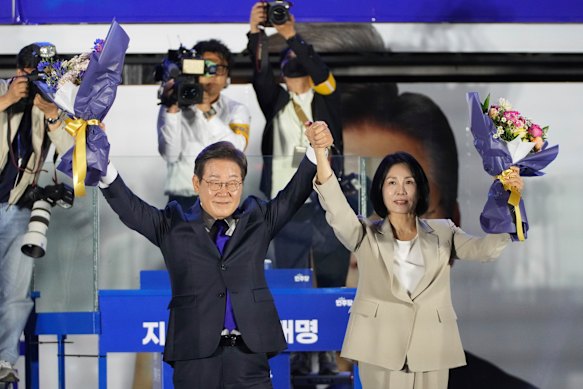
Lee Jae-myung, the presidential candidate of the Democratic Party and his wife Kim Hea-Kyung celebrate in front of the National Assembly.
CREDIT:AP

The toughest external challenges awaiting a new president are US President Donald Trump’s tariff policy and North Korea’s advancing nuclear program. But experts say whoever becomes president can’t do much to secure major progress in South Korea’s favour on those issues.

With nearly 93 per cent of ballots counted as of 2.20am Wednesday, local time, Lee, the Democratic Party candidate, led with 48.66 per cent of votes, and main conservative candidate Kim Moon Soo had 42.26 per cent.

The exit poll by South Korea’s three major television stations – KBS, MBC and SBS – earlier showed Lee projected to obtain 51.7 per cent of total votes cast, beating Kim with 39.3 per cent. Pre-election surveys suggested Lee appeared headed for an easy win, riding on deep public frustration over the conservatives in the wake of Yoon’s martial law debacle.


Members of the People Power Party react as they watch a television report on exit polls for South Korea’s presidential election.
CREDIT:GETTY IMAGES

Even before Lee’s win was formally declared, Kim conceded, telling journalists he “humbly accepts the people’s choice” and congratulated Lee.

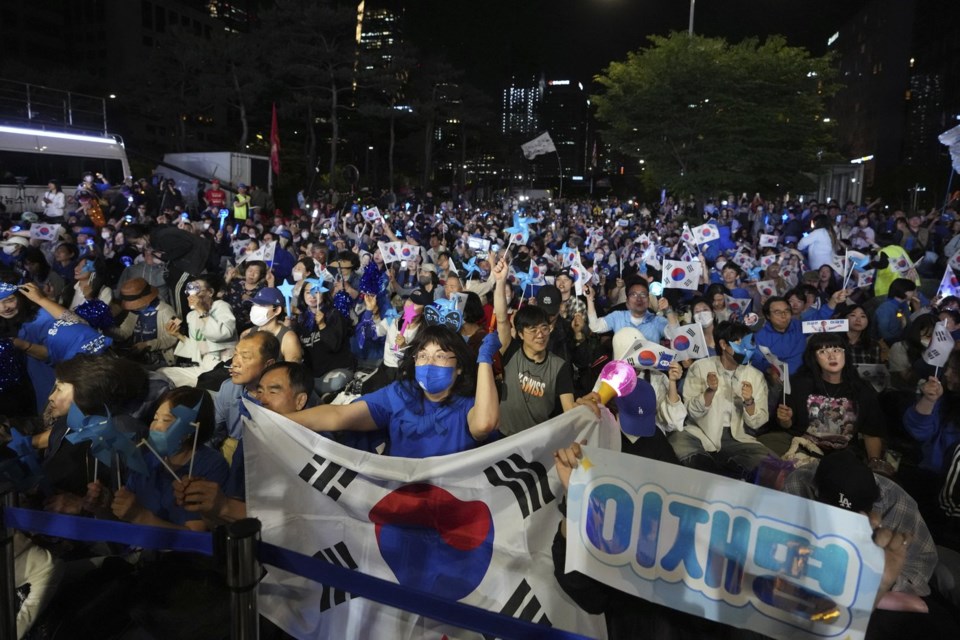
Earlier, Lee appeared before thousands of cheering supporters in the streets of Seoul. He didn’t formally claim victory but reiterated his major policy goals such as revitalising the economy, promoting peace with North Korea and easing a domestic divide.

“Let us move forward with hope and make a fresh start from this moment on,” he said. “Though we may have clashed for some time, even those who did not support us are still our fellow citizens of the Republic of Korea.”

The winning candidate will immediately be sworn in as president for a single, full term of five years without the typical two-month transition period.


Pragmatic diplomacy

Lee, who served as governor of Gyeonggi province and mayor of Seongnam city, has been a highly divisive figure in politics for years.

As a former child labourer known for his inspirational rags-to-riches story, Lee came to fame through biting criticism of the country’s conservative establishment and calls to build a more assertive South Korea in foreign policy. That rhetoric has given him an image as someone who can institute sweeping reforms and fix the country’s deep-seated economic inequality and corruption.

His critics view him as a dangerous populist who relies on political division and backpedals on promises too easily.

On foreign policy, Lee has has vowed to pursue pragmatic diplomacy. He has promised to solidify a trilateral Seoul-Washington-Tokyo partnership, a stance that isn’t much different from the position held by South Korea’s conservatives.


Supporters of Lee Jae-myung celebrate during the vote count near the National Assembly in Seoul.

CREDIT:BLOOMBERG

He said he would pursue better ties with North Korea but acknowledged that it would be “very difficult” to realise a summit with North Korean leader Kim Jong-un anytime soon.

The election serves as another defining moment in the country’s resilient democracy, but observers worry a domestic divide could pose a big political burden on the new president.

The past six months saw large crowds of people rallying to either denounce or support Yoon, while a leadership vacuum caused by Yoon’s impeachment and ensuing formal dismissal rattled the country’s high-level diplomatic activities and financial markets.


RELATED ARTICLE

Dramatic fall for former star lawyer who went from political novice to president in just a year

Lee has promised to heal the national split, but his vow to thoroughly hold those involved in Yoon’s martial law stunt accountable has sparked concerns that he would use investigations to launch political retaliations against his opponents.

In a Facebook posting earlier on Tuesday, Lee called for voters to “deliver a stern and resolute judgement” against the conservatives over martial law. In a campaign speech on Monday, Lee claimed that a win by Kim Moon Soo would mean the “return of the rebellion forces, the destruction of democracy and the deprival of people’s human rights.”

Kim, a former labor minister under Yoon, claimed that a Lee win would allow him to wield excessive power.

AP

South Korea's liberal opposition candidate Lee is expected to win election, exit poll shows

SEOUL, South Korea (AP) — South Korea’s liberal opposition candidate Lee Jae-myung was expected to win a snap presidential election Tuesday, a joint exit poll and ongoing vote counts suggested.
6957b4e8336ec1a78366800f4dec0671b1af6496cf9d7ac15df276b8f2a535b1
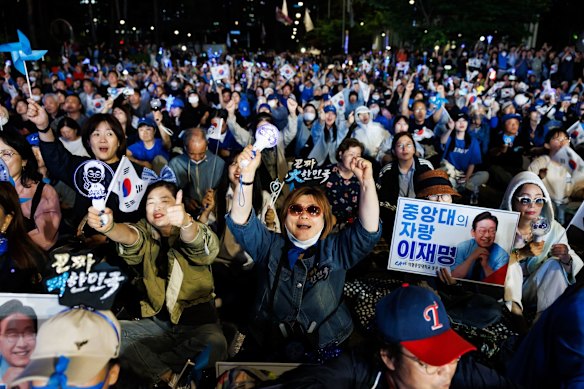
Supporters of South Korea's Democratic Party's presidential candidate Lee Jae-myung, react outside of the National Assembly in Seoul, South Korea, Tuesday, June 3, 2025. (AP Photo/Lee Jin-man)

SEOUL, South Korea (AP) — South Korea’s liberal opposition candidate Lee Jae-myung was expected to win a snap presidential election Tuesday, a joint exit poll and ongoing vote counts suggested. The victory would cap months of political turmoil triggered by the stunning but brief imposition of martial law by now-ousted conservative leader Yoon Suk Yeol.

It was unclear whether Lee’s election would cause any major, immediate shift in South Korea’s foreign policy. Lee, previously accused by critics of tilting toward China and North Korea and away from the U.S. and Japan, has repeatedly stressed South Korea's alliance with the U.S. as the foundation of its foreign policy.

The toughest external challenges awaiting a new president are U.S. President Donald Trump’s tariff policy and North Korea’s advancing nuclear program. But experts say whoever becomes president in South Korea cannot do much to secure major progress in South Korea’s favor on those issues.

With more than 31% of ballots counted as of 11:15 p.m., Lee, the Democratic Party candidate, led with more than 48% of votes, trailed by main conservative candidate Kim Moon Soo with 43%.

The exit poll by South Korea’s three major TV stations -– KBS, MBC and SBS -– earlier showed Lee projected to obtain 51.7% of total votes cast, beating Kim with 39.3%. Pre-election surveys suggested Lee appeared headed for an easy win, riding on deep public frustration over the conservatives in the wake of Yoon’s martial law debacle that plunged South Korea into political turmoil.

Hundreds of Lee supporters gathered outside the National Assembly, waving Korean flags and singing.

Nearly 80% of the country’s 44.4 million eligible voters cast ballots, according to an interim tally. That’s one of the highest turnouts for a presidential election in South Korea, reflecting public eagerness to move past the political turmoil.

The winning candidate will immediately be sworn in as president Wednesday for a single, full term of five years without the typical two-month transition period.

Promise to revitalize the economy

In a Facebook posting earlier Tuesday, Lee, whose Democratic Party led the legislative effort to oust Yoon, called for voters to “deliver a stern and resolute judgement” against the conservatives over martial law.

In one of his final campaign speeches Monday, Lee claimed that a win by Kim would mean the “return of the rebellion forces, the destruction of democracy and the deprival of people’s human rights.” He also promised to revitalize the economy, reduce inequality and ease national divisions.

Kim, a former labor minister under Yoon, claimed that a Lee win would allow him to wield excessive power, launch political retaliation against opponents and legislate laws to protect him from various legal troubles, as his party already controls parliament.

Lee “is now trying to seize all power in South Korea and establish a Hitler-like dictatorship,” Kim told one rally.

Pragmatic diplomacy

Lee, who served as governor of Gyeonggi province and mayor of Seongnam city, has been a highly divisive figure in politics for years.

As a former child laborer known for his inspirational rags-to-riches story, Lee came to fame through biting criticism of the country’s conservative establishment and calls to build a more assertive South Korea in foreign policy. That rhetoric has given him an image as someone who can institute sweeping reforms and fix the country’s deep-seated economic inequality and corruption.

His critics view him as a dangerous populist who relies on political division and backpedals on promises too easily.

On foreign policy, Lee has has steadfastly vowed to pursue pragmatic diplomacy. He has promised to solidify a trilateral Seoul-Washington-Tokyo partnership, a stance that is not much different than the position held by South Korea’s conservatives.

Experts say there aren’t many diplomatic options for South Korea as it tries to address Trump’s tariff hikes and calls for South Korea to pay more for the cost of the U.S. military presence, as well as North Korea’s headlong pursuit of nuclear weapons. Experts say that has made both Lee and Kim avoid unveiling ambitious foreign policy goals.

Impact of tariff hikes

Lee’s government still could become engaged in “a little bit of friction” with the Trump administration, while Kim’s government, which prioritizes relations with Washington, would likely offer more concessions to the U.S., said Chung Jin-young, a former dean of the Graduate School of Pan-Pacific International Studies at South Korea’s Kyung Hee University.

Chung predicted Lee won’t be able to pursue overly drastic steps on foreign policy and security, given the country’s foreign exchange and financial markets are vulnerable to such changes.

Lee has preached patience over Trump’s tariff policy, arguing it would be a mistake to rush negotiations in pursuit of an early agreement with Washington. Kim has said he would meet Trump as soon as possible.

On Monday, South Korean trade officials held an emergency meeting to discuss a response to Trump’s announcement that the U.S. will raise tariffs on steel and aluminum products to 50% beginning Wednesday. South Korea’s central bank last week sharply lowered its 2025 growth outlook to 0.8%, citing the potential impact of Trump’s tariff hikes and weak domestic demand worsened by the political turmoil of past months.

Relations with North Korea

Relations with North Korea remain badly strained since 2019, with the North focused on expanding its nuclear arsenal while refusing dialogues with South Korea and the U.S.

Since his second term began in January, Trump has repeatedly expressed his intent to resume diplomacy with North Korean leader Kim Jong Un, but Kim has so far ignored the offer while making Russia his priority in foreign policy.

Lee, who wants warmer ties with North Korea, recently acknowledged it would be “very difficult” to realize a summit with Kim Jong Un anytime soon. Lee said he would support Trump’s push to restart talks with Kim, which he believed would eventually allow South Korea to be involved in some projects in North Korea.

Foreign policy strategists for Lee understand there isn’t much South Korea can do to bring about a denuclearization of North Korea, said Paik Wooyeal, a professor at Seoul’s Yonsei University.

He said Lee also doesn’t share the Korean nationalistic zeal held by ex-liberal President Moon Jae-in, who met Kim three times during his 2017-22 term.

Hyung-jin Kim And Kim Tong-hyung, The Associated Press


South Korea’s New President Could Transform the Korean Peninsula


How Lee Jae-myung Can Push Trump and Kim Back to Real Diplomacy
June 3, 2025
 Foreign Affairs

The debilitating political vacuum that has reigned in Seoul since South Korean President Yoon Suk-yeol’s impeachment on December 14 has finally ended. On June 3, Lee Jae-myung won South Korea’s presidential election by a decisive margin. Lee, a liberal who narrowly lost the country’s last election to Yoon, has promised to fix both his society’s broken politics and its mounting economic problems with a domestic agenda that includes improving conditions for workers, shoring up the public sector, and boosting growth in strategic areas such as AI and defense.

But for foreign observers, the Lee government’s most significant policies will be those targeted at North Korea. The new president has promised to be less hawkish than Yoon, and his timing is fortuitous. With U.S. President Donald Trump back in office, Lee will have a rare window of opportunity to make progress with North Korea—which remains one of the most intractable problems in international security. During Trump’s first term, the United States and South Korea tried using diplomacy to persuade Kim Jong Un, North Korea’s leader, to slow his nuclear weapons program and stop his military provocations. Their efforts bore some fruit, despite criticism from national security veterans who had become resigned to isolating North Korea. But the process stalled when Trump lost interest, prompting a return to the status quo ante.

After five years without dialogue, leaders in Seoul and Washington could resume productive diplomacy with Pyongyang. In theory, Lee and Trump are well suited as a pair to wrangle the North Korean dictator. Trump yearns to make bold televised deals, and his taste for the dramatic appeals to Kim’s desire to command global attention at flashy summits. Lee can be equally brash, and his gritty determination to improve relations with Pyongyang can keep momentum going if and when Trump’s attention flags.

But both Lee and Trump will need to proceed with a clear-eyed understanding of the new obstacles imposed by the failure of the last attempt at negotiation, which will make it hard to get Kim back to the table. Lee, in particular, must be ready to sacrifice the unrealistic rhetoric about fully denuclearizing North Korea and reunifying the two countries that has long dominated South Korean politics, as well as the fantasy that imposing sanctions will change North Korean behavior.

There are, of course, downsides to diplomacy with Kim, including the likelihood that he will continue his efforts to ally with Russia and the risk that he will retreat once the going gets tough. But trying to restart talks is worth those dangers. Although many observers tend to assume that its isolation and economic misery make North Korea nonthreatening, its new partnership with Russia has given it more power, and without diplomacy, a new war on the Korean Peninsula cannot be ruled out. A pragmatic approach could reduce tensions—and yield a détente between Pyongyang, Seoul, and Washington in the near future.


WILL POWER

The past decade has shown that managing the North Korean risk comes down to one underlying factor: political will in Seoul and Washington. Trump is an outlier among U.S. presidents in that he enjoys dealing with the ruling Kim family. Making a deal with North Korea was a signature focus of his first term’s foreign policy, and sealing it remains a piece of unfinished business.

Trump, in fact, deserves credit for the breakthrough achieved at the 2018 Singapore summit, the first-ever meeting between the U.S. and North Korean heads of state. His willingness to meet with Kim encouraged the Korean leader to stop testing intercontinental ballistic missiles, partially demolish his nuclear weapons test site, and offer to freeze the further development of his nuclear program. The progress Trump set in motion was dependent on equal participation from Seoul. South Korea’s president at the time, Moon Jae-in, doggedly pursued a détente with North Korea and teed up each step in the negotiations. Over the course of a dizzying 12 months of summitry, which began after Kim accepted Moon’s invitation to participate in the January 2018 Winter Olympics in Seoul, all three parties—Pyongyang, Seoul, and Washington—appeared ready to fundamentally change their relationship.

But this opening soon closed. By the time Trump met Kim for a second summit in Hanoi, Trump’s attention had drifted from North Korea, and both men’s greed for a quick deal derailed their fragile progress. On the summit’s first night, the White House announced that the two leaders were ready to sign a “joint agreement” the following day. When both sides insisted on maximalist goals in the next morning’s talks, however, Trump simply walked out before lunch was served. This was a serious mistake: had the U.S. president remained and engaged with his North Korean counterpart, he might have been able to persuade Kim to fully shutter the Yongbyon nuclear facility and lock in the moratorium on missile testing.

In 2018, Pyongyang, Seoul, and Washington appeared ready to change their relationship.

Instead, by 2020, diplomacy had broken down. Ostensibly in response to the COVID-19 pandemic, North Korea imposed the harshest lockdowns on the planet; even its diplomats were sealed off from foreign contact. Weeks ahead of U.S. President Joe Biden’s inauguration, Kim laid out a five-year plan for North Korea’s military modernization; a year later, one of the first pandemic-related restrictions Kim loosened was to allow missile launches. Over the course of 2022, North Korea tested 69 missiles, the most in any year on record. He unveiled one military innovation after another—a nuclear submarine, a guided-missile frigate, military reconnaissance satellites, attack drones. Ankit Panda, a nuclear policy analyst at the Carnegie Endowment for International Peace, recently described Kim’s effort to expand his country’s nuclear capabilities as “breathtaking.”

It didn’t help that when South Koreans narrowly elected Yoon to the presidency in March 2022, he pursued a hard-line approach toward Pyongyang. Yoon’s tough-guy stance only reinforced Biden’s disdain for talking to Kim. For the first time since the end of the Cold War, a U.S. presidential term came and went without a single meeting between U.S. and North Korean officials.

To be sure, Biden officials made other kinds of progress in Asia, strengthening the United States’ Indo-Pacific alliances and facilitating trilateral security cooperation with Japan and South Korea. But they left the North Korean security problem worse than they found it. Thanks in part to Washington’s inattention on Biden’s watch, Kim embarked on a profound strategic reorientation toward Russia. In April 2019, after the aborted Hanoi summit, Kim visited Vladivostok to meet with Russian President Vladimir Putin. When Kim returned to Russia in September 2023, he sealed an alliance between the countries by opening a spigot of ammunition transfers to Russia for its war in Ukraine. Putin reciprocated with a historic visit to Pyongyang the following summer, and the two leaders signed a major defense treaty.


On the basis of the treaty alliance, Putin has been supplying fuel, food, and advanced weaponry to Kim. Meanwhile, starting in the fall of 2024, North Korea sent Russia the most precious resource in any alliance—troops. By the time Biden left the White House, over 10,000 North Korean fighters had been deployed on the Russian front. By providing such aid, North Korea collapsed the divide between the East Asian and European theaters in a way not seen since World War II.


STRAIGHT AIM

These developments would not appear to make 2025 an auspicious year for Washington to reopen negotiations. But the underlying logic that drove Kim to negotiate in 2018 still holds. That year, Kim made a startling announcement: now that his country’s efforts to establish nuclear deterrence were “complete”—and considering that South Korea and the United States seemed serious about détente—North Korea would prioritize a new strategy and put “all efforts on economic construction.”

Kim desperately wants to enable North Korea’s escape from the chronic backwardness in which it has been mired since the end of the Cold War. His country remains one of the poorest in Asia: a quarter of the population lives near the subsistence level, foreign trade is minimal, and its GDP is a small fraction of South Korea’s. The breakdown in diplomacy after the failed Hanoi summit forced Kim to backtrack on his shift from guns to butter, but his underlying ambition remains. Kim’s major domestic speeches still dwell on economic issues and promises of a more prosperous future, just as they did seven years ago. Between inspecting munitions plants and attending missile tests, Kim keeps making visits to scallop farms and tourist projects. North Korea’s political old guard may be resistant to change, but Kim need point no further than China and Vietnam to show how ruling parties in communist states can retain power while simultaneously encouraging rapid economic growth.

Putin’s assistance is helping the North Korean economy limp along. But Russia lacks the means to transform the country. China has the economic muscle and infrastructural capacity to lift up North Korea, but Kim is extremely wary of giving Chinese President Xi Jinping too much leverage over his government, and North Koreans are generally suspicious and resentful of China owing to Beijing’s long history of putting its own interests ahead of Pyongyang’s. That leaves South Korea and the United States as the partners that could enable a true economic transformation.

At a strategic level, therefore, Kim has reasons to reciprocate proactive entreaties by Seoul and Washington. At a minimum, he gains prestige from attending summits with the U.S. president; such meetings provide a domestic propaganda boost as well as more leverage in dealing with North Korea’s neighbors. Kim’s appearance at the Singapore summit led to five meetings with Xi in the space of 12 months, because Xi was forced to treat Kim as something closer to an equal given the importance Trump placed on engaging with the North Korean leader. Another round of summitry with Trump would give Kim new cards to play with Xi—and with Putin, too.

LONG GAME

Since returning to the White House in January, Trump has been a bit of a tease when it comes to North Korea. He has trumpeted his “great relationship” with Kim and promised that his administration “will have relations with North Korea” but so far offered no serious moves to restart negotiations. The slow beginning is not surprising given that making progress with Kim’s regime will be a hard slog, requiring upfront sacrifices from Seoul and Washington. The chasm in mindset between the U.S. and the North Korean leadership, as well as Trump’s insistence on making deals himself, means that Trump’s team is unlikely to cultivate deep relationships with North Korean officials. During Trump’s first term, his negotiator, Stephen Biegun, struggled to get face time with his North Korean counterparts, who were deeply distrustful of Trump’s advisers. Negotiations happened, somewhat frantically, when Trump and Kim were in the same room.

This is where Seoul can come in. In 2018, members of Moon’s team did meet intensively with their North Korean counterparts, hashing out details in their common language and getting to know one another. This inter-Korean dialogue produced concrete agreements in September 2018: the Pyongyang Declaration and the Comprehensive Military Agreement, which lowered the risk of conflict in the demilitarized zone and along the two countries’ maritime border. South Korea’s new president should mimic Moon’s approach by pushing his national security staff and economic advisers to get into the weeds with their North Korean counterparts. A pragmatic, detail-oriented approach by Lee can supplement Trump’s theatrics.

But Lee will have to overcome three large hurdles if he wants to make progress toward a détente with Kim. First, he will have to convince Kim that South Korea can offer North Korea something Russia cannot. That means demonstrating that South Korea can help put North Korea on a path toward significant economic progress—which, in turn, will require Lee to lessen or lift sanctions. Lee can begin by removing the sanctions that South Korea imposed in 2010. But the more important effort will be to convince Trump to call off the Treasury Department’s hunt for new sanctions targets and persuade the UN Security Council to pare back its own sanctions. At the Hanoi summit, Trump would not budge on sanctions relief. But that meeting’s collapse—and, more broadly, the utter failure of sanctions to prevent North Korea from developing its nuclear potential—may prompt him to support Seoul’s push.

Lee can provide the consistent focus on North Korea that Trump lacks.

Lee and Trump should also make it clear that complete denuclearization is not the raison d’être of negotiations. To be sure, the two leaders should ask Kim to take practical steps toward nuclear restraint, such as providing more transparency around North Korea’s nuclear program, ceasing his provocative weapons tests (if the United States and South Korea halt their own provocative military exercises), and shutting down the Yongbyon nuclear testing facility. But Lee and Trump must frame these requests as steps in a broader, reciprocal process of improving relations rather than harping on the demand that North Korea surrender its entire nuclear arsenal.

Finally, Lee will have to shift his language around reunification. Early last year, in a stunning policy reversal, Kim recognized South Korea as a sovereign state and challenged Seoul to agree on a national border. In doing so, he tossed out his country’s—and his family’s—long-standing precept that North Korea and South Korea must be reunified. That put the ball in Lee’s court.

Unlike Kim, Lee lacks the authority to unilaterally change his country’s policy. The South Korean constitution defines the Republic of Korea as encompassing the entire Korean Peninsula and its adjacent islands and stipulates that the country pursue “a policy of peaceful unification based on the basic free and democratic order.” But South Koreans’ views on reunification are evolving: according to polling last year by the Korea Institute for National Unification, less than half of South Korean millennials see reunification as necessary.

At a minimum, Lee should articulate a new vision—the peaceful coexistence of two sovereign states—and nudge the South Korean public toward a more realistic and constructive approach. Paradoxically, by letting go of the dream of reunification, South Koreans would likely increase the actual contact they can have with North Koreans and facilitate reunions between the dwindling number of relatives directly divided by the Korean War. If Seoul moves away from its insistence on reunification, Pyongyang will very likely be more open to contact at the people-to-people level.

None of this will be easy. But Lee can provide the consistent focus on North Korea that Trump lacks. If Lee can foreclose the unrealistic prospect of reunification, stop insisting on North Korea’s complete denuclearization, and offer Kim a path toward healthy economic development, he will open room for a détente. That would make it possible to put in place a wide variety of policies that reduce tensions on the Korean Peninsula. And if Lee succeeds, the U.S.-South Korean alliance can itself undergo a necessary transformation into a partnership based on fostering peace rather than preparing for war.

Turkey holds direct talks with Syrian Kurds as part of broader post-war regional plan: reports

ByTurkish Minute
June 3, 2025

Syrian Kurds wave independence-era flags during a demonstration in support of the US-backed, Kurdish-led Syrian Democratic Forces in the northeastern city of Qamishli, on December 19, 2024. - The show of support for the Syrian Democratic Forces (SDF) comes after Islamist-led rebels toppled Syria's longtime strongman Bashar al-Assad earlier this month, and as Turkey said on December 19 it would push to "disarm" the Kurdish-led forces on its border. (Photo by Delil SOULEIMAN / AFP)

Turkey has entered direct talks with Syrian Kurdish leaders, including the Syrian Democratic Forces (SDF), in a major shift from years of military hostility, Al-Monitor and Middle East Eye reported on Tuesday.

The talks, which began in secret in 2024 and are continuing in 2025, are part of a broader initiative to end the Turkish state’s decades-long war with the outlawed Kurdistan Workers’ Party (PKK), according to Al-Monitor.

Initial meetings were held in Europe — in France and Switzerland — between Turkish officials and senior representatives of the Kurdish-led Autonomous Administration of North and East Syria, Al-Monitor said, citing informed sources.

The meetings followed Turkey’s March 2024 local elections, in which the opposition Republican People’s Party (CHP) won nationwide for the first time with backing from the pro-Kurdish Peoples’ Equality and Democracy Party (DEM Party).

The election outcome prompted the government of Turkish President Recep Tayyip ErdoÄŸan to open a new channel of negotiations with jailed PKK leader Abdullah Öcalan in a bid to regain Kurdish support and secure ErdoÄŸan’s rule beyond the 2028 term limit.

Parallel to this, Turkey sought direct engagement with the Syrian Kurds, despite its ongoing military operations in northern Syria, which have displaced thousands and destroyed civilian infrastructure.

Talks with the SDF — the US-backed force that controls much of northeast Syria — gained new momentum after the fall of Bashar al Assad in December 2024, according to Middle East Eye.

The Assad regime’s replacement by a Sunni-led government under Ahmed al-Sharaa, a former Islamist militant on good terms with Turkey, eased Ankara’s fears that the Kurds would again be used as a proxy against it.

Devlet Bahçeli, ErdoÄŸan’s far-right ally and a longtime opponent of Kurdish rights, stunned observers in October 2024 by calling for Öcalan to be allowed to address parliament and possibly be granted amnesty if he succeeded in ending the war.

On February 27, Öcalan issued a call for the PKK to dissolve.

The PKK leadership, based in the Qandil mountains in Iraq, publicly accepted Öcalan’s call on May 12.

As part of this wider process, SDF commander Mazloum Kobane — reportedly once regarded as Öcalan’s adopted son — signed a landmark agreement with Syria’s new president in March, pledging to integrate the SDF into a future Syrian national army.

The agreement also laid the foundation for Kurdish-led governance to operate within a decentralized framework under Damascus’s oversight — an arrangement Ankara has opposed for years.

However, Middle East Eye reported that Turkey’s stance is shifting, with Ankara now open to informal Kurdish autonomy, provided it stops short of constitutional enshrinement or formal federalism.

Direct Turkish-SDF meetings, including one held last week in southern Turkey, were facilitated by the United States, Middle East Eye said, citing sources with knowledge of the negotiations.

The agenda included the possible US military withdrawal from Syria, the transfer of Islamic State in Iraq and the Levant (ISIL) detainees and camps from SDF to Syrian government control, and the integration of the SDF into a restructured Syrian military.

Kobane confirmed the ongoing talks in a May 30 interview with Shams TV, saying the ceasefire with Turkey had held for more than two months and could evolve into something lasting.

“We are not at war with Turkey,” he said, adding that his group is prepared for improved relations.

According to Al-Monitor, Kobane was offered the possibility of meeting with either Turkish Foreign Minister Hakan Fidan or intelligence chief İbrahim Kalın if the negotiations advance.

Both the SDF and the Turkish Foreign Ministry denied such an offer had been made, Al-Monitor noted.

The reopening of the Nusaybin border crossing — closed since 2012 — is among the concessions being discussed, a step that could revitalize trade and offer an economic boost to Kurdish and Arab-majority regions under SDF control.

Still, Ankara’s key demand remains unchanged: the full elimination of PKK influence within the Syrian Kurdish administration.

A US State Department official told Middle East Eye they would not comment on private diplomacy but welcomed efforts to implement the March 10 agreement between the SDF and the Syrian government.

US envoy Thomas Barrack told Turkish media that the SDF’s continued survival depended on progress with Damascus and warned that the US military presence was being reduced, with bases shrinking from eight to five and only one likely to remain.

Ankara remains firmly opposed to any form of Kurdish federalism in Syria but now appears willing to accept a limited form of Kurdish self-governance, Middle East Eye reported.

Despite years of enmity, Turkish-SDF talks — once unimaginable — are now being quietly normalized through a web of ceasefires, diplomatic backchannels and shared concerns over post-ISIL security and regional stability.

Israel and the new Syria: Where are ties heading?

Hints at normalisation are a way to keep the US engaged and restrain Israel's destabilisation campaign in Syria, but full-fledged diplomatic ties are unlikely


Analysis
Giorgio Cafiero
03 June, 2025
THE NEW ARAB

Since Bashar Al-Assad’s regime fell in late 2024, constant Israeli airstrikes have targeted Syria’s military infrastructure in locations across the war-torn country.

Israeli forces have also advanced into the UN-monitored demilitarised buffer zone separating Syria from the Israeli-occupied Golan Heights, as well as into adjacent regions, including the summit of Mount Hermon.

This Israeli military campaign of destabilisation is about weakening, dividing, and Balkanising Syria to the maximum extent possible to further shift the Levant’s balance of power in Israel’s favour.

In early April, Israeli air operations struck key infrastructure across several Syrian provinces, including airports and military installations in Hama and Homs, as well as a scientific research facility in Damascus.

Residential areas were also hit, with villages such as Koayiah, located near Syria’s borders with Jordan and the Golan Heights, suffering significant damage. Subsequently, on 2 May, Israeli fighter jets targeted an area near the presidential palace in Damascus.

This action came amid escalating sectarian violence in Syria, with Prime Minister Benjamin Netanyahu cynically justifying this aggression under the banner of Israel defending Syria’s Druze minority community.

Nonetheless, last month reports surfaced that Syrian and Israeli officials had engaged in direct “deconfliction” talks aimed at preventing further flareups along their shared border.

These face-to-face meetings marked a notable shift for the relatively new Syrian government, led by President Ahmed al-Sharaa, which had previously relied on backchannel communication through intermediaries such as the United Arab Emirates (UAE). Ahmad al-Dalati, the governor of Quneitra province and security chief in Suweida, has led the discussions on the Syrian side.

Patrick Theros, the former US ambassador to Qatar, spoke to The New Arab about what he believes might emerge from these “deconfliction” talks.

“At this stage, everything depends on the internal politics of Israel. Israel's advance into the border buffer zones and beyond, the IDF's continuing high intensity bombardment of anything it can find in Syria that could remotely be connected to military rearmament, its demand for the disbarment of southern Syria, and its offer to defend the Druze in Syria are designed to keep Netanyahu in power. If he stays in power, the deconfliction talks will continue forever,” he told TNA.

“If Netanyahu falls, a lot would depend on who replaces him,” added Theros.


Giorgio Cafiero


Drastic changes in US-Syria relations


The state of Syrian-Israeli bilateral affairs must be analysed within the context of bold policy shifts by US President Donald J. Trump’s administration regarding Syria, which signal Washington’s growing openness toward the post-Assad government in Damascus. Such changes in US foreign policy carry the potential to profoundly transform Syria and its position on the international stage.

The first leg of Trump’s Gulf tour last month was Riyadh, where he announced the lifting of Washington’s sanctions on Syria. The following day, he held a face-to-face meeting with Sharaa in Riyadh, joined by Saudi Crown Prince Mohammed bin Salman, with Turkish President Recep Tayyip Erdogan participating via phone.

On 23 May, the US Treasury Department issued sanctions relief, allowing American individuals and businesses to engage in financial transactions with Syrian entities - activities that had previously been prohibited under Washington’s sanctions regime.

By the end of the month, the American flag was raised outside the US ambassador’s residence in Damascus - a moment that powerfully symbolised Washington and the nascent Syrian government’s movement toward normalisation in the post-Assad era.


While the US, the UK, and the EU have lifted many sanctions on Syria and engage the relatively new government in Damascus diplomatically, their approaches stand in contrast to Netanyahu’s position.

The Israeli government articulates its desire to see the West keep economic pressure on post-Assad Syria and for Washington and other Western capitals to avoid steps which legitimise Sharaa’s government.

The Islamist rebels-turned-rulers in Damascus understand that only Washington can pressure Israel into halting its military aggression against post-Assad Syria. This is one reason why Sharaa sees entering a new chapter in relations with the US as critical for his country’s future.

“The Trump administration’s 180-degree turn on Syria will constrain Israel’s freedom of action on Syria to some degree, but not completely. Even though US Syria policy now conflicts with Israel’s policy, Trump generally lets Israel do as it pleases,” said Aron Lund, a fellow with Century International and senior analyst at the Swedish Defence Research Agency (who does not speak on behalf of either institution), in a TNA interview.

“Trump may decide to put real pressure on Israel at some point, but it’s more likely to be over Iran or Gaza than over Syria,” he added. Lund did, however, address the possibility of a US military withdrawal from Syria, which he said could result in Washington needing to get “more serious with Israel to prevent disruptions to those plans.”

Since Assad's fall, Israel has annexed land in the UN-monitored demilitarised buffer zone separating Syria from the Israeli-occupied Golan Heights, while heavily bombarding the country. [Getty]


The Turkish factor

Frequently described as the “big winner” in post-Assad Syria, Turkey plays a significant role in these evolving dynamics. Israel’s current posture presents a direct challenge to Erdogan’s regional and international policies, as well as his reputation as a decisive and influential leader within the broader Islamic world. It is likely safe to conclude that the most critical de-escalation talks are those which began between Turkey and Israel under Azerbaijani auspices earlier this year, and have gone through more than three rounds.

“The ‘de-escalation’ between Damascus and Tel Aviv is highly dependent on the Ankara-Tel Aviv talks and the relation between both countries,” explained Yeghia Tashjian, the Regional and International Affairs Cluster Coordinator at the Issam Fares Institute for Public Policy and International Affairs at the American University of Beirut, in a TNA interview.

“If the talks continue on the current path, we may witness a limited de-escalation. If not, Israel would even bomb assets affiliated with Turkey or potential Turkish bases as it did a few months ago,” he added.

Syrian-Israeli normalisation?

A key question many analysts are raising is how the Trump administration could leverage sanctions relief and the diplomatic openings between Washington and Damascus to cajole Syria into the Israeli normalisation camp.

Sharaa has stated that such normalisation with Israel could be on the table, albeit under certain circumstances. Yet, Lund believes that Syria formalising full-fledged diplomatic relations with Tel Aviv is an “unlikely” scenario.

“Sharaa seems to have decided that holding out the prospect of an Israel deal is a good way to keep Washington engaged and perhaps also to make it restrain the Israelis,” he told TNA, adding that “flirting with the idea of normalisation is not the same as actually normalising.”

It is necessary to note that Syria today, unlike Egypt, Jordan, the UAE, and Morocco at the time of the signing of their Israeli normalisation accords with Israel, has an unresolved territorial dispute with Tel Aviv, making it increasingly difficult to imagine Syria entering the Israeli normalisation camp.

“It’s not just about the Palestinians, it’s also about Syrian territory - the Golan Heights. Israel occupies that region and claims to have annexed it as sovereign Israeli land. If you ask Israeli leaders, it's now part of Israel forever. The United States endorses that claim. That makes Syria’s position vis-à-vis Israel very different from the countries that entered into normalisation agreements in the past,” explained Lund in a TNA interview.


Giorgio Cafiero

“In addition, of course, the regional situation is not conducive to an agreement, with so much anger in Syria and elsewhere over Israel’s treatment of the Palestinians in Gaza,” he added.

Syria’s leadership will ultimately seek to maintain diplomatic momentum with the West, most importantly the US. This is one dynamic which will probably prompt Damascus to avoid being confrontational toward Israel, at least for as long as that is possible.

Nonetheless, Israeli land theft in Syria and bombardments of various parts of the war-ravaged country seem likely to continue (assuming the Trump administration refuses to use Washington’s leverage to rein in Israel’s destabilisation campaign in Syria), making it quite unrealistic to imagine Syria entering the Abraham Accords under current circumstances.

“I do not expect that the Israeli side will withdraw from the newly occupied areas in southern Syria. We have seen similar tactics in Gaza and southern Lebanon, the mindset of Netanyahu and his cabinet members has shown that they seek maximalism rather than pragmatism,” Tashjian told TNA.

“The idea of ‘land for peace’ has always been on the table, but it was refused by the Israeli side. The destruction of the Syrian air force and navy by Israel has shown that Israel is not eager for compromise but is seeking to weaken its rival without committing to a long-term agreement,” concluded the Beirut-based scholar.


Giorgio Cafiero is the CEO of Gulf State Analytics
Follow him on Twitter: @GiorgioCafiero


Disney laying off several hundred employees worldwide

Last month, Disney posted solid profits and revenue in the second financial quarter.


People visit the Magic Kingdom Park at Walt Disney World Resort in Florida (Ted Shaffrey/AP) (Ted Shaffrey/AP)


By Michelle Chapman,
 Associated Press
June 03, 2025 

The Walt Disney Company is laying off several hundred employees worldwide as the entertainment giant looks to trim some costs and adapt to evolving industry conditions.

A Disney spokesperson confirmed the action on Tuesday.

The exact number of jobs being cut is unknown, but lay-offs will occur across several divisions, including television and film marketing, TV publicity, casting and development, and corporate financial operations.

No entire teams will be eliminated.

“As our industry transforms at a rapid pace, we continue to evaluate ways to efficiently manage our businesses while fuelling the state-of-the-art creativity and innovation that consumers value and expect from Disney,” the spokesperson said.


“As part of this ongoing work, we have identified opportunities to operate more efficiently and are eliminating a limited number of positions.”

Last month, Disney posted solid profits and revenue in the second quarter as its domestic theme parks thrived and the company added well over a million subscribers to its streaming service.

The company also boosted its profit expectations for the year.

Disney’s also been riding a wave of box office hits, including Thunderbolts* and Lilo & Stitch, which is now the second-highest grossing movie of the year.

In 2023, Disney CEO Bob Iger announced that Disney would cut about 7,000 jobs as part of an ambitious company-wide cost-savings plan and “strategic reorganisation”.


Disney said at the time that the job reductions were part of a targeted 5.5 billion dollars cost savings across the company.

Shares of Disney, which is based in Burbank, California, rose slightly in midday trading.


Scientists say next few years vital to securing the future of the West Antarctic Ice Sheet


Potsdam Institute for Climate Impact Research (PIK)


Collapse of the West Antarctic Ice Sheet could be triggered with very little ocean warming above present-day, leading to a devastating four metres of global sea level rise to play out over hundreds of years according to a study now  published in Communications Earth & Environment, co-authored by the Potsdam Institute for Climate Impact Research (PIK). However, the authors emphasise that immediate actions to reduce emissions could still avoid a catastrophic outcome.

Scientists at PIK, the Norwegian research centre NORCE and Northumbria University in the United Kingdom conducted model simulations going back 800,000 years to give an extended view of how the vast Antarctic Ice Sheet has responded in the past to the Earth’s climate as it moved between cold “glacial” and warmer “interglacial” periods.

“In the past 800,000 years, the Antarctic Ice Sheet has had two stable states that it has repeatedly tipped between. One, with the West Antarctic Ice Sheet in place, is the state we are currently in. The other state is where the West Antarctic Ice Sheet has collapsed,” lead author David Chandler from NORCE commented.

The major driver of change between the two states is rising ocean temperatures around Antarctica, because the heat melting the ice in Antarctica is supplied mostly by the ocean, rather than the atmosphere. Once the ice sheet has tipped to the collapsed state, reversal back to the stable present-day state would need several thousands of years of temperatures at or below pre-industrial conditions.

“Once tipping has been triggered it is self-sustaining and seems very unlikely to be stopped before contributing to about four meters of sea-level rise. And this would be practically irreversible,” Chandler said.

“It takes tens of thousands of years for an ice sheet to grow, but just decades to destabilise it by burning fossil fuels. Now we only have narrow window to act,” said co-author Julius Garbe from PIK.