Tuesday, June 03, 2025


Report India’s Adani Group Under Investigation for Violating Iran Sanctions

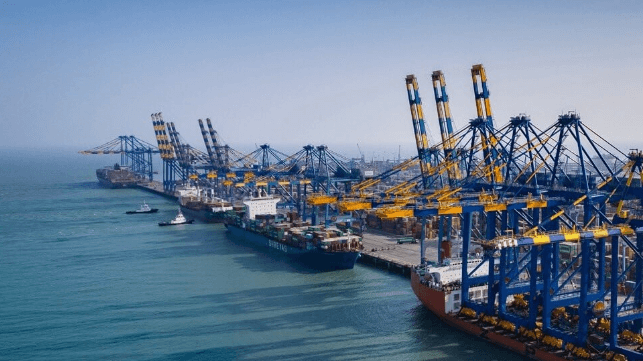
Mundra port India
The report says LPG shipments to the Mundra port operated by Adani are being investigated (file photo of Mundra port)

Published Jun 2, 2025 6:20 PM by The Maritime Executive


India’s Adani Group, which is one of the largest conglomerates and well-known for its port operations, is reportedly under investigation for possible violations of the U.S. sanctions on the Iranian energy industry. President Donald Trump has vowed to crack down on companies in the trade imposing secondary sanctions on anyone trading with Iran for oil and gas.

There has been a lot of attention on India’s energy imports with most of the focus being on its large importation of Russian oil. At times, India has responded to U.S. sanction threats blocking listed shadow tankers while it also has acted to support the insurance market for shadow tankers.

In an exclusive report, The Wall Street Journal is reporting that Adani is now being investigated for a possible role in the importation of Iranian LPG. The newspaper tracks the movements of LPG carriers that it asserts are using well-known evasion tactics including AIS spoofing to disguise lifting and carrying products from Iran.

The Wall Street Journal tracked shipments into the Mundra port in India which is operated by one of the Adani companies. Adani Group and Gujarat State Petroleum Corp highlighted in 2018 the development of the gas terminal in Mundra port. They reported a capacity to handle five million tons of LNG per year and India’s prime minister Narendra Modi traveled to the port to mark the commissioning of two gas pipelines.

Adani responded to The Wall Street Journal denying any “deliberate engagement” to avoid sanctions or illegal trade with Iranian-origin petroleum products. A spokesperson confirmed to the newspaper the company is in the LPG business calling it small but growing for Adani.

The newspaper reports the U.S. Justice Department is investigating the activities of several LPG tankers delivering product to India.

Adani Group is run by Gautam Adani who is the wealthiest person in India and has close ties to Prime Minister Modi. The Wall Street Journal reports his companies are valued at $150 billion.

The company has been accused of other issues in the past but none have been proven. One report said the company was violating Indian securities laws. There have also been unproven allegations of fraud, and bribery.

Adani Group has called the allegations baseless and lies. The Wall Street Journal reports the company hired U.S. lawyers to lobby the U.S. government in hopes of bringing the government investigations to a close.


Ukraine Launches Underwater Attack on Russia's Kerch Strait Bridge

damage Kerch Bridge
Ukraine reported an underwater attack on the Kerch Strait bridge (SBU)

Published Jun 3, 2025 10:58 AM by The Maritime Executive


Two days after a bold attack on Russia’s strategic bomber fleet, Ukraine is reporting it has attacked the Kerch Strait bridge from the water. While the attack appears to have been more superficial than previous efforts by Ukraine, it is the latest response to peace talks that appear to be floundering and Russia’s increased assault on Ukraine.

Ukraine’s security force SBU posted messages and images online reporting that attack which reportedly was conducted at 4:44 a.m. local time. Ukraine says no civilians were injured but claimed to have damaged the underwater supports. There was some online speculation that the attack was staged using underwater drones, while the SBU said the operation had lasted several months and involved agents mining the supports.

The SBU reports the equivalent of 1,100 kg of TNT was used. It claims that the supports were severely damaged at the water level. Local reports said the bridge was closed for an inspection but unconfirmed reports said it was at least partially reopened. Russia’s Defense Ministry did not acknowledge the attack but earlier said the bridge was closed to clear debris after it downed Ukrainian drones.

“We hit the Crimean Bridge twice in 2022 and 2023. So today we continued this tradition underwater,” wrote the SBU on social media. “The Crimean Bridge is an absolutely legitimate target, especially considering that the enemy used it as a logistical artery to supply its troops.”

Russia constructed the 12-mile bridge after occupying the Crimea Peninsular in 2014. It provides vital rail and roadway links to the region, which has made it a repeated target for Ukraine. They have also attacked the ferries used to cross the Kerch Strait.


While global pressure continues to push for a ceasefire and peace agreement, Ukraine reported Russia launched 112 drones overnight but claimed to have shot down 75. The attacks were reportedly widespread across Ukraine mostly hitting civilian infrastructure.

These attacks came after Ukraine and Russia met in Istanbul on Monday for the latest round of peace talks. Ukraine is reported to be continuing to call for a 30-day ceasefire but has also added demands for the release of all prisoners and the return of Ukrainian children in Russian territories.

Media accounts suggest Russia presented one of its most stringent set of demands including Ukraine’s withdrawal from all the areas Russia occupies. Russia is also demanding that Ukraine stop receiving foreign weapons and end its mobilization.


Video CMA CGM Feeder Collides with Barge Causing Two People to Go Overboard

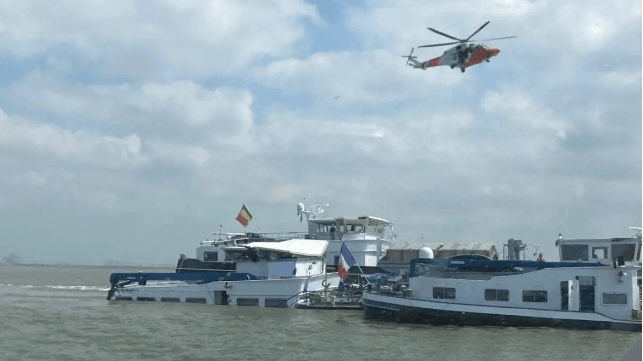
rescue
Rescue operation after the barge collided with the containership (KNRM)

Published Jun 2, 2025 3:46 PM by The Maritime Executive


Dutch and Belgian rescue teams responded to a serious collision on the River Scheldt which seriously injured one person and caused two others to fall overboard as a CMA CGM-operated container feeder and an inland fuel barge collided. One person was sent to the hospital while multiple vessels worked to stabilize the barge and prevent it from sinking.

The Dutch fuel barge Beringzee (82 meters / 269 feet) was underway at mid-day on Friday, May 30, between Antwerp and Vlissingen in the Netherlands, when it was being overtaken by Containerships Nord (20,200 dwt / 1,400 TEU). Authorities are still investigating how it occurred, but the barge was run over by the containership causing it to begin taking on water and leaking fuel.

KNRM, the Dutch rescue service, responded and reported that one person was seriously injured in the collision while the captain and one seafarer both ended up in the water. A large-scale rescue operation was launched, including the KNRM lifeboats Jan van Engelenburg and Zeemanshoop, a Coastguard helicopter, a Coastguard aircraft, police boats from both the Netherlands and Belgium, a patrol vessel from Rijkswaterstaat and several tugboats.

The captain of the inland vessel managed to bring the seriously injured passenger to safety from a part of the ship that was quickly taking on water. He also was able to rescue the sailor who had fallen into the water.

“The captain had sustained injuries and swallowed a lot of water during the rescue operation,” reports KNRM. He was taken by boat to shore and treated by an ambulance crew along with the injured sailor. 

A Belgian police boat arrived at the scene and the seriously injured person was taken on board along with an ambulance nurse, who was part of the helicopter crew. The nurse was lowered to the police boat by the Coast Guard helicopter and the patient was taken to hospital by helicopter. 


Barges were placed alongside the Beringzee to stop it from sinking and the fuel was being transferred to one of the barges. Reports indicated that there was a leak of likely a lightweight diesel fuel. It was expected to evaporate in the river.

The containership sustained only minor damage but was ordered to move into the anchorage to await an inspection. AIS signals show it is back underway as of Monday. It had been traveling from Antwerp to Dunkirk, France at the time of the collision.

Delivered in 2018, Containerships Nord was the first LNG-fueled ship to enter the CMA CGM fleet. The French company had recently completed the acquisition of the Germany-based Containerships and the vessel was the first of four LNG feeders ordered for the European service.


Second Bulker Grounds in Øresund off Sweden in a Week

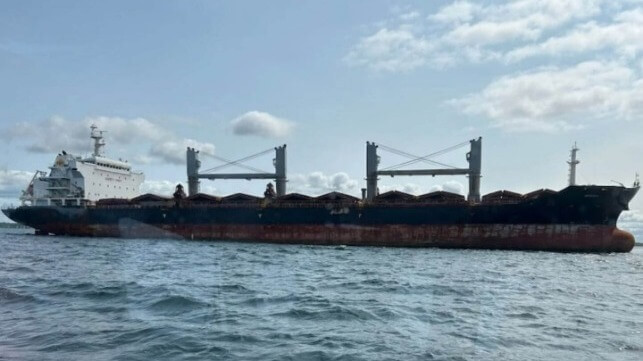
grounded bulker Meshka
Swedish authorities are trying to understand why two bulkers grounded in the Øresund in less than a week (Sjöräddningssällskapet RS Barsebäckshamn)

Published Jun 1, 2025 10:35 AM by The Maritime Executive


Swedish authorities are trying to understand why a second bulker grounded in the Øresund area in less than a week. The incident on Saturday, May 31, was just 40 miles to the north of where a bulker went aground on Sunday, May 25, but so far there are few similarities between the two incidents.

A bulker flagged in Panama, Meshka (35,829 dwt) was southbound in the shipping channel coming from Tarragona, Spain to the small Russian port of Vysotsk near the border with Finland. According to Swedish media reports, the Swedish Maritime Administration’s traffic center (VTS) spotted that the ship was outside the shipping lane and warned the ship around 1000 on Saturday morning. The crew either ignored the warning or did not have time to respond and change course.

The vessel which was traveling only with fuel and ballast however had a draft of seven meters. It ran aground in an area with only three meters of depth. 

The rescue authority dispatched two vessels to investigate and the Swedish Maritime Administration and Coast Guard both responded. It was determined that none of the 24 crew aboard had been injured and there was no immediately apparent damage or oil leaks from the ship. The Coast Guard was assigned authority while the others were standing by in case they needed to become involved.

The Coast Guard reports it conducted sobriety checks and found no suspicions of drunkenness among the crew. They were still interviewing the crew to understand what caused the grounding. It reported on Sunday that it has initiated a preliminary investigation regarding a lack of good seamanship in connection with the grounding. The investigation has now been handed over to the Swedish Prosecution Authority. 

The vessel is near Landhrona, Sweden which is north of Malmö where the other bulker grounded last week. Divers were sent down on Saturday evening, and they reported no visual damage but said most of the hull which measures 180 meters (590 feet) is on the sandy bottom. The Coast Guard reports the vessel has approximately 938,000 liters of oil and lubricants in its tanks.

The authorities are remaining on the scene but said as long as the vessel remains stable, the responsibilities rest with the shipowner, a company based in Dubai. They will need to develop a salvage plan and submit it for approval.

One similarity between the two vessels that grounded is that both have a history of deficiencies reported during port state inspections. The Meshka had 23 deficiencies during a September 2024 inspection at the British port of Immingham. UK authorities detained the ship for 18 days after identifying structural issues, fire safety problems, and crew training issues. The ship however had a clean inspection in May in Spain.

The other bulker, Ali Aykin remains aground on a shoal near the Øresund Bridge. Swedish authorities confirmed during the week that hull damage had been identified and that the ship had taken on water. A salvage plan is being prepared and reviewed for the ship.


Pirates Board Cargo Ship and Abduct One Injured Crewmember

cargo ship piracy
Cargo ship was reportedly boarded in the Gulf of Guinea and one crewmember who was injured is believed to have been abducted (file photo)

Published Jun 2, 2025 1:05 PM by The Maritime Executive


Another cargo ship has been attacked in a violent incident of piracy off the coast of West Africa between Nigeria and São Tomé and Príncipe. Details of the incident remain vague, but it is a well-known area for piracy with the authorities warning vessels to use caution while transiting the region.

An unidentified cargo ship was boarded sailing according to the official account approximately 75 nautical miles northwest of Santo Antonio in São Tomé and Príncipe. Security consultants are placing the vessel 118 nautical miles northwest of Bonny, Nigeria.

The master of the vessel which reports said is registered in Curacao was in contact with the Maritime Domain Awareness for Trade in the Gulf of Guinea (MDAT-GoG) security operation providing updates as the situation unfolded. MDAT-GoG issued an alert reporting the boarding took place Saturday, May 30 although some reports said it started on Friday, May 29.

Initial indications were that seven armed perpetrators boarded the vessel with what appeared to be guns. The majority of the crew mustered in the citadel where they were able to monitor the incident as it unfolded using the vessel’s CCTV system. The perpetrators left the vessel and by May 31 MDAT-GoG was reporting the ship had been searched and confirmed no boarders remained aboard.

One seafarer was reported injured in the incident and in the confusion, it was unclear if it was the first or second engineer. Later reports confirmed it was the second engineer who was also missing, apparently kidnapped by the perpetrators.

The chief engineer of the vessel was later located onboard. The first engineer was among the crew locked in the citadel.

An inspection of the vessel reports the perpetrators also damaged some of the equipment on the bridge. Local authorities boarded the ship to assist the crew and according to the reports were escorting the ship to a port of refuge.

Security analysts have warned that while overall piracy has declined in the Gulf of Guinea, this area has become a hotbed of piracy activity. In April, another vessel reported being boarded and the crew’s belongings and other property were taken while the perpetrators were aboard for four hours. In March, there was a report of shots fired when pirates boarded a bitumen tanker. Family members reported that 10 crewmembers were abducted from the BITU River in that incident.


Greek Ferry Rescues 75 People from Sailboat in Distress

Greek ferry
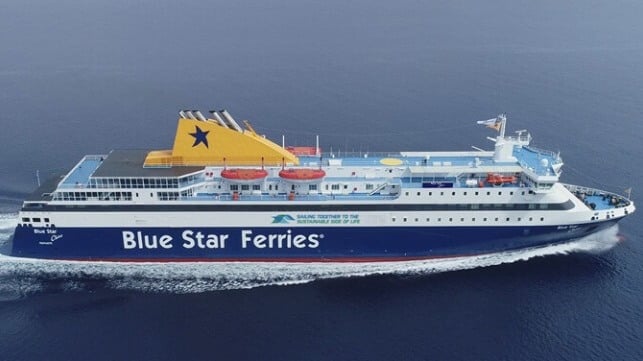
Greek ferry diverted to rescue more than 70 migrants (Blue Star Ferries file photo)

Published Jun 2, 2025 5:33 PM by The Maritime Executive


A Greek ferry diverted Sunday, June 1, from its normal course responding to a distress call. The Hellenic Coast Guard reported the incident but did not supply details on the people who are believed to be migrants or their attempted destination.

The first reports of the unfolding situation came from some of the 200 passengers aboard the interisland ferry Blue Star Xios. They reported that the 14,000 gross ton ferry was stopped early Sunday morning and had put down a boat possibly searching for migrants.

The authorities reported that a distress call came from the sailboat which was located approximately 14 nautical miles off the island of Karpathos in the southeastern Aegean. Reports said the weather conditions were mild with wind considered to be a fresh breeze at around 20 knots.Built in 2007, the ferry is 141 meters (462 feet) in length. It has limited accommodations carrying a total of 1,700 passengers mostly in seating. It is a RoRo with a garage.

Passengers from the ferry posted videos online showing the sailboat coming alongside packed with people. Reports indicate between 70 and 75 people were taken from the overloaded boat onto the ferry. A Greek coast guard vessel was reportedly standing by during the operation.

Greece has had a tumultuous relationship with the influx of migrants and frequent disputes with Turkey which accuses Greece of driving back the migrants. In the latest development in the struggle over the flow of migrants, prosecutors in Greece last week charged 17 crewmembers from a Hellenic Coast Guard cutter for their involvement in a 2023 incident in which another overcrowded boat overturned. Only about 100 people survived, while 72 bodies were recovered and there were accusations that several hundred went down with the boat. The Coast Guard had been tracking the boat and survivors accused a patrol boat of contributing to the loss of the boat.

International organizations have been critical of the organization of operations in the Eastern Mediterranean to handle the flow of migrants. They have called for reforms to organize and coordinate the rescue efforts.


Panama Responds to Critics Highlighting Canceling Flag for Over 650 Vessels

Panama ship regisry
Panama responded to crtiics highlighting its moves to crackdown on violators (file photo)

Published Jun 2, 2025 7:07 PM by The Maritime Executive


The government of Panama issued a statement rejecting the claims of critics that its flag registry has failed to take sufficient action to stop vessels supporting the Iranian oil trade by citing its removal of vessels from the registry. As the largest registry by the number of ships, approximately 8,500 vessels, Panama has come under scrutiny for the number of shadow tankers or vessels transporting Iranian oil that are operating under its flag.

The statement details the actions taken by the Panama Maritime Authority (AMP) over the past few years to purge the ranks of its registry. It is a frequent topic that has often drawn criticism. Today, the AMP asserts that it has de-flagged more than 650 ships from its registry since 2019. In the past, it has discussed the changes to rules and efforts to speed up the cancellation process.

It also reports that last October it took a further step empowering the AMP to unilaterally remove vessels from its registry if their owners appear on international sanctions lists. Today, they claim this has resulted in the cancellation of 214 vessels representing more than 12 million tons over the past eight months.

The statement came after long-time critic, the NGO United Against Nuclear Iran (UANI), renewed its calls for Panama to increase its efforts to stop its support of the Iranian oil trade. UANI CEO Ambassador Mark Wallace asserted that the registry has a “lack of consistent, proactive enforcement,” which the group says permits Iran to continue to earn billions from the oil trade.

UANI asserted that its analysis shows that one in five vessels suspected of transporting Iranian oil, or 17 percent of the 542 vessels the group has listed, sail under the flag of Panama. The group points to the fact that the U.S. and others continue to list vessels registered in Panama when they announce sanctions.

The AMP has highlighted its efforts over the past few years to increase the oversight of its registry and remove violators. In the past, they noted it was a slow process. 

Starting in 2019, the AMP has taken steps such as establishing rules that sanction vessels for deliberately deactivating Long-Rage Identification and Tracking or their AIS signal. Recently, the AMP also established new rules for the reporting of planned ship-to-ship oil transfers, another technique favored by shadow tankers to obscure the source of oil.

Panama was also instrumental in working with other registries to establish information sharing. The program was aimed at notifying other flags when a registry cancels or initiates a sanction or cancellation process. It was designed to crack down on the practice of flag hopping to avoid cancellation or other penalties.

In responding to the critics, the registry highlights that it follows IMO and United Nations standards and maintains close collaboration with the United States. During the Biden administration, the U.S. State Department met with Panama to discuss enforcement and the crackdown on vessels that were violating sanctions.

The Government of Panama notes that the AMP carries out investigations into compliance. It also highlights that the efforts go beyond tankers to also include a focus on illegal, unreported, and unregulated fishing.


First CO2 as Commissioning Begins for First Vessel for Commercial CCS

LCO2 carrier
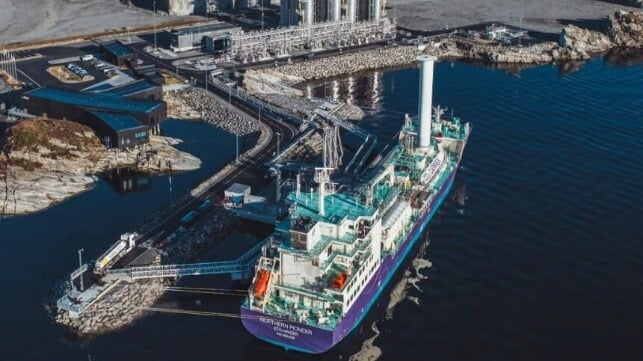
Northern Pioneer docked at the storage and processing plant in Norway (Northern Lights)

Published Jun 3, 2025 2:26 PM by The Maritime Executive


Norway’s Northern Lights project highlighted today that the commissioning process has begun for its first LCO2 carrier vessel after the company confirmed that it has all the necessary permits to start injecting and storing CO2. Operations are scheduled to start this summer, with the first CO2 transport and storage from Heidelberg Materials’ cement factory in Brevik, Norway.

The operation which is a joint venture between Equinor, Shell, and TotalEnergies reported in a social media posting that the first CO2 is aboard the Northern Pioneer, the 10,000 dwt carrier built at Dalian Shipbuilding Industry Company (DSIC) in China and delivered in November 2024. The vessel has the capacity to transport approximately 7,500 cbm of liquified CO2. The cargo transport conditions are a maximum of 19 bar (g) pressure and a minimum of negative 35 C temperature.

“We’re proud to share that commissioning has started, with liquefied CO? from our first customer Heidelberg Materials in Brevik, now beginning gassing up our vessel Northern Pioneer,” the company writes. 


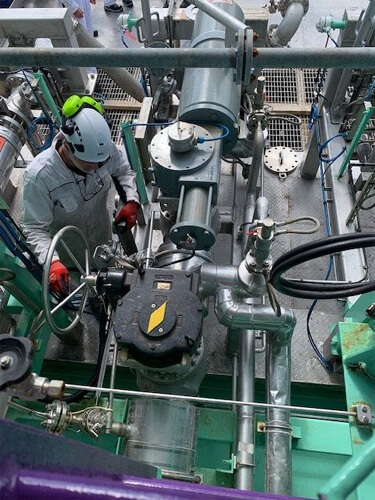
Engineers have begun the cooldown aboard the vessel loading the first LCO2 (Northern Lights)


Northern Lights announced at the beginning of May that the Ministry of Energy, the Ministry of Climate and Environment, the Norwegian Environmental Agency (NEA), and the Norwegian Ocean Industry Authority (Havtil) had all given their consents for the first phase of the storage effort. The permit granted is for the injection and storage of 37.5 million tonnes of CO2 from this year and the next 25 years. This covers the first phase of Northern Lights development with a capacity to transport and store 1.5 million tonnes of CO2 per year. 

The CO2 will be captured by industrial companies and loaded aboard the vessel for transport to the storage and processing facility in Norway. It will then be pumped offshore to the storage site below the North Sea. 

Northern Lights has taken delivery on its first two vessels while two more are being built in China. Before starting operations, it also reported that it had completed the investment decision for an expansion project which will increase transport and storage capacity to a minimum of 5 million tonnes CO2?per year.


Maersk Reaches Milestone with Delivery of 12th Large Methanol Containership

Maersk methanol-fueled containership
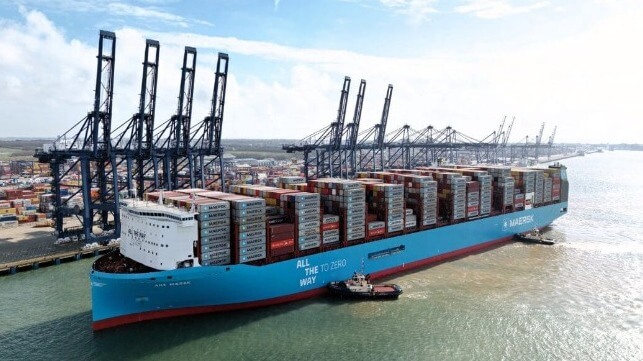
Maersk has taken delivery on the 12 ships in its first class of dual-fuel methanol vessels

Published Jun 3, 2025 1:25 PM by The Maritime Executive


Maersk marked another milestone in the company’s efforts to prepare for the transition to alternative fuels reporting the delivery of the twelfth vessel in its first series of large dual-fuel methanol containerships. Delivery of the new vessel took place in South Korea seventeen months after the naming of the first ship in the class.

The newest is Axel Maersk, named after Axel Poul Peder Maersk Uggla, a grandson of Ane Maersk Mc-Kinney Uggla, chair of the A.P. Moller Foundation and the naming inspiration for the first vessel of the class. Maersk went with names starting with “A” for the entire class, AneAlette, Antonia, Alexandra, Alva, Astrid, AngelicaA.P. MøllerAxelAlbert, Adrian, and Arthur Maersk.

The ships were all built at the HD Hyundai Heavy Industries shipyard in Ulsan where the final vessel was named on May 27. She came two months after Adrian Maersk was named in Rotterdam. The vessels are all being deployed on the company’s new East-West Network established for the Gemini Cooperation with Hapag-Lloyd. Adrian Maersk the company reported would be sailing Asia to the Mediterranean while others in the class are sailing to Northern Europe. Axel Maersk departed for Shanghai, where it is due on June 4 on its maiden voyage.

Each of the ships is 189,500 dwt and approximately 337 meters (1,105 feet) in length with a capacity of 16,000 TEU. MAN Energy Solutions developed the dual-fuel engine which is designed for methanol or gas and can use traditional methanol as well as the future e-methanol or bio-methanol as it becomes available in sufficient quantities. They are registered in Denmark.

Maersk wrote online in announcing the delivery, “We’re proud to be onboard the enter transition. The journey continues …”

This year Maersk is scheduled to also take delivery on six additional dual-fuel methanol containerships. It placed a follow-on order with HD Hyundai in October 2022 for the additional vessels. While they will be similar to the first series the company reports the second series will have a nominal capacity of approximately 17,000 TEU for each vessel.

The ships are part of a large fleet modernization effort Maersk announced in 2024. It had previously ordered from Yangzijiang Shipbuilding Group six 9,000 TEU dual-fuel methanol vessels for delivery in 2026 and 2027. In the second half of 2024, it completed orders for a total of 20 dual-fuel vessels with a total capacity of 300,000 TEU. The order was split between Yangzijiang Shipbuilding and New Times Shipbuilding in China and Hanwha Ocean in South Korea. The vessels will each be equipped with liquified gas dual-fuel propulsion systems, although in August 2024 the company noted it had elected a mix of methanol and liquified gas dual-fuel propulsion systems as it waits for the development of production and supply chains for bio-methanol to be developed. 


Op-Ed: Maritime Perspective Sheds Light on US-Iran Nuclear Negotiations

Iran missile base tour
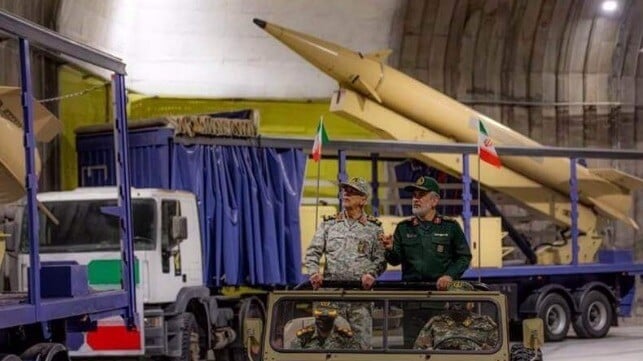
Maj Gen Mohammad Bagheri and Brigadier Amir Ali Hajizadeh tour a ‘missile megacity’ (Press TV)

Published Jun 3, 2025 2:50 PM by The Maritime Executive


Rising tensions between Iran and the United States are casting a shadow over the Middle East region. GCC nations in particular are concerned that commerce will be disrupted should a breakdown in the Omani-mediated talks between the United States and Iran have a military fallout.

Reports suggest that the critical closing stages of negotiations have reached a stalemate, with the normally reticent Omani Foreign Minister Sayyid Badr Al Busaidi acknowledging that while progress has been made obstacles remain. The sticking point in the negotiations appears to revolve around uranium enrichment, which Iran wishes to continue at the 3.67 percent level needed for civil purposes, but which the United States wishes to see ended completely. Amongst solutions to the impasse being discussed is the idea that Iran could carry out processing in a third country, under International Atomic Energy Agency (IAEA) oversight. During its many years of conducting nuclear inspections in Iran, the IAEA has by in large maintained its reputation for probity and impartiality.

However, with the negotiations at a critical juncture, the IAEA has published a report requested by its Board of Governors which describes work that Iran has attempted to hide from IAEA inspections.  Iran’s covert nuclear weapons development agency SPND has apparently conducted work at three undeclared sites (Lavisan-Shian, Varamin, and Turquzabad) to perfect nuclear weapon trigger devices, and has also built up a 408kgs stock of 60 percent enriched uranium, sufficient with limited additional processing to build nine nuclear weapons and a stockpile not needed for any civil purpose. If its Board of Governors endorses the report, then the IAEA could refer Iran to the UN Security Council as being in breach of its non-proliferation obligations. This in turn could oblige Britain, France, and Germany to re-impose snap-back sanctions even before U.S.-Iranian negotiations have reached a dead-end.

With the IAEA report coming at a critical point in the negotiations, but with Iran arguably already breaching Israel’s declared red-line prohibition on nuclear weapons development, President Donald Trump has urged Israel not to attack. Trump believes success in the negotiations is still possible, and that this would remove the risks of resorting to warfare. On his recent trip to the Gulf, Trump was urged by all Arab leaders to discourage attacks on Iran, for fear of disturbing the status quo and the collateral consequences for the region. 

How Iran should now proceed has evidently divided the Iranian political leadership. Hardliners around the Supreme Leader, amongst whom are the commanders of the Islamic Revolutionary Guard Corps (IRGC), have urged that no concessions be made in the negotiations, arguing that Iran’s defenses are strong enough to resist an Israeli attack, and with some now maintaining that it is acceptable within Islamic teaching for Iran to proceed with the development of low yield nuclear weapons. For hardliners, an Israeli attack would be survivable and justification for completing the deployment of nuclear weapons.

Opposition to the hard-liners’ stance is led by the reformist President Masoud Pezeshkian. It is probable that President Pezeshkian’s desire for a successful end to the negotiations, which would see an easing of sanctions and hence an easing of the current economic crisis, was reinforced in his visit last week to Sultan Haitham of Oman, who is determined to see the negotiations end fruitfully and tensions reduced in the region.

While at this delicate stage of the negotiations, the hardliners are being bombastic, the reformists are anxious to avoid providing any provocation or excuse for the talks to be abandoned. This posture is very evident in the current deployments of Iran’s regular armed forces, who tend to align with the moderate reformist faction, whilst the IRGC makes up the hardliner core.

This alignment is apparent in the current deployments of Iran’s regular Navy (Nedaja). Besides having withdrawn its flotilla which hitherto had maintained a constant presence in the Red Sea and Gulf of Aden, the bulk of the Nedaja remains in port in the Bandar Abbas Naval Harbor. Coastal defenses have not as one might have expected at a time of tension been reinforced, and the Nedaja currently has no known flotillas out on long-range patrol - again, contrary to what one might expect, with both a U.S. and a UK carrier strike group in the region. Of their principal ships, only one operational frigate, a Hengam Class logistic ship, and the sole operational Kilo Class submarine are missing from their home base in Bandar Abbas. But that still leaves the IRGC Navy able to cause trouble further afield, for example by threatening the U.S. Naval Support Facility on Diego Garcia.
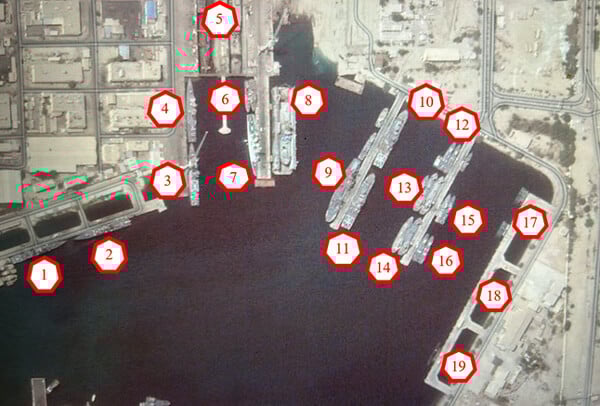
 

 Bandar Abbas Naval Base June 2
(Sentinel-2/CJRC, subject to imagery resolution limitations)

1.     Moudge Class frigate
2.     Alvand Class frigate
3.     Moudge Class frigate
4.     Alvand Class frigate
5.     Kilo Class submarine in dry dock, with probable second Kilo under cover in dry dock alongside
6.     2 x Sina or Kaman Class fast attack craft
7.     Intelligence collector IRINS Zagros (H313)
8.     Hengam Class landing ship IRINS Larak (L512) in floating dry dock
9.     Bandar Abbas Class logistics vessel IRINS Bushehr (K442)
10 and 11.   Hengam Class landing ships IRINS Tonb (L513) and Lavan (L514) 
12.   2 x Hendijan Class auxiliaries
13 and 14.   Total of 4 x Delvar Class auxiliaries
15.   2 x Kaman or Sina Class fast attack craft
16.   Probably 2 x Hendijan Class auxiliaries
17.   Ghadir and Nahang Class midget submarines
18.   Kilo Class submarine missing from its normal berth
19.   Probable Fateh Class medium submarine
Bandar Abbas Naval Base outer harbor:  Forward base ship IRINS Makran (K441) 


Even if the United States and Iran can agree on nuclear proliferation matters, the United States and Israel still want the current negotiations to also introduce limitations on Iran’s development of ballistic and cruise missiles, and on Iran’s IRGC-led regional expansionism. Iran still retains a powerful long-range ballistic and cruise missile fleet, and the IRGC’s response to the reverses suffered by the Axis of Resistance in Syria, Lebanon, and Iraq will be to regroup and covertly try again.  So these are more highly-charged issues that the indefatigable Omani meditators will strive to see resolved before a successful conclusion to the talks can be landed.
 

The opinions expressed herein are the author's and not necessarily those of The Maritime Executive.