Thursday, June 19, 2025


Biopharmaceutical investment in innovation persists after passage of Inflation Reduction Act


R&D spending and business development show a robust, strategic response to anticipated decreases in drug prices


Bentley University


BENTLEY UNIVERSITY

New research from the Center for Integration of Science and Industry at Bentley University  found no evidence to support claims that the price reductions anticipated under the Inflation Reduction Act would decrease R&D spending or investment in innovation. In fact, the biopharmaceutical industry increased R&D spending, equity offerings, and acquisitions of clinical-stage biotechnology companies. The observed changes reflect a strategic response by the industry to preserve both their profitability and productivity.

paper released today titled “Sustaining pharmaceutical innovation after the Inflation Reduction Act; trends in R&D spending, equity investment, and business development” published in Drug Discovery Today, examined R&D spending, public and private equity investments, mergers & acquisitions, and licensing agreements in the biopharmaceutical sector in the six quarters following passage of the IRA in August 2022 compared to the preceding six quarters and historical trends from 2010. The results show that in the six quarters following passage of the IRA, R&D spending was higher ($247 billion versus $211 billion), there was a similar number of equity offerings (1398 versus 1406) with an increase in the number of offerings by companies with products in clinical trials (948 versus 885), an increase in the number of acquisitions (203 versus 169) including a notable increase in acquisitions of companies with products in clinical development (120 versus 75), and a decrease in licensing agreements (504 versus 583), particularly those involving products in clinical trials (165 versus 233).

This new research contradicts arguments that investment in pharmaceutical innovation would decrease in response to the prospect of lower drug prices, revenues, or returns. Instead, this analysis suggests that large pharmaceutical companies have increased their investments in both internal R&D and the acquisition of clinical-stage products to sustain their product pipelines, and that equity investors continue to invest in the biotechnology companies that are primarily responsible for originating new product development.

“Our analysis suggests that the pharmaceutical industry is making the smart, strategic investments in innovation necessary to sustain their pipeline of new products and their profitability in response to the drug pricing provisions of the IRA and the large number of upcoming patent expirations” said Fred Ledley, Director of the Center for Integration of Science and Industry, and the senior author on these studies. “This strategy, however, could be sensitive to decreases in public investment in the early stages of drug discovery or development as well as the stability of financial markets.”

This research builds on two previous reports that generated an evidence base for modeling the potential impacts of the IRA on pharmaceutical innovation and drug approvals. A 2024 paper titled “Modeling impact of inflation reduction act price negotiations on new drug pipeline considering differential contributions of large and small biopharmaceutical companies” in Clinical Trials characterized relationship between revenue and R&D spending in large pharmaceutical manufacturers as well as smaller (emerging) biotechnology companies, and their contributions to clinical development. A related working paper titled “Implications of the Inflation Reduction Act for the biotechnology industry; sensitivity of investment and valuation to drug price indices and market conditions,” published by the Institute for New Economic Thinking, characterized the historical association between indices of drug prices and both investment and valuations in the biotechnology industry. Using these data, a model was constructed suggesting that large pharmaceutical companies, which derive capital for innovation primarily from product revenues, could mitigate any negative effects of the IRA on innovation by strategically focusing R&D spending on late-stage trials and increasing acquisitions of clinical-stage companies, which derive substantial innovation capital through equity offerings. The new study shows that the industry’s response to passage of the IRA is fully consistent with this strategy. 


Henry Dao was the lead author of the publication in Drug Discovery Today with Dr. Ledley. 

This work was funded by the National Biomedical Research Foundation through grants to Bentley University. 

CENTER FOR INTEGRATION OF SCIENCE AND INDUSTRY at Bentley University focuses on advancing the translation of scientific discoveries to create public value. The Center is an environment for interdisciplinary scholarship spanning basic science, data analytics, business, and public policy. For more information, visit bentley.edu/sciindustry and follow us on XLinkedIn, and Bluesky. The Center for Integration of Science and Industry is an affiliate of the Center for Health and Business at Bentley University.

BENTLEY UNIVERSITY is more than just one of the nation's top business schools. It is a lifelong-learning community that creates successful leaders who make business a force for positive change. With a combination of business and the arts and sciences and a flexible, personalized approach to education, Bentley provides students with critical thinking and practical skills that prepare them to lead successful, rewarding careers. Founded in 1917, the university enrolls 4,100 undergraduate and 1,000 graduate and PhD students and is set on 163 acres in Waltham, Massachusetts, 10 miles west of Boston. For more information, visit bentley.edu. Follow us on X and LinkedIn #BentleyUResearch.


UBC scientists propose blueprint for 'universal translator' in quantum networks


Silicon breakthrough could lay foundation for a global quantum internet


University of British Columbia

UBC professor Joseph Salfi 

image: 

UBC professor Joseph Salfi

view more 

Credit: Paul Joseph/UBC


UBC researchers are proposing a solution to a key hurdle in quantum networking: a device that can “translate” microwave to optical signals and vice versa.

The technology could serve as a universal translator for quantum computers—enabling them to talk to each other over long distances and converting up to 95 per cent of a signal with virtually no noise. And it all fits on a silicon chip, the same material found in everyday computers.

"It's like finding a translator that gets nearly every word right, keeps the message intact and adds no background chatter,” says study author Mohammad Khalifa, who conducted the research during his PhD at UBC’s faculty of applied science and the UBC Blusson Quantum Matter Institute.

“Most importantly, this device preserves the quantum connections between distant particles and works in both directions. Without that, you'd just have expensive individual computers. With it, you get a true quantum network."

How it works

Quantum computers process information using microwave signals. But to send that information across cities or continents, it needs to be converted into optical signals that travel through fibre optic cables. These signals are so fragile, even tiny disturbances during translation can destroy them.

That’s a problem for entanglement, the phenomenon quantum computers rely on, where two particles remain connected regardless of distance. Einstein called it "spooky action at a distance." Losing that connection means losing the quantum advantage. The UBC device, described in npj Quantum Information, could enable long-distance quantum communication while preserving these entangled links.

The silicon solution

The team’s model is a microwave-optical photon converter that can be fabricated on a silicon wafer. The breakthrough lies in tiny engineered flaws, magnetic defects intentionally embedded in silicon to control its properties. When microwave and optical signals are precisely tuned, electrons in these defects convert one signal to the other without absorbing energy, avoiding the instability that plagues other transformation methods.

The device also runs efficiently at extremely low power—just millionths of a watt. The authors outlined a practical design that uses superconducting components, materials that conduct electricity perfectly, alongside this specially engineered silicon.

What’s next

While the work is still theoretical, it marks an important step in quantum networking.

"We're not getting a quantum internet tomorrow—but this clears a major roadblock," says the study's senior author Dr. Joseph Salfi, an assistant professor in the department of electrical and computer engineering and principal investigator at UBC Blusson QMI.

"Currently, reliably sending quantum information between cities remains challenging. Our approach could change that: silicon-based converters could be built using existing chip fabrication technology and easily integrated into today’s communication infrastructure."

Eventually, quantum networks could enable virtually unbreakable online security, GPS that works indoors, and the power to tackle problems beyond today's reach such as designing new medicines or predicting weather with dramatically improved accuracy.

Interview language(s): English (Salfi)


Joseph Salfi lab at UBC's Blusson Quantum Matter Institute

Credit

Paul Joseph/UBC

SPACE/COSMOS

“The models were right”: Astronomers find ‘missing’ matter


European Space Agency

Astronomers discover vast filament of ‘missing’ matter 

image: 

This image shows the new filament, which connects four galaxy clusters: two on one end, two on the other. These clusters are visible as bright spots at the bottom and top of the filament (four white dots encircled by colour). A mottled band of purple stretches between these bright dots, standing out brightly against the black surrounding sky; this is the filament of X-ray-emitting hot gas that had not been seen before, and contains a chunk of ‘missing’ matter.

The purple band comprises data from Suzaku. The astronomers were able to identify and remove any possible ‘contaminating’ sources of X-rays from the filament using XMM-Newton, leaving behind a pure thread of ‘missing’ matter. These sources can be seen here as bright dots studded through – and removed from – the filament’s emission.

view more 

Credit: ESA/XMM-Newton and ISAS/JAXA


Astronomers have discovered a huge filament of hot gas bridging four galaxy clusters. At 10 times as massive as our galaxy, the thread could contain some of the Universe’s ‘missing’ matter, addressing a decades-long mystery.

The astronomers used the European Space Agency’s XMM-Newton and JAXA’s Suzaku X-ray space telescopes to make the discovery.

Over one-third of the ‘normal’ matter in the local Universe – the visible stuff making up stars, planets, galaxies, life – is missing. It hasn’t yet been seen, but it’s needed to make our models of the cosmos work properly.

Said models suggest that this elusive matter might exist in long strings of gas, or filaments, bridging the densest pockets of space. While we’ve spotted filaments before, it’s tricky to make out their properties; they’re typically faint, making it difficult to isolate their light from that of any galaxies, black holes, and other objects lying nearby.

New research is now one of the first to do just this, finding and accurately characterising a single filament of hot gas stretching between four clusters of galaxies in the nearby Universe.

“For the first time, our results closely match what we see in our leading model of the cosmos – something that’s not happened before,” says lead researcher Konstantinos Migkas of Leiden Observatory in the Netherlands. “It seems that the simulations were right all along.”

XMM-Newton on the case

Clocking in at over 10 million degrees, the filament contains around 10 times the mass of the Milky Way and connects four galaxy clusters: two on one end, two on the other. All are part of the Shapley Supercluster, a collection of more than 8000 galaxies that forms one of the most massive structures in the nearby Universe.

The filament stretches diagonally away from us through the supercluster for 23 million light-years, the equivalent of traversing the Milky Way end to end around 230 times.

Konstantinos and colleagues characterised the filament by combining X-ray observations from XMM-Newton and Suzaku, and digging into optical data from several others.

The two X-ray telescopes were ideal partners. Suzaku mapped the filament’s faint X-ray light over a wide region of space, while XMM-Newton pinpointed very precisely contaminating sources of X-rays – namely, supermassive black holes – lying within the filament.

“Thanks to XMM-Newton we could identify and remove these cosmic contaminants, so we knew we were looking at the gas in the filament and nothing else,” adds co-author Florian Pacaud of the University of Bonn, Germany. “Our approach was really successful, and reveals that the filament is exactly as we’d expect from our best large-scale simulations of the Universe.”

Not truly missing

As well as revealing a huge and previously unseen thread of matter running through the nearby cosmos, the finding shows how some of the densest and most extreme structures in the Universe – galaxy clusters – are connected over colossal distances.

It also sheds light on the very nature of the ‘cosmic web’, the vast, invisible cobweb of filaments that underpins the structure of everything we see around us.

“This research is a great example of collaboration between telescopes, and creates a new benchmark for how to spot the light coming from the faint filaments of the cosmic web,” adds Norbert Schartel, ESA XMM-Newton Project Scientist.

“More fundamentally, it reinforces our standard model of the cosmos and validates decades of simulations: it seems that the ‘missing’ matter may truly be lurking in hard-to-see threads woven across the Universe.”

Piecing together an accurate picture of the cosmic web is the domain of ESA’s Euclid mission. Launched in 2023, Euclid is exploring this web’s structure and history. The mission is also digging deep into the nature of dark matter and energy – neither of which have ever been observed, despite accounting for a whopping 95% of the Universe – and working with other dark Universe detectives to solve some of the biggest and longest-standing cosmic mysteries.

Notes for editors

Detection of pure WHIM emission from a 7.2 Mpc long filament in the Shapley supercluster using X-ray spectroscopy by K. Migkas et al. is published today in Astronomy & AstrophysicsDOI: 10.1051/0004-6361/202554944


This image shows the new filament, which connects four galaxy clusters: two on one end, two on the other. These clusters are visible as bright spots at the bottom and top of the filament (four white dots encircled by colour). A mottled band of purple stretches between these bright dots, standing out brightly against the black surrounding sky; this is the filament of X-ray-emitting hot gas that had not been seen before, and contains a chunk of ‘missing’ matter.

The purple band comprises data from Suzaku. The astronomers were able to identify and remove any possible ‘contaminating’ sources of X-rays from the filament using XMM-Newton, leaving behind a pure thread of ‘missing’ matter. These sources can be seen here as bright dots studded through – and removed from – the filament’s emission.

Credit

ESA/XMM-Newton and ISAS/JAXA

A simulation of the ‘cosmic web’, the vast network of threads and filaments that extends throughout the Universe. Stars, galaxies, and galaxy clusters spring to life in the densest knots of this web, and remain connected by vast threads that stretch out for many millions of light-years. These threads are invisible to the eye, but can be uncovered by telescopes such as ESA’s XMM-Newto.

Credit

Illustris Collaboration / Illustris Simulation


Contact:
ESA Media relations
media@esa.int

US to screen social media of foreign students for anti-American content


By AFP
June 19, 2025


The State Department will require student visa applicants to make public their social media profiles to be vetted for anti-American views - Copyright AFP/File -

Foreigners seeking to study in the United States will be required to make public their social media profiles to allow screening for anti-American content under new State Department guidelines released Wednesday.

The State Department had temporarily paused issuing visas for foreign students at the end of May while it came up with the new social media guidance and it will now resume taking appointments.

“The enhanced social media vetting will ensure we are properly screening every single person attempting to visit our country,” a senior State Department official said.

US consular officers will conduct a conduct a “comprehensive and thorough vetting of all student and exchange visitor applicants,” the official said.

To facilitate the screening, student visa applicants will be asked to adjust the privacy settings on all their social media profiles to “public,” the official said.

In an executive order on his first day as president, Donald Trump called for increased vetting of persons entering the United States to ensure they “do not bear hostile attitudes toward its citizens, culture, government, institutions, or founding principles.”

Student visas are one of a series of battles waged over higher education by the Trump administration, which has rescinded thousands of visas and sought to ban Harvard University from accepting international students.

Secretary of State Marco Rubio has revoked visas in large part of students who led demonstrations critical of Israel’s offensive in Gaza, as he uses an obscure law that allows the removal of people deemed to go against US foreign policy interests.

In April, the Department of Homeland Security said the social media of foreign student applicants would be examined for “antisemitic activity” that could result in visa denial.

The US government has been vetting the social media of persons seeking to immigrate to the United States or obtain a green card for more than a decade.


Op-Ed: Australian writer barred from entry into the US because of his opinions


By Paul Wallis
June 16, 2025
DIGITAL JOURNAL


An American Airlines plane flies past a cellular tower disguised as a palm tree as it lands at Los Angeles International Airport (LAX) in California in January 2022 - Copyright POOL/AFP/File Patrick Pleul

An Australian writer was barred from entry into the US because of his online commentaries. The writer, a guy called Alastair Kitchen, said that he was interrogated about his online views and then sent back to Australia.

His views included commentary on the Gaza war and college protests. According to Kitchen, who studied at Columbia, they said, “We know why you’re here”. They also found evidence on his phone of “drug use”, which is legal in most of the US.

This is true banana republic stuff.

The whole story is pretty grim. A flight attendant, not a US government official, was given charge of Mr Kitchen’s phone and passport and said he could have them back when he arrived back in Australia.

Let’s just say that only authorized people are supposed to handle ID and personal information.

There are so many ongoing stories about foreigners being refused entry to the US on what are effectively purely political grounds. The level of “forensic insanity” in this case is a bit unusual, though.

The airport interrogations are notorious. Complaints are made almost daily about brutal or arbitrary treatment of travellers. You have to wonder exactly what this chaotic approach to foreigners is supposed to achieve, except a total boycott on travel to the US.

Travel warnings against going to the US are now pretty much universal, ironically, except for Australia, which describes US entry requirements as “strict”.

Let’s clarify:

Any country can refuse entry for any reason related to the applicable laws of that country.

What laws did Mr Kitchen breach?

He arrived documented with a valid passport.

Look at it from a consumer perspective. You pay money to go all the way over there, and your money is forfeited simply because somebody feels like doing that.

You have no recourse at all in this environment.

The Australian consulate attempted to help, but not much resulted.

None of the issues raised regarding Mr Kitchen’s entry seem to have related to US laws of any kind. There are no applicable laws about foreign citizens expressing their opinions, for example.

This was a purely political process.

This sort of thing also happened in the previous Trump administration.

A statement from Australian acting prime minister Marles included the inexcusably insipid remark about our “profoundly important relationship with the United States”, strategic relationship, etc.

That’s nice.

There are other relationships that are much more important.

These include friends, relatives, and business relationships. People relationships.

Relationships that mean something.

Real Americans, the non-goosestepping variety, don’t act like cartoon dictators.

The message for travellers is DO NOT GO TO AMERICA. Boycott the place until it’s sane again.

__________________________________________________
Disclaimer
The opinions expressed in this Op-Ed are those of the author. They do not purport to reflect the opinions or views of the Digital Journal or its members.
Rise in ‘harmful content’ since Meta policy rollbacks: survey


By AFP
June 16, 2025


Meta ditched third-party fact-checking in the United States in January - Copyright AFP Brendan SMIALOWSKI
Anuj CHOPRA

Harmful content including hate speech has surged across Meta’s platforms since the company ended third-party fact-checking in the United States and eased moderation policies, a survey showed Monday.

The survey of around 7,000 active users on Instagram, Facebook and Threads comes after the Palo Alto company ditched US fact-checkers in January and turned over the task of debunking falsehoods to ordinary users under a model known as “Community Notes,” popularized by X.

The decision was widely seen as an attempt to appease President Donald Trump’s new administration, whose conservative support base has long complained that fact-checking on tech platforms was a way to curtail free speech and censor right-wing content.

Meta also rolled back restrictions around topics such as gender and sexual identity. The tech giant’s updated community guidelines said its platforms would permit users to accuse people of “mental illness” or “abnormality” based on their gender or sexual orientation.

“These policy shifts signified a dramatic reversal of content moderation standards the company had built over nearly a decade,” said the survey published by digital and human rights groups including UltraViolet, GLAAD, and All Out.

“Among our survey population of approximately 7,000 active users, we found stark evidence of increased harmful content, decreased freedom of expression, and increased self-censorship.”

One in six respondents in the survey reported being the victim of some form of gender-based or sexual violence on Meta platforms, while 66 percent said they had witnessed harmful content such as hateful or violent material.

Ninety-two percent of surveyed users said they were concerned about increasing harmful content and felt “less protected from being exposed to or targeted by” such material on Meta’s platforms.

Seventy-seven percent of respondents described feeling “less safe” expressing themselves freely.

The company declined to comment on the survey.

In its most recent quarterly report, published in May, Meta insisted that the changes in January had left a minimal impact.

“Following the changes announced in January we’ve cut enforcement mistakes in the US in half, while during that same time period the low prevalence of violating content on the platform remained largely unchanged for most problem areas,” the report said.

But the groups behind the survey insisted that the report did not reflect users’ experiences of targeted hate and harassment.

“Social media is not just a place we ‘go’ anymore. It’s a place we live, work, and play. That’s why it’s more crucial than ever to ensure that all people can safely access these spaces and freely express themselves without fear of retribution,” Jenna Sherman, campaign director at UltraViolet, told AFP.

“But after helping to set a standard for content moderation online for nearly a decade, (chief executive) Mark Zuckerberg decided to move his company backwards, abandoning vulnerable users in the process.

“Facebook and Instagram already had an equity problem. Now, it’s out of control,” Sherman added.

The groups implored Meta to hire an independent third party to “formally analyze changes in harmful content facilitated by the policy changes” made in January, and for the tech giant to swiftly reinstate the content moderation standards that were in place earlier.

The International Fact-Checking Network has previously warned of devastating consequences if Meta broadens its policy shift related to fact-checkers beyond US borders to the company’s programs covering more than 100 countries.

AFP currently works in 26 languages with Meta’s fact-checking program, including in Asia, Latin America, and the European Union.


Musk’s X sues to block New York social media transparency law


By AFP
June 18, 2025


Elon Musk's X argues in a federal lawsuit that a New York state law requiring social media companies to report how they moderate hate speech and disinformation violates First Amendment protections - Copyright AFP/File Lionel BONAVENTURE

Elon Musk’s X Corp. has filed a lawsuit challenging a New York state law that requires social media companies to report how they moderate hate speech and disinformation.

The complaint, filed in a federal court in Manhattan, seeks to halt the law, which X argues violates the First Amendment by forcing platforms to disclose sensitive information about their content moderation practices.

“Today, @X filed a First Amendment lawsuit against a New York law, NY S895B,” X’s Global Government Affairs team posted Tuesday, adding that it had successfully challenged a similar law in California.

“X is the only platform fighting for its users by challenging the law, and we are confident we will prevail in this case as well,” the company said.

The New York law requires social media companies with over $100 million in annual revenue to submit semiannual reports detailing how they define and moderate hate speech, racism, extremism, disinformation and harassment.

Companies face fines of $15,000 per day for violations, which can be sought by the attorney general’s office.

X says the law is “an impermissible attempt by the State to inject itself into the content-moderation editorial process” and seeks to pressure platforms into restricting constitutionally protected speech.

– ‘Stop Hiding Hate’ –

Reporters Without Borders said in a statement that asking X “account for their actions against misinformation is by no means an infringement of freedom of expression, but the bare minimum to clean up the digital space.”

“Freedom of expression does not come without responsibilities,” it added.

The lawsuit comes after X successfully challenged a nearly identical California law last year, according to the filing. New York’s law is “a carbon copy” of the California provisions that were struck down, the filing adds.

X claims New York lawmakers refused to discuss changes to the bill after the California ruling, with sponsors saying they declined to meet because of content on X promoted by owner Musk that “threatens the foundations of our democracy.”

The company argues this indicated “viewpoint discriminatory motives” behind the law’s passage.

Senator Brad Hoylman-Sigal and Assembly member Grace Lee — who introduced the law — said in a statement that their act “does not infringe upon the First Amendment rights of social media companies, nor does it conflict with federal law.”

“Instead, the Stop Hiding Hate Act requires narrowly tailored disclosures by social media companies to allow consumers to better decide which social media platforms they utilize,” they added.

“The fact that Elon Musk would go to these lengths to avoid disclosing straightforward information to New Yorkers as required by our statute illustrates exactly why we need the Stop Hiding Hate Act.”

Elon Musk's fortune at risk after mass corporate exodus at Tesla: report

Tom Boggioni
June 18, 2025
RAW STORY

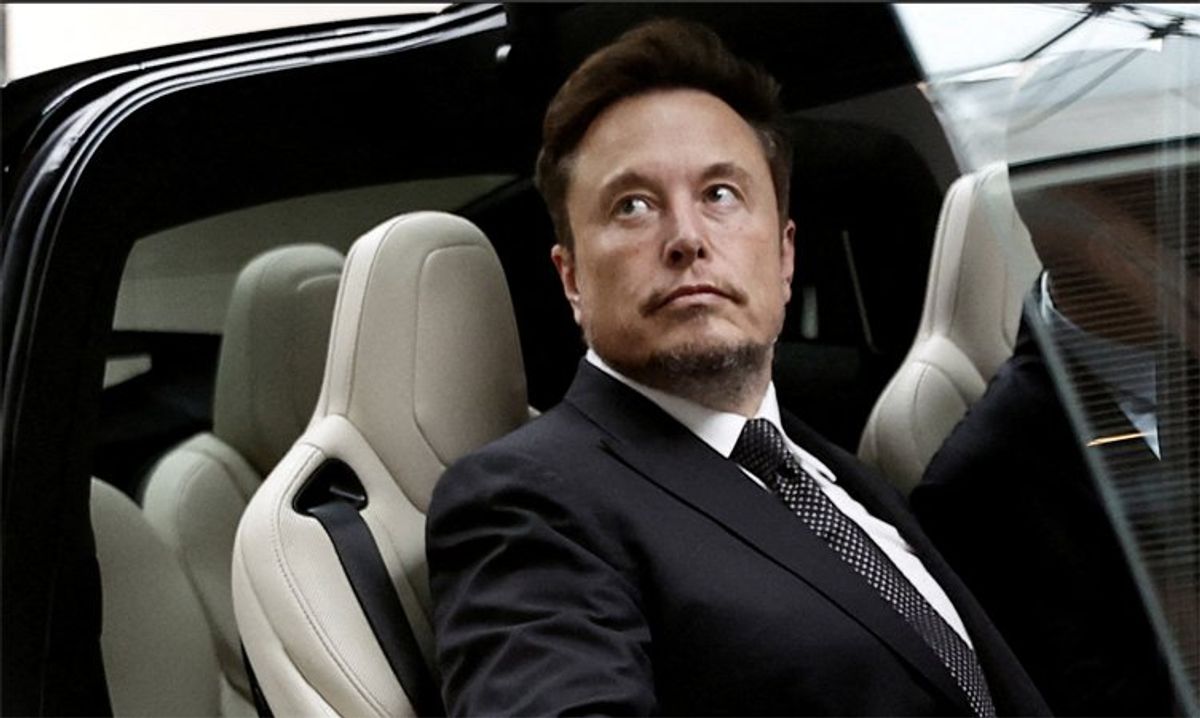
FILE PHOTO: Tesla Chief Executive Officer Elon Musk gets in a Tesla car as he leaves a hotel in Beijing, China May 31, 2023. REUTERS/Tingshu Wang/File Photo

Elon Musk is now facing an uphill battle after stepping away from his position as an advisor to Donald Trump to focus his attention on his embattled Tesla automotive company.
And with that comes the threat that he may lose the faith of investors who helped make him the wealthiest man in the world.

That is according to former Jalopnik editor-in-chief Patrick George in a column for The Atlantic where he pointed out that it is not just consumers who have fled the Tesla brand due to his close alignment with the unpopular Trump –– which is also currently on the rocks –– but also a "brain drain" at his company that has been occurring while his attention has been elsewhere, primarily with his Department of Government Efficiency (DOGE).

With the company now struggling due to a combination of a consumer boycott, dissatisfaction with a lack of innovation on newer models and plummeting stock prices, George suggested it will be up to the billionaire to turn things around at the company that makes up a large portion of his wealth.

And he currently doesn't have the supporting cast to help him succeed, according to the analysis.

According to the Atlantic report, "Something similar to DOGE’s steep staffing cuts has been playing out at Tesla. About a third of the executives who stood onstage with him two years ago have left Tesla or been ousted. Many other high-profile company leaders have resigned. Just since April, Tesla has lost its head of software engineering, head of battery technology, and head of humanoid robotics. Tens of thousands of rank-and-file employees left last year amid waves of mass layoffs."

Noting that Musk's hinting that AI will become a larger part of how the company is run, which led to more corporate departures, George wrote, "His actions might finally be catching up with him."

"Whether Tesla can rebound will test something truly scarce—not Musk’s wealth but the faith that others have in him. Musk has already alienated people on the left and right, but many people still fiercely believe in his ability to make them rich," he wrote before warning, "At some point, even they might start to vanish."

You can read more here.