Tuesday, July 01, 2025

A perfect storm as Israel’s war on Iran pushes the Taliban towards total collapse

A perfect storm as Israel’s war on Iran pushes the Taliban towards total collapse
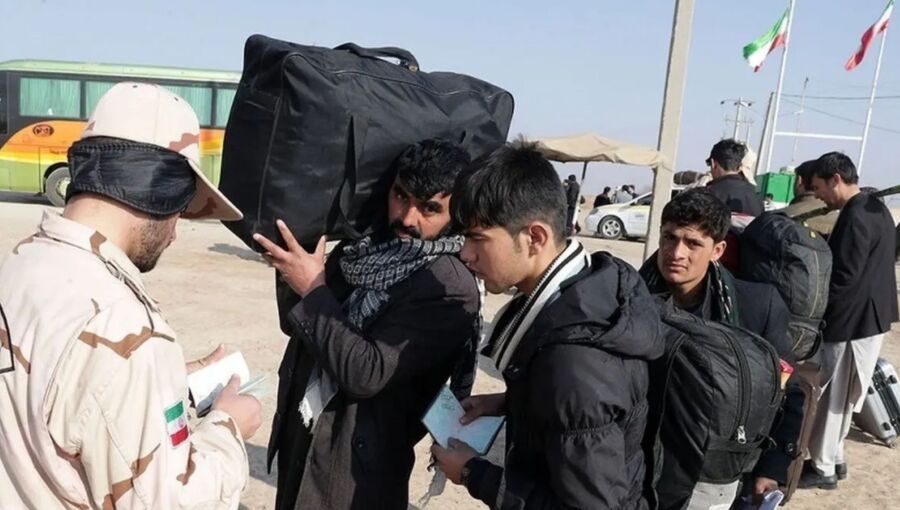
Afghans being forced out of Iran due to mass arrests of collaborators with Israel. / CC: DEFA

By bnm Gulf bureau June 30, 2025

Israel’s military strikes on Iran and now Tehran’s knee-jerk expulsion of Afghan residents have created a catastrophic domino effect that threatens to unravel the Taliban’s fragile governance in Afghanistan, according to the number of people being forced across the border in recent days.

The Islamic Republic, previously reluctantly hosting an estimated 3.8mn displaced Afghans – the largest refugee population globally – has shifted from decades of relative tolerance to aggressive deportation policies in a matter of weeks. This accelerated reversal stems partly from Israel’s June 2025 strikes, which exacerbated Iran’s economic strain and fuelled the scapegoating of Afghans.

Following the Israeli strikes across Iran, Tehran is now enforcing draconian residency rules on the millions of Afghans residing in the country. Census documents granting minimal protection to 2mn Afghans were revoked in early 2025, and services like healthcare, education and property transactions are denied to undocumented migrants. The Interior Ministry explicitly ordered that only six narrow categories of Afghans may remain – primarily those with formal employment ties or political status – while all others "must leave the country."

Iran’s crackdown has triggered a humanitarian tsunami. So far, 88,000 Afghans were deported in a single week in June 2025, with border crossings such as Islam Qala processing 10,000 returnees daily. This is a prelude to the looming expulsion of up to 4mn undocumented Afghans by July 6, dwarfing the 1.3mn already deported from Pakistan. Returnees arrive destitute; Iranian authorities confiscate their savings and belongings during deportation, while Taliban officials lack even basic reception infrastructure.

The economic toll on Afghanistan – already reeling from a 30% GDP contraction since 2021 – is unsustainable. The regime cannot feed its current population, let alone absorb millions of penniless returnees. Compounding this, Iran’s abrupt termination of education for Afghan children with census documents has barred over 610,000 students from schools, including girls who fled the Taliban’s own education bans. This deliberate severing of lifelines deepens despair among families who migrated specifically for schooling or safety.

The Taliban’s legitimacy, already eroded by international isolation and internal fragmentation, faces three existential pressures from this crisis. First, the demographic deluge overwhelms its skeletal governance. With no capacity to provide food, water or shelter at border crossings, scenes of starvation and disease will shatter the regime’s religious pretensions. Secondly, security fractures as former soldiers, police and officials – targeted by the Taliban in 2021 – are forcibly returned. These groups form a natural recruitment pool for armed resistance movements like the Afghanistan Freedom Front, which warns of "chaos and instability." Thirdly, Iran’s charge that Afghans collaborated with Israel during the strikes has subjected returnees to Taliban suspicion, turning them into internal enemies.

Israel’s role in this chain reaction cannot be understated. The strikes on Iran’s nuclear and military infrastructure from June 12-24, 2025, inflicted tens of billions in damages, deepening Tehran’s economic crisis. The Islamic Republic responded by turning on the Afghan population following the sheer number of arrests of Afghans during the 12-day war with Israel. Within days of the ceasefire, Prosecutor General Mohammad Movahedi Azad explicitly linked deportations to alleged Afghan "collaboration with Israel," following reports of Israel paying Afghans a few thousand dollars each to take part in the assault, Iran claims.

The Taliban now confronts an impossible equation: Iran’s expulsions – propelled by Israeli-inflicted wounds – will flood Afghanistan with 2-4mn traumatised citizens while the regime lacks resources to support 10% of that number. Many of those returning were not even born in Afghanistan and have resided in Iran for at least two generations, when the Taliban controlled Kabul before the US invasion of the country in 2001. 

As families starve in border camps and former officials potentially regroup for insurgency, the Taliban’s coercive control will disintegrate. The International Organisation for Migration’s warnings of "coercive regimes of forced returns" underscore a regional race to the bottom, with Pakistan, Turkey and Tajikistan accelerating deportations. Afghanistan’s implosion, once unthinkable, now appears inevitable within months – a grim testament to how Israel’s beef with Iran is now a ticking time bomb for the entirety of west, south and central Asia. Where the dominoes fall is anyone’s guess, but the unrecognised government in Kabul, still requesting its funds to be unfrozen, now faces the biggest challege of its short tenure.

Afghanistan: Surging Returns From Iran Overwhelm Fragile Support Systems, UN Agencies Warn
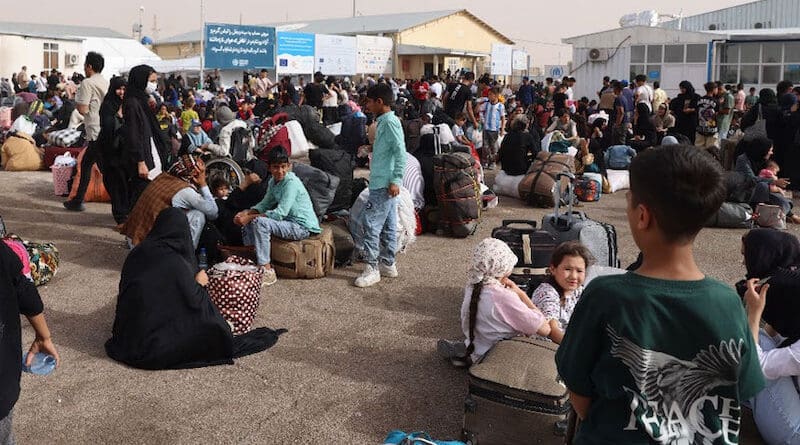
Afghans who have been deported from Iran gather at the Islam Qala border crossing in western Afghanistan. Photo Credit: UNHCR/Faramarz Barzin


By 

More than 700,000 Afghan migrants have returned from Iran so far this year, including 256,000 in June alone, the UN International Organization for Migration (IOM) reported on Monday, warning of immense pressures on Afghanistan’s overstretched support systems.   


Ninety-nine per cent of the returnees were undocumented, and 70 per cent were forcibly returned, with a steep rise in families being deported – a shift from earlier months, when most returnees were single young men, according to the UN agency.

The rise follows a March decision by the Iranian Government requiring all undocumented Afghans to leave the country.

Conditions deteriorated further after the recent 12-day conflict between Iran and Israel, which caused the daily refugees crossings to skyrocket from about 5,000 to nearly 30,000, according to Arafat Jamal, the UN refugee agency (UNHCR) representative in Afghanistan.

“They are coming in buses and sometimes five buses arrive at one time with families and others and the people are let out of the bus and they are simply bewildered, disoriented, and tired and hungry as well,” he told UN News, describing the scene at a border crossing.

“This has been exacerbated by the war, but I must say it has been part of an underlying trend that we have seen of returns from Iran, some of which are voluntary, but a large portion were also deportations.” 


Strain on aid efforts

Afghanistan, already grappling with economic collapse and chronic humanitarian crisis, is unprepared to absorb such large-scale returns.

The 2025 Humanitarian Needs and Response Plan calls for $2.42 billion in funding, but only 22.2 per cent has been secured to date.

“The scale of returns is deeply alarming and demands a stronger and more immediate international response,” said IOM Director General Amy Pope, “Afghanistan cannot manage this alone.”

Meanwhile, UNHCR alongside partners is working to address the urgent needs of those arriving – food, water, shelter, protection. However its programmes are also under severe strain due to limited funding. 

The agency had to drastically reduce its cash assistance to returnee families at the border from $2,000 per family to just $156.

“We are not able to help enough women, and we are also hurting local communities,” added Mr. Jamal.

Some relief, but not enough

In response to growing crisis, the UN Central Emergency Response Fund (CERF) has allocated $1.7 million to the World Food Programme (WFP) to support drought-affected families in Faryab Province.

The funds will provide cash assistance to some 8,000 families in the region, where over a third of the rural population is already facing crisis or emergency levels of acute food insecurity.

“Acting ahead of predicted hazards to prevent or reduce humanitarian impacts on communities is more important than ever,” said Isabelle Moussard Carlsen, Head of OCHA Afghanistan, adding “when humanitarian action globally and in Afghanistan is underfunded…we must make the most of every dollar.” 

‘We have nothing’: Afghans driven out of Iran return to uncertain future


By AFP
June 30, 2025


Iran ordered Afghans without the right to remain to leave by July 6, triggering a mass exodus - Copyright AFP Wakil Kohsar
Susannah Walden and Qubad Wali

Hajjar Shademani’s family waited for hours in the heat and dust after crossing the border into Afghanistan, their neat pile of suitcases all that remained of a lifetime in Iran after being deported to their homeland.

The 19-year-old and her three siblings are among tens of thousands of Afghans who have crossed the Islam Qala border point in recent days, the majority forced to leave, according to the United Nations and Taliban authorities.

Despite being born in Iran after her parents fled war 40 years ago, Shademani said the country “never accepted us”. When police came to her family’s home in Shiraz city and ordered them to leave, they had no choice.

But Afghanistan is also alien to her.

“We don’t have anything here,” she told AFP in English.

Between Iranian universities that would not accept her and the Taliban government, which has banned education for women, Shademani’s studies are indefinitely on hold.

“I really love studying… I wanted to continue but in Afghanistan, I think I cannot.”

At Herat province’s Islam Qala crossing, the checkpoint is usually busy handling the cycle of smuggling to deportation as young men seek work in Iran.

But since Tehran ordered Afghans without the right to remain to leave by July 6, the number of returnees — especially families — has surged. More than 230,000 departed in June alone, the United Nations International Organization for Migration (IOM) said.

Since January, more than 690,000 Afghans have left Iran, “70 percent of whom were forcibly sent back”, IOM spokesperson Avand Azeez Agha told AFP.

Of the more than a dozen returnees AFP spoke to on Saturday, none said they had fled the recent Iran-Israel conflict, though it may have ramped up pressure. Arrests, however, had helped spur their departures.


– Few prospects –


Yadullah Alizada had only the clothes on his back and a cracked phone to call his family when he stepped off one of the many buses unloading people at the IOM-run reception centre.

The 37-year-old said he was arrested while working as a day labourer and held at a detention camp before being deported to Afghanistan.

Forced to leave without his family or belongings, he slept on a bit of cardboard at the border, determined to stay until his family could join him.

“My three kids are back there, they’re all sick right now, and they don’t know how to get here.”

He hopes to find work in his home province of Daikundi, but in a country wracked by entrenched poverty and unemployment, he faces an uphill climb.

The UN mission for Afghanistan, UNAMA, has warned that the influx of deportees — many arriving with “no assets, limited access to services, and no job prospects” — risks further destabilising the crisis-wracked country.

Long lines snaked into tents encircling the reception centre where returnees accessed UN, NGO and government services.

Gusty wind whipped women’s Iranian-style hijabs and young men’s trendy outfits, clothing that stood out against the shalwar kameez that has become ubiquitous in Afghanistan since the Taliban swept to power in 2021, imposing their strict interpretation of Islamic law.

Deputy Prime Minister Abdul Salam Hanafi inspected the site on Saturday, striding through the crowd surrounded by a heavily armed entourage and pledging to ensure “that no Afghan citizen is denied their rights in Iran” and that seized or abandoned assets would be returned.

Taliban authorities have consistently called for “dignified” treatment of the migrants and refugees hosted in Iran and Pakistan, the latter having also ousted hundreds of thousands of Afghans since the latest decades-long war ended.


– ‘Have nothing’ –


Over one million Afghans have already returned to Afghanistan this year from both neighbouring countries. The numbers are only expected to rise, even as foreign aid is slashed and the Taliban government struggles for cash and international recognition.

The IOM says it can only serve a fraction of the returnees, with four million Afghans potentially impacted by Iran’s deadline.

Some of the most vulnerable pass through the agency’s transit centre in Herat city, where they can get a hot meal, a night’s rest and assistance on their way.

But at the clean and shaded compound, Bahara Rashidi was still worried about what would become of her and her eight sisters back in Afghanistan. They had smuggled themselves into Iran to make a living after their father died.

“There is no man in our family who can work here, and we don’t have a home or money,” the 19-year-old told AFP.

“We have nothing.”


Over 230,000 Afghans left Iran in June ahead of return deadline: IOM


By AFP
June 30, 2025


More than 230,000 Afghans left Iran in June, most of them deported, as returns surge ahead of a deadline set by Tehran, the United Nations migration agency said - Copyright AFP Wakil Kohsar


Susannah Walden

More than 230,000 Afghans left Iran in June, most of them deported, as returns surge ahead of a deadline set by Tehran, the United Nations migration agency said on Monday.

The number of returns from Iran rose dramatically in recent weeks. Afghans have reported increased deportations ahead of the July 6 deadline announced by Iran for undocumented Afghans to leave the country.

From June 1-28, 233,941 people returned from Iran to Afghanistan, International Organization for Migration spokesman Avand Azeez Agha told AFP, with 131,912 returns recorded in the week of June 21-28 alone.

Since January, “691,049 people have returned, 70 percent of whom were forcibly sent back”, he added.

For several days last week, the number reached 30,000 per day, the IOM said, with numbers expected to increase ahead of the deadline.

Afghans spilled into an IOM-run reception centre out of buses arriving back-to-back at the Islam Qala border point in western Afghanistan’s Herat province on Saturday.

The recent returns have been marked by a sharp increase in the number of families instead of individuals, the UN said, with men, women and children lugging suitcases carrying all their belongings.

Many have few assets and few prospects for work, with Afghanistan facing entrenched poverty and steep unemployment.

The country is four years into a fragile recovery from decades of war under Taliban authorities, who have called for a “dignified” return of migrants and refugees from neighbouring countries.

Kabul’s Foreign Minister Amir Khan Muttaqi raised the Taliban government’s concerns in a meeting with Iran’s ambassador, according to a statement, saying: “A coordinated mechanism should be put in place for the gradual return of migrants.”

The cash-strapped government faces challenges in integrating the influx of returnees, which has piled on to hundreds of thousands also forced out in recent years from Pakistan — another traditional host of Afghans fleeing conflict and humanitarian crises.

Severe international aid cuts have also hamstrung UN and NGO responses, with the IOM saying it was “only able to assist a fraction of those in need”.

“On some high-volume days, such as recently at Islam Qala, assistance reached as few as three percent of undocumented returnees,” it said in a recent statement.

Returnees AFP spoke to in recent days at the border cited mounting pressure by Iranian authorities and increased deportations, with none pointing to the recent Iran-Israel conflict as a spur to leave the country.

However, “regional instability — particularly the fallout from the Israel-Iran conflict — and shifting host country policies have accelerated returns, overwhelming Afghanistan’s already fragile humanitarian and development systems”, the UN mission in Afghanistan, UNAMA, said in a statement.

Samiullah Ahmadi, 28, was seeing his country of origin for the first time when he crossed the border.

Unsure of what he would do once he reached the Afghan capital Kabul with his family, he was defiant in response to the pressures to return.

“I was born there (Iran). But the situation for Afghans is such that no matter how good you are or even if you have valid documents, they still don’t treat you with respect.”

LITTLE OLD ASIAN LADY KUNG FU VS MMA FIGHTER


The Time Has Arrived for a Comprehensive Middle East Peace

The United States must recognize that its own strategic interests require a decisive break from partnering in Israel’s destructive strategy.


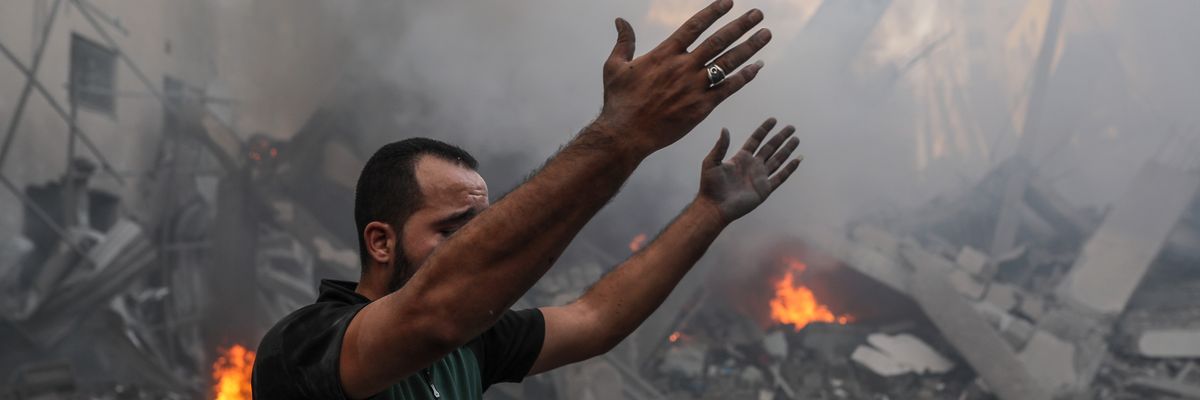
A man wails after Israeli airstrikes in Gaza City, Gaza on October 09, 2023.
(Photo: Belal Khaled/Anadolu Agency via Getty Images)

Jeffrey D. SachsSybil Fares
Jun 30, 2025
Common Dreams

The attack by Israel and the U.S. on Iran had two significant effects. First, it once again exposed the root cause of turmoil in the region: Israel’s project to “reshape the Middle East” through regime change, aimed at maintaining its dominance and blocking a Palestinian state. Second, it highlighted the futility and recklessness of this strategy. The only path to peace is a comprehensive agreement that addresses Palestine’s statehood, Israel’s security, Iran’s peaceful nuclear program, and the economic recovery of the region.

Israel wants to topple the Iranian government because Iran has supported proxies and non-state actors aligned with the Palestinians. Israel has also consistently undermined U.S.-Iran diplomacy regarding Iran’s nuclear program.

Instead of endless wars, Israel’s security can be ensured by two key diplomatic steps—ending militancy by establishing a Palestinian state with United Nations Security Council guarantees, and lifting sanctions on Iran in exchange for a peaceful and verifiable nuclear program.

Israel has driven the region to a 4,000-kilometer swash of violence from Libya to Iran through its reckless, lawless, and warmongering actions, all ultimately aimed at preventing a State of Palestine by “remaking” the Middle East.

The far-right Israeli government’s refusal to accept a Palestinian state is the root of the problem.

When the British empire promised a Jewish homeland in Mandatory Palestine in 1917, the Palestinian Arabs constituted 90% of the population and Jews less than 10% of the population. In 1947, with intense U.S. lobbying, the U.N. General Assembly voted to grant 56% of Palestine to a new Zionist state, while the Jews were only 33% of the population. Palestinians rejected this as a violation of their right to self-determination. After the 1948 war, Israel expanded to 78% of Palestine, and in 1967, occupied the remaining 22%—Gaza, the West Bank, East Jerusalem, and the Golan Heights.

Instead of returning occupied lands in exchange for peace, Israeli right-wing politicians insisted on permanent control of 100% of the land, with the Likud founding charter declaring in 1977 that there would be only Israeli sovereignty “between the Sea and Jordan.”

Israeli Prime Minister Benjamin Netanyahu represents this policy of domination—and has served as prime minister for a total of 17 years since 1996. When he came to power, he and his U.S. neocon allies authored the “Clean Break” strategy to block the creation of a Palestinian state. Instead of pursuing land for peace, Israel aimed to reshape the Middle East by overthrowing governments that supported the Palestinian cause. The U.S. would be the implementing partner of this strategy.

This is exactly what happened after 9/11, as the U.S. led or sponsored wars against Iraq (invasion in 2003), Lebanon (U.S. funding and arming Israeli aggressions), Libya (NATO bombing in 2011), Syria (CIA operation during 2010’s), Sudan (supporting rebels to break Sudan apart in 2011), and Somalia (backing Ethiopia’s invasion in 2006).

Contrary to the glib promises by Netanyahu to the U.S. Congress in 2002—that regime change in Iraq would bring a new day to the Middle East—the 2003 Iraq War augured the events that were to come across the region. Iraq descended into turmoil, and since then, each new war has brought death, destruction, and economic disarray.

This month, Israel attacked Iran even as negotiations between Iran and the U.S. were underway to ensure the peaceful use of Iran’s nuclear program—repeating the same WMD propaganda that Netanyahu used to justify the Iraq War.

Israel has been claiming for more than 30 years that Iran is on the verge of acquiring nuclear weapons. However, on June 18, 2025, the International Atomic Energy Agency (IAEA) director general stated that there is “no proof of a systematic effort” by Iran to develop nuclear weapons. More to the point, Iran and the U.S. were actively engaged in negotiations according to which the IAEA would monitor and verify the peaceful nature of Iran’s nuclear program.

The attack on Iran proves yet again the futility and nihilism of Netanyahu’s approach. The Israeli and U.S. attacks accomplished nothing positive. According to most analysts, Iran’s enriched uranium remains intact, but is now in a secret location rather than under IAEA monitoring. In the meantime, with Israel’s ongoing genocide in Gaza, neither peace nor security have been achieved.

Israel has driven the region to a 4,000-kilometer swash of violence from Libya to Iran through its reckless, lawless, and warmongering actions, all ultimately aimed at preventing a State of Palestine by “remaking” the Middle East.

The solution is clear: It is time for the United States to recognize that its own strategic interests require a decisive break from partnering in Israel’s destructive strategy.

Prioritizing genuine peace in the Middle East is not only a moral imperative, but a fundamental U.S. interest—one that can only be achieved through a comprehensive peace deal. The key pillar of this deal is for the U.S. to lift its veto on a Palestinian State on the borders of June 4, 1967, and to do so at the start, not in some vague distant future that never actually arrives.

For more than 20 years, Arab nations have backed a practical peace plan. So too has the Organization for Islamic Cooperation (OIC), with its 57 member countries, and the League of Arab States (LAS), with its 22 members. So too have almost all the nations in the U.N. General Assembly. So too has the International Court of Justice in its 2024 ruling that Israel’s occupation is illegal. Only Israel, with support from the U.S. veto, has stood in the way.

Here is a seven-point peace plan in which all parties would benefit. Israel would gain peace and security. Palestine would achieve statehood. Iran would win an end to economic sanctions. The U.S. would win an end to costly and illegal wars fought on Israel’s behalf, as well as the risks of nuclear proliferation if the current violence continues. The Middle East would win economic development, security, and justice.First, an immediate cease-fire would apply across the entire region—and the cease-fire would include an immediate release of all hostages and prisoners.

Second, the U.N. Security Council would vote upfront to welcome Palestine as the 194th U.N. Member State on the June 4, 1967 borders, with East Jerusalem as its capital. Israel and Palestine could subsequently agree on mutually desired border adjustments.

Third, Israel would withdraw from all territories occupied since 1967. U.N.-mandated international forces would ensure a peaceful, orderly transition; a transfer of Palestinian territories to Palestinian authorities; and mutual security for both Israel and Palestine.
Fourth, the territorial integrity and sovereignty would be guaranteed for Lebanon, Syria, and all states in the region. All non-state armed groups would be demilitarized, and foreign troops would be withdrawn.

Fifth, the U.N. Security Council would adopt an updated nuclear agreement with Iran, including binding verification, and with all economic sanctions on Iran lifted alongside Iran’s verified compliance with the peaceful uses of its nuclear program.

Sixth, Israel and all Arab and Islamic states would establish full diplomatic relations following the admission of the State of Palestine as a U.N. member state.

Seventh, the Middle East nations would establish an international fund for rebuilding the war-torn parts of Lebanon, Syria, and Palestine, with contributions coming from within the region and from external sources.


Our work is licensed under Creative Commons (CC BY-NC-ND 3.0). Feel free to republish and share widely.


Jeffrey D. Sachs
Jeffrey D. Sachs is a University Professor and Director of the Center for Sustainable Development at Columbia University, where he directed The Earth Institute from 2002 until 2016. He is also President of the UN Sustainable Development Solutions Network and a commissioner of the UN Broadband Commission for Development. He has been advisor to three United Nations Secretaries-General, and currently serves as an SDG Advocate under Secretary-General Antonio Guterres. Sachs is the author, most recently, of "A New Foreign Policy: Beyond American Exceptionalism" (2020). Other books include: "Building the New American Economy: Smart, Fair, and Sustainable" (2017) and "The Age of Sustainable Development," (2015) with Ban Ki-moon.
Full Bio >

Sybil Fares
Sybil Fares is a specialist and advisor in Middle East policy and sustainable development at SDSN
Full Bio >
Internet Access Is a Lifeline for Us in Gaza — So Israel Attacked It


Communications blackouts aren’t accidental. They’re strategy. They’re the tool Israel uses to try to erase us quietly.
PublishedJune 28, 2025

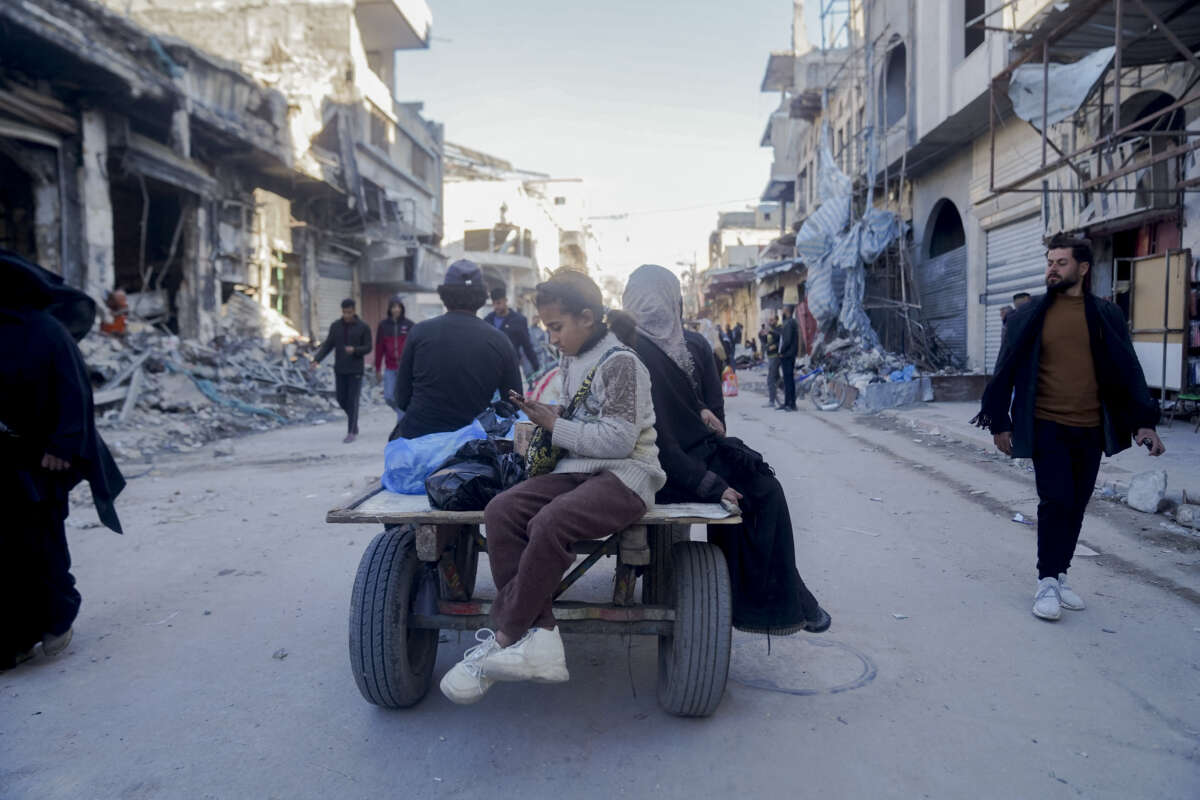
A young girl checks her smartphone on the back of a cart as in Northern Gaza, on February 28, 2025.HAMED SBEATA / Middle East Images / AFP via Getty Images


I’m always consumed by the same question: How will this endless, brutal spectacle of killing finally end?

Will it be like a movie — justice prevailing, liberation won, goodness triumphing over evil?

Will the ending even be worthy of the horrors we’ve endured? Or will it all fade away in an open-ended scene, full of unknowns, unanswered questions, and the absence of closure?

Will I make it to the final scene? Or will my story be abruptly cut short, lost before the credits even roll?

But this isn’t a movie. This isn’t a nightmare I’ll wake up from.

Related Story

Why Are Americans Letting Israel Starve Us to Death in Gaza?
US veto power at the UN is blocking Gaza’s chance for survival.
By Dalia Abu Ramadan , Truthout  June 22, 2025


This is Gaza.


And this is our reality — where every day, our lives are silently severed, not even properly documented in the ledger of Israel’s war crimes.

On June 8, Israeli forces bombed the core internet infrastructure in both the north and south of Gaza. The Strip went dark. We were cut off completely. No messages in, no messages out.

Here, we’ve become experts in sensing when something monstrous is coming — when death lurks under the stillness.

Our minds raced, our bodies — exhausted, broken, starved — could barely keep up. Every possible ending ran through my head: Would we be massacred quietly, all at once? Would we be erased without anyone ever knowing? Does the world even realize we’re vanishing? And if they do, do they care enough to stop it? Will they ever try to wipe our blood off their hands with real action, not hollow statements?

It didn’t end with internet blackouts. Israel jammed all telecommunications. For us, the internet wasn’t a luxury — it was a lifeline, a way to transfer funds during the liquidity crisis, a fragile system holding back hunger.

When even that collapsed, desperation surged.

Crowds gathered at what was called a “humanitarian aid” point in Gaza — praying, not for salvation, but for a box of food. But the gates were shut. And above, Israeli warplanes circled. Without warning, they opened fire. Snipers targeted anyone who dared raise their head. It was like a game — a deadly squash match. Dozens were killed. Hundreds wounded.

Some bled to death on the ground because every call for help was met with the same cold, mechanical response: “No network. Please try again.” But there was no “again.” Only death. Slow. Certain. Inevitable.

One survivor said he heard voices from the drones above: “We told you not to come.” That same day, Israel’s military spokesperson posted on Facebook that the distribution point had been closed. No explanation. No apology. Just a death trap dressed as relief.

Instead of food bags, people were shattered. Torn apart. Their remains brought back home in plastic bags.

That very evening, our neighbor’s home was bombed. Their screams haven’t left my ears. We tried calling the fire department, the ambulances — anyone. Nothing.

So we ran barefoot into the inferno, trying to pull them out with our hands. But one by one, their voices faded. And then, silence.

Explosions thundered in the background. We huddled together, not just out of fear — but because it was the only thing left to do. My heart thudded painfully. My mind was blank, numb. My frail body couldn’t bear more. But I couldn’t stop thinking of the people who’d just died — unseen, unmourned. It could have been someone I loved. But I couldn’t even check my phone to know.

Even mourning is a privilege denied to us.

Another airstrike.

I curled up in the corner. And a voice inside me whispered: This is the last fall, Hend. You’re going to die in limbo.

Two days passed. Nothing changed — except our deepening isolation. Hunger became background noise. We’ve learned to live with gnawing emptiness. But we cannot live without connection. That fragile internet line — it’s our only thread to the rest of humanity.

Nearly two years of televised carnage. Still, the world can’t name it. Genocide. Democide. Deliberate starvation. Systematic annihilation.

It’s all been documented — war crimes, crimes against humanity — coldly and clearly. Yet no sanctions. No accountability. No international court willing to enforce its own laws. No Geneva Convention. No ICC. No ICJ. Nothing but silence.

And so the question remains: Are we still pleading — after all this — to be seen as victims? To prove that our blood is not less valuable? That our children deserve to live, just like yours?

If no one is listening, maybe we should stop screaming. Maybe we should keep the last shred of dignity we have — turn off the cameras — and let the world go on, uninterrupted.

But that’s not what we want.

We want to be seen as humans — not corpses. As dreamers — not headlines. We want you to pressure your governments to end this slaughter — not to sip your coffee and scroll past another mass grave.

This is not “too political.” This is your humanity on trial. Gaza is the litmus test. How you respond will define your legacy.

At 3 am on June 14, a phone rang. It felt like a bomb in the dark. We had no cell service — so how was this happening?

I feared it was the Israeli military — an order to evacuate. But it wasn’t.

It was my sister, Intimaa, calling from abroad. “Are you okay?” she asked. Her voice cracked with fear. “I’ve been calling nonstop.”

Then she shared news I hadn’t heard: “Israel attacked Iran. Twenty commanders killed. Tehran is in ruins.”

She went on: “The Sumud Convoys — the ones meant to break Gaza’s siege — were blocked by Egyptian forces. Hundreds of activists arrested. Some deported.”

Then the line went dead.

That brief call brought no comfort, just more evidence that the world is burning. But still — her voice. Her voice was life.

I lay awake, watching the dark sky erupt with bombs.

I used to believe in those convoys, filled with a thousand people who traveled from across North Africa to try to make it through the Rafah crossing. But they were met with batons and detentions — not solidarity. And, Israel’s assault on Iran was a tactic — to distract, while they accelerate our annihilation.

The journalists who once told our stories are gone — killed or silenced. The massacres are hidden behind fake aid and polished lies. The struggle here is unbearable.

And yet, the sun rose again. I told my family about Intimaa’s call. Their eyes went blank.

So much horror, and we — trapped, starving, displaced — stayed in place.

We passed the news on to neighbors, like stories passed in ancient times. No phones. No news bulletins. Just mouths, and voices, and pain.

My father, determined, charged a single battery through a flimsy solar panel — just to turn on our battered TV. We watched images of Tel Aviv and Tehran — but not a word about Gaza. Not a breath about the massacre at the aid point. Not a whisper about our dead.

We — who are bleeding — were watching another conflict unfold, as if we had already died.

Eventually, workers from the telecom company managed to negotiate access to fix the broken lines. They risked everything. One technician lost his leg to an airstrike.

But on June 15, the internet returned. And with it, a flood of messages. Relatives checking in. The simple miracle of: “You’re still alive.”

It didn’t last. By June 16, the connection failed again. And this time, Israeli forces struck the main service point. Another blackout. Another gag order by bombs.

The telecom company sent a message: “We’re doing everything we can.” And they were — working under death’s shadow.

On June 18, my mother was washing dishes when an airstrike hit our neighbor’s house.

She saw a man fly into the air — and crash to the ground. He died instantly.

She screamed. She still can’t stop trembling. His family is still buried beneath the rubble.

No rescue. No equipment. No time.

And so I write this, in the hope that you are reading it. If you are, then I’ve broken through the blackout — for just a moment.

The silence isn’t accidental. It’s strategy. It’s the tool they use to erase us quietly.

Being Palestinian from Gaza means carrying trauma as identity. And we carry it always — inside and out. From this genocide, from 1948, from everything in between.

Nothing will ever truly heal us. But if our voices still reach you, maybe we haven’t been completely erased.


This article is licensed under Creative Commons (CC BY-NC-ND 4.0), and you are free to share and republish under the terms of the license.


Hend Salama Abo Helow is a researcher, writer and medical student at Al-Azhar University in Gaza. She is also a writer with We Are Not Numbers and has published in the Washington Report on Middle East Affairs, Institute for Palestinian Studies, Mondoweiss and Al Jazeera. She believes in writing as a form of resistance, a silent witness to atrocities committed against Palestinians, and a way to achieve liberation.
At Least 95 Palestinians Killed in Israeli Attacks Including Massacres at Beach Café, Aid Points

"I saw body parts flying everywhere, and bodies cut and burned," said one eyewitness to a strike on the popular al-Baqa Café.


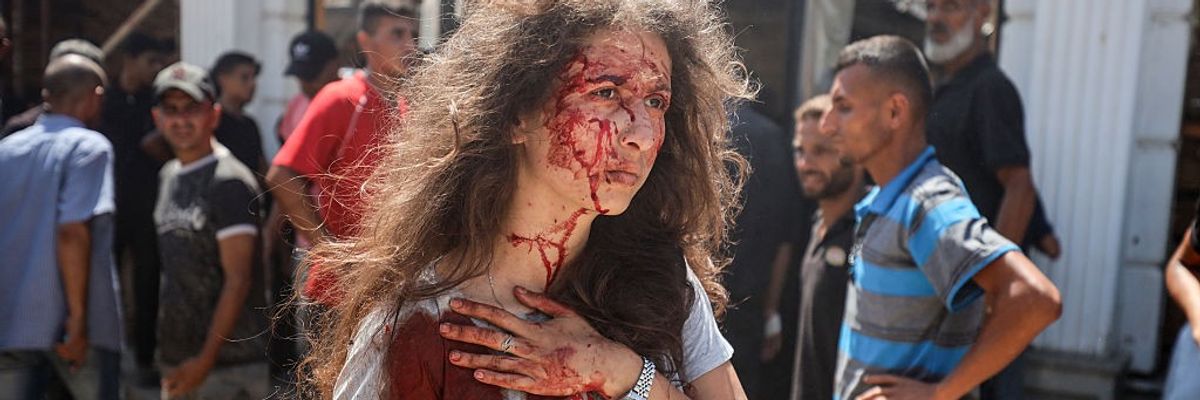
Palestinian journalist Bayan Abu Sultan is seen after being wounded during the al-Baqa Cafe massacre, committed by Israeli forces in Gaza City, Palestine on June 30, 2025.
(Photo: Majdi Fathi/NurPhoto via Getty Images)

Brett Wilkins
Jun 30, 2025
COMMON DREAMS

Israeli forces ramped up their genocidal assault on the Gaza Strip Monday, killing at least 95 Palestinians in attacks including massacres at a seaside café and a humanitarian aid distribution center and bombings of five school shelters housing displaced families and a hospital where refugees were sheltering in tents.

An Israeli strike targeted the al-Baqa Café in western Gaza City, one of the few operating businesses remaining after 633 days of Israel's obliteration of the coastal strip and a popular gathering place for journalists, university students, artists, and others seeking reliable internet service and a respite from nearly 21 months of near-relentless attacks.

Medical sources said at least 33 civilians were killed and nearly 50 others wounded in the massacre, including footballer Mustafa Abu Amira, photojournalist Ismail Abu Hatab—who survived an earlier Israeli airstrike and is reportedly the 227th journalists killed by Israel since October 2023—and prominent artist Frans Al-Salmi, whose final painting depicting a young Palestinian woman killed by Israeli forces resembles photographs of its slain creator posted on social media after her killing.

Warning: Photos shows image of death


Survivor Ali Abu Ateila toldThe Associated Press that the café was crowded with women and children at the time of the attack.

"Without a warning, all of a sudden, a warplane hit the place, shaking it like an earthquake," he said.

Another survivor of the massacre told Britain's Sky News: "All I see is blood... Unbelievable. People come here to take a break from what they see inside Gaza. They come westward to breathe."

Eyewitness Ahmed Al-Nayrab toldAgence France-Presse that a "huge explosion shook the area."

"I saw body parts flying everywhere, and bodies cut and burned," he said. "It was a scene that made your skin crawl."

Witnesses and officials said Israeli Defense Forces (IDF) troops opened fire on Palestinians seeking food and other humanitarian aid from a U.S.-backed Gaza Humanitarian Foundation distribution point in southern Gaza, killing 15 people amid near-daily massacres of aid-seekers.

"We were targeted by artillery," survivor Monzer Hisham Ismail told The Associated Press. Another survivor, Yousef Mahmoud Mokheimar, told the AP that Israeli troops "fired at us indiscriminately." Mokheimar was shot in the leg, another man who tried to rescue him was also shot.

IDF troops have killed nearly 600 Palestinian aid-seekers and wounded more than 4,000 others over the past month, with Israeli military officers and soldiers saying they were ordered to deliberately fire on civilians in search of food and other necessities amid Israel's weaponized starvation of Gaza.

Another 13 people were reportedly killed Monday when IDF warplanes bombed an aid warehouse in the Zeitoun quarter of southern Gaza City, according to al-Ahli Baptist Hospital officials cited by The Palestine Chronicle. IDF warplanes also reportedly bombed five schools housing displaced families, three of them in Zeitoun. Israeli forces also bombed the courtyard of al-Aqsa Hospital in Deir al-Balah in central Gaza, where thousands of forcibly displaced Palestinian families are sheltering in tents. It was reportedly the 12th time the hospital has been bombed since the start of the war.

The World Health Organization has documented more than 700 attacks on Gaza healthcare facilities since October 2023. Most of Gaza's hospitals are out of service due to Israeli attacks, some of which have been called genocidal by United Nations experts.


Israel's overall behavior in the war is the subject of an ongoing International Court of Justice genocide case, while Israeli Prime Minister Benjamin Netanyahu is wanted by the International Criminal Court for alleged war crimes and crimes against humanity in Gaza, including murder and using starvation as a weapon of war.

Since October 2023, Israeli forces have killed or wounded more than 204,000 Palestinians in Gaza, including over 14,000 people who are missing and presumed dead and buried under rubble, according to the Gaza Health Ministry, whose casualty figures have been found to be generally accurate and even a likely undercount by peer-reviewed studies.

The intensified IDF attacks follow Israel's issuance of new forced evacuation orders amid the ongoing Operation Gideon's Chariots, an ongoing offensive which aims to conquer and indefinitely occupy all of Gaza and ethnically cleanse much of its population, possibly to make way for Jewish recolonization as advocated by many right-wing Israelis.

Gaza mourns those killed in Israeli strike on seafront cafe

Gaza City (Palestinian Territories) (AFP) – Once a bustling seafront spot where young people could hope for a rare respite from war, Gaza City's al-Baqa cafe lay in ruins after an Israeli strike killed 24 people including a journalist and an artist.


Issued on: 01/07/2025

The cafe was known before the war for welcoming young professionals and even the few foreigners who were able to visit Gaza © Omar AL-QATTAA / AFP


Blood stains dotted the debris-strewn floor in the aftermath of the strike on Monday, AFP footage showed. Upturned plastic chairs lay alongside wooden planks blown apart in the blast, as tattered fabric gently blew in the sea breeze.

The strike triggered a fresh outpouring of grief in the Palestinian territory already devastated by more than 20 months of war, with social media flooded with posts paying tribute to the dead.

"Gaza lost a rare talent. The world lost beauty and hope," wrote two friends of the artist Amina al-Salmi, nicknamed Frans, in an Instagram post after the young woman's death in the cafe.

"The occupation killed her, but it will never erase her voice," they added. One of the friends, journalist Noor Harazeen, drew parallels between one of Salmi's last drawings and a photo of the attack showing her face covered in blood.

Images of the devastated cafe flooded social media, showing several lifeless bodies © Omar AL-QATTAA / AFP

Tributes have also poured in for Ismail Abu Hatab, described by friends as a journalist and videographer.

During the final prayer before his body was laid to rest, his press vest was placed on his chest, as Gazans have often done for the numerous Palestinian journalists killed during the war triggered by Hamas's attack on Israel on October 7, 2023.

Salmi and Abu Hatab were among 24 people killed in the strike, according to Gaza's civil defence agency.

Images of the bombed cafe showing several lifeless bodies flooded social media.

Journalist and rights activist Bayan Abusultan was also seen in photos posted online, half covered in blood in the aftermath of the blast.

"We survived to curse the occupation for one more day," she wrote on Facebook.

- 'Sea the only refuge' -

The Israeli military told AFP it had "struck several Hamas terrorists" and that "steps were taken to mitigate the risk of harming civilians", adding that the incident was under review.

The cafe was known before the war for welcoming young professionals and the few foreigners who were able to visit the Gaza Strip under Israeli blockade.

Built in several sections, part of which was on stilts above the water, al-Baqa was damaged and then repaired several times in recent months, particularly during the two-month truce that ended in March.

A few weeks ago, the cafe was once again able to offer an internet connection, attracting its pre-war clientele back.

Tributes have also poured in for Ismail Abu Hatab, who is described by friends as a journalist and videographer © Omar AL-QATTAA / AFP

With food only trickling into Gaza, the kitchens were closed, but customers could still get a cup of tea to drink against a backdrop of destruction.

Maher al-Baqa, who co-owns the establishment, told AFP that it is "one of the most well-known cafes on the Gaza coast, frequented by educated youth, journalists, artists, doctors, engineers and hardworking people".

"Young people are fleeing the tragedies and difficult conditions in Gaza. They come here for work meetings or just to relax a little."

Israel "has betrayed these people and bombed the place without any justification", he added.

Journalist Shrouq Aila, who shared photos of the cafe on Instagram, said: "The sea has become our only refuge".

Another journalist, Wassim Saleh, wrote on Facebook that "the sea continues to wash up pieces of bodies, which we bury."

Still in shock but moved by the messages of support, cafe owner Baqa said he lost four employees and three family members in the strike.

"I felt, through the great solidarity of the people with this place, that they were defending wh


Israeli Forces Liken Gaza Aid Site Shootings to Game of “Red Light, Green Light”

The deadly aid site protocol is called “Operation Salted Fish,” the Israeli name for the children’s game.


By Sharon Zhang , 
PublishedJune 30, 2025

Palestinians carry away bags of flour as others wait in front of a distribution point set up by the independent Save Youth Future Society, in coordination with the UN World Food Programme, in Gaza City on June 26, 2025.Bashar Taleb / AFP via Getty Images

Israeli soldiers are ordered to treat crowds of Palestinians gathered to receive humanitarian aid in Gaza as a “hostile force” and communicate with the desperate aid seekers by opening fire, according to a new report citing soldiers who were deployed in Gaza.

Haaretz, echoing reporting by Palestinians and humanitarian groups on the ground, reports that Israeli soldiers are told to shoot at crowds to prevent them from approaching an aid site before it’s open. The fact that they are civilians doesn’t matter, soldiers say, and military leaders pay no mind as to whether or not civilians are killed as a result.

The military uses “everything imaginable” to fire on the crowds, including heavy machine guns, tanks, grenades, and mortars, one soldier said, referring to the area around the U.S.- and Israel-backed “aid” sites as a “killing field.”

“At night, we open fire to signal to the population that this is a combat zone and they mustn’t come near,” one officer said, describing the supposed security practices for the site. “Once, the mortars stopped firing, and we saw people starting to approach. So we resumed fire to make it clear they weren’t allowed to. In the end, one of the shells landed on a group of people.”

The protocol, one soldier said, is called “Operation Salted Fish,” a reference to the Israeli name for the children’s game, “red light, green light.”

Indeed, Palestinian officials and journalists have repeatedly reported Israel hitting crowds with tank fire and other heavy weapons, often causing hundreds of casualties at once, on a near-daily basis.​​ Israeli forces have killed at least 583 Palestinians and injured 4,186 more at sites operated by the Gaza Humanitarian Foundation (GHF), the Gaza Ministry of Health has reported.

In some instances, soldiers are supposedly also firing at crowds near “aid” sites in order to protect private contractors who are demolishing homes in Gaza nearby. Sources said private contractors are “making a fortune” by demolishing homes in Gaza, with the government paying out the equivalent of $1,500 per home.

The Israeli military has claimed that they are simply firing “warning shots” at aid seekers. However, even if this were a legitimate practice, it seems to be yet another coverup from the military as soldiers say they’ve been instructed to open fire directly on civilians.

Soldiers say that this and other practices have made Gaza into a combat zone unlike any other, where there are no rules about who constitutes a legitimate target or whether or not there are instances where soldiers should restrain from fire. Because of the lack of any guidelines or restraints, not only is live fire toward civilians allowed, it’s effectively encouraged, soldiers said.

“Technically, it’s supposed to be warning fire — either to push people back or stop them from advancing,” one reserve tank soldier told Haaretz. “But lately, firing shells has just become standard practice. Every time we fire, there are casualties and deaths, and when someone asks why a shell is necessary, there’s never a good answer. Sometimes, merely asking the question annoys the commanders.”

This practice, of seemingly using the “aid” sites as a honeytrap, comes after Israel has spent the last 20 months systematically starving Palestinians in Gaza, pushing the entire territory into or on the cusp of famine, experts have said.

“The moral aspect is practically nonexistent,” said one military figure, who recently attended a higher-level meeting within the military. “No one stops to ask why dozens of civilians looking for food are being killed every day.”
Rubio hails end of USAID as Bush, Obama deplore cost in lives

Washington (AFP) – The US foreign aid agency formally closed down Tuesday, with President Donald Trump's administration trumpeting the end of the "charity-based model" despite predictions that millions of lives will be lost.


Issued on: 01/07/2025 - 


A Burundian government official speaks with newly arrived Congolese refugees while weighing a sack of rice from the final batches delivered by the now-dismantled United States Agency for International Development © Luis TATO / AFP/File

Founded in 1961 as John F. Kennedy sought to leverage aid to win over the developing world in the Cold War, the US Agency for International Development (USAID) has now been incorporated into the State Department -- after Secretary of State Marco Rubio slashed 85 percent of its programming.

In a farewell to remaining staff on Monday, former presidents George W. Bush and Barack Obama -- as well as U2 frontman Bono -- saluted their work and said it was still needed.

Bush pointed to PEPFAR, the massive US effort to fight HIV/AIDS that he considers one of the top achievements of his 2001-2009 Republican presidency.

"This program shows a fundamental question facing our country -- is it in our nation's interest that 25 million people who would have died now live? I think it is," Bush said in a video message seen by AFP.

Obama, who like Bush has been sparing in openly criticizing Trump, said that ending USAID was "inexplicable" and "will go down as a colossal mistake."

"Gutting USAID is a travesty and it is a tragedy because it's some of the most important work happening anywhere in the world," the Democrat said.

A study published in the medical journal The Lancet predicted that more than 14 million people would die, a third of them small children, by 2030 due to the foreign aid cuts.
'Little to show'

Rubio painted a drastically different picture of USAID, which was an early target of a sweeping government cost-cutting drive led for Trump by billionaire Elon Musk.


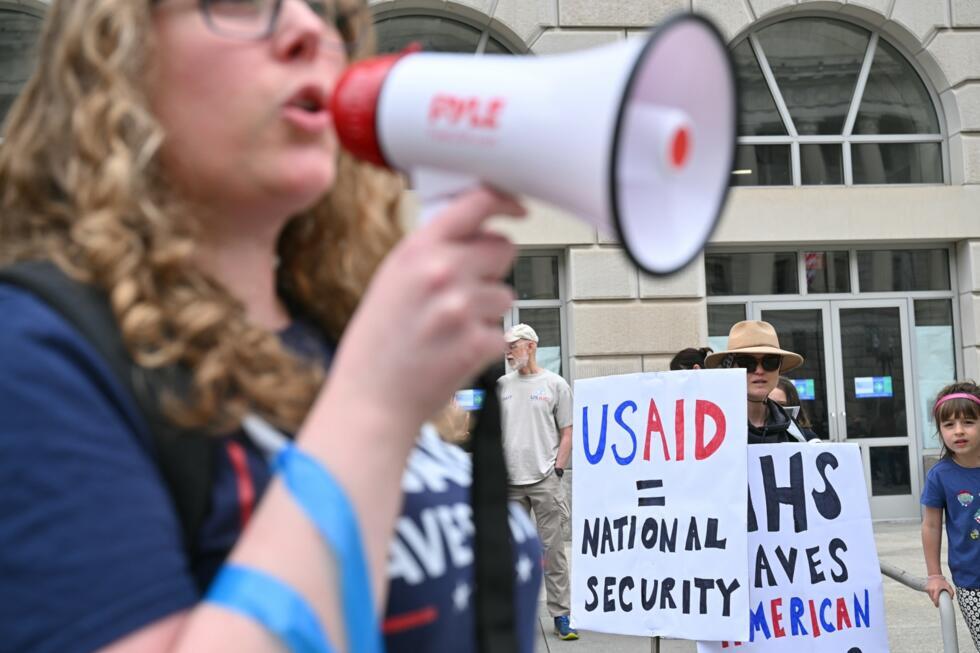
Demonstrators gather outside USAID offices to protect cuts on April 5, 2025 © ROBERTO SCHMIDT / AFP/File

Rubio said that USAID's "charity-based model" fueled "addiction" by developing nations' leaders and that trade was more effective.

"Beyond creating a globe-spanning NGO industrial complex at taxpayer expense, USAID has little to show since the end of the Cold War," Rubio wrote in an essay.

He also complained that many recipients of US aid do not vote with the United States at the United Nations and that rival China often enjoys higher favorability among the public.

A senior State Department official, speaking on condition of anonymity, said that The Lancet study relied on "incorrect assumptions" and said the United States will continue aid but in a "more efficient" way.

He said that PEPFAR will remain, with a priority on stopping HIV transmission from mothers to children.

But he acknowledged the United States was no longer funding PrEP medication, which significantly reduces the rate of HIV transmission and has been encouraged by high-risk communities.

"No one is saying that gay men in Africa shouldn't be on PrEP. That's wonderful. It doesn't mean that the United States has to pay for every single thing," the official said.

He said the Trump administration was looking at "new and innovative solutions" and pointed to food deliveries in war-battered Gaza staffed by US military contractors and surrounded by Israeli troops.

Witnesses, the United Nations and local Gaza officials have reported that Israeli troops have repeatedly opened fire and killed Palestinians waiting for aid -- although the US-backed initiative, the Gaza Humanitarian Foundation, denies any deadly incidents.
'No line of defense'

Bob Kitchen, the vice president for emergencies at the International Rescue Committee, said that the 14 million death prediction was consistent with what the humanitarian group was seeing.

Among the group's programming that was funded through USAID, he said that nearly 400,000 refugees who fled the war in Sudan have now been deprived of acute aid and that more than 500,000 Afghans, mostly women and girls, have been cut off from education and healthcare.

European Union nations and Britain, rather than filling the gap, have also stepped back as they ramp up defense spending with encouragement from Trump.

Kitchen warned that cuts will not only worsen frontline emergencies but weaken more stable countries such as Ethiopia and Kenya, which will have no back-up if rains fail again.

Kitchen said that, beyond moral considerations, the cuts will aggravate migration, a top consideration for Trump.

"It's self-interest. If insecurity spreads, outbreaks spread, there's no line of defense anymore."

© 2025 AFP
Climate change is changing the geography of infectious disease

Europe isn’t just at risk of the direct effects of climate change, it is also exposed to the indirect effects of infectious disease like dengue, chikungunya and West Nile Virus – which are expanding their territories northward.


Issued on: 01/07/2025 -
FRANCE24
By:Diya GUPTA


Salt Lake City Mosquito Abatement District biologist Nadja Reissen examines a mosquito in Salt Lake City, Aug. 26, 2019. © Rick Bowmer, AP

Europe is unusually hot. Several cities in France have been placed on an ‘unprecedented’ high alert on Tuesday, Spain recorded a scorching high of 46 degrees Celsius on Monday while wildfires in Turkey caused by a heatwave have forced more than 50,000 people to be evacuated from five regions in the western province of Izmir.

While the heat is uncharacteristically strong, extreme weather is no longer a surprise. Science agrees that climate change caused by steadily increasing greenhouse emissions has been the primary factor for the scorching new reality that the world is forced to adapt to, be it heatwaves, floods, droughts or extreme cold.

While the cumulative meteorological changes might make life more difficult for people, bacteria, pathogens and viruses are thriving in a world that’s getting hotter and more humid. Climate change is bringing ‘tropical’, climate sensitive illnesses up north, into Europe, shifting the geography of global infectious disease.

The migration of disease

“Over half of all infectious diseases confronted by humanity worldwide have been at some point aggravated and even strengthened by climatic hazards,” says Dr Aleksandra Kazmierczak, an expert on the relationship between climate change and human health at the European Environment Agency (EEA).

Kazmierczak says that climatic conditions have made Europe more suitable for vector and water borne disease. ‘There is a northward, temporal shift because the current climate is more suitable for pathogens. Disease season is longer – ticks, for example, are now active all year round in many places.”

One of the fastest growing infectious diseases in Europe is dengue. 304 cases were reported in Europe in 2024 alone – compared to 275 cases recorded in the previous 15 years combined.

05:11
DOWN TO EARTH © FRANCE 24

The main culprit behind dengue is the Asian tiger mosquito, or Aedes albopictus. The insect is what’s known as a vector, i.e. a living organism that can transmit infectious pathogens between humans or from animals to humans. With its distinctive black and white stripes that resemble those of a zebra more than a tiger, the mosquito is capable of transmitting dengue, zika and chikungunya.

Europe only experienced a handful of diseases carried by the tiger mosquito per year right up until the late 90’s. Most were one-off cases brought home by travelers from South East Asia – Aedes albopictus’s native home. But with increased travel and globalization, the insect’s journeys westward increased. It hopped onto cargo carriers to Albania or hitched a ride to the warmer parts of France and moved to Europe, where it remains to this day.

Read moreHow the tiger mosquito invaded France and what can be done to stop it

In 2006, France officially declared dengue a notifiable disease. In 2022, its presence was detected in most of the French mainland administrative departments. The insect quickly adapted itself to urban environments, where it needs just one still body of water – an undisturbed pond or a neglected watering can – to reproduce and proliferate.

The numbers have jumped so dramatically that scientists now believe that the diseases carried by Aedes albopictus will become endemic in Europe. Some researchers even say that the number of dengue and chikungunya outbreaks could increase five-fold by 2060 compared to current rates.

The tiger mosquito is a known carrier of several pathogens and viruses. Climatic conditions have contributed to a geographic range expansion of several other vectors like ticks and other species of mosquitos and flies, which carry their own diseases like West Nile Fever, Lyme disease and tick-borne encephalitis.
Firefighters work at a cite of a flooding, near Stronie Slaskie, southwestern Poland, Thursday, Sept. 19, 2024. © Tomasz Fijolek, AP

But unfortunately, it isn’t just the bugs we need to be worried about.

Climate change could also increase the occurrence of water-borne disease. In recent years, Europe has experienced the devastating impact of extended period of rain and floods, which wreak havoc on water treatment and distribution systems. Water can gather several pathogens from dumps, fields and pastures and flush them into water treatment and distribution systems.

Kazmierczak also warns of pathogens carried in the sea: "As the arctic melts; salinity in seawater decreases, making it ideal for pathogens like vibrio. It’s been seen more in the Baltic and North Seas. It is transferred from seafood or even exposure in an open wound if you’re swimming in infectious water."
Unearthing the zombie viruses

Permafrost covers almost 15 percent of the northern hemisphere, a significant portion of which is concentrated in Siberia, Alaska and Greenland. As the name implies, permafrost is soil and rock that stays frozen for at least two consecutive years. It acts almost like a cold storage for history: mammoths, saber-toothed tigers and long extinct plants have been preserved, almost entirely intact.

Some of what's stuck in frozen limbo isn't even dead – it's just dormant. Numerous ‘zombie microbes’ have been discovered in melting permafrost over the years, some after millennia. Researchers have raised fears that a new global medical emergency could be triggered – not by an illness new to science but by an ancient disease which modern human immunity is not equipped to deal with. The melting permafrost could also release old radioactive material and banned chemicals that had been dumped as waste.

In this photo provided by the United States Geological Survey, permafrost forms a grid-like pattern in the National Petroleum Reserve-Alaska, managed by the Bureau of Land Management in Alaska. © David W. Houseknecht, AP

This was the case in 2016, when over 2000 reindeer were found dead in Siberia because of an anthrax outbreak. Melting permafrost thawed the carcass of a reindeer that had died decades ago and unleashed the dormant virus into the modern world. Dozens of people living nearby had to be hospitalized.

This bizarre new threat may be another consequence of warming global temperatures, despite sounding like it’s been pulled from the pages of a science fiction novel. But Kazmierczak says that the research is still in its nascent stages and permafrost exists in isolated regions with little habitation.
Adapting to a new environment

The changes in the geography of infectious disease, to a large extent, cannot be undone. Temperatures in Europe have already risen by over 2 degrees in the last decade alone, with no sign of it slowing down.

But despite the warming climate, Kazmierczak is hopeful that Europe can adapt. “National health infrastructures and awareness will be paramount in our adaptation. We already have examples from countries that have already dealt with these illnesses, and we can adapt them to Europe.

“We believe that a way to reduce our carbon footprint is also to bring nature into cities and homes – but hosting vectors, for example, is exactly the flipside that it can have. We need to make sure that we adapt with awareness.”