Friday, July 25, 2025


Aligning AI with Human Values and Well-Being


Mary Ann Liebert, Inc./Genetic Engineering News
Cyberpsychology, Behavior, and Social Networking 

image: 

The premier peer-reviewed journal for authoritative research on understanding the social, behavioral, and psychological impact of today's social networking practices, including Twitter, Facebook, and internet gaming and commerce.

view more 

Credit: Mary Ann Liebert Inc.


In a rapidly evolving digital landscape, the July 2025 Special Issue of the peer-reviewed journal Cyberpsychology, Behavior, and Social Networking highlights the concept of “Humane Artificial Intelligence,” examining how AI can support human flourishing across contexts including healthcare, education, peacekeeping, and daily digital interactions. Click here to read the issue now.

In their Editorial, Guest Editors Giuseppe Riva, PhD, from Università Cattolica del Sacro Cuore, Brenda Wiederhold, PhD, from Virtual Reality Medical Center and Editor-in-Chief of Cyberpsychology, Behavior, and Social Networking and Pietro Cipresso, PhD, from University of Torino, note that Humane AI “aims to harness the transformative power of artificial intelligence while ensuring that it remains under meaningful human control and that its impacts are equitably distributed across all segments of society.”

One article by Riva et al. proposes “Psychomatics,” a new multidisciplinary framework to evaluate how artificial minds process language and meaning differently from human cognition, integrating cognitive science and informatics to examine the inner workings of large language models.

Laffier et al. introduce a conceptual model aligning “digital wellness” with ethical AI use. Drawing on psychological constructs such as emotional intelligence, mindfulness, and critical thinking, the authors argue that these skills help individuals navigate AI engagement in ways that protect well-being and autonomy.

A timely perspective titled "Crowdsourcing Compassion" highlights how patients increasingly use AI tools to share lived experience data through online health communities. These user-led platforms—amplified by AI—are shifting the traditional research pipeline, elevating peer-generated insights and uncovering early trends in emerging conditions like Long COVID.

Other articles in the Special Issue examine practical and ethical challenges of AI in diverse domains:

  • The role of AI in promoting equitable mental health access through digital diagnostics and triage systems
  • A framework for building AI systems that prioritize transparency and emotional resonance
  • Ethical concerns surrounding AI-generated decision-making in peacekeeping and humanitarian missions
  • Strategies to prevent AI from reinforcing bias in marginalized populations
  • The value of integrating qualitative and computational approaches in AI design

Together, the authors in this issue emphasize that as artificial intelligence becomes more embedded in everyday life, its development must remain grounded in human-centric values and psychological insight.


About the Journal
Cyberpsychology, Behavior, and Social Networking is an authoritative peer-reviewed journal published monthly online with Open Access options and in print that explores the psychological and social issues surrounding the Internet and interactive technologies.  Complete tables of contents and a sample issue may be viewed on the journal website.

About Mary Ann Liebert, Inc., a Sage Company
Mary Ann Liebert, Inc. is a global media company dedicated to creating, curating, and delivering impactful peer-reviewed research and authoritative content services to advance the fields of biotechnology and the life sciences, specialized clinical medicine, and public health and policy.


Global estimates of lives and life-years saved by COVID-19 vaccination during 2020-2024


JAMA Health Forum


About The Study:

 This comparative effectiveness study found that COVID-19 vaccinations averted 2.5 million deaths during 2020-2024 (sensitivity range estimates, 1.4-4.0 million). Estimates in this study are substantially more conservative than previous calculations focusing mostly on the first year of vaccination, but they still clearly demonstrate a major overall benefit from COVID-19 vaccination during the years 2020-2024. Most benefits in lives and life-years saved was secured for a portion of older persons, a minority of the global population.


Corresponding Author: To contact the corresponding author, John P. A. Ioannidis, M.D., D.Sc., email jioannid@stanford.edu.

To access the embargoed study: Visit our For The Media website at this link https://media.jamanetwork.com/

(doi:10.1001/jamahealthforum.2025.2223)

Editor’s Note: Please see the article for additional information, including other authors, author contributions and affiliations, conflict of interest and financial disclosures, and funding and support.

#  #  #

Embed this link to provide your readers free access to the full-text article 

 https://jamanetwork.com/journals/jama-health-forum/fullarticle/10.1001/jamahealthforum.2025.2223?utm_source=For_The_Media&utm_medium=referral&utm_campaign=ftm_links&utm_term=072525

About JAMA Health Forum: JAMA Health Forum is an international, peer-reviewed, online, open access journal that addresses health policy and strategies affecting medicine, health and health care. The journal publishes original research, evidence-based reports and opinion about national and global health policy; innovative approaches to health care delivery; and health care economics, access, quality, safety, equity and reform. Its distribution will be solely digital and all content will be freely available for anyone to read.

Predicting vaccination levels without accurate or timely vaccination data


Researchers at Penn State and the World Health Organization develop method to predict measles vaccination levels using routinely collected clinical data on suspected measles cases


Penn State


UNIVERSITY PARK, Pa. — Knowing how many people are vaccinated against an existing or re-emerging threat is a key factor guiding public health decisions, but such information is often sparse or non-existent in many regions, according to researchers at Penn State. Now, in collaboration with a team at the World Health Organization, the researchers have developed a new method to estimate and predict regional measles vaccination coverage levels even when accurate or timely survey data on vaccination is not available. The method uses data that is routinely collected when potential measles cases present at clinics to model vaccination coverage and can be used to guide public health interventions to slow or prevent measles outbreaks.

A paper describing the research appeared recently in the journal Vaccine.

“The measles vaccine is highly effective, providing long-lasting protection from the disease, but we still have outbreaks, and the disease causes over 100,000 deaths each year worldwide because of disparities in vaccine distribution,” said Deepit Bhatia, graduate student in biology in the Eberly College of Science and at the Center for Infectious Disease Dynamics at Penn State and first author of the paper. “The Centers for Disease Control and Prevention recently reported over 1,300 confirmed cases in the United States for the first half of 2025 — the highest number in 33 years. Accurate information on vaccination levels is crucial to guide public health interventions but the sources we have for this information are imperfect.”

Researchers use two main sources for information on vaccination coverage. The Demographic and Health Surveys (DHS) collects health data at the household and individual level in 90 low- and middle-income countries. Formerly funded by the United States Agency for International Development (USAID) the program is considered the gold-standard for accuracy, according to the researchers. These surveys are expensive and time-consuming to perform and are therefore only produced every three to five years. Outside of these large-scale surveys, countries produce administrative vaccinations coverage estimates based on the number of vaccine doses administered to a certain age group in the region. These administrative estimates are produced more frequently, but they are not as accurate as the DHS and can be biased.

“The DHS produce amazing data, but it’s analogous to U.S. Census data in that it is only done every few years,” said Matt Ferrari, director of the Penn State Center for Infectious Disease Dynamics, professor of biology and leader of the research team. “The census is done every 10 years and takes two years to complete. By the time it’s done, it’s out of date. But it’s too expensive to do more frequently. This is how vaccination coverage has been evaluated, particularly in low- and middle-income countries, places where these diseases have the largest impact.”

When developing their new method, the researchers said they wanted to find a way to split the difference between the highly accurate but expensive and potentially out-of-date surveys, and the more timely but less accurate administrative coverage estimates. They built a model using data that is routinely collected when patients are treated for potential measles cases at clinics. They used the mean age of the patients, their vaccination status as reported when at the clinic and whether the suspected cases actually were measles, rather than another disease with similar symptoms. 

“We know that these measures are associated with vaccination coverage levels,” Bhatia said. “For example, in regions with high vaccination levels, young children are less likely to come in contact with the disease and the mean age of cases at the clinic will be higher.” 

The research team used the three indicators as predictors to train a regression model that could best predict the gold-standard DHS data. Importantly, they withheld the most recent DHS data to later use as a stronger test of the predictive power of their method. They then used their model to predict vaccination coverage for the period covered by the latest DHS data and found that it was highly correlated.

“We found that the predictions of our method fit better with the DHS data than the administrative vaccination coverage estimates did,” Bhatia said. “Since our method uses routinely collected information that is readily available to researchers and public health officials, it provides a cheap and more easily accessible methodology to estimate vaccination coverage for a region that can be done quickly and can help inform policy in a timelier way.”

Recent changes to funding for the DHS have increased the relevance of the new method, according to Ferrari.

“Although this wasn’t the case when we began this research, the DHS program is currently on pause,” Ferrari said. “DHS was primarily funded by USAID, and we don’t know when or if they will be started again. Our method can hopefully help provide a stopgap.”

In addition to Ferrari and Bhatia, the research team included Natasha Crowcroft, Sébastien Antoni, M. Carolina Danovaro-Holliday, Anindya Sekhar Bose, Anna Minta and Balcha Masresha at the World Health Organization. The Bill & Melinda Gates Foundation and an Ecology and Evolution of Infectious Disease award, funded by the U.S. National Science Foundation, the National Institutes of Health and the National Institute of Food and Agriculture, supported the research. The Penn State Huck Institutes for the Life Sciences provided additional support.


Can NATO Compete With Russia's Rising Weapons Output?

  • NATO Secretary General Mark Rutte claimed that Russia produces three times more ammunition every three months than NATO does in a year, but that claim is exaggerated.

  • Russia leads in tank, missile, and cheap drone production, mainly by modernizing Soviet-era stockpiles and expanding domestic manufacturing.

  • NATO holds major advantages in combat aircraft and modern artillery systems, and could vastly outproduce Russia in a prolonged war scenario.

Russia is “now producing three times as much ammunition in three months as the whole of NATO is doing in a year,” NATO Secretary General Mark Rutte recently told the New York Times.

RFE/RL and the Conflict Intelligence Team (CIT), an open-source intelligence group, analyzed Russian and Western weapons production to assess whether Russia really has such a large production advantage over the US and its allies and in which categories of weapons -- artillery, ammunition, tanks, aircraft, missiles, and drones, and air defense -- each side has the upper hand.

Fact Or Exaggeration? NATO vs. Russian Artillery Shell Production

It wasn’t the first time Rutte claimed Russia is far outpacing NATO artillery production. In April he told CBS in an interview that Russia “is producing four times more in ammunition than the whole of NATO is producing in a year.”

Ukrainian and Western officials estimate that Russia produced some 2–2.3 million artillery shells in 2024, an increase from an estimated 1.25 million in 2022, as Russia invests in expanding its production capacity.

The US, meanwhile, planned to increase its production of 155mm shells to 1.2 million annually by the end of 2025, with Europe producing approximately the same number -- Germany's Rheinmetall alone plans to produce up to 700,000 per year -- according to conservative estimates.

Actual US production of the shells stands at 40,000 per month, or just shy of half a million per year, for a total of about 1.7 million shells made this year in the US and EU.

For Russia to make three times as much every three months, as Rutte said, its factories would have to produce a massive 20.5 million shells this year.

According to CIT’s analysis, Russia’s factory expansions in BiyskKazan, and other locations may allow it to produce some 4 million 152mm and 122mm shells per year.

Shells Need Guns

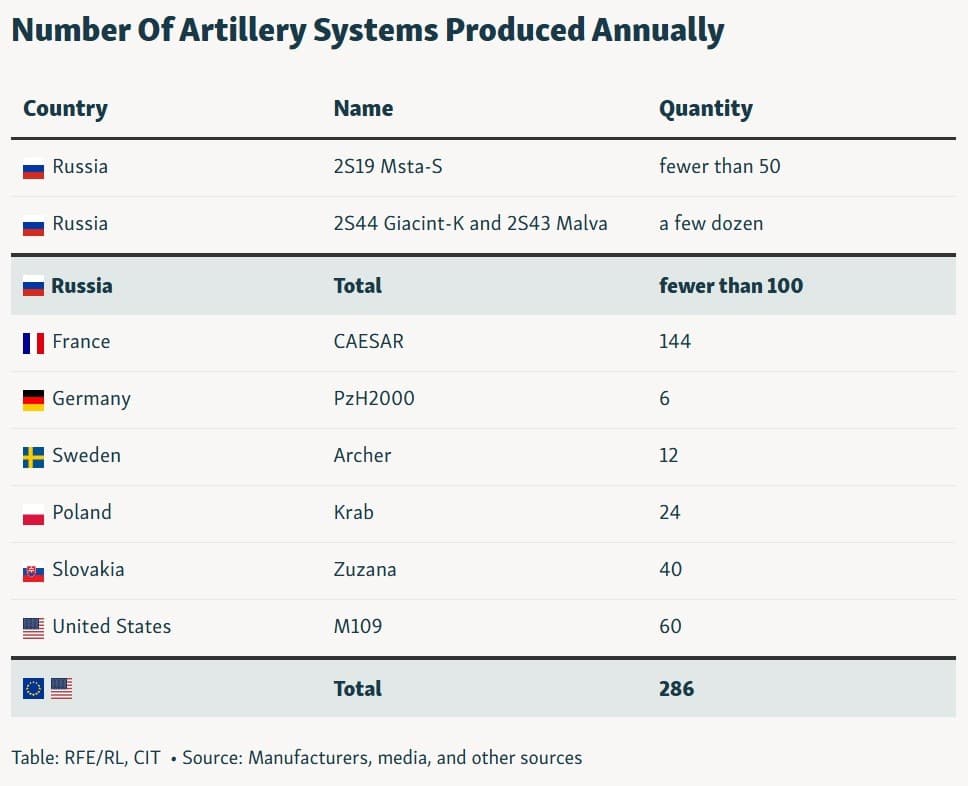
Russia still relies heavily on its stock of Soviet-era artillery systems to fire the shells it produces, with reserves of towed howitzers falling from around 12,000 in 2022 to just over 6,000 in mid-2024. CIT analysts assess that the country produces less than 100 new Msta-S, Giatsint-K, and Malva self-propelled howitzers per year.

NATO clearly has the upper hand here, with France planning to produce 144 CAESAR artillery systems in 2025 and Poland doubling production of its AHS Krab to 100 per year. Slovakia is expected to make 40 Zuzana howitzers and the US produces 216 cannon tubes for its M777 guns annually.

Guns

Heavy Hitters

One area where Russia likely has the upper hand is tanks.

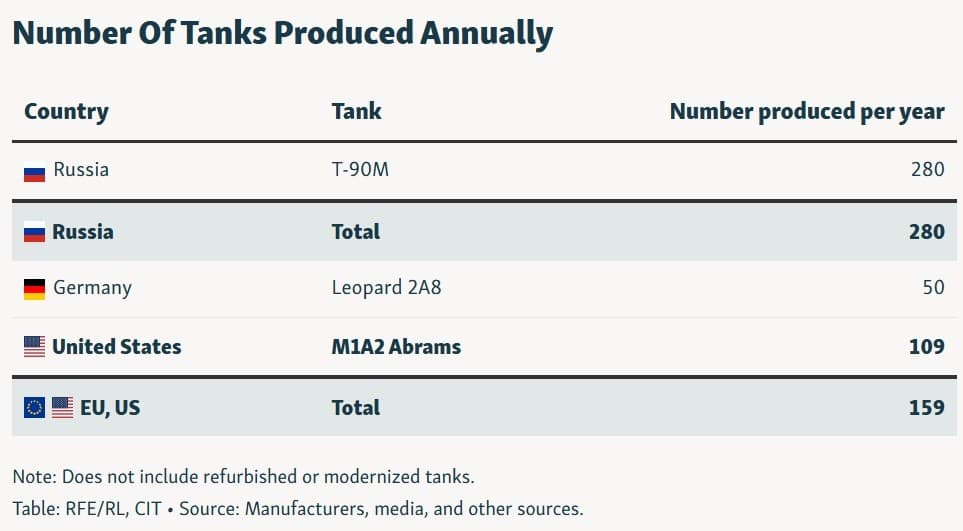
Like artillery, much of its tank production comes from restoring and modernizing Soviet tanks from storage. This would be the bulk of the 1,500 tanks Christopher Cavoli, NATO’s previous Supreme Allied Commander Europe, expects the Russian army to receive in 2025.

However, it has ramped up production “from scratch” of its modern T-90M main battle tank, producing about 280 per year.

Most countries in Europe, on the other hand, barely produce tanks. France hasn’t made a Leclerc in more than a decade, while Britain has ordered 148 of its new Challenger 3 tanks to be delivered by 2030. Germany is the exception, making 50 Leopard 2A8s per year.

The US produces 109 M1A2 Abrams tanks annually -- the Army says this could be increased to 420 if necessary -- and also modernizes up to 200 older models.

Tanks

Air Superiority

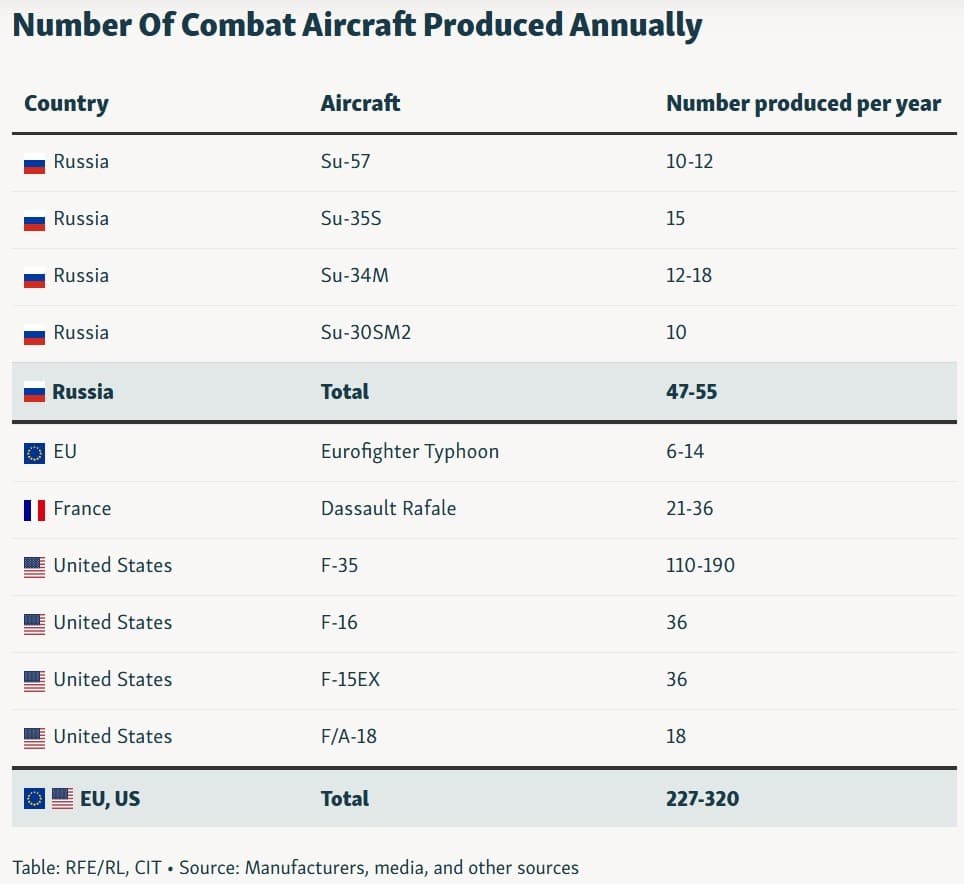
While Russia makes more tanks, the US and EU outproduce it by at least a factor of four when it comes to combat aircraft. Russia can make an estimated 50-60 per year, including multirole aircraft like the new Su-57 and strategic bombers like the Tu-160M2. Despite sanctions, the country is making more planes than before its invasion of Ukraine. In 2018, the Russian military received 36 combat aircraft.

NATO production, though, is much higher, with US manufacturer Lockheed Martin on track to deliver over 170 F-35 strike fighters this year in addition to France, Sweden, and other EU countries making dozens of Rafale, Eurofighter Typhoon, and Gripen jets.

Jet

Air Defense

As Russia launches barrage after barrage of missiles at Ukraine, and Ukrainian drones strike ever deeper into Russia, production of air defense systems has come into the spotlight.

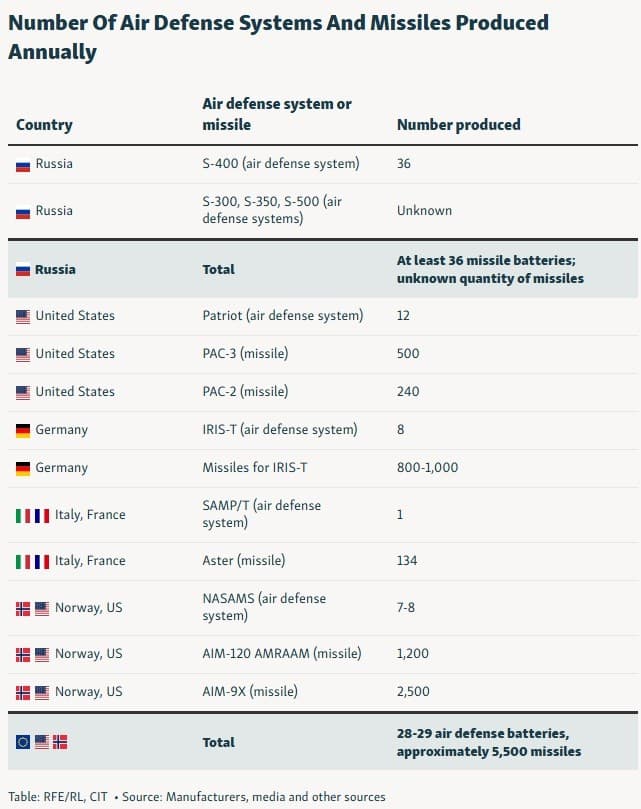
According to The Military Balance, an annual assessment of military capabilities worldwide, Russia had 248 S-400 batteries in 2024 and gained a further 18 in 2025, implying a production capacity of 36 per year. Production of its other systems, like the Tor, Buk, and Pantsir are hard to come by.

Raytheon builds some 12 Patriot missile-defense systems per year, while Germany’s Diehl plans to make 8 IRIS-T systems in 2025 and some 800-1,000 missiles for the system per year. NATO also produces the Norwegian-American NASAMS system, which can use AIM-120 AMRAAM or AIM-9X missiles. The US produces 1,200 and 2,500 of each missile per year, respectively.

Air

A lack of data makes it difficult to assess definitively how many air defense systems and missiles are produced by each party, but with both Ukraine and Russia regularly suffering hits from primitive drones, it seems clear that current rates are not enough to protect either country from a major new feature of the war that is here to stay: cheap mass-produced strike drones.

Drone Wars

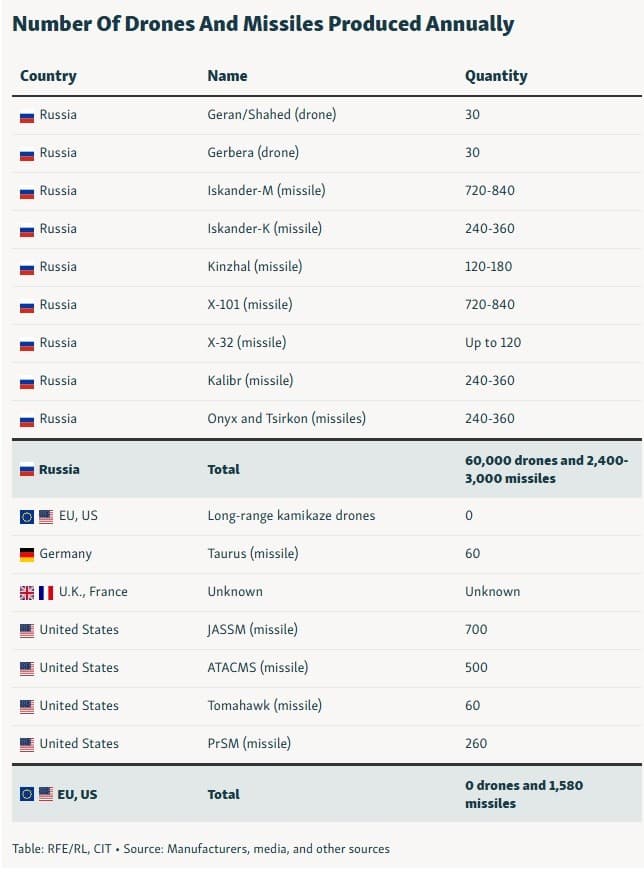
According to Ukraine, Russia produces some 5,000 long-range drones of various types each month, or 60,000 per year. This includes the Geran-2 strike drone (a Russian version of Iran’s Shahed) and the Gerbera, a drone without a warhead used as decoy to saturate Ukraine’s air defenses.

NATO does not currently make anything analogous to these cheap kamikaze drones, with the US opting for much more expensive Reaper and Global Hawk UAVs.

Russia also makes over 200 cruise and ballistic missiles per month, according to Ukraine’s HUR intelligence agency, with annual production in the range of 2,400-3,000 missiles. The US produces an estimated 700 JASSM cruise missiles and 500 ATACMS ballistic missiles per year.

Drone

This gives Russia the advantage in both kamikaze drones and cruise missiles.

In the event of a war between Russia and NATO, NATO’s air defenses would be in a better position to neutralize the drone threat than Ukraine's air defenses, which have suffered from a lack of fighter jets since the beginning of the invasion, CIT analysts say.

While it has an advantage in missile production, Russia’s air defenses, struggling against primitive Ukrainian drones, would likely have a hard time protecting the country’s airspace from NATO missiles.

By RFE/RL

LA REVUE GAUCHE - Left Comment: Search results for PERMANENT ARMS ECONOMY


Peru seizes black market mercury bound for illegal gold mines


Stock image.

Peruvian authorities have halted a shipment of about four metric tons of mercury headed to Bolivia for presumed use in illegal gold mining, they said on Thursday, the latest sign of rising black market activity to fulfill soaring demand for the precious metal.

The mercury had been passed off as a container of crushed rock, but Peru’s customs agency SUNAT said an analysis revealed that the material had been laced with mercury, a toxic metal that is subject to strict environmental controls.

“We could determine that mercury was being transported in its natural state, camouflaged in shipments of gravel,” SUNAT said in a statement. The cargo was detected at the Callao port and came from Mexico, it added.

The seizure appears to be the largest on record in the Amazon region of South America where illegal gold mining is widespread, according to a review of past seizures by the Environmental Investigation Agency (EIA), a Washington-based advocacy nonprofit.

Until now, the biggest known shipment in the region, about a decade ago, was only half the size, according to the EIA.

The latest discovery comes as gold prices have soared in recent months, as global trade uncertainty has made gold particularly attractive for investors. Gold prices are up 28.5% so far this year and hit a record high of $3,500 per troy ounce in April. The frenzy for gold has led to deadly encounters from West Africa to Peru.

The EIA said it alerted Peruvian authorities to the shipment during its research into illicit mercury shipments from Mexico to Bolivia, Colombia and Peru, where miners use mercury to leach gold from sediment of the Amazon riverbanks.

It said higher mercury prices were driving illegal mercury production in Mexico, with a particular spike since the start of this year as traffickers paid a record $330 per kilogram.

“According to traffickers, gold miners’ demand for mercury has driven the sophisticated operation and made it profitable,” the EIA said in a report released on Thursday.

It said its investigation showed that 200 tons of mercury were smuggled from Mexico to Bolivia, Colombia and Peru between April 2019 and June 2025, accounting for a conservative estimate of $8 billion in illegal gold.

Peruvian officials did not address the role of the EIA in the discovery of the mercury-laced gravel from Mexico.

(By Marco Aquino, Daina Beth Solomon and Polina Devitt; Editing by Leslie Adler)


Kumba’s iron ore sales up 3% on better rail and port services


The Sishen mine is the company’s flagship operation and one of the largest open pit mines in the world. Credit: Kumba Iron Ore

South Africa’s Kumba Iron Ore’s mineral sales rose 3% during the first half of the year, helping to offset inflation-related cost increases, following an improvement in rail freight and port operations, it said on Thursday.

In a trading update ahead of the release of its half-year results on July 29, the Anglo American unit said its sales for the six months to June 30 were 18.7 million metric tons, up from 18.1 million metric tons during the same period last year.

Kumba, Africa’s biggest iron ore miner, expects headline earnings to be between 6.841 billion rand and 7.341 billion rand ($389.40 million-$417.86 million) in the six months, compared to 7.148 billion previously.

The company kept its full-year production and sales forecast within the range of 35 million to 37 million metric tons.

Commodity exporters have provided technical and equipment assistance to South Africa’s state-owned freight rail and ports operator Transnet.

It has for years struggled to provide adequate services, blaming equipment shortages, cable theft and vandalism. Companies, including Kumba, have been forced to cut output to match the limited logistics capacity.

“Overall, the collaborative partnership between the ore users’ forum and Transnet on the ore corridor restoration programme is starting to deliver positive outcomes in terms of logistics performance,” Kumba said.

Its increased sales followed a 4% increase in ore transported by rail to Saldanha Bay, as well as improved equipment availability at the port over the first half of the year.

Kumba has previously suggested that private investors should run the 861-kilometre (535 miles) rail line from its mines to the port to enhance efficiency. It is unclear whether that could happen.

($1 = 17.5681 rand)

(By Nelson Banya; Editing by Barbara Lewis)