Tuesday, August 19, 2025

POSTMODERN ALCHEMY

Liquid gold: Prototype harvests valuable resource from urine


Stanford University


A newly developed system transforms human waste into a powerful tool for profitable and sustainable energy and agriculture in resource-limited regions. The prototype, outlined in a Stanford-led study published Aug 19 in Nature Water, recovers a valuable fertilizer from urine, using solar energy that can also provide power for other uses. In the process, the system provides essential sanitation, making wastewater safer to discharge or reuse for irrigation.

“This project is about turning a waste problem into a resource opportunity,” said study senior author William Tarpeh, an assistant professor of chemical engineering in the Stanford School of Engineering. “With this system, we’re capturing nutrients that would otherwise be flushed away or cause environmental damage and turning them into something valuable—fertilizer for crops—and doing it without needing access to a power grid.”

Nitrogen is a key component of commercial fertilizers. Traditionally, it's produced using a carbon-intensive process and distributed globally from large industrial facilities, many of which are located in wealthier nations resulting in higher prices in low- and middle-income countries. Globally, the nitrogen in human urine is equivalent to about 14% of annual fertilizer demand.

The prototype separates ammonia – a chemical compound made up of nitrogen and hydrogen – from urine through a series of chambers separated by membranes, using solar-generated electricity to drive ions across and eventually trap ammonia as ammonium sulfate, a common fertilizer. Warming the system—using waste heat collected from the back of photovoltaic solar panels via an attached copper tube cold plate—helps speed up the process by encouraging ammonia gas production, the final step in the separation process. Solar panels also produce more electricity at lower temperatures, so collecting waste heat helps keep them cool and efficient.   

“Each person produces enough nitrogen in their urine to fertilize a garden, but much of the world is reliant on expensive imported fertilizers instead,” said Orisa Coombs, the study’s lead author and a Ph.D. student in mechanical engineering. “You don’t need a giant chemical plant or even a wall socket. With enough sunshine, you can produce fertilizer right where it’s needed, and potentially even store or sell excess electricity.”

The study shows that integrating the heat generated by the solar panel to warm the liquid used in the electrochemical process and managing the current supplied to the electrochemical system increased power generation by nearly 60% and improved ammonia recovery efficiency by more than 20%, compared to earlier prototypes, which did not integrate these functions. The use of this waste heat is especially promising because there is a lot of it: about 80% of the sun energy that hits solar panels is lost, which could otherwise cause system overheating and efficiency slowdowns.

The researchers also developed a detailed model to predict how changes in sunlight, temperature, and electrical configuration affect system performance and economics. The model showed that in regions such as Uganda, where fertilizer is expensive and energy infrastructure is limited, the system could generate up to $4.13 per kilogram of nitrogen recovered—more than double the potential earnings in the U.S.

The researchers believe the approach could scale to help farmers and communities around the world. Lessons learned about integrating solar panel waste heat could also be applied to industrial facilities, such as wastewater treatment plants, capable of capturing heat produced during electricity generation to power a range of applications.

Coombs is working on a prototype that will have triple the reactor capacity, be capable of processing significantly more urine, and will process faster when more sunlight is available.

Beyond the potential for harvesting a valuable product and generating energy, the approach holds the promise of effective sanitation. More than 80% of wastewater goes untreated – much of it in low- and middle-income countries, according to the UN. Nitrogen in wastewater can contaminate groundwater and drinking water sources, and cause oxygen-depleting algal blooms that kill aquatic plants and animals. By removing nitrogen from urine, the prototype system makes the remaining liquid safer to discharge or reuse for irrigation. The ability to do this with a self-powered system could be a game changer in many countries where only a small percentage of the population is connected to centralized sewage systems.

“We often think of water, food, and energy as completely separate systems, but this is one of those rare cases where engineering innovation can help solve multiple problems at once,” said Coombs. “It’s clean, it’s scalable, and it’s literally powered by the sun.”


Coauthors of the study also include Taigyu Joo, a postdoctoral scholar in chemical engineering at Stanford; Amilton Barbosa Botelho Junior, a postdoctoral research fellow in chemical engineering at Stanford and the University of Sao Paulo, Brazil at the time of the research; and Divya Chalise, a postdoctoral scholar in mechanical engineering at Stanford.


Tarpeh is also an assistant professor, by courtesy, of civil and environmental engineering in the Stanford School of Engineering and the Stanford Doerr School of Sustainability; a center fellow at the Precourt Institute for Energy; and a center fellow, by courtesy, at the Stanford Woods Institute for the Environment.

The study was funded by the Knight-Hennessy Fellowship, the National Science Graduate Research Fellowship, a Global Health Seed Grant from the Stanford Center for Innovation in Global Health, the Camille Dreyfus Teacher-Scholar Award, the Stanford Sustainability Accelerator, and the Fundação de Amparo à Pesquisa do Estado de São Paulo and Capes.

The researchers’ work to convert urine into fertilizer was supported by the Stanford Sustainability Accelerator in its first round of grants in 2022. The team built a lab-scale electricity-driven reactor that extended to 40 days of operation, which inspired and enabled work on pairing electrochemical water treatment with solar panels. The earliest iterations of this project focused on recovering nitrogen and sulfur from wastewater to enable water reuse and fertilizer production, and was supported by the Stanford Woods Institute for the Environment’s Environmental Venture Projects program.


Scientists debut a new foundational atlas of the plant life cycle


Salk Institute researchers map every cell type and developmental state across the entire life cycle of model plant Arabidopsis


Salk Institute

Authors 

image: 

From left: Tatsuya Nobori, Natanella Illouz Eliaz, and Travis Lee.

view more 

Credit: Salk Institute


LA JOLLA (August 19, 2025)—Nearly everything you know about plants was first discovered in a plant you’ve likely never heard of. Arabidopsis thaliana, also known as thale cress, is a small, flowering weed that has shaped much of plant biology as we know it. Serving as the representative plant species in most plant research across the last half century, Arabidopsis has taught us how plants respond to light, which hormones control plant behavior, and why some plants grow long, deep roots while others grow them shallow and wide. But despite its beloved reputation among plant biologists worldwide, many elements of the Arabidopsis life cycle have remained a mystery.

Salk Institute researchers have now established the first genetic atlas to span the entire Arabidopsis life cycle. The new atlas—created using detailed single-cell and spatial transcriptomics—captures the gene expression patterns of 400,000 cells within multiple developmental stages as Arabidopsis grows from a single seed to a mature plant. The publicly available resource will be hugely informative to future studies of different plant cell types and developmental stages, and how they respond to stress and environmental stimuli.

The findings, published in Nature Plants on August 19, 2025, will help expand research and development in plant biotechnology, agriculture, and environmental sciences.

“We’ve come very far in our understanding of plant biology, but until recently, there has been a technological bottleneck preventing us from comprehensively cataloguing cell types and the genes they express uniformly, across developmental stages,” says senior author Joseph Ecker, professor, Salk International Council Chair in Genetics, and Howard Hughes Medical Institute investigator. “Our study changes that. We created a foundational gene expression dataset of most cell types, tissues, and organs, across the spectrum of the Arabidopsis life cycle.”

How to map a plant

In its many years as a model plant, Arabidopsis has seen its fair share of experiments. Scientists have been working to decode Arabidopsis’ genome for decades, mapping which genes are expressed in each cell type across various plant tissues and organs. Using these incremental maps, scientists can start to figure out which genes control the identity and behavior of different parts of the plant.

One effective way to make these maps is by using single-cell RNA sequencing. This genetic sequencing technique looks at the genome’s products—strands of RNA—rather than the original DNA code. This makes it easy for scientists to see which genes are actually used in a cell, and how many. Gene expression maps also help researchers characterize the different types of cells within a species. Since every cell in an organism contains the same genetic code, different cell types can be identified by the unique pattern of genes they express.

While single-cell RNA sequencing has allowed scientists to make detailed maps of cell types, these maps are often restricted to select organs or tissues—for example, looking only at the plant’s roots and ignoring the stem, flowers, and leaves. To move from small genetic maps to a sophisticated atlas, the Salk researchers paired single-cell RNA sequencing with another technology: spatial transcriptomics.

Better technology, better maps

With single-cell RNA sequencing, researchers are forced to separate tissues of interest and process their cells in isolation. With spatial transcriptomics, researchers can create genomic maps of plants as they exist in the real world, within the tissue context. The structure, shape, and location of cells and tissues across the entire plant can remain intact throughout the sequencing process. The result is an insightful view into the identity of cells within multiple tissues and organs at once.

“What excites me most about this work is that we can now see things we simply couldn’t see before,” says co-first author Natanella Illouz-Eliaz, a postdoctoral researcher in Ecker’s lab. “Imagine being able to watch where up to a thousand genes are active all at once, in the real tissue and cell context of the plant. It’s not only fascinating on its own, but it’s already led us to discoveries, like finding genes involved in seedpod development that no one knew about before. There’s so much more waiting to be uncovered in this data, and that sense of possibility is what I am truly enthusiastic about.”

The single-cell and spatial transcriptomic atlas spans 10 Arabidopsis developmental stages, from seed in the ground to flowering adulthood. More than 400,000 cells were captured across this life cycle, demonstrating the striking diversity of cell types that can be found in just one organism.

Where the new map leads us

By looking at the full life cycle of Arabidopsis rather than at a single snapshot in time, the researchers have already found a surprisingly dynamic and complex cast of characters responsible for regulating plant development. They also learned about many new genes whose expression and function in unique cell types can now be further explored.

“This study will be a powerful tool for hypothesis generation across the entire plant biology field,” says co-first author Travis Lee, a postdoctoral researcher in Ecker’s lab. “Our easy-to-use web application makes this life cycle atlas easily accessible to the plant science community through simply navigating to our website, and we can’t wait to learn from the many single-cell genomic studies it will now enable.”

The researchers hope this new resource—currently available for free online—will enable deeper exploration of plant cell development, help explain how plants respond to genetic and environmental perturbations, and advance the field of plant biology overall.

Other authors include Jiaying Xu, Bruce Jow, and Joseph Nery of Salk, as well as Tatsuya Nobori, formerly of Salk and presently at The Sainsbury Laboratory in the United Kingdom.

The work was supported by the Human Frontiers Science Program (no. LT000661/2020-L), George E. Hewitt Foundation for Medical Research, Weizmann Institute of Science, National Institutes of Health (NIGMS K99GM154136), and Howard Hughes Medical Institute.

About the Salk Institute for Biological Studies:

Unlocking the secrets of life itself is the driving force behind the Salk Institute. Our team of world-class, award-winning scientists pushes the boundaries of knowledge in areas such as neuroscience, cancer research, aging, immunobiology, plant biology, computational biology, and more. Founded by Jonas Salk, developer of the first safe and effective polio vaccine, the Institute is an independent, nonprofit research organization and architectural landmark: small by choice, intimate by nature, and fearless in the face of any challenge. Learn more at www.salk.edu.

Illustration 

Illustration capturing the study’s findings, with Arabidopsis thaliana sprouting amongst cells and strands of DNA—all inside a globe.

Credit

Philip Dexheimer

Flower microscopy 

Arabidopsis thaliana spatial transcriptomic assay shows the striking cellular diversity in the plant’s flower, as each color represents a distinct cell type.

Credit

Salk Institute

The Bright Side: Cambridge Dictionary adds 6,000 new words, including ‘skibidi’ and ‘delulu’


The Cambridge Dictionary has added 6,000 new words to its online edition over the past year, including terms popularised by Gen Z and Gen Alpha like "skibidi," "delulu," and "tradwife", the publisher announced Monday. The dictionary also tackled the task of defining "skibidi", a meme-driven word that can mean "cool" or "bad" or sometimes be used without any clear meaning at all.

Issued on: 18/08/2025 - 
By: FRANCE 24


The dictionary cited Australian Prime Minister Anthony Albanese's use of the phrase "delulu with no solulu". © Mike Bowers, AFP

Words popularised by Gen Z and Gen Alpha including "skibidi", "delulu", and "tradwife" are among 6,000 new entries to the online edition of the Cambridge Dictionary over the last year, its publisher said Monday.

Cambridge University Press said tradwife, a portmanteau of traditional wife, reflected "a growing, controversial Instagram and TikTok trend that embraces traditional gender roles".

Watch moreThe rise of the 'tradwife'

The dictionary also took on the challenge of defining skibidi, a word popularised in online memes, as a term which had "different meanings such as cool or bad, or can be used with no real meaning".

The gibberish word was spread by a YouTube channel called "Skibidi Toilet" and is associated with the mindless, "brain rot" content found on social media and consumed by Gen Alpha's overwhelmingly digital lifestyle.

The dictionary defined delulu, derived from the word delusional, as "believing things that are not real or true, usually because you choose to".

As an example, it cited a 2025 speech in parliament where Australian Prime Minister Anthony Albanese used the phrase "delulu with no solulu".

Watch moreENTR: Tradwife influencers

"It's not every day you get to see words like skibidi and delulu make their way into the Cambridge Dictionary," said Colin McIntosh, Lexical Programme manager at the Cambridge Dictionary.

"We only add words where we think they'll have staying power. Internet culture is changing the English language and the effect is fascinating to observe and capture in the Dictionary."

Other new phrases include "lewk", used to describe a unique fashion look and popularised by RuPaul's Drag Race, and "inspo", short for inspiration.

Work from home culture has given rise to "mouse jiggler", referring to a way to pretend to work when you are not.

There is also "forever chemical", man-made chemicals that stay in the environment for years and have gained traction as concerns grow about the irreversible impact of climate change on the health of humans and the plant.

(FRANCE 24 with AFP)


CLIMATE CRISIS
Survivors claw through rubble after deadly Pakistan cloudburst

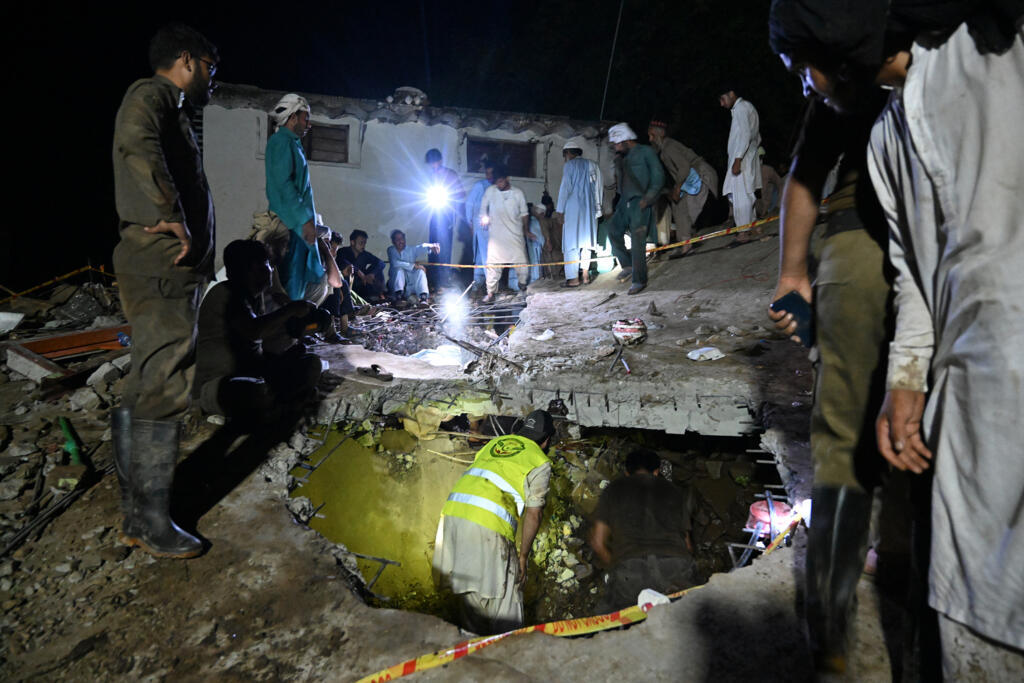
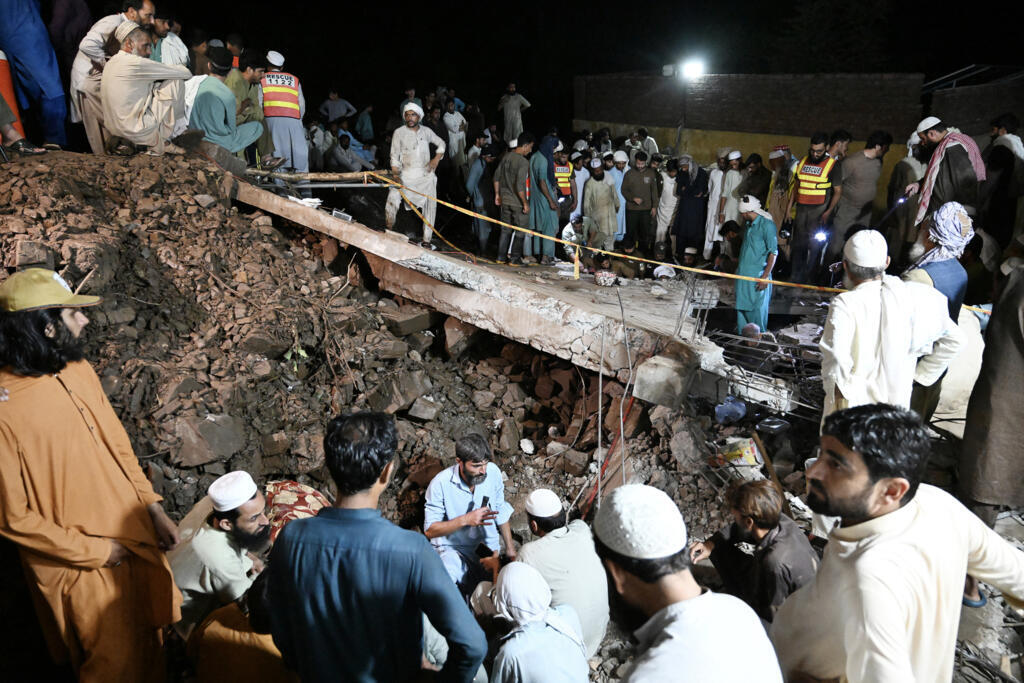
Bar Dalori (Pakistan) (AFP) – In the middle of the night, by the glow of their mobile phones, rescuers and villagers dug through the concrete remains of flattened houses after massive rocks crashed down on a remote Pakistani village following a cloudburst.


Issued on: 19/08/2025 - RFI

Rescue workers and residents search for victims in the debris of collapsed houses after a cloudburst in Dolari village, in northern Pakistan © Aamir QURESHI / AFP

Using hammers, shovels, and in many cases their bare hands to clear the rubble and open blocked pathways, they searched through the debris in darkness, with no electricity in the area.

In just minutes, a torrent of water and rocks swept down on the village of Dalori on Monday, destroying at least 15 houses, damaging several others and killing nine people.

Around 20 villagers are still trapped under the debris.

"A huge bang came from the top of the mountain, and then dark smoke billowed into the sky," Lal Khan, a 46-year-old local labourer, told AFP.

"A massive surge of water gushed down with the sliding mountain," he added.

The cloudburst above Dalori came a few days into heavy monsoon rains that have already killed more than 350 people across mountainous Khyber Pakhtunkhwa province, along the northwest border with Afghanistan.

In just minutes, a torrent of water and rocks swept down on the village of Dalori, destroying at least 15 houses, damaging several others and killing nine people © Aamir QURESHI / AFP


Torrential rains in northern Pakistan since Thursday have caused flooding and landslides that have swept away entire villages, with around 200 people still missing.

And authorities have warned of fresh flash floods in the coming days.

Khan recalled seeing the hand of his neighbour sticking out of the rubble, where rescuers later retrieved her body along with those of her four children.

"We are absolutely helpless. We don't have the means to tackle this calamity that nature has sent upon us," Khan added.
'Like an apocalyptic movie'

Fellow resident Gul Hazir said not one but several cloudbursts from two sides of the village struck the remote valley.

"It was like an apocalyptic movie. I still can't believe what I saw," Hazir said.

"It was not the water that struck first, but a massive amount of rocks and stones that smashed into the houses," Hazir told AFP.

Local administration official Usman Khan told AFP at the site that many of the houses had been built in the middle of the stream bed, which worsened the scale of destruction.

"There was no way for the water to recede after the cloudburst struck at least 11 separate locations in the area," he said.

"It is immensely challenging to carry out operations here, as heavy machinery cannot pass through the narrow alleys."

The people of Dalori had been collecting money to help neighbouring flood-hit areas before disaster struck their village © Aamir QURESHI / AFP


Saqib Ghani, a student who lost his father and was searching for other relatives, tried to claw through the concrete with his bare hands before rescuers pulled him away and villagers gave him water.

The single road leading to the village was demolished at several points, while gravel was scattered across the settlement.

Despite the challenging conditions, excavators were working at several sites to remove debris that had clogged the drainage channels and blocked the flow of water.

Dalori has already held funerals for five victims, while women mourned in darkened homes with no electricity since the disaster.

In the village's narrow alleys, unattended cattle wandered freely amid the devastation.

"I will not live here anymore," said a grieving woman, draped in a large shawl, as she followed a coffin being carried through the street.

Over the past few days, the villagers had been collecting money to help people in neighbouring flood-hit areas, until they too were overwhelmed by disaster and lost everything.

"We didn't know we would be needing help ourselves," Hazir added.

© 2025 AFP
CLIMATE CRISIS

Six killed fighting fires in Spain and Portugal as wildfires ravage peninsula


Six firefighters have died across Spain and Portugal as the Iberian peninsula grapples with devastating wildfires exacerbated by an enduring heatwave. Thousands of firefighters have been deployed across southern Europe in recent weeks to beat back a series of deadly blazes.

Issued on: 18/08/2025 -
By: FRANCE 24
Video by: Antonia KERRIGAN


A firefighter stands as he battles a wildfire in Veiga das Meas, northwestern Spain, Saturday, August 16, 2025. © Lalo R. Villar, AP
01:43


Thousands of firefighters backed by the military and water-bombing aircraft on Monday battled dozens of wildfires across Spain and Portugal, as the death toll increased to six since the outbreaks began.

The Iberian peninsula has been particularly affected by forest fires fuelled by heatwaves and drought blamed on climate change that have hit southern Europe.

More than 343,000 hectares (848,000 acres) of land – the equivalent of nearly half a million football pitches -- have been destroyed this year in Spain, setting a new national record, according to the European Forest Fire Information System (EFFIS).

Fires keep burning in southern Europe as army is deployed in Spain
Firefighters continue to battle blazes © France 24
01:21


The previous record of 306,000 hectares was set in the same period three years ago.

Two firefighters were killed on Sunday – one in each country, both in road accidents – taking the death toll to two in Portugal and four in Spain.

The head of Spain's Civil Protection and Emergencies, Virginia Barcones, told broadcaster TVE there were currently 23 "active fires" that pose a serious and direct threat to the population.

The fires, now in their second week, were concentrated in the northwest regions of Galicia, Castile and Leon, and Extremadura.

In Ourense province of Galicia, signs of the fires were everywhere, from ashen forests and blackened soil to destroyed homes, with thick smoke forcing people to wear facemasks.

Firefighters battled to put out fires, as locals in just shorts and T-shirts used water from hoses and buckets to try to stop the spread.

One resident in O Barco de Valdeorras, dousing his home with water from a hosepipe, described the wildfire that ripped through his area as "like a bomb".

"It came from below and it was like a hurricane," he said. "The good thing was that in two minutes it headed up and it didn't stay here long.

"If not, our house would have been burnt, it would not have survived."
'Complicated situation'

Barcones said she hoped weather conditions would turn to help tackle the fires. Spain's meteorological agency said the heatwave, which has seen temperatures hit 45C in parts of the country, was coming to an end.

Elsewhere, authorities in Turkey said two major fires had been brought under control, while rain and falling temperatures have helped firefighters extinguish dozens of blazes in the Balkans.

Spain is being helped with firefighting aircraft from France, Italy, Slovakia and the Netherlands, while Portugal is receiving air support from Sweden and Morocco.

"It's a very difficult, very complicated situation," Spanish Defence Minister Margarita Robles told TVE.

The size and severity of the fires and the intensity of the smoke – visible from space – were making "airborne action" difficult," she added.

Officials in Castile and Leon said a firefighter died on Sunday night when the water truck he was driving flipped over on a steep forest road and down a slope.

Two other volunteer firefighters have died in Castile and Leon, while a Romanian employee of a riding school north of Madrid lost his life trying to protect horses from the fire.

In Portugal, President Marcelo Rebelo de Sousa said a firefighter died on Sunday in a traffic accident that left two colleagues seriously injured.

A former mayor in the eastern town of Guarda died on Friday while trying to tackle a fire.

Some 2,000 firefighters were deployed across northern and central Portugal on Monday, with about half of them concentrated in the town of Arbanil.

Some 216,000 hectares of land have been destroyed across Portugal since the start of the year.

(FRANCE 24 with AFP)

Spain deploys hundreds of extra troops as it steps up efforts to bring wildfires under control


By Malek Fouda
Published on 18/08/2025 

Spanish firefighters are still battling 12 major and active wildfires in the northwestern Galicia region as much of southern Europe reels from record hot temperatures.

Spanish Prime Minister Pedro Sánchez says a further 500 soldiers will be deployed to battle wildfires that have torn through parched woodland amid a record-setting European heatwave.

The decision to add to the more than 1,400 troops already on wildfire duty came as authorities struggle to contain forest blazes, particularly in the north-western Galicia region and await the arrival of promised aircraft reinforcements from other European countries.

Firefighters are tackling 12 major wildfires in the province, all of them near the city of Ourense, according to the head of the Galician regional government Alfonso Rueda, who delivered the update in a joint press conference with Sánchez.

"Homes are still under threat so we have lockdowns in place and are carrying out evacuations," said Rueda. "Galicia has been battling the spreading flames for more than a week."


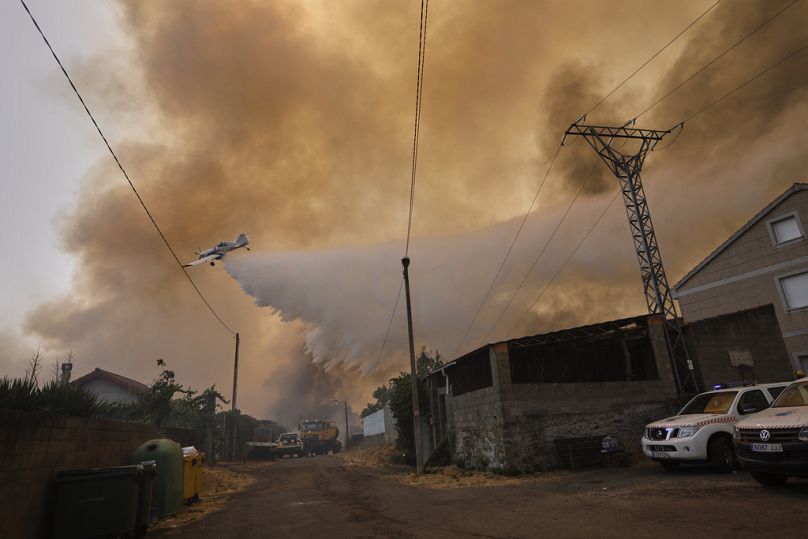
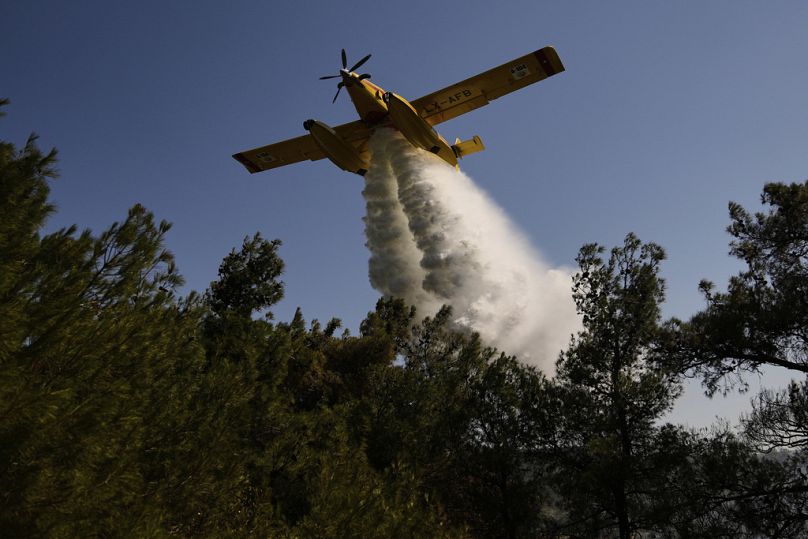
A firefighting plane drops water over a wildfire in Veiga das Meas, northwestern Spain, on Saturday, Aug. 16, 2025 Lalo R. Villar/Copyright 2025 The AP. All rights reserved

Temperatures in Spain could reach 45C in some areas on Sunday, according to the Spanish national weather agency, AEMET. On Saturday, the highest temperature on record was 44.7C in the southern city of Cordoba.

"This Sunday, when extraordinarily high temperatures are expected, the danger of wildfires is extreme in most of the country," AEMET said in a post on X.

The fires in Spain this year have burned 3,430 square kilometres, according to the EU's European Forest Fire Information System. That is an area roughly the same size as metropolitan London.

Experts say Europe has been warming twice as fast as the global average since the 1980s. Scientists believe that climate change is exacerbating the frequency and intensity of heat and dryness in parts of Europe, making the region more vulnerable to wildfires.
Spain awaits assistance from Europe

Madrid is expecting the arrival of two Dutch water-dumping planes that were to join aircraft from France and Italy already helping Spanish authorities under a European cooperation agreement.

Firefighters from other countries are also expected to arrive in the region in coming days, as per an announcement by Spain’s Civil Protection Agency chief Virginia Barcones told public broadcaster RTVE.

Two women walk with their heads covered to protect from the sun during extreme hot weather in Madrid, Spain, Sunday, Aug. 17, 2025 Paul White/Copyright 2025 The AP. All rights reserved

National rail operator Renfe said it suspended Madrid-Galicia high-speed train services scheduled for Sunday due to the fires. It’s not yet clear when service is expected to resume.

Galician authorities advised people to wear face masks to avoid inhaling smoke and ash and advised them to limit time spent outdoors as the risk of heatstroke looms.
Cooler days on the horizon for Portugal

Portugal is set for cooler weather in the coming days after a string of severe wildfires. A national state of alert was enacted on 2 August due to the blazes and was set to end on Sunday, a day before two Swedish firefighting planes were expected to arrive.

Similarly to Spain, Portugal's resources have been stretched. On Sunday, more than 4,000 firefighters and over 1,300 vehicles were deployed, as well as 17 aircraft, to tackle the fires.
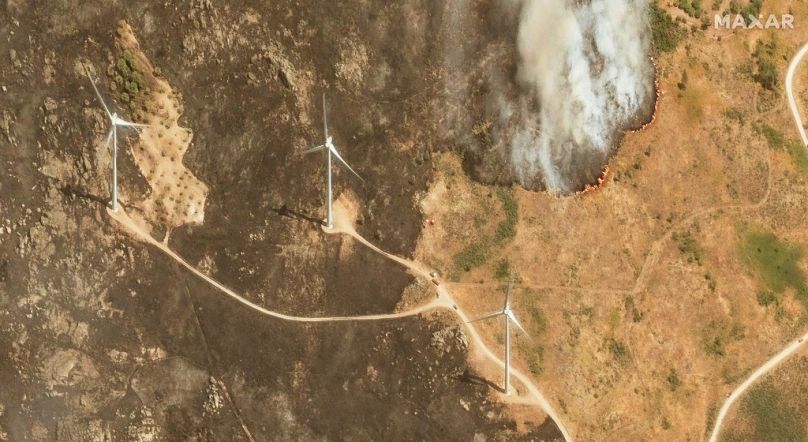
This satellite image provided by Maxar Technologies shows an active fire line for a wildfire in Trancoso, Portugal, Tuesday, Aug. 12, 2025 AP/Satellite image ©2025 Maxar Technologies

The scorched area of forest in Portugal so far this year is 17 times what it was in 2024, estimated at around 1,390 square kilometres, according to preliminary calculations by the Portuguese Institute for the Conservation of Nature and Forests.

Greece, Bulgaria, Montenegro and Albania have also requested help from the EU's firefighting force in recent days to deal with forest fires. The force has already been activated as many times this year as in all of last year's summer fire season.

Gallipoli memorials threatened by Turkish fires

In Turkey, where recent wildfires have killed 19 people, parts of the historic region that includes memorials to World War I's Gallipoli campaign were evacuated on Sunday as blazes threatened homes in the country’s northwest provinces.

Çanakkale Mayor Omer Toraman says six villages were evacuated as a precautionary measure. Officials say about 1,300 firefighting personnel backed by 30 aircraft were battling the blaze.

A water-bombing plane spreads water to extinguish a fire in a forested area in Guzelyeli, on the outskirts of Canakkale, northwest Turkey, Tuesday, Aug. 12, 2025 Khalil Hamra/Copyright 2025 The AP. All rights reserved

A wildfire on the peninsula to the north of the Dardanelles Strait led to the closure of visitor facilities at Gallipoli, the site's management said. The area is dotted with cemeteries, memorials and other remnants of battles waged between Ottoman and Allied troops in 1915.

Turkey has been struck by hundreds of fires since late June, fuelled by record-breaking temperatures, dry conditions and strong winds.

WILDCAT!
Air Canada flight attendants vow to defy back-to-work order as strike talks resume

Toronto (Canada) (AFP) – Striking Air Canada flight attendants vowed Monday to defy another back-to-work order from the country's labor tribunal, but resumed talks seeking to end a walkout that has cancelled travel for half a million people worldwide.


Issued on: 19/08/2025 - 

Passengers look at a depatures board in Montreal, Canada, during the Air Canada strike © ANDREJ IVANOV / AFP

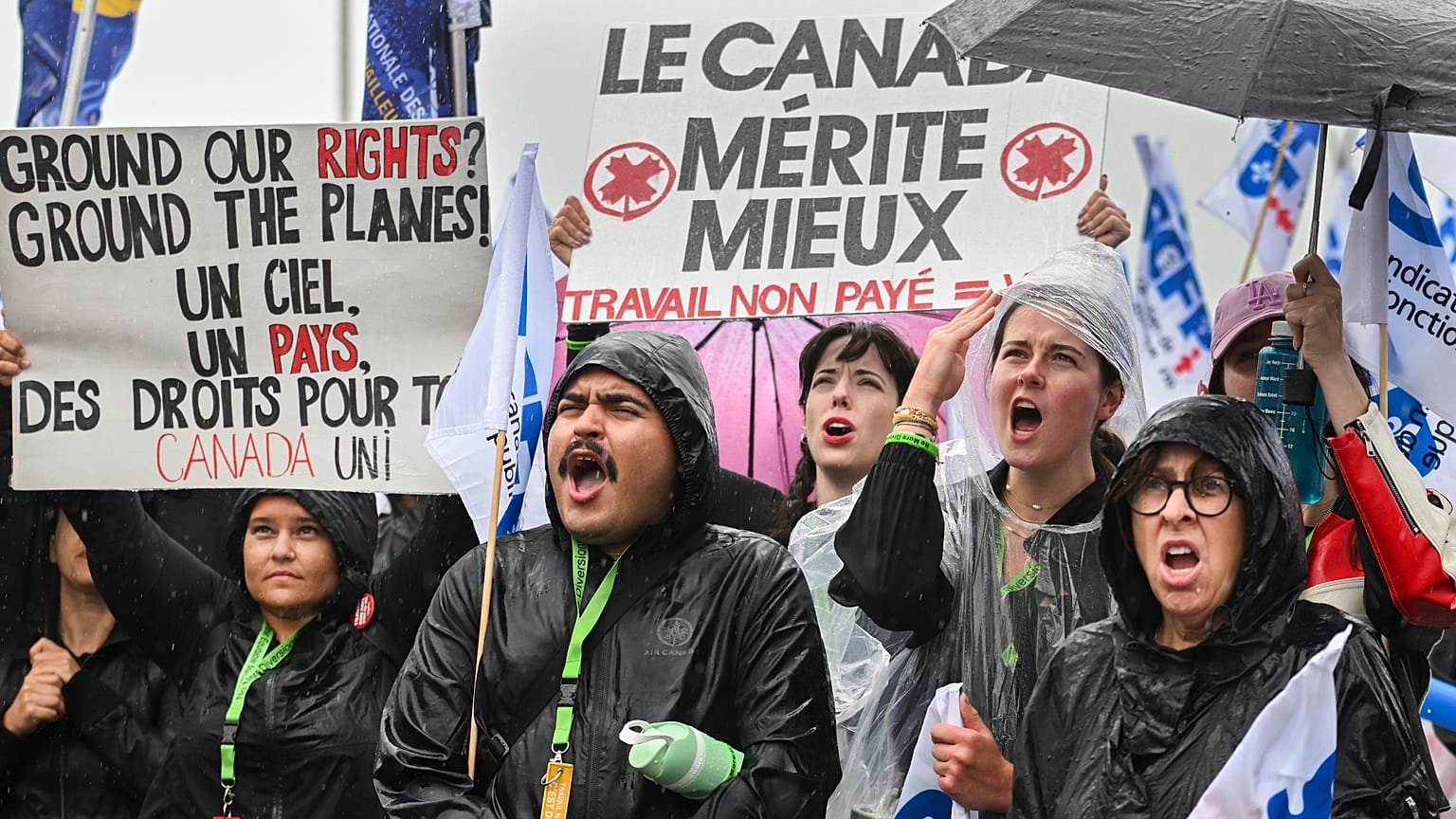
Roughly 10,000 flight attendants walked off the job after midnight Saturday, insisting the airline had failed to address their demands for higher wages and compensation for unpaid ground work, including during boarding.

Canada's national carrier, which flies directly to 180 cities domestically and abroad, said the strike had forced cancellations impacting 500,000 people.

Over the weekend, federal labor minister Patty Hajdu invoked a legal provision to halt the strike and force both sides into binding arbitration.

Following Hajdu's intervention, the Canada Industrial Relations Board (CIRB), a regulatory tribual, ordered the flight attendants back to work Sunday.

The flight attendants' union said it would defy the order, forcing Air Canada to walk back plans to partially restore service.

CIRB regulators upped the pressure Monday.


It ordered the union "to resume the performance of their duties immediately and to refrain from engaging in unlawful strike activities," Air Canada said in a statement.

The tribunal gave the Canadian Union of Public Employees until 12:00 pm (1600 GMT) to communicate to members that they "are required to resume the performance of their duties," the carrier added.

Speaking after that deadline, CUPE president Mark Hancock told reporters the solution "has to be found at a bargaining table," and that the union will not respect the tribunal's ruling.

"None of us want to be in defiance of the law," he said, but stressed the union would not waver in advocating for people asked to work hours on the ground during flight delays without "getting paid a dime."

If Air Canada "thinks that planes will be flying this afternoon, they're sorely mistaken," Hancock said.

The union said later Monday that it had resumed talks with the airline as part of "continued attempts to reach a fair deal."

The evening meetings were taking place in Toronto with the assistance of a mediator, William Kaplan, CUPE's Air Canada component said in a statement on Facebook.

But it added that "at this time, the strike is still on, and the talks have just commenced."

Carney 'disappointed'


Rafael Gomez, an industrial relations expert at the University of Toronto, told AFP the union may be on solid legal footing.

The provision "is written in such a way that it's really for a situation where strikes have gone on a long time and there's no way forward," he said, suggesting that standard could not credibly apply to a strike that is just a few days old.

Prime Minister Mark Carney told reporters Monday it was "disappointing" that eight months of negotiations between the carrier and union did not produce an agreement.

"We recognize very much the critical role that flight attendants play in keeping Canadians and their families safe as they travel," he said.

"It is important that they're compensated equitably."

But, he added, Canada faced a situation where hundreds of thousands of citizens and visitors were facing travel uncertainty.

On Thursday, Air Canada detailed the terms offered to cabin crew, indicating a senior flight attendant would on average make CAN$87,000 ($65,000) by 2027.

CUPE has described Air Canada's offers as "below inflation (and) below market value."

In a statement issued before the strike began, the Business Council of Canada warned an Air Canada work stoppage would exacerbate the economic pinch already being felt from US President Donald Trump's tariffs.

Fightback campaign

On Thursday, Air Canada detailed the terms offered to cabin crew, indicating a senior flight attendant would on average make CAN$87,000 ($65,000) by 2027.

CUPE has described Air Canada's offers as "below inflation (and) below market value".

In a statement issued before the strike began, the Business Council of Canada warned an Air Canada work stoppage would exacerbate the economic pinch already being felt from US President Donald Trump's tariffs.

Other labour organisations are voicing support for the flight attendants. Bea Bruske, President of the Canadian Labour Congress, Canada's largest labour organisation, told Reuters they are ready to join the Air Canada strike if necessary.

"All cards are on the table in terms of what unions are prepared to do to ramp up a fightback campaign," said Bruske, whose organisation represents 3 million workers across Canada.

Help could include financial contributions to cover legal costs for CUPE, she said.

Air Canada's pilot union, the Air Line Pilots' Association, said it encouraged its members to join the picket lines during their time off.

"Air Canada pilots support our flight attendant colleagues in their ongoing struggle to achieve the fair contract they have earned," it said in a statement. "This is an important moment for organised labour across Canada."

(FRANCE 24 with AFP and Reuters)


Air Canada suspends restart plans after flight attendants union defies return to work order

The Canada Industrial Relations Board had ordered airline staff back to work by 2 pm Sunday after the government intervened.


Copyright Graham Hughes/The Canadian Press via AP

By Euronews with AP
Published on 18/08/2025 - 

Air Canada said it suspended plans to restart operations on Sunday after the union representing 10,000 flight attendants said it will defy a return to work order.

The strike was already affecting about 130,000 travellers around the world per day during the peak summer travel season.

The Canada Industrial Relations Board ordered airline staff back to work by 2 pm on Sunday after the government intervened and Air Canada said it planned to resume flights Sunday evening.

Canada’s largest airline now says it will resume flights Monday evening. Air Canada said in a statement that the union “illegally directed its flight attendant members to defy a direction from the Canadian Industrial Relations Board.”

However, union members say they will continue to refuse work until their demands are heard, calling the return to work order unconstitutional.

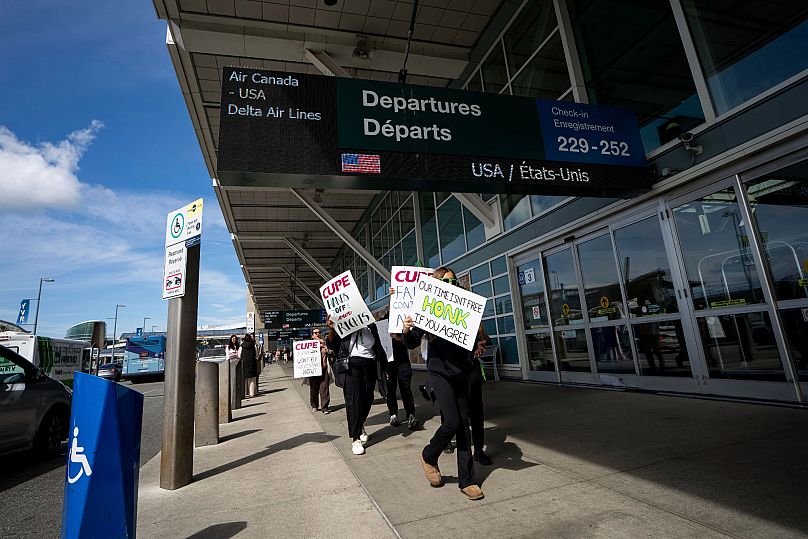
Picketers march around the departures level at the Vancouver International Airport in Richmond, British Columbia, Sunday, Aug. 17, 2025. Ethan Cairns/The Canadian Press via AP

“Our members are not going back to work,” Canadian Union of Public Employees national president Mark Hancock said outside Toronto's Pearson International Airport. “We are saying no.”

Hancock ripped up a copy of the back-to-work order outside the airport’s departures terminal where union members were picketing Sunday morning. He said they won't return Tuesday either.

Flight attendants chanted “Don’t blame me, blame AC” outside Pearson.

“Like many Canadians, the Minister is monitoring this situation closely. The Canada Industrial Relations Board is an independent tribunal," Jennifer Kozelj, a spokeswoman for Federal Jobs Minister Patty Hajdu said in a statement.

Contract talks at an impasse

Less than 12 hours after workers walked off the job, Federal Jobs Minister Patty Hajdu ordered the 10,000 flight attendants back to work, saying now is not the time to take risks with the economy and noting the unprecedented tariffs the US has imposed on Canada. Hajdu referred the work stoppage to the Canada Industrial Relations Board.

The airline said the CIRB has extended the term of the existing collective agreement until a new one is determined by the arbitrator.

The bitter contract fight escalated Friday as the union turned down Air Canada’s prior request to enter into government-directed arbitration, which allows a third-party mediator to decide the terms of a new contract.

Hajdu maintained that her Liberal government is not anti-union, saying it is clear the two sides are at an impasse.

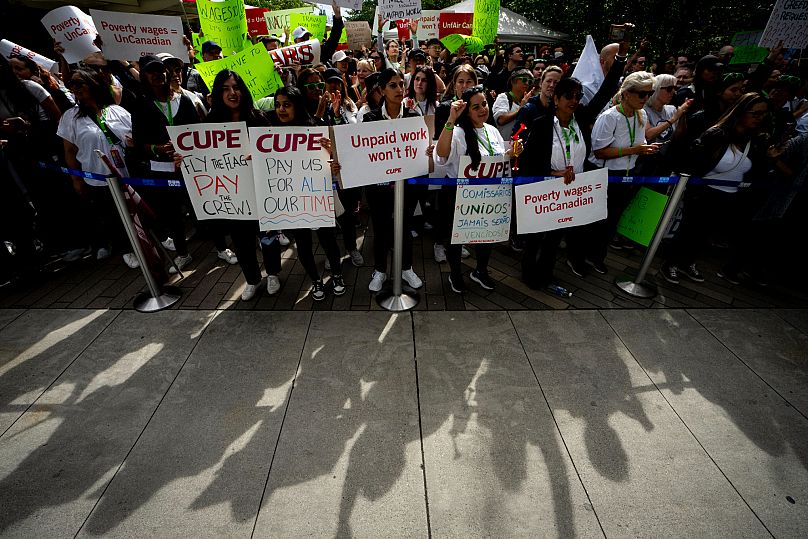
Air Canada workers picket at the Vancouver International Airport in Richmond, B.C., on Sunday, Aug. 17, 2025. Ethan Cairns/The Canadian Press via AP

Passengers whose flights are impacted will be eligible to request a full refund on the airline’s website or mobile app, according to Air Canada.

The airline said it would also offer alternative travel options through other Canadian and foreign airlines when possible. Still, it warned that it could not guarantee immediate rebooking because flights on other airlines are already full “due to the summer travel peak.”

Air Canada and CUPE have been in contract talks for about eight months, but they have yet to reach a tentative deal. Both sides have said they remain far apart on the issue of pay and the unpaid work flight attendants do when planes aren’t in the air.

The airline’s latest offer included a 38% increase in total compensation, including benefits and pensions, over four years, that it said “would have made our flight attendants the best compensated in Canada.”

But the union pushed back, saying the proposed 8% raise in the first year didn’t go far enough because of inflation.


NO STATE INTERVENTION!

Quebec union leaders say workers could face same fate as Air Canada flight attendants

By The Canadian Press
August 18, 2025 

The president of the FTQ, Magali Picard, photographed during a press conference in Quebec City, 
. THE CANADIAN PRESS/Jacques Boissinot

The presidents of two major Quebec unions fear workers in the province could soon face the same treatment as striking Air Canada flight attendants under a provincial law passed in May.

The law gives Quebec’s labour minister the power to end a labour dispute by imposing arbitration when the strike or lockout is deemed likely to cause serious or irreparable harm to the public.

Magali Picard with the FTQ and Éric Gingras with the CSQ say Quebec employers now have an incentive to drag their feet on negotiations while waiting for the government to intervene.

The two union presidents are drawing a parallel between the new Quebec law and federal legislation that permits Ottawa to force two sides in a labour dispute into binding arbitration.

Ottawa has done just that in the conflict between Air Canada and its flight attendants’ union, and the federal labour relations board has ruled the union’s strike unlawful.


However, the union representing the Air Canada flight attendants has defied the order from the labour relations board and says the strike will continue.

This report by The Canadian Press was first published Aug. 18, 2025.


France ‘dismayed’ over Russia’s ban on Reporters Without Borders

The French government has condemned Moscow’s latest move against independent voices after Russia banned Reporters Without Borders, adding the press freedom NGO to its list of "undesirable organisations".


Issued on: 18/08/2025 - RFI


France’s Foreign Ministry says it is dismayed by the announcement that the NGO Reporters Without Borders has been added to Russia’s list of “undesirable organisations", Monday 18 August 2025. © AFP - BERTRAND GUAY

France has voiced its "dismay" at Russia’s decision to outlaw the press freedom NGO Reporters Without Borders (RSF).

The French Foreign Ministry said on Monday that the move formed part of a broader campaign of repression against critical voices, carried out in "flagrant disregard for freedom of expression and press freedom."

Paris also renewed its call for the "immediate and unconditional release of all those prosecuted for political reasons" and urged Russia to honour its international commitments on the right to information and free access to news.

Russian journalist exiled in Paris has 'no regrets' over criticising Ukraine war
'Undesirable organisations'

On 14 August, Russia’s Ministry of Justice announced that RSF had been added to its list of so-called undesirable organisations.

The designation effectively bans the group’s activities inside Russia, placing staff, supporters and funders at risk of prosecution and possible prison sentences.

The Paris-based NGO, campaigns globally for press freedom, documenting violations and providing practical support to journalists working in hostile environments.

In Russia, the group has consistently denounced attacks on independent reporting, censorship, and the targeting of reporters who investigate sensitive topics such as corruption, abuses of power and the war in Ukraine.

Global decline in freedom of expression over last decade, watchdog warns
Decade-long clampdown

This is not the first time Moscow has sought to muzzle international organisations. Over the past decade, Russian authorities have tightened restrictions on foreign NGOs through laws branding them as "foreign agents" or "undesirable."

Amnesty International, Human Rights Watch, and Memorial – one of Russia’s most prominent human rights groups – have all faced severe curbs or outright bans.

Such measures typically criminalise normal organisational activity, exposing staff and even supporters to fines or prison terms, and are widely seen as part of a strategy to isolate Russian society from international scrutiny.

The clampdown has grown sharper since Russia launched its full-scale invasion of Ukraine in 2022.

RSF has pledged to continue its work despite the ban, insisting that it will not abandon the Russian journalists it supports.
Macron says Russia does not want peace, stresses security for Ukraine

Ahead of Monday’s meeting between Ukrainian President Volodymyr Zelensky and US president Donald Trump, French President Emmanuel Macron stressed the necessity of security guarantees for Ukraine in any peace agreement with Russia, adding that Russia did not want peace but rather Ukraine’s “capitulation”.

Issued on: 18/08/2025 - RFI

French President Emmanuel Macron attends a video conference with European Commission Ursula von der Leyen and Ukrainian President Volodymyr Zelensky ahead of Zelensky's meeting with US President Donald Trump in Washington on Monday, 17 August 2025 © Philippe Magoni/Pool via Reuters


"Do I think President Putin wants peace? If you want my honest opinion, no. He wants the capitulation of Ukraine, that's what he proposed,” Macron said about Russia's President Vladimir Putin, who met with Trump in Anchorage, Alaska, on Friday.

Following a videoconference meeting with other European leaders Sunday to coordinate their position before the meeting in Washington Monday, Macron said that a “robust, lasting peace” would respect Ukraine’s “sovereignty and territorial integrity”, while Trump appears to be seeking just an end to fighting between Russia and Ukraine.

Any possible peace agreement must include security guarantees for Ukraine Macron said, to deter Russia from attacking again, and pushing farther into Europe.

“The security of Europeans and France is at stake,” he said, speaking from his summer residence at Fort de Brégançon in south-east France.

Macron and other leaders will accompany Zelensky to “present a united front between Europeans and Ukrainians”, he said, and ask the United States “to what extent” they are prepared to contribute to the security guarantees for Ukraine.

Macron was cautious about a suggestion that the US could contribute to a security guarantee that resembles Nato’s defence mandate

Sunday evening, Trump’s special envoy Steve Witkoff told US broadcaster CNN that the US “is potentially prepared to be able to give Article 5 security guarantees, but not from Nato - directly from the United States and other European countries.”

“I believe that a theoretical article is not enough,” said Macron. “The question is one of substance.”

(with AFP)
Valls heads to New Caledonia in wake of collapse of independence deal

COLONIALIST INDEPENDENCE IS NOT
INDEPENDENCE FROM COLONIALISM

Political tensions in New Caledonia have flared, as its main pro-independence coalition FLNKS voted against a deal that would have given the French overseas territory some sovereign powers – but no independence referendum, a key demand for activists. France's Overseas Minister Manuel Valls is now heading to the archipelago, in what will be a decisive week for its future.


Issued on: 18/08/2025 - RFI

A Kanak flag flies between French and European Union flags in front of Nouméa City Hall in 2024 AFP - SEBASTIEN BOZON

By:David Coffey with RFI

New Caledonia is once again at a political turning point.

The Kanak Socialist National Liberation Front (FLNKS) voted on 9 August to reject outright the Bougival agreement – a French plan signed last month to give the territory its own nationality and some powers, but no new independence referendum, which had been hailed as a potential breakthrough.

The FLNKS is calling instead for a new "Kanaky agreement" and elections this November.

Valls will fly to the Pacific archipelago this week, tasked with navigating a fraught political landscape and seeking an opportunity to restart dialogue.

The agreement, signed in mid-July in the Bougival suburb of Paris, had been presented as a historic step for the Pacific territory.

It proposed the creation of a New Caledonian nationality and envisaged the transfer of key sovereign powers to the territory, including over currency, justice and policing.

New Caledonia independence bloc rejects deal giving powers but no referendum

It was also the first concrete move towards a fresh constitutional settlement after years of tension following the 1998 Nouméa Accord.

Under that deal, France had pledged to steadily hand more political power to New Caledonia and its indigenous Kanak people, setting the stage for two decades of greater self-government.

But after an internal review, the FLNKS rejected the Bougival deal, with Dominique Fochi, secretary-general of the Caledonian Union, saying it clashed with the "foundations and achievements" of their struggle for independence.

FLNKS president Christian Tein described the accord as rushed and "humiliating" for the Kanak people, claiming the negotiators in Paris had no proper mandate.

This rejection has left the Bougival text in limbo, as no settlement is possible without the FLNKS on board.
'The door remains open'

Valls had already announced plans to visit New Caledonia during the week of 18 August prior to the FLNKS’s formal withdrawal from the deal.

In a social media post, he called the Bougival accord "an extraordinary and historic opportunity" but stressed that his "door remains open" in terms of understanding the reasons behind its rejection.

The challenge for Valls will be to break a political deadlock.

Relations between pro and anti-independence camps had shown tentative improvement in recent months – evidenced by a rare handshake between Loyalist MP Nicolas Metzdorf and independence leader Emmanuel Tjibaou in Bougival – but that goodwill has now all but evaporated.

Independence party walks away from French deal on New Caledonia
Election demands

The independence movement has made its conditions for talks clear.

It wants provincial elections to be held in November 2025, arguing that fresh mandates are needed to establish the legitimacy of both camps.

These elections were originally scheduled for May 2024, but were postponed twice due to last year’s deadly riots.

The Bougival agreement would have delayed them further, to mid-2026 – a move Valls and New Caledonia's loyalists support, but which the FLNKS rejects outright.

The independence coalition is also demanding a new "Kanaky agreement", to be signed on New Caledonia Day this year – 24 September. This agreement which would set a roadmap for New Caledonia to achieve "full sovereignty" before France’s 2027 presidential election.

It also insists that talks be held under the supervision of Tein, despite his ongoing legal troubles related to his arrest in 2024, when he was accused of instigating violence during the riots.
What would the ‘Kanaky Agreement’ mean?


While the FLNKS has not published a full draft, the proposed Kanaky agreement appears to go further than the Bougival accord in transferring powers from Paris to Nouméa. Where Bougival left room for gradual, negotiated change, Kanaky would set a fixed timetable towards independence, with sovereignty – including foreign affairs, defence, currency and justice – transferred ahead of 2027.

It would likely include provisions for:

Recognition of a Caledonian/Kanaky nationality as the basis for citizenship rights.


Full control over internal governance, including policing and judicial systems.


Economic self-management, potentially including currency creation or control.


International recognition, paving the way for United Nations membership.

The FLNKS vision is for this agreement to be signed on New Caledonia Day – 24 September – a symbolic nod to the territory’s complex colonial history.
Loyalist counter-measures

The Loyalists – the coalition against independence – meanwhile, are working to keep the Bougival process alive, even without the FLNKS.

They’ve proposed an editorial committee to draft a legal framework for the accord, as well as an ad-hoc technical group including any independence supporters still on board.

The aim is to maintain momentum and isolate FLNKS hardliners.

Metzdorf has highlighted that two moderate independence parties – Palika and the Progressive Union of Melanesia – have already left the FLNKS, reducing its breadth of representation.

The pro-French bloc argues that the Bougival agreement remains the best way to secure political stability, warning that FLNKS demands amount to "blackmail" and could trigger more violence.
Manuel Valls, flanked by French High Commissioner for New Caledonia Louis Lefranc and Nouméa Mayor Sonia Lagarde, in Nouméa on 22 February, 2025. © Delphine MAYEUR / AFP

French deal on New Caledonia 'state' hits early criticism


Legal backdrop

The Nouméa Accord – the 1998 deal governing New Caledonia’s gradual decolonisation – states that until a new agreement is reached, its provisions remain in place.

It states that provincial elections must be held every five years, with November 2025 the next deadline. This could bring the election timetable closer to the FLNKS’s preference, but without their preferred early sovereignty clause.

Macron meets New Caledonian leaders to discuss future after riots

The scars of the 2024 riots, sparked by changes to the electoral roll, remain on both sides.

Loyalists fear a repeat if talks collapse again, particularly if hardliners ramp up street pressure.

While for their part, independence supporters argue that the Bougival agreement’s delays and partial transfer of power risk entrenching the status quo indefinitely.


Meet the NGOs striving to save the last forests of the Comoros

On the most mountainous and densely populated island in the Comoros, only the most remote forests have escaped decades of deforestation – ravages which several NGOs are now trying to repair.


Issued on: 18/08/2025 - RFI

A man fills a basket with flowers from the ylang-ylang tree
 in Morori, Comoros Islands. AFP

Strips of bare land scar the lush and green mountainsides towering above Mutsamudu, the capital of the Indian Ocean island of Anjouan.

"We lost 80 percent of our natural forests between 1995 and 2014," Abubakar Ben Mahmoud, environment minister of the country off northern Mozambique, told French news agency AFP in a recent interview.

The clearing of the forest for cultivation has compounded damage caused by the production of ylang-ylang essential oil, used in luxury perfumes, and the manufacture of traditional carved wooden doors for which the island is renowned.

With a high population density of more than 700 residents per square kilometre, "Deforestation has been intensified as farmers are looking for arable land for their activities," the minister said.

The brown and barren patches on the slopes are starkly visible from the headquarters of Dahari, a leading organisation in the fight against deforestation, based in the hills of Mutsamudu.

Water guardians

The NGO last year launched a reforestation programme, working hand-in-hand with local farmers who are called "water guardians".

Under a five-year conservation contract, the farmers commit to replanting their land or leaving it fallow in exchange for financial compensation, said one of the project's managers, Misbahou Mohamed.

The first phase has included 30 farmers, with compensation paid out after inspection of the plots.

Another significant contributor to deforestation on Anjouan, the ylang-ylang essential oil industry, has in recent years heeded calls to limit its impact.

The Comoros is among the world's top producers of the delicate and sweet-smelling yellow flower, prized for its supposed relaxing properties and widely used in perfumes like the famous Chanel No 5.

Protected areas offer hope for Africa's vanishing forests and wildlife

The production of ylang-ylang, vanilla and cloves makes up a large part of the archipelago's agricultural output, which represents a third of its GDP.

The country has around 10,000 ylang-ylang producers, most based on Anjouan, according to a report commissioned by the French Development Agency for a project to support Comoran agricultural exports.

Burning wood is the cheapest source of fuel for the distillation process, the report highlighted, with 250 kilogrammes (550 pounds) needed to produce one litre of essential oil.

Some producers are trying to limit their use of wood, such as Mohamed Mahamoud, 67, who said he halved consumption by upgrading his equipment.

"I now use third-generation stainless steel alembics, with an improved oven equipped with doors and chimneys," said Mahamoud, who has grown and distilled ylang-ylang near the town of Bambao Mtsanga for nearly 45 years.

To avoid encroaching on the forest, most of his wood now comes from mango and breadfruit trees he grows himself.


Rivers drying up

Some producers have in recent years switched to crude oil to fuel their stills.

But that costs twice as much wood, said one ylang-ylang exporter, who asked to remain anonymous.

And high electricity prices in Comoros mean that using electrical energy would cost 10 times more, "not to mention the long periods of power cuts", he said.

Part of the drive to reduce wood consumption comes from an alarming observation: not only is deforestation stripping Anjouan's mountains, it is also drying up its rivers.


Forests are essential for "the infiltration of water that feeds rivers and aquifers... like a sponge that retains water and releases it gradually", said hydroclimatologist Abdoul Oubeidillah.

"In 1925, there were 50 rivers with a strong year-round flow of water," said Bastoini Chaambani, from the environmental protection NGO Dayima. "Today, there are fewer than 10 rivers that flow continuously."

The Comoros government has meanwhile announced it also intends to take part in reforestation efforts.

"We will do everything we can to save what little forest we have left," said the environment minister.

(with AFP)