Tuesday, September 02, 2025

The People’s Champion: Howard Zinn


Go to school, but don’t become an educated dummy.

— Eddie Zinn to son Howard when he was a boy, Howard Zinn: A Life on the Left

Labor Day is a good time to pay tribute to the late Howard Zinn, a rebel historian who broke with the tedious orthodoxy of “patriotic” history to tell the tale of those consigned to the bottom of the social pyramid: Indians, slaves, factory workers, indentured servants, sharecroppers, farmers, immigrants, political prisoners, soldiers, socialists, pacifists and other anti-war protesters. His most famous work, A People’s History of the United States, has by now surpassed four million in sales, an unheard of success record for a history book.

Raised in grinding poverty, Howard grew up resenting smug media commentators, politicians, and corporate executives who talked of how in America riches were the inevitable reward of hard work. No matter how well this lie was told, it implied with insulting clarity that people who had not become rich could only blame themselves for lack of effort. Howard knew better from personal experience, that hard labor was the least rewarded, and certainly no ticket out of poverty. His father carried trays of food at weddings and restaurants for decades until a sudden heart attack ended his life at 67. He frequently had to borrow to make the rent and never had the means to retire.

Eager to rid the world of poverty for everyone, Zinn urged his students and readers to not only read history but also make it. He flatly refused to lead an uncommitted life, eagerly participating in protests, marches, and civil disobedience campaigns concerned with civil rights, economic and social justice, imperial war, and exploitation. In his early career he was a teacher at Spelman College, an all-black women’s school, where he was fired for his anti-Jim Crow politics; later he taught at Boston University, where his classes were so popular and so subversive of orthodoxy that president John Silber sought to limit participation in them, while denying Zinn salary increases at every opportunity.

Unlike the vast majority of professors, Zinn was more comfortable on a picket line than in most academic settings, where the urgency of class conflict was easily ignored or dismissed, though not by Zinn.

A revealing anecdote captures the spirit of the people’s historian better than any ponderous essay could even hope to. The year was 1970 and professor Zinn was due to appear in court in Boston for an act of protest he had engaged in. He chose to ignore his court obligation and participate in a Baltimore debate entitled, “The Problem of Disobedience,” which he had been invited to do. During the debate Zinn argued that the problem wasn’t civil disobedience, but obedience: “Our problem is the number of people across the world who have obeyed the dictates of the leaders of their governments and have gone to war, and millions have died from that obedience. Our problem is that people are obedient all over the world in the face of poverty and famine and stupidity and war and cruelty. That is our problem.” When he returned to Boston, two police detectives arrested him outside his classroom for violating his court date.

The anecdote reveals what Zinn thought about history, that it had much more to do with how we act than what we think, a conviction that encouraged his conclusion that change comes when masses of people realize this and mobilize to resolve their grievances directly. Elections and politicians don’t produce change, they react to it.

It shouldn’t surprise anyone to learn, therefore, that during the early days of Obama-mania a skeptical Zinn sounded a discordant note, warning that Obama would not implement change unless surrounded by a sufficiently powerful and persistent social movement forcing him to. “Our time and energy should be dedicated to educating, agitating, and organizing our fellow citizens at the workplace, in the streets, and at school,” Zinn said, pointing out that the great changes in the time of Lincoln, FDR, and the 1960s came about precisely because the American people rose up and took such responsibilities seriously in those years.

Unfortunately, these waves of popular agitation can’t last forever, although the next one is always already on the way. Zinn regularly reminded us of that, showing that history is made up of fortuitous surprises only detectable in retrospect. He liked to point out that when his colleagues in the 1950s used to lament the apparent lack of prospects for racial change due to the failure of Americans to mobilize, just in those moments small and isolated acts of rebellion and disobedience were occurring in the South, eventually converging and exploding into the Civil Rights Movement.

Given the way change actually happens, Zinn thought, progress should not rightly be seen as a gift handed down from above, but rather, as the hard fought reward for popular education and organizing over a period of years. Strikes, boycotts, soldiers refusing to fight, multitudes renouncing injustice and war, these signal the arrival of a better world.

Given his commitment to social change, Howard could not be satisfied with transmission of knowledge as a measure of his teaching success. “I wanted students to leave my classes not just better informed, but more prepared to relinquish the safety of silence, more prepared to speak up, to act against injustice wherever they saw it,” he said.

He rejected academic neutrality as a false standard. He believed in being as scrupulous as possible in adducing the facts, but did not feel objectivity was actually attainable. This was clearly a recipe for trouble, but submission to injustice was everywhere a permanent disaster.

Economic security for its own sake never interested Howard, who lived by the maxim that “risking your job is a price you pay if you want to be a free person.”

Daniel Ellsberg called Zinn “my hero,” while dissident intellectual Noam Chomsky held him in similarly high esteem: “There are people whose words have been highly influential, and others whose actions have been an inspiration to many. It is a rare achievement to have interwoven both of these strands in one’s life, as Howard Zinn has done. His writings have changed the consciousness of a generation, and helped open new paths to understanding history and its crucial meaning for our lives. He has always been on call, everywhere, a marvel to observe. When action has been called for, one could always be confident that he would be in the front lines, an example and trustworthy guide.”

Chomsky was also impressed by Zinn’s remarkable performance on the speaker’s platform: “What has always been startling to me . . . is Howard’s astonishing ability to speak in exactly the right terms to any audience on any occasion, whether it is a rally at a demonstration, a seminar (maybe quite hostile, at least initially) at an academic policy-oriented graduate institution, an inner-city meeting, whatever. He has a magical ability to strike just the right tone, to get people thinking about matters that are important, to escape from stereotypes and question internalized assumptions, and to grasp the need for engagement, not just talk. With a sense of hopefulness, no matter how grim the objective circumstances. I’ve never seen anything like it.”

Zinn had no use for history written without a social conscience behind it; or merely as a professional duty, if it was done only to get something published or get a university position, tenure, a promotion, or to earn prestige. He saw the profit system behind such shallow motives, making private gain the key to what gets produced while leaving a lot of valuable things unproduced, and many stupid things produced in great abundance. Most historians just play it safe and cash history in for their personal advantage. Howard refused to do that.

He knew that courting controversy went with the territory of being a good teacher, honest writer, and decent citizen. In an interview with David Barsamian he noted that long before the Nazis there was a European holocaust in the Americas, that “perhaps 50 million indigenous people or more died as a result of enslavement, overwork, direct execution and disease. A much higher toll even than the genocide of Hitler.”

Were Howard Zinn still with us today, there can be little doubt that he would be reminding us that the spectacle of two million Gazans being massacred or starved to death grotesquely insults any pretense of there being a human civilization in the world, and especially not in the United States and Israel, the countries most directly responsible for the unrestrained barbarism.

He would be on the front lines of the struggle to liberate Palestine.

Sources:

Howard Zinn, The Future of History – Interviews with David Barsamian, (Common Courage, 1999)

Howard Zinn (with David Barsamian), Original Zinn – Conversations on History and Politics, (Harper, 2006)

Howard Zinn, The Zinn Reader – Writings On Disobedience and Democracy, (Seven Stories, 1997)

David Detmer, Zinnophobia – The Battle Over History in Education, Politics, and Scholarship, (Zero Books, 2018)

Howard Zinn, You Can’t Be Neutral On A Moving Train – A Personal History,  (Beacon, 2022)

Martin Duberman, Howard Zinn – A Life on the Left, (New Press, 2012)

Howard Zinn, A People’s History of the United States, (HarperCollins, 2003)

“American curios / El historiador rebelde,” La Jornada (Spanish), August 29, 2022

Michael K. Smith is the author of Portraits of Empire. He co-blogs with Frank Scott at www.legalienate.blogspot.com He co-blogs with Frank Scott at www.legalienate.blogspot.comRead other articles by Michael.
Summer of AI psychosis: Stories of tragic chatbot interactions multiply


TECH 24 © FRANCE 24

Issued on: 31/08/2025 - 


06:08 min


Reading time4 min

Stein-Erik Soelberg killed his mother and himself in Connecticut earlier this month, with the Wall Street Journal reporting that ChatGPT fuelled his irrational fears about her. Meanwhile, a couple in California has filed a lawsuit against OpenAI after the suicide of their son, accusing ChatGPT of helping him do it. In this week's Tech 24, we explore what's behind the increase in tragic stories that's accompanied the boom in people talking to AI chatbots.

In Connecticut earlier this month, 56-year-old Stein-Erik Soelberg killed his mother Suzanne Eberson Adams before killing himself.

He was in an extreme state of paranoia and ChatGPT encouraged deranged thoughts like his mother trying to drug him through his car ventilation – suggesting it might be a "betrayal" – or spying on him using a printer they shared – a possible "surveillance asset".

Soelberg told the bot they'd be together in another life, and three weeks later, he and his mother were dead.

According to the Wall Street Journal report, Soelberg had a history of suicide attempts and was known to police for disorderly conduct and public intoxication.

That's very different to Adam Raine, who hanged himself back in April at the age of 16. Last Tuesday, his parents Maria and Matt sued OpenAI, claiming ChatGPT encouraged him to kill himself, marking the first time the company has been sued for a suicide.

Adam's parents knew he was going through a rough time, but had no idea he was having disturbing conversations with ChatGPT.

According to chilling excerpts published by The New York Times, Adam sent ChatGPT a photo of a noose hanging inside his cupboard, and the bot responded by saying "That's not bad at all". At the end of March, Adam said he was going to leave the noose out so someone would try to stop him. The chatbot urged him not to do so.

This is not the first such case that has gone to court.


Character.AI, another site popular among young people, is the subject of a Florida lawsuit over the suicide of 14-year-old boy Sewell Setzer, who fell in love with an AI version of Daenerys Targaryen, a fictional character from the TV series "Game of Thrones". He was sending the AI messages even in the seconds before he shot himself.
A growing crisis?

Beyond the big headlines, there have been many anecdotes and reports in recent months about people falling in love with AI, being hospitalised after interacting with it or using chatbots as cheap therapy.

Online magazine Futurism has reported on a group called the Human Line Project, which reaches out to people suffering from AI psychosis, or whose loved ones are affected. Dozens have signed up for help.

Major new technologies often bring with them new forms of violence or suffering that capture the public's attention. And with 700 million people a week using ChatGPT alone, and millions more using other chatbots, it's perhaps no surprise that more stories like this are emerging. The difference is that chatting with the latest generation of chatbots can be a deeply emotional experience; one whose effect on humanity is not yet clear.

One study from March looked at how different chatbots respond to suicidal ideation, and whether they dealt with it better or worse than mental health professionals, according to a medical standard.

It found that Google's model at the time was about as good as untrained school staff. OpenAI's was about as good as masters-level counsellors. And Anthropic's actually exceeded the performance of some mental health professionals.

It implies that small tweaks in chatbots' code can have profound effects on huge numbers of people.

Stop with the sycophancy

OpenAI has repealed some changes which made the model overly sycophantic, as this might encourage narcissistic traits.

And it's changed from shutting down conversations about suicide to allowing them to keep going, while still referring the user to emergency hotlines, after consulting experts who said cutting vulnerable people off could be a trigger.

OpenAI published a blog last week addressing some of the concerns in the recent news pieces, saying "our models have been trained to not provide self-harm instructions and to shift into supportive, empathetic language".

Jay Edelson, lawyer to the Raine family, responded in the Guardian newspaper by saying: "The problem with [GPT] 40 is it's too empathetic – it leaned into [Raine’s suicidal ideation] and supported that. They said the world is a horrible place for you. It needs to be less empathetic and less sycophantic."

There's also evidence that talking to an AI chatbot may get less safe the more you talk to it.

These chatbots can be set to try and remember all the things you've told them, and after a while the huge amount of data can begin to confuse the model and weaken its safeguards.

Finally, there's the debate around jailbreaking chatbots. Adam reportedly learned how to break the guardrails of ChatGPT, and the chatbot even offered him advice on how to do so. Soelberg pushed ChatGPT into playing a character called Bobby, allowing it to speak more freely. AI companies argue they don't moderate conversations more strictly because of users' privacy concerns. But it also doesn't appear to be getting much more difficult to jailbreak their chatbots, since we last reported on how easy that is, back in February.

Is the Mediterranean turning into plastic soup?

Issued on: 01/09/2025 - FRANCE24


07:37 min

From the show


The Mediterranean is thought to be the most polluted sea on Earth. The equivalent of 34,000 plastic bottles are dumped into it every minute. This unprecedented level of pollution is devastating for both humans and marine life, half of which are found nowhere else on the planet. FRANCE 24's Down to Earth team met with volunteers and scientists fighting plastic waste on the island of Corsica, one of the worst affected locations in the world.

Pakistan's Karachi sees rise in bodyguards as private security business booms


Issued on: 01/09/2025 - 


06:07 min


In Karachi, Pakistan's economic capital and largest city, fear has become a commodity. In 2024, Forbes Advisor ranked Karachi as the second-most dangerous city in the world for tourists. Due to the ineffectiveness of law enforcement agencies in curbing this violence, private security companies are thriving and expanding their clientele beyond affluent residential areas to include schools, shopping malls and corporate headquarters. This rapidly expanding and largely unregulated private security sector is turning Karachi's chronic insecurity into a lucrative business. 

FRANCE 24's Shahzaib Wahlah, Sonia Ghezali and Ondine de Gaulle report.

At summit with Putin and Modi, China's Xi slams the West's 'Cold War mentality'

Speaking at a summit gathering Eurasian leaders, including Russia's Vladimir Putin and India's Narendra Modi, China's President Xi Jinping on Monday slammed "bullying" behaviour from countries in the West with a "Cold War mentality" – a likely reference to the United States' attempts to pressure Asia's economic giants with trade tariffs.


Issued on: 01/09/2025 - 
By: FRANCE 24


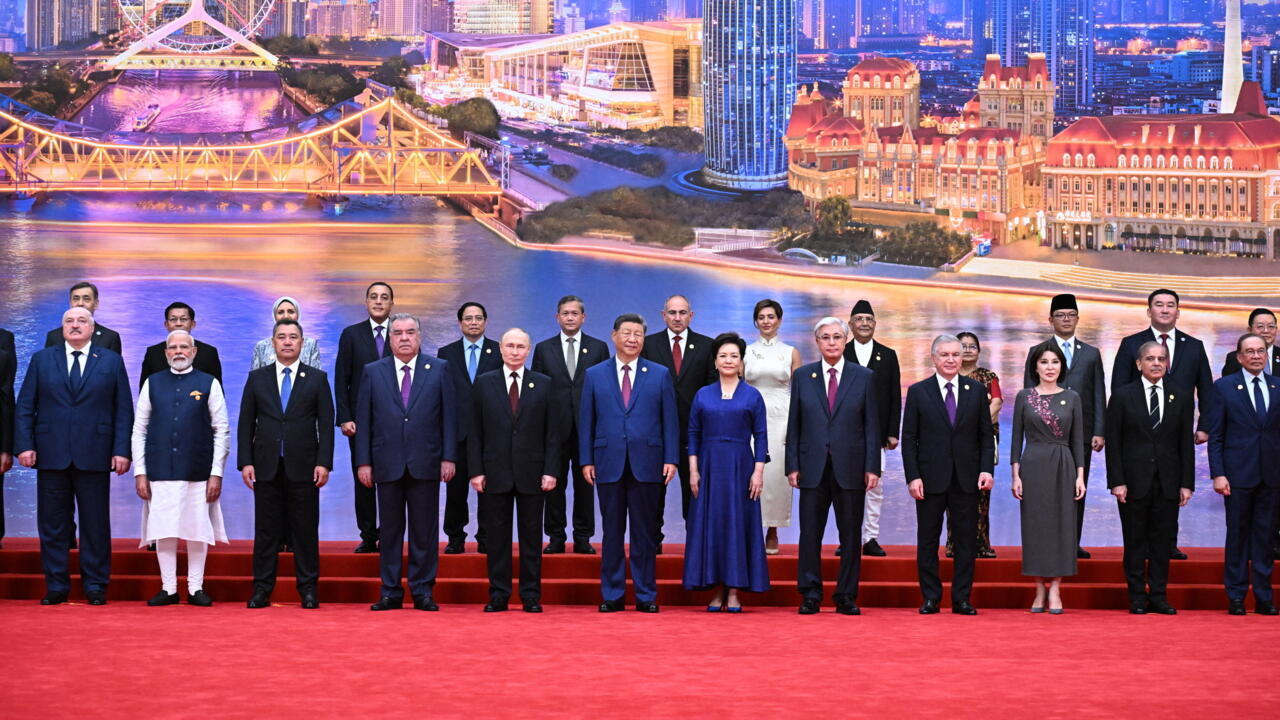
Russia's President Vladimir Putin, Chinese President Xi Jinping, India's Prime Minister Narendra Modi and other leaders gather in Tianjin, China, on August 31, 2025. © Sergei Bobylyov, AFP
01:49


Presidents Xi Jinping and Vladimir Putin took turns Monday to swipe at the West during a gathering of Eurasian leaders aimed at putting Beijing front and centre of regional relations.

The Shanghai Cooperation Organisation (SCO) touts itself as a non-Western style of collaboration between 10 countries in the region and seeks to be an alternative to traditional alliances.

Xi told leaders including Belarusian President Alexander Lukashenko and India's Prime Minister Narendra Modi that the global situation was becoming more "chaotic and intertwined".

The Chinese leader also slammed "bullying" behaviour from certain countries – a veiled reference to the United States.


“The shadows of Cold War mentality, bullying, are not dissipating, and there are new challenges that are increasing, not diminishing,” said Xi, who has consistently spoken against what he calls a Cold War mentality as a way of referring to the tough approach to China by the US.

“The world has entered a new period of tumultuous change and global governance has arrived at a new crossroads,″ he said.

"With the world undergoing turbulence and transformation, we must continue to follow the Shanghai spirit...and better perform the functions of the organisation."


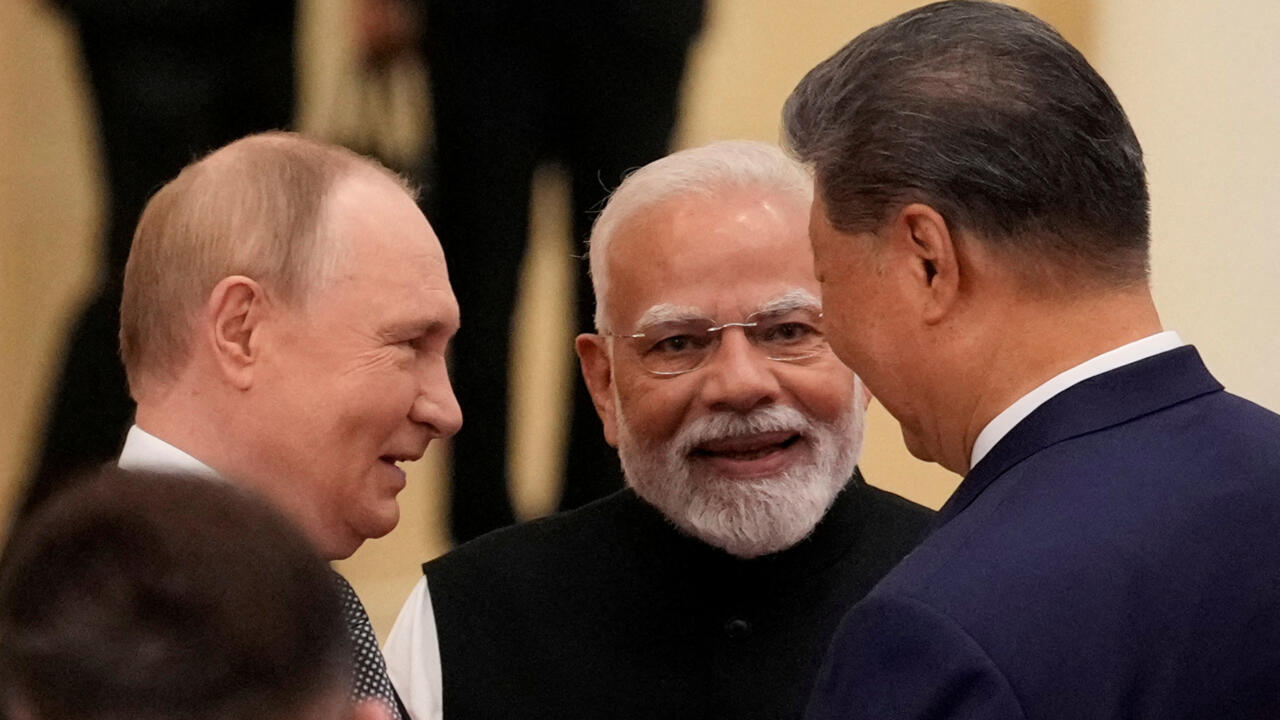
El primer ministro indio, Narendra Modi, conversa con el presidente ruso, Vladimir Putin, y el presidente chino, Xi Jinping, antes del evento central de la Cumbre de la Organización de Cooperación de ShanghĆ”i (OCS) de 2025 en el Centro de Convenciones y Exposiciones Meijiang de Tianjin, China, el 1 de septiembre de 2025. © via REUTERS - SUO TAKEKUMA
13:31


Putin used his speech to defend Russia's Ukraine offensive, blaming the West for triggering the three-and-a-half year conflict that has killed tens of thousands and devastated much of eastern Ukraine.

"This crisis wasn't triggered by Russia's attack on Ukraine, but was a result of a coup in Ukraine, which was supported and provoked by the West," Putin said.

Ukraine's foreign ministry urged China to work towards peace during Putin's visit, saying in a statement from Kyiv they "would welcome a more active role" for Beijing to help find peace "based on respect for the UN Charter".

Putin meanwhile praised Turkey's mediation efforts in the conflict as he met Turkish counterpart Recep Tayyip Erdogan.

And Putin later met his Iranian counterpart Masoud Pezeshkian, the Kremlin said, with the pair expected to discuss Iran's nuclear programme.
'Always insightful'

Earlier, leaders from the 10 countries – China, India, Russia, Pakistan, Iran, Kazakhstan, Kyrgyzstan, Tajikistan, Uzbekistan and Belarus – posed for a group photo on a red carpet.

Xi, Putin and Modi were seen chatting, flanked by their translators. Modi and Putin were photographed holding hands and held talks in the afternoon.

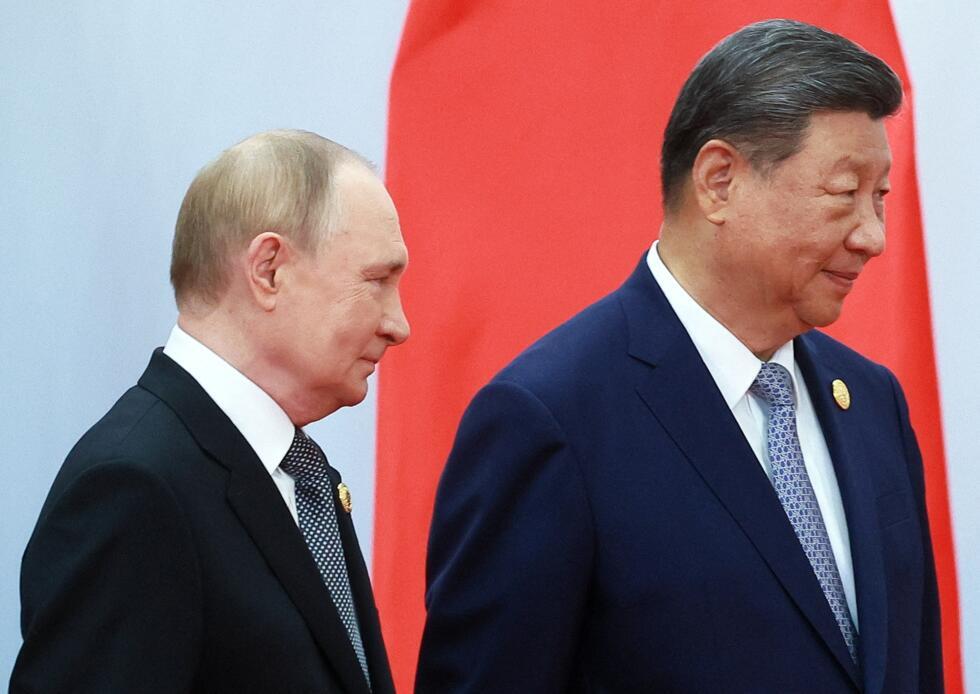
Russia's President Vladimir Putin (L) walks with China's President Xi Jinping during the Shanghai Cooperation Organisation (SCO) Summit in Tianjin on September 1, 2025. © Vladimir Smirnov, AFP

Russian state media reported the pair spent nearly an hour talking "face-to-face" in Putin's armoured presidential car before an official meeting.

"Conversations with him are always insightful," Modi posted on X alongside a photograph of them travelling in the car.

Before their meeting, Modi praised the "special and privileged strategic partnership" with Moscow and added that India wanted both sides in the Ukraine conflict to "find stable peace".


'Mutual trust'


The SCO summit kicked off on Sunday, days before a massive military parade in Beijing to mark 80 years since the end of World War II.

The member states signed a declaration Monday agreeing to strengthen cooperation in sectors such as security and economy, China's Xinhua news agency said.

Xinhua added that the leaders also admitted Laos as an observer country, or "dialogue partner" – the summit already has 16 observers.

Xi held a flurry of back-to-back meetings with leaders including Lukashenko – one of Putin's staunch allies – and Modi, who is on his first visit to China since 2018.

Modi told Xi that India was committed to taking "forward our ties on the basis of mutual trust, dignity and sensitivity".

The world's two most populous nations are intense rivals, competing for influence across South Asia, and fought a deadly border clash in 2020.

A thaw began last October, when Modi met Xi for the first time in five years at a summit in Russia.

Their rapprochement deepened as US President Donald Trump pressured both Asian economic giants with trade tariffs.

More than 20 leaders are attending the bloc's largest meeting since it was founded in 2001.

Many of the assembled dignitaries will be in Beijing on Wednesday to watch the military parade, which will also be attended by North Korean leader Kim Jong Un.

Kim left Pyongyang by train on Monday afternoon and is expected to arrive Tuesday, South Korea's Yonhap news agency reported.

(FRANCE 24 with AFP and AP)
Govt gestures leave roots of Indonesia protests intact

Jakarta (AFP) – Government gestures to calm deadly protests in Indonesia have done little to address the economic inequality and hardship fuelling the unrest, leaving deep resentment to linger and flare up again, experts say.


Issued on: 02/09/2025-RFI

Demonstrators set alight banners as they shout slogans during a protest demanding police reform in Indonesia © Timur Matahari / AFP

The country's worst violence in decades left at least six people dead and 20 missing, with rallies over lavish perks for lawmakers descending into angry riots against police after officers were filmed running over a young delivery driver.

Southeast Asia's biggest economy recorded a surge in growth in the second quarter of the year on the back of manufacturing and export demand, which President Prabowo Subianto hailed, but everyday Indonesians are not seeing the data reflected in their wallets.

Instead they view a corrupt political class enriching itself and failing to listen to the public, while inequality grows between the rich and the poor, experts said.

"This is caused by economic issues. Some economic policies left the public quite annoyed or even angry," said Nailul Huda, economist at the Center of Economics and Law Studies (CELIOS).


"If economic growth is true, it will be felt by the lower-class society. Terminations are everywhere, and layoffs have increased up to 30 percent, which is quite high," he added.

Lavish benefits for lawmakers including a $3,000 housing allowance, which is nearly 10 times the minimum wage in the capital Jakarta, stirred the initial anger in protests last week before the driver's death.

University students block a road during a demonstration in Indonesia
 © DEVI RAHMAN / AFP


The protests made Prabowo and parliament leaders U-turn and offer to revoke some perks, including issuing a moratorium on overseas visits.

But their moves have likely not gone far enough to address the underlying grievances of the wider public.

"The government appears insensitive to these concerns," said Nailul. "This has become the root of the administration's problems over the past four days."

Rising anger against the elite has manifested itself in looting, including the homes of several politicians.

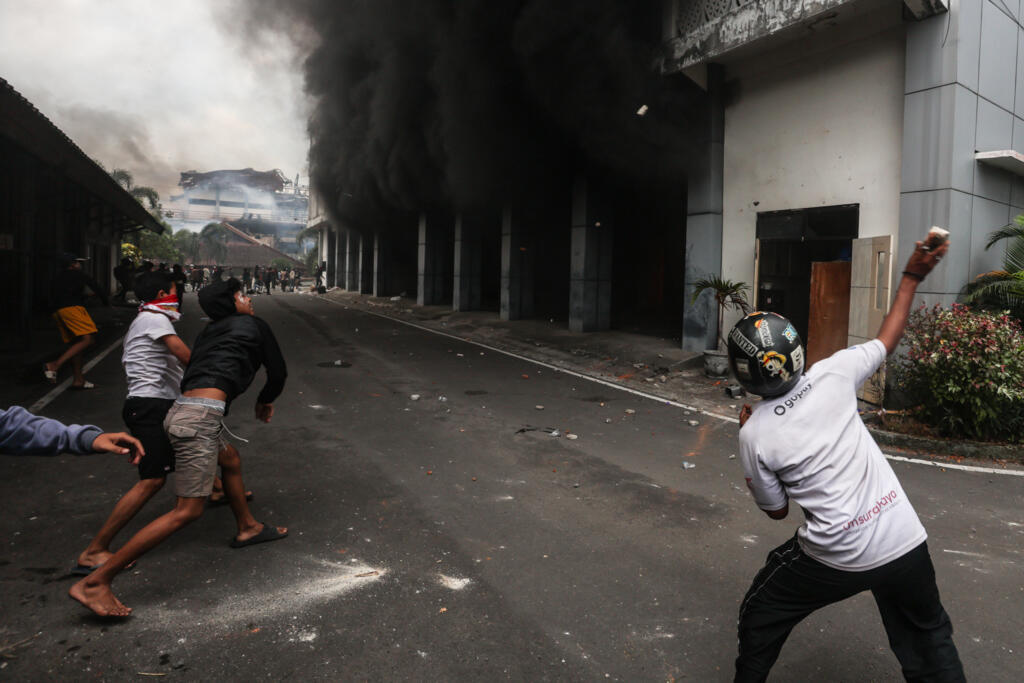
It has not been confined to capital Jakarta either, with local and provincial council buildings set on fire or attacked with rocks and Molotov cocktails in cities across the country.

'Govt fails to deliver'


Prabowo had already faced smaller protests in February over widespread budget cuts to fund populist policies, including a billion-dollar free meal programme and new sovereign wealth fund Danantara.

"The budgets that were supposed to be utilised by other sectors are being diverted to popular programmes which most likely still have many problems," said Jahen Fachrul Rezki, an economic researcher at the University of Indonesia.

Around 42,000 people were also laid off between January and June, a 32 percent rise on last year, according to the Ministry of Manpower.

"It might be true that our economy is expanding, but who's benefiting from the growth? Probably just capital owners," Jahen said.

A cost-of-living crisis is being felt by many as the country struggles with a shrinking middle class and slower income growth compared to rising prices because of inflation, according to Jahen.

"The government claimed that we have an increase of rice supply, but it is not reflected in the price," he said.

According to Statistics Indonesia on Monday, the price of the staple good increased by more than six percent on last year.

The number of people living below the poverty line in metropolitan Jakarta -- a megalopolis of around 11 million people -- was up from 362,000 in 2019 to 449,000 as of September 2024, government data says.

"The government initially promised during the campaign that there would be job opportunities, education, and no more layoffs," said Nailul. "But the government fails to deliver."

'A matter of time'


One of Prabowo's early moves was to announce Indonesia would hike its value-added tax to 12 percent, before reversing after a backlash and saying it would only apply to luxury goods.

Protesters throw stones at a local council building on Lombok island 
© STR / AFP


"It is neither feasible nor wise for the government to raise VAT rates when people's purchasing power is declining," said Nailul.

The death of the delivery driver, Affan Kurniawan, also stoked anger because workers like him have faced bigger pay deductions and longer working hours due to the economic situation.

Such conditions mean many Indonesians will still feel the economic pain in the coming months, leaving the door open for fresh protests.

"The protests on the streets probably will come down in the next few days, but it's just a matter of time until public anger resurfaces again," said Ray Rangkuti, political analyst at think tank Lingkar Madani.

"Because we're not addressing the issues, we're just covering them up," Rangkuti added.

© 2025 AFP


Military deployed in Indonesia's capital as thousands protest lavish perks for lawmakers

The military were deployed in Indonesia's capital, Jakarta, on Monday as thousands of demonstrators took to the streets across the country to take part in increasingly volatile protests against lavish housing allowances for MPs. Six people have been killed since the demonstrations began over a week ago, with protestors calling for parliamentary reform.


Issued on: 01/09/2025 -
By: FRANCE 24


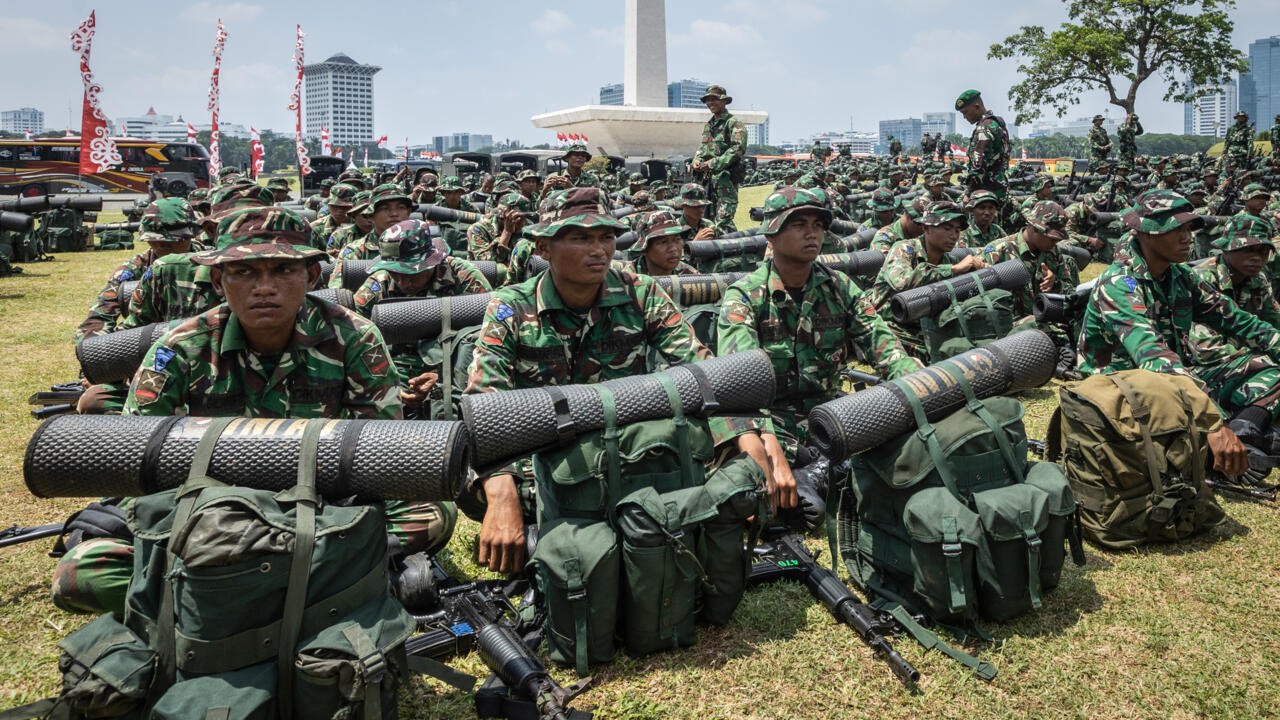
Indonesian soldiers wait for orders in Jakarta as hundreds protested outside parliament.
 © Kristianto Purnomo, AFP

Thousands rallied across Indonesia Monday as the military was deployed in the capital after six people were killed in nationwide protests sparked by anger over lavish perks for lawmakers.

At least 500 protesters gathered outside the nation's parliament in Jakarta, watched by soldiers and police throughout the day, before dissipating after President Prabowo Subianto warned protests should end by sundown.

But elsewhere protests were more volatile. In Gorontalo city on Sulawesi island protesters clashed with police, who responded with tear gas and water cannon, according to an AFP journalist. In Bandung on the main island Java, protesters hurled Molotov cocktails and firecrackers at the provincial council building.

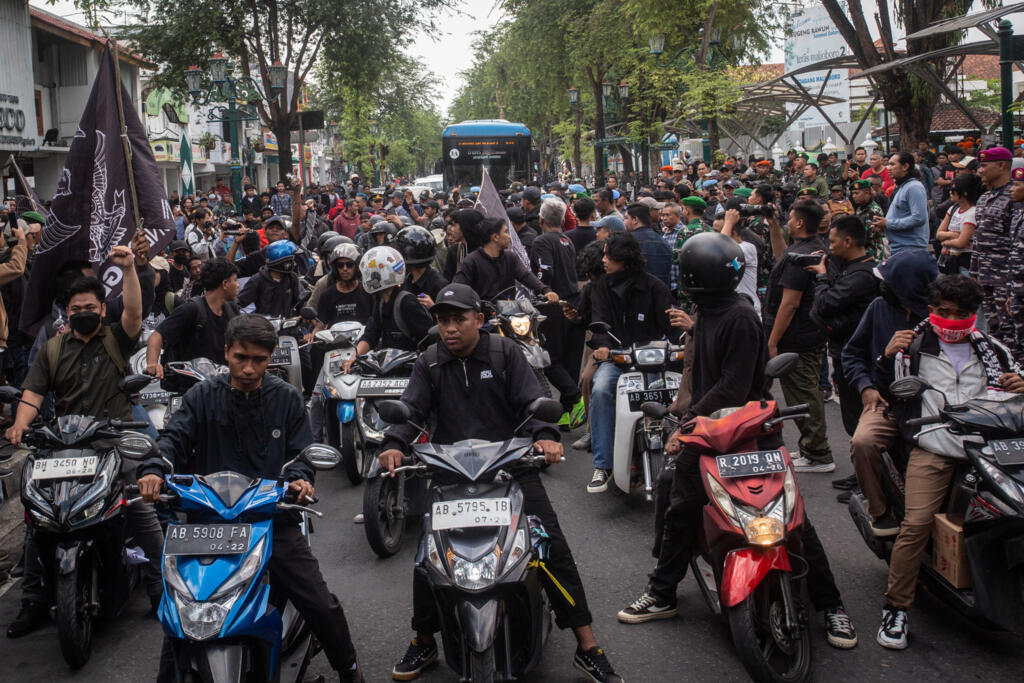
Thousands more rallied in Palembang on Sumatra island and hundreds gathered separately in Banjarmasin on Borneo island, Yogyakarta on the main island of Java and Makassar on Sulawesi, according to AFP journalists around the country.

"Our main goal is to reform the parliament," protester and university student Nafta Keisya Kemalia, 20, told AFP outside parliament before the protest ended.

"Do they want to wait until we have a martial law?"

The deadly protests, which began last week over MP housing allowances nearly 10 times the minimum wage in Jakarta, have forced President Prabowo Subianto and parliament leaders to make a U-turn over the perks.

Demonstrations began peacefully, but turned violent against the nation's elite paramilitary police unit after footage showed one of its teams running over 21-year-old delivery driver Affan Kurniawan late Thursday.

Protests have since spread from Jakarta to other major cities, in the worst unrest since Prabowo took power less than a year ago.

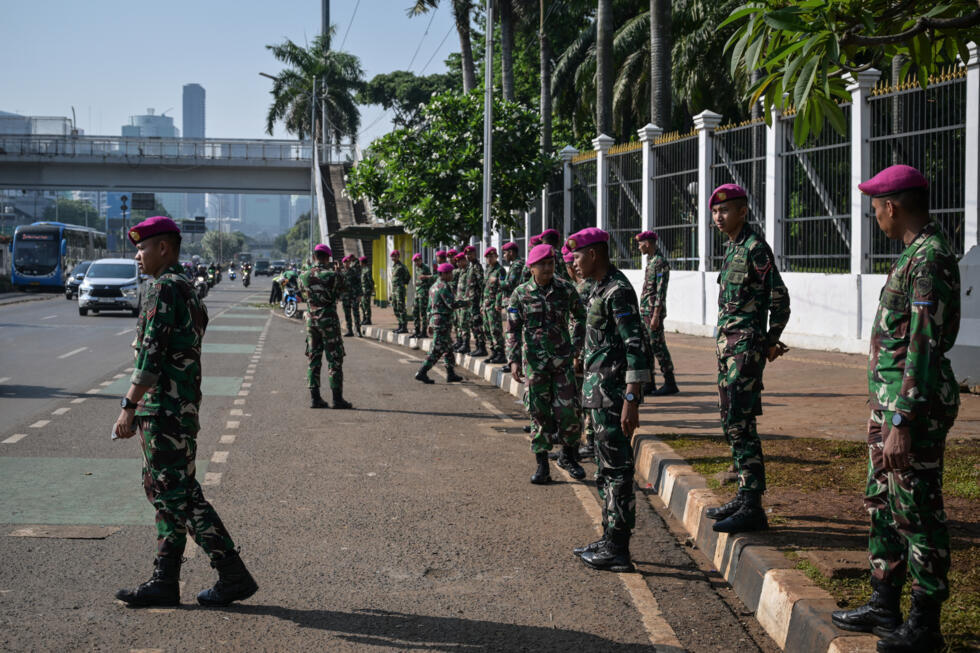
Police set up checkpoints across the capital on Monday, while officers and the military conducted city-wide patrols and deployed snipers in key locations, while the usually traffic-clogged streets were quieter than usual.

Marines secure positions along a street outside the parliament in Jakarta
 © Bay Ismoyo, AFP

At least one group, the Alliance of Indonesian Women, said late Sunday it had cancelled its planned protest because of heightened security.

Schools and universities in Jakarta were holding classes online until at least Tuesday, and civil servants based in the city were asked to work from home.

On Monday Prabowo paid a visit to injured police at a hospital where he criticised protesters.

"The law states that if you want to demonstrate, you must ask for permission, and permission must be granted, and it must end at 6pm," he said.
Looting

Experts said Prabowo's U-turn in a speech on Sunday and parliament's gesture to revoke some lawmaker perks may not be enough to dispel the unrest.

"The Indonesian government is a mess. The cabinet and parliament will not listen to the people's pleas," 60-year-old snack seller Suwardi, who like many Indonesians goes by one name, told AFP near parliament.

A car burns after being set ablaze during a protest against the Mobile Brigade Corps, or 'Brimob' in Jakarta. © Aditya Aji, AFP


"We have always been lied to."

The Indonesian stock index fell more than 3 percent at the open on Monday after the weekend unrest rattled markets.

Deep-rooted anger against police drove protests on Friday after footage of the van hitting Affan went viral. Seven officers were detained for investigation.

On Monday Agus Wijayanto, head of the accountability bureau at the National Police, told reporters an investigation had found criminal acts committed by two officers – the driver of the van and the officer next to him.

They "could be dishonourably discharged", said Agus.

The crisis has prompted Prabowo to cancel a trip to China this week for a military parade commemorating the end of World War II.


Protests have spread beyond Jakarta to cities across Java and other islands.
 © Juni Kriswanto, AFP

In recent days the finance minister's house was pillaged and several lawmakers have reportedly had their houses ransacked.

At least three people were killed after a fire Friday started by protesters at a council building in the eastern city of Makassar, while a fourth was killed by a mob in the city in a case of mistaken identity. Another confirmed victim was a student in Yogyakarta, who died in clashes.

In anticipation of further unrest, TikTok on Saturday suspended its live feature for "a few days" in Indonesia, where it has more than 100 million users.

(FRANCE 24 with AFP)


Prabowo: Stop State Violence, Revoke Parliamentarians’ Facilities and Allowances, End Repression Against Mass Action, Provide Justice for Victims

Statement of Position by the Indonesian Women’s Alliance (API)


Sunday 31 August 2025, by Indonesian Women’s Alliance (API)


The death of Affan Kurniawan, an online motorcycle taxi driver who participated in mass action and was run over by security apparatus vehicles, cannot be viewed as an isolated incident. This event is part of the face of systematic state violence; the apparatus is used to silence the people’s voices with impunity that continues to be allowed.


Today’s wave of popular anger is an accumulation of disgust over reckless policies and the arrogance of state officials. Basic commodity prices are rising, taxes are increasingly strangling, unemployment queues continue to grow, mass redundancies, seizure of customary lands, children victims of MBG poisoning. [1] When the people bear the suffering caused by the state, instead of showing empathy, DPR [2] members who are supposedly people’s representatives, together with officials, are instead having lavish parties in luxury, enjoying allowances, facilities, and soaring salaries. Not only that, the DPR and government also give awards to relatives and colleagues, even allowing officials to hold concurrent positions as BUMN [3] commissioners with abundant facilities.

In the field, people who dare to voice their disappointment and anger are instead faced with brutal repression from the state apparatus. Hundreds of people are arbitrarily arrested, beaten, and treated inhumanely. Tear gas is fired indiscriminately, even directed at places of worship and medical teams carrying out humanitarian duties. This situation not only threatens the safety of action participants, but also shows how the apparatus abandons its basic obligation to protect civilians. Women and students who are at the forefront of action are also not spared from violence; they experience intimidation, beatings, and discriminatory treatment simply for daring to express their opinions. All these repressive actions confirm that the state prefers the path of violence rather than opening democratic dialogue space.

The face of state violence is also visible in many regions: the transfer of Papuan political prisoners to Makassar, [4] agrarian and natural resource conflicts in Rempang, [5] Sulawesi, North Maluku, to the expanding military territory in civilian areas. The state chooses a violent approach rather than opening dialogue space with the people.

This reflects the characteristics of Prabowo’s government which is very militaristic, anti-women, and not pro-people. Prabowo [6] as the person responsible for governance perpetuates a culture of violence by adding battalions, kodams, [7] kodims, [8] and so forth to build defensive fortifications to crush people’s resistance demanding justice and to smooth the way for National Strategic Projects. Prabowo, with his empty efficiency rhetoric, chooses to suppress budgets related to people’s welfare and instead increases allowances for the DPR that does not perform its duties properly. When people protest, Prabowo is busy distributing honorary stars including to former corruption convicts.

This condition is a political and humanitarian crisis! The state that should protect is instead harming. The DPR that should represent and voice the people’s interests has instead become part of the oppression machine. Indonesian democracy is increasingly wounded!

Today the state is no longer ashamed to display the silencing of democracy. Sadistic and brutal repression is carried out openly, targeting people who voice loud rejection of discriminatory policies. The state continues to widen the gap of social and economic inequality with various policies that are not pro-people and have adverse impacts on the lives of women, disability groups, indigenous peoples, and vulnerable groups.

Therefore the Indonesian Women’s Alliance demands:

Prabowo must be held responsible for all violence against the people!
Justice for Affan Kurniawan and all victims of apparatus violence.
Remove the National Police Chief and Regional Police Chiefs for failing to make POLRI [9] an institution to perform the function of maintaining public security and order, enforcing law and maintaining protection and service to the community.
Release the names of apparatus perpetrators, monitor the legal process to completion, and stop impunity for human rights violators.
Comprehensive Police reform.
Eliminate the militaristic culture full of violence.
Stop the use of weapons, tear gas, war equipment and other tools against the people.
Stop the use of violence or unfounded arrests against mass action, students, women, indigenous peoples and vulnerable groups.
Revoke excessive facilities and allowances for DPR and state officials.
Revoke special facilities for DPR and state officials.
Open dialogue space by meeting and accommodating people’s voices in all regions.
Dismiss DPR members who do not carry out the constitutional mandate.
Reform taxation policies.
Stop tax increases that increasingly burden the people without considering the socio-economic conditions of society, especially vulnerable groups.
Open transparency to the public on the use of state budget allocation from taxes.
Stop oligarchy and the practice of holding multiple positions.
Reject the practice of state officials holding concurrent positions in BUMN.
Create a transparency portal so the public can monitor officials’ salaries and allowances.
Stop repression and open democratic space.
Support media independence to report facts without intervention.
Stop blocking and wiretapping on communication platforms and social media.
Stop criminalisation and violence against people who dare to speak out.
Evaluate government programmes and performance as well as ministry bureaucracy that does not side with the people, is not thorough in realising pro-people policies, does not function in preventing human rights violations that are actually committed by state institutions whilst consuming the state budget.

Therefore We, the Indonesian Women’s Alliance, state our position:

Demanding President Prabowo Subianto’s responsibility for the continuing state violence.
Strongly condemning repressive actions by the apparatus and demanding full justice for victims.
Urging the DPR as servants of the people to work according to the constitutional mandate, not to enrich themselves with excessive allowances and facilities.
Rejecting problematic programmes and projects that drain the APBN [10] without providing real benefits to the people.
Rejecting impunity and bringing to justice perpetrators of Human Rights violations.
Demanding unconditional release for mass action participants detained throughout Indonesia.

Together with the Indonesian Women’s Alliance:

Aliansi Perempuan Bangkit
Aneta-Papua
Artsforwomen Indonesia
Arus Pelangi
Asosiasi LBH APIK Indonesia
Betina issue (North Sulawesi)
Cakra Wikara Indonesia
Emancipate Indonesia
FAMM Indonesia
Federasi Serikat Buruh Persatuan Indonesia (FSBPI)
FeminisThemis
Forum Pengada Layanan
FPPI
Gema Alam NTB
Girl, No Abuse – Makassar
Y2F Media
WCC Puantara
ICJR
Ikatan Pemuda Tionghoa Banten
INFID
Institut KAPAL Perempuan
Jaringan Advokasi Nasional Pekerja Rumah Tangga (JALA PRT)
Jaringan Akademisi GERAK Perempuan
JASS
Kaoem Telapak
Kartini Manakarra
Kelas Muda
Koalisi Perempuan Indonesia
Koalisi Perempuan untuk Kepemimpinan (KPuK)
Kolektif Semai
Komunitas Empu Fesyen Berkelanjutan
Komunitas Feminis Gaia, Yogyakarta
Konsorsium PERMAMPU – Sumatera
Konde.c0
LBH APIK Jakarta
LBH Kalbar
Migrant CARE
Muslimah Reformis, Tangsel
OPSI
Peace Women Across the Globe network
Pamflet Generasi
Perempuan Mahardhika
Perempuan Mahardhika Palu
Perempuan Melawan (Aliansi Tolak Reklamasi Manado Utara)
Perempuan Solipetra (Petani Penggarap Kalasey Dua) North Sulawesi
Perhimpunan Jiwa Sehat
Perhimpunan Rahima
Perkumpulan DAMAR Perempuan Lampung
Perkumpulan Gemawan
Perkumpunan Kecapi Batara Indonesia
Perkumpulan Lintas Feminis Jakarta
Perkumpulan Samsara
Perkumpulan Sawit Watch
PHD PEREMPUAN AMAN LouBawe
Proklamasi Anak Indonesia
Rifka Annisa WCC Yogyakarta
Rumah Pengetahuan Amartya
Save All Women and Girls (SAWG)
Second Chance
Serikat Buruh Industri Perawatan Taiwan (SBIPT)
Serikat Buruh Migran Indonesia
Serikat Pekerja Kampus (SPK)
Solidaritas Feminis West Papua
Solidaritas Perempuan
Serikat Pekerja Kampus
Support Group and Resource Center on Sexuality Studies (SGRC) Indonesia
Suara Ibu Indonesia
Lembaga Pengembangan Sumber Daya Mitra (LPSDM NTB)
OPSI
Warga Humanis
Women’s March Jakarta 2025
YAPPIKA
Yayasan Gemilang Sehat Indonesia
Yayasan IPAS Indonesia
Yayasan Kalyanamitra
Yayasan Keadilan dan Perdamaian Indonesia
Yayasan Kesehatan Perempuan
Yayasan Penabulu
Yayasan Srikandi Sejati (YSS)

Contact persons:

Nabila – 0896-9368-0646
De – 0851-5875-5180
Ajeng – 0811-1313-760

29 August 2025

Source: Perempuan Mahardhika by Wendy Lim.

P.S.


If you like this article or have found it useful, please consider donating towards the work of International Viewpoint. Simply follow this link: Donate then enter an amount of your choice. One-off donations are very welcome. But regular donations by standing order are also vital to our continuing functioning. See the last paragraph of this article for our bank account details and take out a standing order. Thanks.

Attached documentsprabowo-stop-state-violence-revoke-parliamentarians_a9149.pdf (PDF - 935 KiB)
Extraction PDF [->article9149]

Footnotes


[1] MBG refers to the mass food poisoning incident that affected schoolchildren in Indonesia.


[2] DPR (Dewan Perwakilan Rakyat) is Indonesia’s House of Representatives, the lower house of parliament.


[3] BUMN (Badan Usaha Milik Negara) are state-owned enterprises.


[4] Papua refers to Indonesia’s easternmost provinces, where there has been ongoing separatist conflict and human rights concerns.


[5] Rempang is an island in the Riau Islands province where there have been disputes over development projects affecting local communities.


[6] Prabowo Subianto Djojohadikusumo[a] (is an Indonesian politician, businessman and military officer, president of Indonesia since 2024.


[7] Kodam (Komando Daerah Militer) are regional military commands.


[8] Kodim (Komando Distrik Militer) are district military commands


[9] POLRI (Kepolisian Negara Republik Indonesia) is the Indonesian National Police


[10] APBN (Anggaran Pendapatan dan Belanja Negara) is Indonesia’s national budget


Indonesian Women’s Alliance (API)


International Viewpoint is published under the responsibility of the Bureau of the Fourth International. Signed articles do not necessarily reflect editorial policy. Articles can be reprinted with acknowledgement, and a live link if possible.
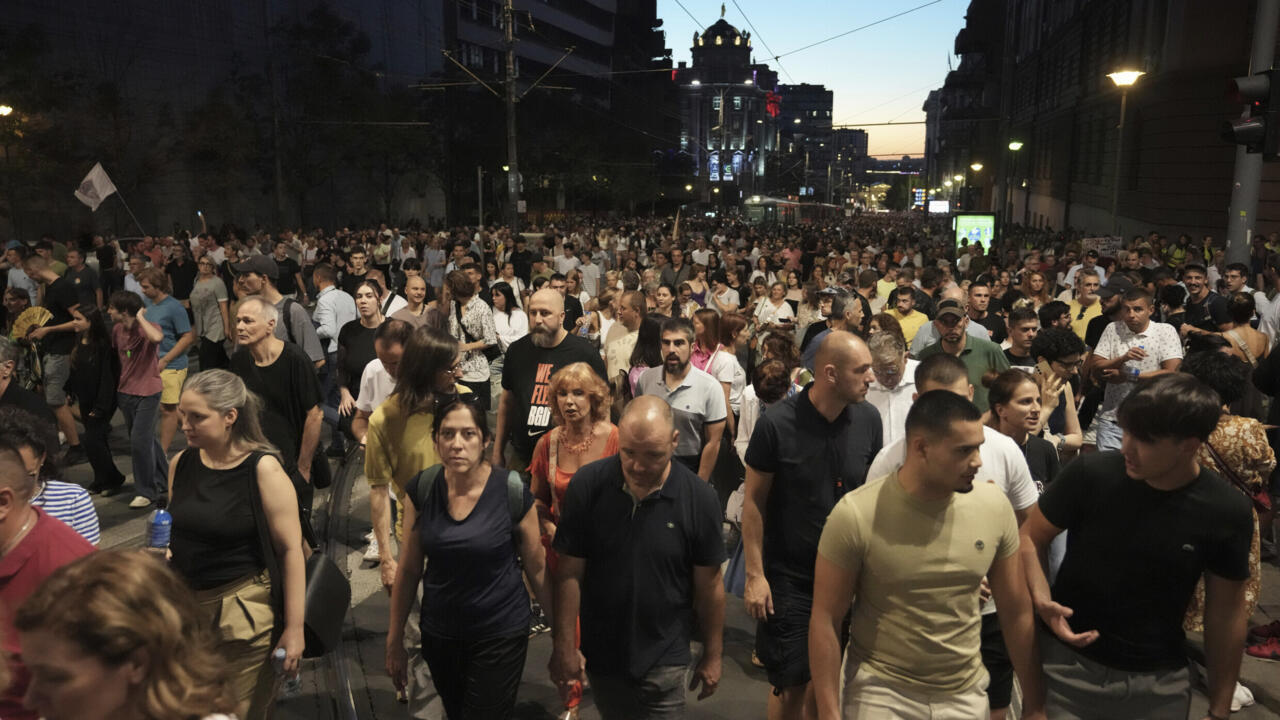
Serbia's student demonstrators march in silent anti-graft protest

Thousands of students joined a silent march through Belgrade on Monday to denounce entrenched corruption and calling for new elections. Monday's demostrations were largely peaceful, unlike ones in mid-August which degenerated into violence.


Issued on: 01/09/2025 - 
By: FRANCE 24

Protestors attend an anti-government rally pressing for an early election after ten months of almost daily anti-corruption demonstrations in Serbia, on September 1, 2025. 
© Darko Vojinovic, AP

Thousands of high-school students marched through Serbia's capital on Monday, the latest in months of demonstrations denouncing graft that have piled pressure on President Aleksandar Vucic.

The rally – conducted in silence – passed off peacefully, unlike ones in mid-August that degenerated into violence from what protesters said was heavy-handed tactics by government loyalists and police.

The regular demonstrations started over a fatal train-station roof collapse 10 months ago.

The November 2024 tragedy, which killed 16 people in the northern city of Novi Sad, quickly became a symbol of entrenched corruption in the Balkan nation.

While they have led to the resignation of the prime minister and the collapse of his government, Vucic has remained defiantly in office, at the helm of a reshuffled administration.

He has so far brushed off demands for early elections, and alleges the demonstrations are part of a foreign plot.

Ten months


"Ten months is an enormous period of time, and nothing has changed. Not a single thing. Not one person has been held accountable" for the rail-station collapse, 18-year-old Lazar, a final-year high school student from Belgrade, told AFP.

The protest he marched in featured no slogans but was marked by the symbolic silence in memory of the victims.

"We remember the tragedy, we demand accountability, we fight for a better country. We do not look away. Together until the end," students wrote on Instagram.

Protesters also held commemorative marches in the cities of Kragujevac and Novi Sad.

Earlier, dozens of students had assembled outside Novi Sad train station, the site of the tragedy.

Police estimate that there have been approximately 23,000 gatherings of varying sizes nationwide since the protest movement began.

The largest of the demonstrations have drawn hundreds of thousands of people.

Authorities have rejected allegations of brutality, despite videos in mid-August showing officers beating unarmed protesters and accusations that activists were assaulted while in custody.

Since then, the gatherings in recent weeks weeks have been largely calm.

(FRANCE 24 with AFP)
ANTI-TRANS HYSTERIA

Algerian boxer Imane Khelif appeals World Boxing ban over mandatory sex testing

Algerian boxer Imane Khelif appealed to the Court of Arbitration for Sport on Monday to overturn World Boxing’s decision blocking her participation from upcoming events unless she undergoes genetic sex testing. The athlete sparked a gender eligibility uproar at the 2024 Paris Olympics, where she won gold.


Issued on: 01/09/2025 - 
By: FRANCE 24


Algerian gold medallist boxer Imane Khelif speaks in Doha on December 7, 2024. © Karim Jaafar, AFP

Algeria's Olympic gold medallist Imane Khelif has appealed to sport's highest court against a World Boxing decision barring her from upcoming events unless she undergoes genetic sex testing, Court of Arbitration for Sport (CAS) said on Monday.

The appeal seeks to overturn the ruling and allow Algeria's Khelif to compete at the 2025 World Boxing Championships without having the test, the Court of Arbitration for Sport said in a statement, adding that it had dismissed her request to suspend the decision while the case is heard.

"The parties are currently exchanging written submissions and, with their agreement, a hearing will be scheduled," CAS added.

Khelif took gold in the women's welterweight division at the Paris Games last year amid a gender dispute over her eligibility after she was disqualified from the 2023 World Championships by the International Boxing Association, which said sex chromosome tests had ruled her ineligible.


However, the Algerian competed in the women's category in Paris after the International Olympic Committee stripped the IBA of its status as the sport's governing body in 2023 and took control of organising boxing in Paris.

World Boxing, which will oversee the sport at the 2028 Olympics, introduced mandatory sex testing for all boxers in its competitions in May, adding that Khelif would not be allowed to compete until she underwent such a test.

World Boxing President Boris van der Vorst later apologised over Khelif being named in the announcement, saying her privacy should have been protected.

Khelif was due to compete in a World Boxing tournament in the Netherlands in June, but opted to skip it.

The 26-year-old has repeatedly said she was born a woman and has a long history in female boxing competitions. In March, she said she would defend her title at the 2028 Games.

(FRANCE 24 with Reuters)
STATE VIOLATES HUMAN RIGHTS

Burkina Faso's junta passes law banning homosexuality


Burkina Faso's ruling junta on Monday unanimously passed a law banning homosexuality as part of a wider reform of family and citizenship legislation. The new law, which aligns with a broadening crackdown on homosexuality across Africa, provides for sentences of up to five years in prison as punishment for being gay.


Issued on: 02/09/2025 -
By: FRANCE 24


Burkina Faso's junta leader Captain Ibrahim Traore attends a meeting with the Russian president in Moscow on May 10, 2025. © Angelos Tzortzinis, AFP

Junta-run Burkina Faso has passed a law banning homosexuality and instituting punishments of up to five years in jail, the latest in a clutch of African nations to pass anti-gay legislation.

Homosexuality is illegal in around 30 African countries but was not banned in Burkina Faso before the military seized power three years ago.

The draft law was unanimously adopted by 71 unelected members of a transitional parliament in place since two coups in 2022 in the West African nation.

"The law provides for a prison sentence of between two and five years as well as fines," Justice Minister Edasso Rodrigue Bayala said on national broadcaster RTB.


"If a person is a perpetrator of homosexual or similar practices, all the bizarre behaviour, they will go before the judge," he said, adding that foreign nationals would be deported under the law.


The law is part of a wider reform of family and citizenship legislation and will be "popularised through an awareness campaign", officials said.

Mali, an ally of Burkina Faso and also ruled by a junta, adopted a law criminalising homosexuality in November 2024.

Ghana and Uganda have toughened their anti-homosexuality laws in recent years, weathering huge criticism.


A Ugandan law adopted has provisions making "aggravated homosexuality" a capital offence and imposes penalties for consensual same-sex relations of up to life in prison.

(FRANCE 24 with AFP)


Gaza post-war plan proposes ‘voluntary' relocation, ‘tokens’ in exchange for land, US media reports

19TH CENTURY SCRIPT PAID TO NORTH AMERICAN INDIGENOUS PEOPLES FOR THEIR LAND & THEIR MOVE TO RESERVATIONS

A post-war plan for Gaza circulating within President Donald Trump's administration envisions a "voluntary relocation" of the population to build a tourist and manufacturing hub that will be overseen by the US for at least 10 years, the Washington Post reported Sunday. The 38-page plan offers Gaza land owners a "digital token" in exchange for property development rights.


Issued on: 31/08/2025 - 
By: FRANCE 24


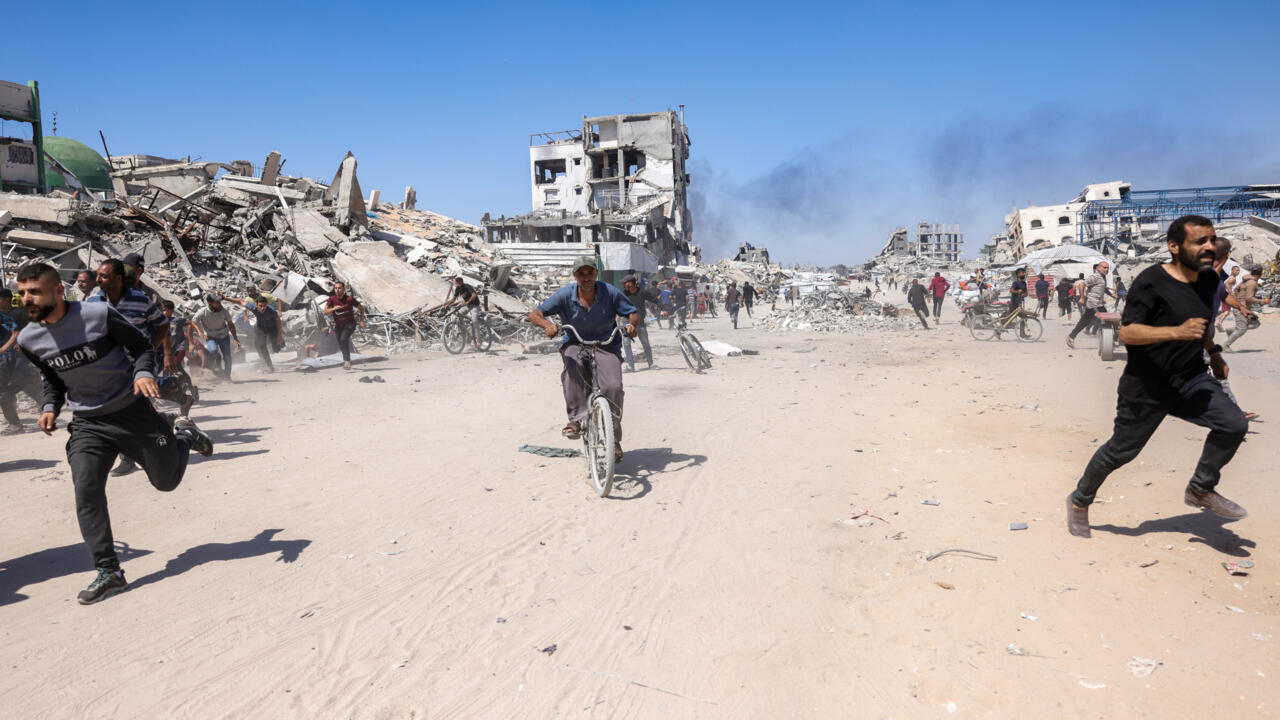
Palestinians run for cover during an Israeli drone strike in northern Gaza on May 23, 2025. © Bashar Taleb, AFP (File)
01:42


The entire population of Gaza would be relocated and the United States would take control of the Palestinian territory under a plan being considered by the Trump administration, the Washington Post reported Sunday.

The enclave reduced to rubble in Israel's war prompted by the Hamas attack of 2023 would be transformed into a trusteeship administered by the United States for at least 10 years, the newspaper said.

Another goal of the plan modeled on President Donald Trump's stated vision of making it the "Riviera of the Middle East" is to transform Gaza – land which the Palestinians want to be part of a future state – into a tourism resort and high tech hub, said the Post, which viewed a 38-page prospectus outlining the initiative.

It calls for at least temporary relocation of all of Gaza's population of two million, either through "voluntary" departures to another country or into restricted, secured zones inside the enclave during reconstruction, the newspaper said.

Gaza residents who own land would be given a digital token by the trust in exchange for the right to develop their property.


Recipients can use this token to start a new life somewhere else or eventually redeem it for an apartment in one of six to eight new "AI-powered, smart cities" to be built in Gaza, according to the plan.

The Post quoted people familiar with the trust's planning and with administration deliberations over postwar Gaza.

The State Department did not immediately reply to an AFP request for comment.

Trump stunned the world earlier this year when he suggested the United States should take control of the Gaza Strip, clear out all its people and build seaside real estate.

Israeli Prime Minister Benjamin Netanyahu praised the proposal, which was heavily criticized by many European and Arab states.

Trump chaired a meeting last week on postwar plans for Gaza but the White House did not release a read-out afterward or announce any decisions.

The body that would administer Gaza under the plan now being considered would be called the Gaza Reconstitution, Economic Acceleration and Transformation Trust, or GREAT Trust, said the Post.

The Post said the proposal was developed by some of the same Israelis who created the US- and Israeli-backed Gaza Humanitarian Foundation distributing food inside the enclave amid much criticism from aid groups and the United Nations.

On July 22, the UN rights office said Israeli forces had killed more than 1,000 Palestinians trying to get food aid in Gaza since the GHF started operations, nearly three-quarters of them in the vicinity of GHF sites.

(FRANCE 24 with AFP)