Tuesday, September 02, 2025


Germany urges Europe to stop China buying so much copper scrap


Europe needs to help its copper smelters by stemming “huge” flows of scrap metal to China, Germany’s Economy Minister Katherina Reiche said, potentially opening up a new front in trade tensions.

“The Chinese are buying copper scrap from the market in huge quantities,” Reiche said at a Siemens Energy AG event in Berlin on Monday. “Large German copper smelters are no longer getting any raw materials.”

The unease about shipping raw materials to China highlights a growing politicization of global commodities supplies, which has accelerated under US President Donald Trump’s protectionist agenda. Any European Union moves to stem supplies would add to trade issues — including China’s exports of electric vehicles — that have strained ties between Brussels and Beijing.


Reiche said there should be Europe-wide policies to ensure China cannot simply outbid European smelters to get scrap metal out of the region, without specifying what restrictions could be implemented. This topic should be part of a wider concept around resilience of European economies, she said.

China has boosted purchases of copper scrap over the past five years as its own smelters ramp up output and supplies of mined copper ore become more costly. But this year has seen an additional dynamic with China seeking supplies from many other countries after a collapse in direct scrap shipments from the US, typically the single biggest origin.

In the first seven months of the year, China took in about 204,000 tons of copper scrap from European Union nations, up 3.5% from a year earlier. Still, its supplies were still a relatively small part of China’s total imports, at about 15%.

Reiche also called for measures to promote mining of lithium and rare earths in Germany.


Codelco warns Chile’s copper output may stall at 5.5Mtpa


Copper cathodes at Gabriela Mistral mine. (Image courtesy of Codelco.)

Chile’s state-owned copper giant Codelco is warning that national production could stagnate at about 5.5 million tonnes per year as the industry faces mounting challenges.

Chairman Máximo Pacheco said at the Ecos de la Minería summit in Santiago the sector faces “enormous difficulties,” citing deeper mining operations, falling ore grades and rising costs. Chile is the world’s top copper supplier, and a prolonged plateau in output could tighten global markets just as demand from the energy transition accelerates.

Despite the challenges, Pacheco said Codelco is pressing ahead with upgrades and new ventures. He confirmed the company remains committed to a lithium partnership with SQM in the Salar de Atacama. He also said an exploration agreement with BHP (ASX: BHP) for the Anillo copper project will be signed this week, while a joint mining plan with Anglo American (LON: AAL) could be finalized in the coming weeks.

SQM President Gina Ocqueteau told local paper La Tercera she is optimistic the deal with Codelco will be ratified before Chile’s next government takes office in March. She noted the partnership’s details could be finalized sooner but warned delays would postpone revenues needed for government projects.

Two hurdles remain before the lithium deal can be sealed: completion of an indigenous consultation process and approval from China’s antitrust regulator, SAMR. Ocqueteau said the consultation, led by state agency Corfo, is well advanced. On SAMR, she noted “good news and a growing sentiment” but acknowledged concerns in Beijing over global lithium supply.

Awaiting minister’s blessing

Chile’s Energy and Mining Minister Aurora Williams confirmed the special contract underpinning the SQM-Codelco venture has already cleared reviews by the Comptroller General and state copper agency Cochilco. “The only thing left for us to do is sign it,” she said.

The contract sets terms for exploration, exploitation, environmental safeguards and economic conditions. It is slated to give Codelco majority control of SQM’s lithium production in northern Chile. If approved, it would cement a landmark partnership in one of the world’s most strategic lithium assets.

Some presidential contenders have said they would review the deal or scrap it altogether if it does not come through before President Gabriel Boric leaves office, putting pressure on his administration to finalize the key pillar of its vow to boost the state’s role in lithium production.


Damen Launches latest Island Class for BC Ferries

Damen Shipyards Group
The second in a series of four fully electric-ready ferries

Published Sep 1, 2025 10:33 PM by The Maritime Executive


[By: Damen Shipyards]

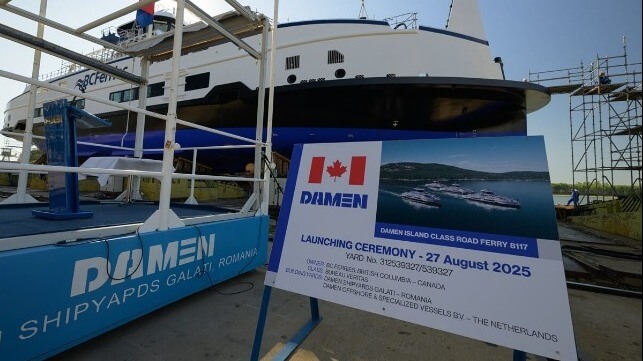
On 27 August, Damen Shipyards Group launched the latest Island Class ferry for Canada’s BC Ferries. The vessel is the second of four Island Class vessels currently under construction at Damen Shipyards Galati in Romania. Once operational, the ferries will provide low emission services connecting coastal communities along the coast of British Columbia.

Forward steps
When delivered, the ferry will be the eighth Island Class vessel that Damen has built for BC Ferries. The Island Class is based on the design of the Damen 8117 Electric Ferry (E3). The Galati shipyard has seen a lot of activity on all four Island Class vessels under construction over the past few weeks. In early July, the yard also marked the grand block assembly of the ninth vessel, and the keel laying of the tenth, on the same day.

These ferries will transport passengers between Nanaimo and Gabriola Island, and Campbell River and Quadra Island. Damen is outfitting the vessels with diesel-electric hybrid propulsion. In the future, once the relevant electrical infrastructure is in place, BC Ferries intends to operate the ferries on 100% electric power.

Long-term collaboration
Damen Executive Director Global Sales Leo Postma said, “There’s been a lot of movement on the various Island Class vessels over the past few months and it’s very exciting for our team to see progress unfolding at such a rate. We continue to enjoy an excellent cooperation with BC Ferries. We are very grateful for the quality of this relationship, which is undoubtedly a significant factor in the ongoing success of the project.”

Damen is also supplying BC Ferries with onshore charging equipment and will, via its BC-based Service Hub, continue to provide its client with support during the vessels’ operational phase.

A new generation
In a further step forward for sustainable public transport operations, the four Island Class vessels currently undergoing construction are being modified to reduce underwater radiated noise. Together, Damen and BC Ferries undertook a series of underwater noise measurements on the Island Class vessels already in operation. Damen, working with its suppliers, has put the findings from these measurements into reducing underwater radiated noise in this next generation of Island Class vessels. This is in line with BC Ferries’ Long Term Underwater Management Plan. The company has developed this Management Plan minimise impacts on marine life in the areas in which it operates, most notably the endangered Southern Resident Killer Whale.

Measures taken include hull drag reduction via towing tank testing after a number of computational fluid dynamics (CFD) simulations. Additionally, the adaptations were made to the vessels’ propulsion system including a new quieter and more efficient propeller blade design. A short video about the launch is available here.

The products and services herein described in this press release are not endorsed by The Maritime Executive.


Oil Exports Resume After 14 Years from Syria’s Tartus Port

oil tanker in Syria
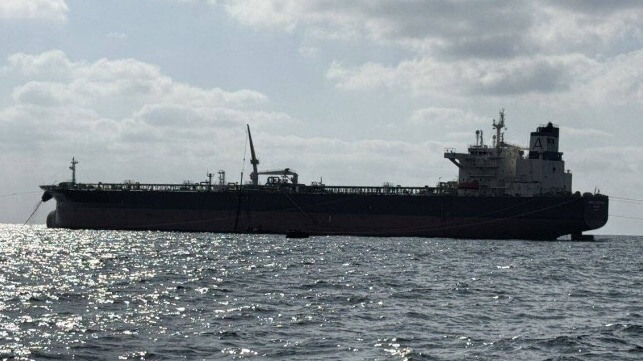
Nissos Christiana moored for loading Syria's first oil exports in 14 years (Syrian Energy Ministry)

Published Sep 2, 2025 11:38 AM by The Maritime Executive


The first cargo of Syrian crude oil to be exported from the port of Tartus since the Syrian civil war was lifted on September 1. The Greek-owned tanker Nissos Christiana (114,264 dwt), loaded 600,000 barrels of heavy crude oil according to the Syrian Ministry of Energy. The cargo has been purchased by BB Energy, a global oil-trading firm, for an unknown final customer.

The vessel, which was built in 2015, is managed by Kyklades Maritime and registered in Greece. According to its AIS signal, it has yet to depart Syria, but the Ministry is calling it an important step in revitalizing the oil sector and broadening international cooperation.


KURDS CONTROL OIL IN SYRIA AND IRAQ

Given the volume of oil lifted, most if not all the crude must have come from oil fields in Rojava, the Kurdish-controlled territory in the north east of Syria controlled by the Democratic Union Party (PYD). The PYD as part of its reconciliation with the new government in Damascus permitted oil exports to recommence in February, although supply may have been disrupted recently by renewed tensions between the PYD and the government.

In 2010, the last full year before production was disrupted, Syria exported a modest 380,000 barrels of oil per day. Shell had developed and operated the largest Syrian oil field in conjunction with government interests, but suspended production in 2011 when EU sanctions were imposed. The second-largest foreign operator was France’s Total, also government-tied.

The revival of Tartus as a crude export terminal comes as DP World has signed an $800 million agreement with the Syrian government under which it will develop and manage the port. DP World replaced the previous Russian operator OAO Stroytransgaz who had operated the port since 2019. 


The Russian Navy appears to have finally closed its links with Tartus, previously the supply and maintenance base for its Mediterranean Flotilla. Earlier this month, without docking the Russian Kilo Class submarine RFS Novorossiksk (B261) was active off Tartus for several weeks, the last remnant of the Mediterranean Flotilla still operating in the Mediterranean.

In an extraordinary reversal of fortunes, the open source analyst italmilradar has plotted what appears to be the imminent departure of the Novorossiksk and its accompanying Goryn Class tug Yakov Grebelskiy through the Straits of Gibraltar - which would mark the end of the permanent Russian presence in the Mediterranean - albeit further visits can be expected.


China is Set to Unveil a Full Set of New Hypersonic Missiles

A YJ-17 captured in low-resolution nighttime footage during preparations for the Beijing parade (Chinese social media)

Published Sep 1, 2025 9:48 PM by The Maritime Executive


China is set to unveil its new hypersonic anti-ship missile at a parade in Beijing to celebrate the 80th anniversary of the end of the Second World War. The YJ-17 has previously been kept under wraps.

The YJ-17, from the Eagle Strike missile family, is reported to be able to reach Mach 8, or over 6,000 mph, and to be able to hit targets at a range of 750 miles. It is believed to have an evasive maneuver capability in its terminal flight phase, and can be vertically-launched from ships.

The previously unseen YJ-17 has been seen alongside a number of other new recently introduced missiles in the mounting areas in Beijing where Wednesday’s parade is being rehearsed. These include the YJ-19 and YJ-20, both hypersonic anti-ship cruise missile, with the YJ-19 capable of being fired from ships.

The YJ-17 missile in particular - when operational on board Chinese ships - will be a new threat to US carriers operating in the Pacific, which the US Navy is seeking to counter by introducing new missile systems of its own. The AGM-158C LRASM long-range cruise missiles can be launched from carrier-borne aircraft. Block V Maritime Strike Tomahawk cruise missiles with a range of over 1,000 miles are programmed to be operationally-ready aboard US destroyers by the end of this month. Both the US Navy and the Air Force are also engaged in a rapid procurement project known as MACE to acquire a cheaper and longer ranged air-launched missile, capable of being launched from stealth aircraft. No doubt the effectiveness of US defensive anti-missile systems will also need to be reevaluated to determine if they are capable of dealing with the hypersonic closing speed of the YJ-17. Also part of the strategy to counter the developing threat is the use of forward islands in the western Pacific, from which the US Marine Indo-Pacific Long Range Fires Battalion can launch SM-6 based Typhon missiles, a tactic rehearsed during the recent Exercise Talisman Sabre in Northern Australia.

On the basis of equipment seen parked up for rehearsals, the 80th anniversary parade is likely to mark an uprating on China’s part of its aggressive stance towards the United States, Japan and Taiwan, probably also to be reflected in the speech which will be made by Chinese leader President Xi Jinping during the parade. Also attending the parade will be Russia’s President Putin and North Korean Supreme Leader Kim Jong-un.

As a political event, the parade will mark the revival of President Xi’s ascendancy, after a period when it was thought that internal opposition to his martial leanings had diminished his standing. A meeting of the Shanghai Co-operation Organization preceded the parade, attended by Indian Prime Minister Narendra Modi – a sign of an Indian-Chinese rapprochement amidst pressure from Washington - as well as leaders of two NATO countries, Recep Erdogan of Turkey and Robert Fico of Slovakia.


Royal Navy Uses Drone Deliveries for STS Transfers for the First Time

Drone delivery
Courtesy Royal Navy

Published Sep 1, 2025 10:05 PM by The Maritime Executive


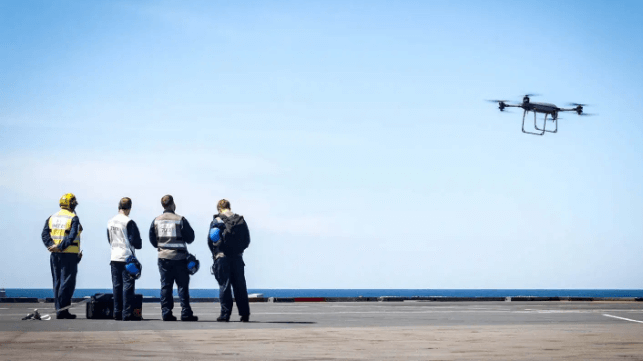
The Royal Navy carrier HMS Prince of Wales has debuted the service's first operational use of cargo drones for ship to ship transfers while on deployment to the Indo-Pacific. Prince of Wales and her crew used a Malloy T-150 quadcopter drone to transfer goods from the carrier to the destroyer HMS Dauntless, eliminating the need to use a helicopter or small craft for small-package flights. 

The drone flew a short one-mile transit from one ship to the other, and a crew aboard Dauntless guided it in for each landing. "This is a key milestone for the trial, achieved by all the hard work that everyone has put in. I’m proud to have achieved this first for the Royal Navy and excited to progress further over the duration of the deployment," said Lieutenant Matt Parfitt, 700X Pioneer Flight Commander.

The service has been experimenting with drone delivery services for a long time. Five years ago, the Royal Navy and Royal Marines began testing the Malloy T-150 for shoreside ammunition drops and combat supply deliveries during amphibious assault exercises, and also began work on testing the larger T-400 for bigger payloads. In 2023, a Royal Navy team trialed a much larger fixed-wing cargo drone for shore-to-carrier deliveries, the W Autonomous Systems HCMC, which has a payload of 100 kilos and a range of more than 850 nautical miles. The Malloy T-150 fills a sweet spot for small ship-to-ship transfers, and does not require a big deck for landing on each end of the trip. 

"This milestone in the Malloy trials is a step toward the vision of a fully integrated hybrid carrier air wing. By taking some of the logistics burden, Malloy will allow our naval helicopters to concentrate on their core outputs," said Captain Colin McGannity, Commander Air Group, UK Carrier Strike Group. "The really exciting bit is that we then plan to incorporate these lessons to be able to use UAVs for many other roles, including options for warfighting."


Russian Authorities Detained Sanctioned Tanker for Unpaid Crew Wages

tanker
Russian authorities detained a shadow fleet tanker for violations including unpaid crew wages (file photo)

Published Sep 2, 2025 1:02 PM by The Maritime Executive


A shadow fleet tanker that is currently sanctioned in the West was reportedly detained by the Russian authorities in the port of Murmansk due to a range of issues, including unpaid crew wages, reports the Russian Seafarers’ Union. The crew of the vessel raised concerns to the union, which says it referred the matter to the Murmansk port captain’s office.

The tanker named Unity (108,929 dwt) is typical of the shadow fleet. Built in 2009, it is reportedly being managed by a shipping company from the UAE. The ship is now showing a registry in Lesotho, having switched in August from Gambia. Databases show the vessel has changed names and flags four times since 2021, including twice in 2024 and briefly under the Russian flag from September 2024 to February 2025.

The union reports the 20-person crew is due nearly $90,000 as of August 13 in back pay. They only received their pay for June on July 27, and further said that the crew that had been signed off had also not received pay. The crew is also seeking compensation for sailing through a pirate danger zone and fines for late payments.

Concerns are being raised about the legal ownership of the vessel, saying that when its registry in Gambia expired on August 5, the vessel’s ownership was changed on the paperwork from Argo Tanker Group to Petroleum United FZCO. The concern is that some of the crew’s employment contracts are with Argo, and the insurance was also changed.

“Sailors fear that since the vessel has indeed changed its flag and registry company, all contracts on board are invalid, and they will not be able to apply to the P&I if the shipowner is unable to fulfill contractual obligations regarding the payment of wages,” said Olga Ananyina of the Russian Seafarers’ Union.

The port control inspection conducted in Murmansk on August 28 is reported to have confirmed numerous violations. The authorities detailed the vessel until the discrepancies were corrected. The AIS signal shows the vessel as underway on September 2, but it is suspect and could be spoofed.

The tanker has been sanctioned by the EU and UK, as well as Australia, Canada, and Switzerland, for its involvement in the Russian oil trade.

The union also reports that Argo Tanker Group, which is listed in databases with a mailing address in Moscow, was also cited by the authorities for failing to pay more than $130,000 to the crew of another tanker named Dignity. The 159,426 dwt tanker operates under the Russian flag, transporting oil from Murmansk, but so far has not been sanctioned. 

The Moscow Times reports a strong rise in late or unpaid wages across Russia. It cites government statistics that show the total amount due has doubled over the past year. As of the end of July, it was reported to be at nearly $13 million. The paper cited the high rate charged by the Central Bank as a key problem for businesses to take out loans to cover operating expenses.

More pay, but less union democracy - A complicated strike victory at Air Canada

CUPE SELLS OUT ITS MEMBERS, AGAIN

Tuesday 2 September 2025, by David Camfield


After an inspiring four days on strike, Air Canada flight attendants are now voting on a tentative agreement (TA) that offers significant gains in pay. To get the TA, however, union officials also agreed to sacrifice the workers’ right to reject the whole deal and fight for more. Canadian socialist David Camfield explains the unusual circumstances of this struggle—and the unusual deal that ended it.


Flight attendants at Air Canada (AC) and Air Canada Rouge, around 10,500 workers, went on strike from August 16 to early in the morning on August 19. The workforce is 70 percent women and mostly young—three-quarters of them have under five years of seniority. They are members of the Canadian Union of Public Employees (CUPE) because AC was once a federal Crown Corporation (a publicly owned company) that was then privatized.

Workers had been on strike for only a few hours when the Liberal federal government intervened. The jobs minister told the Canada Industrial Relations Board (CIRB), the federal labor board in whose jurisdiction workers in air transport fall, to direct the union to end the strike and order that the dispute be resolved through binding arbitration. This intervention was widely expected, since the Liberals have done this before on several occasions, using Section 107 of the Canada Labour Code.

On most of those occasions, union officials simply complied, but this time they didn’t. The workers stayed on strike.

CUPE National President Mark Hancock tore up the CIRB back-to-work order in front of a cheering crowd of strikers at Toronto’s Pearson Airport. The message from CUPE’s top officers and those of CUPE’s Air Canada component was clear: The only way the strike would be settled would be through negotiations. This was undisguised defiance of the order under Section 107, whose legitimacy CUPE officials rejected.

Hancock said he was willing to go to jail if that’s what it came to. This can happen. CUPE National President Grace Hartman did time in jail back in 1981 for not ordering Ontario hospital workers who were on an illegal strike to return to work, and Jean-Claude Parrot of the Canadian Union of Postal Workers was jailed in 1978 for not telling members to respect a back-to-work law passed to end a postal strike.

The strike was absolutely solid, which was no surprise because the strike authorization vote had been 99.7 percent in favor, with a 94.6 percent turnout. Flight attendants were strongly in support of the key union demands: significant wage increases to make up for all the erosion of the buying power of their wages under the previous contract—which had been a ten-year collective agreement!—and an end to the unpaid work that’d long been accepted in the industry. This work is just part of the job for flight attendants, who have only been paid for the time the plane is in the air, not for any time they spend on the plane while it’s on the ground, before or after a flight.

Although the strike completely grounded AC flights, and was disruptive for travelers, there was a lot of sympathy for the flight attendants. CUPE officials had laid the groundwork for this with effective public communications efforts focused on the issue of unpaid work. Members of other unions and other pro-union people started to join the picket lines. For many active union members, leftists, and, I think, lots of other working-class people, seeing Hancock tearing up the back-to-work order and insisting that the strike wouldn’t end until the union had negotiated an agreement was electrifying. For anyone who’s been dismayed by the federal government’s use of Section 107 to snuff out strikes and worried about how that gives the idea to provincial governments that they could add similar provisions to the provincial labor laws that cover about 90 percent of workers in the Canadian state, CUPE drawing a line against the back-to-work order was really inspiring.

The Canadian Labour Congress, the equivalent of the AFL-CIO in the U.S., put out a statement on August 17 demanding that the order be withdrawn. It pledged financial and other support for the strike, and “unwavering solidarity” if the government took legal action against CUPE. No surprise that it was vague about what action that commitment would translate into, but it was still unequivocal support for a law-defying strike. And it called on the government to pledge not to use Section 107 against a strike again and to remove that section from the law as soon as parliament next sits.

The strike continued into Monday, August 18, with bargaining suspended, but that evening it was announced that the union’s bargaining team would be meeting with Air Canada. Early in the morning on Tuesday, they announced a deal had been reached and the strike was over. CUPE’s statement made it sound like a great victory had been won:


Flight attendants at Air Canada and Air Canada Rouge have reached a tentative agreement, achieving transformational change for our industry after a historic fight to affirm our Charter rights. Unpaid work is over. We have reclaimed our voice and our power. When our rights were taken away, we stood strong, we fought back—and we secured a tentative agreement that our members can vote on.

That’s how most people who supported the strike are thinking about the outcome, but it didn’t take long before facts came out that paint a different picture.

The tentative agreement that flight attendants will be voting on only gives them a choice between ratifying the deal and rejecting it, in which case wages will be settled by arbitration, but everything else that was negotiated will end up in the collective agreement anyway. That’s not at all how the collective bargaining process works in the Canadian state. Unionized workers have the right to vote to accept or reject a tentative agreement in its entirety, unless binding arbitration is being used to determine outcomes. But in this case, very unusually, and because the CIRB had declared the strike was over in legal terms, workers have been presented with a ratification vote that doesn’t allow them to actually reject the deal. CUPE officials have agreed to a settlement that denies workers that right and prevents them from going on strike again to fight for a better deal in this round. They didn’t win a negotiated tentative agreement that workers could accept or truly reject, which would have treated the back-to-work order as a dead letter, let alone force a withdrawal of the order.
Workers have been presented with a ratification vote that doesn’t allow them to actually reject the deal.

As for what’s in the four-year tentative agreement, there are wage increases. For people with under five years of seniority, it’s 12 percent in the first year, and for the rest, it’s 8 percent. After that, it’s 3 percent, 2.5 percent, and 2.75 percent. And there is partial ground pay, for an hour or just over one hour per leg of a flight, depending on the width of the plane body, with percentages rising from 50 percent of the hourly pay rate this year to 70 percent in 2028. Those are gains, absolutely, but that doesn’t mean that unpaid work is over or that this is a transformational change.

The ratification vote is ongoing, from August 27 to September 6, online and by phone, and I expect that some won’t vote at all because of their disappointment, anger, and resignation from knowing that even if they reject the deal, they won’t be allowed to fight for a better one. But because expectations were high, maybe a majority will vote no. Although it’s hypothetically possible that flight attendants could reject the deal and then go on a wildcat strike that defies the law and their union officials, I don’t think that’s going to happen. There would have to be really strong organization among rank-and-file workers outside of the official union structure, with confident militant rank-and-file leaders, preconditions that seem doubtful right now.

All in all, I think the outcome is a partial and complicated win. Workers won real gains in pay, but they don’t have the right to reject a deal and fight for a better one. What’s happened seems unlikely to be a big deterrent to the federal government using Section 107 to end strikes in the future.

It’s worth pointing out that negotiating a deal that workers don’t have the right to actually reject had advantages both for the company and for CUPE officials. The company got a guarantee that the strike wouldn’t resume, and union officials got insulation against rank and file pressure to fight for a better deal and lead more strike action.

Also, the outcome of a deal that workers can’t genuinely reject is bad for union-building. It’s not democratic. It took the decision about whether the deal was good enough out of workers’ hands. This isn’t going to encourage the most militant workers who were really inspired by striking to get more involved in the union.

A bigger victory was definitely possible. Air Canada was completely grounded. They were losing a lot of money, so they were under a lot of pressure. Management was completely unprepared for what happened. They expected the federal government would intervene and then CUPE officials would tell workers to comply with a back-to-work order. During the strike, CUPE put out an online graphic with a quote from an interview that AC’s CEO Michael Rousseau did with BNN Bloomberg on August 18. Rousseau said, “Well, we thought, obviously, that Section 107 would be enforced, and that they wouldn’t illegally avoid Section 107.”

If the strike had gone on longer, I think CUPE could have won a much bigger win for flight attendants and for the working class as a whole. Even if they hadn’t forced the government to rescind the order, they could have won a deal with bigger gains that ignored the back-to-work order—a deal that workers could ratify or truly reject. That would have been an amazing precedent. And if there had been sympathy job action by any airport workers or any workers at WestJet, which is AC’s main competitor, like slowdowns, calling in sick, or not crossing picket lines, other employers would have been freaking out behind the scenes and leaning on AC to settle. I don’t know if any sympathy action would’ve happened if the strike had lasted longer, since it’s illegal and most workers today have no experience of doing it, but it’s not impossible that at least a little bit could have happened, especially if the government had moved to punish CUPE for defying the law.

So why did CUPE officials end the strike the way they did? For the top people at CUPE National, I think the main goal was to negotiate a settlement with some gains for flight attendants. They didn’t want to have everything decided by an arbitrator. After the government intervened, that was still their overriding goal. Winning a political victory against the use of Section 107 against strikes, which would have been a victory for the working class as a whole, was secondary. Once they forced AC back to the bargaining table, they dropped that objective and focused on the main goal.

Why did they do that? Above all, they’re committed to collective bargaining. That legally-regulated, tightly-controlled process is at the core of what the layer of full-time union officials, both elected officers and staff, do—that, along with handling grievances, which is how disputes over workers’ rights in collective agreements are dealt with in between rounds of collective bargaining.

I think the top leaders at CUPE have shown that they’re prepared to support militant action if that’s what it takes to preserve conventional collective bargaining. That makes them different from the heads of many other unions. Blatant government intervention with back-to-work orders and back-to-work legislation undermines conventional collective bargaining. So they’re sometimes willing to support workers challenging it or even lead that challenge, as they just did. They’re willing to sometimes use militant tactics to fight for goals that aren’t radical.

We need to remember that defying the law can lead to massive fines for unions. That can damage unions as institutions, even threaten their ability to operate. For the union officialdom of full-time officers and staff, that’s a different kind of problem than it is for rank and file union members, because they depend on the union machine in order to keep on functioning as officials. So once CUPE’s top officers saw a path to getting a deal that would end the strike and put an end to the threat of big fines or charges against them for defying the law, they went for it.

A knowledgeable CUPE person put it to me this way: “You have to hand it to National for playing their cards so well—they effectively posture as bold militants to the membership and public, while effectively containing struggles within status quo parameters. They get their cake and eat it too.”

This isn’t the first time they’ve done it. In 2022, when CUPE’s Ontario School Board Council of Unions (OSBCU) was in bargaining and then was hit with pre-emptive provincial legislation to stop them from striking, they defied the law and struck anyway. Organizing toward sympathy strikes to support OSBCU started to happen. As soon as the provincial premier said he’d withdraw the law if the strike ended, CUPE National officials and other union officials put pressure on the president of OSBCU to accept the offer and go back to bargaining without the power of striking workers and their many supporters as leverage. And that’s what happened.

From a distance, the outcome of the Air Canada strike can easily look like what CUPE National said it was. So lots of people probably think it was simply a tremendous win. That will encourage union activists to use it as a positive example. They can say, “Look, CUPE defied the law and won, that’s what we should prepare to do if we have to.” That’s good. It’s good that flight attendants showed you can have a strike that’s popular and that defies the law and wins, even though it causes inconveniences for lots of people. It’s good that Hancock tearing up the back-to-work order was all over the news.

But what actually happened wasn’t what it looks like from afar. To me, what happened confirms that we can’t rely on the union officialdom to fight to win in a consistent way, even when the officials are more militant. Union members who want unions that are really militant, democratic and solidaristic need to organize themselves on their own and work to change our unions. We need to build caucuses, groups of members who take to heart what the Clyde Workers’ Committee said in Scotland back in 1915: “We will support the officials just so long as they rightly represent the workers, but we will act independently immediately they misrepresent them.”

For more on this strike, check out episode 57 of the podcast Victor’s Children.

30 August 2025

Source Tempest.

Attached documentsmore-pay-but-less-union-democracy-a-complicated-strike_a9153.pdf (PDF - 922.9 KiB)
Extraction PDF [->article9153]

Canada
Lessons from the last federal elections: Towards the renewal of the status quo ante or the desperate search for an agreement with Trumpism
Trump’s Trade War and Canadian Workers
Trump, Europe and outraged virtue: malaise in imperial supremacism
Lives Yes, Pipelines No!
No return to ‘normal’ LGBT politics!
Trade unions/workplace organizing
Labour’s Polycrisis
Building grassroots trade unionism – Troublemakers
Protests follow arrest of union leaders in Panama
Polski Strajk: first strike amongst temporary workers, mainly Polish migrant workers, in AH and Jumbo distribution centres
Ukrainian union leader comments on U.S. left

David Camfield is a member of Solidarity Winnipeg and the author of We Can Do Better: Ideas for Changing Society.


International Viewpoint is published under the responsibility of the Bureau of the Fourth International. Signed articles do not necessarily reflect editorial policy. Articles can be reprinted with acknowledgement, and a live link if possible.

The People’s Champion: Howard Zinn


Go to school, but don’t become an educated dummy.

— Eddie Zinn to son Howard when he was a boy, Howard Zinn: A Life on the Left

Labor Day is a good time to pay tribute to the late Howard Zinn, a rebel historian who broke with the tedious orthodoxy of “patriotic” history to tell the tale of those consigned to the bottom of the social pyramid: Indians, slaves, factory workers, indentured servants, sharecroppers, farmers, immigrants, political prisoners, soldiers, socialists, pacifists and other anti-war protesters. His most famous work, A People’s History of the United States, has by now surpassed four million in sales, an unheard of success record for a history book.

Raised in grinding poverty, Howard grew up resenting smug media commentators, politicians, and corporate executives who talked of how in America riches were the inevitable reward of hard work. No matter how well this lie was told, it implied with insulting clarity that people who had not become rich could only blame themselves for lack of effort. Howard knew better from personal experience, that hard labor was the least rewarded, and certainly no ticket out of poverty. His father carried trays of food at weddings and restaurants for decades until a sudden heart attack ended his life at 67. He frequently had to borrow to make the rent and never had the means to retire.

Eager to rid the world of poverty for everyone, Zinn urged his students and readers to not only read history but also make it. He flatly refused to lead an uncommitted life, eagerly participating in protests, marches, and civil disobedience campaigns concerned with civil rights, economic and social justice, imperial war, and exploitation. In his early career he was a teacher at Spelman College, an all-black women’s school, where he was fired for his anti-Jim Crow politics; later he taught at Boston University, where his classes were so popular and so subversive of orthodoxy that president John Silber sought to limit participation in them, while denying Zinn salary increases at every opportunity.

Unlike the vast majority of professors, Zinn was more comfortable on a picket line than in most academic settings, where the urgency of class conflict was easily ignored or dismissed, though not by Zinn.

A revealing anecdote captures the spirit of the people’s historian better than any ponderous essay could even hope to. The year was 1970 and professor Zinn was due to appear in court in Boston for an act of protest he had engaged in. He chose to ignore his court obligation and participate in a Baltimore debate entitled, “The Problem of Disobedience,” which he had been invited to do. During the debate Zinn argued that the problem wasn’t civil disobedience, but obedience: “Our problem is the number of people across the world who have obeyed the dictates of the leaders of their governments and have gone to war, and millions have died from that obedience. Our problem is that people are obedient all over the world in the face of poverty and famine and stupidity and war and cruelty. That is our problem.” When he returned to Boston, two police detectives arrested him outside his classroom for violating his court date.

The anecdote reveals what Zinn thought about history, that it had much more to do with how we act than what we think, a conviction that encouraged his conclusion that change comes when masses of people realize this and mobilize to resolve their grievances directly. Elections and politicians don’t produce change, they react to it.

It shouldn’t surprise anyone to learn, therefore, that during the early days of Obama-mania a skeptical Zinn sounded a discordant note, warning that Obama would not implement change unless surrounded by a sufficiently powerful and persistent social movement forcing him to. “Our time and energy should be dedicated to educating, agitating, and organizing our fellow citizens at the workplace, in the streets, and at school,” Zinn said, pointing out that the great changes in the time of Lincoln, FDR, and the 1960s came about precisely because the American people rose up and took such responsibilities seriously in those years.

Unfortunately, these waves of popular agitation can’t last forever, although the next one is always already on the way. Zinn regularly reminded us of that, showing that history is made up of fortuitous surprises only detectable in retrospect. He liked to point out that when his colleagues in the 1950s used to lament the apparent lack of prospects for racial change due to the failure of Americans to mobilize, just in those moments small and isolated acts of rebellion and disobedience were occurring in the South, eventually converging and exploding into the Civil Rights Movement.

Given the way change actually happens, Zinn thought, progress should not rightly be seen as a gift handed down from above, but rather, as the hard fought reward for popular education and organizing over a period of years. Strikes, boycotts, soldiers refusing to fight, multitudes renouncing injustice and war, these signal the arrival of a better world.

Given his commitment to social change, Howard could not be satisfied with transmission of knowledge as a measure of his teaching success. “I wanted students to leave my classes not just better informed, but more prepared to relinquish the safety of silence, more prepared to speak up, to act against injustice wherever they saw it,” he said.

He rejected academic neutrality as a false standard. He believed in being as scrupulous as possible in adducing the facts, but did not feel objectivity was actually attainable. This was clearly a recipe for trouble, but submission to injustice was everywhere a permanent disaster.

Economic security for its own sake never interested Howard, who lived by the maxim that “risking your job is a price you pay if you want to be a free person.”

Daniel Ellsberg called Zinn “my hero,” while dissident intellectual Noam Chomsky held him in similarly high esteem: “There are people whose words have been highly influential, and others whose actions have been an inspiration to many. It is a rare achievement to have interwoven both of these strands in one’s life, as Howard Zinn has done. His writings have changed the consciousness of a generation, and helped open new paths to understanding history and its crucial meaning for our lives. He has always been on call, everywhere, a marvel to observe. When action has been called for, one could always be confident that he would be in the front lines, an example and trustworthy guide.”

Chomsky was also impressed by Zinn’s remarkable performance on the speaker’s platform: “What has always been startling to me . . . is Howard’s astonishing ability to speak in exactly the right terms to any audience on any occasion, whether it is a rally at a demonstration, a seminar (maybe quite hostile, at least initially) at an academic policy-oriented graduate institution, an inner-city meeting, whatever. He has a magical ability to strike just the right tone, to get people thinking about matters that are important, to escape from stereotypes and question internalized assumptions, and to grasp the need for engagement, not just talk. With a sense of hopefulness, no matter how grim the objective circumstances. I’ve never seen anything like it.”

Zinn had no use for history written without a social conscience behind it; or merely as a professional duty, if it was done only to get something published or get a university position, tenure, a promotion, or to earn prestige. He saw the profit system behind such shallow motives, making private gain the key to what gets produced while leaving a lot of valuable things unproduced, and many stupid things produced in great abundance. Most historians just play it safe and cash history in for their personal advantage. Howard refused to do that.

He knew that courting controversy went with the territory of being a good teacher, honest writer, and decent citizen. In an interview with David Barsamian he noted that long before the Nazis there was a European holocaust in the Americas, that “perhaps 50 million indigenous people or more died as a result of enslavement, overwork, direct execution and disease. A much higher toll even than the genocide of Hitler.”

Were Howard Zinn still with us today, there can be little doubt that he would be reminding us that the spectacle of two million Gazans being massacred or starved to death grotesquely insults any pretense of there being a human civilization in the world, and especially not in the United States and Israel, the countries most directly responsible for the unrestrained barbarism.

He would be on the front lines of the struggle to liberate Palestine.

Sources:

Howard Zinn, The Future of History – Interviews with David Barsamian, (Common Courage, 1999)

Howard Zinn (with David Barsamian), Original Zinn – Conversations on History and Politics, (Harper, 2006)

Howard Zinn, The Zinn Reader – Writings On Disobedience and Democracy, (Seven Stories, 1997)

David Detmer, Zinnophobia – The Battle Over History in Education, Politics, and Scholarship, (Zero Books, 2018)

Howard Zinn, You Can’t Be Neutral On A Moving Train – A Personal History,  (Beacon, 2022)

Martin Duberman, Howard Zinn – A Life on the Left, (New Press, 2012)

Howard Zinn, A People’s History of the United States, (HarperCollins, 2003)

“American curios / El historiador rebelde,” La Jornada (Spanish), August 29, 2022

Michael K. Smith is the author of Portraits of Empire. He co-blogs with Frank Scott at www.legalienate.blogspot.com He co-blogs with Frank Scott at www.legalienate.blogspot.comRead other articles by Michael.