Tuesday, September 02, 2025


Ukraine Urges China to Pressure Putin as War Overshadows SCO Summit

  • Ukraine called on China to take a more active role in pressuring Russia toward peace as Putin arrived in Beijing after the SCO summit.

  • Kyiv criticized the summit’s Tianjin Declaration for omitting any reference to the war in Ukraine.

  • European leaders plan to meet in Paris to discuss security guarantees for Ukraine, while Trump’s proposed trilateral peace summit remains uncertain.

Ukraine urged China to pressure Vladimir Putin to move toward peace as the Russian president arrived in Beijing following his participation in the Shanghai Cooperation Organization (SCO) summit -- where he defended the war that has killed tens of thousands of people.

"Given the significant geopolitical role of the People's Republic of China, we would welcome a more active role [for Beijing] in bringing peace to Ukraine based on respect for the UN Charter," Ukraine's Foreign Ministry said in a statement as Putin arrived in the Chinese capital on September 2.

The ministry statement noted that the SCO’s final declaration avoided mention of the conflict, which has become a full-scale war since Russia’s February 2022 invasion of Ukraine.

“We consider it eloquent that the main final document of the summit, the 20-page Tianjin Declaration, does not contain a single mention of the Russian war against Ukraine,” the statement said.

“It is surprising that the largest war of aggression in Europe since World War II was not reflected in such an important, fundamental document, while it mentions a number of other wars, terrorist attacks, and events in the world.”

It said the failure to mention Russia’s war in Ukraine in the declaration “indicates the failure of Moscow's diplomatic efforts.”

Ukrainian President Zelenskyy has consistently called on China -- a close ally of Russia -- to put pressure on Putin to end the war.

Another high-profile diplomatic event in China will be held on September 3 -- a massive military parade commemorating the 80th anniversary of the end of World War II. Many leaders -- including Putin -- are remaining in China after the SCO to attend the parade.

Putin Blames The West

At the SCO in Tianjin outside of Beijing, Putin sent a defiant message against the West over his invasion of Ukraine after standing shoulder-to-shoulder with Chinese leader Xi Jinping.

Putin said the war in Ukraine came about “not as a result of a Russian attack” but because of a Western-backed coup in Kyiv, according to comments carried by the Russian news agency TASS.

That was an inaccurate reference to the Maidan protests that pushed Moscow-friendly Ukrainian President Viktor Yanukovych from power in 2014, after he scrapped plans for a trade agreement with the EU and turned toward Russia instead.

Putin added that what he called the West’s attempts to draw Ukraine into NATO posed a "direct threat to Russia’s security," a claim that the military alliance has repeatedly denied.

Meanwhile, Kyiv's European allies in the so-called Coalition of the Willing -- led by French President Emmanuel Macron and British Prime Minister Keir Starmer -- are set to meet in Paris on September 4 to discuss potential security guarantees for Ukraine.

"Together with our partners, and in coordination with NATO, we will work to define robust security guarantees for Ukraine. These are a necessary prerequisite to move credibly towards peace," Macron wrote on X following talks with NATO chief Mark Rutte.

"We will also review Russia’s stance, as it persists in its war of aggression and continues to reject peace," Macron added.

European Commission President Ursula von der Leyen on August 31 said Kyiv's European allies were working on “pretty precise plans” and a "clear road map" for a potential deployment of troops to Ukraine should a peace deal be struck between Kyiv and Moscow.

Von der Leyen, in comments published in The Financial Times, added that any such venture would have the full backing of the United States, which has swayed back and forth on potential involvement over the past year.

'No Concrete Plans' For Trilateral Summit

Separately, on the sidelines of the SCO, Kremlin foreign policy adviser Yury Ushakov said there were no immediate plans for a trilateral meeting between Putin, Zelenskyy, and US President Donald Trump, contradicting recent remarks by Trump that he was arranging such a meeting.

"Now everyone is talking about a trilateral summit...but there has been no concrete agreement on this between Putin and Trump," Ushakov said.

Trump, who has made ending the war a top priority of his administration, has grown increasingly frustrated with Putin's refusal to meet with Zelenskyy but has suggested he was moving toward a trilateral meeting with himself included.

Trump has also expressed anger with Russia's nonstop campaign of air assaults on Ukrainian cities, causing civilian deaths and damage to infrastructure.

On September 2, Mykola Kalashnyk, head of the regional military administration, said an overnight Russian air strike on the city of Bila Tserkva near Kyiv killed one person and created a massive blaze at a multistory building. Attacks were also reported near the cities of Chernihiv and Sumy.

Inside Russia, the Rostov regional governor reported early on September 2 that some 320 people were evacuated from an apartment block after a Ukrainian drone attack. Details were not immediately available.

By RFE/RL

Ukraine says minerals deal with US progressing ‘nicely’
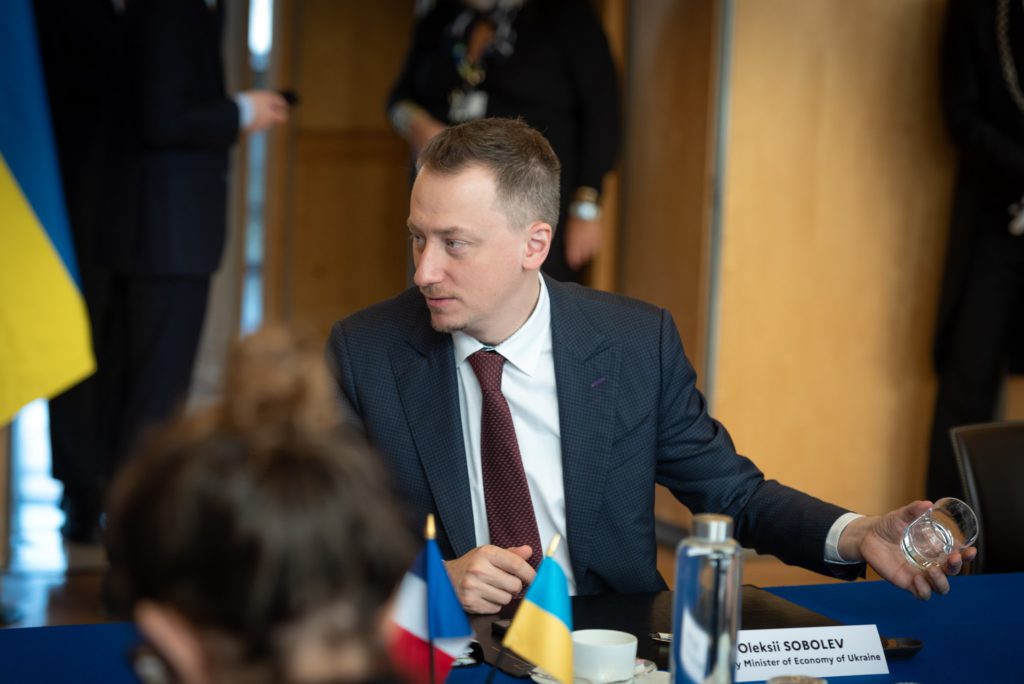

Ukraine’s economy minister Oleksii Sobolev. Credit: Oleksii Sobolev’s Facebook page

Ukraine’s deal to give the US sweeping rights to natural resources projects is advancing as both sides launch operations of a fund that the Trump administration demanded in return for further support for the war-torn country, Ukraine’s economy minister said.

“The fund is progressing very nicely,” Ukrainian Economy Minister Oleksii Sobolev told Bloomberg TV Friday while on a trip to the US.

Washington and Kyiv reached a deal in May that would grant the US privileged access to new investment projects to develop Ukraine’s natural resources, including aluminum, graphite, oil and natural gas. The administration of President Donald Trump has cast the agreement as a way to ensure US interests in the country as it presses for an agreement to Russia’s invasion of Ukraine.

As part of the deal, both sides agreed to set up an investment fund, with the US getting the first claim on profits transferred into it.

Sobolev said a US delegation is set to visit Ukraine in September to decide which companies will benefit from the first investments of the US-Ukraine minerals fund.

Ukraine will also put up more licenses for auction so that US or other companies could mine minerals and receive investments from the fund, Sobolev added. That includes an announcement this week to open up bids for mining a big lithium deposit.

“This is one of the areas that we think would be interesting for US companies for the fund to invest in them,” Sobolev said.

Sobolev, as well as Ukrainian Prime Minister Yuliia Svyrydenko, met with Nasdaq executives on Friday to discuss Ukrainian reconstruction as well as the first ever listing of a Ukrainian company — telecoms firm KyivStar — on the exchange.

President Volodymyr Zelenskiy’s chief of staff, Andriy Yermak, and other officials from Ukraine’s ministry of foreign affairs were also in the US to meet with Trump administration officials, include presidential envoy Steve Witkoff, to discuss the next steps on peace negotiations with Russia.

“Probably everyone sees right now that Russia is not ready to negotiate,” Sobolev said. “Ukraine is ready to negotiate and we’re ready for peace.”

After a summit meeting with Russian President Vladimir Putin failed to yield a peace agreement, Trump has threatened to step up pressure on Moscow. This week, the US imposed higher tariffs on India, a key Kremlin customer, for its purchases of Russian oil.

(By Natalia Drozdiak and Joe Mathieu)

Europe Maps Out Troop Deployment Plan for Ukraine Peace Deal


  • Ursula von der Leyen confirmed the EU has a “clear road map” for a possible troop deployment to Ukraine, supported by the U.S.

  • Macron will host high-level talks in Paris on September 4 with EU leaders, NATO’s Mark Rutte, and Trump administration officials.

  • While planning progresses, Russia continues air strikes across Ukraine, and Zelenskyy pledges new long-range attacks inside Russia.

Kyiv's European allies are working on “pretty precise plans” and a "clear road map" for a potential deployment of troops to Ukraine should a peace deal be struck between Kyiv and Moscow, European Commission President Ursula von der Leyen said.

Von der Leyen, in comments published in The Financial Times on August 31, added that any such venture would have the full backing of the United States, which has swayed back and forth on potential involvement over the past year.

“Security guarantees are paramount and absolutely crucial. We have a clear road map, and we had an agreement in the White House...and this work is going forward very well,” von der Leyen told the FT.

Ukrainian President Volodymyr Zelenskyy has insisted on strong security guarantees from the Western allies, especially the United States, as part of any cease-fire deal with the Russians, who have so far shown no indication of seeking a peace deal.

Von der Leyen has been visiting EU member states close to Russia over the weekend, focusing on efforts to increase national defense spending and military readiness.

She said European leaders were working on the framework for “a multinational troop [deployment] and the backstop of the Americans.”

“Of course, it always needs the political decision of the respective country, because deploying troops is one of the most important sovereign decisions of a nation.”

“[But] the sense of urgency is very high...it’s moving forward. It’s really taking shape.”

“President [Donald] Trump reassured us that there will be [an] American presence as part of the backstop. That was very clear and repeatedly affirmed,” she added.

European leaders have spoken of potentially sending tens of thousands of troops should a peace deal be struck. US forces would reportedly provide command and control, intelligence, and surveillance asset, but not ground troops.

French President Emmanuel Macron has invited European leaders to Paris on September 4 to conduct high-level talks, the FT reported, citing three diplomatic sources.

German Chancellor Friedrich Merz, British Prime Minister Keir Starmer, NATO chief Mark Rutte, and von der Leyen are among those expected, the report said.

Merz, in an interview with German broadcaster ZDF, cautioned that the war could still last for a substantial period but that ending it quickly at Ukraine's expense was not an option.

“We are trying to end it as quickly as possible. But certainly not at the price of Ukraine’s capitulation. You could end the war tomorrow if Ukraine surrendered and lost its independence,” Merz said.

Trump has made ending the war in Ukraine -- which began with Russia's full-scale invasion of February 2022 -- a top priority of his administration.

He has grown increasingly frustrated with Russian President Vladimir Putin's refusal to meet with Zelenskyy and Russia's continued campaign of massive air strikes against Ukrainian civilian targets.

“Putin has not changed. He is a predator,” von der Leyen said. “[Trump] wants peace and Putin is not coming to the negotiation table...He has a negative experience with Putin, more and more, Putin does not do what he says.”

As politicians talked, the violence continued in the war, with Russia maintaining its relentless air attacks on Ukraine on August 31, hitting energy facilities in at least two regions and targeting several other locations across the country.

In response, Zelenskyy said Ukraine will continue to defend itself on its own territory and launch long-range strikes at targets in Russia.

"We will continue our active operations in exactly the way needed for Ukraine’s defense. The forces and resources are prepared. New deep strikes have also been planned," Zelenskyy wrote on X on August 31 after receiving a status report from the Ukrainian commander-in-chief, General Oleksandr Syrskiy.

By RFE/RL

Visiting a secret anarchist warehouse in Ukraine

Saturday 30 August 2025, by Helene Vadsten


Nestor Makhno and Rural Anarchism in Ukraine, 1917–21


The Ukrainian left acts where official systems fail. Bjarke Friborg and Helene Vadsten visited Solidarity Collectives in Ukraine. Here is Helene’s accout of the visit.


Ukraine is under severe pressure after three and a half years of Russian war of aggression and occupation of parts of the country. The war and the neoliberal economic policies of Volodymyr Zelenskyy’s government have riddled an already worn-out social system.

The country is filled with veterans with visible and invisible wounds, psychologically affected relatives of soldiers, children who cannot attend school because their schools lack shelters, internally displaced people lacking roofs over their heads, active soldiers lacking vital equipment.

In May 2025, Bjarke Friborg and Helene Vadsten from Enhedslisten [1] were invited to a meeting with Ukrainian Ksenia (also called Ksusha) from the anarchist network Solidarity Collectives – as well as two European activists who travel in and out of Ukraine and who, for security reasons, wish to remain anonymous.

The war has prompted left-wing groups in and outside Ukraine to put political theories into practice in impressive, solidarity-based aid work. Ksenia from Solidarity Collectives states:

"[...] for me, both personally and as an anarchist, it’s practice that motivates me: Practice in creating horizontal relationships, practice in the present moment. I regard mutual aid – even on a smaller scale – as political activity and a realisation of anarchism’s philosophy. I don’t want to get stuck in theories and considerations about what’s good and what’s bad to do in this situation."
A night full of dangers and a secret meeting

All we had was an agreement to meet and an address somewhere in Ukraine. By that time, we had been in Ukraine for four days. We had spent the night in a car park basement that had been converted into a – by Ukrainian standards – luxurious shelter, while drone swarms, precision cruise missiles and high-speed ballistic missiles hammered down over cities across Ukraine from east to west.

The Putin regime had apparently decided that it was this night at the end of May 2025 that the massive bombing campaign – which has destroyed Ukrainian homes and schools and killed or wounded countless civilians ever since – should begin in earnest.

Now we stood there waiting, very tired and quite alone, at the address we had been given. Time passed while strangers passed us without returning our questioning looks. Had we made a mistake? We checked address and time. It looked correct. Could there have been a misunderstanding?

For security reasons, all location services were deactivated on our mobiles, and although we are from the generation that learned to use maps when they were made of paper and had to be folded out, it felt quite uncertain to stand in a completely unknown place in a war-torn country without either paper maps or the blue dot on Google Maps.

But how had we ended up in that situation? The arrangement had come about as part of a cross-party delegation trip under DIPD, the Danish Institute for Parties and Democracy [2]. Bjarke Friborg and I are members of the steering group for a DIPD project between Enhedslisten, Alternativet [3] and Ukrainian Sotsialnyi Rukh [4]. The purpose of the trip was to gain better insight into the state of democracy among political parties and civil society organisations in the country.

After the first days with occasional daily air alarms, the night’s massive, prolonged attack had given us insight into another part of Ukrainian reality: never knowing when you have to drop everything to run to safety, never knowing when you can return to your interrupted activities, the fear of losing or being hit yourself. The feeling of uncertainty sat in our tired bodies.

But then they came, our activist friends from the Ukrainian anarchist grouping Solidarity Collectives. We were both relieved and happy to finally meet the people we had previously known primarily from encrypted SMS services.
The secret warehouse

If you’ve seen one anarchist office, you’ve seen them all. Or have you?

Yes, there were desks with computers and office supplies, there were stickers, t-shirts, patches and badges and the obligatory flags from various anti-authoritarian groups from home and abroad.

But there were also shelves from floor to ceiling with equipment for use in war. Some of it clearly used, others completely new. Warm sleeping bags, bulletproof vests, knee protectors, helmets, medical equipment and much more. All essential material that, in our non-military-trained eyes, should be standard equipment for all soldiers sent to the front – but isn’t in Ukraine, where soldiers are largely expected to purchase their own equipment.

At Solidarity Collectives, activists collect money and equipment donated by private individuals, activists and anti-authoritarian groupings in Ukraine, Europe and elsewhere in the world. Solidarity Collectives ensures redistribution to anti-authoritarian soldiers at the front. The collective is thus part of a larger international ecosystem of anti-authoritarian forces supporting the very concrete, military struggle against imperialism currently taking place at the front between Ukraine and Russia.

As recipients, they prioritise comrades and allies who have previously participated in political activity – such as trade unionists, anti-fascists, feminists, climate and eco-activists and other progressive left-wing activists who have decided to participate voluntarily in the war against Russia’s invasion or have been recruited through Ukrainian conscription.

Solidarity Collectives has been able to deliver over a hundred effective bulletproof vests (level 4 body armor vests) and countless helmets, night vision equipment, thermal detection equipment, drones, tactical medical equipment, military uniforms, boots and much more through donations.

Part of the storage space and office is dedicated to a very special project: Work tables full of soldering irons, circuit boards and wires, a shelf with stacks of small drones that can be used for logistics, reconnaissance and combat. They don’t look like much when you think of the large, deadly Shahed drones [5] that Russia sends over civilian Ukrainians night after night. On the other hand, they are light to transport, even for soldiers on foot, and they are agile in the air.

In collaboration with Czech and German anti-authoritarian forces, among others, Solidarity Collectives builds, assembles and equips the drones, after which they distribute them. The drones can help anti-authoritarian soldiers at the front move faster and more safely through dangerous areas.

In the future, the part of Solidarity Collectives working with the war effort plans to establish a veterans’ organisation. It will work in collaboration with trade unions and social institutions on rehabilitation of anti-authoritarian soldiers who have been physically or mentally injured, so they can be resocialised into Ukrainian everyday life.

It’s important to remember that Ukrainian soldiers don’t have a fixed time period or end date for active service. This means that those soldiers – who volunteered in the very first days after Russia’s full-scale invasion of Ukraine in 2022 – have been active soldiers in a warring country for three and a half years. At the same time, the Ukrainian state is unable to cover veterans’ needs at present.

The need for support in Ukraine is therefore still enormous. You can support Solidarity Collectives’ targeted work for left-wing, anti-authoritarian soldiers by sending money via PayPal: solidaritycollectives_ua@proton.me

You can also support the vital work with drones via PayPal: solidaritycollectives.fpv@proton.me

When you’ve finished reading this article and perhaps decided to support Solidarity Collectives’ important work, spend 20 minutes of your life watching this harsh, open-hearted, moving interview.
.ith the Belarusian military medic Charlie. Just one of the soldiers Solidarity Collectives supports. Charlie volunteered for the Ukrainian army at the beginning of the full-scale invasion in February 2022.
Solidarity Collectives helps people and animals trapped in the war

In addition to work helping the front, Solidarity Collectives also performs humanitarian tasks among civilians in areas near the front. Using their network, for example among trade union activists, Solidarity Collectives finds out where there is need for humanitarian support and for what. This could be internally displaced people or hospitals and schools.

Solidarity Collectives has organised humanitarian convoys and delivered supplies such as medicine, clothing, food, sleeping bags, mattresses and gas stoves to the cities of Bucha [6], Bilohorodka, Chernihiv, Kryvyi Rih, Mykolaiv, Kramatorsk, Kharkiv and others.

You can support Solidarity Collectives’ civilian support on PayPal: solidaritycollectivesua.humanitarian@proton.me

Most recently, Solidarity Collectives has established the Animal Aid project, which provides food, veterinary treatment and safe shelters for animals. A team of volunteers rescues injured and abandoned animals, helps find new homes for them and works to increase understanding of animals’ needs.

You can support the work with animals on PayPal: solidaritycollectivesua.animals@proton.me
Information work

The media group at Solidarity Collectives aims to explain the anti-authoritarian view of the situation in Ukraine by collecting testimonies from soldiers and activists both from the front lines and from society in general.

They work on documenting, inspiring, sharing knowledge and fundraising for specific projects in various media formats. You can see this, for example, on Instagram in a post about housing in Russian-occupied areas.

You can follow Solidarity Collectives’ media work here:

English-language website
YouTube channel
You can help

We often hear from concerned left-wingers in the west that there is no Ukrainian left, that Ukraine under Zelenskyy has imprisoned the entire left. This is incorrect.

There is an active Ukrainian left, including Solidarity Collectives, which does very concrete and essential political work. However, it is correct that the Ukrainian state does not live up to its democratic obligations, and that there are problematic examples of persecution of trade union and left-wing activists.

The latest development, where Parliament passed and President Zelenskyy signed a law that effectively abolished the independence of anti-corruption authorities, is just one example. But the episode also shows a strength of Ukrainian democracy – because Ukrainians immediately and in large numbers took to the streets to protest in small and large cities across Ukraine.

The Ukrainian people do not want to return to the time under former president Viktor Yanukovych’s [7] totalitarian regime. And they succeeded. After just a few days of protests, Zelenskyy announced that a new law would be passed that reversed the original and secured the independence of anti-corruption authorities. This law was passed on 31 July 2025. Popular pressure works, even in Ukraine.

Ordinary Ukrainians have repeatedly shown themselves ready to act. For justice, for democracy, for their fellow citizens. Ukrainian civil society steps up where the Ukrainian state fails. This applies not least to the many small, progressive left-wing activist groupings. But they need our solidarity and our support.

You can spread the good news: that there is an active Ukrainian left. Help keep Danish public attention on Ukraine’s cause. Share this article.

[(Follow Solidarity Collectives’ social media and like, comment and share posts.

Facebook
Instagram
X (Twitter)
Bluesky

You can also help concretely by sending what you can spare to the accounts mentioned throughout the article. All amounts help, large and small. Otherwise, you can also help here:

Crypto accounts
Patreon)]

18 August 2025

Source Solidaritet. Translated for ESSF by Adam Novak.


Attached documentsvisiting-a-secret-anarchist-warehouse-in-ukraine_a9148.pdf (PDF - 929.5 KiB)
Extraction PDF [->article9148]

Footnotes


[1] Enhedslisten (The Unity List) is Denmark’s main left-wing political party, founded in 1989 as a coalition of socialist and communist parties. it is better known internationally as the Red Green Alliance.


[2] DIPD (Dansk Institut for Partier og Demokrati) is a Danish government agency that supports democratic development and political party cooperation internationally


[3] Alternativet (The Alternative) is a green political party in Denmark founded in 2013


[4] Sotsialnyi Rukh (Social Movement) is a Ukrainian progressive political party


[5] Shahed drones are Iranian-made kamikaze drones extensively used by Russia in its attacks on Ukrainian civilians


[6] Bucha is a city near Kyiv where Russian forces committed documented war crimes against civilians in 2022


[7] Viktor Yanukovych was Ukraine’s pro-Russian president from 2010-2014, overthrown in the Euromaidan revolution


Helene Vadsten is a candidate for the regional election in Region Østdanmark, one of Denmark’s five administrative regions, covering eastern Denmark including Copenhagen, for Enhedslisten (Red Green Alliance).


International Viewpoint is published under the responsibility of the Bureau of the Fourth International. Signed articles do not necessarily reflect editorial policy. Articles can be reprinted with acknowledgement, and a live link if possible.

Malaysia’s Petronas Flags Challenges as Profit and Production Slump

  • Malaysia’s national energy giant Petronas booked lower revenues and profits amid falling oil prices.

  • Petronas reported a 24% decline in revenues and a 19% drop in profit after tax.

  • Petronas has been struggling to boost output in Malaysia.

Malaysia’s national energy giant Petronas booked lower revenues and profits amid falling oil prices and a challenging macro and operational environment, which also led to a 3% decline in first-half oil and gas production.

Petronas reported a 24% decline in revenues and a 19% drop in profit after tax, due to divestments, unfavorable foreign exchange rates, and lower average realized prices from petroleum products, crude oil, and condensates following the downward trend in benchmark prices.

The national oil company’s average total daily production of 2.403 million barrels of oil equivalent per day (boepd) in the first half of 2025 was 3.2% lower compared to the 2.482 million boepd for the same period in 2024, mainly due to lower gas production from domestic operations and lower liquid production from the international portfolio.

Petronas has been struggling to boost output in Malaysia, while the volatile and challenging macro environment in the first half of the year contributed to the lower earnings and deepened the crisis.

In June, the company announced it would reduce its total workforce by about 10%, “as it navigates a polycrisis driven by global pressures, coupled with heightened challenges to unlock the full potential of its oil and gas resources in Malaysia.”

Commenting on the first-half results, Petronas President and Group CEO, Tengku Muhammad Taufik, said “PETRONAS remains unwavering in our commitment to strengthen our business and portfolio resilience for long-term growth amid an increasingly challenging macro environment in the first half of 2025.”

The executive referred to the business environment as “increasingly daunting headwinds.”

Petronas is navigating global market and operational challenges, and is undergoing a strategic transformation with a focus on portfolio high-grading and strategic partnerships, as well as enhanced productivity and cost efficiency, it said.

The Malaysian NOC expects “oil prices to remain subdued due to persistent geopolitical tensions, macroeconomic uncertainties, evolving regulatory landscapes and accelerated unwinding of OPEC+’s production cuts which will continue to reshape global energy dynamics and trade flows.”

By Charles Kennedy for Oilprice.com


How Batteries Are Reshaping the Global Energy System

  • Global grid storage capacity more than doubled in 2024 to 126 GW, with China, the U.S., and Europe leading growth.

  • Batteries are shifting from niche technology to core infrastructure, underpinning the clean energy grid much like pipelines supported the fossil fuel era.

  • Investment opportunities extend across the ecosystem - from manufacturers and integrators to utilities, developers, and software providers.

As the global energy system adds more intermittent renewables, one fact is becoming increasingly clear: Affordable, large-scale energy storage remains the enabling holy grail for these clean energy sources. 

Solar and wind are providing exponentially growing amounts of zero-carbon electricity, but they are still beholden to the weather and the rotation of the Earth. The sun sets and the wind dies down, but the grid must still hum along at perfect balance. That’s where grid-scale battery storage steps in.

The reality is that power must be dispatchable. A megawatt-hour generated at noon on a sunny day in California isn’t nearly as valuable if it can’t be shifted to power homes at 7 p.m., when demand peaks and solar output plunges. Battery storage makes that possible.

Although the so-called One Big Beautiful Bill Act, signed into law on July 4, 2025, actively phases out several clean energy tax credits, the OBBBA cements the federal Investment Tax Credit for standalone energy storage well into the 2030s.

What Is Grid-Scale Storage?

Grid-scale battery energy storage systems are not like Tesla Powerwalls for homes. They are massive installations—sometimes the size of football fields—capable of storing hundreds or thousands of megawatt-hours of electricity. Positioned at the heart of the grid, they:

  • Balance supply and demand across regions
  • Smooth renewable peaks and valleys
  • Provide ancillary services like frequency regulation and voltage support
  • Reduce reliance on costly, carbon-heavy peaker plants

Most of today’s systems are lithium-ion, but alternatives like sodium-ion, flow batteries, and iron-air designs are emerging to extend storage from hours to days—critical for true grid resilience.

Parsing the Data

The 2025 Statistical Review underscores the pace of change. In 2024, global grid storage capacity reached 126 gigawatts—more than double the 59 GW recorded just a year earlier. While that’s still modest compared with the 1,865 GW of installed solar capacity worldwide, the trajectory is remarkable. 

Over the past decade, grid storage has grown at an average annual rate of 75%, echoing the explosive early growth once seen in solar and wind power. Multiple countries There are three key areas globally in which BESS is growing rapidly:

  • United States: Capacity rose from 0.2 GW in 2013 to 28 GW in 2024, with California and Texas leading the charge. Most new storage is paired directly with solar.
  • China: Now the global leader, growing from near zero in 2013 to 75 GW in 2024—over half of the world’s total—reflecting its industrial-scale decarbonization push.
  • Europe: More fragmented but accelerating, reaching 11 GW in 2024. The UK, Germany, and Ireland are leading, spurred by the REPowerEU initiative and energy security concerns.

Investment Implications

Battery storage is shifting from niche technology to core infrastructure. Just as pipelines and transmission lines underpinned the fossil fuel economy, batteries are becoming the scaffolding of the clean energy grid.

The winners won’t be limited to battery manufacturers, though they remain central. Companies scaling lithium-ion production—and those advancing next-generation chemistries—are well positioned. So are engineering and construction firms that integrate batteries into renewable projects, as well as software and grid optimization providers that make storage profitable to operate.

Utilities and renewable developers are also entering the mix, treating storage as critical infrastructure that enhances project economics and provides dispatchable power. Even traditional fossil-heavy utilities are adopting storage as both a hedge and a compliance tool.

Conclusion

Battery storage is no longer a side bet—it is fast becoming the key enabling technology for continued expansion of intermittent renewables. For investors, opportunities span an entire ecosystem: manufacturers, integrators, utilities, developers, and software providers.

Much like the early years of solar and wind, storage is scaling at extraordinary rates. The difference is this time it’s the technology that makes the rest of the clean energy puzzle finally fit together.

By Robert Rapier


Trump Envoy Pushes Critical Minerals Agenda in Uzbekistan

  • Special Envoy Paolo Zampolli arrived in Tashkent on August 28 to deepen U.S.-Uzbek ties, with a focus on critical minerals.

  • Meetings with President Shavkat Mirziyoyev emphasized expanding cooperation in resource development, technology, and trade.

  • Zampolli’s visit also includes public diplomacy events to bolster America’s image, from Independence Day celebrations to cultural outreach.

A Trump administration emissary is making an extended visit to Uzbekistan with the apparent aim of advancing the US critical minerals agenda.

Paolo Zampolli, the White House’s Special Envoy for Global Partnerships, arrived in Tashkent on August 28 with a stated goal of building “enduring ties that sustain the strength and vitality of US diplomacy,” according to a statement issued by the US Embassy in Tashkent.

The Trump administration's foreign policy toward Central Asia has placed heavy emphasis on expanding trade and widening access to the region’s abundant supplies of critical minerals. Meeting in April with an Uzbek journalist, the US envoy in Tashkent, Jonathan Henick, praised what he described as an “unprecedented level” of diplomatic engagement between the United States and Uzbekistan during the first months of 2025. 

Zampolli met with Uzbek President Shavkat Mirziyoyev shortly after his arrival in the country. “During the meeting, issues of the further expansion of Uzbek-American strategic partnership and multifaceted cooperation were discussed in detail,” according to a statement issued by the Uzbek president’s office.

“A constructive political dialogue is developing,” the statement added. “Great potential for promoting cooperation projects in the field of mineral resources, aviation, electrical engineering, agriculture, digital technologies, finance, innovation, education and other priority areas was noted.”

The US embassy statement noted Zampolli will participate in a variety of public diplomacy events in Uzbekistan designed to burnish the US image in the country. Those events include joining Mirziyoyev in marking Uzbek Independence Day, meeting with players of the Uzbek national soccer team, which will play in the World Cup tournament to be held in the United States next year, and attending the opening of American Corner Tashkent, a venue dedicated to promoting American values.

Zampolli is a longtime business acquaintance of Trump and has served as the Caribbean island nation of Dominica’s ambassador to the United Nations.

By Eurasianet


UK Could Allow Oil and Gas Exploration for Tiebacks to Producing Fields

The UK government, which has pledged not to issue new oil and gas exploration licenses, plans to offer operators flexibility and allow them to explore the potential of tiebacks to link adjacent resources to existing oil and gas hubs in the North Sea, a senior figure in Scotland from the ruling Labour party told the Financial Times.

“Even if it is only a marginal increase [in production], why wouldn’t we give it to them,” the Labour official told FT.

The UK government, earlier this year, launched a consultation on the clean future of the North Sea industry, which included delivering the Labour commitment not to issue new licenses to explore new oil and gas fields in the UK. The consultation also engages with industry on how to manage existing fields, which will continue to make an important contribution during the clean energy transition, for the entirety of their lifespan.

Industry, however, says that more exploration and investment would reduce the growing need for imported oil and gas and would strengthen the domestic supply chain and help it transition to providing clean energy solutions, such as offshore wind, for example.

OEUK, the leading offshore industry body, said in June that an independent study it had commissioned from analysts Westwood Global Energy Group showed that over 7.3 billion barrels of oil and gas are “within reach of existing infrastructure – making them viable as tiebacks to existing platforms.”

The proximity to existing hubs will be key because developing fields as tiebacks reduces costs, lowers emissions, and extends the life of existing critical infrastructure, OEUK said.

However, many of these hubs are approaching end-of-life, and without timely investment, the opportunity to develop these resources could be lost, the industry body added.

“The geology has not changed – just the mindset,” Westwood Global Energy Group said in its study.

“While political rhetoric paints UK production in terminal decline, the subsurface still holds untapped potential. What is needed is a new perspective.”  

By Tsvetana Paraskova for Oilprice.com