Wednesday, September 03, 2025


Vatican puts Pope Francis's ecological preaching into practice with vocational farm centre

Singh Gurinder Pal, from India, tends to flowers in front of Arnaldo Pomodoro's sculpture 'The Rose of the Desert' in the plaza of the Laudato Si' Advance Training Centre.
Copyright AP Photo/Domenico Stinellis

By NICOLE WINFIELD with AP
Published on 

The Vatican's first-ever vocational school aims to offer on-site training in sustainable gardening, organic winemaking, and olive harvesting.

The Vatican is inaugurating an ambitious educational centre inspired by Pope Francis’ ecological legacy. It is a 55-acre utopian experiment in sustainable farming, vocational training and environmental schooling for kids and CEOs alike on the grounds of the papal estate on Lake Albano

Pope Leo XIV, who has strongly reaffirmed Francis’s focus on the need to care for God’s creation, will formally open the centre on Friday, returning to the grounds where he spent his first papal summer.

He’ll tour the lush gardens, vineyards and farm of Castel Gandolfo and celebrate a liturgy for the staff who have been working since 2022 to turn Francis’ ecological preaching into practice.

Continuing Pope Francis’ ecological legacy

Officials on Tuesday gave a sneak peek tour of the project’s heart: A huge greenhouse in the same curved, embracing shape as the colonnade of St. Peter’s Square that faces a 10-room educational facility and dining hall.

Once it's up and running, visiting groups can come for an afternoon school trip to learn about organic farming, or a weeks-long course on regenerative agriculture.

The project was inspired by Francis’s 2015 encyclical “Laudato Si” (Praised Be), which cast care for the planet as an urgent and existential moral concern that was inherently tied to questions of human dignity and justice, especially for the poor.

Father Manuel Dorantes, right, director of Laudato Si' Advanced Training Centre shows to journalists the gardens. AP Photo/Domenico Stinellis

In the 10 years since, a grassroots movement has taken root in the church to implement its holistic message via workshops, conferences and now most tangibly, the educational centre named for the encyclical, Borgo Laudato Si.

The centre aims to accomplish many of the goals of the environmental cause. Solar panels will provide all the power the facility needs, plastics will be banned, and recycling and composting systems will be used to reach zero waste.

Officials say water will be conserved and maximised via “smart irrigation” systems that use Artificial Intelligence to determine plants' needs, along with rainwater harvesting and the installation of wastewater treatment and reuse systems.

The Vatican's first-ever vocational school

The Vatican’s first-ever vocational school on the grounds will aim to provide on-site training in sustainable gardening, organic winemaking and olive harvesting. It will also offer new job opportunities for particularly vulnerable groups, including victims of domestic violence, refugees, recovering addicts and rehabilitated prisoners.

The products made will be sold on-site, with profits re-invested in the educational centre: Laudato Si wine, organic olive oil, herbal teas from the farm’s aromatic garden and cheese made from its 60 dairy cows.

The Rev. Manuel Dorantes, the centre's director, stressed that the project is still in its beginning phase – there are currently no on-site dormitories or residences for visitors. But it has already received some trial school groups and placed about a dozen workers in jobs after they completed an inaugural vocational training session.

“The message that Pope Francis wanted to send is that if we, the smallest city-state in the world, can do this, what is the potential for other states that are bigger than us, that have more resources than us,” Dorantes said.

Officials declined to discuss the financing of the project, other than to say an undisclosed number of partners had invested in it and that confidential business plans precluded the Vatican from releasing further information.


 

Europe bans 'toxic' ingredient in gel nail polish that may cause fertility issues

This popular gel nail ingredient is now banned in Europe - Here’s why
Copyright Credit: Canva Images


By Theo Farrant
Published on 

A chemical called TPO, used in many gel nail polishes to speed up drying and preserve colour, has been banned across most of Europe over potential fertility risks.

A common ingredient found in many gel nail polishes has been banned across most of Europe - but it’s still freely available in the United States.

Trimethylbenzoyl diphenylphosphine oxide (TPO) has now been officially outlawed in all cosmetic products after European Union regulators flagged it as potentially toxic to humans.

TPO is a “photoinitiator,” a chemical that helps gel polish harden under UV light and keeps colours vibrant for longer.

The ban comes after animal studies linked TPO to long-term fertility issues, prompting the EU to take precautionary action while more research continues.

What does the ban means for Europe's nail salons, manufacturers and the US market?

Nail salons across the EU’s 27 member states, as well as countries like Norway and Switzerland that follow EU rules, must now stop selling TPO-based gels and safely dispose of existing stock. Manufacturers are racing to reformulate products without the controversial ingredient.

Meanwhile, the US has yet to regulate TPO - joining a long list of chemicals and additives, such as BHA & BHT preservatives and “dough conditioner,” banned in Europe but still in use stateside.

The EU ban could shake things up. US brands that source products from Europe - or reformulate there - might have to adjust. This has the potential to cause shortages or even nudge American regulators to take notice.

Some in the industry have opposed the ban. The Belgian wholesaler ASAP Nails and Beauty Supply set up a protest website, which argues that there was "no human evidence of danger" and that it would cause "major economic damage" to small businesses.


New wave of airport strikes in Portugal expected to disrupt travel until January 2026

Strikes return to Portuguese airports
Copyright AP Photo

By Euronews
Published on 

The first strike began today and will last until next Tuesday, with industrial action planned until January next year.

Travelling through Portuguese airports is to become more difficult again. Two unions from Menzies, the company responsible for ground handling services, have called a new wave of strikes lasting until early 2026.

A total of 76 days of industrial action are planned between now and January next year, with workers targeting key dates including long weekends, Christmas and the New Year. Disruptions are expected to impact travel over the coming months.

The strikes were called by SIMA (the Union of Metal and Related Industries Workers) and the Transport Union (STA). The first in the series of strikes began on Wednesday 3 September and will last until Tuesday 9 September, next week.

The last strike is not expected to end until 2 January 2026.

The workers are demanding an end to basic salaries below the minimum wage, better wages and compliance with the payment of night hours, among other measures.

Minimum services decreed

Portugal’s Court of Arbitration of the Economic and Social Council decreed minimum services at airports, in a decision widely criticised by the unions, including SIMA. It says that the measure decreed obliges it to ensure around 80 per cent of normal operations.

"They call it a minimum, but it's the utmost impudence, turning the strike into a farce staged to protect the company and humiliate the workers," the union added.

The latest wave of industrial action follows previous strikes in July and August. The unions suspended the strikes planned for the end of last month following discussions with the Ministry of Labour. Menzies denies that any progress was made.

The union stated that the cancellation of the latest strikes "was not the result of any agreement, negotiation or concession" and reiterated that its position remains unchanged.

SIMA, meanwhile, denounced the "unacceptable way in which the SPdH/Menzies management and TAP's CEO have conducted the latest attempts at dialogue".


Israelis stage 'day of disruption' against reservists call-up for Gaza City operation

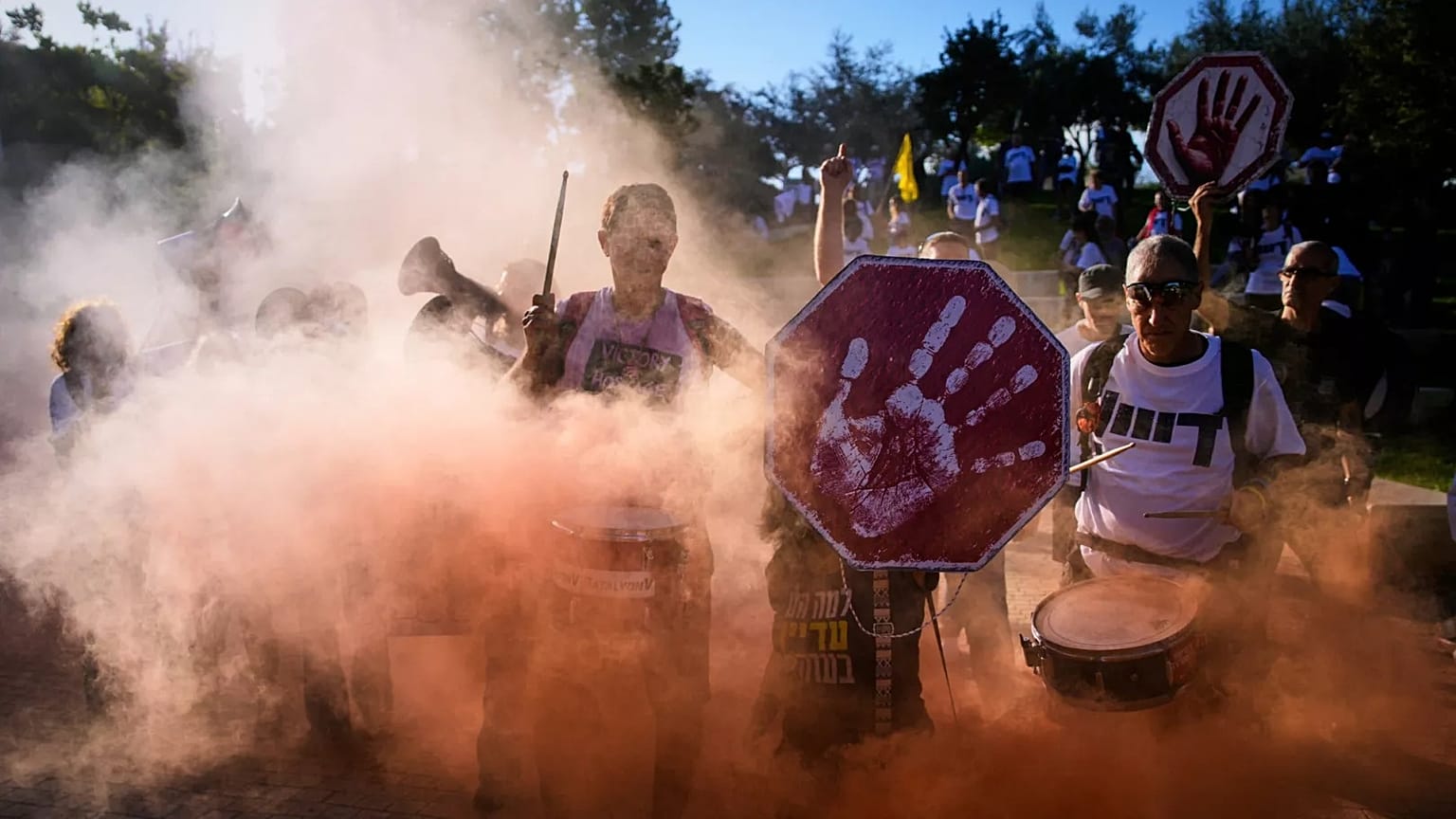
Demonstrators in Jerusalem stage a protest demanding the end of the war in the Gaza Strip, 3 September, 2025
Copyright AP Photo

By Gavin Blackburn
Published on 

The IDF said last month that Defence Minister Israel Katz had approved plans for an expanded military operation into Gaza City and that 60,000 reservists would be called up to support it.

Protesters took to the streets across Israel for what they called a "day of disruption" on Wednesday, denouncing the call-up of tens of thousands of reservists for an offensive in Gaza City that critics fear could endanger the lives of the hostages still being held by Hamas.

Demonstrators have accused Israeli Prime Minister Benjamin Netanyahu and his cabinet of failing to secure a ceasefire deal and intensifying an offensive in Gaza instead.

"We have to take an extreme action so that someone will remember. There’s no such thing as a state abandoning its citizens," Yael Kuperman, a protester near the Knesset, told the Israeli public broadcaster Kan.

The IDF said last month that Defence Minister Israel Katz had approved plans for an expanded military operation into Gaza City and that 60,000 reservists would be called up to support it.

Demonstrators in Jerusalem stage a protest demanding the end of the war in the Gaza Strip, 3 September, 2025 AP Photo

An additional 20,000 reservists currently in the military are also expected to have their service extended.

Israel's military chief of staff, Lieutenant General Eyal Zamir, told reservists on Tuesday that their mobilisation comes as the army prepares to "increase and enhance" its operations in Gaza.

"We are preparing for the continuation of the war, the continuation of the fights. We are going to increase and enhance the strikes of our operation, and that is why we called you," he said.

Israel says that Gaza City, the largest city in the Strip, remains a Hamas stronghold and that the group operates a vast underground tunnel network.

Israel has intensified air and ground assaults on the outskirts of Gaza City, particularly in western neighbourhoods where people are being driven to flee toward the coast, according to humanitarian groups that coordinate assistance for the displaced.

Israeli Prime Minister Benjamin Netanyahu attends the US Independence Day reception in Jerusalem, 13 August, 2025 AP Photo

Site Management Cluster, one such group, said on Wednesday that the prohibitively high cost of moving families, logistical hurdles and a lack of places to go are complicating evacuation efforts.

"Palestinians are also reluctant to move due to the fear of not being able to return or exhaustion from repeated displacement," the group said.

Displaced multiple times

The twin threats of combat and famine are growing more acute for families in Gaza City, Palestinians and aid workers say.

The vast majority of Palestinians have reported being displaced multiple times during the 23-month war.

Hospital officials said on Wednesday that the death toll kept climbing, with 24 people killed in airstrikes overnight into Wednesday.

The Hamas-run Gaza health ministry also reported on Wednesday that five adults and one child had died from malnutrition over the past day, bringing the total toll to 367, including 131 children throughout the war.

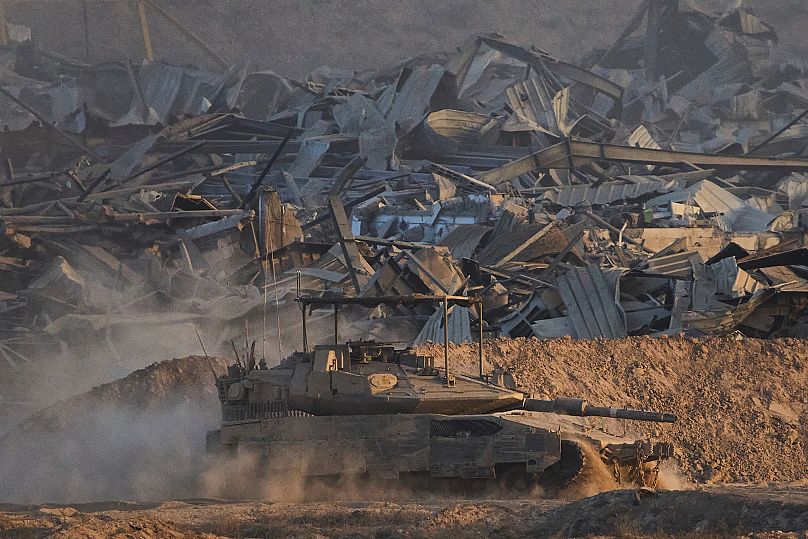
Israeli soldiers drive a tank inside the Gaza Strip as seen from southern Israel, 3 September, 2025 AP Photo

In a letter sent as members of the UK Parliament returned to work in the United Kingdom, three NGOs highlighted how more than 3,700 Palestinians were killed over the 34-day summer break.

The organisations demanded the British government take action, noting famine, a collapse of the health care system and the killing of Mariam Abu Daqqa, a visual journalist who had worked for APnews agency and Doctors Without Borders.

"This is not merely a humanitarian crisis — it is a full-blown and man-made human rights catastrophe," the statement said. "Expressions of 'deep concern' are not enough."

Additional sources • AP


Israel expects Gaza offensive to displace

one million Palestinians


Israel’s planned offensive on Gaza City could displace one million Palestinians, a senior military official said on Wednesday, as Gaza’s civil defence reported dozens killed. In Jerusalem, hundreds of Israelis protested to demand a truce and hostage deal after nearly two years of war.


Issued on: 04/09/2025 -  By: FRANCE 24


Israeli army tanks are positioned in southern Israel, on the border with the Gaza Strip, on September 3, 2025. © Jack GUEZ, AFP

Israel estimates that its imminent offensive on Gaza City would displace one million Palestinians, a senior military official said Wednesday, as Gaza's civil defence reported dozens killed across the territory.

In Jerusalem, meanwhile, hundreds of Israeli protestors took to the streets to call for a truce and hostage release deal after nearly two years of war.

Israel's military has been building up its forces for the planned operation to seize Gaza City, the Palestinian territory's largest urban centre located in its northern part, despite mounting global concern for Palestinian civilians suffering dire humanitarian conditions.

Military chief Eyal Zamir said troops were already "intensifying our combat operations", according to an army statement.

The senior official from COGAT, the Israeli defence ministry body that oversees civil affairs in the Palestinian territories, said "approximately 70,000" Palestinians had already left Gaza's north in recent days, fleeing the Israeli advance.

Briefing journalists on condition of anonymity, the official said Israeli authorities expected "a million people" to flee south, without giving a specific timeframe.

The vast majority of Gaza's more than two million people have been displaced at least once during nearly two years of war.

According to UN estimates, nearly a million people currently live in and around Gaza City, where famine has been declared.

In late August, an Israeli military spokesman said the evacuation of Gaza City was "inevitable", while the Red Cross has warned that any Israeli attempt to do so would be impossible in a safe and dignified manner.

© France 24
02:05

'Waiting 700 days'

Families of hostages held in Gaza and Israeli anti-war groups called for a three-day protest in Jerusalem, culminating on Friday -- day 700 since the Palestinian group Hamas launched its unprecedented attack on Israel in October 2023.

The mother of soldier Matan Angrest, who is held in Gaza, appealed to Israel's Prime Minister Benjamin Netanyahu at a news conference.

"I have been waiting 700 days for you to get my child out of hell, and it is in your hands. I could see Matan again tomorrow, with a single decision on your part," said Anat Angrest.

Of the 251 hostages seized during the Hamas attack, 47 are still in Gaza, including 25 the Israeli military says are dead.

Last month Hamas said it had accepted a new truce proposal that would include phased hostage release.

But as mediators have awaited a formal Israeli response, Netanyahu said the war would only end on Israel's terms as he pushed ahead with plans for the Gaza City offensive.

"Instead of seizing the agreement on the table to reach a comprehensive deal, you choose to continue sacrificing them, abandoning them," Angrest said.

Nira Sharabi, whose husband Yossi was killed in captivity, called for an end to the war.

"Military pressure endangers the lives of the hostages" and "jeopardises the possibility of bringing back the dead" for burial, she said.

During the protests in Jerusalem, a bin was set ablaze near the prime minister's residence, and the fire spread and destroyed a car belonging to a reservist.

Police called it "a red line that has been crossed", while Justice Minister Yariv Levin denounced "terror" on the part of the demonstrators.


© France 24
04:43

Deadly strikes

On the ground, Gaza's civil defence agency said Israeli forces killed at least 62 people on Wednesday.

Umm Abd Abu Al-Jubain told AFP she lost her daughter, son-in-law and several other relatives in a strike on Gaza City.

The bodies were "in pieces, and we pulled this boy out" from under the rubble, she said of her grandson, who survived the strike.

"Your father and mother have gone and left you, my dear," Abu al-Jubain told the bruised boy, holding him in her arms.

As Israel prepares for Gaza City's evacuation, the COGAT official said a planned "humanitarian area" would be set up, extending from a cluster of refugee camps in central Gaza to the southern area of Al-Mawasi and eastwards.

Israel had designated the coastal area of Al-Mawasi a humanitarian zone in the early days of the war, but has repeatedly struck it since.

In mid-August, UN human rights office spokesman Thameen al-Kheetan said Palestinians in Al-Mawasi had "little or no access to essential services and supplies, including food, water, electricity and tents".

Hamas's 2023 attack that triggered the war resulted in the deaths of 1,219 people, mostly civilians, according to an AFP tally based on Israeli figures.

Israel's retaliatory offensive has killed at least 63,746 Palestinians, most of them civilians, according to figures from the health ministry in Hamas-run Gaza that the United Nations considers reliable.

(FRANCE 24 with AFP)


French education system in shock after headteacher’s suicide exposes failure to protect LGBTQ+ staff

Caroline Grandjean had received insults and threats for several months because of her sexual orientation, according to the public prosecutor's office.
Copyright Daniel Cole/Copyright 2023 The AP. All rights reserved

By Sophia Khatsenkova
Published n 

After facing two years of harassment over her sexuality, a school principal in the central Cantal region of France took her own life on 1 September. In the aftermath of the tragedy, unions and rights groups are leading calls for greater protection for teachers.

The suicide of Caroline Grandjean, a headteacher in central France, has shocked the country’s educational community.

On Monday, the 42-year-old teacher took her own life, after nearly two years of harassment over her sexuality.

In response to her death, the French Ministry of Education launched an administrative investigation on Tuesday evening to shed full light on “all the facts and procedures” leading up to the tragedy.

A tragedy on the first day of school

On Monday morning, Grandjean contacted France’s national suicide prevention hotline to express her intentions.

Alerted, police attempted to locate her.

Her body was later found at a location some 10 kilometres from her school, authorities confirmed.

Grandjean’s ordeal began in December 2023, when she discovered homophobic graffiti in her school, where fifteen students are enrolled.

A few months later, in March 2024, more graffiti appeared, followed by a letter with death threats. Despite filing multiple complaints, the harassment persisted.

The academic inspectorate offered her a transfer, which she refused.

Just before the start of the 2024 school year, fresh insults led her to stop working again. She never returned to work.

According to those close to her, the teacher felt abandoned by the institution, which allegedly preferred to relocate her rather than protect her.

“Caroline’s decision to end her life on the first day of school is a message to the National Education system," said Christophe Tardieux, a teacher and graphic novelist, who recounted her story in an article published by French newspaper 20 Minutes.

"She holds it responsible for everything. She wanted people to know and to make noise. Because the institution thrives on silence and did everything to silence her,” Tardieux claimed.

Euronews has reached out to the academic inspectorate for comment on the claims put forward by Tardieux and those who knew Grandjean.

Widespread outrage in the educational community

Aurélie Gagnier, co-general secretary and spokesperson for a teachers’ union, said the tragedy exposed the deep structural failures within the French education system.

She highlighted the lack of concrete support for teachers in distress.

“In cases like this, it is clear that educational authorities must show firm and unwavering support," she said.

"For us, it is obvious that there should be visits from authorities and psychological care.”

In an interview with Euronews, Gagnier also denounced a critical shortage of resources.

“There is only one occupational physician for every 16,000 Education Ministry employees. There are virtually no occupational psychologists," she noted.

The union leader also pointed to the persistent taboo surrounding suicide within the institution.

“We developed a guide for suicide alerts in 2021, but it was never published. The reason? It mentions suicide, and the Ministry’s General Directorate of Human Resources does not want the word to circulate. There is enormous resistance on this issue," Gagnier said.

For unions, every tragedy should serve as a wake-up call.

An alarming trend for LGBTQ+ individuals

LGBTQ+ rights associations share the same outrage.

Julia Torlet, president of SOS Homophobie, believes Caroline Grandjean’s death could have been prevented.

“We protect harassed students, but we see that when it comes to staff, this is still not the case. They are simply transferred to another district," Torlet said.

The SOS Homophobie president also warned of a broad and alarming trend.

“Among LGBTQ+ youth under 25, there are four times more suicides than in the general population. And seven times more among young transgender individuals," Torlet said, noting that one in two people do not dare to disclose their sexual identity in the workplace.

“Just because there are rights does not mean mentalities have changed. Just because we have laws does not mean institutions protect people as a result. We want to highlight this stark contrast.”


Bulgaria's black panther on the prowl mystery continues with latest sighting

FILE: A newborn black jaguar is carried by her mother, named Venus, at the Park of the Legends zoo in Lima, 8 May 2009
Copyright AP Photo

By Gavin Blackburn & Aleksandar Brezar
Published on 

A black panther was reportedly spotted in the Bulgarian village of Dupnitsa, sparking a police investigation and memes. The search for the elusive feline remains ongoing.

The saga of Bulgaria’s elusive black panther appears not to be over after a resident of the village of Dupnitsa filmed an animal he believes could be the potentially dangerous feline.

The village mayor, Desislav Nachov, told local media that he had inspected the location where the video was filmed together with the police.

The authorities are questioning the person who filmed the footage seen by Euronews, which shows what appears to be a large black feline moving through tall grass.

Nachov said no decision has been made yet about whether to open an emergency headquarters to start a search for the animal.

"This depends on the assessment of the police. The person who filmed the video described the animal he saw as resembling a large dog," he said.

Dupnitsa is located around 66 kilometres south of the capital Sofia and relatively close to the Serbian border. It is also more than 430 kilometres west of the Shumen plateau nature park, where the cat was first spotted.

That area was on high alert and locked down for nearly two weeks as a search took place to find the big cat. The search, ruled as inconclusive, was called off in mid-July.

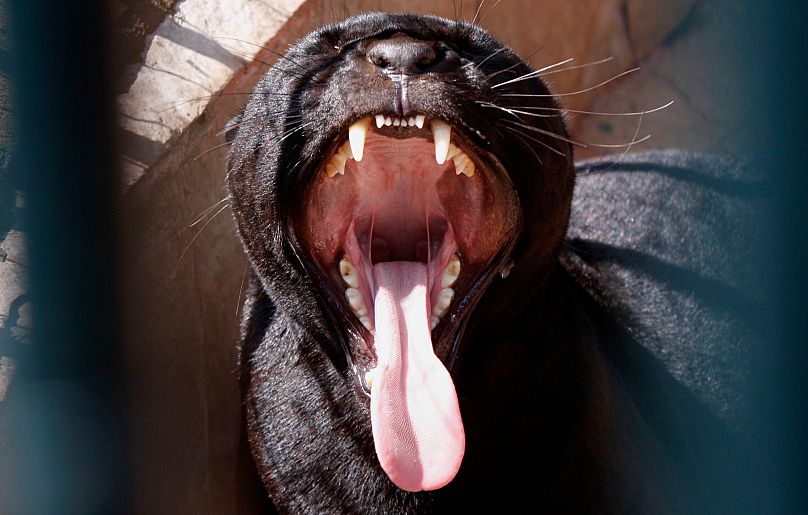
A panther yawns as it sits behind a fence in an upscale home in the Desierto de los Leones neighborhood in Mexico City, 20 October, 2008
A panther yawns as it sits behind a fence in an upscale home in the Desierto de los Leones neighborhood in Mexico City, 20 October, 2008 AP Photo

The search, which began on 19 June, was prompted by a widely circulated video and paw prints that initially led to fears that a dangerous predator was roaming free. 

However, zoologists from the National Museum of Natural History raised doubts, with Dr Stoyan Lazarov saying the paw print likely belonged to a large dog.

A report from fellow zoologist, Professor Nikolay Spasov, supported this claim, also stating the print was not feline in origin.

Despite days of tracking and deploying camera traps and baited stations, no apparent sightings or physical traces were found.

The animal’s movements appear “erratic and unpredictable," said Georgi Krastev, director of the Central Balkan National Park, who helped coordinate the search.

Further rumours about the cat actually being a couple and the female feline being pregnant or with cubs in tow were also dismissed.

Panther inspires memes

While the mystery of the elusive black panther may have been an anticlimactic, albeit still open-ended conclusion, it sparked a wave of humour across the country and the wider region.

Social media has been flooded with memes and AI-generated images of the big cat, as well as folk songs about the black panther or puma from Shumen, jokingly renaming the city to "Pumen".

A meme about the black panther in Shumen spread on Bulgarian social media accounts
A meme about the black panther in Shumen spread on Bulgarian social media accounts Courtesy of Euronews Bulgaria

Businesses were also quick to capitalise on the unexpected publicity, adding references to the panther in their marketing, with restaurants creating images of the panther enjoying local delicacies such as beer and grilled meat.

One of the jokes came from Romania's emergency services, who posted an AI-generated photo of firefighters rescuing a black panther from a tree, a post that quickly went viral with thousands of likes and shares.

It is not the first time a big cat has been reported to be on the loose in Europe. Residents reported seeing a panther around the Italian province of Bari in 2021, leading authorities to warn the public to avoid the countryside.

Authorities in eastern Slovakia also urged residents to exercise caution after a tiger was spotted in an area near the border in 2022.

There have also been several stories in the UK concerning rumoured sightings of panthers roaming the countryside in recent years, though some experts have disputed the veracity of these claims.


China to build land-based 'Suez Canal' to connect Europe and Asia, bypassing shipping routes

Workers build the China World Trade Centre and the Xiong'an railway station connected to Beijing Daxing International Airport / 30 August 2025
Copyright Mahesh Kumar A./ AP.

By Euronews
Published on 

China is quietly building alternative routes to help it export goods to Europe, without passing through its South Sea, to avoid tensions with the United States and its allies in the region.

The mountainous city of Chongqing in China has become a major hub for an overland trade route that some say could become the new Suez Canal.

The route is served by rail, and is expected to become Asia's most important logistics hub.

The South China Morning Post said the city has quickly emerged as a strategic fulcrum in China's trade network, and its model—if it continues to succeed—could inspire the government to go for similar investments in the west of the country.

Every day, the city manages hundreds of shipments, connecting Southeast Asian countries such as Vietnam and Singapore to Europe, including Germany and Poland, using high-speed freight trains.

Short shipping time

The delivery time over land is 10-20 days shorter than traditional sea routes, and considerably simplifies customs issues. The launch of the ASEAN bullet train in 2023 cut the shipping time between Hanoi and Chongqing to just five days, from which goods will reach Europe in less than two weeks.

In addition to its strategic location, Chongqing is a major production powerhouse, responsible for manufacturing about a third of the world's laptops, a major base for the production of electric cars, and a major export centre for a quarter of China's cars.

Geopolitical dimensions

Some observers believe that China's motives for using this city do not only have logistical dimensions, but also have geopolitical dimensions. The trade war with the United States under President Donald Trump has shown the danger of relying on international sea lanes under Western influence such as the Suez Canal and the Straits of Hormuz and Malacca. The coronavirus pandemic exacerbated the risks, exposing the fragility of maritime supply chains.

With the ongoing war in Ukraine and some Chinese shipments subject to seizure in 2023, passing through Russia has become more risky, even though bilateral trade between the two countries reached 240 billion euros in 2024. Therefore, Beijing is pushing for the development of a "Middle Corridor" through Kazakhstan and the Caspian Sea to avoid Russia and the sea straits.

However, Beijing faces many challenges in terms of customs delays, high costs, poor infrastructure, and financial sustainability. Many routes, especially within the Belt and Road Initiative, have relied on government subsidies to make them easier for exporters.