Tuesday, September 23, 2025

GOP judge smacks down Trump's effort to kill wind farm in New England


Matthew Chapman
September 22, 2025
RAW STORY


A judge's gavel (Shutterstock)


A Republican-appointed federal judge has hit the brakes on President Donald Trump's effort to shut down a massive offshore wind project in New England.

According to Politico, D.C. District Court Judge Royce Lamberth "granted a motion for preliminary injunction of the stop-work order imposed by the Trump administration on the New England project during a high-stakes hearing. The multibillion-dollar offshore wind project is one of the highest-profile renewable energy projects that the administration has sought to suspend while it reviews approvals."

Last month, Trump ordered work halted on Revolution Wind, a project developed by Danish wind company Ørsted and Skyborn Renewables, which is already 80 percent complete.

Trump, who has reportedly hated wind power ever since an installation was built near one of his Scottish golf courses, has repeatedly blasted wind projects, claiming they destroy tourism and are a threat to birds and whales. Most of his complaints are significantly overblown.

Attorneys for Revolution Wind said that the stop order “reflects a shockingly expansive theory of agency power to undo prior regulatory approvals,” and puts the administration in violation of the major questions doctrine.

Lamberth, a longtime conservative judge first appointed to the bench by Ronald Reagan, granted a preliminary injunction that pauses Trump's order while the case goes forward.

“There is no question in my mind of irreparable harm to the plaintiff,” wrote Lamberth, adding that the “entire enterprise could collapse” if the order stands, not least because a specialty ship required to finish the project will not be available past December.
MAGA SA

These sinister rants show Trumpworld isn't mourning — it's unleashed

Jason Miciak
September 23, 2025 
RAW STORY


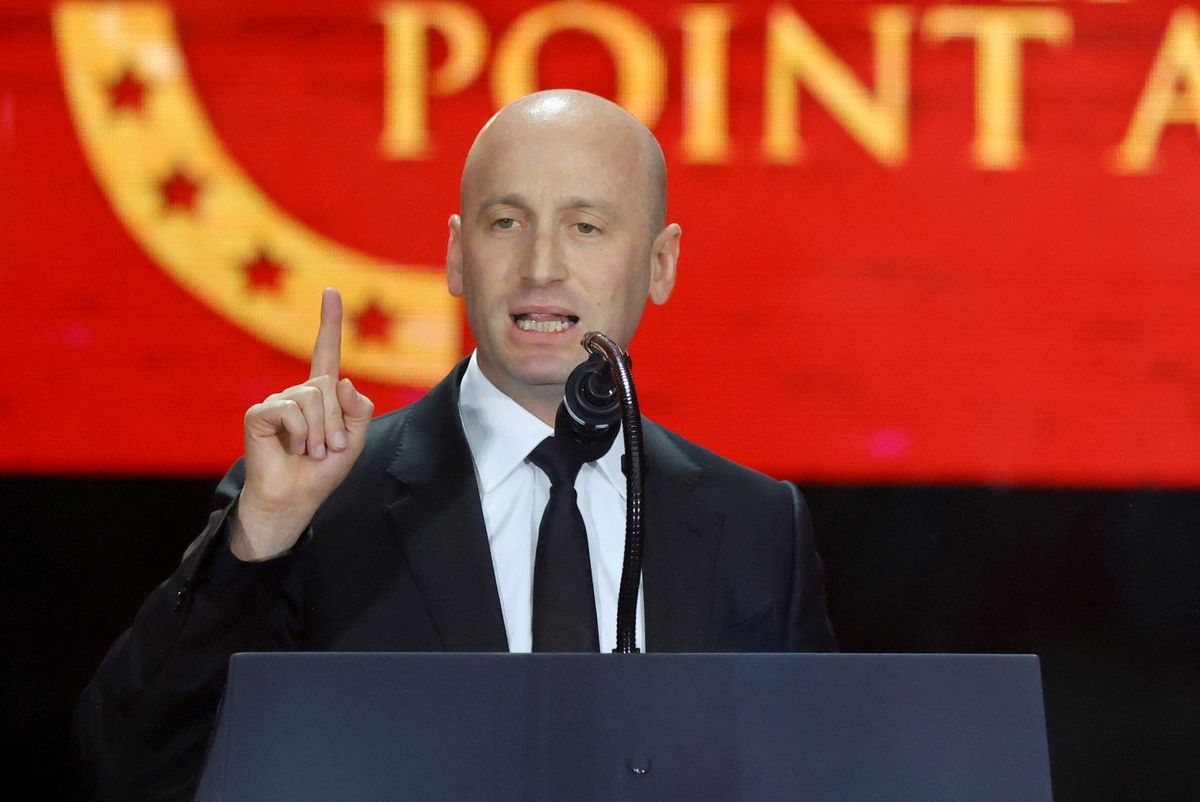
White House Deputy Chief of Staff Stephen Miller speaks at a memorial service for Charlie Kirk. REUTERS/Carlos Barria

Everyone who follows politics from any sort of middle ground suffered comprehensive dread after Donald Trump's second election. We knew of Project 2025 and its "in your face" drive toward totalitarianism. It was baked in — a guarantee.

The nightmare unspooled as it became all too clear that Trump's new administration wouldn't tolerate minders, deep thinkers, the conscientious. There would be no adults in the room. Trump presented a cabinet of laughably unqualified "loyalists" and America pretended it was normal. Expected as it was, the foreboding was no less real.

However, the last 10 days have taken matters to a new level — one even more extreme, perhaps planned all along, but now most definitely here.

Charlie Kirk's murder, along with some admittedly heartless responses, ushered in a new phase, one for which Trumpworld may have been planning all along, but now set upon us over days. In so doing, they ushered in near zoo-level incompetence from a cabinet picked for loyalty despite abject incompetence. The "in your face" aggression, coupled with newfound confidence, brought about the most dangerous week yet in Trump 2.0.

The White House is emboldened, using Kirk's assassination to unapologetically twist the dial, more aggressively crazed than ever. This is dangerous.

The most obvious newly evolving move is the labeling of the entire left as a terrorist movement that threatens American stability. This is gaslighting so pure as to be almost elegant, coming as it does from terrorists who attacked our Capitol. Opposition to Trump has become that much more dangerous. And if one listens closely, they almost took joy in the killing as leaving them finally "freed." What an opportunity.

Stephen Miller, never more self-righteous and raw, the most openly authoritarian-racist member of the administration, recently said:

"With God as my witness, we are going to use every resource we have at the Department of Justice, Homeland Security and throughout this government to identify, disrupt, dismantle, and destroy these networks, and make America safe again for the American people. It will happen, and we will do it in Charlie’s name."

Sorry, but that sounds less like grief than relief.

There are no left-wing networks. As a member of the Democratic Party, I'd say we probably need more and better-defined networks to spread an anti-Trump message, but they don't yet exist. Not as Miller meant.

No matter, Miller wants an excuse to "attack" the left, wanting to spring loose the semi-fascist brownshirts in Homeland Security and National Guard on anyone they don't like. Breathtaking in its boldness, one can feel his rush to rage-filled hatred, ready for an open-field run.

Watch out.

But Miller is only following the example set at the top. Trump has been all over the place, spitting vitriol at the left, using Kirk's death to go next-level. Post-Kirk, he has a treasured launching pad toward Orwellian control, example "A" being Jimmy Kimmel. Emboldened, Trump went after even bigger game — network news, as evidenced by recent interactions with the media, as reported by Politico:

President Donald Trump on Friday reiterated his claim that critical television coverage of him is “illegal” and pushed back on criticisms that his administration was taking actions that chill free speech.

The administration quickly established the fact-free narrative that the left metaphysically groomed the suspect in the Kirk killing, Tyler Robinson, despite all evidence pointing to an isolated, uniquely sick loner, practically apolitical, a young man who simply hated Kirk's intolerance toward LGBTQ Americans. Hardly a political leftist.

But the idea took hold on the right, an excuse to attack all opposition as terrorists threatening Americans. This is as dangerous as it is self-serving.

Meanwhile, the cabinet seemed newly confident, and with increased energy came new evidence of jaw-dropping incompetence. None is in over their head more than FBI Director Kash Patel. Little more than a flame-throwing podcaster, he appeared in front of Congress backed by a new level of anti-left rage, and promptly humiliated himself as the most hapless, fully politicized, and laughable FBI director in history. As noted by USA Today:

During his equally contentious Sept. 16 hearing before a Senate committee, Patel went off the rails, labeling [Sen. Adam] Schiff “a political buffoon at best” and saying, “You are the biggest fraud to ever sit in the United States Senate.”

Try to imagine Fox News's reaction to a Democratic administration, or simply a normal FBI director, trying that. Despite almost non-existent expectations, Patel managed to still surprise as a newly freed, shameless, hapless, moron. This, of course, after erroneously announcing the arrest of a “subject” in the Kirk killing.

It goes on, even down to the Department of Health and Human Services and Robert F. Kennedy Jr.'s absurd crusade against vaccines — the single most powerful public health tool in history, short perhaps of proper sewerage. But conspiracy freaks are going to freak, and the "post-science experts" at a key CDC meeting devolved into clueless chaos.

Per a report in The New York Times:

“Thursday’s session ended with the panel members at odds. A hot microphone caught one panelist calling another committee member 'an idiot,' although it was unclear who was speaking.”

Take your pick.

True, the administration was always vicious, uncaring, and self-satisfied, but it went to a new and dangerous level prior to even Charlie Kirk's memorial service at an NFL stadium in Phoenix. State control and censorship reached late-night comedy, leaving those left on air quivering. All over mildly disrespectful talk — but only talk.

It is likely that the plotters in Project 2025 counted on some seminal moments all along, using each to tighten their grip. They surely envisioned protests, some perhaps descending into violence as their launch pad to the next level. Instead, they are rallying around two grotesque but extremely isolated killings: Kirk as "proof" that political violence is the province of the left, and the murder of Iryna Zarutska, a Ukrainian immigrant, as "proof" that white people are under attack. That incident in Charlotte, North Carolina lubricated a shift to more surface-level racism — always useful to the right.


It all worked better than they could have hoped, and they're showing it with barely suppressed excitement.

The pattern was set in January. Perhaps even ahead of schedule, it is now viciously in your face — a government that is authoritarian, post-law, post-decency, post-unity, in what were the United States. They always fantasized about a war within. Now they get to move, seeing themselves as blameless, responding to a first shot, one taken by "all" Trump opposition. How useful.

MAGA provides its voters self-identity. It's not what they believe. It is shared hatred, never more acute, thus never more united, never more willing to quash all that previously made America great. Those charged with leadership don't need to be good, only "committed."

Unfortunately, the impact will be felt as they move with a greater sense of mission, greater hatred, less confusion, and more dopamine. Never forget: they hate you more than any international faction on earth, more than all of them put together.

Now, though, they have a theme — they're under attack by a violent resistance as a whole. Tragic as one young man's senseless killing may be, they seem more fulfilled, even relieved to have a tragedy transition to a precious tool, never on clearer display than the last week.

And it is just so f–––––– dangerous.

Don't believe me? Listen to them.

“Stephen Miller understands the assignment,” Laura Loomer wrote on Sunday. “Many others don’t. Crush. The. Left. So they never rise again.”


Jason Miciak is a former Associate Editor at Occupy Democrats, author, and American attorney. He can also regularly be found on Politizoom.


KILL FREE SPEECH

The inspiration for Trump's latest assault should chill you to the bone

Thom Hartmann
September 22, 2025 


A large banner featuring Donald Trump hangs on the Department of Labor. REUTERS/Brian Snyder

We’ve seen this movie before. Or at least our grandparents did. Dictators can’t take a joke.

On Feb. 4, 1939 — seven months before their invasion of Poland kicked off World War II — the man with oversight responsibility for German media officially forbade five comedians from ever again performing in public. As the headline in the New York Times explained:
“Goebbels Ends Careers of Five 'Aryan' Actors Who Made Witticisms About the Nazi Regime”

Their crime, according to Josef Goebbels, was publicly telling “brazen, impertinent, arrogant and tactless” jokes about the Führer.

Their humor, Goebbels told the press, only appealed to the “society rabble that followed them with thundering applause — parasitic scum, inhabiting our luxury streets, that seems to have only the task of proving with how little brains people can get along and even acquire money and prominence.”

The Times wrote that Goebbels and Adolf Hitler were particularly incensed that the actors caricatured and ridiculed Hitler’s followers and the loyal toadies in his administration:
“What amused the public most, however, and presumably roiled the National Socialist authorities most — although Dr. Goebbels does not mention it — is that they deftly, but unmistakably, caricatured some gestures, poses and physical characteristics of National Socialist leaders — sometimes with bon mots that made the rounds of the country.”

The Nazi leaders were furious, arguing that they themselves had, the Times noted, “a keen sense of humor that could kill opponents with ridicule.”

Instead of ordering the offending comedians executed, the Times added, they were simply rendered incapable of earning a living in their chosen profession.

“But as National Socialism proposes to remain in power 2,000 years it has neither the time nor the patience to apply that method to the ‘miserable literati.’”

FCC (“Federal Censorship Commission”?) Chairman Brendan Carr seems to be following in Goebbels' footsteps, having implicitly threatened Disney/ABC and two groups of TV station affiliates with regulatory intervention to block multi-billion-dollar mergers if they didn’t take Jimmy Kimmel off the air.

CBS’s rolling over when Trump was offended by Stephen Colbert appears to have emboldened the administration to go after other comedians.

Donald Trump himself, meanwhile, was blunt about how “illegal” it is for people on television to criticize him. And he wasn’t just talking about comedians, specifically calling out “newscasts” that will presumably be Carr’s next target:

“I’m a very strong person for free speech. But 97, 94, 95, 96 percent of the people are against me in the sense of the newscasts are against me. The stories are — they said 97 percent bad. So, they gave me 97, they’ll take a great story, and they’ll make it bad. See, I think that’s really illegal, personally.”

Meanwhile, Trump has sent soldiers into the streets of three American cities, purged federal museums of information about slavery and discrimination against minorities and women, and posted what may have been meant to be a private DM demanding that Attorney General Pam Bondi begin prosecuting his political enemies.

Along those same authoritarian lines, three major federal buildings in Washington, D.C. now sport massive new banners with Trump’s face glowering down on people walking or driving by. Paid for with your tax dollars, the banners violate federal law according to a report released by Sen. Adam Schiff (D-CA).

Georgia Democratic Congressman Hank Johnson was blunt in his critique:

“When I saw the banners hanging from federal office buildings last week, it reminded me of [the] Communist Party in China and banners hanging from federal offices — just totally inappropriate and a step towards authoritarianism. It’s another indication of the march that we’re on towards authoritarianism in this country.”

Will anybody on network television be willing this week to tell “brazen, impertinent, arrogant and tactless" jokes about the Saddam Hussein-like banners?

Stay tuned.
D.E.I.

What FanVerse and women’s sports can teach other industries about sidelining women


By Chris Hogg
DIGITAL JOURNAL
September 22, 2025


FanVerse creates sports experiences designed for women and turns those moments into data that brands and teams can use. - Photo courtesy FanVerse

Every founder is taught the same rule: know your total addressable market (TAM). The bigger your TAM, the bigger your chance to grow.

Now consider this: women make up nearly half of sports fans, yet too often the industry still acts as if they are an afterthought.

That gap is not unique to sports. From car safety tests based on male bodies to financial products built for male investors, industries repeatedly design around a “default customer.” The bias is rarely intentional, but it is built into systems, holding back both participation and growth.

The lesson applies far beyond stadiums. Every sector has users who sign up but never stay, customers who are present but overlooked, or workers whose needs are not factored into how systems are built.

Ashima Chopra saw this flaw up close in sports, and talks about it starting early in her life. She says growing up as an immigrant kid, she played soccer, ran track, and long-distance running, and was often the only girl on all-boys teams.

“I was always relegated to defence,” she recalls.

Later in law, venture capital, and consulting, she was again the only woman in the room. Those experiences made the gap impossible to ignore. What she saw in boardrooms echoed what she felt on the field. Women were there, contributing and invested, yet the system wasn’t built with them in mind.

Despite higher brand loyalty and purchase intent among women, sports marketing and engagement still centers male audiences, she says. Her company FanVerse grew out of that recognition. It is designed to turn casual fans into connected communities and build the data to show brands how.

The company offers a case study in a larger business problem: when companies design for the default, they don’t just miss people, they miss growth.

FanVerse creates sports experiences designed for women and turns those moments into data that brands and teams can use. – Photo courtesy FanVerse


Turning solo fans into loyal communities

FanVerse is built on a straightforward idea: create sports experiences for women and track what happens next. The company stages community events that make it easier to participate, then turns those experiences into data that brands and teams can use.

FanVerse began when Chopra entered and won the inaugural Toast AI Hackathon, a competition that drew 75 women. What started as a simple plug-in concept has since evolved into a company building data-backed tools to help teams and brands engage fans in new ways.

Research from The Collective, Wasserman’s women-focused advisory arm, found distinct segments among women’s sports fans, including those who engage solo and those who prefer more connected experiences

.

Chopra saw the business case in the fact that so many women were showing up alone, without the community that sustains long-term engagement.

“Ninety-five percent of the women who came to our activations had either never watched a game before or they came solo,” she says. “When women feel like they belong, they spend more, share more, and return often.”

FanVerse’s activations are designed to create that sense of belonging.

In Toronto, a crawl through women-led businesses ended with a reserved section at a soccer match.

In New York, events hosted in community-focused spaces drew women who had not previously attended live games. At one gathering, Instagram engagement reached more than 79,000 views in 10 days and every RSVP converted into attendance.

The events are deliberately low barrier; a bingo night with a beverage partner or a candid conversation about menstruation as a performance disruptor offers an entry point that feels accessible.

“Bro culture is out, belonging is in,” says Chopra. She sees FanVerse as a way to create spaces where women feel invited, connected, and seen. That sense of belonging becomes the starting point for stronger and more sustainable engagement.


With FanVerse, each activation is designed as a test.

The company tracks why people show up, what they choose to spend on, and what makes them come back. That information feeds a data platform she calls “data with depth,” moving beyond surface metrics like attendance or merchandise sales to a more detailed picture of identity, belonging, and conversion.

FanVerse is still early but Chopra says she has begun talks with the Women’s National Basketball Association, the Women’s Tennis Association, and brand partners ranging from lifestyle companies to sportswear companies.

The company is now raising a $1 million pre-seed round to turn passive followers into passionate fans via a platform that unites media, community and intelligence to connect fans and brands.

“I hope women feel more seen, celebrated, and valued,” she says. “This is not charity work. This is smart business. Tapping into women is not a nice-to-have. If you really want to grow, it’s a must-have.”

Chopra isn’t the first to notice women’s role in sports, but her model works differently.

Rather than focusing only on visibility or representation, FanVerse is built on segmentation, belonging, and conversion.

The principle reaches beyond sports.

In software, it might be users who log in but never adopt advanced features. In healthcare, patients who register but skip follow-up appointments. In finance, clients who open accounts but avoid higher-value products.

Companies often treat these people as wins because they are present in the system. In reality, they are the most fragile part of the base.

Left alone, they drift. Designed for, they multiply.

That is the larger point FanVerse underscores: growth comes from converting the underserved, not just adding new people.
Why whole sectors shrink when women are overlooked

The gaps Chopra is exposing in sports is a systemic problem.

Chopra argues that women should be treated as reference customers, not edge cases. Designing for them, she says, expands the market.

Ashima Chopra (left) speaks at an event. – Photo courtesy FanVerse

That perspective is echoed in broader research. Gaps show up through financing, product fit, or leadership pathways, but the pattern is the same: women are in the system, yet design and structure limit engagement.

Look at the data —

In agriculture

Women operate farms at meaningful rates, but equipment design, inheritance patterns, and financing norms reduce day-to-day adoption and scale.

According to Farm Credit Canada (FCC), women will make up nearly one third (31%) of farm operators by 2026, but their farms bring in less revenue on average. FCC links that gap to structural barriers rather than effort.

Women operators are less likely to inherit land, which means they often begin with smaller operations or less equity. They report more difficulty accessing financing and are underrepresented in succession planning, according to the BC Institute of Agrologists. Equipment is often built for men, making adoption less straightforward.

If barriers were removed and if women earned the same on average as men, Canadian agriculture GDP could increase by as much as $5 billion.

Inside the energy industry

Women work across energy, but they’re not offered roles that have influence over how technologies get adopted.

The 2024 industry census from Careers in Energy shows women make up nearly 20% of Canada’s energy workforce but hold just 11% of senior management roles, a share that has barely moved in two decades.

That underrepresentation matters because companies with more gender-diverse executive teams are 39% more likely to outperform financially. Recent research also links higher female board representation to lower corporate carbon emissions.

If more women were included in leadership and strategic decisions across the energy transition, firms could expect stronger financial performance and improved emissions outcomes that support faster technology adoption.

Within entrepreneurship

Plenty of women are in the pipeline, but intent rarely converts into funded companies because of gaps in capital and networks.

As Digital Journal previously reported, if women started companies at the same rate as men, Canada would have more than 700,000 additional entrepreneurs.

Women often don’t because of systemic barriers: lower access to financing, weaker investor networks, and underrepresentation in high-growth industries. Since 2014, only 10% of Canadian venture capital deals have involved women founders, says The51.

The lost output from this participation gap is valued at $150 to $180 billion in GDP each year. The Women Entrepreneurship Knowledge Hub reports that majority women-owned SMEs are already generating more than $90 billion in annual revenue and employ nearly one million people, showing how much potential is being held back.

Removing barriers would mean more firms scaling, stronger job creation, and greater resilience in Canada’s innovation economy.

In financial services

In finance, the blind spot is built into the products themselves. Most advice and offerings are still designed with men in mind.

VersaFi reports that women investment advisors across Canada continue to face systemic barriers including bias, limited sponsorship, and inequitable succession planning, which restricts how women grow within the industry.

Women are poised to control nearly half of Canada’s financial assets over the next few years, largely due to inheritance from boomer and silent generation parents and spouses, alongside rising incomes and a narrowing wage gap.

An estimated $4 trillion will transfer to women in Canada by 2028, and 80% of women will change advisors within a year of inheriting wealth. That means that firms failing to adapt will lose clients at the very moment the market is expanding.

Treating women as core clients rather than secondary would help firms capture this shift and expand the overall market for financial services.

FanVerse creates sports experiences designed for women and turns those moments into data that brands and teams can use. – Photo courtesy FanVerse


What leaders can take from FanVerse

FanVerse is a testing ground for what makes participation meaningful. Each activation produces signals leaders can use to understand how growth really happens. That structure turns belonging into something measurable, and it gives leaders a model they can apply beyond sports.

Designing differently isn’t a side project and FanVerse offers a glimpse of what that shift can look like. The company is showing that when systems evolve to serve people who have long been overlooked, participation grows and new forms of value are created.

For leaders, the message is straightforward: growth follows the choices you make about who counts as a customer. The companies that widen that definition will expand their markets and shape them.
Final shots:The real growth story isn’t in adding more people. It’s in finally seeing the ones already there.
Markets are only as strong as who they’re built for. Expand the definition, expand the future.
Designing for belonging isn’t charity. It’s the difference between a customer who drifts and a customer who stays.


Written ByChris Hogg
Chris is an award-winning entrepreneur who has worked in publishing, digital media, broadcasting, advertising, social media & marketing, data and analytics. Chris is a partner in the media company Digital Journal, content marketing and brand storytelling firm Digital Journal Group, and Canada's leading digital transformation and innovation event, the mesh conference. He covers innovation impact where technology intersections with business, media and marketing. Chris is a member of Digital Journal's Insight Forum.
One third of IT professionals say they are only noticed when ‘something explodes’

ByDr. Tim Sandle
SCIENCE EDITOR
DIGITAL JOURNAL
September 22, 2025


Man using a laptop at a conference. — Image © Tim Sandle

IT professional stress stems from techno-complexity, tight deadlines, long working hours, rapid technological changes, and work-life balance issues, leading to burnout, health problems, and decreased motivation. Another source, it would seem, stems from work colleagues outside of the IT function.

The company SolarWinds has released new global survey data on what irritates IT professionals. The survey also reveals what IT personnel want in return for keeping business systems running smoothly.

The findings come from 437 global IT professionals, and it finds that the most annoying phrase reported to IT by users is: “I didn’t touch anything”. This is followed by “You’re good with computers, right?” After this comes: “The Wi-Fi’s broken”.

The findings of the IT Community Pulse survey are based on research fielded in September 2025. This included IT professionals across a range of practitioner, manager, and director roles in Europe, the Americas, and Asia Pacific regions.

Information technology (IT) is a loaded term. For this reason, there remains ambiguity over what an IT professional does. Since IT encompasses many aspects of the world of computers and more, the work is highly varied.

The survey also finds that IT professionals often feel overlooked, underappreciated, as well as too often irritated by their colleagues. Almost a third (31%) of IT professionals say people only notice them when something explodes, while 28% wish colleagues understood they are juggling requests from every department, not just theirs.

The jargon being used in offices adds to the malaise. Nearly a third (31%) said that “AI” is the buzzword most likely to make them want to chuck their monitor out the window, followed by “digital transformation” (15%) and “seamless integration” (13%).

In terms of what IT teams actually want, 65% indicated they would prefer an unlimited IT budget; on a more realistic level, more than half (51%) of those surveyed suggested that a simple, heartfelt “thank you” would go a long way. Another 37% would settle for a public apology from non-IT staff.

Commenting on the findings, Sascha Giese, Tech Evangelist at SolarWinds, says in a statement sent to Digital Journal: “Every day, IT professionals keep networks secure, services running, and hybrid work alive. But it’s often without fanfare and usually without thanks. Instead, they’re constantly bombarded with frustrating jargon, unrealistic demands, and phrases that make their blood boil.”

Giese adds: “While there may be no cure for corporate buzzwords, and no such thing as an unlimited IT budget, there’s still plenty non-IT staff can do to make life easier for our misunderstood and underappreciated IT teams. A little patience goes a long way, and a simple ‘thank you’ might just be the easiest fix you give them all year.”
GEMOLOGY

Museum or sheikh? World’s second largest diamond awaits home


ByAFP
September 22, 2025


Unearthed in Botswana, the 2,488-carat diamond known as Motswedi is being analysed by gem dealer HB Antwerp in the namesake port city in Belgium
 - Copyright AFP/File Alex WROBLEWSKI

The world’s second largest diamond could soon find a new home in a museum or a sheikh’s collection — but first needs to be properly evaluated, the Belgian firm holding it told AFP Monday.

Unearthed last year in Botswana, the 2,488-carat stone known as Motswedi is currently being analysed by gem dealer HB Antwerp in the namesake port city and global diamond hub.

“At the moment it’s very hard to put a price on it,” Margaux Donckier, HB Antwerp’s public affairs director told AFP.

“We first have to inspect the stone and see what we can yield from it in polished form.”

Weighing about half a kilogramme, the Motswedi was discovered last summer at the Karowe mine in northeastern Botswana — Africa’s top diamond producer.

The mine is owned by Canadian company Lucara Diamond, which has partnered with HB Antwerp to handle the processing and marketing of stones exceeding 10.8 carats.

The firm is showcasing the Motswedi as part of a collection of four gems — including the world’s third largest diamond — which were recently discovered at the same mine.

While difficult to price individually at this stage, collectively the four should fetch at least $100 million, Donckier said.

Even without a proper price tag, the Motswedi has already received “plenty of interest from all over the world,” she said.

“The size of these stones is so exceptionally rare that they also perfectly could end up in a museum,” Donckier said, adding some had already got in touch.

“But it could also maybe end up in the hands of a sheikh that would like to add it to his collection,” she said of the largest diamond.

Before the Motswedi was found, the largest diamond discovered in Botswana was a 1,758-carat stone mined by Lucara at the Karowe mine in 2019 and named Sewelo.

The largest gem-quality diamond ever found, by far, is believed to be the Cullinan, discovered in 1905 in South Africa and weighing 3,106 carats.

Among the stones cut from it was the Star of Africa, which is part of the British crown jewels on display in the Tower of London.


Climate goals and fossil fuel plans don’t add up, experts say


By AFP
September 22, 2025


The burning of massive amounts of coal, oil and gas is the main driver of human-caused climate change. - Copyright AFP

 Mohd RASFAN

Countries are still planning to increase production of fossil fuels to levels incompatible with global commitments on climate change, according to new research published on Monday.

The report compiled by more than 50 international researchers compares fossil fuel expansion against the goals of the Paris climate accord, and found a chasm between promises and reality.

Countries are “now collectively planning even more fossil fuel production than two years ago”, concluded the latest “Production Gap” report.

“There continues to be a disconnect between climate ambitions and what countries are actually planning to do with fossil fuel production,” study co-author Derik Broekhoff, from the Stockholm Environment Institute (SEI), told reporters.

Under the Paris accord, nations have agreed to hold global temperature rises to well below 2C compared to preindustrial times, and to strive for a safer limit of 1.5C.

The projected 2030 production of coal, oil and gas exceeds levels consistent with achieving the 1.5C target by more than 120 percent, the report found.

It overshoots even the 2C target by 77 percent, said the report by SEI, Climate Analytics and the International Institute for Sustainable Development that involved dozens of researchers.

The gap has widened since the last report in 2023, the same year nations pledged at the UN COP28 summit in Dubai to “transition away” from fossil fuels.

Demand for gas, which is mostly composed of the potent greenhouse gas methane, has surged while China’s projected decline in coal use has slowed.

All parties to the Paris accord are supposed to submit fresh climate targets and detailed plans for slashing planet-heating emissions before the UN COP30 summit in Brazil in November.

They “must commit to reversing the continued expansion of global fossil fuel production” in these crucial national climate plans, the report stated.

“The continued collective failure of governments to curb fossil fuel production and lower global emissions means that future production will need to decline more steeply to compensate.”

The massive use of coal, oil, and fossil gas for energy since the industrial revolution is the primary driver of human-induced global warming.

Among the 20 largest fossil-fuel producing nations — including oil and gas behemoths like the United States, Saudi Arabia and Russia — some 17 plan to increase operation by 2030, the report said.

Eleven intend to produce more of at least one fossil fuel in 2030 than they were planning just two years ago, it added.
HEGEMON BLUSTERS

IEA feels the heat as Washington pushes pro-oil agenda

“We shouldn’t exaggerate the Trump administration’s so-called pro-oil and gas influence within the IEA, which remains an independent and serious institution,”


By AFP
September 22, 2025


The United States, the world's largest oil producer, has publicly called for the International Energy Agency (IEA) to reform. - Copyright AFP Tobias SCHWARZ

Nathalie ALONSO, Julien MIVIELLE

No stranger to ire from oil-producing nations, the International Energy Agency (IEA) is facing pressure from the Trump administration over its globally-respected reports that predict a dwindling in fossil fuel demand.

The United States, the world’s biggest oil producer and a major contributor to the Paris-based IEA, is threatening to withdraw from the global energy authority unless internal changes are made.

In recent years, the IEA has increasingly charted a decline in fossil fuels and a massive renewables boom, a notable shift for an organisation founded after the oil crisis to ensure energy security for rich nations.

This has angered oil-producing nations and more recently the Trump administration, which is pursuing an energy policy that promotes fossil fuels and has played down their role in driving human-caused climate change.

The IEA’s governance and funding structure have come under scrutiny, as have the focus of its influential reports on energy trends that have predicted peak oil demand and taken climate goals into account.

The lead up to its flagship report, the World Energy Outlook due in November, has proved a balancing act, said one source with close direct knowledge of internal IEA discussions.

“They are in a difficult place, trying to do a difficult job,” the source said.

Reached for comment, the US Department of Energy pointed AFP to comments made in a July interview by its secretary Chris Wright, a former oil and gas executive.

“We will do one of two things: we will reform the way the IEA operates or we will withdraw,” Wright told Bloomberg. “My strong preference is to reform it.”


– ‘Placate the US’ –


This month, the IEA said new fossil fuel projects may be necessary to maintain current production levels — an assessment described as a U-turn by the OPEC oil cartel, long a critic of the agency.

In 2021, the IEA declared that a halt in investment in new oil and gas projects was necessary to meet carbon neutrality.

This net zero scenario has not been abandoned and will appear in the November energy outlook, according to two sources familiar with the report. The final version could change, one of those sources said.

But there is one surprise: the return of another scenario dropped from IEA reports in 2020 that predicts demand for fossil fuels in the absence of global efforts to develop clean energy.

This “is an attempt to placate the US a little,” said the source close to the IEA discussions.

Its return is notable for an agency under executive director Fatih Birol that just two years ago anticipated a peak in demand for coal, oil and gas by the end of this decade.

In this revised scenario no such peak is considered, said Marc-Antoine Eyl-Mazzega, an energy specialist at the French Institute of International Relations, who is familiar with broad shape of the report.

This change reflects the Trump administration’s pro-oil agenda and heralds “a battle over narratives about the world’s energy transformation”, said Eyl-Mazzega.

Any response from the IEA’s other 31 member states would be closely watched, he added.


– ‘Muddying waters’ –


Neil Grant, an energy analyst at Climate Analytics, a think tank, said: “We should all be worried about the Trump administration’s efforts to try and obscure that transparency and muddy the waters within the IEA.”

In a statement, the IEA said the decision to reintroduce this scenario “drew on feedback from multiple stakeholders”.

“The Trump administration, and by extension the oil and gas industry, currently need narratives that say they will be able to continue selling their products for decades to come, that the transition will not take place,” said Romain Ioualalen at Oil Change International, an activist network.

But a source at a Western energy company played down the alarm.

“We shouldn’t exaggerate the Trump administration’s so-called pro-oil and gas influence within the IEA, which remains an independent and serious institution,” the source said.

Closely scrutinised every year by analysts, governments, and industry, the next Energy Outlook “will contain multiple scenarios, with each pointing to different possible trajectories for energy demand”, said the IEA.

None of these are a forecast, it stressed.

“The big question is how they are interpreted. Because they serve as a reference for some — even dogma,” said Eyl-Mazzega.

Amazon faces US trial over alleged Prime subscription tricks

By AFP
September 22, 2025


Amazon Fresh truck. Source: — SounderBruce, CC SA 2.0.

Alex PIGMAN

Amazon goes to trial on Monday in a US government lawsuit that accuses the e-commerce giant of using tricks to enroll millions of customers in its Prime subscription service and then making it nearly impossible to cancel.

The Federal Trade Commission’s complaint, filed in June 2023, alleges that Amazon knowingly used designs known as “dark patterns” to trick consumers into signing up for the $139-per-year Prime service during checkouts.

The case centers on two main allegations: that Amazon enrolled customers without clear consent through confusing checkout processes, and that it created a deliberately complex cancellation system internally nicknamed “Iliad” — after Homer’s epic about the long, arduous Trojan War.

The case will be heard in a federal court in Seattle by Judge John Chun, who is also presiding over a separate FTC case that accuses Amazon of running an illegal monopoly, due to go to trial in 2027.

The cases are part of a volley of lawsuits launched against the big tech companies in recent years in a bipartisan effort to rein in the power of the US tech giants after years of government complacency.

According to court documents, Amazon was aware of widespread “nonconsensual enrollment” in Prime but resisted changes that would reduce these unwanted sign-ups because they negatively affected the company’s revenue.

The FTC alleges that Amazon’s checkout process forced customers to navigate confusing interfaces where declining Prime membership required finding small, inconspicuous links while signing up for the service was through prominent buttons.

Crucial information about Prime’s price and automatic renewal was often hidden or disclosed in fine print, the FTC also alleges.

“For years, Amazon has knowingly duped millions of consumers into unknowingly enrolling in its Amazon Prime service,” the original complaint states.

The service has become central to Amazon’s business model, with Prime subscribers spending significantly more on the platform than non-members.

The lawsuit also targets Amazon’s cancellation process, which required customers to navigate what the FTC describes as a “labyrinthine” four-page, six-click, fifteen-option process to cancel their membership.

The FTC is seeking penalties, monetary relief, and permanent injunctions requiring the company to change its practices.

The case in part relies on ROSCA, legislation that came into force in 2010 that specifically prohibits charging consumers for internet services without clear disclosure of terms, obtaining express consent, and providing simple cancellation mechanisms.

The FTC alleges Amazon violated these requirements by failing to clearly disclose Prime’s terms before collecting billing information and by not obtaining genuine informed consent before charging customers.

Amazon’s defense strategy will focus heavily on arguing that ROSCA and other regulations don’t specifically prohibit the practices in question and that the FTC is stretching the law.

The company has also argued that it made improvements to its Prime enrollment and cancellation processes and that the allegations are out of date.

The jury trial is expected to last about four weeks and will largely rely on internal Amazon communications and documents as well as Amazon executives and expert witnesses.

If the FTC prevails, Amazon could face substantial financial penalties and be required to overhaul its subscription practices under court supervision.
Nvidia to invest up to $100 bn in OpenAI data centers

By AFP
September 22, 2025


As part of their alliance, OpenAI and Nvidia say they collaborate to improve how their software and hardware work together - Copyright AFP/File Alex WROBLEWSKI

Nvidia said Monday it will invest up to $100 billion in OpenAI, building infrastructure for next-generation artificial intelligence.

The strategic partnership aimed at deploying massive data center capacity unites generative AI star OpenAI with the leading maker of chips powering the technology.

“Compute infrastructure will be the basis for the economy of the future,” OpenAI chief executive Sam Altman said in a joint release.

“We will utilize what we’re building with NVIDIA to both create new AI breakthroughs and empower people and businesses with them at scale.”

The partnership will enable San Francisco-based OpenAI to build and deploy AI data centers with Nvidia systems, representing millions of sophisticated graphics processing units (GPUs), according to the companies.

The first Nvidia systems are expected to be operating in the second half of next year.

OpenAI and Nvidia added that they will work together to optimize how the companies’ hardware and software complement each other.

No financial details were provided beyond the possible magnitude of Nvidia’s investment in OpenAI.

Tech industry rivals Amazon, Google, Meta, Microsoft and Elon Musk’s xAI have been pouring billions of dollars into artificial intelligence since the blockbuster launch of the first version of ChatGPT in late 2022.

Nvidia has become a coveted source of high-performance GPUS tailored for generative AI.

Chinese startup DeepSeek shook up the AI sector early this year with a model that delivers high performance using less costly chips.

Silicon Valley-based Nvidia last week announced it would invest $5 billion in struggling chip rival Intel.

The investment represents a significant commitment to Intel’s turnaround efforts. Nvidia joined Japanese investment giant SoftBank and the US government in backing the once-dominant chipmaker, which has fallen behind in recent years after missing key technology shifts.

Nvidia’s GPUs, originally designed for gaming systems, have become the essential building blocks of artificial intelligence applications, with tech giants scrambling to secure them for their data centers and AI projects.

OpenAI released a keenly awaited new generation of its hallmark ChatGPT last month, touting significant advancements in artificial intelligence capabilities as a global race over the technology accelerates.

ChatGPT-5 was made available free to the more than 700 million who use the AI tool weekly, according to OpenAI.