Tuesday, September 23, 2025


Fast-hyperspectral imaging remote sensing: Emission quantification of NO2 and SO2 from marine vessels



Light Publishing Center, Changchun Institute of Optics, Fine Mechanics And Physics, CAS

Fig. 1 

image: 

Fig. 1: Schematic of the fast-hyperspectral imaging remote sensing instrument, detailing its five major components: telescope (including visible, multichannel UV, and hyperspectral cameras), 2D scanning system, spectrometer, power control module, and IPC.

view more 

Credit: Chengzhi Xing et al.


Marine vessels are indispensable to the global economy, transporting over 80% of goods worldwide. However, their emissions, including sulfur oxides (SOₓ), nitrogen oxides (NOₓ), particulate matter, and volatile organic compounds (VOCs), pose a growing threat to the marine and coastal atmospheric environment, especially in busy shipping channels and major port cities. Effective regulation and mitigation of these emissions necessitate efficient and accurate monitoring techniques.


Current optical imaging remote sensing methods, while vital, often fall short due to insufficient detection accuracy and inadequate spatiotemporal resolution. Techniques like satellite and airborne remote sensing are limited by resolution and cloud cover, while portable systems are costly and cannot evaluate plume diffusion. Other spectral imaging methods such as UV/IR cameras and FTIR imaging have their own limitations in quantifying specific pollutants or mobile imaging.


In a new paper published in Light: Science & Applications, a team of scientists, led by Professor Cheng Liu from the University of Science and Technology of China, and co-workers have developed a fast-hyperspectral imaging remote sensing technique. This system achieves precise imaging and quantification of nitrogen dioxide (NO₂) and sulfur dioxide (SO₂) emissions from marine vessels.


The innovative instrument features a coaxial design of three cameras (hyperspectral, visible, and multiwavelength filters) and a high-precision spectrometer temperature control system maintaining 20∘C±0.5∘C to reduce noise. A key advancement is the plume categorization method based on O₄ variations, allowing for tailored Air Mass Factor (AMF) calculations for aerosol-present and aerosol-absent plumes, significantly improving accuracy. Furthermore, multiwavelength filters combined with spectral analysis enable precise plume outline identification and detailed observation of trace gas distribution. The system can complete a plume scan in under 4 minutes with a spatial resolution of less than 0.5m × 0.5m.


These scientists summarize the operational principle of their technique:

"We developed a system that integrates a telescope with visible, multichannel UV, and hyperspectral cameras, a 2D scanning system, and a temperature-controlled spectrometer. The instrument performs continuous 'S'-shaped scanning to cover the target area. Vertical Column Densities (VCDs) are calculated from Differential Slant Column Densities (DSCDs) and AMF. AMF accuracy is enhanced by categorizing plumes based on O₄ DSCD variations to determine aerosol presence and applying specific retrieval algorithms. For precise plume outline and concentration, a plume reconstruction scheme uses differential absorption intensities from filter cameras to create high-resolution distribution weights, correcting the hyperspectral camera's initial measurements."


The study successfully quantified NO₂ and SO₂ emissions from a large ocean cargo ship and an offshore small cargo ship in Qingdao. For instance, maximum NO₂ and SO₂ concentrations from a large ocean cargo ship were 0.124 and 0.425 mg m⁻³, respectively. The technique also captured variations in emissions as ships approached port, likely due to changes in fuel quality and engine power.


"This hyperspectral imaging technique provides a new avenue for atmospheric environment monitoring and the establishment of dynamic, measurement-driven emission inventories, overcoming the timeliness issues of current methods," the scientists forecast. "While challenges like developing comprehensive absorption cross-section libraries and enabling nighttime and greenhouse gas imaging remain, this work is a significant step towards better pollution control and a healthier marine environment." The team also proposed a future-proof concept for nighttime hyperspectral imaging using an active multiwavelength LED source combined with a UAV-mounted reflector and high-precision tracking.


Fig. 2: Reconstruction of plume trace gas concentrations, illustrating (a-1 to a-3) plume signals via different filters and their differences, and (b-1, b-2) SO₂ concentrations measured by the hyperspectral camera and the reconstructed plume with detailed SO₂ distributions.

Fig. 3: NO₂ plume imaging from a large ocean cargo ship at different distances from the harbor: (a-1) 1,000 m, (b-1) 600 m, (c-1) 500 m, and (d-1) 300 m. SO₂ plume imaging from a large ocean cargo ship at different distances from the harbor: (a-2) 1,000 m, (b-2) 600 m, (c-2) 500 m, and (d-2) 300 m.

Credit

Chengzhi Xing et al.


Why is the World's Biggest Inland Sea Shrinking?

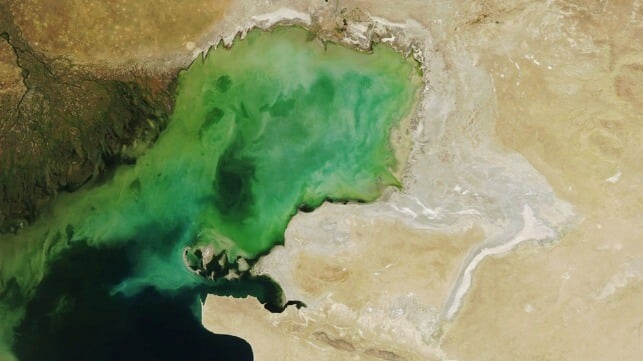
Reduced surface area of the Caspian Sea, 2022 (NASA)

Published Sep 22, 2025 11:22 PM by The Conversation


[By Simon Goodman]

Once a haven for flamingos, sturgeon and thousands of seals, fast-receding waters are turning the northern coast of the Caspian Sea into barren stretches of dry sand. In some places, the sea has retreated more than 50 kilometers. Wetlands are becoming deserts, fishing ports are being left high and dry, and oil companies are dredging ever-longer channels to reach their offshore installations.

Climate change is driving this dramatic decline in the world’s largest landlocked sea. Found at the boundary between Europe and Central Asia, the Caspian Sea is surrounded by Azerbaijan, Iran, Kazakhstan, Russia, and Turkmenistan, and sustains around 15 million people.

The Caspian is a hub for fishing, shipping, and oil and gas production, and is of rising geopolitical importance as it sits where the interests of global superpowers meet. As the sea shallows, governments face the critical challenge of maintaining industries and livelihoods, while also protecting the unique ecosystems that sustains them.

I’ve been visiting the Caspian for more than 20 years, working with local researchers to study the unique and endangered Caspian seal, and support its conservation. Back in the 2000s, the far north-eastern corner of the sea was a mosaic of reed beds, mudflats and shallow channels that teemed with life, providing habitats for spawning fish, migrating birds, and tens of thousands of seals that gathered there to moult in the spring.

Now these remote wild places we visited to catch seals for satellite tracking studies are dry land, transitioning to desert as the sea retreats, and the same story is playing out for other wetlands around the sea. This experience parallels that of coastal communities, who year by year are seeing the water recede away from their towns, fishing wharves and ports, leaving infrastructure stranded on newly-dry land, and the people fearful for the future.

A sea in retreat

The level of the Caspian Sea has always fluctuated, but the scale of recent change is unprecedented. Since the turn of the current century, water levels have declined by around 6cm per year, with drops of up to 30cm per year since 2020. In July 2025, Russian scientists announced the sea had dropped below the previous minimum level recorded during the era of instrumental measurements.

During the 20th century, variations were due to a combination of natural factors and humans diverting water to use for agriculture and industry, but now global warming is the main driver of decline. It might seem inconceivable that a body of water as large as the Caspian could be at risk, but in the hotter climate the rate of water entering the sea from rivers and rainfall is reducing, and is now being outstripped by increased evaporation from the sea surface.

Even if global warming is limited to the Paris agreement target of 2°C, water levels are predicted to fall up to ten meters compared to the 2010 coastline. With the current global trajectory of greenhouse gas emissions, the decline could reach 18 meters, which is about the height of a six-story building.

Because the northern Caspian is shallow – much of it only around five meters deep – small decreases in depth mean huge losses of area. In recent research, colleagues and I showed that even an optimistic ten-meter decline would uncover 112,000 square kilometers of seabed – an area larger than Iceland.

What’s at stake

The ecological consequences would be dramatic. Four out of ten ecosystem types unique to the Caspian Sea would disappear completely. The endangered Caspian seal could lose up to 81% of its current breeding habitat, and Caspian sturgeon would lose access to critical spawning habitat.

As in the Aral Sea disaster, where another massive lake in Central Asia almost entirely disappeared, toxic dust from exposed seabed would be released, with serious health risks.

Millions of people are at risk of displacement as the sea recedes, or face highly degraded living conditions. The sea’s only link to the global shipping network is through the delta of the Volga River (which flows into the Caspian) and then via an upstream canal to the Don River for connections to the Black Sea, Mediterranean and other river systems. But the Volga is already struggling with reduced water depth.

Ports like Aktau in Kazakhstan and Baku in Azerbaijan need dredging just to keep operating. Similarly oil and gas companies are having to dredge long channels to their offshore facilities in the north Caspian.

Already the costs of protecting human interests are in the billions of dollars and are only set to grow further. The Caspian is central to the “middle corridor," a trade route linking China to Europe. As water levels fall, shipping loads must be reduced, costs rise, and settlements and infrastructure risk being stranded tens or even hundreds of kilometers from the sea.

A race against time

Countries around the Caspian are having to adapt, relocating ports, and dredging new shipping lanes. But these measures risk conflicting with conservation goals.

For instance, there are plans to dredge a major new shipping channel across the “Ural saddle” of the north Caspian. But this is an important area for seal breeding, migration and feeding, and will be a vital area for the adaptation of ecosystems as the sea recedes.

Since the rate of change is so rapid, traditional fixed boundary protected areas risk becoming obsolete. What’s needed is an integrated, forward-looking approach to planning across the whole region. If the areas ecosystems will need to adapt to climate change are mapped and protected now, planners and policymakers will be better able to ensure future infrastructure projects avoid or minimize further damage.

To do this, Caspian countries will have to invest in biodiversity monitoring and planning expertise, all while coordinating action across five different countries with different priorities.

Caspian countries are already recognizing the existential risks, and have begun to form intergovernmental agreements to address the crisis. But the rate of decline may outstrip the pace of political cooperation.

The ecological, climatic and geopolitical importance of the Caspian Sea means its fate ultimately matters far beyond its receding shores. It provides a key case study in how climate change is transforming major inland water bodies across the world, from Lake Titicaca to Lake Chad. The question is whether governments can act fast enough to protect both the people and nature of this rapidly changing sea.

Simon Goodman is a Lecturer in Evolutionary Biology at University of Leeds.

This article appears courtesy of The Conversation and may be found in its original form here

The Conversation

The opinions expressed herein are the author's and not necessarily those of The Maritime Executive.


The Italian Communist Party and the pursuit of revolutionary science


University of Chicago Press Journals


Although scholarship has demonstrated the inextricability of the history of science from the histories of industry and politics, little attention has been paid to the role of political parties in the shaping of scientific inquiry. A new article in Isis, “The Political Elaboration on Science and Technology of the Italian Communist Party Between the 1960s and the 1980s,” investigates how political parties mediate social change and scientific progress, using the Partito Comunista Italiano as its object of analysis.

After WWII, the leadership of the PCI, mostly predominated by humanists and social scientists, considered science in mere cultural terms. Furthermore, following the politicization of science under the Fascist regime, the Italian academy tended to discourage its students of science from political engagement. At the beginning of the 1960s, the increasing centrality of science and technology acquired in productive processes, writes article author Daniele Cozzoli, led the party to elaborate an original collective reflection on science.

In the 1960s and 1970s, Italian industrialists were introducing increased automation into their factories, radically modifying the relative autonomy of workers in factories and keeping workers’ wages stagnant. The US and the USSR were locked in a space race that demanded ever greater technological progress, and which further tied scientific research to the military. At the beginning of the 1970s, it appeared clear that economic growth incurred stunning ecological devastation. As Indira Gandhi explained in her famous speech at the 1972 UN Stockholm conference, putting a halt to industrialization in the Global South ran the risk of perpetuating the poverty of still developing nations.

In spite of its hierarchical structure, the PCI became a place where senior scientists, young nontenured scientists, politicians and policymakers, technicians, and workers freely debated. Different positions coexisted, but the prevailing one stressed that science was not neutral. According to this view, the devastation of environment, the arms race, and the compression of workers’ role in factories were not the results of a “neutral” science, but rather those of the development of a military-oriented and consumerist science. The party’s collective reflection on the “non-neutrality” of science led the party leader, Enrico Berlinguer, to formulate the “austerity policy” as a way to give workers back their centrality in productive processes and at the same time establish a non-colonial relation with the Global South.

In the 1970s, when the global oil crisis spurred a panic over energy dependence, tension emerged within the party regarding the construction of nuclear power plants. Although nuclear energy presented a cleaner alternative to oil, and one that would reduce the extraction of resources from the Global South, the nuclear pollution posed an even greater problem. Moreover, the security required to monitor nuclear power sites would mean the increased militarization of the whole Italian society, the construction of an “atomic state” like in the postwar United States.

With the rise of neoliberalism in the 1980s and the fall of the Soviet Union, the orientation of the PCI shifted from communism to social democracy and the party changed its name. But these dialogues demonstrate the nature of political parties as “places where ideas are debated, formed, and elaborated,” and remain as a record of the PCI’s efforts to couple science with radical ends. By framing science within the structure of global inequality, Cozzoli concludes, the PCI aligned themselves with the growing movement in the history of science to recognize contributions and people that have previously gone overlooked.


Since its inception in 1912, Isis has featured scholarly articles, research notes, and commentary on the history of science, medicine, and technology and their cultural influences. Review essays and book reviews on new contributions to the discipline are also included. An official publication of the History of Science Society, Isis is the oldest English-language journal in the field.  

Founded in 1924, the History of Science Society is the world’s largest society dedicated to understanding science, technology, medicine, and their interactions with society in historical context.


Montana State alumnus discovers new, extinct crocodyliform in Montana


Montana State University
Thikarisuchus xenodentes 

image: 

An artistic rendering of Thikarisuchus xenodentes, an extinct crocodyliform from the Cretaceous of Montana.

view more 

Credit: Dane Johnson/Museum of the Rockies


By Diana Setterberg, MSU News Service

BOZEMAN – About 95 million years ago, a juvenile crocodyliform nicknamed Elton lived in what is now southwest Montana at the edge of the Western Interior Seaway. 

Measuring no more than 2 feet long from nose to tip of tail, young Elton was about the size of a big lizard, according to Montana State University professor of paleontology David Varricchio. Had it lived to be full grown, Elton would have measured no longer than 3 feet, far smaller than most members of the Neosuchia clade to which it and its distant relatives belong. The clade includes modern crocodilians and their closest extinct relatives, almost all of them semiaquatic or marine carnivores with simple, conical teeth. 

Elton, by contrast, lived on the land, probably feasting on both plants and insects or small animals with its assortment of differently shaped and specialized teeth. Its unique anatomy reveals that it was part of a new, previously unrecognized family of crocodyliforms endemic to the Cretaceous of North America. 

If not for the sharp eye of Harrison Allen, a 2023 graduate of MSU’s Department of Earth Sciences in the College of Letters and Science, Elton’s ancient remains may never have been discovered. But during a dig in the summer of 2021 in the Blackleaf geological formation on U.S. Forest Service land near Dillon, Allen – then a student in Varricchio’s field paleontology course – noticed a fossil the size of the tip of his pinkie with a “weird texture on it.”

“I brought it to Dr. Varricchio and knew it must be something good, because he said, ‘Take me to where you found this,’” said Allen, who is now studying croc paleontology as a doctoral student at Stony Brook University in New York.

It was an exciting moment for Allen, originally from Kentucky, who chose MSU because it offers a paleontology track for undergraduates majoring in earth sciences. Four years and hundreds of hours of study later, he is the lead author of a paper published this week in the Journal of Vertebrate Paleontologythat describes the morphology and scientific significance of the creature whose remains he found in the Blackleaf Formation.

“After the dig, Dr. Varricchio told me why he was so excited the day I found the initial specimen. It had so much visible anatomy to explore, and he could see it was a tiny, tiny croc skull, fully articulated and preserved – it was a special thing,” Allen said. “We have found dinosaurs (in the Blackleaf) before, but this was the second known vertebrate animal we’d ever found in this formation.”

The extinct animal, which Allen and the paper’s co-authors later named Thikarisuchus xenodentes for its strange, sheathed teeth, has provided new information about the paleoecology of the Blackleaf ecosystem and about patterns of evolution in the croc family tree.

It also provided the ultimate undergraduate research project for Allen, who delved into the painstaking process of excavating, sifting and reconstructing the Thikarisuchus remains with the help of some fellow students.

“As an undergraduate student new to research, I nervously went up to Dr. Varricchio and asked if I could study this specimen,” Allen said. “It led me down the rabbit hole into this amazing world of prehistoric, extinct crocs and their evolutionary niches.” 

The day after Allen recovered the first piece of skeleton, he and his classmates scooped up several bags of sediment from the mound where it was found. Back in Bozeman, Allen and his friend Dane Johnson, who graduated in 2022 and is now a paleontology lab and field specialist at MSU’s Museum of the Rockies, spent between 10 and 20 hours sifting out fine particulate matter and dirt, eventually recovering dozens of tiny pieces of the Thikarisuchus skeleton that collectively fit into the palm of Allen’s hand. As they worked, they listened to music, including Elton John’s 1970s hit “Crocodile Rock.” The nickname “Elton” stuck, long before the specimen was assigned the scientific name that reflects its physical traits.

Allen and Johnson recovered bits of bone from almost all areas of the animal’s body, including its limbs, vertebrae, jaw and 50-millimeter-long skull. Because the fragments were tiny and exceptionally fragile, the students didn’t attempt to physically reassemble them. Instead, they took them for a series of CT scans, including some at MSU’s Subzero Research Laboratory. Allen estimates that he spent well over 100 hours coloring the digital, 2D segment slices that the scans produced, a process necessary to visually distinguish the bones from the rocks they were embedded in.

“Harrison worked super hard to digitally reconstruct the animal, and it came out beautifully,” said Varricchio. 

During the process, Allen discovered that the bones of Thikarisuchus were densely concentrated and organized in a manner consistent with fossils of organisms found in burrows in the Blackleaf Formation and the nearby Wayan Formation in Idaho. He said this suggests that Thikarisuchus was likewise preserved within a burrow, further supporting the notion that fossils recovered from these formations are biased toward those that were preserved in burrows.

The specimen also presented clues about Thikarisuchus’ newly named family group Wannchampsidae and a similar group found in Eurasia known as Atopasauridae. Both groups were tiny and terrestrially adapted, and they shared certain cranial and dental features found in another more distantly related group from the Cretaceous of Africa and South America.

“It suggests that during the same time period, we’re seeing convergent evolution between two distantly related groups due to similar environmental conditions, prey availability and who-knows-what that prompted crocs on opposite sides of the planet to develop similar features,” Allen said. 

As he works toward his Ph.D. and a career as a paleontology professor, Allen said his experiences with Elton cemented his research interest, which has since broadened to include extinct crocs from all over the world.

“The majority of diversity of crocodyliforms is in the past. There were fully marine crocs, fully terrestrial crocs, herbivorous crocs, omnivores and some that cracked shells,” he said. “That amazed me and made me want to get into this more specific realm of paleontology.”

Varricchio said he feels fortunate that students like Allen choose to study at MSU.

“It was a true pleasure to have Harrison as a student here – so much positive enthusiasm, followed up with great research,” he said.


PFAS filter from a ball mill


A team of researchers is developing an environmentally friendly material that could help remove these ‘forever chemicals’


Deutsches Elektronen-Synchrotron DESY

New filter for PFAS chemicals 

image: 

Depiction of the process forming the structure of the new filter for PFAS chemicals

view more 

Credit: Science Communication Lab for DESY


PFAS are fluorinated compounds found in many everyday products, such as outdoor clothing and cookware like Teflon pans. This is because PFAS are durable, heat-resistant and dirt-repellent. Their stability is precisely what leads to problems: although potentially harmful to our health, these substances are scarcely broken down at all in the environment and are regarded as ‘forever chemicals’. PFAS are also found in wastewater. Although they can be removed by filtration, this is a laborious process. A team led by the German Federal Institute for Materials Research and Testing (BAM) has now developed a new filter material based on an unusual production technique. Crucial experiments were carried out at DESY’s X-ray source PETRA III to optimise the process. The working group is presenting its results in the journal small.

The candidates for this new filter material are known as ‘covalent organic frameworks’. The pores of these COFs are just a few nanometres across, so that PFAS molecules literally get stuck inside them. The nanoscale scaffolds can be manufactured using an original technique – by grinding them in a special type of mill. ‘In the laboratory, we use a small plastic cylinder about the size of a film canister,’ explains BAM researcher Franziska Emmerling. ‘Into this, we place some powder, a droplet of solvent and two steel balls, each about the size of a peppercorn.’

A special device then shakes this ball mill to and fro more than 30 times per second, as a result of which its contents are ground up. Initially, the powder granules become smaller, which increases their surface area. After a few minutes, the frictional heat, increased pressure and kinetic energy initiate a chemical reaction. The finely ground particles combine to form larger structures, scaffolds that can act as a filter. This little-known branch of chemical manufacturing is known as mechanochemistry. 

‘It is actually quite an old story. Mechanochemistry probably already played a role in ancient times,’ says DESY physicist Martin Etter. ‘The first pharmaceutical substances for medicines were presumably released or even formed in chemical reactions when plant matter was ground up in a mortar.’ Today, mechanochemical processes are used in industry to synthesise drugs, catalysts and functional materials. Since they do not normally need large amounts of toxic solvents and require comparatively little energy, such methods are considered sustainable and environmentally friendly. 

But what is the most effective way to produce the filter frameworks using a ball mill? To find out, the research group in Hamburg studied the process using the high-intensity, focused X-ray beam produced by PETRA III. While the mill was in action, the beam scanned its contents every ten seconds and was able to determine the structure of the crystals. ‘The pattern produced by the two starting materials at our detector is different from that of the chemical formed by the chemical reaction,’ explains Etter. ‘We were able to watch, in real time, as the patterns of the two starting chemicals became weaker and weaker, while at the same time the pattern of the new chemical began to appear – that of the framework structures.’

To identify the optimal parameters for the process, the team varied a number of factors, including the frequency with which the ball mill was agitated and the amount of solvent added. The results showed that the best scaffolds were obtained at a frequency of 36 hertz, using 266 milligrams of powder and adding 250 microlitres of solvent – just a few drops. Unlike other framework structures already used as filters, the new material does not contain any heavy metals and would therefore be more environmentally friendly.

While it is not yet clear how the potential PFAS filters could be manufactured on an industrial scale, Martin Etter already has some ideas as to where they might eventually be used. ‘In the wastewater treatment plants of companies that produce PFAS chemicals, for example,’ says the physicist. ‘And maybe one day they could even be integrated into ordinary taps to filter our drinking water.’

Research into mechanochemistry will continue at DESY. The experts have high hopes for PETRA IV, the planned successor to the current X-ray source. PETRA IV will deliver a significantly finer, more narrowly collimated X-ray beam, which should speed up the measurements considerably. ‘That means we won’t just be able to take one picture every ten seconds, but perhaps ten pictures per second,’ says Etter enthusiastically. ‘And that would allow us, for example, to observe chemical processes that take place very quickly and in which short-lived intermediate structures are formed.’