Tuesday, September 23, 2025

MARS THE CANDY COMPANY

Mars Invests Billions in European Renewable Energy

Mars Inc. announced Tuesday that its ten Mars Snacking factories across Europe are now operating entirely on renewable energy sources. The move is a significant step in the company's broader sustainability and decarbonization efforts, which aim for net-zero emissions by 2050.

The shift to renewable power follows a decade of investments in the company's European manufacturing facilities. According to the company, these investments include over $1.6 billion (€1.5 billion) spent over the past five years. The company's strategy involved both direct investments in energy reduction and conversion, as well as the purchase of Guarantees of Origin (GO) certificates to cover remaining electricity and natural gas consumption.

The ten factories are located in the Czech Republic, France, Germany, the Netherlands, Poland, and the United Kingdom. These facilities collectively produce approximately 900,000 metric tons of popular confectionery brands annually, including SNICKERS, TWIX, and M&M'S. Around 85% of this production is distributed for consumption within the European region.

This transition comes amid a wider push across the food and beverage industry to reduce its carbon footprint and address consumer demand for more sustainable practices. Many companies are facing pressure from investors and regulators to align their operations with global climate goals. The sourcing of renewable energy, either through direct investment in projects like wind farms or through the purchase of energy certificates, has become a common strategy for corporations to lower their operational emissions.

"At Mars, we believe that the world we want tomorrow starts with how we do business today," said Marc Carena, Regional President for Mars Wrigley. "Therefore, we measure our success not only by financial results, but also by the positive impact we have on people, the planet, and society. Sustainability makes good business sense and is at the heart of our strategy."

The company stated that this development is a key part of its global strategy to achieve its net-zero target by 2050. Mars plans to invest an additional $1.1 billion (€1 billion) in its European manufacturing operations by the end of 2026. This investment is aimed at supporting innovation, economic growth, and the development of modern, energy-efficient infrastructure.

By Michael Kern for Oilprice.com


Aluminum Prices Hit 6-Month High as Supply Concerns Grow

  • Aluminum touched its highest price since early 2025 as China neared its 45-million-ton output cap, stoking deficit fears.

  • Despite bullish momentum, global production continues to rise and U.S. demand fell 4.4% in H1 2025 under tariff pressure.

  • The Midwest Premium hit a record $0.7323/lb, while trade flows shifted as Canadian exports to Europe increased sharply.

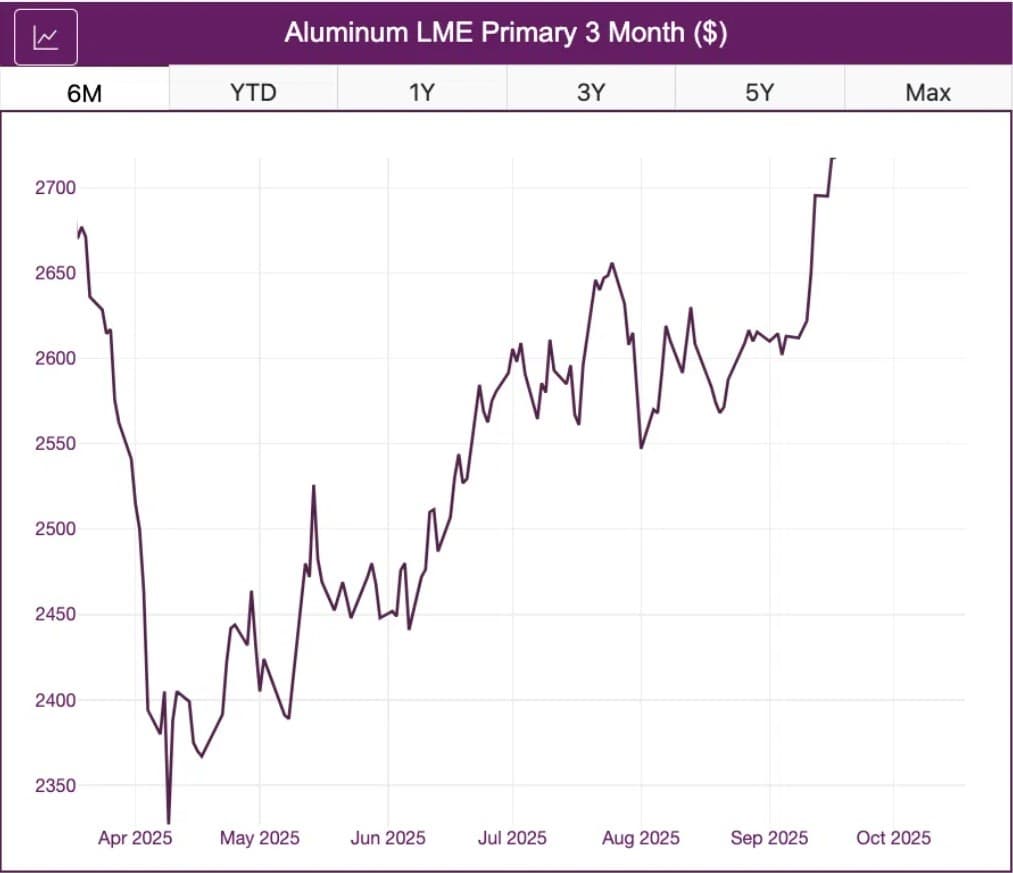
The Aluminum Monthly Metals Index (MMI) remained sideways with an upside bias, rising 0.56% from August to September. Meanwhile, the global price of aluminum reached highs not seen since the beginning of the year. Track other MetalMiner monthly indexes here, and compare how the overall industrial metal market is performing.

Aluminum Prices Bullish on Global Supply Concerns

LME aluminum touched a 6-month high by its September 16 close as the price of aluminum broke out of its sideways trend on emerging deficit concerns due to Chinese output nearing its production cap. 

For years, China’s aluminum sector fueled global overcapacity. State subsidies gave Chinese producers a significant market advantage, while rising electricity prices and ample global supply presented considerable headwinds for their global counterparts. The West is increasingly working to address this issue through trade barriers, including U.S. tariffs and the EU’s Carbon Border Adjustment Mechanism (CBAM), which offer new threats to Chinese exports.

MetalMiner
Source: MetalMiner 
Insights

Meanwhile, domestic demand conditions in China remain soft. The country’s property sector, once a significant consumer of aluminum, remains in the doldrums, with no signs of near-term resuscitation. This forced China to set a 45-million-ton production cap in 2017 and promote a “closed-loop” system, where old capacity must be shuttered before new capacity can be built. 

For most of the year, market response to China’s cap appeared somewhat muted, even as global exchange inventories dwindled. By April, Chinese production hit 44 million tons. While output was close to its cap, it hadn’t reached it yet. However, China’s aluminum capacity is estimated to have reached 45.69 million tons in June, raising concerns about what happens if Chinese output flattens. The situation looks especially dire as the world embarks on grid infrastructure projects that would help fuel aluminum demand.

Headwinds for the Price of Aluminum

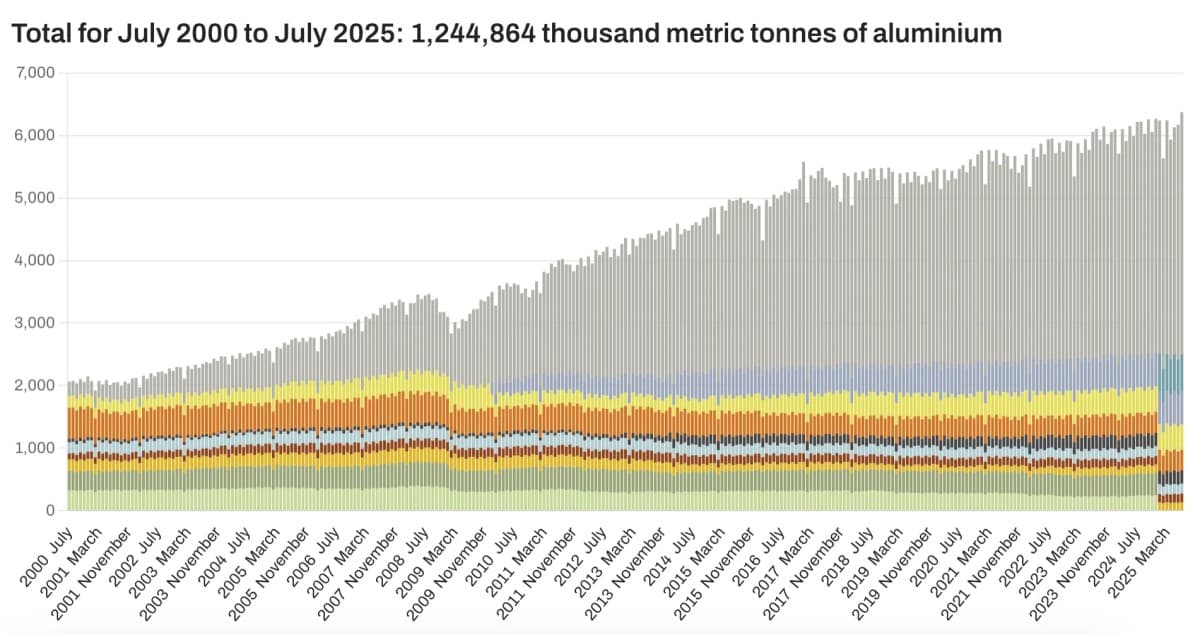
While deficit concerns have added renewed momentum to aluminum prices, there are reasons to be skeptical about the recent breakout. Though China may have reached its production cap, both Chinese and global output remain on the rise. Data from the country’s National Bureau of Statistics showed Chinese primary aluminum production rose 7.4% year-over-year back in June. This echoes data from the International Aluminum Institute, which shows global production levels have yet to stagger meaningfully.

Metal Miner
Source: 
International Aluminum Institute

And while both SHFE and LME exchange inventories are low, they have also begun to rebound. A continued rise would serve to quell supply-side jitters. Rather than exceptional demand conditions, part of the LME drawdown stemmed from the decision to block Russian material from warehouses as a result of the ongoing war in Ukraine. So far, China has helped fill the gap left by Europe as it continues to buy Russian aluminum. Import data showed Chinese aluminum imports rose 38% year over year. So, while sanctions have diverted shipments, they have not removed Russian material from the global market.

Aluminum Demand Falls in the United States

Meanwhile, U.S. tariffs have suppressed U.S. aluminum demand conditions and shifted trade flows. According to the Aluminum Association, North American aluminum demand fell 4.4% during the first half of 2025. Outside of foil, demand reportedly fell in all market segments.

Amid slow demand and tariff pressures, Canadian producers have shifted aluminum deliveries toward Europe. Indeed, recent data showed that Europe’s share of Quebec’s aluminum exports rose from 0.2% in Q1 to 18% in Q2, which has helped to lift LME warehouse stocks off their multi-year lows. 

Overall, subdued demand conditions remain a constraint on market sentiment. Back in April, Goldman Sachs reduced its aluminum price forecast as a result of a weaker economic growth outlook. Sachs’ outlook also suggested the possibility of a surplus into 2026 if demand does not recover as strongly as anticipated. 

Though long-term deficit concerns remain, the near-term price outlook appears less certain. Economic growth remains ongoing, but slow. Meanwhile, time will tell whether China abides by its production cap and how quickly producers elsewhere around the world can ramp up output to meet the anticipated shortfall.

Aluminum Midwest Premium Reaches New ATH

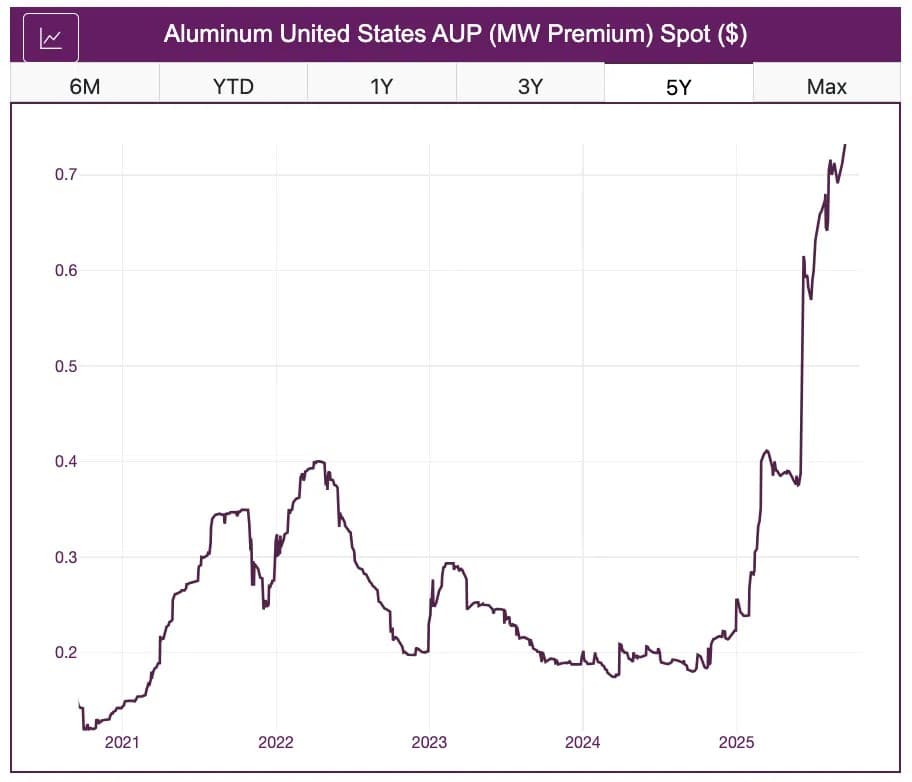
The Midwest Premium joined the LME aluminum price rally, rising to a new all-time high of $0.7323 per pound. Prices appeared to stabilize by mid-August, just short of the level expected to fully price in the cost of U.S. tariffs. 

The recent rise above the $0.73 per pound mark now puts the premium within a few cents of most forecasts. While buyer uncertainty regarding trade policy remains a fixture within the market, domestic conditions appear relatively stable. Simultaneously, mill lead times for most products appear steady or slightly longer.

MM
Source: MetalMiner 
Insights

Biggest Aluminum Price Moves

  • Indian primary cash aluminum prices witnessed the largest increase of the overall index, rising by a modest 1.75% to $2.91 per kilogram as of September 1.
  • Chinese primary cash aluminum prices rose 1.46% to $2,892 per metric ton.
  • The 5052 coil premium over 1050 Korean aluminum fell 5.69% to $4.18 per kilogram.
  • The 3003 coil premium over 1050 Korean aluminum dropped 5.86% to $4.08 per kilogram.
  • Korean commercial 1050 sheet prices declined by 5.92% to $4.04 per kilogram.

By MetalMiner


Serbia's EU Bid Complicated by Russian Energy Ties

  • Serbia and Hungary are collaborating with Russia on energy infrastructure, including an extension of the Druzhba pipeline, which undermines EU efforts to reduce reliance on Russian energy.

  • Ukrainian drone attacks on the Druzhba pipeline have disrupted oil shipments and highlighted the vulnerabilities of relying on this infrastructure, leading to a strong reaction from Hungary.

  • Serbia's actions pose a dual challenge for the EU by maintaining Russian energy dependence and potentially anchoring Chinese influence, complicating its EU accession negotiations on green agenda and sustainable connectivity.

Serbia is a candidate for European Union membership and Hungary has been a full member since 2004, but that hasn’t prevented them from collaborating with Russia to undermine EU cohesion and meddle with efforts to break Europe’s dependency on Russian energy. Ukrainian drones, however, have succeeded in disrupting Belgrade’s and Budapest’s designs.

EU Commissioner for Energy Dan Jørgensen unveiled an ambitious plan in June to stop all Russian oil and natural gas exports to the European Union by 2027. A little over one month later, Hungary and Serbia announced a joint effort to build additional infrastructure that would enable Russian oil exports to reach Serbia via an extension of the Druzhba pipeline. Once built, the pipeline will be able to convey upwards of 5 million tons of oil annually to Serbia. The target completion date is 2027.

A recent analysis published by the Western Balkans Center at New Lines Institute explains how Serbia’s actions are “revealing broader inefficiencies in the EU’s strategy to mitigate external energy influences.”

The analysis states Serbia is pursuing a “deliberate strategy of maneuvering between Russia and China to maximize autonomy while extracting concessions from Brussels. The result is a dual challenge for the EU – Serbia’s continuation of Russian energy dependence that undermines sanctions unity, and resource politics that could anchor Chinese influence at the heart of the Union’s green transition.”

Given Serbia’s EU candidate status, Belgrade’s actions additionally highlight “a broader vulnerability in the EU’s enlargement policy – its inability to prevent candidate states from using external partnerships to evade reform demands necessary for accession.”

As the analysis notes, Serbia’s Druzhba extension plan complicates its negotiations with Brussels on Cluster 4 requirements, which oblige an aspiring member state to harmonize its policies with EU standards concerning the “green agenda and sustainable connectivity.” Among the specific topics that need to be settled are energy supply, infrastructure and the internal energy market.  Although the EU opened negotiations with Serbia on Cluster 4 topics in 2021, none of the necessary provisions have been finalized to date.

“The planned pipeline deepens Serbia’s reliance on Russian oil and contradicts EU accession requirements outlined in Cluster 4,” the New Lines analysis states.

In August, Ukrainian drone attacks on the Druzhba pipeline on Russian territory raised questions about the utility of the Serbian pipeline extension plan. The damage done to the Unecha pumping station in one of those strikes caused a disruption to Europe-bound oil shipments, prompting complaints by Hungary and Slovakia. Despite EU efforts to wean itself off Russian energy, Druzhba remains a vital supply conduit for both Budapest and Bratislava.

In the aftermath of the August attacks, Ukraine’s president, Volodymyr Zelensky suggested that Kyiv might target Druzhba again, unless Hungary moderates its stance on hindering EU assistance to Ukraine, including a block on accession. “We have always supported friendship between Ukraine and Hungary. And now the existence of Druzhba [which means 'friendship’ in Ukrainian] depends on Hungary’s position,” Zelensky said. Hungarian leader Viktor Orban, in turn, warned Zelensky that further Ukrainian efforts disrupt the Hungary-bound flow of Russian oil would have big consequences for Kyiv.

Regardless of whether Ukraine mounts new strikes on Druzhba, the proposal of a Serbian pipeline extension presents a serious challenge to the EU’s cohesion, the New Lines analysis underscores. 

“Serbian geopolitical maneuvering involving Russia is dangerous to European geopolitical stability and prosperity,” the analysis states. “Russia has historically capitalized on destabilization and conflict in the Western Balkans. This further diverts the region from EU democratic norms and allows Russia to extend its influence in Europe, despite EU sanctions.”

By Eurasianet.org 


The EU Remains the World's Biggest Buyer of Russian Gas Despite Sanctions

  • President Trump has threatened steep tariffs on India and China unless they cut Russian energy imports, while pressing NATO to fully sever energy ties with Moscow.

  • Europe continues to import large volumes of Russian LNG and gas despite pledging to phase out Russian energy by 2027, making it Russia’s biggest buyer.

  • India has pushed back against Western criticism, accusing the EU and U.S. of hypocrisy and defending its Russian imports as necessary for energy security.

Since the Russian invasion of Ukraine in early 2022 and the subsequent sanctions on Russian energy, the European Union has encouraged other countries to follow suit by enforcing sanctions, even as Russia offers discounted oil and gas to various countries around the globe. While many countries have adhered to the sanctions, some Asian states, such as China and India, have increased Russian energy imports to stockpile cheap crude and other energy products to meet the growing demand. Meanwhile, as the EU has reduced its reliance on Russia for certain energy products, it has been unable to completely decrease its dependence on Moscow for certain products, leading many to criticise Europe for its double standards.

In recent weeks, United States President Donald Trump has threatened India with extremely high tariffs if it does not reduce its imports of Russian energy, calling for the EU to condemn the import of Russian energy. Trump said that the EU should impose tariffs of up to 100 percent on India and China for continuing to purchase Russian crude to encourage the two powers to decrease their reliance on Moscow, to limit energy revenues for Russia to pump into its war efforts.

However, this is easier said than done, as Europe continues to depend heavily on Russia for certain energy products, despite two and a half years of efforts to decrease this reliance. While some European countries have been able to find alternative energy supplies, thanks to increased domestic production or strengthened trade ties with other world powers, others have not been able to reduce the import of Russian energy so quickly. Europe continues to be the biggest buyer of Russian LNG globally, importing around 51 percent of Russia’s LNG. The EU was also the biggest buyer of Russia’s pipeline gas, purchasing 36 percent of its total exports.

Much of this LNG is being purchased not by the countries that have already stated their intentions to continue purchasing energy from Russia, such as Slovakia and Hungary, but by those who support the sanctions on Russian energy, including France, Spain, and the Netherlands. In fact, after promising to phase out all Russian LNG use in the EU by the end of 2027, in the first half of the year, Europe increased its imports of Russian LNG from $4 billion to almost $5.3 billion. Meanwhile, in 2024, the EU’s bilateral trade with Russia totalled almost $80 billion, with EU imports from Russia of around $42.4 billion.

In August, India criticised the United States and European Union for threatening the Asian state with tariffs for its ongoing reliance on Russian energy, when they themselves continue to import significant volumes of Russian energy. Earlier in the month, President Trump had threatened the introduction of a 25 percent tariff on imports from India, and later said in a social media post that he would be “substantially raising the tariff paid by India to the USA” because of India’s imports of Russian crude.

In recent months, the EU has introduced sanctions on the Indian refiner Nayara, which is majority-owned by Russia, as well as banned the import of refined oil produced using Indian crude, which hit Indian refiners hard. After several months of saying nothing, in August, Indian Prime Minister Narendra Modi said the targeting of India was “unjustified and unreasonable”.

The Ministry of External Affairs spokesperson Randhir Jaiswal issued a statement saying, “Like any major economy, India will take all necessary measures to safeguard its national interests and economic security.” Jaiswal also suggested that several Western countries were, themselves, continuing to import Russian energy and accused Europe of hijacking alternative supplies for itself.

“In fact, India began importing from Russia because traditional supplies were diverted to Europe after the outbreak of the conflict,” Jaiswal said. “The United States at that time actively encouraged such imports by India for strengthening global energy markets’ stability,” he added. “However, it is revealing that the very nations criticising India are themselves indulging in trade with Russia,” he stressed.

Meanwhile, this month, President Trump has put increasing pressure on NATO to stop purchasing crude from Russia and to implement far-reaching sanctions, suggesting that the U.S. would introduce a new wave of sanctions on Russia if this were achieved. In a social media post, Trump said, “I am ready to do major sanctions on Russia when all NATO nations have agreed, and started, to do the same thing, and when all NATO nations stop buying oil from Russia.” The increased call for cutting ties with Russia is aimed at putting pressure on Russian President Putin to finally end Russia’s war with Ukraine.

As Trump places mounting pressure on Europe and NATO to cut ties with Russia, India has criticised the U.S. and EU for threatening states that continue to depend on Russian energy with tariffs despite continuing to trade with Moscow. These double standards have the potential to undermine Trump’s diplomatic aims to put pressure on Putin to end the war. 

By Felicity Bradstock for Oilprice.com


TotalEnergies Set To Revive Stalled $20B LNG Project In Mozambique

  • TotalEnergies is getting ready to resume work on its giant LNG project in Mozambique.

  • TotalEnergies is the main operator of the $20B LNG project, making it Africa’s largest private investment.

  • Islamic State-affiliated Jihadists remain active in Cabo Delgado province.

French oil and gas giant, TotalEnergies (NYSE:TTE), is getting ready to resume work on its giant LNG project in Mozambique, even as an Islamist insurgency in northern Mozambique continues with fresh attacks displacing tens of thousands of people in recent weeks. Total abandoned the project with a liquefaction capacity of 13.1 million metric tons per year four years ago due to insecurity. With a 26.5% stake, TotalEnergies is the main operator of the $20B LNG project, making it Africa’s largest private investment. India’s Bharat Petroleum Corp. Ltd (BPCL) has secured rights to market LNG from the long-stalled project where it holds a 10% stake while three Indian public sector undertakings (PSUs) have a combined stake of 30%.

While security concerns had delayed the project, conditions have improved now, and full-scale development is expected to resume soon,” BPLC managing director Sanjay Khanna said. “Once operational, the two-train LNG project will boost our upstream presence and support the energy transition. We have already secured LNG marketing rights in line with our 10% participating interest.”

Islamic State-affiliated Jihadists remain active in Cabo Delgado province, northern Mozambique, with Rwandan forces now expected to guard the Afungi site after Mozambique’s President Daniel Chapo managed to secure a renewed security agreement with Rwanda’s President Paul Kagame in August. Previously, Rwandan and Southern African Development Community (SADC) troops had successfully led counterinsurgency operations in the war-torn region, managing to reclaim key towns such as Mocimboa da Praia. Unfortunately, SADC forces withdrew a year ago due to funding shortfalls, giving the insurgents a chance to regroup and renew attacks.

Related: Norwegian Offshore Oil and Gas Production Surges Past Expectations

Work on Mozambique’s crown jewel has long faced delays due to insecurity. Back in 2010, Texas-based Anadarko Corp. --now a subsidiary of Occidental Petroleum Corp. (NYSE:OXY)--and Italian energy giant Eni S.p.A. (NYSE:E) announced the discovery of approximately 180 trillion cubic feet of natural gas reserves, equivalent to ~29 billion barrels of oil, in Mozambique’s supergiant offshore basin of Rovuma, immediately catapulting the South African nation to a potential global LNG superpower. 

As you might expect, there was a stampede by oil and gas majors, including ExxonMobil (NYSE: XOM), TotalEnergies (NYSE:TTE), Shell (NYSE: SHEL), Eni, and China National Petroleum Corp. (NYSE: PTR) rushing in to stake their claims. But it was not long before terrorism and the long tail of the “hidden loans” corruption scandal, in which senior officials had formed state-owned companies that borrowed billions of dollars off-the-books, started to cast a pall on the economy and took a heavy toll on investor confidence. 

Mozambique eventually was able to get its projects off the ground, with first exports of LNG launched in November 2022 through the offshore Coral Sul FLNG Project, operated by Eni. This marked the country's first LNG shipment to the international market. However, whereas this smaller project is active, larger, land-based LNG projects, including TotalEnergies' giant project in Cabo Delgado, remain suspended due to security concerns.

And in the meantime, the security situation may be improved, but it is far from stable.

And in the meantime, the security situation may be improved, but it is far from stable. Insurgents linked to Islamic State have staged intermittent attacks in Cabo Delgado this year, including assaults on villages and ambushes along transport corridors that displaced thousands in July and August. Humanitarian groups report that nearly 120,000 people have been forced to flee since the start of 2025, underscoring how fragile gains remain despite Rwandan and Mozambican security deployments. Aid workers warn that while major towns are more secure than during the peak of violence in 2021, rural areas remain exposed, and any renewed escalation could once again jeopardize operations at the Afungi site.

Mozambique is just one of many African countries grappling with the so-called resource curse.

Last week, United Nations investigators on Tuesday unveiled rampant and systemic corruption by South Sudan’s ruling class, compounding the country’s security challenges and putting the pivotal oil-driven economy at severe risk. The global agency has accused South Sudanese authorities of plundering the country’s wealth, including bogus payments totaling $1.7 billion in the 2021-2024 period to companies linked with Vice President Benjamin Bol Mel for road construction contracts that were never delivered. The 101-page report uncovers how South Sudan's government disbursed ~$2.2 billion over a 3-year period through its off-budget "Oil for Roads" programme to companies affiliated with Bol Mel, shell companies, and elite military budgets--while over 90% of promised roads remain unbuilt and nearly two thirds of the country’s population of 12 million teeters on the edge of famine.

"The country has been captured by a predatory elite that has institutionalised the systematic looting of the nation's wealth for private gain," said the commission.

South Sudan produces ~150,000 barrels of oil per day, out of which it gives 10,000 barrels to Sudan as transportation fees because the oil has to go through Sudan to reach Port Sudan where it is loaded into cargo ships. In effect, Sudan receives ~$18 million from South Sudan’s oil every day. Two years ago, clashes broke out between the Sudanese Armed Forces (SAF) and the Rapid Support Forces (RSF) over demands by the army and pro-democracy groups for RSF to become integrated into the regular armed forces. RSF has been demanding that South Sudan stop providing funds to the SAF, which might see the SAF retaliate by preventing the export of South Sudan’s oil through Port Sudan, which it controls. A complete meltdown would not only destabilize the region but also potentially lead to the collapse of the volatile state.

The world’s youngest nation is also one of the poorest, with grand corruption and never-ending civil strife sinking the economy. South Sudan's gross domestic product (GDP) fell from ~12 billion in 2011 when the country gained independence, to just $5.4 billion in 2024. 

By Alex Kimani for Oilprice.com