Tuesday, September 23, 2025

SCI-FI-TEK

China Is Desperate to Dominate Nuclear Fusion

  • China has invested up to $13 billion in fusion energy since 2023, aiming for commercial power by 2030.

  • U.S. lawmakers and scientists warn that Chinese dominance in fusion could reshape global geopolitics.

  • Experts call for a $10 billion federal funding boost and stronger public-private partnerships to keep America competitive.

China has spent up to $13 billion developing fusion energy since 2023 and could commercially replicate star power to generate electricity by 2030, becoming the first nation to master what’s commonly dubbed “the holy grail of energy solutions.”

Doing so would give the Chinese Communist Party (CCP) “the potential to reshape global geopolitics” and “dominate a new energy era,” Massachusetts Institute of Technology physicists warn.

This cannot happen, said Rep. Randy Weber (R-Texas), who chairs the House Science, Space, and Technology Committee’s Energy Subcommittee.

“Fusion energy technologies must be developed and deployed by nations that uphold democratic values, transparency, and international cooperation—not by authoritarian regimes that might exploit energy dominance as a weapon,” he said in opening remarks of a Sept. 18 hearing on the nation’s fusion programs.

“The U.S. must prioritize fusion energy development to outpace the CCP’s aggressive timelines,” Weber added, or China will dominate “the most consequential breakthrough of the century.”

Four fusion experts told the subcommittee during the two-hour hearing that the CCP doesn’t have to win what they see as an existential race, calling on the Trump administration to boost funding to match China’s investment, coordinate research and development with allies, and establish fusion demonstration programs using the same “playbook” that spearheaded breakthroughs in other technologies.

Unlike fission, nuclear fusion replicates the reaction produced by firing atoms, which is the power emitted by stars, and has the potential to provide limitless, clean energy. It is often referred to as “the holy grail of energy solutions.”

Fusion has been researched by academic institutions and government laboratories since the 1950s, with significant breakthroughs in 2022—including Lawrence Livermore National Laboratory’s National Ignition Facility completing a nuclear fusion reaction that produced more energy than used to power the experiment—spurring rapid, exponential advancements since.

“This is our ‘Kitty Hawk’ moment, ushering in a new era of virtually unlimited fusion power,” Commonwealth Fusion Systems Co-Founder/CEO Bob Mumgaard said, calling for a $10 billion one-time “kick” in Department of Energy (DOE) funding.
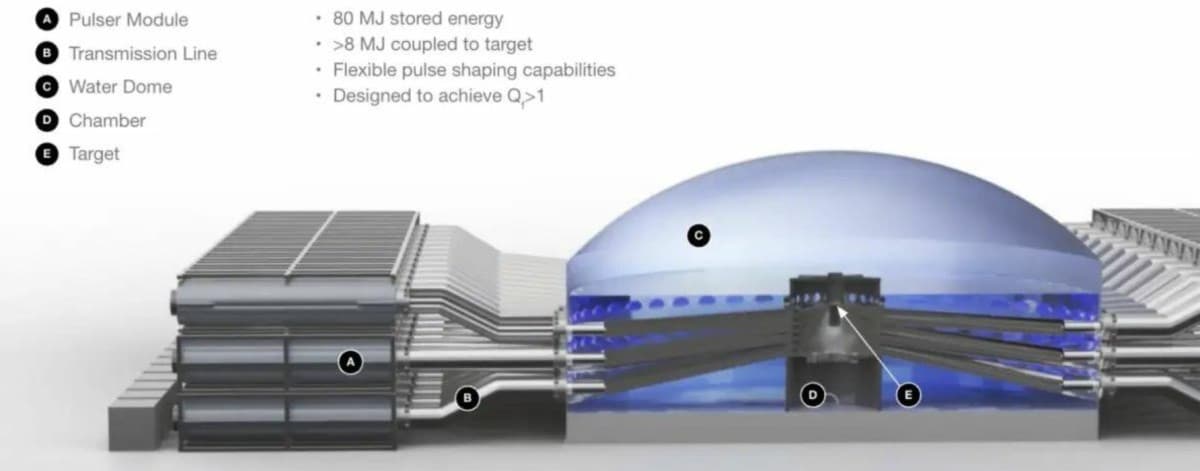

Fusion
A rendering of Pacific Fusion’s Demonstration System, which the company maintains will achieve “net facility gain”—or more energy produced than consumed in a reaction—by 2030. Pacific Fusion illustration provided for congressional testimony on Sept. 18, 2025

‘Decisive Moment Is Upon Us’

Mumgaard, whose company aims to build a small fusion power plant with an ARC tokamak design by the early 2030s, said the nation’s fusion industry has grown from 23 companies that raised $1.78 billion in private capital in 2021 to 53 companies that raised $10.6 billion in 2024.

But now these burgeoning enterprises need to test experimental fusion reactors in a limited-risk environment, which is where DOE and federal funding could make the difference, he said.

Mumgaard said in his testimony that a fusion demonstration program similar to DOE’s advanced fission reactor program would “accelerate deployment of at least three different fusion power plant approaches, with construction starting by the end of 2028 and entering operation by the early 2030s.”

He called for “milestone-based, cost-shared funding that awards only those who show substantial progress toward the goal” with “selection of participants based not just on scientific merit, but also by requiring a clear path to commercial and business success.”

“I agree this $10 billion injection would go a long way to setting us on the course,” Oak Ridge National Laboratory Fusion Energy Division Director Troy Carter concurred.

“The decisive moment is upon us,” he testified. “With deliberate action now—by supporting new facilities, public-private partnerships, and sustained innovation—we can ensure the U.S. leads in bringing fusion energy from scientific promise to commercial reality.”

“The U.S. fusion industry is on the cusp of commercialization,” Pacific Fusion founder and President Will Regan said in his testimony. “America wrote the playbook on investing in fundamental scientific breakthroughs and then scaling their industrial application through the private sector. Fusion is no different, and today we’re at the last mile of solving key scientific challenges to enabling commercial deployment.”

Rep. Zoe Lofgren (D-Calif.) said, while “very much opposed overall” to the fiscal year 2026 (FY26) budget crafted by President Donald Trump, “I would like to say when it comes to his specific request for fusion, it’s moving in the right direction, and I am glad for that.”

DOE’s FY26 budget request provides $7.1 billion for the Office of Science, which includes fusion research and explicitly directs Congress to allocate in a way that “maintains U.S. competitiveness in priority areas such as fusion.”

“I’m hoping we’ll continue to work on a bipartisan basis to get to where we need to go,” Lofgren said. “Like Wayne Gretzky said, ‘You need to skate to where the hockey puck is going to be.’”

“In a world increasingly concerned with how to address rapidly growing energy needs, as well as geopolitical tensions arising from access to energy and energy resources, fusion energy gives us hope,” University of Wisconsin assistant professor Stephanie Diem testified. “We have achieved remarkable scientific advances; now we need robust support to build a thriving fusion energy ecosystem.”

By Zerohedge


Irish Tycoon Proposes Major UK Gas Storage Expansion

  • Tony O’Reilly Jr’s Dcarbonx proposes an £830m gas storage site in the Irish Sea, aiming to increase the UK’s gas storage capacity by over 50 percent.

  • The project seeks to enhance the UK’s energy security by insulating it from global gas market volatility and the intermittency of renewables.

  • The proposal introduces new competition to Centrica, which operates the majority of the UK’s current gas storage, and precedes a government consultation on gas system resilience.

An Irish energy tycoon has revealed plans to build a new gas storage site in the Irish Sea that would boost the UK’s capacity by over 50 per cent.

Tony O’Reilly Jr’s Dcarbonx, which is backed by gas infrastructure behemoth Snam, wants to redevelop a former gas site off the coast of Barrow-in-Furness as part of an £830m megaproject that it claims would address the “mounting national security risk”.

O’Reilly, who is the son of the billionaire former Heinz boss of the same name, said the project would help insulate the UK’s grid from the intermittency of renewables and sudden fluctuations in natural gas prices.

“Without domestic gas storage, the UK is exposed to global gas market volatility, especially during winter,” he said. “The question isn’t whether we need more storage, it’s whether we’re serious about building it.”

The announcement precedes an expected government consultation on Britain’s ‘gas system resilience’, which will seek to examine the country’s storage requirements with natural gas likely to remain an integral part of the UK’s energy mix.

It provided 29 per cent of the UK’s energy demand in 2024, a slight reduction from its recent peak of 38 per cent in 2022.

UK has lowest gas storage capacity in G7

City AM understands the proposal will seek views on whether the government should help prop up gas storage projects, which tend to incur vast upkeep costs.

But according to Dcarbonx, Britain can currently only stockpile 12 days’ worth of average winter gas demand, the lowest gas storage capacity of any G7 economy despite our outsized reliance on the fuel. The average across other major European countries is 90 days.

The firm’s proposed North Sea facility, which was run by British Gas as a extraction site before being decommissioned 2018, would be capable of storing 1.4bn cubic metres of gas, roughly enough to meet an extra six days of average demand, it said.

O’Reilly added: “The UK doesn’t just have a market gap – it has a strategic risk.

“Gas is no longer just a commodity; it is the key transition fuel and an insurance policy for stable growth.”

Dcarbonx, which specialises in gas and hydrogen energy storage, said the site could be operational within five years, subject to regulatory approval and investor appetite.

The proposal has also teed up a fresh bout of competition between O’Reilly’s little-known British-Irish group and British Gas-owner Centrica, which operates the Rough storage site off the North Sea coast.

The site, which the London-listed energy provider recommissioned in the wake of the 2022 energy shock, provides the majority of the UK’s gas storage.

But Centrica expects its Rough site to shoulder an adjusted operating loss of between £50m and £100m this year, a figure which boss Chris O’Shea has branded unsustainable without government support.

O’Reilly told The Times that Dcarbonx’s proposal was a “totally different economic proposition” to the Centrica-run facility.

A spokesman for the Department for Energy Security and Net Zero, which would have to approve the proposal, said: ““Our clean power mission is about improving our long-term national energy security by replacing our dependence on fossil fuel markets with clean homegrown power that we control.

“Our varied sources of gas supply means that the UK is less reliant on gas storage than some other European countries, but we remain open to discussing proposals on gas storage sites, as long as it provides value for money for taxpayers.”

By City AM


Coal Demand Rebounds Across Asia Ahead of Winter

Thermal coal imports into Asia reversed a nine-month losing streak last month, rising to the highest in almost a year, Reuters’ Gavin Maguire reported, noting the rise could extend over the coming winter months.

Citing data from commodity analytics provider Kpler, Maguire reported that thermal coal imports in Asia jumped to 85.34 million tons last month, up by 6.4 million tons from July and the first monthly amount exceeding 81 million tons since December 2024.

The increase was driven by coal production curbs in China aiming to ease domestic oversupply, which drove output down 3% in August. A rebound in industrial activity across East Asia also contributed to the uptick in coal imports last month. The biggest coal buyers in Asia in August were China, South Korea, and Japan. Going forward, coal demand strength will be supported by demand for heating unless, of course, the Asia winter turns out milder than usual.

The news comes on the back of reports about a rebound in international coal prices, thanks to stronger demand from China, published earlier this month. The prices of key seaborne thermal coal grades rebounded in September from four-year lows in June and July amid the strengthening of demand and China’s production decline.

After months of falling coal imports earlier this year, with July arrivals down by 23% from a year earlier, China’s coal imports strengthened in August and are set to remain at high levels in September, too. China is on track to import 27.41 million metric tons of seaborne thermal coal this month, per Kpler data.

The latest developments in coal suggest this will not be the first year when global coal demand experiences a comprehensive annual decline, as some observers had hoped. The Reuters report coincides with news out of the IEA, which expects electricity demand in Southeast Asia to boom in the coming years, doubling from current levels to 2050.

By Irina Slav for Oilprice.com


China Defies Sanctions With Sixth Russian Arctic LNG Cargo

China has received a sixth LNG cargo from Russia’s heavily sanctioned Arctic export project in a sign that the Chinese-Russian trade from Arctic LNG 2 has been flourishing in recent weeks despite U.S. and European sanctions on the project.  

The Arctic Mulan discharged its LNG cargo at the Chinese terminal of Beihai on Tuesday, Reuters reports, citing vessel-tracing data on LSEG and Kpler.

The Arctic Mulan has thus made a second voyage from the Russian plant to China, being the first vessel to offload fuel from Arctic LNG 2 in China at the end of August.

The Russian project is now shipping out regularly, with at least two or three vessels spotted en route from the plant to Asia, according to tanker-tracking services.

The Russian export project has been under U.S., EU, and UK sanctions. Arctic LNG 2, operated by Russian LNG exporter Novatek, had struggled for more than a year to find buyers after the Western sanctions were imposed last year.

However, the export plant came to life this summer and has been shipping cargoes to China in recent weeks. 

Arctic LNG 2 roared back to life in August, in a sign that Russia is done waiting and is now sending off loaded LNG cargoes, which could be testing the Trump Administration’s willingness to sanction Russia’s LNG customers in China.  

For over a year, the U.S. and EU sanctions on Russia’s Arctic LNG 2, which was billed as Russia’s flagship LNG project, had effectively frozen the start-up of the export facility in the Gydan Peninsula. 

The wait ended at the end of August, when a cargo from the facility docked at a Chinese import terminal. The Arctic Mulan arrived at the Beihai LNG terminal, and China received the cargo, making it the first-ever actual exported cargo out of the Russian facility. 

By Tsvetana Paraskova for Oilprice.com


Norwegian Offshore Oil and Gas Production Surges Past Expectations

Norwegian oil and gas production exceeded the regulator’s forecast by 2.6% in August, for the second consecutive month, data from the Norwegian Offshore Directorate showed on Tuesday.

Last month, oil output in Western Europe’s biggest crude and natural gas producer averaged 1.924 million barrels per day (bpd), up by 7.1% compared to the directorate’s forecast, as new fields are ramping up output. Natural gas production offshore Norway topped projections by 1.2%, the regulator said. 

Preliminary oil and gas production for August is lower than in July, as output depends on the scheduled late-summer maintenance on Norwegian export infrastructure and unplanned outages at the dozens of offshore oil and gas fields. 

Yet, total gas sales inched up in August compared to July, the regulator said. 

Norway topped production forecasts for July, too, when crude oil output was 8.2% above expectations and gas output was 2.2% higher compared to the forecast. 

Norway has been boosting its gas production since 2022 when it overtook Russia as Europe’s top gas supplier. Not a member of the EU, but a NATO founding member and key EU and UK ally, Norway looks to continue providing the gas Europe needs.  

So companies operating offshore Norway are raising production of gas and oil, with the support of the Norwegian government, which continues to bet on the oil and gas industry and the massive revenues it raises for the country and its sovereign wealth fund, the world’s largest. 

Norway has also started to plan its 26th oil and gas licensing round in little-explored frontier areas as it looks to boost exploration and resources to stem an expected decline in production from the early 2030s. 

“Norway wants to be a long-term supplier of oil and gas to Europe, while the Norwegian continental shelf will continue to create value and jobs for our country,” Energy Minister Terje Aasland said last month.  

By Tsvetana Paraskova for Oilprice.com


Ørsted Shares Soar on U.S. Court Win over Offshore Wind Farm

Shares in Ørsted (CPH: ORSTED) surged by 12% at opening in Copenhagen on Tuesday after a U.S. court blocked last month’s Trump Administration stop-work order on a nearly completed offshore wind project.

Ørsted and its joint venture partner Skyborn Renewables were progressing the construction of the Revolution Wind off the Rhode Island coast when the Trump Administration issued a stop-work order in August, throwing the project – which is 80% completed – and Ørsted’s operational and financial targets in doubt.

Ørsted and Skyborn Renewables sued to have the order lifted, and a U.S. District Court for the District of Columbia on Monday cleared Revolution Wind to restart activities while the underlying lawsuit challenging the stop-work order progresses.

“Revolution Wind will continue to seek to work collaboratively with the US Administration and other stakeholders toward a prompt resolution,” Ørsted said in a statement.

The Revolution Wind project is 80% complete, with all offshore foundations installed and 45 out of 65 wind turbines installed.

Revolution Wind is a 704-megawatt (MW) offshore wind farm located in federal waters 15 miles south of the Rhode Island coast, 32 miles southeast of the Connecticut coast, and 12 miles southwest of Martha’s Vineyard. The project has 20-year offtake deals, including 400 MW to Rhode Island and 304 MW to Connecticut, which is enough to supply more than 350,000 homes across the two states. This would make Revolution Wind the first multi-state offshore wind project in the United States.

Following the U.S. court’s decision, Revolution Wind will resume impacted construction work as soon as possible, said the Danish company, which is the world’s biggest offshore wind developer.

The U.S. judge’s decision is a big early court win for Ørsted, which has faced unfavorable U.S. Administration decisions and regulations since President Donald Trump took office.

Due to unfavorable U.S. regulatory environment and runaway costs globally, Ørsted is seeking to raise $9.4 billion (60 billion Danish crowns) from shareholders via a rights issue, to have sufficient capital to complete its projects under development.

By Charles Kennedy for Oilprice.com