Wednesday, September 24, 2025


The “Fat Boy Posse’s” Impending Attack on Iran


Mesopotamia. Babylon. The Tigris and Euphrates. How many children in how many classrooms, over how many centuries, have been hang-glided through the past, transported on the wings of these words?

And now the bombs are falling, incinerating and humiliating that ancient civilisation.

On the steel torsos of their missiles, adolescent American soldiers scrawl colourful messages in childish handwriting: ‘For Saddam from the Fat Boy Posse’. A building goes down. A marketplace. A home. A girl who loves a boy. A child who only ever wanted to play with his older brother’s marbles (Arundhati Roy, 2004, p. 81).

Arundhati Roy’s heartrending lament of course refers to the 2003 invasion and destruction of Iraq by the US and its Coalition of the Willing (the US, the UK, Australia, and Poland – a gang otherwise known as the ‘bullied and the bought’). An invasion and occupation that by some estimates have caused the deaths of up to 2.4 million Iraqis, a figure that does not include more than half a million children who died as a result of 13 years of harsh economic sanctions leading up to the invasion.  

But Roy’s words could be applied equally to many other countries that have been subjected to ‘the broad-spectrum antibiotic of [US] “democratic reform”’, and they will be just as relevant to those countries – like Iran – for whom such treatment lies in store.

Since 2003, more or less the same Fat Boy Posse (plus Israel) has been doing pretty much the same things in places like Afghanistan, Lebanon, Libya, Palestine, Somalia, South Sudan, and Syria. Countries that have been cast by the US and its allies (also known as ‘the international community’) as ‘peripheral countries that are either ‘state sponsors of terror’ (never mind that the US is the reigning world champion) and/or countries whose ‘governments are not in control of all of their territory’ and clearly are therefore in need of ‘stabilising’ with US ‘help’.

So where will the Fat Boy Posse and friends strike next?

The notable regional omission from the list of countries that have been ‘stabilised’, ‘democratised’ and saved from themselves by the US et al. is the ancient (ten-thousand-year-old) civilisation of Iran. It is the final and, arguably, the most important remaining target.

A full-blown attack on Iran has been in the making for at least the last half century. It gathered pace with the identification of Iran as a prime target by the US in its pursuit of the Israeli 1996 ‘clean break strategy’ to remake the Middle East.

Now – before Iran becomes too difficult to subdue and disintegrate – there is a sense of urgency in Israel and the US to complete the unfinished business begun with the 12-day war of June 2025. With the support of the West, whose elites have always sought control over the natural resources of the Middle East, Israeli and US bombs and missiles with similar inscriptions to those dropped on Iraq will soon be raining down on Iran.

Except – unlike Iraq, Palestine and the other countries on the list – militarily Iran will be a much more resolute, well-armed and fearsome opponent. In a war with Iran, there will be many missiles flying in the opposite direction. Missiles whose steel torsos will bear inscriptions like, ‘For Donald and Benjamin from the Persian Immortals and Aswaran’.

Drawing on Noam Chomsky and other recent analyses of the issues involved, in this essay, first, we will explain why war with Iran is almost inevitable in the short term. We shall do so by setting out the main factors that – historically – have determined the positions of the opposing sides towards each other and, in the process, expose the specious arguments or pretexts used by Israel and the US to justify their aggression.

Second, we shall discuss briefly the necessary conditions for a just peace in the Middle East and say why we think its prospects are so poor.

Third, we shall argue that the impending war is likely to be more devastating and costly in terms of lives lost than any other war fought in the Middle East, a war that will have significant regional and global ramifications and, according to Jeffrey Sachs, will be unwinnable.

And fourth, on the basis of our discussion, we shall apportion responsibility for the imminent renewal of conflict among the three main combatants – the US, Israel, and Iran.

The Israeli-US Position

The ‘threat’ allegedly posed to US and Western interests and ‘security’ by a recalcitrant Iran has always been a function of its geostrategic importance in the Middle East, which has a number of important dimensions, some quite recently developed, and some of which have global ramifications.

Iran’s Natural Resource Wealth. Iran has the second largest economy in the Middle East, which is dependent on its significant deposits of oil (with an estimated value of $10 trillion) and gas (about 18% of the world total) and, to a lesser extent, substantial reserves of coalcopperiron orelead, and zinc, along with uranium and gold. Overall, in terms of natural resources, Iran claims to be the fifth richest country in the world.

This is the historical bedrock of Western (capitalist) interest in the balkanisation of Iran. US control of the region would give it ‘a degree of lever­age over both rivals and allies prob­a­bly unpar­al­leled in the his­to­ry of empire… It is dif­fi­cult to over­state the role of the Gulf in the way the world is cur­rent­ly run’ (Stevenson quoted in Chomsky, 2019)

Needless to say, these qualities will not have gone unnoticed by a ‘property development’- minded US president.

Threat to the disruption of shipping in the Straits of Hormuz. Iran’s long southern sea border with the Persian Gulf enables it to disrupt shipping, particularly in the very narrow Straits of Hormuz. Approximately 20% of global oil consumption and a high percentage of global gas consumption passes through the straits.

Iran’s improving relations with China and Russia. In addition to the above, the importance to the US of regime change in Iran has increased significantly as Iran’s economic and military ties with Russia, China and North Korea have improved.

Examples include the recently opened Belt and Road Initiative (BRI) rail link from China to Tehran via Kazakhstan, Turkmenistan, and Uzbekistan, which has greatly expanded trade between the two countries. Another rail link is planned that would traverse northern Afghanistan, Tajikistan, and Kyrgyzstan, also as a part of the BRI.

China is now Iran’s largest trading partner and imports a significant proportion (some estimates indicate as much as 90%) of Iran’s oil output or about 11 million barrels per day or 15% of China’s oil imports.

Clearly, the harm that regime change in Iran could do to China will be of considerable appeal to the current US administration and its allies.

According to Michael Hudson, another threat to US interests arises from the warming relations between Iran and Russia, which portend the possibility of a Russian route to the Persian Gulf, via the Caspian Sea and Iran, which would enable Russia to bypass the Suez Canal.

A sovereign Iran also gets in the way of the proposed India-Middle East-Europe Economic Corridor (IMEC), announced by the US in 2023 as a counter to the BRI.

Contribution to de-dollarisation. In conjunction with the rapid development of BRICS, the possibility – suggested by Yanis Varoufakis – that China might establish a new Bretton Woods, and the political frailty of some of the family controlled Arab states, these developments threaten to accelerate the de-dollarisation of the world economy. The reliance of world economies on the US dollar underpins US global hegemony.

An impediment to a Greater IsraelThe notion of a Greater Israel – one that expands its borders to include Gaza, the West Bank, and parts of Lebanon, Syria, Jordan and even Egypt and Saudi Arabia – is a paramount and long-held Zionist objective and a stated ambition of Netanyahu’s right-wing government.

Iran’s geographical presence, which bestrides the Middle East, and its support of Hezbollah, Hamas, and the Houthis – the so-called Axis of Resistance to US/Israeli dominance of the region – is an impediment to this.

In order for Israel to achieve its Greater Israel aims, regime change in Iran is a necessary and sufficient condition.

Defiance and a threat to ‘world peace’. Like Cuba and Venezuela and other recalcitrants, since the election of Ayatollah Ruhollah Khomeini in the Islamic revolution of 1979, Iran’s mortal sin has been to refuse to do as the US and Israel and the West generally dictate, which is taken and depicted as a threat to the US-imposed global order, otherwise known as ‘world peace’. Chomsky (2013) explains it in the following terms:

We’re back to the Mafia principle. In 1979, Iranians carried out an illegitimate act: They overthrew a tyrant that the United States had imposed and supported, and moved on an independent path, not following U.S. orders.

And, most dangerous of all, ‘Suc­cess­ful defi­ance can inspire oth­ers to pur­sue the same course. The ​“virus” can ​“spread con­ta­gion,” as Kissinger put it when labouring to over­throw Sal­vador Allende in Chile’ (Chomsky, 2019). Without absolute fealty to the Godfather, the whole system of domination will crumble. Miscreants must therefore be taught to behave.

Moreover, the significance of disobedience to the US rises exponentially when it is tied to the possibility of nuclear deterrence, as Chomsky (2019) avers: ‘For those who wish to ram­page freely in the region, a deter­rent is an intol­er­a­ble threat — even worse than ​“suc­cess­ful defiance”.’

The threat of nuclear weaponsIsrael has long held that Iran intends to develop nuclear weapons, which would clearly constitute a violation of the Nuclear Non-Proliferation Treaty (NPT). This assertion (unsullied by evidence to support it) has been at the centre of Israel’s long-standing pretext for its aggressiveness towards Iran, justified on the basis of self-defence and presented as the West’s first line of resistance against the threat that a nuclear armed Iran would pose to the rest of the world.

The latter view was expressed explicitly by Israel’s Ambassador to the UN, Danny Danon, on 20 June 2025 before the UN Security Council when he said that Israel was doing the “dirty work… for all of us”, and was protecting “civilisation” from “jihadist [Iranian] genocidal imperialism”, which wants to redesign the global order.

No matter that, with US backing, Israel, Pakistan, and India all posses nuclear weapons and are not signatories to the NPT.

Historical antagonism towards Iran. The last seventy-five years of enmity between Iran and the US and its allies began with the coup instigated by the UK with US support in 1953, which reinstalled Pahlavi as Shah. According to Chomsky (2013), since that time, ‘not a day has passed in which the US has not been torturing Iranians.’

Its continuation to the present day has been marked by ‘cyberwar and sabotage …, numerous assassinations of Iranian scientists, constant threats of use of force (“all options are open”) in violation of international law (and if anyone were to care, the U.S. Constitution) (Chomsky, 2022)’, as the following critical incidents demonstrate:

  • First, the Islamic revolution of 1979, which overthrew the despotic US puppet regime of the Shah.
  • Second, the severance of diplomatic relations by the US in 1980 after Iranian students – who were protesting the admission to the US of the Shah for cancer treatment – broke into the US embassy and held 52 US citizens hostage for 444 days. Economic sanctions were also imposed on Iran.
  • Third, the provision by the US of support to Saddam Hussein in the Iraq-Iran war, which began in September 1980 and lasted for 8 years and resulted in the deaths of up to 750,000 Iranian military personnel and civilians, many of them killed by chemical weapons.
  • Fourth, the designation of Iran as a ‘state sponsor of terror’ by President Ronald Reagan in 1984. This followed an attack on a US military base in Beirut that killed 241 US military personnel. The attack was attributed to Hezbollah, a Lebanese Shia organisation backed by Iran.
  • Fifth, in July 1988, the shooting down of Iran Air flight IR655 by a US warship in the Persian Gulf, which resulted in the deaths of all 290 passengers and crew. Although it paid compensation to the families of those killed, the US never admitted responsibility or apologised. After the tragedy, the arrogance of the US and its disdain of Iran were typified by President George Bush’s infamous exclamation ‘I’ll never apologize for the United States of America. Ever. I don’t care what the facts are.’
  • Sixth, in 1995, the imposition of more sanctions on Iran by President Bill Clinton – which persist to this day – and have caused enormous suffering in Iran. At about the same time, in order to foment insurrection and bring about regime change, the US dramatically increased its funding of exiled Iranian monarchists and opposition groups within the country.
  • Seventh, in 2002, in the aftermath of 9/11, the designation of Iran as a member of the ‘Axis of Evil’ (with Iraq and North Korea) by President George Bush.
  • Eighth, in 2018, President Trump’s withdrawal of the US from the Joint Comprehensive Plan of Action (JCPOA), which was designed to limit Iran’s nuclear activities (including a cap of 3.67% on nuclear enrichment) in exchange for an easing of sanctions.
  • Ninth, in Baghdad in 2020, in a drone strike, the assassination by the US of Iranian General Qassem Soleimani, the head of the Quds Force of Iran’s Islamic Revolutionary Guard Corps (IRGC).
  • Tenth, in March 2025, the initiation by the US of fake negotiations for a new nuclear deal as cover for an attack on Iran by Israel and the US on 13 June 2025, which marked the beginning of the 12-day war.

US/Israeli Orientalism and Islamophobia. Orientalists believe in the intrinsic superiority of the peoples of the West (Europe, the US and the Anglo settler societies) and Western civilisation over the peoples and civilisations of the Orient (the Middle East, North Africa, and South and Southeast Asia) or the “other.”

As we have noted elsewhere:

‘The brutal and, all too frequently, genocidal consequences of Orientalism have a gory track record that is well known, but its manifestations today are more flagrant, more brazen, and more recorded than ever. The Western-perpetrated or sponsored atrocities of the 21st century, many of which are US- and Israeli-made, all bear its hallmarks.

Carried to the extreme, Orientalism casts the “other” as sub-human, or vermin that are treated with revulsion and can be exterminated or deracinated without compunction, as was the practice in the colonies, in apartheid South Africa, in settler societies such as the US, Canada, and Australia, and as is happening now in Palestine. It amounts to institutionalised racism of the most pernicious kind that is both latent and manifest.’

It is certain that a new war with Iran will be fuelled partly by the Orientalism and Islamophobia that are deeply ingrained in the governments of both the US and Israel, and which will include beliefs about the general inferiority and unworthiness of the ‘raghead’ opposition, their corruption and cowardliness, and US and Israeli superiority, exceptionalism and divine right.

In this view, Muslim deaths can be discounted because they are terrorists and religious fanatics or because, if they are not, they carry the seeds of terrorism and religious fanaticism within them and are therefore richly deserving of their fates.

The vitriolic responses of right-wing extremists in the US to the assassination of Charlie Kirk in September 2025 – such as Steve Bannon who said ‘Charlie Kirk is a casualty of war. We are at war in this country’ and Eon Musk: ‘If they won’t leave us in peace, then our choice is to fight or die’ – are representative of the views of a president and government who they helped elect.

According to Chris Hedges, ‘Kirk was a poster child for our [US] emergent Christian Fascism’. And, like all fascists, Kirk was Islamophobic, tweeting ‘Islam is the sword the left is using to slit the throat of America,’ and that it is ‘not compatible with western civilization.’

Presidential idiosyncrasies. Our recent parody of President Trump’s international ‘property development’ ambitions notwithstanding, it is necessary to qualify any attempt to apply the constraints of rational argument to US foreign policy by saying that the president’s psychological condition makes the ideas of ‘logic’ and ‘rationality’ anathema.

We are not alone in thinking this. Commenting on Trump’s first term in office, Chomsky (2019) observed: “It is a mis­take to seek some grand geopo­lit­i­cal think­ing behind Trump’s per­for­mances. These are read­i­ly explained as the actions of a nar­cis­sis­tic mega­lo­ma­ni­ac whose doc­trine is to main­tain per­son­al pow­er, and who has the polit­i­cal savvy to sat­is­fy his con­stituen­cies, pri­mar­i­ly cor­po­rate pow­er and pri­vate wealth but also the vot­ing base.” Most would agree that the bizarreness and unpredictability of his behaviour have discovered new heights in his second term in office.

Sachs (2020) also regards Trump as being ‘emotionally unbalanced’ and ‘psychologically disordered’.

Even though in the cases of Iran and Palestine, the presidents’ whims are subject to gale-force headwinds from the irrepressible and irresistible Israel lobby in the US, and to some extent they will be channelled by Western elites led by his self-appointed pack of oligarchs, it is difficult to imagine any significant US military action against Iran not being subject to his flights of fancy.

In the conclusion to this essay, we shall return to the complex question of presidential caprice and the extent to which it might be influenced by the factors that we discuss below. And we shall consider where the exercise of such caprice is likely to be at its greatest.

Iran’s Position

Historical continuity and resilience. Throughout history, for those with imperial ambitions in the Middle East, Iran/Persia has been a much sought after prize and, for would be conquerors, an implacable and formidable opponent.

These qualities are exemplified in the ancient Iranian battle formation known as the Persian Immortals, which were 10,000 strong and were so named because their number seemed never to be depleted during battle, as dead and wounded were replaced immediately.

The same incandescent bravery was displayed in the war with Iraq where ‘human wave assaults’ were often made by units of young volunteers.

Despite being conquered by the Greeks under Alexander the Great, and others like the Mongols under Genghis Khan, Persian civilisation and cultural identity have shown remarkable strength and durability and have been an important unifying force and source of pride for its people to the present day.

National sovereignty. Since the overthrow of the US puppet regime of the Shah in 1979, quite reasonably, Iran has insisted on being the master of its own affairs, free from the bullying of the Godfather in Washington and his enforcer in the Middle East, Israel.

Regional religious solidarity. Iran’s backing of Hezbollah in Lebanon, Hamas in Palestine, and the Houthis in Yemen can be interpreted as aid to the defence of the sovereignty of fellow (Shia, except Hamas) Muslims against the aggression of a US-supported Israel, that is, a legitimate version of the politically contrived ‘self-defence’ employed by Israel as an excuse for its aggression and endorsed by its Western supporters.

Defensive posture and deterrence. Iran’s position vis-à-vis Israel and the US has been abundantly clear for at least the last 25 years.

Fifteen years ago Chomsky (2011, p. 197) declared that, despite the ‘fevered rhetoric’ about nuclear weapons, ‘rational souls understand that the Iran threat is not one of attack – which would be suicidal.’

Chomsky quotes a senior US intelligence official as estimating (in 2008) that the chances of the Iranian leadership making a nuclear strike (a ‘quixotic attack’) on Israel was in the region of 1%. First, because they realised that this would lead to their own annihilation and Iran’s instant destruction. And second, because the Iranian leadership would be reluctant to sacrifice the ‘vast amounts of money’ and ‘huge economic empires’ they had accumulated (again, the US should know as it is so well-versed in such matters) – now, presumably, even greater than they were then.

The same official acknowledged that Israel’s 1981 attack on Iraq’s nuclear reactor did not end Saddam’s nuclear weapon’s programme, it initiated it.

Clearly, the recent 12-day ‘feeler’ or ‘warm-up’ war was prosecuted by the US and Israel in the full knowledge that, first, if Iran had nuclear weapons (very unlikely), there was only about a 1% chance that they would use them against Israel; and second, if they didn’t, there was good evidence to suggest that an attack by Israel and the US would spur Iran into developing them, as it had done with Iraq.

As we and others have observed elsewhere, in the light of the above, in Iran the balance of opinion in government is now likely to have swung in favour of developing nuclear weapons, as a deterrent.

It would be the rational thing to do. Chomsky (2007) tacitly agrees: ‘It is easy to understand an observation by one of Israel’s leading military historians, Martin van Creveld. After the U.S. invaded Iraq, knowing it to be defenceless, he noted, “Had the Iranians not tried to build nuclear weapons, they would be crazy.”’

In the same paper, Chomsky asks the rhetorical question, ‘how would “we” (the US) have reacted if Iran had invaded Canada and Mexico?’ Of course, since then, the provocations and scope for rhetorical questions of this sort have got much worse.

A Framework for Peace

The framework for peace is the same as it has been since the turn of the century, namely, the creation of a Weapons of Mass Destruction Free Zone in the Middle East (WMDFZME).

For some time, ‘global… support [has been] overwhelming for a WMDFZME; this zone would include Iran, Israel and preferably the other two nuclear powers that have refused to join the Nuclear Non-Proliferation Treaty: India and Pakistan, who, along with Israel, developed their programs with US aid’ (Chomsky, 2012).

Straightforward enough for sane people who want to avoid catastrophe, but even more certain to be spurned now than it was then by the US and Israel for the reasons given above.

The Likely Character of the Impending War

At the beginning of this essay, we referred briefly to just some of the consequences of the invasion of Iraq by the US and its allies, which have included up to 3 million Iraqi deaths.

In my own experience of post-invasion Iraq in 2011/2012, I found a much-underemphasised effect of its invasion and occupation to be as follows:

For many citizens, perhaps most important of all, [is] the daily public humiliation at the hands of foreign occupying forces… [which] has stripped them of much of their sense of personal and national honour and pride, their dignity and their self-respect. All of this can result in something akin to mass psychological trauma in the population as a whole, and particularly among children.

…in the immediate aftermath [of invasion and occupation], for the visitor to such places, it is this feature of the state that is among the most striking and emblematic. A deep and pervasive sense of national violation, sullen resentment of chronic injustice, combined with popular antipathy towards the invader and its vestiges are palpable and everywhere discernible in the statements and body language of ordinary citizens.

These societal responses can last in uniquely damaging ways for generations.

Over a period of three quarters of a century, we have shown in our discussion above that Iran has been subjected to similar indignities and humiliations by the same perpetrators, which in the brief war of June 2025 alone included the assassination of 30 Iranian military leaders and 11 senior nuclear scientists and the deaths of more than 500 civilians. For many, perhaps most, Iranians, the cumulative effects of these humiliations will be much the same as those I observed in Iraq in 2011/12, and which research demonstrates are very long lasting – over generations. Iranians will be incensed that the US and Israel can do these things to them repeatedly and with disdain and apparent impunity – as sane people anywhere would be.

Partly for these reasons, a war between the US/Irael and Iran is likely to be much longer lasting, much more bitterly contested, and much bloodier and more destructive than previous wars in the region.

But it will be so also because the opposing sides will be much more evenly matched militarily; because the weaponry used by both sides will be much more advanced and deadlier; because Iran is a huge country geographically – about twice the size of Iraq – and has a population of more than 90 million; because Iran will receive significant material support from other countries such as Russia, China, North Korea, and many Islamic countries; and because Iran has great pride in the continuity of its ancient civilisation and a long history of resisting and, eventually, overcoming invaders.

Such a conflict could well result in WWIII, as Chomsky (2007) noted some years ago when the circumstances were not nearly as incendiary as they are now.

Apportioning Responsibility

Even in a case which many would suppose with good cause to be open and shut, it is necessary when apportioning responsibility for war to present and consider the evidence as we have tried to do above.

To reiterate, in 2012, Chomsky observed that ‘Iran’s strategic doctrine is defensive, designed to deter invasion long enough for diplomacy to take effect. If Iran is developing nuclear weapons (which is still undetermined), that would be part of its deterrent strategy.’

Even in the face of the increased and persistent aggression by the US and Israel since then, there is nothing to suggest that Iran’s position has changed.

Indeed, despite the incessant provocation by the US and Israel – including credible alleged betrayal by the International Atomic Energy Agency (IAEA) of the whereabouts of the Iranian nuclear scientists assassinated by Mossad in June 2025 – Iran has resumed dialogue with the IAEA about the possibility of a new inspection arrangement.

For the US, on the other hand, Chomsky’s (2015) words of ten years ago apply with even greater force now because the US government’s weakening grip on global power is likely to have increased its desperation: ‘[The United States] is a rogue state, indifferent to international law and conventions, entitled to resort to violence at will. … Take, for example, the Clinton Doctrine—namely, the United States is free to resort to unilateral use of military power, even for such purposes as to ensure uninhibited access to key markets, energy supplies and strategic resources—let alone security or alleged humanitarian concerns. And adherence to this doctrine is very well confirmed and practiced, as need hardly be discussed among people willing to look at the facts of current history.’

An administrative change made recently by President Trump – which renamed the Department of Defence the Department of War – is partly no doubt Trumpian bravado and bluster but it is also a strong statement of the increasing bellicosity of his government.

For the US and Israel and Western capitalist elites in general, the economic and geostrategic incentives for regime change in Iran, which have always been great, now seem irresistible. Made urgent by the fact that delay will make the task much more difficult.

For Iran, on the other hand, its posture remains defensive – because it recognises the immense human costs that a full-fledged and drawn-out war will entail; because its leadership, like any government, wants to remain in power (and, perhaps, as alleged by US intelligence some years ago, protect their personal fortunes); and because in the end such war will still be suicidal.

The crucial difference is that Iran’s defensive stance now seems certain to include the rapid development of nuclear weapons, for deterrence. The longer that the US and Israel wait, the more likely this becomes.

It is here, perhaps, that the two critical personalities on the aggressors’ side will most come into play. Egged on by the baying of Israeli Zionists at home, the powerful Israel lobby in the US, and the insatiable avarice of the hyena-like cackle of savage capitalists that Trump has assembled in his cabinet, the majestic self-assurance (omniscience) of Trump and Netanyahu combined with the conviction that all will be lost unless Iran can be brought to heel quickly make an imminent attack on Iran almost inevitable despite the strong likelihood that it will lead to a nuclear conflagration.

This, together with the mycorrhizal relationship that exists between two extremely aggressive rogue states whose interests in regime change in Iran coincide, we believe has created an unstoppable momentum.

One in which the trigger for war will be in the hands of a US president whose psychological propensities and fallibilities are so well known that the large number and heavy weight of factors in favour of an all-out assault on Iran can be packaged in a way that will make him squeeze it.

And so a protracted and perhaps unwinnable war will be set in motion, another ancient civilisation (a fanatical ‘peripheral country’ that can destroy the world – no matter the oxymoron) will be incinerated by the Fat Boy Posse, the Middle East will be set ablaze, and a world war could follow. All to the accompaniment of the phocine clapping and honking of approval from Trump’s herd of domesticated oligarchs, the exultant hosanas of Israeli Zionists, and the celebratory tinkling of champagne glasses among capitalist elites.

Peter Blunt is Honorary Professor, School of Business, University of New South Wales (Canberra), Australia. He has held tenured full professorships of management in universities in Australia, Norway, and the UK, and has worked as a consultant in development assistance in 40 countries, including more than three years with the World Bank in Jakarta, Indonesia. His commissioned publications on governance and public sector management informed UNDP policy on these matters and his books include the standard works on organisation and management in Africa and, most recently, (with Cecilia Escobar and Vlassis Missos) The Political Economy of Bilateral Aid: Implications for Global Development (Routledge, 2023) and The Political Economy of Dissent: A Research Companion (Routledge, forthcoming 2026). Read other articles by Peter.

The “Hotel California Effect” of Fealty to the US


For Noam Chomsky, the Thucydidean dictum ‘the strong do what they can and the weak suffer what they must’ is one of the most valid and important principles of international relations, which can be expressed in different ways.

In general, the principle implies that to keep the prevailing system of control exercised by those in power intact, it is necessary to make sure that none of the weak gets out of hand, meaning that they should all behave according to direction by the strong and not independently. They must follow orders because, if independent thinking and action are seen to work in one place, others might try to do the same, and the system of domination would unravel.

The Mafia Doctrine

Chomsky (2013) refers to his application of this principle to US foreign policy as ‘the Mafia Doctrine’:

In the Mafia system, if some small storekeeper decides not to pay protection money, the money may not mean anything to the godfather, but he’s not going to let him get away with it. And, in fact, he’s not just going to go in and send his goons to get the money; he’s also going to beat him to a pulp, because others have to understand that disobedience is not tolerated. In international affairs, that’s called “credibility.”

No need here to set out the many countries, and the wide variety of ways, in which the US has firmly established its ‘credibility’.

In this short essay, we argue that countries that belong to the US-led ‘mafia’ – and therefore owe fealty to the don in Washington DC (at present, Donald Trump) – will be subject to what we call ‘the Hotel California effect’.

Roles and Responsibilities of Gang Membership

As a member of a mafia gang (or family), your role is subordinate, ranked strictly according to how willing you are to do nasty jobs effectively and efficiently for the boss without question, or how much loot you can deliver, and your reliability in these respects.

There is no participative management; no possibility of a primus inter pares arrangement; not even any meaningful consultation.

The imperious and unreflectively self-assured and authoritarian current godfather in Washington DC would entertain none of these encroachments on his absolute power, no matter how grovelling or politely expressed a request for some decision-making involvement might be, even if it came from his underboss (sottocapo).

So, for example, following a recent visit to the UK by President Trump and his ‘royal’ treatment there, ‘the president’s chief-of-staff [Susie Wiles, was asked] how much difference the visit [would] make to Britain’s ability to influence US policy on trade, tariffs and international affairs. Her response was frank – “none at all”.’

What chance then lesser gang members like Australia?

Clearly, gang members must simply to do as they are told – ‘if the don gives you orders, the guy down below doesn’t kid around’ (Chomsky, 2011). The rules are straightforward. Obey. Be in awe of your don (Donald). And every time he says or does something, make sure that you are seen to participate enthusiastically in the phocine clapping and honking of approval.

But perhaps the most important part of your job is to extract ‘rents’ and to kill people who have done you no harm (or help others to kill them) – sometimes in very large numbers that include women and children.

The reasons for doing so have solely to do with disobedience. The pretexts given are usually silly and/or spurious.

But you cannot object to any of this or concern yourself with it.

Your duties can also include inflicting less than deadly harm on others, that is, harm that is not immediately lethal but frequently leads to that end over a longer period – a form of torture, like economic sanctions.

And then of course there is actual torture, which you are also expected to carry out as instructed.

It’s all illegal of course and the killings therefore amount to murder and crimes against humanity and sometimes genocide. Collective guilt of this sort strengthens the commitment of gang members.

You are also expected not to blab about any of this to anyone and to help cover it up and stop people from talking or complaining about it (not because the don pays any attention to the law, but because he doesn’t like the disrespect it implies). This ‘code of silence’ (omerta) – behaving as if nothing untoward ever happens – must never be broken, usually on pain of death.

You can see that the analogy with the US and its allies is not at all far-fetched. Examples are easy to come by and include Australia’s and the UK’s contributions to the invasion of Iraq (as members of the ‘Coalition of the Willing’), which resulted in the deaths of up to 2.4 million Iraqis; their contributions to the US-led invasion of Afghanistan where about 241,000 people were killed (mostly civilians); and the various types of support rendered by them to the US-backed genocide in Palestine.

There are many more examples, some of which we have discussed elsewhere.

‘Rewards’ and Punishments

The disobedience rule applies equally to gang members, friends and foes.

With respect to ‘rewards’, when, as a gang member, you do as you are told, you are allowed to get on with your life (always within very strictly defined limits) and from time-to-time crumbs from the master’s table might be bestowed upon you.

He might, for example, allow you to play golf with him at Mar-a-Lago (so long as you lose, pay the green fees, and buy the drinks); or purchase nuclear submarines from him at extortionist prices; or condescend to build his military bases all over your territory, some of which incorporate highly sophisticated eavesdropping devices that supply intelligence to countries unknown for nefarious purposes that are kept secret from you.

Other examples will come readily to mind.

And that’s the good news.

To reiterate, the trouble, though, with being a member of a mafia gang, particularly the biggest and baddest one around, is that disobedience by you is not tolerated either, perhaps even less than disobedience by non-gang members.

Other mortal sins include disloyalty, disrespect, and weakness.

All of which makes you wonder how many prime ministers and foreign ministers in how many ‘international community’ countries have lain awake at night worrying that they might have said or done something that could be taken to construe any of these things.

Having inflicted so much pain and suffering on countries that have broken the rules, they will know all too well what the don’s reactions to real or perceived transgressions by gang members will be.

So, for example, on questions of human rights, this means that even in your wildest dreams you would never say to the (richly deserving) US anything remotely like what you might say – for example – to China.

It also means of course that you cannot wake up one morning feeling bright and sparky in the refulgence of a new dawn and suddenly decide that ‘all this murder and mayhem are not for me, I’m out of here’ – that is, unless you are prepared to incur the Godfather’s wrath (note that the hypocrisy of a sudden change of heart would not matter as you have become inured to all of the double dealing).

The ‘Hotel California Effect’

We are all just prisoners here of our own device…You can check out any time you like but you can never leave’.

When it comes to discussions of Australian foreign policy, much of what is written seems to assume that the degree to which we should follow the US lead or do as we are told is a matter of choice.

The Mafia Doctrine that we have outlined clearly indicates that the ‘choices’ that Australian and other gang members can make about what are supposedly their own foreign affairs are highly circumscribed.

Accordingly, exhortations to our foreign minister and prime minister to ‘break a leg’ and make policy changes – such as ‘disengaging’ from the Godfather in Washington or ploughing a different furrow from the one he has told us to plough, in the Pacific or anywhere else – could well turn out to be (to mix my metaphors) much too close to the bone for comfort.

Peter Blunt is Honorary Professor, School of Business, University of New South Wales (Canberra), Australia. He has held tenured full professorships of management in universities in Australia, Norway, and the UK, and has worked as a consultant in development assistance in 40 countries, including more than three years with the World Bank in Jakarta, Indonesia. His commissioned publications on governance and public sector management informed UNDP policy on these matters and his books include the standard works on organisation and management in Africa and, most recently, (with Cecilia Escobar and Vlassis Missos) The Political Economy of Bilateral Aid: Implications for Global Development (Routledge, 2023) and The Political Economy of Dissent: A Research Companion (Routledge, forthcoming 2026). Read other articles by Peter.
\

Symbolic Declarations: Palestinian Recognition at the UN General Assembly

“True to the historic commitment of my country to the Middle East, to peace between the Israelis and Palestinians, this is why I declare today, France recognises the state of Palestine.” So stated President Emmanuel Macron to more than 140 leaders in attendance at the United Nations General Assembly on September 22. He further declared that “we must do everything in our power to preserve the possibility of a two-state solution”.

On September 21, the United Kingdom, Canada, Australia and Portugal had similarly recognised Palestinian statehood. The intention was clear: to resuscitate the moribund two-state solution, long confined to diplomacy’s morticians. For UK Prime Minister Sir Keir Starmer, the decision had been prompted, to a large degree, by, “The Israeli government’s relentless and increasing bombardment of Gaza, the offensive of recent weeks” and continued starvation and devastation.

Canadian Prime Minister Mark Carney had high hopes for his country’s gesture. “Canada recognises the State of Palestine and offers our partnership in building the promise of a peaceful future for both the State of Palestine and the State of Israel.”

joint statement from Australian Prime Minister Anthony Albanese and Foreign Minister Penny Wong reiterated the country’s “longstanding commitment to a two-state solution, which has always been the only path to enduring peace and security for the Israeli and Palestinian peoples.”

While most countries in Africa, Asia and South America recognise a Palestinian state, Western states, for the most part, have gone slow on the issue, holding to the long-standing assumption that Palestinians should patiently wait their turn once Israel gave consent. The attacks of October 7, 2023 by Hamas on Israel, and the retributive, vengeful war of annihilation being waged in Gaza, turned matters. Recognising Palestine became a matter of considered calculation, a potential incentive to convince Israel about the merits of a ceasefire and a return to talks that would lead to conditions of tolerable co-existence. But conditions would also be imposed on Palestinian statehood. The habits of former colonial powers resurfaced: a Palestinian state would be declared, but only on their terms.

Central to the new rollcall of states recognising Palestine are various undertakings, some of them more realistic than others. The Palestinian Authority, for instance, has given assurances that elections will be held in a timely fashion, and reforms made to a worn and corrupt administration in the West Bank. The assurance given by the Palestinian Authority leader, Mahmoud Abbas, on ensuring the disarming of the militants and the demilitarisation of the Gaza Strip is something he is in no position to give, seeing that any such decision will lie with Hamas.

Abbas, in his video address (his travel visa to the US had been revoked), again performed the necessary rites of sorrow and condemnation involving the “killing and detention of civilians, including Hamas’ actions on October 7, 2023.” He warned that “peaceful, popular resistance of this brutal occupation” would continue till it was defeated. He advertised the fact that local elections and elections for institutions, federations and unions had been conducted, with tepid acknowledgement of “a specialised committee to develop the justice sector in Palestine.” As for holding “democratic general elections,” that was a matter for Israel, blamed for obstructing and preventing them from taking place in East Jerusalem.

The antics of recognition have done nothing to halt the methodical destruction of Gaza City, nor restore regular channels of humanitarian aid. In Israel, Prime Minister Benjamin Netanyahu holds to the idea that Palestinian statehood must never be allowed to eventuate. “It will not happen,” he thundered, arguing that recognising such an entity was a gift to terrorism. “A Palestinian state will not be established west of the Jordan River.” In keeping with previous isolated states in history – apartheid South Africa, Nazi Germany and fascist Italy – he hopes that Israel can develop an economy with “autarkic characteristics” and become a “super Sparta”.

Israeli opposition leader Yair Lapid is less sure. While condemning unilateral recognition of a Palestinian state as undue reward for terroristic acts, he is convinced that sober and sensible diplomacy could have averted the issue. “The government that brought upon us the worst security disaster in our history is now also bringing upon us the most severe diplomatic crisis,” he opined in a seething post on X.

Unfortunately for the Palestinian cause, what is left in Gaza City is being levelled even as the diplomats and politicians congratulate themselves in New York. Israel’s odious ambassador to the UN, Danny Danon, is partially right in calling the recent clutch of declarations “empty” in character. Israeli Finance Minister Bezalel Smotrich captures the sneering mood: “The days when Britain and other countries would determine our future are over, the mandate is over, and the only answer to the anti-Israeli move is sovereignty over the homeland in Judea and Samaria and removing the foolish idea of a Palestinian state from the agenda forever.”

Binoy Kampmark was a Commonwealth Scholar at Selwyn College, Cambridge. He lectures at RMIT University, Melbourne. Email: bkampmark@gmail.comRead other articles by Binoy.


Recognize Hamas


Today's symbolic actions make no difference, but there are symbolic actions that could''


Meaningless gestures

Israel’s most genocidal Western supporters are planning to “recognize” a “Palestinian state”. France, Britain, maybe even Canada if the Palestinian state meets the Canadian Prime Minister’s novel criterion (the Canadian PM said he thinks there needs to be a “Zionist Palestinian State”).

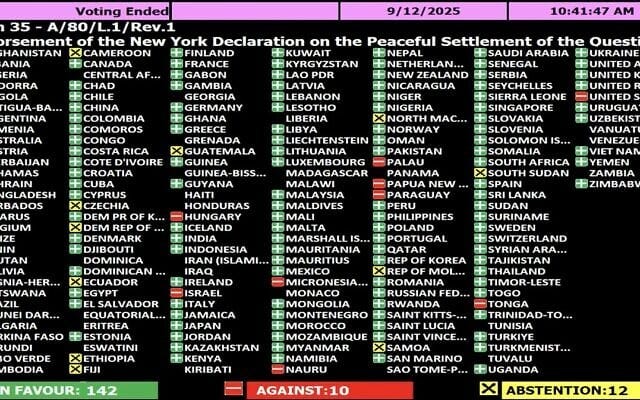
This “Palestinian State” will be run by the “Palestinian Authority” and will derive its authority not from its arms or the electoral legitimacy of its people, but from an agreement with Israel signed in Oslo in 1993 under American auspices, one that binds the Palestinian Authority but not Israel. For this agreement, the Palestinian Authority imprisons, tortures, and kills Palestinians, while the Israelis enthusiastically break every obligation and provision that is supposed to compel their side.The UN General Assembly adopts a resolution endorsing the New York Declaration on the Peaceful Settlement of the Question of Palestine and the Implementation of the Two-State Solution, September 12, 2025 (UN)

Meanwhile, some United Nations committee, following some group of something called “genocide scholars”, has decided two years and hundreds of thousands of deaths later, that Israel is, indeed, committing genocide in Gaza.

Genocidal politicians like Bernie Sanders followed – they too, discovered that there’s a genocide in Gaza.

Do not find hope in these gestures.

That’s not because they are symbolic. The US / Israel and Western allies are more dependent on propaganda than any other tool. Symbolism is extremely important to them. If they were deprived of their symbols, they would have a far harder time committing this genocide.

But these gestures do not do that. These gestures are meaningless.

The Heated Exchange

What is a sort of symbolic gesture that would have an effect on the genocide?

There’s a clue to be found in the viral video of a Chinese academic confronting an Israeli official. The Chinese academic states a figure (probably one tenth of the actual death toll) of 70,000 killed, and says that Israel lost legitimacy when they killed so many women and children. The Israeli official says that is not factual. Prof. Xuetong rejoins that Israel does not get to determine what is factual and what isn’t.

Prof. Xuetong gets right to the heart of Israel’s symbolic power: it is to determine what is factual and what isn’t.

But the truth is that even Prof. Xuetong accepts much, far too much, of Israel’s “facts”.

Through its disciplined spokesman, Israel tells the professor that “the terror organisation Hamas is still holding our hostages”.

Prof. Xuetong replies: “Your military people should [have shot] the terrorists. Not the children! Not the women! When [you] shot the women and the children, you lost the legitimacy to carry out any actions [for] that reason.”

You agree they’re genociding. Why do you still believe them?

But if it’s the case that Israel is committing genocide, why is the “international community” that decides the facts accepting Israel’s claim that Palestine is full of terrorists that are to be killed?

Why is the “international community” accepting Israel’s claim that Hamas is a terrorist organization at all?

Why is the “international community” accepting Israel’s lies about what happened on October 7, 2023?

It’s been two years. Official bodies now accept that Israel’s committing genocide. Now how about some skepticism about the claims Israel made to justify that genocide?

Reject both Israeli facts and Israeli logic

The international community to which Prof. Xuetong refers has some serious rethinking to do. It is not solely the acceptance of Israeli facts, but the acceptance of Israeli logic that must stop.

If the international community accepts that terrorists are simply to be eliminated, there is a lot more genocide in our future. What is the definition of terrorism? Israelis and their followers would say, “a terrorist is whoever we say it is”, but to try to apply any non-racist logic, the only viable definition of terrorism is something like the “killing of noncombatants for political objectives”. Israeli logic is that everyone involved in the entire chain is a terrorist: those who fire the weapons, those who make the weapons, those who transport them, those who manufacture them, those who finance them, and those who justify their use. And furthermore, Israelis state that eliminating terrorists is so important that it’s acceptable to kill 2-10 others per terrorist if they are “human shields”. This is the declared, accepted doctrine (Israeli practice, which includes rape, torture, and infrastructure destruction, is much worse) which Israeli lawyers defend in public and under which they are committing this genocide.

Imagine if the “international community” applied this logic about eliminating terrorists consistently. The Israelis are, after all, killing people all over the world, and especially Palestinians, for political objectives – terrorism. There are hundreds of thousands of people in their army, navy and air force firing these weapons. Between Israel, Europe, the US and beyond, there are millions of people involved in the production and distribution of these weapons and in the ideological and media terrorist apparatus of rationalization and justification.

If the “international community” wishes to apply Israel’s logic about terrorism, it has three choices:

  1. Accept racism. Accept that the US / Israel has a right to label terrorists, commit genocide, and the rest of the world can just hope not to be on the list.
  2. Commit a counter-genocide. Start drawing up their own list of millions of people in the US, Israel, and Europe, who, by way of their participation in the production, distribution, and justification of bombing and famine in Gaza, meet the Israeli definition of terrorists, to be eliminated.

The third choice is to discard this logic altogether, get out of the genocidal Israeli mentality, and focus on what will stop genocide, not proliferate it.

Symbolic gestures

Symbolic gestures should attack Israel’s symbolic powers:

  • Israel’s lies about October 7th.
  • Israel’s ability to label the Palestinian people – and the people of the whole world, increasingly – as “terrorists” or “human shields”, who Israel has the right to kill.
  • Israel’s ability to label anyone resisting them as illegitimate, as outside of politics, and as people who Israel is allowed to kill. Yesterday it was the PLO. Today it’s Hamas. Symbolic demons, symbolic targets when the real target is the entire Palestinian people and especially their children.

If the Israelis succeed in their genocide and “wipe out Amalek”, tomorrow there will be a new Amalek – and the Israelis will be there to extract the world’s condemnations of Amalek one way or another. Israel conjures up enemies to continue its supremacist and colonialist aims.

A Meaningful Gesture: Recognize Hamas

Imagine if the “international community”, instead of “you should have killed the terrorists and spared the children,” were to say “We don’t give a damn if you call them terrorists, you have no right to kill anybody anywhere.

Imagine if the “international community” were to say, “we have investigated your claims and we don’t believe your lies about October 7th.

Imagine if the “international community” were to say, “the military actions taken by Palestinian armed organizations against the Israeli army are legitimate, but the genocidal actions taken by Israel, including mass Hannibal actions killing hundreds of Israelis on October 7, are not. We recognize the Palestinian resistance, but Israel has lost its right to be recognized.”

Imagine if the “international community” were to say, “none of the things Israel has said about them can disqualify the Palestinian resistance, but Israel’s genocidal actions and statements have disqualified Israel.”

Imagine if the “international community” were to say, “after your long record of atrocities, the only sensible conclusion is not that the future Palestinian state must be disarmed, but that Israel must be disarmed.

Imagine if the “international community,” instead of making a fantastical distinction between “offensive” weapons and “defensive” weapons, were to say, “with no sign of a halt to the genocide on the horizon, we are going to work towards ensuring parity of weapons between the Palestinians and the Israelis, so there is meaningful deterrence from genocide now and in the future.”

Yes, today’s symbolic gestures are meaningless. But symbolic gestures are not inherently meaningless.

If the “international community” wants to take meaningful, purely symbolic action, the thing to do isn’t to recognize a disarmed, Zionist, Palestinian statelet. It isn’t to attend to Israel’s chosen collaborators. It’s to begin negotiating the future of the region directly with the people that Israel wants to kill. It’s to recognize that resistance to genocide is legitimate by recognizing the people resisting. It’s to say, yes, people resisting now will indeed have a say in the future of Palestine, while the people committing genocide now will not.

It’s to recognize Hamas.

Anti Empire Project: Our numbers grow and ebb, but as long as there is an empire we will also be here. Some of us. We put these words out into the world to feel less isolated and atomized as we fight the struggle for our own minds. Read other articles by Anti Empire Project, or visit Anti Empire Project's website.'


Israeli Overreach in Palestine and West Asia


In an extraordinary televised statement, Israeli Prime Minister Benjamin Netanyahu has told the Zionist faithful that the state of Israel will curtail its current ambitions as part of a longer term strategy. The statement is short on specifics, but it comes on the heels of several apparent major failures of Israeli policy.

The most recent is the attack on Qatar, which has probably robbed both Israel and the US of the vaunted Abraham Accords, which had been a cornerstone in Israeli, US and Western policy in the region. Although Israel, the UAE and Bahrain are the only official signers, Qatar, Saudi Arabia, Oman, Bahrain and Kuwait assumed (or gained assurances) that by “normalizing” relations with Israel and cooperating with the US and NATO countries, they could come under a protective American umbrella that would assure their security from common enemies, in much the same way as Jordan and Egypt, if not better. The bombing of Qatar was a message that not only can they not trust Israel to honor the arrangement, but that US protection – a supposedly rock solid foundation – was essentially worthless, even for a small, compliant country housing the largest US military base in West Asia to protect it. The fact that the Israeli bombings took place in the capital of Qatar, less than 20 miles from al-Udeid airbase leased to the US and heaquarters of the US Central Command, was not lost on the Qataris or the other Gulf monarchies. It was a grave shock to US interests in the region. Even if the US had taken pains to assure the Arab monarchies after the fact that it had been a foolish error of judgment that would not be repeated, these conservative and sensitive partners are not likely to take such assurances for granted anymore, and will be more open to offers from more reliable protectors.

The US does not often rebuff or chastise Israel, and even less under a Trump administration so beholden to Israel and its US supporters for delivering the White House to him. But in this case even the threat of releasing Epstein files – which the Mossad is thought to hold – might not be enough to coerce such assistance to Israel for a second such episode. (You can only divulge the files once, after which they no longer have value.)

This brings us to the threat of a US-Israeli attack on Iran. This, too, is probably receding, partly as an effect of the Israeli and US miscalculation in Qatar. Instead, the US is more likely to settle for the recent UN imposition of “snapback” economic sanctions on Iran, which were probably inevitable in any case. Even Iran and the rest of the world might prefer such sanctions as an alternative to a major regional war with unknown consequences. In addition, the Pentagon has expressed concern about the depletion of US weaponry through transfer to Israel and Ukraine. Netanyahu’s speech indicates that Israel might also be having second thoughts, related more to the effect of such a war upon an Israeli public already demoralized and by what seems like endless sacrifices to them. Another exodus of Israel’s population could have major long term consequences.

For these reasons and others, it is possible that Israel is also trimming its ambitions with respect to Gaza. Already, Netanyahu has stepped back from his recent goal of depopulating all of Gaza. His military commanders have told him that they would need six infantry divisions to do that, while the current under-strength units amount to little more than one. Netanyahu has therefore adjusted the goal to ethnically cleansing just the northern third of the territory, consisting mostly of Gaza City. Nevertheless, this task is more difficult because few Palestinians in northern Gaza consider southern Gaza safer or more livable than Gaza City, even under attack. Netanyahu knows how to change that equation, but he won’t. Furthermore, the longer he pursues this objective, the less patient the Israeli population – including the military – will become, and the more casualties it will take from the literally underground resistance of Hamas and its allies. Israeli society is substantially exhausted and perhaps unwilling to stay the course.

Of course, Israel is by no means throwing in the towel on all of its actual and potential occupied territories. It has captured substantial amounts of Syrian territory with relatively little opposition since the defeat of the Syrian army. Its military is also active in Lebanon, with the long term purpose of capturing, depopulating and annexing south Lebanon. Resistance there has been subdued since a ceasefire was negotiated November 27, 2024, despite thousands of Israeli violations, but Israel may decide that this is where it can advance its expansionist agenda more successfully than on other fronts. Nevertheless, Israel has failed at least six times at capturing south Lebanon since 1967, and it may prove beyond their means this time, as well. Hezbollah will undoubtedly have a say in the matter.

Meanwhile, the rest of the world is becoming more activist in isolating and ostracizing Israel. Israel can survive even if its only lifeline is the US, but it could potentially become a caged existence that will last only as long as its support in the US, where the Jewish community seems to be growing at roughly the same rate that Israel’s shrinks, but where there is increasing concern that Israel is committing a genocide.

These trends are reflected in Netanyahu’s speech and in the frustration and division within Israeli society itself. Is the Zionist experiment finally starting to fail? We know that it cannot survive without massive support and protection from the United States and its powerful Zionist lobby. But is this lobby reaching the limits of its power, as it seeks to circumscribe free speech, academia, the media and other aspects of American society, using antisemitism as a bludgeon? It is not clear that Americans, especially the younger generation, will tolerate such invasion upon their lives and freedoms.

Paul Larudee is a retired academic and current administrator of a nonprofit human rights and humanitarian aid organization. Read other articles by Paul.

Beyond Time to Say Who the Real 

Terrorists Are


In George Orwell’s book, 1984, the dominant force was able to determine what was true and what was false – hence 2+2=5. Today, those remaining in Gaza, who have survived the intensive bombing of almost all of Gaza’s infrastructure, sniper shootings, and starvation, are hanging onto life by a thread. Yet, it is the Palestinians who are proscribed as the terrorists and their genocidal oppressors who are the victims. Palestinians are labelled as terrorist because they are not willing to bow down to Zionist Israeli despotism. After more than a hundred years of theft and a creeping dispossession of their land, they have formed resistance movements in an attempt to protect their lives and their homes. From the Zionist Israeli perspective even a child, or an unborn Palestinian, is a terrorist because that child could and often does grow up and join his brothers and sisters in resistance against them.

An individual in the U.K. can receive a custodial sentence for pointing out that; ‘not only under international law, but also under any kind of natural moral law, armed resistance to occupation and genocidal oppression, is not only a right but a duty. How have we reached such a perverse and twisted understanding of natural justice where speaking out about an obvious truth, has become a crime. With the twelve man/woman jury and presumption of innocence before the Law, the British judicial system was once seen as a model of justice and democracy around the world.

The influence of Zionist fascist ideology didn’t appear overnight. It was a step by step insidious capture that has taken decades to gain hold over all of our institutions, media and government. It is an ideology, created by those who thrive on power and wealth, with a track record of exploiting the divisions that naturally occur between groups of people.

Syria, a secular country under Assad, had defied Israel and the US by staying loyal to the Palestinian cause. They had been a pivotal part of the resistance movement by facilitating the transfer of weapons from Iran to Hezbollah in Lebanon. Secular Syria no longer exists under the, Al-Julani , HTS (ISIS/al-Qaeda) led regime. Regardless of what one thought about Syria under Assad, Syria today is a place where kidnapping, rape and murder have taken place over the whole of the country with terrifying uniformity.

Today, apart from evidence of bombed areas, Lebanon on the surface seems to function as it always has, with a stoicism born of adversity. The shops and the cafes are still there where people gather together and talk. However, look deeper and the wounds are apparent under the surface. Just a year ago the Israeli pager attacks, the bombings and the assassination of Lebanon’s revered leaders in the resistance, are wounds where the blood has not yet dried. The ongoing genocide in Gaza reminds the Lebanese and Palestinians of the savagery of Zionist Israel’s intentions of further killings and land grabs. There is a fear that the divisions between the different factions could be exploited. Clearly, exploiting these cracks are the aims of Israel, the US and their Saudi allies.

One needs to look no further for evidence of this than the monstrosity of the 40 acre US Embassy, cut from a mountain and overlooking the Bay of Beirut, to understand the symbolism of a dominant power. The US and Saudi Arabia, on behalf of the Zionist Israeli entity, are insisting that the Lebanese Parliament disarm Hezbollah, the Lebanese resistance movement’s only real defence against Israel’s further expansion into their sovereign territory. Never before has Lebanese unity been more essential.

As the local currency in Lebanon continues to plummet the US have proposed an investment of some $72 million to pay the majority of the salaries of the Lebanese army in dollars.
(‘Beirut and the Birth of the Fortress Embassy’, Habib Battah, Middle East Research)

‘Who pays the Piper Calls the tune’. Neither the US nor Israel have a track record of standing by previous agreements. In fact, the absence of being trustworthy would clearly suggest this is a power not to be trusted. The disarming of the PLO in 1982 with the promise of international forces protecting Palestinian women and children, is a glaring example of how catastrophic it can be when agreements are not kept. Zionist Israel is the birth child of the US and under Trump, relations have never been closer. It is not unreasonable to conclude that this is a move to break any resistance from within Lebanon to defend itself against Israel.

Winston Smith, the protagonist in Orwell’s 1984, was reduced to defying the totalitarian Party’s attempts to crush him of his identity by repeatedly stating his name. Palestinians are being told that they are not Palestinians but Arabs who do not belong on the land of their ancestors. The heavy price they are paying for their commitment to home and to their resistance to the juggernaut powers that oppress them, is starvation and death.

For those of us in the West, who are not facing this genocide on the front line, the least we can do is to be clear in our minds, in our hearts and in our speech, as to who the terrorist is and who the terrorist is not. Truth cannot be crushed by threats and bombs.

To quote from someone speaking on behalf of the Lebanese right of resistance; ‘We are all created from the one human soul. The murder of one is the murder of all.’ The resistance movements are not just fighting for the lives of the Palestinians, the lives of the Lebanese, or even just the lives of those in the Middle East, they are fighting for the liberation of all people around the world.

Let us, in the ‘supposed free world’, speak the truth with a clear strong voice and not join with their persecutors in condemning them.

Heather Stroud, the author of The Ghost Locust and Abraham's Children, has been involved in human rights issues for a number of years. She lives in Ryedale where she is increasingly drawn into campaigns to keep the environment free from the industrialization and contamination of fracking. Read other articles by Heather.

(WOTD)WORD OF THE DAY 

Aporophobia


Aporophobia is a negative attitude toward poverty that often culminates in an irrational fear of very poor people. It is the plight of being terrified by physical destitution when having to walk by a boozed-up bum. The word comes from the ancient Greek áporos (without resources). It sums up the horror the well-meaning citizen experiences seeing clear evidence that the system doesn’t work for all.

The roots of aporophobia are difficult to pin down. Most people, living in a safe comfortable home and regularly eating nice square meals, cross the street without thinking twice at the sight of a lunatic panhandler, or reflexively clutch their pearls. They try to avoid eye contact as if their lives depended on it. There’s an unenunciated belief that poverty is contagious if you brush against it, even ever so lightly.

If severe, aporophobia can interfere with daily activities such as making loads of cash or going on luxury vacations.

Cognitive behavioral therapy is the most commonly used treatment, although sometimes medication has to be prescribed to alleviate anxiety attacks.

Final note on aporophobia: Next time you bump into a deranged derelict, say a prayer for his soul, and also thank somebody up there that you’ve survived the encounter. Let’s call it what it is, the compassion of the Twenty-First Century.

J.S. O’Keefe’s short stories, essays and poems have been published in Everyday Fiction, WENSUM, Roi Faineant, 101 Words, Spillwords, AntipodeanSF, 50WS, Friday Flash Fiction, etc. Read other articles by J.S., or visit J.S.'s website.