Wednesday, September 24, 2025

House Speaker Mike Johnson Is a Leading War Criminal


By illegally refusing to hold votes on whether or not to halt wars, Speaker Mike Johnson has made himself responsible for those wars and every death, injury, traumatic impact, bit of destruction, degree of global warming, and brutal influence on our culture that stems from those wars.

It’s a crowded field, I know. Soldiers are proudly publishing videos of their own gruesome crimes. Prime Ministers are touring the world in defiance of arrest warrants. But I want to make sure we’re aware of one prominent member of the list of individuals responsible for the crime of war: U.S. House Speaker Mike Johnson (Republican from the state of total submission to Trump).

War is a crime under numerous laws and treaties, absolutely regardless of who does it. There is no exception for legislatures. But let’s assume that you define all distant murders (such as of Venezuelan boaters) as war, and that you commit to total non-recognition of all the laws against war (and of the U.S. Constitution’s mandate that treaties be the supreme law of the land) — in other words, let’s assume that you are the New York Times. Then you’re left with the problem that the U.S. Constitution allows Congress and not the Executive to declare wars.
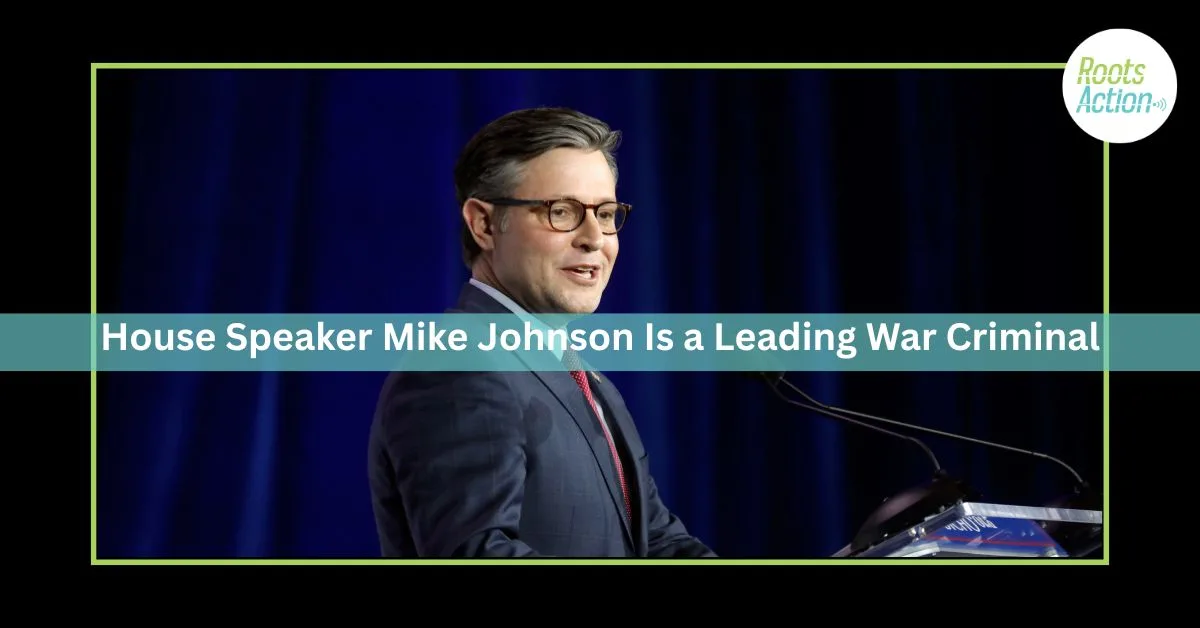
Mike Johnson is a war criminal

In 1973, the Congress, overriding the veto of the Executive, created a new law called “The War Powers Resolution” which allowed presidents to do what they’d long been doing anyway, namely launch unconstitutional wars, but put time limits and reporting requirements on those wars, and established the means for any single member of either house of the Congress to compel a vote in that house on whether to, in effect, declare:

“Not this time. This particular war, the Congress says no to, as the first branch of the government and the branch in possession of Constitutional war powers. End it immediately, or cease threatening and do not begin it.”

If we were not steadfastly ignoring all treaties, we might note that threatening wars is always a violation of the United Nations Charter. Ignoring treaties or not, the U.S. Congress needs to do something to halt each war/crime. Just as every shipment of weapons to Israel violates numerous U.S. laws and treaties, yet we still require Congress to pass yet another law before the shipments are stopped, a U.S. war may violate numerous laws and yet roll on unless somebody does something to stop it. So, what can Congress do?

This is where the War Powers Resolution comes in. It is a tool that can be used to, at the very least, compel our so-called “representatives” to vote yes or no on a deeply unpopular and malevolent war that their funders and party leaders expect them to keep rolling on.

Or, rather, the War Powers Resolution used to be such a tool. Now, we have a man running the U.S. House of Representatives who is violating the War Powers Resolution by not holding the votes that it requires. By illegally refusing to hold votes on whether or not to halt wars, Speaker Mike Johnson has made himself responsible for those wars and every death, injury, traumatic impact, bit of destruction, degree of global warming, and brutal influence on our culture that stems from those wars.

For decades, a single Congress Member, or a small number of them — Dennis Kucinich and Ron Paul were a frequent “bipartisan” combination in relatively recent history — could introduce a resolution and force a vote, despite the wishes of the House “leadership” or the president or even the weapons dealers — on whether to end or forestall a particular war. The votes failed, over and over again, but they created pressure against wars and helped ordinary people identify which Congress Members needed to hear from them. (If someone has a detailed record of all such votes, I wish they’d tell me.)

And then came Yemen. For the first time, a house of Congress — and in fact it was both of them — was not just forced to hold a vote, but saw the vote pass. (When one house passes one of these things, the other house has to vote too.) The bill was sent to President Trump 1.0, requiring an end to U.S. warmaking in Yemen. Trump vetoed, and Congress failed to override. The Congress then chose not to send the same bill to President Biden at all. But a new threat to the war machine had appeared.

Now there are resolutions in the House that legally require swift votes on Venezuela and on Iran, but no votes are expected, because Mike Johnson doesn’t want them.

Here’s how FCNL’s “War Powers Resolution Activist Guide” accurately describes the law, but not the reality:

“Any member of the House or Senate, regardless of committee assignment, can invoke section 5(c) of the War Powers Resolution and get a full floor vote on whether to require the president to remove U.S. armed forces from hostilities. Under the procedural rules of the War Powers Act, these bills are granted expedited status—requiring a full floor vote in the House within 15 calendar days, and in the Senate within 10 calendar days of introduction. This provision is especially powerful because it allows members of Congress to force timely debates and votes on the president’s use of military force, reinforcing Congress’s constitutional authority over decisions of war and peace.”

(What the law actually says is 15 days for action in a committee plus three more days for a vote by the full house.)

But, according to National Review, Johnson has “come out against” holding a legally mandated vote on war on Iran. That publication explains that “Johnson could remove the privileged nature of the resolution and prevent it from getting a vote, according to Politico.” That sounds as though Politico has made some legalistic case for Johnson’s right to violate the law. Still, you’ll find no such thing at the Politico link, which merely says: “Speaker Mike Johnson could move this week to kill the effort with language getting rid of the privileged nature of the resolution, according to a person granted anonymity to relay the private discussions.” But “language” is not a pass to violate a law.

Congressman Ro Khanna has a statement on why the House should vote on Iran, but it focuses on the substantive reasons to vote and vote yes, noting on the legal requirement of holding the vote merely “It is structured as a privileged resolution, meaning it will receive a vote. Every member of Congress will have to decide whether they stand for diplomacy and the Constitution, or for endless war and executive overreach.” Will they?

According to The Hill, Khanna and Congressman Massie could force a vote regardless of what Johnson wants. Can they? Why haven’t they?

There are other required votes, including on the same war and on Venezuela, that have also not been happening. The Senate, meanwhile, has held a vote on (and not passed) a resolution to prevent war on Iran. I suppose there’s little risk to the merchants of death for the Senate to comply with the law and hold mandated votes as long as the House does not.

H.Con.Res.38 on Iran has been waiting for a vote since June 17.

H.Con.Res.40 on Iran has been waiting for a vote since June 23.

Does that seem like 18 days to anybody?

Each of these resolutions has an unusually large number of cosponsors for a resolution that only requires one sponsor to compel a vote, possibly because the new reality is one of people demanding that their representatives cosponsor these things, something they have infinite amounts of time to do, since there’s never any vote on them.

This piece originally appeared on https://progressivehub.net/house-speaker-mike-johnson-is-a-leading-war-criminal/ 

David Swanson is an author, activist, journalist, and radio host. He is director of WorldBeyondWar.org and campaign coordinator for RootsAction.org. Swanson's books include War Is A Lie. He blogs at DavidSwanson.org and War Is a Crime.org. He hosts Talk Nation Radio. Follow him on Twitter: @davidcnswanson and FaceBookRead other articles by David.
Five Actions that Definitively Disqualify Trump for his Coveted Nobel Peace Prize


I am especially proud to be the first President in decades who has started no new wars.
— Donald Trump, Farewell Address, 20 January 2021

I am the Peace President and only I will prevent WW3!
— Donald J. Trump, Truth Social, 6 September 2024

I think I’m going to get a Nobel Prize for a lot of things, if they gave it out fairly, which they don’t.
— Donald Trump, Washington Post, 23 September 2019

Seemingly crushing Trump’s aspirations, Cross World News has headlined: “Donald Trump’s Nobel Peace Prize Push Rejected.”

It has long been obvious that the self-described “president of peace” Donald Trump has been immodestly pining and campaigning for a Nobel Peace Prize. Trump figures if Barack Obama — audaciously though — was awarded the peace prize, then he should be as well. “They gave it to Obama. He didn’t even know what he got it for. He was there for about 15 seconds and he got the Nobel Prize.” Trump complained, “With me, I probably will never get it.”

Nonetheless, Trump believes that he has the bona fides to win a vaunted and tainted Nobel Peace Prize. Trump prides himself on his having held negotiations with the DPRK and on his role in pushing for the Abraham Accords in the Middle East. In more recent times, he has taken credit for having ended seven wars. Even if all this were indisputably true, he still should not be in contention for a peace prize.

Five solid reasons that invalidate peace credentials

To start, a nomination from Israeli president Benjamin Netanyahu — indicted for alleged responsibility “for the war crimes of starvation as a method of warfare and of intentionally directing an attack against the civilian population; and the crimes against humanity of murder, persecution, and other inhumane acts from at least 8 October 2023 until at least 20 May 2024” as cited by the  UN-backed International Criminal Court (ICC) — should raise some eyebrows.

Even so, Berg Harpviken, who guides the Nobel Peace Prize committee said, “To be nominated is not necessarily a great achievement. The great achievement is to become a laureate.” Trump is just one of 338 individuals and organizations nominated this year.

1) — More egregious for Trump’s Nobel Peace Prize aspirations are his administration’s actions that are strongly supportive of the Israeli government’s genocidal actions in Palestine.

2) — There is the case of the ongoing US-NATO proxy war against Russia in Ukraine. This was admitted by secretary of state Marco Rubio, in an interview with Sean Hannity, saying, “And frankly, it’s a proxy war between nuclear powers – the United States, helping Ukraine…” US involvement is cited as prolonging the fighting that has seen, according to retired US colonel Douglas Macgregor, over 1.7 million Ukrainian soldiers killed or missing in action, including over a hundred thousand Russians.

3) — In March 2025, the United States launched Operation Rough Rider, a large campaign of air and naval strikes against Ansar Allah targets in war-ravaged Yemen.

4) — On 22 June 2025, the US air force and navy bombed three nuclear facilities in Iran, this despite Iran having not attacked or threatened the US and being in negotiations at that time with the US over Iran’s nuclear program.

5) — On 3 September 2025, the US Trump attacked a small Venezuelan boat, allegedly carrying drugs bound for the US, killing all eleven people onboard. The BBC cites experts calling the attack illegal:

[Prof Michael Becker:] “Not only does the strike appear to have violated the prohibition on the use of force, it also runs afoul of the right to life under international human rights law.”

Prof [Luke] Moffett said that the use of force in this case could amount to an “extrajudicial arbitrary killing” and “a fundamental violation of human rights”.

The US narrative has since been heavily called into question.

Subsequently, on 13 September 2025, according to the Venezuelan foreign minister Yvan Gil, the US navy further ratcheted up tensions by raiding a Venezuelan tuna boat with nine fishermen while it was sailing in Venezuelan waters.

Conclusion

Actively abetting a genocide, promoting a proxy war, launching attacks on nuclear facilities, bombing war-ravaged Yemen, and illegally bombing and raiding small boats in open water on unproven claims, separately, and definitively in totality, must rule out any consideration for a peace prize.

Kim Petersen is an independent writer. He can be emailed at: kimohp at gmail.com. Read other articles by Kim.

It’s a Bitch

As I walked into a Fort Worth Post office the other day, I passed a young redneck wearing a patently ignorant t-shirt. Not just ordinarily stupid, run-of-the-mill cretinous or incredibly ignorant. But extraordinarily ignorant—if not full-blown delusional.

The wearer was the usual type. Hair high and tight underneath a straw cowboy hat, a forearm tattoo or three, with at least one rendering of his favorite phallic stand-in … daring a nonexistent mob to “Come and Take It.” He was flaunting his pseudo-badassery for all who were susceptible (or as ill-informed as he).

I rolled my eyes as we passed, but I didn’t look back. It was pointless for me to respond, even nonverbally. But it was too much, really. Too much of too much on a tortuous loop.

The teen ranger’s t-shirt read: “UNITED STATES OF AMERICA: YOU MEAN TEXAS AND ITS 49 BITCHES”

Yeah.

Yeah, I thought. Sexist, asinine and perversely grandiose.

I mean, I’m a native Texan and all, and proud to be so. Except when young troglodytes brandish apparel that flagrantly illustrates Lone Star idiocy. He might as well have been wearing an “I’m With Stupid” tee except, instead of the arrow pointing left or right, it pointed straight up, at the dip’s dip-stained chin.

To be fair, though, the teen ranger was probably educated in Texas, where—in the teen ranger’s vernacular—literacy rates are inferior to the citizens of 47 other bitches in America. But he did get the current number of states right, and that’s reassuring. Because the numeracy levels of the wayward denizens in 45 other bitches are superior to those of Texas.

Forty-five? Forty-seven? Why do those numbers ring a bell? Hmmm.

For the peanut gallery, numeracy is the capacity to understand, reason with, and apply basic numerical concepts. It’s essentially the numerical counterpart of literacy. As in, if you’re ranked 46th out of 50, you’re darn near illiterate in terms of math, which is why you may still consider the state of your birth swell. And why your clueless opinion of said birthplace is so groundlessly swollen.

A colloquial corollary to someone being one’s bitch is making someone one’s bitch. Are Texas conservatives watching too many prison dramas? Or is it an unconscious itch they’ve found a way to metaphorically scratch?

It’s becoming increasingly difficult to explain things to Jethro Q. Pudwhack, because he is fiercely unworldly, proudly ill-informed and comfortably illiterate in terms of culture, politics and ethics. Not to mention insensate in terms of his own sexism, chauvinism and—yes, again—perverse braggadocio.

Now, I, myself, grew up a redneck. We had a small pasture, a garden, a few dogs and spent a little time around cattle. But even I know that if you’re trotting near the rear of fifty head of cattle, you’re getting the last lick of feed, grass or hay, and you’re settling for backwash at the trough.

The real head-scratcher for me is, why are teen ranger and his ilk okay with backwash?

Where were his ma and pa when conservative knuckle-draggers rode into their town, and why didn’t they run them off before their little Jethro Q. Pudwhack was intellectually handicapped by their talking points?

Stupid may be as stupid does, but Joannie and Jethro Q. Pudwhack elected the current batch of scamps and they, in turn, made “stupid” the state bird. But what’s the point in Bocephus going around giving every state that’s not full of doofuses the bird?

Now, I know what you’re thinking.

Well, maybe not thinking, but vaguely wondering.

You’re wondering if I’m really from Texas, because, in that dim space between your ears, you suspect real Texans don’t run their heads about education or opine polysyllabic about the lack or sad state thereof. But you and yers are simply mistaken simps.

Not everyone in Texas drinks piss from a boot and breathes through their mouth. And a bunch of us are plumb tired of settling for backwash at a shrinking trough and teen rangers who don’t have a lick of sense.

You may not have realized our state is no longer great, and you may not be able to get your hat around the implications of our current morass: our legislature is full of dumbasses and the only thing really big around here these days is our clear and present acceleration backwards … or, in the words of teen rangers, moving backwards bigly.

It’s a bitch.

Thinking Beyond the Bars: How Higher Education Helped Me Develop Confidence in Myself and Rediscover My Humanity


Ambitious young people are told that a college degree is necessary to launch a successful career. For me — a “lifer” taking courses from my cell in a state prison — higher education isn’t about job preparation but rediscovering my humanity, about learning to think beyond the bars.

I’m not the first person to discover the power of education while incarcerated, but I feel a responsibility to tell this story, not only to reach other prisoners but for all the people who feel left behind by educational institutions. There have been a lot of obstacles between me and higher education — times I didn’t believe in myself and times when institutions didn’t believe in people like me — but I have learned that no one has to settle for that.

Let me start with a stereotype of young Black men — that they think excelling in school is for nerds, not for tough guys on the street. That doesn’t describe all Black boys, of course, but it was true of the guys I ran with. I had loved learning when I was younger, but a combination of institutional failures and peer pressure knocked me off that path. I regret giving up so easily, which was reinforced by a school system that didn’t seem to care much about Black children. I ended up in that “school-to-prison pipeline” for the poor and marginalized.

A series of bad choices as a young adult led to my current residence in the Washington Corrections Center, serving a life-without-parole sentence. While incarcerated, I became a “better late than never” enthusiast for higher education.

But the prison system hasn’t made that easy. The tough-on-crime politics of the 1990s produced the federal Violent Crime Control and Law Enforcement Act in 1994, which eliminated almost all financial aid to prisoners. (It was only in 2023 that prisoners once again became eligible for Pell Grants.)

In 1995, Washington state passed a law that prohibited public funding to support higher education for prisoners beyond adult basic education and the General Education Diploma (GED). Prisoners who had been sentenced to life without the possibility of parole were denied access to more than one post-secondary degree, unless it was pre-vocational or vocational training was needed for their work in prison. The legislation was supposed to eliminate “unnecessary” spending by the Department of Corrections. (That law was partially repealed in 2017, allowing some funding up to two-year degrees.)

Tough-on-crime laws — including “Three Strikes, You’re Out” and “Hard Time for Armed Crime” — led to larger prison populations in Washington state and around the country. Access to education was not a priority, and budget cuts after the 2008 recession led the Department of Corrections to prioritize education for prisoners with less than seven years on their sentence. The rest of us were out of luck.

Don’t ask me to explain how that fits with the rehabilitation mission of prisons — people who are incarcerated know the gap between that rhetoric and the reality of warehousing prisoners. That’s why incarcerated people have done much of the work themselves, one of the most exciting aspects of my experience.

My introduction into higher education began in 2015 through my experience with the TEACH program (Taking Education and Creating History) at Clallam Bay Corrections Center, another prison where I was incarcerated. TEACH was created in 2013 by the Black Prisoners Caucus to address the educational disparities that exist within the prison system for minority, long-term, and undocumented prisoners.

That experience helped me rediscover my humanity.

At that facility, we had a healthy working relationship with prison officials, who gave us classroom space. Through TEACH, we were able to develop and facilitate the courses we needed. We understood that the educational system had left most of us behind, and I learned that some of us came with life experiences and credibility that some of the most decorated professionals did not have.

But we couldn’t deepen our knowledge from experience without help. TEACH leaders established a relationship with Peninsula College and Seattle Central College. For me, getting ready for college-level study took some work.

Before I could start taking college courses, I needed to earn certificates in college-prep math and anger management. After the completion of those two nine-week courses, I took African American studies, a parenting class, and college-prep writing. Then I felt ready to take my first college course through Seattle Central. That sociology class required a lot of writing, which was intimidating at first, but I loved what I was learning, and that course showed me that my experience was shaped by larger social forces.

At the beginning of my college journey, I was uncertain of my ability, an insecurity rooted in so many bad experiences in school. But TEACH had helped me believe in myself, teaching me not to accept the limits of the bars I lived behind, and eventually I was able to start giving back to the program. I was given a chance to facilitate the stress and anger-reduction class I had taken, which led to me joining the program’s board at Clallam Bay. After being transferred to Washington Corrections Center, I was elected vice chair of the program when it was brought to that prison in 2018.

As I worked with the program, I learned my experience was not unusual.

I talked with Taking Education and Creating History) at Clallam Bay Corrections Center a prisoner-student who went on to create and facilitate a sound and song-production course at WCC, which taught prisoners to play and create songs on a keyboard. He said that initially he wasn’t sure he could teach a class, let alone one that he created. TEACH helped him gain the confidence he needed, encouraging him to teach the course the way he thought best. More prisoners sought his expertise, deepening his confidence.

Dwuan Conroy, another TEACH student, said that in addition to the direct benefits for him, the funding for this program took the burden off his wife and family to pay for his education. And when he is released, his enhanced ability to set goals and meet deadlines means that he’ll have a chance at better paying jobs. And, he said, it shows his family that he is making the changes needed to be a better man.

Unfortunately, six months later Mullin-Coston’s sound course was canceled, because it was “not serving a facility need.” That is an example of short-sighted decision-making. If we care about rehabilitation, any learning that creates a positive environment and promotes healthy interactions among prisoners should be seen as a crucial facility need.

The COVID pandemic also created obstacles, shutting down the WCC TEACH partnership with Centralia College and Seattle Central. Conroy was enrolled in courses in biology, anthropology, and English, but lockdowns meant that formal classes were canceled. With little help available from teachers and staff, he said, the prisoner-students relied on each other to finish courses.

“It was these interactions with other prisoners that helped me through the course work despite my learning disabilities,” Conroy said. ”Knowing I had others around in TEACH that could help me through it and not judge, that empowered me to continue my focus during such a difficult time.”

Once the college’s staff members where allowed back into the prison, it was clear that our peer-support work had been crucial in keeping us on track, and 10 students graduated in the fall of 2023.

Taxpayers and politicians who prioritize punishment over rehabilitation may not care about how education enhances prisoners’ mental health and intellectual development. Once again, that’s short-sighted, because education also reduces recidivism. For every dollar spent on education programs, four dollars are saved on re-incarceration costs. One study showed that prisoners who complete some high school courses have a recidivism rate of 55 percent. Vocational training cuts recidivism to 30 percent, an associate degree to 13.7 percent, and a bachelor’s degree to 5.6 percent. A master’s degree brings the recidivism rate down to zero,

Prison education is not a frivolous expense for society but instead an essential investment in human beings. Education reduces conflict among prisoners. Communities are safer when educated and empowered prisoners return home.

As for me, I need two classes to earn my associate degree, after which I want to pursue a bachelor’s degree in behavioral health, and perhaps a master’s degree someday. I still live behind bars. But developing my mind has helped me find the humanity in myself and see more clearly the humanity in others as well.FacebookTwitterReddit

Darrell Jackson is a member of the Black Prisoners Caucus, Co-Chair of T.E.A.C.H (Taking Education and Creating History), and a writer through Empowerment Avenue. He is a student, mentor, and social justice advocate, who is currently serving a life without the possibility of parole sentence at Washington Corrections Center in Shelton, Washington. He can be contacted at securustech.net. Darrell Jackson#329268 and can be found on X @DKJackson20. Read other articles by Darrell.


Suspending Courses, Washing Delicates, and Baking: A University Justifies Harming Staff
and Students

These people are a charming, lynch worthy bunch. In claiming they are short of cash, the managerial dunderheads at the University of Technology Sydney thought it prudent to throw A$4.8 million at the tax consultants KPMG to design what it calls the Operational Sustainability Initiative (OSI). The linking of these three words alone suggests that something sinister and inhumane is afoot, a program closer to an assassination or disposal program than a sensible readjustment. Indeed, the OSI became the subject of a “notice to give information” in June from Safework NSW, accusing the university of “wilful and negligent mismanagement” of the restructuring undertaking “despite full knowledge that the process is causing significant psychological harm to staff, including documented instances of suicidal ideation, anxiety, and depression.”

The university, as reported in The Australian Financial Review in May, was hoping to give a savage pruning to the institution’s budget to the value of A$100 million. This initially involved the sacking of 400 staff members, a proposal cooked up even as five senior UTS executives travelled to the United States on an alumni trip worth A$140,000. That financially minded paper also wondered why UTS ended up using KPMG “instead of its own staff to design this plan” in an adventurously asinine contract stuffed with such terms as “leveraging solutions”, “acceleration of value”, and “decision trees”. (Meaningless terms suggest a mind without meaning.) KPMG crows in convoluted ecstasy about a “six-layer framework for target operating model design”. No wonder the technocrats were so wooed by it all.

The suggested program from the firm was ordinary and, as with most products arising from such an organisation, prosaic. It could have just as easily been done by clumsy butchers with a plagiarised MBA. KPMG produced spreadsheets dealing with courses and subjects that might be offered in future, which ones deserved to be confined to oblivion and what areas of research warranted interest as opposed to those that did not. Just to confirm the firm’s almost awe-inspiring lack of expertise, it was also called upon to examine “current and future state teaching capacity”.

Part of the tool kit of advice developed by KPMG to staff most likely heading for the chop developed into a ragbag of nonsense and piffle: to stay mentally sound, best wash delicates with your hands. Try to take up baking, because that is what a disturbed mind awaiting imminent suffering needs. Keep a gratitude journal. Make sure to brush and floss your teeth, because you obviously did not do that before a consultancy firm hired by a university told you to do.

There is every reason to suppose that ChatGPT could have come up with the same, risible nonsense, saving the shameful creeps in management some cash. But sound reasoning is not a prerequisite to those rising up the greasy towers of technocracy in learning institutions, let alone any other institution. Incompetence is often essential, while talent and ethical worth are impediments best done away with.

The vice-chancellor of the university is very much short of parfit, though sports the name Andrew Parfitt. He is adamant that no decisions have been made on job losses or the discontinuing of any courses which, knowing the pattern of university practices, is precisely the opposite of what will happen. “The temporary suspension is aimed at prospective new students for 2026.” This is the sort of shoddy reasoning we have come to expect from the vice-chancellorship and any number of university proconsuls and viceroys that suck the lifeblood out of education. Ella Haid, spokesperson of the UTS Students Association General Councillor and Stop the Cuts UTS, is hard to fault in her assessment on this: “We should be clear that management is doing this because they’re pursuing a hefty financial surplus. They’ve no interest in seeking student or staff consultation on this major restructure.”

The response from UTS to reports, notably by the ABC, was one of dastardly fudging, oily manoeuvring and sickly denial. Rather than admitting to blunder, organisational insensitivity, and being outed, it attacked the national broadcaster for its reporting in a statement. “We are disappointed that the ABC reported that these comprehensive support initiatives were only rolled out as a result of their reporting.”

The reports, claimed the university, had ignored context. “By focusing on just six dot points from a single article on an external wellbeing hub comprising extensive, differentiated resources, the ABC chose to portray this as being representative of the tone, intent and totality of support provided to UTS employees.”

The parasitic problems associated with university management have become critically colossal. Being unable to exist without attachment to the authentic university, that pulsing, thriving organism of cerebration sustained by students and research, the leadership of such bodies continues to make decisions that harm academic staff and any chance of a rich learning experience for students. (A survey from the National Tertiary Education Union of 380 respondents from UTS found that 35% had experienced high levels of psychological distress from the OSI endeavour.)

That harm is then justified through cringeworthy programs of “wellbeing” and assistance, their very existence intended to exonerate the misdeeds of culprits who shamelessly engender an environment of emotional and intellectual terrorism. They create the bullets, use them, and drag out the psychological bandaging to conceal the wounds.

Should courage ever be mustered by cowed academics and the atomised student body, the cosmos of the vice-chancellor and those complicit in sustaining it can finally be terminated with little sorrow and much relish.

Binoy Kampmark was a Commonwealth Scholar at Selwyn College, Cambridge. He lectures at RMIT University, Melbourne. Email: bkampmark@gmail.comRead other articles by Binoy.


Trump Wants “Denuclearization,” But Does Washington?


In the grim competition between environmental destruction and nuclear war over which one will cause the demise of civilization, the nuclear option gets considerably less media coverage than global warming. This is unfortunate, for nuclear weapons are no less of a threat. In fact, given how many close calls there have been since the 1950s, it’s miraculous that we’re still around to discuss the matter at all. In a global geopolitical environment that continues to see rising tensions between the West and both China and Russia, as well as between India and Pakistan, and between a genocidal nuclear-armed Israel and much of the Middle East, few political agendas are more imperative than, to quote President Trump in early 2025, denuclearization.

The signs are not auspicious, however. For one thing, the last remaining missile treaty between Russia and the U.S., New START, expires in February 2026. New START limits both countries to 1,550 deployed warheads on no more than 700 long-range missiles and bombers. If Trump and Putin don’t come to an agreement before then, the end of this treaty could lead to a dangerous increase in deployed nuclear arsenals and possibly a new arms race. On the other hand, if the two countries embrace the opportunity presented by the impending expiration of New START to forge a new and ambitious arms control regime, that could at least set the Doomsday Clock back a few seconds.

Russia wants a new treaty to limit arms, as it proposed that topic for discussion at the Alaska summit in August between Trump and Putin. Sadly, it is unlikely that Washington shares the same goal. On multiple occasions, Trump has said he wants “denuclearization” talks with Russia and China, but the Washington establishment is much more ambivalent. In October 2023, the Congressional Commission on the U.S. Strategic Posture endorsed a very belligerent stance. Among other things, it recommended that the U.S. fully modernize and expand its nuclear arsenal; mount on delivery vehicles “some or all” of the nuclear warheads it holds in reserve; increase the planned procurement of B-21 bombers, submarine-launched ballistic missiles (SLBMs), and nuclear-armed air-launched cruise missiles; “re-convert” SLBM launchers and B-52s that New START rendered incapable of launching a nuclear weapon; deploy nuclear delivery systems in Europe and the Asia-Pacific; and prepare for a two-theater war against China and Russia.

Similarly, in February 2024, the head of the U.S. Strategic Command recommended a return to deploying ICBMs with multiple nuclear warheads. Incredibly, some officials even advocate resuming explosive nuclear testing, on which the U.S. declared a moratorium in 1992. Such a resumption would doubtless encourage other nuclear states to do the same thing, which could trigger an arms race.

It is worth noting that Washington’s aggressive posture is nothing new. Since the start of the Cold War, the U.S. has been by far the most globally imperialistic state and by far the most responsible for escalating arms races. Its military and CIA interventions in countries around the world have been on a vastly larger scale than the Soviet Union’s or Russia’s, and it has typically rebuffed Russia’s frequently expressed desire for peace. In his magisterial book The Limits of Power (1972), the historian Gabriel Kolko argued that as early as the 1940s, “Russia’s real threat [to Washington] was scarcely military, but [rather] its ability to communicate its desire for peace and thereby take the momentum out of Washington’s policies.” Due to the Soviet Union’s relative economic and military weakness, Stalin sponsored international peace conferences and made numerous peace overtures to the Truman administration, all of which were rejected. Such overtures continued in the months and years after Stalin’s death, but in most cases they met with a chilly reception.

Decades later, Gorbachev enraged American officials by pursuing “public diplomacy” around nuclear disarmament. In 1985, he unilaterally declared a moratorium on nuclear weapons tests, hoping the U.S. would follow suit. It didn’t. The following year, he announced his hope of eliminating all nuclear weapons everywhere by the year 2000. The Reagan administration was flabbergasted and generally appalled by the idea, though Reagan himself was sympathetic. But at the summit later that year, Reagan followed his advisors’ recommendations and rejected Gorbachev’s pleas to eliminate nuclear weapons. At least something was salvaged the following year, when Reagan and Gorbachev signed the INF Treaty.

In our own century, as NATO expanded ever farther east—blatantly threatening Russia—the Kremlin responded, yet again, with what amounted to peace initiatives. Putin floated the idea of joining NATO (as Yeltsin and even Gorbachev had), but the U.S. had no interest in that. A few years later, in 2008, Moscow proposed a pan-European security treaty, arguing that this was necessary in order to overcome all vestiges of the Cold War. That idea went nowhere, much like Moscow’s 2010 proposal of an EU-Russia free-trade zone to facilitate a Greater Europe from Lisbon to Vladivostok, “which would provide mutual economic benefits and contribute to mitigating the zero-sum format of the European security architecture,” to quote the analyst Glenn Diesen. Ultimately, the U.S. rebuffed all Russian attempts to thaw relations.

Evidently, for many decades, the U.S. has rarely had much interest in respectful coexistence with Russia. As outlined in a very revealing RAND Corporation report from 2019, its priority has been to “stress” Russia, to “overextend” it, for instance, by provoking it to invade Ukraine. Because “some level of competition with Russia is inevitable,” Washington has to wage a “campaign to unbalance the adversary” and “caus[e] the regime to lose domestic and/or international prestige and influence.” This campaign has been going on since the 1940s.

Indeed, in its report, RAND even tentatively suggested that “U.S. leaders could probably goad Russia into a costly arms race by breaking out of the nuclear arms control regime. Washington could abrogate New START and begin aggressively adding to its nuclear stockpile and to its air and missile delivery systems. Moscow would almost certainly follow suit, whatever the cost.” In 2023, as we have seen, the Commission on the U.S. Strategic Posture endorsed these recommendations.

The only hope for peace, and particularly for a reduction of nuclear arsenals, is that American citizens will relentlessly pressure their elected representatives to stop marching towards Armageddon and act to ensure human survival. After all, if there is a danger of a two-front war with Russia and China, as the Congressional Commission reported in 2023, the obvious way to avoid such a horror is through diplomacy. Not through a massive arms race that could precipitate this very war.

From the antiwar left to the MAGA right, we all must demand that, for once, politicians choose the path of sanity.


Chris Wright, Ph.D. in U.S. history (University of Illinois at Chicago), is the author of Worker Cooperatives and Revolution and Popular Radicalism and the Unemployed in Chicago during the Great Depression. Read other articles by Chris, or visit Chris's website.