Sunday, November 02, 2025

Interview

Fired for “Crime” of Speaking at Socialism Summit, Texas Professor Speaks Out

Professor Tom Alter is appealing to Texas’s Board of Regents after being temporarily reinstated and then fired again.
October 31, 2025

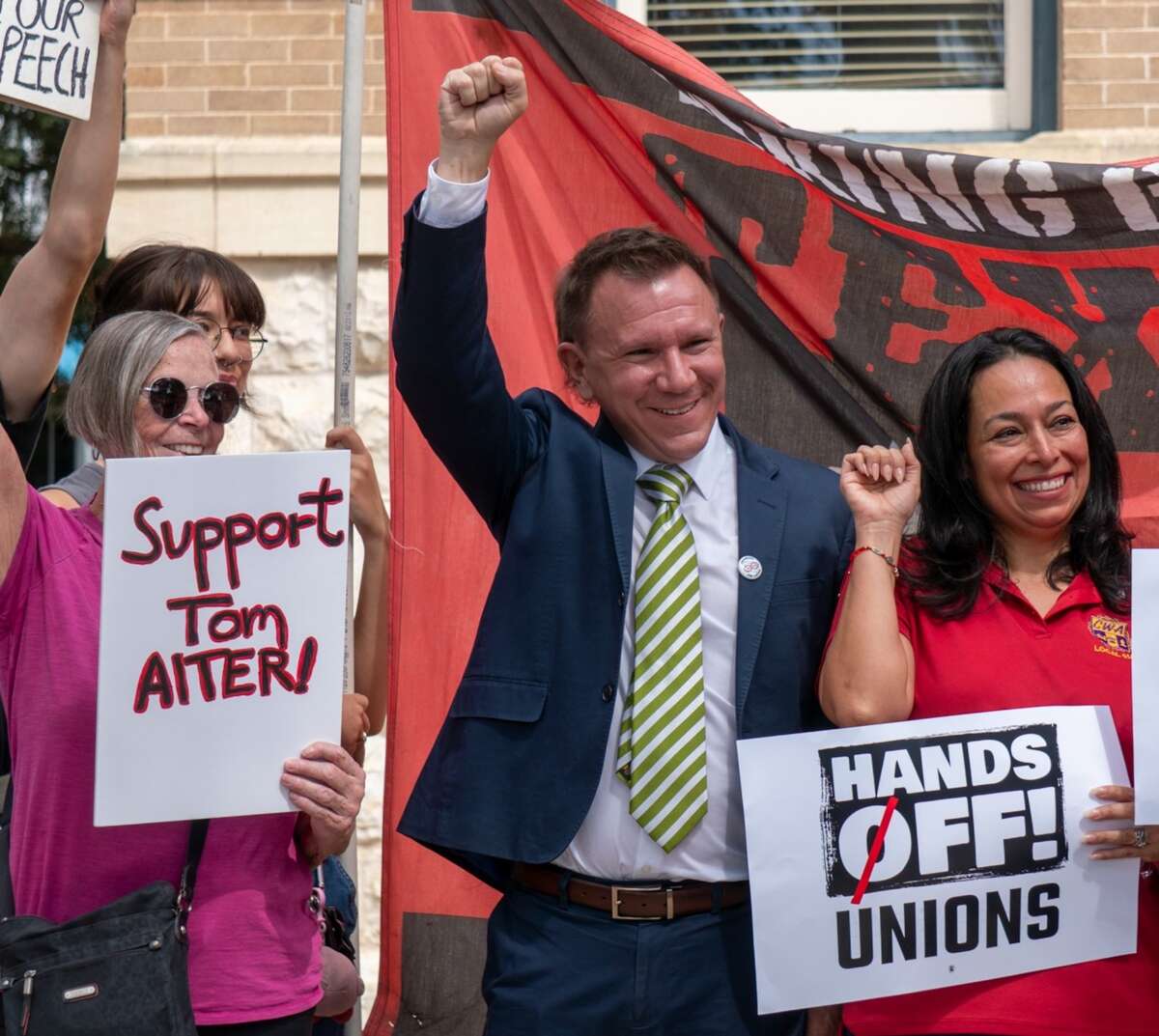
Tom Alter with his supporters at a press conference and rally in September.
Photo: courtesy of Tom Alter

Since Charlie Kirk’s assassination, the Trump administration has intensified the bipartisan New McCarthyism, compelling willing government, corporate, and institutional bosses to censure, suspend, and fire workers for exercising their First Amendment rights across the country. In one of the worst instances, Texas State University fired tenured professor Tom Alter in September for the “crime” of speaking at an online socialist conference.

Far right grifter and self-declared “anti-communist cult leader” Karlyn Borysenko violated the conference’s protocols, recorded Alter’s speech, edited it to distort his comments, and shared her doctored video on social media, which then went viral.

University President Kelly Damphousse responded by summarily firing Alter without due process, violating his First Amendment rights and academic freedom. After a judge ruled that Texas State University had violated Alter’s rights and issued a restraining order, the university temporarily reinstated him. But, in October, the university held a due process hearing, issued a ruling against Alter, and fired him again. He is now appealing its decision to Texas’s Board of Regents.

Alter is a beloved teacher, a member of the Texas State Employees Union, and the author of the widely acclaimed book Toward a Cooperative Commonwealth: The Transplanted Roots of Farmer-Labor Radicalism in Texas. In this interview for Truthout, Alter discusses his firing as well as the campaign to reinstate him with full pay and benefits and without censure or restrictions.

The interview that follows has been lightly edited for clarity and length.

Ashley Smith: You were recently summarily fired without due process by Texas State University for speaking on your own time and own capacity at a socialist conference. After a judge ruled the university had violated your rights, Texas State temporarily reinstated you. But then the president held a due process hearing and fired you again. How did the president justify such a violation of your First Amendment rights and academic freedom?

Tom Alter: In his October 13 dismissal letter, Texas State University President Kelly Damphousse justified my firing on grounds that threaten not only academic freedom but civil rights in general. He claimed my remarks at the online socialism conference called for building a revolutionary socialist party with, according to Damphousse, “the purpose of overthrowing the United States Government, and they provide a roadmap for doing so.”

He admits, “while this type of activism in itself, if undertaken on your own personal time and without reference to your role as an associate professor at Texas State University, likely would not constitute serious misconduct, I find that your recorded remarks … implicate Texas State” and that “disruption of university operations, the destruction of university property, and acts of violence on university campuses across our country are real. The threat of these activities to the Texas State campus community is also real.”

There are two things at play here by Damphousse that do not line up with the facts. First, I did not call for overthrowing the U.S. government. My talk was largely about different forms of working-class organization and struggle. As part of this, I posed the question, for those engaged in direct action tactics in a future hypothetical revolutionary situation, of “How does one expect to overthrow the U.S. government without organization?”

Secondly, the sole piece of evidence Damphousse cites is a YouTube video of my online conference talk edited by a self-described fascist. Conference organizers and I went to extra efforts so that conference speakers would not be identified by their places of employment. In none of the conference promotional material was I identified as a Texas State University faculty member.

In introducing myself at the conference, I did so as a member of Socialist Horizon and of the Texas State Employees Union (TSEU). The TSEU represents employees of the entire state of Texas. Attendees at the conference had to pre-register and the conference had a no recording policy.

The fascist grifter, unknowingly to us, filmed the entirety of the live stream, including when the conference went to break between sessions. It was during a break between sessions, when most participants left their screens, that someone who knew me asked what it is like teaching at Texas State.

The fascist grifter took this casual exchange during a break and edited the footage to make it seem like my employment at Texas State was part of my conference presentation. This was explained in detail to Damphousse. Without needing a forensic examination of the video, it is clear that the video on YouTube has been edited.

My session had a co-presenter, along with a chair, and a question-and-answer period. None of this is present in video held up by Damphousse because it has all been edited out by the fascist. The truth does not matter to Damphousse, just how things seem to a far right audience uninterested in knowing the truth.


“I … have the protection of being a tenured professor with the ability to speak on matters of ‘public concern.’ If I can be fired for exercising my basic rights, then no one is safe.”

Damphousse is carrying out a politically motivated attack on a socialist and a union member. His language of inciting violence and criminal activity mirrors the language used by Trump and other far right politicians around the world in going after left-wing and even liberal organizations. This sets a very dangerous example for anybody concerned with the rights of free speech and assembly.

As a government employee I have protected free speech in my capacity as a private citizen. I also have the additional protection of being a tenured professor with the ability to speak on matters of “public concern.” If I can be fired for exercising my basic rights, then no one is safe.

This seems to be a part of a campaign organized by the state government and far right on higher education and civil liberties in general in Texas. What does it look like on your campus and others in the state?

There is no doubt that my firing is part of a campaign organized by the far right on higher education across Texas. A few days before my first dismissal in September, a professor at Texas A&M University was fired for teaching issues related to gender identity. The president of the university was even forced to resign for not firing the professor soon enough.

In the wake of the Charlie Kirk assassination, two African American students, one at Texas Tech and another at Texas State, were singled out on X by Texas Gov. Greg Abbott for using their free speech rights to protest Kirk memorials held in public spaces on campus. The Texas Tech student was expelled and the Texas State University student was forced to withdraw or be expelled. A staffer at Texas State was fired for expressing her free speech on social media.

Since then, Abbott on October 19 announced that the state is “targeting professors … pushing leftist ideologies.” Shortly after it was announced that a University of Texas professor had been removed from an administrative role over “ideological differences.” Far right politicians, like Abbott, in an Orwellian manner say they are trying to stop indoctrination of students while actively working to turn universities in Texas into centers of far right indoctrination.


“My firing has had a severe impact on my family with two school-aged children. We have lost our source of income and our health insurance.”

Amid this, the Texas State University administration has ordered an audit of courses to remove classes that discuss LGBTQ topics and issues of sexuality. Texas Tech has also gone through a similar audit. The University of North Texas is being investigated by Texas Attorney General Ken Paxton for refusing to “address left-wing extremism” and “terror.” The “extremism” and “terror” Paxton is referring to are the actions of people who protested the racism and attacks on academic freedom being carried by Turning Point USA.

What impact has your firing had on you, your family, coworkers, and students? How has everyone responded?

My firing has had a severe impact on my family with two school-aged children. We have lost our source of income and our health insurance, and we now face an uncertain future. This is a situation no one wants to be in, though we are not alone as the economic crisis of capitalism deepens for working-class people.

The firing has had a deeply chilling effect on campus. Faculty are afraid to speak out for fear of being fired on a campus where tenure is not honored. I have heard from professors who are now afraid to teach lessons they had previously taught worry-free for years. These are not professors who were “indoctrinating” students. I have never heard of a professor doing such a thing on my campus.

Now these professors are scared of teaching basic facts related to race, class, and gender. Language against teaching diversity put forth by the far right is so broad that this fear has even extended into the sciences. Biology professors are now worried about teaching facts about biodiversity. This would be laughable if it was not actually happening.

Students are worried about protesting after a student who was forced to withdraw from the university for exercising his right to free speech in the university’s so-called “free speech zone.” While my firing created a repressive environment, especially for faculty, after the first couple of weeks, more faculty and students are coming forward to express their dissent to this far right attack on our fundamental civil liberties.

What are the implications of your firing for faculty, workers, and students in public education in Texas?

My firing has serious implications and ramifications. If a professor who has tenure, which is a form of a contract, can be fired for exercising their democratic rights on their own time and in their personal capacity, then really no one is safe. This is why my case is so important.

We must not allow my firing to be used as a precedent to fire more people for using their democratic rights. I say democratic rights because more than free speech is at stake — our rights to freedom of assembly and press, along with due process, are also being violated.

Your firing is part of a larger bipartisan attack on academic freedom, the right to organize, and freedom of speech. It began under the Biden administration with the attack on students, faculty, and staff organizing in solidarity with Palestinians against Israel’s genocidal war. What did that look like and how did it open the door for Trump’s full-blown McCarthyism in the wake of Charlie Kirk’s assassination? How have university bosses responded to Trump’s McCarthyism in Texas and nationally?

Palestine has been the axis around which many of our struggles currently revolve. Like countless wars before, the U.S. government’s funding of Israel’s genocide of Palestinian people has drained money from resources needed by working people during this time of economic crisis.


“Biology professors are now worried about teaching facts about biodiversity. This would be laughable if it was not actually happening.”

As for basic rights, if one cannot protest a genocide being livestreamed for all to see, then how can we use our democratic rights? Academics have been fired and students expelled for protesting the genocide. The Biden administration, along with Democratic and Republican governors, in attacking the democratic rights of Palestinian liberation activists, opened the door for the far right to attack all forms of expression.

Now all of our democratic rights are under attack under Trump’s neo-McCarthyism. Trump has offered preferential funding to universities who comply with his plan to turn universities into centers of far right indoctrination. While some universities have rejected Trump’s offer, the University of Texas at Austin is still considering it.

In response to your case and others, unions, organizations, and student groups have rallied to your defense. What have they done? How are they responding to this most recent firing? What are the lessons of all this organizing for other defense campaigns?

Unions, students, and organizations concerned with democratic rights have all rallied to my defense. This has been a moment when everyone has upheld the labor movement’s core principle that “an injury to one is an injury to all.” The Texas State Employees Union, the Texas State University chapter of the Young Democratic Socialists of America, and San Marcos’s chapter of Socialist Horizon have united to organize much of the on the ground support. As part of my defense campaign, they have staged protests and canvased for free speech and academic freedom.

The American Association of University Professors and the Texas-American Federation of Teachers have made the invaluable contributions, especially by providing me with a lawyer and legal advice. The Committee to Defend Tom Alter has brought unions, left organizations, and socialist groups to rally support for me across the country.


“More than free speech is at stake — our rights to freedom of assembly and press, along with due process, are also being violated.”

The Committee has an advisory board of academics, intellectuals, and longtime activists. While my socialist politics have not always been front and center during parts of the campaign, I have not hidden them. In my private and personal capacity, I continue to advocate for a better future based on the needs of the working class against the profit and greed-driven system of capitalism.

Finally, what are the next steps in your struggle for reinstatement? What can people do to help?

The immediate next step in my case is the appeal to the Texas State University System Board of Regents. We will ask them to reverse President Damphousse’s decision and reinstate me to my position at Texas State. On top of that, we will show that Damphousse’s groundless decision has compromised academic freedom, violated tenure, and caused a serious blow to the standing and reputation of Texas State.

For many in the Texas State community and myself, the university means a lot to us, and we are deeply saddened by the harm Damphousse’s actions have caused to Texas State. The Board of Regents has a chance to undo this harm and restore the previously thriving academic environment at Texas State.

People can help by contacting the board’s Subcommittee for Academic and Health Affairs, which will be hearing my appeal and demand my reinstatement. Academics can sign and send this letter and everyone else this one to the board. To get further involved in my defense campaign and other struggles to defend civil liberties, go to the website of the Committee to Defend Tom Alter and join Haymarket Books’ special event, “Speak Out! Tom Alter, MAGA McCarthyism, and the Fight for Free Speech,” which will feature, among others, Eman Abdelhadi, Jodi Dean, and Dave Zirin.

And for those who can, please donate to help support me and my family amid the financial crisis my firing has thrown us into. That will help me focus on the fight to defend my civil liberties and those of everyone else. This is not just about me. All of us, all working class and oppressed people, are in the fight of our lives against Trump and his clique of right-wing billionaires. It is time for us to unite to defend democracy and fight for a society that puts people and the planet before profit.


This article is licensed under Creative Commons (CC BY-NC-ND 4.0), and you are free to share and republish under the terms of the license.

Ashley Smith is a socialist writer and activist in Burlington, Vermont. He has written in numerous publications including Truthout, The International Socialist Review, Socialist Worker, ZNet, Jacobin, New Politics, and many other online and print publications. He is currently working on a book for Haymarket Books entitled Socialism and Anti-Imperialism.


Repression of Palestine Solidarity on Campus Enabled Anti-Migrant Escalation


Faculty are forming support networks to connect with each other to protect students and end the genocide in Palestine.
November 2, 2025
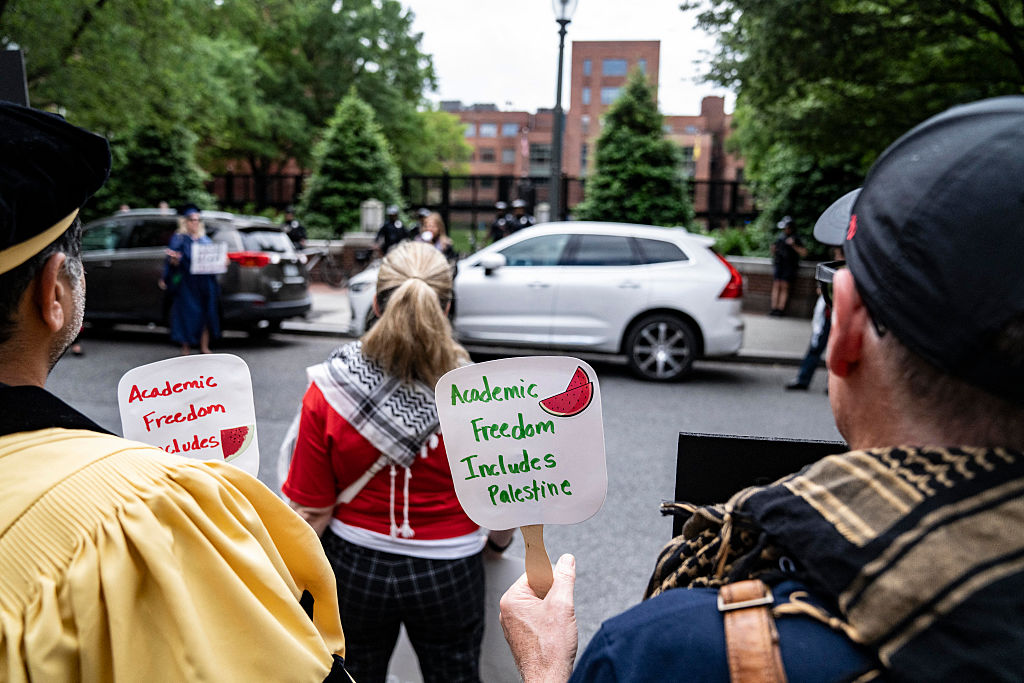
A group of faculty, staff, and students of the George Washington University meet in the yard where there was a pro-Palestine encampment last year, in May 8, 2025, in Washington, D.C
ANDREW THOMAS / Middle East Images / AFP via Getty Images

Truthout is a vital news source and a living history of political struggle. If you think our work is valuable, support us with a donation of any size.

Photos of Palestine solidarity encampments have disappeared from the news, replaced by pictures of immigration agents kidnapping university students and community members, but the campus-based battle to force universities to divest from Israel and weapons manufacturing is still underway.

This a long-term, smoldering battle. “The campuses are definitely as active as they were a year ago from my purview,” says Akin Olla, communications director for the anti-militarist youth organization Dissenters. But, he adds, “The actions look different and are generally less media-friendly.”

While this struggle continues, its shape has shifted, as students who were initially on the front lines of pro-Palestine activism experience additional vulnerability due to the Trump administration’s attacks. Many of these students are Muslim immigrants or from immigrant families, while others are queer or trans and confronting a different series of attacks. As a result of these changes, the shape of the work has changed. For one thing, faculty who spoke to Truthout said that campus student groups are working more in coalition to provide some shielding to targeted students, like Students for Justice in Palestine or Muslim student associations.

Faculty across the United States continue to organize: They’re supporting students and their movements; organizing their own events; building aboveground and underground safety networks in response to the presence of immigration police on campus; and pushing their own unions and scholarly associations to take political positions.
Attacks on International Students and Faculty

Since Donald Trump took office in January 2025, people on campuses have experienced a series of rollercoaster events around the status of international, immigrant, and undocumented students and staff. In March, there were a series of high-profile kidnappings of students on visas and green cards like Rümeysa Öztürk and Mahmoud Khalil in retaliation for their activism on Palestine. These widely publicized kidnappings were accompanied by the sudden revocation of 6,000 student visas around the U.S., the majority of which were not related to activism or political opinions.

Related Story

ICE and the Israeli Military Are 2 Sides of the Same Coin — We Must Resist Both
Opposing ICE in the US while backing genocide in Gaza is senseless. These struggles are intertwined.  By Marcy Winograd , Truthout  October 5, 2025


The dramatic crisis of the spring has given way to other forms of exclusion: This summer, the administration made a dramatic reduction in the number of student visas that were issued, leading to a 30-40 percent drop in international students attending school in the U.S. this fall. Then on September 19, the Trump administration issued an executive order about H-1B visas that initially made it seem as if H-1B visa holders would no longer be able to come and go from the U.S. without their employers paying a $100,000 fee. There are currently around 120,000 faculty and university workers holding H-1B visas across the U.S., many of whom travel internationally professionally as part of their research.

There does not seem to be an end in sight to attacks on immigrant, undocumented, and international students, faculty, and staff, nor does there seem to be an obvious line that will not be crossed as the administration escalates its attacks. Jenna Loyd, co-founding member of Sanctuary Campus Network, says that in addition to a spillover from the administration’s attacks on immigrants more broadly, the logic is to “attack the whole idea of universities being international spaces.”
Universities Are Not Left-Wing Bastions

Contrary to Republican talking points, universities are not hotbeds of radical leftism. In reality, governing boards react swiftly and punitively to events that rock the boat.

At a small private liberal arts college in the Northeast, a political theorist is facing dismissal for her activism. “Laura,” who chose not to give her real name because she is on the job market, found herself on the wrong side of her institution when she organized a series of speaking events about Palestine. The events featured high-profile speakers and highlighted the interconnectedness of Palestine to other issues, including campus repression of free speech, in an effort to build more solidarity with Palestine on campus.

Faculty active in the pro-Palestine struggle are generally frustrated at the lack of support and activism from their colleagues. Many faculty, says Laura, have an “easy posture of learned helplessness” around difficult issues, insisting disingenuously that the university is not a political space. “It’s racism masked behind civility politics,” Laura says.

At the University of Central Florida, Talat Rahman, faculty union president and professor of physics, says that there is unfortunately not nearly as much support for organizing against the genocide as for resisting Immigration and Customs Enforcement (ICE), although the two causes are interrelated. Rahman says there is a lot of fear on campus, but that “people can only be afraid for so long. At some point you have to live with your own conscience.”

It’s no coincidence that the attacks on students and immigrants on campus began with those speaking out against the genocide in Palestine, says Bill V. Mullen, professor emeritus of American Studies at Purdue and secretary-treasurer for American Association of University Professors local 6741. “The opposition to the war against Palestinians has become a hammer to destroy academic freedom…. Whatever your position might even be on Palestine and Israel, you have to acknowledge that this is the mechanism that’s being used to try to reshape higher education. The discussion of Palestine is actually a discussion about our work conditions.”

In other words, the repression of pro-Palestine protesters on university campuses, under Joe Biden and under every previous presidential administration, created the opportunity for the anti-immigrant attacks by the Trump administration, as well as other attacks against diversity, equity, and inclusion, and independent governance.
Creating Sanctuary at the Grassroots

Despite mission statements extolling the benefits of diversity and care for their students, campus administrations have offered little other than platitudes to protect international and undocumented students, leaving it to faculty staff and students to organize and protect each other. The overwhelming majority of university administrations are too risk-averse to offer real support to students facing an expanded immigration dragnet, so some faculty are responding to administrative compliance with ICE and the Department of Homeland Security by forming their own support networks.

One national coordinating group is the new and growing Sanctuary Campus Network, which aims to pool ideas and resources so that faculty on any single campus don’t need to reinvent the wheel. The network has been holding large Zoom meetings on the first Friday of each month since December 2024. These meetings often involve a training or presentation from a partner organization, like Muslims for Just Futures or Palestine Legal.

One early project of Sanctuary Campus Network was to develop an immigration-focused Know Your Rights training and slide deck that was adapted specifically for the campus environment. The network encouraged members to give the presentation on their own campuses to disseminate this information as widely as possible while reducing the time that individual faculty need to spend developing materials.

Similarly, the network has a large drive of materials for printing and use by faculty, like signs that can be placed on office or classroom doors indicating that these are private spaces (and therefore closed to immigration agents without a signed judicial warrant). The goal is to use these signs to indicate to students and others who may be targeted which faculty are supportive and where they will be harbored in the event of a raid on campus.

Sanctuary Campus Network is broken up into five regions, and members meet regularly in smaller groups. Rachel Ida Buff, a writer and working historian currently teaching at University of Wisconsin-Milwaukee, who is part of the Midwest region, says that these regional meetings have been “really, really useful,” and validating, allowing faculty to commiserate, share tactics, and build camaraderie with each other. These regional network meetings are especially important as a space to build a collective effort since the number of active faculty on an individual campus may be quite small.
Tending the Soil to Build a Fertile Organizing Space

Organizing on campus, like organizing more generally, does not always look like what it looks like in the movies. Laura says that a big part of her role in mentoring student activists is teaching that “activism is not always the flashiest thing.” Instead, it’s often about “illuminating how power functions” and other less obvious goals, she says.

Dana Morrison, member of Faculty and Staff for Justice in Palestine at West Chester University in Pennsylvania, explained that one of the group’s goals is politicization. On regional public campuses like West Chester, most students work and many live far from campus, leading to a relatively apolitical campus. “How do you [participate in coordinated national events] if on your own campus, nobody has even uttered a political thing in the public space?” Morrison says that “you have to have the soil correct for anything to happen.”

It’s not just students on campus who are sometimes relatively apolitical. Sanctuary Campus Network co-founding member A. Naomi Paik pointed out that some faculty have little experience with activism and are just learning to organize. There are places to learn, however: A focus of the network as well as of the American Association of University Professors has been to offer trainings on the various components of organizing, and there are usually at least a small group of faculty members on each campus who do have this experience.

Mullen, who helped organize the second National Day of Action for Higher Education on April 17, 2025, as part of the Coalition for Action in Higher Ed (CAHE), says “overcoming hopelessness is a crucial organizing problem.”

The Day of Action featured scores of actions on a diverse range of campuses, as well as a full day of online programming organized by CAHE. Mullen says that one of the goals of this year’s events was to bring Palestine more directly into the focus of higher ed organizing. CAHE is beginning to transition to an organization from an ad hoc coalition, and is already planning for April 17, 2026.

Negotiating Long-Term Struggles Amid High Turnover

One of the main challenges of campus activism is the churn of leadership in student groups. Campaigns like divestment struggles are long, much longer than the average tenure of a student activist. Several faculty members mentioned that student organizations that led earlier protests on their campus are in a process of reformation after all the leaders graduated at once.

Faculty have much lower rates of turnover and can be present for a longer campaign, but activist faculty are careful about their role in relationship to students. Morrison says that she and her colleagues are careful to develop campaigns of their own rather than drive campus-wide divestment campaigns. “If we were to define the campaign, name the target, and all that kind of stuff, we’d be taking up space in terms of how we teach students,” she says. Faculty would end up teaching students that their participation is not important.

Instead, Morrison’s Faculty and Staff Justice in Palestine chapter organized a successful divestment campaign focused on their labor union. Other faculty have engaged in pressure campaigns within their scholarly associations, like the Sociologists for Palestine campaign.

On some campuses, student groups have merged with off-campus community groups so that students who’ve graduated can stay involved. This is the case with the Dissenters chapter at North Carolina State University, says Chelsey Dyer, assistant teaching professor of anthropology who serves as the faculty adviser for the group. Dyer says this joint community/campus structure also allows her and other involved faculty to show up to the group more as peer activists than specifically as faculty mentors.

Similarly, Buff says campus sanctuary organizing on her campus in Milwaukee has benefited from collaborations with deeply rooted immigrant organizing in the city, and that Buff herself has benefited from looking to other activists as peers rather than often-fearful faculty colleagues.

The struggle to protect international, immigrant, and undocumented students is deeply entwined with the longer-term struggle for a free Palestine and to build a more liberatory version of higher education itself. Mullen puts it this way: “If both parties have been willing to consent to supporting a mass killing of a population, it’s not a shock that both parties participated in the firing of college presidents and the arrests of students.”

The odds are daunting, but faculty like Mullen emphasize that building cross-campus and national networks reduces their isolation — and their fear.


This article is licensed under Creative Commons (CC BY-NC-ND 4.0), and you are free to share and republish under the terms of the license.


October Krausch

October Krausch, Ph.D., is a public sociologist, activist and writer in the Detroit metro area. Their writing has been published in Truthout, In These Times, Inside Higher Ed and The Progressive, among others. They have been involved in a range of community movements including anti-eviction movements, free schools, independent media and Latin American solidarity work, and are currently facilitating the Abolitionist Book Club, an inside/outside reading group with members of the Black Prisoners Caucus. Always working to balance love and rage, October finds freedom in the struggle.
Classified US Report Finds ‘Many Hundreds’ of Alleged Israeli Human Rights Violations in Gaza

The long backlog and a reporting protocol developed especially for Israel are likely to keep Israeli forces from being held accountable, said officials.


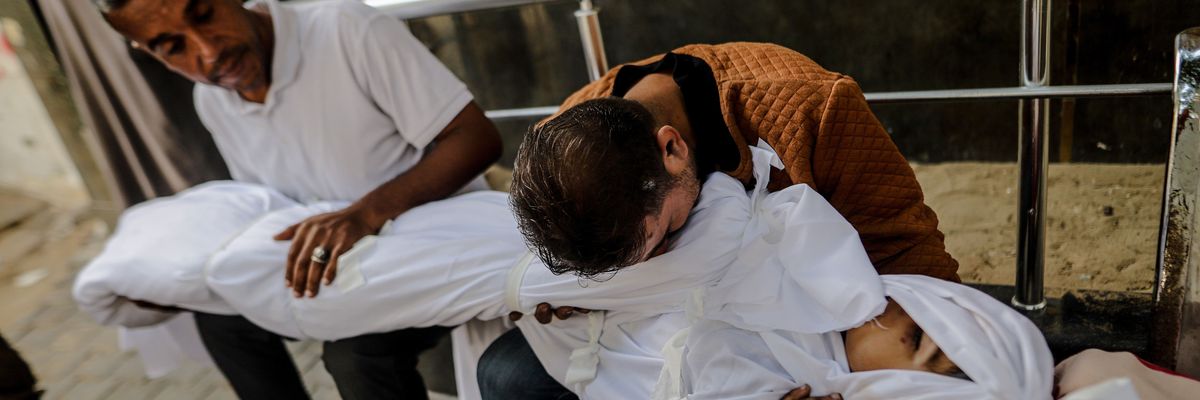
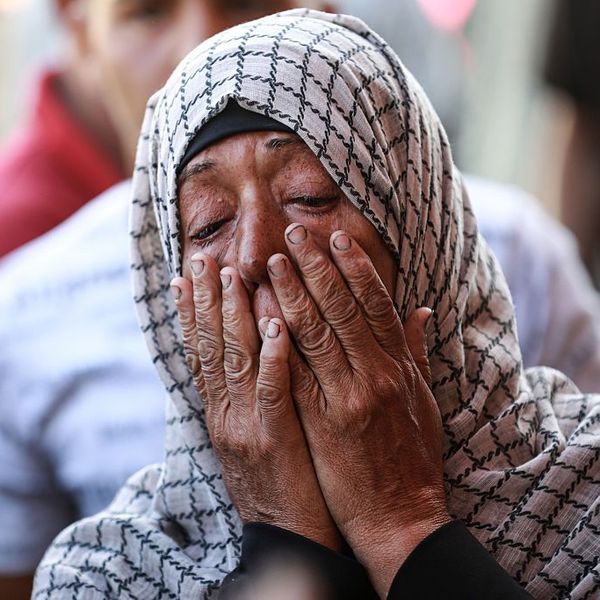
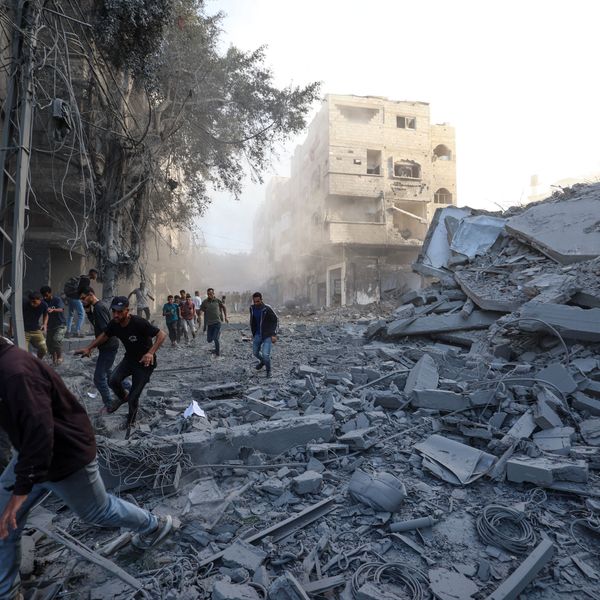
Palestinians mourn as the bodies of recent Israeli attack victims were taken from the al-Shifa Hospital for burial in Gaza City, Gaza on October 29, 2025.
(Photo by Saeed M. M. T. Jaras/Anadolu via Getty Images)


Julia Conley
Oct 31, 2025
COMMON DREAMS


Progressive lawmakers and rights groups have long warned that by arming the Israel Defense Forces and providing the IDF with more than $21 billion, the US has violated its own laws barring the government from sending military aid to countries accused of human rights abuses and of blocking humanitarian relief.

On Thursday, a classified report by the US State Department detailed for the first time the federal government’s own acknowledgment of the scale of alleged human rights abuses that the IDF has committed in Gaza since it began bombarding the exclave in October 2023.

RECOMMENDED...


Human Rights Defenders Decry ‘Unspeakable Suffering’ in Gaza as Genocide Enters Third Year


Ceasefire Imperiled as Israel Kills Scores of Palestinians in Gaza

The Office of the Inspector General’s document, reported on by the Washington Post, which spoke to US officials about it, also detailed how allegations of human rights abuses against the Israeli military are made harder to prove by a vetting process that is only afforded to Israel—not other countries accused of violations.

The US officials said the long backlog of “many hundreds” of possible violations of the Leahy Laws, which bar US military assistance from going to units credibly accused of human rights abuses, would likely take years to review—calling into question whether the IDF will ever be held accountable for them.

“The lesson here is that if you commit genocide and war crimes, do as much as possible because then it becomes difficult to investigate everything,” said journalist and Northwestern University professor Marc Owen Jones grimly in response to the Post‘s report.

The government report was described by the Post days after the State Department dismantled a website used to report human rights violations by foreign militaries that receive US aid, which was established in 2022 to ensure the US was in compliance with the Leahy Laws.

The Biden administration flagged at least two 2024 attacks by Israeli forces—one that killed seven World Central Kitchen aid workers and one known as the “flour massacre,” in which more than 100 Palestinians were killed and nearly 800 were injured as they tried to get flour from aid trucks—as ones that may have used US weapons, signaling that continuing US aid to Israel would break the Leahy Laws.

“To date, the US has not withheld any assistance to any Israeli unit despite clear evidence.”A report by Amnesty International last year focused on several IDF attacks on civilian infrastructure—which killed nearly 100 people including 42 children—in which Israel used bombs and other weapons made by US companies such as Boeing.

But just a week after the Amnesty analysis, the Biden administration told Congress in a mandated report that it was “not able to reach definitive conclusions” on whether Israel had used US-supplied weapons in attacks such as the one on the World Central Kitchen workers.

After the report of the new analysis, said University of Maryland professor Shibley Telhami, former President Joe Biden and former Secretary of State Antony Blinken “cannot hide from responsibility” after they persistently defended and funded Israel’s attacks on Gaza.

But along with the long backlog of potential human rights abuses, the so-called Israel Leahy Vetting Forum, which dates back to 2020, is likely to prevent the State Department from reviewing the allegations against the IDF.

The government’s protocol for reviewing allegations against Israel differs from that of other countries; a US working group is required to “come to a consensus on whether a gross violation of human rights has occurred,” with representatives of the US Embassy in Jerusalem among those who participate in the working group.

“To date, the US has not withheld any assistance to any Israeli unit despite clear evidence,” Josh Paul, a former State Department official who resigned in the early weeks of Israel’s war on Gaza over the Biden administration’s military support, told the Post.

Shahed Ghoreishi, a former State Department communications official who was fired earlier this year after pushing for the agency to condemn ethnic cleansing and other abuses in Gaza, said it was “predictable” that the State Department declined to answer questions from the Post about the inspector general’s report.

“There may be nothing that can excuse the brushing of crimes under the rug,” said Ghoreishi, “but ducking questions and hoping it goes away (including no more State Department press briefings) is an abdication of responsibility to the American people.”

The inspector general’s report was compiled days before Israel and Hamas reached a ceasefire agreement earlier this month; the deal is still formally in place, but Israel has continued carrying out strikes, killing more than 800 Palestinians since it was signed.
The World Must Demand the Release of Palestinian Leader Marwan Barghouti

His continued imprisonment is not merely unjust; it silences the one leader most capable of uniting the Palestinian people and leading them toward a political solution.


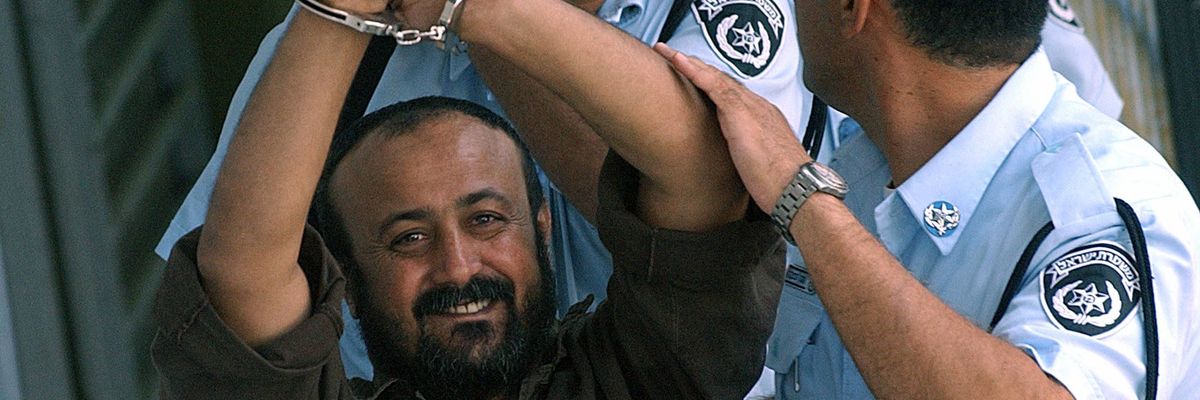
Hand cuffed and flashing the ‘V’-sign, Marwan Barghuti the leader of Yasser Arafat’s Fatah movement in the West Bank is flanked by Israeli policemen as he is led to a police vehicle 29 September 2003 on his way back to jail, after appearing before a Tel Aviv court.
IPhoto by Tal Cohen /AFP via Getty Images)


Medea Benjamin
Nov 01, 2025
Common Dreams


For more than two decades, Marwan Barghouti has sat behind Israeli bars—a living emblem of a brutal occupation that has denied Palestinians their freedom and dignity. His continued imprisonment is not merely unjust; it silences the one leader most capable of uniting the Palestinian people and leading them toward a political solution. Polls over many years show he is the most popular Palestinian political figure, trusted across factions and generations—even by many who have lost faith in politics. Releasing him is not a concession. It is a prerequisite for peace.

When the Second Intifada (uprising) began in 2000, Barghouti was a prominent member of Fatah, the Palestinian political faction that dominates the Palestinian Authority (PA), which governs limited parts of the occupied West Bank. He was also an elected parliamentarian. He was arrested by Israeli forces on April 15, 2002, and in 2004 an Israeli court convicted him and sentenced him to five life terms plus 40 years, accusing him of involvement in attacks that killed Israelis. Barghouti denied the charges, refused to recognize the court’s legitimacy, and declared himself a political prisoner under occupation.


Independent observers, including the Inter-Parliamentary Union, later found that the proceedings failed to meet international fair-trial standards and bore the marks of political persecution.

Barghouti’s case is inseparable from the larger machinery of occupation: like thousands of other Palestinian prisoners, he has endured brutal and degrading treatment, including torture, solitary confinement, and denial of adequate medical care. Israeli authorities are obligated under international law to ensure due process, humane treatment, and access to counsel and healthcare—obligations they routinely violate.

[The case of Marwan Barghouti] is inseparable from the larger machinery of occupation: like thousands of other Palestinian prisoners, he has endured brutal and degrading treatment, including torture, solitary confinement, and denial of adequate medical care.

Throughout his imprisonment, Barghouti has supported a principled stance: he rejects attacks on civilians and defends the right of a people living under military occupation to resist within international law. He has long advocated for negotiations grounded in equality and self-determination. That combination makes him uniquely capable of serving as a key mediator.

It is precisely this credibility that Israel fears. As his son Arab Barghouti said, “Israel sees my father as a danger because of his ability to bring Palestinians together.” Keeping him locked away serves two aims for Israel: decapitating credible Palestinian leadership and perpetuating the fiction that “there is no partner for peace.”

His family fears for his life, with witness reports that he was severely beaten by guards in September. That fear increased on August 15, 2025, when Israeli Minister Itamar Ben Gvir released a video in which he personally threatened Barghouti inside his prison cell.

The family has repeatedly asked Israel to allow international lawyers and the International Committee of the Red Cross to visit him, but their requests have been denied.

There was hope that Barghouti would be released as part of the recent Gaza ceasefire agreement between Israel and Hamas, and Trump said he was considering pressing Israel for his release, but Israel refused.

For years, world leaders have championed his cause. In 2013, Former President Jimmy Carter, Archbishop Emeritus Desmond Tutu, and other prominent world leaders and Nobel Peace Laureates called for his release. More recently, UN Special Rapporteur Francesca Albanese said, “Anyone serious about ‘peace’ should ensure his release, as the most popular—and unlawfully detained—Palestinian leader.” On October 29, a group of global leaders called The Elders, which was started by Nelson Mandela in 2007, called on President Trump to demand Barghouti’s release, “capitalising on the opportunity opened up by the fragile ceasefire deal in Gaza.”

Even senior Israeli security figures, including former Shin Bet director Ari Ayalon, have acknowledged that if Israel truly wants a partner who can deliver the Palestinian public to an agreement, Barghouti is the one leader with the legitimacy to do it.

But perhaps the most interesting recent advocate is Ronald Lauder, president of the World Jewish Congress, who–behind the scenes–lobbied for Barghouti as a gesture to the Arab countries pushing for his release.

Barghouti’s popularity as a uniting figure is why so many Palestinians call him their Nelson Mandela. Mandela’s release did not solve South Africa’s problems overnight, but it unlocked a door that had been nailed shut. Barghouti’s freedom could do the same.

If Israel truly seeks peace, it must stop locking away the very leadership capable of achieving it. If the international community truly stands for human rights, it must raise the political cost of Barghouti’s continued detention.


Our work is licensed under Creative Commons (CC BY-NC-ND 3.0). Feel free to republish and share widely.


Medea Benjamin is co-founder of Global Exchange and CODEPINK: Women for Peace. She is the co-author, with Nicolas J.S. Davies, of War in Ukraine: Making Sense of a Senseless Conflict, available from OR Books in November 2022. Other books include, "Inside Iran: The Real History and Politics of the Islamic Republic of Iran" (2018); "Kingdom of the Unjust: Behind the U.S.-Saudi Connection" (2016); "Drone Warfare: Killing by Remote Control" (2013); "Don't Be Afraid Gringo: A Honduran Woman Speaks from the Heart" (1989), and (with Jodie Evans) "Stop the Next War Now" (2005).
Full Bio >
An Antidote to Despair: Climate and Labor Unite

Wells Fargo Workers United and Stop the Money Pipeline are teaming up to target one corporation that clearly doesn’t care about everyday people: Wells Fargo.


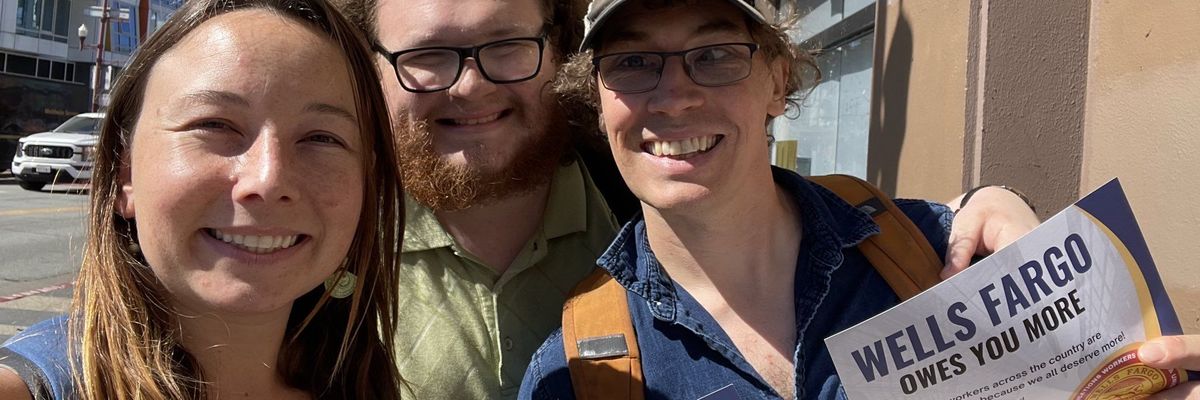
Climate activists visit Wells Fargo locations in San Francisco, California to discuss unionization.
(Photo by Stop the Money Pipeline)

Sarah Lasoff
Cole Weber
Nov 01, 2025
Common Dreams


Living in the United States right now, it’s easy to feel rage and despair. Corporations and billionaires have amassed so much money and power that popular opinions held by everyday working people are no longer represented by our federal government, and corporations are freer than ever to do what they like.

The results are damning: rising costs of basic needs like healthcare, housing, insurance, and groceries, making them unaffordable. We are faced with increasingly dangerous extreme weather events, endangering our homes, businesses, and loved ones. We are exposed to more pollution and toxins in our air, water, and soil than ever before. On top of it all, our mandated tax dollars are being used to kill and starve children at home and abroad.

Now, we find ourselves asking: How can we possibly influence our government, these corporations, and the billionaire class to do the right thing? Our only choice is to work together: the climate and labor movement uniting to hit these corporations and billionaires where it hurts—their wallets.

Wells Fargo Workers United and Stop the Money Pipeline are teaming up to target one corporation that clearly doesn’t care about everyday people: Wells Fargo. In February, despite its rank as the fifth largest funder of fossil fuels in the world in 2024, Wells Fargo publicly dropped its 2030 and 2050 climate goals. Wells Fargo has also been caught union busting, recently allegedly eavesdropping on bargaining. The bank has already faced over 30 Unfair Labor Practice (ULP) charges, and has been found violating workers’ rights on multiple occasions. Since its founding, Wells Fargo executives have proven that they will prioritize profit over people and the planet.

There’s a magical reality that happens when talking to people about the power they already have to impact a corporation and the world.

We won’t let them get away with it. If enough Wells Fargo workers join the union, they can withhold, or threaten to withhold, their labor, which could cost the company real revenue loss. Workers can then use this leverage to negotiate for higher wages, more staff, and an end to Wells Fargo’s funding of the climate crisis. This the first time that a union is forming at a US bank this large.

We’re seeing real momentum. Already, 28 Wells Fargo branches have voted to unionize and are actively engaging in bargaining. In August, over 30 people from communities facing the brunt of pollution from fossil fuel build-out in the Gulf South visited bank branches in San Francisco to inform workers about the union and Wells Fargo dropping its climate targets.

There’s a magical reality that happens when talking to people about the power they already have to impact a corporation and the world. We’ve seen workers light up when we share more about the support system of workers who feel the same way they do. They lift out of the drudgery of their daily routine, and sparkle with energy as we explore the possibility of change in their workplaces. In a time when so many of us are isolated, the opportunity to come together safely in person and affect real meaningful change can be so fulfilling, and even joyful. We need as many people as possible talking to Wells Fargo workers about the union to build the power we need to win.

This isn’t just about what we’re against, this is about what we fight for: a collective future where all of us can thrive, drink clean water, and breathe clean air; where workers unite to build power for better working conditions and climate policies. Any worker, anywhere, can take action. If you are a union member, or connected to any climate or labor organizing, talk to your leadership to see what you can do to build these bridges.We won’t deny the challenges before us. It's true, stepping outside of your comfort zone is scary, but this is a space of growth and creativity. To create a better world, we have to do things that challenge ourselves and our status quo. As the saying goes, “Action is the cure for despair.” The only way to effectively protect our world and democracy is to stand together across climate and labor and fight back as one. It’s time that we embrace this moment together.


Our work is licensed under Creative Commons (CC BY-NC-ND 3.0). Feel free to republish and share widely.


Sarah Lasoff of Stop the Money Pipeline is an organizer, both in career and in spirit. For the past 12 years, she has been inspiring people to come together and build a healthy and safe future for all people. Sarah lives in Portland, Oregon on a small urban farm with her roommates, seven chickens, and two cats.
Full Bio >

Cole Weber of Wells Fargo Workers United is a trade unionist and maker of good trouble. He has only been organizing for a year, but is passionate about helping people take power in their own lives and workplaces. Cole lives in Beaverton, Oregon with his husband, and shares custody of an elderly chihuahua with his former roommate and best friend.
Full Bio >
Opinion

Why We Shouldn’t Care What Bill Gates Has to Say About the Climate Crisis

If we were listening to people on the grounds of whether they had a good track record, the world would not spend a lot of time on Gates and climate. But if you have a hundred billion dollars all is forgiven.


Bill Gates and Warren Buffett speak with journalist Charlie Rose at an event organized by Columbia Business School on January 27, 2017 in New York City.
(Photo by Spencer Platt/Getty Images)


Bill Mckibben
Nov 01, 2025
The Crucial Years

I feel quite strongly that we should pay less attention to billionaires—indeed that’s rather the point of this small essay—so let me acknowledge at the outset that there is something odd about me therefore devoting an edition of this newsletter to replying to Bill Gates’ new missive about climate. But I fear I must, if only because it’s been treated as such important news by so many outlets—far more, say, than covered the United Nations Secretary General’s same-day appeal to international leaders that began with a forthright statement of the science. Here’s António Guterres:
The truth is that we have failed to avoid an overshooting above 1.5°C in the next few years. And that going above 1.5°C has devastating consequences. Some of these devastating consequences are tipping points, be it in the Amazon, be it in Greenland, or western Antarctica or the coral reefs.


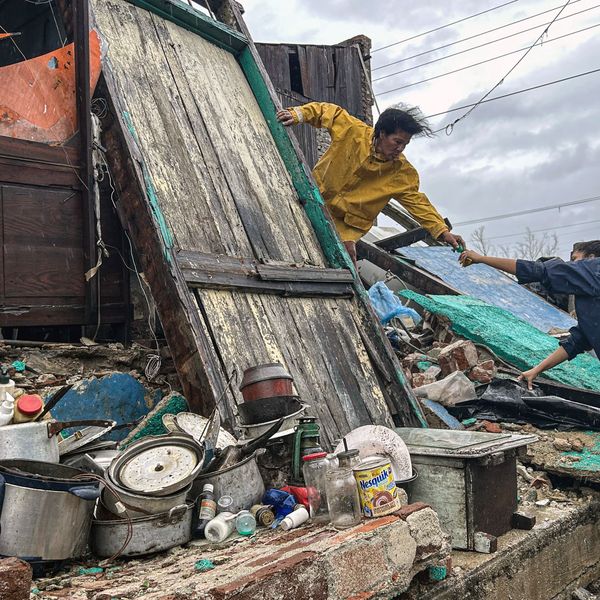
In fact, I could probably just note that Gates, with impeccable timing, decided to drop his remarks at the same moment that Hurricane Melissa plowed into Jamaica, doing incalculable damage because of winds made stronger by the ocean heat attributable to global warming. As Jeff Masters reported:
Human-caused climate change increased Hurricane Melissa’s wind speeds by 7% (11 mph, or 18 km/h), leading to a 12% increase in its damages, found researchers at the Imperial College of London in a rapid attribution study just released. A separate study by scientists at Climate Central found that climate change increased Melissa’s winds by 10%, and the near-record-warm ocean waters that Melissa traversed—1.2°C (1.2°F) warmer than average—were up to 900 times more likely to be that warm because of human-caused climate change.

RECOMMENDED...


‘There Is No Lack of Money’: Climate Movement Demands Billionaire Tax to Fund Greener Future


Richest 0.1% Overwhelmingly Guilty of the ‘Climate Plunder’ Wrecking Planet Earth

And, oh, the same day Hue, in Vietnam, reported one of the two or three greatest rainfalls in recorded human history: 5 feet of rain in 24 hours, the kind of deluge made ever more likely by a warming atmosphere that can hold more water vapor. As the Associated Press reported, “Global warming is making tropical storms stronger and wetter, according to experts, because warmer oceans provide them with more fuel, driving more intense winds, heavier rainfall and shifting precipitation patterns across East Asia.”

Anyway, Bill Gates’ letter.

It was wrong of him to write it because if his high-priced pr team didn’t anticipate the reaction, they should be fired. I assume they did, and that they were okay with the entirely predictable result from our president. Here’s how the Washington Times described it:
“I (WE!) just won the War on the Climate Change Hoax,” said Mr. Trump in a Wednesday post on Truth Social. “Bill Gates has finally admitted that he was completely WRONG on the issue. It took courage to do so, and for that we are all grateful. MAGA!!!”


Bill Gates didn’t, of course, say that. He said climate change was real and we should be worried about it, but that it wouldn’t lead to “humanity’s demise” or “the end of civilization” (which seems like the lowest of low bars) and that:
Although climate change will hurt poor people more than anyone else, for the vast majority of them it will not be the only or even the biggest threat to their lives and welfare. The biggest problems are poverty and disease


and therefore that’s where we should focus our money. His letter is actually directed at delegates to the global climate conference next month in Brazil, essentially telling them to back off the emissions reductions and concentrate on growing economies in the developing world because “health and prosperity are the best defense against climate change.”

Any conversation about Bill Gates and climate should begin by acknowledging that he’s been wrong about it over and over again. He’s explained that up until 2006—i.e., 18 years after Jim Hansen’s testimony before Congress laying out the science, and well past the point where George W. Bush had acknowledged its reality—he like Trump thought the whole thing was a crock. “I had assumed there were cyclical variations or other factors that would naturally prevent a true climate disaster,” he explained—at the time he was the richest man in the world, and yet his scientific advisers couldn’t get across the simple facts to him.

And he was last heard from on the topic in 2021, when he wrote a book explaining that it was going to be very hard to do renewable energy because it came with a “green premium”—i.e. it cost more. Sadly for his argument, that was pretty much the year that sun and wind crossed the invisible line making them less expensive than coal and oil and gas. (You can read my review from the New York Times here, and you can read his response to it in Rolling Stone here where he explains, “McKibben is stuck in this time warp.”)

So—if we were listening to people on the grounds of whether they had a good track record, the world would not spend a lot of time on Gates and climate. But if you have a hundred billion dollars all is forgiven, and so there has been lots of fawning coverage. The fact that Gates framed all this in a way designed to appeal to the president is so obvious that it hardly bears mentioning (the richest men in the world have all been sucking up to him, so no extra shame here); let’s instead just go to the heart of his argument. Which is weak in the extreme.

Take the case of Jamaica. The warming-fueled hurricane that smashed into the island on Tuesday did a lot of damage. How much? The first estimates from the insurance industry say between 30 and 250% of the country’s annual GDP. The wide range is because we don’t yet have pictures from much of the country, so let’s go with the very low end of the range. Thirty percent of a country’s GDP is… a lot of money. It’s as if Hurricane Katrina had cost America $8 trillion. If America suddenly had an $8 trillion hole, what do you think that would do to its ability to pay for education and healthcare and the like? That’s what “development” is. Jamaica is in a hole it will spend forever getting out of.

And oh, Cuba and Haiti got smacked too. And Vietnam. And… and that was just last week. According to the National Bureau of Economic Research, every one degree climb in temperature knocks 12% off GDP. The paper concluded that “by the end of the century people may well be 50% poorer than they would’ve been if it wasn’t for climate change.” And who gets hurt the most? That would be the developing countries that Gates in theory worries about. Here’s a Stanford study showing that “the gap between the economic output of the world’s richest and poorest countries is 25% larger today than it would have been without global warming.”

Gates goes on and on about public health, but as the US Global Leadership Coalition (a group he has lauded extensively) said a few years ago:
Warmer temperatures could expose as many as one billion people to deadly infectious diseases such as Zika, dengue, and chikungunya. In the US alone, disease cases from mosquitoes, ticks, and fleas more than tripled from just under 30,000 to almost 100,000 a year from 2004 to 2016. A warmer climate could lead to an additional 250,000 people dying of diseases including malaria each year between 2030 and 2050, according to the World Health Organization.

Is this a smaller effect than the things he worries about? On the same day that Gates issued his letter, the premier medical journal the Lancet issued its annual update on climate and health, and what it found was:
Rising global heat is now killing one person a minute around the world, a major report on the health impact of the climate crisis has revealed.

It says the world’s addiction to fossil fuels also causes toxic air pollution, wildfires, and the spread of diseases such as dengue fever, and millions each year are dying owing to the failure to tackle global heating.


The irony of Gates’ new letter is that he acknowledges, in passing, how wrong he was four years ago about the “green premium”:
You probably know about improvements like better electric vehicles, dramatically cheaper solar and wind power, and batteries to store electricity from renewables. What you may not be aware of is the large impact these advances are having on emissions.

Ten years ago, the International Energy Agency predicted that by 2040, the world would be emitting 50 billion tons of carbon dioxide every year. Now, just a decade later, the IEA’s forecast has dropped to 30 billion, and it’s projecting that 2050 emissions will be even lower.

But he uses that new knowledge to argue that since they’ve done so well we’ve knocked the high end off climate projections and hence can calm down about it all. He misses the most obvious point, which is that if you care about development the rapid expansion of solar and wind power gives us the greatest possible chance we’ve ever had to really knock down poverty, at exactly the same point that we’re spreading the technology that can help limit how high the temperature eventually gets.

Jigar Shah, who led the Department of Energy loans office under Biden, put it best:
Bill Gates hasn’t made sense on Climate since he teamed up with Bjorn Lomborg in 2009. This is just a restating of Bjorn’s book from this year about how we have a finite amount of money and we shouldn’t use it for climate. What they get wrong is that climate solutions are now fully profitable.

Here’s Rajiv Shah, writing in the New York Times last year, about the opportunity:
As world leaders gather this week for the United Nations General Assembly they should reimagine their approach. In today’s digital world, nothing matters more to individual well-being than energy: Access to electricity determines fundamental aspects of individuals’ lives, like whether they are healthy or have a job.

Instead of treating electrification as one of many goals, it’s time to see it is essential to all of them. And that means the world needs to focus investment and effort on getting reliable, clean electricity to the nearly 700 million people who don’t have any—and the 3.1 billion more who don’t have enough.

As Rajiv Shah explained in the headline to that article, “Want to End Poverty? Focus on One Thing.” Clean electricity.

I doubt Rajiv Shah can say anything about Gates’ letter—he worked at the Gates Foundation for years as part of his long and distinguished career. In fact, not many people can really reply—Gates money is too important to too many agencies and organizations. But since I don’t get any of it, let me say: He’s really not the guy to be listening to on this stuff. Really.


© 2022 Bill McKibben


Bill Mckibben is the Schumann Distinguished Scholar at Middlebury College and co-founder of 350.org and ThirdAct.org. His most recent book is "Falter: Has the Human Game Begun to Play Itself Out?." He also authored "The End of Nature," "Eaarth: Making a Life on a Tough New Planet," and "Deep Economy: The Wealth of Communities and the Durable Future."
Full Bio >
Opinion

Why Canada Should Want No Part of Trump’s Idiotic and Dangerous ‘Golden Dome’

While the debate rages on in Canada about how best to resist Trump’s grip on our economy, we’ve quietly signed on to fully co-operate with his ultimately more threatening military agenda.


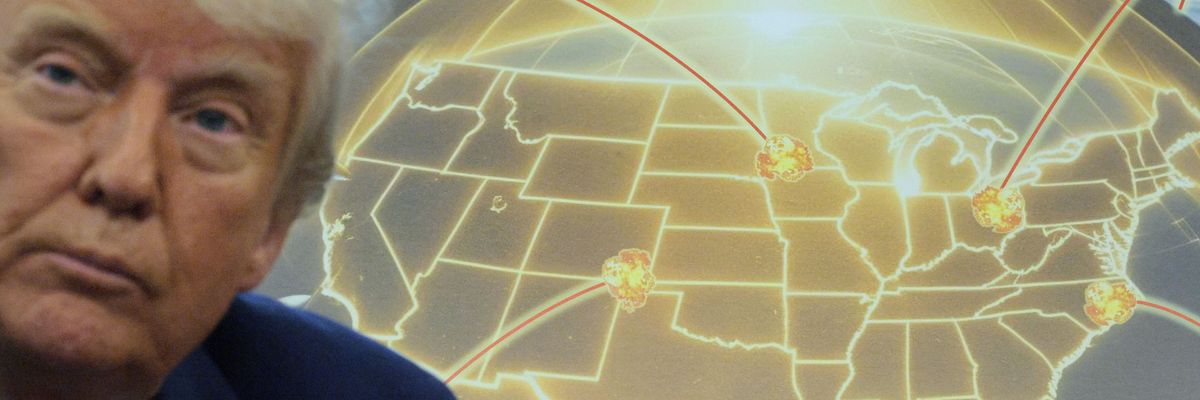
President Donald Trump speaks in front of a map of his proposed “Golden Dome” missile defense system in the Oval Office at the White House on May 20, 2025 in Washington, DC.
Photo by Chip Somodevilla/Getty Images


Linda Mcquaig
Nov 02, 2025
Toronto Star

It’s certainly worrisome, as we’re discovering, that U.S. President Donald Trump has so much sway over our economy.

What’s even more worrisome, but rarely mentioned, is that this volatile, vengeful, vindictive, reckless and deeply unpredictable man also has control over the world’s most powerful nuclear arsenal.
.

Of course, Canadians don’t get to determine who sits in the Oval Office. But we do have some options how to respond.

And while the debate rages on in Canada about how best to resist Trump’s grip on our economy, we’ve quietly signed on to fully co-operate with his ultimately more threatening military agenda.

Our elbows aren’t just not up, they’re in lockstep with his.

At the urging of Trump, Prime Minister Mark Carney has agreed to radically raise our military spending over the next decade, jacking it all the way up from 1.4 per cent to five per cent of our GDP.

Furthermore, Carney has also signalled Canada’s intention to join Trump’s “Golden Dome” — thereby discarding decades of sensible Canadian refusal to become part of the long-smouldering Republican “Star Wars” fantasy of world nuclear domination.

This move is a striking departure for Canada, and it has received far too little attention.

For decades, Canadian governments, both Liberal and Conservative (under Brian Mulroney), wisely declined to participate in earlier versions of the Golden Dome under former U.S. presidents Ronald Reagan and George W. Bush. Canada’s refusal was largely on the grounds that these so-called “missile defence” systems are not just defensive. In fact, they undermine arms treaties and encourage arms races.

Indeed, Canada’s apparent willingness to embrace the Golden Dome would amount to a repudiation of our long tradition of supporting arms control and specifically our role in trying to prevent the use of weapons in space.

This danger was underlined last week by Douglas Roche, a former Canadian ambassador for disarmament, when he lamented in a speech in Ottawa that the Carney government “has joined the Western pretence that a Golden Dome missile defence system will save us.”

Roche, a retired Canadian senator, considers it “deeply disturbing” that the Carney government seems willing to embrace the Golden Dome, which threatens to “provoke the development of a new offensive nuclear arms system.”

Roche calls nuclear weapons “instruments of pure evil.”

In an earlier column, I argued that Carney’s decision to appease Trump by dramatically raising our military spending means there will be little revenue left for other priorities.

Even worse, Carney’s willingness to join Trump’s Golden Dome misadventure will leave us less safe, by adding fuel to the already-overheated arms race.

The Golden Dome — a trillion-dollar project likely to enrich Peter Thiel and other U.S. tech billionaires — is central to the revival of the nuclear arms race, reversing the significant disarmament progress made in earlier decades. The Golden Dome is based on the far-fetched idea that a land mass the size of North America can be shielded from incoming missiles through a technology often likened to a speeding bullet hitting another speeding bullet from thousands of miles away. It can work in a test but is regarded as less reliable in warfare.

However, by providing the illusion of protection, the Golden Dome could encourage political leaders to consider using nuclear weapons, not just defensively, but in “first strike” situations, to pre-emptively knock out opponents. In other words, it risks encouraging nuclear aggression.

In an article last month in Scientific American, astrophysicist Ramin Skibba suggested that the Golden Dome would lead to a “more overt weaponization of space” and concluded that its main feature may be “the perilous acceleration of arms races and the enrichment of profit-seeking defence and space-tech contractors for what is, at best, only the illusion of safety.”

Hardly sounds like something Canada should be part of, particularly when the lethal nuclear arsenal connected to it will be under the control of someone we know, from firsthand experience, to be volatile, vengeful, vindictive, reckless and deeply unpredictable.


© 2023 TheStar.com

Linda Mcquaig is an author, journalist, and former NDP candidate for Toronto Centre in the Canadian federal election. The National Post has described her as "Canada's Michael Moore." She is also the author of "The Sport and Prey of Capitalists: How the Rich Are Stealing Canada's Public Wealth" (2019), "War, Big Oil and the Fight for the Planet: It's the Crude, Dude" (2006) and (with Neil Brooks) of "Billionaires' Ball: Gluttony and Hubris in an Age of Epic Inequality" (2012).
Full Bio >
AMERIKAN GESTAPO

ICE’s ‘Frightening’ Facial Recognition App is Scanning US Citizens Without Their Consent

“An ICE officer may ignore evidence of American citizenship—including a birth certificate—if the app says the person is an alien,” said the ranking member of the House Homeland Security Committee.


A federal immigration agent uses his cell phone as he patrols the halls of immigration court at the Jacob K. Javitz Federal Building on October 22, 2025, in New York City.
(Photo by Michael M. Santiago/Getty Images)


Stephen Prager
Nov 01, 2025
COMMON DREAMS


Immigration agents are using facial recognition software as “definitive” evidence to determine immigration status and is collecting data from US citizens without their consent. In some cases, agents may detain US citizens, including ones who can provide their birth certificates, if the app says they are in the country illegally.

These are a few of the findings from a series of articles published this past week by 404 Media, which has obtained documents and video evidence showing that Immigration and Customs Enforcement (ICE) and Customs and Border Protection (CBP) agents are using a smartphone app in the field during immigration stops, scanning the faces of people on the street to verify their citizenship.
RECOMMENDED...


More Than 170 US Citizens Have Been Held by Immigration Agents, Some Abused or Detained for Days: ProPublica


Siding With Trump, Facebook Suspends Chicago Community Group Issuing ICE Alerts

The report found that agents frequently conduct stops that “seem to have little justification beyond the color of someone’s skin... then look up more information on that person, including their identity and potentially their immigration status.”

While it is not clear what application the agencies are using, 404 previously reported that ICE is using an app called Mobile Fortify that allows ICE to simply point a camera at a person on the street. The photos are then compared with a bank of more than 200 million images and dozens of government databases to determine info about the person, including their name, date of birth, nationality, and information about their immigration status.

On Friday, 404 published an internal document from the Department of Homeland Security (DHS) which stated that “ICE does not provide the opportunity for individuals to decline or consent to the collection and use of biometric data/photograph collection.” The document also states that the image of any face that agents scan, including those of US citizens, will be stored for 15 years.

The outlet identified several videos that have been posted to social media of immigration officials using the technology.

In one, taken in Chicago, armed agents in sunglasses and face coverings are shown accosting a pair of Hispanic teenagers on bicycles, asking where they are from. The 16-year-old boy who filmed the encounter said he is “from here”—an American citizen—but that he only has a school ID on him. The officer tells the boy he’ll be allowed to leave if he’ll “do a facial.” The other officer then snaps a photo of him with a phone camera and asks his name.


In another video, also in Chicago, agents are shown surrounding a driver, who declines to show his ID. Without asking, one officer points his phone at the man. “I’m an American citizen, so leave me alone,” the driver says. “Alright, we just got to verify that,” the officer responds.

Even if the people approached in these videos had produced identification proving their citizenship, there’s no guarantee that agents would have accepted it, especially if the app gave them information to the contrary.

On Wednesday, ranking member of the House Homeland Security Committee, Rep. Bennie Thompson (D-Miss.), told 404 that ICE agents will even trust the app’s results over a person’s government documents.

“ICE officials have told us that an apparent biometric match by Mobile Fortify is a ‘definitive’ determination of a person’s status and that an ICE officer may ignore evidence of American citizenship—including a birth certificate—if the app says the person is an alien,” he said.

This is despite the fact that, as Nathan Freed Wessler, deputy director of the ACLU’s Speech, Privacy, and Technology Project, told 404, “face recognition technology is notoriously unreliable, frequently generating false matches and resulting in a number of known wrongful arrests across the country.”

Thompson said: “ICE using a mobile biometrics app in ways its developers at CBP never intended or tested is a frightening, repugnant, and unconstitutional attack on Americans’ rights and freedoms.”

According to an investigation published in October by ProPublica, more than 170 US citizens have been detained by immigration agents, often in squalid conditions, since President Donald Trump returned to office in January. In many of these cases, these individuals have been detained because agents wrongly claimed the documents proving their citizenship are false.

During a press conference this week, Homeland Security Secretary Kristi Noem denied this reality, stating that “no American citizens have been arrested or detained” as part of Trump’s “mass deportation” crusade.

“We focus on those who are here illegally,” she said.

But as DHS’s internal document explains, facial recognition software is necessary in the first place because “ICE agents do not know an individual’s citizenship at the time of the initial encounter.”

David Bier, the director of immigration studies at the Cato Institute, explains that the use of such technology suggests that ICE’s operations are not “highly targeted raids,” as it likes to portray, but instead “random fishing expeditions.”