‘I can’t eat’: Millions risk losing food aid during US shutdown
By AFP
November 1, 2025

Eric Dunham (Center) is one of several Houston residents receiving free lunch bags at a restaurant in the Texas metropolis as funding lapses for the US program that provides food benefits for millions of Americans - Copyright AFP Mark Felix
Moisés ÁVILA
Approximately one in eight Americans receive food stamp benefits from the US government, a program at risk of losing its funding as of Saturday due to the government shutdown.
One such beneficiary is Eric Dunham, a 36-year-old man who became disabled after an accident and needs help from the federal Supplemental Nutrition Assistance Program (SNAP) to live.
“If I don’t get food stamps I can’t eat,” Dunham told AFP, explaining that after all his expenses, he has just $24 left over per month.
“That’s it,” the father of two teenagers said. “The rest goes to child support.”
Since the federal government shuttered on October 1 due to ongoing budget disagreements between Republicans and Democrats in Congress, President Donald Trump’s administration has announced it would no longer be able to fund SNAP as of Saturday — the first cessation since the program began six decades ago.
A federal judge stepped in Friday and ordered the government to use emergency funds to keep SNAP running, and Trump said he aimed to comply. But many recipients have had their aid disrupted amid the bureaucratic tug-of-war.
Dunham — who works in the service industry, though in a reduced capacity since his accident — was able to receive some sandwiches and drinks on Saturday afternoon distributed by Petit Beignets and Tapioca, a restaurant in northwest Houston.
“There’s a lot of layoffs going around, and on top of that, we have the government shutdown and the SNAP benefits — nobody knew what was going to happen, and I made sandwiches for someone who comes and has SNAP benefits, and at least can have one meal for sure,” the restaurant’s owner Nhan Ngo, 37, said.
Though Dunham could not use his SNAP card to repay Ngo, he gave him a surprise hug as a show of thanks.
– ‘Not something extraordinary or luxurious’ –
Elsewhere in the city, thousands of people who did not receive their food stamps or fear they will not get them in the near future lined up in cars outside NRG Stadium, where the Houston Food Bank is distributing fruit and non-perishable food items.
The food bank’s president Brian Greene told AFP that the SNAP stoppage affects “about 425,000 households just in the Houston area.”
“So every community is trying to step up to help these families get by in the meantime.”
Despite the judicial order to resume funding SNAP during the shutdown, “it would take several days for the states to restart the program,” Greene explained. “They all had to stop because they were out of money.”
The gap in benefits impacted Sandra Guzman, a 36-year-old mother of two, who had placed an order for her food stamps last week but was told there were none available. She had to seek food aid elsewhere in the meantime.
“This is not something extraordinary or luxurious, this is something basic as getting food for my kids,” Guzman told AFP. “I’ll say food stamps represent 40 percent… of my expenses.”
– Trump’s ballroom or food aid –
Mary Willoughby, a 72-year-old Houston resident, waited in line outside the stadium with her granddaughter to receive food. She thinks if the aid freeze lasts, it could cause widespread chaos.
“We need our food stamps. We need our social security. We need our Medicare… If you cut all that out, it’s going to be nothing but a big war right now because people are gonna start robbing,” she said.
“We need the help.”
Another person in line, Carolyn Guy, 51, said she found it absurd that the Trump administration was paying millions to build a new White House ballroom while claiming there was no money to fund SNAP benefits.
“Why are you taking our stuff from us? We work hard,” she said. “You can take our food stamps, but here you’re getting ready to build a ballroom? Doesn’t make sense to me.”
Despite Court Rulings, Trump Refuses to Pay Out Food Stamp Benefits to Tens of MillionsBy AFP
November 1, 2025
Eric Dunham (Center) is one of several Houston residents receiving free lunch bags at a restaurant in the Texas metropolis as funding lapses for the US program that provides food benefits for millions of Americans - Copyright AFP Mark Felix
Moisés ÁVILA
Approximately one in eight Americans receive food stamp benefits from the US government, a program at risk of losing its funding as of Saturday due to the government shutdown.
One such beneficiary is Eric Dunham, a 36-year-old man who became disabled after an accident and needs help from the federal Supplemental Nutrition Assistance Program (SNAP) to live.
“If I don’t get food stamps I can’t eat,” Dunham told AFP, explaining that after all his expenses, he has just $24 left over per month.
“That’s it,” the father of two teenagers said. “The rest goes to child support.”
Since the federal government shuttered on October 1 due to ongoing budget disagreements between Republicans and Democrats in Congress, President Donald Trump’s administration has announced it would no longer be able to fund SNAP as of Saturday — the first cessation since the program began six decades ago.
A federal judge stepped in Friday and ordered the government to use emergency funds to keep SNAP running, and Trump said he aimed to comply. But many recipients have had their aid disrupted amid the bureaucratic tug-of-war.
Dunham — who works in the service industry, though in a reduced capacity since his accident — was able to receive some sandwiches and drinks on Saturday afternoon distributed by Petit Beignets and Tapioca, a restaurant in northwest Houston.
“There’s a lot of layoffs going around, and on top of that, we have the government shutdown and the SNAP benefits — nobody knew what was going to happen, and I made sandwiches for someone who comes and has SNAP benefits, and at least can have one meal for sure,” the restaurant’s owner Nhan Ngo, 37, said.
Though Dunham could not use his SNAP card to repay Ngo, he gave him a surprise hug as a show of thanks.
– ‘Not something extraordinary or luxurious’ –
Elsewhere in the city, thousands of people who did not receive their food stamps or fear they will not get them in the near future lined up in cars outside NRG Stadium, where the Houston Food Bank is distributing fruit and non-perishable food items.
The food bank’s president Brian Greene told AFP that the SNAP stoppage affects “about 425,000 households just in the Houston area.”
“So every community is trying to step up to help these families get by in the meantime.”
Despite the judicial order to resume funding SNAP during the shutdown, “it would take several days for the states to restart the program,” Greene explained. “They all had to stop because they were out of money.”
The gap in benefits impacted Sandra Guzman, a 36-year-old mother of two, who had placed an order for her food stamps last week but was told there were none available. She had to seek food aid elsewhere in the meantime.
“This is not something extraordinary or luxurious, this is something basic as getting food for my kids,” Guzman told AFP. “I’ll say food stamps represent 40 percent… of my expenses.”
– Trump’s ballroom or food aid –
Mary Willoughby, a 72-year-old Houston resident, waited in line outside the stadium with her granddaughter to receive food. She thinks if the aid freeze lasts, it could cause widespread chaos.
“We need our food stamps. We need our social security. We need our Medicare… If you cut all that out, it’s going to be nothing but a big war right now because people are gonna start robbing,” she said.
“We need the help.”
Another person in line, Carolyn Guy, 51, said she found it absurd that the Trump administration was paying millions to build a new White House ballroom while claiming there was no money to fund SNAP benefits.
“Why are you taking our stuff from us? We work hard,” she said. “You can take our food stamps, but here you’re getting ready to build a ballroom? Doesn’t make sense to me.”
“The administration has chosen to hold food for more than forty million vulnerable people hostage to try to force Democrats to capitulate without negotiations,” says one Georgetown law professor.
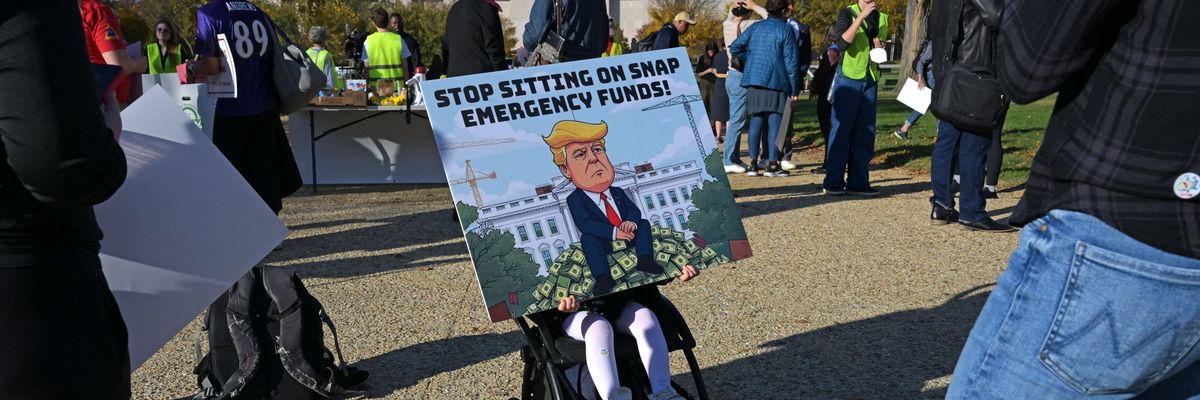
People attend the People’s Pantry Food drive to replenish food banks ahead of the Supplemental Nutrition Assistance Program (SNAP) lapse at the USDA Headquarters, on the National Mall, Washington, DC, on October 30, 2025.
(Photo by Oliver Contreras/AFP)
Stephen Prager
Nov 01, 2025
COMMON DREAMS
Two federal judges have said the Trump administration cannot use the government shutdown to suspend food assistance for 42 million Americans. But hours into Saturday, when payments were due to be disbursed, President Donald Trump appears to be defying the ruling, potentially leaving millions unable to afford this month’s grocery bills.
A pair of federal judges in Massachusetts and Rhode Island ruled Friday that the Department of Agriculture’s (USDA) freeze on benefits from the Supplemental Nutrition Assistance Program (SNAP), also known as food stamps, was unlawful and that the department must use money from a contingency fund of $6 billion to pay for at least a portion of the roughly $8 billion meant to be disbursed this month.
RECOMMENDED...
25 State AGs Sue Trump Over Refusal to Fund Food Assistance for Poor
‘It Does Not Have to Be This Way’: Child Hunger Set to Surge as Trump Withholds SNAP Funds
“There is no doubt that the six billion dollars in contingency funds are appropriated funds that are without a doubt necessary to carry out the program’s operation,” said US District Judge McConnell of Rhode Island in his oral ruling. “The shutdown of the government through funding doesn’t do away with SNAP. It just does away with the funding of it. There could be no greater necessity than the prohibition across the board of funds for the program’s operations.”
McConnell added: “There is no doubt, and it is beyond argument, that irreparable harm will begin to occur if it hasn’t already occurred in the terror it has caused some people about the availability of funding for food for their family.”
SNAP benefits are available to people whose monthly incomes fall below 130% of the federal poverty line. More than 1 in 8 Americans rely on the program, and 39% of them are children. According to USDA research, cited by the Washington Post, those who receive SNAP benefits rely on it for 63% of their groceries, with the poorest, who make below 50% of the poverty line, relying on it for as much as 80%.
McConnell shot down the administration’s contention that the contingency funds may be needed for some other hypothetical emergency in the future, saying “It’s clear that when compared to the millions of people that will go without funds for food versus the agency’s desire not to use contingency funds in case there’s a hurricane need, the balances of those equities clearly goes on the side of ensuring that people are fed.”
While the judge in Massachusetts, Indira Talwani, ruled that Trump merely had to use the contingency funds to fund as much of the program as possible, McConnell went further, saying that in addition, they had to tap other sources of funding to disburse benefits in full, and do so “as soon as possible.” Both judges gave the administration until Monday to provide updates on how it planned to follow the ruling.
However, after the ruling on Friday, Trump insisted on social media that “government lawyers do not think we have the legal authority to pay SNAP with certain monies we have available, and now two courts have issued conflicting opinions on what we can and cannot do.”
He added: “I do NOT want Americans to go hungry just because the Radical Democrats refuse to do the right thing and REOPEN THE GOVERNMENT. Therefore, I have instructed our lawyers to ask the Court to clarify how we can legally fund SNAP as soon as possible.”
Attorney and activist Miles Mogulescu pointed out in Common Dreams that, “until a few days ago, even the Trump administration agreed that these funds should be used to continue SNAP funding during the shutdown.”
On September 30, the day before the shutdown began, the USDA posted a 55-page “Lapse of Funding” plan to its website, which plainly stated that if the government were to shut down, “the department will continue operations related to... core nutrition safety net programs.”
But this week, USDA abruptly deleted the file and posted a new memo that concocted a new legal reality out of whole cloth, stating that “due to Congressional Democrats’ refusal to pass a clean continuing resolution (CR), approximately 42 million individuals will not receive SNAP benefits come November 1st.”
As Mogulescu notes: “The new memo cited absolutely no law supporting its position. Instead, it made up a rule claiming that the ‘contingency fund is not available to support FY 2026 regular benefits, because the appropriation for regular benefits no longer exist.'”
Sharon Parrott, the president of the Center on Budget and Policy Priorities, who previously served as an official in the White House Office of Management, said last week that it’s “unequivocally false” that the administration’s hands are tied.
“I know from experience that the federal government has the authority and the tools it needs during a shutdown to get these SNAP funds to families,” Parrott said. “Even at this late date, the professionals at the Department of Agriculture and in states can make this happen. And, to state the obvious, benefits that are a couple of days delayed are far more help to families than going without any help at all.”
She added: “The administration itself admits these reserves are available for use. It could have, and should have, taken steps weeks ago to be ready to use these funds. Instead, it may choose not to use them in an effort to gain political advantage.”
In hopes of pressuring Democrats to abandon their demands that Congress extend a critical Affordable Care Act tax credit and prevent health insurance premiums from skyrocketing for more than 20 million Americans, Republicans have sought to use the shutdown to inflict maximum pain on voters.
Trump has attempted to carry out mass layoffs of government workers, which have been halted by a federal judge. Meanwhile, his director of the Office of Management and Budget, Russell Vought, has stripped funding from energy and transportation infrastructure projects aimed at blue states and cities.
“Terminating SNAP is a choice, and an overtly unlawful one at that,” says David Super, a constitutional law professor at Georgetown University. “The administration has chosen to hold food for more than forty million vulnerable people hostage to try to force Democrats to capitulate without negotiations.”
Federal judge forces Trump admin to fund food stamps through November
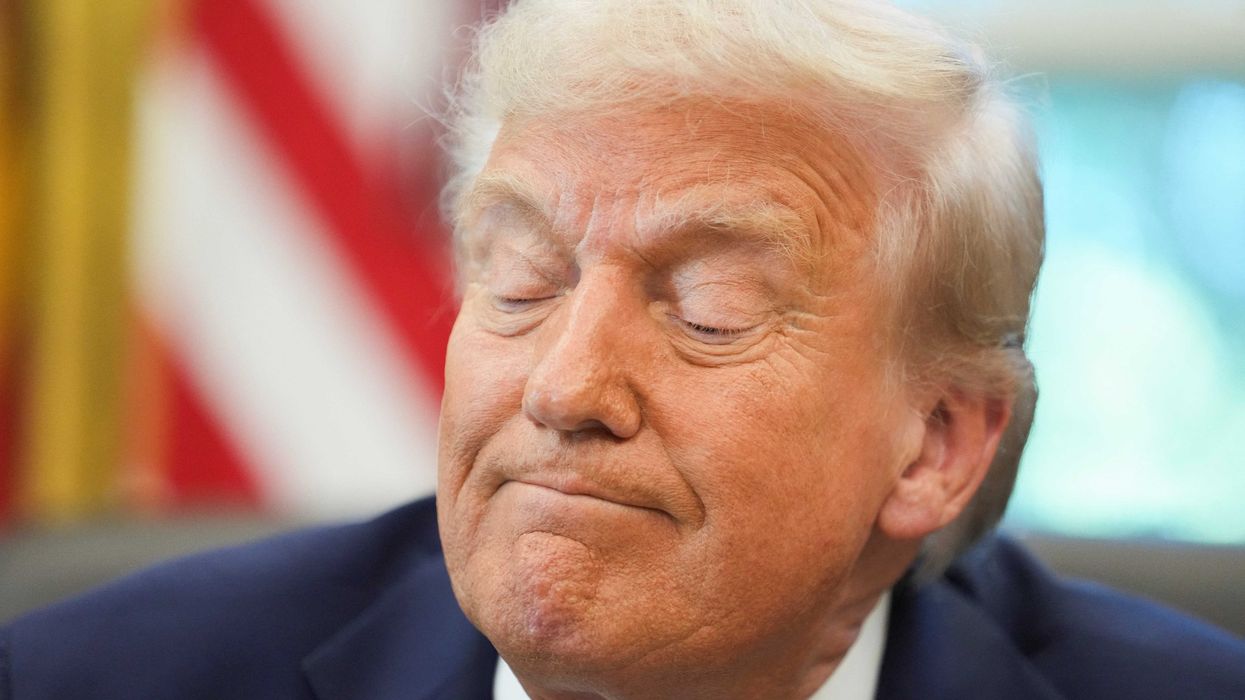
.S. President Donald Trump reacts in the Oval Office at the White House in Washington, D.C., U.S., September 19, 2025. REUTERSKen Cedeno
.S. President Donald Trump reacts in the Oval Office at the White House in Washington, D.C., U.S., September 19, 2025. REUTERSKen Cedeno
October 31, 2025
ALTERNET
President Donald Trump's administration has been compelled to fund the Supplemental Nutrition Assistance Program (SNAP, also known as food stamps) through November, after a decision by a federal judge.
ABC News reported Friday that U.S. District Judge John J. McConnell (an appointee of former President Barack Obama) ordered the U.S. Department of Agriculture (USDA) to use its contingency fund to partially fund SNAP through next month. The contingency fund is capable of covering roughly two-thirds of the SNAP funding shortfall. The decision comes as U.S. District Judge Indira Talwani (another Obama appointee) sided with Democratic attorneys general and governors from 25 states, in declaring the Trump administration's decision to not use the contingency fund "unlawful."
"The court is orally at this time, ordering that USDA must distribute the contingency money timely, or as soon as possible, for the November 1 payments to be made," Judge McConnell wrote in his ruling.
"There is no doubt, and it is beyond argument, that irreparable harm will begin to occur -- if it hasn't already occurred -- in the terror it has caused some people about the availability of funding for food for their family," he added.
Due to the ongoing government shutdown, approximately 42 million Americans were on track to lose their food assistance beginning Saturday. The Trump administration stated last week that even though there is a USDA contingency fund of roughly $6 billion to keep SNAP afloat, it wasn't going to tap into those funds, asserting that the money was to be used for emergencies like "hurricanes, tornadoes and floods."
The states of Arizona, California, Colorado, Connecticut, Delaware, Hawaii, Illinois, Kansas, Kentucky, Maine, Maryland, Massachusetts, Michigan, Minnesota, Nevada, New Jersey, New Mexico, New York, North Carolina, Oregon, Pennsylvania, Rhode Island, Vermont, Washington state and Wisconsin took the administration to federal court earlier this week. Kansas Gov. Laura Kelly (D), Kentucky Gov. Andy Beshear (D) and Pennsylvania Gov. Josh Shapiro (D) joined the suit through their respective offices, as their states have Republican attorneys general.
Top Republicans in the House and Senate have been insisting that Democrats vote for the Republican-written government funding bill if they want SNAP benefits to continue without interruption. However, doing so would mean tens of millions of Americans likely experience a significant increase in their heath insurance premiums when Affordable Care Act (ACA) tax credits expire at the end of 2025.
An extension would require 60 Senate votes due to filibuster rules, and Democrats — who have just 47 seats in the Senate — would need 13 Republicans to break rank and vote to extend the ACA credits. Rep. Marjorie Taylor Greene (R-Ga.), whose adult children are expecting their monthly premiums to double, has consistently laid blame for the shutdown at Republicans' feet and accused her party of not having an alternative plan to the ACA to lower Americans' healthcare costs. Sen. Bernie Moreno (R-Ohio) suggested earlier this week that Greene write her own bill.
Click here to read ABC's full report.
President Donald Trump's administration has been compelled to fund the Supplemental Nutrition Assistance Program (SNAP, also known as food stamps) through November, after a decision by a federal judge.
ABC News reported Friday that U.S. District Judge John J. McConnell (an appointee of former President Barack Obama) ordered the U.S. Department of Agriculture (USDA) to use its contingency fund to partially fund SNAP through next month. The contingency fund is capable of covering roughly two-thirds of the SNAP funding shortfall. The decision comes as U.S. District Judge Indira Talwani (another Obama appointee) sided with Democratic attorneys general and governors from 25 states, in declaring the Trump administration's decision to not use the contingency fund "unlawful."
"The court is orally at this time, ordering that USDA must distribute the contingency money timely, or as soon as possible, for the November 1 payments to be made," Judge McConnell wrote in his ruling.
"There is no doubt, and it is beyond argument, that irreparable harm will begin to occur -- if it hasn't already occurred -- in the terror it has caused some people about the availability of funding for food for their family," he added.
Due to the ongoing government shutdown, approximately 42 million Americans were on track to lose their food assistance beginning Saturday. The Trump administration stated last week that even though there is a USDA contingency fund of roughly $6 billion to keep SNAP afloat, it wasn't going to tap into those funds, asserting that the money was to be used for emergencies like "hurricanes, tornadoes and floods."
The states of Arizona, California, Colorado, Connecticut, Delaware, Hawaii, Illinois, Kansas, Kentucky, Maine, Maryland, Massachusetts, Michigan, Minnesota, Nevada, New Jersey, New Mexico, New York, North Carolina, Oregon, Pennsylvania, Rhode Island, Vermont, Washington state and Wisconsin took the administration to federal court earlier this week. Kansas Gov. Laura Kelly (D), Kentucky Gov. Andy Beshear (D) and Pennsylvania Gov. Josh Shapiro (D) joined the suit through their respective offices, as their states have Republican attorneys general.
Top Republicans in the House and Senate have been insisting that Democrats vote for the Republican-written government funding bill if they want SNAP benefits to continue without interruption. However, doing so would mean tens of millions of Americans likely experience a significant increase in their heath insurance premiums when Affordable Care Act (ACA) tax credits expire at the end of 2025.
An extension would require 60 Senate votes due to filibuster rules, and Democrats — who have just 47 seats in the Senate — would need 13 Republicans to break rank and vote to extend the ACA credits. Rep. Marjorie Taylor Greene (R-Ga.), whose adult children are expecting their monthly premiums to double, has consistently laid blame for the shutdown at Republicans' feet and accused her party of not having an alternative plan to the ACA to lower Americans' healthcare costs. Sen. Bernie Moreno (R-Ohio) suggested earlier this week that Greene write her own bill.
Click here to read ABC's full report.
Food stamps, the bulwark against hunger for over 40 mn Americans
By AFP
October 31, 2025

Concerns about SNAP drove volunteers to replenish food banks at the USDA Headquarters, in the National Mall, Washington - Copyright AFP Oliver Contreras
Myriam LEMETAYER
The ongoing budget deadlock in the United States is threatening food security of around 42 million Americans who receive food stamps at the start of each month to help get by.
The US Department of Agriculture had said that no money could be paid out on Saturday due to the shutdown.
But on Friday, a federal judge helped ease some of the uncertainty at the last minute by ordering the government to use emergency funds to ensure the continuity of the Supplemental Nutrition Assistance Program (SNAP), which has helped low-income Americans for more than 60 years.
The idea that SNAP assistance could be paused is “truly unprecedented,” Meredith Niles, a professor specializing in food policy at the University of Vermont, told AFP.
“This has never happened in more than 50 years of the program, despite numerous other government shutdowns,” she said.
Here’s how SNAP works, and what its absence could mean for those affected.
– How does it work?
While food stamps date back to the 1930s during the Great Depression, the SNAP program was created in 1964 and expanded nationwide in 1974, according to Niles from the University of Vermont.
Today, around one-in-eight Americans receive SNAP benefits each month based on income, according to the Department of Agriculture.
This costs the federal budget nearly $100 billion.
Beneficiaries have a payment card, similar to a debit card, which they can use in supermarkets, grocery stores, and some farmers’ markets. The cards are usually reloaded automatically on the first day of the month.
To qualify for SNAP, along with being low-income, recipients must meet certain requirements — which can vary from working at least 30 hours a week to being medically deemed unable to work due to disability.
“It is an important program for many Americans,” Niles said, adding that recipients receive an average of around $6 per person day.
Every day items like fruit, vegetables, canned goods, chips, and pasta are covered by SNAP, while alcohol and pre-prepared meals are not.
From January 2026, around ten states also plan to exclude the purchase of soft drinks using SNAP vouchers.
– Impact of SNAP pause –
Nationwide, around nine percent of grocery purchases are paid for using SNAP, according to Niles, with a quarter of all purchases using the vouchers made at the retail giant Walmart.
“We’re talking about billions and billions of dollars that aren’t going to be in the economy,” if SNAP payments are frozen in future, she added.
If SNAP payments are halted, Niles said she expects people will try to compensate by dipping into their savings, skipping meals, or deferring other expenses like repaying loans or attending medical appointments.
Households will receive retroactive benefits once the suspension is lifted and federal funding is made available again, according to a US Department of Agriculture document shared with AFP.
– Beyond party politics –
SNAP is an issue that transcends politics, with millions of Democrats and Republicans registered to receive the support.
Close to 24 million SNAP recipients live in states that voted for the current Republican President Donald Trump, while approximately 18 million beneficiaries live in places that voted Democrat in last year’s presidential race, according to AFP analysis.
In the event of non-payment, states have invited recipients to make use of food banks — which could be swiftly overwhelmed by the demand.
According to the latest available data, 13.5 percent of American households did not have guaranteed access to sufficient quantity and quality of food in 2023, the highest level since 2014.
In September of this year, the Department of Agriculture announced it would stop gathering the data for this report.
By AFP
October 31, 2025
Concerns about SNAP drove volunteers to replenish food banks at the USDA Headquarters, in the National Mall, Washington - Copyright AFP Oliver Contreras
Myriam LEMETAYER
The ongoing budget deadlock in the United States is threatening food security of around 42 million Americans who receive food stamps at the start of each month to help get by.
The US Department of Agriculture had said that no money could be paid out on Saturday due to the shutdown.
But on Friday, a federal judge helped ease some of the uncertainty at the last minute by ordering the government to use emergency funds to ensure the continuity of the Supplemental Nutrition Assistance Program (SNAP), which has helped low-income Americans for more than 60 years.
The idea that SNAP assistance could be paused is “truly unprecedented,” Meredith Niles, a professor specializing in food policy at the University of Vermont, told AFP.
“This has never happened in more than 50 years of the program, despite numerous other government shutdowns,” she said.
Here’s how SNAP works, and what its absence could mean for those affected.
– How does it work?
While food stamps date back to the 1930s during the Great Depression, the SNAP program was created in 1964 and expanded nationwide in 1974, according to Niles from the University of Vermont.
Today, around one-in-eight Americans receive SNAP benefits each month based on income, according to the Department of Agriculture.
This costs the federal budget nearly $100 billion.
Beneficiaries have a payment card, similar to a debit card, which they can use in supermarkets, grocery stores, and some farmers’ markets. The cards are usually reloaded automatically on the first day of the month.
To qualify for SNAP, along with being low-income, recipients must meet certain requirements — which can vary from working at least 30 hours a week to being medically deemed unable to work due to disability.
“It is an important program for many Americans,” Niles said, adding that recipients receive an average of around $6 per person day.
Every day items like fruit, vegetables, canned goods, chips, and pasta are covered by SNAP, while alcohol and pre-prepared meals are not.
From January 2026, around ten states also plan to exclude the purchase of soft drinks using SNAP vouchers.
– Impact of SNAP pause –
Nationwide, around nine percent of grocery purchases are paid for using SNAP, according to Niles, with a quarter of all purchases using the vouchers made at the retail giant Walmart.
“We’re talking about billions and billions of dollars that aren’t going to be in the economy,” if SNAP payments are frozen in future, she added.
If SNAP payments are halted, Niles said she expects people will try to compensate by dipping into their savings, skipping meals, or deferring other expenses like repaying loans or attending medical appointments.
Households will receive retroactive benefits once the suspension is lifted and federal funding is made available again, according to a US Department of Agriculture document shared with AFP.
– Beyond party politics –
SNAP is an issue that transcends politics, with millions of Democrats and Republicans registered to receive the support.
Close to 24 million SNAP recipients live in states that voted for the current Republican President Donald Trump, while approximately 18 million beneficiaries live in places that voted Democrat in last year’s presidential race, according to AFP analysis.
In the event of non-payment, states have invited recipients to make use of food banks — which could be swiftly overwhelmed by the demand.
According to the latest available data, 13.5 percent of American households did not have guaranteed access to sufficient quantity and quality of food in 2023, the highest level since 2014.
In September of this year, the Department of Agriculture announced it would stop gathering the data for this report.
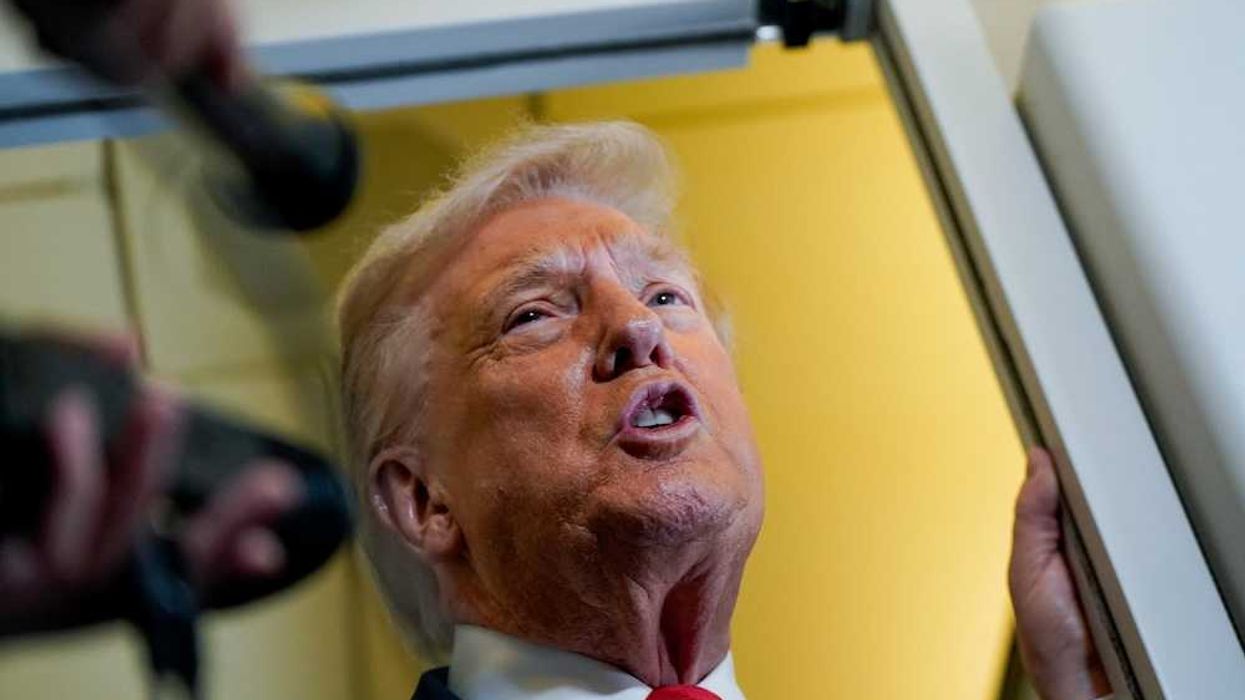
U.S. President Donald Trump speaks to members of the media aboard Air Force One as he departs for Florida from Joint Base Andrews, Maryland, U.S., October 31, 2025. REUTERS/Elizabeth Frantz
October 31, 2025
ALTERNET
Amid the administration’s refusal to tap contingency funds to sustain the Supplemental Nutrition Assistance Program (SNAP) — and with two federal judges now ordering it to do so — President Donald Trump came under fire Friday for claiming that most SNAP recipients are Democrats.
Forty-two million Americans may lose their benefits starting on Saturday if the Trump administration does not act.
While there are no exact statistics on party affiliation, large numbers of SNAP users reside in deep red states.
According to WIRED, data collected by the USDA “shows that deep-red states like Alabama, Florida, Mississippi, and Louisiana are among those with the highest percentage of food stamp recipients.”
READ MORE: ‘Complicit in Evil’: GOP Firestorm Erupts Amid Heritage Head’s Carlson Defense
And according to Philip Bump, the former Washington Post columnist, “more members of vulnerable populations who receive SNAP benefits … live in districts that also voted for Trump.”
President Trump, however, offered a different perspective while speaking to reporters aboard Air Force One on his way to Mar-a-Lago.
Amid the administration’s refusal to tap contingency funds to sustain the Supplemental Nutrition Assistance Program (SNAP) — and with two federal judges now ordering it to do so — President Donald Trump came under fire Friday for claiming that most SNAP recipients are Democrats.
Forty-two million Americans may lose their benefits starting on Saturday if the Trump administration does not act.
While there are no exact statistics on party affiliation, large numbers of SNAP users reside in deep red states.
According to WIRED, data collected by the USDA “shows that deep-red states like Alabama, Florida, Mississippi, and Louisiana are among those with the highest percentage of food stamp recipients.”
READ MORE: ‘Complicit in Evil’: GOP Firestorm Erupts Amid Heritage Head’s Carlson Defense
And according to Philip Bump, the former Washington Post columnist, “more members of vulnerable populations who receive SNAP benefits … live in districts that also voted for Trump.”
President Trump, however, offered a different perspective while speaking to reporters aboard Air Force One on his way to Mar-a-Lago.
“And, you know, largely, when you talk about SNAP, you’re talking about largely Democrats, but I’m president. I wanna help everybody,” he said. “I want to help Democrats and Republicans, but when you’re talking about SNAP, if you look, it’s largely Democrats, they’re hurting their own people.”
Critics pushed back against the President’s claim.
“Florida has nearly 3 million SNAP recipients. Texas has 3.5 million. All those deep red Southern states have huge SNAP populations,” noted Punchbowl News co-founder John Bresnahan.
“This is not true at all. The loss of SNAP funding will hit red America hard, too,” observed MSNBC deputy managing editor of news Zack Stanton. “Even if it was true, it’s weird to be ok with Americans going hungry because they live in blue states.”
READ MORE: ‘Disturbing’: Johnson Scorched for Saying He’s Starving SNAP to ‘Pressure’ Democrats
“He’s trying to say—of course—that SNAP is for poor non white people, mostly living in the cities he wants militarily occupy. But, as it happens, SNAP is also for lots of poor white people living in the rural/small town areas Trump claims to care about,” wrote Dissent Magazine’s Richard Yeselson.
“And there it is. Trump openly reveals why he and other Republicans are cutting SNAP. The irony is that a lot of poor people in America who are on SNAP are rural Trump voters,” noted U.S. Rep. Brendan Boyle (D-PA).
“Trump is refusing to fund SNAP during the shutdown (something every other administration has done) because he wrongly believes that all families who rely on it are Democrats, and Democrats deserve to starve,” wrote The Lincoln Project.
“SNAP helps feed children, including one in four kids in America. Are children Democrats or Republicans? I don’t know BECAUSE THEY ARE CHILDREN. SNAP also helps veterans, seniors and people with disabilities,” commented U.S. Rep. Ted Lieu (D-CA).
Critics pushed back against the President’s claim.
“Florida has nearly 3 million SNAP recipients. Texas has 3.5 million. All those deep red Southern states have huge SNAP populations,” noted Punchbowl News co-founder John Bresnahan.
“This is not true at all. The loss of SNAP funding will hit red America hard, too,” observed MSNBC deputy managing editor of news Zack Stanton. “Even if it was true, it’s weird to be ok with Americans going hungry because they live in blue states.”
READ MORE: ‘Disturbing’: Johnson Scorched for Saying He’s Starving SNAP to ‘Pressure’ Democrats
“He’s trying to say—of course—that SNAP is for poor non white people, mostly living in the cities he wants militarily occupy. But, as it happens, SNAP is also for lots of poor white people living in the rural/small town areas Trump claims to care about,” wrote Dissent Magazine’s Richard Yeselson.
“And there it is. Trump openly reveals why he and other Republicans are cutting SNAP. The irony is that a lot of poor people in America who are on SNAP are rural Trump voters,” noted U.S. Rep. Brendan Boyle (D-PA).
“Trump is refusing to fund SNAP during the shutdown (something every other administration has done) because he wrongly believes that all families who rely on it are Democrats, and Democrats deserve to starve,” wrote The Lincoln Project.
“SNAP helps feed children, including one in four kids in America. Are children Democrats or Republicans? I don’t know BECAUSE THEY ARE CHILDREN. SNAP also helps veterans, seniors and people with disabilities,” commented U.S. Rep. Ted Lieu (D-CA).
'Stop reproducing': Republicans 'can’t seem to decide' how to treat hungry voters
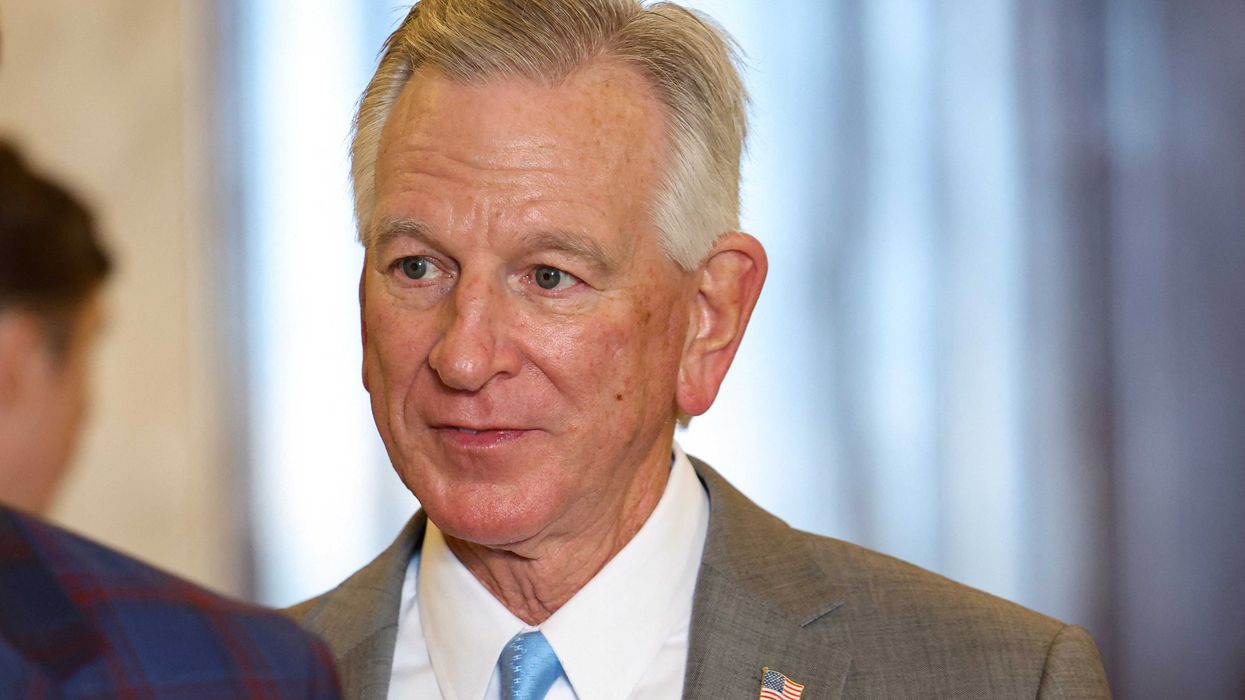
U.S. Senator Tommy Tuberville (R-AL) leaves a bipartisan luncheon, weeks into the continuing U.S. government shutdown on Capitol Hill in Washington, D.C., U.S., October 23, 2025. REUTERS/Kylie Cooper
With President Donald Trump proclaiming on Friday that “I do NOT want Americans to go hungry,” it appears that Trump’s Republican Party is indeed the party of the people.
But MSNBC producer Ja’han Jones said don’t be fooled. This is just one empathetic proclamation from one person at one particular moment. There’s still a whole party saying something else.
“Democrats have been in virtual lockstep in their support for the Supplemental Nutrition Assistance Program, or SNAP, and the need to continue aid to its beneficiaries, which include millions of children and working-class Americans,” said Jones. “Republicans, on the other hand, can’t seem to decide whether their message should be that SNAP recipients are the [Democrats’] victims of a shutdown …, or that they are lazy grifters finally getting the harsh wakeup call they deserve.”
The Trump administration may post messages cooing over “mothers, babies, and the most vulnerable among us” falling victim to Democrats’ stubbornness, but the administration’s “performative compassion hasn’t been embraced across the Republican Party or among conservative influencers,” said Jones.
Sen. Tommy Tuberville (R-Ala.) ranted about “a lot of young men on SNAP that should be working,” despite data showing “39% of SNAP participants were children, 20% were elderly, and 10% were nonelderly individuals with a disability,” in 2023, and additional federal data confirming that millions of SNAP recipients are already working full time.
U.S. Rep. Clay Higgins, (R-La.) posted on X that SNAP beneficiaries should have been stocking up for the shutdown in advance — so it’s on them.
“Any American who has been receiving $4,200 per year of free groceries and does NOT have at least 1 month of groceries stocked should never again receive SNAP, because wow, stop smoking crack,” Higgins said.
Jones said MAGA influencers are even more judgmental, with Trump ally Mike Davis, “who previously clerked for Supreme Court justice Neil Gorsuch and assisted Gorsuch and Brett Kavanaugh during their confirmation hearings” saying in a social media post that “it’s outrageous 40MM people get food stamps.”
“Get off your fat, ghetto a——,” wrote Davis. “Get a job. Stop reproducing. Change your s—— culture.”
Politifact debunked the argument, promoted by people like Davis, falsely claiming the bulk of SNAP benefits go to non-white people and immigrants, but that doesn’t stop MAGA types like Conservative podcaster Adam Carolla from blithely suggesting that “nobody could benefit from a nice fast more than the SNAP recipients.”
“While some conservatives want to use the potential of SNAP recipients going hungry as a cudgel to force Democrats to give up their demands and end the government shutdown, that messaging is being clouded by more vocal conservatives who seem perfectly fine with — if not giddy about — the suffering of SNAP recipients, said Jones.
Jones added that, so far, the public does not appear to be buying Trump’s sympathetic act over the braying of his fellow Republicans. Recent polling data shows that a plurality of the country blames Republicans, not Democrats, for the shutdown.
Read the MSNBC report at this link.
U.S. Senator Tommy Tuberville (R-AL) leaves a bipartisan luncheon, weeks into the continuing U.S. government shutdown on Capitol Hill in Washington, D.C., U.S., October 23, 2025. REUTERS/Kylie Cooper
November 01, 2025
ALTERNET
With President Donald Trump proclaiming on Friday that “I do NOT want Americans to go hungry,” it appears that Trump’s Republican Party is indeed the party of the people.
But MSNBC producer Ja’han Jones said don’t be fooled. This is just one empathetic proclamation from one person at one particular moment. There’s still a whole party saying something else.
“Democrats have been in virtual lockstep in their support for the Supplemental Nutrition Assistance Program, or SNAP, and the need to continue aid to its beneficiaries, which include millions of children and working-class Americans,” said Jones. “Republicans, on the other hand, can’t seem to decide whether their message should be that SNAP recipients are the [Democrats’] victims of a shutdown …, or that they are lazy grifters finally getting the harsh wakeup call they deserve.”
The Trump administration may post messages cooing over “mothers, babies, and the most vulnerable among us” falling victim to Democrats’ stubbornness, but the administration’s “performative compassion hasn’t been embraced across the Republican Party or among conservative influencers,” said Jones.
Sen. Tommy Tuberville (R-Ala.) ranted about “a lot of young men on SNAP that should be working,” despite data showing “39% of SNAP participants were children, 20% were elderly, and 10% were nonelderly individuals with a disability,” in 2023, and additional federal data confirming that millions of SNAP recipients are already working full time.
U.S. Rep. Clay Higgins, (R-La.) posted on X that SNAP beneficiaries should have been stocking up for the shutdown in advance — so it’s on them.
“Any American who has been receiving $4,200 per year of free groceries and does NOT have at least 1 month of groceries stocked should never again receive SNAP, because wow, stop smoking crack,” Higgins said.
Jones said MAGA influencers are even more judgmental, with Trump ally Mike Davis, “who previously clerked for Supreme Court justice Neil Gorsuch and assisted Gorsuch and Brett Kavanaugh during their confirmation hearings” saying in a social media post that “it’s outrageous 40MM people get food stamps.”
“Get off your fat, ghetto a——,” wrote Davis. “Get a job. Stop reproducing. Change your s—— culture.”
Politifact debunked the argument, promoted by people like Davis, falsely claiming the bulk of SNAP benefits go to non-white people and immigrants, but that doesn’t stop MAGA types like Conservative podcaster Adam Carolla from blithely suggesting that “nobody could benefit from a nice fast more than the SNAP recipients.”
“While some conservatives want to use the potential of SNAP recipients going hungry as a cudgel to force Democrats to give up their demands and end the government shutdown, that messaging is being clouded by more vocal conservatives who seem perfectly fine with — if not giddy about — the suffering of SNAP recipients, said Jones.
Jones added that, so far, the public does not appear to be buying Trump’s sympathetic act over the braying of his fellow Republicans. Recent polling data shows that a plurality of the country blames Republicans, not Democrats, for the shutdown.
Read the MSNBC report at this link.

Senate GOP leader slammed over 'performative outrage' after he blocked food stamp funding

U.S. Senate Majority Leader John Thune (R-SD) pushes his glasses up as he speaks to reporters outside his office on the fourteenth day of the U.S. government shutdown on Capitol Hill in Washington, D.C., U.S., October 14, 2025. REUTERS/Elizabeth Frantz
Adam Lynch
U.S. Senate Majority Leader John Thune (R-SD) pushes his glasses up as he speaks to reporters outside his office on the fourteenth day of the U.S. government shutdown on Capitol Hill in Washington, D.C., U.S., October 14, 2025. REUTERS/Elizabeth Frantz
Adam Lynch
October 31, 2025
ALTERNET
Washington Monthly Editor Bill Scher recently deconstructed Senate Majority Leader John Thune’s (R-S.D.) explosion on the Senate floor last weekend as he labored to pin the shutdown of Supplemental Nutrition Assistance Program (SNAP) food benefits on Democrats.
“SNAP recipients shouldn’t go without food. People should be getting paid in this country. And we’ve tried to do that thirteen times! You voted ‘no’ thirteen times!” Thune said. “This isn’t a political game. These are real people’s lives that we’re talking about!”
But it was all performance, according to Scher.
“Look, it’s fair to tag Democrats for being the instigators of the government shutdown, but not for President Donald Trump’s decisions that maximize the shutdown’s pain and hurt people who do not need to be hurt,” Scher wrote. “Before the shutdown began almost a month ago, the Department of Agriculture, led by Secretary Brooke Rollins, made clear that the delivery of SNAP … need not be impacted.”
The details of that reality were "available here at this URL until at least October 10, according to the Internet Archive Wayback Machine," said Scher. Additionally, Thune blocked legislation by Sen. Ben Ray Luján (D-N.M.) that would have funded SNAP benefits.
“But Trump’s USDA has memory-holed it,” Scher said, adding that when visitors now visit that URL, they get a Republican attack ad against Democrats that Scher said “almost surely” violates the Hatch Act: “Senate Democrats have now voted 12 times to not fund the food stamp program, also known as the Supplemental Nutrition Assistance Program (SNAP). Bottom line, the well has run dry. At this time, there will be no benefits issued November 01. We are approaching an inflection point for Senate Democrats. They can continue to hold out for healthcare for illegal aliens and gender mutilation procedures or reopen the government so mothers, babies, and the most vulnerable among us can receive critical nutrition assistance.”
But the truth is that SNAP has never been disrupted during past shutdowns, either during Republican or Democratic administrations, said Scher. They’ve always been provided by officials using available funding sources to prevent a break in benefits.
“Democrats shoulder no responsibility for Trump and Rollins cutting off SNAP benefits from those who need them to survive,” said Scher. “You can’t even argue Democrats should have expected SNAP to be affected because USDA declared ahead of the shutdown that it wouldn’t.”
Furthermore, the number of SNAP beneficiaries tops 40 million, “more than a tenth of the U.S. population,” said Scher. So, at least until very recently, the program enjoyed bipartisan support.
“Thune can save his performative rage for the people playing political games with people’s lives: Donald Trump and Agriculture Secretary Rollins,” Scher said.
Read the Washington Monthly report at this link.
Washington Monthly Editor Bill Scher recently deconstructed Senate Majority Leader John Thune’s (R-S.D.) explosion on the Senate floor last weekend as he labored to pin the shutdown of Supplemental Nutrition Assistance Program (SNAP) food benefits on Democrats.
“SNAP recipients shouldn’t go without food. People should be getting paid in this country. And we’ve tried to do that thirteen times! You voted ‘no’ thirteen times!” Thune said. “This isn’t a political game. These are real people’s lives that we’re talking about!”
But it was all performance, according to Scher.
“Look, it’s fair to tag Democrats for being the instigators of the government shutdown, but not for President Donald Trump’s decisions that maximize the shutdown’s pain and hurt people who do not need to be hurt,” Scher wrote. “Before the shutdown began almost a month ago, the Department of Agriculture, led by Secretary Brooke Rollins, made clear that the delivery of SNAP … need not be impacted.”
The details of that reality were "available here at this URL until at least October 10, according to the Internet Archive Wayback Machine," said Scher. Additionally, Thune blocked legislation by Sen. Ben Ray Luján (D-N.M.) that would have funded SNAP benefits.
“But Trump’s USDA has memory-holed it,” Scher said, adding that when visitors now visit that URL, they get a Republican attack ad against Democrats that Scher said “almost surely” violates the Hatch Act: “Senate Democrats have now voted 12 times to not fund the food stamp program, also known as the Supplemental Nutrition Assistance Program (SNAP). Bottom line, the well has run dry. At this time, there will be no benefits issued November 01. We are approaching an inflection point for Senate Democrats. They can continue to hold out for healthcare for illegal aliens and gender mutilation procedures or reopen the government so mothers, babies, and the most vulnerable among us can receive critical nutrition assistance.”
But the truth is that SNAP has never been disrupted during past shutdowns, either during Republican or Democratic administrations, said Scher. They’ve always been provided by officials using available funding sources to prevent a break in benefits.
“Democrats shoulder no responsibility for Trump and Rollins cutting off SNAP benefits from those who need them to survive,” said Scher. “You can’t even argue Democrats should have expected SNAP to be affected because USDA declared ahead of the shutdown that it wouldn’t.”
Furthermore, the number of SNAP beneficiaries tops 40 million, “more than a tenth of the U.S. population,” said Scher. So, at least until very recently, the program enjoyed bipartisan support.
“Thune can save his performative rage for the people playing political games with people’s lives: Donald Trump and Agriculture Secretary Rollins,” Scher said.
Read the Washington Monthly report at this link.



.JPG)