Monday, November 03, 2025


LME fines Japan’s Mizuho for rules breach


Stock image.

The London Metal Exchange said on Friday it had fined a unit of Japanese financial group Mizuho 265,000 pounds ($356,000) for a breach of rules following an investigation into alleged misconduct.

Mizuho Securities USA, a Category 2 LME member, failed to report the over-the-counter positions of two of its affiliates between September 5, 2022 and December 20, 2024, the LME said in a notice.

Exchange rules require members to report information about the OTC metals business of their clients, affiliates or themselves to the LME on a weekly basis.

Mizuho’s failure to submit the reportable OTC positions was due to “a gap in its internal system and controls”, breaching its obligations to establish and maintain appropriate and adequate risk management systems, the LME said, adding that Mizuho had since carried out remedial action.

The fine is part of a settlement with Mizuho that has been approved by the LME’s enforcement committee, said the notice from the LME’s head of market surveillance, Joe Morrison.

Mizuho declined to comment.

($1 = 0.7451 pounds)

(By Tom Daly; Editing by Kirsten Donovan)


OP-ED: Trump’s trade deals are reshaping America’s critical minerals future 


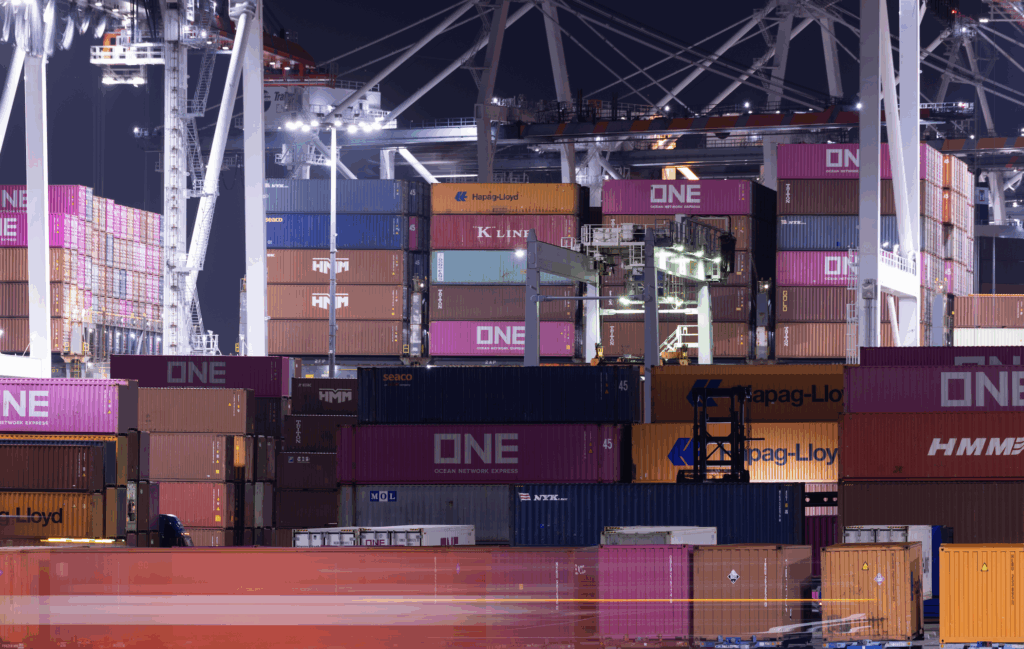
Shipping containers at the Port of Los Angeles. Stock image by Matt Gush.

The United States is entering a new era of resource security. With fresh agreements signed with Australia and Malaysia, and another on the horizon with Japan, the country is taking decisive steps to secure access to the critical minerals that power everything from electric vehicles (EVs) and renewable energy systems to advanced defense technologies.

These deals represent far more than trade diplomacy; they mark a strategic pivot toward independence in a market long dominated by China. For too long, America’s industrial and energy ambitions have been tied to a single point of global processing control. By asserting stronger partnerships with key Indo-Pacific allies, the US is signaling to the world that it will no longer rely on competitors to fuel its growth.

Now, for the first time in decades, these partnerships are laying the foundation for a more independent, resilient, and competitive future where US innovation is no longer constrained by foreign bottlenecks but fueled by reliable access to the resources that matter most. 

Strengthening US supply security and innovation

With these new agreements in place, the US is positioned to strengthen not only its access to raw materials but also its capacity to refine, process, and recycle them at home. Diversifying imports away from China gives American industries the stability they need to plan and invest with confidence.

By locking in commitments like Malaysia’s pledge to avoid export bans or quotas on rare earths bound for the US, and similar cooperative frameworks with Thailand, Cambodia, and now Australia and Japan, the country is building a supply network anchored in trust and transparency. This kind of coordination is essential for ensuring that future technologies—particularly in EV batteries, aerospace, and semiconductor manufacturing—have secure, ethical, and scalable inputs. 

Reduced exposure to Chinese export controls means more predictable pricing and greater certainty for investors, which in turn accelerates the development of domestic processing hubs and clean-energy technologies. The ripple effects extend across every sector that depends on critical minerals, meaning this shift is not simply about securing supply but rather rebuilding control over the industrial inputs that define the modern economy. By prioritizing allied cooperation and domestic capability, the US is laying the groundwork for a future defined by innovation, resilience, and true energy independence. 

A new era of opportunity

For US miners, these developments represent a long-awaited turning point. The clarity and certainty created by these trade agreements give the industry the stability it needs to grow responsibly and competitively. With dependable access to raw materials from trusted allies, American mining companies can focus on efficient extraction, high environmental standards, and value-added processing within North America.

At the same time, new policy alignment between trade and resource strategy is reducing barriers that once slowed investment and project development. Lower financing risk, faster permitting timelines, and renewed investor confidence are likely to follow, opening the door to new offtake partnerships and co-development opportunities with allied suppliers.

The economic potential is substantial, with billions in added sector value and thousands of new, high-paying jobs projected across key mining states such as Nevada and Wyoming. Beyond the immediate business gains, this momentum signals something larger: a transition from dependence to leadership. By aligning trade policy with industrial capability, the US is positioning itself at the center of a secure, allied mineral supply chain that strengthens national security, fuels clean energy growth, and makes resource independence not just an aspiration but a defining feature of America’s economic future. 

President Trump’s trade strategy has set the stage for a stronger, more secure future for American industry. These agreements are not just about access to minerals; they are about restoring control, confidence, and competitiveness to the US in this critical sector.

By fostering reliable partnerships, encouraging domestic investment, and prioritizing American production, the country is rebuilding the foundation of its industrial strength. From clean energy to advanced defense systems, every sector that depends on critical minerals stands to benefit from a supply chain rooted in trust, transparency, and shared prosperity.

Ultimately, the path ahead is clear: through continued collaboration with allies and bold investment in homegrown capability, the US can secure its place as the global benchmark for resource security and industrial innovation. 

* Brodie Sutherland is CEO of Patriot Critical Minerals Corp., and a geologist with over a decade of experience leading mineral exploration across 20+ countries.


Trump’s $8.5 Billion Effort to Secure a Rare Earths Supply Chain

  • The U.S. and Australia signed an $8.5 billion deal to boost critical minerals and rare earth projects, including new mining and refining facilities.

  • China currently dominates the rare earth sector, controlling over two-thirds of mining and nearly all magnet manufacturing capacity.

  • Despite progress, experts warn that developing alternative supply chains could take up to a decade, keeping the West reliant on Chinese materials in the near term.

The United States is looking to develop new rare earth minerals supply chains to reduce China’s dominance of the sector. In October, President Donald Trump and Australian Prime Minister Anthony Albanese met at the White House to sign an agreement for the strengthening of the critical minerals and rare earths supply chain, with $8.5 billion in projects outlined. 

Rare earths are critical minerals that are used in a variety of applications, including the production of magnets for weapons platforms, semiconductor manufacturing, robotics, and electric vehicles. Currently, China is the largest producer of rare earth metals, dominating the global supply chain. China holds around 70 percent of the world’s rare earth metals, or 44 million metric tonnes of reserves, followed by Brazil with 21 million tonnes, India with 6.9 million tonnes, and Australia with 5.7 million tonnes.

As an ally with the United States, Australia is well-positioned to develop its rare earths market, with financial support from the North American country to help counter Chinese dominance. Following the meeting, Albanese said there would be three groups of joint projects between Australia and the U.S., including companies such as the U.S. aluminium firm Alcoa.

The deal reportedly includes an investment of $3 billion from the U.S. for mining and processing projects and outlines a price floor for critical minerals. The White House announced that it plans to invest in the construction of a gallium refinery in Western Australia with a capacity of 100 metric tonnes per year. It said that U.S. investments in Australia were expected to unlock deposits of critical minerals worth $53 billion.

President Trump told reporters, “In about a year from now, we’ll have so much critical mineral and rare earths that you won’t know what to do with them.” He also said that the U.S. is working with countries other than Australia to diversify its critical mineral supply chains.

However, the development of Australia’s rare earth metals market could take between five and seven years, according to sectoral experts. Meanwhile, China continues to contribute 90 percent of the world’s rare earths refining capacity, around 69 percent of global rare earth mining, and 98 percent of magnet manufacturing.

Following the deal between Trump and Albanese, China’s Ministry of Foreign Affairs, Guo Jiakun, responded by saying, “Resource-rich nations with critical minerals should play a proactive role in safeguarding the security and stability of the industrial and supply chains, and ensure normal economic and trade cooperation.”

Earlier in October, China’s Commerce Ministry announced expanded curbs on the export of rare earths, stating that it aimed to prevent the “misuse” of minerals in the military and other sensitive sectors. The Asian giant added dozens of pieces of refining technology to its control list and announced rules requiring compliance from foreign rare earth producers who use Chinese materials. This led many in the industry to raise concerns over the lack of diversity in the global supply and the potentially detrimental effect of China’s decision.

The rare earth market was valued at $6 billion in 2024, according to Goldman Sachs. The financial institution warned that a disruption of 10 percent in industries reliant on rare earths could lead to $150 billion in economic losses. It said that samarium, graphite, lutetium, and terbium would be extremely vulnerable to export reductions.

The bank said that Western producers, such as Lynas Rare Earths and Solvay, could alleviate the shortages, but dependence on China remains high. It emphasised the eight-to-10-year timeline to develop new rare earth mines and the need for advanced expertise and infrastructure, which most countries with mining potential would need to develop.

The U.S. government is not only looking to Australia to reduce its reliance on China, but is also discussing the possibility of establishing a strategic reserve of rare earths and supporting domestic producers with price controls and tariffs. During his trip to Asia this month, Trump also signed deals with Japan, Malaysia, Thailand, Vietnam, and Cambodia to diversify access to critical minerals.

This week, the U.S. and China reached a framework agreement that will halt the implementation of a 157 percent tariff on Chinese goods and could make way for a trade deal between President Trump and Chinese leader Xi Jinping when they meet. Little information has been released about the deal, but it is likely to include an agreement on rare earths. 

Despite the potential deal between the U.S. and China, the Trump administration is expected to continue to seek ways to diversify its critical minerals supply chain to reduce its reliance on China. Following several months of strained trade relations, the U.S. is expected to continue investing in its energy sovereignty by offering financial support to domestic companies and establishing deals with other world allies across a range of energy sources.

By Felicity Bradstock for Oilprice.com


Angola says national budget will not fund Endiama’s De Beers bid


(Image courtesy of De Beers)

Angola will not fund state-owned miner Endiama’s proposed acquisition of a stake in De Beers through the national budget, Finance Minister Vera Daves de Sousa said on Friday.

Endiama has bid for a majority stake in Anglo American unit De Beers, a source familiar with the matter told Reuters on October 24.

The southwest African country had initially indicated interest in a minority stake in De Beers, which has been put up for sale as Anglo restructures its asset to focus mainly on clean energy metal copper.

Asked how Angola plans to fund the proposed acquisition during a press briefing on the 2026 national budget, de Sousa said there was no provision for the share purchase in the spending plan for next year.

“So, let us assume that the entity (Endiama) has the courage to take this decision, because the funding will not come out of the national budget. That is all I can say,” she said.

Anglo values De Beers at $4.9 billion after recording $3.5 billion in impairments over the past two years.

Angola’s ambitions for De Beers could potentially trigger a standoff with neighbouring Botswana, which is also seeking control of the diamond producer.

Botswana – which currently owns 15% of De Beers and contributes 70% of its annual rough diamond production – considers the company a strategic national asset, despite a recent slump in prices that has badly hurt its economy.

(By Miguel Gomes, Nelson Banya and Sfundo Parakozov; Editing by Franklin Paul and Rosalba O’Brien)


Indonesia’s Amman Mineral moves a step closer to getting export permit

Credit: Amman Mineral

Indonesia’s energy ministry has backed copper miner Amman Mineral Internasional to export 480,000 dry metric tons of concentrate, the company said on Saturday, with the recommendation valid for six months from October 31.

Amman Mineral needs the backing to secure an export permit from the trade ministry, which said on Saturday Amman had yet to apply for one.

“With the resumption of copper concentrate exports, which had been suspended since early 2025, Amman will be able to prevent concentrate storage facilities from exceeding their capacity,” Amman said in a statement.

This would allow mining operations to continue, it added.

Since mid-2023, Indonesia has banned exports of copper concentrates and other raw minerals to encourage domestic processing of the metal.

However, Amman was allowed to export until December 2024, a date by which it was expected to commission a smelter to process concentrates into copper cathodes, used to make wires, cables and electronics.

But the smelter stopped operations temporarily in July and August this year after damage to its flash converting furnace and sulphuric acid plant units.

Repairs may finish in the first half of 2026, Amman said, adding that the smelter is operating partially now.

(By Stanley Widianto and Bernadette Christina; Editing by Muralikumar Anantharaman)


Study: South Africa-Europe Shipping Route Could Run on Ammonia by 2029

Harbor and iron or pier at Saldanha Bay, South Africa (Hp.Baumeler / CC BY SA 4.0)
Harbor and iron ore pier at Saldanha Bay, South Africa (Hp.Baumeler / CC BY SA 4.0)

Published Nov 2, 2025 8:58 PM by The Maritime Executive


Despite the existing uncertainty in global regulations for clean shipping, some decarbonization initiatives are setting ambitious targets for transitioning to alternative fuels. One such example is the South Africa-Europe iron ore shipping route, which could feasibly deploy ammonia-fueled bulk carriers as soon as 2029 and scale toward full decarbonization by 2035. These findings are contained in a feasibility study by the Global Maritime Forum, produced in partnership with a consortium formed in 2023 to develop a green shipping corridor on the South Africa-Europe iron ore trade route.

The consortium includes Anglo American, CMB.TECH, Freeport Saldanha, Vuka Marine and Engie. The green shipping corridor being developed will link Saldanha Bay in South Africa’s Western Cape to the Port of Rotterdam in Netherlands. It will become one of the first Global South-to-North green shipping routes.

With South Africa advancing a national green hydrogen market, the maritime sector is seen to play a key offtake role. As a result, some major ports in the country are at different stages of developing green shipping fuel infrastructure. Saldanha Bay is one of the ports, offering a significant opportunity to cut emissions in the shipping sector as South Africa’s primary iron-ore export terminal.

Recently, the port appointed the Council for Scientific and Industrial Research (CSIR) to coordinate phase 1 of its Green Hydrogen Master Plan. The initiative is aimed at positioning Saldanha Bay port as a green hydrogen production and export hub. The project has been shown to be cost-competitive, especially with the conversion of green hydrogen to ammonia fuel.

According to the Global Maritime Forum study, the green hydrogen projects already underway near the ports of Boegoebaai, Saldanha and Walvis Bay are enough to meet the green corridor’s fuel demand. This includes the corridor’s high-demand scenario of 22 bulk carriers per annum by 2035. However, the study predicts that in the initial years of the green corridor operation, ammonia-fueled vessels will likely bunker in Rotterdam. As a major global fuels hub, Rotterdam is currently one of the most mature ports in terms of ammonia bunkering and safety frameworks.

In the meantime, Saldanha Bay has an opportunity to finalize infrastructure for green ammonia production. Based on its strategic location and significance in bulk shipping, Saldanha Bay by 2035 is poised to become an important global bunkering hub for green ammonia.

“However, to help Saldanha Bay transition quickly, blending public and private funding can unlock investment in infrastructure and reduce the risks of early projects,” said Shannon Neumann, Associate, Investment Facilitation at Freeport Saldanha.

Top image: Harbor and iron ore pier at Saldanha Bay, South Africa (Hp.Baumeler / CC BY SA 4.0)


South Africa Halts Plans for Establishing a Shipping Line

Big Whites
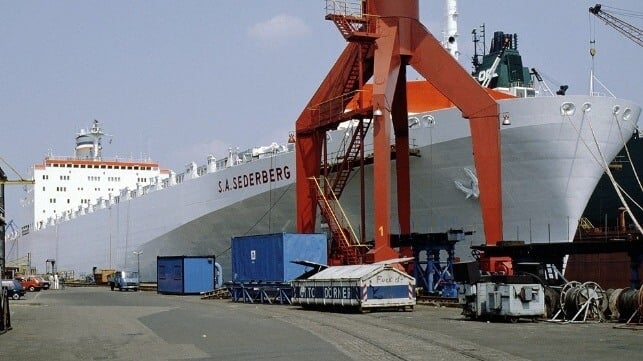
Back to the future: South Africa's previous state-owned shipping line operated four boxships during the apartheid era, including SA Sederberg, seen here in Hamburg circa 1986 (Wolfgang Fricke / CC BY SA 3.0)

Published Nov 2, 2025 8:32 PM by The Maritime ExecutivE


South Africa has temporarily shelved plans for establishing a shipping line to allow for further consultations. Early last month, the Cabinet approved the withdrawal of the Merchant Shipping Bill, which was tabled in parliament in May 2023. The Bill contained provisions for reviving South Africa’s maritime sector, including cabotage regulations to develop the country’s merchant fleet. This would be operated under a state-owned entity referred as the South African Shipping Company (SASCO).

In approving the withdrawal of the bill, the cabinet said that the Department of Transport will now have time to finalize consultations with different stakeholders. The discussions will be carried out under the National Economic Development & Labor Council (NEDLAC). The body is mandated to facilitate public participation for government bills in cooperation with trade groups and community organizations.

Early this year, major industry groups in the South African maritime sector voiced their opposition to the Merchant Shipping Bill. The lobbyists including Exporters Western Cape (EWC) argued that the bill skipped the NEDLAC process, hence lacking industry input. A Parliamentary Monitoring Group (PMG) report dated 20 May 2025 also indicated that the Bill was not submitted to NEDLAC, which is against parliamentary procedures.  

The bill’s proposal to establish SASCO also proved contentious with different stakeholders. For instance, the South African Association of Freight Forwarders (Saaff) said that the existing port infrastructure could easily be overwhelmed by cabotage regulations. The hub and spoke port model requires well-developed and efficient terminals to avoid backlogs along the transport chain. In the case of South Africa, a port such as Durban handles over 60% of the country’s containerized cargo. This means the port could be easily overwhelmed in a scenario where it is made as a hub port under the cabotage regulations proposed by the bill.

“While the development of a national shipping capability is broadly supported, implementing a restrictive cabotage regime without understanding its full economic impact risks unintended consequences,” added Saaff.

In addition, some observers doubted the government’s ability to run a national shipping line, recalling the era of the previously state-owned Safmarine. Formed in 1946, Safmarine was acquired by the Danish ocean carrier Maersk in 1999, at a time when the global shipping industry was undergoing massive consolidation.

Top image: SA Sederberg, seen here in Hamburg circa 1986 (Wolfgang Fricke / CC BY SA 3.0)


Saudi’s RSGT Finalizes 30-Year Lease of Djibouti’s Tadjourah Port

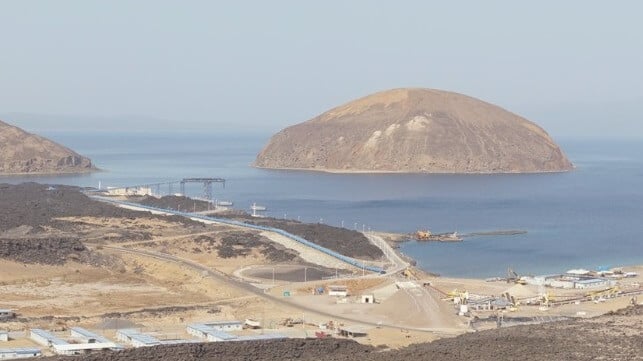
Tadjourah port
iStock / Anil_Mukundan

Published Nov 2, 2025 9:55 PM by The Maritime Executive


Middle East-based terminal operators continue to expand their footprint in Africa, with governments in the region opening up ports to private investors. Last week, Saudi Arabia’s Red Sea Gateway Terminal (RSGT) signed a 30-year concession agreement with Djibouti Ports and Free Zones Authority (DPFZA) to operate and develop Port of Tadjourah. The concession builds on a memorandum of understanding (MoU) signed by the two parties in March. The MoU set out cooperation between Djibouti and Saudi Arabia in maritime and logistics sectors.

The Tadjourah port was commissioned in 2017 as part of Djibouti’s government plan to expand transport infrastructure in northern Djibouti. The port was also built to facilitate potash exports from Ethiopia, mined in the Danakil Depression of the Afar region. Other Ethiopian general cargo exports processed at the port include livestock and sesame.

Under the 30-year concession deal, RSGT has pledged to transform Port of Tadjourah into a multi-purpose terminal of choice in the region. The operator projects that in the next few years the port will reach a handling capacity of five million tons per year, enhancing its status as a gateway for Ethiopia’s general cargo imports and exports.

“The collaboration between RSGT and DPFZA in the development of the Port of Tadjourah will further consolidate Djibouti’s strategic position as a leading logistics and maritime hub in the Horn of Africa and the Red Sea,” said DPFZA.

In addition, the RSGT concession comes at a time there are plans to expand multi-modal connections to Tadjourah port. Last week, the Ethiopian Railway Corporation announced plans for a $1.58 billion standard-gauge railway intended to connect Northern Ethiopia to the Red Sea ports of Tadjourah, Assab and Massawa. These ports offer the closest sea-access for Ethiopia’s Afar and Tigray regions, which are seeing growth in the potash mining sector.

The proposed extension of the railway to Tadjourah port is part of the existing Ethiopia-Djibouti line completed in 2017. The route is currently served by the Tadjourah-Balho-Mekelle highway. The northward expansion of the Ethiopia-Djibouti railway to reach Tadjourah will go a long way in accelerating growth for the port.


Caledonian Maritime Assets Relies on ABB to Power All-Electric Ferries

ABB
ABB, maritime, marine, maritime industry, technology, shipbuilding, Remontowa Shipbuilding S.A., Caledonian Maritime Assets Ltd, Port Askaig, ports, ferries, ferry terminal, shore power

Published Nov 2, 2025 7:32 PM by The Maritime Executive


[By: ABB]

ABB has won an order with Poland-based Remontowa Shipbuilding S.A. to supply power distribution and propulsion systems featuring ABB’s Compact Onboard DC Grid™ for seven all-electric double-ended ferries. The vessels are scheduled for delivery to Scottish owner Caledonian Maritime Assets Ltd (CMAL) between late 2027 and early 2029. ABB has also been selected as the sole supplier responsible for delivering shore power solutions across multiple CMAL ferry terminals, beginning with Kennacraig and Port Askaig.  

As part of the ship owner’s Small Vessel Replacement Programme aiming to achieve a substantial renewal of the small vessel fleet and associated port upgrades, the 50-meter ferries will bring enhanced resilience and sustainability to the CMAL fleet . They will serve nine routes in the Clyde and Hebrides region on Scotland’s west coast, each transporting up to 200 passengers and 24 cars at a time – with the exception of one vessel, which has capacity for 250 passengers and 16 cars.

"We appreciate ABB’s expertise in power, propulsion and electrification. Combined with our excellence in shipbuilding, we will make this a great set of vessels to advance low-emission transportation across the western Scottish ferry network,” said Michal Jaguszewski, Director of Commerce, Remontowa Shipbuilding S.A.

Designed for vessels with significant space limitations, ABB’s Compact Onboard DC Grid™ solution offers a distributed configuration that simplifies system integration and enhances efficiency. The system comprises a robust, short circuit-tested marine DC switchboard and wall-mounted HES880 mobile inverters. Flexible and highly efficient operations are secured through a seamlessly integrated power and energy management, alarm and monitoring system. Integrated with ABB’s new AXME Marine Motors, the comprehensive solution combines high power density and light weight in a small footprint. Developed specifically for small to mid-sized electric and hybrid vessels, the Compact Onboard DC Grid™ blends proven durability, high performance, and installation flexibility in one compact solution.

Once operational, ABB’s shore connection system will allow berthed vessels to turn off their engines and connect to the local electrical grid, thereby significantly reducing CO? emissions and decreasing noise pollution in port areas. As a result, air quality in the area will improve, and the emission reductions will support CMAL’s long-term environmental goals.

Co-funded by the Scottish Government, the project represents an important step in the United Kingdom’s efforts to decarbonize its ports by eliminating emissions from docked vessels. 

“These ferries will bring increased capacity and the benefits of clean, fully electric propulsion to island and rural communities in Scotland”, said Jim Anderson, Director of Vessels at CMAL. “ABB’s experience in system integration and ensuring ship electrification and shore connection work efficiently together is well placed, and we look forward to taking delivery of the vessels.” 

“This order confirms the ability of our Compact Onboard DC Grid™ to meet the power requirements of our short-distance shipping customers in a distributed design suited to smaller hulls,” said Juha Koskela, President, ABB’s Marine & Ports division. “By enabling the efficient and flexible electrification of inland, coastal, and short-sea ships, the system makes an invaluable contribution to maritime decarbonization. Additionally, this collaboration strengthens ABB’s position as a global leader in shore connection technology and reflects the growing demand for cleaner port operations worldwide.”

The products and services herein described in this press release are not endorsed by The Maritime Executive.


Ukraine Hits Oil Pier at Port of Tuapse in Long-Range Drone Attack

Tuapse
Anton Geraschenko / Russian social media

Published Nov 2, 2025 4:58 PM by The Maritime Executive


Ukraine's armed forces have attacked the oil terminal at the Russian Black Sea port of Tuapse, damaging the loading facility and two ships that were alongside the pier. 

Video from the time of the attack recorded the loud sound of piston-engined drones, indicative of a long-range aerial UAV strike of the type that Ukraine has used extensively to target Russian oil and gas infrastructure. Bystander imagery from Tuapse's harbor showed at least three fires burning on the pier or aboard vessels moored at it. NASA FIRMS fire detection data confirmed a large infrared signature at the facility, visible from space. At least one photo captured tracer fire from ongoing air defense efforts well after daybreak, suggesting that the attack continued after several hits. 

The deepwater Rosneft terminal at Tuapse has a capacity of about 50 million barrels per year and the ability to load vessels of up to 250 meters in length and 15 meters of draft (Aframaxes). The degree of impairment of the terminal's operation was not immediately known, but locals in the town of Gizel-Dere - about two miles to the south - reported a substantial oil spill on the water, confirming a successful strike.

Anton Geraschenko, former Deputy Minister of Internal Affairs of Ukraine, identified the vessels at the pier at the time of the attack as the Greek-owned Aframax Pollux and product tanker Coast Buster, along with the Turkish-owned product tanker Chai

"In addition to the direct damage to the technological chains involved in shipping, there will be a reaction among the companies that ship and fill up there. This includes an increase in insurance premiums and, in principle, will discourage many from entering these ports," said Ukrainian Navy spokesman Dmytro Pletenchuk, speaking to local media after the attack. 

It is the second time that Ukrainian forces have attempted to attack the pier at Tuapse in a matter of months. The previous strike occurred in late September, and involved a combined attack of air and surface drones. At least one suicide drone boat made it through Russian defenses and struck a loading pier, though the degree of damage was unclear. 

UK Publication Writer Witherby Buys a Ship to Survey Strategic Straits

Sea Ranger
Sea Ranger, seen here as Lone Ranger, circa 2018 (Raphael Belly / VesselFinder)

Published Nov 2, 2025 5:54 PM by The Maritime Executive


The nautical publication and training company Witherby Group that has been equipping the shipping industry with nautical and navigational materials has acquired a new oceanographic research vessel to carry out coastal survey work in the strategic Sunda and Lombok Straits, on contract to the government of Indonesia. 

The new vessel, which was the first research ship of the Schmidt Oceanographic Research Institute, will be named MV Sea Ranger (ex name Lone Ranger). The 78-meter vessel was originally built as one of the world’s largest ocean-going salvage ships. 

As a company that has for close to three centuries built experience in publishing operational and navigational guidance and technical standards for the shipping industry, Witherby says the vessel will be instrumental in advancing its work going into the future. Sea Ranger will replace MV Astra, a small research boat that has since been sold. In 2022, Astra made history as the first sub-24-meter motor-powered vessel to circumnavigate the globe. The journey of around 27,000 nautical miles was completed in a record five months.

Sea Ranger is currently undergoing reactivation and refit works as well as stress testing all of the equipment onboard before entering service next year. The 1973-built ship has a proven capability for global operations, having carried out expeditions as far south as Antarctica.

The ship is expected to support maritime knowledge and safety through research directly linked to shipboard operations and strengthen the delivery of computer-based training programs.

The vessel will be entering service in time for a project to write technical guides for safe passage in the Lombok and Sunda straits, among other strategic choke points. Witherby is also creating new editions for other key waterways, such as an expanded Suez Canal guide.

In May, the firm signed a memorandum of agreement with Indonesia’s Directorate General of Sea Transportation to jointly publish a passage planning guide for the Lombok and Sunda straits, which are vital connectors between the Indian Ocean and the Java Sea. The straits are increasingly becoming important global shipping corridors, with traffic through the constrained waters continuing to grow. The guide will be a critical resource for domestic and international vessels seeking safe and compliant passage.  

Witherby intends to utilize Sea Ranger to conduct comprehensive testing and review of the guides. The vessel is also expected to play a central role in enabling Witherby to expand and improve its publications on maritime security, environmental protection and shipboard operations by providing facilities for research on emerging security issues, environmental compliance and energy efficiency solutions.

“All research will be conducted with the goal of continuous improvement of shipboard systems and reporting, using and building further on Witherbys' substantial knowledge and experience for the benefit of the shipping industry,” said Witherby.

Top image: Sea Ranger, seen here as Lone Ranger, circa 2018 (Raphael Belly / VesselFinder)


Poor Bridge Resource Management Led to Boxship Hitting Tall Ship

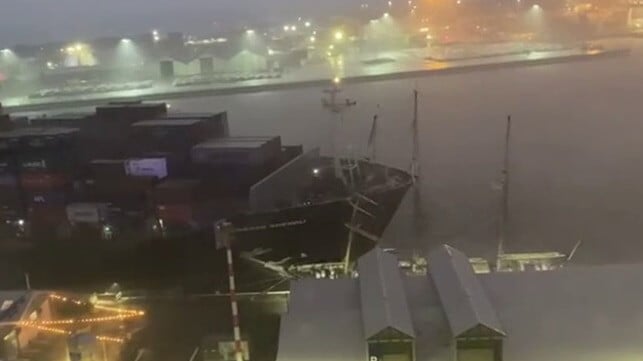
Maersk Shekou hits the Leeuwin II's rigging (ATSB)

Published Nov 2, 2025 8:10 PM by The Maritime Executive


Poor bridge resource management was a leading factor in the allision of the Maersk Shekou with the moored tall ship Leeuwin II in Fremantle last year, according to the Australian Transport Safety Bureau. 

In the early hours of August 30, 2024, Maersk Shekou was entering Fremantle's harbor with two pilots on the bridge. Conditions were poor, with heavy squalls. The primary pilot assigned for the transit was fatigued, so the backup pilot took charge during the master/pilot exchange. The two pilots conversed casually in English during the transit in, while the rest of the bridge team had separate conversations in another language. Winds were gusty, blowing up to 54 knots. The boxship took up an escort of four assist tugs as it approached the harbor entrance. 

At about 0610, as they entered the narrow entrance channel for the inner harbor, southwesterly winds picked up to about 40 knots on the starboard quarter. The helmsman put the rudder over to 30 degrees to port in order to counter the force and maintain heading of 083, but it was insufficient. Through 0615, the pilot gave a series of order to the tug escorts to steady the ship back the its intended course. Once this was accomplished, the helmsman put the rudder to starboard to steady up on the last ordered course of 083 - straight towards a pier. The pilot had forgotten to give a rudder order to turn to port, and the helmsman followed every instruction he had been given. 

The pilot and secondary pilot reacted to the impending allision with the pier using a series of engine, bow thruster and tug orders in order to turn to port and bring the ship onto a safe course. The helmsman continued to steer for a steady heading of 083, fighting their efforts. An attempt at an emergency stop was not fully successful, and at about 0618, Maersk Shekou's starboard bow flare hit STS Leeuwin II's rigging, dismasting the tall ship. The Leeuwin's crew abandoned ship onto the pier just as impact occurred, and two sustained minor injuries in the process.   

Maersk Shekou's stern kept swinging toward the pier, and the pilots tried to kick it away using the bow thruster and ahead thrust. This was not successful, and a stack of containers on the Shekou's poop deck hit the roof of the Western Australia Maritime Museum. The hull made contact with the pier, resulting in a breach of about six feet long above the waterline. 

ATSB found that poor bridge resource management contributed to the casualty. The bridge team did not actively monitor the rate of turn and the helm; they did not conduct proper error management through early challenge and response; and they did not share the same mental model of wheel over points for the transit. In addition, the secondary pilot was engaged in a phone conversation with dispatch at the time of the final turn, and was not monitoring the other pilot, so he was not available to catch the mistake. 

Several other lesser factors were at play. The fourth tug was being hooked up in the moments before the missed turn - later than planned - and this may have distracted the team with an unplanned event. The 40-knot squally conditions - outside normal operating parameters for Fremantle's tight harbor - also made the vessel harder to control in the minutes before the turn, adding to the team's workload. The risks of high winds were not considered prior to reaching the passage plan's abort point. 

"A properly functioning bridge team requires that all its members maintain a shared mental model to actively monitor the ship’s progress. To ensure this is effective, where deviations from the passage plan are required, this information should be conveyed to all members of the team. Similarly, actions that are incorrect or missed should be immediately identified, communicated and rectified," concluded ATSB.