Saturday, November 08, 2025

Mexican leader calls for tougher sexual harassment laws after attack


By AFP
November 5, 2025


Mexico's President Claudia Sheinbaum was groped by a man on the street while greeting wellwishers near the presidential palace - Copyright AFP 

Pablo PORCIUNCULA

Mexican President Claudia Sheinbaum called Wednesday for sexual harassment to be made a crime nationwide after being groped on the street in an attack that underscored the dangers women in the Latin American country face.

Sheinbaum, 63, was attacked while greeting supporters near the presidential palace in Mexico City on Tuesday as she was walking to a public event.

A drunken man approached her, put his arm around her shoulder, and with the other hand touched her hip and chest, while attempting to kiss her neck.

A member of the presidential security detail pulled him away. Mexico’s first woman president initially appeared confused by the incident, which was caught on camera, even agreeing to take a picture with the man.

He was later arrested.

The incident put the focus on Mexico’s troubling record on women’s safety, with sexual harassment commonplace and rights groups warning of a femicide crisis.

Around 70 percent of Mexican women aged 15 and over will experience at least one incident of sexual harassment in their lives, according to United Nations data.

The UN says an average of 10 women are murdered every day in Mexico.


– Conflicting codes –


Sheinbaum said Wednesday she had pressed charges against the man and would review nationwide legislation on sexual harassment.

“My thinking is: if I don’t file a complaint, what becomes of other Mexican women? If this happens to the president, what will happen to all the women in our country?” she told her regular morning press conference.

She said she “only realized what really happened after seeing the videos.”

Mexico’s 32 states and Mexico City, which is a federal entity, all have their own penal codes.

Mexico City defines sexual harassment as “conduct of a sexual nature that is undesirable to the person who receives it” and is punishable by one to three years in prison.

Not all states, however, consider sexual harassment a crime.

“It should be a criminal offense, and we are going to launch a campaign,” Sheinbaum said, adding that she had suffered similar attacks in her youth.

Feminist groups noted that such incidents were a daily reality for many Mexican women.

“Every day they are experiencing this situation of harassment, of intimidation,” Veronica Cruz, of Las Libres (The Free Ones) feminist collective, said, calling the fact of “it happening even to the president of the Republic” a symbol of the problem.

The attack also drew criticism of Sheinbaum’s security detail and of her insistence on maintaining a degree of intimacy with the public, despite Mexican politicians regularly being a target for cartel violence.

At rallies nationwide in September to mark her first year in power, she allowed supporters to embrace her and take selfies.


– ‘Very worrying’ –


Former anti-drug prosecutor Samuel Gonzalez told AFP that Tuesday’s incident sent a message to criminals that the head of state is “vulnerable,” a development he called “very worrying.”

“It’s a political contact strategy that does jeopardize her security,” security analyst David Saucedo said.

Her guards “should check that anyone approaching her is not intoxicated or armed,” he added.

Despite the concern, the former Mexico City mayor has ruled out increasing her security.

“If there’s no risk to us, we’ll continue as we have been. We need to be close to the people,” she said.
ALL CAPITALI$M IS STATE CAPITALI$M

With Big Tech Talking Government Backing, Has OpenAI Become “Too Big to Fail”?

Leaders at the AI company are scrambling to pacify concerns that the bubble around their company could soon burst.
November 7, 2025

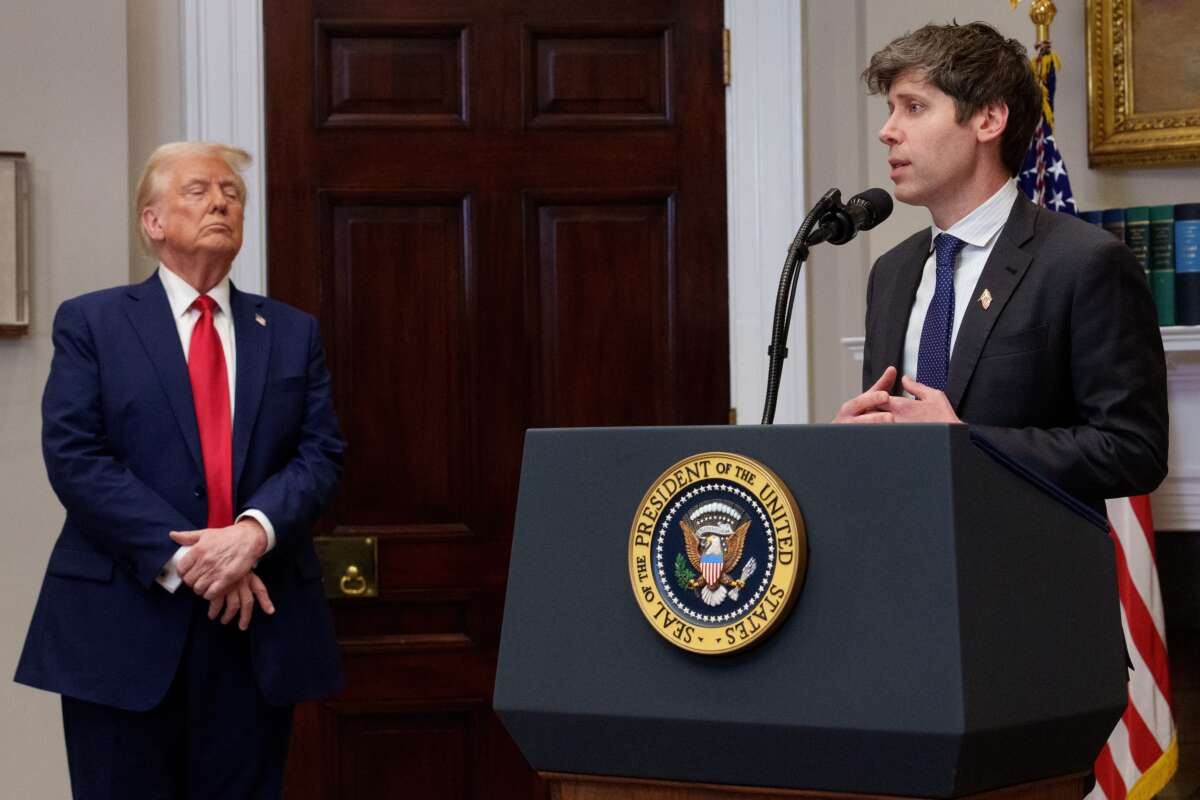
OpenAI CEO Sam Altman, accompanied by President Donald Trump, speaks during a news conference in the Roosevelt Room of the White House on January 21, 2025, in Washington, D.C.Andrew Harnik / Getty Images

Hype around artificial intelligence, or AI, could be about to collide with reality. Watchdogs are blasting the sense of “corporate entitlement” displayed by the OpenAI leaders as they make public gaffes and investors grow increasingly wary that the AI bubble propping up the economy could burst.

In a social media post on November 6, OpenAI Chief Financial Officer Sarah Friar appeared to walk back a previous statement in which she suggested that the company is pursuing government loan guarantees for the massive financial investments needed to buy advanced chips and build data centers required to power AI.

However, corporate watchdogs warn the firestorm that erupted over Friar’s comments is just the latest warning sign that OpenAI is becoming “too big to fail” as the industry aggressively lobbies at all levels of government to shift enormous financial burden onto taxpayers. The hype that initially inspired the investors to pump tens of billions of dollars into AI companies may be fading into flurry of negative headlines, and now fears of a bursting AI bubble are roiling markets worldwide.

OpenAI, which is behind ChatGPT and the video generator Sora, was founded in 2015 as a nonprofit that claimed to have ambitions to protect humanity from the potential harms of generative AI. Last month, the company wrapped up a long-awaited restructure that that turned it into a for-profit entity valued at $500 billion, despite the fact that its products have yet to yield significant revenue streams (which explains why ChatGPT can now be used as a sexbot). The company appears to be losing money — and lots of it. OpenAI reportedly brings in about $13 billion in annual revenue but plans to spend $1 trillion on infrastructure and development over the next five years, including the continued buildout of data centers that are already increasing energy costs for consumers in the communities where they’re located.

Asked about financing a boom in AI computing at a Wall Street Journal event on November 5, Friar said OpenAI is looking for an “ecosystem of banks and private equity” as well as a government “backstop” that would guarantee investments in cutting-edge chips and data centers. The comment was widely interpreted as a request for loan guarantees from the Trump administration. Friar also responded to worries among investors that AI companies may be overvalued, saying the market needs more “exuberance” about AI.


Big Tech Data Centers Compound Decades of Environmental Racism in the South
The American South has long been a site of both corporate extraction and fierce political resistance.  By Jai Dulani , Truthout  September 20, 2025


“I don’t think there’s enough exuberance about AI, when I think about the actual practical implications and what it can do for individuals,” Friar said during an onstage interview on Wednesday. “We should keep running at it.”

Robert Weissman, co-president of the corporate watchdog Public Citizen, said attitude among OpenAI’s leadership is dripping with “corporate entitlement.”

“OpenAI must rank among the most self-important and brazen corporations in history,” Weissman said in a statement on Thursday. “Having conjured a $500 billion for-profit corporation from a nonprofit, OpenAI execs now hope that federal government subsidies can supercharge their wealth even further.”

David Sacks, the venture capitalist serving as President Donald Trump’s AI czar, also chimed in, saying on social media that there would be “no federal bailout” for the AI industry.

“The U.S. has at least 5 major frontier model companies. If one fails, others will take its place,” Sacks wrote in a post on X.

As backlash grew on social media, Friar attempted to clarify her comments on November 6, explaining in a post on LinkedIn that her use of the word “backstop” had “muddied her point.” Still, Friar said both the government and the private sector must be “playing their parts” in the development of technological infrastructure — which, in this case, would be building AI data centers that threaten to guzzle up water and electricity to the detriment of local communities.

“As I said, the U.S. government has been incredibly forward-leaning and has really understood that AI is a national strategic asset,” Friar said.

Many people in the post’s comment section were not convinced.

“In those almost naïve words lies a simple truth: AI spending has become the ‘too big to fail’ of this late cycle,” said Magrino Bini, a British scientist and market analyst. “And that candid statement comes from the CFO of the company at the very center of the AI frenzy, someone who has probably run the cash-flow analysis 101 and knows the truth behind those spending commitments.”

Sam Altman, the OpenAI CEO who faces his own embarrassing headlines as of late, said in a lengthy post on Thursday that the company would not take a government bailout if it failed. Altman said the company has discussed federal loan guarantees for building semiconductor manufacturing facilities, which are desired by the U.S. government. Still, he believes a massive investment in AI infrastructure is needed for “something so important” that will “improve people’s lives.”

However, Altman did not offer details about how a technology that threatens to make jobs disappear and unleash online deepfakes and misinformation would improve our lives.

“This is the bet we are making, and given our vantage point, we feel good about it,” Altman wrote. “But we of course could be wrong, and the market — not the government — will deal with it if we are.”

Altman and Friar’s attempts at damage control did not provide much clarity about how the company actually expects to interact with the federal government, but the Trump administration has indeed embraced the AI boom rather than regulate the increasingly controversial industry. Shortly after taking office, Trump revoked President Joe Biden’s more cautious AI policies and issued an executive order to shield the industry from regulation. The administration has also inked lucrative contracts with companies such as Palantir for AI tools that are used to surveil and deport immigrants.

Trump has also already shown interest in deeper governmental involvement in tech infrastructure. In an unusual move for the U.S. government, the Trump administration in August obtained a 10 percent equity stake in Intel, a company that makes chips for computing, including those used in data centers. The government’s stake came out of a deal negotiated with the chipmaker over billions of dollars in grants that had been promised to Intel but not yet received.

In September, Nvidia, the world’s largest chip maker, announced a $5 billion investment in Intel, and the two companies are now collaborating on AI infrastructure. Nvidia also agreed to invest as much as $100 billion in OpenAI to fund a massive data center build-out, and in return, OpenAI agreed to run those centers on Nvidia chips.

The arrangements between Nvidia and Intel, and by extension, Intel and the White House, have been criticized as “circular deals” that threaten to crash the economy if the AI bubble bursts. Here’s how Bloomberg financial reporters Emily Forgash and Agnee Ghosh described the risk posed by circular AI deals last month:


Never before has so much money been spent so rapidly on a technology that, for all its potential, remains largely unproven as an avenue for profit-making. And often, these investments can be traced back to two leading firms: Nvidia and OpenAI. The recent wave of deals and partnerships involving the two are escalating concerns that an increasingly complex and interconnected web of business transactions is artificially propping up the trillion-dollar AI boom. At stake is virtually every corner of the economy, with the hype and buildout of AI infrastructure rippling across markets, from debt and equity to real estate and energy.

Reflecting on Friar’s initial “backstop” comment, Weissman said it appears that OpenAI has quietly discussed the prospect of federal subsidies with the Trump administration and received positive signals. Perhaps it’s no coincidence that OpenAI President Greg Brockman was among the attendees at a dinner for donors to Trump’s highly controversial White House ballroom, even if neither he nor OpenAI have been reported to be actual donors to the project.

“Given the Trump regime’s eagerness to shower taxpayer subsidies and benefits on favored corporations, it is entirely possible that OpenAI and the White House are concocting a scheme to siphon taxpayer money into OpenAI’s coffers, perhaps with some tribute paid to Trump and his family,” Weissman said.

‘Blunt Corruption’: Trump DOJ Hands Google an Antitrust Win After Tech Giant’s Ballroom Donation


Alphabet, Google’s parent company, is contributing $22 million to the president’s ballroom project.


Jake Johnson
Nov 06, 2025
COMMON DREAMS

The US Justice Department has reportedly given the tech behemoth Alphabet a green light to acquire the cybersecurity firm Wiz after it was revealed that the Google parent company donated to President Donald Trump’s $300 million ballroom project.

The merger deal is valued at over $30 billion and would mark Alphabet’s largest acquisition to date, even as the company faces antitrust cases at the state and federal level. Wiz CEO Assaf Rappaport announced the Justice Department’s decision on Wednesday at an event hosted by the Wall Street Journal.

The DOJ approval came after Bloomberg reported in June that the Justice Department’s antitrust arm was reviewing whether Alphabet’s acquisition of Wiz would illegally undermine competition. The following month, the Justice Department ousted two of its top antitrust officials amid internal conflict over shady corporate settlement deals.

Lee Hepner, an antitrust attorney and senior legal counsel for the American Economic Liberties Project, called the DOJ’s clearing of Alphabet’s Wiz acquisition “the kind of blunt corruption that most won’t notice.”

Hepner observed that news of the approval came shortly after the White House released a list of individuals and corporations that have pumped money into Trump’s gaudy ballroom project. Google—which also donated to Trump’s inauguration—was one of the prominent names on the list, alongside Amazon, Apple, and other major corporations.

Google is reportedly funneling $22 million to the ballroom project.

“These giant corporations aren’t funding the Trump ballroom debacle out of a sense of civic pride,” Robert Weissman, co-president of the consumer advocacy group Public Citizen, said earlier this week. “They have massive interests before the federal government and they undoubtedly hope to curry favor with, and receive favorable treatment from, the Trump administration.”

“Millions to fund Trump’s architectural whims are nothing compared to the billions at stake in procurement, regulatory, and enforcement decisions,” he added.

According to a Public Citizen report published Monday, two-thirds of the 24 known corporate donors to Trump’s ballroom project—including Google—are beneficiaries of recent government contracts.

Dismissing Criminal Prosecution of Boeing is Outrageous, Unconscionable


WASHINGTON - A federal judge in Texas today dismissed a criminal conspiracy case against Boeing over two crashes of its 737 Max jetliner that killed 346 people. Robert Weissman, co-president of Public Citizen, released the following statement:

“Unconscionable is inadequate to address the outrage of the Trump Justice Department’s decision to dismiss the criminal prosecution of Boeing. Not only did Boeing’s recklessness lead directly to the deaths of hundreds of people, but it violated the terms of the sweetheart deal it reached with the first Trump administration, again jeopardizing the lives of air passengers.

“Judge O’Connor believed his hands were tied in permitting the DOJ to drop the case, but his sharply worded decision reveals that he agrees the department’s action is outrageous. ‘The Government has a confession from Boeing, signed by the CEO and Chief Legal Officer, admitting to all the elements of the conspiracy charge against it,’ he wrote.

“For an Attorney General and DOJ leadership that has brought shame and disgrace to a previously magisterial agency, this marks a new low.”


Economist Paul Krugman: Trump’s 'signature policy' may drown in a 'puddle of humiliation'


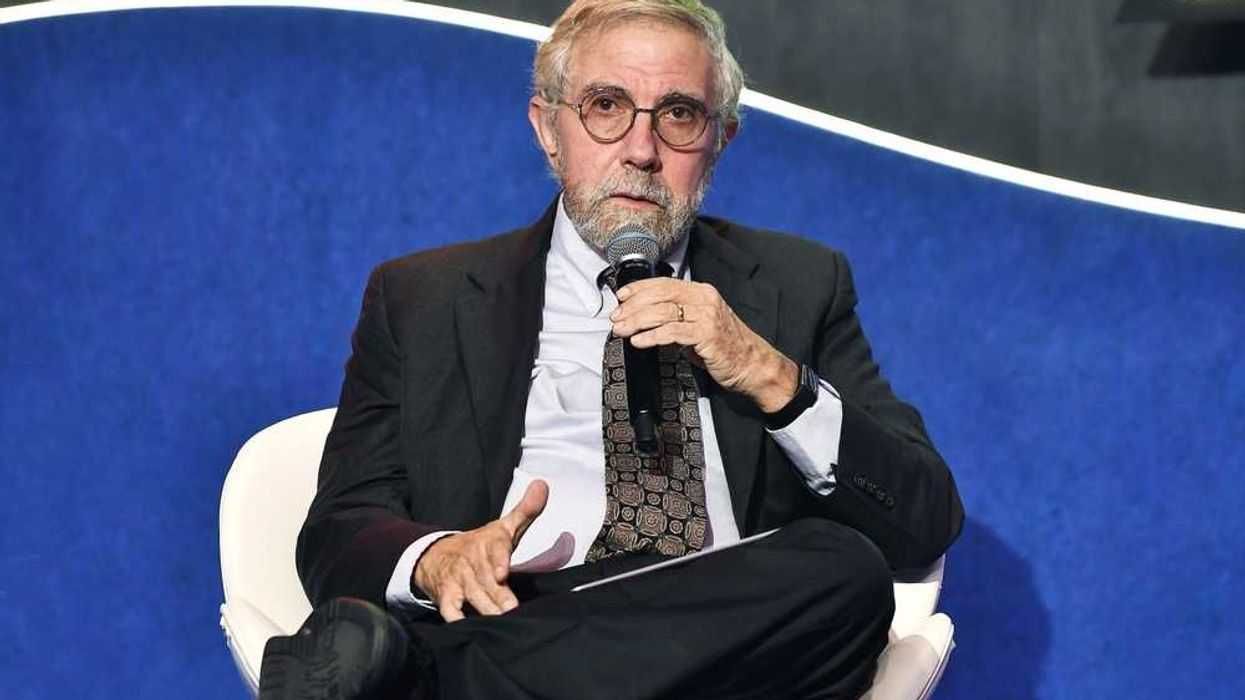
Economist Paul Krugman during FIDES 2023 in Rio de Janeiro,
 Brazil on September 25th, 2023 (A.PAES/ Shutterstock.com)
November 07, 2025  
 ALTERNET


Wednesday, November 5 was a major day for the U.S. Supreme Court, which listened to oral arguments on President Donald Trump's trade policy in Learning Resources v. Trump.

At issue is whether or not Trump, under the Emergency Powers Act of 1977, can unilaterally impose steep tariffs by executive order without the input of Congress. The justices listened to arguments, both pro and con, and attorney Neal Katyal — known for his liberal/conservative legal alliance with Never Trump conservative attorney George Conway — offered anti-Trump trade policy arguments.

Liberal economist Paul Krugman analyzes the hearing in a November 7 column posted on his Substack page. And he emphasizes that Trump, thanks to the conservative-dominated High Court, may be in for a major "humiliation."

"How is it going for Trump's tariffs before the Supreme Court?" Krugman asks. "I'm not an enthusiast for prediction markets because they basically just summarize conventional wisdom. But tracking conventional wisdom is sometimes useful. And the prediction markets verdict on Wednesday's hearing, shown at the top of this post, was clear: it was a disaster for the (Trump) Administration's case."

Krugman adds, "So, Trump's signature economic policy may soon melt down into a puddle of incompetence and humiliation. If that should happen, I will celebrate both the end of an extraordinarily bad policy and the Supreme Court's willingness to (finally!) check Trump's authoritarian behavior. Yet I am somewhat disappointed with the specific grounds upon which the Supremes appear to be resting their arguments against the Trump tariffs."

The former New York Times columnist goes on to argue that the High Court's 6-3 right-wing supermajority may reach the right decision for the wrong reasons.

"They have so far focused on the fact that tariffs are taxes, and that the Constitution specifically gives taxing authority to Congress and not the president," Krugman explains. "Fair point. But the Court for International Trade, in their ruling against the Trump tariffs, made a different argument. The Emergency Powers Act only empowers the president to act in response to economic emergencies. And while the White House has declared two such emergencies — trade deficits and fentanyl — the CIT found that neither declaration provided a plausible rationale for the actual tariffs Trump imposed."

Krugman continues, "More broadly, supporting Trump's tariffs requires engaging in doublethink. You have to believe Trump's assertions that everything is wonderful, that this is the best economy ever. But you also have to believe that we’re facing an economic emergency that justifies massive tariff increases, hitting almost every nation and abrogating generations’ worth of international agreements."

Paul Krugman's full Substack column is available at this link.


‘Mega-Layoffs’ Under Trump as Corporations Have Cut 1 Million Jobs This Year—Most Since 2003

“Trump put billionaires in charge of everything,” said progressive Congressman Greg Casar. “It’s a disaster.”


President Donald Trump speaks to reporters aboard Air Force One en route to the White House on November 2, 2025.
(Photo by Samuel Corum/Getty Images)

Brad Reed
Nov 06, 2025
COMMON DREAMS

The US labor market, which in recent months had ground nearly to a halt, now appears to be entering a downward spiral.

As reported by the Washington Post on Thursday, new data from corporate outplacement firm Challenger, Gray & Christmas found that employers in October announced 153,000 job cuts, which marked the highest number of layoffs in that month since October 2003.


Corporate America Accelerates Layoffs As Trump Economy Flashes Red Warning Signs


First Mass Layoff at Retail Giant Target in a Decade Under Trump’s Flailing Economy

Total announced job cuts in 2025 have now reached 1.1 million, a number that the Post describes as a “recession-like” level comparable to the steep job cuts announced in the wake of the dotcom bust of the early 2000s, the global financial crisis of 2008, and the onset of the Covid-19 pandemic in 2020.

John Challenger, the CEO of Challenger, Gray & Christmas, told the Post that the huge number of October layoffs showed the economy was entering “new territory.”

“We haven’t seen mega-layoffs of the size that are being discussed now—48,000 from UPS, potentially 30,000 from Amazon—since 2020 and before that, since the recession of 2009,” he explained. “When you see companies making cuts of this size, it does signal a real shift in direction.”

CNBC noted that the Challenger report found that the tech sector is currently being hardest hit by the layoffs, and it said that the adoption of artificial intelligence was a significant driver of job cuts.

“Some industries are correcting after the hiring boom of the pandemic, but this comes as AI adoption, softening consumer and corporate spending, and rising costs drive belt-tightening and hiring freezes,” the report said. “Those laid off now are finding it harder to quickly secure new roles, which could further loosen the labor market.”

With the backing of Big Tech investors, President Donald Trump has pushed to prevent states from regulating AI, over the objections of labor groups and progressive lawmakers. Last month, Sen. Bernie Sanders (I-Vt.) warned that without strong regulation, tech billionaires’ investments in AI will likely “increase their wealth and power exponentially” while wiping out “tens of millions” of jobs.

According to Bloomberg, however, AI adoption is just one factor in companies’ decision to enact mass layoffs, as some firms have also cited the need to protect their profit margins from the impacts of President Donald Trump’s tariffs, which have raised prices for a wide variety of products and materials.

Democratic lawmakers were quick to seize on the news of mass layoffs as evidence that Trump is sending the US economy into a ditch.

“Trump put billionaires in charge of everything,” remarked Rep. Greg Casar (D-Texas) in a social media post. “It’s a disaster.”

“Trump inherited the fastest growing economy in the [Organization for Economic Cooperation and Development], fastest reduction in inflation, record job creation,” said Rep. Sean Casten (D-Ill.). “Dumb tariffs, racist immigration policies, attacks on the rule of law and termination of congressionally mandated programs did this.”

Sen. Chris Murphy (D-Conn.), meanwhile, simply wrote that “Trump’s economy suuuuucks.”
OPINION
Democratic elites fall for lies from Trump and the right-wing media complex

WALL ST DEMS WANT TO BE THE NEW GOP POST TRUMP


U.S. President Donald Trump holds scissors next to Eric Trump and Donald Trump Jr., and Sarah Malone, Executive Vice President of Trump International Aberdeen Golf Links, after cutting the ribbon during the grand opening of Trump International Golf Links Aberdeen in Balmedie, Aberdeen, Scotland, Britain, July 29, 2025. REUTERS/Evelyn Hockstein


November 05, 2025 | ALTERNET


Look, Zohran Mamdani is not the future of the Democratic Party.

I know this is true, because the same was said of Eric Adams. New York City’s outgoing mayor did not live up to his billing. Its incoming mayor (presumably) is almost certainly not going to live up to his. The reason isn’t because Mamdani will become as corrupt as Adams became (though who knows?). The reason is that New York is New York.

Yes, it’s the largest urban center in the country. Yes, its influence cannot be overstated. But what’s good, or bad, for New York isn’t necessarily what’s good, or bad, for America. It may no longer be entirely true that all politics is local, but most of politics still is.

Once you accept the truth of this, all other considerations of Mamdani and the rest of the Democratic Party seem rather dull, as he becomes just another politician in a constellation of politicians who figured out how to appeal to a winning majority in their respective constituencies.

Once you accept that a city isn’t a metaphor for a country, or for a national party, the talk about how he’s dividing Democrats looks kinda stupid. Yes, he calls himself a democratic socialist. So what? Is that going to work in a place like Virginia? Maybe, but probably not. If it did, someone would have tried it. Since no one has, there’s your answer.

Think of it this way. Donald Trump is from New York. His business is based there. He represents the city’s elites. But he’s never won there. Three straight campaigns made no difference. Is anyone going to seriously suggest that, in this context, as New York goes, so goes the country (or so goes the GOP)? No, because that would be stupid.

Yet somehow, seemingly no one thinks how stupid it is to ask if Mamdani is the future of the Democrats, because only the Democrats, never the Republicans, are subjected to that kind of questioning. The reason for this is rooted in the Democratic Party itself, among certain elites who want to prevent it from becoming a fully realized people’s party. And they do this, foremost, by accepting as true the premise of the lies told about the Democrats by Trump and the Republicans.

What lies? First, remember that the number of actual democratic socialists in the Democratic Party (I’m talking about people who choose to call themselves by that name) is vanishingly small. Only two have any kind of national profile. (They are US Senator Bernie Sanders of Vermont and New York Congresswoman Alexandria Ocasio-Cortez, and Sanders doesn’t really count. He’s technically an independent.)

This stone-cold fact means nothing to Donald Trump. All Democrats, all liberals, all progressives, all leftists, and all socialists, democratic and otherwise, are the name. They are radical Marxist anarchist communists or whatever word salad pops into his soupy brain. There are no enemies to his right. There is nothing but enemies to his left. Does he respect his enemies enough to speak truthfully about them?

No, he lies.

His lies are what certain elites inside the Democratic Party are paying the most attention to. They are not celebrating Mamdani’s success. They are not defending him on the merits. They are not standing on the truth. They are not even standing in solidarity. What they are most focused on is the lies Donald Trump tells, which are magnified by the right-wing media complex, which are echoed by the press corps.

And what they see is either a fight they believe can’t be won or an opportunity to shiv a competing faction within the Democratic Party. Either way requires accepting as true the lies told about their own people, thus making it seem perfectly reasonable to wonder if winning a major election in America’s biggest city is good for the Democrats.

(The answer: don’t be stupid. Of course, it is.)

That these certain elites would rather surrender to lies than fight them tells us their beef with Mamdani isn’t about ideology. (It’s not about whether “democratic socialism,” or any other school of thought, would be appealing to voters outside New York.) It’s about how Mamdani, but specifically lies about him, complicates messaging efforts in a media landscape already heavily coded in favor of Donald Trump, especially of his view of the Democrats, which is that they’re all communists.

Those who are worried about Mamdani’s impact on the Democrats also take for granted the assertion that voters rejected Kamala Harris on ideological grounds – that her policies were out of touch with voters whose main concern was good-paying jobs and lower inflation.

They are ignoring that Harris actually campaigned on so-called working-class issues and that few voters could hear her working-class messaging over the din of Trump’s lies about her. The crisis facing the Democrats is not one of ideology. It’s a crisis of information. Certain elites are pretending otherwise, because it’s better for them if they do.

Mamdani’s victory is a local matter. That is the lesson for certain elites inside the party. It’s also a lesson for their loudest critics.

Certain progressives, let’s call them, believe that Mamdani’s popularity comes from focusing on class (the cost of living in New York). They believe that by doing so, he transcended “identity politics” to amass a following sizable enough to defeat the Democratic establishment.

This overlooks the fact that the establishment, in the form of the DNC and House Minority Leader Hakeem Jeffries, are backing him. But more important is again the question of ideology. Certain elites think his will turn off voters outside New York. Certain progressive think it will turn them on. They believe a class-based ideology is the unifying force that working people across the country have needed. They just can’t see it, they say, because the establishment gets in the way.

But race and class can’t be easily disentangled, not in America. To many Americans, the idea of government of, by and for the people is a perversion of the “natural order.” It flattens the hierarchies of and within race and class. This belief is bone deep in many of us. It prevents lots of white Americans from being in solidarity with nonwhite Americans, even if they face similar grinding hardships.

Most of all, such thinking overlooks the basics. Many New Yorkers struggle to make ends meet. Housing is too high. Healthcare is too expensive. Food is too much. I trust Mamdani when he says he’s a democratic socialist. But I also trust that he’s not fool enough to believe that struggle is the same as class consciousness. He identified the problem. He asked voters to give him the power to try to solve it.

That’s not ideology.

That’s just good politics.
Military experts condemn Trump's Pentagon chief for unprecedented 'purge' of top generals


Members of the military attend a meeting convened by U.S. Defense Secretary Pete Hegseth, at Marine Corps Base Quantico, in Quantico, Virginia, U.S., September 30, 2025. REUTERS/Kevin Lamarque

November 07, 2025 | ALTERNET

Since President Donald Trump's second term began in January, Defense Secretary Pete Hegseth has fired roughly two dozen top generals and admirals — often for political reasons.

Approximately 20 current and former military leaders recently told the New York Times that Hegseth's decisions were leading to the Pentagon having a dearth of generational experience that could take years to recover. Former National Security Council member Kori Schake said the Trump administration was "squandering an enormous amount of talent." Sen. Elissa Slotkin (D-Mich.), who was a CIA officer before running for Congress, referred to Hegseth's firings of three-star and four-star generals and admirals as a "purge" on her X account.

"The places where we’ve looked at these kinds of things are places like China," Slotkin said during a Senate hearing. "I used to work on Iraq. They would do the same thing."

Many top officers were fired due to their ties to General Mark Milley (Ret.), who was the United States' top military leader between in the final two years of Trump's first term and through most of former President Joe Biden's term. Milley told journalist Bob Woodward in 2024 that Trump was "fascist to the core" and "the most dangerous person to the country." The Times reported that Hegseth had delayed or cancelled the promotions of "at least four senior military officers" because they previously worked for Milley.

This includes Maj. Gen. James Patrick Work, who was set to head U.S. Central Command, which oversees military operations in the Middle East. Work served as Milley's executive officer in 2018, and his status remains in limbo despite strong backing from U.S. Army leadership.

Hegseth also fired Adm. Milton Sands in August, who is the commander of the elite Navy SEALs, because he promoted diversity, equity and inclusion (DEI) initiatives within the SEALs. Rear Adm. Michael Donnelly was nominated to become vice admiral and commander of the Navy's Seventh Fleet, which the Times reported is the Navy's largest overseas fighting force. However, Hegseth cancelled his promotion after the far-right Daily Wire reported that a sailor on the aircraft carrier Ronald Reagan performed in drag during a talent show (Donnelly was not on board the carrier at the time).

Several of the Times' sources worried that Hegseth had politicized the military, and thereby ruined its credibility among the civilian populace. Gen. Stanley McChrystal (Ret.) told the paper: "Once lost, the legitimacy of a military that reflects and represents all Americans will be difficult to recover."

"The message being sent to those younger soldiers and sailors and airmen and Marines is that politics can and should be part of your military service," Rep. Jason Crow, (D-Colo.), who is a former Army Ranger, told the Times. "It’s a dangerous message."

Click here to read the Times' full report.
​'How it happened in Cuba': Pop superstar Gloria Estefan now carries her passport 'just in case'


Gloria Estefan at the 2025 Vanity Fair Awards at La Borda del Mentidero in Madrid, Spain on October 7, 2025 (Oscar Gonzalez Fuentes/Shutterstock.com)

October 30, 2025 | ALTERNET


Although Gloria Estefan was born in Havana, Cuba, the 68-year-old pop star has lived in the United States since she was two and is a longtime U.S. citizen. Estefan, whose family moved to Florida to escape from Fidel Castro's communist dictatorship, is fluent in Spanish but has performed primarily in English over the years.

But during a late October interview with the Times of London, Estefan revealed that she now carries her U.S. passport as a form of identification because of President Donald Trump's anti-immigration crackdown.

"I have lived in the U.S. for 66 years — never have I seen freedoms being eroded in the way they are now," Estefan told the Times. "We need to stay very firm and protect those freedoms…. I know people who are in the country legally and have been taken away. One was the girlfriend of our guitar technician. She had been in the U.S. for 25 years, came in with a visa, paid taxes. In her last appointment at immigration, she got carried away and has been at a detention center for five months. Why?"

The former Miami Sound Machine singer continued, "It's inhumane, it's scary and not necessary. We don't have much power other than letting people know that that’s not what the U.S. stands for. I am not Republican or Democrat."

Estefan, born in 1957, rose to prominence in pop music during the 1980s as lead singer for the Miami Sound Machine — whose major hits included "Conga," "Bad Boy," "1-2-3," "Rhythm Is Gonna Get You," among many others. The singer became a full-time solo artist after the group broke up.

During the Times interview, Estefan drew a parallel between Trump's second administration and the crackdown on civil liberties in Castro's Cuba during the 1960s.

Estefan told the Times, "I carry my passport card around just in case, because who knows what can happen. I was born in Cuba — that's why we're so wary of what's happening, because this is the way things happened there. The U.S. Supreme Court ruled that you can be stopped and questioned if you're speaking Spanish or you have darker skin…. It's tough. When we're out with the family, it's very natural to speak Spanish. It's weird that, all of a sudden, you'd have to fear that."

Read the Times of London's full interview with Gloria Estefan at this link.
Trump transport chief devises 'unique action' to fix travel as he complains issues fell on his 'lap'

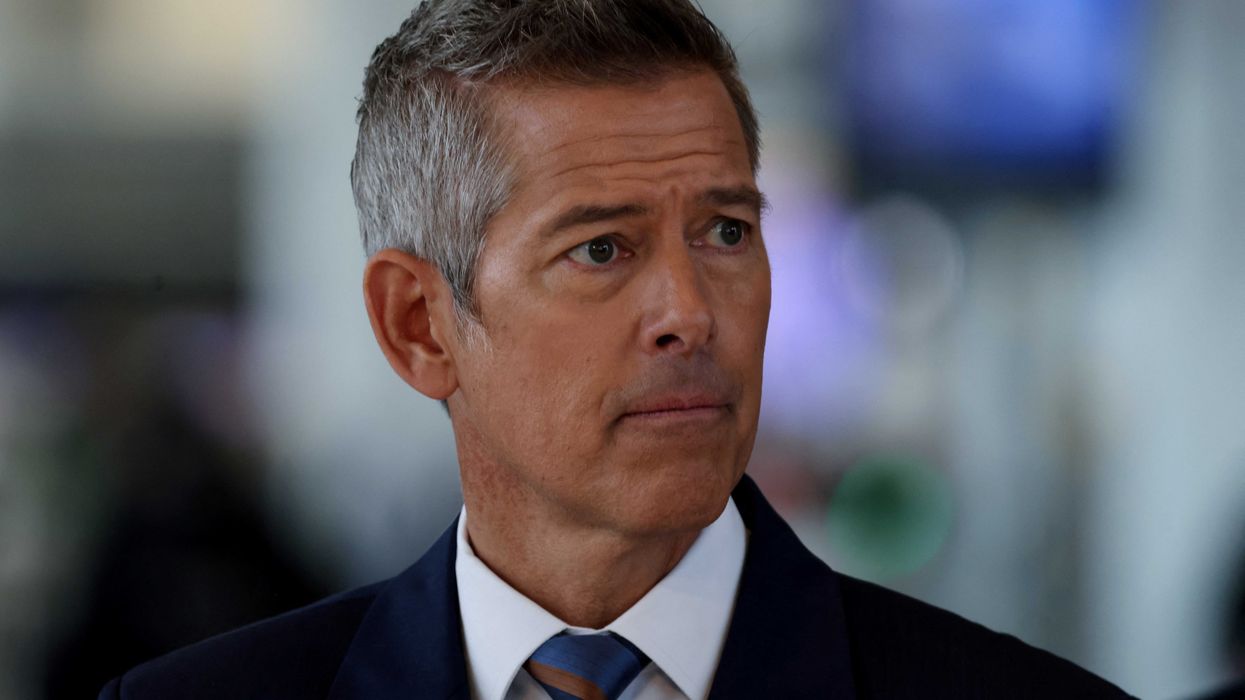
U.S. Transportation Secretary Sean Duffy attends a press conference on the impact of the ongoing federal government shutdown on air travel, at LaGuardia Airport in the Queens borough of New York City, U.S., October 28, 2025

November 07, 2025
ALTERNET

U.S. Secretary of Transportation Sean Duffy sought Friday to cast a positive light on the Federal Aviation Administration’s order requiring airlines to cut ten percent of flights at 40 major airports — a move prompted by overworked air traffic controllers who have gone weeks without pay as the government shutdown stretches into its 38th day with no immediate end in sight.

More than 800 flights nationwide were canceled on Friday, leaving some travelers “scrambling to figure out backup plans,” the Associated Press reported.

But According to Secretary Duffy, he has come up with a “unique action” that reduces a major frustration of air travel: flight delays.

“I asked the head of the air traffic controller union to reach out to his controllers, to ask them to show up. It is their jobs,” Duffy said on Friday.

“If they start coming to work, we may have the same experience we had in Newark: We had delays and cancellations in Newark in the early summer. We reduced the capacity, and then the flights were on time. Right?”

“It was the most on-time months we had in Newark ever,” he added. “So that could be an outcome of what we’re doing, and we’ll see probably more people on less flights, which means less pressure on controllers.”

Secretary Duffy also said, “There’s a very easy solution to the problem that they put directly on my lap, which is open the damn government. Vote to open the government, so those who snipe at me for having to take really unique action — they put that on my plate.”

Critics blasted Duffy.

Republican former U.S. Rep. Adam Kinzinger wrote: “Cutting flights because of the govt shutdown is a stunt, plain and simple.”

He also remarked, “We’re c
utting flights and food because of the govt shutdown but ICE is out [in] full force!”


'Am I going to be homeless?' Air traffic controller says colleague facing eviction


Air traffic controllers resume operations a day after Hollywood Burbank Airport operated for hours without a staffed control tower due to staffing shortages amid the U.S. government shutdown, in Burbank, California, U.S., October 7, 2025. 
REUTERS/Daniel Cole


November 07, 2025  
ALTERNET

Air traffic controllers have been working without pay for 37 days, and more are having to deal with the stress of going without basic needs the longer the government shutdown drags on. For one controller, this includes potentially living on the street.

In a Friday interview with CNN host Erin Burnett, Dan McCabe — who is the Southern Regional Vice President of the National Air Traffic Controllers Association — said more air traffic controllers are in "desperate" economic situations, and feel increasingly "hopeless" and "mad" every day the shutdown continues.

"I got a call today that there is a controller, a fairly new controller that is now being evicted from their apartment. They got the notice that if they don't pay rent by Sunday, they're getting evicted. So, you know, that's great," McCabe said sarcastically. "You get to add that stress to everything. Now when they're on break, they get to think about, 'how am I going to pay to move? Where am I going to go? Am I going to be homeless?'"

McCabe reminded viewers that the work of an air traffic controller is "fatiguing," and that many controllers have "punishing" schedules in which they have to report to work six days out of the week for 10 hours a day.

"That's four days off a month for anyone counting. And that's not a lot of time to spend with your family or do things around the house," he said. "... I worry about them all the time, because they're dealing with things that they have nothing to do with. And like, we're talking about the person who's facing eviction: Are we really going to let this person take a hit on their credit, where they're going to have trouble getting a new place?"

"What have they done wrong? They've been to work," he continued. "They're doing what they they swore they would do as their first day as a federal employee — working on behalf of the United States of America, they're moving people and cargo globally. And this is what they're getting out of it ... there are no words for it."

McCabe went on to say that he "completely understand[s]" why Transportation Secretary Sean Duffy and the Federal Aviation Administration were cutting air traffic and delaying flights, saying safety should always take precedent over efficiency.

"We're reducing the efficiency to to account for the safety of it," he said. "And when you have people that are going to work and they're worried about things, basic human needs, you're injecting some risk into a system that at its foundation was built to be risk averse. I completely understand what they're doing."

Watch the segment below

Colorado Votes to Tax the Rich to Fund ‘Incredibly Popular’ Free School Meals

“Colorado sent a clear message tonight: No child should ever have to learn on an empty stomach,” said the state Democratic Party.


Jefferson Junior/Senior High School cafeteria worker Zoila Estrada serves seventh grade students lunch on September 26, 2024 in Edgewater, Colorado.
(Photo by RJ Sangosti/The Denver Post via Getty Images)

Brett Wilkins
Nov 05, 2025
COMMON DREAMS

Colorado voters on Tuesday handily approved a pair of ballot measures to fully fund free meals for all K-12 public school students, give raises or stipends to scholastic cafeteria workers, and enact grants for schools to buy fresh foods from local farmers.

According to unofficial results published Wednesday morning by the Colorado Secretary of State’s office, Proposition LL overwhelmingly passed 64.66% to 35.34%. The proposal allows the state to keep and spend $12.4 million in tax revenue, including interest, already collected under Proposition FF to fund the Healthy School Meals for All Program, a 2022 voter-approved initiative to provide free breakfast and lunch to students and provide food purchasing grants to public schools.

Proposition MM—which raises taxes on households with annual incomes over $300,000 to fund the meals program—was approved 58.07% to 41.93%. The measure is meant to fill funding gaps in Proposition FF and was spurred by US President Donald Trump’s signing of the so-called One Big Beautiful Bill Act, which inflicted the largest-ever cuts in the Supplemental Nutritional Assistance Program (SNAP), largely to pay for tax cuts for the ultrarich and corporations.

“We’re relieved that Colorado kids will continue to have access to free meals at school,” Anya Rose, director pf public policy at the advocacy group Hunger Free Colorado, told Colorado Public Radio (CPR) after the measures’ passage. “I think that hunger is top of mind for a lot of people right now, and it’s really visible for people. And we know that this is an incredibly popular program that is more important, now than ever, since there are so many people struggling to make ends meet and resources have fallen through for a lot.”


Joe Kabourek, who managed the Keep Kids Fed campaign, said in a statement: “Thank you to every voter, volunteer, community partner, and endorsing organization who turned out to pass Propositions LL and MM, ensuring every child in Colorado can continue to get a healthy meal at school.”

Nine US states have now enacted laws providing free meals to all public school students regardless of family income: California, Colorado, Maine, Massachusetts, Michigan, Minnesota, New Mexico, New York, and Vermont. Cities including Boston, Chicago, Detroit, Los Angeles, San Francisco, and Washington, DC have enacted similar programs.

Betsy Hayes of Denver recalled the cruelty her children faced from other students for needing free school meals.

“It was very embarrassing for them and stigmatizing to them, and I really would like other kids not to have to go through that,” she told CPR.


Our Cities Should Not Be Training Grounds for War


What neighborhoods need are affordable housing, accessible healthcare, well-funded schools, and good jobs—not Humvees on their corners.


Katerina Canyon
Nov 07, 2025
Common Dreams


When President Donald Trump stood before military leaders at Marine Corps Base Quantico this September and declared that American cities should serve as “training grounds” for US troops, he did more than test the limits of civil-military relations—he crossed them. His proposal isn’t just bluster. It represents a dangerous escalation in domestic militarization that undermines the Constitution and endangers the very people our government is sworn to protect.

American neighborhoods are not battlefields. These our the places where we build our homes, send our children to school–the places we take the buses to work every morning. These cities are markers of who we are, not training grounds. Treating them as warfields sets a precedent that imperils every citizen, especially the Black, immigrant, and working-class communities he has repeatedly vilified. Cities like ChicagoLos Angeles, and Portland don’t need military drills. They need investments in housinghealthcare, and education.


‘Unlawful and Un-American’: Trump Claims He Can Send ‘Army, Navy, Air Force, Marines’ Into US Cities


The Librarian’s Call: Documenting Is Resistance

There’s a reason the Posse Comitatus Act of 1878 restricts the role of federal troops in domestic law enforcement. The law enshrines a fundamental democratic principle: Civilian life must be separate from military power. Trump’s plan to “train” troops in US cities would erase that line entirely.

He has already blurred these boundaries before—from ordering federal forces into Los Angeles during immigration protests to threatening governors who refused to deploy National Guard troops on his terms. Each instance chips away at the legal and moral walls that protect civilian governance.

Democracy thrives when communities are supported, not surveilled; when people are empowered, not patrolled.

Presidents have rarely invoked exceptions to Posse Comitatus. Dwight Eisenhower did so to enforce school desegregation in 1957; George H. W. Bush during the 1992 Los Angeles riots. Those were extraordinary moments of crisis—not political theater. Turning urban neighborhoods into “training zones” is neither an emergency response nor a lawful one. It’s an authoritarian rehearsal.

Equally troubling is the administration’s push to reshape the armed forces around an exclusionary, hyper-masculine “warrior ethos,” while dismantling diversity and inclusion programs. Combining that militant culture with domestic deployments is a recipe for disaster. Soldiers trained to neutralize foreign enemies should never be tasked with policing American citizens. That pairing risks injury, mistrust, and tragedy. This culture of war needs to end.

The US military has long earned public trust precisely because it stood apart from partisan politics. Using troops in domestic political battles destroys that trust—and corrodes the foundation of democracy itself.

Communities need peace, not militarization. No number of military drills will solve crime, poverty, or unrest. What neighborhoods need are affordable housing, accessible healthcare, well-funded schools, and good jobs—not Humvees on their corners.

At the Peace Economy Project, we’ve spent decades showing how misplaced our national priorities have become. The United States now spends nearly $1 trillion each year on its military, yet millions of Americans struggle to pay rent or buy groceries. Trump’s proposal to rehearse war inside our own borders exposes just how warped this imbalance is.

Some dismiss his statements as rhetoric. But we’ve already seen troops deployed unlawfully, governors coerced, and protesters tear-gassed. Each time the line blurs between civilian life and military power, it becomes easier to cross again. We are marching steadily toward authoritarianism.

What begins as “training” can morph into surveillance, detainment, or suppression of protest. Once normalized, that level of militarization will be nearly impossible to reverse.
What We Must Do

We cannot allow our neighborhoods to become rehearsal spaces for war. Congress must move swiftly to reaffirm the protections of the Posse Comitatus Act and establish clear penalties for violations. Governors must reject attempts to federalize local security for political purposes. Civil society—from churches to universities to advocacy groups—must remain vigilant, united, and vocal.

Above all, we must remember: Democracy thrives when communities are supported, not surveilled; when people are empowered, not patrolled.

Our cities are not training grounds. They are where families grow, where culture flourishes, and where democracy takes root. The path to peace and safety does not run through military drills in our streets—it runs through justice, opportunity, and care.

As Executive Director of the Peace Economy Project, I call on every elected official, civic leader, and citizen to reject this dangerous experiment in domestic militarization. We must defend the line between war and peace, between authoritarianism and democracy—before it disappears altogether.

Because if we allow our streets to become training grounds for soldiers, we risk losing the very freedoms those soldiers are sworn to defend.


Our work is licensed under Creative Commons (CC BY-NC-ND 3.0). Feel free to republish and share widely.

Katerina Canyon
Katerina Canyon is the executive director of the Peace Economy Project, a St. Louis-based nonprofit advancing demilitarization and community-centered investment. She is also an MFA candidate whose work explores the social costs of militarization and the civic imagination.
Full Bio >


Judge says Trump border commander lied to court about use of force incident


USBP Chief Patrol Agent of the El Centro sector, Greg Bovino, speaks with federal agents in the Cicero neighborhood during an immigration raid, after U.S. President Donald Trump ordered increased federal law enforcement presence to assist in crime prevention, in Chicago, Illinois, U.S., October 22, 2025. REUTERS/Jim Vondruska

November 07, 2025
ALTERNET


ABC News reports the Border Patrol official in charge of Trump’s immigration crackdown in Chicago admitted to lying about a thrown rock before launching tear gas at protesters.

U.S. District Judge Sara Ellis said Thursday that Patrol Commander Greg Bovino fabricated claims about the Oct. 23 incident, which was caught on camera with Bovino throwing a gas canister at demonstrators in Chicago's Little Village neighborhood without giving a verbal warning — a violation of the judge's earlier temporary restraining order limiting the use of force, the judge said. That same day, the judge issued a preliminary injunction limiting the use of force during immigration arrests and protests.

"Mr. Bovino and the Department of Homeland Security claimed that he had been hit by a rock in the head before throwing the tear gas, but video evidence disproves this. And he ultimately admitted he was not hit until after he threw the tear gas," Ellis said.

DHS initially defended Bovino's actions saying that a Border Patrol transport van transporting undocumented immigrants was attacked by demonstrators.

"The mob of rioters grew more hostile and violent, advancing toward agents and began throwing rocks and other objects at agents, including one that struck Chief Greg Bovino in the head," Assistant Secretary Tricia McLaughlin said in an October statement.

But Bovino proved McLaughlin’s statement incorrect.

ABC News reached out to DHS in the aftermath of Bovino’s confession but DHS officials responded by criticizing the judge's decision to grant a preliminary injunction.

“This injunction is an extreme act by an activist judge that risks the lives and livelihoods of law enforcement officers,” the official said.

Commenters on X slammed Bovino’s dishonesty.

“I’d sure as s—— go to jail if had lied about my actions,” posted retired veteran Scott Warhin on X.

“In any other era in America, Greg Bovino would immediately be fired for flagrantly lying under oath in court,” complained another critic on X. “But Trump loves criminals and miscreants. America has had enough of this s—— show.”

Read the ABC report at this link.


Top ICE Official Says Protesters Can Be Arrested for Simply Criticizing Mass Deportation Campaign: Court Filing


“It’s impossible to overstate how much of what ICE is doing on the ground reflects this completely preposterous conflation of hostile speech and hostile conduct,” commented one legal expert.


Demonstrators protest outside of the immigration processing and detention facility on October 11, 2025 in Broadview, Illinois.
(Photo by Scott Olson/Getty Images)


Brad Reed
Nov 04, 2025
COMMON DREAMS

A court filing released late on Monday alleged that US Border Patrol Commander-at-Large Gregory Bovino said that merely making what he called “hyperbolic comments” about immigration enforcement operations, including President Donald Trump’s “Operation Midway Blitz” in Chicago, was enough to justify being arrested.

As reported by the Chicago Sun-Times on Tuesday, attorneys representing several Chicago-based media organizations who are suing to restrict federal immigration agents’ use of force in their city claimed that Bovino said during a sworn deposition that “he has instructed his officers to arrest protesters who make hyperbolic comments in the heat of political demonstrations.”


Group Calls on Illinois AG to Open Probe Into ‘Unlawful Actions of Federal Agents’ in Chicago


More Than 170 US Citizens Have Been Held by Immigration Agents, Some Abused or Detained for Days: ProPublica

The attorneys also said in the court document that Russell Hott, the field director for Immigration and Customs Enforcement (ICE) in Chicago, said during his deposition that he did not agree that it would be “unconstitutional to arrest people” simply for expressing opposition to his agency’s current mass deportation operation in the Windy City.

This section of the filing caught the attention of Steve Vladeck, a law professor at Georgetown University, who said it appeared federal immigration officials are straightforwardly violating the First Amendment right to peacefully protest.

“It’s impossible to overstate how much of what ICE is doing on the ground reflects this completely preposterous conflation of hostile speech and hostile conduct,” he wrote in a post on Bluesky. “The First Amendment protects—or, at least, is supposed to protect—the former up and until it’s a ‘true threat,’ which none of this is.”

Elsewhere in the filing, the plaintiffs’ attorneys alleged that Bovino said during testimony that he had “interacted with many violent rioters and individuals” at the ICE facility in Broadview, Illinois, which in recent weeks has become the focal point of local protests. Additionally, the attorneys wrote, Bovino would “not admit he has ever seen protesters who were not violent rioters.”

The attorneys commented that “by Bovino’s logic, anyone who shows up to protest is presumptively violent or assaultive and he can ‘go hard’ against them.”

The case involving the Chicago media organizations and federal immigration enforcement officials is currently being overseen by US District Court Judge Sara Ellis, who last month issued a temporary restraining order that barred federal officers from using riot control weapons “on members of the press, protestors, or religious practitioners who are not posing an immediate threat to the safety of a law enforcement officer or others.”

Federal immigration officials have been employing increasingly aggressive and violent tactics in the Chicago area in recent weeks, including attacking a journalist and a protesting priest with pepper balls outside an Immigration and Customs Enforcement facility; slamming a congressional candidate to the ground; dragging US citizens, including children, out of their homes during a raid in the middle of the night; and fatally shooting a man during a traffic stop.

A hearing on whether to make permanent Ellis’ restraining order which strictly limits the use of riot control munitions has been set for November 5.