Economist Paul Krugman: Trump’s 'signature policy' may drown in a 'puddle of humiliation'
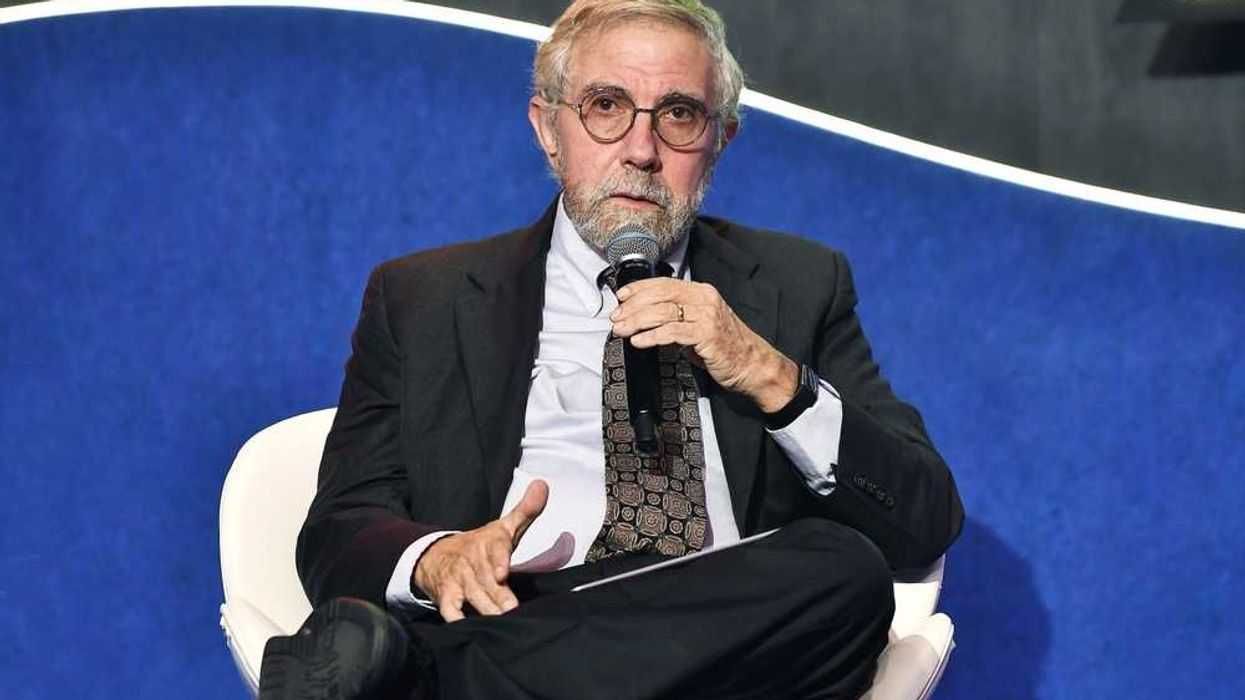
Economist Paul Krugman during FIDES 2023 in Rio de Janeiro,
Economist Paul Krugman during FIDES 2023 in Rio de Janeiro,
Brazil on September 25th, 2023 (A.PAES/ Shutterstock.com)
Wednesday, November 5 was a major day for the U.S. Supreme Court, which listened to oral arguments on President Donald Trump's trade policy in Learning Resources v. Trump.
At issue is whether or not Trump, under the Emergency Powers Act of 1977, can unilaterally impose steep tariffs by executive order without the input of Congress. The justices listened to arguments, both pro and con, and attorney Neal Katyal — known for his liberal/conservative legal alliance with Never Trump conservative attorney George Conway — offered anti-Trump trade policy arguments.
Liberal economist Paul Krugman analyzes the hearing in a November 7 column posted on his Substack page. And he emphasizes that Trump, thanks to the conservative-dominated High Court, may be in for a major "humiliation."
"How is it going for Trump's tariffs before the Supreme Court?" Krugman asks. "I'm not an enthusiast for prediction markets because they basically just summarize conventional wisdom. But tracking conventional wisdom is sometimes useful. And the prediction markets verdict on Wednesday's hearing, shown at the top of this post, was clear: it was a disaster for the (Trump) Administration's case."
Krugman adds, "So, Trump's signature economic policy may soon melt down into a puddle of incompetence and humiliation. If that should happen, I will celebrate both the end of an extraordinarily bad policy and the Supreme Court's willingness to (finally!) check Trump's authoritarian behavior. Yet I am somewhat disappointed with the specific grounds upon which the Supremes appear to be resting their arguments against the Trump tariffs."
The former New York Times columnist goes on to argue that the High Court's 6-3 right-wing supermajority may reach the right decision for the wrong reasons.
"They have so far focused on the fact that tariffs are taxes, and that the Constitution specifically gives taxing authority to Congress and not the president," Krugman explains. "Fair point. But the Court for International Trade, in their ruling against the Trump tariffs, made a different argument. The Emergency Powers Act only empowers the president to act in response to economic emergencies. And while the White House has declared two such emergencies — trade deficits and fentanyl — the CIT found that neither declaration provided a plausible rationale for the actual tariffs Trump imposed."
Krugman continues, "More broadly, supporting Trump's tariffs requires engaging in doublethink. You have to believe Trump's assertions that everything is wonderful, that this is the best economy ever. But you also have to believe that we’re facing an economic emergency that justifies massive tariff increases, hitting almost every nation and abrogating generations’ worth of international agreements."
Paul Krugman's full Substack column is available at this link.
November 07, 2025
ALTERNET
Wednesday, November 5 was a major day for the U.S. Supreme Court, which listened to oral arguments on President Donald Trump's trade policy in Learning Resources v. Trump.
At issue is whether or not Trump, under the Emergency Powers Act of 1977, can unilaterally impose steep tariffs by executive order without the input of Congress. The justices listened to arguments, both pro and con, and attorney Neal Katyal — known for his liberal/conservative legal alliance with Never Trump conservative attorney George Conway — offered anti-Trump trade policy arguments.
Liberal economist Paul Krugman analyzes the hearing in a November 7 column posted on his Substack page. And he emphasizes that Trump, thanks to the conservative-dominated High Court, may be in for a major "humiliation."
"How is it going for Trump's tariffs before the Supreme Court?" Krugman asks. "I'm not an enthusiast for prediction markets because they basically just summarize conventional wisdom. But tracking conventional wisdom is sometimes useful. And the prediction markets verdict on Wednesday's hearing, shown at the top of this post, was clear: it was a disaster for the (Trump) Administration's case."
Krugman adds, "So, Trump's signature economic policy may soon melt down into a puddle of incompetence and humiliation. If that should happen, I will celebrate both the end of an extraordinarily bad policy and the Supreme Court's willingness to (finally!) check Trump's authoritarian behavior. Yet I am somewhat disappointed with the specific grounds upon which the Supremes appear to be resting their arguments against the Trump tariffs."
The former New York Times columnist goes on to argue that the High Court's 6-3 right-wing supermajority may reach the right decision for the wrong reasons.
"They have so far focused on the fact that tariffs are taxes, and that the Constitution specifically gives taxing authority to Congress and not the president," Krugman explains. "Fair point. But the Court for International Trade, in their ruling against the Trump tariffs, made a different argument. The Emergency Powers Act only empowers the president to act in response to economic emergencies. And while the White House has declared two such emergencies — trade deficits and fentanyl — the CIT found that neither declaration provided a plausible rationale for the actual tariffs Trump imposed."
Krugman continues, "More broadly, supporting Trump's tariffs requires engaging in doublethink. You have to believe Trump's assertions that everything is wonderful, that this is the best economy ever. But you also have to believe that we’re facing an economic emergency that justifies massive tariff increases, hitting almost every nation and abrogating generations’ worth of international agreements."
Paul Krugman's full Substack column is available at this link.
‘Mega-Layoffs’ Under Trump as Corporations Have Cut 1 Million Jobs This Year—Most Since 2003
“Trump put billionaires in charge of everything,” said progressive Congressman Greg Casar. “It’s a disaster.”
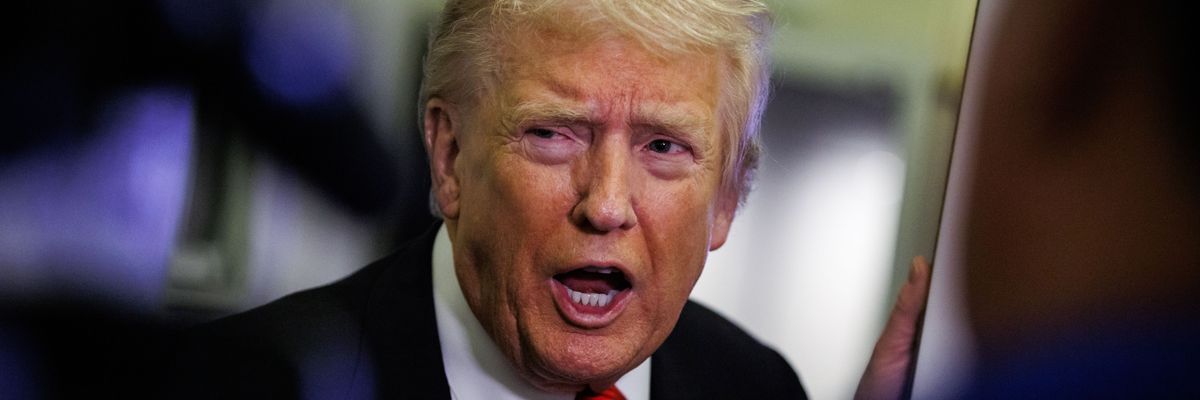
President Donald Trump speaks to reporters aboard Air Force One en route to the White House on November 2, 2025.
(Photo by Samuel Corum/Getty Images)
Brad Reed
Nov 06, 2025
Nov 06, 2025
COMMON DREAMS
The US labor market, which in recent months had ground nearly to a halt, now appears to be entering a downward spiral.
As reported by the Washington Post on Thursday, new data from corporate outplacement firm Challenger, Gray & Christmas found that employers in October announced 153,000 job cuts, which marked the highest number of layoffs in that month since October 2003.

Corporate America Accelerates Layoffs As Trump Economy Flashes Red Warning Signs

First Mass Layoff at Retail Giant Target in a Decade Under Trump’s Flailing Economy
Total announced job cuts in 2025 have now reached 1.1 million, a number that the Post describes as a “recession-like” level comparable to the steep job cuts announced in the wake of the dotcom bust of the early 2000s, the global financial crisis of 2008, and the onset of the Covid-19 pandemic in 2020.
John Challenger, the CEO of Challenger, Gray & Christmas, told the Post that the huge number of October layoffs showed the economy was entering “new territory.”
“We haven’t seen mega-layoffs of the size that are being discussed now—48,000 from UPS, potentially 30,000 from Amazon—since 2020 and before that, since the recession of 2009,” he explained. “When you see companies making cuts of this size, it does signal a real shift in direction.”
CNBC noted that the Challenger report found that the tech sector is currently being hardest hit by the layoffs, and it said that the adoption of artificial intelligence was a significant driver of job cuts.
“Some industries are correcting after the hiring boom of the pandemic, but this comes as AI adoption, softening consumer and corporate spending, and rising costs drive belt-tightening and hiring freezes,” the report said. “Those laid off now are finding it harder to quickly secure new roles, which could further loosen the labor market.”
With the backing of Big Tech investors, President Donald Trump has pushed to prevent states from regulating AI, over the objections of labor groups and progressive lawmakers. Last month, Sen. Bernie Sanders (I-Vt.) warned that without strong regulation, tech billionaires’ investments in AI will likely “increase their wealth and power exponentially” while wiping out “tens of millions” of jobs.
According to Bloomberg, however, AI adoption is just one factor in companies’ decision to enact mass layoffs, as some firms have also cited the need to protect their profit margins from the impacts of President Donald Trump’s tariffs, which have raised prices for a wide variety of products and materials.
Democratic lawmakers were quick to seize on the news of mass layoffs as evidence that Trump is sending the US economy into a ditch.
“Trump put billionaires in charge of everything,” remarked Rep. Greg Casar (D-Texas) in a social media post. “It’s a disaster.”
“Trump inherited the fastest growing economy in the [Organization for Economic Cooperation and Development], fastest reduction in inflation, record job creation,” said Rep. Sean Casten (D-Ill.). “Dumb tariffs, racist immigration policies, attacks on the rule of law and termination of congressionally mandated programs did this.”
Sen. Chris Murphy (D-Conn.), meanwhile, simply wrote that “Trump’s economy suuuuucks.”

No comments:
Post a Comment