ALL CAPITALI$M IS STATE CAPITALI$M
With Big Tech Talking Government Backing, Has OpenAI Become “Too Big to Fail”?
Leaders at the AI company are scrambling to pacify concerns that the bubble around their company could soon burst.
By Mike Ludwig ,

Big Tech Data Centers Compound Decades of Environmental Racism in the South
The American South has long been a site of both corporate extraction and fierce political resistance. By Jai Dulani , Truthout September 20, 2025
“I don’t think there’s enough exuberance about AI, when I think about the actual practical implications and what it can do for individuals,” Friar said during an onstage interview on Wednesday. “We should keep running at it.”
Robert Weissman, co-president of the corporate watchdog Public Citizen, said attitude among OpenAI’s leadership is dripping with “corporate entitlement.”
“OpenAI must rank among the most self-important and brazen corporations in history,” Weissman said in a statement on Thursday. “Having conjured a $500 billion for-profit corporation from a nonprofit, OpenAI execs now hope that federal government subsidies can supercharge their wealth even further.”
David Sacks, the venture capitalist serving as President Donald Trump’s AI czar, also chimed in, saying on social media that there would be “no federal bailout” for the AI industry.
“The U.S. has at least 5 major frontier model companies. If one fails, others will take its place,” Sacks wrote in a post on X.
As backlash grew on social media, Friar attempted to clarify her comments on November 6, explaining in a post on LinkedIn that her use of the word “backstop” had “muddied her point.” Still, Friar said both the government and the private sector must be “playing their parts” in the development of technological infrastructure — which, in this case, would be building AI data centers that threaten to guzzle up water and electricity to the detriment of local communities.
“As I said, the U.S. government has been incredibly forward-leaning and has really understood that AI is a national strategic asset,” Friar said.
Many people in the post’s comment section were not convinced.
“In those almost naïve words lies a simple truth: AI spending has become the ‘too big to fail’ of this late cycle,” said Magrino Bini, a British scientist and market analyst. “And that candid statement comes from the CFO of the company at the very center of the AI frenzy, someone who has probably run the cash-flow analysis 101 and knows the truth behind those spending commitments.”
Sam Altman, the OpenAI CEO who faces his own embarrassing headlines as of late, said in a lengthy post on Thursday that the company would not take a government bailout if it failed. Altman said the company has discussed federal loan guarantees for building semiconductor manufacturing facilities, which are desired by the U.S. government. Still, he believes a massive investment in AI infrastructure is needed for “something so important” that will “improve people’s lives.”
However, Altman did not offer details about how a technology that threatens to make jobs disappear and unleash online deepfakes and misinformation would improve our lives.
“This is the bet we are making, and given our vantage point, we feel good about it,” Altman wrote. “But we of course could be wrong, and the market — not the government — will deal with it if we are.”
Altman and Friar’s attempts at damage control did not provide much clarity about how the company actually expects to interact with the federal government, but the Trump administration has indeed embraced the AI boom rather than regulate the increasingly controversial industry. Shortly after taking office, Trump revoked President Joe Biden’s more cautious AI policies and issued an executive order to shield the industry from regulation. The administration has also inked lucrative contracts with companies such as Palantir for AI tools that are used to surveil and deport immigrants.
Trump has also already shown interest in deeper governmental involvement in tech infrastructure. In an unusual move for the U.S. government, the Trump administration in August obtained a 10 percent equity stake in Intel, a company that makes chips for computing, including those used in data centers. The government’s stake came out of a deal negotiated with the chipmaker over billions of dollars in grants that had been promised to Intel but not yet received.
In September, Nvidia, the world’s largest chip maker, announced a $5 billion investment in Intel, and the two companies are now collaborating on AI infrastructure. Nvidia also agreed to invest as much as $100 billion in OpenAI to fund a massive data center build-out, and in return, OpenAI agreed to run those centers on Nvidia chips.
The arrangements between Nvidia and Intel, and by extension, Intel and the White House, have been criticized as “circular deals” that threaten to crash the economy if the AI bubble bursts. Here’s how Bloomberg financial reporters Emily Forgash and Agnee Ghosh described the risk posed by circular AI deals last month:
Never before has so much money been spent so rapidly on a technology that, for all its potential, remains largely unproven as an avenue for profit-making. And often, these investments can be traced back to two leading firms: Nvidia and OpenAI. The recent wave of deals and partnerships involving the two are escalating concerns that an increasingly complex and interconnected web of business transactions is artificially propping up the trillion-dollar AI boom. At stake is virtually every corner of the economy, with the hype and buildout of AI infrastructure rippling across markets, from debt and equity to real estate and energy.
Reflecting on Friar’s initial “backstop” comment, Weissman said it appears that OpenAI has quietly discussed the prospect of federal subsidies with the Trump administration and received positive signals. Perhaps it’s no coincidence that OpenAI President Greg Brockman was among the attendees at a dinner for donors to Trump’s highly controversial White House ballroom, even if neither he nor OpenAI have been reported to be actual donors to the project.
“Given the Trump regime’s eagerness to shower taxpayer subsidies and benefits on favored corporations, it is entirely possible that OpenAI and the White House are concocting a scheme to siphon taxpayer money into OpenAI’s coffers, perhaps with some tribute paid to Trump and his family,” Weissman said.
Leaders at the AI company are scrambling to pacify concerns that the bubble around their company could soon burst.
By Mike Ludwig ,
November 7, 2025
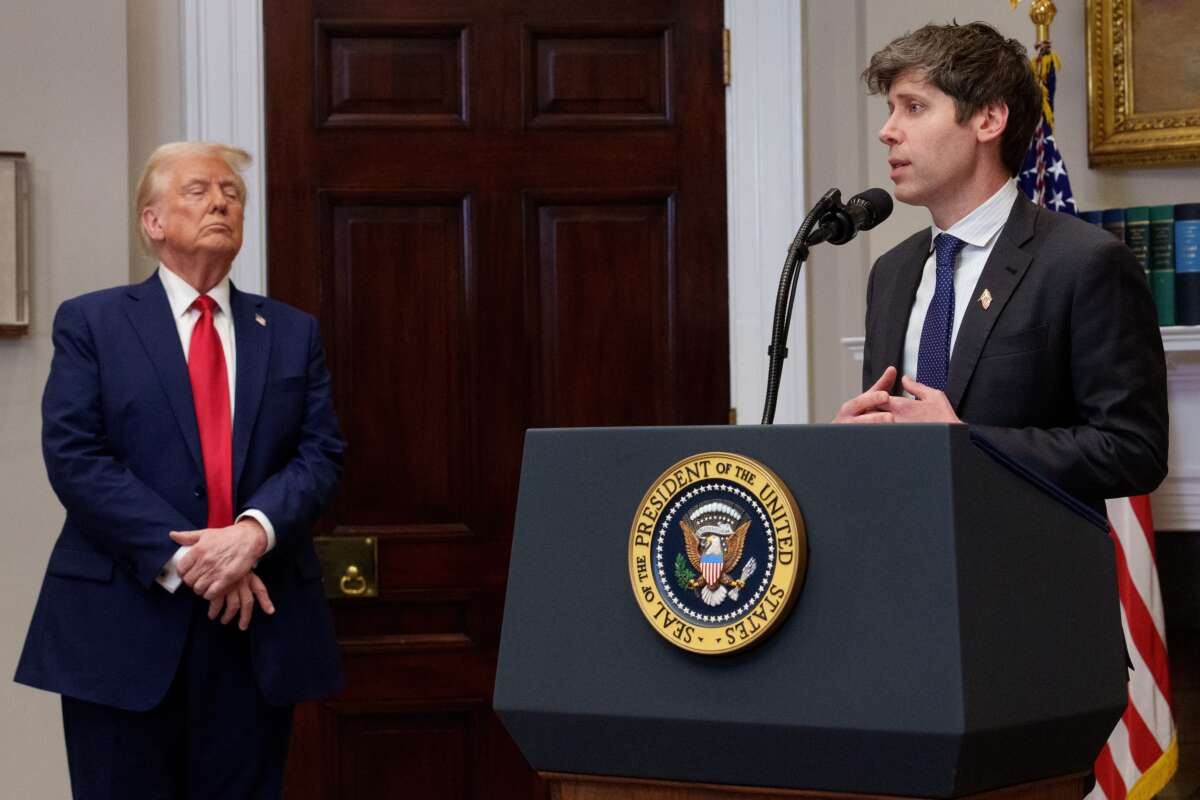
OpenAI CEO Sam Altman, accompanied by President Donald Trump, speaks during a news conference in the Roosevelt Room of the White House on January 21, 2025, in Washington, D.C.Andrew Harnik / Getty Images
Hype around artificial intelligence, or AI, could be about to collide with reality. Watchdogs are blasting the sense of “corporate entitlement” displayed by the OpenAI leaders as they make public gaffes and investors grow increasingly wary that the AI bubble propping up the economy could burst.
In a social media post on November 6, OpenAI Chief Financial Officer Sarah Friar appeared to walk back a previous statement in which she suggested that the company is pursuing government loan guarantees for the massive financial investments needed to buy advanced chips and build data centers required to power AI.
However, corporate watchdogs warn the firestorm that erupted over Friar’s comments is just the latest warning sign that OpenAI is becoming “too big to fail” as the industry aggressively lobbies at all levels of government to shift enormous financial burden onto taxpayers. The hype that initially inspired the investors to pump tens of billions of dollars into AI companies may be fading into flurry of negative headlines, and now fears of a bursting AI bubble are roiling markets worldwide.
OpenAI, which is behind ChatGPT and the video generator Sora, was founded in 2015 as a nonprofit that claimed to have ambitions to protect humanity from the potential harms of generative AI. Last month, the company wrapped up a long-awaited restructure that that turned it into a for-profit entity valued at $500 billion, despite the fact that its products have yet to yield significant revenue streams (which explains why ChatGPT can now be used as a sexbot). The company appears to be losing money — and lots of it. OpenAI reportedly brings in about $13 billion in annual revenue but plans to spend $1 trillion on infrastructure and development over the next five years, including the continued buildout of data centers that are already increasing energy costs for consumers in the communities where they’re located.
Asked about financing a boom in AI computing at a Wall Street Journal event on November 5, Friar said OpenAI is looking for an “ecosystem of banks and private equity” as well as a government “backstop” that would guarantee investments in cutting-edge chips and data centers. The comment was widely interpreted as a request for loan guarantees from the Trump administration. Friar also responded to worries among investors that AI companies may be overvalued, saying the market needs more “exuberance” about AI.
Hype around artificial intelligence, or AI, could be about to collide with reality. Watchdogs are blasting the sense of “corporate entitlement” displayed by the OpenAI leaders as they make public gaffes and investors grow increasingly wary that the AI bubble propping up the economy could burst.
In a social media post on November 6, OpenAI Chief Financial Officer Sarah Friar appeared to walk back a previous statement in which she suggested that the company is pursuing government loan guarantees for the massive financial investments needed to buy advanced chips and build data centers required to power AI.
However, corporate watchdogs warn the firestorm that erupted over Friar’s comments is just the latest warning sign that OpenAI is becoming “too big to fail” as the industry aggressively lobbies at all levels of government to shift enormous financial burden onto taxpayers. The hype that initially inspired the investors to pump tens of billions of dollars into AI companies may be fading into flurry of negative headlines, and now fears of a bursting AI bubble are roiling markets worldwide.
OpenAI, which is behind ChatGPT and the video generator Sora, was founded in 2015 as a nonprofit that claimed to have ambitions to protect humanity from the potential harms of generative AI. Last month, the company wrapped up a long-awaited restructure that that turned it into a for-profit entity valued at $500 billion, despite the fact that its products have yet to yield significant revenue streams (which explains why ChatGPT can now be used as a sexbot). The company appears to be losing money — and lots of it. OpenAI reportedly brings in about $13 billion in annual revenue but plans to spend $1 trillion on infrastructure and development over the next five years, including the continued buildout of data centers that are already increasing energy costs for consumers in the communities where they’re located.
Asked about financing a boom in AI computing at a Wall Street Journal event on November 5, Friar said OpenAI is looking for an “ecosystem of banks and private equity” as well as a government “backstop” that would guarantee investments in cutting-edge chips and data centers. The comment was widely interpreted as a request for loan guarantees from the Trump administration. Friar also responded to worries among investors that AI companies may be overvalued, saying the market needs more “exuberance” about AI.
Big Tech Data Centers Compound Decades of Environmental Racism in the South
The American South has long been a site of both corporate extraction and fierce political resistance. By Jai Dulani , Truthout September 20, 2025
“I don’t think there’s enough exuberance about AI, when I think about the actual practical implications and what it can do for individuals,” Friar said during an onstage interview on Wednesday. “We should keep running at it.”
Robert Weissman, co-president of the corporate watchdog Public Citizen, said attitude among OpenAI’s leadership is dripping with “corporate entitlement.”
“OpenAI must rank among the most self-important and brazen corporations in history,” Weissman said in a statement on Thursday. “Having conjured a $500 billion for-profit corporation from a nonprofit, OpenAI execs now hope that federal government subsidies can supercharge their wealth even further.”
David Sacks, the venture capitalist serving as President Donald Trump’s AI czar, also chimed in, saying on social media that there would be “no federal bailout” for the AI industry.
“The U.S. has at least 5 major frontier model companies. If one fails, others will take its place,” Sacks wrote in a post on X.
As backlash grew on social media, Friar attempted to clarify her comments on November 6, explaining in a post on LinkedIn that her use of the word “backstop” had “muddied her point.” Still, Friar said both the government and the private sector must be “playing their parts” in the development of technological infrastructure — which, in this case, would be building AI data centers that threaten to guzzle up water and electricity to the detriment of local communities.
“As I said, the U.S. government has been incredibly forward-leaning and has really understood that AI is a national strategic asset,” Friar said.
Many people in the post’s comment section were not convinced.
“In those almost naïve words lies a simple truth: AI spending has become the ‘too big to fail’ of this late cycle,” said Magrino Bini, a British scientist and market analyst. “And that candid statement comes from the CFO of the company at the very center of the AI frenzy, someone who has probably run the cash-flow analysis 101 and knows the truth behind those spending commitments.”
Sam Altman, the OpenAI CEO who faces his own embarrassing headlines as of late, said in a lengthy post on Thursday that the company would not take a government bailout if it failed. Altman said the company has discussed federal loan guarantees for building semiconductor manufacturing facilities, which are desired by the U.S. government. Still, he believes a massive investment in AI infrastructure is needed for “something so important” that will “improve people’s lives.”
However, Altman did not offer details about how a technology that threatens to make jobs disappear and unleash online deepfakes and misinformation would improve our lives.
“This is the bet we are making, and given our vantage point, we feel good about it,” Altman wrote. “But we of course could be wrong, and the market — not the government — will deal with it if we are.”
Altman and Friar’s attempts at damage control did not provide much clarity about how the company actually expects to interact with the federal government, but the Trump administration has indeed embraced the AI boom rather than regulate the increasingly controversial industry. Shortly after taking office, Trump revoked President Joe Biden’s more cautious AI policies and issued an executive order to shield the industry from regulation. The administration has also inked lucrative contracts with companies such as Palantir for AI tools that are used to surveil and deport immigrants.
Trump has also already shown interest in deeper governmental involvement in tech infrastructure. In an unusual move for the U.S. government, the Trump administration in August obtained a 10 percent equity stake in Intel, a company that makes chips for computing, including those used in data centers. The government’s stake came out of a deal negotiated with the chipmaker over billions of dollars in grants that had been promised to Intel but not yet received.
In September, Nvidia, the world’s largest chip maker, announced a $5 billion investment in Intel, and the two companies are now collaborating on AI infrastructure. Nvidia also agreed to invest as much as $100 billion in OpenAI to fund a massive data center build-out, and in return, OpenAI agreed to run those centers on Nvidia chips.
The arrangements between Nvidia and Intel, and by extension, Intel and the White House, have been criticized as “circular deals” that threaten to crash the economy if the AI bubble bursts. Here’s how Bloomberg financial reporters Emily Forgash and Agnee Ghosh described the risk posed by circular AI deals last month:
Never before has so much money been spent so rapidly on a technology that, for all its potential, remains largely unproven as an avenue for profit-making. And often, these investments can be traced back to two leading firms: Nvidia and OpenAI. The recent wave of deals and partnerships involving the two are escalating concerns that an increasingly complex and interconnected web of business transactions is artificially propping up the trillion-dollar AI boom. At stake is virtually every corner of the economy, with the hype and buildout of AI infrastructure rippling across markets, from debt and equity to real estate and energy.
Reflecting on Friar’s initial “backstop” comment, Weissman said it appears that OpenAI has quietly discussed the prospect of federal subsidies with the Trump administration and received positive signals. Perhaps it’s no coincidence that OpenAI President Greg Brockman was among the attendees at a dinner for donors to Trump’s highly controversial White House ballroom, even if neither he nor OpenAI have been reported to be actual donors to the project.
“Given the Trump regime’s eagerness to shower taxpayer subsidies and benefits on favored corporations, it is entirely possible that OpenAI and the White House are concocting a scheme to siphon taxpayer money into OpenAI’s coffers, perhaps with some tribute paid to Trump and his family,” Weissman said.
‘Blunt Corruption’: Trump DOJ Hands Google an Antitrust Win After Tech Giant’s Ballroom Donation
.jpg)
Alphabet, Google’s parent company, is contributing $22 million to the president’s ballroom project.
Jake Johnson
Nov 06, 2025
COMMON DREAMS
The US Justice Department has reportedly given the tech behemoth Alphabet a green light to acquire the cybersecurity firm Wiz after it was revealed that the Google parent company donated to President Donald Trump’s $300 million ballroom project.
The merger deal is valued at over $30 billion and would mark Alphabet’s largest acquisition to date, even as the company faces antitrust cases at the state and federal level. Wiz CEO Assaf Rappaport announced the Justice Department’s decision on Wednesday at an event hosted by the Wall Street Journal.
The DOJ approval came after Bloomberg reported in June that the Justice Department’s antitrust arm was reviewing whether Alphabet’s acquisition of Wiz would illegally undermine competition. The following month, the Justice Department ousted two of its top antitrust officials amid internal conflict over shady corporate settlement deals.
Lee Hepner, an antitrust attorney and senior legal counsel for the American Economic Liberties Project, called the DOJ’s clearing of Alphabet’s Wiz acquisition “the kind of blunt corruption that most won’t notice.”
Hepner observed that news of the approval came shortly after the White House released a list of individuals and corporations that have pumped money into Trump’s gaudy ballroom project. Google—which also donated to Trump’s inauguration—was one of the prominent names on the list, alongside Amazon, Apple, and other major corporations.
Google is reportedly funneling $22 million to the ballroom project.
“These giant corporations aren’t funding the Trump ballroom debacle out of a sense of civic pride,” Robert Weissman, co-president of the consumer advocacy group Public Citizen, said earlier this week. “They have massive interests before the federal government and they undoubtedly hope to curry favor with, and receive favorable treatment from, the Trump administration.”
“Millions to fund Trump’s architectural whims are nothing compared to the billions at stake in procurement, regulatory, and enforcement decisions,” he added.
According to a Public Citizen report published Monday, two-thirds of the 24 known corporate donors to Trump’s ballroom project—including Google—are beneficiaries of recent government contracts.
Dismissing Criminal Prosecution of Boeing is Outrageous, Unconscionable
WASHINGTON - A federal judge in Texas today dismissed a criminal conspiracy case against Boeing over two crashes of its 737 Max jetliner that killed 346 people. Robert Weissman, co-president of Public Citizen, released the following statement:
“Unconscionable is inadequate to address the outrage of the Trump Justice Department’s decision to dismiss the criminal prosecution of Boeing. Not only did Boeing’s recklessness lead directly to the deaths of hundreds of people, but it violated the terms of the sweetheart deal it reached with the first Trump administration, again jeopardizing the lives of air passengers.
“Judge O’Connor believed his hands were tied in permitting the DOJ to drop the case, but his sharply worded decision reveals that he agrees the department’s action is outrageous. ‘The Government has a confession from Boeing, signed by the CEO and Chief Legal Officer, admitting to all the elements of the conspiracy charge against it,’ he wrote.
“For an Attorney General and DOJ leadership that has brought shame and disgrace to a previously magisterial agency, this marks a new low.”
The US Justice Department has reportedly given the tech behemoth Alphabet a green light to acquire the cybersecurity firm Wiz after it was revealed that the Google parent company donated to President Donald Trump’s $300 million ballroom project.
The merger deal is valued at over $30 billion and would mark Alphabet’s largest acquisition to date, even as the company faces antitrust cases at the state and federal level. Wiz CEO Assaf Rappaport announced the Justice Department’s decision on Wednesday at an event hosted by the Wall Street Journal.
The DOJ approval came after Bloomberg reported in June that the Justice Department’s antitrust arm was reviewing whether Alphabet’s acquisition of Wiz would illegally undermine competition. The following month, the Justice Department ousted two of its top antitrust officials amid internal conflict over shady corporate settlement deals.
Lee Hepner, an antitrust attorney and senior legal counsel for the American Economic Liberties Project, called the DOJ’s clearing of Alphabet’s Wiz acquisition “the kind of blunt corruption that most won’t notice.”
Hepner observed that news of the approval came shortly after the White House released a list of individuals and corporations that have pumped money into Trump’s gaudy ballroom project. Google—which also donated to Trump’s inauguration—was one of the prominent names on the list, alongside Amazon, Apple, and other major corporations.
Google is reportedly funneling $22 million to the ballroom project.
“These giant corporations aren’t funding the Trump ballroom debacle out of a sense of civic pride,” Robert Weissman, co-president of the consumer advocacy group Public Citizen, said earlier this week. “They have massive interests before the federal government and they undoubtedly hope to curry favor with, and receive favorable treatment from, the Trump administration.”
“Millions to fund Trump’s architectural whims are nothing compared to the billions at stake in procurement, regulatory, and enforcement decisions,” he added.
According to a Public Citizen report published Monday, two-thirds of the 24 known corporate donors to Trump’s ballroom project—including Google—are beneficiaries of recent government contracts.
Dismissing Criminal Prosecution of Boeing is Outrageous, Unconscionable
WASHINGTON - A federal judge in Texas today dismissed a criminal conspiracy case against Boeing over two crashes of its 737 Max jetliner that killed 346 people. Robert Weissman, co-president of Public Citizen, released the following statement:
“Unconscionable is inadequate to address the outrage of the Trump Justice Department’s decision to dismiss the criminal prosecution of Boeing. Not only did Boeing’s recklessness lead directly to the deaths of hundreds of people, but it violated the terms of the sweetheart deal it reached with the first Trump administration, again jeopardizing the lives of air passengers.
“Judge O’Connor believed his hands were tied in permitting the DOJ to drop the case, but his sharply worded decision reveals that he agrees the department’s action is outrageous. ‘The Government has a confession from Boeing, signed by the CEO and Chief Legal Officer, admitting to all the elements of the conspiracy charge against it,’ he wrote.
“For an Attorney General and DOJ leadership that has brought shame and disgrace to a previously magisterial agency, this marks a new low.”


No comments:
Post a Comment