Sunday, November 09, 2025

POSTMODERN GODDESS

‘Only death can protect us’: How the folk saint La Santa Muerte reflects violence in Mexico

(The Conversation) — Since appearing as a public shrine in 2001, the female death deity’s popularity has exploded and is a frequent sight in public ceremonies such as the Day of the Dead.


A devotee carrying his daughter rests his hand on the glass to an altar to La Santa Muerte in Tepito in Mexico City. (AP Photo/Rebecca Blackwell)

Myriam Lamrani
November 3, 2025

(The Conversation) — When a life-size skeleton dressed like the Grim Reaper first appeared on a street altar in Tepito, Mexico City, in 2001, many passersby instinctively crossed themselves. The figure was La Santa Muerte – or Holy Death – a female folk saint cloaked in mystery and controversy that had previously been known, if at all, as a figure of domestic devotion: someone they might address a prayer to, but in the privacy of their home.

She personifies death itself and is often depicted holding a scythe or globe. And since the early 2000s, her popularity has steadily spread across Mexico and the Americas, Europe and beyond.

The idea and image of death made into a saint is both unthinkable and magnetic. Her association with drug traffickers and criminal rituals makes many people wary of the skeletal figure. La Santa Muerte also faces significant opposition from the Catholic Church, which condemns her veneration as heretical and morally dangerous. High-ranking church figures such as Cardinal Norberto Rivera Carrera in Mexico have publicly denounced her devotion, warning that it promotes superstition and goes against Christian values.

This criticism highlights a profound tension between official religion and the grassroots devotion. Many Mexicans who feel abandoned by government and church institutions embrace her as a source of hope. Indeed, based on my research, La Santa Muerte represents strength, protection and comfort to her devotees, which include prisoners, police officers, sex workers, LGBTQ+ people, migrants, the working class and others among less vulnerable populations. Despite her fearsome appearance, she offers a form of care they are often denied elsewhere.

As an anthropologist who has studied La Santa Muerte in Mexico, I believe her power reflects a paradoxical Mexican understanding of death – not only as a symbol of fear but as an intimate part of everyday life that has become one of resilience and resistance amid the country’s chronic violence.
Death and the state

In my recent book, “The Intimacy of Images,” I examine how devotion to La Santa Muerte in Oaxaca – the state famed for its Day of the Dead tradition – draws on Mexico’s long-standing, often playful relationship with the image of death.
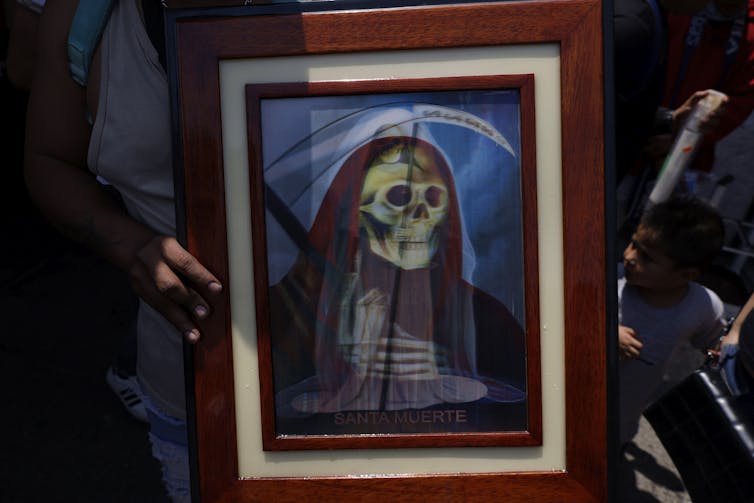

A person holds a picture during a visit to the Santa Muerte temple in Tepito, Mexico City, on April 1, 2025.
Gerardo Vieyra/NurPhoto via Getty Images

Based on over a decade of ethnographic fieldwork, I found how people’s prayers, offerings and promises to her are part of a desire for solutions to everyday problems such as illness, economic hardship and protection from harm. Her frequent representation in images such as altars, tattoos and artistic productions also reflects an evolving social understanding of death that has long been a pervasive symbol of Mexican culture, identity and the power of the state.

Following the Mexican Revolution in the early 20th century, death as a symbol of the new Mexican nation was popularized by artists such as José Guadalupe Posada, especially through La Catrina, the caricature of the dandy skeleton often associated with the Day of the Dead. Whereas death and its personification were once part of an ethos of celebration and fearlessness in the face of death, they have now become disturbing reminders of the mounting insecurity and violence in Mexico.

This transformation, and the role the skeletal saint plays in providing protection in this dangerous context, reflects Mexico’s broader descent into turmoil. In the 2000 national elections, the Institutional Revolutionary Party was unseated after 71 years of uninterrupted rule. The election of the conservative National Action Party, or PAN, in its place saw the fracturing of informal alliances between the state and criminal networks that had previously tamped down on crime through systems of patronage.

In 2006, newly elected PAN President Felipe Calderón launched a militarized war on crime after the yearslong evolution of these early criminal networks into ruthless organizations.

In the following decades, cartel violence has surged, civilian deaths and femicides have escalated, and state institutions have been accused of either direct complicity or a refusal to intervene. The 2014 disappearance of 43 students in Iguala – a case that revealed the degree of state and criminal organizations’ collusion and remains unresolved – only crystallized public outrage. Such rampant violence continues to this day.

Since the beginning of the Mexican drug war in 2006, an estimated 460,000 people have been murdered, and more than 115,000 people are officially listed as missing in the country – roughly one in every 1,140 residents. In heavily affected states such as Guerrero and Jalisco, that ratio is likely far higher, revealing the uneven geography of violence and disappearance across the country.

Claudia Sheinbaum, the country’s first female president – who took office in October 2024 – has promised to dismantle organized crime. Yet the violence and widespread public perceptions of insecurity persist.
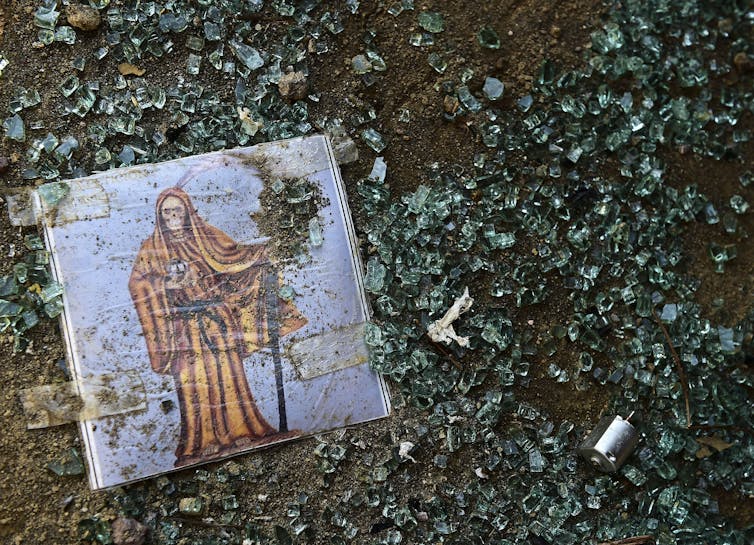

A religious image of La Santa Muerte is pictured next to a truck damaged by gunfire in Mexico’s Durango state.
Ronaldo Schemidt/AFP via Getty Images


A violent mirror


For most devotees, La Santa Muerte is not an ally of the criminals, despite its use by cartel-linked groups. Instead, she is one of the few remaining forms of help amid a terrifying social reality. She offers no illusion that the situation of political dysfunction or rampant violence will improve – only presence and protection. Her image reflects a brutal truth: Survival is no longer guaranteed by a state whose ties to the cartels run deep.

This political and spiritual vacuum is seen in the rise of other lay figures of devotion – folk saints such as Jesús Malverde, more official ones such as San Judas Tadeo, or even devotion to the devil.

La Santa Muerte is distinct, however. She is death personified, the end of life, the ultimate judge and a symbol of shared mortality, regardless of status, race or gender. As one devotee told me: “If you open us, you’ll find the same bones.” La Santa Muerte is also imbued with care and love by her followers. Some address her as kin, an aunt or a revered mother incarnating maternal protection and a kind of strength more commonly associated with the masculine. As many say: “She’s a badass.”

In a country where state protection is scarce and the boundaries between authorities and cartels blur, she represents the people and also shields her believers through miraculous protection. Her followers turn to her because, as they say, only death can protect them from death.

Given her devotees’ vulnerability and the wholehearted trust they place in their skeletal saint, La Santa Muerte is more than mere folklore. She is the patron saint of the many in a country where death walks close. She is a figure of personal solace and collective resilience. Above all, she is a mirror – reflecting a society in crisis and engulfed in violence, and a people reaching for meaning, dignity and protection in the face of it all.

(Myriam Lamrani, Associate Researcher, Department of Anthropology, Harvard University. The views expressed in this commentary do not necessarily reflect those of Religion News Service.)


The Conversation religion coverage receives support through the AP’s collaboration with The Conversation US, with funding from Lilly Endowment Inc. The Conversation is solely responsible for this content.


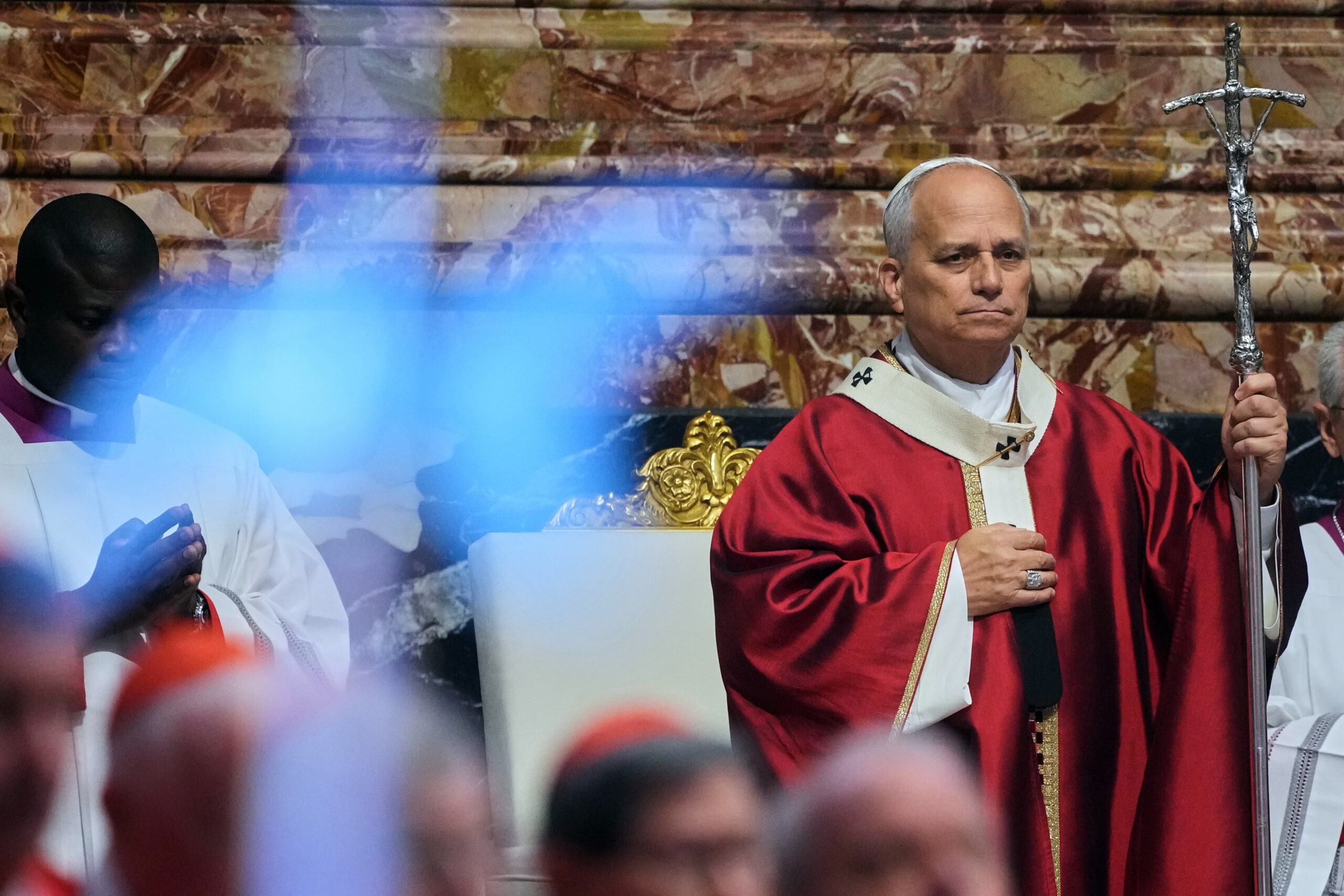
Pope Leo calls for 'deep reflection' about treatment of detained migrants in the United States

VATICAN CITY (AP) — The Chicago-born pope was responding Tuesday to a range of geopolitical questions from reporters outside the papal retreat at Castel Gandolfo, including what kind of spiritual rights migrants in U.S. custody should have, U.S. military attacks on suspected drug traffickers off Venezuela and the fragile ceasefire in the Middle East.


HIS STERN COUNTENANCE


Associated Press
November 6, 2025

VATICAN CITY (AP) — Pope Leo XIV called for “deep reflection” in the United States about the treatment of migrants held in detention, saying that “many people who have lived for years and years and years, never causing problems, have been deeply affected by what is going on right now.”

The Chicago-born pope was responding Tuesday to a range of geopolitical questions from reporters outside the papal retreat at Castel Gandolfo, including what kind of spiritual rights migrants in U.S. custody should have, U.S. military attacks on suspected drug traffickers off Venezuela and the fragile ceasefire in the Middle East.

Leo underlined that scripture emphasizes the question that will be posed at the end of the world: “How did you receive the foreigner, did you receive him and welcome him, or not? I think there is a deep reflection that needs to be made about what is happening.”


He said “the spiritual rights of people who have been detained should also be considered,’’ and he called on authorities to allow pastoral workers access to the detained migrants. “Many times they’ve been separated from their families. No one knows what’s happening, but their own spiritual needs should be attended to,” Leo said.

Leo last month urged labor union leaders visiting from Chicago to advocate for immigrants and welcome minorities into their ranks.

Asked about the lethal attacks on suspected drug traffickers off Venezuela, the pontiff said the military action was “increasing tension,’’ noting that they were coming even closer to the coastline.

“The thing is to seek dialogue,’’ the pope said.

On the Middle East, Leo acknowledged that the first phase of the peace accord between Israel and Hamas remains “very fragile,’’ and said that the parties need to find a way forward on future governance “and how you can guarantee the rights of all peoples.’’

Asked about Israeli settler attacks on Palestinians i n the West Bank, the pope described the settlement issue as “complex,’’ adding: “Israel has said one thing, then it’s done another sometimes. We need to try to work together for justice for all peoples.’’

Pope Leo will receive Palestinian President Mahmoud Abbas at the Vatican on Thursday. At the end of November he will make his first trip as Pope to Turkey and Lebanon.
Joyful Day of the Dead commemorations rally US Latino communities despite immigration raid fears

MINNEAPOLIS (AP) — These crucial religious, family and community celebrations for most Mexicans and many other Latin Americans have taken on special significance this year in U.S. Latino communities, as the Trump administration escalates immigration enforcement raids, including in Minnesota.


Giovanna Dell'orto
November 3, 2025

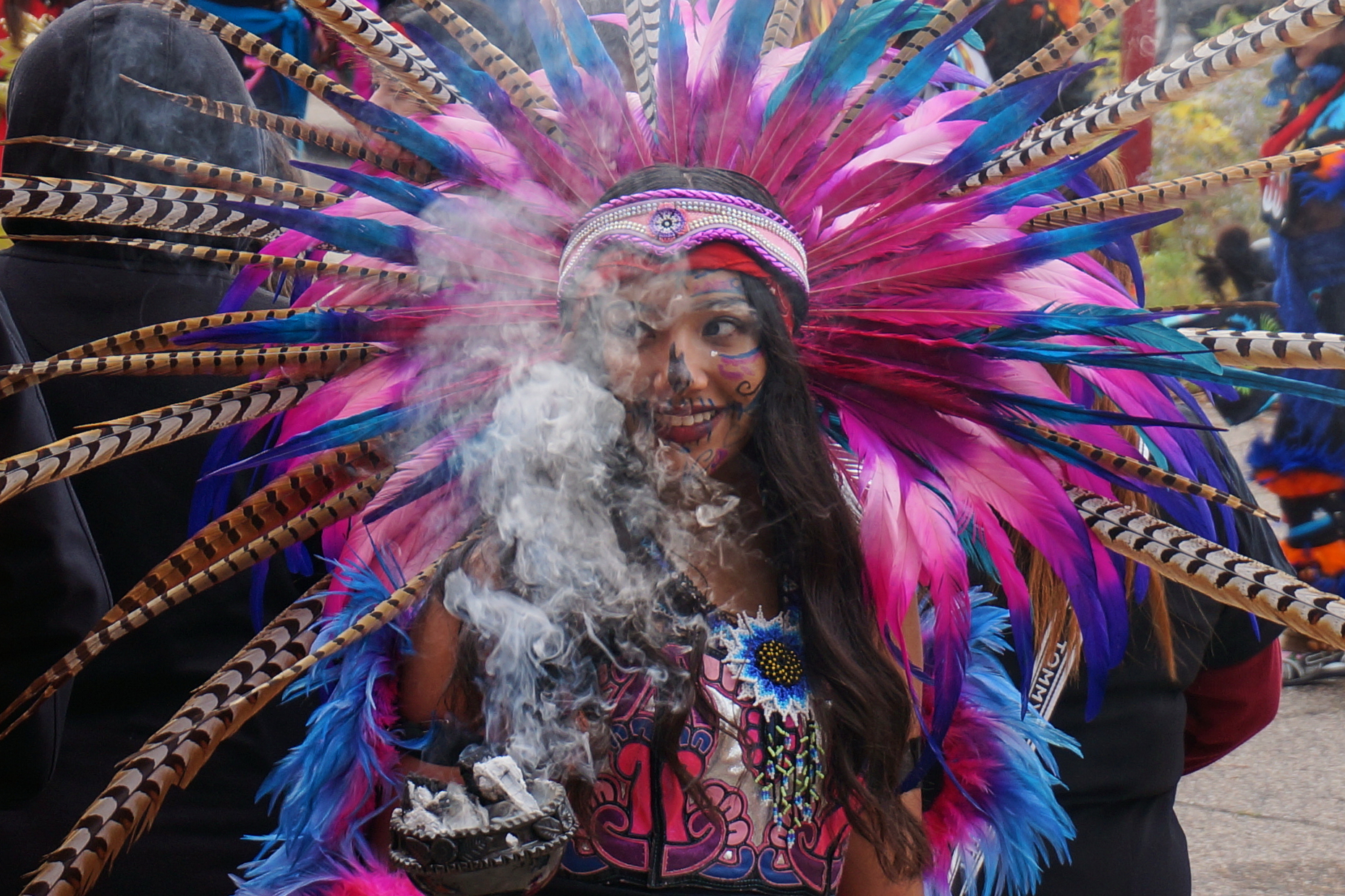
MINNEAPOLIS (AP) — More than 100 people followed Aztec dancers through an arch of paper flowers into El Colegio High School on Saturday morning to visit altars that students had created to commemorate Día de Muertos or Day of the Dead.

“It’s … a way of greeting our ancestors into our homes, back into our lives, even if they’re like not here physically, but spiritually,” said Daniela Rosales, a senior at the small, bilingual school in Minneapolis. “It’s a way of just having the community come all together and knowing that in some way they might feel safe.”

These crucial religious, family and community celebrations for most Mexicans and many other Latin Americans have taken on special significance this year in U.S. Latino communities, as the Trump administration escalates immigration enforcement raids, including in Minnesota.

While some organizers worried that fears of deportation would cast a pall on public celebrations, participants turned out in droves in cities big and small, saying the rituals brought a much-needed sense of resilience and community pride.

“We decided we can’t cave,” said Justin Ek, one of the founders of the Day of the Dead festival in Mankato, a city in the Minnesota farmland. “Our cultural celebrations are what we need to fill our souls for what’s to come.”

The Indigenous Latino artist’s family started a small commemoration in the parking lot of their painting business in 2018. This year, some 12,000 people joined the daylong celebration that included live music and several dozen papier-mâché sculptures of Catrinas (elaborately dressed skeletons) and fantasy creatures called alebrijes. Most activities were funded by community donations.

Grieving, but with happiness: The spiritual side of Day of the Dead

Ek’s father came to the U.S. from Mexico as a preteen, and in the struggle to make a living and eventually build a family, many connections with his homeland and relatives there disappeared, Ek said.

Day of the Dead festivities became a way to grieve that and rekindle some ties, he added, in addition to commemorating more recent family deaths.

“It’s our way to honor what we lost,” Ek said.

The holiday’s balance of joyful remembrance and a renewed sense of presence distinguishes it from both the outright party atmosphere of Halloween and the somber memorials of the Christian holy days of All Saints on Nov. 1 and All Souls’ Day on Nov. 2.

In fact, Day of the Dead evolved over centuries from Indigenous practices across the Americas, and only settled on these fall dates after Catholicism was introduced, said Cary Cordova, a University of Texas professor.

Different regions mark it with unique details, but the crucial element is paying homage to the dead with “ofrendas,” festive offerings of food, drinks, music and pastimes favorite by the dead. Their souls, many believe, return for a visit, guided by the candles and marigold flowers that mark the path to the ofrendas.

Whether in his Mexican childhood or today in Mankato, Luis Alberto Orozco said the key is to commemorate by “having fun as they would be” — with the departed’s favorite snacks and songs.

“It’s remembering people who passed on positively because they would want us to remember them happy … and making ourselves feel they’re with us,” Orozco said.

Joyful and prideful commemorations defy fears of immigration enforcement

As the emcee of this year’s celebration, Orozco reflected on tense conversations in recent months about whether the event in Mankato might draw immigration enforcement raids, especially as rumors spread on social media.

“We decided we were not going to be afraid. It was important for us to keep our faith,” he said. “Once I got to the event and saw all the people smile, all the fears went away.”

The recent crackdown on illegal immigration in Chicago has generated controversy and stirred fears across that city.

Lisa Noce, some of whose ancestors immigrated from Mexico to Chicago’s Pilsen neighborhood where she grew up, worried people would stay away from a Day of the Dead installation she helped create by the National Museum of Mexican Art there. But a big crowd came.

“I’m very thankful that it turned out that way,” she said, adding that she also sets up a smaller ofrenda in her kitchen with candy, Barbie dolls, and smiling photos of deceased family members.

‘Ofrendas’ range from family shrines to political statements

For more than a century, Day of the Dead artistic representations have also moved from the family to the public sphere.

Starting in Mexico and later through the Chicano rights movement in the United States, ofrendas have also become a form of protest covering often marginalized victims, said Luis Fitch, a Minneapolis artist who has created Day of the Dead images for retail giant Target and the U.S. Postal Service.

In Los Angeles, site of some of the strongest enforcement actions, a group advocating for detained migrants planned for Sunday a prayer with Buddhist, Jewish and Protestant Christian rituals as well as altars commemorating those who died in detention, said the Rev. Jennifer Gutierrez, one of the organizers.

“There’s pretty high anxiety,” said Gutierrez, a United Methodist minister. “But also an atmosphere of coming together to help each other.”

Back at El Colegio High School, the half dozen altars with flickering candles, decorated candy skulls and a profusion of paper flowers commemorated local and global losses.

There were pictures of the children killed at a school Mass just 3 miles (5 kilometers) away, but also those who died crossing the U.S-Mexican border as well as victims of the terror attacks on 9/11, the war in Gaza and violence against Indigenous women.

“We try to keep our sources of spiritual strength always nourished,” said Susana De Leon, one of the traditional Aztec dancers who got the commemoration started at El Colegio.“When the community sees us dancing, they feel strengthened. They feel the love.”


Halloween and a declining Christian tradition coexist on All Saints' Day in Spain

MADRID (AP) — The sobriety of the Catholic tradition, by which on All Saints' Day graves are cleaned and flowers are brought to cemeteries to spend time with deceased loved ones, has given way in recent years to sweets, fake blood, and spider webs from one of the most iconic holidays in the United States.


Alicia Leon and Teresa Medrano
November 3, 2025

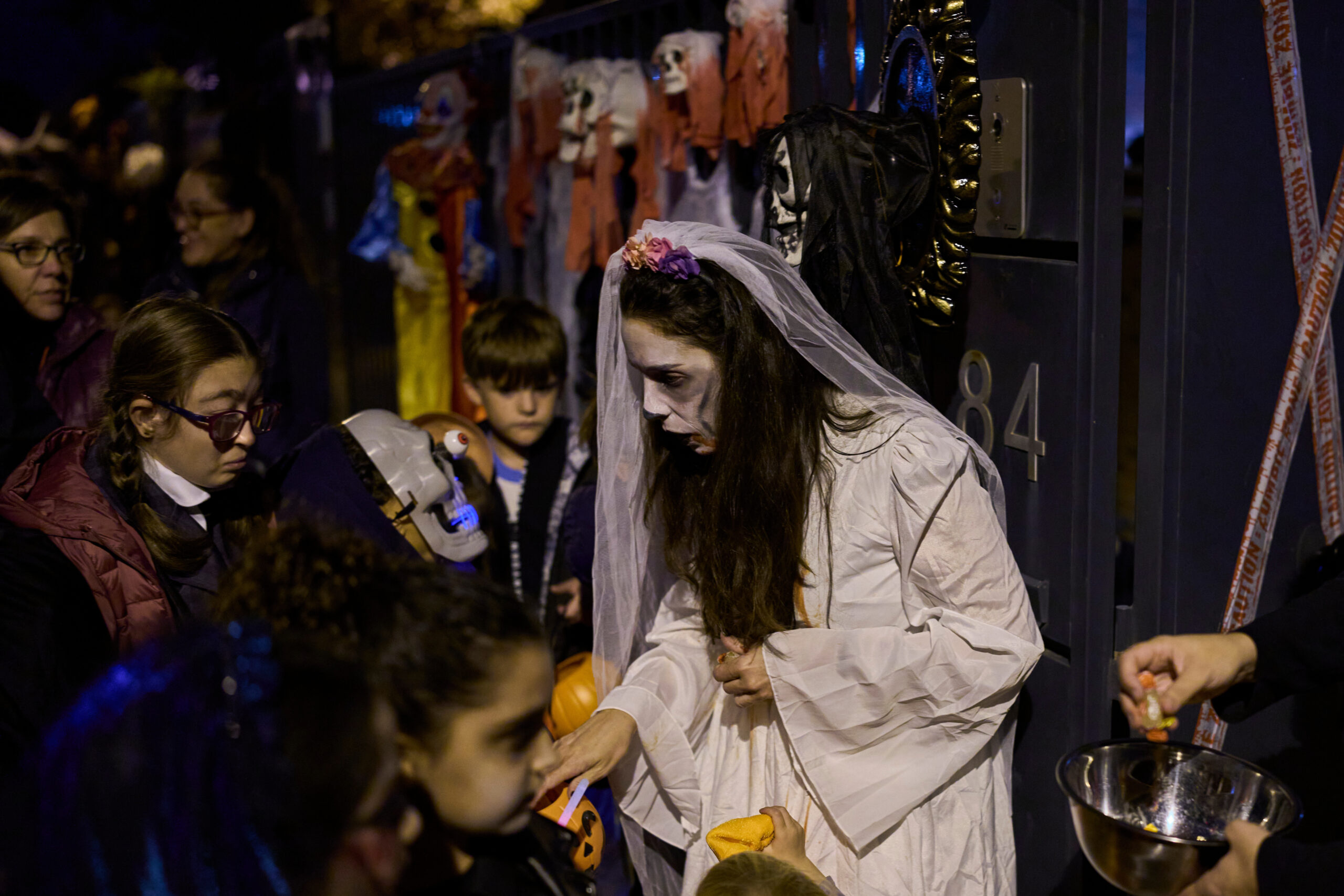
MADRID (AP) — Skeletons, ghosts, and monsters of all kinds took to the streets of many cities in Spain at nightfall to celebrate Halloween. The next morning, an older generation flocked to the country’s cemeteries to remember their dead.

The sobriety of the Catholic tradition, by which on All Saints’ Day graves are cleaned and flowers are brought to cemeteries to spend time with deceased loved ones, has given way in recent years to sweets, fake blood, and spider webs from one of the most iconic holidays in the United States.

As in many other parts of the world, instead of their own ancestral traditions, younger people have embraced the more commercial side of a celebration that originated from the pagan festival of Samhain, which honored the end of summer and the harvest. And it does not appear that they will follow in the footsteps of their elders.

The cultural change did not happen overnight, but is a consequence of the secularization of societies, explained José Bobadilla, a sociologist specialized in culture and religious diversity.

“Obviously, the process of a new, more Americanized culture has had an influence not only in Europe,” said Bobadilla, who noted that the current celebration, which is spreading throughout the world, “downplays the idea that it is a time to remember those who are no longer with us.”

The Almudena cemetery in Madrid, the largest in Spain with some five million people buried there, began receiving its first visitors early in the morning.

At the main entrance, several flower stalls waited with bouquets ready for those who left the arrangement of the graves to the last minute.

“We always come on (Nov) 1st,” said Alicia Sánchez, a 69-year-old retiree who lamented the loss of tradition due to a lack of interest among younger people.

“I don’t like Halloween because it’s not our holiday. But everyone has their traditions, and that should be respected,” she said.

Paz Sánchez visited her husband’s grave with his son, as they do on many other days. This time, however, they were surprised to see so few people despite it being the busiest day of the year.

“Maybe they don’t feel like getting up early to come to the cemetery,” said Sánchez, 87.

A few hours earlier, as in the last decade, Paracuellos de Jarama, a town about 30 kilometers (18.6 miles) northeast of Madrid, dressed up for Halloween.

It started with just a few neighbors, but now dozens of houses are decorated with pumpkins and ghosts, there is a haunted passageway, and hundreds of people roam the streets trick-or-treating.

Miguel Izquierdo transformed his family home into a pirate ship with recycled wood for the hull and an old sheet as a sail. The lights, music, and 30 kilos (66 pounds) of candy, which ran out in less than two hours, made it one of the most popular.

After three years, they continue to participate “because of how much fun the children have,” said Izquierdo, 42, who runs an audiovisual production company. “We like it because it’s a party, because it’s a costume party, and because there’s candy.”

“I don’t dislike the party, but I think it’s not part of our traditions,” said Antonia Martín, 68, who celebrated Halloween – without costume – for the first time for her grandchildren.


Associated Press religion coverage receives support through the AP’s collaboration with The Conversation US, with funding from Lilly Endowment Inc. The AP is solely responsible for this content.

Bad Bunny vs. MAGA’s Bigoted Vision of America

The hatefulness and histrionics of Trump’s allies exemplify how the ill-formed and culturally biased so easily make fools of themselves.


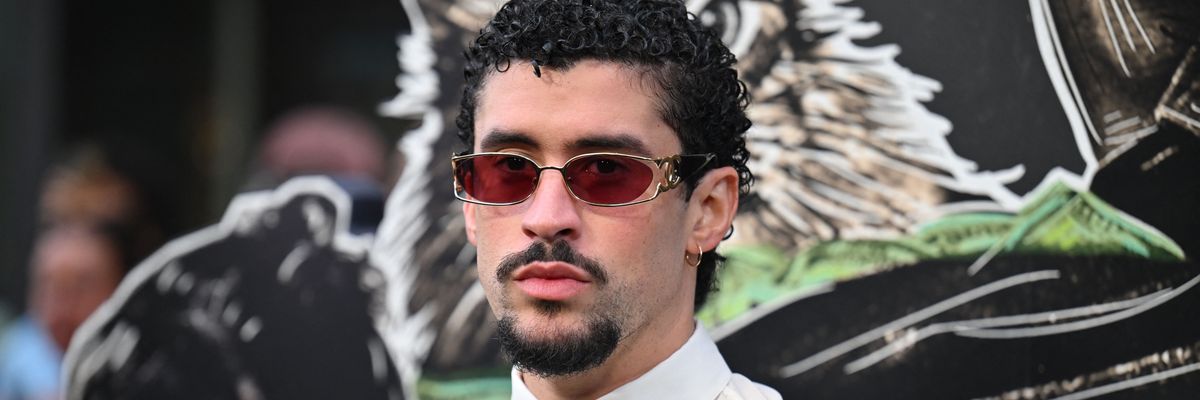
Puerto Rican singer Bad Bunny attends the premiere of "Caught Stealing" at the Regal Union Square in New York on August 26, 2025. (Photo by ANGELA WEISS/AFP via Getty Images)
Photo by ANGELA WEISS / AFP

Ernesto Sagás
Nov 08, 2025
Common Dreams

The selection of musical megastar Bad Bunny to headline the Super Bowl’s halftime show has ignited a storm of controversy among conservative circles. The ostensive reason is that Bad Bunny (born Benito Antonio Martínez Ocasio) is a Puerto Rican who sings in Spanish, and thus according to his MAGA critics, he does not represent “America.”

For the new form of conservativism known as MAGA, the vision of America and Americans is narrow, and does not include the likes of Bad Bunny. Newsmax host Greg Kelly, for instance, claimed Bad Bunny “hates America, hates President Trump, hates ICE, [and] hates the English language!” Fox News host Tomi Lahren, meanwhile, claimed Bad Bunny is “Not an American artist.” Republican House Speaker Mike Johnson not only mislabeled Bad Bunny as “Bad Bunny Rabbit,” he argued Bad Bunny was not a role model, calling for replacing him with someone with “broader Appeal,” like 82-year-old Lee Greenwood.

The Bad Bunny controversy raises the question: what is America and how should it be represented?

The histrionics of MAGA leaders exemplify how the ill-formed and culturally biased so easily make fools of themselves. For instance, the trope that Bad Bunny is not American demonstrates profound ignorance. Bad Bunny was born in Bayamon, Puerto Rico. As such, he was a United States citizen at birth. Puerto Rico has been a US possession since its conquest in 1898, and its residents have been US citizens since the passage of the Jones Act in 1917.

As for Bad Bunny hating America, this claim is nothing short of odd. Though Bad Bunny did not support candidate Trump in 2024, and disagrees with ICE roundups, 75 million Americans did not vote for President Trump (something that residents of Puerto Rico cannot do), and we suspect millions of others, including the authors here, do not support mass ICE roundups. Such free speech stances, which are at the core of the First Amendment of the Constitution, in no way reflect any disdain for this country. As James Baldwin poignantly taught decades ago, and is the case for millions of others today, it is our love for this country that leads us to question it in order to push it towards our laudable goals of freedom and equality.

Further, Bad Bunny singing in Spanish in no way means he hates this country or its dominant language, English. Bad Bunny is fluent in English but prefers to sing in his native tongue of Spanish. While Trump proclaimed English as the country’s official language, such a declaration does not carry the weight of law. That edict also appears to run afoul of a host of US Supreme Court decisions embracing our multicultural and multilingual country, including Meyer v. Nebraska, which held invalid efforts to forbid teaching foreign languages, and Lau v. Nichols. holding that failure to provide non-English instruction violated students’ civil rights.

The United States of America is a multicultural, multiracial nation made up of the descendants of immigrants from all over the world, as well as Indigenous nations and other lands that were conquered during a period of US imperial expansion in the 19th century. Puerto Ricans have fought bravely and died valiantly in America’s wars since WWI, and they contribute in numerous ways to make America great. So, why being a Spanish-speaking Puerto Rican makes of Bad Bunny less of an American in MAGA cohorts?

For months now, we have been witnessing a whitewashing of the American experience spearheaded by the Trump administration. Museums, colleges and universities, and even our very diverse military have all been forced to scrub references to the valuable contributions made by women, people of color, and immigrants (except for white ones).

Puerto Ricans, a Spanish-speaking, Latin American people of color (who also happen to be US citizens), do not fit the MAGA mold, and Bad Bunny’s fame is a reminder that our nation, based on the principle of E pluribus unum (Out of many, one) can be proudly represented by many people in many ways.

Previous Super Bowl halftime performers, many of them foreign-born, have reflected our nation’s best (and diverse) talents, but suddenly, a Puerto Rican is not American enough? Turning Point USA’s “All American” alternative halftime show is quite revealing of MAGA’s cultural whitewashing attempts by promising “Anything in English.”

This piece was first published in the Miami Herald.

Our work is licensed under Creative Commons (CC BY-NC-ND 3.0). Feel free to republish and share widely.


Ediberto Roman
Ediberto Roman is professor of Law & Director of Immigration and Citizenship Initiatives at Florida International University.
Full Bio >

Ernesto Sagás
Ernesto Sagás is Professor of Ethnic Studies at Colorado State University. He has a Ph.D. in political science from the University of Florida with a concentration in Latin American studies.
Full Bio >


Bad Bunny and Puerto Rican Muslims: How both remix what it means to be Boricua

(The Conversation) — Like Bad Bunny’s music, Puerto Rican Muslims’ lives challenge ideas about race, religion and belonging in the Americas.


The Mezquita Al-Madinah in Hatillo, Puerto Rico, about an hour west of San Juan, is one of several mosques and Islamic centers on the island. 


Ken Chitwood
November 6, 2025

(The Conversation) — Bad Bunny, born Benito Antonio Martínez Ocasio, is more than a global music phenomenon; he’s a bona fide symbol of Puerto Rico.

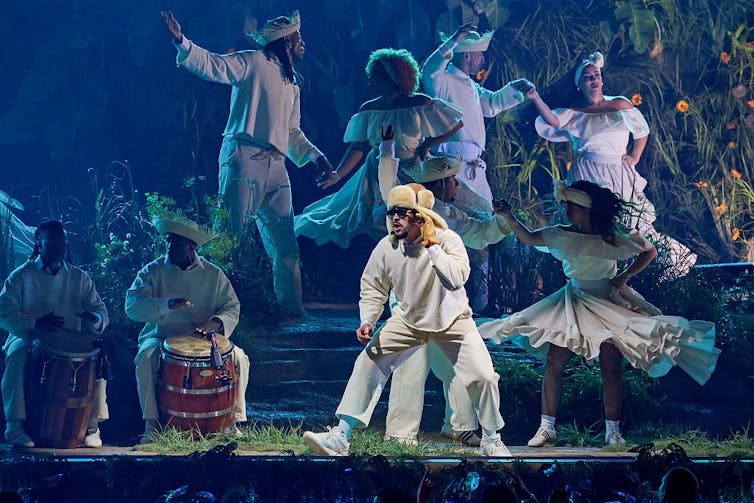
The church choir boy turned “King of Latin Trap” has songs, style and swagger that reflect the island’s mix of pride, pain and creative resilience. His music mixes reggaetón beats with the sounds of Puerto Rican history and everyday life, where devotion and defiance often live side by side.

Bad Bunny has been called one of Puerto Rico’s “loudest and proudest voices.” Songs like “El Apagón” – “The Blackout” – celebrate joy and protest together, honoring everyday acts of resistance to colonial rule and injustice in Puerto Rican life. Others, like “NUEVAYoL,” celebrate the sounds and vibrancy of its diaspora – especially in New York City. Some songs, like “RLNDT,” mention spiritual searching – featuring allusions to his own Catholic upbringing, sacred and secular divides, New Age astrology and Spiritism.

As a scholar of religion who recently wrote a book about Puerto Rican Muslims, I find echoes of that same strength and artistry in their stories. Although marginalized among Muslims, Puerto Ricans and other U.S. citizens, they find fresh ways to express their cultural heritage and practice their faith, creating new communities and connections along the way. Similar to Bad Bunny’s music, Puerto Rican Muslims’ lives challenge how we think about race, religion and belonging in the Americas.


Bad Bunny performs during his ‘No Me Quiero Ir De Aqui’ residency on July 11, 2025, in San Juan, Puerto Rico.
Kevin Mazur/Getty Images


Stories of struggle

There are no exact numbers, but before recent crises, Puerto Rico – an archipelago of 3.2. million people – had about 3,500 to 5,000 Muslims, many of them Palestinian. Economic hardship, natural disasters such as hurricanes Irma and Maria, and government neglect have since forced many to leave, however.

As of 2017, there were also an estimated 11,000 to 15,400 Puerto Rican Muslims among the nearly 6 million Puerto Ricans and nearly 4 million Muslims in the United States.

Like any Puerto Rican, these Muslims know the struggles of colonialism’s ongoing impactfrom blackouts and economic inequality to racism. For example, in the viral 23-minute video for “El Apagón,” journalist Bianca Graulau outlines how tax incentives for external investors are displacing locals – a theme reinforced in Bad Bunny’s later song, “Lo Que Le Pasó a Hawaii.”

The video for “El Apagón” includes a short documentary about gentrification on the archipelago.

Converts to Islam also face unique challenges – and not just Islamophobia. Many are told they are “not real Puerto Ricans” because of their newfound faith. Some are treated as foreigners in their own families and friend groups, often asked whether they are abandoning their culture to “become Arab.”

To be a Puerto Rican Muslim, then, is to negotiate being and belonging at numerous intersections of diversity and difference.

Still, some connect their Muslim identity to moments in Puerto Rican history. In interviews, they told me how they identify with Muslims who came with Spanish conquistadors during colonial times. Others draw inspiration from enslaved Africans brought to the Caribbean. Many of them were Muslim and resisted their condition in ways large and small: fleeing to the forest to pray, for example, or living as “maroons” – people who escaped and formed their own communities.

Many ways to be Puerto Rican


Puerto Rican culture cannot be neatly mapped onto a single tradition. The archipelago’s religion, music and art blend together influences from Indigenous Taíno, African, Spanish and American cultures. Religious processions pass by cars blasting reggaetón. Shrines to Our Lady of Divine Providence stand beside U.S. chain restaurants and murals demanding independence.

Bad Bunny embodies this fusion. He is rebellious yet rooted, irreverent yet deeply Puerto Rican. His music blends contemporary sounds from reggaetón and Latin trap with traditional “bomba y plena.” It all adds up to something distinctly “Boricua,” a term for Puerto Ricans drawn from the Indigenous Taíno name for the island, “Borikén.”


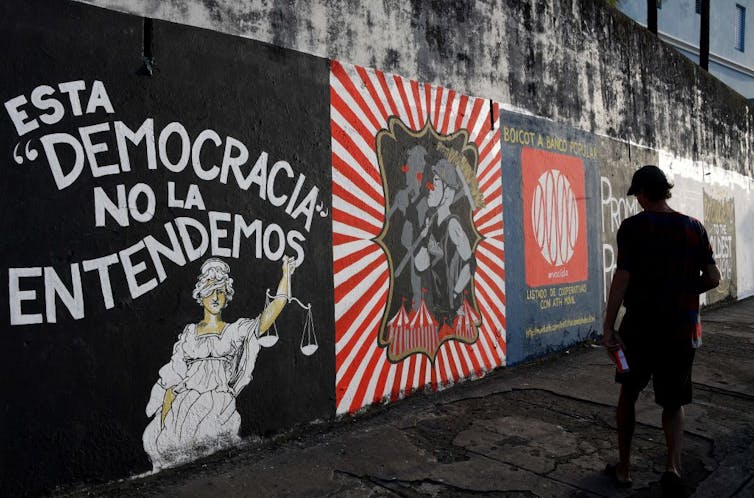
A mural in San Juan, Puerto Rico, photographed in 2017, says, ‘We don’t understand this democracy.’
Mark Ralston/AFP via Getty Images

Puerto Rican Muslims wrestle with what it means to be authentically Boricua, though. In particular, their lives reveal how religion is both a boundary and a bridge: defining belonging while creating new ways to imagine it.

Since Spanish colonization in the 1500s, most Puerto Ricans have been Roman Catholic. But over the past two centuries, many other Christian groups have arrived, including Seventh-day Adventists, Lutherans and Pentecostals. Today, more than half of Puerto Ricans identify as Catholic and about one-third as Protestant.

Alongside these traditions, Afro-Caribbean traditions such as Santería, Espiritismo and Santerismo – a mix of the two – remain active. There are also small communities of JewsRastafari and Muslims.

Even with this diversity, converts to Islam are sometimes accused of betraying their culture. One young man told me that when he became Muslim, his mother said he had not only betrayed Christ but also “our culture.”

Yet Puerto Rican Muslims point to Arabic influences in Spanish words. They celebrate traces of Islamic design in colonial and revival architecture that reflects Muslims’ multicentury presence in Spain, from the 700s until the fall of the last Muslim kingdom in Granada in 1492. They also cook up halal versions of classic Puerto Rican dishes.

Like Bad Bunny, these converts remix what it means to be Puerto Rican, showing how Puerto Rico’s sense of identity – or “puertorriqueñidad” – is not exclusively Christian, but complex and constantly evolving.


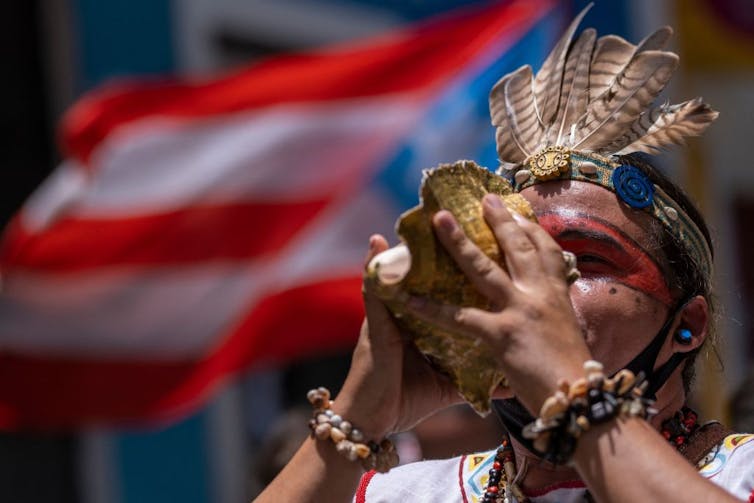
A member of the Council in Defense of the Indigenous Rights of Boriken, dressed in Taino traditional clothing, sounds a conch during a march through San Juan, Puerto Rico, on July 11, 2020.
Ricardo Arduengo/AFP via Getty Images


In solidarity


Many Puerto Rican converts frame their faith as a counternarrative, rejecting the Christianity imposed by Spanish colonizers. They also resist Islamophobia, racism and foreign domination, with some converts drawn to the religion as a way to oppose these forces. Similar to Bad Bunny’s music, which often critiques colonialism and social constraints, they push back against systems that try to define who they can be.

To that end, Puerto Rican Muslims also build connections with other groups facing injustice. In reggaetón terms, they form their own “corillos” – groups of friends – united by shared struggles.

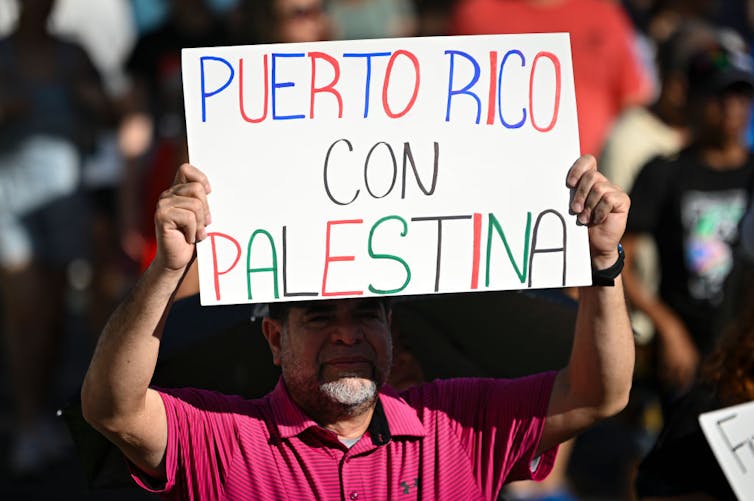
They demonstrate on behalf of Palestinians, seeing them as another colonized people without a nation. The first Latino Muslim organization, Alianza Islámica – founded by Puerto Rican converts in 1987 – emerged out of the era’s push for minorities’ rights around the New York City metro area. And after the 2016 Pulse Nightclub shooting, where about half of the 49 victims killed were Puerto Rican, and the mosque attended by the shooter was intentionally set on fire, Boricua Muslims joined with LGBTQ+, Muslim and Latino communities to grieve and demand justice.


Pro-Palestine supporters attend a rally to end the war on Nov. 12, 2023, in San Juan, Puerto Rico.
Miguel J. Rodríguez Carrillo/VIEWpress via Getty Images

In these ways, Puerto Rican Muslims remind me that notions of community, identity or justice do not stand on their own. For many people, they are linked – parts of the same fight for dignity and freedom.

That is why, when I listen to songs like “NUEVAYoL” or “El Apagón,” I think of the Puerto Rican Muslims I know in places such as Puerto Rico, Florida, New Jersey, Texas and New York. Their stories, like Bad Bunny’s music, show how being Puerto Rican today means constantly negotiating who you are and where you belong. And that religion, like music, can carry the sound of struggle – but also the hope of one day overcoming the injustices and inequalities of everyday life.

(Ken Chitwood, Affiliate Researcher, Religion and Civic Culture Center, USC Dornsife College of Letters, Arts and Sciences; Bayreuth University. The views expressed in this commentary do not necessarily reflect those of Religion News Service.)


The Conversation religion coverage receives support through the AP’s collaboration with The Conversation US, with funding from Lilly Endowment Inc. The Conversation is solely responsible for this content.
FELLOW WORKER DOROTHY DAY

On Dorothy Day’s birthday, the life and work of the last living Catholic Worker who knew her

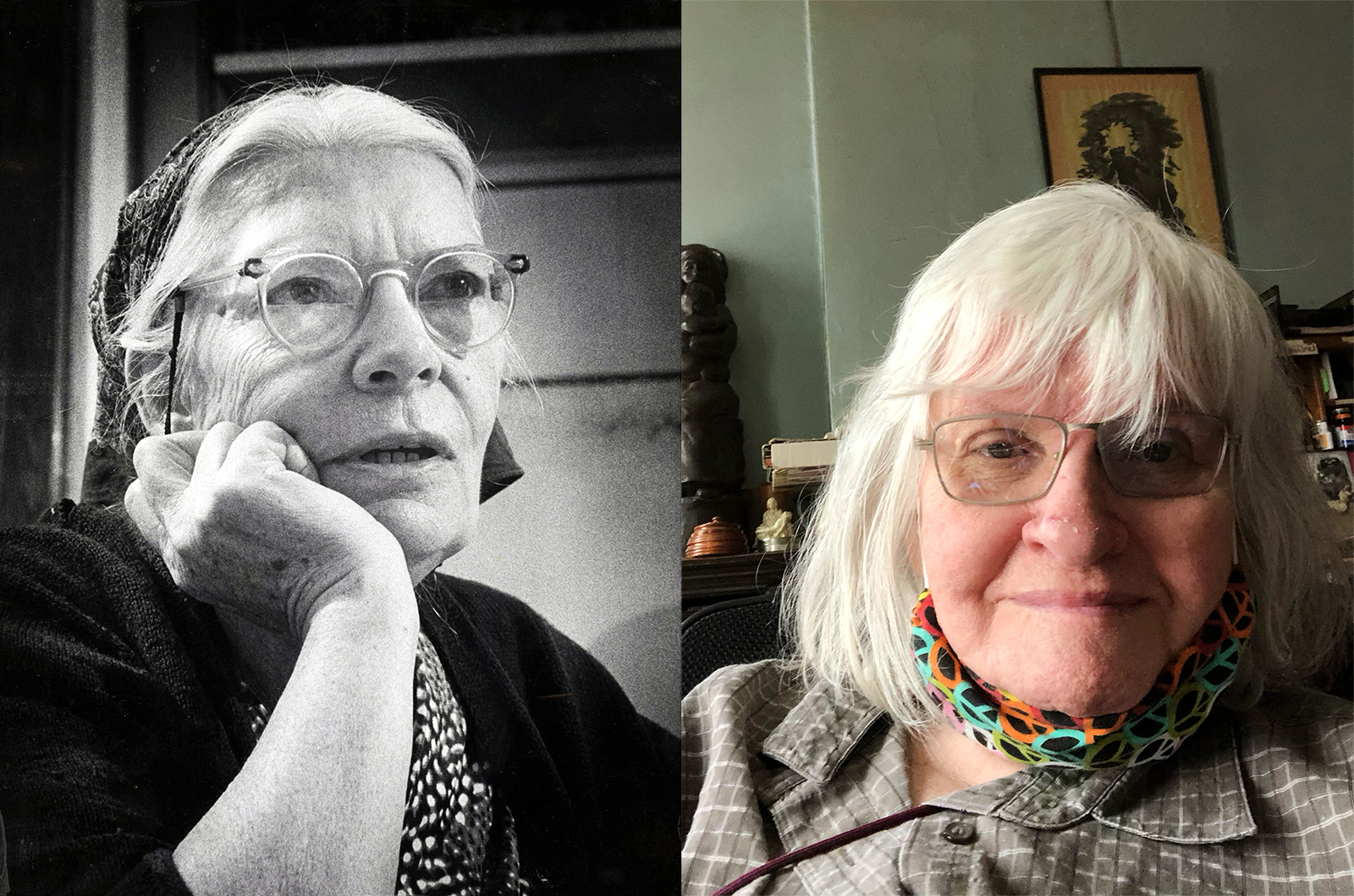
NEW YORK (RNS) — Jane Sammon is the only Catholic Worker still living in one of the original Houses of Hospitality who worked with Dorothy Day, now a candidate for sainthood.


Dorothy Day in 1968, left, and Jane Sammon in 2025.
 (Photo courtesy Milwaukee Journal/Marquette University Archives; courtesy of Sammon)

Fiona Murphy
November 7, 2025
RNS


NEW YORK (RNS) — Jane Sammon was terrified the first time she met Dorothy Day, the Catholic Worker founder now being considered for sainthood by Rome.

“ I was at the front mopping the floor, and I thought my stomach would drop out,” Sammon said. “It’s like that saying, ‘Jesus is coming look busy,’ you know? Well, Dorothy is coming, look busy!”

It was 1972, and at 25, Sammon had traveled from Cleveland, Ohio, to St. Joseph’s House, a house of hospitality in Manhattan run by Dorothy Day and other members of the Catholic Worker, eager to see a place where Catholics were standing “unequivocally” against the Vietnam War. Staying with friends in Brooklyn, Sammon one day decided to visit St. Joseph’s House on E 1st Street. The rest, she said, is something of a mystery.

Decades later, Sammon is the only member still living in the movement’s New York Houses of Hospitality who lived and worked alongside Day, a woman known worldwide for feeding the poor and advocating for workers’ rights. Since 1933, when The Catholic Worker newspaper was founded, the world around the movement has changed, but Sammon says Day’s presence still looms large.

“ I don’t think anybody else in this house could say they knew Dorothy in the flesh,” Sammon said. “But for me, and this is the big thing, I think we could all know Dorothy Day the way we know Jesus.”

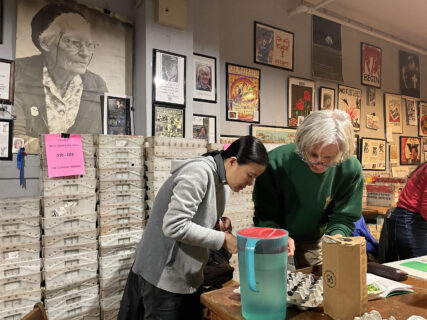
Fifty-three years have passed, and Sammon, 78, has spent most of her life within a two-block radius, living and working at St. Joseph’s House and Maryhouse. The Catholic Worker movement is a community founded by Day in New York through the first houses of hospitality, rooted in voluntary poverty and dedicated to living among and serving the poor in faith and solidarity.

“She’s been a very constant presence in that house,” Martha Hennessy, the granddaughter of Day, said. “She’s been very dedicated to Maryhouse, to the movement and to Dorothy.”

Saturday, Nov. 8, is Dorothy Day’s birthday. Day, with the title “Servant of God,” is currently in the first formal stage in the canonization process. The diocese’s collection of evidence and testimonies about her life has been sent to the Vatican’s Dicastery for the Causes of the Saints for review and approval, at which point Pope Leo would declare her “Venerable,” recognizing she lived a life of heroic virtue. After that, the beatification and canonization process generally requires two miracles attributed to her intercession.


Martha Hennessy, right, Dorothy Day’s granddaughter and a member of New York’s Maryhouse Catholic Worker community, reads an excerpt from her grandmother’s book “On Pilgrimage” in the courtyard of the Vineapple Cafe in New York, Dec. 8, 2021. (RNS photo/Renée Roden)

RELATED: Evidence of Dorothy Day’s ‘everyday’ sainthood heads to Rome, boxed and beribboned

Even after all these years, Sammon’s first encounter with Dorothy stays in her mind. “Her voice… it was very disarming to me,” said Sammon, who, with a mop in hand, recalls that in her mid-20s, she expected the then-75-year-old Day to sound old or possibly crotchety, but she didn’t.

The two shared a brief conversation about who Sammon was and where she was from, and little did either of them know, Sammon would be bringing Day medicine on her deathbed eight years later, in a room four floors above where Sammon lives now. Day died in 1980, just 21 days after her 83rd birthday.

“The last thing she said to me was, ‘and I really want to thank you,’” Sammon said. “And I said, ‘OK, Dorothy.’” At the time, Sammon and Day had lived on the same floor of Maryhouse for several years. “She said it to be comforting, in a way,” Sammon said.

Today, Maryhouse and St. Joseph House still feed hundreds of New Yorkers every week and together house about 50 people. From Tuesday to Friday, Catholic Workers at Maryhouse, some volunteers, others residents, prepare lunch for dozens of vulnerable women.


Lunch service is prepared at Maryhouse in New York City. (RNS photo/Fiona Murphy)

On Friday nights, the auditorium at Maryhouse fills for what Peter Maurin, the French Catholic visionary and co-founder of the movement, called a “Clarification of Thought,” a gathering where activists, filmmakers, musicians, theologians and other thinkers share their ideas and projects.

“Jane is all of our mentor and a pillar in the community,” said Joanne Kennedy, 56, who first came to the New York Catholic Worker in 1995 and later lived at both St. Joseph’s House and Maryhouse. “It’s her home with a lot of other people, but she’s been one long, continuous strand, and that deserves a proper kind of reverence.”

Sammon has written a column for The Catholic Worker newspaper, still printed monthly, since Day’s death in 1980. The column, titled “The Book of Notes,” chronicles everyday life at the Worker and is published under the pen name Ric Rhetor, a play on the word “rhetoric.”

“It is the most popular thing, hands down, the most-read column in the paper on the regular,” said Kennedy. “It’s one of the only things that’s always in it.”

Fellow Catholic Worker Bernie Connaughton, 70, describes an evening in 2000 when he and Sammon were serving sandwiches in a subway station. Connaughton said police began harassing a homeless man on the stairs, and “Jane went right over to the cop and said, ‘Don’t you talk to him that way, officer,’” Connaughton recalls. “’He deserves respect.’”

“She can’t help herself,” Connaughton said. “She can’t stay quiet when she sees something wrong. That can work for good or bad, but it’s who she is.”


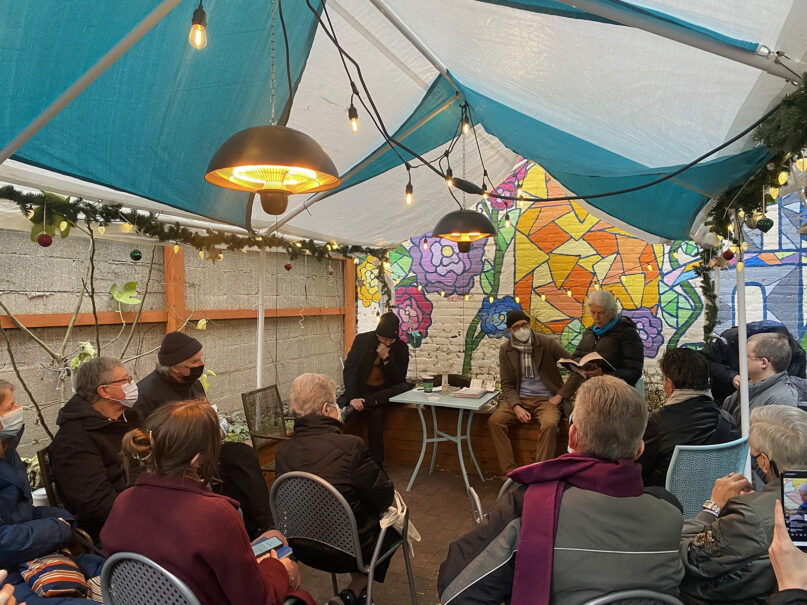
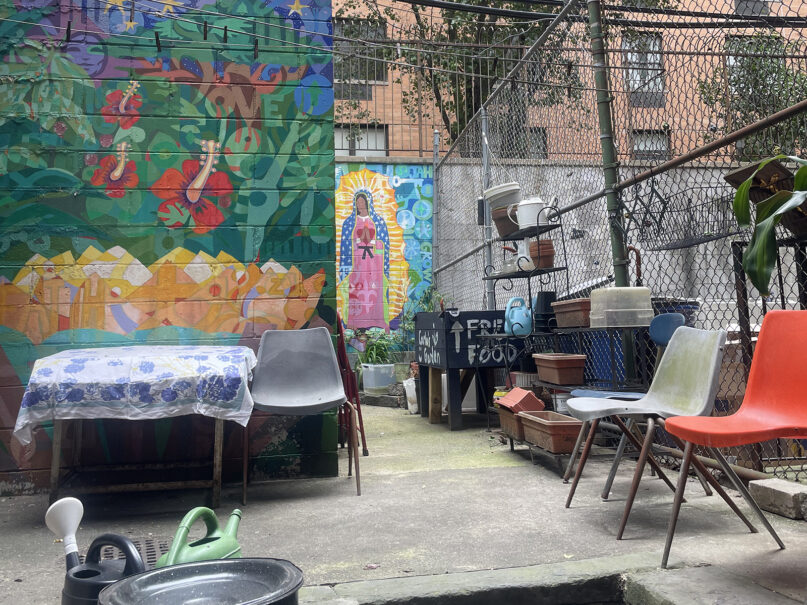
The communal backyard of the Catholic Worker’s Maryhouse in New York City. (RNS photo/Fiona Murphy)

Sammon grew up in a devout Catholic family in Cleveland, where her father, Leo, worked as a steam fitter and was involved in the Association of Catholic Trade Unionists. Her mother, Cecilia, who died when Jane was just 11, “had a heart for poor people,” Sammon said. When she was 10 years old, Sammon said her father first told her about Dorothy Day.

Years later, inspired by reading The Catholic Worker newspaper and its call to the works of mercy and its radical stance on peace, Sammon moved to New York with piqued interest. She describes “a trifecta” that drew her to the movement: the Catholic Workers’ genuine love for the Catholic Church, their willingness to live in voluntary poverty and their readiness to risk jail opposing the Vietnam War.

“This idea that your beliefs might have engendered an idea that would cause you to get arrested — and they were willing to do that,” Sammon said. “That was it. And then when I got here, they also had some good fun.”


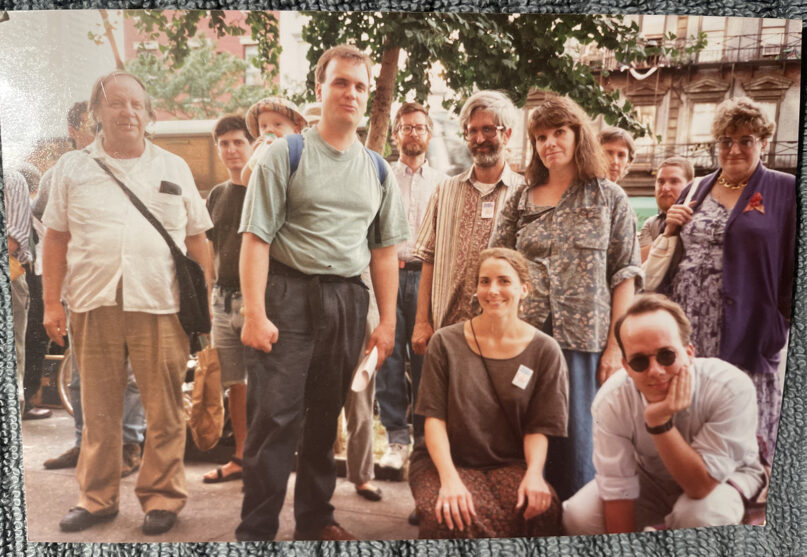
Jane Sammon, standing second from right, and fellow Catholic Worker community members in a photo from the late 1980s or early 1990s. (Photo courtesy of Sammon)

Sammon now faces health issues that make it difficult for her to walk. She said she does “considerably” less at the Catholic Worker than in years past. She still writes her column and helps organize some Friday night events. She continues to run Maryhouse on Sundays, a tradition she began more than a decade ago to give other residents a day of rest.

Today, new faces come through the Catholic Worker often. Maryhouse hosts an Integral Ecology Circle of approximately 50 members, mostly under age 40, who recently added a rooftop garden to provide fresh food.

Members of the Catholic Worker’s Integral Ecology Circle plant vegetable seedlings at the Maryhouse auditorium in New York City in March 2024. A photo of Dorothy Day, left, oversees the room. (RNS photo/Fiona Murphy)

The rooftop garden at Maryhouse in New York City. (RNS photo/Fiona Murphy)

RELATED: New York Catholic Workers bring new growth with rooftop garden

“I think I feel like I’m married to this place in a way,” said Sammon, who never married or had children and plans to continue her vow of poverty through the end of her life. “A lot of people find it very hard to understand choosing this lack of material success — to say you don’t want to have it — when there are others who never even had the chance to know whether they could choose that or not.

“What does it mean to be poor? I think at the Catholic Worker it’s a religious understanding,” she added.

In the archives at Maryhouse, there’s a short recording of a conversation between Sammon and Day, from when Sammon was still in her 20s. Day was speaking with a priest about nonviolence and Catholicism in the office at St. Joseph’s House when Sammon walked in looking for a pair of shoes.

“Dorothy said, ‘Come in, come in, what do you want? You can have anything!’” Sammon said. “I laughed, I said, ‘anything?'”


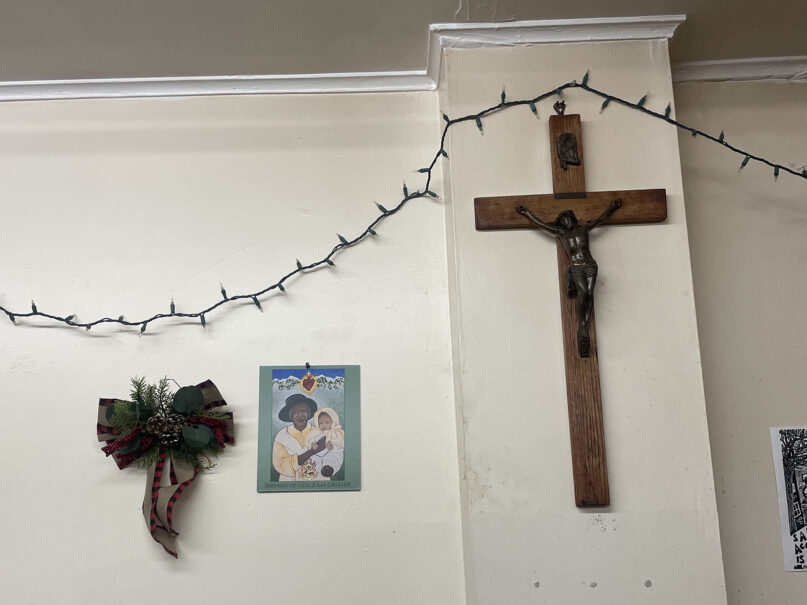
Decorations adorn Catholic Worker’s St. Joseph’s House in New York City. (RNS photo/Fiona Murphy)

Though Day has been gone for many years, Sammon said there’s no need to dwell on that.

“You’re able to learn from so many people at the Catholic Worker, not only the Dorothy Day person,” Sammon said. “But some woman who walks in, who’s lived out on the street, who just tells you about life in a way that you didn’t know before. And that’s the idea.”

There will be a Mass held at Maryhouse on E 3rd Street at 7 p.m. on Saturday evening, Nov. 8, dedicated to Dorothy Day.


Republican pollster warns GOP to abandon the word 'capitalism'


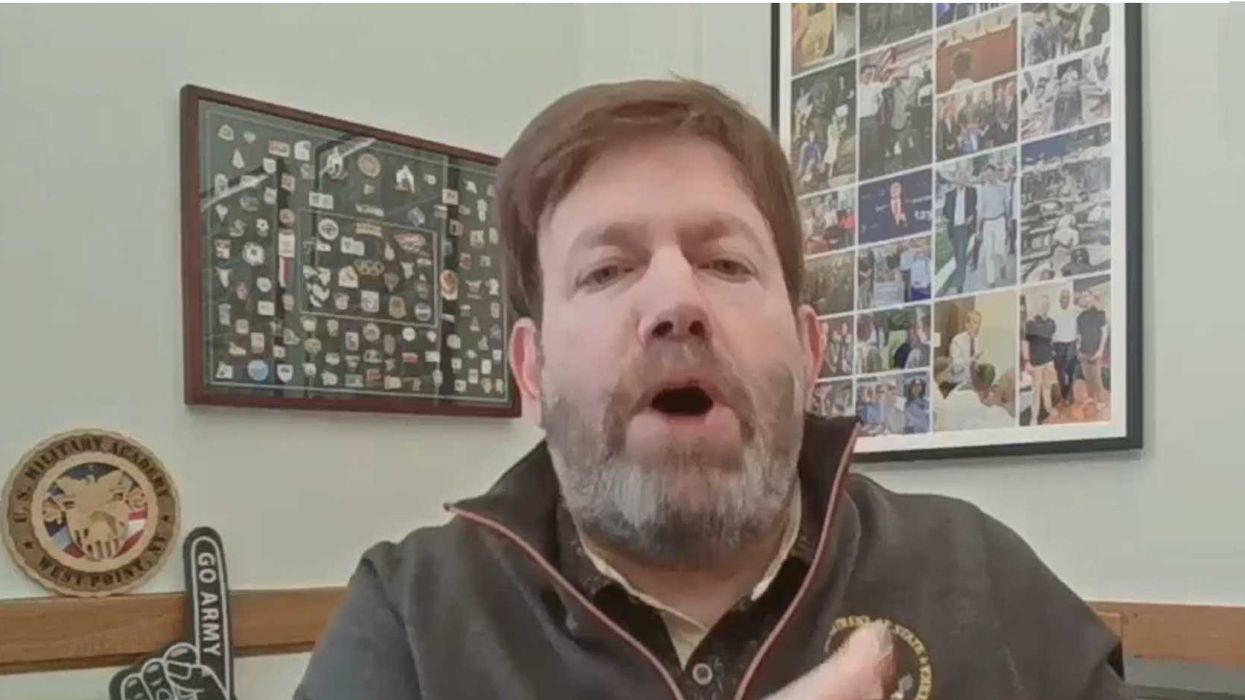
Republican communication strategist Frank Luntz (YouTube Screengrab)

November 08, 2025 | ALTERNET

Ronald Reagan Republican and GOP strategist Frank Luntz says the word “capitalism” has become a dirty word that Republicans must avoid if they want to win election in the aftermath of Zohran Mamdani.

With communication strategist Luntz, winning elections is primarily about messaging, and the word ”capitalism” is no longer a winning message as billionaire “capitalists” accrue most of the wealth and leave Americans worrying about their rent and food pantries. Just recently, the Top 10 U.S. billionaires’ collective wealth grew by nearly $700 billion and analysts warned government policies are driving inequality to new heights.

“Is it fair that some people's children will be born billionaires without having to work a day in their life, while others will work two or three jobs just to put food on their table and a roof over their heads,” Luntz asked CNN anchor Michale Smerconish. “Second, is it fair that some schools have all the technology, all the resources, and others can't even afford books or chalk?”

“Why do I ask that? Because you can see it. You can visualize it,” said Luntz, who correctly predicted Tuesday’s off-year elections would “go badly” for the Republican Party. “And third, does everyone … who works hard and plays by the rules — shouldn’t they have a genuine shot at the American dream? These are the questions that you ask at the beginning to bring audiences over to you. And without asking those questions, you're cutting people out.”

“[Democratic socialist Sen.] Bernie Sanders is on Line 2 for you because he's finding this pretty convincing,” Smerconish responded, and then asked Luntz if the U.S. would “be properly cast as a democratic socialist nation” by 2050.

“It’s already happening,” said Luntz. “I work with young people all across the country. Under age 30, they prefer socialism to capitalism already. The 30s, they are about dead even. It's only when you get to be older 40 that you become more supportive [of capitalism].”

“We should be calling it ‘economic freedom,’ not capitalism, because capitalism is about CEOs,” Luntz added. “It's about billionaires, and it's about Wall Street. Economic freedom is about Main Street, about the workforce and about the opportunities for the future. And I want to give you one bit of language that whoever wins this wins the entire debate, whether it's capitalism or socialism.”

Whether or not they vote that way, Luntz advised Republicans to sell America as “a place for new ideas, better solutions and where good people thrive if we want to move forward as a country … and no one is left behind.”

“Whoever controls that language wins the debate,” he said.

“I think AOC, Mamdani and Bernie are all going to be clamoring for your services after the first part of our exchange,” said Smerconish — but Luntz jettisoned any notion that he stood behind the policies of the three politicians.

“They won’t get it,” Luntz said.


Wealth Taxes Will Barely Slow Inequality. So Why Do the Super-Rich Resist Them?

A 2 percent wealth tax is like shaving off a fraction of a spire from a large cathedral, says economist 
Nancy Folbre.
November 5, 2025

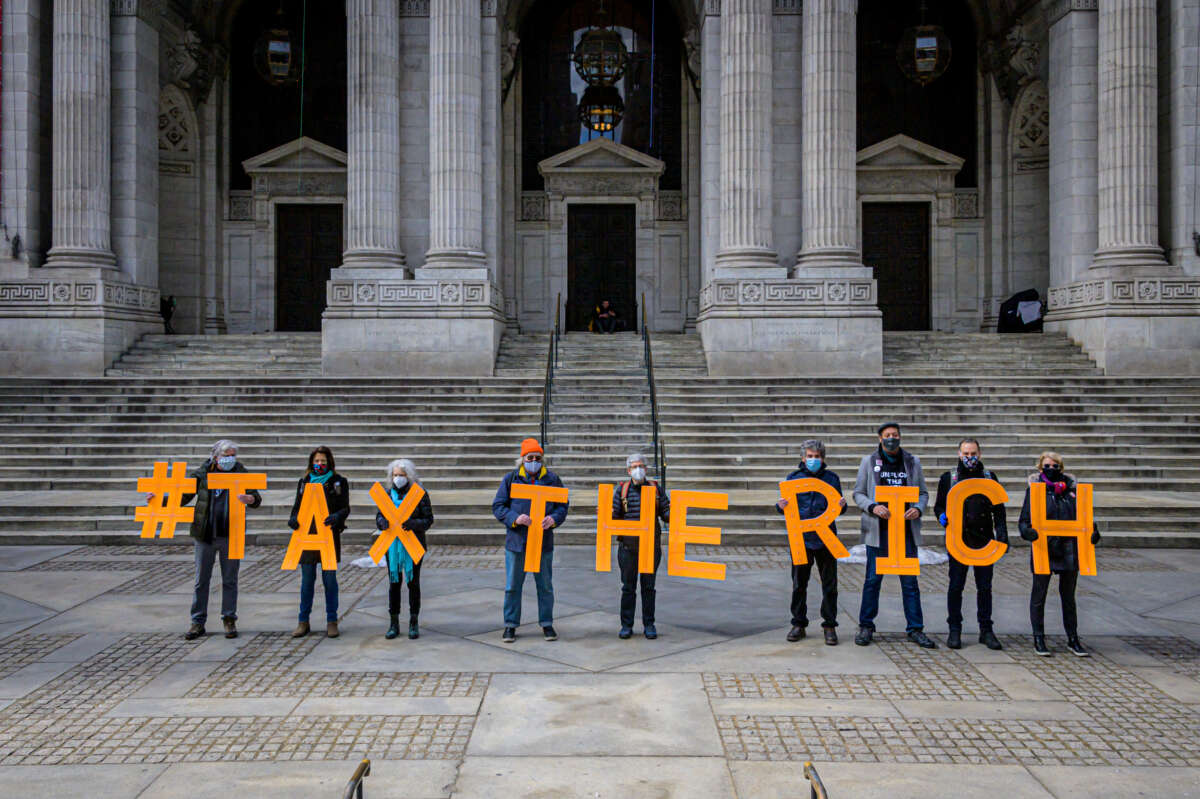
People spell out #TaxTheRich at the New York Public Library in New York City in March 2021.Erik McGregor / LightRocket via Getty Images


Zohran Mamdani’s historic victory for the working class in the financial capital of the world is a reflection of the growing appeal of bold platforms that attack extreme inequality and oligarchy and move toward a more equitable and just society. Inequality, to be sure, is one of the biggest social problems facing many countries across the globe. The gap between haves and have-nots has grown to such extreme levels that it threatens social stability by undermining both democratic governance and economic sustainability. And how could it be otherwise when the richest 1 percent own more wealth than 95 percent of humanity? In the United States, a country with wealth disparities greater than all other major developed nations, the richest 1 percent holds approximately 31 percent of the nation’s total wealth while the top 50 percent owns 98 percent of the total share of U.S. wealth.

In the light of this deeply disturbing data, it is hardly surprising that there is a proliferation of voices calling for the implementation of measures to reduce economic inequality. In France, the so-called Zucman tax proposal has become the hottest topic in the country, and although lawmakers in France’s lower house have just rejected multiple proposals for taxing the ultra-rich, the fight is not over. In the United States, a group of Democrats in Congress has recently introduced the Billionaires Income Tax Act, and labor and health groups in California have proposed a 5 percent wealth tax on the state’s billionaires to offset billions in federal funding cuts to healthcare. As further evidence of the political traction that the demand to tax the ultra-rich is gaining, Illinois lawmakers have proposed a one-time 4.95 percent tax on residents who hold paper assets with net worth exceeding $1 billion.

Be that as it may, and assuming that wealth tax proposals are politically viable and can withstand the challenges posed to them by the ruling and oligarch class and its various allies, are they sufficient enough to reduce the stunning levels of inequality in today’s world or do we need to abolish extreme wealth altogether? Moreover, what does the structure of the U.S. tax system reveal about class warfare and does it tell us anything about the current government shutdown? Renowned socialist and feminist economist Nancy Folbre shares her insights into these and other critical questions on the political efforts to tax the top and their economic ramifications. Folbre is professor emerita of economics and director of the Program on Gender and Care Work at the Political Economy Research Institute (PERI) at the University of Massachusetts Amherst.


C.J. Polychroniou: Across the world, proposals to tax the ultra-rich in order to tackle soaring inequality are gaining momentum. Indeed, many options have been put on the table, ranging from new taxes on capital income and higher income tax rates to a global wealth tax. Why is taxing the ultra-rich considered to be of such critical importance given that inequality is part of the foundation of capitalist economies? Will it actually close the wealth gap?

Nancy Folbre: I’m not sure that such proposals are gaining momentum, but they’re certainly generating publicity, and in the process, raising awareness of the increasingly extreme concentration of income and wealth on every level. Global inequality is especially shocking, and economist Gabriel Zucman has explained how nations could collectively move toward a global tax of 2 percent on the wealth of billionaires. Brazil has been a key proponent, bringing it to table at international meetings. Given the current structure of global political institutions, feasibility seems pretty remote.

Could such a wealth tax actually lower wealth inequality? Probably not, even if implemented on a national level. At best it could slow the trend that Thomas Piketty, among others, has documented: the increasing concentration that results when wealth grows faster than the economy as a whole — as riches beget riches.

One can only wonder where and when this trend will come to an end. The Marxian vision of a declining rate of profit leading to capitalist crisis has been displaced by a more dystopian vision of relentless and endless accumulation of money and power. The anxiety this vision provokes — and the threat to democracy that it portends — explains why the words “wealth tax” cross more politicians’ lips than they have in the past.

However, inequality itself seems less a political concern than the difficulty of financing the social reproduction of the population in a period of increasing inequality and social division — or, in more everyday language — paying for the “welfare state.” In the current political environment, large deficits and ballooning public debt can only go so far before they run up against the need to either increase taxes or cut spending, and working-class voters who feel economically left-behind are furious at the thought of being asked to pay more or make do with less.

What do you think of the so-called Zucman tax which is causing quite a stir in France? It involves levying a 2 percent tax on households whose income exceeds 100 million euros. But let’s assume that this proposal was also going to be implemented in the United States and across the globe. Is a 2 percent tax on the ultra-rich sufficient to reduce inequality?

Widespread public support for a 2 percent wealth tax in France has been largely driven by such practical concerns — using the resulting revenues to avoid cuts in social spending and retirement benefits. A September poll showed support from 86 percent of respondents, partly because the proposal was designed to affect only about 1,800 households. It other words, it singles out the group you’ve described as the “ultra-rich.”

This hardly seems sufficient to significantly reduce overall inequality. You could think of it as shaving about 2 percent off the tall spire of a large cathedral of wealth. Yet the proposal has great symbolic valence, dramatizing inequality and raising fundamental questions about fairness — which is exactly why it faces fierce resistance.

Can you discuss a bit the nature of the overall structure of taxation in the U.S. and whether, in particular, it reflects who’s winning the capital-labor class struggle? Also, does it help to explain the government shutdown?

In the U.S., most attention gets focused on the federal income tax, because it is a major source of revenue, but also because Republicans have consistently pushed to reduce the tax rate on high incomes. Conservative advocates of supply-side economics have insistently claimed that this would promote economic growth, making everyone better off. No evidence supports this claim.

Policies that impose a higher tax rate on higher income individuals are labeled “progressive” and those that do the opposite, “regressive.” Both political parties have colluded in policies that have reduced progressivity steadily since the 1960s. The highest marginal tax rate (the rate on taxable income in the highest bracket) fell from about 91 percent to about 35 percent in the early 2000s. Also since the 1960s, corporate income taxes have fallen by about half even as payroll taxes increased.

Back in 2006, the famously successful investor Warren Buffet actually complained that his secretary faced a higher tax rate on her earnings than he did on increases in his wealth, which included capital gains that went completely untaxed. As he put it, “There’s class warfare, all right, but it’s my class, the rich class, that’s making war, and we are winning.”

Notice that this is a very different kind of class struggle than one over profits and wages at the point of production. It’s a struggle over the social wage, payment for health, retirement, and safety net benefits that are more efficiently provided through the state than by the private sector, benefits that have been won through a process of democratic political bargaining.

Employers have obvious economic incentives to oppose increases in the social wage, if they are forced to pay for them. However, public social spending can enable them to keep wages lower by shifting some of the costs of reproducing workers to the public as a whole. This is why the incidence of taxation really matters. Increases in the social wage, such as the expansion of health insurance benefits, have partially compensated for fifty years of stagnation in the inflation-adjusted earnings of the majority of employees in the U.S. In recent years, however, even this partial compensation has declined, and it is currently under direct attack.

The Trump administration has been doing everything in its power to cut taxes for the rich and cut social benefits for low- and middle-income families (see this dissection of the so-called Big Beautiful Bill passed last summer). The current shutdown of the U.S. government is a showdown, with Democrats reduced to rather desperate efforts to simply hold the line by insisting on the maintenance of health care subsidies for the Affordable Care Act.

Indignant taxpayers who believe they are paying more than their fair share point to federal income taxes, which are relatively progressive, partly because many Americans don’t even earn enough to pay them. But federal income taxes account for only about half of total tax revenues, and more than half of corporate income taxes are simply passed on to consumers in the form of higher prices. Other taxes, including state and local sales and property taxes, are regressive.

These regressive taxes largely countervail progressive income taxes, leading to little differential impact across the income distribution. The Institute on Taxation and Economic Policy reports that in 2024 the richest 1 percent of Americans paid about 23.9 percent of all taxes, but their share of total taxable income was 20.1 percent. This estimate does not include consideration of “unrealized capital gains” (increases in the value of their wealth). The poorest 20 percent of all Americans were estimated to pay only 1.5 percent of their income in taxes, but their share of total income was only 2.6 percent. Many of them were living in poverty because they were raising children or caring for elderly family members — activities that should be counted as contributions to our “social reproduction.”

It’s a bit complicated, isn’t it? The difficulty of sorting out who is actually paying for what surely helps explain why it has become difficult to defend — much less increase — the social wage.

In California, the Service Employees International Union (SEIU) has proposed a ballot initiative to impose a one-time 5 percent tax on billionaires. What benefits could be derived for the people of California from a wealth tax on the state’s 200 or so billionaires?

This union initiative provides yet another example of class struggle over the distribution of the costs of social reproduction. The explicit rationale of the proposal for a one-time wealth tax is to counter $30 billion in threatened federal cuts to California’s Medicaid program of health insurance for low-income families, as well as to provide more support for public education in the state.

Will it solve the state’s fiscal problems? Obviously not. But it’s a step in the right direction, like a policy that the city of Los Angeles established in 2023, imposing a higher property tax rate on extremely valuable real estate in order to help fund affordable housing — a “mansion tax.”

What about the argument that wealth taxes will cause the super-rich to flee?

Yes, this is always the threatened response, and some super-rich will probably follow through — especially those who already own multiple mansions around the world. But many wealthy individuals value their local communities enough to stay put. Here in Massachusetts, where I live, we passed a Fair Share Amendment to our state constitution in 2022 to allow a 4 percent surtax on incomes of more than a million dollars. We haven’t seen a significant exodus, and we’re using the revenue to help fund community colleges and repair potholes. I’m proud to say that my union, the Massachusetts Society of Professors, played a crucial role in winning this amendment.


This article is licensed under Creative Commons (CC BY-NC-ND 4.0), and you are free to share and republish under the terms of the license.

C.J. Polychroniou

C.J. Polychroniou is a political scientist/political economist, author and journalist who has taught and worked in numerous universities and research centers in Europe and the United States. Currently, his main research interests are in U.S. politics and the political economy of the United States, European economic integration, globalization, climate change and environmental economics, and the deconstruction of neoliberalism’s politico-economic project. He is a columnist for Global Policy Journal and a regular contributor to Truthout. He has published scores of books, including Marxist Perspectives on Imperialism: A Theoretical Analysis; Perspectives and Issues in International Political Economy (ed.); and Socialism: Crisis and Renewal (ed.), and over 1,000 articles which have appeared in a variety of journals, magazines, newspapers and popular news websites. Many of his publications have been translated into a multitude of languages, including Arabic, Chinese, Croatian, Dutch, French, German, Greek, Italian, Japanese, Portuguese, Russian, Spanish and Turkish. His latest books are Climate Crisis and the Global Green New Deal: The Political Economy of Saving the Planet (with Noam Chomsky and Robert Pollin as primary authors, 2020); The Precipice: Neoliberalism, the Pandemic, and the Urgent Need for Radical Change (an anthology of interviews with Noam Chomsky, 2021); Economics and the Left: Interviews with Progressive Economists (2021); Illegitimate Authority: Facing the Challenges of Our Time (an anthology of interviews with Noam Chomsky, 2023); and A Livable Future Is Possible: Confronting the Threats to Our Survival (an anthology of interviews with Noam Chomsky, 2024).