HANDS OFF COLOMBIA
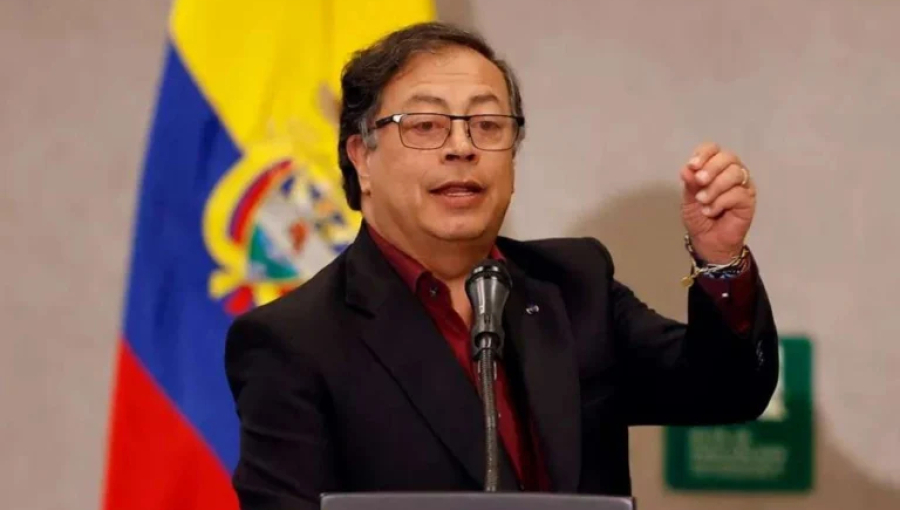
Colombian President Gustavo Petro ordered all levels of the country's public security forces to halt intelligence sharing with US agencies on November 11, dealing another blow to relations between Washington and its historic Latin American ally.
The directive suspends communications and agreements with US intelligence organisations until the Pentagon ends missile strikes on vessels allegedly transporting drugs in the Caribbean, according to Petro's statement on X. The Colombian leftist leader emphasised that counter-narcotics efforts must be subordinated to human rights protections for Caribbean populations.
The strikes have killed at least 76 people across 19 documented operations since August, targeting suspected drug-trafficking boats mostly off Venezuela's coast. However, analysts believe the US Navy buildup in the Caribbean far exceeds what is needed for counter-narcotics operations and is ultimately aimed at unseating Venezuelan authoritarian leader Nicolas Maduro.
The US deployment in the Caribbean now reportedly exceeds 15,000 personnel, the largest military buildup in the region in three decades. On November 11, the USS Gerald Ford, the world’s largest aircraft carrier carrying more than 4,000 sailors and dozens of aircraft, arrived in the area.
Petro, who has called for US President Donald Trump to be investigated for war crimes over the strikes, referenced the death of Alejandro Carranza, a Colombian fisherman allegedly killed in the operations, telling a Latin American-European Union summit on November 10 that the victim "may have carried fish or cocaine but had not received a death sentence."
The decision threatens cooperation valued at approximately $400mn (COP 1.58 trillion) annually in bilateral military assistance covering training, equipment, maintenance and intelligence operations, according to documents reviewed by El Tiempo. US assistance to Colombia in 2025 was projected to fall below $100mn even before the intelligence suspension due to Trump's wide-ranging aid cuts, according to the Washington Office on Latin America.
Colombia's National Police Director William Rincón declined to address the presidential directive following a press conference on November 11, stating such matters concerned diplomatic rather than police affairs, La Silla Vacía reported.
Relations between Washington and Bogotá have deteriorated sharply under the Trump administration, which placed financial sanctions on Petro and family members in October over allegations of permitting drug cartels to operate. The US decertified Colombia as a cooperative partner in counter-narcotics efforts in September, marking the first such designation since 1997, while Trump has branded Petro an "illegal drug dealer" in public remarks last month.
The suspension follows decades of close security cooperation initiated under Plan Colombia in 1999. Colombian officials maintain that 85% of intelligence used by US interdiction task forces originates from Colombian sources, whilst Colombia accounted for 65% of global cocaine seizures last year. Historic captures, including drug lords Gonzalo Rodríguez Gacha in 1989 and Pablo Escobar in 1993, benefited from US intelligence support.
Defence Minister Pedro Sánchez told El Tiempo on November 9 that cooperation with US Chargé d'Affaires John McNamara remained intact, with anti-drone capability seminars scheduled for the coming week.
Meanwhile, in a similar move, the UK has suspended some intelligence cooperation with US forces conducting the Caribbean strikes, citing legal concerns that the operations amount to extrajudicial executions without due process, according to CNN.

.jpeg)
Venezuela has elevated its military alert level and activated what Defence Minister Vladimir Padrino López called a “higher phase” of Plan Independence 200, a nationwide defence operation ordered by President Nicolás Maduro.
The plan involves “full operational readiness” across all branches of the armed forces and includes the mobilisation of “land, air, naval, riverine, and missile assets,” as well as the Bolivarian Militia and civilian security forces. The measure, named "Law of the Command for the Integral Defence of the Nation", aligns with the Chavista regime's push for what it describes as “perfect civic-military-police integration” in response to the perceived threat of US aggression.
In public remarks, Maduro declared that Venezuela “has truth and reason on our side,” and that “we are on the right side of history.”
The decision comes as the USS Gerald R. Ford, the largest aircraft carrier in the US Navy, arrived in Latin America earlier this week. The Pentagon said the deployment aims to “disrupt narcotics trafficking and dismantle transnational criminal organisations,” following at least 19 US operations in the region that have left 76 people dead. However, analysts believe the Navy buildup in the Caribbean far exceeds what is needed for counter-narcotics operations and is ultimately aimed at driving Maduro from power.
President Donald Trump has denied plans for imminent strikes inside Venezuela but has previously floated the possibility of “precision kinetic strikes” against alleged drug trafficking and military targets. Former US Admiral Jim Stavridis said any campaign could begin with attacks on airfields or ports used for drug shipments, adding that Washington’s pressure strategy might seek to convince Maduro “that his days are numbered”, The Washington Post reported.
Analysts say Venezuela’s armed forces, though weakened, remain equipped with advanced weapons such as Russian-made S-300VM air defences. Yet many doubt they could withstand a direct US intervention.
Maduro, meanwhile, has called on supporters to prepare for “a general, insurrectionary, and revolutionary strike” if Venezuela is attacked. The ruling Socialist Party has also pledged to move to “an armed phase of the revolutionary process” akin to a guerrilla-style resistance should hostilities erupt.
Despite repeated warnings of possible US action, the domestic situation remains stable. According to diplomatic reports cited by El Pais, Maduro’s military and political base appears cohesive, with little sign that an external attack would fracture the armed forces’ loyalty to his government.
In related developments, Russian Foreign Minister Sergey Lavrov on November 11 dismissed reports that Venezuela had requested military assistance from Moscow amid rising tensions with the United States.
“No, we have not received any such request,” Lavrov told reporters, adding that both nations had signed a strategic partnership treaty in May that remains in the “final stage of ratification.” Venezuela, along with Cuba and Nicaragua, is the closest Russian ally in the region.
Earlier reports, corroborated by statements from Russian lawmakers, suggested Caracas had sought support from the Kremlin to bolster its air defences with missile systems, radar equipment, and refurbished Su-30MK2 aircraft, though neither government has confirmed this.
Supercarrier USS Ford Nears Staging Area for Caribbean Campaign
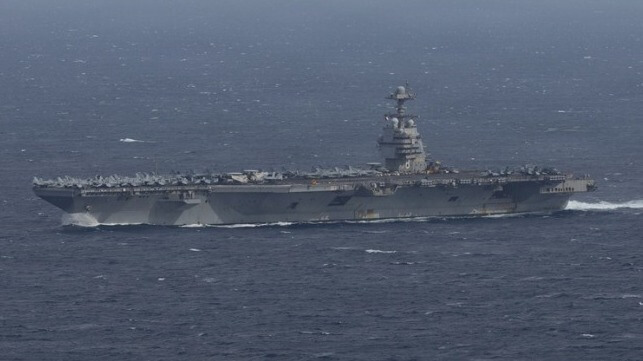
The supercarrier USS Gerald R. Ford has entered the U.S. 4th Fleet area of responsibility and is headed towards the Caribbean, where she will join a growing naval presence off the coast of Venezuela. She is accompanied by destroyers USS Bainbridge, USS Winston S. Churchill and USS Mahan.
Ford is the world's largest carrier and the most expensive warship of all time. At $13 billion for the first hull, before post-delivery repair costs, she competes with Shell's Prelude LNG for the record of most expensive vessel of any kind. Last month, Ford was ordered to return from the Mediterranean promptly in order to join the task force in the southern Caribbean, aligning with media reports of a possible strike plan in the making for targets in Venezuela.
“The enhanced U.S. force presence in the USSOUTHCOM AOR will bolster U.S. capacity to detect, monitor, and disrupt illicit actors and activities that compromise the safety and prosperity of the United States homeland and our security in the Western Hemisphere,” said Chief Pentagon Spokesperson Sean Parnell. “These forces will enhance and augment existing capabilities to disrupt narcotics trafficking and degrade and dismantle Transnational Criminal Organizations.”
Ford is carrying four squadrons of F/A-18 Super Hornet strike fighters, one squadron of the E/A-18 Growler anti-air-defense variant, and various support aircraft. She is not equipped to carry the F-35 stealth fighter.
Open-source satellite intelligence analysis shows that Ford is joining a substantial military presence in the area, including some assets rarely seen. The covert special forces base ship MV Ocean Trader - civilian-crewed, unmarked and never revealed on AIS - has been spotted off Grenada this week, per MT Anderson and other established analysts. This shadowy vessel is known to have landing capacity for heavy helicopters, accommodations for 160 supernumeraries for 45 days, underway replenishment capability, an onboard SCIF, machine gun mounts, and launch and recovery capacity for jet skis and RIBs.
Military officials have confirmed the Ocean Trader's presence in the region to Task & Purpose, and she has been photographed taking on supplies in Ponce, Puerto Rico - showing the running rust of a long deployment with little underway maintenance.
