Thursday, November 13, 2025


Tariff Dividend Checks For Dummies (The People In Policy Debates) – OpEd


November 13, 2025 

By Dean Baker

I learned basic arithmetic skills in third grade. I wasn’t exceptional; everyone in my public school third-grade class learned them. Of course, we all can now use computers to have calculations done for us in a fraction of a second. But still, somehow we have major national debates that show zero understanding of even the most basic arithmetic.

The latest example is the $2,000 tariff dividend check that Trump is promising us. The arithmetic here is about as simple as it gets. We have roughly 340 million people in the country. Let’s say 10 percent don’t get the check because they meet Trump’s category of “high-income.”

That leaves over 300 million people getting Trump’s $2,000 checks. That comes to more than $600 billion. Trump’s tariffs are raising around $270 billion. That means we will be paying out $330 billion more in Trump tariff dividend checks than he is raising in tariff revenue. That would add $270 billion to the deficit — this coming from the same guy who is making an obsession of paying down our national debt.

And just to be clear, we were already looking at a budget deficit for 2026 of $1.8 trillion. If we add $330 billion, the deficit for the fiscal year will be $2.1 trillion. To put this in simple language that even a reporter for a major national news outlet can understand, Trump is proposing to add $2.1 trillion to the debt in 2026; he is not paying it down.

I acknowledge not being a deficit hawk and am not terrified by a deficit of this size, which is roughly 7 percent of GDP. But I suspect most of the politicians in Washington are, and certainly anyone who thinks we need to be paying down the debt should be screaming bloody murder.

But watching the reaction in major media outlets, there seems almost no appreciation of the fact that Trump was floating what would ordinarily be considered a very large increase in the deficit. In fact, if Trump were to give this tariff dividend check every year over the next decade, it would add close to $4 trillion to the debt (counting interest payments), almost as much as the big tax cut Congress approved earlier this year.

It’s also worth comparing Trump’s tariff dividends to other items in the news. The government shutdown was in large part over the $35 billion in annual payments for enhanced subsidies for people buying insurance in Obamacare exchanges. Trump and Republicans in Congress claimed that we didn’t have the money to pay for these subsidies. Trump’s tariff dividend checks would cost more than 17 times as much as the enhanced insurance subsidies.

To make another comparison, Trump saved us around $6 billion a year by shutting down PEPFAR, the program that has saved tens of millions of lives by treating people in Africa for AIDS. This means that Trump’s tariff dividend checks will cost us 100 times as much as the AIDS program that he said we couldn’t afford.

And just to throw in one more comparison, the annual appropriation for public broadcasting was $550 million. Trump’s tariff dividend checks would cost more than 1,000 times as much as the government’s payments for public broadcasting.

People can differ in their views on how important it is to save lives in Africa or provide people here with healthcare. They may also differ in their assessments of how important deficits are. But it really would be good if media outlets could make knowledge of third grade arithmetic a job requirement for reporters who deal with budget issues. It should be their job to provide meaningful information to the public on the topic. Letting someone talk about $2,000 dividend checks, and also about paying down the debt, is a sick joke.
\\


This first appeared on Dean Baker’s Beat the Press blog.


Dean Baker is the co-director of the Center for Economic and Policy Research (CEPR). He is the author of Plunder and Blunder: The Rise and Fall of the Bubble Economy.


Trump proposes $2,000 payments to most Americans to highlight benefits of tariffs
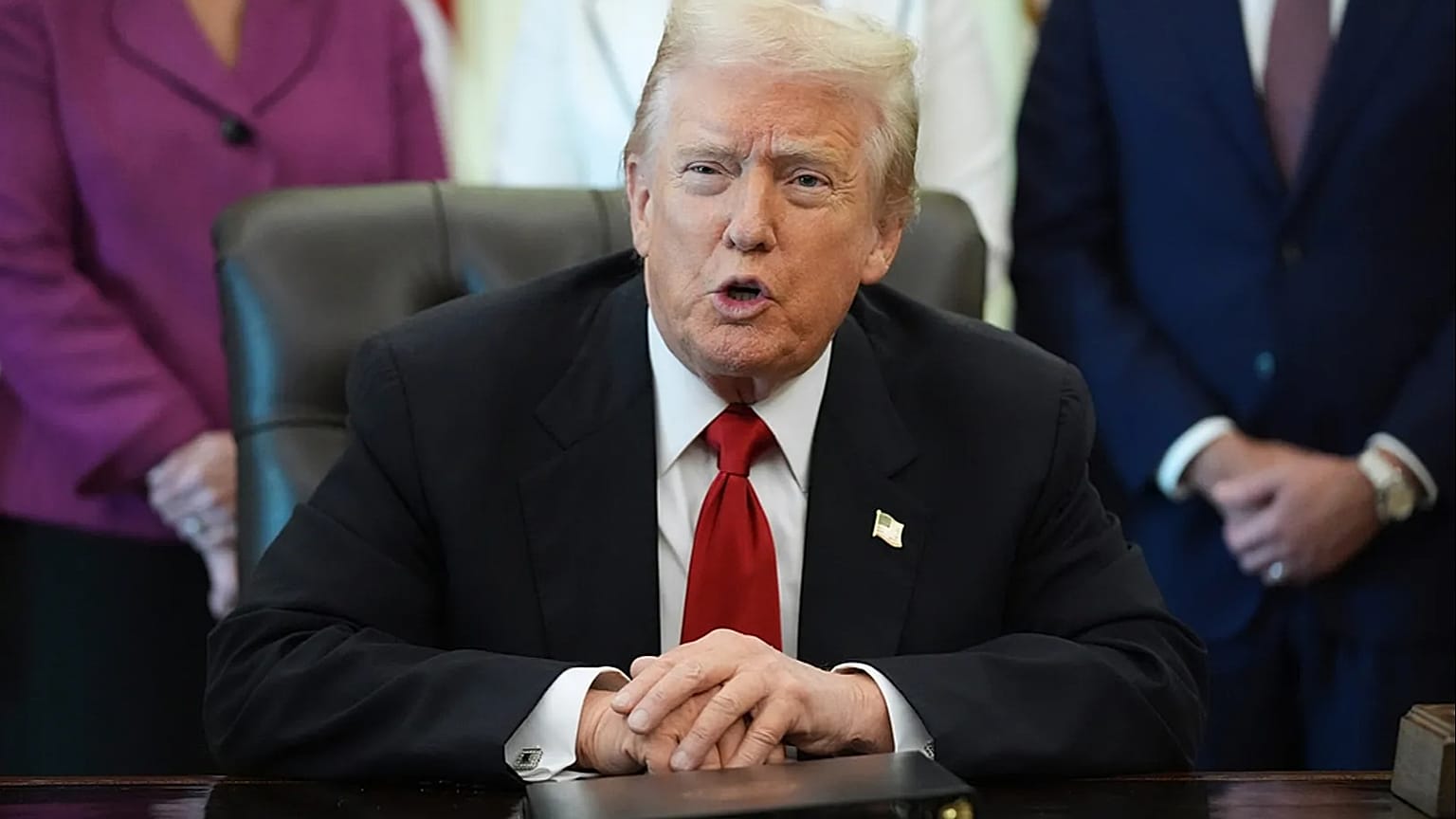
File - President Donald Trump speaks during an event about drug prices in the Oval Office of the White House in Washington. 6 November 2025
Copyright Evan Vucci/Copyright 2025 The AP. All rights reserved


By Doloresz Katanich
Published on 

US President Donald Trump has proposed issuing payments of at least $2,000 to all Americans, apart from those in high-income brackets, saying the move would highlight the benefits of his tariff policy.

The US leader has floated the idea of paying a “tariff dividend” to almost all Americans from revenue collected by his administration from the tariffs applied on leading global economies, in an effort to bolster public support amid uncertainty over whether the Supreme Court will limit his use of tariffs.

On Sunday, Trump wrote on social media: “People that are against Tariffs are fools!,” adding that the country is “taking in trillions of dollars and will soon begin paying down our enormous debt, $37 trillion.”

He also suggested that “a dividend of at least $2,000 a person (not including high-income people!) will be paid to everyone.” The amount is equal to about €1,729.

The administration has yet to provide further clarification on how the payments would be distributed.00:02

Following Trump’s post, Treasury Secretary Scott Bessent indicated in an interview on ABC News’ This Week that the administration was considering tax cuts, but also said he had not spoken to Trump about the proposed dividend.

“The $2,000 dividend could come in lots of forms, in lots of ways,” Bessent said, suggesting possibilities such as eliminating taxes on tips, overtime, Social Security or even instituting an auto loan interest deductible.

With roughly 340 million citizens in the US, and around 19% of them living in upper-income households according to the Pew Research Center, approximately four-fifths of Americans could qualify for the proposed dividend.

The scheme would cost the federal budget, which has yet to be signed into law, hundreds of billions of dollars in 2026.

The US Committee for a Responsible Federal Budget reported that customs duties collected in the 2025 fiscal year were about $195 billion or (€168,63bn), representing an increase of US$118 billion (€102bn), up by approximately 150% from the previous year.

The US budget is further strained by the cost of servicing the national debt, which stands at more than 122% of GDP, or $37.64 trillion (€32.5tr).

Trump’s announcement comes after a turbulent week for his tariff plans. Last week, the Supreme Court signalled doubts over his authority to impose reciprocal tariffs under emergency powers, following earlier rulings from lower courts that he had exceeded his authority.

Trump has said that overturning the tariffs would be a “disaster” for the country, noting that much of the revenue would be used to reduce the national debt.

Tariffs have become a central pillar of Trump’s foreign policy in his second term, with double-digit reciprocal tariffs imposed on most countries. He has justified the measures by declaring America’s longstanding trade deficits a national emergency.

From Army To Zelenskyy, Ukraine’s Corruption Scandal Rocks Country – Analysis


November 13, 2025
By Ray Furlong and RFE/RL’s Ukrainian Service


Ukraine has been rocked by a corruption scandal in which suspects allegedly discussed millions of dollars worth of kickbacks on protection for energy plants, even as Russian bombs raining down on them plunged citizens into cold and darkness.

But it’s not only the allegations that are explosive. The cast list includes people at the highest levels of government centered around a longstanding close collaborator of President Volodymyr Zelenskyy himself.

Worse still, the investigation has been carried out by anti-corruption institutions that Zelenskyy tried to muzzle before the biggest street protests since Russia’s full-scale invasion forced him to back down in the summer.

Meanwhile, corruption is a hot-button issue for Ukraine’s international reputation.

Critics of Western support for the embattled nation, fighting Europe’s biggest conflict since World War II, have sought to play down its measures to improve transparency since breaking free of Moscow’s orbit after mass street protests in 2014.

There’s a huge amount at stake.

Who Are The Suspects?

Several people have been implicated in Operation Midas, an ongoing investigation.

The alleged ringleader is Tymur Mindich, a co-owner of the Kvartal 95 comedy troupe that Zelenskyy also co-owned before he became president. The business was an important vehicle for Zelenskyy to gain popularity as a comedian and actor before entering politics.

Mindich, 46, was also a business partner with billionaire Ihor Kolomoyskiy, who backed Zelenskyy’s 2019 presidential campaign and who has been in pretrial detention since 2023 on fraud and money-laundering charges.

Law enforcement sources said Mindich left Ukraine shortly before his home was searched by police on November 10.

He has not commented on the case.

Who’s Who In The Ukrainian Energy Corruption Scandal

Suspects allegedly discussed millions of dollars worth of kickbacks on protection for energy plants, laundered through an office owned by the family of a former Ukrainian lawmaker now in Russia’s Senate.

Viktor Chumak, chief military prosecutor in 2019-20 and acting prosecutor-general in 2020, told RFE/RL’s Ukrainian Service “it is absolutely impossible, unless you are helped by law enforcement officers” to exit the country quickly amid Ukraine’s wartime travel restrictions.

Another high-profile figure involved in the case is Herman Halushchenko, who was suspended from his position of justice minister on November 12. He previously served as energy minister.

Halushchenko said he would defend himself in court from claims he had received “personal benefits” from Mindich in the alleged kickback scheme.

Former Defense Minister Rustem Umerov, who is currently secretary of the National Security and Defense Council, and former Deputy Prime Minister Oleksiy Chernyshov, are also implicated in the case.

Umerov has denied involvement. Separate corruption charges were brought against Chernyshov in June.

On recordings made by the National Anti-Corruption Bureau of Ukraine (NABU), the suspects used nicknames among themselves. Mindich was Karlson, Chernyshov was Che Guevara.

On November 12, Energy Minister Svitlana Hrynchuk tendered her resignation, following a call by Zelenskyy for her to go. She insisted she had not broken the law.
What Are The Allegations?

NABU and the Specialized Anti-Corruption Prosecutor’s Office (SAPO) allege $100 million of graft in the energy sector by “a high-level criminal organization.”

The focus is on Energoatom, the state-owned nuclear power operator with around $4.7 billion in annual revenue. The suspects allegedly charged 10-15 percent kickbacks from Energoatom’s private subcontractors in return for keeping their contracts running.

In one NABU tape, former energy minister adviser Ihor Myronyuk is heard apparently threatening to cancel such contracts.

“You’ll be wiped out completely…. All your employees will be conscripted into the army,” he is heard saying. Myronyuk denies any wrongdoing.

At another point, participants are heard discussing giving contracts for protective structures against air attacks at energy installations.

NABU has carried out 70 house searches and made 1,000 hours of secret audio recordings as part of the investigation.
How Bad Is This?

The potential fallout is huge.

Millions of Ukrainians are enduring untold hardships as Russia’s full-scale invasion approaches its fourth anniversary. This includes frequent power cuts as Russia targets energy infrastructure to degrade Ukraine’s war effort and drain morale.

With winter approaching, these pressures are increasingly acute.

Tymofiy Mylovanov resigned from Energoatom’s supervisory board on November 11, saying his proposals for the company’s response to the scandal were being ignored.

“Every hryvnya that is spent ineffectively, whether it is stolen, or simply spent ineffectively, is a loss of life on the front line,” he told RFE/RL.

EU foreign policy chief Kaja Kallas called the scandal “extremely unfortunate,”adding that it was important Kyiv takes it seriously.

As noted, the allegations run extremely close to Zelenskyy.

In Ukraine, it hasn’t escaped notice that he moved to curtail the independence of NABO and SAPO just a few months ago.

At that point, investigators were already well advanced into a 15-month operation that has only now been made public.

The move against the two agencies led people to take to the streets in protest despite making themselves potential targets for Russian air strikes. The sensitivity of the issue was underlined by a protester who linked it to the war, with a poster reading, “This is not the future my brother died for.”

Ukraine’s Western backers, who have long pressured Kyiv to improve its record on fighting corruption, added to the pressure — urging Zelenskyy to backtrack. Less than 72 hours after signing the law that removed the autonomy of NABU and SAPO, he submitted a bill restoring it.

“I do not rule out that this [investigation] was the reason for the pressure imposed on NABU in the summer. I can’t rule it out,” said Chumak, the former prosecutor.

“It was an attempt to transfer all the cases — first of all, to get the materials from all the cases, and secondly, to transfer them to another entity.”

Mylovanov said he did not believe Zelenskyy attempted a cover-up. “The president clearly said that there should be sentences,” he said.

But perceptions are important, and not only in Ukraine.

Western governments providing military and economic support to Kyiv need to justify it to their electorates, and this scandal doesn’t make that any easier.

“Trust is at stake — among the population, the army, and international partners. No dissolution of a supervisory board, no sentencing of a few individuals, and no new audits will undo the damage that is unfolding,” said Mattia Nelles, co-founder and executive director of the German-Ukrainian Bureau, a think-tank that promotes stronger support for Ukraine in Germany.

“Minor changes here and there will no longer be enough to bridge the gulf of distrust. Otherwise, this risks becoming a turning point in Zelenskyy’s presidency.”Ray Furlong is a Senior International Correspondent for RFE/RL. He has reported for RFE/RL from the Balkans, Kazakhstan, Georgia, and elsewhere since joining the company in 2014. He previously worked for 17 years for the BBC as a foreign correspondent in Prague and Berlin, and as a roving international reporter across Europe and the former Soviet Union.
RFE/RL’s Ukrainian Service has seen its audience grow significantly since Russia’s full-scale invasion in February 2022 and is among the most cited media outlets in the country. Its bold, in-depth reporting from the front lines has won many accolades and awards. Its comprehensive coverage also includes award-winning reporting by the Donbas.Realities and Crimea.Realities projects and the Schemes investigative unit.


RFE RL

RFE/RL journalists report the news in 21 countries where a free press is banned by the government or not fully established.


Ukraine's justice and energy ministers resign amid ongoing corruption probe

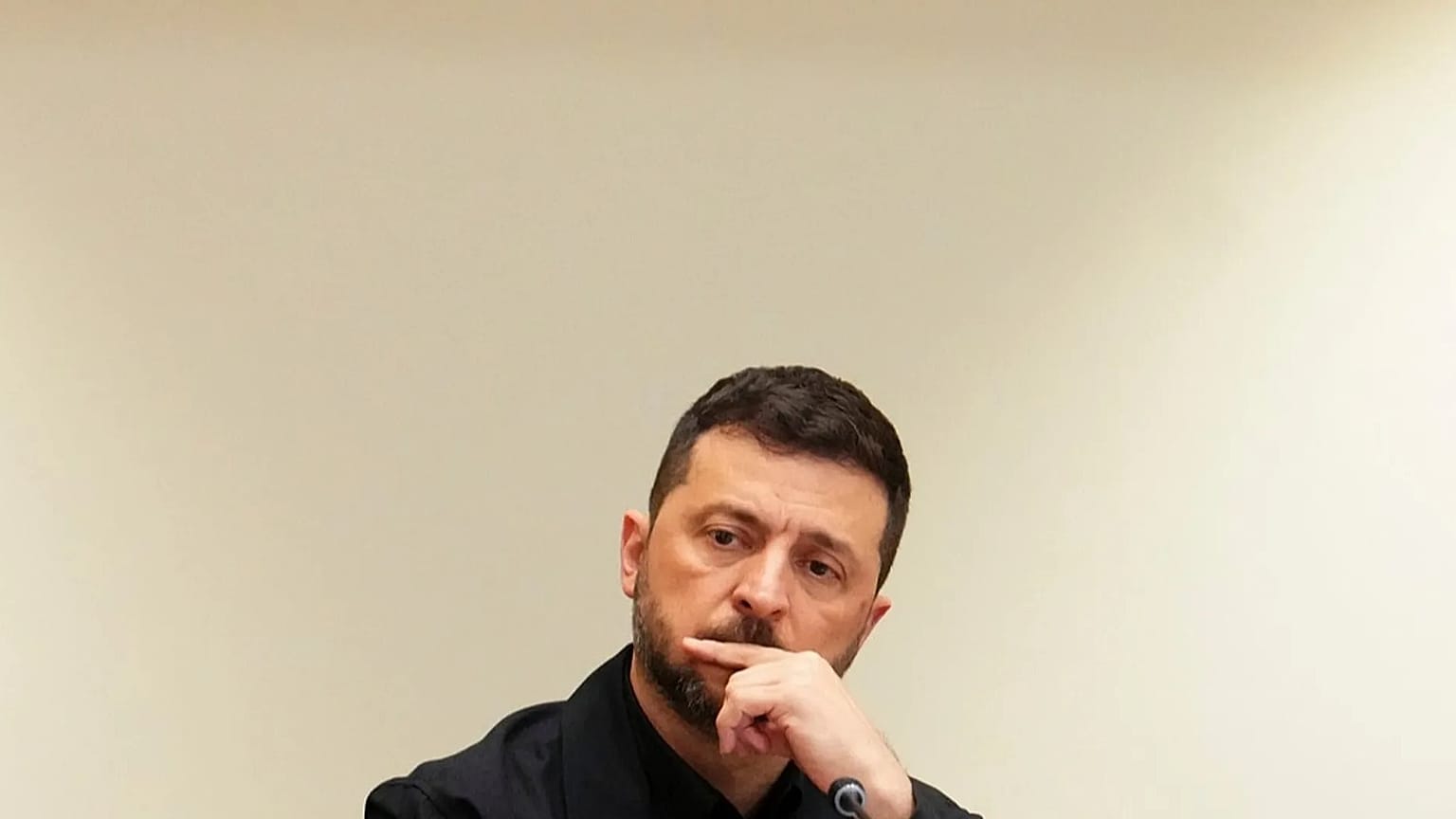
FILE: Ukrainian President Volodymyr Zelenskyy in a meeting during the United Nations General Assembly in New York, 23 September 2025
Copyright AP Photo

By Sasha Vakulina
Published on 

Earlier on Wednesday, the Ukrainian president called for the two ministers to leave office amid a major investigation into alleged corruption in the energy sector, calling it a "matter of trust".

Ukraine's Minister of Justice Herman Halushchenko and Minister of Energy Svitlana Hryshchuk have submitted their resignations following revelations of a major corruption probe, Prime Minister Yulia Svyrydenko announced.

Earlier on Wednesday Ukraine’s President Volodymyr Zelenskyy called for the resignation of the country’s justice and energy ministers, saying "they cannot stay in office”.

“It is a matter of trust”, Zelenskyy said on Wednesday, adding, “If there are accusations, they must be answered.”

“The decision to remove them from office is an operational one, the quickest possible. I have asked the prime minister of Ukraine to request these ministers' resignations," he explained.

"I ask the members of the Verkhovna Rada to support these requests. Everything else must be decided in the legal sphere.”

Meanwhile, Svyrydenko also said that the government initiated the sanctions procedure against Oleksandr Tsukerman and Zelenskyy's former business partner and close associate Timur Mindich.

Zelenskyy is expected to sign the sanctions into force following the council's approval.

Halushchenko first served as Ukraine’s energy minister since 2021 and was then appointed justice minister this July. He is now being investigated by the National Anti-Corruption Bureau (NABU) as part of a large-scale corruption scheme involving Energoatom.

Earlier, Halushchenko said he supports the government’s initial decision to suspend him, adding that he had a conversation with the prime minister.

"I fully agree: a political decision needs to be made first, and only then should we deal with all the details," he said on Facebook.

“I am not clinging to the position of minister and will not cling to it. I believe that suspension during the investigation is a civilized and proper course of action. I will defend myself in the legal domain and prove my position.”

Earlier, the Ukrainian government also announced its decision to dissolve Energoatom's supervisory board.

NABU probe continues

On Tuesday, Ukraine’s anti-corruption bureau charged eight people with bribery, abuse of office and illicit enrichment.

It also published tapes where the group, using code names and encrypted language, discussed alleged kickbacks and bribes.

According to NABU, the main organiser of the alleged corruption scheme is believed to be Timur Mindich, a former business partner of Ukraine’s President Volodymyr Zelenskyy.

He is the co-owner of Kvartal 95, a production company founded and formerly part-owned by the president of Ukraine.

Anti-corruption prosecutor Serhiy Savytskyi said at a court hearing on Tuesday that Mindich allegedly committed a crime by unlawfully influencing Halushchenko.

NABU said the investigation lasted for 15 months and resulted in 1,000 hours of wiretapping and 70 raids.

Halushchenko is also featured in the NABU tapes.


The Corruption Probe Rocking Ukraine’s Wartime Government

  • Anti-corruption agencies uncovered an alleged $100 million kickback scheme involving top officials and business associates close to President Zelenskyy.

  • The investigation, Operation Midas, centers on Energoatom contracts and includes leaked audio, dozens of raids, and high-profile resignations.

  • The scandal threatens domestic trust and international support for Ukraine as it fights Russia’s invasion.

Ukraine has been rocked by a corruption scandal in which suspects allegedly discussed millions of dollars worth of kickbacks on protection for energy plants, even as Russian bombs raining down on them plunged citizens into cold and darkness.

But it's not only the allegations that are explosive. The cast list includes people at the highest levels of government centered around a longstanding close collaborator of President Volodymyr Zelenskyy himself.

Worse still, the investigation has been carried out by anti-corruption institutions that Zelenskyy tried to muzzle before the biggest street protests since Russia's full-scale invasion forced him to back down in the summer.

Meanwhile, corruption is a hot-button issue for Ukraine's international reputation.

Critics of Western support for the embattled nation, fighting Europe's biggest conflict since World War II, have sought to play down its measures to improve transparency since breaking free of Moscow's orbit after mass street protests in 2014.

There's a huge amount at stake.

Who Are The Suspects?

Several people have been implicated in Operation Midas, an ongoing investigation.

The alleged ringleader is Tymur Mindich, a co-owner of the Kvartal 95 comedy troupe that Zelenskyy also co-owned before he became president. The business was an important vehicle for Zelenskyy to gain popularity as a comedian and actor before entering politics.

Mindich, 46, was also a business partner with billionaire Ihor Kolomoyskiy, who backed Zelenskyy's 2019 presidential campaign and who has been in pretrial detention since 2023 on fraud and money-laundering charges.

Law enforcement sources said Mindich left Ukraine shortly before his home was searched by police on November 10.

He has not commented on the case.

Viktor Chumak, chief military prosecutor in 2019-20 and acting prosecutor-general in 2020, told RFE/RL's Ukrainian Service "it is absolutely impossible, unless you are helped by law enforcement officers" to exit the country quickly amid Ukraine's wartime travel restrictions.

Another high-profile figure involved in the case is Herman Halushchenko, who was suspended from his position of justice minister on November 12. He previously served as energy minister.

Halushchenko said he would defend himself in court from claims he had received "personal benefits" from Mindich in the alleged kickback scheme.

Former Defense Minister Rustem Umerov, who is currently secretary of the National Security and Defense Council, and former Deputy Prime Minister Oleksiy Chernyshov, are also implicated in the case.

Umerov has denied involvement. Separate corruption charges were brought against Chernyshov in June.

On recordings made by the National Anti-Corruption Bureau of Ukraine (NABU), the suspects used nicknames among themselves. Mindich was Karlson, Chernyshov was Che Guevara.

On November 12, Energy Minister Svitlana Hrynchuk tendered her resignation, following a call by Zelenskyy for her to go. She insisted she had not broken the law.

What Are The Allegations?

NABU and the Specialized Anti-Corruption Prosecutor's Office (SAPO) allege $100 million of graft in the energy sector by "a high-level criminal organization."

The focus is on Energoatom, the state-owned nuclear power operator with around $4.7 billion in annual revenue. The suspects allegedly charged 10-15 percent kickbacks from Energoatom's private subcontractors in return for keeping their contracts running.

In one NABU tape, former energy minister adviser Ihor Myronyuk is heard apparently threatening to cancel such contracts.

"You'll be wiped out completely…. All your employees will be conscripted into the army," he is heard saying. Myronyuk denies any wrongdoing.

At another point, participants are heard discussing giving contracts for protective structures against air attacks at energy installations.

NABU has carried out 70 house searches and made 1,000 hours of secret audio recordings as part of the investigation.

How Bad Is This?

The potential fallout is huge.

Millions of Ukrainians are enduring untold hardships as Russia's full-scale invasion approaches its fourth anniversary. This includes frequent power cuts as Russia targets energy infrastructure to degrade Ukraine's war effort and drain morale.

With winter approaching, these pressures are increasingly acute.

Tymofiy Mylovanov resigned from Energoatom's supervisory board on November 11, saying his proposals for the company's response to the scandal were being ignored.

"Every hryvnya that is spent ineffectively, whether it is stolen, or simply spent ineffectively, is a loss of life on the front line," he told RFE/RL.

EU foreign policy chief Kaja Kallas called the scandal "extremely unfortunate," adding that it was important Kyiv takes it seriously.

As noted, the allegations run extremely close to Zelenskyy.

In Ukraine, it hasn't escaped notice that he moved to curtail the independence of NABO and SAPO just a few months ago.

At that point, investigators were already well advanced into a 15-month operation that has only now been made public.

The move against the two agencies led people to take to the streets in protest despite making themselves potential targets for Russian air strikes. The sensitivity of the issue was underlined by a protester who linked it to the war, with a poster reading, "This is not the future my brother died for."

Ukraine's Western backers, who have long pressured Kyiv to improve its record on fighting corruption, added to the pressure -- urging Zelenskyy to backtrack. Less than 72 hours after signing the law that removed the autonomy of NABU and SAPO, he submitted a bill restoring it.

"I do not rule out that this [investigation] was the reason for the pressure imposed on NABU in the summer. I can't rule it out," said Chumak, the former prosecutor.

"It was an attempt to transfer all the cases -- first of all, to get the materials from all the cases, and secondly, to transfer them to another entity."

Mylovanov said he did not believe Zelenskyy attempted a cover-up. "The president clearly said that there should be sentences," he said.

But perceptions are important, and not only in Ukraine.

Western governments providing military and economic support to Kyiv need to justify it to their electorates, and this scandal doesn't make that any easier.

"Trust is at stake -- among the population, the army, and international partners. No dissolution of a supervisory board, no sentencing of a few individuals, and no new audits will undo the damage that is unfolding," said Mattia Nelles, co-founder and executive director of the German-Ukrainian Bureau, a think-tank that promotes stronger support for Ukraine in Germany.

"Minor changes here and there will no longer be enough to bridge the gulf of distrust. Otherwise, this risks becoming a turning point in Zelenskyy's presidency."

By RFE/RL


RUSSIAFICATION

Only one percent of pupils in the Russian Federation are studying in minority language schools.


Red Square, Moscow, Russia.

November 13, 2025
By Paul Goble


Only one percent of pupils in the Russian Federation are studying in minority language schools. This number is significantly less than the share of Russians whose primary language is not Russian. Additionally, just 11 percent of students are studying a non-Russian native language as a separate subject (Yesli Byt’ Tochnym, November 6).

As of 2010, approximately 14.3 percent of Russians considered a minority language their “native” language, and 20 percent of Russians identified as ethnically non-Russian (Minority Rights Group, accessed November 11). The share of school-age children who are non-Russian may be even greater, given that fertility rates among non-Russians remain higher than those among ethnic Russians (see EDM, October 31, 2024).

In the case of more than three dozen nations, instruction in all kinds of subjects in their native languages has ended, with more likely to be eliminated from school programs in the future (Vedomosti, September 15; Yesli Byt’ Tochnym, November 6). Half as many students are studying in a language other than Russian compared to nine years ago. This decline is even more pronounced as a proportion since the total number of pupils in Russian schools has decreased in the past decade (The Moscow Times, September 1).

These trends have been the direct result of Russian President Vladimir Putin’s policies over the last decade, which have banned republics from requiring that all pupils on their territories study their titular languages and nominally gave parents the right to choose to have their children study in Russian rather than those languages. In reality, however, the policies put pressure on students to learn Russian rather than the titular language of their republics by requiring any school graduate who wants to attend university to pass tests in Russian. Additionally, many schools that had offered instruction in non-Russian languages closed, and there is no longer an incentive for replacing teachers who can teach in non-Russian languages when those who do retire (Takie Dela, September 9).

These changes have not been popular among large swaths of non-Russians, who view them as a threat to their language and culture (see EDM, November 5, December 3, 2012; see Commentaries, January 23, 2014). The number of non-Russian parents calling for their children to be given the chance to study their native languages, at least in separate classes for a few hours a week, has risen. Given that Moscow continues to reduce the number of hours allocated for minority language classes and largely confines them to the earliest grades, many non-Russian parents are unsatisfied. One or two hours of language instruction per week cannot compensate for the loss of instruction in all subjects in that language (Yesli Byt’ Tochnym, November 6).

The Kremlin is pursuing a policy that some Russian commentators have called the “folklore-ization” of ethnic minorities, using surface-level reforms to assuage continuing non-Russian resistance to its policies. Moscow has created national holidays and other activities that appear to boost the status of non-Russians but, in reality, further reduce them from self-standing nations to marginalized ethnic groups inside a culturally, linguistically, and politically Russian state (The Moscow Times, November 5). Folklore-ization has placated some non-Russians, but has outraged others who see it as part of a drive to eliminate non-Russian nations from playing a key role in the administration of the state, quite possibly leading to the elimination of non-Russian republics as a political entity (MariUver, April 24).


The Kremlin’s reduction in non-Russian language instruction and the political power of non-ethnically Russian republics is not without risks for Moscow. The inclusion of an increasing number of non-Russians within the ethnic Russian nation angers some Russian nationalists who fear that this may lead to more intermarriage between Russians and non-Russians, a multiplication of Russian dialects, and even the assimilation of ethnic Russians by non-Russians, all phenomena that are anathema to these Russians’ identities (Window on Eurasia, June 15, October 7).

More worrisome for the Kremlin, Putin’s policy of Russianizing education is sparking increased non-Russian protests. Some such protests have been successful, as in the recent case when Moscow was publicly forced to back down on its plans to stop classifying non-Russian tongues as “native languages” (Window on Eurasia, June 15, August 25). Putin’s Russianization and Russification policies may lead to the elimination of some nations and republics, as he hopes, but these policies could also spur the rise of more Russian speakers among ethnic minorities who will be able to compete with ethnic Russians for jobs and benefits.

These non-Russians may become radicalized in their nationalism if and when they are blocked from fairly competing with ethnic-Russians for jobs. A non-Russian who is denied a position because they do not speak Russian fluently is one thing, but a non-Russian who speaks perfect Russian and then is denied it is something else entirely (MariUver, November 8; Idel Realii, November 6). As students of nationalism have long noted, the Irish did not become nationalists until they stopped speaking Gaelic, and British control of India was not threatened so much by Hindi-speaking peasants as by English-trained lawyers, such as Gandhi.

Putin shows no sign of letting up on his Russianization drive, increasingly insisting that Russian culture dominates. This relentless preference has alienated non-Russians while empowering some Russian nationalists (Window on Eurasia, November 8). The continuing war against Ukraine has radicalized Russian nationalists and some non-Russians who have been disproportionately affected by the war, setting the stage for more conflicts between Russian nationalists and the non-Russian nations (Window on Eurasia, May 22, 2023).

Most non-Russians had their children in Russian-language schools long before Putin began his current push. This means that those who did not are the most radically committed to the survival of their national languages and thus the most likely to react in opposition to Moscow (Yesli Byt’ Tochnym, November 6). Putin’s language reforms in the schools are likely to have a larger and more fateful set of consequences than he intends, as similar impositions of the language of empire have had throughout history. 

This article was published at The Jamestown Foundation