Thursday, November 13, 2025

DETENTE

Op-Ed: China's New Carrier is a Challenge to Western Maritime Dominance

As part of a broader seapower strategy, it reflects Beijing’s ambition not just to contribute to, but to lead, the global maritime order.
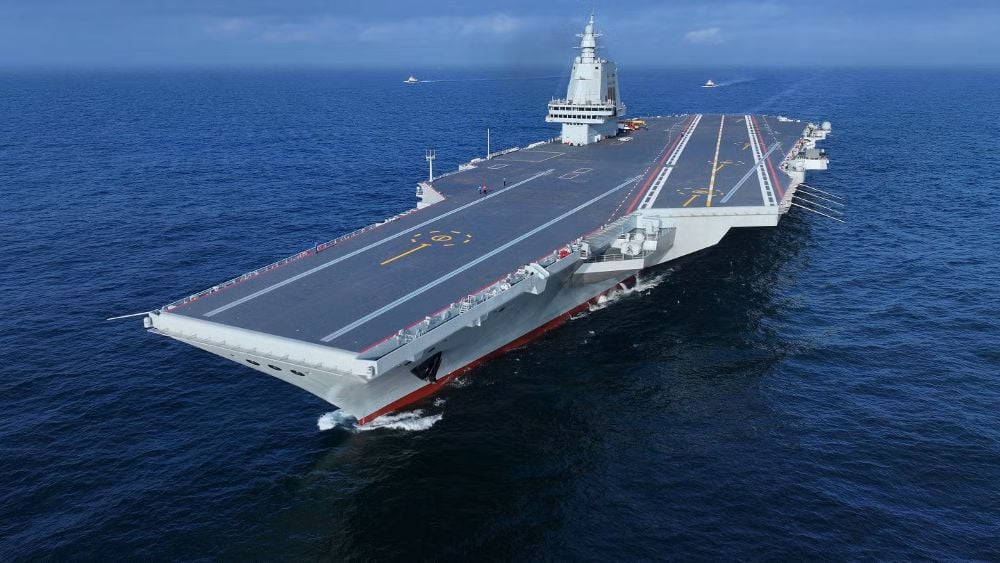
Fujian carrier
Ding Ziyu / China Ministry of National Defense

Published Nov 11, 2025 11:17 PM by The Conversation


[By Basil Germond]

China’s new Fujian aircraft carrier, unveiled recently by President Xi Jinping with great fanfare, has been hailed by Chinese state media as a major milestone in the country’s naval modernization program and a key development in the country’s aspirations to become a maritime power.

In the context of Beijing’s sustained seapower strategy, the long-term implications for the security and leadership of the global maritime order are certainly significant and enduring.

The launch means China now has three aircraft carriers in service and is capable of maintaining a continuous carrier presence at sea. And there have been reports of satellite images which suggest construction has already begun on China’s fourth carrier.

This will increase Beijing’s ability to preventatively deploy warships to faraway locations it considers important. It gives China the potential to control the airspace wherever their battle group is operating, as well as the ability to project air power in more distant theaters of conflict.

The new carrier also means China can launch heavier and specialist aircraft, for example with airborne early-warning systems and fighter jets equipped with greater fuel and payload capacity.

This expands Beijing’s operational options. It elevates China into a select group of four nations (US, UK, France, China) capable of independently operating a carrier battle group with the capacity to generate substantial strategic advantages from the sea.

Among this group, however, the US remains far ahead. It enjoys a significant lead in terms of carrier fleet size, technological sophistication, operational experience, global reach and sustained carrier strike capabilities.

Aircraft carriers are obviously key naval assets in confrontations between comparable nations in open ocean environments – known as “blue-water engagements”. But they are also important in controlling the maritime battlespace – particularly through air superiority – and in projecting power ashore.

The Fujian does not dramatically shift the global balance of power in China’s favor. But its enhanced land-attack capabilities nonetheless expand Beijing’s operational toolkit, allowing a more flexible and assertive naval strategy.

A strong symbolic power

Since the Second World War, aircraft carriers have replaced battleships as the capital ships, the principal and most powerful warships in any country’s navy that are designed to form the core of a fleet and deliver decisive combat power.

Such capital ships carry strong symbolic weight. They signal a state’s ability to mobilize the resources required to procure, sustain and operate such complex platforms, as well as its intent to function as an ocean-going naval power.

In this light, China’s aircraft carrier program has considerable symbolic resonance. It reflects both Beijing’s intrinsic naval capabilities and its extrinsic power – that is, its increasingly elevated status within the international pecking order.

China’s comprehensive seapower strategy

China’s carrier program needs to be understood as part of Beijing’s wider seapower strategy. Unlike other authoritarian states such as Russia or Iran, the power base of China’s regime is much more dependent on international trade and so on freedom of navigation. Consequently, China does not seek to disrupt the global maritime order. It wants to lead it and initiate a new cycle of global dominance.

To that end, Beijing is not only expanding its naval power but, perhaps more significantly, its civilian seapower. This includes a robust shipbuilding industry, a large and growing merchant marine registered as Chinese. And it has made substantial direct investments in critical western infrastructure, such as ports.

Many of these investments have been made via private Chinese firms which maintain close ties with the state. This gives Beijing additional leverage to exercise civilian seapower to further its political interests. For example, it can use Chinese shipping companies to circumvent western sanctions on Russia, or interfere in European ports owned by Chinese firms.

In the South China Sea, Beijing aggressively uses its fishing fleet, backed by its coastguard and navy to achieve a degree of control over contested areas it considers to have economic or strategic importance.

So the commissioning of the Fujian is more than a technical milestone for the Chinese navy – it is a signal of intent. It reinforces China’s growing capacity and willingness to shape the maritime domain. As part of a broader seapower strategy, it reflects Beijing’s ambition not just to contribute to, but to lead, the global maritime order.

Basil Germond is a professor in the department of Politics, Philosophy and Religion at Lancaster University. He specializes in naval affairs, seapower, maritime security, maritime geopolitics, and ocean governance. Previously, he was a Visiting Research Fellow at Oxford (Changing Character of War program) and Research Fellow at the University of St Andrews. He holds a PhD from the Graduate Institute of International Studies, Geneva.  

This article appears courtesy of The Conversation and may be found in its original form here.

The Conversation

The opinions expressed herein are the author's and not necessarily those of The Maritime Executive.

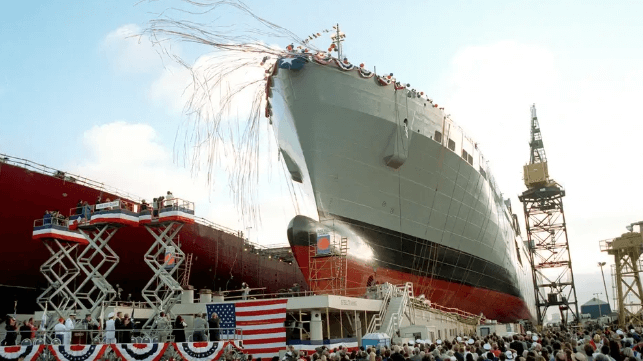
 

Building Markets, Not Just Ships: A Blueprint for US Shipbuilding

USNS Red Cloud
USN file image

Published Nov 12, 2025 12:07 PM by Peter Heron and Rear Adm. John W. Mauger (USCG, ret'd)


In 2024, U.S. commercial shipyards produced just one-tenth of one percent of global ship output. That stark number underscores a long-term competitiveness challenge with implications that extend well beyond the waterfront. A stronger commercial shipbuilding sector could bolster national and economic security, strengthen the maritime workforce, and make the broader industrial base more resilient. But the question remains: how can the U.S. compete in an industry dominated by well-established global leaders?

Our research suggests the answer may lie not in replicating the models of others, but in competing differently. Many of the world’s major shipbuilding nations—particularly China, South Korea, and Japan—rely heavily on government subsidies, state ownership, and conglomerate structures to absorb losses and sustain production scale. The U.S. system is built on different foundations: private enterprise, diversified capital markets, and cross-industry innovation. Those distinctions, while challenging in some respects, may offer strategic advantages if harnessed deliberately.

The U.S. could focus on using targeted public funding to unlock larger volumes of private capital—channeling investment into areas where market demand and U.S. comparative advantages already intersect. That means enabling—not replacing—the market.

Three emerging segments stand out: autonomous vessels, alternative fuels, and smart ports. Each offers a near-term opportunity to attract private sector funding, catalyzing new demand for U.S.-built ships and maritime systems, while supporting modernization across the broader industrial base.

Autonomous vessels can improve safety and create new exportable technologies. Alternative fuels—such as LNG, methanol, hydrogen, and even next-generation nuclear micro-reactors—are changing ship design and propulsion in ways that align with U.S. energy leadership. Smart ports, meanwhile, apply digital and automation tools that can improve trade efficiency and logistics resilience. Together, these markets could re-anchor U.S. shipbuilding competitiveness in areas where the nation already leads globally—in artificial intelligence, the Internet of Things, cloud computing, and advanced energy.

Focusing on these disruptive segments also allows the U.S. to compete on innovation rather than scale. Autonomy, digital infrastructure, and alternative fuels are still emerging markets; the competitive “rules” are not yet fixed. By helping to shape standards, technologies, and financing frameworks early, the U.S. can create conditions that attract private investment and accelerate learning across its maritime value chain.

To grow these emerging markets the U.S. should consider steps that lower investor risk, standardize technologies, and streamline regulation, which can help private capital flow into the sector. For example, establishing shared testing ranges for autonomy and fuels, aligning technical standards across ports, or creating flexible financing structures could allow both public and private actors to plan beyond single budget cycles. Similarly, focusing on workforce readiness—through training in AI, systems integration, and advanced manufacturing—could align talent development with emerging maritime needs.

This approach reframes shipbuilding not just as a manufacturing challenge, but as an innovation and investment opportunity. It also leverages the strengths of the broader U.S. economy: deep financial markets, a leading research ecosystem, and industries already advancing technologies that are expected to define the next era of shipping. In doing so, it creates the potential for commercial shipbuilding to reinforce national security, rather than rely on it.

The global shipbuilding landscape will remain highly competitive. Yet by pairing targeted public support with private-sector innovation, the U.S. can compete on its own terms—building not just ships, but markets that demand them. Durable shipbuilding competitiveness can come from catalyzing investable demand. Competing differently can be the most practical—and most powerful—way forward.

Pete Heron is a Principal with Deloitte Consulting LLP. He serves in the aerospace and defense sector. He has delivered global supply chain transformations with benefits of millions of dollars in income statement and balance sheet improvements. 

Rear Admiral John W. Mauger, USCG (retired), has over three decades of experience in maritime operations. A marine safety engineer, he ensured the safety and security of commercial shipping through the development and enforcement of US and international regulations for ship design, construction, and operation. 

The opinions expressed herein are the author's and not necessarily those of The Maritime Executive.
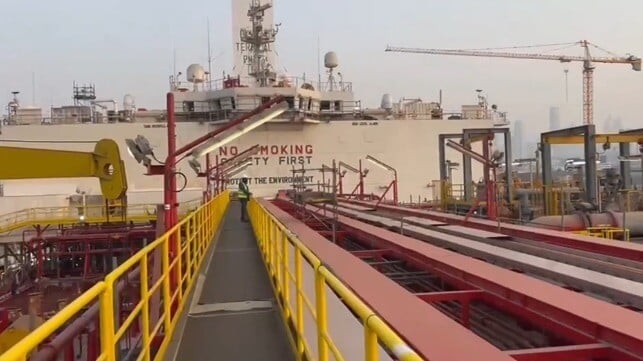
 

Nigeria Gets its First Locally-Owned FPSO

 Floating Production, Storage and Offloading (FPSO)

FPSO
FPSO Emem (NUPRC)

Published Nov 12, 2025 4:03 PM by The Maritime Executive


Nigeria has welcomed its first locally owned floating production, storage and offloading (FPSO) vessel. The FPSO Emem is owned by the Nigerian oil company Oriental Energy Resources (OER). This reveals growing capacity by local producers to deliver complex offshore development in a market dominated by global oil majors. The FPSO has been undergoing conversion at the Drydocks World Dubai Shipyard, which was initially scheduled to be completed in February.

After almost eight months of delay, Nigerian Minister for Petroleum Resources Heineken Lokpobiri early this week presided over the sail away ceremony of the FPSO at the Dubai yard. The $315 million FPSO is expected to arrive in Nigerian waters by December. It will be stationed in the Okwok field in southeast offshore Nigeria, helping to unlock higher production in the block.

OER is targeting to reach a production of 30,000 barrels of oil per day in the Okwok field. Emen can process up to 40,000 bpd and store about 1 million barrels. However, the FPSO will initially handle production from five wells. OER proposes to drill up to 15 wells in Okwok, which is estimated to have recoverable reserves of 45 million barrels.

The FPSO has been launched at a time Nigeria is increasing its oil output. In October 2024, Nigeria unveiled “Project One Million Barrels” initiative aimed at driving recovery in its oil sector. In reflecting one-year progress of implementing the initiative, Minister Lokpobiri last month said that the impact of the reforms is visible in the upstream market. One of the figures the minister shared is that Nigeria has boosted its daily crude oil output to around 1.83 million barrels. In addition, the number of active drilling rigs have increased from 31 in January to 50 by July.

Last month, Nigeria also hit a major milestone with the commissioning of its first wholly owned Floating Storage and Offloading (FSO) vessel. The FSO, named Cawthorne, was developed by the Nigerian National Petroleum Company (NNPC) and has capacity for 2.2 million barrels. The vessel will boost crude oil production and transportation in Oil Mining Lease 18 and the surrounding assets in Nigeria’s Eastern Niger Delta. In addition, the FSO will reduce reliance on pipelines, which are a major target in oil theft and vandalism.


Anemoi Fits Out a Valemax Bulker With Five Rotor Sails

Anemoi
Courtesy Anemoi

Published Nov 12, 2025 9:40 PM by The Maritime Executive


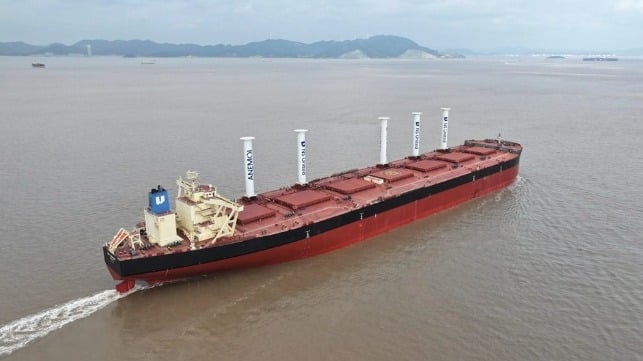
The push to cut shipping emissions through wind assisted propulsion continues to gain traction after Anemoi Marine completed the installation of five rotor sails on the very large ore carrier (VLOC) NSU Tubarao, a vessel operated by Brazilian mining giant Vale International.

Built by Japan Marine United, the 400,000 dwt Tubarao was delivered in 2020 and is among the largest bulk carriers in the world. The 361-meter vessel, which is owned by NS United Kaiun Kaisha and sails under the Liberian flag, has been retrofitted with five rotor sails measuring 35 meters tall and five meters in diameter.

The rotor sails are designed to maximize the Magnus effect, which provides lift and thrust to reduce engine propulsion demand in order to sail at a given speed. The wind-assisted propulsion technology is expected to reduce the ship’s fuel consumption and CO2 emissions by approximately six to 12 percent annually.

The installation was completed during a scheduled dry docking at the Chinese yard Zhoushan Xinya Shipyard. The rotor sails are deployed using a folding (tilting) mechanism for flexibility during cargo handling. It is the fourth VLOC installation on vessels chartered by Vale, all used primarily to transport iron ore from Brazil to Japan.

With the Tubarao retrofit, Anemoi has now surpassed 1.6 million dwt of vessel tonnage installed with its wind assisted propulsion technology.

During the scheduled dry docking, Tubarao was also equipped with a new shaft generator designed to enhance efficiency. The upgrade not only improves the vessel’s own energy performance but also optimizes fuel consumption when operating the rotor sails. Integrating the technology with the vessel’s shaft generator through advanced control system integration is designed to ensure seamless coordination between wind propulsion and onboard power supply.

“The scale of this project shows the market’s growing confidence in wind power as a crucial enabler of lower emissions shipping. Working with progressive partners, we are able to advance rotor sail technology and show how optimizing propulsion integration and navigation for wind assistance can deliver even greater benefits,” said Clare Urmston, Anemoi CEO.

Vale has been investing heavily in cutting-edge efficiency and environmental innovation in shipping as part of efforts to cut down on emissions. Since 2020, the company has announced investments of up to $6 billion to reduce scope 1 and 2 emissions by 33 percent by 2030 and committed to a 15 percent reduction in scope 3 emissions by 2035.

The company is the largest producer of iron ore, pellets and nickel, and also has operations in manganese, ferroalloys, copper, gold, silver, and cobalt. It operates second-generation Valemaxes with a capacity of 400,000 dwt and Guaibamaxes with a capacity of 325,000 dwt.

In July, the company signed 25-year charter agreements with Shandong Shipping for 10 new Guaibamax vessels measuring 340 meters in length and with a capacity of 325,000 tonnes. The vessels, which will be methanol dual fuel-powered, will also be equipped with five rotor sails each.

Samsung Heavy Industries Agrees to Build Amogy's Ammonia-Power Systems

Kraken
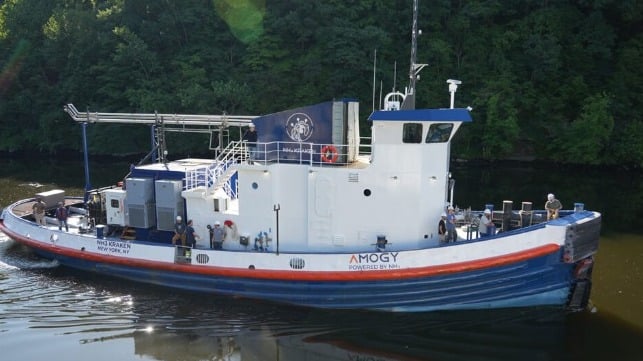
Amogy is known for its ammonia-powered tug prototype, the Kraken (Amogy)

Published Nov 12, 2025 6:46 PM by The Maritime Executive


Ammonia-power startup Amogy has reached an agreement with Samsung Heavy Industries (SHI) to manufacture Amogy's systems in South Korea. The deal will see SHI set up a facility for production and testing, starting with the manufacture of the equipment for an ammonia distributed-power project in the city of Pohang-Si. 

Amogy's system uses catalysts to split ammonia into nitrogen and hydrogen. The hydrogen is then used to power a fuel cell or a reciprocating engine. This takes advantage of the high energy density of ammonia, but  without direct ammonia combustion, which comes with certain challenges related to fuel toxicity and emissions. It has been tested in drones, tractors, trucks, and a midsize tugboat. 

The Pohang-Si city power generation project is a major step ahead in scale. With a consortium of Korean partners, Amogy plans to deliver a one-megawatt power generation system by next year, then scale up to 40 MW for commercial operations by 2029. The installation will pair Amogy's ammonia  cracker with HD Hyundai's HX22 hydrogen powered engine.  

Samsung is an investor in Amogy, and it signed a deal with the startup in 2024 to develop ammonia power systems for maritime applications. The new agreement expands the partnership by making SHI a contract manufacturer for Amogy's modules, which can be used for both shoreside and vessel applications.  

“Samsung Heavy Industries has the world’s most advanced manufacturing and production capabilities, and partnership with them to manufacture our systems is a significant step forward for Amogy,” said Seonghoon Woo, CEO of Amogy. “With SHI’s expertise, we can ensure the quality, reliability, and scalability of our systems as we accelerate commercialization – advancing decarbonization across both land and sea.”


MSC Spends $4B for Two New Cruise Ships at Chantiers de l'Atlantique

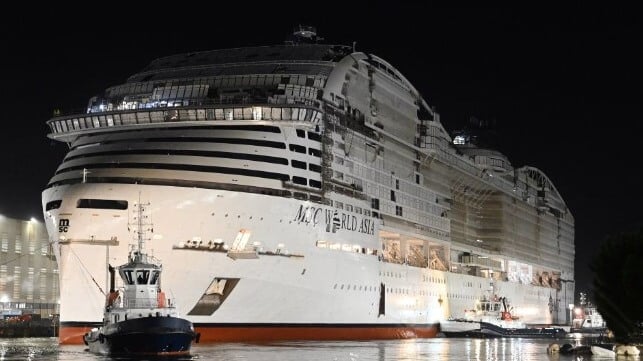
MSC World Asia's float-out ceremony (MSC)

Published Nov 12, 2025 9:17 PM by The Maritime Executive


The cruise industry's ambitious bet on continued growth extended further into the next decade on Tuesday as MSC Cruises signed contracts worth $4 billion for two additional vessels to be built at Chantiers de l'Atlantique.

The Geneva-based cruise operator made the announcement during milestone ceremonies at Saint-Nazaire for two other vessels in its World Class lineup. In back-to-back ceremonies, the yard floated out the newbuild MSC World Asia and held a coin ceremony for MSC World Atlantic.

The pair of newly-ordered ships, designated World Class 7 and 8, are slated for completion in 2030 and 2031 respectively. The addition expands MSC's investment to $12 billion across eight World Class vessels in various stages of planning and construction.

“We are deeply grateful to MSC Cruises for their renewed confidence. What our shipyard is achieving today is truly exceptional — four new ships ordered in 2025! The World Class series, now totaling eight vessels, is a testament to our teams’ expertise and to MSC’s vision," said Laurent Castaing, General Manager of Chantiers de l’Atlantique.

Pierfrancesco Vago, head of MSC's cruise division, said that the investment shows confidence in cruising's future trajectory. He emphasized the ships' energy efficiency and their use of liquefied natural gas, which the company views as a bridge to future green fuels.

Each World Class ship is designed with distinct themed districts, intended to offer passengers varied atmospheres and experiences within a single vessel. 

Once fitted out and delivered, MSC World Asia will begin Mediterranean service in December 2026. The ship's itineraries will include weekly voyages calling at Barcelona, Marseille, Genoa, Civitavecchia, Messina and Valletta.

MSC World Atlantic is scheduled for delivery in 2027, and the vessel will operate on Caribbean routes from Port Canaveral beginning in the 2027-28 season.

The World Class series began with MSC World Europa, delivered in 2022. MSC World America entered service this year, while four additional unnamed vessels are scheduled for completion between 2028 and 2031. Construction on the two newest orders will begin in 2029. 

Humanity travels an average of 78 minutes per day, regardless of living standards 


Universitat Autonoma de Barcelona


People travel for many reasons—commuting, as part of their job, or to go shopping—and the time spent traveling differs from day to day, from person to person. But remarkably, populations tend to travel for close to 1.3 hours per day (78 minutes), no matter where they live, or how rich they are. This is shown by a new international study from the Institute of Environmental Science and Technology at the Universitat Autònoma de Barcelona (ICTA-UAB) and the McGill University in Canada, which concludes that the key to reducing energy consumption at population level lies in designing communities that encourage low rates of energy use during those 78 minutes of daily travel. 

Although technological advances have made vehicles more efficient, global energy consumption in transport continues to rise. The study, recently published in the scientific journal Environmental Research Letters, suggests that the energy used per hour of travel — rather than per kilometer traveled — is the real factor that will determine future energy consumption. 

The analysis is based on data from personal and work-related travel in 43 countries, representing more than half of the world’s population. The results confirm previous indications that societies tend to stabilize their total daily travel time at around 1.3 hours (78 minutes) per day, with a variability of 0.2 hours (12 minutes). In other words, populations spend, on average, between 66 and 90 minutes a day traveling from one place to another, regardless of the mode of transport or the distance covered. This “convergent” range of travel time does not depend on whether people are walking, biking, or driving, and appears to come from deep-rooted psychological desires to see the surroundings, combined with practical limits that prevent people from spending too much time traveling. 

“The most important finding is that people don’t travel less when speed or efficiency increases; instead, they travel farther,” explains the study’s corresponding author, Eric Galbraith. 

Researchers argue that this convergence of travel time provides a robust tool for predicting how societies will respond to technological changes or public transport policies, even if these involve complex behavioral changes. Since total travel time remains constant, the behavioral changes will end up altering how that time is distributed among different modes of transport—and with it, energy expenditure. 

For example, a city organized around light rail, where each person spends about 40 minutes a day on the train and walks the rest of the time, will predictably consume about five times more energy than a city where all travel is on foot. And a city based on combustion-engine cars can use up to 100 times more energy per person than a pedestrian city, even if vehicles are relatively efficient per kilometer traveled. 

The study emphasizes that policymakers and urban planners play an essential role in reducing energy consumption in transport: by promoting travel modes with low energy use per hour, such as walking, cycling, or electric public transport. 

“Since total travel time is nearly constant,” says coauthor William Fajzel, a PhD student at McGill University, “policies that enable people to choose low-energy-per-hour modes of transport will be the most effective for reducing transport energy demand.”  


Randomized trials show no evidence of non-specific vaccine effects


A new Danish analysis of more than 25 years of research on non-specific vaccine effects shows that prominent researchers have systematically over-interpreted the findings from their randomized trials


Aarhus University


For more than three decades, researchers Christine Stabell Benn and Peter Aaby from the Bandim Health Project have conducted randomized trials involving thousands of children in Guinea-Bissau and Denmark to demonstrate so-called non-specific vaccine effects – that is, whether vaccines also protect against diseases other than the one they are designed to prevent.

A new comprehensive Danish review now shows that the trials have been unable to demonstrate non-specific effects for the widely used vaccinations against measles, tuberculosis, diphtheria, tetanus, and whooping cough.

“It is concerning that such a prominent research group has conducted so many randomized trials over such a long period without finding real results. Randomized trials are normally considered the gold standard in medical research, so if they do not show anything, one should be very cautious about presenting it as convincing evidence,” says Henrik Støvring from Steno Diabetes Center Aarhus and Aarhus University, who led the new review.

Comprehensive analysis across all studies

The new study is the first to systematically analyze all of Benn and Aaby’s randomized trials. While others have previously criticized individual studies, the researchers behind the new review examined the full body of work.

“We find indications that the researchers systematically selected and highlighted results that supported their theories, while downplaying the fact that they did not confirm the primary hypothesis the trials were actually designed to test. When you look at the overall picture, there are almost no real findings left,” explains Henrik Støvring.

Benn and Aaby have claimed that their results meant it was time to change the global approach to vaccination – all new vaccines should routinely be assessed for non-specific effects, and vaccination programmes should be revised worldwide.

When the gold standard does not hold

The new review is based on 13 randomized trials presented in 26 articles containing more than 1,400 separate statistical analyses. Only one of the 13 randomized trials demonstrated the effect it was designed to detect – and that trial was stopped early and was considered unsuccessful by the researchers themselves.

The review showed that only about 7% of the many hypotheses tested by the researchers could be expected to be correct. Notably, this did not apply to the researchers’ own primary hypotheses – these were not supported by the corrected results.

“In 23 out of 25 articles, the researchers highlighted secondary findings as support for their theories, but in 22 of these cases the evidence disappeared after proper statistical handling. Overall, the researchers’ interpretation did not take into account how many analyses they had conducted, and they did not focus on the main outcomes of the trials,” says Henrik Støvring.

Not a rejection of the field

The researchers stress that the purpose was not to determine whether non-specific vaccine effects exist, but to examine Benn and Aaby’s research practices.

“We hope that others in the field will now re-evaluate the evidence – what do we actually know about non-specific vaccine effects? Although Benn and Aaby have contributed about one-third of all research in the area, others have also studied the question, and this should be included to form a complete picture,” says Henrik Støvring.

The study was conducted in collaboration between Henrik Støvring (Steno Diabetes Center Aarhus and Aarhus University), Claus Thorn Ekstrøm (University of Copenhagen), Jesper Wiborg Schneider (Aarhus University), and Charlotte Strøm (SharPen). The study has just been published in the leading international journal Vaccine.


Behind the research result

Study type: Meta-analysis

Collaborators: The study was conducted in collaboration between Henrik Støvring (Steno Diabetes Center Aarhus and Aarhus University), Claus Thorn Ekstrøm (University of Copenhagen), Jesper Wiborg Schneider (Aarhus University), and Charlotte Strøm (SharPen).

External funding: None

Potential conflicts of interest: None of relevance to this study. 

Link to scientific article: https://doi.org/10.1016/j.vaccine.2025.127937