Thursday, November 13, 2025


Congo produces first 1,000t of traceable artisanal cobalt

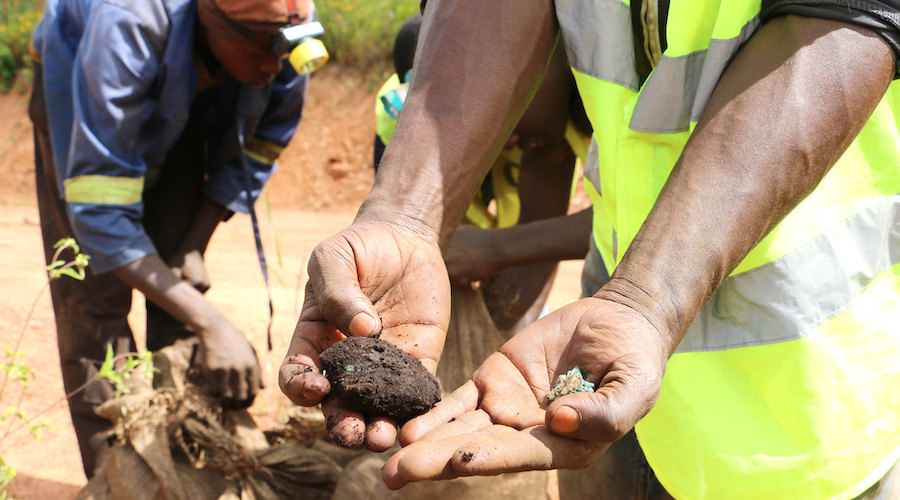
Cobalt mining in the Democratic Republic of the Congo. (Image by Fairphone, Flickr).

The state cobalt agency in Democratic Republic of Congo has produced its first 1,000 metric tons of traceable artisanal cobalt, a key step in formalizing the sector in a country that supplies much of the world’s battery metal.

Congo holds about 72% of global cobalt reserves and accounts for over 74% of supply, much of it from informal artisanal mines.

Artisanal mining is a lifeline for Congo, employing an estimated 1.5 million to 2 million people and supporting more than 10 million people indirectly.

Unregulated cobalt avoids official oversight, making supply hard to track and vulnerable to government confiscations. That uncertainty reduces the amount of ethically sourced material and pushes up prices for traceable cobalt.

Aiming to curb oversupply and support prices, Congo introduced export quotas in October after a months-long export ban.

The quota system, managed by regulator ARESCOM, restricts exports and promotes local processing by making it less attractive for producers to ship out raw cobalt.

Entreprise Générale du Cobalt (EGC), created in 2019 as a subsidiary of state-owned miner Gécamines, announced its first 1,000 tons of traceable artisanal cobalt at a ceremony in Congolese mining town Kolwezi on Thursday. The company said its traceability model will clean up the supply chain and align production with international environmental, social and governance standards.

“The vision is to transform artisanal cobalt into a strategic asset under Congolese control,” CEO Eric Kalala said at the launch in Kolwezi, the heartland of Congo’s cobalt production.

“Every ton purchased by EGC must reflect not only the value of the mineral, but also the dignity of those who extract it.”

Global cobalt demand is forecast to rise 40% by 2030, driven by demand for electric vehicles and energy storage, according to the International Energy Agency.

Automakers and electronics firms increasingly require proof of ethical sourcing, putting pressure on producers to eliminate child labor and unsafe practices.

EGC plans to expand beyond the inaugural 1,000 tons while adding refining capacity and capturing a larger share of the artisanal market, Kalala said.

EGC did not disclose how the inaugural 1,000 tons will be marketed or sold.

(By Benoit Nyemba, Ange Adihe Kasongo and Maxwell Akalaare Adombila; Editing by Robbie Corey-Boulet and Matthew Lewis)


US House report accuses China of minerals market interference

Map of Baotou City: Epicentre of China’s rare earth industry. Stock image.

China for decades has sought to manipulate global critical minerals prices, using its control as an economic weapon to expand its manufacturing sector and its geopolitical influence, a US House of Representatives committee said on Wednesday.

The allegations, contained in a 50-page report from the bipartisan US House Select Committee on China and reviewed by Reuters, adds to a series of missives from Washington criticizing Beijing’s sway in critical minerals markets.

President Donald Trump and his predecessor, Joe Biden, have in recent years sought to crimp China’s dominance in the critical minerals sector.

Mineral price controls

The committee’s legislative report aims to codify presidential orders into law with an array of recommendations including price controls and expanded government oversight of price reporting agencies.

The Chinese Embassy in Washington did not immediately reply to a request for comment. China has previously accused the US of distorting and exaggerating Beijing’s rare earths export controls and of stirring up panic over the issue.

“China has a loaded gun pointed at our economy, and we must act quickly,” said Congressman John Moolenaar, a Michigan Republican and chair of the committee.

A chemist by training who previously worked at Dow Chemical, Moolenaar added that Beijing’s practices had “caused American job losses, driven American miners out of business, and jeopardized national security.”

The report, compiled by committee staff, was also endorsed by the ranking Democrat, Congressman Raja Krishnamoorthi of Illinois.

It alleges that China’s role as the world’s largest processor of many critical minerals has made it nearly impossible for the United States and allies to determine the true price of certain metals, including rare earths.

The report also suggests that the London Metal Exchange, where many minerals are traded, is susceptible to influence from Beijing, as it is owned by the Hong Kong Exchanges and Clearing.

“The LME advertises itself as showing prices that ‘properly reflect global supply and demand.’ However, with the (Chinese government) looking over HKEC’s shoulder, it is difficult to determine whether the prices it publishes accurately reflect global supply and demand.”

The LME said it is subject to the laws and regulations of the United Kingdom, where it is based.

“All of the LME’s key prices are determined on the basis of transparent trading activity from an international participant base,” a spokesperson said.

Targeted pricing allegations

The House committee’s report, based on published reports and data, also alleges that China has specifically targeted the lithium and rare earths industries, raising and lowering prices to bolster its own economy.

“Each time lithium prices rose, the PRC government took action to bring lithium prices back down,” the report said.

The Trump administration cited issues with pricing in September when it sought an equity stake in Lithium Americas.

The report offers 13 policy recommendations, some of which Trump has already taken. It also aims to spark broader dialogue about China’s presence in the minerals markets rather than seek to address every concern.

“One single policy will not completely address the serious challenge the United States faces on critical minerals, so we must simultaneously pursue multiple policy prescriptions,” it said.

One of those recommendations, the creation of a “critical minerals czar,” was instituted by Trump earlier this year. The report also suggests the creation of a US minerals stockpile, which the administration has indicated it is open to.

(By Ernest Scheyder and Pratima Desai; Editing by Veronica Brown and Edmund Klamann)

CU


Column: Copper joins critical minerals list but the US has plenty already

Stock image.

Copper has been added to the US government’s list of critical minerals – the metals deemed vital to the country’s economic and national security.

Fortunately, the United States has already accumulated what is the world’s second largest copper stockpile, behind China’s state reserves.

It has done so without spending a dollar of federal money. Rather, the copper market has done all the work in the form of a yawning arbitrage gap between the US price traded by the CME and the international price traded on the London Metal Exchange (LME).

The pricing differential has already drawn massive amounts of physical copper into the United States. And it’s still doing so as the market bets that the critical mineral designation, first flagged in August, increases the chances of US import tariffs.

CME Premium to LME copper

Trading the gap

When US President Donald Trump ordered an investigation into copper imports on national security grounds in February, the market moved quickly to price in the potential for US import tariffs similar to those already imposed on steel and aluminum.

The CME spot premium over the London market stretched to almost $3,000 per metric ton at one stage in July, creating an extraordinary opportunity for the world’s largest traders to ship as much physical metal as they could get their hands on to the United States.

The premium imploded in July when the Trump administration blind-sided the market by imposing tariffs on imports of copper semi-manufactured products but deferring until July 2026 a decision on refined metal.

Tariff trade over?

So it seemed, but the arbitrage gap has been widening again. The spot CME premium has rebounded from under $100 per ton in August to over $300, while the 10-month forward premium is now priced at almost $800 per ton.

Sure, the current arbitrage gap is not nearly as wide as it was in July, but it’s more than enough to cover the physical costs of shipping units to the United States.

Global exchange stocks of copper

Market of first resort

This year’s tariff trade is visible in the form of rising copper stocks held by the CME, which has only domestic US delivery points.

CME stocks have mushroomed from a February low of 83,900 tons to over 335,000 tons. CME warehouses now hold more copper than the LME and Shanghai Futures Exchange combined.

Metal is still arriving in the CME delivery network every day, mostly at New Orleans but there have also been inflows at Baltimore, Salt Lake City and Tucson.

What’s on the CME may be just the tip of the iceberg.

Consultancy Benchmark Minerals Intelligence thinks there is in total between 731,000 and 831,000 tons of “economically trapped” copper in the United States. Trapped in the sense that it would now require a huge inversion of the arbitrage between the United States and the rest of the world to free up metal for re-export.

Indeed, given the renewed widening in the US premium, the likelihood is for more metal to join the growing copper mountain rather than move the other way.

US trade statistics have fallen foul of the government shutdown but refined copper imports were already over one million tons in the first seven months of the year, up almost 400,000 tons on the year-earlier period.

More recent export data from major copper suppliers such as Chile, Peru and Australia suggest no let-up in the physical tariff trade.

The United States remains the market of first resort for spare copper, which is why Europe’s largest producer Aurubis has been able to hike its premium for 2026 deliveries by an aggressive 38% to a record $315 per ton over the LME basis price.

US strategic stockpile

Market dynamics have generated a tectonic redistribution of global copper to the United States, where it is now locked in by the same dynamics.

Without anyone seeming to plan it, the country is successfully building what might be described as a strategic stockpile, just one held by the commercial rather than the state sector.

The stockpile is still growing and will continue to do so as long as the arbitrage allows traders to make an easy profit by scooping up metal everywhere else and sending it to a US port.

No-one knows how much copper is held by China’s Strategic Reserves Administration. It’s a state secret but a two-million ton target has floated around the market for many years.

The United States isn’t there yet, but it’s well on its way to building a similar-sized reserve.

There may, though, be yet another ironic twist in the copper tariff trade.

The Trump administration has said it will look again at US import dependency in July next year, with the option of phasing in a tariff on refined copper from 2027.

Every ton of copper clearing US customs reduces that dependency, even without factoring in the intended tariff booster to domestic production.

(The opinions expressed here are those of the author, Andy Home, a columnist for Reuters.)

(Editing by Susan Fenton)

Ivanhoe Electric secures $200M bridge loan for Arizona copper mine

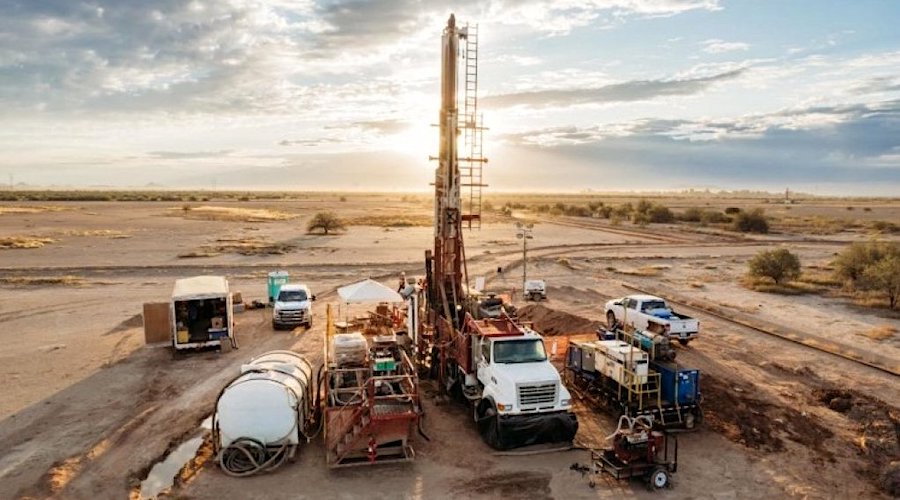
Santa Cruz copper project. (Image courtesy of Ivanhoe Electric | Twitter.)

Ivanhoe Electric (NYSE-A, TSX: IE) says it has secured a $200 million bridge loan from a syndicate of banks in support of its efforts to build the next major US copper mine in Arizona.

In a press release Thursday, Ivanhoe said the loan — backed by National Bank Capital Markets, Societe Generale and BMO Capital Markets — serves as “an important component” of the overall financing strategy for its Santa Cruz project as it aims to begin construction in the first half of 2026.

Executive chairman Robert Friedland said the credit approvals from this group of “top-tier mining financiers” are a clear vote of confidence in the Santa Cruz project, which he envisions as one of the first new US copper mines in almost two decades. “Santa Cruz is the first step in our vision to grow a new American-based and American-focused critical metals company,” Friedland stated in the release.

“The bank group conducted extensive technical due diligence as part of their credit approval process, and we are grateful for their support for our company and the Santa Cruz copper project,” Taylor Melvin, Ivanhoe’s CEO, added.

Melvin also noted that upon closing of the bridge loan, expected in December, the company will have added over $360 million in liquidity this quarter, placing it in an “exceptionally strong financial position” as it enters a critical development year for its flagship copper project.

Shares of Ivanhoe Electric fell despite the announcement, amid broader weakness in the equities market. By 10:30 a.m. ET, it traded at $12.81 apiece in New York, down 3.9% on the day, for a market capitalization of $1.88 billion.

Long-term copper producer

Located in Casa Grande, about 77 km south of Phoenix, Santa Cruz hosts a large underground deposit that is being earmarked as a long-term US producer of copper cathodes. Ivanhoe has been working on the project since 2022 and has so far delineated 3 million tonnes of indicated copper resources, about half of which are mineable reserves.

Anchored by this resource, Ivanhoe produced earlier this year a new preliminary feasibility study (PFS) for Santa Cruz, outlining a potential 23-year mine capable of producing 72,000 tonnes of 99.99% pure copper cathodes annually in the first 15 years.

Using a base case copper price of $4.25 per lb., the PFS gave the project an after-tax net present value (NPV) of $1.4 billion and an internal rate of return (IRR) of 20%. The initial project capital was pegged at $1.24 billion, for an estimated capital intensity of $17,000/t of copper. Its cash costs of $1.32/lb. over the life of mine would be in the first quartile globally and the lowest cost in America.

Financing talks

As part of its project financing strategy, Ivanhoe said it is in talks with interested parties both project-level minority investment and long-term debt. These include the US Export Import Bank, which indicated in April its interest in providing an $825 million loan that could cover the project’s construction costs.

In Thursday’s release, Ivanhoe said it remains well-positioned to deliver on its indicative Santa Cruz Copper project timeline, which is to begin copper cathode production in late 2028.


Rio Tinto puts Jadar lithium project on backburner

The Jadar project has an estimated production capacity of 58,000 tonnes per year. (Image courtesy of Rio Tinto.)

Rio Tinto (ASX: RIO) will halt development of the long-delayed Jadar lithium project in Serbia as the Australian miner looks to shed costs and shift focus elsewhere, according to media reports.

On Thursday, Bloomberg reported that Rio intends to place the near $3 billion project into “care and maintenance,” citing an internal memo that was later confirmed by a company spokesperson.

Rio Tinto did not respond to MINING.COM’s request for comment.

This move essentially ends Rio’s two-decade-long quest to tap into one of the world’s largest lithium resources. The company had estimated that Jadar could produce 58,000 tonnes of refined battery-grade lithium carbonate per year, starting as early as 2027.

Lack of progress

According to the memo seen by Bloomberg, Rio said it was “not in a position to sustain the same level of spend and resource allocation,” given the project’s lack of progress.

Since its initial discovery in 2004, the Jadar project has faced numerous regulatory setbacks, political uncertainty and community opposition. Belgrade revoked licences for the project in January 2022 after massive protests by environmental groups over the proposed mine.

Despite regaining it two and a half years later, the permitting process barely moved.

The decision to stop the project altogether comes five months after the Australian miner raised its cost estimates for Jadar, from $2.4 billion before to approximately $2.95 billion. The revision, the mine’s managing director previously said, reflected costs to meet “European Union environmental and human rights standards.”

Mothballing the Jadar project would deal a further setback to the EU’s hopes of building an independent battery metals supply chain. If built, it would be the largest lithium mine on the continent and is expected to meet approximately 90% of its current lithium demand.

Simplify operations

The decision to halt Jadar marks the latest cost-cutting measure under new chief executive Simon Trott, who replaced Jakob Stausholm earlier this year and has pledged to simplify operations and reduce management layers.

Rio has already cut about 480 jobs—roughly 3% of staff—at its Australian iron ore division since 2024, and is still trimming its workforce, according to the Australian Financial Review. More job cuts are expected in the coming months as the group implements a new organizational structure, AFR also said.

With Jadar out of the picture, Rio’s lithium focus would fall almost entirely on its South American assets, such as the $2.5 billion Rincon project that was approved by Argentina earlier this year and the two projects it is partnering with Chile on.

Shift in priority

CEO Trott had foreshadowed the move to de-prioritize its non-Latin-American assets when he told investors at a recent Goldman Sachs event in London that not all of Rio’s lithium assets will advance simultaneously.

“The bar is really high, and we can progress the very best of them,” Trott said at the event.

His predecessor Stausholm said earlier this year that the Lithium Triangle area, which also includes Bolivia, “offer the best chance for the world to access low-cost, high-quality lithium.”

Barclays analyst Amos Fletcher told AFR that Jadar and the other hard rock lithium mines inherited from last year’s merger with Arcadium – namely Mt Cattlin in Western Australia and Galaxy in Canada – may be sold.

“The message is that we need to start living within our means,” Glyn Lawcock, head of metals and mining at Barrenjoey Markets, told Bloomberg on Thursday.

“They’ve only got so much capital they can allocate and they’ve allocated quite a bit of capital to lithium already through the acquisition of Arcadium.” 


Tax officials probe MinRes and founder Ellison, AFR reports

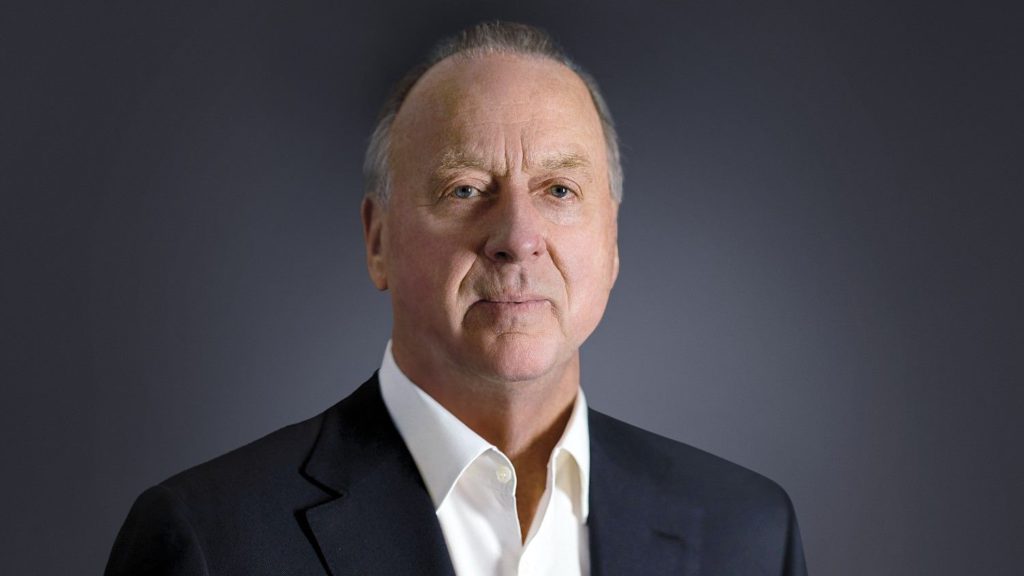
Chris Ellison, managing director and founder of Mineral Resources. Credit: Mineral Resources Ltd.

Australian tax officials have started a new investigation into Mineral Resources Ltd. and its founder and managing director, Chris Ellison, the Australian Financial Review reported Thursday.

The investigation by the Australian Taxation Office is focused on how MinRes and Ellison calculated income and fringe benefits taxes, the newspaper said citing an ATO request sent to the Federal Court. It follows earlier, separate, inquiries by both the Australian Securities and Investments Commission and the Australian Securities Exchange.

A spokesperson for MinRes did not immediately respond to a phone call or emails. The ATO did not respond to questions before publication.

Ellison has been under scrutiny for roughly a year since an internal company probe found he had engaged in “profoundly disappointing” conduct including not paying personal income tax. He was fined A$8.8 million ($5.8 million) by the company and forfeited his salary and other incentives worth as much as A$9.6 million. Ellison also made a commitment to step down from the top job by the middle of next year.

The company’s own inquiry also found MinRes had made payments of A$3.8 million to an offshore company owned by Ellison for mining equipment and parts. He agreed to repay the amount. It also revealed the Perth-headquartered firm had paid rent on properties owned by Ellison and other rent-related financial benefits to his daughter. On occasion, he used company resources and staff for work on his private boat and properties, and to manage his finances.

Under Ellison the company grew from a mining contractor to operating its own mines. MinRes recently brought its massive Onslow iron ore project online, and struck a new joint venture agreement with South Korea’s Posco Holdings Inc. to reduce debt.

(By Paul-Alain Hunt)


Four Glencore Traders Plead Not Guilty to Bribery Charges

cash
Pixabay

Published Nov 12, 2025 7:45 PM by The Maritime Executive


Four former employees of trader Glencore have pleaded not guilty to charges of bribery in connection with the firm's oil operations in Nigeria, Ivory Coast and Cameroon in 2007-14.  

Paul Hopkirk, 51; Martin Wakefield, 66; David Perez, 54; and Ramon Labiaga, 56, have been arraigned at a UK court and have pleaded not guilty to charges of "conspiracy to give corrupt payments" to local officials and intermediaries. Gibson, Perez and Wakefield face an additional charge of falsifying accounting documents for allegedly writing up fake cash-payment invoices for an intermediary, Nigeria's Amazoil Ltd. Two additional top trading executives, former oil trading chief Alexander Beard and oil operations director Andrew Gibson, have also been charged but have yet to enter pleas; both maintain that they are innocent.  

The case will take time to make its way through the court system, and the trial is set to begin in October 2027. 

Corruption allegations have plagued all of the major commodity trading houses in recent years, and Glencore is no exception. In 2022, the company pleaded guilty to American charges of international bribery and market manipulation, and it paid a combined $1.1 billion in penalties and fines.

According to the U.S. Justice Department, Glencore International and its subsidiaries bribed intermediaries and foreign officials in West African countries for more than a decade, securing favorable oil contracts in return. In Nigeria alone, prosecutors said, Glencore and its subsidiaries paid more than $52 million to local intermediaries, in the expectation that those funds would be used to pay bribes to Nigerian officials. The scheme netted the trading house hundreds of millions of dollars in profits, Justice officials said. 

"At bottom, Glencore paid bribes to make money – hundreds of millions of dollars. And it did so with the approval, and even encouragement, of its top executives," said then-U.S. Attorney Damian Williams for the Southern District of New York at the time. 

In addition, the company admitted that its American traders were in the practice of submitting fake bids to the Platts trading window in order to drive benchmark fuel oil prices up or down, depending on whether they were buying or selling. This technique was used in order to manipulate fuel oil prices at two American seaports. As a penalty for this scheme, Glencore agreed to pay a criminal fine of $340 million, forfeiture of $144 million, and hire an independent monitor for three years. It also settled a related case brought by the Commodity Futures Trading Commission (CFTC) for a civil penalty of $865 million and disgorgement of another $320 million.

If the firm's admitted bribery offenses had been discovered later, it could have avoided prosecution in the United States. The Trump administration halted all enforcement action on Foreign and Corrupt Practices Act (FCPA) cases in February 2025. In an executive order, the White House said that pursuing corruption cases like the one against Switzerland-based Glencore "actively harms American economic competitiveness and, therefore, national security."  


Diego Garcia Legislation Postponed Until 2026

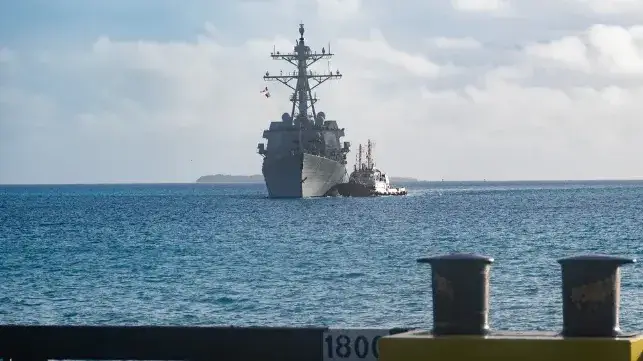
Destroyer USS John Finn arrives at the strategic naval base at Diego Garcia, British Indian Ocean Territories (USN)

Published Nov 12, 2025 11:21 PM by The Maritime Executive


The British government has confirmed that the next stage of the legislative process to enact the UK's agreement to hand over sovereignty of the British Indian Ocean Territory to Mauritius has been postponed until 2026, while alternative solutions are explored.

The progress of the legislation, which needs to be passed by both houses of Parliament before ratification of the treaty with Mauritius can take place, has been upset by a recognition that the inhabitants of the Chagos Islands were not consulted before the agreement to consign them to Mauritius was agreed. The government assessed that an amendment to force reconsideration of the handover, hinged on this matter, was in danger of being agreed in the House of Lords. This would in effect have sunk the legislation.

At the same time, a court case calling for a judicial review to prevent the government's handover is being heard in the British High Court, the point of law being again the lack of consultation with Chagos islanders. Many Chagos islanders would like to remain British, and have greater faith that the British government would allow them to return to outer islands in the archipelago than would the government of Mauritius.

At the center of the move to surrender the Chagos and to provide continuance for the US Naval Support Facility on Diego Garcia, is the UK's Attorney General, Lord Hermer. Lord Hermer is also believed to have ruled last week that the United Kingdom should no longer pass intelligence to the United States on matters concerning anti-drug running operations off Venezuela, based on his assessment that the interdictions of drug-running craft in recent weeks fall foul of international law. The United States will not be overly constrained by a lack of intelligence pertaining to this one particular area. But by courtesy of islands in the Caribbean which still fly the British flag, and other countries close to Venezuela such as Guyana which are members of the Commonwealth, the United Kingdom still conducts pertinent intelligence collection in the area which would aid American operations. In normal times, HMS Medway (P223) and HMS Trent (P224), the Royal Navy's patrol vessels permanently assigned to the area, work in close conjunction with the US Coast Guard, US Navy and the Drugs Enforcement Agency.

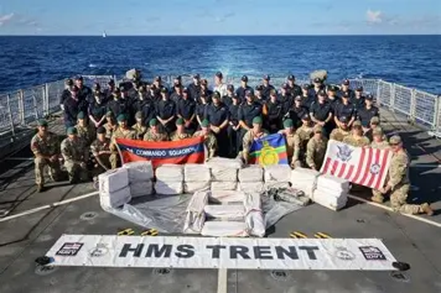
Haul from a $267M joint US-UK drug seizure displayed on board HMS Trent (UK MoD)


Russia Suspends Red Sea Base Plans as Sudan War Rages

Port Sudan
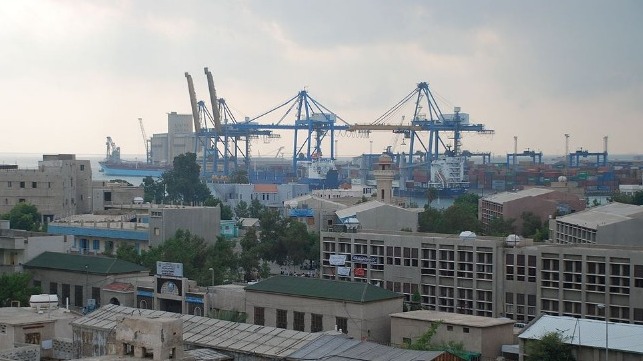
Port Sudan (file image)

Published Nov 13, 2025 10:54 AM by The Maritime Executive


Russia claims to have suspended its plans to establish a naval base in Sudan, ending its hopes for a presence “east of Suez.”

The Kremlin initially brokered the deal to build the naval base back in 2017 during then-dictator Omar al-Bashir’s rule. Ratification of the deal stalled after the ongoing civil war in Sudan broke out in 2023; however, the Sudanese Armed Forces (SAF), which controls Port Sudan, early this year indicated that there were no obstacles to setting up the Russian base.

But with the war intensifying between SAF and the rival Rapid Support Forces (RSF), Russia sees little hope in building the base in the near future. In a recent interview with local media, Russian Ambassador to Sudan Andrey Chernovol said that Sudan is unlikely to ratify the agreement for the base anytime soon.

“Given the current military conflict, progress on this issue is currently suspended,” said Chernovol.

The worst of the fighting is in the country's central and western regions, but the northeast is not immune. In May, a large-scale drone attack on a Sudanese naval base near Port Sudan demonstrated that the RSF (with its foreign backing) has the reach to damage infrastructure at Russia's future base site.

For Russia, the suspension of the base deal is a major setback as the country hoped to secure a permanent presence in the Indian Ocean. In addition, the base would have been Russia’s first naval base in Africa since the Soviet era. The location of Port Sudan in the Red Sea region was attractive to Russia, given its strategic position near the Suez Canal, a critical global maritime chokepoint.

But even if base construction were to proceed in Sudan, the Russian Navy is currently resource-constrained owing to the ongoing war in Ukraine. One of the signs is the waning presence of the Russian Navy in the Mediterranean Sea. At one point in 2018, Russia had at least two submarines and ten surface ships patrolling the Mediterranean waters. In the past few months, Russian naval assets in the region have been the lowest in years, often consisting of just a single Kilo-class submarine supported by a surveillance vessel.

The drop has been attributed to the loss of Russia’s strategic port in Tartus, Syria, which provided critical resupply and repair services for the Mediterranean Flotilla. Instead, Russia has shifted its naval assets to bolster its presence in the Baltic Sea and the Arctic.


American Icon

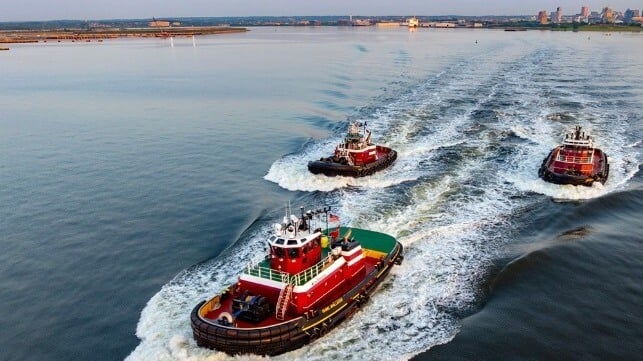
In the U.S., the McAllister name goes hand in glove with towing.

McAllister
Courtesy of McAllister

Published Nov 11, 2025 11:06 PM by Tony Munoz

(Article originally published in Sept/Oct 2025 edition.)


"Our mission is to provide safe, sustainable and quality services to our customers and keep the flag flying for generations to come," says Buckley ("Buck") McAllister, the company's fifth-generation president. "Ultimately, we strive to be the best boat company in the business."

And that, in a nutshell, is the driving force behind the family's success.

"We have a great family legacy," McAllister adds, "and it takes elbow grease to measure up to that tradition." Okay, include hard work in that formula.

There are many storied names in the shipping business, but few have the staying power of the McAllisters. They're a legend in and around New York harbor, and the company's distinctive red-and-white striped stacks are a familiar sight in ports up and down the East Coast and as far away as Puerto Rico. And it all started with a single vessel that didn't even have a stack. It had a sail.

BACK STORY

That vessel was a so-called "sail lighter," purchased by the company's founder, Captain James McAllister, in 1864. At the time, he was a mate on a coal collier, and when he arrived in New York harbor, he looked around at all the bustling activity and thought, "Boy, it's a lot easier to find a job here than back in Ireland, where people are starving to death." So he stayed.

It's a familiar story – the Graces, the Morans, the Crowleys, the McAllisters – all Irish families fleeing the potato famines and setting up shop in America. And while the Grace family is no longer in the shipping business, the other three very much are and compete head-to-head in a number of ports.

As for the sail lighter, it was the "pickup truck" of its day, going out to ships at anchor and offloading parcels for delivery elsewhere in the harbor. As the business grew and thrived, James McAllister brought over family members from Ireland to work with him, ensuring a workforce he knew and could trust. The lighterage business was soon augmented with towing, and the company's first steam tug, the R.W. Burke, was acquired in the 1880s, at the time the Brooklyn Bridge was being built. More vessel acquisitions followed along with several mergers.

When Captain James died in 1916, his four sons assumed control of the now much larger company, which by 1918 had moved into the ocean towing business. Always an innovator, the company inaugurated one of the first deep sea tug-barge combinations with the 156-foot tugboat C.W. Morse, carrying molasses from Cuba to New Orleans. And in 1927, it installed a 375-horsepower diesel engine in the Daniel McAllister, making it the first diesel-powered tug in New York harbor.

The third generation – Anthony, James and Gerard McAllister – took the helm in 1936 and helped guide the company through the Great Depression. During the 1940s and 50s, they began expanding the company to include operations in Pennsylvania, Virginia and Canada.

The 1960s saw further growth and expansion, and in 1974 the fourth generation of McAllisters – including Buck McAllister's father, Captain Brian – took over. It was not an easy transition as the company was prospering and Wall St. firms were interested in acquiring it and the fourth generation had to come up with a lot of cash to keep it out of unfriendly hands.

There were more challenges to come – the oil price collapse of the 1980s, an ownership issue and legal battles in the 1990s – but the company powered through and kept growing and innovating. It had helped pioneer the development of the Kort-nozzle, flanking-rudder tugs that dominated the 1960s and '70s. In the 1980s and 1990s, it further modernized its fleet by building Z-drive tractor tugs with the latest firefighting equipment and capabilities.

Today, the fleet stands at more than 70 vessels, 41 of them tractor tugs. Its operations have expanded to include 14 ports up and down the East Coast and Puerto Rico including Eastport and Portland, Maine; Providence, Rhode Island; Bridgeport, Connecticut; New York; Philadelphia, Pennsylvania; Camden, New Jersey; Baltimore, Maryland; Norfolk, Virginia; Wilmington, North Carolina; Charleston, South Carolina; Jacksonville and Port Everglades, Florida; and San Juan, Puerto Rico.

It also owns and operates a ferry business across Long Island Sound – the Bridgeport & Port Jefferson Steamboat Company, established in 1883. It runs four passenger-car ferries between Bridgeport, Connecticut and Port Jefferson, New York: the Grand Republic, Long Island, Park City and P.T. Barnum, each capable of carrying 1,000 passengers and 100 automobiles.

FIFTH GENERATION

When Buckley McAllister and the fifth generation took the helm in 2013, the company was on solid footing. It had weathered the financial collapse of 2008 and celebrated its 150th anniversary in 2014 with, among other notable events, the publication of a company history, McAllister Towing: 150 Years of Family History.

The fifth generation brought with it a different style of management – more disciplined, more detail-oriented, less swashbuckling. The traditional family values of loyalty, trust, hard work and accountability remain, but the organization is more structured with general managers in the field handling most of the day-to-day operations and corporate taking care of sales, engineering, accounting, insurance, HR and legal matters.

After all, Buckley McAllister is a lawyer who thinks like a CEO. He says the key is "having a management system that incorporates best practices on safety, health, security, and the environment." To support those goals, he's long been a board member of the Steamship Mutual P&I Club, the Seamen's Church Institute and the Coast Guard Foundation, to name a few. He's also a member of the Maritime Association of the Port of New York & New Jersey and the American Bureau of Shipping and served as Chairman of the American Waterways Operators (AWO) in 2013-14.

"McAllister Towing is fundamentally in the ship assist business," he says. "A tug's main mission is to physically assist another vessel. Our company acts in that same way, taking care of other company's vessels and businesses. That's why I support industry organizations."

He further elaborates: "The Seamen's Church Institute provides ministry and training to mariners that build and support our workforce. The AWO is a powerful advocate for the workboat industry and a key partner on improving safety, environmental and regulatory standards. The Coast Guard Foundation takes care of the folks who keep our harbors safe, secure and efficient. The Steamship Mutual P&I Club provides resources and expertise for situations where things don't go as planned. All of these organizations have at their core the mission of taking care of vessels and crew, which is central to what we do as a company."

PARTNER OF CHOICE

Despite all the emphasis on new equipment and tug technology ("I could really nerd out about boat technology," he quips), McAllister says, "The real horsepower is in the wheelhouse."

It's the people who make it all work, he explains: "At the end of the day, the tugboat business is really all about the quality of your people and the quality of the service you provide. That's why we're constantly thinking about how to provide better training to our mariners and better service to our customers."

Sounds like a surefire formula for success now and into the foreseeable future.

"We're confident that investing in our business and our people will ensure McAllister is primed for the future and remains the partner of choice for the next generation of shipping," he concludes.

Amen to that. - TME

Tony Munoz is The Maritime Executive's founder, publisher and editor-in-chief.

The opinions expressed herein are the author's and not necessarily those of The Maritime Executive.
 

New Bahrain-Qatar Ferry Link Symbolizes End of a 55-Year Feud

Qatar
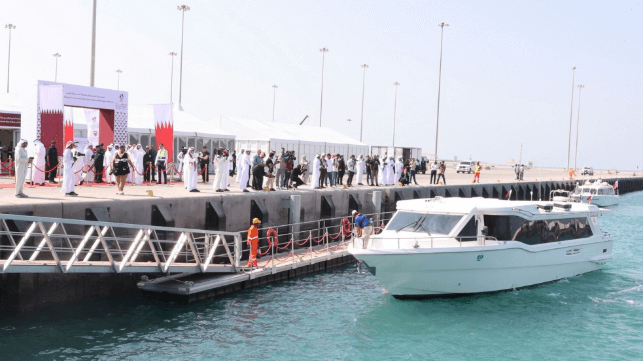
Small vessel, big significance: the first ferry arrives in Qatar from Bahrain (Qatar Ministry of Transport)

Published Nov 12, 2025 12:28 PM by The Maritime Executive


Bahrain and Qatar have for the first time established a direct ferry link. Previously, GCC citizens who wished to travel between the two countries had to fly, or take a long land route through Saudi Arabia subject to border controls. The new ferry route, which went into service on November 6, makes the direct transit in 50 minutes. Initially, two return services will run each day, but from this modest start the operator wants to build a higher-volume service.

The establishment of the new service is politically significant, as for decades the two countries have been in dispute about the border between the two countries, a dispute which also covered differences in the relationship each country enjoys with Iran. With such a move normally indicative in diplomatic circles of a new mood, Qatar last week also appointed a new ambassador - Nasser Abdullah Hassan Al Nassr - to Bahrain. His predecessor had served for only a year.

The underlying border dispute was largely cleared up in 2001, when an International Court of Justice judgment was formally accepted by both sides. Bahrain was awarded the Hawar islands, just offshore of Qatar's north-western coast, a finding reflected in a substantial eastward adjustment to the maritime border between the two countries, a change which benefitted Bahrain.

Bahrain's claim to the historical town of Zubarah, on the Qatari mainland and opposite the Hawar Islands, was however rejected, an award which continued to rankle with Bahrain because Zubarah is the ancient home of origin of Bahrain's Khalifa royal family. Zubarah two centuries ago was a major pearl diving center, and the substantial ruins of the city, which are well-preserved by the Qatari authorities, were designated as an UNESCO World Heritage Site in 2013.

The new ferry service is being run by the Bahraini Masar Group, a private operator. It plies between Saadah Marina on Muharraq Island in Bahrain and Al Ruwais Port in Qatar. The service will at first only carry foot passengers who are also GCC citizens, so its introduction will be limited. But it may appeal to the Bahraini Shi'a population, which has strong familial ties to Iran, as those who cross to Qatar from Bahrain will now be able to fly on to Iran.

Such a move can be regarded as a necessary precursor to the introduction of a common travel area within the GCC, which implies the removal of barriers to travel between GCC states that have occasionally been put in place in recent decades when quarrels and disputes have arisen between neighbors. The common travel area is being advanced by the introduction later this year of the Unified GCC Tourist Visa.


Oman to Build Clean Energy Bunker and Export Hub in Salalah

Salalah
File image courtesy Salalah Port Services

Published Nov 12, 2025 2:15 PM by The Maritime Executive


HIF Global and Acciona Nordex Green Hydrogen have signed a deal with Oman's Ministry of Transport, Communications and Information Technology to explore the building of an e-methanol production and bunkering hub in the port of Salalah, in Oman's Dhofar Province. The project leverages vast wind and solar farms producing electricity which are being built in the hinterland behind Salalah, in projects involving EDF, Fortescue, J-Power, Marubeni and Samsung.

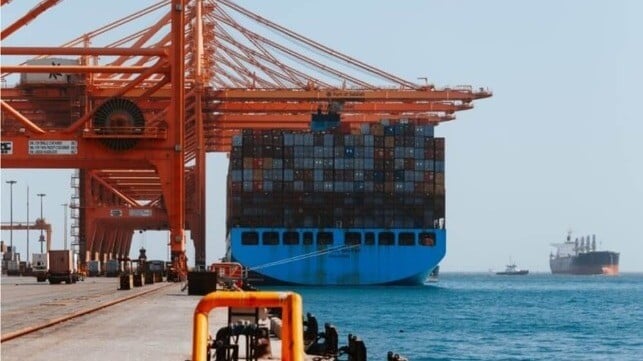
The port of Salalah has experienced major growth in recent years, both in container and general cargo traffic. Container traffic grew 21% in the 1H25 compared with the same period last year, with movement of 2.03M TEUs, largely a consequence of the rounding-out of Gemini services provided by Maersk and Hapag-Lloyd. General cargo over the equivalent periods grew by 11%, largely on the back of increased gypsum dry bulk cargo. After a recent expansion, Salalah can now handle 6M TEUs annually, and in recent years throughput has grown quickly to match capacity as new facilities are introduced.

The port of Salalah is particularly popular with visiting sailors in the summer, when the local area uniquely enjoys lush green vegetation and monsoon rains, at a time when temperatures in the rest of the region are in the high 40Cs.

HIF Global, based in Houston (TX), has expertise in building and delivering projects which combine captured CO2 and hydrogen - produced by the solar and wind energy - to produce e-methanol. E-methanol can in turn be refined to produce synthetic substitutes for petrol, diesel and aviation fuel.

Separately, two sovereign-owned companies, OQ Alternative Energy and Asyad Shipping, are working with A.P. Moller-Maersk and Sumitomo Middle East to provision e-ammonia and e-methanol bunkering and export facilities at Salalah, but also in the port of Duqm. A local firm, Horizon Energy Salalah, has already signed a lease agreement creating a biofuel storage hub in Salalah.