Friday, November 14, 2025


Manifesto for an ecosocialist revolution: Possible consequences in the Philippines
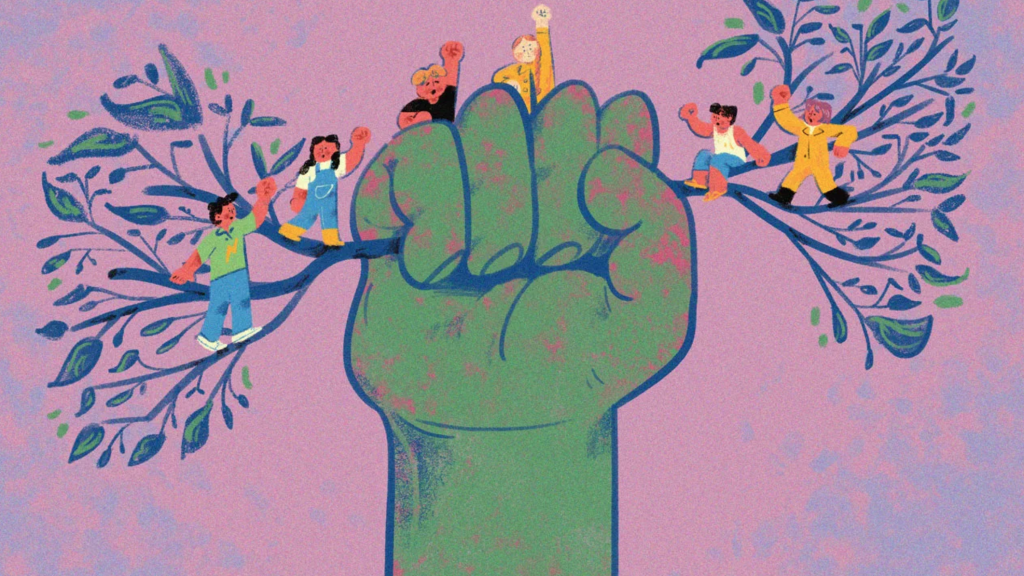

Ecosocialism fist

First published at International Viewpoint.

At its last world congress, the Fourth International adopted a document entitled Manifesto for an ecosocialist revolution — Break with capitalist growth. The aim of this lecture is not to enter into the details of this text, but rather to present the problems it addresses. As a conclusion, I will suggest some elements for a possible concretization within the framework of the Philippines.

Starting point: the huge threat of the “ecological crisis"

The starting point is the so-called “global ecological crisis”. In our opinion, this crisis confronts us to a situation of existential threat without any historical precedent, not only in the history of capitalism, but also in the history of the humankind.

The scientists identify nine parameters for the human sustainability on the planet Earth:
1. The climate change (manly due to the atmospheric concentration in CO2, mainly due to the combustion of fossil fuels);
2. The biodiversity loss (the rhythm of this loss is presently higher than when the dinosaurs disappeared, 60 million years ago);
3. The air pollution by particles (cause of numerous respiratory diseases);
4. The poisoning of the ecosystems by «new chemical entities » (radioactive nucleids, pesticides, PFAS… mostly carcinogen, some of which accumulate because they cannot — or can only very slowly — be destroyed naturally);
5. The land use change and the degradation of soils (deforestation, erosion, nutrients loss, destruction of the wetlands…);
6. The acidification of the oceans (hence the death of the coral reefs, hotspots of biodiversity);
7. The fresh water resources;
8. The perturbation of the Nitrogen and Phosphorus cycles (the overuse of nitrates and phosphates in the agriculture causes a phenomenon known as eutrophication: excessive algae growth depletes the water’s dissolved oxygen)
9. The state of the stratospheric Ozone layer (that protects us from the UV rays).

For each of these parameters, the scientists determined a "boundary" of sustainability. The boundary is not a strict limit but its crossing means we enter a dangerous, unsustainable zone. Fifteen years ago, the researchers estimated three boundaries had been crossed: CO2, biodiversity and Nitrogen). At the moment, they estimate seven boundaries have been crossed. The only indicator that evolved positively is the state of the Ozone layer (because adequate, non-neoliberal measures, have been taken — for specific reasons that won’t be developed here). No clear boundary has been determined yet for the air pollution by particles.

It boils down to read this list of parameters to understand that the so-called "ecological crisis" is also a huge social crisis with enormous possible consequences. These consequences are well known, especially in your country: more violent typhoons, more heavy rainfalls, more droughts, more heatwaves, more landslides, more coastal and river flooding, sea level rise, etc. All these phenomena are worsening and will continue worsening if nothing changes.

If one puts aside the Ozone layer, the other questions are very intertwined, and climate change plays a central role in the whole. Global warming accelerates the biodiversity loss, the burning of fossil fuels is a major cause of air pollution by particles, oceans acidification results from the growing atmospheric concentration in CO2, deforestation is the second source of CO2 emissions, nitrates in excess degrades in a potent greenhouse gas (nitrous oxide), pesticides and PFAS are products of the fossil (petrochemical) industry.

Scientists have been warning for decades for a catastrophe, but the governments did nothing — or nearly nothing. Today, some heads of state, like Trump and Millei, openly deny the reality. Others take measures that are grossly insufficient, ineffective, and can even worsen the situation; moreover, at the moment, they question them in name of the competitiveness.

As a result of this attitude, the catastrophe is no longer a possibility. In fact, we have entered the catastrophe, and it is growing faster and faster. If nothing changes, if an emergency plan is not applied, it will be out of control. The physical state of the Earth will change, and no reversal will be possible. The catastrophe will become a cataclysm, comparable to the one that caused the end of the dinosaurs. According to some recent research, a succession of "positive retroactions" starting at 2°C of warming might suffice to push the planet on this irreversible path.

Although they are not responsible, the poor are the main victims, especially in the poorest countries. At the moment, according to the IPCC (AR6, workgroup 2, full report), three quarters of the global harvested areas experience yield losses induced by meteorological drought; 3-3.5 billion people are heavily impacted by climate change; four billion people experience severe water scarcity for at least part of the year. Most of these people are poor in the poorest countries. The very existence of these people is at risk.

A prominent climatologist, former cochair of the IPCC workgroup one, said recently in an interview: at the present rhythm, we are heading to a 4°C increase of the global average temperature in the coming decades. Nobody knows exactly what the Earth would look like in this situation, but one thing is absolutely certain: such a hot planet could not support the life of 8 billion humans; probably, it could only support half that number.

The most basic common sense should dictate urgently taking drastic measures of social and ecological justice. Why is it that they are not taken? What is it that is stronger than the basic common sense, stronger than the collective survival instinct? The answer is crystal clear: the race for profit, which inevitably entails producing ever more commodities at an ever-lower cost, hence creating ever more social inequalities and discriminations.

The simple truth is capitalism is a productivist system, and this productivism is a destructivism. Social capitalism does not exist. Green capitalism does not exist, for the same reason. We must try to get rid of this absurd system. It not, it will crush the popular classes, and possibly break the humankind and the nature of which it is part

A revolution — a global social, ecological, feminist, anticolonialist revolution is objectively necessary. This is the starting point of our Manifesto.

A renewed global historical perspective

This starting point is not new. But it implies a renewed global historical perspective. In the Communist Manifesto, Marx and Engels wrote that the proletariat must take political power “to increase the total productive forces as rapidly as possible”. This is no longer an option globally. Even a stationary economy is no longer an option. Globally, the fact that the boundaries of sustainability have been crossed means that capitalism has brought us too far. We have to go back, period. Increasing the productive forces is what capitalism does. We have to decrease them globally. In other words, degrowth is objectively necessary. Degrowth is not a project of society — ecosocialism is our project. It is not a demand. It is a constraint that we must take into account in the transition to another society.

This global degrowth perspective seems completely at odds with the situation in a country like the Philippines and other poor countries. Indeed, a huge amount of social needs remains unsatisfied. A quarter of the population does not have enough food. You need to develop the education system, the health system, a distribution system providing drinkable water to all, and so on.

These needs are fully legitimate. Nobody can deny them, they must be satisfied. Obviously, this entails a certain kind of economic growth. Cement is needed to build decent houses for everybody. Energy is needed to produce this cement. Capabilities are needed to face all these challenges, in the interest of the poor.

In other words, humankind can only cope with the social-ecological crisis by respecting the fundamental principle of the “common but differentiated responsibilities and capabilities” enshrined in the UNFCCC. The developed countries are responsible for the crisis, they have to pay for it. They have the capabilities; they have to transfer them. They must reduce their emissions by 15% per year. This is only possible by the mean of a radical economic degrowth, that takes into account the poor in these countries, too.

But the degrowth challenge concerns the poor countries, too. Indeed, the “common but differentiated responsibilities and capabilities principle” does not mean that these countries can follow the pattern of development followed by the developed countries.

This pattern was based — and is still based — on fossil fuels and agribusiness. The global ruling class and the capitalist “elites” in the global South claim this extractivist pattern will permit even the poorest countries to catch up the most developed countries. This is totally untrue. The truth is, if poor countries continue applying this pattern of “development” — like China does — it will worsen the catastrophe supported by the poor, including accelerating the transformation of the catastrophe into a cataclysm. One understands immediately this is not a reasonable perspective!

Consequences for the poorest countries

This brings our Manifesto to an important conclusion. 

The discourse of ‘the South catching up the North’ is a chimera, a smokescreen to conceal the continuation of capitalist and imperialist exploitation, which widens inequalities. With the increase in ecological disasters, this discourse is losing all credibility… Now is not the time for ‘catching up’ but for planetary sharing … To satisfy their needs, the people in dominated countries need a development model radically opposed to the imperialist and productivist one, a model that prioritizes public services for the mass of the population, and not the production of goods for the world market. This anticapitalist and anti-imperialist model expropriates the monopolies in the sectors of finance, mining, energy, agribusiness, and socializes them under democratic control.

The Manifesto goes further. It differentiates the so-called “emerging” countries and the poorer countries like the Philippines, that emit yearly on average 1.4tCO2/capita (less than the average emissions per capita needed globally to respect the Paris agreement):

Especially in the poorer countries, the necessity to meet the needs of the population will require increased material production and energy consumption over a period of time. Within the framework of the alternative development model and other international exchanges, the contribution of these countries to global ecosocialist degrowth and respect for ecological balances will consist of:
• Imposing just reparation on imperialist countries.
• Cancelling the conspicuous consumption of the parasitical elite
• Fighting ecocidal megaprojects inspired by neoliberal capitalist policies, such as giant pipelines, pharaonic mining projects, new airports, offshore oil wells, large hydroelectric dams and immense tourist infrastructures appropriating natural and cultural heritage for the benefit of the rich.
• Ecological agrarian reform to substitute industrialized agro-business.
• Refusing the destruction of biomes by breeders, palm oil planters, agribusiness in general and the mining industry, “forest compensation” (REDD and REDD+ projects) as well as “fishing agreements” which offer fishery resources to industrial fishing multinationals, etc.

We have seen that this path of development (ecosocialist degrowth) is contradictory with the productivist approach of the Communist Manifesto. But it is not at all contradictory with Marxism. Indeed, Marx himself changed his mind. The Marx of the Communist Manifesto saw the emancipation of the exploited and oppressed as conditioned by the increase of the productive forces. Twenty years later, in Capital, Marx sees the emancipation (“the only possible freedom”) as conditioned by the rational management of the exchange of matter between the humankind and the rest of nature. He is no longer a productivist nor an admirer of the technology in general. On the opposite, he denounces the alliance between the agribusiness and the great industry which “ruins the two sources of all wealth — the nature and the labourer”. And that’s not the last word of his evolution. At the end of his life, in his letter to the Russian populist Vera Zasulich, Marx clearly states that the “rural commune”, where it exists, and in alliance with the working class of the developed countries, makes it possible to build up a socialist society without passing through capitalism. This last development of is thought is of huge importance today, particularly in the light of the struggles of the indigenous people. So, we consider our Manifesto as an extension and a deepening of Marx’s continuous evolution.

A renewed Transitional Programme: women, farmers, indigenous peoples

The new, anti-productivist, perspective of the Manifesto implies an effort to renew our programme, that is to say our vision of the world we are fighting for, our demands and our strategy. I cannot develop all these aspects in detail. The world we are fighting for is the subject of the important chapter two of our document. It is built on the idea that, once the fundamental needs are democratically satisfied, being is more important than having. As for the transitional demands forming a bridge towards the new society, we remain faithful to the method outlined by Leon Trotsky and fully assume the demands he put forward, such as the expropriation of large capitalist groups, the reduction of working hours, workers’ control, etc. But we broaden the scope.

We broaden the scope because we consider all the social movements as being part of the class struggle: 

The class struggle is not a cold abstraction. “The real movement that abolishes the current state of things” (Marx) defines it and designates its actors. The struggles of women, LGBTQI people, oppressed peoples, racialized peoples, migrants, peasants and indigenous peoples for their rights are not simply adjacent to the struggles of workers against the exploitation of labour by the bosses. They are part of the living class struggle. They are part of it because capitalism needs the patriarchal oppression of women to maximize surplus value and ensure social reproduction at a lower cost; needs the discrimination against LGBTQI people to validate patriarchy; needs structural racism to justify the looting of the periphery by the centre; needs inhuman “asylum policies” to regulate the industrial reserve army; needs to submit the peasantry to the dictates of junk food-producing agribusiness to compress the price of labour power; and needs to eliminate the respectful relationship that human communities still maintain within themselves and with nature, to replace it with its individualistic ideology of domination, which transforms the collective into an automaton and the living into dead things.

The Manifesto gives a central place to the feminist demands. Women take care more than men. The reasons are discussed among feminists: is it due to their nature, or to patriarchal oppression? We think patriarchal oppression is the key factor, but that’s not the point here. The point is that “to take care” is what we urgently need to fight against the ecosocial catastrophe: indeed, we need to take care of people and of nature.

To take care implies recognizing the central importance of the social reproduction compared to production. This importance can only increase in the context of the necessary turn to a just, ecosocialist degrowth. Today, it is not by chance that the right, the far right and the reactionary forces in general fiercely attack the women’s rights, in particular their right to control their own body, their own reproductive capacities. Virilism and machism are used and encouraged by the far right as weapons of domination on the women. This domination on women is part of a broader reactionary project of domination on society and appropriation of nature by capital. Ultimately, the growing violence against women (and against the LGBT+) is an expression of the fact that the ruling class is determined to defend its system of exploitation of people and nature by all means necessary.

The importance given to the indigenous people is another example of our renewed approach of the transitional programme. Even if they are a minority of the global population, the indigenous people bring the evidence that another relationship between humankind and the rest of nature is possible. Their witness is of huge ideological signification: 

Indigenous peoples and traditional communities are at the forefront of the struggle against the destructive domination of capitalism over their bodies and territories. In many regions, they are even the vanguard of new revolutionary movements of the subaltern classes. Therefore, we recognize that they are a fundamental part of the revolutionary subject of the 21st century.

For the same kind of reasons, the Manifesto also gives a great importance to the struggles and demands of the small peasants against agribusiness. 

Proactive policies are needed to stop deforestation and replace agribusiness, industrial tree plantations and large-scale fishing with small farmer agroecology, ecoforestry and small-scale fishing respectively... Farmers and fisherfolk must be properly compensated by the community, not only for their contribution to human food but also for their ecological contribution… Food sovereignty, in line with the proposals of Via Campesina, is a key objective. It requires radical agrarian reform: the land should go to those who work it, especially women. Expropriation of big landowners and capitalist agribusiness who produce goods for the world market. Distribution of land to peasants and landless peasants (families or cooperatives) for agro-biological production.

A renewed strategy

A renewed programme logically implies a renewed strategy. The Manifesto breaks with the dogmatic vision of the class struggle as the action of an objectified/idealised industrial, mainly male, working class. Not only are the struggles of the women, the youth, the indigenous people, the small peasants, the migrants and the LGBT+ persons part of the class struggle, but they play a decisive role in certain circumstances. Look at Greta Thunberg sailing to cross the Atlantic and mobilizing a climate demonstration of 500.000 people in Montreal, or sailing through Gaza to break the blockade by Israel: by these actions, she is at the forefront of the class struggle!

Moreover, these struggles help combatting the productivist ideology within the working class. By the way, this point had been noticed by Lenin in his fight against the “workerism” and the “economicism” (in What Is To Be Done?): “Class political consciousness can be brought to the workers only from without; that is, only from outside the economic struggle, from outside the sphere of relations between workers and employers.” That’s why the Manifesto, in its last chapter, insists on the importance of a strategy based on the convergence and articulation of the struggles. It is not an easy path, because each social movement has its own rhythm and specificities. By the way, this is why it is crucially important to build political parties with members active in the different social movements.

An emergency plan for climate and social justice in the Philippines?

The Communist Manifesto was not an endpoint but a starting point of Marx and Engels’ thought.

The same is true for our Ecosocialist Manifesto, even if it has not got the same historical ambition, of course! Our Manifesto, actually, is nothing more than a diagnosis, a perspective arising from it, and a few strategic and programmatic guidelines. These guidelines have to be concretized and deepened at the level of the different countries and groups of countries.

According to the 2017 World risk report, Philippines is the third most vulnerable country to climate change. Not only will the poor be the main victims, but the disaster will create new poor and breed a spiral of disaster vulnerability and social inequalities. In this context, the concretization of the Manifesto might consist in elaborating something like an «Emergency plan for climate and social justice ». The ambition should be to address the main combined social and ecological problems taking into account the extreme urgency of a coherent, planned and immediate answer.

There is a well-known book by Eduardo Galeano entitled The Open Veins of Latin America. Actually, the veins of the Philippines are open too, for the same reasons: colonialism (though, by the same colonizer…) and imperialist plundering with the complicity of the corrupted local “elites”. The situation is even worse than that described by Galeano, because not only are your labour forces and natural resources being plundered, but, as a “return”, you are also bearing the brunt of the ecosocial catastrophe caused by the capitalist powers.

What might an emergency plan for climate and social justice look like? On basis of what we have seen and learned in the last few days, the heart of the alternative could be a radical land reform aimed at the generalization of agroecology — taking into account the rights of indigenous peoples and the protection of biodiversity. Twenty percent of the active population works in the agriculture, 60% in the (broadly informal) sector of the services. The question of land is decisive to stop — and possibly reverse — the rural exodus, the unsustainable swelling of a megacity like Manila and its slums, the emigration of millions young people (mainly women) to the Gulf and other countries, and the health problems arising from the poisoning and destruction of the environment.

The challenges are enormous and should not be underestimated. They need structural responses. In my view, a radical, democratic land reform might be the central pillar of a plan answering to the basic needs in health, water, housing, sanitation and education.

As an example, let us take the threats to Manila and its region. They result from the combination of accumulating poverty (due to the capitalist mode of development) with accelerated ground subsidence (due to excessive pumping of the underground water), sea-level rise and increasing violence of the typhoons (both due to climate change). The “relative sea-level rise” sums the effects of global sea-level rise, storm surge and ground subsidence. Scientists estimate the relative sea-level rise in Manila Bay during the last century at 60cm (three times the global sea-level rise). It could equal 2.04 metres by 2050. Such a rise would inundate permanently 60-80 square kilometers in Metro Manila alone. Please note these figures do not include the growing risks of river flooding due to more frequent heavy rainfalls and bad land-use (deforestation, etc.)… nor the possible impacts of the (probable) dislocation of parts of the Antarctica ice caps!

A large proportion of the informal settlers live in the most vulnerable areas of Manila Bay. Millions of poor people are at risk, especially women, children and the elderly. Accommodation and dikes will not suffice to prevent the danger. On the opposite, such a business-as-usual answer could increase the danger (that is typically what the IPCC calls “maladaptation”: adaptation that increase the risks), especially if they are implemented technocratically, without democratic control and participation of the communities.

Relocation seems to be unavoidable. But relocation too must be organized socially and democratically. Very often, disasters are used by governments as a strategy to evict the poor. For so far I know, that seems to be the case in Manila. Following certain studies, 6,000 households have been relocated to areas that are devoid of access to basic needs, turning them into new slums. The last IPCC report mentions the fact that, in Manila, “fragmentation of urban infrastructure intended to promote climate resilience resulted as marginal reduction of vulnerability, the increased vulnerability of excluded communities more than offsetting the decreased vulnerability of more well-off communities”. The reason is political: “adaptation plans primarily assessed through the prism of economic/financial viability”.

Relocation and other adaptation measures are immediate demands needing a clear commitment to social justice, ecology and democracy. Relocation in particular implies planning, public ownership of the land, public enterprises to build decent houses in good urban environment, and popular control to prevent the corruption scandals. More broadly, relocation implies a model of development breaking with the different forms of extractivism (mining, agribusiness and industrial fishing) feeding bad, unequal under-development (the fact that Philippines is not self-sufficient in rice production speaks for itself). In other words, combatting the social-ecological threats requires measures that begin to encroach on capitalist rules.

A fight for political power

To raise the immediate urgent problems linking them to anticapitalist solutions was the transitional method applied by Lenin in his famous text “The Impending Catastrophe and How to Combat It”. We all should reread it, it is a source of inspiration.

Such an emergency plan anchored in the main immediate ecosocial problems and threats could seem exaggerated or unrealistic. But most probably, alas, the development of the catastrophe will show its pertinence and urgency in the eyes of a growing part of the population.

This development of the consciousness could be slower than in Russia between July and October 1917 (Lenin wrote "The Impending Catastrophe" in July). This is due to the fact that the rhythm of the ecosocial catastrophe is still relatively slow at the moment. But this rhythm is not linear, which means that a sudden acceleration is possible. We should sound the alarm vigorously.

In the case of sea level rise, as I said before, there is a very high probability of disintegration of a huge glacier in the Antarctica (the Totten glacier). Nobody knows when it will happen, but scientists consider it as unavoidable and it will provoke an immediate rise of the ocean level by at least 1.5 m.

To give two other examples: following the IPCC, due to global warming and the death of the coral reefs, the maximum fish cash potential of Philippines seas could lose 50% by 2050, compared to 2001-2010 levels; following the World Resource Institute, the country will endure a high degree of water shortage by 2040, with negative consequences especially in the agriculture (-10% rice yield by 1°C warming).

Of course, such an emergency plan for social and ecological justice is only possible if it is linked to a fight for the political power. In fact, the realization of the plan supposes a government based on the needs and mobilisation of the popular classes, breaking with the capitalist dogma’s, the corruption, the extractivism and the dictatorship of finance capital.

Such a government could not easily resist imperialism if it remained isolated, but the great similarity of the situations in South east Asia (the situations of Jakarta and Ho Chi Minh Ville are very similar to that of Manila) permits to hope that an extension of the struggle to several countries would be possible.

Our greatest wish is that our Manifesto will encourage the left and the social movements to develop such an alternative and to unite around it.

Presentation by Daniel Tanuro of Manifesto for an ecosocialist revolution — Break with capitalist growth at a discussion for scholars and leaders, activists of social movements and political organizations, co-organized by IIRE-Philippines and Partido Manggagawa. in September 2025 .

Canadian auto isn’t in ‘crisis’, it’s in danger of extinction


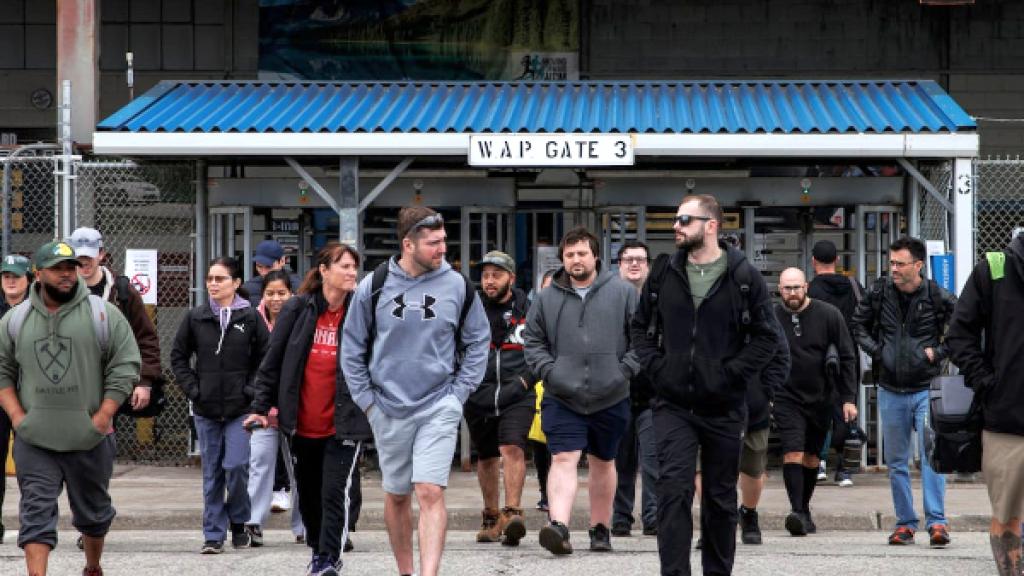
Workers leave the Stellantis Windsor Assembly Plant, in Windsor, Ont., ahead of a shutdown linked to US auto tariffs.

First published at Socialist Project.

Canadian autoworkers have faced many crises over the years, but the present threat is distinct. Lana Payne, President of Unifor, has warned that “If we don’t push back hard against him [US President Donald Trump] and against these companies, we’re going to lose it all.” So far, the debate over what to do has started and stopped with Trump’s tariffs. But the threats go deeper, both for auto companies and for our ability as workers and citizens to determine democratically what kind of society we want — that is, for Canada’s substantive and not just formal sovereignty. Taking on these larger challenges demands coming to grips with some tough realities.

The starting point for a response must be that the tariffs are only a symptom of Canada’s larger dilemma: the over-dependence on the world’s dominant global power. We may be America’s long-standing ‘closest economic partner and most loyal ally’, but that hasn’t prevented Trump from treating us as a vassal state.

Beyond tariffs

No-one would know, hearing the Trump Administration’s justification for tariffs against Canada, that the US actually has a trade surplus with Canada in manufactured goods, including auto. The tariffs were imposed in spite of this and driven, as US Secretary Treasurer Scott Bessent brazenly asserted, by the US determination to apply ‘the most America-first policies that are possible’.

Bessent added that the only qualifier was not ‘incurring market wrath’. This declaration that the only constraint America accepts is the US stock market, overwhelmingly the property of the rich (10% of the US population owns more stock than the other 90%), offers a remarkably bleak – if accurate – view of not just America’s international vision, but of US internal democracy.

Whatever the long-standing frustrations of many Canadians with our subordinate relationship to the US and a pervasive unease with what America represents, dissent was historically muted by the economic seduction of US goods, US markets, US investment, US technology and the alleged security of the US military umbrella. But today, a good many Canadians have learned — or relearned — that clinging to the US is a liability. Though Trump has brought antipathy for US unilateralism to a head, what we confront isn’t reducible to Trump. The problem preceded Trump and will remain after he’s long gone.

Canada is, of course, not alone in its dependence on the American Empire. Other countries, including other US allies, face similar anxieties. In Canada’s case, however, the dependence is however especially extreme and in the auto industry uniquely so. In auto, moving major Canadian assembly plants to the US is disruptive and costly, but comparatively easier than in other sectors and other countries. This is an effect of being part of a highly integrated continental industry with the main market being the US, and with the core research, development and planning decisions concentrated in the US.

Canada does have lower labour costs than the US, largely because of our lower dollar and the American stubborn refusal to adopt a universal public healthcare system. But unlike the huge labour cost differential between Mexico and the US (Mexico’s labour costs are about one-sixth that of the US) Canada’s labour cost advantage is not large enough to over-ride the uncertainties put in play by Trump’s pressures to relocate to the US.

Seeing corporations exiting Canada and the growing bias against future investment in Canada is appalling, but it should not be surprising. It’s precisely what Trump intended with his tariff threats. Even if the tariffs end and Trump and our Prime Minister hug each other, US corporations won’t forget this experience very easily. Caution in placing new work and production facilities in Canada will persist.

The threat to jobs on both sides of the border

A second reality affects workers on both sides of the border. Autoworkers are in the firing line between an environmental crisis that can’t be avoided and an industry that, obsessed with its short-term profits, has failed to prepare for the evolving planetary climate catastrophe. This too predates Trump, though he has done everything he can to make it worse.

The contrast with China is stunning. While the North American corporations are actively delaying conversion to EVs (electric vehicles), China charges ahead. While the North American industry dithers, China has established secure access to the necessary EV supply chains and the required rare-earth minerals for EV batteries. While China subsidizes EV research, battery innovation, assembly costs, and constructs a national network of readily available recharging stations Trump doubles down on keeping gas prices low, reinforcing dependence on environmentally costly oil.

The North American based corporations shed crocodile tears about there being no demand for EVs, but China has demonstrated that if the price is right and if the recharging stations are readily at hand, consumers will come. As China’s production ramped up, economies of scale lowered the cost of EVs to the point that EVs in China now sell for about $20,000 — less than half the price of EVs here and elsewhere. EVs now account for about 50% of the market in China but only 10% of the US market and 15% of Canada’s.

To put these achievements in historical perspective, at the turn of this century the US vehicle sector was assembling more than six times that of China (even Canada was assembling about 50% more). China’s production was then only 3.4% of the global industry. Yet today, with electric vehicles being the future of the industry, China accounts for 7 of every 10 EVs produced globally. That’s the same ratio the US was producing of the world’s gasoline driven vehicles at the height of America’s postwar economic dominance in the mid-fifties.

The China-US contrast in the transition to EVs extends to their respective responses to energy renewables; China is far and away also the leader in solar and wind power. Acknowledging China’s impressive response to a fundamental threat to nature and humanity isn’t a matter of being ‘pro-China’. China clearly has its share of drawbacks, notably its weak worker and union rights and its undemocratic top-down rule.

The point rather is to shift blame from the alleged disinterest of North American consumers in EVs to the astonishing economic and technological failures of American capitalism to make EVs a practical consumer option. Given this historic failure it is incredulous to imagine corporate America and the American state leading the world out of the broader and far more complex environmental catastrophe before us.

Auto can no longer deliver jobs the way it once did

A third reality is that the auto industry in the developed countries is not going to be – can’t be – the job creator it was in the past. The hundreds of thousands of auto jobs lost in Canada and the US over the decades are not coming back and, at best, only some of the existing jobs will be saved.

The reasons for this are clear: the environment won’t sustain further maximizing the cars on the road; the market for new vehicles in the developed capitalist countries is relatively saturated; whatever growth there is, is offset by productivity gains; and the shift to EVs will require significantly less labour per vehicle unless battery production also occurs in Canada. (There is as well the fact that international competition is shifting vehicle production away from the developed West, with China and Mexico being the main beneficiaries.)

In the US, motor vehicle jobs have fallen by over 20% since 2000, a loss of almost 300,000 jobs. This obscures the far larger impact on the American Mid-West, since it includes job gains in the American South. Since the turn of the century motor vehicles jobs in Michigan, Ohio, and Indiana fell by 46%, more than double the national US decline.

Asian and European corporations had come to the US to counter protectionist threats, but they avoided going where the auto jobs were being lost and went instead to the overwhelmingly non-union US South. Tariffs alone did little for manufacturing in the Mid-West. Though US jobs losses have flattened in the last half-dozen years, insecurity for autoworkers remains a permanent reality.

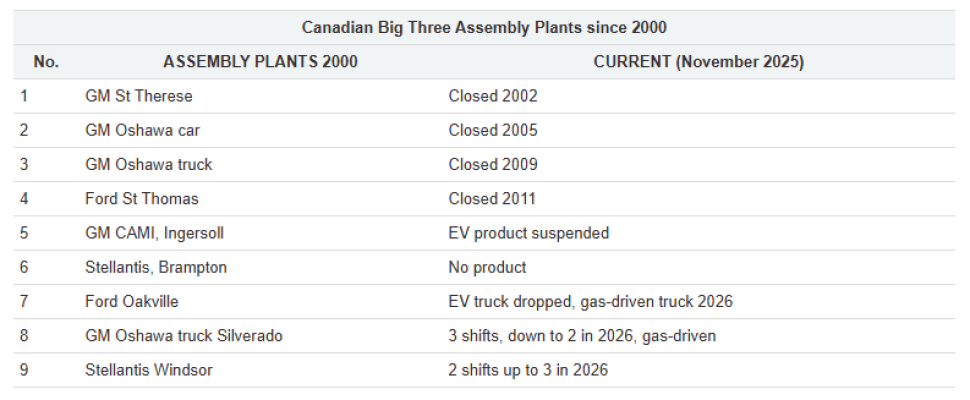
For Canada, jobs have declined by close to 30% — worse than in the US as a whole, but not as high as in the Mid-West, though the latest data predates the impact of the tariffs. In 2000, the US-based Big Three — GM, Ford, and Chrysler (now Stellantis) — had nine assembly plants in Canada. In spite of the massive subsidies over the years, no new plants have been added by the Big Three; four facilities have since closed; three are in limbo, waiting for products; and one has lost a shift and there is uncertainty about its future. Only two Big Three assembly plants are currently assembling motor vehicles (one expecting the addition of a third shift in 2026).

Image
Canadian Big Three Assembly Plants since 2000

Toyota, with three non-union facilities (one of which is the only added assembly plant in the industry over this period) is now assembling more in Canada than the traditional Big Three combined. Add Honda’s two Canadian facilities and the assembly capacity of these two Japan-based companies will exceed that of the Big Three even if the Big Three plants in limbo get products. The message here, which Unifor is very aware of, is that unionizing the Japanese transplants has become as crucial today as unionizing GM and later Ford and Chrysler was in the 1930s.

Resistance is paramount

No resistance essentially means giving up. Moving to tripling our military expenditures to make Trump love us only led, as should been expected, to Trump adding other demands. And the only thing more absurd than Ontario thinking of no better ads than praising US President Ronald Reagan is hearing that our Prime Minister ‘apologized’ to Trump for a Canadian jurisdiction putting out an ad that Trump didn’t like.

The boom in military expenditures, as is also the case in Europe, will mostly be spent buying US equipment and will divert government revenues from funding health, education, and social services for the poor, as well as from adequate investment for addressing the environment. In surrendering to US pressure, Canada is essentially trying to defend its sovereignty by becoming more like the US.

When unions began to accept, under duress, corporate demands for concessions in the eighties in exchange for promises of job security, an instructive lesson emerged. Giving in to bullying only reveals weaknesses and invites more concessions. The jobs didn’t come, unions lost credibility with their members, and workers and their unions were weakened for the battles to come.

Immediate responses

What then can be done to salvage the reeling Canadian auto industry? Various immediate steps have been proposed to stop the hemorrhaging of the Canadian auto industry: fighting for products in suddenly idled plants, counter-tariffs, diversifying Canadian trade, joint-ventures with China, and an industrial strategy. Each is important yet even together they are limited.

Getting immediate product for existing facilities, rather than being brushed off with a ‘possibility’ of a future product down the road, is critical. As Unifor has insisted, passively leaving facilities idle reduces pressure on the corporation to deliver and risks such facilities fading from public attention. Moral outrage about broken promises is however unlikely to get the union very far. Every form of protest, including a revival of the union’s historical legacy of plant takeovers, has to be part of its arsenal.

Introducing counter-tariffs against the US, as Canada’s Prime Minister originally threatened, is unlikely to work as a tactic. On its own it would likely have little or no positive impact on Canadian jobs and no doubt lead to more US threats. But imposing counter-tariffs would nevertheless be a defiant assertion that we won’t be walked over without a fight. It might also rally other US allies to respond more aggressively. If Canada, the most dependent of US allies, has concluded it must challenge the US then why not them as well?

Diversifying our trade, including with China, now seems like straightforward common-sense. Doing so isn’t a matter of replacing our subservience to the US with a new dependency, but simply an overdue rebalancing of our overdependence on the US. Yet, here too, we should have no illusions that modest steps will solve Canada’s auto crisis. Canada has, for example, neither the leverage of China’s massive market and its vast pools of low-cost labour, nor China’s technological foundation. What space exists abroad is already occupied by China, and Europe also is looking to exports to offset the limits imposed by the US.

As for joint EV ventures with China, the US would surely block significant numbers of these vehicles flowing to the US market from Canada. In fact, it is already doing this even against US companies operating in Canada. Without assured access to the US market and with China not wanting to risk further overall US retaliation, it’s hard to imagine China considering such cooperation with Canada.

An ‘industrial strategy’, with the government playing a larger role in the economy, has long been raised and is now being resuscitated for auto and other sectors. But given the scale of the problem, some qualifiers are elemental. If the leadership role remains in private hands, with governments meekly trying to influence the direction through ‘incentives’, it won’t work. There is long experience to back this up. The government must lead, and public ownership will have to play a significant role.

Furthermore, focusing on the supply side is not enough. Markets for the output from an industrial strategy must be found and this again raises the planning role of the state as a purchaser of goods (more on this below). Above all linking an industrial strategy to markets can’t be left to corporate decisions on profitability and ‘competitiveness’. Such prioritizing of the corporate freedom to do what is best for their stockholders undermines our freedom to address our needs. The newly created markets must be reserved for our newly developed domestic productive capacity.

Among other things this highlights inevitable conflicts within industrial strategies. Worker and popular concerns may not, and generally will not, converge with business interests. As in all capitalist countries such differences in goals shape the policy responses. Working people may feel torn about how to respond — not surprisingly, since the issues are complex and the ‘Big Questions’ have for so long been obscured. But Canada’s economic elites and their state allies are clear. Their singular priority is returning to the pre-Trump trade status-quo which also brought pressures on Canadian workers and governments to ‘match’ (that is, be competitive with) the US, the country with the worst labour laws and weakest social programs amongst the core capitalist states.

Nationalist rhetoric can therefore be a trap — a vehicle to co-opt the labour movement into a ‘jointness’ within which labour is a subordinate player and its particular interests are defused. Notably, the opposition we would face in any serious alternatives posed from below would not be restricted to American corporations. Canadian businesses would in general be just as or even more antagonistic to unravelling the dependence of the Canadian working classes on the US.

Setting our sights higher

The crippling point about political and economic dependency is that you can’t just snap your fingers and escape historic chains. If we look to counter what we are up against, there is no way out except to think bigger, much bigger. The immediate can’t be ignored but this must not come at the expense of developing and preparing for a longer-term response.

Significantly breaking the chains to the US would disrupt everything in Canada’s capitalist economy. Coping with this would demand a comprehensive degree of planning; as emphasized, it could not be done by tweaking markets and corporate incentives. And since you can’t plan what you don’t control it would also mean increased regulation of corporations and the development of state-owned companies to realize the plans. Overcoming Canadian dependency on the US consequently also forces overcoming our dependency at home on both major Canadian and American capital.

The new planning capacities would have to be democratic capacities in terms of whose interests they serve and how decisions are made. Economic restructuring, formerly a threat to workers, would potentially become an opportunity. Such historic transformations can’t happen overnight but raising them now provides markers — guideposts — to where we should be heading. In struggling with how to come to grips with what we’re up against, a number of points are fundamental.

First, while the union must fight to save what still has possibilities, if the corporations have decided to leave, it is no longer a realistic strategy to beg them to stay. It is then the productive capacities — the industrial spaces, flexible equipment, multi-purpose tool and die shops, the varied component capabilities — not the companies themselves that must become the target. These are assets we must not waste. Repeating the failed history of bribing them to stay is futile. Some corporations may stay and invest in Canada, but we can’t depend on this to solve the overwhelming threats we confront. Here especially the tactics will have to include reviving labour’s history of sit-ins and plant takeovers.

Second, we must set our sights beyond making vehicles. Making vehicles, especially ones more compatible with the environment is not to be dismissed, but the larger challenge lies in converting our rich productive potentials and developing them to produce the myriad of goods we need beyond auto.

Third, linking transformation in the production capacity in transportation to the environmental crisis may make the points more concrete. To address the environment, we will have to fix everything about how we live, work, travel, and play. For those asking what we will produce if we relay significantly less on the US market, the answer is that tackling the environmental challenge holds out a good part of the answer: accelerating the shift to EVs; converting all public vehicles to EV fleets made in Canada (postal vehicles, utility vehicles, ambulances, school buses, police cars); expansions in public transit vehicles and their infrastructure; retrofitting houses and offices; transforming workplace machinery; immense investments in non-renewable energy alongside the phased retreat from oil production.

Fourth, a National Conversion Institute could monitor developments, develop plans for needed goods and facilitate conversions and investment in new facilities. It would coordinate financing with local governments and their specific municipal environmental projects and with businesses supplying components. Provincial governments could set up local technology hubs in various communities where thousands of young engineering workers would research community and business needs and initiate or support engineering adjustments to produce new goods, services, and production methods.

Fifth, union locals, in the public as well as private sectors, could set up workplace committees to monitor whether their employer is planning cutbacks or closures, prepare for the worst if it does happen, and bring in the proposed National Conversion Center to address alternatives to maintaining production and services. Trade would still take place, but it would be integrated into the needs of the new, far more inward oriented domestic economy, not left to the free trade of private corporations.

Manufacturing has, for decades now, been downplayed as a fading part of the economy. But fixing and sustaining the environment can’t be done without manufacturing capacities. This includes meeting people’s yearly necessary social needs, such as the shortages in collective goods like housing, education and senior care, and reversing the erosion of community healthcare clinics, sports facilities and community centers. There is also the very considerable and urgent load of fixing and sustaining the environment. Rather than wondering what will happen to our excess labour, we may very well face a shortage of labour if we can a political and social turn to meeting social needs and not market imperatives.

Conclusion: The necessary challenge of ‘thinking big’

In the early 1980s, Canadian workers confronted an acceleration of globalization, ruling economics and political elites looked toward closer integration with the US, Ottawa driving what came to be called neoliberalism (aptly summarized by Adolph Reed as ‘capitalism without a working-class opposition’). The UAW parent union to autoworkers in North America reluctantly accepted that there was no option but to give in to concessions demanded by the auto companies and was looking to impose this same defeatist position on its Canadian members.

Canadian autoworkers were in an historic bind. The parent union represented 90% of the Big Three workers in a uniquely integrated industry. The certifications recognizing the union were formally with the parent union. A split from the US would therefore mean losing not just the weight and resources of the far larger US parent union. It would also require recertifying all its hundreds of bargaining units. In choosing to defy the UAW central that had once inspired their own breakthroughs, Canadian autoworkers were also challenging some of the largest corporations in the world, their own government, and the trend to ever deeper integration with the US.

In spite of this, the union leadership in Canada understood that if it didn’t want to ‘lose it all’ it had to win its members over to breaking away from its American parent. Led by its President, Bob White, the confidence to take this necessary risk prevailed. The credibility this established for the newly independent Canadian Autoworkers (CAW) union in the wider society subsequently allowed it to lead, along with other Canadian unions and social movements, to fight against free trade, neoliberalism, and deepening integration with the US.

It was not, however, then clear to the CAW and Canadian autoworkers, nor the larger union movement, how much further they would need to go to succeed. Today that dilemma of the relationship to the US is back. Among the significant differences in the context today is that the weakening of the labour movement over the intervening years has left the labour movement no longer coping with the extent of our dependence on the US but primarily arguing for ending the tariffs and, effectively inviting greater integration with the US.

Building a different kind of society on the edges of the American empire is obviously an intimidating historical task. It’s easy to understand why people shy away from it. Yet thinking bigger is ultimately the only practical option if we want to escape our present impasse with its frustrations and demoralization. The exact steps and timing in soberly moving in this direction will ‘depend’. But what should not be avoided is at least starting the discussions — in our workplaces, union locals, communities, and nationally — on what we face, where we stand in response, what needs doing, and how we might do it.

Electoral politics will inevitably be necessary but past experience tells us that leaving this to the politicians will fritter away decisive action. The electoral world is only relevant if a social base has been built outside of parliament with the vision, commitment, solidarity, and confidence to drive the politics. This demands an institution laser-focused not on the next election but on building the social force that will one day make electoral activity truly relevant. The creation of such an institution — a ‘party’ of a different kind — is, ultimately, the critical missing piece in our struggles. 

Sam Gindin was research director of the Canadian Auto Workers from 1974–2000. He is co-author (with Leo Panitch) of The Making of Global Capitalism (Verso), and co-author with Leo Panitch and Steve Maher of The Socialist Challenge Today, the expanded and updated American edition (Haymarket). 


Ecosocialist MP Paul Murphy on Catherine Connolly’s historic presidential election victory in Ireland


Fianna Fáil and Fine Gael. For the entire history of the Irish state they have ruled Ireland. In the 1980s they had close to 80% of the vote between them before a slow secular decline, which was massively accelerated by the economic crisis. Because of that, from 2016 they had a confidence and supply arrangement and since 2020 they have ruled in coalition. They have had almost identical positions on nearly every question but have always presented themselves as opponents. The traditional political establishment is losing their grip on things here, but by coming together they were able to stop the change that many people wanted to see.

Another important context is that the pendulum in Ireland, like in most countries, was generally swinging leftward from 2014 onwards in the aftermath of the crisis, with major social movements. In particular the successful campaign against water charges — an attempt to impose charging for water, commodification and privatisation of water — was a huge mass movement, with 73% of people refusing to pay, repeated mass demonstrations and grassroots organising. We then went on to win a series of important victories on issues of oppression. We won on abortion rights, overturning the constitutional ban on any form of abortion and winning, effectively, the right to choose, with some limitations which we are still pushing against. But relative to most countries and relative to where we came from, as a country dominated by the Catholic Church, it was a big victory. We also won marriage equality, the first country to do so by referendum.

So, there was a definite swing to the left, both behind rising socialist left forces such as PBP, for which I am a TD, and largely behind Sinn Féin as the main expression of that. But over the past few years that pendulum has swung back to the right with the decline of social movements and energy to the left, the rise of anti-immigrant sentiment and anti-immigrant protests, and the emergence of a far right. The far right in Ireland does not have an organised parliamentary expression, but it does have some openly fascist local councillors elected. It also has some sympathy and voices in parliament from some small right populist forces.

For that reason things have become much more complicated. In 2020 we thought there was a chance to defeat Fianna Fáil and Fine Gael and elect a left government, but by 2024 heads were down and there was a local election in which the left got a very poor result, in particular for Sinn Féin, who played into the anti-immigrant sentiment and declined as a consequence. PBP-Solidarity, the radical left alliance in the Dáil Éireann, went from five seats to three — not a disaster but a setback. That reflected the general mood.

In general things have been difficult for the left, with the exception of a mass ongoing movement on Palestine. This presidential election was the first time we have seen an electoral expression of that. It is also the first time the left have won a majority of votes: we have had previous left-wing presidents, but never elected on more than 50%, whereas Catherine got more than 63% on first preference. She also won the biggest number of total votes, the biggest percentage of votes and the biggest margin of victory for any presidential candidate ever.

So, in a sense, seemingly out of nowhere, we have a big electoral victory for the left, which raises people’s sights and gives people hope that we could have a left government and we could have major social movements again on a range of issues.

What were some of the key issues that the campaign focused on?

If you go on Connolly’s website you will not find a list of policies, it is not that sort of election. But you will find a list of values and key issues. Some of the key ones include neutrality and anti-militarism. There is a big attempt to undermine what is left of Ireland’s traditional military neutrality and line up with Western imperialism to get Ireland close to joining NATO. Neutrality was the key issue, bigger than any others.

Gaza and the Irish government’s complicity in the genocide in Gaza was also a key issue. The Irish government’s complicity is less than that of the British, United States and, presumably, the Australian government — there is no active support in terms of sending support or weapons to Israel. But we are still complicit in allowing weapons to fly through our airspace and refusing to take action to impose sanctions on Israel. Until recently, the Central Bank of Ireland was the space where Israeli war bonds were authorised to be sold across the European Union and were openly declared to be raising money to use in the genocide. The political establishment and political candidates say they are totally appalled at what is happening, but they are against any meaningful action, because it will cause them trouble with US imperialism.

The third issue is the housing crisis. There is an immense crisis that has been deepening and deepening for close to 15 years now. Back in 2016 we had less than 5000 people in emergency accommodation, so homeless, but now it is well over 16,000 people. It has more than tripled in nine years. Rents have tripled in 10 years as prices have soared, and there are people getting enormously rich from this, big corporate landlords and big developers, who, fundamentally Fianna Fáil and Fine Gael represent. So, while it is not a traditional presidential issue, Connolly spoke about housing, the failures of the government and, fundamentally, putting the right of people to have a home before the right of corporations and landlords to profit.

Other issues included disability justice. There has been a movement on disability justice and the main candidate of the establishment, Fine Gael’s Heather Humphreys, was previously a minister and had tried to implement a form of disability payments that would have introduced I, Daniel Blake style assessments of capacity to work to put pressure on people to go back to work or face payment cuts. In general disability has emerged as a very big political issue, including in the 2024 elections.

The other big issue is that of the Irish language. There is a revival of interest in and enthusiasm for the Irish language and it really took off as an issue in the campaign. People who speak Irish are often portrayed as if they look down on the rest of us for not speaking Irish — the majority of people do not speak Irish fluently. But that was not Connolly’s approach at all; what was interesting is that Connolly learnt Irish in her forties and now speaks it fluently and Irish will be the working language of the presidency. There was a big protest during the election of 20–30,000 people demanding Irish language rights both north and south of the border.

But fundamentally it is about Ireland’s position in the world. Are we just going to become part of the Global North, part of the imperialist core, or does our tradition of being colonised, of British imperialism and our struggle against it have a value. I was at loads of events with Connolly and she spoke really interestingly about it. If you read degrowth literature there is a lot of reference to Indigenous people and cultures having a fundamentally different understanding of nature than Western capitalist society. Connolly was effectively making the same point about the Irish language, that there is not a false dichotomy between humanity and nature in the language, and understanding and speaking the language gives you an insight into the problems that we have. It was interesting because it is a point that might seem to be a bit obscure but it really resonated with people.

The other context to that is that if you drive through any hard-pressed working class community now, you will see Irish tricolours flying, unfortunately as an expression of anti-immigrant sentiment. This is mostly part of a conscious campaign of a small number of far-right agitators, but also some people who have fallen into that trap. That is very new. Traditionally, if you saw a tricolour it was not an expression of the far right, it was either representing the republican movement or it was related to sport. Whereas now there is an attempt by the far right to take our flag and use it how the St George’s cross is used in England or the Australian flag is used — as an expression of a narrow vision of what it is to be Irish, that is to be white-Irish, not to be traveller (which is an ethnic minority in Ireland), not to be a person of colour and not to be an immigrant. So, the Irish language revival is part of the contestation of that, which is to say no, there is a different vision of what it is to be Irish, which is to be in solidarity with Palestine, to be in opposition with imperialism and to be welcoming and open.

While there was no far-right candidate on the ballot paper — they tried to get a populist right figure up but missed out — issues of racism and immigration played less of a central, explicit role in the campaign, but it was still there in the background. Connolly was very explicit, there is a slogan saying “Ireland is full”, to which Catherine responded by unambiguously saying “Ireland is not full”. The political establishment has been leaning into this far-right rhetoric, even more so since the election. It is incredible that we have a candidate elected on a clear anti-racist platform and the response has been to ramp up the rhetoric about immigration in an attempt to divert attention away from the government and toward the most vulnerable people in our society, asylum seekers.

The campaign was broadly supported by the left and many independent activists. What impact did this have on the campaign and how will it be built on?

This is one of the most important aspects of the campaign in terms of the ramifications for the future.

To situate Connolly politically, for those who do not know her, she would describe herself as a socialist, but would not describe herself as a revolutionary socialist or a Marxist. On the political spectrum in Ireland she would sit somewhere between the radical left PBP and the Social Democrats, who are a marginally left split from the Labour Party.

Commentators at the start of the campaign were saying that Connolly’s politics aligned more closely with PBP than anyone else, which is true. In opinion polls and elections PBP gets about 3%, but you have to win at least 50% to win a presidential election. So it was an attempt to talk her down. It also meant that with the prospect of a joint left candidate, she would not necessarily be the top choice of those to our right.

PBP have been pushing for the left to stand together since 2020. There is an historic issue in Ireland of left or progressive parties going into coalition with Fianna Fáil and Fine Gael. The Labour Party has multiple times gained support in opposition and then gone into a coalition government, usually with Fine Gael. The Green Party has done that twice in its existence, both times being wiped out after a term in government. We have always called for parties to rule out a coalition with Fianna Fail and Fine Gael and to commit to a left government. We have a preferential voting system so we advocate transferring preferences among left parties.

In general the other parties were not interested because they wanted to leave their options open to potentially go into coalition government. In particular Sinn Fein, who are the biggest party of the opposition by a longshot — generally polling about 20% — were not very interested.

The 2024 election proved very difficult for them, as Fianna Fail and Fine Gael were clearly going back into coalition together, so Sinn Fein could not present themselves as a realistic alternative government option. So, in the final couple of days, they said people should preference PBP and the Social Democrats.

After that election, which was disappointing for the left, within Sinn Fein there was a process of reflection. There was an interesting article by an internal figure who raised the idea of being part of a broader, progressive left platform. This is an example of a small cog of revolutionary socialists turning much bigger wheels, but the wheels needed to be open to being turned, and in this case Sinn Fein was.

We decided early that Connolly would be the strongest candidate. There were meetings of all the left and progressive parties for about six months discussing the presidential election and potential plans. Those meetings were useful to have but were not ultimately going very far. PBP and the Social Democrats decided to support Connolly. To nominate someone for president you need 20 TDs or Senators to sign a nomination form, between those two parties we had very close to 20 and some supportive independents. We proposed to the other parties to support Connolly and she went public about her campaign.

This put pressure on the other parties to come behind Connolly. Labour came on board, despite some bad blood with Connolly who was a former Labour Party member. The Green Party came on board too. Sinn Fein took their time and were considering running their own candidate, but saw the groundswell of support behind Connolly and came on board.

After the election every party is eager to claim they were the ones who made the difference, but the truth is every party played an important role. Sinn Fein coming on board, even late, was important, they are the biggest opposition party and brought resources, knowhow in terms of that scale of a campaign, and knowledge about how to deal with smear campaigns. It was a mixture of negotiations at the top and pressure from below to get the parties on board. Lots of independents also got involved.

The political and media establishment were strongly opposed to Connolly. There is a quote in an article you wrote from Irish political commentator Ivan Yates that they tried to “smear the bejaysus out of her”. What can you tell us about this push back from the establishment?

Initially the strategy from the establishment was to ignore her. She was the only declared candidate who had enough nominations to be in the race and did not receive much coverage initially. But fairly quickly the smear campaign took off. It was pretty incredible and unrelenting. Every day front page newspapers were trying to make Catherine look bad.

It was interesting and I think the establishment made a mistake here, because the president is not a position that is ultimately that powerful, yet they threw everything at it. The danger for them is that they have undermined themselves, they have undermined the credibility of large sections of the media and their ability to do the same again in the next general election will be diminished. That does not mean they will not try, and it will have an impact.

One of the reasons the smears had less of an impact was the limited power of the presidency. They claimed that if she won Ireland would lose lots of jobs, US multinationals would pull out, etc. This did not have much teeth for two reasons. First, our current president is someone who also comes from a left of Labour Party tradition and has been very outspoken on Gaza, housing and neutrality — and the sun has not fallen down. Second, people know the presidency is not that important. People get to vote on the basis of values and what they want to see, without having to worry about the fearmongering implications.

The smears really escalated when it was clear she was a front runner. The quote from Ivan Yates that you mentioned, which in 20 years time will be famous in Ireland, has entered the political lexicon. What was significant about it was that Yates is a former Fine Gael TD; it was not his assessment of what they were doing but his advice for what they should do. He said if he was advising Fine Gael he would “smear the bejaysus out of her”. He encouraged them to label her a Russian asset, a provo [member of the Provisional IRA] and many other things. We were able to use this to expose what was going on.

There was an early engagement between myself and the media at a press event that went viral. A journalist from the biggest circulating newspaper in Ireland was caught up with a blatant lie in their article. The lie was that “video evidence showed that when [Ukrainian President Volodymyr] Zelensky addressed parliament, Catherine Connolly did not applaud”. They could have checked the video evidence, which clearly shows that she did. I did not [applaud], but that is not the point. They did not back down on this blatant lie. This, and the Yates quote, ended up working in our favour. What is ironic is there is a new controversy around Yates, which is that he was on the payroll of Fianna Fail, who had hired him to train their candidate in the election.

All sorts of smears were thrown at Connolly, but the main line of smears was that she was not to be trusted in terms of this state and was not in line with our “allies”. [Fine Gael’s Heather] Humphreys, the main establishment candidate, refused point blank to criticise the US for its arming, funding and support of Israel’s genocide. The idea was that Connolly was going to undermine our standing with our Western imperialist allies. She criticised France, Britain and the US, saying she did not trust them, which the media went into a frenzy over.

Through all of this, Catherine did not budge an inch. The media could not understand it because pretty much all parties, when confronted with a supposed scandal, they backtrack and apologise. Even [former British Labour leader] Jeremy Corbyn, when presented with an artificial scandal around antisemitism, retreated and gave them more. But they just keep going, it does not work to retreat. Connolly did not give an inch on anything, she just repeated her points.

She criticised the re-armament of Europe, and said there are parallels with Germany in the run-up to World War II. She was then accused of comparing the current German government to the Nazis, which she had not done; she was just making a point about how dangerous re-armament is for the world.

She was presented as soft on [Russian President] Vladimir Putin and somehow not opposed to the invasion of Ukraine. In every debate, Humphreys would say “I’ve never heard you condemn Putin’s invasion of Ukraine”, and Connolly would say: “No, no, I have, I am on record condemning it.” She was asked about this in interview after interview having to repeat this.

The media scrutinised a visit Connolly had made to Syria, and accused her of being soft on [former Syria dictator Bashar al-]Assad, despite being on record opposing Assad. The trip was simply to visit Palestinian refugee camps.

They made a big deal of Connolly employing someone who had been in a radical republican group and convicted and serving prison time for an attempted robbery of guns. They tried to make out that this was a security risk in the parliament. However, Connolly had done everything correctly, and was never told this person was a security risk or anything like that. Some politicians would have thrown the woman under the bus and condemned her, but she did not. She stuck to her guns and said, “we have a criminal justice system, she served her time and I believe in people being rehabilitated, what is the problem here? This person is an upstanding citizen and is contributing to society, how dare you drag her name through the mud.”

It was powerful. People began to describe Connolly as authentic. She always said what she thought and did not give in. The final smear was a US/Trump style attack ad targeting Connolly’s previous work as a barrister for banks in repossession of people’s homes. They tried to make a big deal out of this, but in the Irish legal system you cannot refuse work on the basis of politics. It was deeply cynical because Fine Gael and Fianna Fail were involved in the policy which led to people’s homes being repossessed, while Connolly voted seven times for a ban on evictions, which Humphreys voted against. That was a voter suppression tactic, not an attempt to win people over to their candidate. It was about turning away working class voters. But this backfired for them because it came after the “smear the bejaysus” comment.

There were loads more smears than that, but these were some key ones. The press officer for the campaign said it was just non-stop. A former journalist who supported the campaign said journalists were getting 40 texts a day from Fine Gael with attack lines against Connolly. It was non-stop. But it did not work at all.

How would you compare Connolly's win with another high profile left victory, that of Zohran Mamdani in the New York City Mayoral election?

I think it is part of the same international process.

At a PBP national meeting I motivated that we should get stuck into this presidential campaign, and it was not automatic that we would do that because of the nature of the position. One of the main arguments I made is that in general the political pendulum is swinging to the right — and generally that is still the case, we should not fool ourselves because of Connolly and Mamdani — but there is the emergence of powerful counter currents to that.

People see, with horror, the way the world is going, and that the arguments of the far right in terms of immigrants, but also in terms of climate, are being taken up by the political establishment and being normalised. The whole world is absolutely abandoning any commitment to avoiding ecological catastrophe. The whole political establishment is involved in disgusting scapegoating of the most vulnerable people, attacks on trans people, refugees, etc. There is something awful happening that people can sense and that is propelling a layer of people to the left in reaction to that.

The three international examples I gave at the time, about six months ago, were Zohran, the success of Die Linke [in Germany] on the basis of taking a hard line against the far right and the energy around Your Party in Britain, which is now also energy around the Green Party in Britain. Now you can definitely add Connolly to the mix of that international picture of a counter current — I think it is real. I do not think we should mistake it as the overall pendulum swinging back to the left, because I do not think that is the case, but there are big counter currents that the left can connect to, ride, have victories and hopefully build substantial left organisations from.

From a distance, the scale and the number of people involved in the Mamdani campaign was obviously much higher, even taking into account population differences. Connolly’s campaign was a movement, she described it as a movement and not about herself, and 60,000 people volunteered and about half of those got involved. It is not normal to have a ground campaign in a presidential election, it is normally all in the media, but we had serious canvassing operations across the country, with all the left organisations involved and new people coming in. But it was not on the scale of movement that we have seen in New York. Some of that is the nature of the campaign, if this was a campaign for a left government it would have been a different picture, with higher stakes and more to be won.

It seems to be the same here as it is in the case of Die Linke and in Britain, that the dynamic force behind Connolly demographically is a similar group of people, which is relatively young, disproportionately women, and disproportionately downwardly mobile college educated young people. The media were shocked that we packed out a venue for a “get out to vote” rally with a load of great musicians in the final week of the campaign. Tickets sold out in an hour and we could have packed a venue ten times that size. It was kind of unprecedented in Irish politics. The crowd was overwhelmingly that demographic, people who are disproportionately involved and appalled at what is happening.

There is a big positive, but there is also a challenge to us. Our traditional base as the radical left is in the most hard-pressed, most deprived working class communities. While Connolly won in those areas in a massive way, there was not the same energy and volunteers as there were among young renters, who, do not get me wrong, are a vitally important group. But there is a gap opening up there which is a challenge to us. There were high rates of spoiled votes, which was linked to a campaign by the far right. There is a challenge to bridge that gap, to fight the fight to keep the base in those hard-pressed working class communities. These communities were the core of the campaign against the water charges, a very powerful group of people.

We do not want to just become the parties on the left of the downwardly mobile young people, although inevitably they will make up a big chunk of the active core at this stage — which is a good thing, people are being radicalised, pushed to the left in horror at what is happening. But there is a certain challenge there around what issues you campaign on and how you relate to people.

The main lesson is hope. A point I made at the first rally is that Connolly gives you hope. It is a bleak world. For those of us who are ecosocialists it is horrific; we have a world that is sliding deeper and deeper into barbarism, marked by the rise of the far right and anti-immigrant sentiment, war and genocide and ecological catastrophe. For those of us who know, it is getting worse and worse and worse. And then, someone comes along and gives you a bit of hope, and we should take hope from this. It is not over yet, we have not definitely lost yet. 

The rise of anti-immigrant sentiment has happened very quickly in Ireland and it is depressing. Good working-class people have gone down terrible pipelines, pushed by the likes of Elon Musk. But this result gives you hope that the majority of people do not agree with that, and do not like where the world is heading. That is a basic point I have made again and again.

There are many lessons of the campaign: the importance of movements, Connolly reflecting and being part of the movement (she likely would not have won without the movement for Gaza, which meant that the smear attacks did not work), the left coming together. But the most important thing is that people agree about what they would like to see. They agree about housing, about disability justice, Irish language, neutrality and Gaza. In their hearts most people agree, broadly speaking, with the values of the left.

This does not mean that divide and rule and scaremongering do not work, but the majority of people do not like the way society and our world is going and there is a lot to work with and the potential to win victories.

What are the next steps for the left in Ireland?

The main thing we have been saying, which gets a huge resonance from people, is that this movement does not stop now. For Connolly, this is all about trying to create a dynamic of unity on the left that could pose the possibility of getting rid of Fianna Fail and Fine Gael. There is a strategy here and that does not stop now.

I spoke at one of the final rallies the night before the election in Galway, where Connolly is from and the campaign was massive, and that point got a huge resonance. People have this energy and sense of being able to achieve something and they do not want that to go away. They also know that winning the presidency is good but does not really change people’s lives. There is a huge energy and interest for people in this.

PBP organised a meeting titled “What’s Next for the Left” last week and held it in a venue that fits 250–300 people, the sort of venue that with an important issue and a lot of work we can usually fill. But again, we put it online and all the tickets were gone within an hour. The thirst of people to discuss what is next and find a way forward is really profound.

So far, within the left, PBP has been unique in immediately after the election releasing a press statement about what we think should happen next. That is not an ultimatum, we want to have a dialogue with others on the left, but we need to find a way forward together. Effectively there are two parts to that from our perspective. One is, in the here and now, we cannot wait until the next election, we have to try and work together, mobilise people to win things now for people.

The four key areas we have identified are: defensive neutrality, Gaza, the housing crisis and cost of living. There is a key piece of legislation they are trying to put through to get rid of defensive neutrality before the end of the year. On Gaza, we need to end Ireland’s complicity and take meaningful action against Israel. On the housing crisis, there is a longstanding coalition with the trade unions, but it has been kind of moribund and not a lot has happened.

The housing crisis is particularly important because the far right have managed, with the assistance of the government, to make it about immigration, which it is not about at all. It is about profiteering of landlords and developers and not investing and building public housing basically. So, we need to mobilise people on that.

Then there is the cost of living crisis, which became a bigger issue during the election because the budget came in the middle of the election. The budget actively made people poorer: on average people were 2.5% poorer in terms of disposable income and the lowest 10% will be 4.5% poorer.

We have ideas about united front campaigns on these issues using the dynamic of unity to try and mobilise people and give them confidence. People voted for these values; now we need to mobilise for those values in their local communities and nationally.

The second element is the question of elections and posing the possibility of a left government. There are parts of the left that emphasise one or the other of those. I think you really have to do both. If you just emphasise the left government element, you make the same mistake as Sinn Fein in 2020 and 2024. You demobilise people, create a vacuum for the far right to step into and lose political momentum. You have to mobilise people in the here and now and give them a sense of their own power. 

But it would also be a mistake just to say "mobilise people now”. People are engaged in the campaign because they want to see fundamental change, and they see that change as coming through a change in government. So, you need to relate to that and point a way forward, even understanding that the next general election is likely to be four years away.

So, in relation to that, we are immediately beginning the process of having bilateral discussions with the other parties and trying to move towards establishing a liaison committee of the left parties, where we can tease things out over a period of time. We are putting forward the idea of a major assembly of the left, of parties and non-party people, to discuss these things in a non-binding way. We do not want people to feel like they will be invited to the room and then out-voted — we are different parties with our own democratic structures and rights, but let us at least have this discussion together.

Connolly was a TD, so there will be a by-election for one seat in her area. It would be great to see if we can have a unified challenge in that campaign. Could we have one candidate supported by the left? Or, at the very least, can we have transfer [preference] pacts between different parties and candidates of the left. That would be a step forward if we can achieve that.

Then looking toward the next general election, can we have a coordinated challenge of the left, which would likely find its expression in transfer pacts on the basis of a commitment to broad left principles and a commitment not to vote for Fianna Fail and Fine Gael to be Taoiseach (prime minister) and to vote for a left candidate to be Taoiseach.

To be clear, all of that comes with complications from our perspective, particularly as revolutionary socialists. The truth is that a government led by Sinn Fein, involving Social Democrats, Labour and the Green Party, is unlikely to be a government that challenges capitalism in a decisive way. It is a government that capitalism would not be happy with and would be scared of. But these are parties that are not making a commitment to challenge capitalism. But we think it would represent a certain turning of the page of politics and put class politics on the agenda in a more definite way.

The idea that we can get rid of Fianna Fail and Fine Gael, that we can have a left government, is something that is raising people’s hopes, getting people into action and mobilising people. We want to be connected to that and say to people that, fundamentally, to resolve the housing, ecological and cost-of-living crisis we need to actually challenge the economic system itself. We need a government that is willing to mobilise people from below to overcome the opposition of the capitalist class and the state, and have a fundamental ecosocialist transformation of society.

So for us, as PBP, we would not be entering into a government and taking ministerial positions if we feel it is going to let people down and that does not commit to that ecosocialist program. So, you may have a situation where, if this goes well, we have an election of a left government, and we vote for a Sinn Fein candidate for Taoiseach, as we have done in the past two elections, but without taking up ministerial positions. Insofar as they implement the agreed broad left principles, we vote for every progressive reform, but we reserve the right to mobilise people from below against the government if they break any of those promises, and to vote against the government if they implement austerity measures, anti-immigrant measures or anything like that.

So, this is not without complications, but in a choice of standing aside from the process or jumping in head first and trying to lead this process, we want to be part of this dynamic while maintaining our political independence and our own ideas, using it in a mass way to say this is why we need fundamental change in our society.

I was in Greece when Syriza was elected. So, we know a left government in and of itself does not resolve people's problems. It came under massive pressure from the Troika [European Commission, the European Central Bank and the International Monetary Fund] and then completely capitulated. We are trying to build a broad movement for a left government, but within that trying to make the argument for fundamental socialist change.