Friday, November 14, 2025


Kazakhstan and Russia’s neo-imperialism
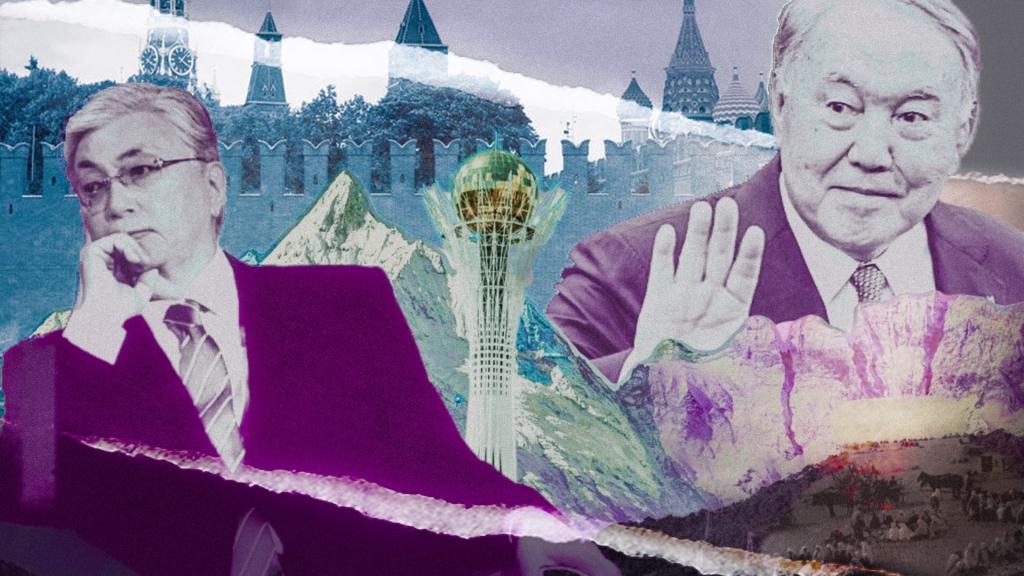

Kazakhstan graphic Posle

First published at Posle.

Commentators and scholars often describe Kazakhstan’s position vis-à-vis Russia in overly rigid terms, either as completely subordinate or entirely independent. The truth lies somewhere in between. Although Kazakhstan’s authorities must take Moscow’s line into account due to deep infrastructural and energy dependence, they have nevertheless sought to pursue their own interests, partly in response to pressure from below. However, following the mass protests of January 2022 and the onset of the war in Ukraine, the ruling class in Kazakhstan has seen its room for maneuver drastically reduced.

It was not always this way. In the 2000s, despite the political kinship between former President of Kazakhstan Nursultan Nazarbayev and first Boris Yeltsin, then Vladimir Putin, Kazakhstan largely succeeded in holding back the expansion of Russian business interests.

Although Russian firms have long outnumbered all other foreign companies operating in Kazakhstan, Russia ranks only third in terms of total investment there, behind the United States and the Netherlands. In the early years of independence, transnational corporations arrived to develop the country’s major oil fields and the necessary commercial infrastructure, creating serious competition for Russian enterprises. Although Russian capital maintained a presence across key sectors of Kazakhstan’s economy — from finance to oil — it never achieved outright dominance.

Through a policy known as “multi-vector diplomacy,” Nazarbayev sought to prevent any single great power from exerting excessive influence. The idea was to maintain close ties with the world’s leading states while also keeping a distance, using a web of diversified economic partnerships to balance the interests of both regional and global powers. Following the 2008 financial crisis, significant portions of the economy gradually fell under the control of Kazakhstani elites or the state itself.

It is worth noting that the Kazakhstan and Russian elites are still closely linked, both culturally — through shared Soviet-era experiences, education, and a common language — and economically, through assets held in Russia, joint ventures, and regular intergovernmental contact. Kazakhstani officials have often copied the programs and legislation of their Russian counterparts, particularly with regard to repressive governance. Yet despite these close ties, the prospect of political integration between the two countries has never been seriously discussed.

Since gaining independence, Kazakhstan has failed to limit the flow of Russian imports. Since the 2000s, Russia has remained the country’s largest trading partner, supplying 30-40% of Kazakhstan’s food and manufactured goods. In order to preserve these trade volumes, which had been gradually shrinking throughout the 2010s, the Eurasian Economic Union (EAEU) was established.

From the outset, the EAEU has offered Kazakhstan fewer advantages than it has offered to Belarus or Kyrgyzstan. This is due to the size and nature of the Russian market, which is the largest within the bloc but remains relatively closed to Kazakhstani goods. Export data clearly illustrates this: Russia accounts for less than 10% of Kazakhstan’s total exports. Moscow, for its part, has little incentive to change this situation, as doing so would endanger its own producers, who already have limited access to other markets.

Despite the establishment of the EAEU, Kazakhstan has succeeded in maintaining its political sovereignty. Nazarbayev, an early proponent of Eurasian integration after the collapse of the Soviet Union, has consistently opposed proposals for a shared parliament, common citizenship, or a unified currency. As a result, Kazakhstan’s dependence on Russia remains primarily infrastructural.

This dependency is most acute in the oil sector, which is vital to the Kazakh economy and accounts for almost half of the state’s budget revenues. Around 98% of Kazakhstan’s oil exports are transported via pipelines that cross Russian territory. This system originated in the late Soviet era and has since expanded, giving Moscow a powerful instrument of political leverage.

In addition, Kazakhstan heavily relies on Russian refineries in Omsk and Orenburg to process its crude oil into fuel for domestic use. These supplies prevent acute shortages, as Kazakhstan’s three refineries cannot meet national demand on their own.

This network of dependencies provides the Kremlin with ample opportunity to manipulate the situation politically should Kazakhstan deviate from Moscow’s course or resist compromise. If it chose to do so, Russia could obstruct oil exports, limit access to refining facilities, block the import of Kazakhstani goods, or suspend food deliveries. Any of these steps would trigger at least a short-term crisis in Kazakhstan, one that would require significant resources to overcome.

The contraction of sovereignty

Since Kassym-Jomart Tokayev became president, there has been a noticeable narrowing of the distance between Kazakhstan and Russia. Back in 2020, the Kremlin had already shifted to a more assertive strategy to reshape Kazakhstan’s e-government system and almost succeeded in securing Sberbank as its key developer. However, a sharply negative reaction from the Kazakh public, coupled with Western sanctions against Russia, forced both sides to abandon the plan.

Another attempt to expand Russian influence came in the form of renewed discussions around building a nuclear power plant, with Rosatom emerging as the almost certain choice for the main contractor. However, the final decision on the project was not made until 2025.

The turning point in relations between the two regimes came when Kazakhstan’s elite turned to Vladimir Putin for help with the transfer of power from Nursultan Nazarbayev to Tokayev. The original arrangement between the two presidents envisioned Tokayev as a nominal leader while Nazarbayev would retain real control. To secure this arrangement, Nazarbayev took the post of Chairman of the Security Council, which at that time formally oversaw the heads of Kazakhstan’s security agencies — and informally, many executive officials as well.

However, Tokayev soon began asserting his authority and establishing an independent bureaucratic apparatus. Throughout 2021, both leaders made several trips to Moscow in an attempt to negotiate a balance of power. However, these consultations ended without resolution.

The events of January 2022 began as a clash between two elite factions in western Kazakhstan but quickly escalated following a wave of mass strikes and civic mobilization in several major cities, culminating in armed confrontations with the police in Almaty. After consulting Putin, Tokayev requested the deployment of Collective Security Treaty Organization (CSTO) peacekeeping forces to quell the unrest. As the majority of these troops were Russian, many Kazakh citizens viewed the intervention as an “imperial intrusion” by the former metropolis.

Armed clashes subsided within days of the peacekeepers’ arrival. However, in months that followed, Tokayev repeatedly had to repay Putin for his willingness to secure the Kazakh president’s political survival. This was probably the key condition for Tokayev’s continued hold on power — one that Putin accepted despite his long and cordial relationship with Nazarbayev. Without Russian support, Nazarbayev’s entourage could have easily unseated Tokayev and reclaimed control.

At that moment, few within the elite were in a position to act decisively: the unrest had left rival factions disoriented, scrambling to decide which side to support in order to preserve their privileges.

Proximity by compulsion

Following the introduction of Western sanctions and the sharp deterioration in Russia’s relations with the West, Vladimir Putin has demanded ever greater displays of loyalty from Central Asian leaders — a demand that carries the constant threat of secondary sanctions. As none of Russia’s opponents have yet offered Kazakhstan any tangible incentives to change its foreign policy, the government in Astana continues to cooperate closely with Moscow. Nevertheless, despite the geopolitical pressure and Tokayev’s personal debt to Putin, the Kazakh president did not abandon his attempts to demonstrate independence after the start of the war in Ukraine.

In the early months of the invasion, Tokayev did not prevent citizens in major cities from organizing humanitarian aid for Ukrainians. The authorities also refrained from dispersing an anti-war rally in Almaty, which attracted at least 2,000 people — an impressive turnout for a city still traumatized by the violent clashes of early 2022. Tokayev himself repeatedly called for a peaceful settlement of the conflict and, on several occasions, made statements that irritated the Kremlin. His most notable statement came at the St. Petersburg International Economic Forum, where he publicly declared that “Kazakhstan does not recognize the quasi-state territories of the DPR and LPR.”

However, this brief period of political liberalism did not last long. Russian politicians and media figures soon revived old narratives, labelling Kazakhstan an “artificial state.” At the same time, the country became a major hub for sanctions evasion and parallel imports of Western goods, both civilian and military. Before long, Moscow launched yet another wave of economic expansion into the Kazakh market.

Russia’s growing presence was visible both in the increase in the number of Russian-registered companies and in its acquisition of stakes in Kazakhstan’s strategic assets. Between 2021 and 2024, the number of firms with Russian capital increased by 138%, reaching nearly 19,000 and accounting for 42% of all foreign enterprises registered in Kazakhstan. Among these were major players like InDriver, Yandex, and Playrix, as well as smaller firms involved in parallel imports that later came under Western sanctions. The influx of Russian businesses even triggered a boom in Kazakhstan’s commercial real estate market, with companies rushing to buy or build office and warehouse space.

The energy sector was of particular strategic importance. In 2023, Rosatom acquired stakes in several of the country’s largest uranium deposits, though it resold them to Chinese firms later, in 2024. This gave Rosatom control of around a quarter of Kazakhstan’s uranium production. Other Russian companies, such as Inter RAO, reached agreements to build three coal-fired power plants. This was a deeply unpopular move among Kazakh citizens concerned about worsening air quality. Even greater public discontent erupted over the decision to build a nuclear power plant with Rosatom as the main contractor. In an attempt to legitimize the project, local authorities announced plans for a referendum, while outspoken critics faced criminal prosecution.

These were among the key issues discussed during Tokayev’s frequent official and informal meetings with Putin — the sheer number of which is itself a testament to Russia’s growing influence. Since 2022, the two presidents have held regular phone calls and in-person meetings, sometimes several times a month.

Russia’s negotiating “virtuosity” lies in its ability to entice Kazakhstan with favorable financing during the early stages of projects such as power plants, only to later pass the financial burden onto Kazakhstan’s state budget. A similar pattern may yet unfold with the nuclear project, the contract terms of which remain undisclosed. However, Kazakh officials would likely not have agreed to such deals if they did not personally benefit from them.

Nevertheless, the expansion was not entirely linear. Russia persuaded Kazakhstan’s authorities to buy out Sberbank’s local subsidiary, and later sold them a portion of shares in the Eurasian Development Bank, the main financial institution of the Eurasian Economic Union. By 2024, some Russian firms had even begun to return to domestic jurisdiction, either because they had learned to operate more effectively under sanctions or because they had failed to adapt to Kazakhstan’s institutional environment.

In economic terms, Kazakhstan has enjoyed short-term benefits from this arrangement through parallel imports and the relocation of Russian businesses. Russian investment in Kazakhstan reached a record $4 billion in 2024. However, despite trade between the two countries growing by $4 billion during the war to reach $28 billion, it remains structurally imbalanced in Russia’s favour.

The current economic relationship is based on a clear logic: Russia first rewards Kazakhstan’s elites, then extracts resources in return. However, Moscow does not offer a coherent strategy for mutually beneficial and equitable development — one that could enrich both nations’ societies rather than merely enriching their political and business circles.

Uncertain resistance

Tokayev’s debt to Putin may seem immeasurable. The Russian leader has at times managed to secure astonishing concessions for his elites, such as selling Kazakhstan electricity at a tariff four times the market rate when it was in desperate need of it, or persuading Astana to purchase more Russian gas, thus undermining the prospects of domestic production. To further ingratiate itself with the Kremlin, Kazakhstan has introduced a draft law on “foreign agents” and is already considering how to refine it.

At the same time, Tokayev recognizes the limitations of aligning with Russia. He cannot simply ignore the discontent of Kazakh citizens, which stems from the questionable legitimacy of his presidency. His 2019 election was marred by continuous protests and widespread irregularities, with many viewing him as merely Nazarbayev’s handpicked successor. The demonstrations in January 2020 went further, demanding the dismantling of the entire political order. Moreover, Tokayev has continued his predecessor’s discredited political course, maintaining the oligarchic system and deep social inequality that characterized Nazarbayev’s rule.

Fearing renewed social mobilization, Tokayev hastily organized a constitutional referendum, followed by early presidential and parliamentary elections. However, the registration of new political parties and the emergence of new political figures were stifled from the outset.

Meanwhile, the state continues to lash out against civil society with periodic waves of repression. This dynamic is only reinforced by global trends: the election of Donald Trump in the United States and the shift to the right in European politics have changed priorities. When meeting with Kazakhstan’s president, Western leaders now show little interest in human rights or democratic reform.

Despite the government’s ongoing crackdown on grassroots activism, Tokayev has been forced to make limited concessions to the public. Since Russia’s invasion of Ukraine, many Kazakhstani people have viewed Moscow with deep suspicion, seeing it as both a political threat and an economic burden. This view is increasingly shared by segments of the country’s own elite.

Against this backdrop, Tokayev’s occasional gestures toward liberalization and his tolerance of anti-colonial rhetoric unfold within a broader conversation about “decolonization,” a debate that the authorities have so far chosen not to suppress.

The decolonial discourse in Kazakhstan has primarily developed within cultural communities and academic circles in the two largest cities, Almaty and Astana. Since Kazakhstan’s independence, contemporary art has become the main platform for decolonial discourses, serving as the arena for social critique amid censorship in academia and the public sphere. However, the main theorists and intellectual architects of this discourse are researchers based in European and American universities. In constant dialogue with cultural institutions and art communities in Kazakhstan, these researchers launch collaborative educational and artistic projects that help to sustain the debate.

In Kazakhstan, the decolonial conversation tends to adopt an anti-Russian stance while largely avoiding the broader issue of neocolonialism. The imperial logic embedded in Western capitalism — the foundation of today’s global order — is rarely questioned. Few view capitalism as the root cause of social inequality. On the contrary, many in this intellectual milieu see it as a necessary vehicle for Kazakhstan to enter the “upper league” of modernized states modeled on the West. As a result, culture and language have become the primary battlegrounds of decolonial resistance.

However, the questions raised by decolonization are far from trivial. They delve into the depths of the country’s collective memory, touching on some of the darkest chapters of Soviet modernization and policy. The Russian Empire’s treatment of the nomadic peoples of the steppe, the arbitrary drawing of borders during the creation of socialist republics, and Stalin’s disastrous collectivization policies all contributed to a catastrophic famine in the early 1930s, killing more than a million people.

Over the following decades, Kazakhstan became a testing ground for a variety of Soviet experiments, including mass deportations, forced labor camps, nuclear weapons testing, and the ecological disaster of the Aral Sea, which was drained to serve the cotton industry.

Another issue to add to this list is the systemic ethnic discrimination that was typical of the Soviet Union. One of the most notorious examples occurred in 1986 when Moscow appointed Gennady Kolbin, an outsider with no connection to the republic, as the First Secretary of Kazakhstan’s Communist Party. The decision, presented as a fait accompli, sparked widespread protests that were brutally suppressed. Thousands were detained, and around a hundred received prison sentences. Kolbin’s administration justified the crackdown as a fight against “nationalism,” thereby silencing what were, in essence, democratic demands.

Yet the methods proposed by Kazakhstan’s decolonial thinkers to overcome imperial legacies are unlikely to free the country from structural oppression.

Simply put, their strategy involves elevating the Kazakh language and culture to hegemonic status in order to transform all existing identities into a fundamentally new national form. They argue that this unification will dissolve all inequalities, including class divisions. They believe that a shared cultural and linguistic foundation will naturally yield a more democratic political system, similar to those in advanced Western democracies.

Paradoxically, Kazakhstan’s decolonial discourse diverges sharply from the theoretical debates in the Global South. It largely rejects the core task of postcolonial thought, which is to transcend the ontology of Western modernity and its institutions of capitalism and the nation-state. Instead, Kazakh intellectuals are calling for a return to the past and a reexamination of the self beyond Soviet and Russian colonial narratives, only to reassemble that self through Western modernist frameworks, in pursuit of recognition as a “full-fledged” nation-state on the global stage.

Equally troubling is that this movement offers no clear strategies to tackle the social and economic inequality that fueled the 2022 protests. On the contrary, cultural fragmentation could exacerbate these divisions. It may give rise to a dominant group that embodies the “gold standard” of national identity, claiming the right to monopolize political and economic resources, thereby reproducing the same inequalities that define the current authoritarian order.

Tokayev allows the decolonial debate to flourish for two reasons. Firstly, it provides a semblance of legitimacy amid his ongoing crisis of authority: the mere ability to criticize Russia helps deflect public anger over his own concessions to the Kremlin. Secondly, it provides a means of political mobilization in the event of new unrest. By perpetuating the narrative of colonial oppression, the regime can divert popular resentment away from local power structures and towards Moscow.

A new course needed

Yet uniting society remains nearly impossible for one simple reason: repression. The legitimacy deficit facing Tokayev has prompted Kazakhstan’s leadership to prohibit virtually all forms of collective protest. Local authorities rarely authorize peaceful and legal demonstrations, while unauthorized ones are swiftly dispersed by the police. The only mass events tolerated today are those orchestrated by state political technologists.

The labor movement occupies a particularly vulnerable position. Trade unions fight their own local battles, but neither have the means nor see the need to coordinate their efforts or articulate shared demands. This fragmentation was glaringly evident during the January 2022 protests, when striking oil workers in western Kazakhstan and miners in the country’s central regions failed to show solidarity with each other. Such disunity is the legacy of the brutal suppression of labor organization following the 2011 Zhanaozen protests, as well as of earlier attempts by Nazarbayev in the 1990s to divide the working class ahead of major privatizations.

The absence of an organized grassroots movement capable of exerting pressure from below has not only led to the degeneration of Kazakhstan’s political regime but also increased the likelihood of a profound economic crisis. As the developed world gradually moves away from fossil fuels, Kazakhstan risks entering this transition unprepared and divided.

The current ruling class shows no interest in, nor capacity for, offering an alternative path forward. Any far-reaching reform would threaten the existing system of rent extraction — something that neither the entrenched Nazarbayev-era oligarchs nor the new elite emerging around Tokayev are willing to tolerate. As a result, over the course of his presidency, Tokayev’s administration has failed to articulate a coherent economic vision, instead preserving the neoliberal trajectory set by his predecessor.

Moreover, as long as Putin remains in power, he will continue to serve as the guarantor of Kazakhstan’s loyal, status quo–oriented regime. In the event of large-scale unrest, Kazakh citizens may once again witness the landing of Russian troops, this time ostensibly to “restore legitimacy” to the current or a future authoritarian leader. This would only reinforce the country’s regressive drift and perpetuate Russia’s neo-imperial practices.

Against the backdrop of political stagnation, Kazakhstan urgently needs to adopt a well-conceived anti-Russian stance. This stance should be based on principled opposition to Putin’s authoritarianism and imperial ambitions, rather than on existential hostility towards Russia or its citizens. The goals of progressive and leftist movements in both countries are not mutually exclusive. The regional pyramid of authoritarian power, in which hegemonic autocracy props up its weaker counterparts, can only be dismantled collectively by proposing a new logic of socio-economic development that appeals to the wider public.

Confined within narrow national borders, both countries face limited prospects for prosperity, as the problems of each extend far beyond their own jurisdictions. Without a fundamental shift in Russia’s foreign policy, Kazakhstan will struggle to achieve meaningful economic or political progress. At the same time, Russia itself needs to revitalize its war-battered economy, a process that could be aided by reinventing the current model of regional economic integration. With its experience and potential, Kazakhstan could play a crucial role in establishing a fairer trade system and developing an industrial and technological base that serves the interests of ordinary citizens rather than ruling elites.

What is needed, therefore, is a post-Soviet internationalist project that aims to jointly formulate new political and economic programs. However, the form and substance of such an international project must be the subject of a broader and deeper discussion.

Electoralism cannot free Palestine: The problem of the Palestine solidarity movement is not ultraleftism


Tempest Palestine graphic

First published at Tempest.

In response to an escalating Israeli genocide, the Palestine solidarity movement has transformed over the past two years, both in the United States and globally.

In the aftermath of the recently announced ceasefire, it is important to recognize that the international movement played a critical role in forcing this reprieve for the people of Gaza. While far from delivering justice to Palestinians, it brought a desperately needed pause to Israel’s bombardment, however temporary and limited. In fact, when Donald Trump told Benjamin Netanyahu on October 9 that he must accept a ceasefire deal and that Israel “cannot fight the world,” he did so in the context of the latest wave of global fightback for Palestine. This included the Sumud Flotillageneral strikes across Italy, and mass protests across Europe. This wave of resistance once again forced global attention back onto Gaza, demonstrated the extent of global solidarity with the Palestinian people, and forced right-wing governments like Italy’s to face their population’s opposition to their complicity. To a lesser extent, this latest wave of upsurge for Palestine included U.S. celebrities, from Ms. Rachel to actors like Hannah Einbinder speaking out at the Emmys, but did not take a mass shape in the United States as it did across Europe.

This is the context in which Eric Blanc’s latest interview with Bashir Abu-Manneh and Hoda Mitwally, “Ultraleftism Can’t Free Palestine,” which ran in Jacobin, should be assessed. The writers speak to the fact that the solidarity movement for Palestine within the United States is not as strong or sizable as it could be, which is true. Especially given its decades serving as Israel’s primary backer, and with the U.S. government acting as Israel’s co-conspirator in the past two years of genocide, an even stronger, mass fighting movement is needed to end Washington’s role in sustaining Israeli apartheid and ethnic cleansing.

While the U.S.-based movement has made gains over the past two years — particularly in the encampments across numerous campuses, in forcing the resignations of more than a dozen U.S. officials under Joe Biden, and arguably in forcing Biden to step down from running for office again — the movement also has notable weaknesses. It is far from where it needs to be to effectively challenge the U.S.-Israel relationship.

Discussions of strategy, therefore, should be welcome. We need to assess and learn from both the strengths and weaknesses of our movement to continue collectively organizing over the coming months and years. Organizers and activists within the Palestine solidarity movement should have a common goal of building as broad and politically effective a movement as possible. This means grappling with the challenges of doing so in a time of severe repression and, at the same time, encouraging layers of people who are new to activism to join us.

But if a deeper discussion of strategy is both needed and welcome, the analysis offered in “Ultraleftism Can’t Free Palestine” fails in important ways. The writers focus overwhelmingly on the problems within the Left, suggesting that much of the movement for Palestine is focused on overly narrow goals that do not speak to the wider U.S. working class. They seek to defend Alexandria Ocasio-Cortez and other politicians from criticism, and in so doing they claim that activists within the movement are taking cues from “middle-class activists,” rather than sticking to class-based demands and focusing on an electoral strategy.

This is problematic for a number of reasons. First, the demands of the movement have been clear and unwavering since October 2023, with the call for an immediate and unconditional ceasefire and Israel’s withdrawal from Gaza. This has been linked to a demand to end U.S. arms sales to Israel and a call for boycott, divestment, and sanctions of the Israeli state. These central demands of the movement, put forward consistently by organizations and activists across the movement throughout the course of the genocide, can hardly be described as ultraleft.

While some sections of the movement have put forward additional slogans and points of emphasis, such as a need for anti-Zionism and a rejection of Democratic Party politicians, these have not been advanced as its central demands or requirements for joining the movement.

Second, the Palestinian, Arab, and Muslim Americans who make up a large segment of the movement are by and large members of the working class. In fact, it was early on in the genocide when Arab Americans, in particular, generalized slogans about how the U.S. spends money on Israel’s wars rather than on healthcare and education at home. These arguments gained widespread traction, becoming a point of focus for the movement. Arab American activists in the United States, while part of the working class here, also often retain ties to families and communities facing horror back home. These activists are part of a multi-racial Palestine movement.

The implication of the Jacobin interview with Abu-Manneh and Mitwally is that the working class, by which they effectively mean the white working class, is entirely disconnected from demands around Palestine. In reality, the U.S. working class is multi-racial, as is the movement for Palestine. And much of this multi-racial working class can be moved to act for Palestine out of solidarity, not simply out of their own material interests, as the interview claims.

Contrary to what the interview suggests, a strategic focus that goes beyond electoral demands and expediency is not a reflection of middle-class bias. In fact, poor and working-class people vote at much lower levels than those who are middle class or wealthy, given years of betrayal and abandonment by the two-party system.

The approach within “Ultraleftism Can’t Free Palestine” is one broadly shared by Jacobin and much of the more electorally focused sections of the Democratic Socialists of America. The argument goes well beyond how we build the Palestine movement, but claims that the Left has gone too far and must abandon many of its ideas to reach an allegedly rightward-leaning working class. Instead of meeting layers of people who are newly radicalizing in their thousands, coming to sharper conclusions about Palestine, capitalism, and the Democrats, and eager for political discussion and to mobilize, their approach calls for diluting left-wing politics to their lowest common denominator. These politics seek to ensure compatibility with the electoral demands and logic of establishment politics and the Democratic Party.

Last month, I attended the Palestine-focused panel at the Jacobin conference in New York City, which espoused the same perspective. The panel overwhelmingly focused on the shortcomings of the Left, rather than, for example, the challenges of repression and organizing under a Trump presidency, which are severe. This is a significant oversight as the Trump administration has significantly escalated the repression that was pursued by President Biden and prior administrations, against the Palestine solidarity movement. This is a development that Blanc seems to minimize in his interview.

During the conference session, the panel moderator voiced that it was a problem that the Left continues to focus its energies on criticizing politicians such as AOC and Zohran Mamdani, to which the speakers agreed. One of the speakers also insisted that slogans including “From the River to the Sea, Palestine Will Be Free” are too radical and should be abandoned. At a time when Mamdani has bowed to pressure to distance himself from phrases such as “Globalize the Intifada” — a slogan that has been demonized by establishment politicians and been met with racist smears from the Right — the Left should defend the demands of our movement, not jump to censor more of them.

The “Ultraleftism” interview and the Jacobin conference session rest on the illusion that if activists stopped criticizing AOC and other politicians, and stick to the electoral realm, other Democrats will join in cutting off funding to Israel, and that progressives like Bernie Sanders and AOC can create shifts within the Democratic Party on their own, without the pressure of the Palestine solidarity movement.

But politicians like Mamdani — who I hope will become the new mayor of New York City — are on hostile terrain inside the Democratic Party, and are routinely forced to water down their politics to advance. This is already happening, with Mamdani stating that he will bring Zionists into his administration, distancing himself from “Globalize the Intifada,” and going out of his way to meet with and to reassure the Democratic Party leadership.

What we need instead are movements that can fight for their principles and demands, no matter the politicians in office, and that can keep progressive politicians accountable. Subsuming the movement into the Democratic Party would drastically weaken the solidarity movement and neuter its ability to effectively tackle the joint U.S.-Israel war on Palestinians. If tethered to electoral solutions and to working with Democrats, the movement is likely to see continuously watered-down demands, and even the abandonment of basic demands that do not fit with Democratic Party goals. (This was made abundantly clear yet again with the denial of a Palestinian voice at the Democratic National Convention and with AOC’s assertion in her speech that Kamala Harris was “working tirelessly to secure a cease-fire in Gaza.”)

Contrary to what is implied by Abu-Manneh and Mitwally, anti-Zionism is not a barrier to entry to the Palestine solidarity movement. Instead, anti-Zionism is a standpoint that segments of the movement, including many Jewish activists, have adopted as they have become more left-wing and radicalized throughout the course of the genocide. But the authors’ insistence that a commitment to anti-Zionism be dropped threatens the gains of the movement.

We should be working to raise the level of political education about Zionism and the history of the struggle for Palestinian liberation, which includes advancing more radical, left-wing conceptualizations of the struggle as a fight against settler-colonialism, imperialism, and Zionism, rather than seeing the genocide in Gaza as a problem of “human rights” and a rogue Israeli (or U.S.) administration.

The interview also manages to diminish the weight of the student encampment movement. Blanc redirects blame for the repression student activists have faced, claiming that the students had an “excessive focus” on security culture and that the language of the encampments was “inflammatory.” In fact, the student movement brought Gaza back into national attention last spring after coverage had quieted and the need to attend to security was imposed by college administrations and police and politicians who attacked the free speech and assembly rights of the movement, often in league with far right forces seeking to harass, doxx, intimidate, and silence protestors.

The encampments had a range of politics. The activists involved were predominantly young students, who are naturally going to experiment with tactics and different political frameworks. This is also part of a healthy process of movement growth. Bottom-up, student-led activism should be encouraged, not admonished and channeled into electoral-only approaches.

It is true that ultraleftism exists within the movement. We must be sober about the state of the movement and honestly assess the numerous challenges ahead, rather than just pat ourselves on the back. Some of the ultraleftism is inevitable. Tens of thousands of people became active and organized around Palestine for the first time over the past two years. These newly emerging layers of activists have been forced to navigate the challenges of the movement in a country with a Left that has been so weakened that it lacks seasoned, enduring leadership and, at times, even basic organizing know-how. Any criticism of the range of politics, and the strategic debates, within the movement should include our collective reckoning with the Left it inherited as we attempt to overcome these challenges.

The related problem of moralism, which we have often seen in the Palestine movement, is rooted in an understandable outrage and a lack of clear direction on how to broaden and deepen the movement in a period of such devastation.

This has led to illusions among many in the movement, in other capitalist states that claim to offer an alternative to U.S. hegemony. This includes a strategic focus on armed struggle, or more specifically the so-called “Axis of Resistance,” neither of which will lead to liberation.

But the solution to these weaknesses is not to insist that activists focus almost exclusively on electoral struggles (to appease an imaginary, one-dimensional working class), or to decline to criticize politicians like AOC who have continuously waffled on Palestine.

The Palestine solidarity movement does not need to rethink its central demands, relinquish its slogans, backtrack from the gains it has made, or focus on the halls of power to the detriment of its political independence. Many working-class people in the United States understand and are moved by the horrors Palestinians are facing — and more can be won to this understanding through effective organizing.

Instead of watering down our politics, we need more assessments and strategy sessions, more cross-organizational forums, more discussions of how to maintain the movement with the rise of fascism and the far right, more debates and serious thinking about how to hold elected officials accountable, and serious study of lessons from the past.

Shireen Akram-Boshar is a socialist activist, writer, and editor based in New York. She is a member of the Tempest Collective.


Netanyahu Cabinet’s Complicity in the Gaza Genocide


The ICC has challenged Israel’s prime minister and his former defense minister for the Gaza atrocities. Several other cabinet members have contributed to these crimes. But none have been charged for these crimes. Should they be charged? Could they be charged?

by  | Nov 14, 2025 |

Recently, a classified report by a U.S. government watchdog discovered that Israeli military units have committed “many hundreds” of potential violations of U.S. human rights law in the Gaza Strip. The findings by the State Department’s Office of Inspector General mark the first time a U.S. government report has acknowledged the scale of Israeli actions in Gaza that fall under the purview of Leahy Laws that bar U.S. assistance to foreign military units credibly accused of gross human rights abuses. Indirectly, these findings also highlight U.S. complicity in the Gaza genocide, due to continuing arms transfers and financing.

Conveniently, the story was released only after two years of Israel’s genocidal atrocities in Gaza. In light of an avalanche of international reports during the period, the classified report represents a tip of iceberg.

And yet, in November 2024, after an investigation of war crimes and crimes against humanity, the International Criminal Court (ICC) issued arrest warrants for only two Israeli government leaders: Prime Minister Benjamin Netanyahu, and his former Minister of Defense Yoav Gallant. The two were alleged to be responsible for the war crime of starvation as a method of warfare and for crimes against humanity of murder, persecution, and other inhumane acts in early Gaza war (genocide was not included.)

Notably, the warrant against Netanyahu was the first against the leader of the U.S.-led West-backed country for war crimes. But were the two really the sole cabinet leaders responsible for the genocidal atrocities?

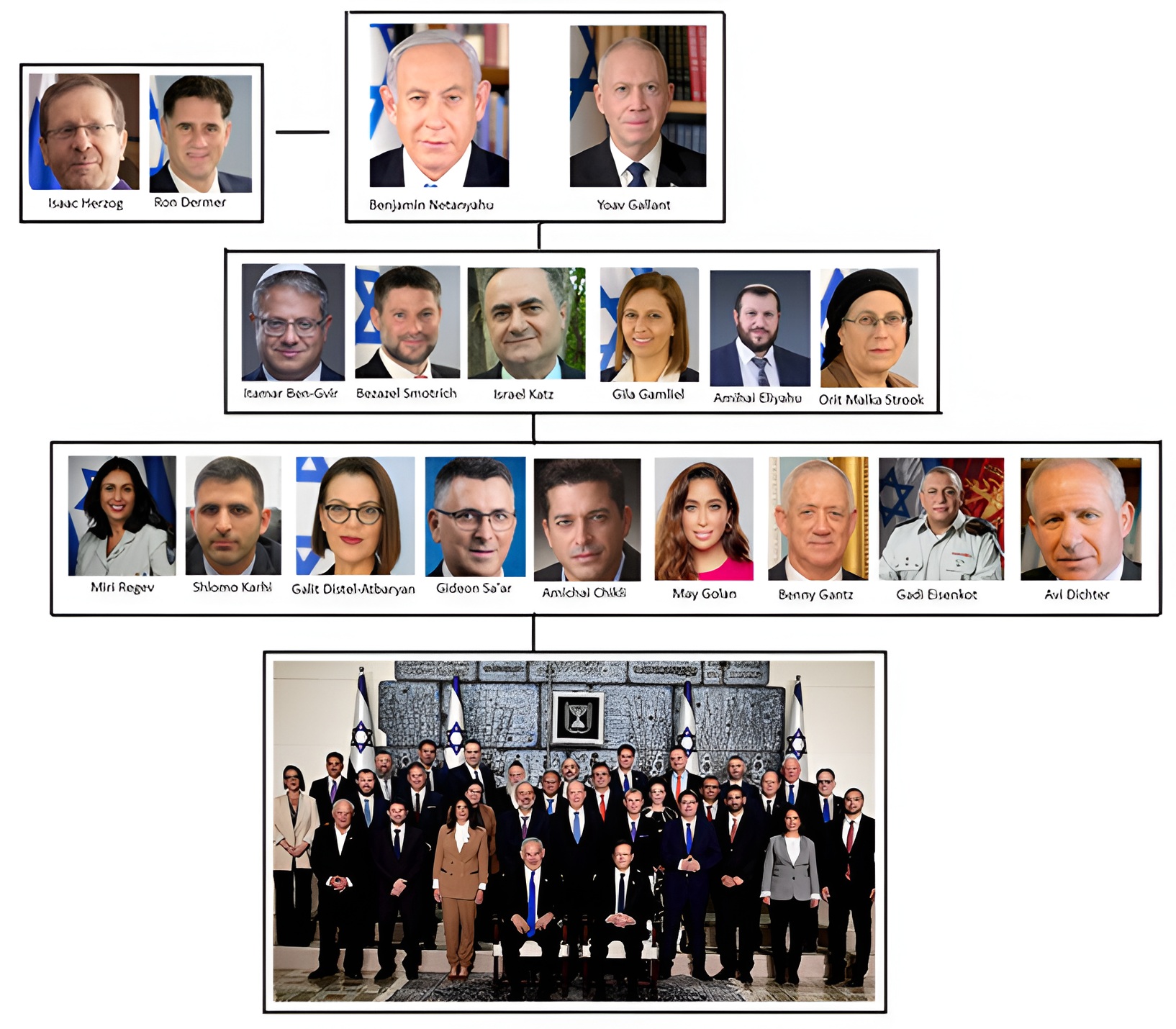
Effectively, there are circles of Israeli officials who share complicity for the Gaza genocide, including high-profile ministers, internationally-less known enablers, military and intelligence architects of obliteration, Netanyahu’s veteran advisor and the president.

Israel’s War Cabinet

The key ministers   

Supporting Netanyahu and Gallant, there were at least half a dozen cabinet members who contributed to those brutalities, with some insisting on more destructive measures and protracted bombardment.

Even before Israel’s genocidal atrocities in Gaza, the Minister of National Security Itamar Ben-Gvir, the leader of the far-right and supremacist Jewish Power party, had long promoted the expulsion of “non-loyal” Arab citizens, the full blockade of Gaza, the Judaization of Israel-occupied Palestinian territories and total elimination of Hamas and all who support Palestinian resistance.

Ben-Gvir has been seconded by Bezazel Smotrich, the far-right leader of the national religious Zionists and Netanyahu’s Minister of Finance and Defense, who has tried to use the Gaza War to annex the West Bank to the pre-1967 Israel. A self-proclaimed racist and fascist, Smotrich promoted the blockade of the Gaza Strip calling for the expulsion of Palestinians from Gaza.

Still another hardliner is Netanyahu’s Foreign Minister Israel Katz. As Netanyahu’s Energy Minister in October 2023, Katz had famously declared a complete siege of Gaza: no “electrical switch will be turned on, no water hydrant will be opened and no fuel truck will enter.” More recently, now-Defense Minister Katz pledged that Gaza will be destroyed, and that anyone who stays in Gaza City will be considered “terrorists and terror supporters.”

Objecting to any humanitarian aid to Gaza, Heritage Minister Amihai Eliyahu, Ben-Gvir’s party colleague, suggested “nuking” the Strip to get rid of the “monsters of Gaza,” including women and children. Despite a global debacle, Netanyahu did not fire Eliyahu. In May 2025, the emboldened minister said Israel should bomb Gaza’s food and fuel reserves, to starve the population.

Like Eliyahu, Settlement Minister Orit Strook believes that death and devastation in Gaza served God’s purpose: Israel’s national redemption. That’s why she opposed all ceasefire efforts. Hamas and Palestinians had to be eradicated so that the Messianic Jewish settlers can rebuild Azza; that is, the Judaized Gaza.

The enablers   

Though less known internationally, another set of cabinet members contributed to the protracted genocidal atrocities. After October 7, then Information Minister Galit-Distel Atbaryan posted her infamous tweet: “Erase Gaza from the face of the earth… and fire and brimstone on the heads of the Nazis in Judea and Samaria (the Hebraized term for the West Bank).”

Transportation Minister Miri Regev, a former IDF brigadier-general and IDF spokeswoman who likes to describe herself as a “happy fascist,” criticized efforts to detain Israeli soldiers in the notorious Sde Teiman detention camp – the Israeli version of Abu Ghraib and the best-known node of “a network of torture camps.”

Promoting the full removal of all Palestinians from Gaza, Minister of Communications Shlomo Karhi had a central role in the censure of international media in Israel and the occupied territories, including the shutdown of Al Jazeera’s Israel bureau. Many of these views were supported by Foreign Minister Gideon Sa’ar, a promoter of the West Bank’s annexation.

Months before October 7, Diaspora Minister Amichai Chikli stated that the Palestinian Authority was a “neo-Nazi entity” and antisemitic and that it was necessary to “examine alternatives to its existence.” Chikli has built special ties with European far-right movements and led over 100 civil initiatives to align international sentiments with the cabinet’s view that Hamas is a collection of human animals and Nazi antisemites. In October, he invited Tommy Robinson, a British far-right anti-Islam activist with a dark history of criminal convictions, to Israel – despite objections and criticism by the Jewish Leadership Council and the Board of Deputies of British Jews.

Then there was the Minister for Social Equality and as Minister for Women’s Empowerment May Golan, long haunted by bribery and fraud allegations. Golan is Netanyahu’s openly racist appointee, who had hoped to serve as Israel consul general in New York City until her appointment was rejected. She called for another Nakba” (lit. “Catastrophe” in Arabic referring to the mass displacement and dispossession of Palestinians in 1948), to cleanse all Palestinians from Gaza.

Despite their supportive roles and accessorial liability in the Palestinian genocide, none of these cabinet members have been charged by the ICC.

The architects of obliteration    

Another set of decision-makers features those Israeli leaders who have had a direct or indirect role in the military doctrine that was deployed in Gaza. Gila Gamliel belongs to Netanyahu’s set of key ministers but as the Minister of Intelligence she also represented the country’s intelligence elite. Since October 2023, she has been in charge of plans of Gaza’s ethnic cleansing to cash on the expulsion via real estate development and by resettling far-right Messianic settlers in Gaza.

The Netanyahu cabinet has also included veteran military leaders whose role was crucial long before and after October 7. They pioneered what can be called the obliteration doctrine, a lethal mix of scorched earth policy, collective responsibility and civilian victimization, coupled with massive indiscriminate bombardment and systematic use of artificial intelligence. As Prof. William Schabas, a leading scholar of genocide, has noted, ‘the obliteration doctrine’ “adds a new term to the lexicon on genocide, notably in the application of international law and its judicial mechanisms.”

As I have demonstrated, this doctrine accounts for the decimation of urban infrastructure and the genocidal atrocities in Gaza. Already in 2006, it was first tested in Dahiya, a Shia Muslim enclave in Beirut. Gadi Eisenkot, the former IDF chief of staff, was its architect who pledged it would be used “in the next war.”

In spring 2024, Benny Gantz, the leader of a center-right party and former IDF chief of general staff, was portrayed as a “moderate” alternative to Netanyahu by the U.S. Secretary of State Blinken. And yet, Gantz sat in Netanyahu’s cabinet through the most devastating phase of Israel’s assault against Gaza. Worse, in the past, he has been haunted by several war crime allegations.

Then there was the controversial and tough-talking Avi Dichter, a former head of Israel’s internal security Shin Bet and veteran politician whose brutal methods in the occupied territories have sparked charges of extrajudicial killing and war crimes since early 2000s. Soon after October 7, Dichter disclosed the Israeli goals: “We are now rolling out the Gaza Nakba,” adding “Gaza Nakba 2023, that’s how it will end.”

None of these architects of obliteration were featured among the ICC warrants, either. 

Netanyahu’s right-hand and the president  

The portrait of Netanyahu’s cabinet also features Isaac Herzog, the Israeli president. Right after October 7, Herzog condemned all residents of Gaza for “collective responsibility” in the Hamas attack on Israel. In this view, there were no innocents in Gaza. The doctrine legitimized the killings of Palestinian women and children who account for 70 percent of the perished in Gaza.

The portrait also includes Ron Dermer, Netanyahu’s Minister of Strategic Affairs, who recently left the cabinet but remains PM’s close advisor. He was intimately linked with the PM’s fatal decisions regarding Gaza. These included a covert plan to “thin” the Palestinian population in Gaza “to a minimum,” by the creation of a “humanitarian crisis” to transfer the refugees away from the area.

Neither Herzog nor Dermer have had to worry about an ICJ warrant.

Furthermore, these high officials represent just the tip of their bureaucracies in which armies of subordinates implemented their decisions, from Netanyahu’s close confidant Dermer to soldiers who were guided to target women and children, including emergency workers who sought to save the victims; journalists who were silenced; and children who were deliberately shot in the head or the left side of the chest.

In light of the track-record of these and other high-level officials, the ICC arrest warrants for PM Netanyahu and his ex-defense minister Gallant would seem to be largely symbolic.

Symbolic justice

Normally, a prosecution team would draw a long list of potential indictees and then decide who could be prosecuted, relying on the strength of available evidence and the resources of the prosecution team.

In light of the ICC’s arrest warrants, the prosecutor’s office reportedly had a wider net of names that were considered. The decision to zoom onto just Netanyahu and Gallant was likely motivated by the view that they represented the apex of Israel’s military campaign against Gaza and its people.

Furthermore, the two were charged mainly with war crimes and crimes against humanity, not genocide.

Presumably, the ICC prosecutor office may wait until there is a final ruling on South Africa’s charge of genocide – likely in late 2027 or early 2028 – before deciding whether to add genocide to the list of charges against Netanyahu, Gallant and anyone else that they add to the list.

The effort to charge two Israeli leaders rather than the entire cabinet, whose members have had a substantial role in the genocidal atrocities, does not represent the pursuit of “victims’ justice.” In substance, it is still another instance of “victors’ justice,” as the former colonial powers continue to undermine appropriate genocide prosecution.

The original version was published by Informed Comment (US) on Nov, 7, 2025.


Dr. Dan Steinbock is an internationally recognized visionary of the multipolar world and the founder of Difference Group. He has served at the India, China and America Institute (US), Shanghai Institutes for International Studies (China) and the EU Center (Singapore). For more, see https://www.differencegroup.net