It’s possible that I shall make an ass of myself. But in that case one can always get out of it with a little dialectic. I have, of course, so worded my proposition as to be right either way (K.Marx, Letter to F.Engels on the Indian Mutiny)
Friday, November 14, 2025
Canada’s European pivot: Could an inclusion in the Eurovision Song Contest be next?
Canada is exploring the possibility of joining Eurovision, something officials say reflects the country's effort to assert its cultural independence and deepen ties with Europe. The EBU has confirmed early talks are underway, but no decision has been made.
Despite the fact many Canadian artists have featured in Eurovision – most famously Céline Dion, who won in 1988 for Switzerland - Canada has never participated in the world's largest music event. But that could be about to change.
Canada’s federal budget, released on 4 November, included a mention that Canada’s government is working with its national broadcaster for a bid to join the Eurovision Song Contest.
The North American country had previously considered participation before, but the Canadian Broadcasting Corporation (CBC) - an associate member of the European Broadcasting Union, which organises Eurovision - said in 2022 that it had “ruled out” the idea, determining it would be “prohibitively expensive.”
However, the budget includes a $150 million funding increase for CBC/Radio-Canada and also allocates $400 million to various cultural organizations and funds.
The timing is also far from anodyne, considering Donald Trump has slapped Canada with tariffs. Last month, Trump said he was adding 10 per cent to US tariffs on goods imported from Canada, after the province of Ontario aired an anti-tariff advertisement featuring Ronald Reagan.
Trump's administration had already imposed a 35 per cent levy on all Canadian goods - including a 50 per cent levy on metals and 25 per cent on automobiles.
Prime Minister Mark Carney said in response that Canada was ready "to continue to build on the progress we had been making" in trade talks, but added that it was developing trade relationships with other countries.
Indeed, Trump's actions have precipitated the Canadian government’s desire to deepen its alliances with Europe, and a Eurovision inclusion could be just the ticket to distance itself further from the US.
Carney even made a point of visiting France and the UK in March on his first trip overseas as prime minister, declaring that Canada is “the most European of the non-European countries.”
Regarding Canada’s inclusion in Eurovision, François-Philippe Champagne, Canada’s finance minister, told Global News that the contest is “a platform for Canada to shine.”
“This is about protecting our identity - yes, we want to protect our sovereignty, but you also want to help people in the arts sector and in the film industry to make sure they can shine around the world. And we have a lot to offer as Canadians.”
On Wednesday, the director of the Eurovision Song Contest, Martin Green, issued the following statement: “The Canadian conversation with CBC/Radio-Canada is in its very early stages and we look forward to continuing our discussions with them.”
He added: “We’re always excited to know that broadcasters want to be part of the world’s largest live music show.”
Céline Dion, seen on left performing 'Ne partez pas sans moi' during preliminary competitions of the "Grand prix eurovision de la chanson" in Switzerland - 7 February 1988 AP Photo
Relate
Canada’s European pivot could follow the example of Australia, which joined Eurovision in 2015 after receiving a special invitation from the EBU despite being outside the European Broadcasting Area.
However, don’t expect a confirmed new inclusion any time soon, as Eurovision is currently wrestling to keep the contest from tearing itself apart.
There has been much internal disagreement about who should be able to take part in the competition. Israel’s participation has been the source of much controversy in recent months.
Several European broadcasters, including Ireland, the Netherlands and Slovenia, have threatened to withdraw from next year’s competition unless Israel’s broadcaster KAN is banned from participating.
Organizers had scheduled a vote for this month on whether Israel should be allowed to compete in the 70th anniversary edition of Eurovision in Vienna, Austria, in May 2026. The vote has since been postponed.
“So right now, expanding Eurovision really isn’t the major focus of the European Broadcasting Union - it's trying to save the contest as it is,” Dean Vuletic, a historian of the Eurovision Song Contest, told Global News.
Vuletic did add, however, that he was not surprised that the Canadian budget included a line about the competition.
“Canada is a country that is close to Europe, culturally, politically, especially the countries of the European Union,” he said. “We’re talking about the EU member states which are the core of Eurovision and they’re the ones that Canada is looking to develop closer ties with considering the current situation in the world.”
Clashes erupt between Druze and Syrian government forces in Suwayda
Copyright Omar Sanadiki/Copyright 2025 The AP. All rights reserved.
By يورونيوز
Published on
Violent clashes erupted in Suwayda between the Druze National Guard and Syrian government forces, involving heavy weapons and drones, in the latest major escalation of fighting between the two sides.
Violent clashes erupted on Thursday night in western Suwayda governorate between the newly formed Druze National Guard and Syrian government General Security forces, involving heavy weapons and drones in the most significant escalation in the region in months.
The fighting lasted for hours and included mutual targeting of contact lines using drones, mortars and heavy machine guns, the sources said. No information was available on any changes to control maps.
The National Guard, founded by Sheikh Hikmat al-Hijri, a Druze leader, blamed government forces for the escalation.
The town of al-Majdal "was subjected to a large-scale attack that lasted for more than an hour, through several axes, using heavy and medium weapons and attack drones," the National Guard said in a statement.
His forces "valiantly repelled the attempt, inflicting heavy losses on the attacking forces in terms of equipment and personnel."
The state-run Syrian News Agency quoted a security source as saying "outlaw groups are targeting with mortars and heavy machine guns the towns of Wolga, Tal al-Aqra, Tal Hadid and al-Mazraa in rural Sweida." There was no immediate official comment from the General Security Service or the Syrian government.
The almost daily skirmishes that have continued for months escalated into large-scale clashes.
According to media reports, General Security Forces carried out "several attacks and violations" from their positions, using drones and heavy machine guns.
The National Guard intensified strikes on the "sources of fire" with heavy machine guns and mortars in response.
'Will Syria become a peaceful country?'
Israeli Prime Minister Benjamin Netanyahu said that Israel is keeping an eye on the latest developments and decisions by interim President Ahmed al-Sharaa, stating, "I'm going to look at what is actually being done, what is actually being achieved."
"Does Syria become a peaceful country? Does he weed out the jihadists in his own military? Does he work forward with me to achieve a demilitarised zone in southwest Syria that abuts the Golan Heights?" Netanyahu asked in a televised interview on Thursday.
"What do we do to secure our Druze brothers, the Syrian Druze brothers of Israel, who were mutilated, massacred, almost as bad as in the 7 October massacre that was conducted by Hamas in Gaza," he said.
If the demilitarisation of southwest Syria and permanent protection for the Druze minority does take place, "we can move on," Netanyahu concluded.
Speaking at an event in London on Thursday, Syrian Foreign Minister Asaad Hassan al-Shibani said that the events in Suwayda "stemmed from accumulated social tensions that escalated into clashes, sparked by Israeli interference."
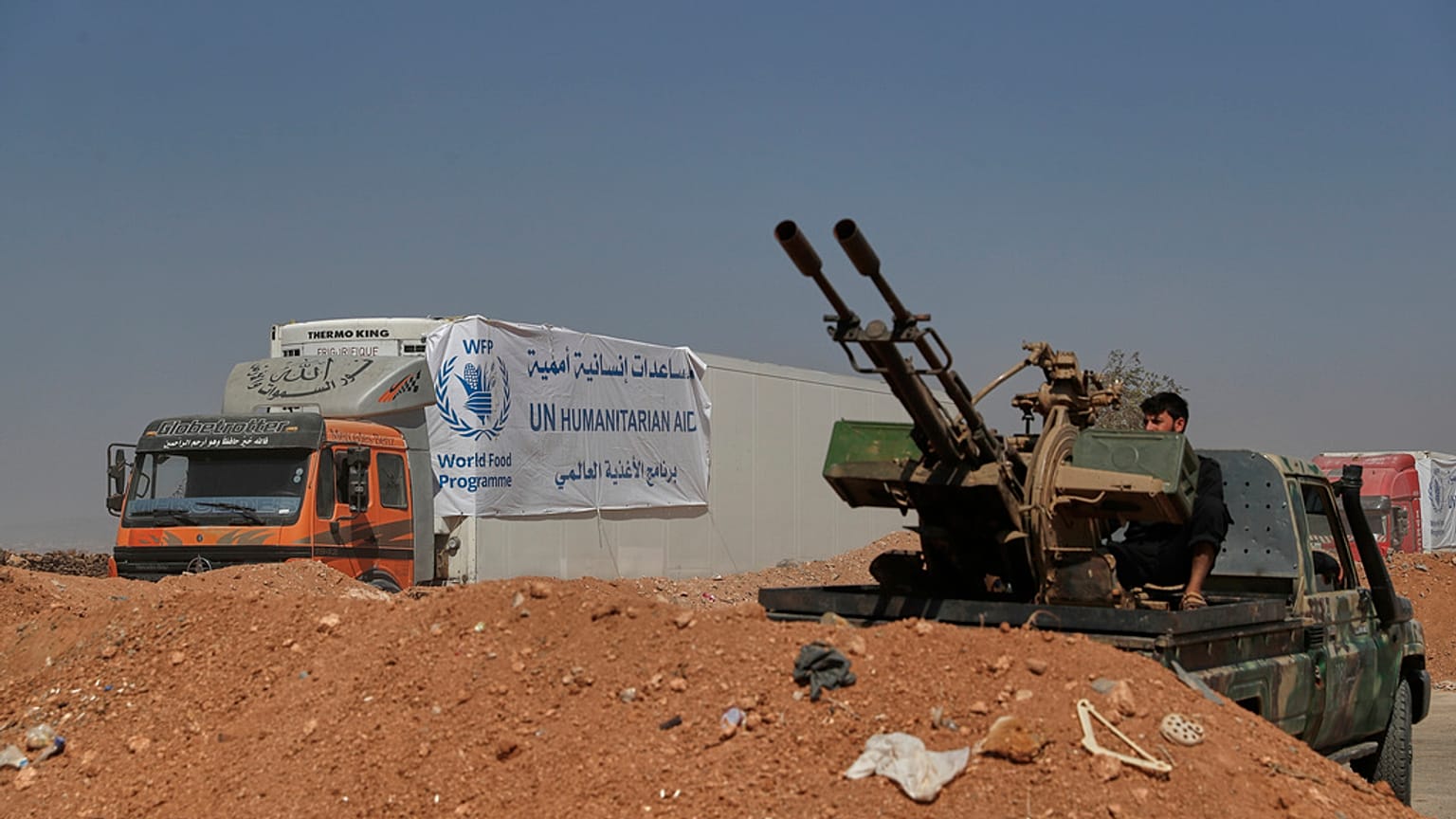
The government is "working carefully to contain the crisis", al-Shibani said, noting that more than 70 relief convoys have been sent to the province. He added that "there are parties in the province that do not want a settlement."
Kazakhstan
Toqaev Balances Relations With Putin After Landmark US-Central Asia Summit – Analysis
Following a high-profile summit in Washington with all five Central Asian leaders that saw new US deals worth billions of dollars, Kazakh President Qasym-Zhomart Toqaev met with Russian President Vladimir Putin in Moscow to reaffirm ties and chart Russia’s future economic role in the Central Asian country.
Toqaev arrived on November 11 for a one-on-one discussion with Putin and held formal talks on November 12 to discuss joint gas projects and the economic fallout from US sanctions on Russia’s major oil companies. The Kazakh president also addressed a Kazakh-Russian economic forum.
“We agreed to strengthen our partnership in the areas of oil, oil products, coal, and electricity production, transportation, and supply,” Toqaev said in televised remarks on November 12 after meeting with Putin. “We discussed in detail the prospects for gas cooperation, in particular gas supply to Kazakhstan’s regions bordering Russia, as well as transit to third countries.”
Alongside the four other Central Asian presidents in Washington last week, Toqaev held talks with US President Donald Trump and heralded the “beginning of a new era of interaction between the United States and Central Asia.”
Russia’s full-scale invasion of Ukraine and subsequent Western sanctions on Moscow have also opened up new economic opportunities for Central Asia, and the Kremlin is looking to adapt.
Andrew D’Anieri, associate director of the Atlantic Council’s Eurasia Center, told RFE/RL that Toqaev arrived in Moscow with more leverage and stature in dealing with Putin following his prominent face time with Trump last week.
D’Anieri said that while the “choreography and rhetoric are meant to convey the closeness of Russia and Kazakhstan,” Toqaev came to Moscow “with more firepower than he had last week.”
“That’s good for Kazakh sovereignty and therefore US interests overall,” he said. Russia’s Evolving Role In Central Asia
The move marks the latest step in Kazakhstan’s longstanding and carefully calibrated diplomatic balancing act between Russia, the main outside power in Central Asia; China, which has grown increasingly influential over the last decade; and Western powers like the United States looking to deepen their footprint in the region.
“Following the [US-Central Asia] summit, the visit to Moscow can be seen as a reaffirmation of Kazakhstan’s strategic ties with Russia and an effort to ease any concerns within the Russian political elite,” Yunis Sharifli, a nonresident fellow at the China Global South Project, told RFE/RL.
Kremlin spokesman Dmitry Peskov told reporters before the visit that Putin was open to hearing more about Toqaev’s bilateral and joint meetings with Trump in Washington.
“If the president of Kazakhstan considers it necessary to inform our president about the content of the contacts he had in Washington, of course that will be extremely interesting for the Russian side,” Peskov said.
Energy ties played a prominent part of the discussions in Moscow, according to Toqaev, who said that he and Putin agreed to boost their partnership in the oil sector.
Peskov said on November 12 that the two presidents discussed uninterrupted operations for the Caspian Pipeline Consortium (CPC), whose pipeline Kazakhstan relies on to export more than 80 percent of its oil and runs to one of Russia’s Black Sea terminals. The CPC pumps oil from western Kazakhstan and includes US oil giants Chevron and Exxon Mobil as its main shareholders.
Peskov did not elaborate on the detials of the talks surrounding the CPC.
“[Russia] is attempting to restructure and redefine its role in the region,” Sharifli said.
LUKoil and Rosneft, two Russian oil giants hit by US sanctions in October, have large holdings in Kazakhstan. LUKoil also holds stakes in Kazakhstan’s massive Tengiz and Karachaganak fields, which are operated by Western oil giants. Kazakhstan’s More Confident In Dealing With Moscow
Ahead of his arrival in Moscow, Toqaev looked to play up Russia’s warm ties with Kazakhstan and the country’s standing on the global stage.
In an article published in the Russian state-owned newspaper Rossiyskaya Gazeta, he praised Astana’s “eternal friendship” with Moscow and described Kazakhstan’s relationship with Russia as a “comprehensive strategic partnership and alliance.”
Toqaev also mentioned recent high-level talks that he held with Chinese leader Xi Jinping, Trump, and other European, Asian, and African presidents.
“Although many of them are at opposite ends of the geopolitical spectrum, they all recognize the exceptional role of Russia and its leader in resolving key issues in international relations,” Toqaev wrote. “In other words, it is impossible to overcome the contradictions of the modern world without Moscow’s participation.”
Sharifli says that that while “Moscow continues to play a critical role as a security provider,” it’s adapting in the region as its economy shifts amid the war in Ukraine into areas like e-commerce and developing new ways for Rosatom, its state nuclear giant, to expand its partnerships with Central Asian governments.
“Overall, while Russia’s dominance in traditional sectors has declined, it is actively seeking new channels to sustain and adapt its presence in Central Asia over the long-term,” he said.
Vlad Paddack, a fellow at Nightingale Intelligence, a political foresight firm, told RFE/RL that the diplomacy in Moscow on the heels of the summit in Washington “showcases Kazakhstan’s ascendance as a middle power, adept at balancing major powers while reinforcing its regional leadership.”
Beyond sanctions and energy ties, Toqaev also discussed infrastructure during his talks with Putin.
While summits this year between Central Asian leaders and the United States and the European Union have focused on building up the Middle Corridor — a roughly 6,500-kilometer trade route connecting China to Europe through Central Asia and the Caucasus by bypassing Russia, Moscow is also looking to open up trade access to South Asia by transiting through Kazakhstan and its neighbors.
Paddack says this reflects Kazakhstan’s “ambition to serve as Eurasia’s primary logistics hub” and position itself at the heart of all regional trade.
Reid Standish is RFE/RL’s China Global Affairs correspondent based in Prague and author of the China In Eurasia briefing. He focuses on Chinese foreign policy in Eastern Europe and Central Asia and has reported extensively about China’s Belt and Road Initiative and Beijing’s internment camps in Xinjiang. Prior to joining RFE/RL, Reid was an editor at Foreign Policy magazine and its Moscow correspondent. He has also written for The Atlantic and The Washington Post.
RFE RL
RFE/RL journalists report the news in 21 countries where a free press is banned by the government or not fully established.
COMMENT: Trump was “sent by heaven”, Russia is a “God-given” neighbour, says Kazakhstan’s president. What's cooking?
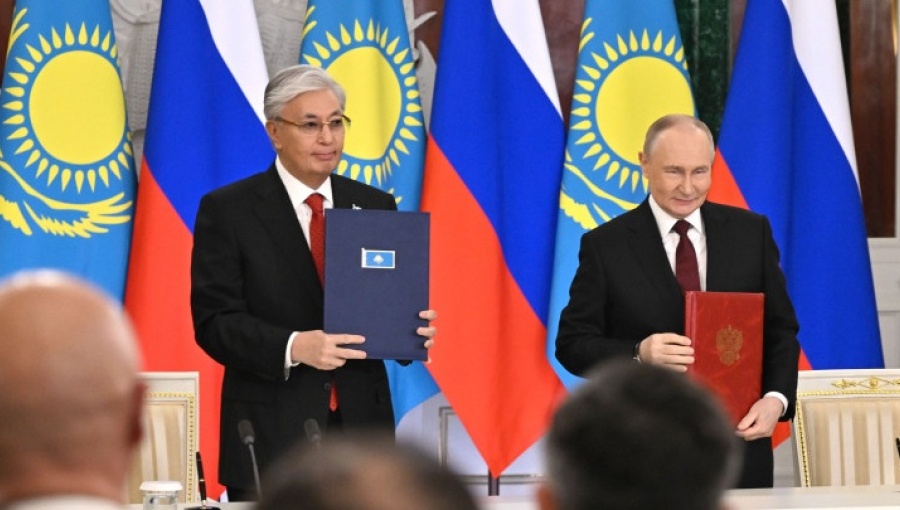
Tokayev, left, and Putin declared Russia and Kazakhstan's relations upgraded. / Akorda.kz
By Will Conroy, bne Eurasia bureauNovember 14, 2025
In hindsight, will it go down as a dud, a wet squib? For a day last week, the big Donald Trump-Central Asia summit consumed the agenda at the White House. Numerous memoranda that could deliver a great quantity of trade and investment deals were signed and America’s loquacious president declared that US, Central Asia relations will be strengthened “like never before”.
The cameras were packed up, the sound was turned down and the sober reflection began.
Temur Umarov, a fellow at the Carnegie Russia Eurasia Center, comes across as a sceptical analyst who is hedging his bets.
In a November 11 essay examining the outcome of the “C5+1” summit, attended by all five of Central Asia’s presidents, Umarov concludes: “Central Asia’s rapprochement with the United States has every chance of remaining at the level of empty promises and utopian projects with impressive-sounding figures. But it could also force the region to face a difficult choice between incurring the wrath of its traditional allies Russia and China or disappointing Trump and becoming even more dependent on Moscow and Beijing.
“For now, however, the region is unlikely to be concerned about this. The current task for Central Asia’s leaders is to squeeze as much capital as possible—even if it’s only symbolic—out of Trump’s interest. By the time they need to demonstrate practical success, there may already be someone else in the White House.”
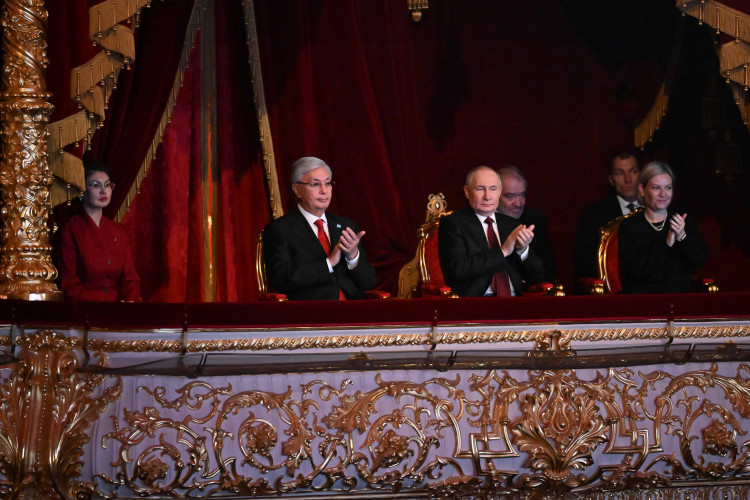
Very notably, just six days after the Washington, DC summit, Kazakh President Kassym-Jomart Tokayev was sat on the balcony of the Bolshoi Theatre in Moscow with Russian leader Vladimir Putin, who ostentatiously spent many hours with Tokayev, hosting him on a state visit.
The state visit to Russia of Tokayev (left centre) included a trip to Moscow's Bolshoi Theatre with Putin (Credit: Akorda.kz).
The Kremlin was suitably scathing in its assessment of Trump’s wooing of Central Asia, a traditional post-Soviet ally. The messaging was not subtle. Putin’s spokesman Dmitry Peskov was asked to respond to the gushing praise Tokayev delivered to Trump’s face. That praise included a moment on camera at a working dinner when even Trump’s eyebrows may have felt some uplift as Tokayev told him: "You are a great leader, a statesman sent by heaven to bring common sense and traditions that we all share and value."
Peskov wryly dismissed Tokayev’s remarks as “nothing unusual” and part of some form of standard procedure for an official visit to the US. “A great many people who end up visiting the White House start talking like that,” quipped Peskov.
Still, as suggested by Umarov: “Never before has the United States been so successful in its attempts to convince Central Asia that cooperation with Washington is worth the inevitable irritation it will elicit from the region’s two powerful neighbors, China and Russia.”
Whether the new approach will bear fruit remains to be seen, says Umarov in his analysis, while observing: “Attention from Washington has always been a valuable asset for the governments of post-Soviet countries. It lends them additional weight on the international stage, while at home it underscores who’s in charge. This is particularly important for the countries of Central Asia, where the United States is the only power that Russia and China are willing to take seriously, unlike the EU, Turkey, or any other middle power.
“Accordingly, Central Asia has always been willing to adapt to the U.S. ideological agenda, even when Washington’s talk of promoting democracy could not have been further from the real priorities of Central Asia’s rulers. And when Trump himself began to crush organizations like the U.S. Agency for International Development, the National Endowment for Democracy, and Radio Free Europe/Radio Liberty that had long irritated the region’s ruling regimes, that automatically guaranteed him their ardent support.
“Neither the U.S. president’s extremely hazy knowledge of the region nor the additional tariffs he imposed (25 percent for Kazakhstan, 10 percent for the rest) could alienate Central Asia’s leaders after that. On the contrary, the region’s presidents became even more active in adapting to Washington’s new agenda, publicly criticizing NGOs and the fight against climate change.”
As Tokayev flew into Russia for his state visit, two Su-35 fighter jets escorted his plane through Russian airspace. The Kazakh leader had, meanwhile, smoothed his arrival in Moscow by writing an article published to coincide with his visit by Russian newspaper Rossiyskaya Gazeta and headlined, "Eternal Friendship – A Guiding Star for Our Peoples."
In the article, Tokayev described how he had held talks with the leaders of China, the US, European and other Asian countries. He wrote: "Despite the fact that many of them are at opposite ends of the geopolitical spectrum, they all recognise the exceptional role of Russia and its leader in resolving key issues in international relations. In other words, it is impossible to overcome the contradictions of the modern world without Moscow's participation."
The Russians are well-used to the pragmatic multi-vector foreign policy found across Central Asia, but Tokayev was clearly signalling to Putin that in building up relations with the US, business or otherwise, he knows to tread very carefully.
Russia already faces the difficulty that China has crept to dominance in trade and investment with Central Asia and now threatens to surge ahead. However, geopolitically at least, it is not prepared to give up on the premise that it will always have a special place in the region’s considerations.
In meeting Putin, Tokayev continued to lay it on thick, describing Russia as a “God-given” neighbour, declaring that his state visit to the country was the highlight of his year and asserting that the inking of a declaration of the transition of Russian-Kazakh relations to a comprehensive strategic partnership and alliance as set to “usher in a new era”.
"Tokayev's visit to Moscow after the [US-Central Asia] summit can be seen as a confirmation of Kazakhstan's strategic ties with Russia and an attempt to allay any concerns among the Russian political elite," assessed Yunis Sharifli, a researcher at the China Global South Project, talking to Azattyk. "Especially since Moscow continues to play a crucial role in ensuring security, leveraging its long-standing military and military-technical ties with governments in the region," he added.
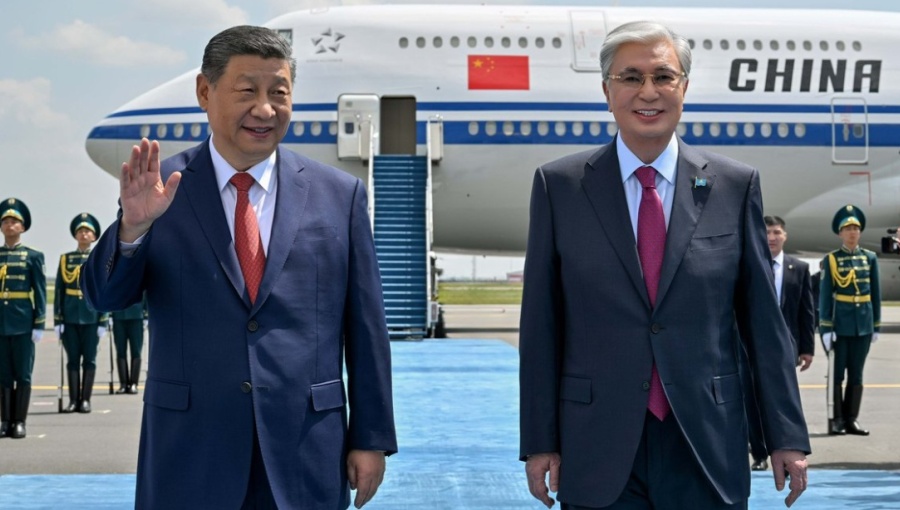
Look out Mr Trump, look out Mr Putin, China's Xi Jinping is another rival for Central Asia's affections (Credit: Kazakh presidency).
"I believe Kazakhstan's multi-vector policy is highly relevant to the current climate," Joanna Lillis, author of Dark Shadows: Behind the Scenes of Kazakhstan's Political Secrets, told Azattyk, adding: "Russia is under sanctions, China is increasing its influence, and the West is offering economic and geopolitical alternatives for Kazakhstan and other Central Asian countries.
“However, I still believe that Kazakhstan's geography is such that Russia is a large, sometimes aggressive, but unavoidable neighbor. Therefore, a multi-vector policy works in Kazakhstan's favour and protects the country from neighbouring aggression. Since March 2022, when the war [between Russia and Ukraine] began, Kazakhstan has not damaged relations with Russia, China, or the West – one could say this policy is sustainable."
As things stand, Kazakhstan, Central Asia’s largest economy, remains economically highly vulnerable to any flaring tempers in Moscow. The fact that around four-fifths of its oil shipments can only make it to export markets via a pipeline route that runs across Russian territory to the Black Sea is alone enough to demonstrate that reality.
But what if, similarly to China, the US comes through with the finance that the currently over-extended Russia cannot manage for transformative investments in critical minerals, rare earths, clean energy, artifical technology and other "trending" industries of our times?
Kazakhstan, like Uzbekistan and the three smaller countries of Central Asia, could find itself treading a fine line with Russia if it invites in great volumes of American capital. But Central Asia, one might say, will only decide if it wants to cross that bridge should it come to it, and as Umarov advises: “This overwrought rhetoric [from Tokayev] may create the impression that U.S.-Central Asian relations are truly on the verge of reaching a fundamentally new level of cooperation, but achieving this in practice will be very difficult, even if both sides are willing.”
The United States, he pointedly adds, “has yet to launch a single major project in Central Asia comparable to China’s investments under the Belt and Road Initiative or Russia’s recent plans to build nuclear power plants in Kazakhstan and Uzbekistan”.
And besides, as always with Central Asia, things are never so simple as they appear. Concludes Umarov: “Even if Washington really wanted to increase its investment in the region, it wouldn’t be easy. The investment climate in Central Asia isn’t particularly favorable for Western partners, and the rules of the game are idiosyncratic and require understanding of the patron-client relationships among local elites.
“Sometimes even having the go-ahead from the very top is no guarantee of success, as the Americans have already discovered for themselves. In 2020, SkyPower Global CEO Kerry Adler said that Uzbek President Shavkat Mirziyoyev’s personal invitation to invest in the country’s green energy sector had led to nothing but multimillion-dollar losses. Even countries well versed in the region’s business practices are not immune to having their assets appropriated, as regularly happens to Chinese and Russian investors.
“Another challenge for potential U.S. investors is how saturated Central Asian economies are with Chinese and Russian projects. China is now present in virtually every sector and area of the region, which, among other things, hinders the advancement of the EU’s Global Gateway infrastructure initiative. It will be all but impossible to advance influence and investment in Central Asia without developing some form of coexistence with China and Russia.”
Kazakhstan: Prosecutors Stall Criminal Investigation Into Police Torture Of Jehovah’s Witness – Analysis
Baglan Yankin leads police raid on Jehovah's Witness meeting, Kentau, 13 August 2025 Photo Credit: Jehovah's Witnesses
The criminal investigation into four police officers who tortured and threatened to murder Jehovah’s Witness Daniyar Tursynbayev in the southern town of Kentau on 13 August appears to be at a standstill. An official of Kentau Prosecutor’s Office – which a court had to order to begin an investigation – insists that it cannot proceed until Tursynbayev makes his statement about the torture in person in Kentau. “It is necessary that testimony is taken in the presence of the victim,” he told Forum 18. “This can’t be done appropriately by video.”
Tursynbayev and his family fled from Kentau to the city of Almaty after the torture, fearing for their safety. He has offered to testify in Almaty or by video, but Kentau Prosecutor’s Office has rejected this. “Returning to Kentau – the town where he was tortured and threatened with death – causes Tursynbayev serious concern for his life and the safety of his family,” Jehovah’s Witnesses told Forum 18 (see below).
Four police officers – reportedly led by Lieutenant Colonel Baglan Yankin – subjected Tursynbayev to repeated torture and murder threats. After six hours of interrogation and torture, he admitted he had conducted “illegal missionary activity”. After release late in the evening, his friends took him to hospital to document his fractured rib and other injuries (see below).
Kazakhstan’s obligations under the United Nations Convention Against Torture require it both to arrest any person suspected on good grounds of having committed, instigated or acquiesced to torture “or take other legal measures to ensure his [sic] presence”, and also to try them under criminal law. No one has been arrested or tried in relation to the torture (see below).
Lieutenant Colonel Yankin again denied that he or other officers had tortured Tursynbayev. “This is slander,” he told Forum 18. He also denied that police had held Tursynbayev on 13 August for more than six hours (see below).
Lieutenant Colonel Yankin told Forum 18 that he remains at work at Kentau Police. “On what basis should I be removed from duty?” he asked. “There aren’t such facts [of torture].” An administrative case has been initiated against Yankin in relation to a raid on Kentau’s Jehovah’s Witness community on the same day that officers tortured Tursynbayev. The case has not reached court (see below).
Erkegali Meyirbekov, head of Kentau Police, did not reply to Forum 18’s September written questions about why its officers tortured Tursynbayev. An officer of Kentau Police told Forum 18 on 13 November that Meyirbekov was out of the office at a meeting. No other officer would discuss the case (see below).
On 12 September, the non-governmental Coalition Against Torture wrote to General Prosecutor Berik Asylov in Astana. It complained that no criminal case had been launched to punish the torturers for “the brutal treatment and torture” of Tursynbayev. The Coalition pointed to Kazakhstan’s obligations under the UN Convention Against Torture and demanded the immediate launch of a case under Criminal Code Article 146 (“Cruel, inhuman or degrading treatment, torture”) (see below).
The torture of Tursynbayev “clearly took place”, notes Andrey Grishin of the Kazakhstan International Bureau for Human Rights and the Rule of Law in Almaty. Yet launching the criminal case happened only “with great difficulty”. But simply the launching of the case “does not mean it will be investigated properly”, he wrote (see below).
“We remain deeply concerned about Tursynbayev’s safety and the integrity of the legal process,” Jehovah’s Witnesses told Forum 18.
Police have refused to return Tursynbayev’s passport or phone which they seized on 13 August. “This is a violation of his fundamental rights and deprives him of opportunities necessary for a normal life,” Jehovah’s Witnesses told Forum 18. “He cannot leave the country, apply to the Public Service Centre, obtain documents, or receive medical care” (see below).
Meanwhile, fears are growing that the regime is preparing legal changes to restrict further the exercise of freedom of religion or belief. President Kasym-Zhomart Tokayev said in March that laws on religion must be “adapted to the new conditions” (see below).
One commentator in Astana pointed to the growing number of media publications criticising “dangerous sects”. The individual noted that a spike in such publications – usually funded by state grants to the media – often precedes a tightening of legal controls on exercising freedom of religion or belief. “I think this issue is being promoted on state grants in advance of the initiative to change the Religion Law,” the individual told Forum 18 (see below).
Tight controls on exercise of freedom of religion or belief
The regime imposes tight restrictions on the exercise of freedom of religion or belief. Against legally-binding international human rights obligations, the Religion Law allows only state-registered religious communities to hold meetings for worship which must be at state-approved locations. The Muslim community faces even tighter restrictions: only mosques subject to the state-controlled Muslim Board are allowed to exist.
All other meetings for worship risk punishment. Individuals, charities and companies face fines under Administrative Code Article 490, Part 1, Point 1 (“Violating the requirements of the Religion Law for conducting religious rites, ceremonies and/or meetings”) for holding meetings for worship without state permission or allowing such meetings to be held in their premises.
Officials and politicians have repeatedly expressed an intention to make state controls over the exercise of freedom of religion or belief tighter. The head of the National Security Committee (NSC) secret police, Yermek Sagimbayev, told deputies of the non-freely-elected parliament in October 2023: “The initiative on the need to harshen legislation in the area of regulating religious activity has more than once been discussed at a government level.”
In early 2024, the regime drafted a wide-ranging Amending Law to amend the 2011 Religion Law and a range of other Laws and Codes. The Law was never adopted. Tighter controls planned on exercise of freedom of religion or belief?
However, the regime appears to remain committed to legal changes to restrict further the exercise of freedom of religion or belief. Speaking in Burabai on 14 March 2025, President Kasym-Zhomart Tokayev appeared to support concerns from a number of politicians over what they considered “the growing influence of non-traditional religious movements among young people”.
“Freedom of religion is guaranteed in Kazakhstan, but disorder and permissiveness are unacceptable,” Tokayev declared in remarks posted on the presidential website. “Destructive movements and ideologies alien to our culture must certainly be curbed.”
Tokayev added: “The most important mission of religion is the consolidation of the nation. Documents regulating the activities of religious associations should facilitate this goal. This issue must be comprehensively studied and legislation adapted to the new conditions.”
No proposed amendments to the Religion Law have yet been submitted to the Mazhilis, the lower house of parliament, according to its website.
One commentator in Astana pointed to the growing number of media publications criticising “dangerous sects”. The individual noted that a spike in such publications – usually funded by state grants to the media – often precedes a tightening of legal controls on exercising freedom of religion or belief. “I think this issue is being promoted on state grants in advance of the initiative to change the Religion Law,” the individual told Forum 18 on 11 November.
The attack on Kentau’s Jehovah’s Witness community was accompanied by a social media video on 3 July from a channel that warns of the dangers of “religious extremism” (see below).
Anuar Khatiyev, Chair of the regime’s Religious Affairs Committee in the capital Astana (part of the Culture and Information Ministry), did not answer his phone each time Forum 18 called between 10 and 13 November. Police torture Daniyar Tursynbayev, threaten with murder
On 13 August, Police in Kentau in the southern Turkistan Region detained Jehovah’s Witness Daniyar Tursynbayev. Four officers – reportedly led by Lieutenant Colonel Baglan Yankin – subjected him to repeated torture and murder threats. After six hours of interrogation and torture, he admitted he had conducted “illegal missionary activity”. After release late in the evening, his friends took him to hospital to document his fractured rib and other injuries.
Police did not return Tursynbayev’s passport and phone that they had seized from him (see below).
Police lodged an administrative case against Tursynbayev on charges of “illegal missionary activity”. If found guilty, he would be due for a fine and – as an Uzbek citizen – deportation (see below).
“This case is entirely based on confessions Kentau police officers extracted from Tursynbayev through the use of torture,” Jehovah’s Witnesses complained to Forum 18 in September. “We are deeply concerned that Daniyar Tursynbayev could be deported, separating him from his wife and daughter, both of whom are citizens of Kazakhstan.”
Lieutenant Colonel Yankin denied that anyone had tortured Tursynbayev. “This is not true. It is disinformation,” he told Forum 18 in September.
Reached on 11 November, Lieutenant Colonel Yankin again denied that he or the three other officers had tortured Tursynbayev. “This is slander,” he told Forum 18. “There are cameras in the office and I could send you the video.” (He did not do so.)
Lieutenant Colonel Yankin denied that officers had arrested or detained Tursynbayev on 13 August. “He wrote a statement,” he insisted.
Police detained Tursynbayev at about 4 pm on 13 August and released him at about 10:30 pm. However, Lieutenant Colonel Yankin denied that police had held him for more than six hours. Yet he repeatedly refused to say at what time he claims police had detained and then released Tursynbayev. “We scan people biometrically when they come in and when they leave,” he told Forum 18.
Erkegali Meyirbekov, head of Kentau Police, did not reply to Forum 18’s September written questions about why its officers tortured Tursynbayev. An officer of Kentau Police told Forum 18 on 13 November that Meyirbekov was out of the office at a meeting. No other officer would discuss the case.
Rustem Sabirzhanuly, head of Turkistan Regional Religious Affairs Department, told Forum 18 in September that he had just spoken to Kentau Police. “There was no beating at all, this is an absolute lie.” Reached again on 10 November, Sabirzhanuly again denied the torture of Tursynbayev. “Police said they didn’t conduct torture. They went to the meeting in response to a complaint from neighbours.” He claimed that a regional Jehovah’s Witness leader had denied that Tursynbayev was affiliated with the community.
Forum 18 asked the National Preventive Mechanism (the body supposed to prevent torture in places where people are detained) in Astana in September whether it has taken up Tursynbayev’s case, what it has done (if anything) on his case, and why those who tortured Tursynbayev had not been arrested. Forum 18 received no response. Kazakhstan’s obligations under Convention against Torture
Kazakhstan is a party to the United Nations Convention against Torture and Other Cruel, Inhuman or Degrading Treatment or Punishment. This defines torture as “any act by which severe pain or suffering, whether physical or mental, is intentionally inflicted on a person for such purposes as obtaining from him or a third person information or a confession, punishing him for an act he or a third person has committed or is suspected of having committed, or intimidating or coercing him or a third person, or for any reason based on discrimination of any kind, when such pain or suffering is inflicted by or at the instigation of or with the consent or acquiescence of a public official or other person acting in an official capacity.”
Under the Convention, Kazakhstan is obliged both to arrest any person suspected on good grounds of having committed, instigated or acquiesced to torture “or take other legal measures to ensure his [sic] presence”, and also to try them under criminal law which makes “these offences punishable by appropriate penalties which take into account their grave nature”.
Many Muslim prisoners of conscience jailed for exercising their freedom of religion or belief have been tortured in a variety of ways. Prison officials responsible do not generally face arrest or punishment. Police raid religious meeting
Also on 13 August, a few hours after it detained Tursynbayev, Kentau Police raided the home where the Jehovah’s Witness community meets. “Your actions are illegal. Stop your actions,” Baglan Yankin, Deputy Chief of Kentau Police Department, told those gathered. He insisted to them that he was speaking “on behalf of the government of the Republic of Kazakhstan”. He ordered those present to leave the premises.
On 3 July, a social media channel Aqiqat Soz published a short video where local residents called for the Jehovah’s Witness community in Kentau to be closed down as its members “directly contradict the bases of Kazakh culture and faith”. It said local residents had submitted a complaint to the local administration on 12 June.
In July, Kentau Akimat (Administration) tried through the Town Court to have the activity of the registered Jehovah’s Witness community suspended. It failed on technical grounds. It did not respond to Forum 18’s 11 September question why it had sought the suspension of the legal entity’s activity. Tursynbayev seeks redress for police torture
After his release, Daniyar Tursynbayev moved to the city of Almaty, fearing that he and his family would not be safe in Kentau.
Tursynbayev sought redress for the torture inflicted by police officers in Kentau. However, Kentau Prosecutor’s Office initially refused to launch an investigation.
On 12 September, the non-governmental Coalition Against Torture wrote to General Prosecutor Berik Asylov in Astana. It complained that no criminal case had been launched to punish the torturers for “the brutal treatment and torture” of Tursynbayev. The Coalition pointed to Kazakhstan’s obligations under the UN Convention Against Torture and demanded the immediate launch of a case under Criminal Code Article 146 (“Cruel, inhuman or degrading treatment, torture”).
On 12 September, Kentau Town Court upheld Tursynbayev’s complaint and ruled that the Kentau Prosecutor acted unlawfully when he transferred the statement regarding torture inflicted on Tursynbayev by officers of Kentau Police to the Internal Security Division of Turkistan Regional Police. The court ordered the prosecutor to initiate an investigation under Criminal Code Article 146.
On 15 September, the prosecutor appealed against this court decision to Turkistan Regional Court.
Additionally, on 15 September, Turkistan Regional Court upheld Tursynbayev’s appeal and ruled that Kentau Prosecutor’s refusal to independently initiate an investigation into the torture allegations was unlawful. The court ordered the prosecutor to rectify this violation.
On 25 September, Kentau Prosecutor’s Office opened a pre-trial investigation into the torture of Tursynbayev by police officers. “Significantly, this investigation was not initiated by the prosecutor’s office but was ordered by Kentau Town and Turkistan Regional Courts, which ordered the prosecutor to register the complaint and investigate,” Jehovah’s Witnesses told Forum 18.
The very evening that the case was registered, Kentau Prosecutor D. Dosaliyev sent an SMS message to Tursynbayev’s lawyer. He requested Tursynbayev’s appearance for questioning at Kentau Prosecutor’s Office the following morning, 26 September – despite the fact that Tursunbayev had left Kentau because of concerns for his safety and was living in Almaty.
On 26 September, Tursynbayev’s lawyer submitted a petition requesting that the questioning be conducted in Almaty or by video. “The relevant law provides for questioning of a victim at either their place of residence or via video conference,” Jehovah’s Witnesses told Forum 18. “Tursynbayev has valid reasons to fear for his safety should he return to Kentau, as the police officers regarding whom he complained have not been suspended from duty and continue to search for him, exerting pressure on his associates and his lawyer.”
On 27 September, Kentau Prosecutor’s Office denied the application, insisting on Tursynbayev’s personal appearance in Kentau despite lawful alternatives being available. The lawyer appealed against this denial, but on 9 October, Kentau Town Court rejected the appeal, upholding the requirement for questioning in Kentau. Turkistan Regional Court also rejected a further appeal.
On 1 October, Kentau Prosecutor’s Office denied the second motion (questioning via video conference). The lawyer appealed against the decision to Kentau Town Court, which rejected the appeal on 22 October. Simply launching the case “does not mean it will be investigated properly”
Aidos Iskakov of Kentau Prosecutor’s Office implied that the investigation into the torture of Daniyar Tursynbayev is at a standstill. He insists that Tursynbayev must make his statement about the torture in person. “It is necessary that testimony is taken in the presence of the victim,” he told Forum 18 from Kentau on 13 November. “This can’t be done appropriately by video.”
Told that Tursynbayev fears for his safety if he returns to Kentau, Iskakov responded: “We offered for him to give the testimony in Turkistan, but he refused. He doesn’t want to go there.”
Iskakov refused to give any other information about the pre-trial investigation. “I can’t give any information about what stage the investigation is at, because of the secrecy of the investigation. I can’t say if anyone has been arrested or not.”
Jehovah’s Witnesses point to Tursynbayev’s fears. “Returning to Kentau – the town where he was tortured and threatened with death – causes Tursynbayev serious concern for his life and the safety of his family,” they told Forum 18.
On 1 October, Murat Tleuberdiyev, Head of Turkistan Region Prosecutor’s Office, replied to the Coalition Against Torture’s 12 September letter to the General Prosecutor. Tleuberdiyev noted the opening on 25 September of a “pre-trial investigation” under Criminal Code Article 146, Part 2, Paragraph 1. He added that “necessary investigative measures” are underway. “The course of the investigation is under the control of the Regional Prosecutor’s Office,” he wrote in the letter seen by Forum 18.
Nurdaulet Zhanatayev of Turkistan Region Prosecutor’s Office, who drafted Tleuberdiyev’s response to the Coalition Against Torture, insists that Kentau Prosecutor’s Office is continuing the investigation, despite Iskakov’s comments. “An expert analysis has been commissioned,” Zhanatayev told Forum 18 from Turkistan on 13 November. He would not say what the “expert analysis” is of.
Zhanatayev said that no one had been arrested and no criminal case has been presented to court. However, he refused to give any other information about the case, citing the secrecy of the investigation.
Told that Kentau Prosecutor’s Office is not proceeding with the investigation until Tursynbayev comes to Kentau to give testimony in person, Zhanatayev insisted again that it is proceeding. He refused to explain whether the law does or does not allow Tursynbayev to give testimony by video.
The torture of Tursynbayev “clearly took place”, notes Andrey Grishin of the Kazakhstan International Bureau for Human Rights and the Rule of Law in Almaty. Yet launching the criminal case happened only “with great difficulty”. But simply the launching of the case “does not mean it will be investigated properly”, he wrote on 17 October. Police to be punished for disrupting religious meeting?
On 22 September, the registered Jehovah’s Witness local religious organisation based 200 kms away in Aksukent, to which the Kentau community belongs, and several individual believers submitted a complaint to the Religious Affairs Committee in the capital Astana regarding the unlawful police disruption of their worship meeting on 13 August.
In its 13 October response, the Committee refused to initiate proceedings, claiming a lack of authority to hold the responsible officials accountable.
Anuar Khatiyev, Chair of the Religious Affairs Committee in Astana, did not answer his phone each time Forum 18 called between 10 and 13 November.
After a similar 3 October complaint to the General Prosecutor’s Office, the materials regarding the disruption to the religious meeting were passed to Turkistan Region Prosecutor’s Office and then to Kentau Prosecutor’s Office.
Kentau Prosecutor’s Office initiated a case under Administrative Code Article 490, Part 2 (“Impeding lawful religious activity as well as violation of the civil rights of physical persons on grounds of their religious views or insulting their feelings or profanation of items, buildings and places revered by followers of any religion, unless there are signs of criminally punishable actions”) against Police Lieutenant Colonel Baglan Yankin.
(Officials who violate freedom of religion or belief are not previously known to have been punished. Officials generally use Administrative Code Article 490, Part 2 only to punish Muslims who, during prayers in mosques, say the word “Amen” aloud.)
Lieutenant Colonel Yankin confirmed the administrative case to Forum 18 on 11 November, but said the court has not yet set a date to hear it. He said Kentau Police have not removed him from duty. “On what basis should I be removed from duty?” he asked. “There aren’t such facts [of torture].”
On 20 October, Kentau Prosecutor’s Office sent the materials to Kentau Police with instructions to consider Colonel Yankin’s disciplinary liability. The results are pending.
On 8 October, Jehovah’s Witnesses filed a separate complaint with Kentau Town Court under Administrative Code Chapter 44 (which covers appeals against state agencies’ actions or failure to take actions in cases of alleged administrative violations). The complaint was about the inaction of Kentau Police and the unlawful actions of Colonel Yankin and three other police officers. The court accepted the complaint but a hearing date has not yet been set.
An officer of Kentau Police told Forum 18 on 13 November that its head, Erkegali Meyirbekov, was out of the office at a meeting. No other officer would discuss the case. Tursynbayev accused of unlawful missionary activity
On 13 August, after officers tortured Tursynbayev and unlawfully seized his passport and mobile phone, Colonel Baglan Yankin of Kentau Police drew up a record of an offence against him under Administrative Code Article 490, Part 3 (“Carrying out missionary activity without state registration (or re-registration)”).
On 8 September, police sent the administrative case against Tursynbayev to Kentau Town Court.
On 13 September, Tursynbayev’s lawyer filed a motion with Kentau Town Court to transfer the case to Almaty, since Tursynbayev had moved and had formally notified the court of his change of residence. On 15 September, Kentau Town Court granted the motion and ordered the transfer of the case to Almaty’s Specialised Inter-District Administrative Court.
On 1 October, the lawyer discovered online that on 30 September, the Almaty court had accepted the administrative case, scheduled a hearing for the same day at 17:30, and summoned Tursynbayev to appear.
“Neither Tursynbayev nor his lawyer was notified, even though the case file contains the lawyer’s contact information,” Jehovah’s Witnesses complained to Forum 18. Because of Tursynbayev’s “failure to appear”, the judge issued an order for his compulsory appearance. At 18:30, the police arrived at Tursynbayev’s residence, but did not find him at home.
On 2 October, Tursynbayev and his lawyer went to the Specialised Inter-District Administrative Court in Almaty and submitted a motion stating that he was ready to appear and requesting notification of the hearing. Nevertheless, the court issued a ruling to return the administrative case to Kentau.
On 3 October, Tursynbayev’s lawyer learned of this transfer and filed an appeal. On 6 October, Tursynbayev himself filed similar appeals.
On 23 October, Tursynbayev and his lawyer personally attended the appellate panel of Almaty City Court and provided evidence of his residence in Almaty. Nevertheless, the court upheld the Specialised Inter-District Administrative Court’s decision to return the case to Kentau. (The complaint regarding the compulsory appearance order – since neither the lawyer nor Tursynbayev was properly notified by the court – is still under review.)
The administrative case has now been returned to Kentau Town Court. The court website does not list any hearings in the case. No residence permit, no passport
Since 13 August, Daniyar Tursynbayev – now living with his family in Almaty – has been without his passport. “This is a violation of his fundamental rights and deprives him of opportunities necessary for a normal life,” Jehovah’s Witnesses told Forum 18. “He cannot leave the country, apply to the Public Service Centre, obtain documents, or receive medical care.”
On 2 September, Tursynbayev’s lawyer filed complaints with Kentau Police and Turkistan Regional Police regarding the seizure of his passport and phone. Officials responded to his lawyer that the passport is in the administrative case file and the phone is retained as physical evidence.
On 13 September, Tursynbayev’s lawyer filed further complaints regarding the unlawful seizure of the passport and phone.
On 1 October, the secretary of the judge at Almaty’s Specialised Inter-District Administrative Court informed the lawyer that Tursynbayev’s passport was not among the case materials and its whereabouts were unknown.
Against this background, on 16 October Tursynbayev’s lawyer learned that on 9 October, Kentau Police terminated his temporary residence permit with immediate effect and without notice. (The original residence permit was valid until 7 August 2026.) Tursynbayev was forced to pay a fine and obtain a new residence permit.
F18News
Forum 18 believes that religious freedom is a fundamental human right, which is essential for the dignity of humanity and for true freedom.