The United Nations Security Council voted Monday in favour of a US-drafted peace plan for Gaza, that includes the deployment of an international force and a path to a future Palestinian state. It marks a significant step for the fragile ceasefire after more than two years of war between Israel and Hamas.
Issued on: 18/11/2025 - RFI
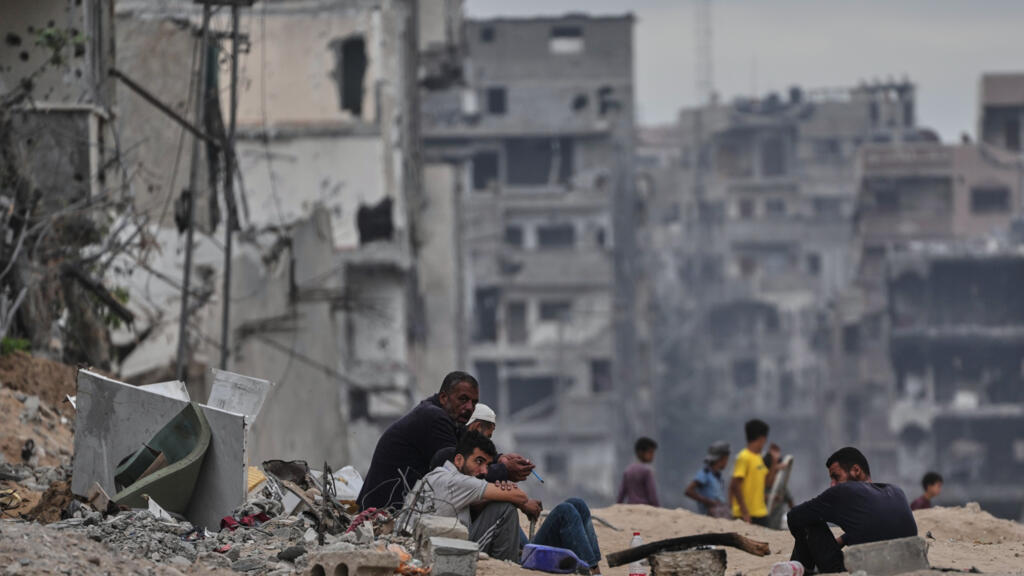
Displaced Palestinians sit next to the remains of their destroyed homes in the Shati refugee camp in Gaza City, 12 October 2025. AP - Abdel Kareem Hana
There were 13 votes in favor of the text, which US President Donald Trump claimed would lead to "further Peace all over the World," with only Russia and China abstaining – but no vetoes.
US ambassador to the UN Mike Waltz said after the vote that "today's resolution represents another significant step that will enable Gaza to prosper and an environment that will allow Israel to live in security."
But Hamas, which is excluded by the resolution from any governance role in Gaza, said the resolution did not meet Palestinians' "political and humanitarian demands and rights."
The text, which was revised several times as a result of high-stakes negotiations, "endorses" the US president's plan, which allowed for a fragile ceasefire between Israel and Hamas to take hold on 10 October in the war-wracked Palestinian territory.
'Post-apocalyptic wasteland': aid worker describes enduring horror in Gaza
The Gaza Strip has been largely reduced to rubble after two years of fighting, sparked by Hamas's attack on Israel on 7 October, 2023.
The peace plan authorises the creation of an International Stabilization Force (ISF) that would work with Israel and Egypt and newly trained Palestinian police to help secure border areas and demilitarize the Gaza Strip.
The ISF is mandated to work on the "permanent decommissioning of weapons from non-state armed groups," protecting civilians and securing humanitarian aid corridors.
It also authorizes the formation of a "Board of Peace," a transitional governing body for Gaza – which Trump would theoretically chair – with a mandate running until the end of 2027.
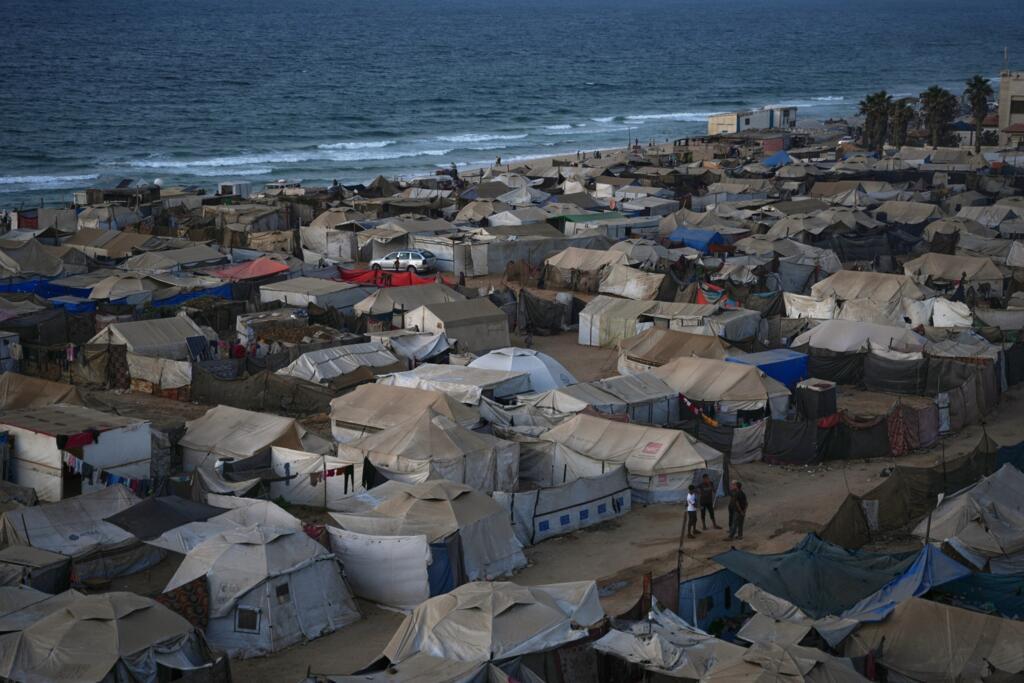
Tents fill a makeshift camp for displaced Palestinians in Zawaida, in the central Gaza Strip, on Saturday, 1 November 2025. AP - Abdel Kareem Hana
Future Palestinian state
In convoluted language, the resolution does mention a possible future Palestinian state.
Once the Palestinian Authority has carried out requested reforms and the rebuilding of Gaza is underway, "the conditions may finally be in place for a credible pathway to Palestinian self-determination and statehood," the text says.
That eventuality has been firmly rejected by Israel.
The resolution also calls for the resumption of humanitarian aid deliveries at scale through the UN, ICRC and Red Crescent.
"We must also substantially step up our work to support the UN humanitarian effort. That requires opening all crossings and ensuring that aid agencies and international NGOs can operate without obstruction," said a British ambassador to the UN, James Kariuki.
Israeli ambassador to the UN Danny Danon said ahead of the vote that the resolution would "make sure that Hamas will not pose a threat against Israel anymore."
Turkey ready to help rebuild Gaza, but tensions with Israel could be a barrier
Veto-wielding Russia circulated a competing draft, saying the US document does not go far enough towards backing the creation of a Palestinian state.
Moscow's text, seen by French news agency AFP, asked the Council to express its "unwavering commitment to the vision of the two-state solution."
It would not have authorised a Board of Peace or the deployment of an international force for the time being, instead asking UN Secretary-General Antonio Guterres to offer "options" on those issues.
"Security Council members were, in practice, not given the time to do the work in good faith," Moscow's ambassador Vasily Nebenzya said.
"The US document is yet another pig in a poke. In essence, the Council is giving its blessing to a US initiative on the basis of Washington's promises, giving complete control over the Gaza strip to the Board of Peace."
The US won the backing of several Arab and Muslim-majority nations, publishing a joint statement of support for the text signed by Qatar, Egypt, the United Arab Emirates, Saudi Arabia, Indonesia, Pakistan, Jordan, and Turkey.
(with AFP)
Future Palestinian state
In convoluted language, the resolution does mention a possible future Palestinian state.
Once the Palestinian Authority has carried out requested reforms and the rebuilding of Gaza is underway, "the conditions may finally be in place for a credible pathway to Palestinian self-determination and statehood," the text says.
That eventuality has been firmly rejected by Israel.
The resolution also calls for the resumption of humanitarian aid deliveries at scale through the UN, ICRC and Red Crescent.
"We must also substantially step up our work to support the UN humanitarian effort. That requires opening all crossings and ensuring that aid agencies and international NGOs can operate without obstruction," said a British ambassador to the UN, James Kariuki.
Israeli ambassador to the UN Danny Danon said ahead of the vote that the resolution would "make sure that Hamas will not pose a threat against Israel anymore."
Turkey ready to help rebuild Gaza, but tensions with Israel could be a barrier
Veto-wielding Russia circulated a competing draft, saying the US document does not go far enough towards backing the creation of a Palestinian state.
Moscow's text, seen by French news agency AFP, asked the Council to express its "unwavering commitment to the vision of the two-state solution."
It would not have authorised a Board of Peace or the deployment of an international force for the time being, instead asking UN Secretary-General Antonio Guterres to offer "options" on those issues.
"Security Council members were, in practice, not given the time to do the work in good faith," Moscow's ambassador Vasily Nebenzya said.
"The US document is yet another pig in a poke. In essence, the Council is giving its blessing to a US initiative on the basis of Washington's promises, giving complete control over the Gaza strip to the Board of Peace."
The US won the backing of several Arab and Muslim-majority nations, publishing a joint statement of support for the text signed by Qatar, Egypt, the United Arab Emirates, Saudi Arabia, Indonesia, Pakistan, Jordan, and Turkey.
(with AFP)
Netanyahu condemns settler violence by 'extremists' after West Bank village torched
Israeli Prime Minister Benjamin Netanyahu condemned a “handful of extremists” after violent settler attacks erupted in a West Bank village on Monday, following the demolition of an illegal outpost. Homes and cars were torched as tensions soar amid a sharp rise in settler violence since the Gaza war began.
Issued on: 17/11/2025
By:FRANCE 24
Israeli Prime Minister Benjamin Netanyahu condemned a “handful of extremists” after violent settler attacks erupted in a West Bank village on Monday, following the demolition of an illegal outpost. Homes and cars were torched as tensions soar amid a sharp rise in settler violence since the Gaza war began.
Issued on: 17/11/2025
By:FRANCE 24
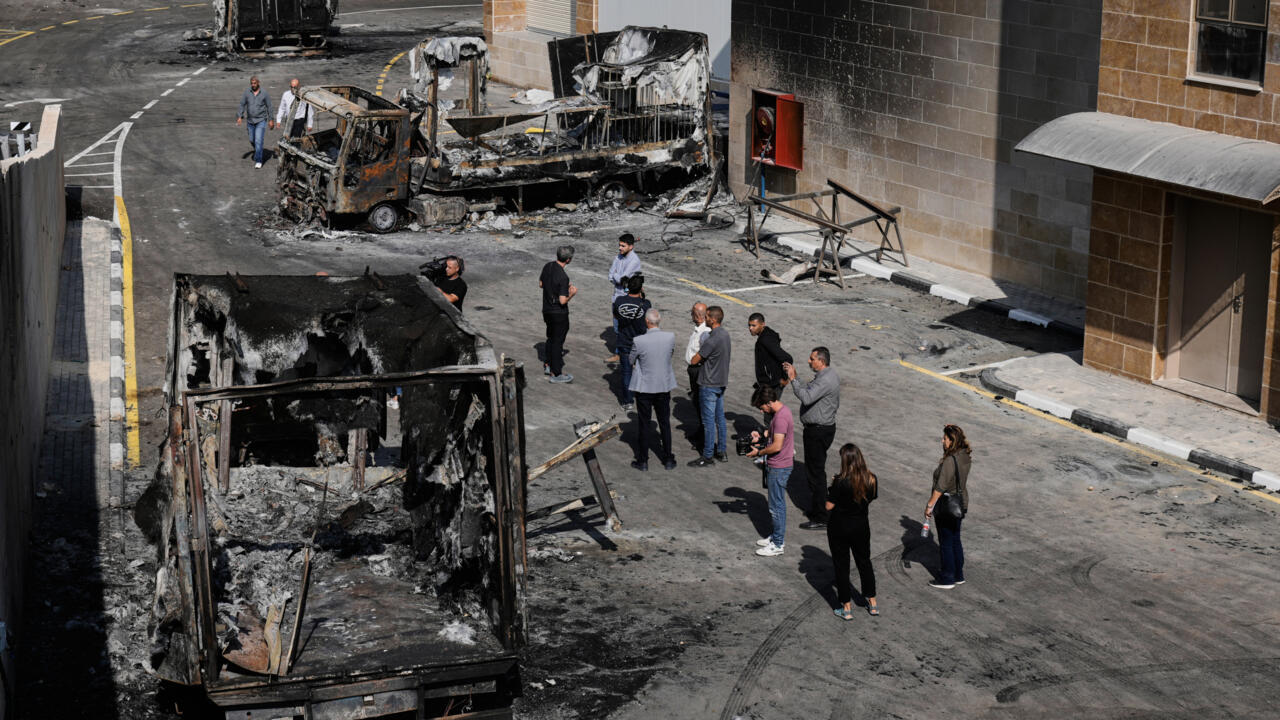
Palestinians and journalists survey damage in an industrial zone following an attack by Israeli settlers the previous day in the West Bank village of Beit Lid, near Tulkarm on November 12, 2025. © Majdi Mohammed, AP
Israeli Prime Minister Benjamin Netanyahu condemned the violence of a "handful of extremists" among Israeli settlers in the occupied West Bank, following clashes and attacks on Monday.
"I view with great severity the violent riots and the attempt by a handful of extremists to take the law into their own hands," Netanyahu said, calling the perpetrators "a group that does not represent" Israeli settlers in the Palestinian territory.
Homes and vehicles were torched and vandalised in a Palestinian village in the West Bank on Monday evening after demonstrators earlier clashed with security forces dismantling an illegal settler outpost in the same area.
A large force was deployed to the Tzur Misgavi outpost in the Gush Etzion area, south of Bethlehem, footage broadcast by Israeli media showed.
One clip showed a bulldozer knocking into the side of a building with people standing on top.
Israeli media said 25 families were evacuated from the site.
Violence in the West Bank has soared since the Hamas attack on Israel triggered the Gaza war in October 2023.
In recent weeks, attacks attributed to Israeli settlers, notably those living in outposts, have multiplied in the West Bank, targeting Palestinians and sometimes Israeli soldiers.
Israel's military chief Eyal Zamir said last week that he wanted to put a stop to such attacks.
The United Nations said October had been the worst month for West Bank settler violence since it began recording incidents in 2006, with 264 attacks that caused casualties or property damage.
Almost none of the perpetrators have been held to account by the Israeli authorities.
"The evacuation is being carried out in accordance with the law," said COGAT, the Israeli body that runs civil affairs in the Palestinian territories.
"Criminal activity and severe incidents of violence at the site affected the security of the area," it said in a statement.
The authorities and security forces will continue to "uphold law and order" in the West Bank, "with a particular focus on enforcing action against structures built illegally".
'Difficult day'
Israel has occupied the West Bank since 1967, and more than 500,000 Israelis now live there in settlements, alongside some three million Palestinians.
While all Israeli settlements in the Palestinian territory are illegal under international law, outposts are also prohibited under Israeli law. However, many end up being legalised by the Israeli authorities.
Israel's far-right Finance Minister Bezalel Smotrich – a proponent of settlement expansion and a settler himself – oversees civil affairs in the Palestinian territories.
Smotrich said he ordered the demolition of Tzur Misgavi because the outpost was built on land already designated for a construction project.
"No-one is going to teach us how to build settlements," he said in a statement.
In a video message to residents, Yaron Rosenthal, the head of the Gush Etzion regional council, said he had been asking the settlers since January to stop building the outpost, as a road is planned to pass through that area.
"This is a difficult day, but if we don't stop the illegal construction today, we will pay a heavy price tomorrow for the future of the settlements," he said.
At least 1,006 Palestinians, including militants, have been killed in the West Bank by Israeli forces or settlers since the Gaza war started, according to the Palestinian health ministry.
During the same period, 43 Israelis, including soldiers, have been killed in Palestinian attacks in the West Bank, according to official Israeli figures.
(FRANCE 24 with AFP)
Israeli Prime Minister Benjamin Netanyahu condemned the violence of a "handful of extremists" among Israeli settlers in the occupied West Bank, following clashes and attacks on Monday.
"I view with great severity the violent riots and the attempt by a handful of extremists to take the law into their own hands," Netanyahu said, calling the perpetrators "a group that does not represent" Israeli settlers in the Palestinian territory.
Homes and vehicles were torched and vandalised in a Palestinian village in the West Bank on Monday evening after demonstrators earlier clashed with security forces dismantling an illegal settler outpost in the same area.
A large force was deployed to the Tzur Misgavi outpost in the Gush Etzion area, south of Bethlehem, footage broadcast by Israeli media showed.
One clip showed a bulldozer knocking into the side of a building with people standing on top.
Israeli media said 25 families were evacuated from the site.
Violence in the West Bank has soared since the Hamas attack on Israel triggered the Gaza war in October 2023.
In recent weeks, attacks attributed to Israeli settlers, notably those living in outposts, have multiplied in the West Bank, targeting Palestinians and sometimes Israeli soldiers.
Israel's military chief Eyal Zamir said last week that he wanted to put a stop to such attacks.
The United Nations said October had been the worst month for West Bank settler violence since it began recording incidents in 2006, with 264 attacks that caused casualties or property damage.
Almost none of the perpetrators have been held to account by the Israeli authorities.
"The evacuation is being carried out in accordance with the law," said COGAT, the Israeli body that runs civil affairs in the Palestinian territories.
"Criminal activity and severe incidents of violence at the site affected the security of the area," it said in a statement.
The authorities and security forces will continue to "uphold law and order" in the West Bank, "with a particular focus on enforcing action against structures built illegally".
'Difficult day'
Israel has occupied the West Bank since 1967, and more than 500,000 Israelis now live there in settlements, alongside some three million Palestinians.
While all Israeli settlements in the Palestinian territory are illegal under international law, outposts are also prohibited under Israeli law. However, many end up being legalised by the Israeli authorities.
Israel's far-right Finance Minister Bezalel Smotrich – a proponent of settlement expansion and a settler himself – oversees civil affairs in the Palestinian territories.
Smotrich said he ordered the demolition of Tzur Misgavi because the outpost was built on land already designated for a construction project.
"No-one is going to teach us how to build settlements," he said in a statement.
In a video message to residents, Yaron Rosenthal, the head of the Gush Etzion regional council, said he had been asking the settlers since January to stop building the outpost, as a road is planned to pass through that area.
"This is a difficult day, but if we don't stop the illegal construction today, we will pay a heavy price tomorrow for the future of the settlements," he said.
At least 1,006 Palestinians, including militants, have been killed in the West Bank by Israeli forces or settlers since the Gaza war started, according to the Palestinian health ministry.
During the same period, 43 Israelis, including soldiers, have been killed in Palestinian attacks in the West Bank, according to official Israeli figures.
(FRANCE 24 with AFP)
