Wednesday, November 19, 2025

Trump Plan to Privatize Student Loans Denounced as ‘Giveaway to Wealthy Insiders’

“By selling parts of the federal student loan portfolio, the Trump administration may seek to unlawfully strip borrowers of their legally guaranteed protections,” wrote a group of more than 40 Democratic lawmakers.


US Secretary of Education Linda McMahon and Treasury Secretary Scott Bessent listen after the signing of an executive order in Washington, DC on July 31, 2025.
(Photo by Jim Watson/AFP via Getty Images)


Jake Johnson
Nov 18, 2025
COMMON DREAMS

Dozens of Democratic lawmakers in the US House and Senate warned Monday that the Trump administration’s reported push to sell off the federal government’s massive student portfolio to the private market would be disastrous for borrowers and a “lucrative giveaway” to predatory corporations.

The lawmakers, led by Sens. Elizabeth Warren (D-Mass.) and Bernie Sanders (I-Vt.) in the Senate and Rep. Ayanna Pressley (D-Mass.) in the House, pointed with alarm to recent reports indicating that Treasury and Education Department officials have met repeatedly with finance industry executives for the purpose of valuing the federal government’s student loan portfolio, which is believed to be worth around $1.7 trillion.

“By selling parts of the federal student loan portfolio, the Trump administration may seek to unlawfully strip borrowers of their legally guaranteed protections,” the lawmakers wrote in a letter to Education Secretary Linda McMahon and Treasury Secretary Scott Bessent. “As experts have explained, private investors’ ‘interest would likely be to squeeze as much profit from the repayment as they could.’ Those profits would likely come at the expense of the borrower via fewer protections and less generous benefits.”

Politico reported last month that the Trump administration is considering selling at least part of the federal government’s student loan portfolio to private companies.

Though small relative to the federal portfolio, the private student loan market has an “outsized” impact on borrowers, the advocacy group Protect Borrowers explained earlier this year.

“While private student loans account for roughly 8% of all student loan debt, more than 40% of student-loan-related complaints submitted to the Consumer Financial Protection Bureau (CFPB) are about private loans,” the group said. “Of these private student loan complaints, roughly one-third are from borrowers who are struggling and can’t afford their monthly payment. This is because, unlike federal student loans, private loans lack critical safeguards for students and parents.”

In their letter to McMahon and Bessent, the Democratic lawmakers demanded that the Trump administration “immediately cease any efforts to privatize the federal student loan portfolio,” arguing that “this sale would be a giveaway to wealthy insiders at the expense of working-class borrowers and taxpayers.”

Warren echoed that sentiment in a statement, saying, “Any way you spin it, this sale would be a massive giveaway to giant companies.”

“It’d be a tremendous mistake,” the senator added.
MONOPOLY CAPITALI$M

‘Colossally Wrong Decision’ as Facebook Parent Company Wins Instagram-WhatsApp Antitrust Case

“This court has effectively told every aspiring monopolist that our current justice system is on their side.”


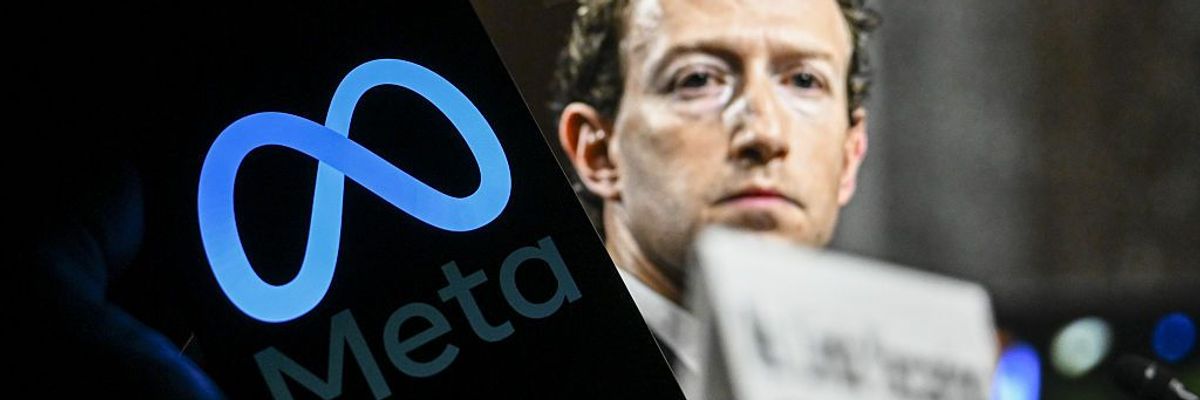
A mobile phone screen displays Meta logo and a digital screen displays founder of Meta Mark Elliot Zuckerberg in the background in Ankara, Turkey on October 28, 2025.
(Photo by Arda Kucukkaya/Anadolu via Getty Images)

Brad Reed
Nov 19, 2025
COMMON DREAMS

Anti-monopoly advocates are warning that a federal judge’s ruling in favor of Facebook parent company Meta in a major antitrust case will have negative repercussions for US consumers by allowing Facebook to continue wielding monopoly power in the social media marketplace.

Judge James Boasberg in the District Court for the District of Columbia ruled Tuesday that the company’s acquisitions of Instagram and WhatsApp did not violate US antitrust policy.


RECOMMENDED...


‘Blunt Corruption’: Trump DOJ Hands Google an Antitrust Win After Tech Giant’s Ballroom Donation

Boasberg found that the Federal Trade Commission (FTC) had not proven Meta holds monopoly power in the personal social networking market, “largely because he folded TikTok and YouTube into the same market and concluded that their popularity reduces Meta’s share below illegal levels,” said the American Economic Liberties Project (ALEP).

John Bergmayer, legal director at Public Knowledge, argued that Boasberg’s ruling demonstrates a basic misunderstanding about the economics of the social media market.

“The court’s opinion reflects a view of the market that is at odds with how digital-platform power operates today,” he said. “Meta systematically acquired emerging competitors precisely because direct, head-to-head competition threatened its dominance. Meta’s consolidation strategy deprived consumers of innovative services and prevented the development of a truly competitive social-networking ecosystem.”

Nidhi Hegde, executive director of ALEP, described the ruling as a “colossally wrong decision” that “turns a willful blind eye to Meta’s enormous power over social media and the harms that flow from it.”

“These deals let Meta fuse Facebook, Instagram, and WhatsApp into one machine that poisons our children and discourse, bullies publishers and advertisers, and destroys the possibility of healthy online connections with friends and family,” she said. “By pretending that TikTok’s rise wipes away over a decade of illegal conduct, this court has effectively told every aspiring monopolist that our current justice system is on their side.”

Hegde added that it should now fall upon US Congress to “step in and break up Big Tech, prohibit addictive surveillance algorithms, and create the conditions for building a better future.”

Open Markets Institute policy counsel Tara Pincock said Boasberg’s ruling was “profoundly misguided,” and accused the judge of blocking the FTC from reversing a mistake it made last decade when it signed off on Meta’s purchases of Instagram and WhatsApp.

“Judge Boasberg erred in concluding that Facebook competes with TikTok and YouTube,” said Pincock, a former state assistant attorney general in Utah. “I was part of the bipartisan coalition of states that brought this case alongside the FTC in December 2020, and the court’s framing misrepresents what is at stake. This case has never been about generic ‘time and attention.’ It is about how people connect, communicate, and build communities—and about how a powerful company abused its dominance to protect itself from competition.”
Dems Introduce Bill to ‘Stop Apparent Bribery Involving Trump Ballroom Donations’

“Billionaire companies are bankrolling Trump’s ballroom and it stinks of bribery,” said Sen. Elizabeth Warren.


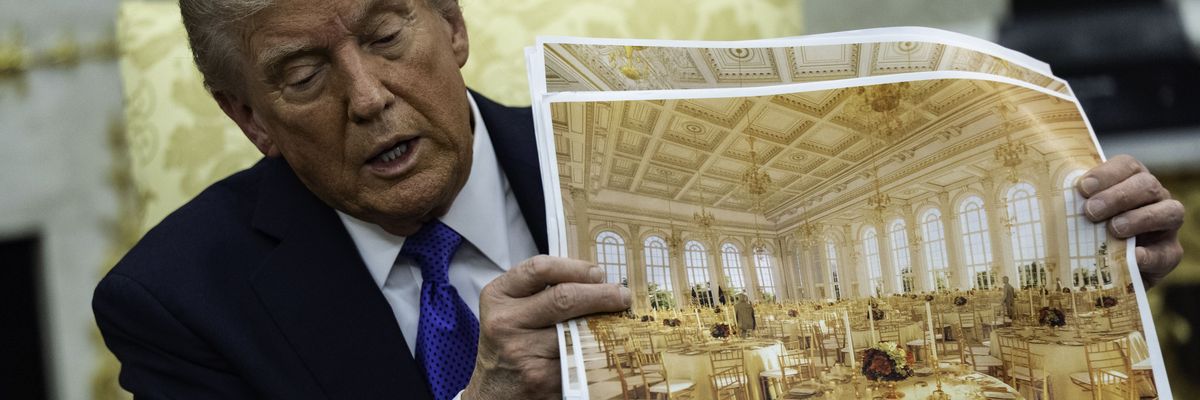
US President Donald Trump speaks holding a photos of his White House ballroom, in the Oval Office in Washington, DC on October 22, 2025.
(Photo by Salwan Georges/The Washington Post via Getty Images)

Brett Wilkins
Nov 18, 2025
RAW STORY

Amid concerns over President Donald Trump’s White House ballroom, a pair of Democratic US lawmakers on Tuesday introduced legislation “to root out apparent bribery and corruption” involving the $300 million project.

Sen. Elizabeth Warren (D-Mass.) and Rep. Robert Garcia (D-Calif.) introduced the Stop Ballroom Bribery Act, described by Warren’s office as “the first piece of legislation addressing the ballroom that would impose donation restrictions.”

“Billionaires and giant corporations with business in front of this administration are lining up to dump millions into Trump’s new ballroom—and Trump is showing them where to sign on the dotted line,” Warren said in a statement. “Americans shouldn’t have to wonder whether President Trump is building a ballroom to facilitate a pay-to-play scheme for political favors. My new bill will put an end to what looks like bribery in plain sight.”

Garcia said: “Donald Trump is raising hundreds of millions of dollars to build himself a White House ballroom at a time when millions of American families can barely make ends meet. It’s outrageous that the White House won’t reveal who’s bankrolling Trump’s pet project, and that the people’s house could be funded by shady figures, corrupt money, and bad actors.”

“This bill will ban contributions from anyone with a conflict of interest, prevent bribery, and ensure we can hold any administration accountable for blatant corruption,” he added.

Noting that many of the “wealthy individuals, corporations, and organizations” funding the ballroom “need something from the Trump administration,” Warren’s office flagged “serious concerns of quid-pro-quo arrangements and possible bribery.”

“Ethics experts have argued that the apparent pay-to-play relationship between Trump and business leaders oversteps the norms of presidential behavior and could erode Americans’ trust in government,” the senator’s office added.

As Warren’s office noted:
Key ballroom donors currently have business interests in front of the Trump administration. For example, Google, which recently donated $22 million to settle President Trump’s censorship lawsuit against YouTube, will benefit if Trump’s [Department of Justice] decides not to appeal a recent judicial ruling in a relevant antitrust case. Meanwhile, Union Pacific Railroad is seeking federal approval of a lucrative merger and Palantir is working to get more federal contracts.

The White House has refused to be fully transparent, publishing only a noncomprehensive donor list missing multiple key donors and offering donors anonymity. Donations for projects like the ballroom are often channeled through the National Park Service and philanthropic partners; nonprofits with formal ties to property used by the president and [Vice President JD Vance] raise unique conflict-of-interest risks when fundraising from individuals and corporations with interests in front of the federal government.

The Stop Ballroom Bribery Act would:Impose pre-donation restrictions, including banning contributions from entities and individuals that present a conflict of interest, make it clear that donations cannot be conditioned on receipt of benefits from the federal government, require congressional approval for foreign donations, and proscribe the president and other senior officials and their families from taking donations;
Impose post-donation restrictions, including banning the display of donors’ names and logos, enact a two-year cooling-off period before a donor to a covered project can lobby the federal government, and prohibit conversion of leftover donated funds to anyone’s personal use or to benefit the president and other senior officials and their families;
Require transparency, including the disclosure of any meetings with senior federal officials or their relatives within a year of the donation, and mandate National Park Service publication of all donations to covered projects and ban anonymous donations; and
Enable enforcement, judicial review, and the pursuit of civil and criminal penalties for violators.

"President Trump's decision to unilaterally destroy the East Wing of the White House to build a ballroom financed by wealthy individuals and corporations not only ignores our country's laws but raises serious ethical concerns—namely, whether individuals and corporations funded this project in the hopes of buying access and influence," said Debra Perlin, vice president for policy at Citizens for Responsibility and Ethics in Washington (CREW), which supports the legislation.

Virginia Canter, chief counsel and director for ethics and anticorruption at Democracy Defenders Action—another backer of the bill—said that “over the past year, President Trump has raised millions of dollars for vanity projects at the White House—like paving over the Rose Garden and demolishing the beloved East Wing.”

“These funds have come from private donors without meaningful transparency or accountability,” Canter added. “The highest office in the land should never be for sale, nor should it ever appear to be.”
Ocasio-Cortez Says ‘We Should Not Be Entertaining a Bailout’ of AI Industry as Bubble Fears Grow

Rep. Alexandria Ocasio-Cortez said no government rescue of artificial intelligence firms “as healthcare is being denied to everyday Americans.”


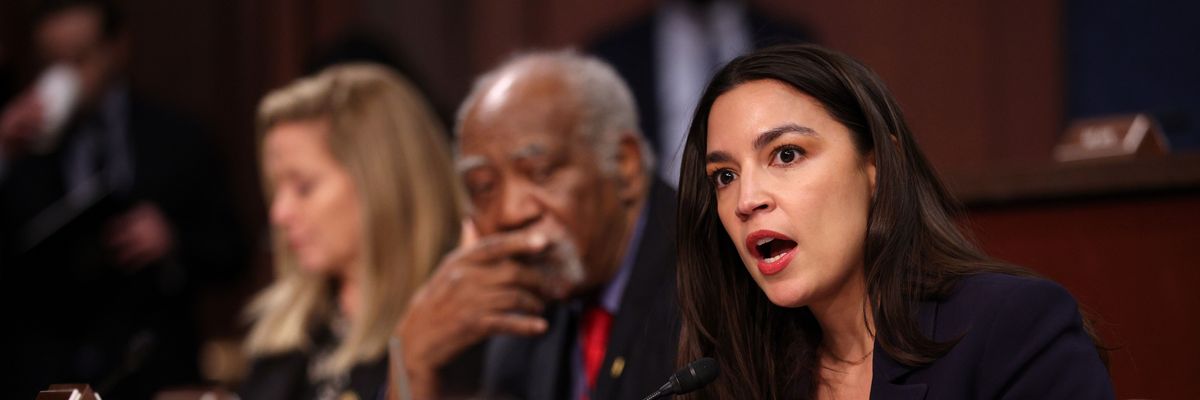
US Rep. Alexandria Ocasio-Cortez (D-NY) speaks during a House Oversight and Government Reform Committee hearing on March 5, 2025.
(Photo by Kayla Bartkowski/Getty Images)

Jake Johnson
Nov 19, 2025
COMMON DREAMS

US Rep. Alexandria Ocasio-Cortez said Tuesday that the federal government should not consider a taxpayer bailout of the artificial intelligence industry as fears grow that the rapidly expanding sector poses systemic risks to the global economy.

“Should this bubble pop, we should not be entertaining a bailout,” Ocasio-Cortez (D-NY) said during a House subcommittee hearing. “We should not entertain a bailout of these corporations as healthcare is being denied to everyday Americans, as SNAP and food assistance is being denied to everyday Americans, precipitating some of the very mental crises that people are turning to AI chat bots to try to resolve.”


Ocasio-Cortez echoed the concerns of industry insiders and analysts who have warned in recent weeks that the AI investment boom created a bubble whose rupture would cause far-reaching economic carnage.

“We’re talking about a massive economic bubble,” the New York Democrat said Tuesday. “Depending on the exposure of that bubble, we could see 2008-style threats to economic stability.”

Ocasio-Cortez’s remarks came on the same day that Sen. Elizabeth Warren (D-Mass.) sounded the alarm about potential Trump administration plans to “use taxpayer dollars to prop up OpenAI and other AI companies at the expense of working class Americans.”

“The Trump administration’s close ties with AI executives and donors—including millions of dollars of contributions to President Trump’s new ballroom project—raise concerns that the administration will bail out AI executives and shareholders while leaving taxpayers to foot the bill,” Warren wrote in a letter to the White House’s AI czar, David Sacks.


OpenAI, a firm at the center of the nascent industry, has reportedly been in discussion with the Trump administration about the possibility of receiving federal loan guarantees for the construction of chip factories in the United States. Robert Weissman, co-president of the watchdog group Public Citizen, warned earlier this month that “it is entirely possible that OpenAI and the White House are concocting a scheme to siphon taxpayer money into OpenAI’s coffers, perhaps with some tribute paid to Trump and his family.”

“Perhaps not so coincidentally, OpenAI president Greg Brockman was among the attendees at a dinner for donors to Trump’s White House ballroom, though neither he nor OpenAI have been reported to be actual donors,” Weissman added.

Writing for the Wall Street Journal last week, Sarah Myers West and Amba Kak of the AI Now Institute observed that “the federal government is already bailing out the AI industry with regulatory changes and public funds that will protect companies in the event of a private sector pullback.”

“The Trump administration is rolling out the red carpet for these firms,” they wrote. “The administration’s AI Action Plan aims to accelerate AI adoption within the government and military by pushing changes to regulatory and procurement processes. Government contracting offers stable, often lucrative long-term contracts—exactly what these firms will need if the private market for AI dips.”

“Federal policy has jumped the gun: We don’t yet know if AI will transform the economy or even be profitable,” West and Kak added. “Yet Washington is insulating the industry from all sorts of risk. If a bubble does pop, we’ll all be left holding the bag.”


Warnings of AI Bubble Grow Louder as Big Investors Dump Nvidia Stock

“I’m very nervous about the size of these investments in these data centers,” one tech CEO said.


The NVIDIA logo is displayed on a mobile phone with a financial stock graph visible in the background, in this photo illustration in Brussels, Belgium, on November 18, 2025.
(Photo by Jonathan Raa/NurPhoto via Getty Images


Brad Reed
Nov 18, 2025
COMMON DREAMS

Tech industry insiders are growing more wary of a financial bubble in the artificial intelligence industry that many analysts have been warning could tip the global economy into a severe recession.

Sundar Pichai, CEO of Google parent company Alphabet, said in an interview with BBC published Tuesday that he believes the speculation currently pumping up investment in AI is akin to the kind of speculation that occurred in the late 1990s ahead of the dot-com stock crash.

“We can look back at the internet right now,” he told BBC. “There was clearly a lot of excess investment, but none of us would question whether the internet was profound. I expect AI to be the same. So I think it’s both rational and there are elements of irrationality through a moment like this.”

PIchai said that he believed his firm would be well positioned to weather the bursting of an AI bubble, although he also cautioned that “I think no company is going to be immune, including us,” were such a scenario to occur.

Sebastian Siemiatkowski, CEO of global payments network Klarna, told the Financial Times on Monday that while he still believed in the potential of AI, he also thought many of the biggest players in tech were vastly overspending to build out infrastructure that would not be needed to power the technology.

Siemiatkowski pointed to advances made this year by Chinese AI firm DeepSeek in vastly reducing the power needed to run AI as evidence that the energy-devouring data centers being constructed across the US would be a massive overbuild.

“I think OpenAI can be very successful as a company but at the same time I’m very nervous about the size of these investments in these data centers,” he said. “That’s the particular thing that I am concerned about.”

Some major investors are also signaling that the boom may be over for AI.

MarketWatch reported on Monday that Palantir chairman Peter Thiel’s hedge fund, Thiel Macro LLC, dropped all its shares in Nvidia, the US-based semiconductor giant that manufactures most of the chips used to power AI. The move by Thiel was revealed just one week after Japanese investment holding company SoftBank disclosed that it had divested its entire $5.8 billion stake in Nvidia.

Nvidia has also become a target for investor Michael Burry, who famously made a fortune by short-selling the US housing market ahead of the 2008 financial crisis, and who recently revealed that his firm was making bets against Nvidia and Palantir.

Concerns about a potential AI bubble have roiled global markets this week, and all major US stock indexes once again traded lower on Tuesday, marking the fourth consecutive losing session.

According to the Wall Street Journal, the current selloff is being driven by investors spooked about “lofty valuations and a pile-up of debt to build data centers,” and the paper pointed to a new survey showing that “45% of fund managers see an AI bubble as the top ‘tail risk’ for markets” right now.
Trump EPA’s Rollback of Wetlands Protections Is Latest ‘Gift’ to Polluters, Groups Say

“Eliminating protections from small streams and wetlands will mean more pollution downstream—in our drinking water, at our beaches, and in our rivers,” said one advocate.


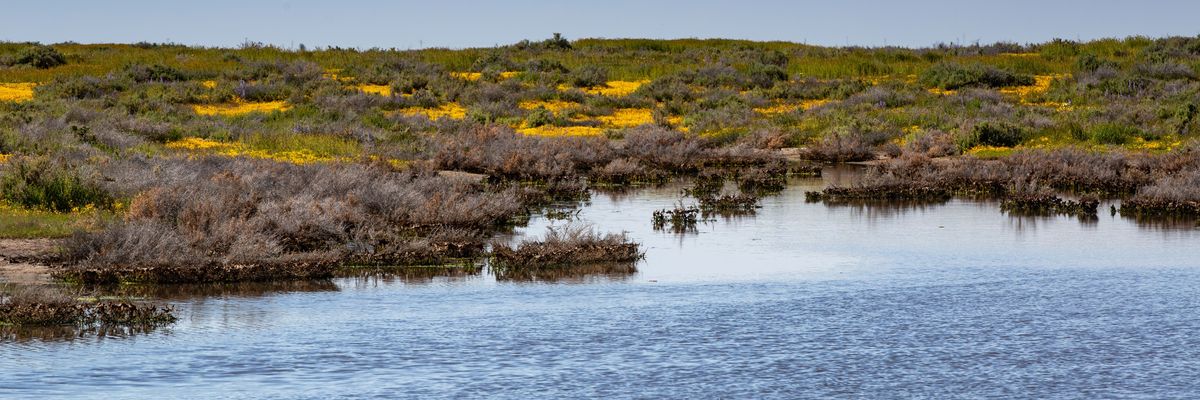
Alkali wetlandsare seen on April 22, 2023, in Carrizo Plain National Monument, California.
(Photo by George Rose/Getty Images)


Julia Conley
Nov 18, 2025
COMMON DREAMS

Environmental justice campaigners on Monday said the Trump administration’s latest rollback of wetland protections was “a gift to developers and polluters at the expense of communities” and demanded permanent protections for waterways.

“Clean water protections shouldn’t change with each administration,” said Betsy Southerland, former director of the Office of Science and Technology in the US Environmental Protection Agency’s (EPA) Office of Water. “Every family deserves the same right to safe water, no matter where they live or who’s in office.”
RECOMMENDED...


Another Giveaway to Big Oil as Trump Wrenches Open 13 Million Acres of Arctic for Drilling


‘Americans Should Be Enraged’: Reports Expose Unprecedented Corruption at Trump DOJ

EPA Administrator Lee Zeldin proposed changes to the rule known as “Waters of the United States” (WOTUS), which has been the subject of debate and legal challenges in recent decades. Under the Trump administration, as in President Donald Trump’s first term, the EPA will focus on regulating permanent bodies of water like oceans, lakes, rivers, and streams.

The administration would more closely follow a 2023 Supreme Court decision, Sackett v. EPA, which the Natural Resources Defense Council (NRDC) found this year would remove federal protections from 60-95% of wetlands across the nation.

The Zeldin rule would eliminate protections for most wetlands without visible surface water, going even further than Sackett v. EPA in codifying a narrower definition of wetlands that should be protected, said the Environmental Protection Network (EPN). The rule comes after pressure from industry groups that have bristled over past requirements to protect all waterways.

Wetlands provide critical wildlife habitats, replenish groundwater, control flooding, and protect clean water by filtering pollution.

The Biden administration required the Clean Water Act to protect “traditional navigable waters, the territorial seas, interstate waters, as well as upstream water resources that significantly affect those waters,” but was constrained by the Sackett ruling in 2023.

“This proposed rule is unnecessary and damaging, and ignores the scientific reality of what is happening to our nation’s water supply.”

Tarah Heinzen, legal director for Food and Water Watch, said the new rule “weakens the bedrock Clean Water Act, making it easier to fill, drain, and pollute sensitive waterways from coast to coast.”

“Clean water is under attack in America, as polluting profiteers plunder our waters—Trump’s EPA is openly aiding and abetting this destruction,” said Heinzen. “This rule flies in the face of science and commonsense. Eliminating protections from small streams and wetlands will mean more pollution downstream—in our drinking water, at our beaches, and in our rivers.”

The “critical functions” of wetlands, she added, “will only become more important as worsening climate change makes extreme weather more frequent. EPA must reverse course.”

Leda Huta, vice president of government relations for American Rivers, added that the change to WOTUS will “likely make things worse for flood-prone communities and industries dependent on clean, reliable water.”

“This proposed rule is unnecessary and damaging, and ignores the scientific reality of what is happening to our nation’s water supply,” said Huta. “The EPA is taking a big swipe at the Clean Water Act, our greatest tool for ensuring clean water nationwide.”

The proposal was applauded by the National Association of Manufacturers, whose president, Jay Timmins, said companies’ “ability to invest and build across the country” has been “undermined” by the Obama and Biden administration’s broader interpretation of WOTUS.

But Southerland said Zeldin’s proposal “ignores decades of science showing that wetlands and intermittent streams are essential to maintaining the health of our rivers, lakes, and drinking water supplies.”

“This is one of the most significant setbacks to clean water protections in half a century,” she said. “It’s a direct assault on the clean water Americans rely on.”


Drew Caputo, vice president of litigation for lands, wildlife, and oceans at Earthjustice, said the group was evaluating the legality of the proposal and would “not hesitate to go to court to protect the cherished rivers, lakes, streams, and wetlands that all Americans need and depend on.”

“The proposal avoids specifying the exact scale of the deregulation it proposes, but it clearly would result in a serious reduction in legal protections for waters across the United States,” said Caputo. “Many waters that have been protected by the Clean Water Act for over 50 years would lose those protections under this proposal.”
Property Insurance Is the Canary in the Climate Coal Mine

We too have a little bird trying to call our attention to a major problem. That bird is the insurance industry with its army of actuaries.


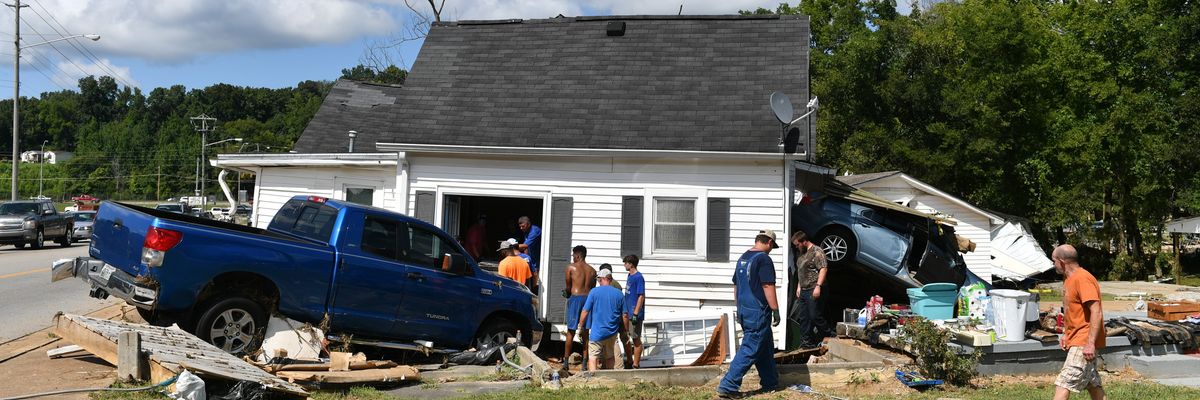
A view is shown of the damage after heavy rain and devastating floods in Waverly, Tennessee, United States on August 22, 2021.
(Photo by Peter Zay/Anadolu Agency via Getty Images)

Common Dreams


As the cost of insuring our houses escalates around the United States and the world, it appears that property insurance is acting like a canary in a coal mine.

Canaries used to be taken into coal mines because they served as an early warning system if dangerous gases were building up. Since the canaries were more sensitive to these gases than people, they protected the miners from life-threatening conditions. When the canary dropped dead, the miners could still get out..


Survivors of Philippines ‘Super Typhoon’ Sue Oil Giant for Causing Climate Emergency


Like the canaries, the actuaries who interpret data for insurance companies are more sensitive than most individual people to changes going on in the world. Actuaries earn big salaries because the financial health of their employers depends on them.

Things have already gotten so bad that the National Academies of Sciences, Engineering, and Medicine (NASEM) recently sponsored a webinar panel discussion: “Extreme Weather Events and Insurance: Households, Homeowners, and Risk.” (This link will take you to a video of the event.)

Any coal miner who refused to evacuate a mine when the mine’s canary keeled over—perhaps saying, “I don’t believe there is any real danger here”—would not have been long for this world.

The panelists were located in the United States (Washington, DC and Madison, Wisconsin) and England (London and Cambridge). Climate changes are not limited to the United States, nor is awareness that we need to do something about them if we can.

The panelists were not grinding particular political axes. They were discussing the measured fact that an increasing number of extreme weather events are destroying valuable property—housing, commercial buildings, streets, bridges, etc.—requiring insurance company payouts to policyholders.

These insurance payouts must be financed by the premiums charged to people who are insuring their property. As damages increase, the premiums also have to increase. Although premiums may be regulated by state regulators, if they do not allow the needed increases insurance companies will pull out of doing business in that state.

As insurance companies pull out, it may become more and more difficult—perhaps even impossible—for people to insure their houses. But if a house cannot be insured, banks won’t finance a mortgage on it, and if it cannot be financed the owner may be unable to sell it.

For many people, their home is their primary investment, and they cannot afford to live in it if they cannot insure it. If it burned down or was otherwise destroyed, they would be wiped out financially. But if they cannot sell it, then the homeowner is a real pickle.

Disrupted housing markets can produce disastrous results for a country’s economy in general, as we Americans discovered during the recession beginning around 2008.

The impact of a world that is heating up is not being felt as much in the United States as in many other countries in Europe, Africa, and Asia which are suffering from unusually long bouts of very hot weather, flooding downpours alternating with extreme droughts, forest fires, etc. Some island nations may be literally wiped out as melting icebergs and glaciers increase sea level, putting them underwater.

But enough extreme weather events are already occurring in the United States that the insurance companies must make major increases in their prices.

Any coal miner who refused to evacuate a mine when the mine’s canary keeled over—perhaps saying, “I don’t believe there is any real danger here”—would not have been long for this world.

Americans who continue to politicize discussion of global warming—either denying its existence, its extent, its speed, or its seriousness—will be like that coal miner. We too have a little bird trying to call our attention to a major problem. That bird is the insurance industry with its army of actuaries. We ignore that warning at our own risk, and at the risk of our children and grandchildren.


Paul F. Delespinasse
Paul F. deLespinasse, who now lives in Oregon, is professor emeritus of political science at Adrian College in Michigan. He can be reached via his website, www.deLespinasse.org.
Full Bio >


Congress, Don’t Shield Big Oil From Accountability

As city leaders from across the US gather this week to discuss our collective priorities, let’s reaffirm our commitment to protect access to the courts for all our communities.


An American flag is shown afixed to a burned truck in a neighborhood decimated by the Marshall Fire on January 2, 2022 in Louisville, Colorado.
(Photo by Michael Ciaglo/Getty Images)

Guyleen Castriotta
Bryan Kennedy
Nov 18, 2025
Common Dreams


As local leaders from across the country gather in Salt Lake City this week for the annual National League of Cities conference to advocate for the interests of local governments, the challenges of protecting and preparing our communities for the future are clearer than ever. Local governments and their taxpayers are being stretched thin. Between the rising cost of living, increasingly severe weather disasters, escalating maintenance costs, and other expenses, local leaders like us in Colorado, Wisconsin, and beyond are having to make tough decisions about our priorities—and the last thing we need is to have the tools at our disposal taken away from us.

And yet, there is a campaign in Congress right now that aims to do just that.


Defending Democracy Starts With Your Phone Plan: Why I Cut Ties With T-Mobile

Goliaths of industry, including pesticide and oil companies, have been lobbying Congress for legal liability shields that would block communities from holding them accountable in court for any of their bad actions. No matter your politics, we should all agree that it’s dangerous and wrong to hand any industry a blanket get-out-of-jail-free card.

Bayer, the maker of Roundup, is asking Congress to put an end to the lawsuits the megacorporation is facing for the health harms its product has caused for years—and some lawmakers are actually pushing legislation that would do so.

Broad legal shields for entire industries would not only threaten local governments’ ability to pursue accountability, but also violate a core value of our justice system.

Similarly, lobbyists for oil and gas companies are lobbying federal lawmakers for a legal shield that could effectively put the fossil fuel industry above the law and block dozens of state and local lawsuits the companies are currently facing for deceiving the public about how their products’ fuel climate change. Municipalities in Colorado, one of our home states, are among the communities demanding that Big Oil companies pay their fair share of the climate costs taxpayers are now facing to adapt to an increasingly severe climate. Like tobacco and opioid companies, fossil fuel companies have long known their products were dangerous, but pushed disinformation to cover up the evidence and protect their profits, while our communities pay the price.

Plainly, our right to access the courts is under attack. Local leaders understand the power that comes from being able to access the courts, which is why the National League of Cities—which represents more than 2,700 cities across the country—has a standing commitment to oppose any federal legal shield that would undermine municipalities’ authority to bring affirmative litigation.

These attacks on our right to access the courts cannot stand. Broad legal shields for entire industries would not only threaten local governments’ ability to pursue accountability, but also violate a core value of our justice system. When bad actors lie to the public and cause harm in our communities, the legal system is supposed to serve as a fair venue—where arguments and evidence are considered—but that system is not possible when you take away our ability to present arguments and evidence at all.

Imagine if Big Tobacco or opioid manufacturers had secured legal immunity from Congress—communities decimated by cancer and addiction would never have been able to fund treatment centers and public health campaigns without first filing accountability lawsuits only made possible through access to the justice system.

As city leaders from across the US gather this week to discuss our collective priorities, let’s reaffirm our commitment to protect access to the courts for all our communities and speak with one voice across party lines to ensure that our congressional representatives do the same.
Think Tank Launches ‘One-Stop Shop’ for Economic Info to Fight Trump’s War on Data

“We’re collecting all data we can to assess the economy’s health in this time when the gold standard data are under attack,” said the Economic Policy Institute’s senior economist.


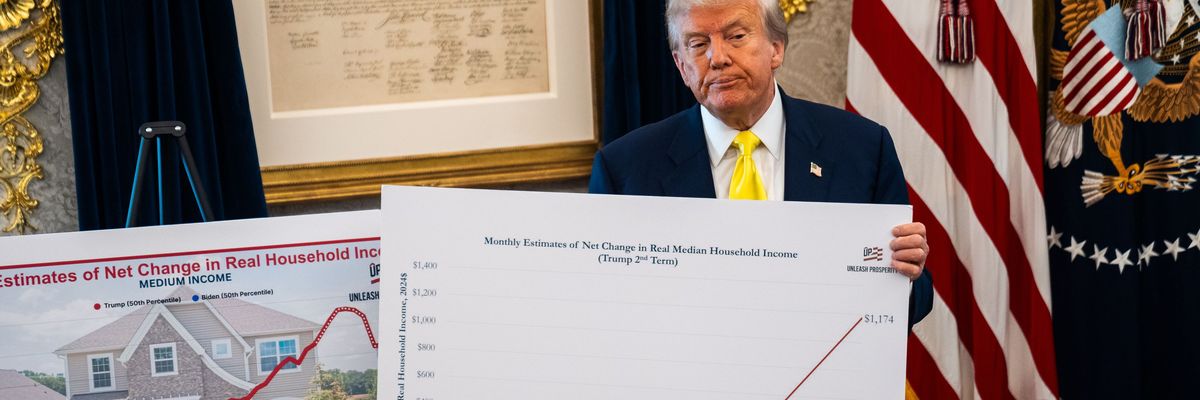
US President Donald Trump holds up an economic data chart in the Oval Office of the White House on August 7, 2025.
(Photo by Demetrius Freeman/The Washington Post via Getty Images)


Brett Wilkins
Nov 18, 2025
COMMON DREAMS


Amid President Donald Trump’s efforts to conceal the harmful consequences of his economic policies by hiding key data and replacing economists who tell harsh truths with partisan yes-people, a leading US think tank on Monday announced a new digital dashboard “to provide an accountability check” against attempts to manipulate and mislead the public.

The Economic Policy Institute (EPI) says its new data accountability dashboard “serves as a one-stop shop” for economic data as federal statistic agencies (FSAs), once the “gold standard” for information, “face historically unprecedented threats from the Trump administration to their capacity and even their independence.”

“This raises the specter of a future where FSA data cannot be relied upon to honestly report whether the US economy is experiencing dysfunction,” EPI said.

In a bid to circumvent this, the EPI dashboard “displays a range of data not collected or disseminated by FSAs to shed some light on the economy during the pause in government data collection during the shutdown and—even more importantly—to provide an accountability check against efforts to manipulate FSA data in the future.”


As EPI senior economist Elise Gould explained in a statement: “The data collected by the federal statistical agencies are an incredibly valuable public good. While there would never be a good time to squander it, the absolute worst time to degrade data quality is when the economy is facing policy shocks that threaten to cause either a recession or an uptick of inflation.”

“Given this urgency, we’re collecting all data we can to assess the economy’s health in this time when the gold standard data are under attack,” she added.

Trump’s attempts to hide unfavorable economic data date back to his first administration, when he blocked or delayed economic analyses on the projected impacts of his tariffs. For example, half a dozen economists at the US Department of Agriculture (USDA) quit en masse in April 2019, claiming they suffered retaliation for publishing reports that shed negative light on the president’s trade and taxation policies.

In a related move that year, the USDA abruptly relocated its Economic Research Service main office from Washington, DC to Kansas City, Missouri, prompting another wave of resignations. ERS publications—including reports on farm income, rural economies, and trade impacts—dropped sharply, with key analyses delayed or blocked. Critics, including former agency officials, argued that the move to Kansas City was intended to conceal negative impacts of Trump’s trade policies from the public.

During Trump’s second administration, Commerce Secretary Howard Lutnick disbanded the Federal Economic Statistics Advisory Committee (FESAC), a key body that worked under the Commerce Department’s Bureau of Economic Analysis to ensure that the federal government produces accurate data on economic indicators.

Trump also gutted the Bureau of Labor Statistics’ Technical Advisory Committee, which had advised the Department of Labor about how economic changes can impact data collection. In August, Trump fired BLS Commissioner Erika McEntarfer, baselessly accusing her of manipulating economic data to harm him politically by publishing a jobs report showing weak employment growth.

Two weeks later, the president nominated EJ Antoni, a senior economist at the Heritage Foundation described as a “partisan bomb thrower” who helped write Project 2025, a blueprint for a far-right overhaul of the federal government, to replace McEntarfer. Antoni stunned critics with suggestions including eliminating federal monthly jobs reports, and with his overall lack of data management experience. His nomination was later withdrawn amid mounting controversy.

Additionally, the Trump administration has summarily fired dozens of independent agency leaders, required every federal agency to have a White House liaison, and required ostensibly independent agencies to submit draft regulations to the Office of Management and Budget—headed by Project 2025 architect Russell Vought—for review before publication.

As Common Dreams reported, an analysis published in September by the Center on Budget and Policy Priorities detailed how the Trump administration’s politicization of data, combined with funding cuts, is making it more difficult for experts to determine how the president’s policies are impacting US households.

From ending tracking of the impacts of climate-driven extreme weather, to removing a study from the Department of Justice website that showed violent attacks by far-right extremists outpaced those committed by the left, to removing questions about gender identity from key crime surveys, the Trump administration’s attacks on information transcend economic data.

“The assault on data, research, and facts is fundamental to Trump and his authoritarian regime,” Liza Featherstone, a contributing editor at The New Republic, recently wrote. “He seems to understand that data provides the basis for arguments, and he does not want any arguments. He also understands that facts and knowledge can only be nourished and sustained by institutions and experts, so he is destroying those institutions and pink-slipping those experts.”

“We must appreciate their importance and their stakes as well as he does, and remain as committed to the institutions, the data, the facts, and the experts as Trump is to their eradication,” Featherstone added. “He has brought sincere zeal to their destruction, and we must bring an even greater passion to their restoration and renaissance. We will need it, as ours is the harder job.


World COPD Day: November 19, 2025


In support of World COPD Day on November 19, the Global Initiative for Chronic Obstructive Lung Disease (GOLD), is drawing attention to the importance of correctly diagnosing COPD earlier - with the theme ‘Short of Breath, Think COPD’  


Global Initiative for Chronic Obstructive Lung Disease

2025 World COPD Day 

image: 

World COPD Day: November 19, 2025

view more 

Credit: Original content developed by the Global Initiative for Chronic Obstructive Lung Disease (GOLD)


World COPD Day: Short of Breath, Think COPD

Appropriate diagnosis of COPD can have a very significant public health impact. 

For Immediate Release

In support of World COPD Day on November 19, the Global Initiative for Chronic Obstructive Lung Disease (GOLD), is drawing attention to the importance of correctly diagnosing COPD earlier - with the theme ‘Short of Breath, Think COPD’.  

Chronic obstructive pulmonary disease (COPD) is a preventable and treatable condition marked by breathlessness, chronic sputum production and cough, claiming three million lives globally each year —particularly in low-resource countries — and is expected to increase due to aging populations and ongoing exposure to risks like tobacco smoke and air pollution.

Although COPD is a common, preventable, and treatable disease, extensive under-diagnosis, misdiagnosis, and late-diagnosis lead to patients receiving no treatment, incorrect treatment, or less effective treatment. Studies from across the world suggest that up to 70% of adults with COPD remain undiagnosed, with rates even higher in low and middle-income countries.(1,2,3) Undiagnosed COPD can lead to greater symptom burden, poor quality of life, impaired work productivity, and poorer overall general health status.(4)

There are many factors that can lead to inappropriate or missed diagnosis, including patient-, healthcare system-, and provider-related factors. Patients may not recognize or report symptoms accurately, healthcare systems may not have resources to adequately train staff in respiratory health, or providers may have a poor understanding of COPD diagnostic criteria.

It’s important for health providers to look for the following risk factors:

  • Age ≥ 35 years
  • Exposure to risk factors (tobacco smoke, household and outdoor air pollutions, occupational exposures
  • Genetic factors
  • Prematurity and early life disadvantage factors
  • Respiratory symptoms

Accurate and timely diagnosis of COPD can improve quality of life and health outcomes. Based on currently available evidence, GOLD advocates for active case finding, including performing spirometry in individuals with symptoms and/or risk factors.(5)

Although there is currently no cure for COPD, steps to help improve diagnosis can have a positive impact on future health. Patients and families can help advocate for more research and better access to care, including routine spirometry screenings and telehealth access for patients in remote settings.  In addition, providers and policy makers can work together to improve access to spirometry and advocate for its use as a general health marker in all stages of life. Health systems can work to increase academic training programs specializing in respiratory health, as well as improve training in COPD diagnostic criteria, including the use and interpretation of spirometry.

Learn more in the 2026 GOLD Report: GLOBAL STRATEGY FOR THE DIAGNOSIS, MANAGEMENT, AND PREENTION OF CHRONIC OBSTRUCTIVE PULMONARY DISEASE (2026 REPORT).

World COPD Day World COPD Day is an annual global initiative run by the Global Initiative for Chronic Obstructive Lung Disease (GOLD), a member of the Forum of International Respiratory Societies (FIRS). The goal of World COPD Day is to raise awareness and present new knowledge and therapeutic strategies for COPD worldwide.  The 23rd annual World COPD Day will take place on November 20, 2024. 

Be part of the global effort to improve the lives of people with COPD. Join World COPD Day events organized by GOLD and FIRS. Find out more here.

Chronic obstructive pulmonary disease (COPD) is a preventable and treatable disease causing breathlessness, chronic sputum production, and cough. It's a leading global killer, especially prevalent in low-resource countries. Annually, COPD claims three million lives worldwide, a number projected to rise due to aging populations and continued exposure to risk factors like tobacco smoke. While tobacco smoke is a primary risk factor, COPD's complex etiology involves genetic and environmental factors, beginning in utero and progressing throughout life.

For more information about GOLD please contact Katie Langefeld at k.langefeld@goldcopd.org.


  1. Lytras T, Kogevinas M, Kromhout H, et al. Occupational exposures and 20-year incidence of COPD: the European Community Respiratory Health Survey. Thorax 2018; 73(11): 1008-15 https://pubmed.ncbi.nlm.nih.gov/29574416.
  2. Lamprecht B, Soriano JB, Studnicka M, et al. Determinants of Underdiagnosis of COPD in National and International Surveys. Chest 2015; 148(4): 971-85
  3. Martinez CH, Mannino DM, Jaimes FA, et al. Undiagnosed Obstructive Lung Disease in the United States. Associated Factors and Long-term Mortality. Annals of the American Thoracic Society 2015; 12(12): 1788-95
  4. Labonté LE, Tan WC, Li PZ, et al. Undiagnosed Chronic Obstructive Pulmonary Disease Contributes to the Burden of Health Care Use. Data from the CanCOLD Study. American Journal of Respiratory and Critical Care Medicine 2016; 194(3): 285-98
  5. Global Initiative for Chronic Obstructive Lung Disease (GOLD). Global Strategy for Prevention, Diagnosis and Management of COPD: 2026 Report. 2026 GOLD Report and Pocket Guide - Global Initiative for Chronic Obstructive Lung Disease - GOLD