Friday, November 21, 2025

US lawmakers split over Trump's claim of Christian persecution in Nigeria


The United States Congress is divided over President Donald Trump’s claim that Christians in Nigeria face religious persecution, with conservatives calling for sanctions while Democrats denounced the threats as reckless at a hearing on Thursday.


Issued on: 21/11/2025 - RFI


At a public hearing of the House Foreign Affairs Subcommittee on Africa, lawmakers grappled with whether to back Trump’s recent decision to label the country a “state of particular concern” over religious freedom.

The US president has insisted that Christian communities in Africa’s most populous nation face widespread persecution – a claim that Nigerian officials have strongly rejected.

At Thursday's hearing, Chris Smith, a veteran Republican who chairs the Africa subcommittee, argued that Nigeria was “ground zero, the focal point of the most brutal and murderous anti-Christian persecution in the world today”.
\
He accused the Nigerian authorities of failing in their constitutional duty to protect citizens, insisting that armed groups act “with impunity” against Christians.

Echoing Trump's threat of possible military intervention, the congressman urged the State Department to “seriously consider supporting human-rights vetted Nigerian forces to defend and protect Nigerian Christians and moderate Muslims”.

Smith also called for targeted sanctions – such as travel bans and asset freezes – aimed at individuals and entities deemed responsible for attacks.
'Reckless' threats

But others say the situation in Nigeria is more complicated, with both Christians and Muslims caught up in violence.

Democratic Congresswoman Sara Jacobs argued that Trump’s threats were irresponsible and risked derailing cooperation with a key African partner.

“President Trump’s threat is reckless, and any unilateral military action in Nigeria is illegal,” she said, pointing out that Congress had not authorised the use of force in Nigeria to protect Christians.

Experts told the hearing that instability in Nigeria stems from longstanding failures of governance, complex grievances and agitation rather than just religious conflict.

“A narrow narrative that frames Nigeria’s security situation solely as the persecution of Christians oversimplifies the issue,” said Oge Onubogu, director of the Africa programme at the Centre for Strategic and International Studies (CSIS).

“Religious and ethnic violence is driven more by governance failures and worsened by hate speech and conspiracy theories.”

Nigerians push back on Trump’s military threat over Christian killings
Contested 'genocide' claims

Researchers and Nigerian officials point out that much of the insecurity ravaging parts of the country is driven by criminality and competition over land and resources, especially in the North West region and Middle Belt.

Jihadist groups including Boko Haram are also known to victimise Muslims as well as Christians.

A high-level Nigerian delegation is in Washington this week to discuss the matter.

How Nigeria is reintegrating repentant former Boko Haram fighters

The designation of Nigeria as a “country of particular concern” (CPC) earlier in November followed months of lobbying by conservative politicians and Christian advocacy groups who claim that Christians in Nigeria are facing “genocide” – a term widely contested by researchers on the ground.

These organisations have amplified stories of attacks and displacement, urging the US government to step in.

The US government gives the CPC label to nations it says are engaged in severe violations of religious freedom. Trump previously designated Nigeria a CPC in December 2020 during his first term in office, but that decision was reversed the following year under President Joe Biden.
PATRIARCHY IS FEMICIDE

Deadly attacks on women rise in France amid growing partner violence

Women in France faced rising deadly violence from current or former partners in 2024, with official data showing more than three femicides or attempted femicides every day.

Issued on: 20/11/2025 - RFI

A woman holds a placard reading "You never kill for love" at a march against domestic violence in Paris on 23 November 2019. © AP - Thibault Camus

Fresh figures from the Interministerial Mission for the Protection of Women (Miprof) show the number has increased over the past year.

"Every seven hours, a woman is killed, survives an attempted killing, is driven to suicide or attempted suicide by her partner or ex-partner," said an annual letter from the National Observatory on Violence Against Women, which is part of Miprof.

The data shows 107 women were victims of domestic femicide last year, 270 were victims of attempted domestic femicide and 906 women faced harassment by a spouse or ex-spouse that led to suicide or attempted suicide.

Ahead of 25 November, the International Day for the Elimination of Violence against Women, the Observatory warned that the harm documented in the figures remains severe.

Victim of assault 'every 2 minutes'


In total, 1,283 women were victims of direct or indirect femicide or attempted domestic femicide in 2024, compared to 1,196 in 2023. That represents 3.5 women every day.

The observatory said these figures cover couples only and do not show all femicides outside relationships or deaths following violence within couples.

The letter notes that data from the Interior Ministry’s 2023 “experiences and perceptions of security” survey shows a woman is the victim of rape, attempted rape or sexual assault every two minutes.


It also states that every 23 seconds, a woman faces sexual harassment, sexual exhibitionism or unsolicited sexual content.

Miprof Secretary General Roxana Maracineanu said the figures present “an indisputable fact”.

In 2024, girls and women remained “the main targets – if not the almost exclusive targets – of gender-based and sexual violence, at all ages and in all spheres of their personal and social lives”.

She said breaking “this vicious cycle” will require constant training of frontline professionals and that identifying and reporting violence “must become a reflex”.

(with newswires)
France's most vulnerable households are getting poorer, warns charity

Families, people grappling with health issues and many foreign nationals are slipping deeper into poverty in France, according to charity Secours Catholique, which says the profile of those seeking help has changed dramatically over the past three decades.


Issued on: 21/11/2025 - RFI

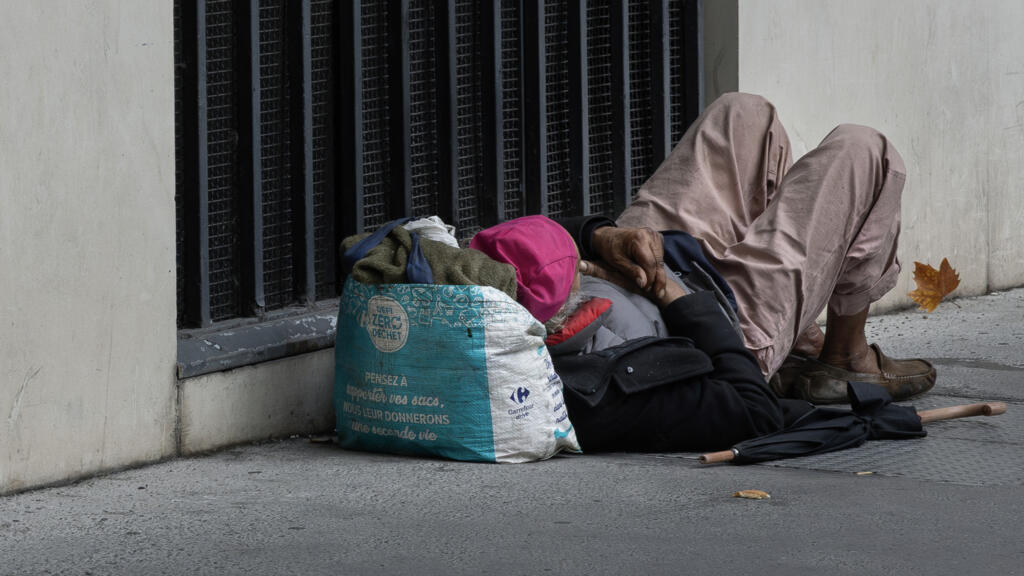
A homeless man in Paris, on 20 October 2025. 
AFP - JOEL SAGET

According to Secours Catholique's latest annual report, released on Thursday, the median monthly income of the people it supports fell to €565 in 2024 – down from €658 in 2014.

Nearly all of those the organisation assists – around 95 percent – were living below the poverty line last year. That threshold is defined as 60 percent of the national median income, or €1,316 per month for a single person in 2024.

And 74 percent were living in what is classed as extreme poverty – below 40 percent of median income, or €877.

It’s a long-term shift that worries the charity. “Thirty years ago, poverty was considered unbearable and a problem that had to be fought,” said Secours Catholique’s president, Didier Duriez.

“But since the 2010s, people in precarious situations have been stigmatised and often considered to be welfare recipients,” said Duriez, who called for a political “wake-up call”. Without one, he warned, “the situation will get even worse”.

France faces homelessness crisis as deaths and child poverty soar


Foreigners living in precarity

Secours Catholique supports more than a million people each year, and the charity says a growing share of them now have no formal income at all.

In 2024, more than a quarter – just under 26 percent – were surviving through “resourcefulness” and the solidarity of friends, family or community groups. Back in 1994, that figure stood at just over 10 percent.

Seventy percent of those without resources are migrants without stable administrative status – people awaiting a decision on their right to stay, rejected asylum seekers or individuals living undocumented.

Another 10 percent are foreign nationals with secure status. Only 20 percent are French citizens.

Secours Catholique has seen a striking rise in the number of foreign nationals seeking assistance. In 1994 they represented 20 percent of the charity’s beneficiaries – by 2024 that figure had jumped to 53 percent.

The organisation stresses that this jump does not correspond to an increase in France’s overall foreign-born population, which has risen by a modest 2 percent over the same period.

Instead, it argues, the change reflects the tightening of rules for obtaining residence permits, pushing more people into precarious situations without legal rights.
Link between poverty and poor health

Across all households supported by Secours Catholique, women continue to make up a slight majority at over 56 percent – a figure that has held steady for three decades, inching up by five points since the mid-1990s.

Families account for almost 47 percent of beneficiaries, and single mothers are especially vulnerable: three out of four of them live in extreme poverty, the charity said.

Poverty harder to bear for women and children, French report claims

The report highlights the growing link between poverty and ill health. Nearly 23 percent of beneficiaries in 2024 were living with significant health problems or disabilities, compared with around 15 percent in 1999.

These cases are predominantly French nationals in their 50s, often based in rural areas where access to services can be patchy and employment options limited.

Secours Catholique insists that political will – backed by investment in social support, housing and pathways to regularisation – could stabilise or even reverse some of these trends.

"When solidarity is affirmed as a priority, poverty declines," its report said. "When this priority fades, poverty increases."

(with newswires)
India: The Red Fort Blast A Singular Shock – Analysis


The Red Fort


November 18, 2025 
SATP
By Ajit Kumar Singh


On November 10, 2025, at least 10 civilians were killed and another 32 injured when a slow-moving car exploded near the iconic Red Fort in Delhi at around 6:52 pm [IST]. Two days later, on November 12, the Government officially termed the suicide blast a “terror attack”.

In a press release, the Government stated, “The country has witnessed a heinous terror incident, perpetrated by anti-national forces, through a car explosion near the Red Fort on the evening of 10 November 2025. The explosion resulted in multiple fatalities, and caused injuries to several others… The Cabinet directs that the investigation into the incident be pursued with the utmost urgency and professionalism so that the perpetrators, their collaborators, and their sponsors are identified and brought to justice without delay.”

In a related incident on November 14, 2025, at around 11 pm [IST], a blast occurred at the Nowgam Police Station in Srinagar, Jammu and Kashmir (J&K), while authorities were extracting samples from a large cache of explosives confiscated from Faridabad, Haryana, in connection with an inter-State terrorist module suspected to be linked to the Delhi blast.

J&K Director General of Police, Nalin Prabhat, stated, “Due to the sensitive and unstable nature of the recovered material, the sampling and examination were being carried out with extreme caution. Despite all precautions, an accidental blast occurred… “

Prior to the incident near Red Fort, according to the SATP database, the national capital had recorded at least 35 terrorism-related incidents resulting in 134 deaths and 885 injuries, since 1997. The last terrorist incident occurred on October 20, 2024, when Khalistan Zindabad Force terrorists carried out a blast in Rohini, Delhi, though no casualties were reported. The last incident of Islamist terrorism occurred on January 29, 2021, when a low-intensity Improvised Explosive Device exploded near the Israel Embassy in New Delhi; no one was injured, though some vehicles were damaged. The last major (resulting in three or more fatalities) terrorist attack in Delhi occurred on September 7, 2011, when a blast at the reception area near Gate No. 5 of the Delhi High Court killed 13 people and injured 89, one of whom died later. The Hizbul Mujahideen was responsible for the attack.


Since the 26/11 Mumbai terrorist attacks in 2008, which killed 175, including 144 civilians, six major terrorist attacks have taken place outside major conflict theatres – J&K, Punjab and the Northeast – before the November 2025 Red Fort blast. These included: February 13, 2010: 16 civilians, including three foreigners (a Sudanese, an Italian, and an Iranian), were killed, in a terror attack at Pune in Maharashtra.
July 13, 2011: 19 civilians were killed in a terror attack at Mumbai in Maharashtra.
September 7, 2011: Nine civilians were killed in a terror attack at Delhi.
February 21, 2013: 17 civilians were killed in a terror attack at Dilsukhnagar, Hyderabad Urban District, Andhra Pradesh.
October 27, 2013: Eight civilians killed in a terror attack at Patna in Bihar. Lashkar-e-Taiba/Indian Mujahidin were responsible for the attack.
December 26, 2013: Five persons killed and several injured in a bicycle bomb blast in Jalpaiguri, West Bengal, suspected to have been engineered by the Kamtapur Liberation Organisation, which observes its Martyrs’ Day on December 28.

The October 27, 2013, incident in which eight persons were killed in six serial blasts near Gandhi Maidan — the venue of then Bharatiya Janata Party prime ministerial candidate Narendra Modi’s rally in Patna, Bihar — remains the last major Islamist terror attack outside India’s principal theatres of conflict, since the 26/11 attacks.

Since October 2013, there have been 17 Islamist terrorist incidents (excluding the November 2025 Delhi blast) outside these conflict theatres, resulting in 30 fatalities — civilians: six; Security Force (SF) personnel: three; terrorists: 19; Not Specified: two. The last of these that resulted in a civilian fatality occurred on June 28, 2022, when Kanhaiya Lal Teli, a Hindu tailor, was murdered in Udaipur, Rajasthan, by two assailants reportedly linked to the Islamic State. The attackers filmed the killing and circulated the video online.

At peak, in 2008, 362 lives were lost in 39 incidents of Islamist terrorist depredations outside the principal theatres of conflict in India, including, 281 civilians, 29 SF personnel and 15 terrorists. Five of the seven years between 2002 and 2008 recorded over 100 fatalities in such incidents. In the 10 years between 2015 and 2024, five recorded zero fatalities.

The dramatic improvement in the situation was largely due to sustained pressure by the SFs throughout this period (October 28, 2013-November 9, 2025), which led to the neutralization of a large number of terrorist modules across the country. Crucially, the nationwide network of domestic facilitators in the Students’ Islamic Movement of India and its offshoot, the Indian Mujahideen, was completely dismantled by the security and intelligence agencies, crippling the operational capacities of terrorist groups operating out of Pakistani and Bangladeshi soil at that them. At least 918 terrorists/associates were arrested during this period, before the Red Fort blast, and several terrorist plots have been foiled before they reached the stage of execution.

Despite the shock of the Red Fort incident of November 10, a far greater catastrophe has been averted, as SFs recovered around 2,900 kilograms of explosives from Faridabad, Haryana. Though the investigations are ongoing, preliminary investigations indicate likely linkages between the Faridabad haul and the Red Fort blast.

The trail of this case began on October 17, 2025, Jaish-e-Mohammed propaganda posters were found pasted in Srinagar’s Nowgam area. Police arrested the persons who put up the posters, Nisar Ahmed Dar, a labour contractor from Nowgam; 19-year-old Yasir-ul-Ashraf from Bunpora; and 25-year-old Maqsood Ahmad Dar from Bunpora on October 19 in Nowgam. Their interrogations led to the detention of 24-year-old cleric Mufti Irfan Ahmad Wagay from Nadigam village in Shopian the same day, at the Nowgam mosque. Further probes exposed a 22-member terror module, resulting in the November 5 arrest of Doctor Adeel Ahmad Rather in Saharanpur, Uttar Pradesh; the November 8 arrest of Doctor Muzamil Ahmad Ganie in Faridabad, Haryana; and November 9-10 arrests of Doctor Shaheen Saeed in Faridabad, and Zameer Ahmad Ahanger, 29, from Wakoora village in Ganderbal, J&K. Additional detentions on November 11 in Pulwama included Tariq, Aamir, Umar Rashid, Ghulam Nabi, Doctor Sajjad Malla, and Shameema Begum, as well as the early November arrests of Hafiz Mohammad Ishtiyak in Mewat, Haryana, and an unnamed paramedic at Srinagar’s Government Medical College on October 19; Doctor Umar Mohammad Nabi is believed killed in the blast, while another Doctor Umar remains absconding. The plot, alleged intended to target multiple locations across six cities, but was thwarted when 2,900 kilograms of various explosive materials, including just under 360 kilograms of ammonium nitrate, were seized in Faridabad.

Separately, just days before the Faridabad recovery, on November 8, 2025, the Gujarat Anti-Terrorist Squad (ATS) arrested three persons, including Doctor Ahmed Mohiuddin Saiyed – an MBBS graduate from China – for allegedly attempting to produce Ricin, a deadly organic toxin, to carry out a bio-terrorism attack. The Gujarat ATS also searched Saiyed’s residence in Rajendranagar, Hyderabad, on November 11, 2025, and seized several unidentified chemicals and raw materials packed in cartons.

The Government’s responses to the Red Fort blast have been uncharacteristically cautious, and it took three days for the Union Ministry of Home Affairs to announce that the incident was a terrorist attack. In the past, the top leadership and state agencies have been quick to identify the groups affiliations and state sponsors of alleged perpetrators, but there is evident reluctance to do so in the present case, principally due to the strategic and policy implications that would then bind the Government. In the wake of Operation Sindoor, Prime Minister Narendra Modi had declared that “any future act of terror will be considered an Act of War against India,” and that Operation Sindoor was not over, but only in suspension, and would be reactivated by any future act of terrorism by Pakistan-linked groups. These statements, and subsequent declarations by various prominent ministers and the Defence, Home and External Affairs ministries, create an expectation of escalated retaliation against Pakistan in case of a terrorist attack linked to groups operating or directed from that country. Given the complex and ambiguous outcomes of Operation Sindoor, both in the military and diplomatic spheres, it is evident that the Government would be reluctant to hastily commit itself to such a course of action.

Prime Minister Narendra Modi has consequently declared, with great caution, that “those behind the conspiracy will be brought to justice”, but has scrupulously avoided reference to any possible linkages to Pakistan, as have other prominent members of his Government and Party. In an interesting contrast, Pakistani Prime Minister Shehbaz Sharif’s knee jerk response to the Islamabad Court suicide bombing of November 11, 2025, just a day after the Red Fort bombing in New Delhi, was to blame India – even as his Defence Minister Khwaja Muhammad Asif identified the Tehreek e Taliban Pakistan (TTP) as the group involved, and accused the Afghan Taliban of providing support and safe haven to its leadership and cadres. Shebaz Sharif’s reaction to the Islamabad Court bombing is the more typical of the trajectory of the India-Pakistan discourse, where Islamabad and New Delhi have been quick to accuse each other in the wake of such incidents in the past.

It remains to be seen whether such evasion will remain sustainable as the investigations, now headed by the National Investigation Agency, India premier counter-terrorism investigator, proceed, and how the national political-strategic narrative evolves. It is clear that, despite the political rhetoric, a repeat or further escalation of a response on the model of Operation Sindoor is unlikely to serve India’s interests. The Government, however, appears to have painted itself into an infructuous corner, and needs to extricate itself from its current predicament. Terrorism will not magically disappear as the result of fitful ‘punitive’ strikes in Pakistan, and occasional terrorist strikes in India cannot negate tremendous counterterrorism successes forged by the country’s security and intelligence agencies. Terrorism is no longer an existential threat to the country, and a steady consolidation, and proportionate and covert punitive measures against Pakistan where its responsibility is established, would far better serve India’s national interests.


Ajit Kumar Singh
Senior Fellow, Institute for Conflict Management

SATP

SATP, or the South Asia Terrorism Portal (SATP) publishes the South Asia Intelligence Review, and is a product of The Institute for Conflict Management, a non-Profit Society set up in 1997 in New Delhi, and which is committed to the continuous evaluation and resolution of problems of internal security in South Asia. The Institute was set up on the initiative of, and is presently headed by, its President, Mr. K.P.S. Gill, IPS (Retd).
Slovakia’s ‘Chalk Revolution’ Puts Robert Fico On The Defensive

November 18, 2025 
EurActiv
By Natália Silenská


(EurActiv) — A wave of student-led protests across Slovakia – quickly dubbed the “Chalk Revolution” – has seen pavements nationwide covered with anti-government slogans. The movement is expected to peak on Monday, the anniversary of the student-led 1989 Velvet Revolution, which helped bring down communist rule in Czechoslovakia.

The movement began a week ago after Fico announced a last-minute visit to a high school in the eastern city of Poprad to deliver a lecture on geopolitics. The sudden appearance raised tensions, and a 19-year-old student known as “Muro” marked the occasion by chalking anti-Fico messages on the pavement.

The school principal called the police, and the student was taken in for questioning. Fico cancelled the lecture soon after, claiming the European Commission was preparing to launch infringement proceedings over Slovakia’s anti-LGBTI amendment – a suggestion the Commission’s spokesperson questioned the same day.

The incident triggered a wave of solidarity, with students across Slovakia recreating Muro’s chalk messages. A call for action – “The November Chalk Wave – Solidarity with Muro” – spread rapidly on social media.

Organisers expect the movement to peak on 17 November, the anniversary of the 1989 Velvet Revolution, which began with student demonstrations and grew into mass protests that helped bring down communist rule in Czechoslovakia

The symbolism is sharpened by Fico’s decision to abolish 17 November as a national holiday as part of the government’s consolidation package. Yet most universities – along with dozens of companies and organisations – are still giving people the day off, with commemorations and rallies planned across the country.

Representatives of Fico’s party, Smer-SD, insisted the student was simply a “victim” of pro-European opposition narratives – a claim he denied, saying he has no link to any political party.
Students walked out on Fico

The standoff escalated on Friday, 14 November, when Fico returned to Poprad to deliver his postponed lecture – and faced a room of students dressed mostly in black. Irritated, he asked: “Are you heading to a funeral?”

But the breaking point came when he criticised EU support for Ukraine, claiming that the bloc planned to provide €140 billion to continue the war. Students jingled their keys – a gesture drawn directly from the Velvet Revolution.

Fico snapped: “If you’re such heroes in your black T-shirts and so desperately for this war, then go. Go on, jingle like in November. Stand up and go. Go fight in Ukraine!”

About 30 students stood up and walked out, one holding a Ukrainian flag.

“It was very intense. It was unpleasant. He was arrogant,” Sarah, a student who witnessed the exchange, told Slovak media. Public support poured in, including from the Slovak Chamber of Teachers, which said it “repeatedly objects to the prime minister’s aggressive and demeaning remarks about young people who care about the state of their country.”

“When they had the opportunity to discuss, they left”, Fico wrote on social media after the walkout, welcoming the fact that some students nevertheless came back later to discuss the issue with him.

For Fico, the episode capped a bruising week – from revelations linking his adviser Miroslav Lajčák to Jeffrey Epstein to the dismissal of Deputy PM Peter Kmec over a subsidies scandal.

Contacted by Euractiv, the Slovak authorities haven’t commented by the time of publication.


EurActiv publishes free, independent policy news and facilitates open policy debates in 12 languages.


Chalk Circle. (1944) by Bertolt Brecht. Digitalized by. RevSocialist for. SocialistStories. Page 2. Page 3. Page 4. Page 5. Page 6. Page 7. Page 8 ...


The True Source Of Civilization’s Future Is Energy Wisdom – OpEd


November 18, 2025 
By Armando Cavanha, Ronald Stein and Yoshihiro Muronaka


Energy wisdom—not energy denial—is the foundation of sustainable civilization. Three industry leaders share their individual thoughts on the state of energy, and then collectively join forces for a powerful conclusion.


Introduction (Armando Cavanha of Brazil)

Twenty-five years ago, Professor Franco Battaglia wrote a provocative essay claiming that “pursuing energy saving is a foolish idea.” He argued that as efficiency improves, people inevitably consume more energy, and that prosperity itself depends on greater energy use.

“The more energy we use,” he said, “the better our well-being.” To save energy, therefore, would mean to live worse.

Yet the statement “The first source of energy is saving” still resonates. It invites a reinterpretation, not as an economic contradiction, but as a moral and civilizational question. True saving is not deprivation; it is intelligence in utilization—the conscious alignment between human purpose and the limited natural resources of this 4-billion-year-old Planet Earth.

In today’s world, obsessed with carbon neutrality and net-zero slogans, this idea becomes urgent. The challenge is not simply to consume less, but to consume wisely—to rediscover saving as an ethical act that integrates science, culture, and respect for life.
Efficiency and Saving (Yoshihiro Muronaka of Japan)

For an engineer, the distinction between efficiency and saving is fundamental.

Efficiency is a design challenge: achieving a task with the minimum input through better engineering.
Saving, on the other hand, is often a behavioral practice: using less through habit or restraint.

Japan’s experience after the 1970s oil crisis illustrates this well. Instead of moralizing about sacrifice, industries pursued technical excellence—the Top Runner approach.

They designed machines, appliances, and industrial systems to achieve maximum performance per unit of energy. In doing so, saving became a byproduct of innovation, not a constraint on it.

But to understand the deeper meaning of saving, we must remember that products, transportation fuels, and electricity are not the purpose of civilization, it is a means to serve life. They exist to serve a purpose, to enable human life and creativity. When engineers design a process—whether a factory, a power plant, or even a kitchen stove—the goal is never “to consume energy,” but to achieve the intended function with elegance and precision.

Consider the act of cooking. A mother preparing dinner for her family adjusts the flame according to each ingredient—sometimes it is strong, sometimes gentle, sometimes paused. Every material, every process, has its optimal time and rhythm.

The art of engineering is similar: finding the point where nothing is wasted, and every bit of energy fulfills its role. Designers and manufacturers think about these details long before the process begins—choosing materials that are robust but not heavy, that conduct heat well, that do not cause food to stick to the pan, and that are easy to clean.

Every decision reflects a search for harmony between purpose and performance. True efficiency is not just in the moment of use, but in the thoughtfulness that shapes the entire lifecycle of the tool.

When the engineer’s intention—to design for perfect efficiency—meets the hand of the mother cooking with love, the story of energy finds its completion.

Technology and humanity have become one. Energy, at that moment, fulfills its true role—not as a master, but as a humble servant in the story of life.
The Resource Reality (Ronald Stein USA)

While policymakers promote “net zero” illusions, the real challenge is material: our civilization depends on finite, non-recyclable resources. Every year, humanity consumes about 35 billion barrels of oil, 8.5 billion tons of coal, and 132 trillion cubic feet of natural gas.

These are not renewable flows but one-time gifts of the Earth—and they sustain more than 6,000 products essential to modern life: medical devices, fertilizers, computers, transportation, clothing, and even the food chain itself for the 8 billion now living on this Planet.

Solar panels and wind turbines cannot produce any materials demanded by our materialistic society. They depend on them. Every renewable system requires mining, metallurgy, logistics, and manufacturing powered by hydrocarbons.

Eliminating fossil fuels without viable replacements is not just impractical, it is morally irresponsible. It would condemn billions to poverty, hunger, and disease, returning humanity to pre-industrial conditions.

The true moral imperative is not to abandon energy, but to use it wisely, preserve it efficiently, and develop new forms responsibly.

Energy is a utility that sustains civilization. The tragedy of today’s debate is that many leaders treat affordable energy as a villain, forgetting that without it there is no economy, no medicine, no education, no comfort, and no dignity.
Toward Energy Wisdom (Joint Conclusion)

From Franco Battaglia’s challenge to Armando Cavanha’s reinterpretation, and from Ronald Stein’s energy literacy to Yoshihiro Muronaka’s engineering vision, a coherent message emerges: Energy wisdom—not energy denial—is the foundation of sustainable civilization.

Energy efficiency, behavioral awareness, and moral responsibility are not contradictions; they are the three dimensions of maturity in how humanity relates to nature.

Efficiency seeks to perfect the means. Savings seeks to harmonize purpose and needs. Wisdom seeks to align technology, ethics, and life.

Our task is not to glorify scarcity or excess, but to rediscover balance.

Energy is not an enemy to be defeated, nor an idol to be worshiped. It is a faithful companion on the human journey—a silent partner in every heartbeat of civilization.

As we face the great transitions of the 21st century, may our leaders learn this simple truth:
“The future of humanity will not be secured by denying energy, but by mastering the wisdom to use it responsibly.”


About the authors: 

Armando Cavanha A Brazilian executive and researcher with degrees in AI, logistics, business, and engineering. Former PETROBRAS leader and CEO of Thompson Knight Global Energy Services. Author and host of the “Cafe com Cavanha” channel.


Ronald Stein, P.E., is an engineer, columnist on energy literacy at America Out Loud NEWS, and advisor on energy literacy for the Heartland Institute and CFACT, and co-author of the Pulitzer Prize-nominated book “Clean Energy Exploitations.” He is also the recipient of an unsolicited Tribute to Ronald Stein from Stephen Hines.

Yoshihiro Muronaka, P.E.Jp is a chemical engineer who currently focuses on evaluating net-zero and decarbonization policies, advocating alternative energy concepts such as “carbon symbiosis,” and promoting balanced international energy cooperation.


Looking Back At More Than 80 Years Of Saudi-US Economic Cooperation

US President Donald Trump speaks during the Saudi-US Investment Forum. 
Photo Credit: The White House, X


November 18, 2025 
By Arab News


Saudi Arabia and the US have seen steadily growing economic ties throughout a relationship spanning more than 80 years, beginning with oil and expanding to defense and technology in recent years.

What began as a reliance on oil and gas has expanded to more diverse economic collaboration built on Vision 2030 initiatives.

Economic cooperation between the two nations was solidified in the early 1930s when King Abdulaziz granted the right of oil exploration to the American company Standard Oil through a 66-year contract. This led to the formation of the Arabian-American Oil Company, better known as Aramco.

Saudi Arabia and the US signed an interim diplomatic trade agreement in 1932, establishing an initial framework for trade, according to the Saudi Press Agency.

Aramco’s Dammam Well No. 7 struck commercial quantities of oil in 1938, ushering in a new age in the Kingdom’s development.

In the early 1970s the two countries deepened their trading relationship. In 1972, the value of the Kingdom’s imported goods and materials from the US was $314 million, and the Kingdom’s exports were $194 million.

Economic relations between the two countries were underlined in June 1974 through the formation of the US-Saudi Arabian Joint Commission on Economic Cooperation, which provided US expertise to develop infrastructure to advance Saudi Arabia’s non-oil economic development.

The two countries agreed to increase the number of private US companies working on local projects in the Kingdom.

The two nations went on to maintain a steady and growing economic relationship with partnerships largely focusing on defense, energy, investment and technology.

The partners took a step forward in their economic cooperation in 2005 by formalizing a partnership in education with the King Abdullah Scholarship Program. This program allowed thousands of Saudi students to study in US universities, building a long-term foundation for a knowledge-based economy.

According to a White House fact sheet, Saudi Arabia is now one of the US’ largest trading partners in the Middle East.

The Kingdom’s direct investment in the US totaled $9.5 billion in 2023, and was focused on the transportation, real estate, and automotive sectors.

US-Saudi goods trade totaled $25.9 billion in 2024, with US exports at $13.2 billion and imports at $12.7 billion.

One recent major platform for economic cooperation was the Saudi-US Investment Forum held in Riyadh in May, at which Saudi Arabia signed deals with the US worth more than $300 billion.

Crown Prince Mohammed bin Salman, speaking at the forum, said the Kingdom was looking at $600 billion of investment opportunities, adding that he hoped this would rise to $1 trillion.

Minister of Communications and Information Technology Abdullah Alswaha, speaking to the Saudi Press Agency on the sidelines of the forum, said that the event reflected the Kingdom’s growing prominence on the global digital economy map, with the country the largest digital economy in the region and a key hub for investment in artificial intelligence and cloud computing.

Nov. 18 will mark another milestone in the Saudi-US relationship with the Saudi crown prince meeting US President Donald Trump in Washington.

The relationship between the countries, which was underlined by the meeting between King Abdulaziz Al-Saud and President Franklin D. Roosevelt on board the USS Quincy in 1945, has endured and prospered.

And these ties have witnessed continued economic expansion and moves into new sectors like technology.

Arab News is Saudi Arabia's first English-language newspaper. It was founded in 1975 by Hisham and Mohammed Ali Hafiz. Today, it is one of 29 publications produced by Saudi Research & Publishing Company (SRPC), a subsidiary of Saudi Research & Marketing Group (SRMG).
Chinese Mining Stirs Up Anger In Zimbabwe


The Centre for Natural Resource Governance has documented the impact of large, industrial Chinese mining operations on Zimbabwe’s landscape. 

Photo Credit: CENTRE FOR NATURAL RESOURCE GOVERNANCE

November 18, 2025 
By Africa Defense Forum


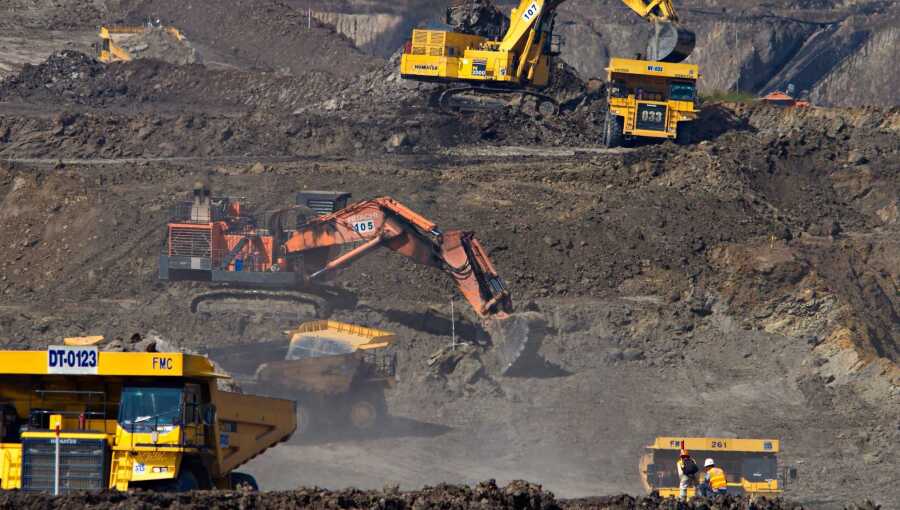
Armies of excavators and dump trucks carving deep, terraced ruts into and around hills, mountainsides and waterways are a common sight in Zimbabwe. For locals, the scars of large, industrial mining operations offer frequent reminders of the environmental toll

Public anger among Zimbabweans has risen steadily in recent years amid accusations of Chinese mining companies committing serious crimes — ranging from murder, rape and forced evictions to pollution and loss of habitats — sometimes with few or no legal consequences.

Journalist and human rights advocate Tendai Mbofana recently raised alarm when he shared a video on October 21 of a Chinese mining operation near his home in Redcliff. The video, which was widely shared across Zimbabwean media outlets, showed heavy equipment digging next to the Cactus Port Dam, leading Mbofana to warn of a serious threat to the ecosystem along the Kwekwe River.

“The only word that I can think of right now to describe these Chinese mining activities in Redcliff is that it’s appalling. It’s reprehensible,” he told The Public Eye newspaper. “We cannot surely call ourselves an independent, sovereign, self-governing state when we allow foreigners to come into our country and do pretty much what they want.”

Chinese-owned companies control an estimated 90% of Zimbabwe’s mining industry, according to the Harare-based Centre for Natural Resource Governance (CNRG), an organization that seeks to support communities affected by mining. It has reported on mineral extractions worth billions of dollars annually to Chinese mining companies, including $2.79 billion in 2023.

“Over the past decade, CNRG has led efforts to investigate and document the environmental, social, and economic effects of mining in Zimbabwe,” the organization said in an October 14 statement. “Our research … consistently reveals that many foreign mining operations, including those involving Chinese capital, occur in [sensitive] environments, circumvent regulation, lack transparency and bribe officials to weaken their oversight role.”

Mbofana said mining in Redcliff is destroying landscapes and poisoning a water source that supplies commercial and subsistence farmers downstream.

“Cactus Port Dam is a very important dam for Redcliff,” he said. “The Kwekwe is vital for agriculture, for flora and fauna in aquatic life, but that is all under threat by these Chinese activities. We are going to be left behind with unusable land and mountains that have been mutilated.”

Mbofana’s video set off stern criticism from citizens and environmental and civil society activists who say Chinese companies are plundering the country’s natural resources with little oversight or accountability.

“This is not investment, it’s daylight environmental terrorism,” Rodreck Kudakwashe, a prolific Harare-based social commentator, posted on X on October 21. “The Chinese systematically strip Zimbabwe of its resources and mortgage our future under the guise of economic development.”

Mbofana reported “a massive blast during the night that shook homes across Redcliff and filled the air with suffocating dust” in an October 22 article on the Harare-based NewsHawks website. “This was not an isolated incident. Residents say these blasts have become a regular nightmare.

“If the mining continues unchecked, contamination and siltation will inevitably destroy the livelihoods of countless farmers and threaten food security for families dependent on small-scale agriculture. Once the dam and river are polluted by mining waste, it will take generations to recover, if ever.”

Citing Chinese lithium extraction in Zimbabwe’s Bikita region, journalist Marcus Mushonga said China’s resource-for-infrastructure model has raised alarms about exploitation, sovereignty and sustainability.

“Across Africa, Chinese mining operations have been linked to environmental destruction, labor violations and disregard for local communities,” he wrote in an October 22 article for the South Africa-based Centre for African Journalists news agency.

“In Zimbabwe, the partnership between the state and Chinese entities — often described as opaque and unaccountable — has left many communities disenfranchised and ecosystems degraded.”


The Africa Defense Forum (ADF) magazine is a security affairs journal that focuses on all issues affecting peace, stability, and good governance in Africa. ADF is published by the U.S. Africa Command.


Feasibility study for diversion of Siberian river to Central Asia reportedly in works

Feasibility study for diversion of Siberian river to Central Asia reportedly in works
The Ob. / gov.ru
By Eurasianet November 19, 2025

The Russian Academy of Sciences is reportedly seeking funding from the Kremlin for a feasibility study for a project to divert water from the Ob River to Central Asia. The request raises an immediate question to which there isn’t a clear answer: what’s in it for Moscow?

Diverting Siberian river water to Central Asia is not a new idea; a Soviet plan to do so was developed back in the 1970s, but it ended up being abandoned during the Perestroika era in the mid-80s. That old plan envisioned the construction of an open canal, while the new iteration would supposedly involve the laying of plastic water pipes across more than 2,000 kilometres (1,243 miles) of rugged terrain, the Russian news outlet RBK reported

The estimated price tag is $100bn and construction would take at least 10 years to complete. If built to its currently envisioned specifications, up to 22 cubic kilometres (5.3 cubic miles) of water per year could be diverted to Central Asia.

A feasibility study, provided it receives the requested funding, would gauge the technical challenges and potential risks of undertaking such an ambitious infrastructure project, including “climatic effects, the impact on water and terrestrial ecosystems, and  the impact on the long-term socio-economic development of the participating countries,” according to a Forbes.ru report.

The Russian Academy of Sciences is also reportedly ready to undertake a feasibility study on the diversion of waters from the Pechora and Northern Dvina rivers to southern Russian regions via the Volga River Basin. The report notes that many Russian regions are grappling with water shortages, including Kalmykia and Krasnodar Krai, along with the Astrakhan, Orenburg and Rostov regions.

Forbes.ru cites a Russian scientist, Robert Nigmatulin, as saying the pipeline project could alleviate Central Asia’s growing water deficit. The reports, while mentioning cost, do not mention anything about potential financing, or whether Central Asian beneficiary states have had a chance to review and endorse the plan. 

It’s also unclear whether the project would be a for-profit venture, turning water into an export commodity like oil and natural gas, or whether Russia intends to try to use water as an instrument of geopolitical leverage. Perhaps both.

This article first appeared on Eurasianet here.


Asian utilities locked into coal as long-term contracts slow transition

Asian utilities locked into coal as long-term contracts slow transition
/ Dominik Vanyi - Unsplash
By bno - Taipei Office November 20, 2025

Asia’s shift towards cleaner energy is being hampered by decades-long coal power agreements that continue to bind utilities to fossil-fuel generation, even at times when cheaper renewable supplies are readily available, a piece on Devdiscourse claims. Climate analysts warn that these entrenched commitments are delaying emissions reductions in some of the world’s fastest-growing energy markets, undermining global climate targets and exposing governments to rising financial risks.

Across Southeast Asia, long-term users of coal, between 50 and 100% of existing coal-fired capacity is covered by power purchase agreements (PPAs) with roughly nine to 18 years yet to run, according to the Powering Past Coal Alliance (PPCA), a coalition of governments, businesses and civil society groups calling for a managed exit from coal. Long-term commitments are also widespread in China and India – two of the world’s biggest miners of coal, where buyers have accumulated extensive coal procurement obligations, leaving wind and solar assets underused.

The consequences are becoming increasingly visible. Southeast Asia still sourced about 45% of its electricity from coal in 2024, up from 35% a decade earlier, even as coal’s share of global power generation declined from 39% to around 34%, and while renewables investments increase, according to data from energy think-tank Ember. Renewables, by contrast, accounted for just 26% of the region’s electricity output, well below the global average of 41%.

Industry representatives acknowledge that the economics of entrenched coal assets present formidable barriers. Guaranteed revenue for plant operators and the security of jobs make early closures politically and financially challenging and the act of breaking contract terms can also expose grid operators to penalties.

Even China — where carbon emissions are on course to fall this year after an extended period of flat or declining output — has seen coal-fired generation rise. Analysts warn that the country risks repeating patterns seen in late 2024. As a result China’s curtailment challenges are expected to intensify. According to the report, consultancy Wood Mackenzie forecasts that solar curtailment rates will average more than 5% across 21 provinces over the next decade, compared with just 10 provinces facing similar issues in the first eight months of this year.

Other major Asia-Pacific economies are reporting similar strains. Japan, Australia and India have all indicated increased renewable curtailment in 2025 as coal commitments limit flexibility. India, despite setting ambitious clean energy targets, is preparing new long-term power purchase agreements with coal generators. Analysts at Ember and Climate Trends warn that as renewable generation grows, retailers risk accumulating stranded assets and paying mounting fixed charges on underused coal plants.