Saturday, November 22, 2025

Memory chip crunch set to drive up smartphone prices


By AFP
November 20, 2025


While AI-led demand is surging, chip-makers are also winding back spending on capacity, which is keeping prices elevated - Copyright AFP STR


Katie Forster

Shoppers could face higher prices for phones, laptops and other gadgets next year, manufacturers and analysts warn, as AI data centres hoover up memory chips used in consumer electronics.

The world’s biggest tech companies are ploughing head-spinningly huge sums into building the hardware that powers artificial intelligence tools like ChatGPT.

Their insatiable demand is snarling up a supply chain kept tight on purpose by chipmakers who are keen to avoid price drops that dent profits, experts say.

In 2026, supply chain pressure for memory chips “will be far greater than this year”, Lu Weibing, president of Chinese electronics giant Xiaomi, said this week.

“Everyone will likely observe that retail prices for products will see a significant increase,” he told an earnings call.

William Keating, head of semiconductor and tech consulting firm Ingenuity, expects the same.

“All companies that manufacture PCs, smartphones, servers etc will be impacted by the shortage,” Keating told AFP.

“End result: consumers will pay more.”

In high demand are key chips known as DRAM and storage components called NAND, which are found in everyday gadgets but are also needed to help process the vast amounts of data crunched by generative AI.

That’s driving up memory chip prices, which in turn is turbocharging revenue for the firms that produce them such as South Korea’s Samsung and SK hynix, and Micron and SanDisk in the United States.

“AI-related server demand keeps growing, and this demand significantly exceeds industry supply,” Kim Jae-june of Samsung Electronics said last month.

– ‘Keep prices high’ –

Samsung said Sunday that it plans to build a new semiconductor plant in South Korea to meet the soaring demand, while SK hynix recently reported its best-ever quarterly performance, “driven by the full-scale rise in prices of DRAM and NAND”.

Industry analysts TrendForce have lowered their 2026 global production forecasts for smartphones and notebook laptops.

“The memory industry has begun a robust upward pricing cycle,” which “forces downstream brands to hike retail prices,” TrendForce said.

Cars may also be affected, although Keating noted that a smaller portion of their tech relies on memory chips.

Last week China’s largest contract chipmaker SMIC said customers were hesitant to place orders owing to uncertainty over how many phones, cars, or other products the memory chip industry can supply.

The cause of the shortage is two-fold.

AI-driven demand is greater than anticipated, but memory chip makers have also been “drastically cutting” spending on expanding capacity in recent years, Keating explained.

“Keep capacity tight, keep prices high is basically their mantra,” he said.

“They’ve done this deliberately to ensure that there’s no repeat of the most recent memory price collapse, which cost the memory makers tens of billions in losses.”

Price jumps for memory chips “are huge and the trend is continuing”, said Stephen Wu, founder of the Carthage Capital investment fund.

“Consumers and enterprises should expect higher memory prices, longer lead times, and more take-or-pay contracts through at least early 2026,” Wu said.
‘Beggars belief’: Londoners baffled by bizarre AI Christmas mural


By AFP
November 19, 2025


The display at first glance seems to depict a jolly crowd enjoying the festive season - Copyright AFP Pablo PORCIUNCULA

People in London were left baffled Wednesday by what appeared to be a botched AI-generated Christmas mural showing a Santa-like figure with a half-orange beard and revellers with disfigured faces.

The display in posh Kingston upon Thames in southwest London at first glance seems to depict a jolly crowd enjoying the festive season.

But closer inspection reveals a disturbing array of figures including people with warped faces, a snowman with strange facial features, and dogs with the heads of birds all bizarrely splashing through water.

A Father Christmas figure is pictured looking pained in the water at the foot of a rock. His eyes are shut, and his beard is half orange and half white.

The large-scale mural looms above several popular riverside restaurants in the upmarket town.

People who had seen it — and others keen to have their say — took to social media for a lively discussion.

“The entire thing is horrendous,” wrote one.

“I’m equal parts delighted and horrified,” said another.

“It beggars belief that if you’re going to use AI you wouldn’t even take a fraction of the time you’ve allegedly saved in producing whatever this is to at least check it a bit,” added someone else.


“This is magnificent,” chimed in another, prompting someone else to respond: “It’s worse every time you look.”

Kingston Upon Thames Council said in a statement it had had “no involvement in the planning or funding of the display”.

“The landowner has now confirmed to us that they will be removing the installation,” it added.
Lufthansa enters race for TAP stake against Air France-KLM


By AFP
November 20, 2025


TAP's stake sale is attracting interest from major airlines - Copyright GETTY IMAGES NORTH AMERICA/AFP/File JOE RAEDLE

Germany’s Lufthansa on Thursday expressed an interest for a stake in TAP Air Portugal, joining Air France-KLM in the race for part of the carrier which is set to be privatised.

TAP, nationalised during the Covid pandemic, is among a handful of state-owned carriers remaining in Europe, and is of interest to bigger players due to its routes to Brazil and Portuguese-speaking Africa.

Lufthansa, which already owns a host of carriers and is Europe’s biggest airline group by revenue, said it had submitted a bid to the state holding company that owns TAP.

“Our goal is to strengthen Portugal’s global connectivity, preserve TAP’s Portuguese identity, and ensure the airline’s sustainable growth,” said Lufthansa CEO Carsten Spohr in a statement.

“TAP Air Portugal is of great strategic importance to the European aviation industry… with our extensive investments in Portugal, we continue to see the Lufthansa Group as the best partner for TAP and for Portugal.”

Lisbon announced in September it was seeking a major international airline to buy most of the 49.9 percent stake in the carrier which it plans to privatise.

Lufthansa said that after acquiring a “minority stake”, it aimed to establish a “long-term partnership” with Portugal’s national airline.

Air France-KLM said Wednesday it had also formally expressed its interest to take a stake in TAP.

IAG group, which includes British Airways and Iberia, has also previously said it is keen on taking a stake.

The three groups have in recent years become the dominant players in Europe’s aviation sector.

As well as being Germany’s flag carrier, Lufthansa operates Eurowings, Austrian, Swiss and Brussels Airlines and recently acquired a stake in Italy’s ITA, formerly Alitalia.

The government in Lisbon has made maintaining routes to Portuguese-speaking parts of the world a priority in any deal for TAP.

On Wednesday the Portuguese carrier reported that it flew back into the black in the July-September period, booking a healthy profit.
Colombia shows first treasures recovered from 300-year-old shipwreck


By AFP
November 20, 2025


The San Jose was owned by the Spanish crown when it was sunk, laden with treasure, off Colombia's coast in June 1708 - Copyright Colombian General Maritime Directorate (DIMAR)/AFP Handout

Colombian authorities on Thursday showed off the first objects to be recovered from a treasure-crammed Spanish galleon that sank off the coast 300 years ago: three gold and bronze coins, a canon and a porcelain cup.

The items were the first to be brought to the surface, ten years after the wrecked San Jose was discovered in the Caribbean Sea.

The San Jose was owned by the Spanish crown when it sank near Cartagena in June 1708. Only a handful of its 600-strong crew survived.

British documents state that the ship suffered an “internal explosion,” while Spanish reports point it being struck in battle.

The ship had been heading back from Panama in the New World to the court of King Philip V of Spain, laden with chests of emeralds and some 200 tons of gold coins.

Before Colombia announced the discovery in 2015, the ship had long been sought by adventurers.

Spain had laid claim to the ship and its contents under a UN convention Colombia is not party to, while Indigenous Qhara Qhara Bolivians claim the riches were stolen from them.

Colombia has insisted on examining the wreck for purposes of science and culture. The treasure it contains is thought to be worth billions of dollars.

Among the artifacts spotted by deep-sea cameras so far are an anchor and cargo such as jugs and glass bottles, cast iron cannons, porcelain pieces, pottery and objects apparently made of gold.

Investigators also recovered samples of the sediment accumulated in the ship over the years, which will be analyzed to “better understand the causes of the shipwreck,” said Alhena Caicedo, director of the Colombian Institute of Anthropology and History (ICANH).

The wreck is also claimed by US-based salvage company Sea Search Armada — which insists it found it first more than 40 years ago and has taken Colombia to the UN’s Permanent Court of Arbitration, seeking $10 billion dollars.
Grieving family blames false US shooting accusations for death of NFL fan

By AFP
November 19, 2025


Stephanie Fairweather looks at pictures of her late brother Denton Loudermill Jr. in Olathe, Kansas, on November 12, 2025 - Copyright AFP Amy KONTRAS


Bill MCCARTHY

Denton Loudermill Jr. watched every Kansas City Chiefs game at his sister’s house with his family. The Kansas native and his late father were diehard fans.

So, when the 2024 Super Bowl champions’ victory parade coincided with the one-year anniversary of his dad’s death, Loudermill thought attending would be healing.

He donned a Chiefs-red sweatshirt, matching sweatpants and Jordan sneakers that his sister, Reba Paul, said were the only “flashy” thing about him.

By nightfall, images of Loudermill in that same sweatsuit were plastered across social media, with internet sleuths falsely accusing him of a shooting at the parade that killed one and injured 22 others.

Many posts, including one amplified by now-Missouri Secretary of State Denny Hoskins and state senator Rick Brattin, misidentified Loudermill as “Sahil Omar” — a fictional “illegal immigrant” hoaxers have linked to multiple atrocities.

The misinformation sent the father of three into a year-long spiral of paranoia. He lost weight. He developed post-traumatic stress disorder. At the car wash where he worked, he saw customers compare him to photos online.

Eventually, Loudermill sought therapy, but he never made his third appointment in April. That morning, he was found unresponsive on his living-room floor. He was 49.

An autopsy report said Loudermill died accidentally from cocaine, synthetic marijuana and alcohol. It mentioned PTSD and depression and that he was drinking in excess the previous two days, but said he did not have a history of suicidal thoughts.

Loudermill’s sisters, however, trace his passing to the lies that derailed his “simple” life.

“He would still be here today had it not been for that,” said Paul, who is pursuing a legal case against Hoskins and Brattin. “It took away his peace.”


– ‘Living hell’ –


Loudermill was alone at the rally when shots rang out. His brother Quincy and another sister, Stephanie Fairweather, left early.

The violence emerged from a dispute, authorities said. Two men and two juveniles were charged.

Amid the chaos, officers handcuffed Loudermill and sat him on a curb. Multiple news outlets, including AFP, took photos and videos as he was detained.

It emerged that he was only briefly held for moving “too slow” under police direction and was not connected to the shooting.

AFP swiftly updated its photo captions to reflect his release and within 24 hours published a fact-check debunking the misinformation about him that was spreading rapidly online.

In an X post sharing Loudermill’s picture, US Congressman Tim Burchett announced that one of the shooters had been “identified as an illegal Alien.”

Similar claims piled up. Threats followed.

“It was just like wildfire,” LaRonna Lassiter Saunders, Loudermill’s attorney, told AFP. “It was a huge injustice to Denton.”

Suddenly fearing for his safety, Loudermill told his sister, “They really think I’m out here killing people, killing kids.”

He tried to clear his name, telling one interviewer that life was “a living hell” and calling for remorse from the politicians.

Burchett deleted his post and clarified that the shooter was not an immigrant, but his correction failed to say Loudermill was not a suspect.

Neither Burchett, Hoskins nor Brattin — who also deleted their posts — responded to AFP’s requests for comment.

Loudermill also turned to the courts, but the dragging process tormented him.

A lawsuit against Burchett collapsed over jurisdictional issues, while suits against Hoskins and Brattin remain ongoing in Missouri.

Last month, a judge denied requests by the state lawmakers to dismiss their cases. Paul said the family intends “to fight for our brother until our dying day.”

George Washington University’s Mary Anne Franks, a free speech and technology law expert, said social media has made full accountability elusive.

“What depresses me about these cases is that even if they’re ultimately successful, the damage is really impossible to undo.”


– ‘Is everything OK?’ –


In the months after the false accusations started, Loudermill’s sisters agonized as their brother — who once made friends everywhere — grew scared of crowds.

“He was always worried about somebody looking at him,” Fairweather said.

The day before he died, Loudermill texted his lawyer Saunders: “Is everything OK?”

It was their final correspondence.

“Imagine having the false accusations you’re illegal, you’re a terrorist, you shot children,” Saunders said. “That’s a lot.”

The loss remains heavy on Loudermill’s siblings. Fairweather took time off work due to depression. When they search the shooting online, the false claims about their brother still pop up.


Busted: Coast Guard denies changing guidelines after 'huge backlash' from public

RAINBOW FLAGS STILL BANNED


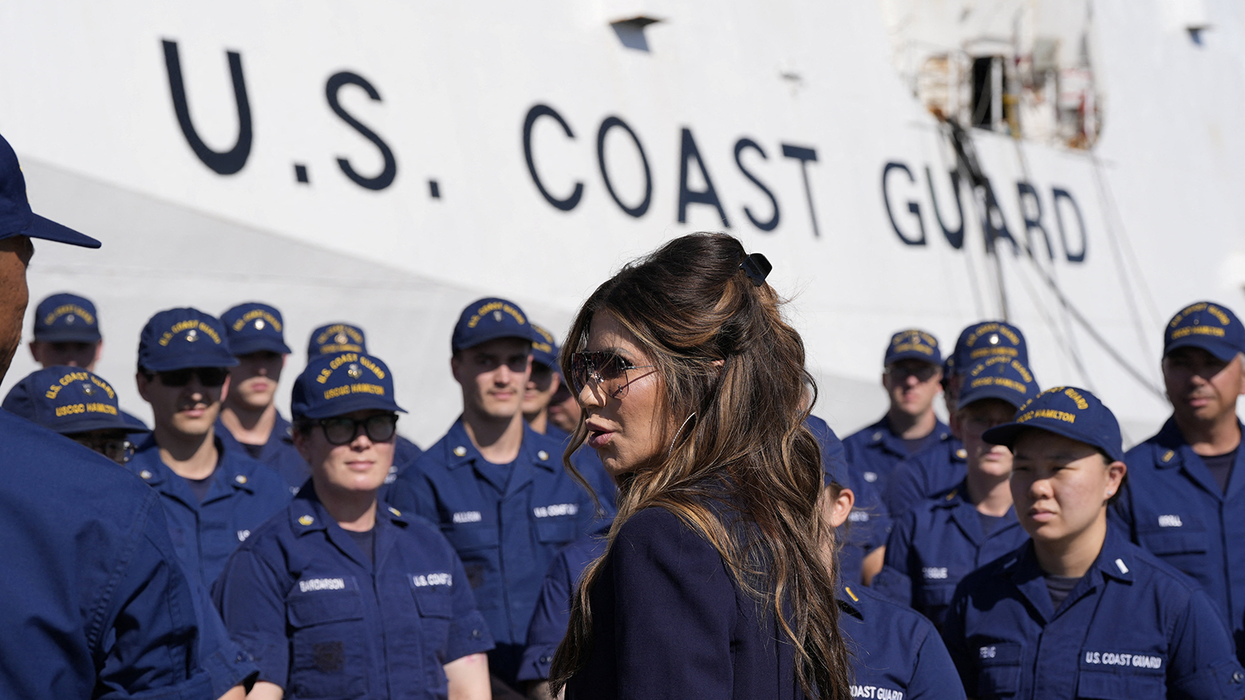
U.S. Homeland Security Secretary Kristi Noem participates in a tour at the U.S. Coast Guard Station, in Charleston, South Carolina, U.S., November 7, 2025. Alex Brandon/Pool via REUTERS
November 21, 2025
ALTERBED

The U.S. Coast Guard (USCG) changed direction this week after a bombshell report revealed it had reclassified symbols like swastikas and a noose from “prohibited hate symbols” to “potentially divisive” symbols. According to one CNN reporter, it caused a “huge backlash.”

Last week, a new set of guidelines for the USCG recast symbols such as a noose or swastika as “potentially divisive.”

The sudden policy flip happened mere hours after The Washington Post reported that new “harassment guidelines” were about to be enacted. The decision was set to take effect on Dec. 15, the report said.

CNN correspondent Brian Todd called the matter "unbelievable."

"What's extraordinary, Pamela, is that we're even sitting here talking about something like this," he told host Pamela Brown.

Todd said that on Friday, President Donald Trump's administration denied that the policy had changed it in the first place.

"But they did change it," Brown cut in.

"They did change it," agreed Todd, "again, to downgrade the language referring to nooses and swastikas and other similar symbols as, 'potentially divisive.'"

Tricia McLaughlin, public affairs assistant secretary for the Department of Homeland Security, "is denying that the Coast Guard is even backtracking on this issue," Todd said.

According to CNN, McLaughlin claimed "the 2025 policy is not changing."

"USCG issued a lawful order that doubles down on our current policies prohibiting the display, distribution, or use of hate symbols by Coast Guard personnel," McLaughlin said in a statement.

She did not clarify whether the policy would change after 2025.

"It's a lot of confusion. It's a lot of back-and-forth," commented Todd, noting the Post has proof of the change.

"Then when they reported that there was a huge backlash, as there should be, obviously," Todd continued. "And now they're changing it back, but they're denying that they ever really went there in the first place."


In U-turn, US rights report to track gender changes, DEI

By AFP
November 20, 2025


People take part in a gathering to celebrate Transgender Day of Remembrance 
in Nice, France, on November 19, 2025 - Copyright AFP Valery HACHE


Shaun TANDON

In a sharp change, the United States said Thursday that its signature human rights report would start tracking countries that support gender changes for children and diversity and equity programs.

First launched nearly 50 years ago, the State Department’s annual report on human rights practices has long attempted to offer comprehensive accounts of abuses overseas, often angering other governments.

President Donald Trump’s administration has shifted the US tone on human rights, seizing on the issue as a cudgel against adversaries and as a way to promote domestic priorities while downplaying concerns when other interests are at play.

In a cable sent to US embassies around the world, Secretary of State Marco Rubio called for reporting on a series of key causes for Trump as part of a revamped and more concise annual report.

“In recent years, new destructive ideologies have given safe harbor to human rights violations,” State Department spokesman Tommy Pigott said.

“The Trump administration will not allow these human rights violations, such as the mutilation of children, laws that infringe on free speech and racially discriminatory employment practices, to go unchecked,” he said.

“We are saying enough is enough.”

Specifically, the report will ask US embassies to report on countries that allow “chemical or surgical mutilation of children in operations that attempt to modify their sex.”

Rubio also asked embassies to track “enforcement of policies like affirmative action of diversity, equity and inclusion that ‘provide preferential treatment’ to workers on the basis of race, sex or caste.”

The issues reflect top priorities for Trump since he took office.

Trump has repeatedly railed against transgender rights. Rubio’s State Department has insisted that passports now reflect Americans’ sex as listed on their birth certificates, ending decades of allowing people to select their sex, and has ended the option of an “X” for gender initiated under his predecessor Antony Blinken.

Former president Joe Biden’s administration had made LGBTQ rights a major thrust of its foreign policy, appointing the first State Department envoy to advocate for sexual minorities overseas — a position immediately ended by Rubio.

Trump has not only ended equity programs aimed at providing opportunities for historically disadvantaged groups but has threatened companies that do practice such policies, saying they hurt America’s white majority.

– ‘Natural rights’ –

In the first human rights report released by the second Trump administration — unveiled in August but compiled largely before he returned to office — LGBTQ rights were significantly downplayed, with references removed even for countries such as Uganda, which has imposed an anti-homosexuality law that carries the death penalty.

In the cable, Rubio also ordered embassies to track violations of “free speech.”

The Trump administration has harshly criticized US allies in Europe for restricting online speech.

Vice President JD Vance castigated Germany for restrictions against the far-right AfD and the United States has criticized top ally Britain for penalties over online posts that targeted migrants.

The push comes despite Rubio revoking visas for foreigners over their speech, including statements against Israel’s military offensive in Gaza and posts mocking conservative commentator Charlie Kirk after his murder.

Trump on Tuesday brushed aside concern over the murder of Saudi dissident journalist Jamal Khashoggi, strangled and dismembered in a Saudi consulate, as he rolled out the red carpet for the kingdom’s crown prince, who promised major business.

A senior State Department official said that Rubio was seeking to refocus on “natural rights,” a key concept for philosophical conservatives that was also pushed during the first Trump administration.

“The United States remains committed to the Declaration of Independence’s recognition that all men are endowed by the Creator with certain unalienable rights,” the official said on customary condition of anonymity.

Rights “pre-exist governments” and “are given to us by God, our Creator, not by governments,” he said.

“We are moving away from group identities, group labels,” the official said.

“Prior administrations had maybe focused on certain issues that we think were politically driven,” he said.


OP-ED

Trump’s Anti-Trans Policies Embolden Far Right, But Our Existence Challenges It

Trans existence challenges the fundamental tenets of fascism and exposes the fragility of authoritarian power.
November 20, 2025
Hundreds of people protested in New York City, on February 3, 2025, against U.S. President Donald Trump's executive order signed January 28, 2025, to restrict gender transition procedures for people under the age of 19, and reports of a local hospital group cancelling appointments for young people in response.CHARLY TRIBALLEAU / AFP via Getty Images

In 2025, over a thousand anti-transgender bills were introduced in 49 states across the country. Of those, over 100 have passed so far this year, continuing the trend of five consecutive record-breaking years of anti-trans legislation from 2020 to 2024.

In recent years, I have watched these state-level attacks on transgender people spread across more than half the country, with many of these policies now being embraced at the federal level. In June, the Supreme Court ruled that Tennessee’s ban on gender-affirming care was constitutional, effectively opening the door for similar bans in 26 states. This term, the court will also consider the constitutionality of transgender sports bans — which have been adopted in 27 states — and whether states can prohibit LGBTQ conversion therapy.

At the same time, Donald Trump has made targeting transgender people, especially youth, a cornerstone of his administration’s agenda. According to Advocates for Trans Equality, “This administration has aggressively targeted trans people, seeking to force the nation back to an imaginary time where people like us didn’t exist—where gender is a prison to cage us, instead of a canvas to express our true selves.”
Since the first day of his term, he has rescinded Biden-era LGBTQ equity executive orders; signed executive orders defining sex as an “immutable biological classification”; limited diversity, equity, and inclusion governmental programs; directed agency heads to take action to end gender-affirming care for trans youth; and ended public service loan forgiveness for government employees who work with transgender youth. The Trump administration has also issued a national security memo calling people and organizations “domestic terrorists” if they support “extremism [on] gender” or “hostility towards those who hold traditional American views on family,” and Vice President JD Vance has implied that being transgender, or advocating for transgender people may make you part of “a terrorist movement.”

These anti-trans policies have led to an increasingly emboldened far right movement that feels vindicated by the federal government. I know this because I have been on the receiving end of their targeting.

In September, two friends and I publishedBe Gay, Do Crime: Everyday Acts of Queer Resistance and Rebellion, a book that highlights a different moment in radical queer history each day. We wanted to curate a collection of moments in LGBTQ history that challenge the sanitized narratives often centered on wealthy, white, gay assimilationist perspectives and legal victories. Instead, we aimed to include global, people’s-history perspectives and to explore how, for hundreds of years, communities have resisted the criminalization of LGBTQ identities and fought for diverse visions of liberation using a wide range of resistance strategies.

We were excited to wear our “Be Gay, Do Crime” shirts and connect with people — especially young people — who are facing queer erasure in their classrooms, medical discrimination, and high rates of bullying and harassment. I wanted to help create this book because it is exactly the kind of resource I needed when I was a young closeted bisexual nonbinary person— to feel seen, affirmed, and welcome.

Be Gay Do Crime was released by PM Press in September 2025.Zane McNeill

Yet after Charlie Kirk’s murder on September 10, the far right was eager to blame my community — a pattern it follows after nearly every act of gun violence to avoid addressing gun control. The week after our book was published, a self-described “investigative journalist” (who was previously arrested after posting photos on X of a woman in a grocery store wearing a keffiyeh “for the purpose of terrifying, harassing, or embarrassing” her) shared a post about our book, calling it a “blueprint for ‘Queer Rebellion.’” A poster for an event for the book at Firestorm Books featuring one of the other editors garnered the attention of far right influencers like Andy Ngo and organizations including the Manhattan Institute, the National Conservative, and Catturd, a far right troll on X favored by Elon Musk.

Libs of TikTok, a notorious anti-LGBTQ page with 4.5 million followers founded by right-wing propagandist Chaya Raichik, called the book event poster “a symbol of lgbtq t*rrorism.” One commenter asked, “So when do we classify them as terrorists?” Another demanded that the government “put them in mental institutions and don’t let them out till they prove they can behave.” Others tagged the FBI, the Department of Justice, and Donald Trump, which might be funny if our government weren’t actively surveilling the web and actively trying to criminalize anti-fascist organizing, transgender people, and trans allies.


Efforts are underway to erase us from history, re-pathologize our identities, and push us out of public life.

I share this to emphasize how frightening it is to be transgender in the U.S. right now. Efforts are underway to erase us from history, re-pathologize our identities, and push us out of public life in an attempt to justify the surveillance and criminalization of our communities and to make it easier to enact and inspire violence against us.

In fact, as a result of years of anti-trans rhetoric, transgender people are experiencing rising levels of harassment, violence, anxiety, depression, and suicidal ideation. Since 2024, 55 percent of transgender people have taken steps to be less visible, and many transgender youth and their families have been forced to leave red states, only to face the loss of gender-affirming care even in “safe haven” states. Some have even fled the country entirely.

At the same time, the LGBTQ suicide hotline has been defunded, making it clear that anti-trans policies are intended to kill us, making every transgender suicide a murder that falls squarely on the hands of politicians. According to Advocates for Trans Equality’s 2025 Trans Day of Remembrance Report, 27 transgender people were murdered and 21 died by suicide from November 2024 through October 2025. The actual numbers are likely higher due to widespread misgendering in news reporting.

But we will not stop fighting. Our very existence challenges the fundamental tenets of fascism and exposes the fragility of authoritarian power. We show that gender is diverse and mutable. We challenge the authoritarian myth that people are born into fixed categories and exist only to reproduce for the nationalist state. Instead, trans and intersex people show that people can find joy in their bodies and resist the rigid binary of woman/man and the heterosexuality on which authoritarianism depends. We are powerful, beautiful, and free — and that terrifies them.


Italy probes Tod’s executives over labour exploitation


By AFP
November 20, 2025


Tod's are best known for their driving loafers - Copyright AFP/File Frederic J. BROWN

Italian prosecutors are investigating three executives from luxury fashion label Tod’s, as well as the company itself, for alleged labour exploitation, according to a court document seen Thursday by AFP.

Milan Prosecutor Paolo Storari had previously requested a six-month ban on the company’s advertising, with Judge Domenico Santoro fixing a December 3 hearing on the matter, according to his decree dated November 14, viewed by AFP.

The prosecutor’s office alleges that Tod’s — best known for its trendy leather moccasins — acted in “full awareness” of the exploitation of Chinese subcontractors, with violations in working hours, wages, hygiene and safety, as well as “degrading” housing.

The company, according to prosecutors, was “devoid of organisational models” to prevent the exploitation of sub-contracted workers, read the court document.

“In particular, it outsourced the audit service to suppliers and then failed to minimally take into account the results of these inspections, which noted numerous indicators of exploitation,” it said.

The Tod’s executives under investigation are responsible for operations, supply chain issues and compliance.

The executives allegedly exploited 53 workers, most of them Chinese, working for six different subcontractors of Tod’s, the document showed.

In the prosecutors’ October 29 request for the court to suspend Tod’s advertising, they alleged that “the illicit system described has generated enormous profits thanks to the exploitation of (severely underpaid) Chinese labour and was made possible by serious organisational deficiencies”.

The 144-page court document includes accusations by a Chinese worker at one subcontractor that his boss beat him with his fists and a long plastic and aluminium tube when he confronted him about 10,000 euros (around $11,500) in unpaid back wages.

Despite a contract for four hours of work a day, the worker said he worked from 9 in the morning until 10 o’clock at night, with two half-hour breaks for lunch and dinner and no days off.


– Beyond negligence –


The investigation revealed “a phenomenon where two worlds… that of luxury on the one hand and that of Chinese laboratories on the other, come together for a single objective: cost reduction and profit maximisation through avoidance of labour law regulations”, read the document.

Prosecutors said the shoemaker’s “organisational deficiencies and the lack of controls” went beyond negligence, describing it as a “malicious” attitude.

They had previously asked for Tod’s to be temporarily placed under court administration for failing to carry out checks in the chain of production.

In a statement Thursday, Tod’s said Italy’s top court had rejected that request on Wednesday. It did not give details, but media reports say the request for judicial administration has been held up by a dispute over legal jurisdiction.

“Regarding the new allegations concerning the same matter, the company is now reviewing, with the same composure, the additional material, produced with worrying timing, by Dr. Storari,” the company added.

Tod’s founder and chairman Diego Della Valle is one of Italy’s wealthiest individuals. He defended his company last month, telling reporters that Tod’s was respected around the world and upheld “ethical values”.

He also warned that such investigations risked damaging “Made in Italy” brands.

Several high-end labels have been placed under judicial administration in Italy amid investigations about the treatment of sub-contracted workers, most recently luxury brand Loro Piana.
Researchers stunned by wolf’s use of crab traps to feed


By AFP
November 20, 2025


The wolf dragged a green crab trap from the water to the shore to eat its bait in the Heiltsuk Indigenous territory of Canada - Copyright AFP/File TOM BRENNER

When a wild wolf encounters a potential meal, its instinct is usually to pounce — but researchers in western Canada have recorded at least one wolf taking a strikingly different approach.

The behavior captured on video in a remote part of British Columbia province shows a wolf completing multiple steps to retrieve a crab trap from deep water, sophisticated behavior researchers say marks “the first known potential tool use in wild wolves.”

“I couldn’t believe my eyes when we opened up that camera,” said Kyle Artelle, an environmental biologist at the State University of New York.

The discovery, detailed in the journal Ecology and Evolution, came partly by accident.

For several years, crab traps have been submerged in deep water in the area as part of a program to eradicate European green crabs, an invasive species.

Researchers, working in collaboration with the Heiltsuk First Nation, observed that the traps had mysteriously been dragged ashore and the bait removed.

Because the traps had been set in deep water and never exposed during low tide, they assumed a marine predator was involved.

They set up cameras in May 2024 and quickly solved the mystery.

A female wolf was recorded swimming out and dragging the buoy attached to a trap to shore.

She then pulled in the line attached to the trap. With the trap on shore, she chewed through its netting to access the bait.

It was a “carefully choreographed sequence,” the researchers said — not a wild predator aggressively pursuing food.

Artelle said it was “incredible behavior.”

“This wolf showed up and she just saw a float and she knew the float was attached to a trap. She knew how to pull the trap up. She knew if she pulled the trap onto the beach, she could get food… Really intelligent, really incredible, sophisticated behavior.”

The researchers, who included University of Victoria geography professor Paul Paquet, conceded they do not know how pervasive such levels of sophistication are among wild wolves.

They noted the wolf may have figured out how to get the trap on shore through trial-and-error, stressing that wolves in the remote area are less exposed to danger — including from humans — and therefore may have more time to experiment.