Sunday, November 23, 2025

TotalEnergies Rejects War-Crimes Allegations Tied to Mozambique LNG

TotalEnergies (TTE) has issued a detailed rebuttal to allegations filed before France’s National Anti-Terrorist Prosecutor’s Office, rejecting claims that the company or its Mozambique LNG project was complicit in war crimes, torture, or enforced disappearances in Cabo Delgado in 2021.

The complaint, submitted “against persons unknown and against TotalEnergies,” stems from a September 2024 Politico investigation alleging that Mozambican soldiers committed abuses near the Afungi LNG site between June and September 2021. TotalEnergies says the accusations are baseless, emphasizing that all project personnel were evacuated in early April 2021 after the Islamic State–affiliated Al-Shabab attack on Palma.

TotalEnergies states that neither it nor the Mozambique LNG consortium received any information in 2021 indicating that abuses had occurred, and says internal checks and stakeholder outreach turned up no evidence supporting Politico’s claims. The company also states that Politico has refused to share underlying data or supporting documentation for the allegations.

Cabo Delgado has been an insurgency hotspot since 2017, with Islamist militants targeting villages, infrastructure and government forces. The Palma assault in March 2021, one of the conflict’s deadliest episodes, forced the full evacuation of LNG operations and halted the multibillion-dollar development.

Following the evacuation, Mozambican security forces took control of the Afungi site and surrounding infrastructure during counter-insurgency operations—an environment in which the contested allegations emerged. Human rights reporting in the region remains complex, given fragmented oversight and ongoing conflict conditions.

The company says it has interacted extensively with Politico since the article’s publication, publicly posting the full correspondence after accusing the outlet of selectively quoting company responses. TotalEnergies argues that both the complaint and related media narratives improperly link the company to violent episodes associated with Mozambique’s broader security crisis.

TotalEnergies highlighted that security for the LNG project was managed under a now-expired Memorandum of Understanding between Mozambique and project operators. The MoU required training of more than 5,000 security personnel in the Voluntary Principles on Security and Human Rights, established a grievance mechanism, and allowed for removal of security officers for misconduct.

According to the company, none of the grievances filed through these mechanisms supported the accusations referenced in the complaint.

Mozambique LNG formally asked Mozambican authorities to open an investigation in late 2024, and in March 2025 the country’s Attorney General confirmed that a criminal probe was underway. TotalEnergies says it is cooperating fully and has also requested an independent investigation by Mozambique’s National Human Rights Commission, pledging to publish its findings.

The company pointed to its 2022 independent assessment by Jean-Christophe Rufin, which reviewed humanitarian conditions in Cabo Delgado and led to a 2023 action plan expanding local development and community-support programs. TotalEnergies reiterated that the long-term socio-economic stability of the province remains central to the project’s objectives.

Mozambique LNG—where TotalEnergies holds a 26.5% stake—remains one of the largest LNG developments planned in sub-Saharan Africa, though its restart timeline continues to hinge on security conditions in northern Mozambique.

By Charles Kennedy for Oilprice.com


 ‘Radical and Reckless’: House Passes LNG Bill to Jack Up Climate Pollution and Energy Prices


“The explosion of LNG exports in recent years has already generated massive profits for the fossil fuel industry, while consumers and local communities pay the price,” said one climate campaigner.
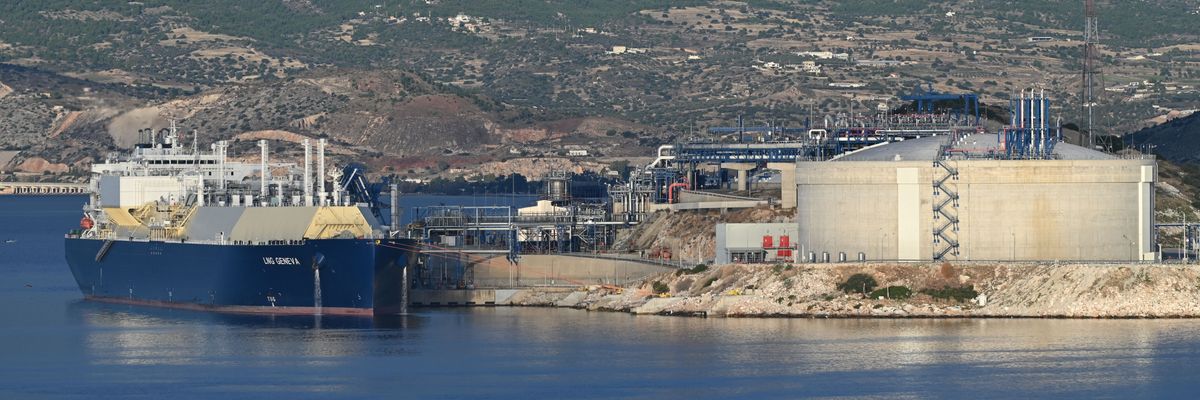

A liquefied natural gas tanker that departed from the Port of Cameron unloads US LNG at the Revithoussa terminal in Greece, on November 7, 2025.
(Photo by Nicolas Koutsokostas/NurPhoto via Getty Images)


Jessica Corbett
Nov 21, 2025
COMMON DREAMS


As government leaders from around the world met in Brazil to discuss solutions to the fossil fuel-driven climate emergency, the GOP-controlled US House of Representatives on Thursday advanced a bill that would lift restrictions on liquefied natural gas.

Eleven Democrats joined all Republicans present in voting for GOP Texas Congressman August Pfluger’s Unlocking our Domestic LNG Potential Act, which would also grant the Federal Energy Regulatory Commission sole authority over applications for import and export facilities. It’s now up to the Senate whether the bill will reach President Donald Trump.


As E&E News reported: “Pfluger and Republican leadership previously championed the bill in response to President Joe Biden’s LNG pause, in which the Department of Energy paused new terminal approvals to evaluate whether they were in the public interest. It passed the House last year, but never received Senate consideration.”

While Pfluger, House Speaker Mike Johnson (R-La.), and Sen. Tim Scott (R-SC), the upper chamber sponsor, celebrated Thursday’s vote, climate campaigners blasted the bill—just one part of a sweeping GOP effort to boost the planet-heating fossil fuel industry during Trump’s second term.

“The explosion of LNG exports in recent years has already generated massive profits for the fossil fuel industry, while consumers and local communities pay the price,” Sierra Club director of beyond fossil fuels policy Mahyar Sorour said in a statement after the vote. “The last thing we need is even less oversight over these costly, polluting export projects.”

“House Republicans should be focused on making investments in a clean economy and reducing energy costs for our families, not further padding the pockets of Big Oil and Gas executives,” Sorour added. “The Senate should reject this dirty bill.”


Tyson Slocum, director of Public Citizen’s Energy Program, highlighted that “President Trump explicitly promised during the campaign that he would lower Americans’ utility bills by half within 12 months. Not only has Trump obviously failed on that promise, but this legislation would exacerbate the energy affordability crisis.”

Slocum pointed to his group’s estimates that “natural gas prices for American households have increased by $10.3 billion from January through August 2025 compared to the same time period a year earlier—a 20% increase.”

“Eight LNG export terminals now consume more natural gas than all American households combined,” he continued. “The US Department of Energy’s Energy Information Administration’s November 2025 Short Term Energy Outlook concludes that Americans face sharply higher natural gas prices ‘primarily due to increased liquefied natural gas (LNG) exports.’”

“This radical and reckless deregulatory proposal eliminates the requirement that gas exports comply with the public interest, allowing fossil fuel companies to enjoy unregulated exports at the expense of affordable energy here at home,” Slocum stressed. “The move by Congress to allow bypassing these safeguards could have catastrophic impacts on the consumers in the US, sending energy prices soaring, while allowing climate change to get far worse.”

“Despite Trump promising he would cut Americans’ energy bills, Congress is set to put consumers at risk of paying more, raising major questions about Trump’s close allegiance with dirty energy executives who want to ship more fuel overseas,” he added. “Creating more capacity to export US fossil fuels abroad will only accelerate the climate crisis and hurt US consumers.”


The vote happened on the same day that Doug Burgum, the billionaire fossil fuel industry ally whom Trump appointed to lead the US Department of the Interior, ordered the termination of the Biden administration’s 2024-29 National Outer Continental Shelf Oil and Gas Leasing Program and the development of a “new, more expansive” plan “as soon as possible.”

Responding to the order in a statement, Sierra Club executive director Loren Blackford said that “Donald Trump and Doug Burgum are once again trying to sell out our coastal communities and our public waters in favor of corporate polluters’ bottom line.”

LNG Shipping Shortage Behind Dramatic Hike in Atlantic Rates
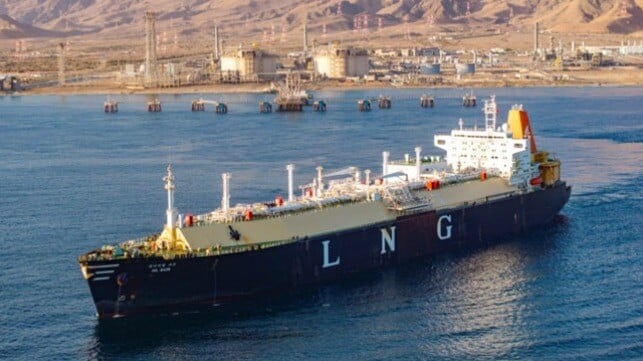
LNG gas carrier
Gas carrier off the LNG Oman terminal at Qalhat (Oman LNG)

Published Nov 21, 2025 2:04 PM by The Maritime Executive


Increased production of LNG in West Africa and the United States, and delays in discharges at Egyptian LNG terminals, has prompted a short squeeze on LNG shipping availability. Rates have increased dramatically over the past three weeks.

LNG freight was being offered at $170,000 per day on the follow in the London market on the morning of November 21. This represents a 150 percent rise in rates in comparison with the Atlantic $75,000 per day rate being quoted two weeks ago. The prices at the beginning of November were already about 50 percent higher than rates prevailing in August. At current levels, Atlantic freight rates are the highest they have been for two years, whilst Pacific rates have risen but not by the same margins. Inevitably, the longer the shortage of shipping lasts, the wider the effect on geographic rates will be.

Some LNG importers in the United States are delaying purchases in the hope that the spike in shipping rates will fall away. Others in Europe are likely to do the same, leading to the prospect that come the winter there will be a shortfall in supply, particularly if Ukraine is successful in further restricting Russian output and shipments.

New Fortress Energy Warns of Possible Bankruptcy as Debt Pressures Mount

Shares of billionaire Wes Edens’ New Fortress Energy Inc. plunged on Friday after the liquefied natural gas (LNG) firm warned that it may file for bankruptcy protection in the U.S. if it cannot reach an out-of-court restructuring deal with creditors. The New York-based company said in a regulatory filing that it’s also considering a court-supervised restructuring in the U.K., underscoring the severity of its financial strain.

New Fortress, which supplies natural gas across the Caribbean and Latin America, has been battling shrinking revenues and rising debt burdens for months. The company reported $8 billion in liabilities against only $1.3 billion in assets, admitting “substantial doubt” about its ability to continue operating without fresh liquidity. Shares fell as much as 27% in intraday trading, extending a year-long slide of more than 80%.

The firm has been scrambling to buy time with creditors, most recently securing a short-term reprieve to delay interest payments on its 2029 senior-secured notes until mid-December. Bloomberg previously reported that management had explored both U.S. Chapter 11 protection and U.K. restructuring mechanisms as options to preserve value while renegotiating debt.

Founded by Edens to capitalize on LNG demand in emerging markets, New Fortress Energy expanded rapidly through acquisitions and project financing but has since faced liquidity pressures amid volatile gas prices and delayed project cash flows. Analysts warn that unless a comprehensive refinancing deal materializes soon, the company could face court-supervised restructuring before year-end.


Australia: A Global LNG Power Facing Local Shortages

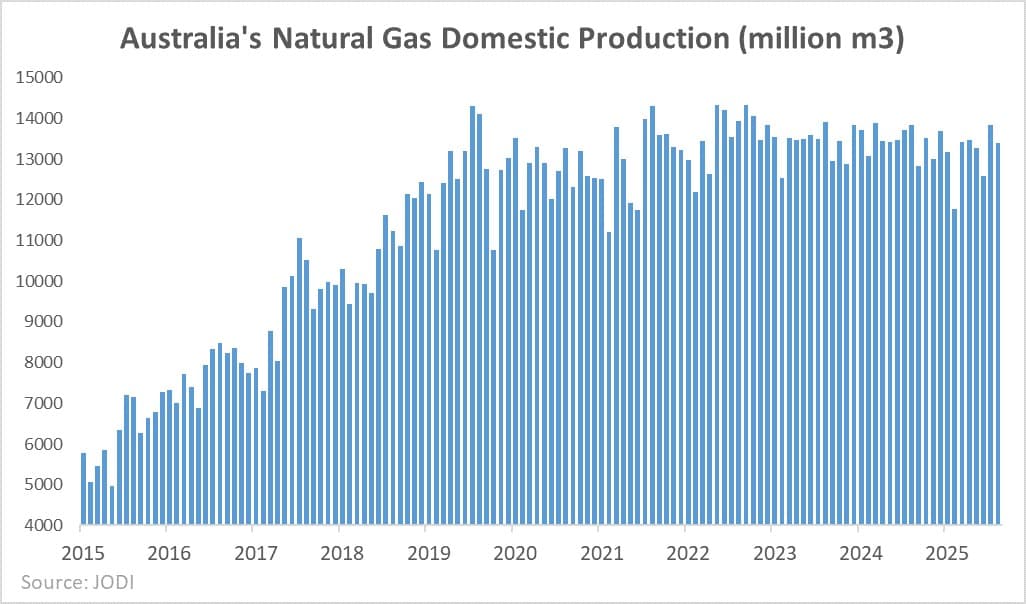
  • Australia remains the world’s third-largest LNG exporter, but domestic gas output has plateaued at around 13 million m³/month since 2021.

  • Despite ConocoPhillips announcing a new discovery this month, the pace of exploration has declined sharply, leaving the eastern parts of the country undersupplied and vulnerable to price spikes.

  • Regulatory hurdles and environmental opposition are deterring investment, threatening both domestic stability and export commitments.

Australia may still stand as the world’s third-largest LNG exporter (behind Qatar and the United States) but the foundations of that success are faltering. The September 2025 start-up of the Barossa Project, designed to feed Darwin LNG, and ConocoPhillips’ November drilling success in the Otway Basin offer welcome headlines, but they do little to offset the deeper structural imbalance now shaping Australia’s national gas landscape. Most production remains concentrated in Western Australia and Queensland, far from the south-eastern population centres that depend on it, while new developments struggle to keep pace with both export commitments and rising domestic demand. At the same time, new investment is increasingly deterred by regulatory tightness and stringent environmental requirements, leaving Australia’s long-term gas outlook more fragile than its export rankings suggest.

For decades, exploration was one of Australia’s greatest strengths: since the 1960s, hydrocarbons were discovered at a rate of roughly a billion barrels of oil-equivalent per year. But after 2015 that trend began to change. Offshore exploration has declined and is now concentrated almost entirely in the west and northwest – regions with little population, limited domestic industrial demand, and a direct pathway into Asia-facing LNG terminals. Australia’s geography has amplified this imbalance: the most prolific basin, North Carnarvon, lies off the western coast, while nearly two-thirds of the population and most of the country’s industrial load are located in the east, with no pipeline linking the two. As a result, most new offshore discoveries naturally flow into LNG export plants rather than the domestic market, deepening the divide between where gas is produced and where it is consumed. This structural disconnect has become the central fault line in Australia’s energy system, and it has grown more severe as LNG exports have expanded.

Recent drilling activity shows glimmers of hope but underscores how little has been done in recent years. The first offshore hydrocarbon exploration well since 2023 – Chevron’s Deep 1 and Dino South 1 – was drilled only in May 2025. In November, ConocoPhillips, alongside 3D Energi and Korea National Oil Corporation, spudded its first well under the Otway Basin Program near shores of Victoria province (53 km offshore from Port Campbell, 12 km from existing gas production wells), a government-funded initiative designed to shore up southeastern supply. Just two weeks later, on November 17, the company announced it had struck gas in the two target reservoirs (Waare A and Waare C) – the first discovery in the region in four years – adding that six wells are planned across two permits. However, the potential flow rates and ultimate resource recovery are still to be determined.

The consequences of waning exploration activity are increasingly visible in production trends. While national gas output more than doubled between 2015 and 2021, rising from around 5.5 million cubic metres per month to roughly 13 million cubic metres, it has since plateaued. Over the last 4 years production has hovered around an average of 13 million m3/month, signalling that without new exploration, the country has already reached a stagnation point and risks slipping into structural decline.

With national output flattening, the weakest point in Australia’s gas system is increasingly the east coast, where demand keeps rising even as local supply fails to keep pace. Eastern Australia’s gas system is built around Queensland’s CSG (coal seam gas)-LNG  plants, which draw from the domestic market and have steadily increased their intake. When long-term lower-priced contracts expired between 2016 and 2019, domestic prices rose sharply and began tracking regional Asia LNG netback values – the price LNG exporters could earn overseas, minus regasification and shipping. That linkage now defines the market: in Queensland, New South Wales (NSW) and Victoria, gas started behaving like a globally traded commodity, not a locally priced utility. Each winter, gas flows southward, but the constrained pipeline network cannot meet peak demand, causing local tightness and sharp price spikes. Government have required CSG-LNG exporters to offer uncontracted volumes to the domestic market before selling spot cargoes abroad. An east-coast price cap of A$12/GJ, introduced in summer 2023 and extended up to 2033, aims to protect consumers from global volatility. Despite the cap having exemptions, allowing undeveloped fields to be priced under a “reasonable price” mechanism, the result is a system that suppresses price signals just when investment is needed most.

Pressure on supply is exacerbated by state-level environmental opposition. In NSW and Victoria, local resistance has prevented new projects for years. The Narrabri CSG development, which could supply up to half of NSW’s demand, spent a decade stalled by protests, litigation and political friction before finally being approved in 2020. Victoria’s ban on onshore gas exploration from 2017 to 2021 – still prohibiting coal seam gas – ensured that Queensland remains the only state producing CSG. This geographic bottleneck forces the market to rely on higher-cost southern basins and long-distance interstate flows, raising prices, increasing winter risks, and tightening supply further.

At the same time, the electricity system has become more fragile. This summer, wholesale power prices reached A$107 per MWh – a decade high – as supply stress collided with ageing coal-fire power stations that still make up around 65% of the energy mix. Outages during high demand are becoming more common, amplifying the consequences of any gas shortage.

The unstable regulatory environment is beginning to scare away investors. In September, Abu Dhabi National Oil Company abandoned its planned US$19 billion acquisition of Santos, deterred by regulatory risk, domestic gas obligations and environmental pressures. Without major external investment, Australian producers face stagnation and an increasing likelihood of failing to meet both domestic commitments and international contract terms. ExxonMobil has already paused recent investments, citing the unpredictability of approvals and fiscal settings. Woodside’s North West Shelf expansion project – the largest export facility in the country – only received provisional clearance in May after more than six years in the approvals pipeline.

The final irony is that Australia may soon need to import LNG to stabilise the very market it once dominated. Several regasification projects are advancing. Squadron Energy’s Port Kembla terminal is expected to begin operations in mid-2026. Vopak has acquired an FSRU (floating storage and regasification unit) for its Port Phillip Bay project in Victoria, with imports projected to begin in 2029. Four additional import terminals are under construction across Victoria, South Australia and New South Wales. But FSRUs are costly and scarce, and any imported LNG would force domestic prices to track not only global spot levels (already volatile) but also shipping and regasification costs.

For this reason, expanding domestic local supply (by projects similar to the Otway Basin exploration near to the southeast coast) remains the lowest-cost, lowest-emission, and most strategic solution. Yet approvals are slow, regulatory obligations are heavy, and investor confidence is wavering. If Australia cannot reset its approach, capital will migrate to more welcoming jurisdictions. Timor-Leste is already preparing a new exploration bidding round for 2026, having secured revised maritime boundaries and signalling its capability to attract upstream investment that Australia appears unable to accommodate.

Australia’s gas system is entering a decisive phase. A decade of declining exploration, increasing regulatory intervention, environmental constraints and infrastructure fragmentation has pushed the market toward structural imbalance. The Barossa start-up and the Otway discovery show that new supply remains possible – but unless the policy framework shifts, these isolated wins will not prevent deeper shortages, higher prices and eroding investor confidence. The country must choose whether to remain a global LNG power with a secure domestic market or allow its system to drift toward chronic vulnerability.

By Natalia Katona for Oilprice.com

LME to stop running benchmark platinum and palladium auctions

Credit: LME

The London Metal Exchange will stop administering twice-daily auctions that set benchmark platinum and palladium prices from the middle of next year, as it focuses on its core base metals offering.

Results of the LBMA Platinum and Palladium Price auctions are used across the market and industry for settling contracts and transactions. The auction process itself also provides a window of increased liquidity that helps those trading in large volumes.

The LME began running the auctions in 2014, with the electronic procedure replacing a previous phone-based system. The overhaul — a similar revamp also took place in the gold and silver markets — came as scrutiny increased on how benchmarks are set.

The platinum and palladium auctions “no longer represent a core activity for us and, therefore, we believe it is in the best interests of the LME and the market to transition pricing to an alternative venue,” Jamie Turner, chief operating officer at the LME, said in a statement.

Details on a new administrator of the auctions will be announced in January, said Ruth Crowell, chief executive officer of the LBMA, which oversees London’s precious metals markets. Daily gold and silver auctions are currently run by ICE Benchmark Administration.

Six participants are currently able to directly take part in the platinum and palladium auctions, according to the LBMA’s website. They are BASF Metals Ltd., Goldman Sachs Group Inc., HSBC Holdings Plc, Johnson Matthey Plc, ICBC Standard Bank Plc and StoneX.

Last year, Goldman Sachs and HSBC units were among four companies that agreed to pay a combined $20 million to settle claims they manipulated prices in the platinum and palladium markets after a decade of litigation.

(By Jack Ryan)


China expands BHP iron ore ban to new product as talks drag

Credit: BHP

China’s state-owned iron ore buyer has ordered steel mills and traders to stop purchasing a certain type of BHP iron ore, sources said, adding to a separate ban already in place and escalating a dispute over a new contract.

China Mineral Resources Group (CMRG), set up in 2022 to centralize iron ore purchasing and win better terms from miners, asked Chinese steel mills and traders this week not to buy new cargoes of Jinbao fines, a type of low-grade iron ore from the world’s third-largest iron ore miner BHP, according to two sources familiar with the matter.

“CMRG told mills that they are not allowed to take delivery of Jinbao fines from ports in three days … so there might be a hustle and bustle at ports these few days,” said one of the sources.

Reuters could not determine how many iron ore traders and steel mills received the order from CMRG this week.

The ban is the second after CMRG asked Chinese steel mills and traders in September to stop buying BHP’s Jimblebar Blend Fines. The parties are locked in lengthy negotiations over an annual contract for 2026.

BHP said in response to questions about the Jinbao ban that it does not comment on commercial negotiations. Earlier in the day the miner said it was still negotiating with CMRG.

CMRG did not immediately respond to questions.

Small trade volumes

CMRG may have chosen to target Jinbao fines instead of other BHP cargoes because trade in the lower-grade iron ore is very small and the ban would not drastically disrupt the market, said both sources and an analyst, who all spoke on condition of anonymity given the sensitivity of the matter.

All three sources said the trade is so small they don’t regularly track volumes.

Tightening supplies of medium-grade iron ore like Pilbara Blend Fines at ports following the first ban have underpinned prices despite weakening demand for the key steelmaking ingredient.

Iron ore prices hit a more than two-week high on Wednesday even as crude steel output in the world’s largest producer of the metal slid to the lowest level since December 2023 as bad weather led some northern mills to cut production.

(Editing by Louise Heavens and Aidan Lewis)

Stand-off between China’s iron ore buyer and BHP tightens iron ore supplies


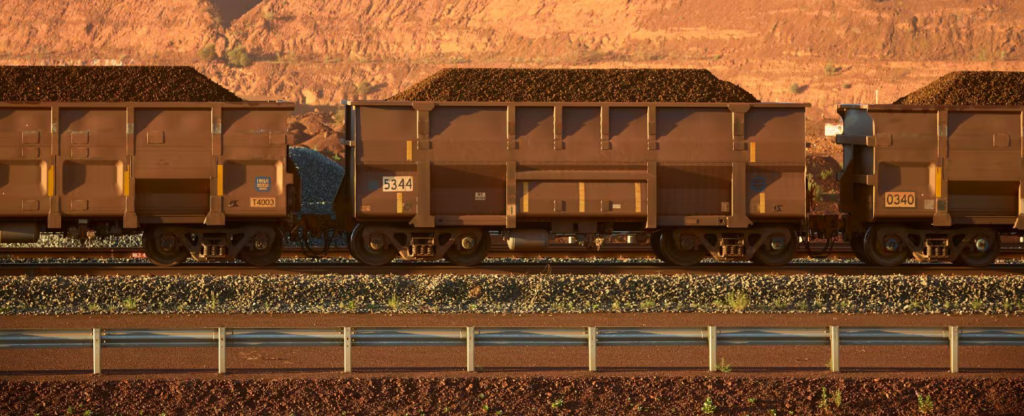
The Jimblebar iron ore mine is a part of an 85:15 joint venture between BHP and Mitsui and ITOCHU. Credit: BHP

Protracted negotiations between China’s state iron ore buyer and miner BHP have tightened availability of some iron ore, seven sources said, underpinning prices despite weakening demand for the key steelmaking ingredient.

China Mineral Resources Group (CMRG), set up in 2022 to centralize iron ore purchasing and win better terms from miners, asked Chinese steel mills and traders in September to stop buying BHP’s Jimblebar Blend Fines while negotiating annual contract terms with the Australian miner for 2026 supply.

Trade of Jimblebar fines is still frozen in China, leaving mills that previously used it switching to a substitute, Pilbara Blend Fines (PBF), rival Rio Tinto’s flagship product, resulting in a rapid drawdown in PBF inventory, the sources said.

A BHP spokesperson told Reuters “negotiations are ongoing”, declining to elaborate. CMRG did not immediately respond to a Reuters request for comment.

Rio Tinto had no immediate comment.

Portside inventories of PBF began falling in mid- to late September and were down by around 40% to 6.5 million tons on November 18, the lowest since August, according to two of the sources with knowledge of the matter.

By contrast, portside stocks of Jimblebar fines, which account for around a quarter of BHP’s production, continued to pile up, surging by 156% over the same period, one of the sources said.

All sources requested anonymity due to the sensitivity of the matter.

Thinning margins have propelled Chinese steel mills to favor medium-grade cargoes such as PBF, heating up competition and accelerating the drawdown in port inventories, sources said.

Profitability among Chinese steel mills has been falling since mid-August, with only around 39% of mills operating at a profit by November 13, versus 55% in the same period a month before and 58% at the same time in 2024, data from consultancy Mysteel showed.

Iron ore futures prices hit a more than two-week high on Wednesday even as crude steel output in the world’s largest producer of the metal slid to the lowest level since December 2023 as bad weather led some northern mills to cut production.

The tightened availability of PBF at Chinese ports contributed to surprising resilience in iron ore prices, said the two trade sources and the other two analysts, with one of them adding that the situation created a “man-made bull market”.

Ore prices have climbed 3% from a month before and 8.4% from the beginning of the year to close at 791.5 yuan ($111.23) per metric ton on Wednesday.

($1 = 7.1157 Chinese yuan)

(By Melanie Burton; Editing by Lewis Jackson and Lincoln Feast)


Northern Graphite halts Lac des Iles operations for repairs

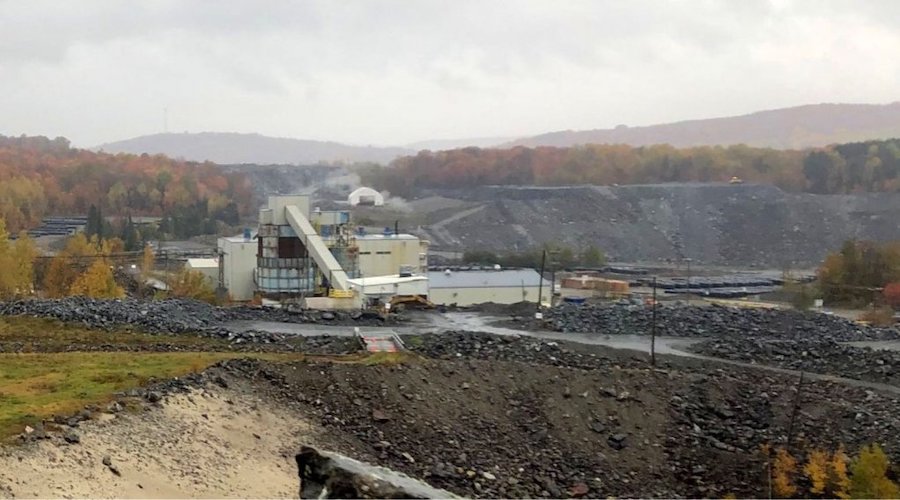
The Lac des Iles mine in Quebec (LDI) is the only graphite producer in North America.
 (Image courtesy of Northern Graphite.)

Northern Graphite (TSXV: NGC) says it has temporarily halted its Lac des Iles mine and mill to address an unexpected equipment issue, and to bring forward the planned maintenance and development work ahead of its pit expansion next year.

The decision follows a bearing failure at the mill, a long-lead-time component with a replacement window of approximately four to six weeks, the Canadian graphite developer said in a press release Thursday, adding that a replacement part has already been ordered.

While it completes the repair, the company will also advance other maintenance and repair projects at Lac des Iles that had originally been scheduled for January, designed to support the transition to mining from the new pit.

“Rather than stopping the plant now and again in January, we decided to start the maintenance program immediately in order to avoid having two separate shutdowns,” Northern Graphite’s chief executive Hugues Jacquemin said in a news release.

Located 150 km northwest of Montreal, Quebec, Lac des Iles is the only operating graphite mine in North America.

Expanding graphite mine

The Lac des Iles mine has been in operation for 35 years, serving primarily industrial clients in the US, from refractories for steelmaking to heat management in electronics and friction materials for the global automotive sector.

Currently, it produces around 15,000 tonnes of concentrates per year, but has the installed capacity to produce up to 25,000 tonnes annually. Pre-stripping activity is now underway as part of Phase 1 of an expansion program that could potentially add eight years to the mine life by opening a new pit.

The Canadian government is covering 75% of the expansion costs by providing around C$6.22 million in interest-free, repayable contribution. The funding, announced in late August, also allowed Northern Graphite to keep the mine in operation. Before that, the company had considered shutting it down by year-end without sufficient funding for the planned expansion.

The pit extension is based on the mine’s resource published in January 2024 which outlined 3.3 million indicated tonnes at an average grade of 6.4% graphitic carbon (Cg), containing around 213,000 tonnes of Cg, plus 1.4 million inferred tonnes averaging 7.4% Cg containing approximately 106,000 tonnes Cg.

Permit being finalized

First production from the expanded pit could come as soon as the second quarter of 2026, Northern Graphite said, noting that it is now in the final stages of permitting with the Quebec environmental ministry for the Phase 1 expansion.

The Phase 1 permit, if received, would allow the company to mine to 203 metres above sea level. It is currently authorized to mine to 209 metres in the current pit, which is approximately 10 metres above the water table.

However, Northern Graphite said in its press release that mining has already reached that depth, and a relatively small amount of material has inadvertently been mined and blasted slightly below 209 metres. As a result, mining operations have been temporarily halted until the company confirms there have been no adverse impacts and will request a minor amendment to its existing certificate of authorization to mine remaining ore in the current pit to 203 metres.

This could result in a production gap of approximately two to three months between existing operations and production from the expanded pit, it warned.

Shares of Northern Graphite fell by 9.3% to C$0.20 on the latest update, bringing its market capitalization down to C$28 million ($19.9 million).

Codelco signs partnership with Japan’s NTT DATA for AI and robotics

(Image courtesy of Codelco via Flickr)

Chile’s state-run Codelco, the world’s largest copper producer, and Japanese technology firm NTT DATA have signed a memorandum of understanding in Tokyo, Codelco said on Thursday.

The partnership will focus on using artificial intelligence, robotics and quantum computing to improve automation, safety, and sustainability at Codelco’s mines.

Codelco did not specify any investments tied to the partnership.

The partnership covers 5G/6G connectivity, photonic and satellite networks, generative AI, robotics, quantum computing, autonomous operations and clean technologies.

NTT DATA will provide an R&D framework encompassing generative AI, autonomous robot control, operational understanding through digital twins and process productivity improvement using quantum computing.

“Improving safety and productivity within the mining industry is essential. NTT DATA will help address these challenges,” said NTT DATA CEO Yutaka Sasaki in a statement.

The agreement includes governance structures with strategic committees and technical coordination teams to oversee projects.

(By Daina Beth Solomon; Editin by Aida Pelaez-Fernandez)

Australian mining giant BHP drops Anglo American takeover bid

Sydney (AFP) – Australian resources giant BHP said Monday it had dropped a bid to take over British rival Anglo American that would have created the world's largest miner of copper.


Issued on: 24/11/2025 - FRANCE24

MINING IS UNSUSTAINABLE

Copper demand has exploded in recent years, with the metal needed for solar panels, wind turbines, electric-vehicle batteries and consumer electronics © - / AFP/File

Bloomberg News reported on Sunday that BHP, the world's largest mining company, had approached Anglo with a bid in an attempt to disrupt a merger with Canadian peer Teck Resources.

But Anglo knocked back the offer.

"BHP Group confirms that it is no longer considering a combination of the two companies," the firm said in a statement on the Australian Securities Exchange website.

BHP "continues to believe that a combination with Anglo American would have had strong strategic merits and created significant value for all stakeholders," the firm said.


"BHP is confident in the highly compelling potential of its own organic growth strategy," it added.

Asked for comment, Anglo referred AFP to the statement from BHP.

The failed bid is BHP's second attempt in as many years to take over Anglo American.

Last year it walked away from a $49 billion offer to buy the firm after disagreements over "regulatory risk and cost" in South Africa, where BHP had sought to split off Anglo's platinum holdings in a politically sensitive move that stirred government opposition.

Copper demand has exploded in recent years, with the metal needed for solar panels, wind turbines, electric-vehicle batteries and consumer electronics.

It is also used in military hardware, including aircraft, and there is growing demand linked to the boom in artificial intelligence and data centres.

Prices of the industrial metal soared to record highs last month.

The new combined group between Anglo and Teck would be worth more than $50 billion according to the companies' current market values.

An agreed deal is expected to complete in 12-18 months, subject to regulatory hurdles, said a joint statement.

Shareholders of Anglo American -- the bigger of the two firms with revenue of more than $27 billion in 2024 -- will own 62.4 percent of the new group and Teck shareholders the remainder.

Teck has said the new group will be "a top five global copper producer".

In August, US group Peabody Energy walked away from a $3.8-billion deal to buy Anglo American's steelmaking coal business.

© 2025 AFP

Anglo, Teck pushed by Canada to give head-office job guarantees


Downtown Vancouver, British Columbia. Stock image.

Canada is putting pressure on Anglo American Plc to make stronger commitments to executive and management jobs at its proposed Vancouver headquarters as a condition of taking over Teck Resources Ltd., according to people familiar with the matter.

Industry Minister Melanie Joly is reviewing the tie-up between the two mining companies and has the power to block it. Anglo has promised to relocate its global headquarters from London to the largest city on Canada’s west coast, an unusual move meant to boost the chances of winning government approval in Ottawa.

But Joly’s office wants guarantees it would be more than just a paper move. The minister is arguing the Vancouver office should be the home of a significant number of executives and employees — and that Anglo should go further than what was outlined in its initial deal proposal, according to people with knowledge of matter, speaking on condition they not be identified.

The government isn’t asking Anglo to change its legal domicile to Canada from the UK, the people said.

The government also wants to ensure the new entity, to be called Anglo Teck, would support the critical minerals strategy of Canada and the Group of Seven, the people said. The G-7 recently announced a production alliance to counter what they describe as China’s manipulation of the market.

Teck’s smelter in British Columbia produces refined zinc and lead, which can be used in military hardware, and Joly wants to ensure the merged company fits into Canada’s efforts to build up a larger defense industrial sector.

Government officials have also discussed options for stockpiling strategic commodities produced by Teck such as copper, the people said. The talks between the companies and the government are still active and it’s unclear whether that would end up in the final agreement. Joly’s office declined to comment, referring Bloomberg News back to her previous statements.

A spokesperson for Anglo American referred to the company’s previous statements in which it said it will maintain at least current levels of employment. A “significant majority” of the executive team — including the chief executive officer, the deputy CEO and the chief financial officer — will be based in Canada, the company said. Anglo Teck also promised to invest at least C$4.5 billion ($3.2 billion) in projects over five years, including the extension of a major copper mine.

Shareholders of both companies are set to vote on the transaction on Dec. 9.

Speaking to reporters this week, Joly declined to get into specifics about what she’s looking for from Anglo and Teck. But she said the government wants to see greater economic benefits for Canada in order to approve the deal.

“We’re having many conversations with both companies,” she said, adding that she has a broader goal of ensuring Canada has more “national champions” and homegrown companies that become major players.

“That’s what I want to do with our new industrial policy, that’s what I want to do also through our new defense industrial strategy, and that’s certainly something I have in mind when looking at Anglo Teck,” she said.

Previous Canadian governments have been criticized for approving foreign takeovers of major resource and manufacturing companies without securing solid guarantees over employment, executive jobs and production.

In 2009, Canada sued United States Steel Corp. for breaking pledges to keep jobs and production after it took over steelmaker Stelco Inc. That experience may have factored into the government’s decision the following year to block BHP Group’s attempt to buy Potash Corp. of Saskatchewan.

In 2019, Barrick Mining Corp. merged with Randgold Resources Ltd. and still technically maintains its headquarters in Toronto’s financial district, but that office is much smaller than it used to be.

Prime Minister Mark Carney’s government has unveiled a series of measures to shore up access to critical minerals, including pledges to fund domestic projects and secure supply of key metals. Energy Minister Tim Hodgson said this month Canada has begun stockpiling scandium and graphite after reaching deals with domestic miners.

Anglo has said it expects secondary stock listings for the new entity in Toronto and New York, but it’s not looking to move its primary listing from London.

(By Jacob Lorinc and Brian Platt)


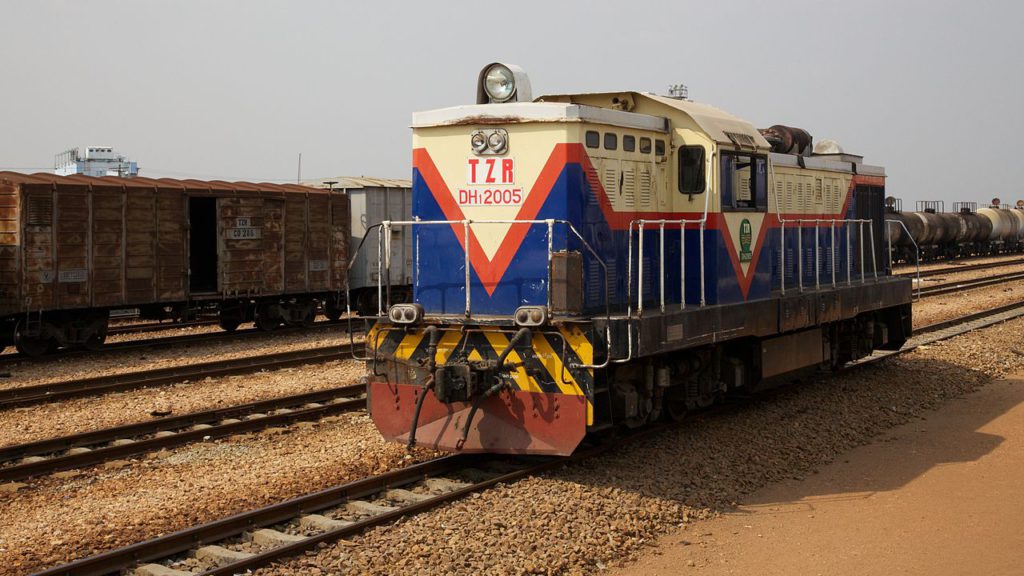
China starts $1.4 billion revamp of Mao-era African railway


Tazara Railway. David Brossard, Wikimedia Commons, under licence CC BY-SA 2.0.

Zambia initiated a $1.4 billion overhaul of a key railway linking the southern African nation’s copper region to a port on the Indian Ocean, in a ceremony that marked the first visit by a Chinese premier to the country in almost three decades.

The launch of the upgrade by Zambian President Hakainde Hichilema was attended by Chinese Premier Li Qiang and Tanzanian Vice President Emmanuel Nchimbi. It follows a September agreement by the three nations to revamp a route originally financed and built with Beijing’s assistance under Mao Zedong in the 1970s.

“The Tazara railway is a signature project of China-Africa corporation,” Li said in a speech in Lusaka, the capital, on Thursday. “China is ready to work with Zambia and Tanzania to let this railway carry hope, brim with new vigor in the new era and provide more momentum for the development of Tanzania, Zambia and Africa as a whole.”

The 1,860-kilometer (1,156-mile) Tanzania-Zambia railway has fallen into disrepair, operating at only a fraction of its original capacity. Once completed, the upgrade will ease severe congestion at regional border crossings, where most cargo currently moves by road, as Zambia and neighboring Democratic Republic of Congo ramp up copper production.

The line will compete with another — the Lobito Corridor — backed by the US and the European Union, which links the same copper-producing region of Zambia to an Atlantic port on Africa’s west coast.

(By Taonga Mitimingi)


A2MP secures $300 million from Afreximbank for African minerals

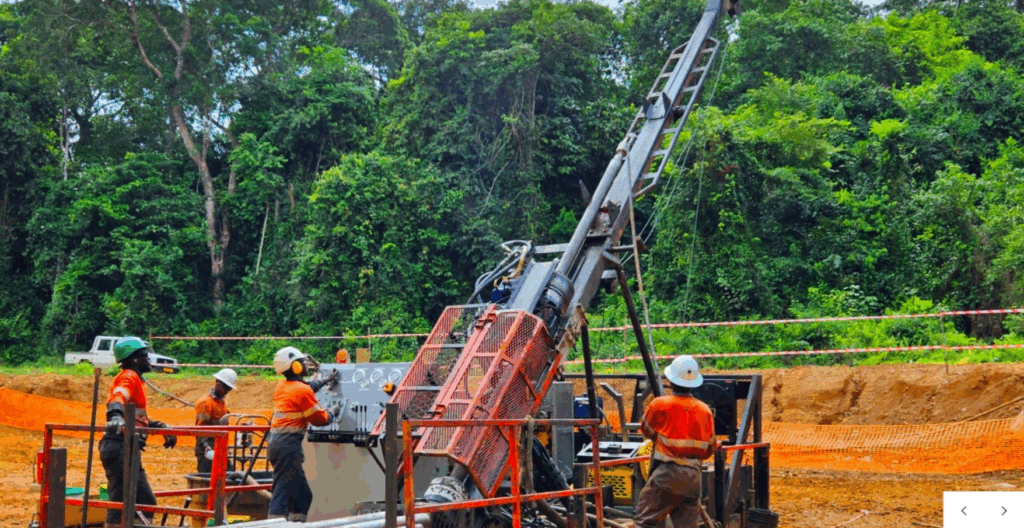
Minkebe and Mboumi project in Gabon. Credit: A2MP

A2MP, a minerals processing company controlled by the family of Indian businessman Gagan Gupta, has secured $300 million of funding from a subsidiary of the African Export-Import Bank.

The Dubai-headquartered firm will use the mix of debt and equity from Afreximbank’s Fund for Export Development in Africa to support existing projects and target acquisitions, according to A2MP’s global strategy adviser, Adjou Ait Ben Idir. A2MP has mining interests from Gabon and Cameroon to Mozambique, while owning almost 50% of FG Gold, which is building the Baomahun gold mine in Sierra Leone.

“The idea is to cover the whole value chain from exploration to exploitation to processing to trading,” Ben Idir said in an interview. A2MP’s focus is “pan-African and multi-mineral,” she said.

A2MP’s portfolio includes companies with manganese mines and an iron ore project in Gabon, as well as a bauxite venture in Cameroon. One company is already building a ferroalloy smelter in Gabon, Ben Idir said, while another is studying constructing a refinery in Cameroon that would transform bauxite into alumina, the feedstock used to make aluminum.

The leaders of African nations including Democratic Republic of Congo, Guinea and Zimbabwe are pressing investors to build more processing facilities on the continent. Gabon plans to ban the export of raw manganese from 2029.

“We’d love to do it,” Ben Idir said, commenting on mineral-processing projects in Gabon. “If it’s not us, then it’ll be someone else.”

Gupta is the founder and chief executive officer of Arise Integrated and Industrial Platforms, an operator of industrial parks that’s active in more than a dozen African countries. The former Olam Group Ltd. executive’s family office controls A2MP, but is separately backing the construction of a gold mine in Mali and copper exploration in Zambia.

(By William Clowes)