Monday, November 24, 2025

“Things Happen:” Is Murder OK If the Victim Was Controversial?


 November 21, 2025

Photograph Source: Jami430 – CC BY-SA 4.0

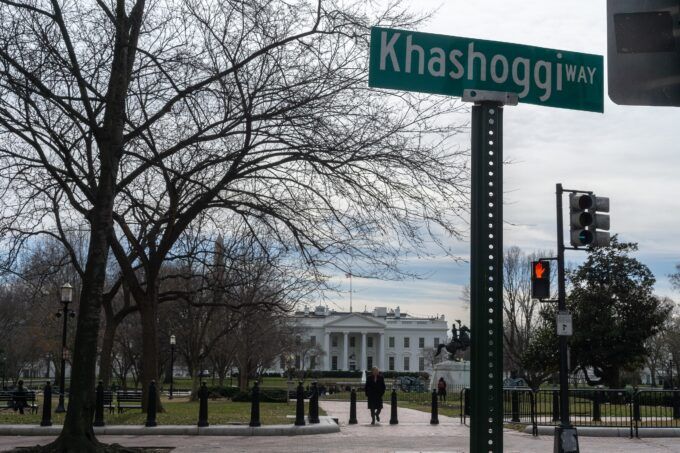
President Donald Trump on Tuesday angrily dismissed a question about the 2018 murder of Jamal Khashoggi, claiming the Washington Post columnist, a Saudi dissident, was “extremely controversial” and insisting the issue was only raised during his meeting with Saudi Crown Prince Mohammed bin Salman to embarrass his visitor.

“A lot of people didn’t like that gentleman [“Kashoggi],” that you’re talking about,” the president explained. “Whether you like him or didn’t like him, things happen.” He added that the crown prince “knew nothing about it.”—again implying that US intelligence agencies, which blamed the prince for the murder, don’t know what they are talking about.

During the joint appearance, Trump called Mohammed “one of the most respected people in the world” and said that they talk on the phone at all hours. Trump also upbraided a reporter from ABC News–libeled as “fake news” by the president—for asking Mohammed about Khashoggi. Trump called her question “horrible, insubordinate and just a terrible question.” He added that the network’s “license should be taken away.” So much for the free speech Trumpists claim to enforce at American universities, where the White House forbids criticism of Israeli “genocide.”

The Saudi prince and US president agreed to sign a mutual defense deal. The president pledged to sell the kingdom American F-35 fighter jets, brushing aside Israeli concerns that such a deal would compromise Israel’s military edge in the Middle East. The two sides made progress on negotiations over exporting Nvidia chips to power Saudi Arabia’s deep investments in artificial intelligence, despite concerns from some U.S. officials that such a move could lead to the spread of American know-how and benefit China.

The president is not burdened by worries about human life. Between July 2020 and January 2021, the Trump administration resumed federal executions after a 17-year hiatus, putting 13 death row inmates to death in the final months of his first term. This unprecedented flurry of executions made Trump the “most prolific executioner in over a century” and broke with precedent by continuing executions during a presidential transition period

In January 2020 Trump authorized a drone strike that killed Iranian Major General Qasem Soleimani and several others near Baghdad International Airport. The UN special rapporteur on extrajudicial executions considered the assassination a potential violation of international law.

The Trump administration has killed many dozens in military strikes on boats in the Caribbean Sea and the eastern Pacific suspected of transporting illegal drugs. Some lawmakers and international law experts call these actions “sanctioned murder” or extrajudicial killings, arguing they blur the line between law enforcement and an act of war.

Trump and some of his associates have been charged with and convicted of various federal crimes, but none for murder.

The administration’s war on immigrants has killed many in body or spirit, breaking up families and sending targets to countries where they do not know even the language, A Human Rights Watch report cited cases of more than 138 Salvadorans who were killed after being deported  to dangerous conditions in their home country. Even  Russians and Afghan dissidents have been sent back to their dictatorial homelands. Trump has never condemned Russia’s president for killing thousands of Ukrainians and his own people in a war over “controversial” issues.

The administration has shown clemency to many individuals convicted of violent crimes such as the January 6, 2021, attack on Congress.

The bottom line seems to be that if something benefits the president, anything goes. Trump and his family have multiple business interests in the Middle East and other “controversial” places such as Serbia. They expect that whatever they do, no matter how controversial, will go unpunished.

Walter Clemens is Professor Emeritus of Political Science at Boston University and Associate, Harvard University Davis Center for Russian and Eurasian Studies. He is the author Complexity Science and World Affairs and the Republican Virus in the Body Politic.


The U.S.’s Empty Chair U.N. Policy 


 November 21, 2025

The object of the children’s game musical chairs is to find a seat when the music stops. The object of the diplomatic game of “empty chair” is to leave a seat unoccupied to show displeasure with whatever diplomatic game is being played. The United States is now playing the empty-chair game with the United Nations, and the recent Security Council adoption of the U.S. peace plan for Gaza does not change that policy.

Historically, France’s famous “empty chair” policy in 1965 marked a serious setback for the development of the European Union. French President Charles de Gaulle, reluctant to give up French sovereignty to a multilateral organization such as the European Economic Community, refused to send representatives to critical meetings. The United States is showing similar petulant behavior toward the United Nations in its absence from the United Nations Human Rights Council (UNHRC) Peer Review session as well as the U.N.’s climate summit in Brazil.

“You are as others see you,” is not only a principle of social psychology, it also has meaning in international relations. Since 2008, the UNHRC has conducted a formal Universal Periodic Review (UPR) to evaluate how countries uphold human rights. Every four and a half years, different countries are brought before the 47 member Council – members are elected by a majority vote of the U.N. General Assembly. This year it was the United States’ turn to have its human rights record reviewed by its peers.

Guess what? It didn’t show up, making it the first member country to opt out of its own review in the 17+ years of the UPR. Other countries have had their reviews postponed, but there has never been a complete withdrawal. The only other country that has missed its UPR session is Israel (in early 2013), but it later participated after a delay.

The UPR was established to facilitate dialogue among all 193 U.N. member states about their human rights policies. Since the first UPR in 2008, the U.N. has reviewed all 193 member states three times with participation rates close to 100 percent. The U.S. Peer Review has been rescheduled for November 2026 in the hope the U.S. will return to the table. However, its withdrawal means that there will be no U.S. national report, no official U.S. appearance at the review, and no responses to issues raised by civil society in the traditional stakeholder submissions.

A State Department official, as reported by The Hill, justified the empty chair saying taking part would overlook the body’s “persistent failure to condemn the most egregious human rights violators,” and that the U.S. would not be “lectured about our human rights record by the likes of HRC members such as Venezuela, China, or Sudan.”

Others disagree. “Showing up and explaining your own record on human rights is the bare minimum for any government that purports to exercise international leadership and uphold democratic norms,” said Uzra Zeya, president and CEO of Human Rights First. She added, “The United States isn’t being singled out — every U.N. member state takes its turn having its human rights record assessed. Running away from that scrutiny doesn’t just show weakness and a lack of confidence, it will give rights-abusing governments cover to do the same themselves.”

Two academics observed, “T]he USA’s withdrawal from the UPR is (1) an unprecedented step that risks contributing to further regression in global human rights protections, and (2) suppresses civil society organisations’ (CSOs) ability to hold the USA to account both domestically and internationally.”

The UPR is not the only venue where the United States is deploying an “empty chair” policy. Top U.S. government officials did not attend the annual United Nations climate summit for the first time in 30 years. No major American political leaders traveled to Belém, Brazil, to participate in COP30. “President Trump will not jeopardize our country’s economic and national security to pursue vague climate goals that are killing other countries,” a White House spokeswoman explained the absence to the New York Times. Already on his first day in office, Trump had withdrawn from the Paris climate agreement.

Again, others disagree about the U.S. empty chair, this time in Brazil. “The United States has lost credibility…It is completely immature, irresponsible, and very sad for the United States…” a Costan Rican diplomat, Christina Figueres, was quoted in The Guardian.

By empty-chairing COP30, the Trump administration has weakened America’s leadership role in climate diplomacy and given geopolitical competitors like China more room to assert themselves. A June 2025 New York Times article made it clear that “China came to dominate even clean energy industries the United States had once led. In 2008 the United States produced nearly half of the world’s polysilicon, a crucial material for solar panels. Today, China produces more than 90 percent. China’s auto industry is now widely seen as the most innovative in the world, besting the Japanese, the Germans and the Americans.”

Empty-chairing is smugness personified. “I don’t need you, I can do it alone.” France eventually became a member of the European Union and one of its driving forces. “America First,” a popular isolationist slogan from the 1910s through the 1940s that resurfaced in Trump’s 2016 campaign, has reappeared in the administration’s attitude towards multilateral institutions. While Trump’s actions against Venezuela and elsewhere are certainly not isolationist, refusing to participate in the UPR and COP30 and denigrating the United Nations are self-defeating in an interdependent world.

As for the Security Council adopting the U.S. peace plan for Gaza as a potential indication of Trump’s support for multilateralism, Julian Borger in The Guardian described Resolution 2803 (2025) as “a miasma of vagueness” and “one of the oddest in United Nations history.” He added, “The fact that the resolution passed 13-0, with Russia and China abstaining, is testament to its calculated haziness as well as the global exhaustion and desperation over Gaza after two years of Israeli bombardment…” Hardly a ringing endorsement of multilateralism, the resolution does little to signal a fundamental shift in U.S. policy toward the U.N. Its provisions for official Palestinian participation are conditional and extremely limited, reflecting American hegemonic power rather than genuine pluralism.

Musical chairs is a game for children. Empty-chairing is a childish reaction in the adult world of diplomacy. While countries can certainly disagree with one another, refusing to show up is an immature way of expressing that disagreement. Empty-chairing and cherry-picking when to engage multilaterally undermine international cooperation. When the music stops, everyone should have a chair.

Daniel Warner is the author of An Ethic of Responsibility in International Relations. (Lynne Rienner). He lives in Geneva.

Sunday, November 23, 2025


Chinese Yard Delivers DP-Capable Floating Fish Farm Ship

Zhangjiang Bay 1 at launch (Bestway)

Published Nov 20, 2025 11:25 PM by The Maritime Executive


China's Jiangsu Dajin Heavy Industry Co. has delivered a unique world's first: a DP-capable, ship-shaped, cage-type aquaculture vessel for oceangoing service. The unusual ship design will be deployed off the coast of Naozhou Island, Zhanjiang, where it will be initially used to raise yellow croaker.

The new Zhanjiang Bay 1 is a "mobile marine ranch," according to Chinese state media. It is designed to raise multiple species within one fish farm, and has 12 separate production bays. Targeted production is estimated at 2,000-5,000 tonnes of fish, with "low" levels of energy consumption during operations.  

The objective of making a ship-shaped, station-keeping fish farm is to expand aquaculture into deeper offshore waters, according to the operator. With all-electric propulsion and a DP system, plus onboard provisions for fish feed distribution, the vessel will be able to work further off the coast - and will be able to move to more sheltered waters when a storm system comes through. The ship is part of a push to develop a multi-billion-dollar "blue pastures" industry, a new way to add to China's domestic fish production without re-depleting domestic fisheries

The Zhanjiang Bay 1 will be deployed far from disputed waters, but China's giant fish farms have caused tension elsewhere. In the Yellow Sea, two Chinese net cage structures have been installed in the South Korea-China Provisional Measures Zone (PMZ) - an area of indeterminate boundaries between the two countries. Earlier this year, South Korea’s National Assembly declared the net cage structures "a threat to maritime safety" and requested their removal, following an independent assessment that the structures could have dual-use applications for military surveillance.

The shipbuilder that delivered Zhangjiang Bay 1, Jiangsu Dajin - a division of Bestway Marine - is a comparatively new yard on the Yangtze with a specialty in construction vessels. It has delivered heavy lift crane vessels, deep-sea submersible support vessels, and pile-driving barges. At higher volume, it also produces handysize bulkers and 5,000 dwt multipurpose vessels used in coastwise trade. 

China Brightens U.S. Darkness… Nevertheless!


 November 21, 2025

Image by Getty and Unsplash+.

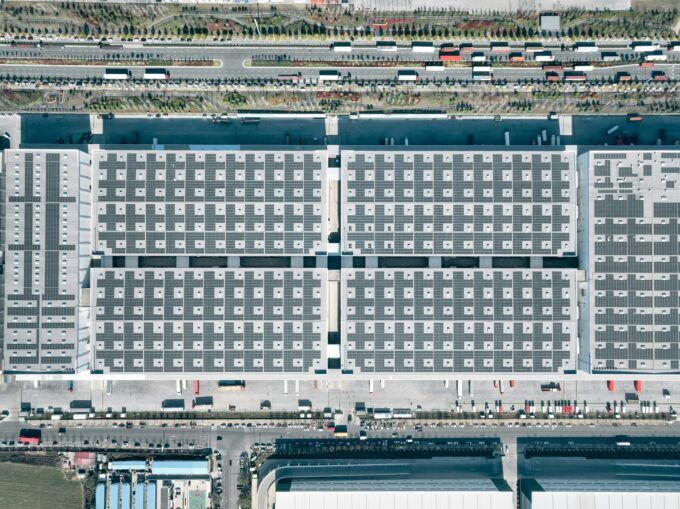
China is leading the green energy transition for the world as the United States tries to force countries to buy US oil and gas. Last year China installed more renewable energy than the rest of the world combined. Meanwhile, the US committed $625 million in taxpayer funds to save and revive the coal industry. Yes, US taxpayers are subsidizing coal production. It should be noted that “clean coal” is so misleading that it reeks of malodorous sulfur.

China is upstaging the United States across the world by tackling climate change head on. According to a brilliant article in YaleEnvironment360 by Isabel Hilton, As U.S. and E.U. Retreat on Climate, China Takes the Leadership Role, November 10, 2025, “China today produces about 80 percent of all solar panels and more than 70 percent of all electric vehicles.” China has reduced the cost barrier for “the rest of the world” by bringing down costs of solar panels by 90% and reducing the overall expenses for renewables by 70%. Furthermore, as the world’s biggest clean energy juggernaut, it builds clean energy factories abroad investing in 54 countries over the past three years alone. This is tackling climate with gusto while the US reverts to the dark ages of grinding away drill bits and steam shovels blackening the atmosphere.

“If history is any guide, the country that dominates energy usually dominates economics and politics, which is why it is not just old war allies that are cozying up to Beijing. Narendra Modi, the president of longtime rival India, visited China for the biggest ever meeting of the Shanghai Cooperation Organization along with dozens of other regional leaders.” (There is Only One Player: Why China is Becoming a World Leader in Green Energy, The Guardian, September 7,2025).

China’s renewable effort is well ahead of expectations. The country has installed capacity of 1,200GW six years ahead of schedule, which is enough to power approximately 1.2 million homes.

Yet, China is still heavily addicted to coal: “Scientists and campaigners say the climate will not be stabilized solely by selling more photovoltaic cells or windmill blades; it is also necessary to phase out fossil fuels. On this half of the balance sheet, China’s record remains ‘highly insufficient’ and its current policies would, if continued, push the planet towards 4C of heating, according to Climate Action Tracker, an independent initiative assessing countries’ compliance with the Paris agreement. It points out that China is off course from the commitments it previously made to ‘strictly limit’ coal use and to reduce energy and carbon intensity by 2025,” Ibid.

The pushback has been most evident in China’s coal sector, where there has been a surge of investment in the past two years to the highest level in a decade. Major domestic coal companies, such as CHN Energy, Jinneng and Shaanxi Coal and Chemical, have considerable political influence. Thus, China, similar to the US, is beholden to rightward leaning politics that override green technology policies, making it nearly impossible to meet nation/state emissions targets set at Paris 2015 to hold global warming to under 2C. This ridiculously dangerous course has, in fact, become a bad joke, not a laughing matter, as the world’s whipsaw climate system thrashes civilization at every turn. The 2020-decade ia the most expressive decade of a worldwide maniac climate system of all time with ocean heat content dangerously hitting all-time records. A major study claims an ocean regime change. This is a serious threat to the entire planetary climate system equivalent to an emergency.

Coal Kills Climate and People

“Despite claims of ‘clean coal’ made by the industry and administration officials, coal is the dirtiest and most polluting fuel on the planet. Every terawatt-hour of electricity from coal emits about 950,000 metric tons of carbon dioxide, the primary driver of climate change. Even fracked gas emits only about 57 percent as much CO2. Both the mining and burning of coal also create huge quantities of other pollutants: sulfur dioxide, nitrogen oxides, particulates, heavy metals, and fly ash. A 2023 study in the journal Science found that coal particulates are more than twice as deadly as the same-size particulates from other sources and traced over 450,000 deaths to coal pollution since 1999.”(The Real Reason the Feds Want to Revive Coal, Sierra, October 15, 2025)

AI Greets Coal

The real push for coal is coming from another industry with close ties to the Trump administration. Technology companies investing heavily in AI are fostering a boom in data centers nationwide. Data centers took up about 2 percent of the nation’s electrical power pre-2020. By 2023, that share more than doubled to 176 terawatt-hours of power, more than the total power for the State of Illinois. By 2028, data centers are projected to use up to 12 percent of the entire US electrical grid. This spike in power requirements is impacting electrical bills for consumers, and along with Trump policies slowing down or shutting down new renewable power projects, it will require a ramp up in coal and gas. Trump is preying upon this sudden surge in power requirements to endorse coal. The EPA has proposed delays and gutting regulations for wastewater from coal-fired power plants and pledged to gut the Clean Air Act’s Regional Haze Rule as the DOI intends to open 13.1 million acres of federal land for coal mine leasing.

In the biggest step backwards in modern US history, the Trump administration is spoiling both the atmosphere and the nation’s waterways “Expanding mining and spending taxpayer money on burning coal, while rolling back vital health protections, will only exacerbate the deadly pollution and rising electricity bills that communities are facing across the country,” (Earthjustice Responds to Trump Administration Coal Industry Giveaways, Earthjustice, Sept. 26, 2025).

Red States suffer much more from these policies than any other states. They are double-clobbered (1) by loss of Biden Inflation Reduction Aet jobs, e.g. wind and solar, that Trump cancels, decimating climate mitigation policies, axing climate science, firing leading scientists (the “brain drain”) and (2) suffer the biggest impact of deadly pollution as their blackened coal operations revive. They elected Trump and got what he promised to do, destroy renewables and pollute the atmosphere. “Clean coal” is the biggest con in the history of the planet.

Headlines: “Republicans Sell Out Constituents, Vote to Cut Jobs and Raise Energy Costs Nationwide,” Climate Power, May 27, 2025. “About 80 percent of manufacturing investments spurred by a Biden-era climate law have flowed to Republican districts.” (The New York Times, Feb. 11, 2025) Anything with Biden’s name attached is destroyed.

Project 2025 hit the green economy like a tsunami of mass destruction but Red States take the biggest hits; beware of Midterms vomiting up a lame duck presidency.

Robert Hunziker lives in Los Angeles and can be reached at rlhunziker@gmail.com.