Sunday, November 23, 2025

Quiet, Piggy: Reporters Aren’t Trump’s Subordinates
 November 21, 2025

Photograph Source: The White House – Public Domain

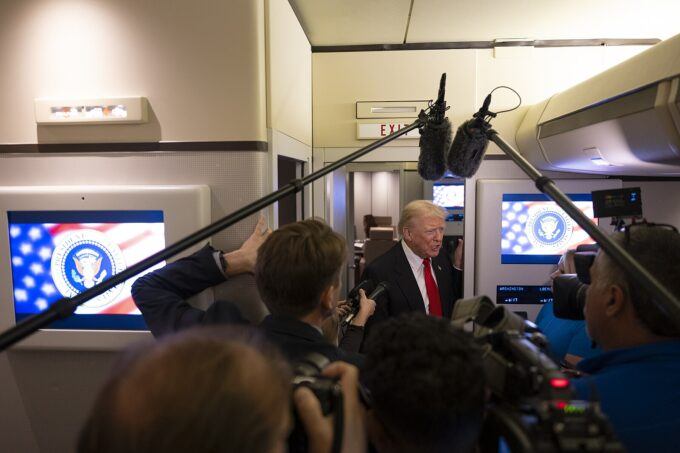
At an Oval Office event on November 18, US president Donald Trump let loose on an ABC News reporter, Mary Bruce, for daring to question Saudi terror kingpin Mohammed bin Salman about the 2018 murder — by Saudi agents, likely on MBS’s direct order — of Washington Post columnist Jamal Khashoggi.

Such questioning, Trump said, was “insubordinate,” musing that Federal Communications Commission chair Brendan Carr “should look at” taking away ABC’s broadcast license.

What does it mean to be “insubordinate?”

Put simply, insubordination entails a person who’s lower on some ladder of authority defying the orders of someone who’s higher on that ladder.

Trump clearly believes in the existence of such a ladder, upon which he enjoys higher ranking than, and authority over, mere mortals. Especially journalists. And most especially female journalists.

He doesn’t bother trying to hide that belief. Earlier in the week, while fielding questions about his long, close, personal relationship with late sex trafficker Jeffrey Epstein, a flustered Trump tried to shush Bloomberg’s White House correspondent, Catherine Lucey: “Quiet. Quiet, piggy.”

In reality, Trump’s only subordinates (with respect to his position as president of the United States) are employees of the federal government’s executive branch. Literally everyone else in the country is either his equal or his superior.

The president is subordinate to Congress.  Congress makes the laws, and can override his vetoes if he doesn’t like the laws they make. He has to ask the Senate for permission to appoint high-level executive branch officials or to enter into treaties. He only gets to spend money Congress appropriates, and only on the purposes it appropriates that money for.

The president is also subordinate to the courts, especially the US Supreme Court. In any legal controversy involving the executive branch, he has to defend his policies before those courts, or go to them, hat in hand, requesting that they enforce those policies. They decide; he obeys.

That’s what the US Constitution says, and what it means, even if we see far more breach than observance in practice.

With respect to the press, he’s neither superior nor subordinate. They don’t work for him, he doesn’t work for them, and the First Amendment forbids Congress (and therefore its subordinate, the president) to make/enforce laws “abridging the freedom of speech, or of the press.”

As for the public, presidents supposedly work for us, and constantly claim to.

The title “chief executive” doesn’t mean “chief of everything.” It means “chief” of executing the orders his superiors give him, and of the people he further delegates that execution to.

Trump’s not Mary Bruce’s boss. He’s not Catherine Lucey’s boss. He’s neither your boss nor mine. He’s a mere functionary who should learn his place — his SUBORDINATE place.

Thomas L. Knapp is director and senior news analyst at the William Lloyd Garrison Center for Libertarian Advocacy Journalism (thegarrisoncenter.org). He lives and works in north central Florida.

The Rich People Who Own the Media Want Generations to Fight, Not Classes


 November 21, 2025


Photograph by Nathaniel St. Clair

The idea of generational warfare is pernicious tripe. It gets pushed endlessly in the media because rich people would rather see kids lashing out at their parents than at them. And since the rich own the media, we hear a lot about generational inequality. Jeff Bezos’ Washington Post gave us the latest effort at generational warmongering.

Just to give some basic facts that are not in dispute, the country is getting richer year by year. Using the projections from the Social Security Trustees, per capital income is projected to be 15.4 percent higher in 2035, 32.6 percent higher in 2045, and 54.3 percent higher in 2055, when virtually all the baby boomers will be dead.

Since the baby boomers are for the most part not going to be partaking in these higher levels of consumption, who do the generational warriors think will be getting this income? It’s worth mentioning that these could prove to be very conservative projections of income growth. If AI has anywhere near the impact its proponents are claiming, per capita income will grow by far more than the Social Security Trustees are projecting.

Given the indisputable fact that the country is getting richer, how can there be a story where Gen Xers, Millennials, and Gen Zers will be poorer on average than baby boomers? There is a story where generations can do worse through time, but that would be a story of within generation inequality, not between generations inequality.

The problem is not greedy boomers, but rather ridiculously rich people like Elon Musk, Jeff Bezos, and Mark Zuckerberg hoarding the country’s wealth for their own use and the use of their heirs. People are less likely to see that story because these super-rich people are the ones who own the major media outlets and social media platforms, but that is reality.

Given these simple and undeniable facts, it is striking how often we see this generational inequality nonsense. As is the case with this piece, they often push outright lies to make their case. For example, this piece tells readers:

“’Baby boomers “entered the labor force during decades of strong economic growth, rising productivity and relatively high real wages,’ Mitchell said. They were in their prime earning and saving years during long bull markets, namely in the 1980s and ’90s, she said, as well as the economic recovery that followed the Great Recession.”  ….

“And ‘particularly for middle-income workers, real wage gains since the 2000s have been modest, compared to the robust wage growth that boomers benefited from mid-career,’ Mitchell said.” …

“Post-World War II, ‘you had this tremendous boom that many got to ride for a very long period of time,’ Ney said.” [Jeremy Ney, a professor at Columbia University’s business school.]

This turns reality on its head. As I wrote in a piece last month:

“There was in fact a golden age, but it predated the entry of most boomers into the labor market. The economy experienced a period of low unemployment and rapid real wage growth, which was widely shared, from 1947 to 1973. At the endpoint of this boom period, the oldest boomers were 27, and the youngest were 9.

“After 1973, the economy took a sharp turn for the worst. The most immediate cause was the Arab oil embargo, which sent oil prices soaring. The economy at that time was far more dependent on oil than is the case today. Soaring oil prices sent inflation higher, which prompted the Fed to bring on severe recessions, first in 74-75 and then again in 1980-82.

“The full story is more complicated and highly contested, but what happened to the economy is not. We had a period of far higher unemployment and stagnant real wage growth that lasted until the mid-1990s. The median real wage in 1996 was actually 4.4 percent lower than it had been in 1973.

“The average unemployment rate for people between the ages of 20-24 over the years 1973 to 1988 (when the last boomer hit 24) was 11.3 percent. By comparison, it averaged 7.2 percent over the last decade, although it has been rising rapidly in 2025.”

After stagnating for two decades, the median real wage has been rising modestly for the last three decades.

Finally, the piece includes this inadvertently damning comment for the argument it is trying to push on readers.

“’In 1940 there was a 90 percent chance that you were going to earn more than your parents. To somebody born today, it is just a coin flip,’ Ney said.”

Since average income has risen consistently over the last seventy years and is universally projected to continue to rise (barring a climate disaster), the only reason why most workers won’t earn more than their parents would be a further rise in inequality. In other words, more money going to people like Washington Post owner Jeff Bezos and less money going to ordinary workers.

If there is not a further increase in inequality, then most workers in ten or twenty years will be earning considerably more than do workers today. That is irrefutable logic, which apparently has no place in the Washington Post.

This first appeared on Dean Baker’s Beat the Press blog.

Dean Baker is the senior economist at the Center for Economic and Policy Research in Washington, DC. 

Trump Adds Censorship to the Campaign Against Arms Control and Disarmament


 November 21, 2025

Photograph Source: Office of Speaker Mike Johnson – Public Domain

Donald Trump made it clear in the 2016 presidential debates that he had no understanding of the central issues of the nuclear arms race, particularly the role of the nuclear triad.  When Trump couldn’t answer a question on nuclear verification, he predictably responded that “it would take me an hour and a half to learn everything there is to know about missiles.  I think I know most of it anyway,”

The Pentagon’s Joint Chiefs of Staff were so alarmed by Trump’s nuclear ignorance that they held a seminar to brief the president on the nuclear inventory in 2017.  Following the meeting, responding to Trump’s demand for increasing the size of the nuclear inventory tenfold, Secretary of State Rex Tillerson referred to Trump as a “fucking moron.”

In his second term, Trump has deployed a new weapon, which is the censoring of sensitive documents that reveal the danger of an accidental launch of nuclear weapons and the problems associated with nuclear exercises.  In an unprecedented act, the Department of State has removed from its website a 15-page document dealing with a 1983 NATO nuclear exercise that produced a “war scare” in the Kremlin.  The document was withdrawn from the department’s series on the “Foreign Relations of the United States,” which contains over 400 volumes.

When Trump began his second term, he fired the nine nonpartisan members of the Historical Advisory Committee, who presumably would have stood in the way of this unusual censorship.  The censored document dealt with U.S. naval exercises that “simulated surprise naval air attacks on Soviet targets.”  Soviet and Russian officials over the years have assumed that such exercises would be used to conceal an actual U.S. attack against Russia, which is why any evidence of a sophisticated strategic exercise would raise alarm bells in the Kremlin.

I was one of several Soviet analysts at the CIA in 1983 who convinced CIA director William Casey that the Soviet “war scare” was genuine and that President Reagan needed to be informed,  Casey was hesitant at first and his deputy, Robert Gates, was downright dismissive of our analysis.  Fortunately this was one of the few times that Casey ignored Gates and followed the lead of his Soviet analysts.  As a result, President Reagan withdrew from participation in the exercise and the overall exercise was toned down and made less threatening.  This opened the door to the Reagan-Gorbachev summits in the 1980s that produced major success in the field of arms control and disarmament.  (CIA analysts had the advantage of a Soviet agent, Oleg Grinevsky, who provided credibility to the argument that the war scare in the Kremlin was genuine.)

The White House and the Pentagon presumably withdrew the document from the historical record because it explores the danger of possible misuse of nuclear weapons and the added danger of the failure to conduct a strategic dialogue.  Similarly, the Pentagon currently is waging a propaganda war against the important film, “House of Dynamite,” because it exploits the dangers of an accidental launch and the ineffectiveness of national missile defense.  (I co-authored a book, “Phantom Defense,” nearly 30 years ago that documented the failures and waste associated with national missile defense.)

The Trump national security team cannot even claim to have a serious expert on arms control and disarmament at a time when there are compelling reasons for a high-level Russian-American dialogue to reduce nuclear weapons, to restrict military exercises, and to avoid any return to nuclear testing. The Russians have called for such a dialogue; the United States has not yet responded.

The Cuban missile crisis should have taught us lessons in support of bilateral negotiations in times of tension as well as the need to bring China into the strategic dialogue.  Shouldn’t we assume that Russian and Chinese leaders who face U.S. military encirclement and aggressive military exercises could overreact to the actions and policies of their major adversary?

Melvin A. Goodman is a senior fellow at the Center for International Policy and a professor of government at Johns Hopkins University.  A former CIA analyst, Goodman is the author of Failure of Intelligence: The Decline and Fall of the CIANational Insecurity: The Cost of American Militarism, and Whistleblower at the CIA: An Insider’s Account of the Politics of Intelligence.  His forthcoming book is American Carnage: Donald Trump’s War on Intelligence.  Goodman is the national security columnist for counterpunch.org.