Tuesday, November 25, 2025

Israel launches strikes in Gaza ceasefire's latest test as hospitals say 24 killed

DEIR AL-BALAH, Gaza Strip (AP) — Israel has previously carried out similar waves of strikes after reported attacks on its forces during the ceasefire.
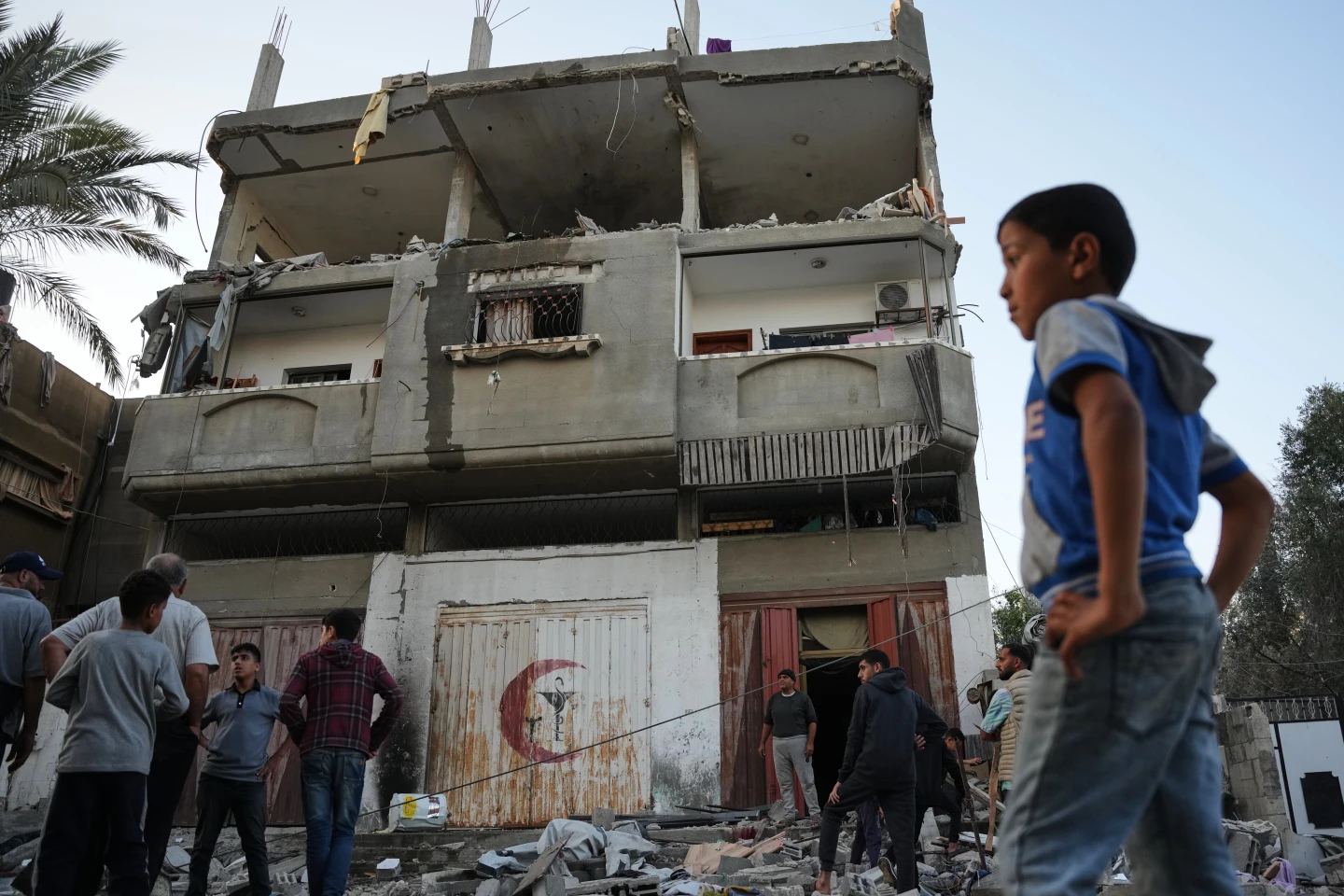

Palestinians inspect the damage to a house targeted by an Israeli strike in Deir al-Balah, in the central Gaza Strip, Saturday, Nov. 22, 2025. (AP Photo/Abdel Kareem Hana)

Wafaa Shurafa
November 24, 2025

DEIR AL-BALAH, Gaza Strip (AP) — Israel’s military on Saturday launched airstrikes against Hamas militants in Gaza in the latest test of the ceasefire that began on Oct. 10, as Prime Minister Benjamin Netanyahu’s office said five senior Hamas members were killed. Health officials in Gaza reported at least 24 people killed and another 54 wounded, including children.

The strikes, which Israel said were in response to gunfire at its troops, came after international momentum on Gaza, with the U.N. Security Council on Monday approving the U.S. blueprint to secure and govern the territory. It authorizes an international stabilization force to provide security, approves a transitional authority to be overseen by President Donald Trump and envisions a possible future path to an independent Palestinian state.

Israel has previously carried out similar waves of strikes after reported attacks on its forces during the ceasefire. At least 33 Palestinians were killed over a 12-hour period Wednesday and Thursday, mostly women and children, health officials said.

‘A fragile ceasefire’

One of Saturday’s strikes targeted a vehicle, killing 11 and wounding over 20 Palestinians in Gaza City’s Rimal neighborhood, said Rami Mhanna, managing director of Shifa Hospital, where the casualties were taken. The majority of the wounded were children, director Mohamed Abu Selmiya said.

Associated Press video showed children and others inspecting the blackened vehicle, whose top was blown off.

A strike targeting a house near Al-Awda Hospital in central Gaza killed at least three people and wounded 11 others, according to the hospital. It said a strike on a house in Nuseirat camp in central Gaza killed at least seven people including a child and wounded 16 others.

Another strike, targeting a house in Deir al-Balah in central Gaza, killed three people, including a woman, according to Al-Aqsa Hospital.

“Suddenly, I heard a powerful explosion. I looked outside and saw smoke covering the entire area. I couldn’t see a thing. I covered my ears and started shouting to the others in the tent to run,” said Khalil Abu Hatab in Deir al-Balah. “When I looked again, I realized the upper floor of my neighbor’s house was gone.”

He added: “It’s a fragile ceasefire. This is not a life we can live. There’s no safe place.”

Israel’s military in a statement said it launched attacks against Hamas after an “armed terrorist” crossed into an Israeli-held area and shot at troops in southern Gaza. It said no soldiers were hurt. The military said the person had used a road on which humanitarian aid enters the territory, and called it an “extreme violation” of the ceasefire.

In other statements, the military said soldiers killed 11 “terrorists” in the Rafah area and detained six others who tried to flee an underground structure. It also said its forces killed two others who crossed into Israeli-held areas in northern Gaza and advanced toward soldiers.

Israeli forces remain in just over half of Gaza after withdrawing from some areas under the ceasefire.

A senior member of Hamas’ political bureau, Izzat al-Rishq, in a statement accused Israel of “fabricating pretexts to evade the (ceasefire) agreement and return to the war of extermination” and said Hamas had urged the U.S. and other mediators to compel Israel to implement the agreement.

The Hamas statement didn’t comment on the claim by Netanyahu’s office of five senior members killed.

The toll of war

The war began with the Hamas-led attack on southern Israel on Oct. 7, 2023, that killed some 1,200 people and took over 250 hostage. Almost all of the hostages or their remains have been returned in ceasefires or other deals. The remains of three are still in Gaza.

Israelis rallied again on Saturday night in Tel Aviv, demanding a state commission of inquiry into the events around the Oct. 7 attack.

“The government of Israel failed in its most important mission: to protect its children, to protect its citizens, not to abandon soldiers on the battlefield without rescue and without assistance,” said Rafi Ben Shitrit, father of Staff Sgt. Shimon Alroy Ben Shitrit, who was killed in the attack.

Gaza’s Health Ministry says 69,733 Palestinians have been killed and 170,863 injured in Israel’s retaliatory offensive. The toll has gone up during the ceasefire both from new Israeli strikes and from the recovery and identification of bodies of people killed earlier in the war.

The ministry does not distinguish between civilians and combatants in its figures but has said women and children make up a majority of those killed. The ministry, part of the Hamas-run government and staffed by medical professionals, maintains detailed records viewed as generally reliable by independent experts.

NAKBA II
Netanyahu convenes cabinet on settler violence in the West Bank that continues unabated

JERUSALEM (AP) — In the latest deaths, the Palestinian Health Ministry said two Palestinian youths aged 18 and 16 were killed by Israeli gunfire overnight.


Julia Frankel
November 24, 2025

JERUSALEM (AP) — Israel’s prime minister met with top security officials to discuss a rising tide of Israeli settler violence in the West Bank, an Israeli official said Friday, as fresh allegations surfaced of Israeli settlers hurling rocks at passing Palestinian vehicles in the West Bank village of Huwara.

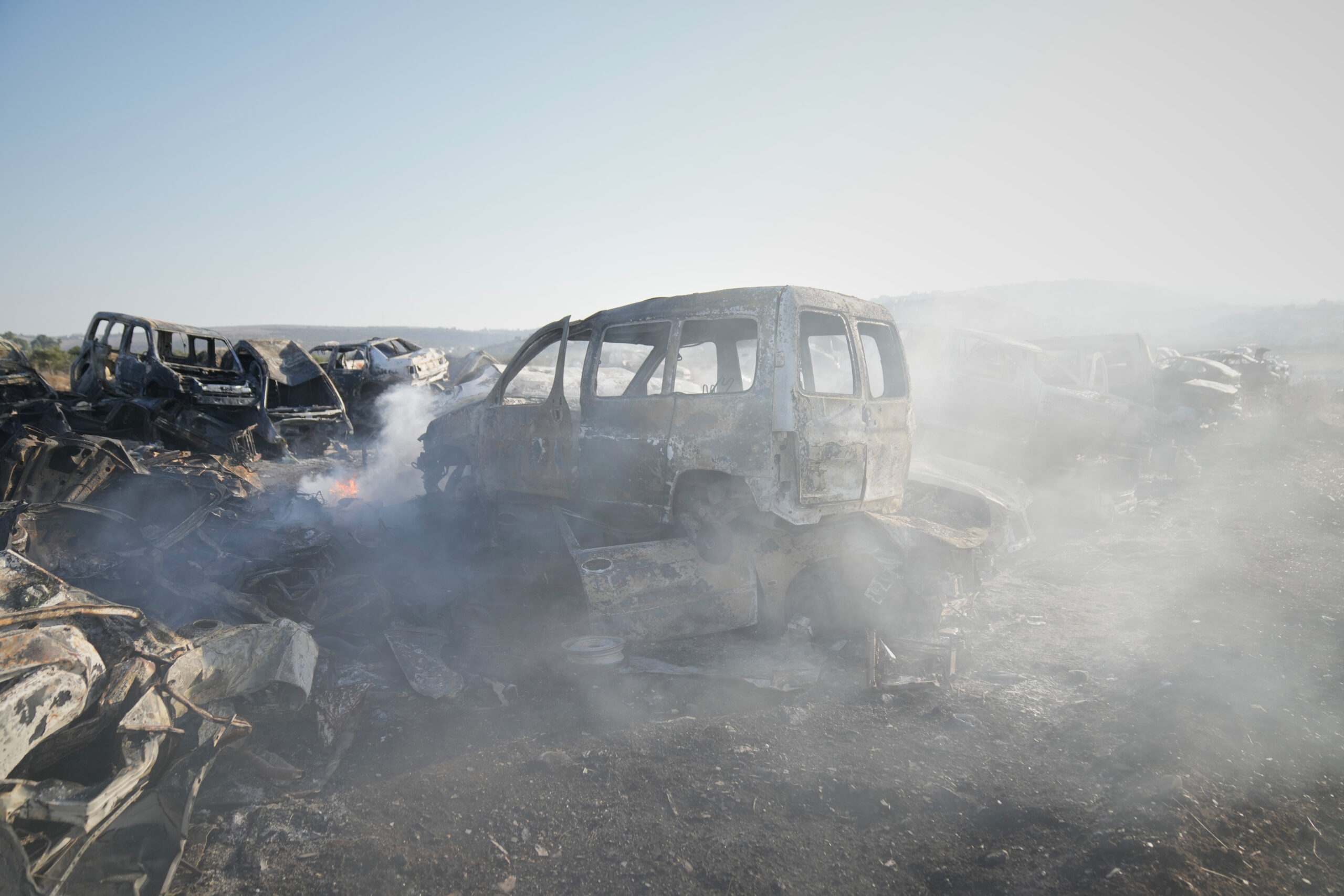
Huwara Mayor Jihad Ouda said the stone throwing was quickly followed by a huge fire at a nearby scrapyard. Flames lit up the evening sky and sent massive columns of smoke into the air, images and video on social media showed. The military said it had reports that Israelis set the fire and that police were investigating.

The U.N. humanitarian office documented 29 attacks by settlers in the West Bank from Nov. 11-17, U.N. spokesman Stephane Dujarric told reporters Friday. The attacks caused 11 injuries and damage to 10 homes, two mosques and nearly two dozen vehicles, as well as damage to crops, livestock, and roughly 1,000 trees and saplings, he said.

Israeli forces have killed more than 200 Palestinians in the West Bank so far this year, including 50 children, Dujarric said.

In the latest deaths, the Palestinian Health Ministry said two Palestinian youths aged 18 and 16 were killed by Israeli gunfire overnight. The circumstances of the shootings were not immediately clear. Israeli police did not immediately respond when asked to comment.

At the meeting, Prime Minister Benjamin Netanyahu and officials from the military, the country’s Shin Bet domestic security service and the police discussed the recent spike in violence and proposals on curbing it, according to an Israeli official who spoke on condition of anonymity because they were not permitted to talk about a closed-door gathering. The official said proposals floated at the meeting included getting violent settlers to attend educational programs.

The Prime Minister’s Office did not immediately respond to request for comment about what was discussed. The Israeli official said there would be a follow-up meeting.

Settler attacks ramped up during the Palestinian olive harvest season in October and early November and have continued since. Netanyahu has called the perpetrators “a handful of extremists” and urged law enforcement to pursue them for “the attempt to take the law into their own hands.” But rights groups and Palestinians say the problem is far greater than a few bad apples, and attacks have become a daily phenomenon across the territory.

Stones hurled at Palestinian cars, scrapyard torched


Mohammad Dalal, the owner of the torched Huwara scrapyard, claimed that witnesses told him Israeli settlers were seen throwing rocks Thursday from an overpass at passing Palestinian vehicles below. He said the massive fire began soon after.

He said the Israeli army arrived later to force the perpetrators away.

“If the army had not removed them, they would have done even more,” Dalal said. “These settlers are causing destruction everywhere here. … Where can we go? We want to remain steadfast on our land, no matter what.”

An Israeli investigation unit of soldiers and border police officers on Friday collected evidence at the scorched scrapyard, according to an Associated Press crew who was asked to leave by the investigators.

Asked about the incident, the Israeli military said it dispatched soldiers to the area after receiving reports that settlers were throwing rocks at Palestinian cars. It also said other reports indicated that “several” Israeli civilians had set fires and damaged property in the area. It said soldiers searched the area but didn’t find any suspects and that the police were now handling the case.

Huwara has been the target of numerous attacks over recent years. In February 2023, scores of Israeli settlers went on a violent rampage there, setting dozens of cars and homes on fire after two settlers were killed by a Palestinian gunman. Palestinian medics said one man was killed and four others were badly wounded.

Settler violence surges

U.N. humanitarian office figures show 2,920 Israeli settler attacks took place between January and October this year.

Israel’s government is dominated by far-right proponents of the settler movement including Finance Minister Bezalel Smotrich, who formulates settlement policy, and Cabinet minister Itamar Ben-Gvir, who oversees the nation’s police force.

The security cabinet meeting came shortly after Israeli settlers celebrated the creation of a new, unauthorized settlement near Bethlehem.

Israel’s Civil Administration also recently announced plans to expropriate large swaths of Sebastia, a major archaeological site in the West Bank. Peace Now, an anti-settlement watchdog group, said the site is around 1,800 dunams (450 acres) — Israel’s largest seizure of archaeologically important land.

Singapore slaps sanctions on Israeli settlers

Singapore said Friday it will impose targeted financial sanctions and entry bans on four Israeli individuals for what it said was their involvement in violence against Palestinians in the West Bank. Singapore’s Foreign Ministry named the individuals as Meir Ettinger,Elisha YeredBen-Zion Gopstein and Baruch Marzel. Some are currently under international sanction by the European Union, the U.K. and other countries.

In a statement, Singapore’s Foreign Ministry said the settlers have been involved in “egregious acts of extremist violence against Palestinians in the West Bank” and urged the Israeli government to stop the violence and hold the perpetrators accountable.

—-

AP correspondent Edith M. Lederer at the United Nations contributed to this report.
Associated Press religion coverage receives support through the AP’s collaboration with The Conversation US, with funding from Lilly Endowment Inc. The AP is solely responsible for this content.

Opinion

Why did so many influential Jews dine with bin Salman at the White House?

(RNS) — Have we become so enamored with access — to influence, wealth, power — that we neglected the very old Jewish instinct that is the courage to say no?


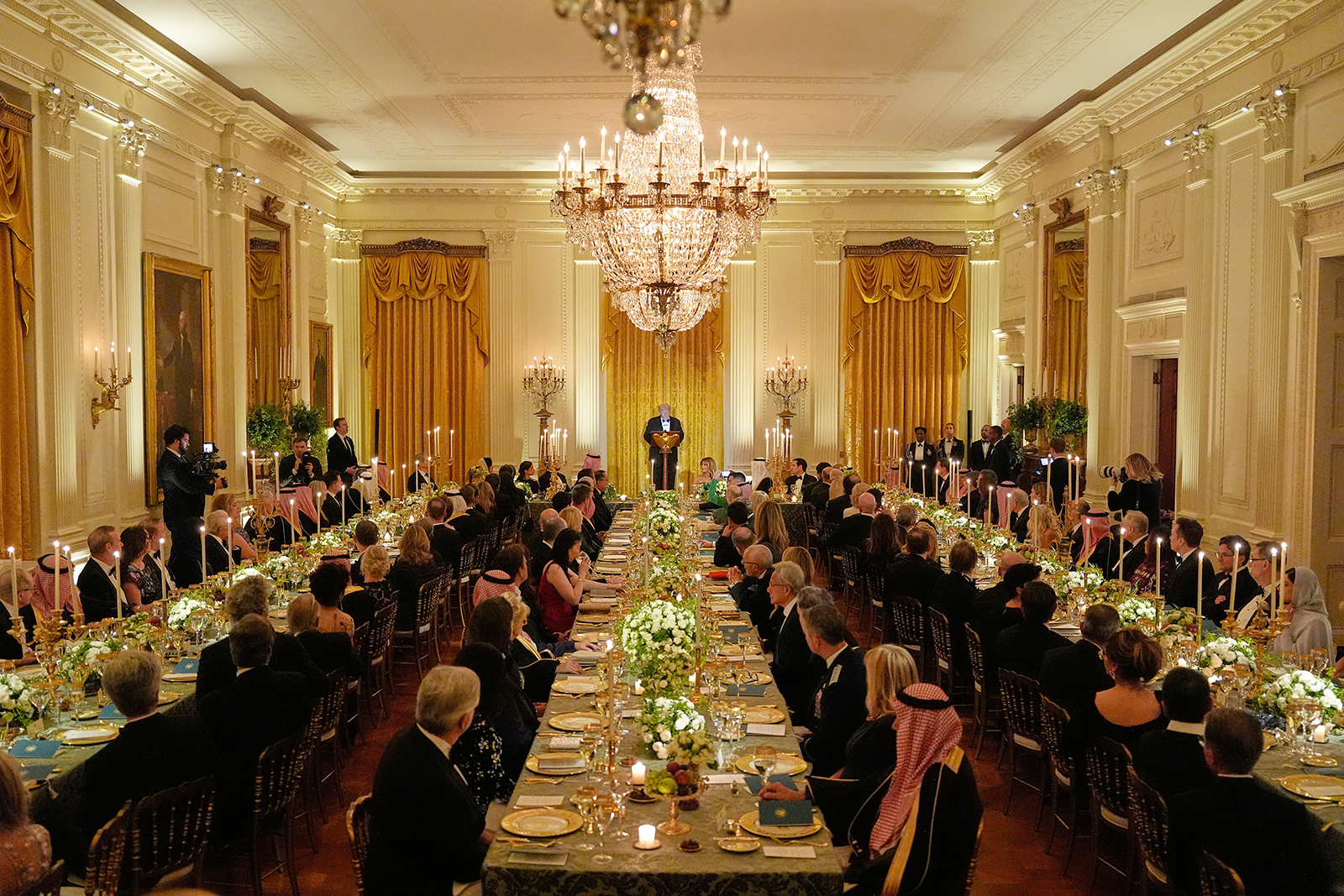
President Donald Trump speaks during a dinner with Saudi Arabia's Crown Prince Mohammed bin Salman in the East Room of the White House, Tuesday, Nov. 18, 2025, in Washington. (AP Photo/Alex Brandon)


Jeffrey Salkin
November 21, 2025
RNS


(RNS) — When you take your tux to the dry cleaners after a big state banquet, and you notice there is a blood stain on the cuff, do you have to pay extra for them to get it out?

I’m asking because the White House held a black-tie dinner for Saudi Crown Prince Mohammed bin Salman. The guest of honor was a man whom the CIA concluded ordered the cold-blooded, bone-saw murder of journalist Jamal Khashoggi.

Seated in the room were some of the most influential Jewish business leaders and philanthropists of our generation, including: Stephen Schwarzman, CEO of Blackstone; Josh Harris, managing partner of the Washington Commanders; Bill Ackman, CEO of Pershing Square Capital Management; Neri Oxman, an American-Israeli designer; Marc Benioff, CEO of Salesforce; Alex Karp, CEO of Palantir Technologies; Albert Bourla, CEO of Pfizer; and David Ellison, CEO of Paramount Skydance.

These CEOs, investors and power brokers were present because they run empires — financial, technological and cultural. One is the child of Holocaust survivors, and many are extremely generous to worthy Jewish causes.

Did they shake Prince Mohammed’s blood-tainted hand?

I understand and support diplomacy, geopolitical strategy and the necessity of normalization between Israel and Saudi Arabia. And some might say the aforementioned A-listers were not there “as Jews.” They were simply there, as my parents would have said, as machers, or important people.
RELATED: The ideology that killed Rabin is alive and well 30 years later

That begs a larger question: When identifiable Jews show up, can they ever not show up as Jews? And if they show up as Jews, can they ever not ask themselves questions like, is there a cost to standing too close to power that has blood on its hands? Is there a point at which access becomes complicity? And, when Jews forget the value of moral distance, what are we losing?

This moment did not emerge from a vacuum. As Chuck Freilich, the former Israeli deputy national security adviser, pointed out in eJewishPhilanthropy, we are witnessing a generational shift in American Jewish influence.

In 1981, the organized American Jewish community mobilized ferociously to fight the sale of surveillance aircrafts to Saudi Arabia. Every major Jewish organization was engaged. They ultimately lost, but they extracted a lasting victory: the U.S. commitment to Israel’s “qualitative military edge,” a pledge later codified in law.

That was what communal power looked like. But today? We have a proposed sale of F-35 stealth fighters to Saudi Arabia, which the Israeli military has warned would potentially threaten its regional air superiority and the country’s security. And Jewish leaders are still dining with Saudi Arabia’s ruler and the American president together.

As Judah Ari Gross writes in eJewishPhilanthropy:

The American Jewish institutional power that was far more potent in 1981 has been supplanted by the influence of individual American Jews, including those in attendance at last night’s White House dinner. “For Jewish businesspeople to have connections with the Saudis is not only not problematic, they can be a bridge,” Freilich said.

However, Freilich warned that while they can have an influence on geopolitical events, these Jewish business leaders are inherently constrained and are not a sufficient substitute. “Sure, they have clout, but they need to use it judiciously,” he said. That is why American Jews need to have a “really strong lobby,” Freilich said. “They don’t have the power that they once did, and that’s a real problem.

What did it mean for those Jewish leaders to be present in the White House dining room at the side of a ruler whose hands are, according to our intelligence community, stained by atrocity? What did it mean for the memory of Khashoggi? What will it mean for our children, who will learn that the business titans of their community dined in the presence of a man who allegedly silenced a dissident with a bone saw?

What did it mean for our ancestors, who taught us — through Torah, through history, through our very blood — that Jewish dignity is bound up with the refusal to bow before cruelty?

I am not naïve. I have binged “The Diplomat” on Netflix. I know international relations require engagement with unsavory actors. Diplomacy is not a seminar in moral philosophy.

But, still, there is a price, or at least a question. Have we become so enamored with access — to influence, wealth and power — that we have neglected the very old Jewish instinct that is the courage to say no? Or at least have hesitation, second thoughts or conscience? If we cannot ask for that, then, as Jews, what are we doing in the world?

Who is my hero in this story of proximity to power? Mary Bruce of ABC News. She was among the reporters let into the Oval Office to question the president and Prince Mohammed. She asked Trump whether it was appropriate for his family to be doing business in Saudi Arabia while he was president. Then, she asked the prince:

Your royal highness, the U.S. intelligence concluded that you orchestrated the brutal murder of a journalist — 9/11 families are furious that you are here in the Oval Office. Why should Americans trust you? And the same to you, Mr. President.

In response, Trump said, “You don’t have to embarrass our guest by asking a question like that.” He also later called her question, “a horrible, insubordinate, and just a terrible question.”

But in that moment, she was not just speaking for herself. The biblical prophets Nathan, who castigated King David, and Elijah, who castigated King Ahab, were speaking through her lips.

We need more of that. And we need well-placed Jews to try some of it as well.

If we cannot speak honestly when we stand too close to power that kills, then our silence is not strategy. It is surrender.

Before the next invitation arrives, let us think about this a little bit more clearly.


Israel to admit thousands from India's Jewish 'lost tribe'
THEY NEED TO INCREASE THEIR DEMOGRAPHIC VOTING BLOC
with DW, dpa, EFE
November 23, 2025

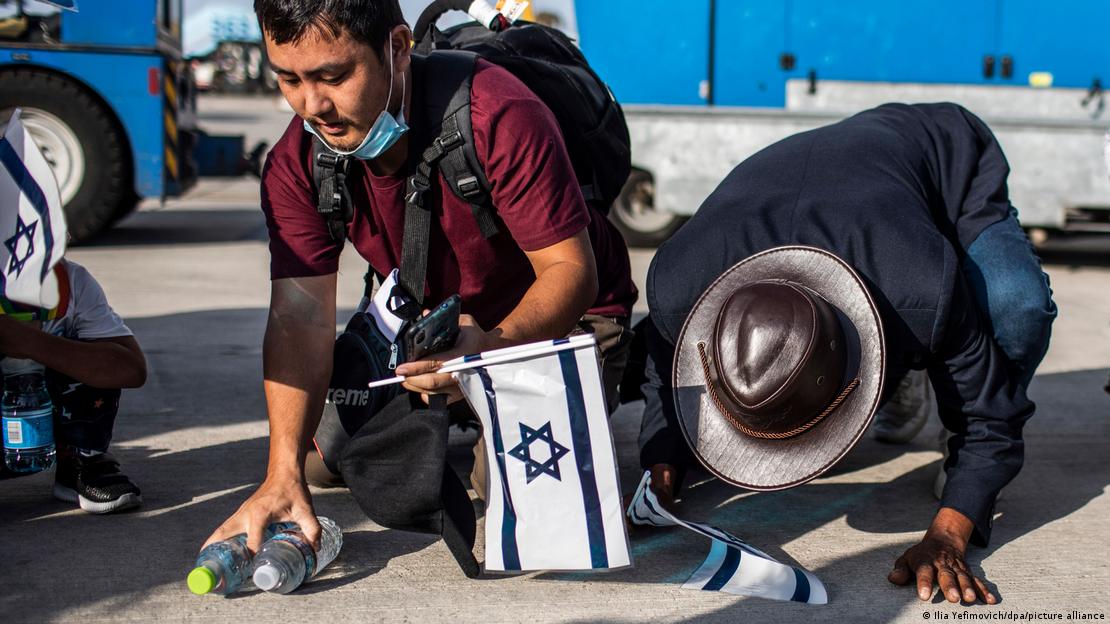
Israel says it is preparing a plan to bring thousands of Jewish-identifying Bnei Menashe from northeast India and resettle them. Prime Minister Benjamin Netanyahu said it was an "important and Zionist decision."

The Jews from India's northeastern states claim to be descendants of one the 10 lost tribes of Israel

Image: Anupam Nath/AP Photo/picture alliance

Israel has approved a plan to absorb about 5,800 members of the Bnei Menashe community by 2030, according to a government decision announced Sunday.

The group, an ethnic community from the northeastern states of Mizoram and Manipur in India, is expected to move to the Galilee region of northern Israel in stages. The region has been heavily affected by conflict with Lebanon's Hezbollah militant group, with tens of thousands of residents leaving the area in recent years.

Prime Minister Benjamin Netanyahu called the decision "important and Zionist," saying it would strengthen Israel's north.

What is the plan for India's Bnei Menashe?

A first group of 1,200 people is scheduled to arrive next year. The ministry responsible for their absorption will provide initial financial support, Hebrew language instruction, job guidance, temporary housing and social programs to help newcomers settle.

The government expects to allocate about €23.8 million (about $27.4 million) for the absorption of this initial wave alone. The upcoming arrivals follow roughly 4,000 Bnei Menashe who have already immigrated to Israel over the past two decades.

The plan was jointly coordinated with the Indian government.


Thousands of the Bnei Menashe have already immigrated to Israel over the past two decades
Image: Ilia Yefimovich/dpa/picture alliance

Demographic considerations remain central to Israeli state policy, particularly in relation to the broader Israeli-Palestinian conflict.

Israel's population stands at about 10.1 million, around 73% of whom are Jewish, compared with an estimated 5.5 million in the Palestinian territories.
Who are India's Bnei Menashe?

The Bnei Menashe identify as descendants of the biblical tribe of Manasseh, considered one of the "lost tribes" of Israel. Many had practiced Christianity before converting to Judaism and receiving recognition from Israel's Chief Rabbinate. They observe traditional Jewish practices, celebrate holidays such as Sukkot, and have established synagogues in their communities.

Israel did not formally endorse Bnei Menashe immigration until 2005, when the then Sephardi Chief Rabbi officially recognized the communityas descendants of a lost tribe of Israel.

Galilee, where they are expected to reside, is a historic mountainous region with major cities including Nazareth, Tiberias, and Safed. It borders Lebanon to the north and the Jordan Valley and Sea of Galilee to the east.

Edited by: Karl Sexton and Roshni Majumdar

Richard Connor Reporting on stories from around the world, with a particular focus on Europe — especially Germany.
Opinion

The theology of climate denial comes to the Pentagon

(RNS) — If you want cover for rolling back climate initiatives, few one-liners do as much work as calling them religious.


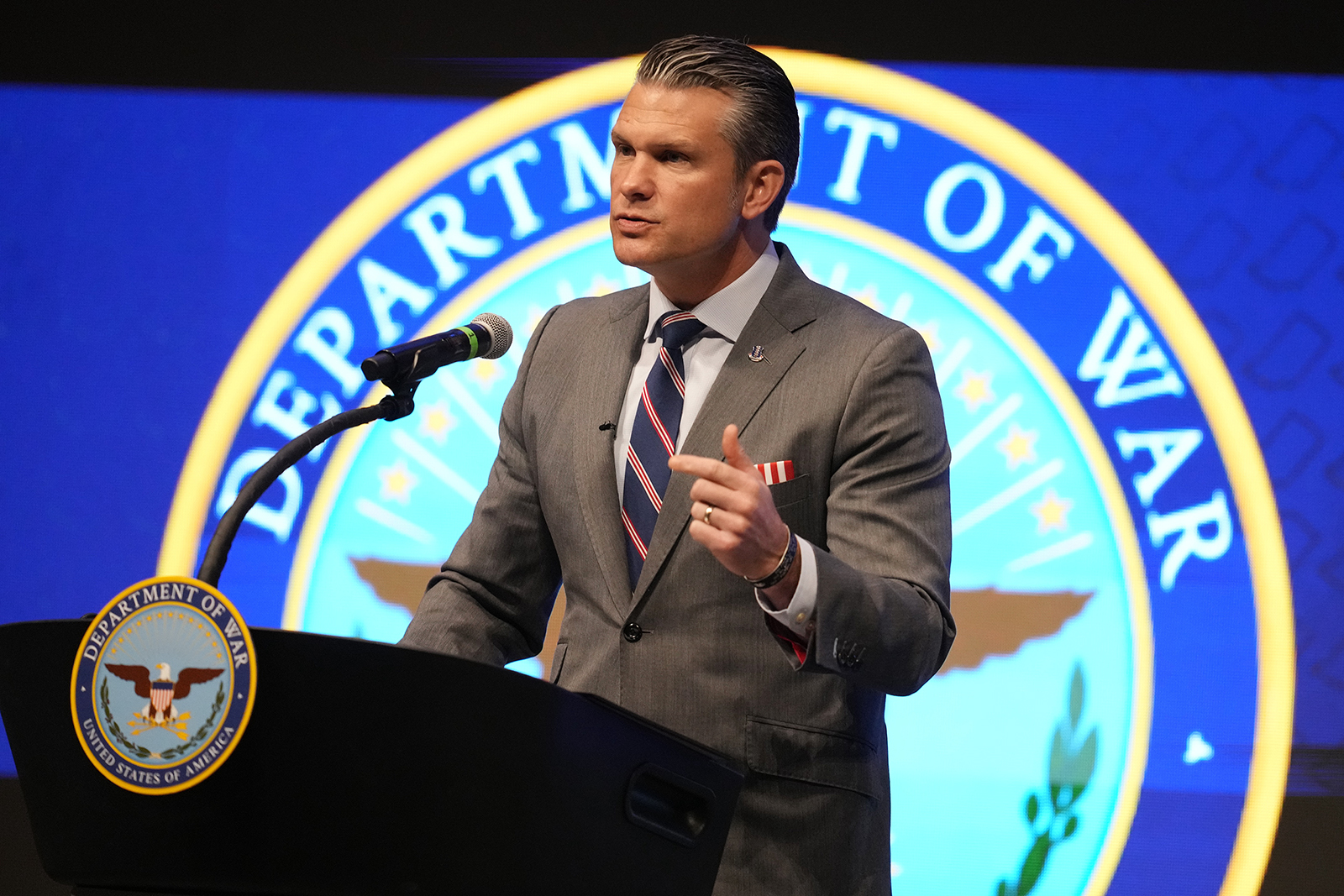
Defense Secretary Pete Hegseth speaks during the 4th annual Northeast Indiana Defense Summit at Purdue University Fort Wayne, Wednesday, Nov. 12, 2025, in Fort Wayne, Ind. (AP Photo/Darron Cummings)


Colin Weaver
November 20, 2025
RNS


(RNS) — In his speech to senior military leaders on Sept. 30, U.S. Secretary of War Pete Hegseth took a well-worn page out of the climate skeptic’s playbook: He framed climate change research, policy and activism as a “religion.” More specifically, he declared there was “no more climate change worship” in the Department of War.

Hegseth has been calling concern with climate change a “religion” for a while. He’s far from alone. Lee Zeldin, the administrator of the Environmental Protection Agency, announced a wave of sweeping environmental deregulations back in March, exclaiming, “we are driving a dagger through the heart of climate-change religion and ushering in America’s Golden Age.” (Zeldin likes the rhetoric.)

Similar remarks were made during the first Trump administration. In 2016, Kathleen Hartnett White, a nominee to head the Council on Environmental Quality, called belief in climate change a “kind of paganism.” William Happer, a physicist and frequent adviser to President Donald Trump in 2017, called climate scientists “a glassy-eyed cult.” More recently, former Trump economic adviser and Heritage Foundation fellow Stephen Moore asserted that “climate change is not a science, it’s a religion.”

The popularity of this rhetoric makes sense. If you want cover for rolling back climate initiatives, few one-liners do as much work as calling them religious.

Anti-environmentalists and climate skeptics have been calling environmentalists “religious” and “fanatical” for decades. In 1971, Richard John Neuhaus published “In Defense of People: Ecology and the Seduction of Radicalism,” a book that described strands of the environmental movement as devotional, absolutist and under the delusion of a sacred mission.

Fast forward to 2003, when Michael Crichton — yes, that Michael Crichton — called environmentalism the religion “we all need to get rid of.” Two years later, Oklahoma Sen. James Inhofe called “man-induced global warming … an article of religious faith.” (He’s the one who used the snowball to “disprove” climate change 10 years later.) Meanwhile, the Cornwall Alliance for the Stewardship of Creation, a right-wing evangelical anti-environmentalist think tank, has regularly used the same slogan.

In 2017, its “Resisting the Green Dragon” campaign went live, which called environmentalism a false religion. (On how American evangelicals pivoted from environmental curiosity in the 1980s to animosity in the ’90s, see Neall W. Pogue’s “The Nature of the Religious Right” and Robin Veldman’s “The Gospel of Climate Skepticism.”) Likewise, throughout the 2000s and 2010s, journalists such as Bret Stephens and Congress-people like Lamar Smith invoked the climate-religion comparison.

But why does this rhetoric work? On one level, it is a familiar way to frame environmentalists as fanatical and dogmatic while positioning their critics as reasonable and realistic. After Zeldin mentioned climate religion, for example, he pivoted to discussing how his policies will save trillions in taxes, reignite American manufacturing and unleash “America’s full potential” while still protecting human and environmental health.

This sloganeering invites us to imagine anyone who wants to constrain our reliance on fossil fuels as opposed to a balanced approach to economics, energy and human well-being. From this angle, it just makes sense to drill, baby, drill and to roll back such principles as the endangerment finding, which states that greenhouse gases endanger public health and welfare.

Yet on another level, the idea of fighting a climate religion appeals to a narrative that has circulated widely among conservative evangelicals going back at least to the 1970s. In that story, secular humanists and others on the left have their own kind of religion, one bent on displacing Christianity. This narrative feeds what religion scholar Veldman calls the “embattled mentality” among many on the religious right. Drawing on her research among evangelicals in Georgia, Veldman argues that evangelical climate skepticism is significantly connected to how environmentalists and, more recently, climate advocates are associated with these forces of Christian displacement.

The idea of fighting a climate religion plays into these replacement anxieties. This dynamic is powerfully symbolized by evangelicals like Inhofe when they invoke their faith to counter climate science. For some right-wing Christians, the struggle against climate-based reforms is part of a larger holy war. That is something Hegseth, also an evangelical, makes explicit in “American Crusade,” which frames the U.S. as besieged by secular leftists, including environmentalists.

As Lisa Sideris has observed, the rhetoric of climate religion is a long-standing strategy to discredit both religion and science while obscuring the very real causes and effects of human-caused climate change in the present and future. So when skeptics use this slogan we get Orwellian doublespeak. The relevant paganism here is the cult of carbon and capital and its curious marriage to strands of conservative Christianity. Skeptics investing in and defunding research on catastrophic global warming are trying to claim in effect, “We’re not the fanatics, you are!”

The rhetorical trick is old, but what is new is the Department of War using it to mask the rolling back of climate initiatives at the Pentagon. In his beautiful and disturbing book “The Nutmeg’s Curse,” Amitav Ghosh describes the vicious relationship between the Pentagon and climate change: On the one hand, Ghosh says, the U.S. military has been one of the most rigorous and longest-standing students of global warming. (Among other sources, Sen. Sheldon Whitehouse cited naval climate research in response to Inhofe’s snowball.)

On the other hand, the military is a massive consumer of fossil fuels and concrete, to say nothing of land degradation, ecocide and pollution, all of which drives climate change and environmental injustice. That relationship alone is shocking: The U.S. military is significantly contributing to the very global crises it is preparing for and responding to (in the forms of, say, climate migration and resource wars).

But with respect to climate skepticism, I used to find a shred of bitter consolation — and a rhetorical tool — in knowing that the military took climate change deadly seriously. Perhaps no more. The denialist rhetoric that initially served to undermine environmental regulation has migrated into the language of the security state itself.


(Colin Weaver is a postdoctoral teaching fellow at the University of Chicago Divinity School. A version of this article originally appeared in Sightings, a publication of the Martin Marty Center for the Public Understanding of Religion at the divinity school. The views expressed in this commentary do not necessarily reflect those of Religion News Service.)


Scientists warn mountain climate change is accelerating faster than predicted, putting billions of people at risk


A major global review has revealed how climate change has impacted mountain regions over the last 40 years


University of Portsmouth

Swiss Alps 

image: 

Ftan, located in the Lower Engadine, Swiss Alps

view more 

Credit: Sven Kotlarski


  • Temperature, rainfall, and snowfall patterns are shifting at an accelerated rate in mountain regions 

  • Over one billion people worldwide depend on mountain snow and glaciers for water, including the populations of China and India 

  • As temperatures rise, more snow is changing to rain, decreasing mountain snowfall 

Mountains worldwide are experiencing climate change more intensely than lowland areas, with potentially devastating consequences for billions of people who live in and/or depend on these regions, according to a major global review. 

The international study, published in Nature Reviews Earth & Environment, examines what scientists call "elevation-dependent climate change" (EDCC) - the phenomenon where environmental changes can accelerate at higher altitudes.  

It represents the most thorough analysis to date of how temperature, rainfall, and snowfall patterns are shifting across the world's mountain ranges. 

Led by Associate Professor Dr Nick Pepin from the University of Portsmouth, the research team analysed data from multiple sources including global gridded datasets, alongside detailed case studies from specific mountain ranges including the Rocky Mountains, the Alps, the Andes, and the Tibetan Plateau. 

The findings reveal alarming trends between 1980 and 2020: 

  • Temperature: Mountain regions on average are warming 0.21°C per century faster than surrounding lowlands 

  • Precipitation and snow: Mountains are experiencing more unpredictable rainfall and a significant change from snow to rain 

“Mountains share many characteristics with Arctic regions and are experiencing similarly rapid changes,” said Dr Pepin from the University of Portsmouth’s Institute of the Earth and Environment. “This is because both environments are losing snow and ice rapidly and are seeing profound changes in ecosystems. What's less well known is that as you go higher into the mountains, the rate of climate change can become even more intense.” 

The implications extend far beyond mountain communities. Over one billion people worldwide depend on mountain snow and glaciers for water, including in China and India - the world's two largest countries by population - who receive water from the Himalayas. 

Dr Pepin added: “The Himalayan ice is decreasing more rapidly than we thought. When you transition from snowfall to rain because it has become warmer, you're more likely to get devastating floods. Hazardous events also become more extreme.” 

"As temperatures rise, trees and animals are moving higher up the mountains, chasing cooler conditions. But eventually in some cases they'll run out of mountain and be pushed off the top. With nowhere left to go, species may be lost and ecosystems fundamentally changed.” 

Recent events highlight the urgency. Dr Pepin points to this summer in Pakistan, which experienced some of its deadliest monsoon weather in years, with cloudbursts and extreme mountain rainfall killing over 1,000 people

This latest review builds on the research team’s 2015 paper in Nature Climate Change, which was the first to provide comprehensive evidence that mountain regions were warming more rapidly higher up in comparison to lower down. That study identified key drivers including the loss of snow and ice, increased atmospheric moisture, and aerosol pollutants. 

Ten years on, scientists have made progress understanding the controls of such change and the consequences, but the fundamental problem remains. “The issue of climate change has not gone away,” explained Dr Pepin. “We can't just tackle mountain climate change independently of the broader issue of climate change.” 

A major obstacle remains the scarcity of weather observations in mountains. “Mountains are harsh environments, remote, and hard to get to,” said Dr Nadine Salzmann from the WSL Institute for Snow and Avalanche Research SLF in Davos, Switzerland. “Therefore, maintaining weather and climate stations in these environments remains challenging.” 

This data gap means scientists may be underestimating how quickly temperatures are changing and how fast snow will disappear. The review also calls for better computer models with higher spatial resolution - typically most current models can only track changes every few kilometres, but conditions can vary dramatically between slopes just metres apart. 

Dr Emily Potter from the University of Sheffield added: “The good news is that computer models are improving. But better technology alone isn't enough - we need urgent action on climate commitments and significantly improved monitoring infrastructure in these vulnerable mountain regions.” 

The ocean is undergoing unprecedented, deep-reaching compound change


Institute of Atmospheric Physics, Chinese Academy of Sciences
Compound Change in the Global Ocean 

image: 

Vast regions of the global ocean are experiencing compound state change, with simultaneously warming, becoming saltier or fresher, losing oxygen, and acidifying.

view more 

Credit: Zhetao Tan


Earth's ocean, the planet's life-support system, is experiencing rapid and widespread transformations that extend far below its surface. A promising international study published in Nature Climate Change reveals that vast regions of the global ocean are experiencing compound state change, with simultaneously warming, becoming saltier or fresher, losing oxygen, and acidifying—clear indicators of climate change pushing marine environments into uncharted territory.

Led by researchers from the Institute of Atmospheric Physics (Chinese Academy of Sciences), Mercator Ocean International (MOI, France), and the Laboratoire de Météorologie Dynamique at the École Normale Supérieure (ENS–PSL, France), the study developed an assessment and monitoring framework and tool to standardise and combine and multiple ocean essential variables, pinpoint when and where are clearly affected by compound state change in a warming climate. With this framework, this study demonstrates an increase in impacts of these compound state changes across much of the ocean's upper 1,000 meters, identifying areas most affected.

“Between 30% and 40% of the ocean's upper layers have already undergone significant shifts in at least two critical properties compared to 60 years ago,” explains Dr. Zhetao Tan (ENS-PSL), the study's lead author. “In some areas, up to a quarter of the ocean shows simultaneous changes in temperature, salinity, and oxygen—a striking and alarming trend.”

The most intense compound changes are occurring in the tropical and subtropical Atlantic, North Pacific, Arabian Sea, and Mediterranean Sea. The combined impact of these shifts is particularly concerning: while each variable affects marine life independently, their simultaneous alteration can push ecosystems beyond their adaptive limits.

“The ocean is experiencing strongly compound change multidimensionally,” warns Prof. Lijing Cheng (IAP/CAS), “The ocean condition is transforming in multiple dimensions at once, and even the deep ocean—once considered stable—is responding more rapidly than we thought.”

This innovative framework also enables us to identify when and where climate change signals surpass short-term variability, and allows us to move from looking at the change in each variable on its own to combining them into a multivariate composite index. This approach allows for scientists to determine when the ocean has transitioned into a new state and how deep these changes penetrate—critical insights for monitoring and mitigating climate risks.

“Our findings are based on direct physical and biogeochemical observations,” emphasizes Prof. Sabrina Speich (ENS-PSL), co-chair of the Ocean Observations for Physics and Climate group. “They underscore the urgent need for sustained, high-quality ocean monitoring to inform global climate action.”

Compound ocean changes are reshaping marine ecosystems and threatening the communities that rely on them. “Marine species face heightened stress when exposed to multiple stressors simultaneously, forcing migration or decline,” notes Dr. Laurent Bopp (ENS–PSL). “This disruption can destabilize global fisheries, compromise food security, and jeopardize livelihoods.”

Beyond biodiversity, these shifts may weaken the ocean's capacity to absorb carbon and heat, undermining its role as Earth's climate regulator.

“This framework provides a scientific foundation for assessing climate risks and supporting policies, such as the expansion of marine protected areas under the UN's High Seas Treaty,” says Dr. Karina von Schuckmann (Mercator Ocean International).