Friday, November 28, 2025

Inside the Chaos of Trump’s Ukraine Peace Plan


  • A U.S.-drafted peace plan has drawn criticism for mirroring Russian demands, including limits on Ukraine’s military and NATO membership.

  • Leaked audio shows Trump’s envoy Steve Witkoff advising a Kremlin aide on how to influence the White House, fueling accusations of bias.

  • Witkoff’s upcoming sixth trip to Moscow, possibly joined by Jared Kushner, underscores Washington’s push for a deal many see as dangerously one-sided.


The White House’s lead envoy is heading to Russia for a sixth time. Ukraine fears a peace that heavily favors Moscow. A leaked phone call shows the US envoy advising a Kremlin official on how to sweet-talk the White House.

And Russia’s invasion -- now in its 46th month -- has pushed Ukraine’s beleaguered armed forces closer to the breaking point.

There’s a lot that happened in the six days since a US-drafted peace proposal first leaked – not to mention the circumstances under which it was drafted.

The 28-point plan jolted what until recently had been sputtering efforts to halt the Russian war, something that Trump had pledged to do within 24 hours of taking office in January.

Here’s what you need to know as of November 26, as diplomats and negotiators from Washington, Moscow, Kyiv, and many other European capitals wrangle over details over a concrete, and controversial plan.

The Main Sticking Points?

After the US plan leaked, and then was given to Ukrainian President Volodymyr Zelenskyy, the Ukrainian leader sent his chief of staff and other officials to Geneva for urgent talks with US officials, including Secretary of State Marco Rubio.

Zelenskyy reportedly was blindsided by the plan, which echoed most of the hard-line positions that Russia has held before the invasion.

The Geneva talks, however, produced an "updated and refined" framework – a reworked 19-point plan -- that would deliver a “sustainable and just peace,” both the White House and Zelenskyy's office said.

But Zelenskyy’s comments suggested the thorniest issues might still be on the table. That includes the fate of a chunk of the Donetsk region that the Kremlin has been hellbent on seizing.

Moscow has repeatedly said it must control all of Donetsk, one of five Ukrainian regions Putin baselessly claims are Russian. Ceding land that Ukraine’s forces have kept out of Russia’s clutches, at great cost, would be a massive concession by Kyiv and could have political repercussions for Zelenskyy.

Other pitfalls include the Kremlin’s insistence that Ukraine be forever barred from joining NATO and a potential cap on the size of Kyiv’s military.

The US draft would require Ukraine to “enshrine in its constitution that it will not join NATO” and the alliance to formalize a pledge that Ukraine will never be admitted.

That approach may be unpalatable for Ukraine, which wants freedom to choose its geopolitical partners – and currently has its NATO aspirations codified in its constitution.

Ukraine also wants to be able to defend itself from any potential future Russian attack.

In previous negotiations, Russia called for Ukraine’s military to be under 100,000 personnel. The initial US draft would cap it at 600,000. A European counterproposal would raise that to 800,000 “in peacetime.”

Several top Republican senators have criticized the initial US plan, including former Majority Leader Mitch McConnell.

"A deal that rewards aggression wouldn’t be worth the paper it’s written on. America isn’t a neutral arbiter, and we shouldn’t act like one,” he said in a post to X.

White House spokeswoman Karoline Leavitt claimed there had been tangible progress, saying there were only “a few delicate, but not insurmountable, details that must be sorted out."

Sixth Time’s A Charm?

A real estate developer with no diplomatic background, Steve Witkoff is the man tapped by Trump to lead efforts to find an end to Russia’s war. He’s met with Putin five times already, traveling to Moscow on his private jet.

Some of Witkoff’s prior actions have raised alarm bells to outside observers, who fear he is being manipulated or that he misunderstands the war’s deeply intractable historical contours.

Witkoff has relied on translators provided by the Kremlin for his conversations with Putin and other officials, rather than using translators authorized by the US Embassy.

After Witkoff’s last meeting with Putin in August, US and European officials said the envoy misunderstood the geography of Ukrainian territory Putin was claiming.

Representative Don Bacon, a Republican who has criticized the Trump administration’s engagement with Russia, called for Witkoff to be fired.

Sending Witkoff back to Moscow, a visit Kremlin foreign policy aide Yury Ushakov confirmed would happen next week, is a sign that the White House is eager to cement some or all of the points that were set in Geneva and Abu Dhabi.

Another wild-card: Trump mentioned his son-in-law, Jared Kushner, might accompany Witkoff, something neither Ushakov nor Kremlin spokesman Dmitry Peskov commented on.

Kushner was reportedly present for previously undisclosed US meeting involving Witkoff and Russian who is also not a diplomat but who has played a starring, unconventional role in negotiations with the Americans: Kirill Dmitriev.

Wait, A Leaked Phone Call?

In late October, Dmitriev, a sharp-tongued, Harvard-trained businessman who heads Russia’s sovereign wealth fund, traveled to Miami, Florida. He met with Republican Representative Anna Luna, giving her what he said were undisclosed Russian files on the assassination of President John F. Kennedy. He also gave her a box of chocolates and a book of Putin quotes.

Dmitriev had been blacklisted in 2022, along with other Russian officials, in punishment for the Russian invasion of Ukraine. Trump's Treasury secretary has called him a "Kremlin propagandist."

It later emerged that Dmitriev, who was given an exemption by US authorities to travel, had secret meetings with Witkoff and Kushner while in Miami— reportedly leaving some White House and State Department officials in the dark.

After news of the US proposal emerged last week, several US senators said that Rubio told them the draft was Russian in nature, influenced by a Russian, though Dmitriev was not named.

Rubio, who was in Geneva, insisted it was a US draft.

On November 25, not long before Trump announced Witkoff would travel to Moscow, Bloomberg News published a transcript of what it said was telephone call between Witkoff and Ushakov.

The call took place on October 14, two days before Trump and Putin held their own call, on October 16 -- and about two weeks before Witkoff met Dmitriev in Miami.

According to the transcript, Witkoff advised Ushakov on how to charm Trump on a possible peace deal.

“I would make the call and just reiterate that you congratulate the president on this achievement, that you supported it, you supported it, that you respect that he is a man of peace and you’re just, you’re really glad to have seen it happen. So I would say that,” Witkoff was quoted as saying.

“I know what it’s going to take to get a peace deal done: Donetsk and maybe a land swap somewhere,” Witkoff reportedly said.

Bloomberg did not say how it obtained the recording, which was likely made by US intelligence agencies who routinely monitor and eavesdrop on foreign officials’ conversations. RFE/RL could not independently verify the transcript.

Trump partially confirmed the fact of the call, though not its content: “He’s got to sell this to Ukraine. He’s going to sell Ukraine to Russia. That’s what a dealmaker does.”

Ushakov also appeared to confirm the fact of the call, telling a Russian state TV reporter that it was leaked to undermine the backchannel negotiations. He later told the newspaper Kommersant that his conversation with Witkoff had occurred via the WhatsApp messaging app.

“It is unlikely that such a leak could have come from the participants in the conversation,” he was quoted as saying.

By RFE/RL


Will a Ukraine Peace Deal Really Lure Europe Back to Russian Gas?

  • Peace deal uncertainty clouds outlook for Russian energy flows, as Washington’s envoys push for a Ukraine-Russia agreement that Moscow has yet to endorse.

  • Analysts say even a ceasefire would not reverse Europe’s break from Russian gas after 2022.

  • Gas prices remain subdued despite lower storage, with EU reserves around 77% full and benchmark TTF prices dipping below €30/MWh for the first time in 18 months.

As the Trump Administration looks to broker a Ukraine-Russia peace deal, analysts and traders seek to anticipate how a potential agreement could change energy flows in Europe.

To be sure, a peace deal is far from certain, as stumbling blocks and differences remain, while Russia has not weighed in on the plan yet. White House envoy Steve Witkoff will travel to Moscow next week to discuss the peace plan with the Kremlin as Russia appears reluctant to accept any offer that doesn’t fully meet all its demands.

Even if a deal is reached – and this is not the base case scenario of many traders and observers – it is unlikely to change Europe’s reluctance to return to the Russian energy dependence which it has fought so hard to shake off. Most analysts say even a clean ceasefire wouldn’t meaningfully shift Europe’s stance after 2022.

Going off Russian pipeline gas cost European households and industries a lot as energy bills and industry costs surged. More than three years after the energy crisis began to take its toll on Europe’s cost of living and competitiveness, the prospect of eased energy flows from Russia is not particularly appealing to most of the EU.

No Turning Back

Russian gas has not been banned in the EU, and will not be for another year. As-is, the EU aims to stop LNG imports from Russia from 2027.

It’s unlikely that a peace deal would reverse Europe’s course to cut off dependence on Russian energy once and for all.

Europe also doesn’t have an easy way to restart Russian pipeline flows even if a peace deal landed tomorrow. Nord Stream is physically destroyed, Yamal–Europe has been shut since Poland terminated its contract, and Ukraine’s own transit agreement with Gazprom expires next year with no political appetite to renew it. The hardware, contracts, and politics simply don’t line up for a quick return.

Related: UK Risks Gas Shortages in 2030s as Domestic Output Plunges

“Even if sanctions on Russia's energy sector were eased, European governments would be reluctant to re-embrace Moscow as a core supplier after the shock of 2022,” Reuters columnist Ron Bousso wrote in his opinion column this week.

Indeed, most EU member states haven’t received Russian gas for three years and many don’t plan to return depending on the Kremlin for supply even if a fair peace deal for Ukraine is reached.

After three difficult years, and especially winters, with soaring gas prices in Europe, this year prices have held in a narrow trading range despite the fact that European gas storage sites were filling at a slower pace ahead of the winter compared to previous years. Storage levels are about 10 percentage points lower than at this time last year and the five-year average. As of November 25, gas storage sites across the EU were about 77% full, according to data from Gas Infrastructure Europe.

Despite the lower levels of gas in storage, the market appears to believe that Europe will have enough supply this winter, mostly thanks to record U.S. LNG exports, most of which are going to Europe right now.

Even if Russian pipeline gas magically came back into play, Europe has already rebuilt its entire supply picture around LNG.

Strong LNG Flows Ease Winter Supply Concerns

The U.S. exported 10.1 million metric tons of LNG in October, per data from LSEG cited by Reuters, becoming the first country ever to ship out more than 10 million metric tons in a single month. The start-up of Venture Global’s Plaquemines export project and the ramp-up of Cheniere’s Corpus Christi Stage 3 facility led the increase.

Europe took almost 69% of all U.S. LNG exports last month, the LSEG data showed.

The U.S. is set to further boost its LNG exports in the coming months and years.

The U.S. is expected to export 14.9 billion cubic feet per day of LNG this year, up by 25% from 2024, the Energy Information Administration (EIA) said in its latest Short-Term Energy Outlook (STEO) this month. Plaquemines LNG in Louisiana has ramped up exports more quickly than the EIA expected, leading the administration to raise its forecast of LNG exports in the current quarter by 3% compared with last month’s outlook. The EIA expects U.S. LNG exports to increase by an additional 10% in 2026.

The supply wave of U.S. LNG will continue through this decade as LNG developers are taking advantage of market and regulatory tailwinds to approve investments in new projects.

Supply from Qatar is also set to rise as the world’s second-largest LNG exporter after the U.S. is hiking production and export capacity in the biggest LNG expansion ever. Qatar looks to boost its export capacity by a whopping 85% from current levels by 2030.

The LNG supply wave is good news for Europe, if the EU moves to significantly scale back its Corporate Sustainability Due Diligence Directive (CSDDD), which places additional barriers to LNG flows to Europe, and even penalties on companies.

The EU is working to rewrite the proposed legislation, fearing its supply security is at stake.

With the start of the winter heating season amid lower-than-usual inventories, Europe’s gas prices haven’t spiked as in previous winters.

On the contrary, the benchmark price at the TTF hub in Amsterdam slipped below the key threshold of 30 euros per megawatt-hour (MWh) this week, for the first time in a year and a half, amid strong LNG flows, milder temperatures, and negotiations about the end of the war in Ukraine.

In a sign that gas supply conditions in France and Europe have stabilized, French supermajor TotalEnergies will demobilize its LNG floating storage and regasification unit (FSRU) in the port of Le Havre, which was installed in 2022 to serve as a “safety net” for gas supply. The floating terminal is no longer necessary, TotalEnergies said this week.

Another sign of a well-supplied market is that portfolio managers have turned increasingly bearish on European gas.

The latest positioning data showed that speculators shifted from a net long to a net short position on the Title Transfer Facility (TTF) futures for the first time since March 2024, according to ING.

“The move was once again driven by fresh shorts entering the market, which pushed the gross short to yet another record high,” ING strategists Warren Patterson and Ewa Manthey said on Thursday.

“This large short position leaves a fair amount of positioning risk, if any supply or demand surprises emerge through the winter.”

By Tsvetana Paraskova for Oilprice.com


BACKGROUND

A draft of the 28-point plan reviewed by AFP:

1. Ukraine's sovereignty will be confirmed.

2. A comprehensive non-aggression agreement will be concluded between Russia, Ukraine and Europe. All ambiguities of the last 30 years will be considered settled.

3. It is expected that Russia will not invade neighbouring countries and NATO will not expand further.


4. A dialogue will be held between Russia and NATO, mediated by the United States, to resolve all security issues and create conditions for de-escalation.

5. Ukraine will receive reliable security guarantees.

6. The size of the Ukrainian Armed Forces will be limited to 600,000 personnel.

7. Ukraine agrees to enshrine in its constitution that it will not join NATO, and NATO agrees to include in its statutes a provision that Ukraine will not be admitted in the future.

8. NATO agrees not to station troops in Ukraine.

9. European fighter jets will be stationed in Poland.

10. The US will receive compensation for the security guarantees it provides. If Ukraine invades Russia, it will lose the guarantee. If Russia invades Ukraine, in addition to a decisive coordinated military response, all global sanctions will be reinstated and recognition of its new territories and all other benefits of this deal will be revoked. If Ukraine launches a missile at Moscow or St. Petersburg without cause, the security guarantee will also be deemed invalid.

11. Ukraine is eligible for EU membership and will receive short-term preferential access to the European market while this issue is being considered.

12. A powerful global package of measures to rebuild Ukraine will be established, including the creation of a Ukraine Development Fund, the rebuilding of Ukraine's gas infrastructure, the rehabilitation of war-affected areas, the development of new infrastructure and a resumption of the extraction of minerals and natural resources, all with a special finance package developed by the World Bank.

13. Russia will be reintegrated into the global economy, with discussions on lifting sanctions, rejoining the G8 group and entering a long-term economic cooperation agreement with the United States.

14. Some $100 billion in frozen Russian assets will be invested in US-led efforts to rebuild and invest in Ukraine, with the US receiving 50 percent of the profits from the venture. Europe will add $100 billion to increase the amount of investment available for Ukraine's reconstruction. Frozen European funds will be unfrozen, and the remainder of the frozen Russian funds will be invested in a separate US-Russian investment vehicle.

15. A joint American-Russian working group on security issues will be established to promote and ensure compliance with all provisions of this agreement.

16. Russia will enshrine in law its policy of non-aggression towards Europe and Ukraine.

17. The United States and Russia will agree to extend the validity of treaties on the non-proliferation and control of nuclear weapons, including the START I Treaty.

18. Ukraine agrees to be a non-nuclear state in accordance with the Treaty on the Non-Proliferation of Nuclear Weapons.

19. The Zaporizhzhia Nuclear Power Plant will be launched under the supervision of the UN's International Atomic Energy Agency (IAEA), and the electricity produced will be distributed equally between Russia and Ukraine.

20. Both countries undertake to implement educational programmes in schools and society aimed at promoting understanding and tolerance.

21. Crimea, Luhansk and Donetsk will be recognised as de facto Russian, including by the United States. Kherson and Zaporizhzhia will be frozen along the line of contact, which will mean de-facto recognition along the line of contact. Russia will relinquish other agreed territories it controls outside the five regions. Ukrainian forces will withdraw from the part of Donetsk Oblast that they currently control, which will then be used to create a buffer zone.

22. After agreeing on future territorial arrangements, both the Russian Federation and Ukraine undertake not to change these arrangements by force. Any security guarantees will not apply in the event of a breach of this commitment.

23. Russia will not prevent Ukraine from using the Dnieper River for commercial activities, and agreements will be reached on the free transport of grain across the Black Sea.

24. A humanitarian committee will be established to resolve prisoner exchanges and the return of remains, hostages and civilian detainees, and a family reunification programme will be implemented.

25. Ukraine will hold elections in 100 days.

26. All parties involved in this conflict will receive full amnesty for their actions during the war and agree not to make any claims or consider any complaints in the future.

27. This agreement will be legally binding. Its implementation will be monitored and guaranteed by the Peace Council, headed by US President Donald Trump. Sanctions will be imposed for violations.

28. Once all parties agree to this memorandum, the ceasefire will take effect immediately after both sides retreat to the agreed points to begin implementation of the agreement.

(FRANCE 24 with AFP)


SEE


UK Auto Production Plunges 31% as Cyberattack and Weak Exports Bite

UK automotive production plunged in October, with combined car and commercial vehicle output falling 30.9% year-on-year to 62,116 units, according to new data released by the Society of Motor Manufacturers and Traders (SMMT). The sharp contraction reflects both the ongoing fallout from a major cyber incident that disrupted operations at Britain’s largest carmaker and wider structural pressures in the country’s auto sector.

Car production dropped 23.8% to 59,010 units, leaving factories 18,474 vehicles short of October 2024 levels. The decline marks the first month of a phased restart following the cyberattack that forced a temporary production halt earlier this autumn. Output for the domestic market fell 10.6% to 13,785 units, while exports slid 27.1% to 45,225. Shipments to the UK’s largest overseas markets, particularly the EU, US and Japan, recorded declines, though exports to Türkiye and China rose.

Commercial vehicle manufacturing endured an even steeper decline, tumbling 74.9% to just 3,106 units, its seventh consecutive monthly drop. The SMMT attributed the collapse primarily to a major manufacturer consolidating its operations in the North West, a move that has temporarily depressed national volumes.

Despite the grim headline figures, one bright spot was the continued rise of electrified vehicle production. Nearly half of all cars built in October, 46.2%, were battery-electric, plug-in hybrid or hybrid models. Electrified output rose 10.4% to 27,287 units, underscoring the UK industry’s pivot toward EV manufacturing even as domestic demand remains under pressure.

The production update comes two days after the UK government’s Autumn Budget, which included several measures welcomed by manufacturers. These included a £1.5 billion increase in Automotive Transformation Fund support, a deferral of regulations affecting employee car ownership schemes, and the launch of a consultation on a new British Industrial Competitiveness Scheme aimed at reducing industrial energy costs, long a sticking point for UK manufacturers competing with international rivals.

However, industry leaders warned that new tax measures could weaken the UK’s appeal just as policymakers are trying to attract major EV investment. The government confirmed plans for a new pay-per-mile electric vehicle tax (eVED), a move that could suppress EV demand at the very moment automakers are required to increase sales under the country’s Zero Emission Vehicle (ZEV) mandate.

“In introducing a new electric vehicle Excise Duty, the government risks undermining demand for the very vehicles manufacturers are compelled to sell,” said SMMT Chief Executive Mike Hawes. “This is the wrong measure at the wrong time.”

Year-to-date, UK factories have produced 644,366 vehicles, down 17% from the same period in 2024. Yet the latest independent outlook from Auto Analysis forecasts a return to growth in 2026, with output expected to reach 828,000 units as new electric models come online. Under favourable industrial conditions, UK production could climb toward 1 million units by 2030, the report suggests.

The SMMT cautioned that October’s data includes provisional figures from one manufacturer and may be revised. The next production release is scheduled for 19 December 2025.

By Charles Kennedy for Oilprice.com


Can Policy Reform Save Bolivia's Once-Dominant Gas Sector?

  • Bolivia’s gas exports have shrunk dramatically, leaving Brazil as its only major customer amid rising competition from Argentina.

  • Years of underinvestment and rigid state control through YPFB have eroded production and exploration capacity.

  • With fiscal clarity, policy reform, and private investment, Bolivia could re-establish itself as a reliable regional gas supplier.

Bolivia’s hydrocarbons sector began the 21st century from a position of strength. Major discoveries, steady foreign investment, and robust exports underpinned national development. However, the 2006 nationalization fundamentally changed sector dynamics. While the state captured a larger share of revenues, the policy environment gradually discouraged upstream investment. Exploration waned, reserves declined, and production began to fall just as regional markets became more competitive. Bolivia still has meaningful geological potential, but capital and capabilities must return if that potential is to materialize.

Bolivia’s contemporary export picture is starkly different from what it was even a decade ago. Brazil is now effectively Bolivia’s only significant market for natural gas. Although a long-term gas supply contract with Brazil expired in 2019, Bolivia continues to export under shorter-term arrangements, leveraging existing pipeline infrastructure and long-standing commercial ties. Brazil’s fundamentals remain favorable: industrial gas demand continues to expand, thermal generation remains important for grid stability, and the liberalization of the Brazilian gas market is encouraging new entrants who increasingly value pipeline gas as a flexible complement to liquefied natural gas.

However, Brazil’s appetite for Bolivian gas is tempered by concerns about supply reliability. Declining Bolivian production has resulted in delivery shortfalls, forcing Brazilian buyers to diversify. This creates an opportunity for competitors, and Argentina is the most prominent among them.

Argentina, once Bolivia’s second major export destination, no longer represents a real market. The ramp-up of Vaca Muerta shale production, combined with investments in transport infrastructure, has allowed Argentina to sharply reduce imports from Bolivia. In fact, Argentina is now positioning itself as a future exporter to Brazil, particularly during high-demand seasons. This development has strategic consequences: Bolivia now faces a region where it must compete, rather than one where geography alone guaranteed its relevance.

For Bolivia to secure and expand its remaining export foothold in Brazil, the country must present itself as a dependable, long-term supplier supported by clear policy direction and credible investment plans.

W. Schreiner Parker, Head of Emerging Markets & NOCs

YPFB will play a decisive role in shaping this trajectory. The state company remains central to Bolivia’s hydrocarbons ecosystem, but to catalyze a meaningful sector revival it must operate more commercially, streamline decision-making, and partner more effectively with international oil companies and private firms. YPFB’s future relevance depends on facilitating new exploration rather than attempting to manage all upstream activities internally. Joint ventures, transparent contracting frameworks, and more agile project execution will be essential.

For its part, the new Bolivian government must re-establish predictability, both in fiscal terms and in regulatory governance. Investors will respond not to political messaging but to clarity, consistency, and the visible alignment of institutions around medium- and long-term development priorities.

President Paz takes office at a moment when Bolivia’s hydrocarbons sector faces real risks, but also a genuine opportunity to reset. If policy conditions improve and capital returns, Bolivia can strengthen its role as a strategic gas supplier to Brazil even amid rising competition from Argentina. With pragmatic reforms, institutional stability, and a more commercially oriented YPFB, Bolivia has a pathway to regain relevance in the regional gas sector and spark a long-needed upstream renaissance.

By W. Schreiner Parker via Rystad Energy


The Bull Case for Vaalco Energy and Its African Assets

  • Vaalco Energy, an oil and gas producer with a global footprint, is recommended as a strong buy for investors with a high-risk profile due to its strong balance sheet, low valuation multiples, and dividend yield.

  • Despite uneven results caused by production setbacks in Gabon and a Q3 earnings and revenue miss, the company's production hit the upper range of estimates and it retains ample liquidity.

  • Near-term catalysts include upcoming drilling campaigns in Gabon, Egypt, and Côte d'Ivoire, along with long-term prospectivity in Block P offshore Equatorial Guinea and the Atlantic Margin.


Vaalco Energy (NYSE:EGY) is small cap, Houston, Texas-based producer of oil and gas. Its original focus was offshore in the African country of Gabon, but a few years ago it diversified through a beneficial merger that expanded its global footprint. The company delivered a strong Q-4, 2023 earnings report that included news of its further diversification and entry into Côte d'Ivoire. The stock rallied to nearly $8.00 per share following the release of that report. A mixed report for Q-2 that year took the wind out of the company's sails, and thus began the long slide to the current $3.33 level.

Now the Q-3 report is out, and there could be some reason for optimism for a rebound in the company’s shares, despite a miss on EPS and revenue. At a glance, the company trades at low multiples and is currently well below its 200 Day SMA of $3.90 per share. This bodes well for finding a favorable recommendation on EGY.

In this article, we will dig into the particulars on EGY and come up with an investment recommendation for the stock. First we will take a quick look at the macro picture for oil.

The crude oil macro

The oversupply narrative is dominating trading in upstream equities. Crude oil has fallen about 30% thus far this year and may not have yet tested a bottom. Compounding current sluggishness is the war premium that had added back ~$10.00 to the price has leaked away as two of the three international hotbeds of belligerence-Israel/Gaza, and Ukraine/Russia, have shown signs of slowing to a simmer recently, a step down from outright hostilities.

Peace, while a noble objective, is not good for business in oil and gas, as fears of a supply interruption keep traders long futures contracts in times of belligerence. When things calm down, the contracts are dumped on the market and must find a home, at a price. One spot worth keeping an eye on is Venezuela, as the U.S. turns the screws on the Maduro regime. A war in our hemisphere, so near the booming Guyanese ExxonMobil (NYSE:XOM) Stabroeck project, could have profound consequences.

Geopolitical volatility makes it important to pick your entry points carefully when investing in upstream oil and gas companies. There is good news on the horizon for those who take the plunge, however. Fortunately, demand remains strong and has decades to run if the new forecast from the International Energy Agency (IEA) is any guide. Fears of stranded barrels being written off on oil companies' balance sheets are less prevalent than a few years ago.

The thesis for Vaalco

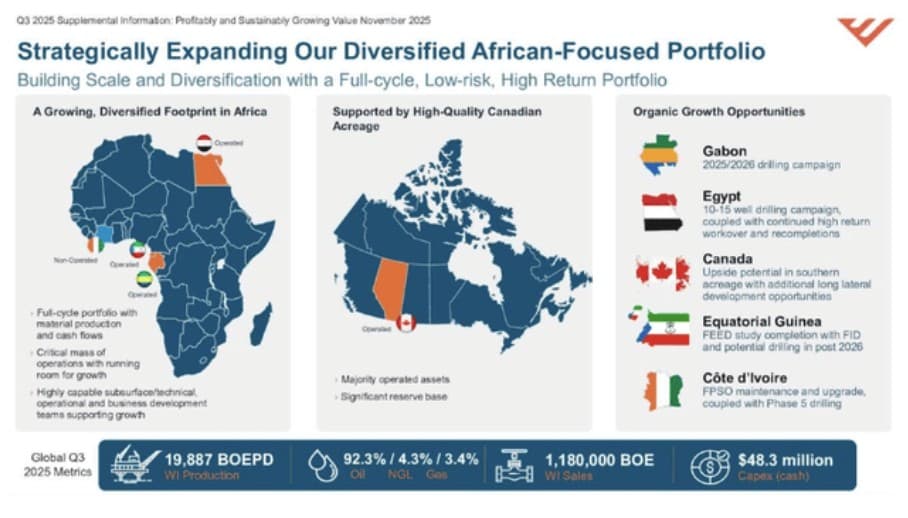
Vaalco has been growing production since its merger with TransGlobe in 2022. This transformed the company from sole reliance on its Gabonese assets to a diversified player with a number of levers to pull globally.

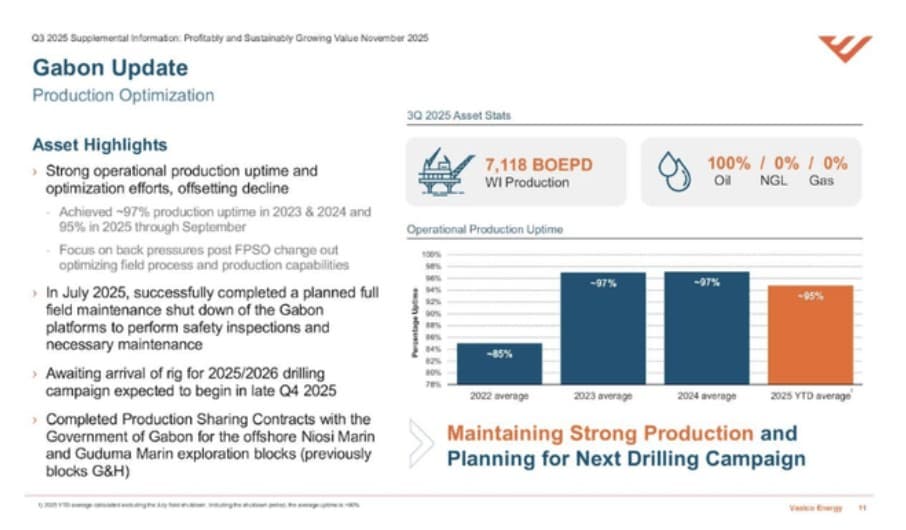
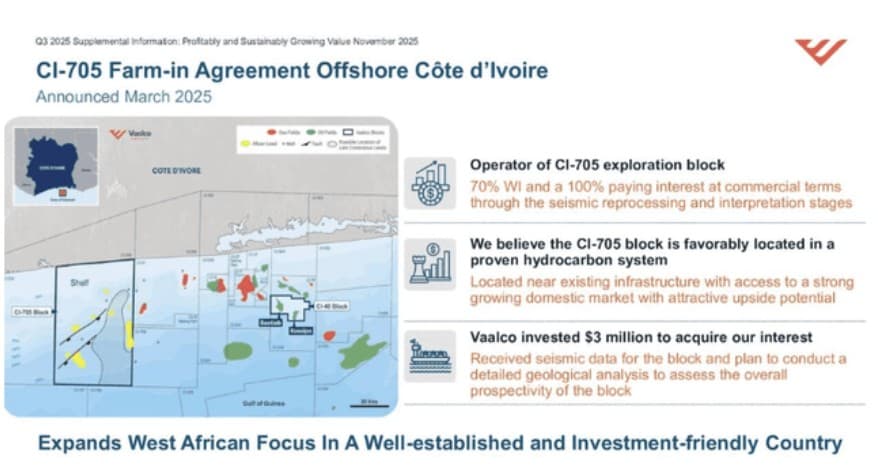
A move last year into Côte d'Ivoire was viewed favorably, and EGY just farmed into another offshore block in that country. In the short run, the company's focus has been on ramping up production in its Egyptian concession and Gabon. Results have been uneven with production progress and efficiency increases in Egypt, offset by a production turnaround and an FPSO refurbishment, combined with rig-related drilling delays in Gabon. This has pushed expected production from a new drilling campaign to the right, adversely impacting the stock. 

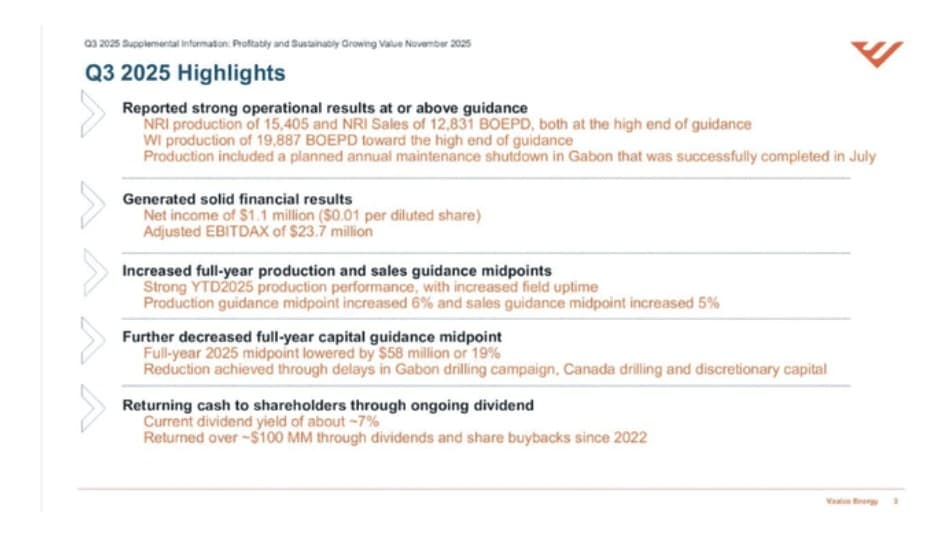
As the slide below notes, the shutdown and the near completion of the FPSO refurbishment, and then next the arrival of, Borr Drilling's Norve jack up is underway and should spud the first well sometime this month.

Vaalco trades at a low EV/EBITDA multiple-2.8X, and a low flowing barrel valuation- $19K per barrel. Analysts here and on Wall Street rank the company as a strong buy. Price targets are $10.00 per share, but EPS estimates point to small losses over the next couple of quarters, which could delay any rally in the stock.

The company has a quarter of its Q-4 production hedged at $ 60 and plans to increase this to about half. In 2026, EGY plans to hedge about 40% of its daily output.

The company is returning capital to shareholders through a 6.5% dividend yield. The company has a small amount of LT debt and has been implementing a capital reduction and cost-cutting program that should improve cash flow and production.

Catalysts for EGY

An explorer's job is to find oil and gas. Full stop. Operating oil and gas assets is also enhanced by the adjacency of other assets. Sometimes this is called critical mass. It enables cost optimization through several avenues. Gaining operatorship over a block where seismic has already been shot for $3 million seems like a reasonably derisked proposition to me. Someone thought Block CI-705 offshore, Côte d'Ivoire, was prospective enough to shoot seismic, which isn't cheap, so it could be like the last person to pull the handle on a slot machine. Or it could lead to nothing. That's exploration. Dry holes are instructive as well. TotalEnergies, (NYSE: TTE) drilled a test in 2021, and DH'd it. Why did they drill it?

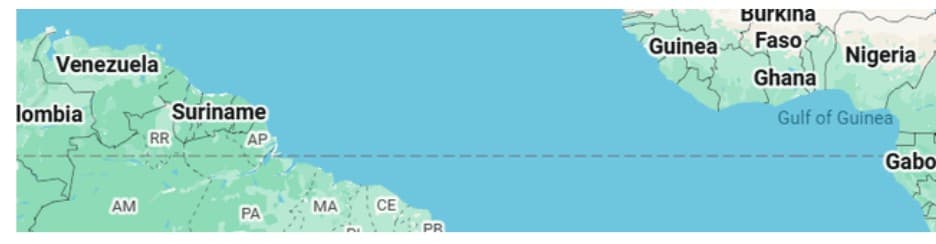
Why does anyone think this area might be prospective? Well, if you go back 400 million years and put the puzzle pieces together to form Gondwana, you find the area now known as Côte d'Ivoire fits nicely adjacent to the areas known as Guyana and Suriname. That should cement it in your head as to what the Geo-types have in the back of their minds at EGY. This sort of thinking about the Atlantic Margin has led to the well-publicized discoveries in Guyana, Suriname, and Namibia.

Snapshot of Atlantic basin (Google Maps)

This is all down the road a piece, even in the success case. In the near term, we have the upcoming drilling campaigns in Gabon, Egypt, and the Baobab field in Côte d'Ivoire -EGY's legacy position from the TransGlobe merger.

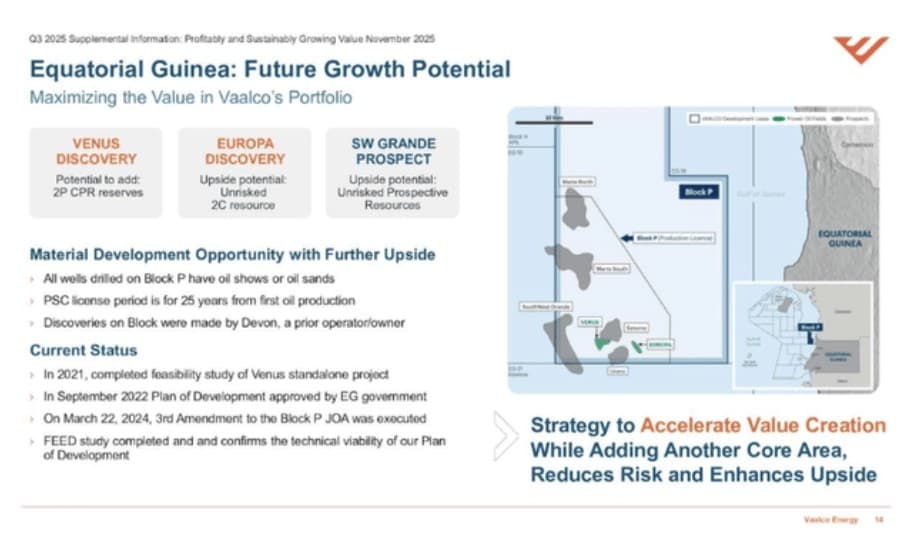
No catalyst discussion would be complete without at least a mention of EGY's 60% interest in Block P, offshore Equatorial Guinea. As of this date, a Plan of Development has been approved, and a Joint Operating Agreement is in place. Although Venus (Not to be confused with Total's Venus discovery offshore Namibia) As the slide below discusses, there is future prospectivity in this block. And the two producers and one injector needed to bring on Venus could be done in 2026.

Canada is taking a backseat after several successes in the company's Cardium and Mannville plays in Alberta, with no further drilling planned until 2026. The slide below shows the 2.50-mile horizontal section performing nearly as well as the 3.0-mile type curve.

Q-3, 2025 for EGY

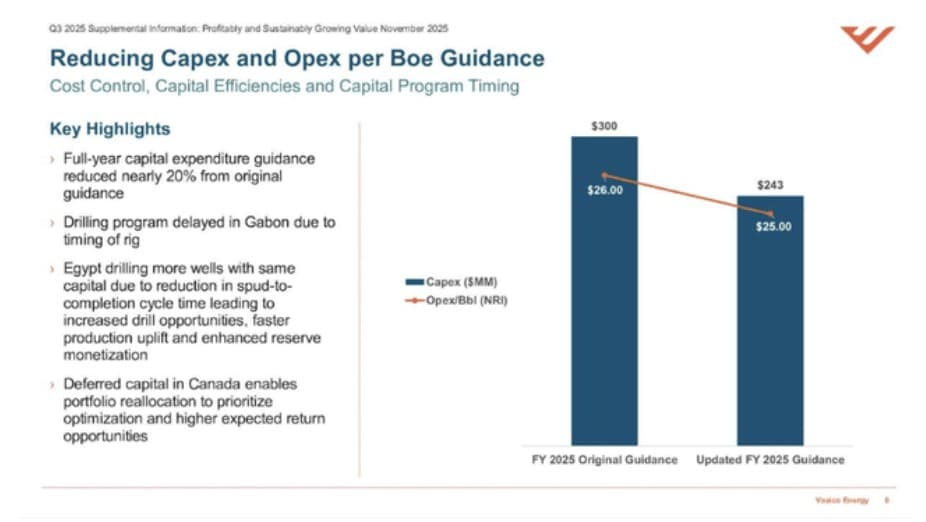
Most notably, the company hit the upper range of most production estimates, but cash flow suffered due to softness in Brent prices. Guidance for the full year expects 5% uplift YoY. Capex was reduced due to the issues with Gabon to optimize cash flow for the quarter. Even so, the company had to call upon its revolver for current expenses. Otherwise, the company has no debt.

Company filings

Risks to the thesis for EGY

Even great deals can get cheaper. Picking an entry point can be frustrating as fundamentals continue to weaken. That's the era we are in right now. As I laid out in the Macro, there are many moving pieces driving oil prices, and most of them are not supportive. No matter how good the price of EGY stock looks relative to the recent past, it can always get cheaper when the market turns against upstream investors.

Your takeaway

EGY’s report reads pretty well. And EGY management is due some deference for their experience in West African operations, going back decades. Their balance sheet management also speaks well for the company. Borrowing money to support operations when interruptions in other projects present cash flow hiccups is no big deal. The company retains ample liquidity, assuming refurbishment with the FPSO goes according to plan.

In my view, Vaalco's strong balance sheet, prospects for improving cash flow in the next year, and low multiples, put a buy target squarely on the company at its current level. The company is currently trading in a range well below its 50 and 200 day SMAs, which is probably more induced by the depressed pricing of Brent than anything else.

I am giving EGY a Strong for investors with a high risk profile, seeking capital growth and competitive shareholder returns.

By David Messler for Oilprice.com 


Angola Launches Its First Plant to Process Non-Associated Gas


Angola inaugurated on Thursday its first plant to process non-associated natural gas as the African oil producer looks to develop a standalone gas industry, too.

The plant, worth $4 billion, was inaugurated by Angola’s President João Lourenço in the presence of Minerals and Petroleum Minister Diamantino Azevedo.

The gas processing facility was built in the Soyo municipality by New Gas Consortium (NGC), which is a first for Angola as it targets to develop and produce non-associated gas located in the offshore gas fields. Historically, gas in Angola has been captured as a by-product of oil extraction, the so-called associated gas.

The plant will be operated by Azule Energy, which is a joint venture of BP and Eni.

NGC, for its part, is an incorporated joint venture of Azule Energy with Sonangol P&P, Chevron, and TotalEnergies. The non-associated gas of Phase 1 of the project will come from the Quiluma and Maboqueiro shallow waters field with additional potential of gas from Blocks 2, 3, and 15/14 areas.

The plant has the capacity to process 400 million standard cubic feet of gas per day (MMscfd) and 20,000 barrels of condensate per day, and will supply gas to the Angola LNG plant, boosting domestic gas supply and Angola’s exports.

The new plant was completed six months ahead of schedule and its start-up turns a new page in Angola’s energy history, Minister Azevedo said at the inauguration.

Angola is betting big on natural gas developments as a short-term increase in oil production is not expected to last, despite the West African country leaving OPEC over capped production.

Companies operating in Angola have recently started up two oil projects, but they have also begun to target non-associated offshore gas plays, hoping that a massive gas resource could be waiting to be tapped.

Earlier this year, Azule Energy discovered a major natural gas reservoir offshore Angola in the first gas-targeting exploration well in the oil-producing country.

Eni Launches Angola’s First Non-Associated Gas Project Ahead of Schedule

Eni has formally launched operations at Angola’s first non-associated gas development, inaugurating the New Gas Consortium (NGC) Gas Treatment Plant in Soyo through Azule Energy, its 50:50 joint venture with bp. The milestone marks a major advancement in Angola’s long-stated ambition to become a competitive natural gas supplier, both regionally and globally.

The ceremony was attended by Angolan President João Lourenço and senior energy officials, underscoring the strategic importance of the project to the country’s energy transition and economic diversification plans.

The NGC plant, which processes up to 400 MMscf/d of gas and 20,000 b/d of condensate, has entered commissioning following first gas in November 2025. Gas sourced from the offshore Quiluma and Maboqueiro fields will be treated in Soyo before being delivered to the Angola LNG facility for export or distributed to the domestic market.

The project reached this stage just 24 months after groundbreaking and six months ahead of schedule, a notable achievement for a major offshore-to-onshore gas development.

The NGC development is central to Angola's effort to shift from an oil-dependent upstream sector toward a more diversified energy portfolio. As the country positions itself as a stable, long-term natural gas supplier, the project is expected to support downstream sectors, including fertilizer production, which is becoming a key national priority for agricultural expansion.

For Eni, the launch reinforces its strategy of leveraging gas-weighted assets and expanding LNG-linked production across Africa. Azule Energy—now Angola’s largest independent operator since its creation by Eni and bp—adds a high-impact, schedule-advantaged project to its portfolio.

The NGC is operated by Azule Energy (37.4%), alongside Cabinda Gulf Oil Company (31%), Sonangol E&P (19.8%), TotalEnergies (11.8%), with ANPG serving as concessionaire.

By Charles Kennedy for Oilprice.com