It’s possible that I shall make an ass of myself. But in that case one can always get out of it with a little dialectic. I have, of course, so worded my proposition as to be right either way (K.Marx, Letter to F.Engels on the Indian Mutiny)
Sunday, November 30, 2025
Clues Trump may have been plotting to help Bolsonaro escape and give him asylum in the US
I just want to put up top that this story is about what it sounds like, which is fantastical and like something out of a spy thriller, and yet there’s nothing we can put past this administration. But it’s also about how The New York Times missed — or chose to ignore — a story staring it right in the face.
When I read reports last weekend about how Jair Bolsonaro, the Brazilian president who’d been sentenced to home confinement after being convicted in a notorious coup plot, had been arrested after an attempted escape, the first person I thought about was Donald Trump.
Trump, of course, is Bolsonaro’s best buddy and fellow authoritarian coup-plotter who, unfortunately for us, was indicted but never convicted because he became president again and killed the cases against himself. And since becoming president, Trump has spent months railing against Brazil and its Supreme Court — even imposing 50 percent tariffs on the country as retribution — demanding Brazil’s current president release Bolsonaro.
But that wasn’t the only reason I thought about Trump. Reports about Bolsonaro’s arrest focused on how his ankle monitor was breached after midnight, and security forces immediately detained him, putting him in a pretty cushy jail, under orders from a judge on the Brazilian Supreme Court who noted that Bolsonaro lives close to the U.S. embassy.
I couldn’t help but think the judge and law enforcement might be aware of a plot involving the U.S., and I discussed it on my SiriusXM show on Monday, speculating that it could have been an attempt by Bolsonaro to get to the U.S. embassy and get asylum from the U.S., which, under Trump, would give it to him.
It wasn’t until Tuesday that I actually saw the video from later in the day on Saturday of Trump, heading to his chopper at the White House, being asked questions by reporters about Bolsonaro, which you can watch right here.
At first, Trump clearly seems not to catch that the reporter is asking about Bolsonaro being arrested the night before and instead thinks it’s just a general question of some sort about his dictator pal.
TRUMP: So I spoke last to the person you just referred to, and we’re going to be meeting, I believe, in the very near future.
Reporter: Sir, are you aware about the president being arrested today?
Trump responds with what is clearly shock, sticking his head out .
TRUMP: What?!
Reporter: I’m talking about the former Brazilian president being arrested today.
TRUMP: No, I don’t know anything about that.
Trump seems a bit stunned, and again says, “I don’t know anything about it,” before asking the reporter, “Is that what happened?”
Then he kind of grimaces, and says, “That’s too bad,” and repeats again, “I Just think it’s too bad.”
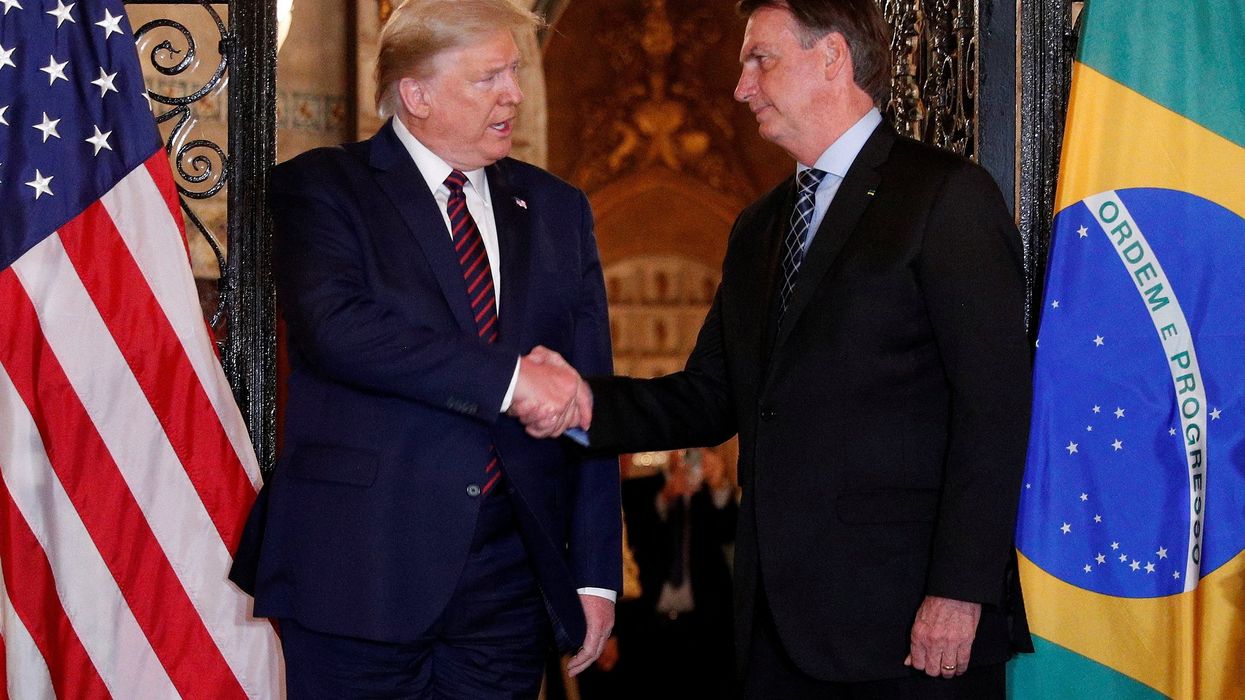
U.S. President Donald Trump shakes hands with Brazilian President Jair Bolsonaro before attending a working dinner at the Mar-a-Lago resort in Palm Beach, Florida, U.S., March 7, 2020. REUTERS/Tom Brenner/File Photo
The Times published a story about the latest on Bolsonaro’s arrest, but it oddly focused up top on how Trump, supposedly learning the limits of his power, doesn’t have as much interest in Bolsonaro as he used to, and it quoted from the exchange with reporters — but only the part where he says “That’s too bad,” and not the part where he says he just spoke to Bolsonaro: “That’s too bad.”
It was a telling response from President Trump on Saturday when he learned the news from reporters that his once close ally, the former Brazilian president Jair Bolsonaro, had just been arrested.
Did he have any thoughts?
“No,” Mr. Trump replied. “I just think it’s too bad.”
What a difference a few months make.
In July, Mr. Trump sent an angry letter to the current Brazilian president, Luiz Inácio Lula da Silva, demanding that the authorities drop charges that Mr. Bolsonaro had attempted a coup. Mr. Trump slapped 50 percent tariffs on Brazilian imports and imposed sanctions on a Brazilian Supreme Court justice to try to keep Mr. Bolsonaro — a right-wing politician sometimes called the Trump of the Tropics — out of prison.
Five months later, Mr. Trump has all but admitted defeat.
This ia a very strange framing. It completely omits what Trump said before he said “That’s too bad.”
Trump said he’d just spoken with Bolsonaro the night before. And said he they were going to be meeting “very soon.”
How would Trump be able to meet Bolsonaro in home confinement in Brazil?
And how did the Times not catch what would otherwise throw cold water on the framing of its story? After all, far from forgetting about Bolsonaro, Trump was very much thinking about Bolsonaro, having just spoken to him and planning to see him “soon.”
Thankfully, the always sharp Rachel Maddow proved I was not crazy and being conspiratorial. Because when I did a search this morning, after seeing the video, I found that she indeed covered this on her MS Now program, raising all the right questions even as she pointed to what fantastical plot this would be if true.
But where is the rest of the media, and why did the Times not home in on Trump’s highly interesting comments, instead making it appear as if Trump had been giving up on Bolsonaro?
Michelangelo Signorile writes The Signorile Report, a free and reader-supported Substack. If you’ve valued reading The Signorile Report, consider becoming a paid subscriber and supporting independent, ad-free opinion journalism.
The Pope's favorite movie says a lot about where America is right now — and Donald Trump
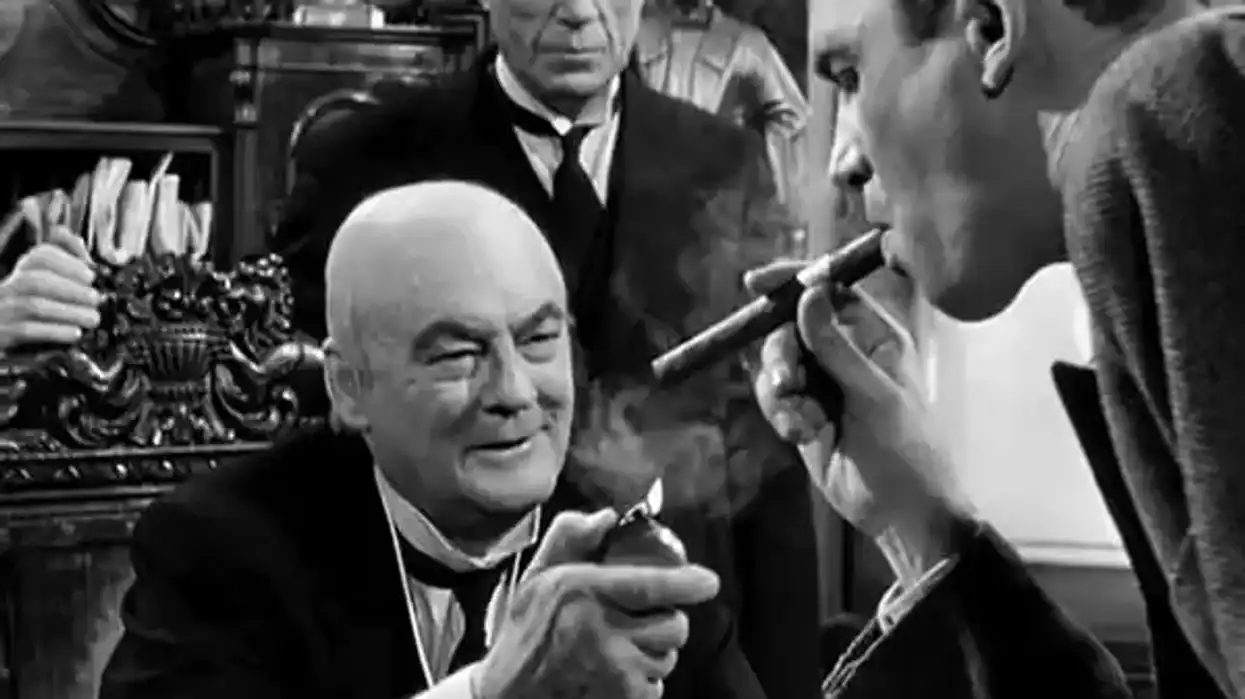
Lionel Barrymore as Henry F. Potter in RKO Radio Picture's "It's a Wonderful Life"
Pope Leo recently said his favorite movie of all time was “It’s a Wonderful Life.”
Mine too. I first watched it when I was a kid in the early 1950s. For years, it was shown the week before Christmas. I loved it. Still do.
The pope’s and my favorite movie has a lot to tell us about where America is right now, and the scourge of Donald Trump.
If you don’t already know it, the central conflict in the movie is between Mr. Potter (played by Lionel Barrymore) and George Bailey (Jimmy Stewart).
Potter is a greedy, cruel banker. In his Social Darwinist view of America, people compete with one another for scarce resources. Those who succeed deserve to win because they’ve outrun everyone else in that competitive race.
Potter, in other words, is Trump.
George is the generous, honorable head of Bedford Falls’ building-and-loan company, the one entity standing in the way of Potter’s total domination of the town.
After the death of George’s father, who founded the building-and-loan company, Potter — who sits on the bank’s board — seeks to dissolve it. Potter claims George’s father “was not a businessman. He was a man of high ideals, so-called, but ideals without common sense can ruin a town.” For Potter, common sense is not coddling the “discontented rabble.”
Exactly what Trump would say (think of his cuts to Medicaid, refusal to extend Obamacare subsidies, and withholding of food stamps during the government shutdown).
To George, though, Bedford Falls is a community whose members help each other. He tells Potter that the so-called “rabble … do most of the working and paying and living and dying in this community.” George’s father helped them build homes on credit so they could have a decent life.
“People were human beings to him,” George tells Potter, “but to you, they’re cattle.”
When George’s Uncle Billy accidentally loses some bank deposits that fall into Potter’s hands, the banker sees an opportunity to ruin George. (Trump would do precisely the same.)
This brings George to a bridge where he contemplates suicide, thinking his life has been worthless, before a guardian angel counsels him to think about what Bedford Falls would be like if George hadn’t been born — poor, fearful, and completely dependent on Potter. The movie ends when everyone George has helped — virtually the entire town — pitches in to bail out George and his building-and-loan.
It’s a cartoon, of course — both a utopian and a dystopian version of America — but the cartoon poses a choice that’s become all too relevant: Do we join together, or do we let the Potters of America — Trump and his billionaire backers — run and ruin everything?
Since the political rise of Ronald Reagan, Republicans and the moneyed interests have used Potter-like Social Darwinism to justify tax cuts for the wealthy, union-busting, and cutbacks in social safety nets.
Trump is shamelessly finishing what Ronald Reagan started.
The goal is to have Americans so angry and suspicious of one another that we don’t look upward to see where all the money and power have gone. That way, we don’t join together — as did the good citizens of Bedford Falls — to stop Potter, er, Trump, and the oligarchs behind him.
What would Republicans and America’s moneyed interests say about “It’s a Wonderful Life” if it were released today? They’d probably call it socialist, maybe even communist, and it would make them squirm — especially given the eerie similarity between Lionel Barrymore’s Potter and Trump.
When “It’s a Wonderful Life” was released, the FBI considered it evidence of Communist Party infiltration of the film industry. Either a movie was subversive or it wasn’t, and in the bureau’s broad framing, this one certainly was.
The FBI’s Los Angeles field office, using a report by an ad-hoc group that included Fountainhead author and future Trump pinup girl Ayn Rand, warned that the movie represented “rather obvious attempts to discredit bankers by casting Lionel Barrymore as a ‘scrooge-type’ so that he would be the most hated man in the picture.” The movie “deliberately maligned the upper class, attempting to show the people who had money were mean and despicable characters. This … is a common trick used by Communists.”
The Bureau’s report compared “It’s a Wonderful Life” to a Soviet film and alleged that Frank Capra, its director, was “associated with left-wing groups” and that the film’s screenwriters, Frances Goodrich and Albert Hackett, were “very close to known Communists.”
This was all rubbish, of course, and a prelude to the witch hunt led by Republican senator Joseph McCarthy of Wisconsin, who launched a series of highly publicized probes into alleged Communist penetration of Hollywood, the State Department, and even the U.S. Army.
Trump’s probes are into alleged disloyalty to himself, which is akin to McCarthy’s communism in the early 1950s. Loyalty to Trump is now the purity test all elected Republicans must pass.
As director Frank Capra does in his dystopian view of what Bedford Falls would have been had George Bailey never existed, Trump is seeking to rewrite American history as if his brazen attempt to overturn the results of the 2020 election never occurred. If he succeeds, we’re all in a dystopian Pottersville.
In announcing the 77 pardons he recently issued to officials who joined him in seeking to steal the 2020 election, Trump called them “victims of political persecution” who were “targeted for defending the Constitution.”
In fact, they were co-conspirators in the worst attack on our system of government since the Civil War.
Trump declared that the pardons “end a grave national injustice.” In fact, the national injustice was that neither Trump nor any of his co-conspirators have yet been convicted of treason.
He declared that his pardons “continue the process of national reconciliation.” In fact, they continue his pursuit of national amnesia.
In Trump’s retelling, January 6 was “a beautiful day full of love and peace.” In fact, it was a day of national disgrace.
Presumably, Lionel Barrymore’s Mr. Potter would have said the same if that was necessary to secure his hold over Pottersville.
I don’t know whether Pope Leo had all this in mind when he called “It’s a Wonderful Life” his favorite movie of all time. But it’s likely that the pope, who hails from Chicago, knows what Mr. Potter — er, Trump — is doing to America, and indirectly to the world.
Handmaid’s Tale author Margaret Atwood says it’s time to 'worry' for America
Canadian author Margaret Atwood turned 86 last week and is unafraid of speaking out about her southern neighbor.
The Guardian served a host of fans the opportunity to swap words with the author of “The Handmaid’s Tale,” which is now an acclaimed streaming series. And in those exchanges Atwood shared the same lingering trepidation that molded her emblematic series into the rallying cry that it is today.
When asked by a fan what she would do were she American, Atwood answered: “now, this very minute, I’d be worrying a lot about my country. Is it a democratic world leader on a steep slide into autocracy?”
Another fan asked why we keep electing “psychopaths” to office, to which the author of the “Book of Lives” said sometimes voters get waylaid by bad information.
“Quite often, in elections, people are not given the choice of something they actually want. So they vote, not for the best, but for the one they think will be the least worst. Not surprisingly, they sometimes get it wrong. And in an age of disinformation (see 18th-century political pamphleteering, just for a fun comparison) the possibility of deciding on the basis of accurate information may be pretty low.”
When asked if women and human society would ever be able to truly “topple patriarchy” Atwood was more concerned with women being able to “hold the line – the line on one side of which women don’t have jobs, money or political rights; and on the other side of which they do?”
The hypocrisy of the Trump era was another phenomenon needing address. While hypocrisy “has been a constant factor in human societies,” Atwood said there are high and low points, but now “we are seeing the greatest democracy of modern times turning away from these ideals, the ideals are looking better as aspirations than they have for a while.”
“What will we do and who will we be without them?” she asked.
Like the world of the “Handmaids Tale,” Atwood was unsure if U.S. democracy could last.
“I don’t know. But America is a large and very diverse country. It will be hard to make all the Americans line up and salute without killing a lot of people,” she said. “And the armed forces — as we have just been reminded — take an oath to the Constitution, not to an individual. It’s a bit like fairies in Peter Pan. Democracy will die if you don’t believe in it. (But so will money.)”
She added, however, that “more hopeful turns are always possible — except at the moment when you’ve been pushed out a window.”
“[T]there is no ‘inevitable course of history’. And yes, individuals have made a difference. And can still do so. (Though at what cost?)” Read the Guardian report at this link.
Why America's most hated appliance is so hard to ban
The push to ban gas-powered leaf blowers has gained an unlikely figurehead: Cate Blanchett, the Australian actress. “Leaf blowers need to be eradicated from the face of the Earth,” she said in an interview in March. Her complaints have gone viral on TikTok and other social media platforms. “It’s a metaphor for what’s wrong with us as a species,” Blanchett said. “We blow s--- from one side of our lawn to the other side, and then the wind is just going to blow it back!”
Her complaints about leaf blowers — equal parts entertaining and earnest — stretch back nearly 20 years, and now the mood has caught up with her. Today, more than 200 local governments in the U.S. have restricted gas-powered lawn equipment or provided incentives to switch to quieter, less-polluting electric tools. The first bans date back to the 1970s, but the trend picked up after the pandemic lockdowns in 2020, when newly homebound workers discovered just how inescapable the whine of their neighbor’s leaf blower can be.
“With every year that passes, more and more communities across the country are taking action to address the shocking amount of pollution and noise from gas lawn equipment,” said Kirsten Schatz, clean air advocate at the Colorado Public Interest Research Group, called CoPIRG.
Gas-powered leaf blowers aren’t just annoying; they’re bad for public health. Closing the windows can’t shut out their low-frequency roar, which can be louder than the World Health Organization’s recommended limit of 55 decibels up to 800 feet away. The unwanted sound can lead to high levels of stress, along with disturbing people’s sleep and potentially damaging hearing over time.
And while lawn and garden equipment is only a small slice of global carbon emissions, leaf blowers and other gas-powered tools “pack a big punch for the amount that they create based on the size of their engines,” said Dan Mabe, the founder of the American Green Zone Alliance, a group that works with cities and landscapers to shift to electric equipment. In 2020, fossil-fueled lawn and garden equipment in the U.S. released more than 30 million tons of CO2, more than the emissions of the city of L.A.
Cities and states across the country have taken different approaches to dealing with the problem. California’s law banning the sale of new gas-powered blowers took effect last January, while cities like Portland and Baltimore are phasing out their use. Some places, like Wilmette, Illinois, have enacted seasonal limits, either permanently or until a full ban takes effect. Others, like Colorado, attempt to sweeten the deal of buying electric lawn care equipment, offering a 30 percent discount.
But implementing the bans is proving more challenging than many expected. Many communities are frustrated that the new rules are not being properly enforced, said Jamie Banks, the founder and president of Quiet Communities, a nonprofit working to reduce noise pollution.
Westport, Connecticut, fought for years to get a seasonal restriction on gas-powered blowers, only to find that local officials were not enforcing it, Banks said. Noise complaints are not exactly at the top of police officers’ priority lists, and sometimes ordinances are written in a way that’s hard to carry out — police aren’t usually expected to go around town taking noise readings, for example. Some communities are taking a deliberate approach to the problem: Banks pointed to a group of towns in the greater Chicago area, including Wilmette, that are trying to create consistent policies across the region and working with the local police.
Then there’s the matter that swapping gas blowers for ones powered by electricity isn’t as straightforward as it sounds. While the costs are comparable for homeowners — you can get electric blowers at a big-box store like Home Depot for around $200 or less, cheaper than most gas ones — electric blowers are more expensive for commercial landscapers. They require multiple batteries for workers to get through the day. While a typical professional gas-powered blower runs for $550, a comparable electric one costs $700 and requires thousands of dollars worth of batteries. Landscapers also have to buy hundreds of dollars worth of charging equipment and find ways to charge safely on the go.
Plus, it can be difficult to meet the standards customers expect with electric leaf blowers, which are less powerful than gas ones. “If you have customers that are demanding that you get everything off the ground, and you better do it quickly, and you’d better not charge me too much money, it’s really tough,” Banks said.
Bans have already generated a political backlash in some Republican-led states. Texas and Georgia have passed laws prohibiting local governments from regulating gas-powered leaf blowers. The Western States Petroleum Association, an oil industry group, launched a Latino-focused messaging campaign in California that pushes back against laws to electrify vehicles and leaf blowers. But leaf blowers aren’t just a culture-war lightning rod; in some places, they’re leading to personal conflict. In Evanston, Illinois, a suburb north of Chicago, several landscape workers allege they’ve been harassed by people reporting violations of the local ban.
The American Green Zone Alliance noted in a recent statement that “heavy-handed bans on gas-powered leaf blowers can unintentionally create stress and hardship for workers who often labor for low wages, with limited benefits or control over their working conditions.”
Although there remain a lot of details to work out, the organization is still pushing lawn care to go electric. “We are trying to convince our industry, ‘Look, we need to accelerate this,’” Mabe said.
The alliance is advocating for incentives that are sufficient to make the new equipment affordable for landscaping businesses operating on razor-thin margins. (In the end, lower fuel and maintenance costs for electric blowers can save companies money if the equipment is properly cared for, Mabe said.) Seasonal bans on gas-powered leaf blowers may be more feasible in some places than year-round ones, because they leave short windows for using the fossil-fueled devices in the spring and fall to take care of heavy cleanup jobs.
Another solution: Customers could loosen their expectations and accept a scattering of leaves, instead of demanding a perfectly manicured lawn. “Now, if that aesthetic was more relaxed, that could help change things,” Banks said. “Maybe they wouldn’t need to carry so many batteries.” Leaving some leaves on the ground is, at least ecologically speaking, a good thing — decaying leaves fertilize the soil and form a protective layer that provides shelter for snails, bees, and butterflies.
And of course, in many cases, a leaf blower isn’t needed at all: You can do as Blanchett advises and take matters into your own hands with a good-old fashioned rake.
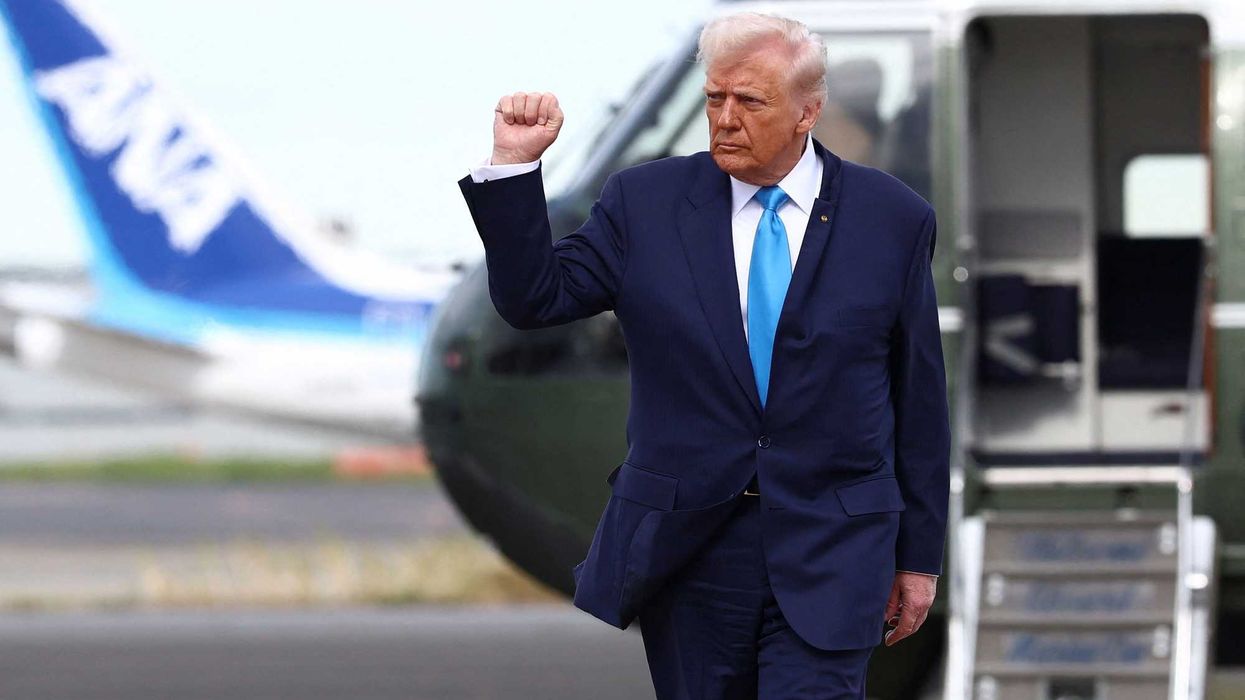
U.S. President Donald Trump gestures as he walks from Marine One to board Air Force One to depart Haneda Airport for South Korea, in Tokyo, Japan, October 29, 2025. REUTERS/Evelyn Hockstein
President Donald Trump repeatedly claims that he inherited a troubled, dysfunctional economy from his Democratic predecessor, Joe Biden, and quickly turned it around. In fact, the United States enjoyed record-low unemployment during Biden's presidency, but widespread frustration over inflation helped Trump pull off a narrow victory of roughly 1.5 percent on Election Night 2024.
Economist Justin Wolfers, who teaches at the University of Michigan but is originally from Sydney, Australia, tore apart Trump's claims about the economy — from tariffs to the stock market — during a Saturday, November 29 appearance on MS NOW's "The Weekend."
Trump claimed that his tariffs will bring in so much revenue that the U.S. will be able to "almost completely" eliminate federal income tax.
But Wolfers told "The Weekend" hosts Eugene Daniels, Jackie Alemany and Jonathan Capehart, "This is just nonsense. Let me start with one important fact-check. The president appears not to understand the difference between millions, billions, and trillions. That's actually one of the most important points in all of economics; they're massively different. We are not taking in trillions of dollars in tariff revenue."
Wolfers added, "If we were, we could afford his $2000 tariff checks. We aren't. So therefore, we can't."
The University of Michigan economist also pushed back against Trump's claims about the stock market, which, he stressed, is performing better in other countries than it is in the United States.
Wolfers told Daniels, Alemany and Capehart, "The other thing that he talks about a lot is the stock market. Now, here's a funny thing: If you look at the stock market returns from, say, 25 of the biggest countries around the world, the United States ranks around about 22nd right now. So yes, American stocks are up. But guess what? They're up even more everywhere else."
U.S. consumers, according to Wolfers, are pessimistic — not optimistic — about the state of the economy.
Wolfers told Daniels, Alemany and Capehart, "So, consumer confidence right now — it's quite striking just how bad it is. So, consumer confidence right now is very close to being an all-time low. And this has been measured back to the 1970s. So consumers say that they're feeling worse than they were during the Great Recession, than they were during the pandemic, than they were during the early '80s recession. It's really quite striking numbers. If you dig into that a little bit, you ask them things like: What do you think about the quality of us economic policy?"
The economist continued, "The number of people who think that the quality of economic policy is poor is at an all-time high. It's roughly three-fifths of the American people. What you have, I think, is that the president has fundamentally lost the battle of ideas. What you normally do with an economic program is you come up with some ideas, and you try and convince people of the virtues of them. And he has fundamentally failed. There's a deep question as to how long people are going to keep spending."
What’s Driving the US Electricity Price Hike and What Can We Do About It?
Electricity prices can’t keep going up and up something’s got to give: A hybrid supply-demand response would minimize the economic pain of high electricity prices while putting the country on a more sustainable path.
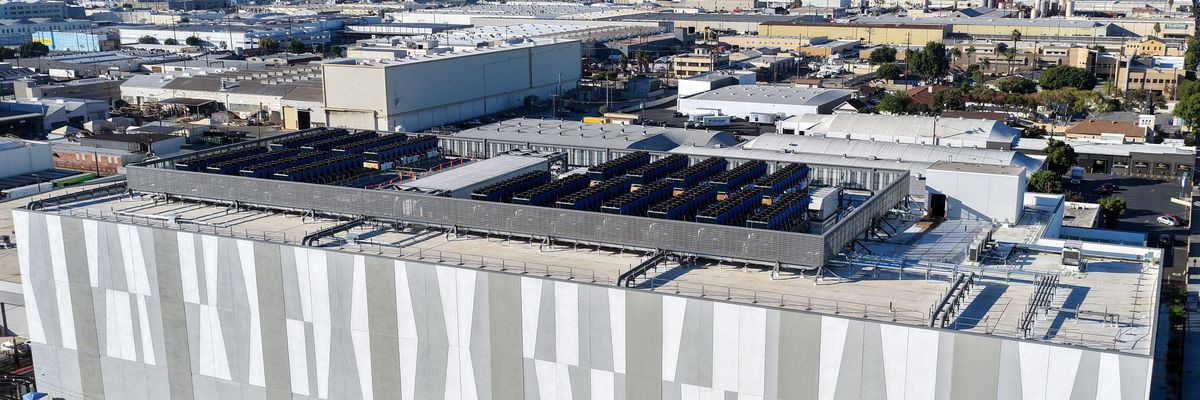
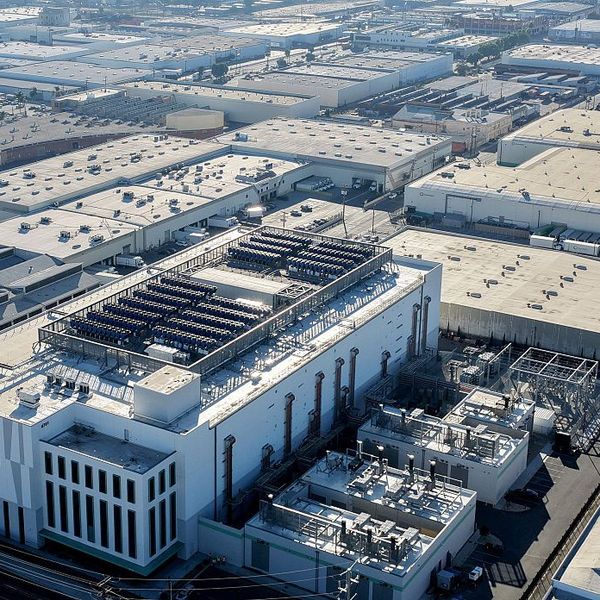
An aerial view of a 33 megawatt data center with closed-loop cooling system is seen on October 20, 2025 in Vernon, California. (Photo by Mario Tama/Getty Images)
Using current economic trends to predict the future can be misleading, since all trends are subject to limits and countertrends. In this article, I’ll apply that truism to a trend that a lot of people are talking about—soaring electricity prices in the United States.
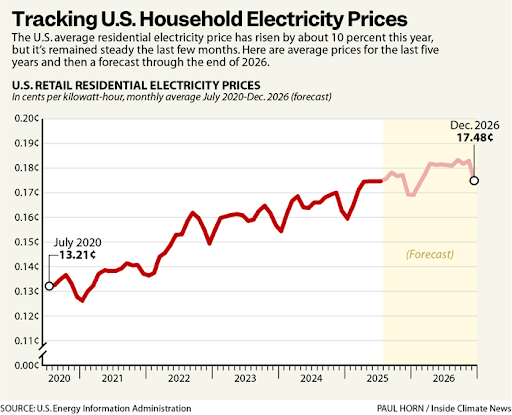
Across the US, electricity prices are rising more than twice as fast as the overall cost of living. The main driver of costs is the enormous electricity demand of over 1,000 new data centers, built mostly for artificial intelligence (AI) applications. Each data center, depending on its size, requires anywhere from a few kilowatts up to 100 megawatts of power (enough to power a medium-sized city). Installations of new data centers are growing at more than 10% annually; at that rate, the total number of data centers will double in less than seven years. Indeed, the International Energy Agency expects global electricity demand from data centers to double by the end of this decade, when it will total more than the entire electricity demand of Japan. Goldman Sachs Research predicts that 60% of this increased demand will be met by fossil fuel sources. RECOMMENDED...
Understanding why rising electricity demand from data centers is a serious problem requires more than a glance at your latest utility bill. Energy isn’t just one of many inputs into the economy; in effect, it is the economy, since doing anything requires it. Of all the energy used in the US and globally, only a little over 20% is in the form of electricity; the rest entails the direct burning of fossil fuels (most electricity is generated also by burning fossil fuels; in the US, 60% of electricity comes from fossil fuel sources—mostly natural gas). Electricity is not a direct source of energy; it’s an energy carrier. But, for households and industries alike, it is an extremely useful way of conveying energy to end users. Just flip a switch or push a button, and electricity makes something happen. It does many things for us, but its role in enabling communications and data processing gives electricity a pivotal importance in the overall energy mix of modern society.
Energy usage for data processing and communications doesn’t tend to rise and fall in response to short-term changes in power prices; economists call it “inelastic.” So, when electricity prices soar, households and businesses must adjust. For households, that typically means buying fewer discretionary consumer products; for businesses, it means raising prices for services or goods. The whole economy grinds slower. We have a storied history of recessions in 1973, 1979, and 2008 that were related to rising fossil fuel prices impacting the entire economy (see photos of gasoline lines and shortages from 1973). What happened with fossil fuels could happen with electricity: As electricity assumes a central role in our energy system, future price spikes could conceivably be as crippling as the OPEC oil embargoes of the 1970s.
A bursting AI bubble could at least temporarily halt electricity price increases tied to new data centers. But it might be a dreadful “solution,” especially for people who are neither wealthy nor politically connected.
Growing electricity demand for data centers is also a problem because of climate change. Almost all of society’s “progress” in reducing emissions has been in the electricity generation sector (e.g., using solar panels instead of coal to generate electricity). But if electricity demand grows fast, that makes it harder to continue increasing renewables’ share of electricity generation: Demand spikes put utility companies in panic mode, so they deploy any new generating capacity they can quickly obtain—and, so far, they’re resorting to new natural gas turbines more often than new wind projects or solar arrays.
Data centers may be a largely unforeseen disruption to an enormous project that energy planners call the energy transition. As society moves away from fossil fuels, more of its energy usage will occur via electricity—which is the energy output of solar panels, wind turbines, and hydroelectric dams. The transition depends on an ongoing electrification of the economy, starting with electric vehicles. With data centers sucking up so much electricity, it becomes all the harder to deploy electricity to other uses and sectors, which is what planners had been counting on.
Electricity prices can’t keep going up and up. Something’s got to give. Let’s first explore the more obvious solutions to the electricity price dilemma, and then the systemic limits and countervailing trends that will determine which of those solutions is more feasible and likely. I’ll finish by proposing a hybrid supply-demand response that would minimize the economic pain of high electricity prices while putting the country on a more sustainable path.
More Electricity Demand? Just Increase Supply!
The obvious solution to rising electricity prices is to meet new demand with new supply. Just generate more power. What energy sources are available for that purpose?
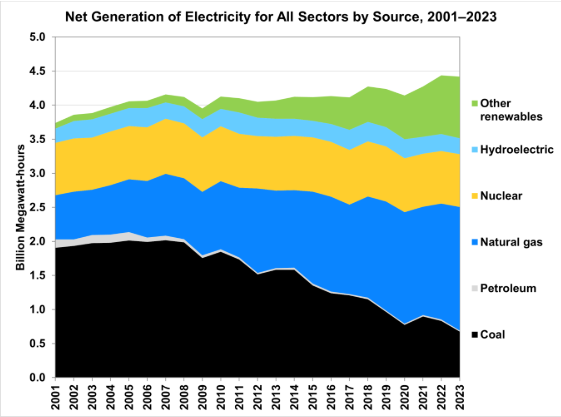
(US electricity generation by energy source, US Department of Energy. The Trump DoE may have stopped updating its data, as its website features no graph carrying these trendlines forward to 2024.)
Natural gas is currently the main energy source for electricity generation in the US, and its share of total generation has grown sharply in recent years. Also, the US is the world’s biggest gas producer. Further, natural gas is the cleanest-burning fossil fuel, though it still produces carbon emissions. These factors together make natural gas the obvious solution for most utility companies. But there are some caveats regarding the future of natural gas, which we’ll unpack in the next section when we explore limits and countertrends.Nuclear power has been stagnant in the US for the past three decades: 12 commercial reactors were retired between 2013 and 2021, and two new ones (in Georgia) were recently put into service. The average age of US nuclear plants is 42 years. The nuclear industry, eager for a comeback, has proposed construction of small modular reactors (SMRs) that would allegedly be cheaper and safer than existing nuclear plants, which typically have been slow and costly to build and have been targeted by citizen opposition due to safety concerns. However, the industry’s rosy claims for SMRs are disputed. In the meantime, Microsoft has partnered with the owners of the Three Mile Island nuclear facility, site of the worst nuclear disaster in US history.Renewables consist mostly of solar, wind, hydro, and geothermal. Power generation in this sector is expanding quickly, but likely not enough to avert supply shortages or price spikes if AI keeps growing at its current pace. The Trump administration is doing all it can to stall the further expansion of renewables, which continues despite these headwinds. President Donald Trump’s opposition to renewables appears to be political rather than economic, perhaps aimed to repay campaign donations from fossil fuel companies. The oil industry’s drilling technology could be used for deep geothermal electricity generation, the potential scale of which is enormous. The first commercial plants are now under construction; upfront costs are projected to be high, with low and stable operational costs. However, scaling up deep geothermal production to a significant fraction of the nation’s electricity supply might take decades.Coal has seen a dramatic and relentless fall in its share of overall power generation in the US (though not in China or India). This is due not just to the pollution and climate policies of previous federal administrations. Fuel supply issues (most of America’s higher-quality coal is already largely depleted), together with cheaper natural gas, have persuaded most electric utility companies that coal is a fuel of the past. The Trump administration is calling for a return to coal, but few utility companies appear to be listening. That’s likely because the federal push for new coal power plants seems driven more by an appeal to voters in mining states like West Virginia, Kentucky, Ohio, and Wyoming than by economics.
None of those supply solutions seems ideal. Moreover, before we try to choose a candidate and say, “Problem solved,” it’s essential that we examine limits and countertrends that could cause the current electricity price trajectory to shift. Why the Electricity Price Trend Could Change
US electricity prices could rise even faster, or the current trend could go into reverse and electricity could get cheaper. What are the foreseeable limits or countertrends that could lead to either of those outcomes?
One factor is natural gas prices, which have been relatively low and stable for the past couple of decades; indeed, adjusted for inflation, they have declined significantly. This has been due to rising North American shale gas supplies released by fracking. Cheap natural gas, in turn, has kept US electricity prices relatively stable until recently. Now, however, two factors are contributing to a likely increase in natural gas prices.
The first is the growth of the US liquefied natural gas (LNG) industry. Currently Europe is, for political and security reasons, phasing out Russian natural gas delivered by pipeline. Instead, Europeans are buying more LNG imported by tanker, a costly substitute. Gas producers in the US, flush with shale gas, are eager to serve these new customers, who are willing to pay much more for natural gas than Americans do currently. So, new LNG export terminals are springing up on the US Gulf Coast, with some already shipping their first cargoes. With a growing share of US natural gas being exported (projected to be over 10% of total production by 2030), domestic prices for the fuel will likely rise, forcing gas-burning utility companies to hike up electricity prices further and faster.
When the people own the means of generation, they can collectively decide to promote renewables over fossil fuels as a source of power.
Meanwhile, America’s shale gas miracle may soon start to peter out. As I noted in a recent article, shale gas fields suffer from rapid depletion of individual wells and thus require high rates of drilling. Most US shale gas regions have already passed their peak of production and are in their plateau or decline phase of extraction. One prominent resource analytics firm forecasts that total US shale gas production will peak between 2027 and 2030. If natural gas production falls, it may be difficult for other electricity sources to grow fast enough to avert power supply problems or rate hikes.
A factor that could conceivably slow electricity price increases, or perhaps even cause prices to fall, is investors’ potential unwillingness to further finance the build-out of AI. In recent months, many Wall Street analysts have expressed dismay at the expanding gap between AI spending—projected to hit $1.5 trillion this year—and actual revenues for companies developing and using AI. Many investors now believe AI stocks are a financial bubble whose bursting could cause a recession or depression for the entire US economy, even the global economy.
A bursting AI bubble could at least temporarily halt electricity price increases tied to new data centers. But it might be a dreadful “solution,” especially for people who are neither wealthy nor politically connected. Past financial crises have been stanched with bailouts for banks and investors, thereby transferring wealth from the public to risk-taking entrepreneurs, while ordinary folks deal with job losses and vanishing retirement nest eggs. A Better Solution to Unaffordable Electricity
Any realistic solution to soaring electricity prices must address both supply and demand.
Supply: Of the sources of energy for electricity generation, renewables make the most sense, even though they are subject to their own limits and drawbacks, including unsustainable requirements for scarce raw materials and major concerns about environmental, social, health, and security impacts.
Demand: Since materials limits mean that electricity generation from renewables cannot be scaled up indefinitely, it is essential that planners identify ways to reduce electricity demand over the long-term.
Investor-owned utilities have an incentive to sell more product so as to generate more profits and returns for investors. Investor ownership is therefore an impediment to stabilizing electricity supply at a sustainable scale over the long run. Fortunately, there are two other ownership models: electric cooperatives and publicly owned utilities. These kinds of power producers currently supply almost 30% of all US electricity, and typically charge their customers less for power.
When the people own the means of generation, they can collectively decide to promote renewables over fossil fuels as a source of power, as my own local provider, Sonoma Clean Power (SCP), already does.
Community-owned power companies can also promote the reduction of electricity demand. For example, SCP incentivizes the purchase of energy-efficient electric appliances, rooftop solar, and EVs. States can also help with demand reduction; for example, the State of California provides rebates for home efficiency measures.
Here’s another demand reduction strategy, one that’s tailored to the specifics of our current dilemma: States and counties could refuse to grant building permits for new data centers. Failing that, they could wall off AI’s rising electricity demand from electricity markets by requiring data center builders to provide dedicated power plants not connected to the grid. Some data center operators are already doing this, though only a tiny minority so far; most of the off-grid generators rely on natural gas.
This strategy will likely face pushback. The Trump administration is working on ways to keep individual states from regulating AI. Further, even if these efforts fail, AI companies can be expected to hire expensive lawyers and lobbying firms to oppose regulations such as a requirement for off-grid power.
But suppose all new data centers do supply their own off-grid generators. If those generators use natural gas, then competition for fuel with grid-tied power plants could raise natural gas prices, again likely causing electricity prices to soar. The best work-around would be to require data centers to build only renewable-energy generators (including deep geothermal). Again, expect pushback.
Altogether, it’s hard to see any of this happening without a broad base of public support, which would in turn require the public to be better informed on energy issues. It would also require leadership from grassroots activists and politicians. It’s a big ask, when there are already plenty of other priorities for problem solvers. However, unless more electric utilities come to be publicly owned, and a large majority of data centers start generating their own off-grid power from renewable sources, electricity price hikes for households and businesses are likely to continue until the AI financial bubble bursts or electricity prices rise enough to cripple the economy.
Electricity is our energy future, but the details of that future are still sketchy. Right now, the picture is being drawn by billionaire investors, but it looks dark and dystopian. Surely more imaginative artists could do better.
Our work is licensed under Creative Commons (CC BY-NC-ND 3.0). Feel free to republish and share widely.
Richard Heinberg Richard Heinberg is a senior fellow at the Post Carbon Institute and the author of fourteen books, including his most recent: "Power: Limits and Prospects for Human Survival" (2021). Previous books include: "Our Renewable Future: Laying the Path for One Hundred Percent Clean Energy" (2016), "Afterburn: Society Beyond Fossil Fuels" (2015), and "Peak Everything: Waking Up to the Century of Declines" (2010). Full Bio >
‘Not even trying to hide it’: Trump admin social media post flagged for ‘Nazi dog whistle'
An image shared by President Donald Trump's Department of Labor on social media. (Department of Labor)
A social media post from President Donald Trump’s Department of Labor was flagged Saturday by internet sleuths for its apparent “Nazi dog whistles,” including a potential reference to the Confederacy and its questionable font choice.
Posted on Friday, the official Labor Department X account published a post depicting the Lincoln Memorial statue with 11 stars dotted around the statue’s head. Near the bottom of the image reads the text “Americanism Will Prevail,” written in blackletter gothic-style typeface, a font associated with Franktur calligraphy.
The post also includes the following text: “The fight for Western Civilization has begun – and Americanism will Prevail.”
Online critics, however, were quick to note several aspects of the post that some described as clear dog whistles.
“What a coincidence they used 11 stars just like the racist loser Confederacy, over President Lincoln’s head,” wrote X user “Patrick Skinner,” a law school student who’s amassed more than 65,000 followers.
“What a coincidence they used Germanic font like the racist loser Third Reich. What a coincidence… the Germanic font is certainly a choice. Deliberate. Gee, wonder why they went out of their way to do that??”
Similar patriotic images typically depict 13 stars to represent the original 13 colonies, whereas the Confederacy, which saw seven states seceded from the United States by February of 1861, and 11 by April of that year, is sometimes represented with 11 stars, such as on one of its “Stars and Bars” flags.
Critics were also quick to highlight the post’s Franktur font, which was used in the early Nazi period in Germany up to 1941, up until the Nazi regime barred its use, later claiming to be “non-Aryan.”
“The use of a Blackletter typeface here is chef’s kiss,” wrote X user “Martyn Schmoll,” who’s frequently shared content critical of the Trump administration and has amassed more than 5,300 followers. “The dip----- creating these memes must have the Nazi graphic standards manuals on their desks.”
Others, like X user “Gangsta Dreski,” noted the openness of the supposed dog whistles, arguing that the Trump administration staff behind the post were “not even trying to hide it.”
'Devastating': Internet erupts over conservative outlet's 'damning' report on Trump allies
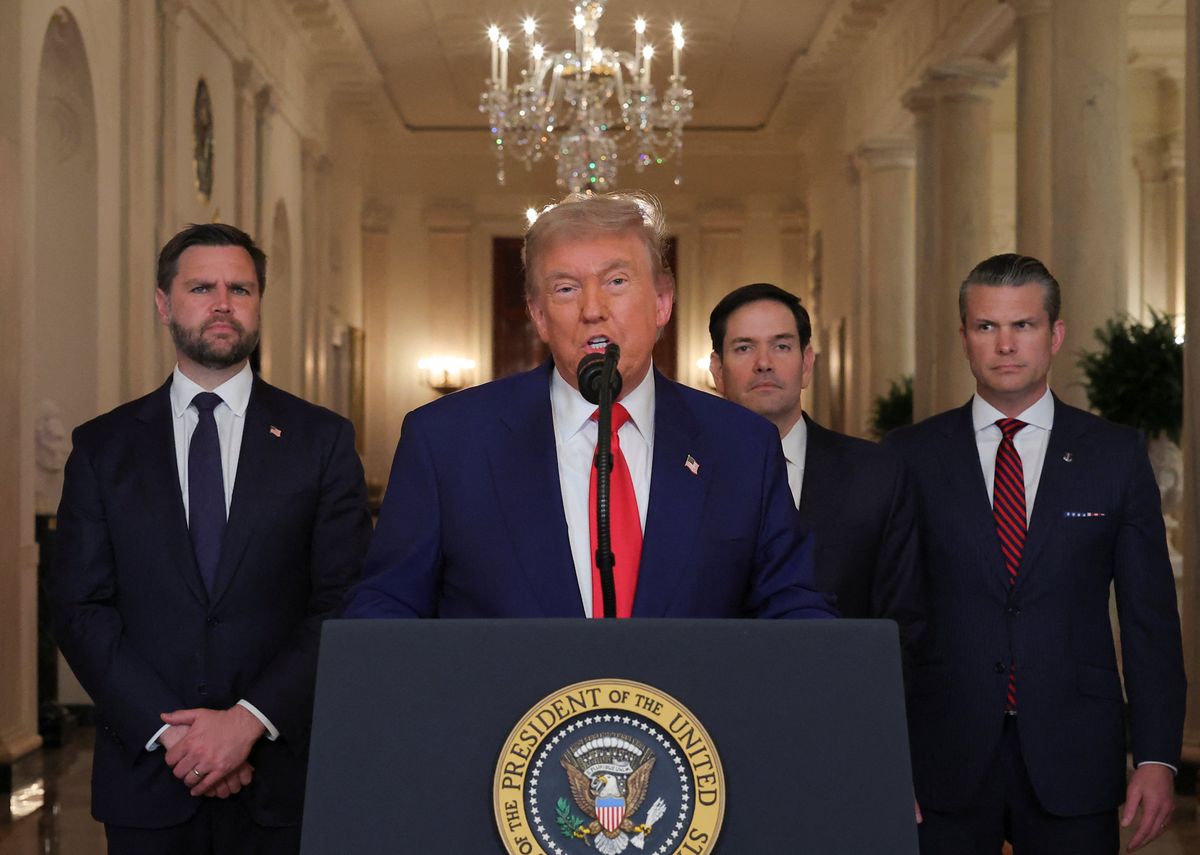
RAW STORY U.S. President Donald Trump delivers an address to the nation accompanied by U.S. Vice President JD Vance, U.S. Secretary of State Marco Rubio and U.S. Defense Secretary Pete Hegseth, at the White House in Washington, D.C., U.S. June 21, 2025, following U.S. strikes on Iran's nuclear facilities. REUTERS/Carlos Barria/Pool
The conservative Wall Street Journal is causing an internet uproar with its new report on Donald Trump allies who are cashing in on ending the Russia-Ukraine war.
The Journal's piece ahead of the weekend, Make Money Not War: Trump’s Real Plan for Peace in Ukraine, claims that, "The Kremlin pitched the White House on peace through business. To Europe’s dismay, the president and his envoy are on board."
"For the Kremlin, the Miami talks were the culmination of a strategy, hatched before Trump’s inauguration, to bypass the traditional U.S. national security apparatus and convince the administration to view Russia not as a military threat but as a land of bountiful opportunity, according to Western security officials," the Wall Street Journal reported. "By dangling multibillion-dollar rare-earth and energy deals, Moscow could reshape the economic map of Europe—while driving a wedge between America and its traditional allies."
The report made waves immediately.
Former speechwriter to President George W. Bush, David Frum, called it a "devastating report on the real Trump-Russia deal: betray Ukraine in exchange for privileged business benefits for Trump insiders."
Activist Garry Kasparov said, "As I said in my Halifax speech a few days before this damning WSJ report, this has always been personal business for Trump, not national interest."
"It’s how Putin turned Russia into a mafia state and it’s been Trump’s goal from day one of his new unleashed admin," he added Saturday.
Going further, he said, "And also as happened with Putin, politicians and pundits spend too much time looking for complicated motivations from ideology or psychology or blackmail. It’s money. It’s always money. They’re crooks. With immense power, but still crooks. Don’t overcomplicate things."
Bloomberg Opinion columnist Ronald Brownstein chimed in, "If the betting markets did Pulitzer odds, this remarkably reported [WSJ] piece would be a comet."
Trump exposed for 'funneling' donor money into his bank account: report
November 29, 2025 (REUTERS)
Newsbreak reports that millionaire President Donald Trump is diverting donor money straight into his pocket.
“Even as he leverages his presidency to make himself millions, perhaps even billions of dollars, Donald Trump is also funneling Republican donor money into his own cash registers through the political committees he controls,” said Newsbreak writer S.V. Date.
In the 10 months since he retook office, the Republican National Committee has spent at least $796,513 at Trump’s hotels and country clubs, while MAGA Inc., Trump’s super PAC, has spent $60,733, according to a Federal Election Commission data analysis.
The figures are based on most recent filings, with some committees providing updates only twice a year, so that number will likely grow. The total number for 2025 will not be disclosed until the end of January 2026.
But that combined $857,246 represents just under four-fifths of the $1.1 million that the Republican candidate and committees spent at Trump’s properties, reports Date.
“The RNC, for example, spent $193,145.70 on March 5 to hold an event at Mar-a-Lago, Trump’s country club and residence in Palm Beach, Florida. Two months later, on May 2, the committee spent $307,202.49 for an event at his golf resort in Doral, near Miami’s airport. Three weeks later, on May 30, MAGA Inc. spent $20,711.84 at Trump’s golf course in Sterling, Virginia,” Datre said.
In all, 73 different GOP candidates and committees “sent money Trump’s way,” said Date. “Directing committees that he controlled, and encouraging Republican candidates he did not, to spend at his properties — thereby putting all profits into his own pockets — was a strategy [Trump] also used in his first term in office.”
“When Trump rakes in tens of millions of dollars from crypto deals, it’s easy to miss when he grifts hundreds of thousands of dollars from his political apparatus, but those numbers add up. Ask an average American if they think pocketing $800,000 is a big deal or chump change,” said Jordan Libowitz, head of communications for the watchdog group Citizens for Responsibility and Ethics in Washington.”
Libowitz added that what makes it worse is that this money was originally donated “with the intention of helping elect candidates and push a political agenda,” jnot further enrich a millionaire president.
“More to the point, if there’s no limit to which he’s willing to use the presidency to profit himself, then there’s no limit to the ways America could be up for sale,” Libowitz said. Read the Newsbreak post at this link.
FILE PHOTO: Federal agents gather outside 26 Federal Plaza (Jacob K. Javits Federal Building), where migrants who were detained during a raid in Lower Manhattan by U.S. Immigration and Customs Enforcement (ICE) were brought in, in Manhattan, New York, U.S., October 21, 2025. REUTERS/Eduardo Munoz/File Photo
Although MS NOW host, Never Trump conservative and ex-GOP Congressman Joe Scarborough often says that the United States' immigration laws must be obeyed and enforced, he is vehemently critical of the way in which President Donald Trump's United States Immigration and Customs Enforcement (ICE) raids are being carried out. Scarborough considers the raids reckless and blatantly cruel.
"Companies that have collaborated with immigration enforcement agencies in various ways to aid Trump's mass deportation initiative — whether through allowing ICE to raid their parking lots, taking on contracts with DHS, or a variety of other actions — are starting to feel the rumblings of a consumer revolt," Carrasquillo reports. "Home Depot is possibly the most visible case after the company’s parking lots became a familiar setting for shocking viral clips and local news segments depicting federal agents' aggressive attempts to apprehend unsuspecting day laborers. The home-improvement chain now faces the prospect of a national boycott."
Carrasquillo adds, "But that's not the end of their troubles: Bold and unpredictable protests are beginning to disrupt retail operations across the country…. For months now, Home Depot has been singled out for its role as a staging ground in the Trump deportation regime."
Another possible target for boycotts, according to Carrasquillo, is AT&T.
Carrasquillo reports, "There's also speculation that AT&T data could have been used by DHS to target people during the shocking raid at the 7500 South Shore Drive residential building raid in Chicago."
Chris Newman, general counsel for the National Day Laborer Organizing Network (NDLON), doesn't see these boycotts letting up anytime soon.
Newman told The Bulwark, "People are becoming more emboldened to cross Trump as his power wanes. The shared goal of the corporate overlords and ICE is to make people feel powerless, and these actions are a way of resisting that sense of powerlessness."
Adrian Carrasquillo's full article for The Bulwark is available at this link.





 (US electricity generation by energy source,
.jpg)