Sunday, November 30, 2025

Educators Worry Palestine Censorship Could Reshape Public Education Entirely


New efforts to shut down honest discussion of Palestine could restrict everything from literature to science classes.
PublishedNovember 29, 2025

Students get to work on the first day of school in Hannah Jones' 5/6 combo class at Trabuco Mesa Elementary School in Rancho Santa Margarita, California, on August 13, 2025.Paul Bersebach / MediaNews Group / Orange County Register via Getty Images


Awave of bills introduced this year in state legislatures across the country sought to censor Palestine-related education in public schools. Several passed with the support of pro-Israel Democratic lawmakers, a trend that educators and First Amendment advocates told Truthout reflects the alignment of pro-Israel groups with MAGA forces. As these efforts continue, many said they fear public education could be reshaped far beyond social studies classrooms and the topics of Israel and Palestine.

“The censorship of Palestinians is the same as the ‘Don’t Say Gay,’ and the anti-critical race theory attacks on Black history,” Nora Lester-Murad, an organizer with the #DropTheADLfromSchools effort, told Truthout. The Anti-Defamation League (ADL) is one of a number of pro-Israel groups supporting regressive public education legislation across the country. “Yes, it’s Zionist, and yes, it’s promoting Israel, but it’s also part of this right-wing effort to take public education in a direction that’s away from critical thinking and that’s anti-liberatory.”

This year, legislators in at least eight states — including Arizona, Arkansas, Kansas, Kentucky, Missouri, Nebraska, Oklahoma, and Tennessee — introduced bills that would directly adopt the International Holocaust Remembrance Alliance (IHRA) definition of antisemitism in public schools. That definition equates criticism of Israel with antisemitism. Dozens of civil society and rights groups, as well as unions of educators, have warned against its adoption because of its power to chill or suppress speech critical of Israel or Zionism.

Michael Berg, an organizer with Jewish Voice for Peace (JVP) in Missouri, said lawmakers who sponsored House Bill (HB) 937 seemed more committed to preventing teachers and pupils from criticizing Israel than preventing discrimination against Jewish students. “They were attached to the IHRA definition, so it shows that it’s very specifically about speech about Israel,” he said. Organizers succeeded in stopping HB 937 in Missouri this year, but Berg told Truthout they are already preparing to fight a new iteration of the bill in the upcoming legislative session.

Other states have made similar efforts, including California, where Democrats hold a supermajority in the state assembly. There, this year’s Assembly Bill (AB) 715 was the latest in a series introduced under the guise of curbing antisemitism, but whose critics argue are censorship bills that undermine the implementation of earlier legislation mandating ethnic studies courses in public schools. AB 715 does not define antisemitism, but calls for using the Biden-era United States National Strategy to Counter Antisemitism as “a basis to inform schools on how to identify, respond to, prevent, and counter antisemitism.” That white paper claims that “the United States has embraced” IHRA’s definition as a “valuable tool” in countering antisemitism. Gov. Gavin Newsom signed AB 715 into law in October; the American-Arab Anti-Discrimination Committee (ADC) filed a suit challenging the law in federal court in November.

Related Story
CA Educators Are Resisting Anti-Palestine Bills Pushing “Academic Police State”
Activists say the bills will make public education more hostile for people already targeted by anti-Palestinian racism. By Marianne Dhenin , Truthout  August 20, 2024


Meanwhile, this August in Massachusetts, another Democratic stronghold, the state’s Special Commission on Combating Antisemitism approved recommendations meant to curb antisemitism in schools. The recommendations call on districts to teach IHRA’s definition of antisemitism in anti-bias trainings for teachers and school administrators. A statewide coalition of labor unions, civil rights groups, and progressive Jewish organizations warned that rather than countering antisemitism, the recommendations “pit some Jewish students against other marginalized populations” and will likely “undermine safe learning and working environments for students and teachers.”

These moves dovetail with a federal agenda to remake the nation’s public schools and historical programming at other public institutions, such as museums and national parks. Since his return to office, President Donald Trump has signed executive orders demanding an end to “radical indoctrination in K-12 schooling” and “restoring truth and sanity to American history.” The administration advocates teaching a whitewashed and aggrandizing version of the nation’s past that Trump, in one executive order, called “patriotic education.”

The fact that pro-Israel Democratic lawmakers and groups that have traditionally enjoyed reputations as liberal organizations, such as the ADL, have been driving forces behind the recent spate of public education censorship bills comes as no surprise to Lara Kiswani, executive director of AROC Action and an organizer with the California Coalition to Defend Public Education (CCDPE), which mobilized against AB 715. “It’s a right-wing agenda to support genocide [and] it’s a right-wing agenda to support segregation and apartheid, so it’s not a surprise that pro-Israel interest groups, who are inherently right-wing, are aligning themselves with the MAGA interest groups across the country,” she told Truthout.

Theresa Montaño, a former public school teacher who now teaches Chicano/a Studies at California State University, Los Angeles, told Truthout the harms of this regressive legislation are already being felt. “There have been a number of incidents where teachers and educators are reported for being antisemitic, and [the IHRA] definition is the reason why,” she said. “It has already impacted the lives, reputations, and livelihoods of so many.”

Montaño was herself a named defendant in a lawsuit filed in 2022 by the Deborah Project, a pro-Israel firm, on behalf of teachers and parents who accused her and other defendants of using antisemitic content in their classrooms. That case was dismissed in November 2024, with the judge criticizing the plaintiff’s lack of evidence and unpersuasive arguments. Montaño told Truthout: “Today, it’s Palestine. Tomorrow, is it the rainbow flag on my door, the fact that I talk about settler colonialism in the southwest, [or] my Black Lives Matter poster?”

When Arizona passed a bill in May 2025 that would have adopted IHRA’s definition of antisemitism for identifying antisemitic conduct in schools, Gov. Katie Hobbs vetoed it, recognizing in the wake of cases like Montaño’s that the bill was about “attacking our teachers.

The recent wave of bills limiting Palestine-related speech in public schools also harms students. “We believe that antisemitism is being used to censor education on Palestine, and we believe that our students have a right to understand both sides of an issue,” Seth Morrison, spokesperson for JVP’s Bay Area chapter and an organizer with CCDPE, told Truthout. “We’re not saying don’t talk about Israel or don’t talk about the Holocaust. What we’re saying is that there are many open issues here and that Arab and Muslim students especially are being intimidated and censored because of IHRA and related activities.”

In California, efforts to censor Palestine in the classroom are disrupting the rollout of ethnic studies courses, meaning students are being left with fewer opportunities to learn about the communities of color that comprise almost three-quarters of the state’s student population. Since its case against Montaño, the Deborah Project has also sued the Mountain View–Los Altos High School District and the Hayward Unified School District for release of records related to ethnic studies instruction; both districts settled and agreed to cover the firm’s legal fees. This February, a suit brought by the Louis D. Brandeis Center succeeded in stopping ethnic studies instruction in the Santa Ana Unified School District.

ADC’s case against AB 715 argues the new law violates the First Amendment right of students to receive information in the classroom. “Courts have held that the right to be exposed to different viewpoints [and] to have frank and open discussions and debates … is protected in public schools under the First Amendment,” Jenin Younes, ADC’s national legal director, explained to Truthout.

Plaintiffs’ stories in that case show how Palestine-related speech arises even in unexpected places, and how censoring it could limit learning experiences. Jonah Olson, a plaintiff and middle school science teacher in Adelanto, California, told Truthout, “I don’t initiate a whole lot of political discussion in my science class, but I do try to foster, as per the NGSS framework, connections to real-world experiences, connecting those things to science and engineering practices.” California adopted its Next Generation Science Standards, or NGSS, in 2015.

Recently, students in Olson’s classes have chosen to research and experiment with water desalination and food preservation after learning, Olson suspects from social media, that people in Gaza have not had adequate potable water or food while living under Israeli bombardment for the past two years. “They’re engaging in the world and seeing science and engineering questions and problems to be solved and then exercising that inquiry in the way they’re supposed to [according to NGSS],” he said. “They’re citing in their projects the real-world connection to the genocide in Gaza.”

Kiswani told Truthout stories like these reflect students’ hunger to learn and engage with real world injustices: “It’s a time now where we really have to ensure that our students are able to have a dignified experience in the classroom, but also that we don’t allow our public education system to completely be taken over by political interest groups, which would result in a very destructive and unfortunate outcome of erasure, invisibility, and lack of agency given to students who need [those things] more now than ever.”
Swiss voters reject mandatory national service for women and new inheritance tax

JAMEY KEATEN
November 30, 2025 
AP


A person walks past referendum posters of political parties and associations as Swiss voters are casting ballots to decide whether women, like men, must do national service in the military, civil protection teams or in other forms, in Geneva, Switzerland, on Nov. 26, 2025. (Martial Trezzini/Keystone via AP)(ASSOCIATED PRESS)

A person walks by referendum posters of political parties and associations as Swiss voters are casting ballots to decide whether women, like men, must do national service in the military, civil protection teams or in other forms, in Geneva, Switzerland, on Nov. 26, 2025. (Martial Trezzini/Keystone via AP)(ASSOCIATED PRESS)

GENEVA (AP) — Swiss voters on Sunday decisively rejected a call to require women to do national service in the military, civil protection teams or other forms, as men must do already.

In a referendum, over 84% of voters rejected the “citizen service initiative” and none of the country's 26 cantons, or states, came anywhere near voting in favor. Proposals need a majority of both voters and cantons to pass.

A separate proposal to impose a new national tax on individual donations or inheritances of more than 50 million francs ($62 million) was shot down by more than 78% of voters. The revenues were to be used to fight the impact of climate change and help Switzerland meet its ambitions to have net-zero greenhouse gas emissions by 2050.

Supporters of the national service plan hoped that it would boost social cohesion by adding jobs in areas like environmental prevention, food security and elderly care. But lawmakers opposed it, mainly for cost reasons and out of concern that it could hurt the economy by taking many young people out of the workforce.

The proposal came at a time when other European countries are finding ways to bolster their armed forces in the face of growing concerns about Russia's potential threat beyond the war in Ukraine.

Young men in neutral Switzerland are already required to carry out military service or join civil protection teams. Conscientious objectors can do other types of service, and those who opt out entirely must pay an exemption fee. Each year, about 35,000 men take part in mandatory service.

The failed initiative would have required all Swiss citizens to do national service — women can currently do so on a voluntary basis — and applied the concept of national security to areas beyond military service or civil protection.

Its supporters pointed to “landslides in the mountains, floods in the plains, cyberattacks, risks of energy shortages or war in Europe” and said that their plan would mean everyone taking responsibility for “a stronger Switzerland that’s able to stand up to crises.”

The government countered that the army and civil defense have enough staff, and no more people should be recruited than are needed.

While compulsory military service for women might be seen as “a step toward gender equality,” it added, the idea would “place an extra burden on many women, who already shoulder a large part of the unpaid work of raising and caring for children and relatives, as well as household tasks.”

The government also opposed the proposal for a new tax on large donations or inheritances, arguing that approval could prompt some of the wealthiest in Switzerland — an estimated 2,500 people — to move elsewhere. Sums beyond 50 million francs ($62 million) could have been hit with a 50% rate.

Switzerland holds national referendums four times a year, giving voters a direct say in policymaking.

___

Associated Press writer Geir Moulson in Berlin contributed to this report.

Swiss vote on compulsory civic duty, climate tax for super-rich


By AFP
November 29, 2025


Neither of the initiatives are expected to pass - Copyright AFP Fabrice COFFRINI
Nina LARSON

Switzerland votes Sunday on whether to replace the current men-only military conscription with a compulsory civic duty for men and women alike and on taxing the super-rich to fund the climate fight.

Neither initiative is expected to pass, according to recent polls, but they have generated significant discussion in the wealthy Alpine nation.

Under Switzerland’s direct democratic system, 100,000 signatures are needed to put virtually any issue to a popular vote, with the Swiss given a say on a wide range of topics every few months at the national, regional and local levels.

The Swiss government and parliament have urged voters to reject the two national items on Sunday’s ballot, arguing that they would entail huge costs and could threaten the economy.

Polling stations were to open for a few hours on Sunday morning before closing at noon (1100 GMT).

But most votes are typically cast in advance, with initial results expected by mid-afternoon.

– ‘True equality’ –

The so-called Civic Duty initiative initially garnered quite broad backing, but its support has crumbled in recent weeks, with the latest survey from market researcher gfs.bern finding that 64 percent of those polled were opposed.

The committee behind the initiative maintains that requiring every Swiss citizen, regardless of gender, to do national service in the army or in a civilian capacity would strengthen social cohesion.

The initiative aims for “true equality”, committee head Noemie Roten told AFP.

She described the current system as discriminatory — for men, but also for women, who are largely excluded from useful networks and experiences obtained during service.

“Be it in the army, civil protection, civil service or voluntary firefighters, the idea is for every young person to contribute to the collective wellbeing,” she said.

Opponents of the initiative denied it would enhance equality.

Cyrielle Huguenot, head of equality, family and migration issues at the Swiss Trade Union Federation (USS), argued that the initiative “completely obscures the reality of women in this country”.

Women already do the vast majority of unpaid tasks in Swiss society, she told AFP.

“And now you are asking women to provide even more unpaid service. This would only exacerbate the imbalance.”

– ‘Tax the rich’ –


The second item on the ballot Sunday, known as the “initiative for a future”, has also sparked controversy with its demand for a new climate tax on big inheritances.

It appears even less likely to pass, with a full 68 percent of those questioned for the latest gfs.bern poll against.

The text, put forward by the youth wing of Switzerland’s Socialist Party, calls for a 50-percent inheritance tax on fortunes above 50 million Swiss francs ($63 million) — estimated to affect some 2,500 households.

Under the slogan “tax the rich, save the climate”, the group calculates that the levy would rake in six billion Swiss francs annually, which could go towards funding an ecological transformation of Switzerland’s economy through things like renovating buildings, developing renewable energy and expanding public transportation.

A massive opposition campaign has warned that very wealthy people might leave the country to avoid the tax, weakening the economy.

People inheriting family businesses might also be hurt, critics caution.
‘End of an era’: MTV pulling plug on global music channels


By AFP
November 30, 2025


MTV in the 1980s fuelled the fame of up-and-coming singers, Madonna among them - Copyright GETTY IMAGES NORTH AMERICA/AFP Dia Dipasupil


Akshata KAPOOR

MTV kick-started a new era of music and pop culture in 1981, when it went on air for the first time, emblematically playing “Video Killed the Radio Star” as its debut music video.

More than four decades later, the channel, now owned by US media giant Paramount Skydance, will wind down its international music broadcasting by the end of the year as it struggles to compete with online streaming and social media.

MTV Music, MTV Hits and its 80s and 90s music shows will be shut down in the UK and other European countries in the coming months, sources at Paramount confirmed to AFP.

These music channels will stop broadcasting at the end of the year in France, Germany, Poland, Australia and Brazil as well, according to various media reports.

It has been declared the “end of an era” by dismayed fans and former MTV video jockeys — the beloved music presenters known as VJs who appeared on millions of screens at the the height of the network’s popularity.

However, the conditions that made MTV “revolutionary” simply “don’t exist anymore”, said Kirsty Fairclough, a professor of screen studies at Manchester Metropolitan University.

The rise of digital streaming platforms like YouTube and TikTok has “completely refigured how we engage with music and images”, the researcher on popular culture told AFP.

Viewers or listeners now expect “immediacy” and “interactivity” that sitting in front of the television to watch rolling music videos cannot provide, she added.

James Hyman, who directed and produced MTV Europe’s dance music shows in the 1990s, agrees the network thrived before the internet was ubiquitous.

“It was so exciting, because that’s mainly all people had,” Hyman told AFP.

– ‘Experimentation’ –

Hyman was at the heart of MTV’s Party Zone — which celebrated dance and club culture and played up-and-coming techno, house and trance music — alongside MTV VJ Simone Angel.

Both of them left the network when MTV Europe split up into regional subsidiaries and pivoted from music programming to reality shows in the early 2000s.

“I was heartbroken when it started to split up into different regions. To me that was like the beginning of the end,” Dutch presenter Angel told AFP.

According to British audience researcher Barb, MTV Music reached around 1.3 million UK households in July 2025.

In comparison, Barb figures reported in 2001 showed MTV UK and Ireland’s package of music channels had reached over 10 million homes.

For Angel, MTV’s slow decline in popularity can be traced back to its move away from original, edgy music content key to helping smaller artists break out.

“Initially MTV Europe wasn’t just about making the most amount of money… that sense of experimentation made the channel very exciting,” said the former VJ.

Paramount has taken several cost-cutting measures since its merger with Skydance earlier this year, announcing 1,000 job cuts last month and reviewing its other cable television offerings.

Some MTV music channels will stay on air in the United States, and the flagship MTV HD channel will be available in the UK, but with a focus on entertainment rather than music.

“The ‘M’ stood for music, and that’s gone,” lamented Hyman, who has carefully stored VHS tapes of the shows he produced for Party Zone.

The tapes whir in Hyman’s VHS player at his home in London, playing clips from the 90s: intimate interviews with The Prodigy and Aphex Twin, funky, experimental music videos, and wild hairstyles.

– ‘Seismic’ influence –

The impact of MTV and MTV Europe was “seismic” in its heyday, said Fairclough, bringing both famous and up-and-coming artists into the homes of music fans around the world.

“It definitely marks the end of an era in how music is experienced, both visually and culturally, because MTV really fundamentally reshaped popular music,” she said.

Moments like the premiere of Michael Jackson’s “Thriller” music video and Madonna’s “Like a Virgin” performance at the first MTV Video Music Awards (VMAs) in 1984 shaped the cultural conversation.

“MTV was so powerful it defined youth culture,” said Hyman, recalling its sweeping influence on fashion, film and music in Britain and Europe.

Ever since news broke that the music channels were facing the axe, Hyman and Angel have been urging Paramount to make archive tapes available to the public, insisting that people still want their MTV.

“To me it almost feels like MTV has been on life support for such a long time,” said Angel.

“But now that they’re actually threatening to pull the plug, we have all suddenly realised… this means too much to us.”
Electric vehicle prowess helps China’s flying car sector take off


By AFP
November 30, 2025


Employees work on the assembly line for the electric flying car at a factory of Xpeng's subsidiary Aridge - Copyright AFP/File Jade GAO

Luna LIN

A worker in white gloves inspects the propellers of a boxy two-seater aircraft fresh off the assembly line at a Chinese factory trialling the mass production of flying cars.

Globally, technical and regulatory challenges have prevented the much-hyped flying car sector from getting off the ground.

But Chinese companies are building on rapid development of drones and electric vehicles (EVs) in the world’s second-largest economy, while harnessing government support for the futuristic inventions.

“China has the potential to establish a competitive edge” for flying cars, said Zhang Yangjun, a professor at Tsinghua University’s School of Vehicle and Mobility.

“Future competition will increasingly hinge upon cost control and supply-chain efficiency, and these are areas where China holds clear advantages,” he told AFP.

At the brightly lit factory in the southern industrial heartland of Guangzhou, logistics robots zip around ferrying unfinished parts.

The lightweight six-propeller aircraft under construction take off vertically and fit into a large car, to create the “Land Aircraft Carrier” — a modular flying vehicle made by Aridge, an arm of Chinese EV maker XPeng.

The flying part is stored and charged in a wheeled on-land vehicle dubbed “the mothership”.

At full capacity, the Aridge factory can churn out one every 30 minutes. It began its trial production phase in early November and the company plans to start deliveries next year, saying it has had more than 7,000 pre-orders.

– James Bond –

But there is a long way to go before flying cars are whizzing through the air every day.

“Regulations, the consumer’s comfort with this product, and also how you manage airspaces, your supply chains, all need to catch up gradually,” Michael Du, vice president of Aridge, told reporters at a recent event.

Competition is heating up among global tech giants over the future of aerial mobility, with Tesla CEO Elon Musk teasing the debut of a flying car prototype within weeks.

“If you took all the James Bond cars and combined them, it’s crazier than that,” Musk told the Joe Rogan Experience podcast.

American aviation pioneer Glenn Curtiss debuted the first flying car prototype in 1917.

But successful designs have only become possible in recent years as electric motors and high-performance batteries have advanced.

Major players in the sector have conducted manned test flights, including California-based companies Joby and Archer, as well as Aridge, EHang and Volant in China.

This year EHang became the world’s first flying car company to be fully approved for commercial operation, something Aridge has yet to achieve.

EHang plans to introduce an air taxi service, priced similarly to a premium road taxi, within three years.

“Flying cars remain at an early developmental stage,” said Zhang, who edited a white paper on China’s flying car industry.

He still sees the sector as worthy of long-term endeavour, and authorities agree.

– Low-altitude economy –

Beijing has named the “low-altitude economy” — flying cars, drones and air taxis — as a strategic field for the next five years, seeking to accelerate their development.

Provincial governments from Guangdong to Sichuan have pledged to loosen restrictions.

A Boston Consulting Group report said China’s flying car market is approaching “a critical inflection point”, and predicted it will be worth $41 billion by 2040.

However, the sector has struggled to find viable business models elsewhere, with several high-profile insolvencies in Europe, and leading US players burning through cash with plans for mass production yet to materialise.

Direct comparisons between the sector in China and other international markets is tricky.

But “in terms of the EV supply chain, China is far in the lead”, said Brandon Wang, a Beijing-based investor whose portfolio includes AI, robotics and flying cars.

Flying cars can use EV parts once they are certified for aviation use, which may help Chinese companies scale up.

China also has an “engineer dividend” that allows its companies to quickly solve technical issues in the production process, Wang added.
C.R.T.

Black History Has the Power to Ignite Movements. That’s Why the Right Fears It.

The administration’s pre-emptive assault on history is a desperate attempt to stop new social movements from starting.
November 29, 2025


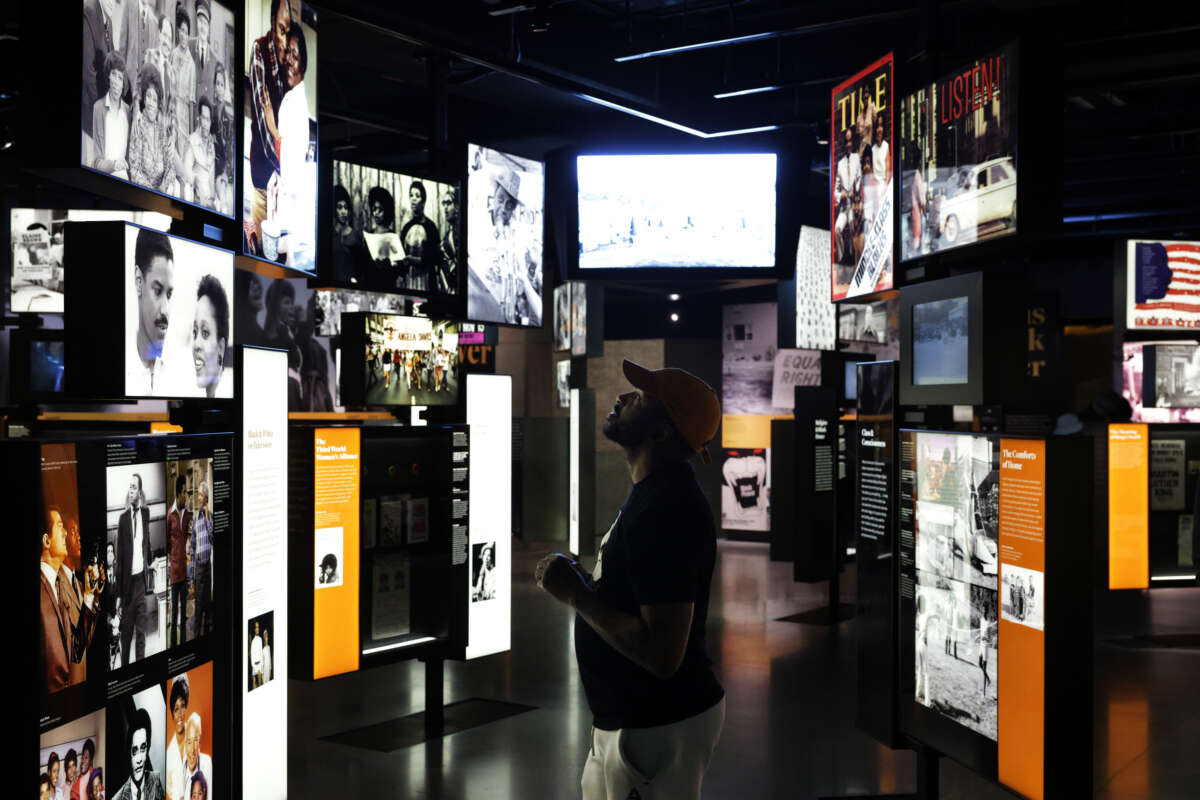
A visitor browses an exhibition at the Smithsonian National Museum of African American History and Culture on August 28, 2025, in Washington, D.C.Alex Wong / Getty Images

Ilooked at the slave shackles in the exhibit. My ancestors wore chains like this one. A bone-deep sorrow hit. When I researched my family history, names began to vanish as I traced it to Indigenous and African slavery. Here, right in front of me was material proof of the horror they survived. What is my responsibility to them?

The Slavery and Freedom exhibit at the National Museum of African American History and Culture in D.C. is a soul-shaking experience. Going from the bottom level to the higher exhibits, visitors take the journey from slavery to freedom. I went years ago, and decided to go again with family and friends. During the government shutdown, the closed museum doors were symbolic of a larger right-wing attack. Donald Trump and the MAGA movement have censored Black history, pulled Black books, removed Black Lives Matters icons, and led to a mass firing of Black federal employees.

The right wing suppresses Black history because it ignites social movements. Black history transforms rage into activism by putting racist events into a larger story of struggle against oppression. It shines a light on a hidden past. It exposes the hypocrisy of MAGA.

The right-wing attack on Black history is stupid, cruel, and futile. The logical end of censoring Black history is national suicide. Black history is a legacy with lessons that can heal the divides in the U.S. and repair our relationship to the world. Black history can free us from the right-wing image of the U.S. as a white Christian nationalist utopia, which never existed, and lead us to a clear-eyed radical realism. Black history bears a truth that makes it possible, finally, to create a future we can live in as liberated beings.


Trump’s War on Black America


Related Story

Interview |
Black History Testifies to the Impossible Creative Power of Black Resistance
Literary scholar Farah Jasmine Griffin discusses how Black yearning keeps surviving in the face of racist violence. By George Yancy , Truthout  February 23, 2025


Trump and MAGA are waging war on Black America. They have attacked it on three fronts; Black culture, Black economics, and voting rights. The attack on history is the most dangerous, because history gives birth to new protests.

Black history bears a truth that makes it possible, finally, to create a future we can live in as liberated beings.

In March, federal workers aimed jackhammers at the Black Lives Matter mural — blocks from the White House — and destroyed it. Less than a mile away, the African American Museum of D.C. was closed during the shutdown and has only recently reopened.

Trump came out the gate of his second presidency with a barrage of executive orders. One executive order titled “Ending Racial Indoctrination in K-12 Schooling” led to Black-authored books being yanked from school libraries run by the Department of Defense. Trump shut down diversity, equity, and inclusion (DEI) programs. He terrified business leaders with possible DEI investigations. Black history month celebrations were cancelled at federal agencies.

In a perverse kind of trickle-down racism, Trump’s attack on Black Lives Matter became a permission structure for increased on-the-ground bigotry. White influencers proudly wore blackface for Halloween. Politico exposed a Young Republicans’ chat where they gleefully traded racist comments. Black comedian W. Kamau Bell has painted a portrait of a right-wing shift in standup performances in which anti-trans jokes and anti-Black slurs have become commonplace. This is not a series of isolated events: FBI statistics on anti-Black hate crime, consistently the most common form of hate crime, spiked during Trump’s two terms.

Side by side with the cultural attack is an economic one. Remember Elon Musk proudly waving a chainsaw at CPAC? Well, it worked. Black women’s unemployment leapt from 5.9 percent in February to 7.5 percent in September. Trump’s cuts to the federal workforce and attacks on “DEI” forced 300,000 Black women out of their jobs. Put that number next to the 2003 statistic that 64 percent of Black families are led by a single parent, most of whom are single mothers, and the effects are devastating. Women are now trying to hold families together without work or health care.

When seen in that light, a closed history museum may seem to be at the bottom of the list of things to worry about. Yet a living relationship to history has the power to create a political consciousness for resistance. The ripping up of Black Lives Matter’s art, the censoring of Black books, the effort to whitewash Black history — all are part of a desperate attempt to stop a new social movement before it starts.

The Past Transforms Us

Emmett Till’s casket was right there, and no one could speak. I stood with visitors to the African American Museum in D.C., and the “Defending Freedom, Defining Freedom” exhibit that highlights the Civil Rights Era weighed on us. To be in the presence of history, to be inches away from the casket that Emmett Till lay in, was dizzying.

The ripping up of Black Lives Matter’s art, the censoring of Black books, the effort to whitewash Black history — all are part of a desperate attempt to stop a new social movement before it starts.

Trump actually visited the museum in 2017 and in a somber tone, said, “This museum is a beautiful tribute to so many American heroes, heroes like Sojourner Truth, Harriet Tubman, Frederick Douglass.” Eight years later, in August 2025, Trump posted on Truth Social, “The Smithsonian is OUT OF CONTROL, where everything discussed is how horrible our Country is, how bad Slavery was…” Well, that’s a 180-degree turn.

Why the change? Two events upset Trump’s first term: COVID-19 and Black Lives Matter. Protests against police brutality have been ocean tides in the Black Freedom Struggle, of which BLM is the most recent wave.

Black protests against police brutality go far back. We see it in Abolitionists fighting the 1850 Fugitive Slave Law, and we see resistance in the Red Summer of 1919. Racist brutality sparked the Harlem riots of 1935 and 1943. In 1991, the police beating of Rodney King led to the L.A. riots. In 1999 the police murder of Amadou Diallo and the 2006 killing of Sean Bell launched marches. Wave after wave reached higher and higher. In 2020, BLM became a tsunami of protest, the largest in U.S. history — and it was also strong enough to carry voters to the polls and throw Trump out of office.

The Black Freedom Movement has more power than any president or any system. Trump knows this. MAGA knows this. This is why they erase Black history. The past transforms us, it fires up dormant desires. It realigns us with our ancestors. Black artists and intellectuals always documented the dramatic effect of learning about Black history.

Assata Shakur wrote in her 1988 autobiography, Assata, “I didn’t know what a fool they made of me until I grew up and started reading real history.”

Malcolm X wrote in his 1965 classic, The Autobiography of Malcolm X, “History had been ‘whitened’ in the white man’s history books and the black man had been brainwashed for hundreds of years.”

From Frederick Douglass to Dead Prez, Ida B. Wells to Alicia Garza, knowing one’s history has always been the key ingredient to activating Black consciousness.

The Black thinker who systemized this transformation is Dr. William E. Cross in his 1971 essay, “The Negro-to-Black Conversion Experience.” Cross had a front-row seat to the 1968 climax of rebellion. He repeatedly saw apolitical brothers and sisters sparked by the revolution; they shed old lives, old fashions, and old ideas, and re-emerged in the street, wearing afros and bright pan-African colors. They went through stages like a butterfly molting in a cocoon, flying out, free as themselves.

Black history is the cocoon; it is the stories and imagery, the feeling of ancestors, it is the site of transformation. When millions upon millions undergo that change, like during the George Floyd protests, it becomes a historical force. A meteorologist, trying to show how interconnected all things are, once said that a flap of a butterfly’s wings can set off a tornado. It’s true. Why? The more that racists try to repress our history, the more we use it to explain what is happening, and how to fight back. The next social movement is already beginning, like a tornado.

As Pressure Builds, More Will Find Our History

When I finished my tour of the African American Museum, I was at the top floor. Sunlight came through the windows. The building is designed to recreate the journey from slavery to freedom. Standing at the top, I felt deeply moved.

Black history is the cocoon; it is the stories and imagery, the feeling of ancestors, it is the site of transformation.

The power of history, especially at a museum, is that right there under glass is evidence of our past. Flesh fades to dust. Bones crumble. Yet here are real things touched by real people. This is why the African American Museum in D.C. is the crown jewel of a large network of Pan-African historical sites. In New York, there’s the African Burial Ground. In Boston, there’s the Black Heritage Trail. In Tennessee, there’s the National Civil Rights Museum. In Ghana, there are slave castles and the heart-wrenching Door of No Return. The interconnected network of sites creates multiple transformation zones, where people enter and come out changed. When we leave, we take this history with us.

The tragedy of this moment is that Trump and MAGA have succumbed to a juvenile, cartoon version of history. If they turn back time, they believe, the joy of unlimited power will be at their fingertips. The harder they push for total control, the more pressure they place on masses of people. The government shutdown worsened hunger. People in the U.S. are facing even more unpayable health insurance. Rage at ICE builds in neighborhoods as masked agents separate families.

Under this pressure, many are forced to ask questions. When they do, they will find answers waiting for them. They will find our history.

Expect more tornados to come.


This article is licensed under Creative Commons (CC BY-NC-ND 4.0), and you are free to share and republish under the terms of the license.


Nicholas Powers
Nicholas Powers is the author of Thirst, a political vampire novel; The Ground Below Zero: 9/11 to Burning Man, New Orleans to Darfur, Haiti to Occupy Wall Street; and most recently, Black Psychedelic Revolution. He has been writing for Truthout since 2011. His article, “Killing the Future: The Theft of Black Life” in the Truthout anthology Who Do You Serve, Who Do You Protect? coalesces his years of reporting on police brutality.


Trump’s Peace With NATO Reinforces Its Purpose: US-Led Global Hegemony


Trump’s hardball tactics have extorted greater allied cooperation and reasserted US domination over the organization.
PublishedNovember 29, 2025

U.S. President Donald Trump, U.S. Defense Secretary Pete Hegseth, and U.S. Secretary of State Marco Rubio attend a press conference during the 76th NATO Summit in the World Forum in The Hague, Netherlands, on June 25, 2025.
Beata Zawrzel / NurPhoto via Getty Images

This October, Secretary of War Pete Hegseth dominated the NATO ministerial meeting in Brussels, while pressuring Europeans to assume an even heavier share of the defense burden. Referring to his peers as “ministers of war,” Hegseth demanded that member states purchase additional U.S. arms for Ukraine. “All countries need to translate goals into guns,” he hammered home. “That’s all that matters: hard power.”

Following Hegseth’s lead, NATO Secretary General Mark Rutte is now directing a campaign to secure arms purchase commitments. Rutte emphasizes that he is “proud” of the alliance’s ongoing assistance to Ukraine, noting that Russia has “lost 1 million people — dead or seriously wounded.”

Hegseth’s strongarm tactics and fundraising drive showcase the power dynamics that underlie NATO policymaking. In recent years, the organization has portrayed itself as an alliance of democracies confronting unprovoked aggression in Ukraine and China’s meteoric rise. Yet fundamentally, NATO is a U.S.-dominated forum, rather than a symposium of equals — a reality that Rutte’s relentlessly patient handling of the Trump administration makes clear.

Since 1949, members have exploited the alliance to solidify American global leadership, coordinate interventionism, and contain rivals that challenge Western influence. Rather than promote peace, NATO continues to pose one of the greatest threats to international stability by fueling armed conflicts in Ukraine and across the world.
NATO’s Fascists

NATO often portrays itself as a principled alliance of democracies confronting authoritarian rivals. But historically, the organization has collaborated with far-right intellectuals and statesmen, in order to maintain its military-industrial edge and geopolitical power. Following World War II, U.S. officials protected Wernher von Braun and around 1,500 other Nazi scientists from prosecution, while integrating them into the alliance’s scientific establishment. Eventually, the German General Adolf Heusinger, whose men butchered Jews and tossed children into wells, became a senior NATO commander.

Related Story

Europe Puts Social Programs on Chopping Block to Appease Trump on NATO Funding
Fawning for Trump’s favor, European leaders are ramping up military spending at the expense of public benefits. By Sasha Abramsky , Truthout July 3, 2025

For decades, Spain’s fascist strongman, Francisco Franco, was also an essential alliance partner. Between 1951 and 1953, the United States negotiated the Pact of Madrid, securing access to Spanish military bases and turning the country into a staging ground for NATO operations.

During negotiations, Washington appeared outwardly critical of Franco, while assuring his blood-soaked regime that it prioritized cooperation — a balancing act that insiders labeled a “comedy.” Privately, the U.S. embassy dismissed moral reservations, suggesting that officials approach relations “from a practical, even selfish, point of view,” since collaboration “could pay dividends in our own interest.” After concluding the pact, U.S. authorities praised Spain, a country studded with mass graves, for its “defense of the free world.” And Spanish bases became NATO launchpads in the escalating Cold War.

That came at a cost. In 1966, one of the U.S. Strategic Air Command’s B-52 bombers crashed above Palomares, releasing four hydrogen bombs over the seaside town. Residents remember a scalding wind and enormous fireball bursting over the horizon. “We thought that it was the end of the world,” one explained. The U.S. government promised to clean up the radioactive waste, but instead left the region riddled with plutonium particles. For the Spanish left, Palomares was the victim of NATO, an organization increasingly inseparable from the Franco dictatorship.

Ultimately, the alliance’s most visible fascist partner was the Portuguese Estado Novo regime. Between 1961 and 1974, NATO’s institutional heft and arms allowed Portugal to wage a merciless war against anti-colonial forces in Africa. The legendary African revolutionary, Amílcar Cabral, was scathing: “Portugal would never be able to launch three colonial wars in Africa without the help of NATO, the weapons of NATO, the planes of NATO, [and] the bombs of NATO.” In turn, Portugal’s military base in the Azores islands was an essential instrument of U.S. power projection, allowing American forces to airship arms to Israel and manipulate the geopolitical balance in the Middle East.

But in April 1974, disaffected officers toppled the Estado Novo regime, in order to initiate a democratic transition and halt the colonial wars. From Washington, Secretary of State Henry Kissinger feared that the unfolding Carnation Revolution would elect a communist government. The Pentagon reviewed “a contingency plan to take over the Azores,” as officials plotted “covert action” and prepared “our assets … for a coup.” NATO members slipped aid to the Socialist Party to offset communist influence, issued a communiqué isolating the Portuguese left, and conducted military exercises off the coastline.

By 1976, these maneuvers helped Prime Minister Mário Soares push the revolution rightward, while steamrolling over popular demands. Throughout the process, U.S. Ambassador Frank Carlucci frequently met with Soares and other politicos, holding court in the “Crow’s Nest” — a glass-enclosed observation deck overlooking Lisbon.

If anything, NATO’s Cold War history is not a record of democratic accomplishment but moral compromise. Repeatedly, alliance leaders protected Nazis, backed dictators, and subverted revolutions to preserve hard interests. Fascist regimes cooperated precisely because NATO allowed them to escape international isolation, while maintaining their colonial reach and authoritarian control.
Razing Yugoslavia

Founded to contain the Soviet Union, NATO’s purpose disappeared with the end of the Cold War in 1991. Yet President George H.W. Bush refused to dismantle the nuclear-armed alliance. Russian leaders hoped to shape its future, while demilitarizing Europe. But Bush was blunt: “to hell with that.”

Instead, he and President Bill Clinton strived to maintain the institutional architecture of the Cold War — now to preserve U.S. hegemony in a “unipolar” world. In 1992, the Pentagon’s vision statement explained that its “first objective” was to “prevent the re-emergence of a new rival,” as well as “European-only security arrangements which would undermine NATO.” The alliance remained an indispensable instrument of imperialism. It allowed the United States to steer Europe’s defense policy, preserve U.S. supremacy, and prevent the EU from becoming a rival voice in the international system.

To rebrand itself, NATO intervened in Yugoslavia throughout the 1990s, while claiming to defend oppressed ethnic minorities. Yet the historian David Gibbs concludes that its involvement “helped create the [Balkan] conflict in the first place.” For years, the United States and other alliance members backed ethnic separatists and allowed foreign states to funnel arms to local allies.

For the first time in history, NATO engaged in direct combat in 1994 by downing four fighter jets over Bosnia-Herzegovina. The peace mediator David Owen believed that Washington’s policies “prolong[ed] the war of the Bosnian Serbs,” while his partner, Cyrus Vance, named it “Genscher’s war” because of the German foreign minister’s ruinous involvement.

In 1999, NATO intervention climaxed as the Yugoslav government clashed with Albanian separatists in Kosovo. Secretary of State Madeleine Albright spearheaded the NATO drive for intervention, prompting policymakers to call it “Madeleine’s war.” During peace talks, the Yugoslav delegation agreed to accept Kosovo’s autonomy. But Albright also insisted that NATO — rather than neutral peacekeepers — occupy the contested territory. Rejecting compromise, she confided that the “whole point is for the [Yugoslav] Serbs to accept a NATO force.” After all, humanitarian interventionism offered a new justification for the alliance’s post-Cold War existence.

Albright’s demand scuttled the negotiations. “We intentionally set the bar too high for the Serbs to comply,” a senior U.S. official admitted afterward. “They need some bombing.”

Brandishing NATO’s firepower, members conducted over 38,000 combat sorties, pummeling Yugoslavia with depleted uranium shells, cluster bombs, and other munitions. Spokesperson Jamie Shea claimed that “more discipline and care [was] taken” to protect civilians than in any other conflict “in the history of modern warfare.” By contrast, Amnesty International concluded that NATO committed “serious violations of the laws of war.” Carefully curated media coverage suggested that planes solely used precision-guided munitions and struck military targets with unfailing accuracy. Yet most explosives were conventional bombs, pilots flew too high to be precise, and air strikes killed around 500 noncombatants.

At one point, NATO bombed a passenger train, then released sped up footage of the incident to make it look like an accident. The alliance even targeted Yugoslavia’s state television station. Britain’s prime minister, Tony Blair, implicitly acknowledged that NATO bombed the TV studio to prevent footage of its war crimes from generating “sympathy for the victims.”

Alliance members asserted that intervention was necessary to halt ethnic violence between Albanians and Serbians. Yet the air strikes accelerated the bloodshed, an outcome that NATO Supreme Allied Commander Wesley Clark called “entirely predictable.” Years later, Albright’s investment firm attempted to buy up Kosovo’s public telecom company — certifying the victory of Western capitalism and NATO expansion, while puncturing the myth of humanitarian intervention.

In short, American officials reinvented the alliance through war after the Soviet Union dissolved. From their perspective, the post-Cold War peace posed an existential challenge: undermining support for NATO and, thus, the institutional architecture of U.S. global leadership. For Washington, the Balkan crisis was not a tragedy but an opportunity. By lunging into the region, officials rebranded NATO as a selfless vehicle for humanitarian interventionism, even as they accelerated the destruction of Yugoslavia.
Article-Five Aggression

The 9/11 attacks in 2001 prompted NATO to activate its Article 5 defense clause for the first time in history. Member states vigorously backed the U.S. invasion of Afghanistan, while contributing troops to the occupation. But the military campaign was hardly an act of self-defense: Later, the 9/11 Commission, which closely studied the attacks on the World Trade Center and Pentagon, concluded that the country’s Taliban leadership had opposed strikes against the United States, and, afterward, its initial response to U.S. demands for cooperation was “not negative.”

Once again, NATO involvement lent American military operations a multilateral facade, while the “Global War on Terror” offered the organization a new sense of purpose in a world without communism. U.S. officers spearheaded the International Security Assistance Force, integrating European partners into their war machine and dictating strategy.

Western leaders claimed that they were building a vibrant democracy in Afghanistan to safeguard human rights. In reality, NATO operations often culminated in massacres and fostered a spike in the sexual abuse of young boys — a discredited custom known as bacha bazi. The Taliban outlawed the practice when they came to power in 1996. Yet the NATO occupation, in effect, restored bacha bazi by empowering the Northern Alliance, a U.S.-backed coalition of Afghan militias. A U.S. Army War College study concluded that practically “all of the 370 local and national checkpoints in the Uruzgan Province had boy slaves.”

NATO commanders knowingly protected local child sex abusers and prohibited subordinates from stopping rape crimes, explaining that “boys are for fun and women are for babies” in Afghanistan. A British soldier recalled watching Afghan soldiers gang rape a screaming child. His officer stood by and refused to let him intervene, telling him to “forget about it.” Other soldiers described the sickening realization that some Afghan colleagues kept sex slaves on shared military bases, after entering rooms to find children lying between adult men or chained to beds.

But such crimes failed to move senior officials. Instead, the Pentagon persecuted whistleblowers and suppressed studies denouncing the pervasive abuse of Afghan children.

Beyond protecting brutal partners, NATO itself perpetrated numerous war crimes. British veterans claimed that killing civilians became “addictive,” and “lots of psychotic murderers” served in Afghanistan. One recalled that his comrades handcuffed and shot “a child, not even close to fighting age.” Indeed, soldiers reported that killing civilians and detainees “became routine.” During operations, NATO combatants would target residential buildings, “go in and shoot everyone sleeping there.” After securing the area, they again swept the premises to finish off survivors. “It was expected,” one veteran explained. “Everyone knew.”

U.S. General Douglas Lute stated that Afghanistan’s president was “so consistent with his complaints” that no senior diplomat could deny NATO war crimes were “a major irritant for him.” Yet top alliance leaders buried the information to protect their forces from accountability.

In August 2021, Western forces finally left Afghanistan after a two-decade standoff with the Taliban. Then, in a vengeful twist, President Joe Biden imposed punishing economic sanctions, threatening millions of Afghan civilians with starvation. NATO Assistant Secretary General for Operations John Manza later admitted that U.S. officials had cared more about “protecting the sitting president’s chances of reelection than … telling the truth about the lack of progress.” Yet official statements remained upbeat. During a postwar review, NATO praised the occupation as proof that members could undertake complex operations. “Crisis management should therefore remain a core Alliance task,” authorities concluded. By then, the occupation had claimed 241,000 lives.
The Devil’s Garden

Months after NATO exited Afghanistan, Russia launched a full-scale invasion of Ukraine in February 2022. For years, experts had asserted that alliance policies in Eastern Europe were escalating tensions. In 1997, Brussels and Kyiv drafted the “Charter on a Distinctive Partnership,” stirring Russian anxieties by pursuing “NATO-Ukraine military cooperation and interoperability.” As Atlanticists redivided Europe, the political scientist Peter Gowan predicted the “onset of intense American-Russian rivalry in Ukraine,” even anticipating that the country could become the epicenter of a global war.

At the Bucharest Summit in 2008, NATO announced support for future Ukrainian membership. In response, the U.S. ambassador to Russia, William Burns, warned that alliance expansion threatened to trigger a regional catastrophe. “Ukrainian entry into NATO is the brightest of all redlines for the Russian elite,” he cautioned. “Today’s Russia will respond.” Nonetheless, U.S. officials continued to steer Ukraine into NATO’s sphere of influence, helping provoke Russia’s illegal 2022 invasion.

As Russian jets scraped the skies, the very officials who previously occupied Afghanistan united to denounce President Vladimir Putin’s aggression. Since then, NATO has affirmed that Ukraine is on an “irreversible path” to admission, while again branding itself as a democratic bastion against autocracy. Invoking racist and orientalist stereotypes, leading Atlanticists such as Josep Borrell claim that Europe is a “garden,” and the outside world is a “jungle” threatening to “invade” it.

Yet in practice, NATO remains an instrument for imposing imperial discipline, rather than safeguarding democracy. Since his first term, President Donald Trump has griped about the U.S. share of the financial burden and threatened to leave members defenseless. But rather than undermine NATO, his hardball tactics have extorted greater allied cooperation and reasserted U.S. dominance within the organization.

In particular, Trump has exploited the war to seize control of Ukrainian minerals, while coercing European states into buying U.S. arms and boosting defense spending. Openly groveling, NATO Secretary General Mark Rutte assured him that Europe will “pay in a BIG way,” and “it will be your win.”

But those defense programs are destabilizing the globe, including the Middle East, where Israel is a major partner. One week before the Gaza genocide began, NATO Admiral Rob Bauer visited Israeli bases to continue “tackling common threats and security challenges together.” Tellingly, Bauer toured the military’s Gaza Division, while reviewing the “underground counterterrorism” initiatives that have turned the strip into a suffocating prison camp.

Since October 2023, NATO members have accelerated weapons shipments to Israel, sponsoring its rampage in Palestine. U.S. agencies alone have shipped over $21.7 billion in military aid. The Delàs Center concludes that military commerce between Madrid and Tel Aviv is “more lively, abundant and lucrative” than ever, as Israeli and EU leaders kickstart joint drone development programs. One UN report calls such partnerships “the fuel and profits of genocide.”

The destruction of Gaza would be impossible without the involvement of NATO states. European leaders criticize Trump’s slanted peace plan for Ukraine and reckless pressure tactics against Kyiv. Yet they have lavishly praised his Gaza “ceasefire,” which Israeli forces have violated nearly 500 times: killing hundreds of Palestinians. And while condemning Russian aggression, alliance members are systematically persecuting peace activists and allowing Israel to arrest, torture, and murder their own citizens with impunity.

Ultimately, the organization’s global footprint reflects a terrible irony. During the Cold War, NATO never initiated formal combat operations. But since the Berlin Wall fell, its interventions have been unceasing, while continuing a tradition of embracing brutal partners. Rather than an anchor of stability, NATO has repeatedly contributed to the conditions for the very wars that make its existence necessary. As the Russo-Ukrainian conflict unfolds, the arms race accelerates, and Israel continues to violate the ceasefire and starve Gaza, demilitarization remains both an urgent demand — and existential threat — for the U.S.-led imperial alliance.


This article is licensed under Creative Commons (CC BY-NC-ND 4.0), and you are free to share and republish under the terms of the license.

Jonathan Ng is a postdoctoral fellow at the John Sloan Dickey Center for International Understanding at Dartmouth College.